
We can decide to be better. When I say we have to be better, that includes me.
- Valentina, The Power Fantasy Vol 1, issue #13, 2025, written by Kieron Gillen
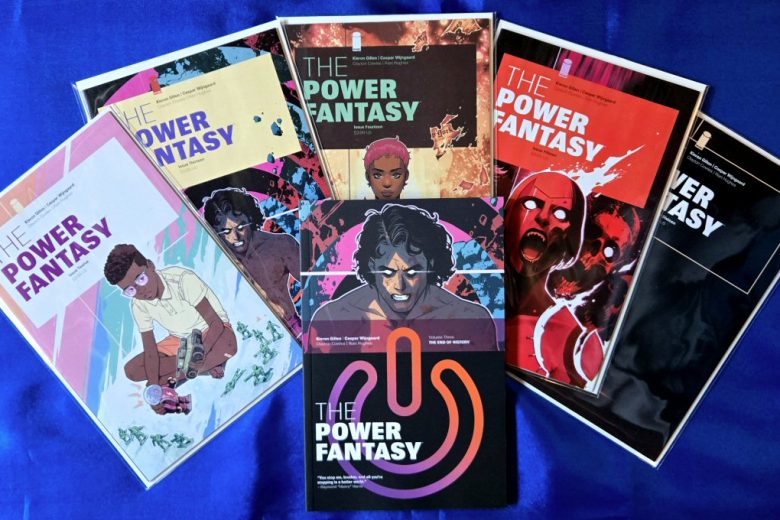
One of the underlying premises of this site is that comics are a medium, not a genre. And in any artistic medium, there are higher concept pieces of art. The Power Fantasy (TPF) by Kieron Gillen and Caspar Wijngaard (Image Comics) is one of those – while still dealing with a lot of very relatable human inter-personal drama. Through its narrative and imagery, it elevates the form of the superhero genre into a compelling examination of ethics – specifically, the nature of power, and the responsibility we have to one another.
Please see my TPF – Introduction for an overview of the series and its main characters, including a discussion of the first story arc (issues #1-5, “The Superpowers”) and key elements of the second arc (issues #6-11 “Mutually Reassuring Destruction”). This series has turned the concept of a “superpower” on its head, and reframed classic superhero ethics in a novel way.
In this second installment, I will cover the end of the second arc and the full third arc (issues #12-16, “The End of History”), and what these further reveal about Gillen’s novel interpretation of the ethics of power. TPF has been building over its 16-issue run to a major world-altering (world-ending?) climax. The series pulls no punches, and the conclusion to this third arc does not disappoint.
A good fiction writer or artist always leaves a trail of breadcrumbs for the reader to find. When the big reveal comes, intrepid readers can trace back the clues and see how the creator played fair with their audience. And of course, analytical readers who spotted the clues as they came along get to pat themselves on the back for their cleverness in anticipating the outcome. But a great writer will ultimately reveal how you actually learned the wrong lessons from those clues – and that the true meaning is far more significant than you realized (read any Kazuo Ishiguru novel to see what I mean). Gillen is that sort of comics writer.
To help you understand this series, the creators (Gillen and Wijngaard, plus Clayton Cowles letterer, Rian Hughes designer) have created an extensive primer on the bindings.app introducing the story and the six main characters, with links for more information (including the entire first issue online for free). I also suggest you check out my TPF – Introduction for a detailed assessment of the ethics of the six main characters (Etienne, Valentina, Magus, Heavy, Masumi, and Eliza), and the major story elements up to issue #8.
My selection of Valentina’s virtue ethics quote at the top of this page reflects her critical role in the events of this series. As I will explain below, I have always believed that Valentina would be key to how this series unfolded. I just hadn’t anticipated what Gillen had in mind. Of course, any opinions expressed below are my own, and I have no more information about what this series is all about than anyone else. But I thought I would do something a bit out of character and speculate a little on where I think this might be going. And please be aware that there will be full spoilers up to the end of the third arc (issue #16) below – you have been warned!
As always, if you would like to know more about the terms I’m using on this site, please follow the links throughout or check out my Ethics 101 page or Glossary of Terms post.
The story so far
The present time of the TPF series is set in 1999-2000, in an alternate reality where the the creation of the first atomic weapon in 1945 also led to the development of people with equivalent “superpowers” – that is, individuals with the same destructive capability as nuclear weapon states. The series jumps back and forth across those decades, as we learn of the pivotal moments that have brought this world to its current fraught state – literally on the brink of destruction.
Not surprisingly, the presence of the superpowers has caused events to diverge from our reality, as they have directly intervened in historical world events. There have also been novel conflicts between the superpowered individuals themselves, resulting in the deaths of a number of them (e.g., the “Devil”, the Major, the clairvoyant from Mumbai, etc.) and in the shifting pattern of alliances among the six surviving superpowers. But there have also been a number external shocks that our world has never seen (e.g., the arrival of the extra-terrestrial Signal in 1978, and the extra-dimensional Queen in 1989).
The first arc began with a confrontation between the gravity-controlling radical Ray “Heavy” Harris and the psychic telepath (“omnipath”) Etienne Lux. To resolve the issue, Etienne agreed to openly murder the President of the United States and much of his senior staff – resulting in Etienne subsequently living on the run from the Americans, protected by the angelic Valentina. These events – and Etienne’s growing power – convinced the technomancer anarchist Jacky Magus that the fragile balance-of-power between the superpowers in untenable, and Etienne must be eliminated or neutralized.
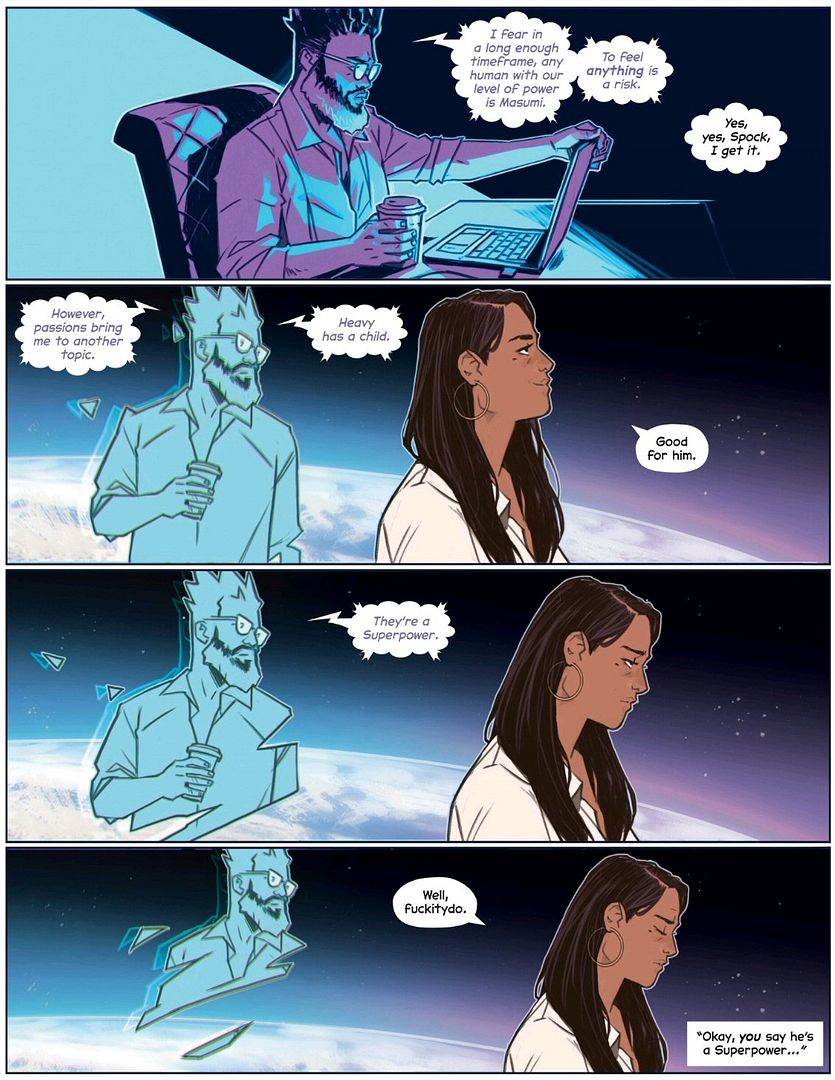
We soon come to learn that Heavy has his own plans to alter the balance of power and has been hiding a superpower son who shares his politics. From issue #9, where it also revealed by Etienne that he has been emotionally limiting himself for years in order to make “clean” utilitarian decisions – and live with the terrifying emotional consequences of his actions:
It is also revealed that Etienne has been manipulating people and events to keep the Deconstructa-linked Masumi and the damned Eliza pacified (with Valentina’s tacit approval). Learning the truth about their respective situations would likely lead them to destroying the world. Suffice it to say, it’s a pickle!
Major plot elements since my Introduction
The major final plot of the second story arc revolves around the reveal that Jacky Magus has been dead for a decade. His senior acolyte Dev – the former husband of Eliza – has been masquerading as Magus ever since the Second Summer of Love event in 1989 (the same event that saw Eliza trade her soul to hell). From issue #10:
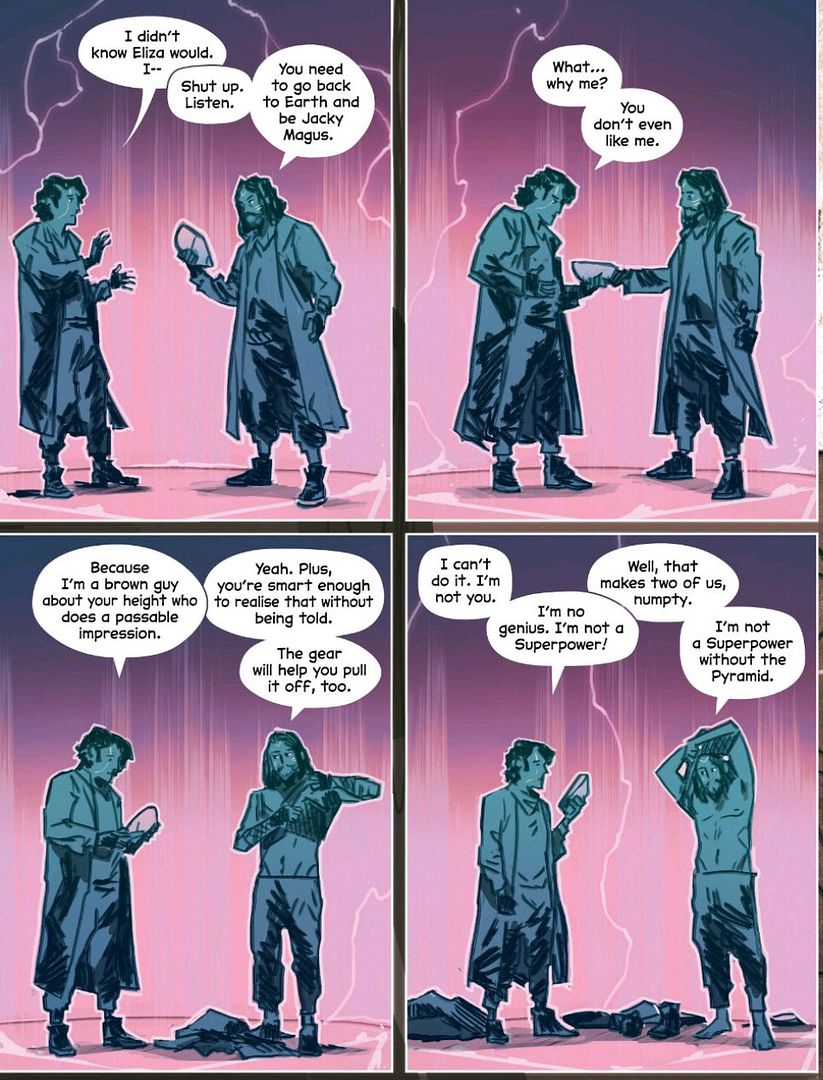
This is quite the reveal. But what does Jacky mean about not being a superpower?
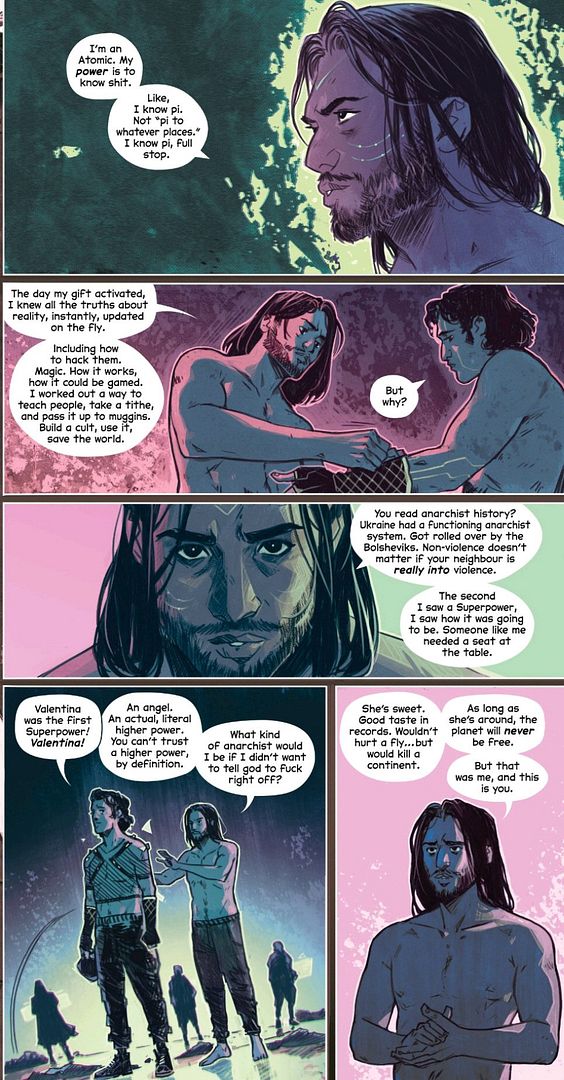
Jacky’s perspective on Valentina is interesting (and one that I can relate to, see my discussion below). But more generally, these scenes help to rehabilitate his character. Despite his political views, he consistently does what he thinks is the right thing to do, no matter how hard personally – including sacrificing himself in this moment.
And as for Dev?
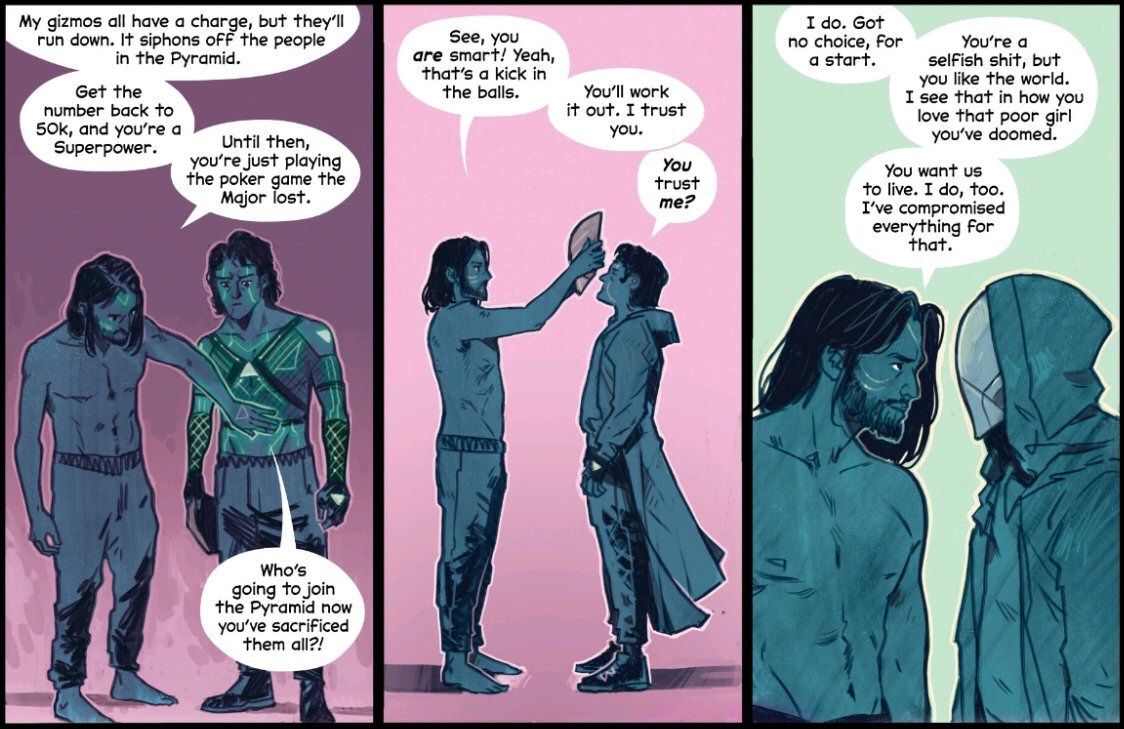
So, Dev has acquired all of Magus’ technology, but lacks Magus’ superpower ability to know the magic leaking from heaven. As such, Dev is unable to create anything new – and could be easily taken off the board if anyone knew the truth. But he could function as a superpower if the Pyramid’s power base were restored, which he has been actively working on, including most recently through an alliance with the Americans.
Dev doesn’t come across so well here (since it’s clear that his actions have doomed Eliza to suffering for all eternity). And his actions since Jacky’s death could be seen as self-serving as well. But as rei-ismyname (aka Doctor Eldritch) recently reminded me, consider the horror of what the next decade had to be like for him – always pretending to be someone else, never being your authentic self with anyone, never letting your guard down. Well, except for that little slip of the tongue I described in the epilogue to my introduction.
Once Dev reveals himself to Eliza, they have a larger problem – Etienne can read Eliza’s mind. From issue #10:
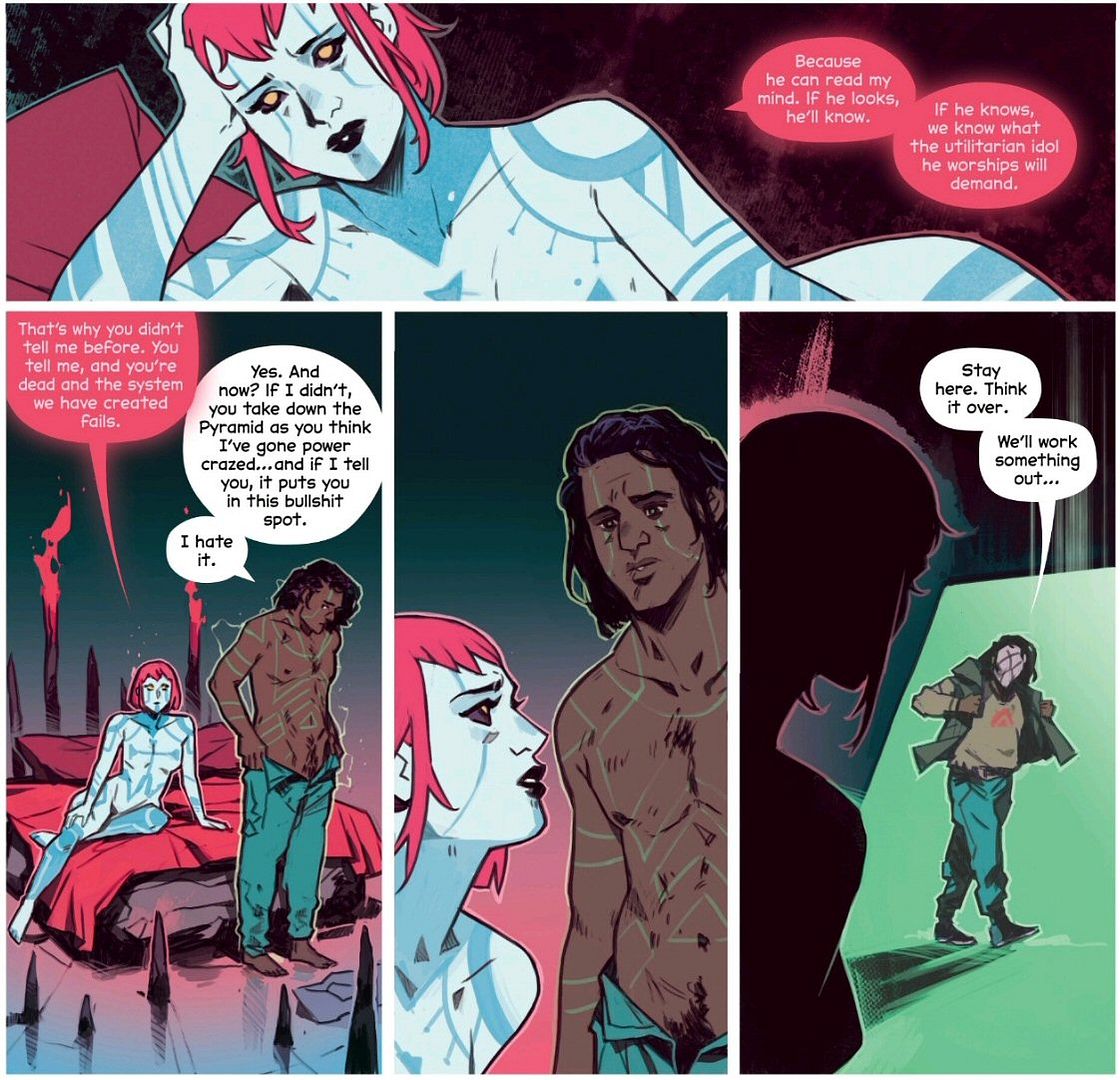
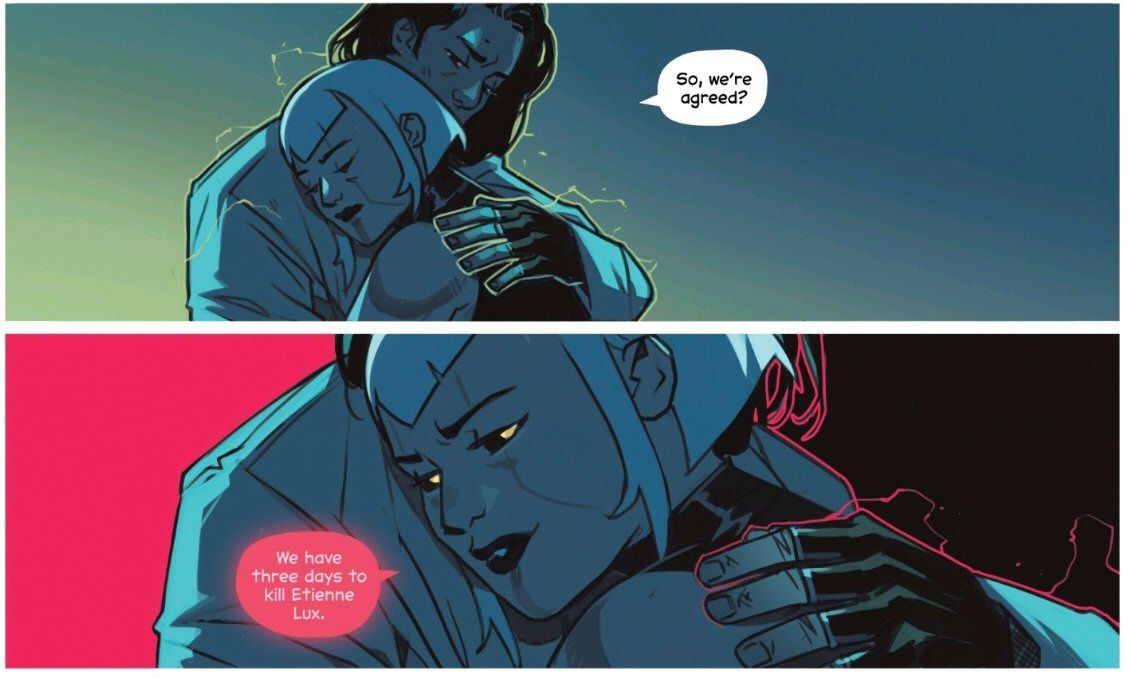
So together, they come up with the only plan they can:
We don’t have long to wait – they execute their plan to murder Etienne in the next issue, with an ingenious solution to bypass his failsafe safeguard (i.e., the threatened psychic shockwave that would kill a continent). From issue #11:
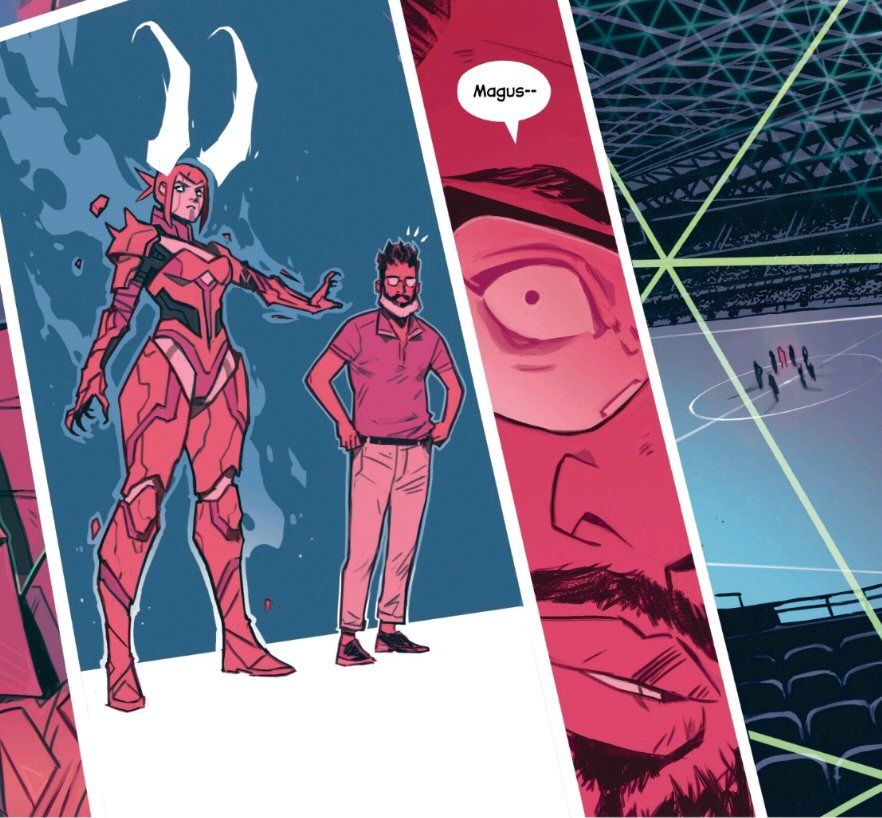
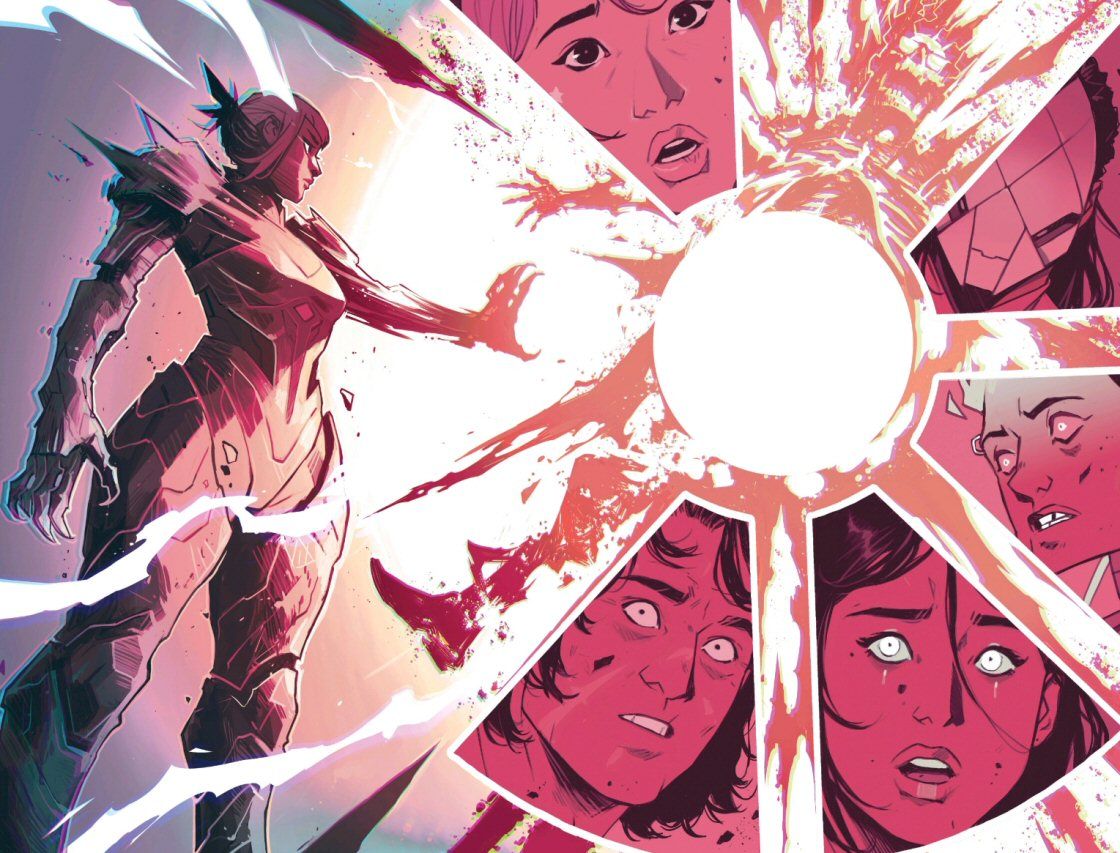
But the issue doesn’t end on this (appropriately gruesome) cliffhanger. Rather, it gives us something more interesting to ponder as it cuts to a scene in a coffee shop in New York:
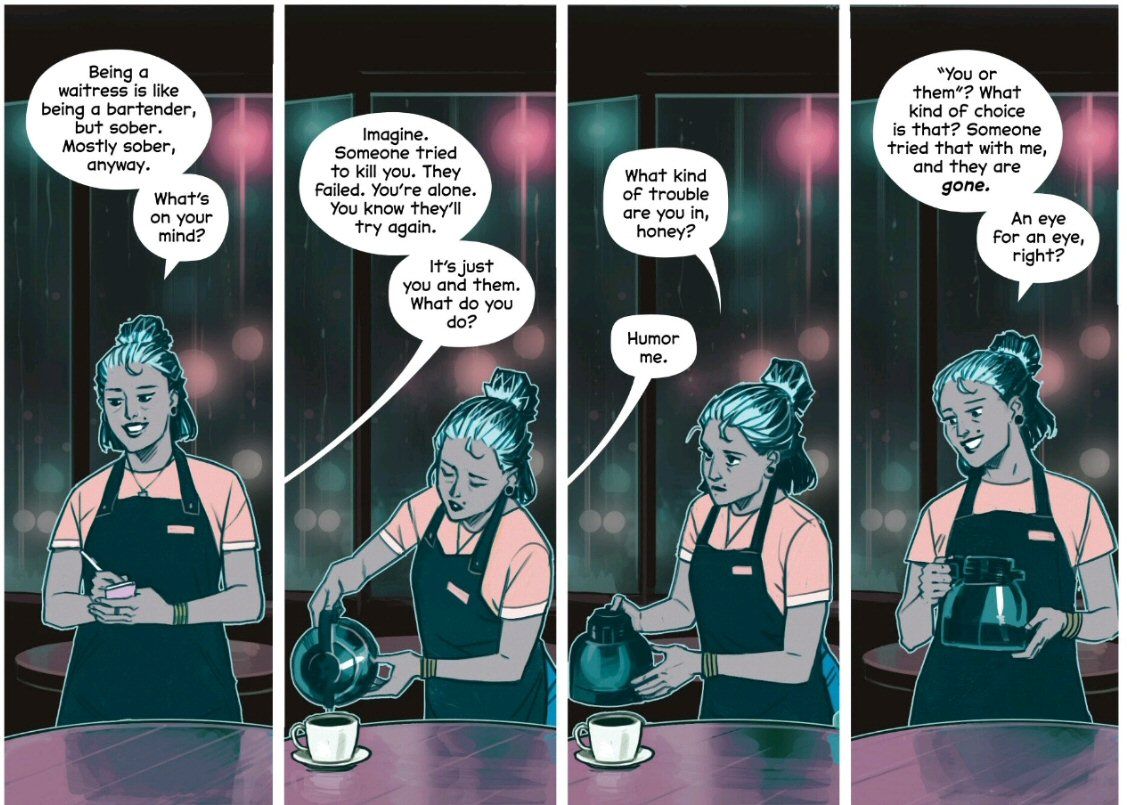
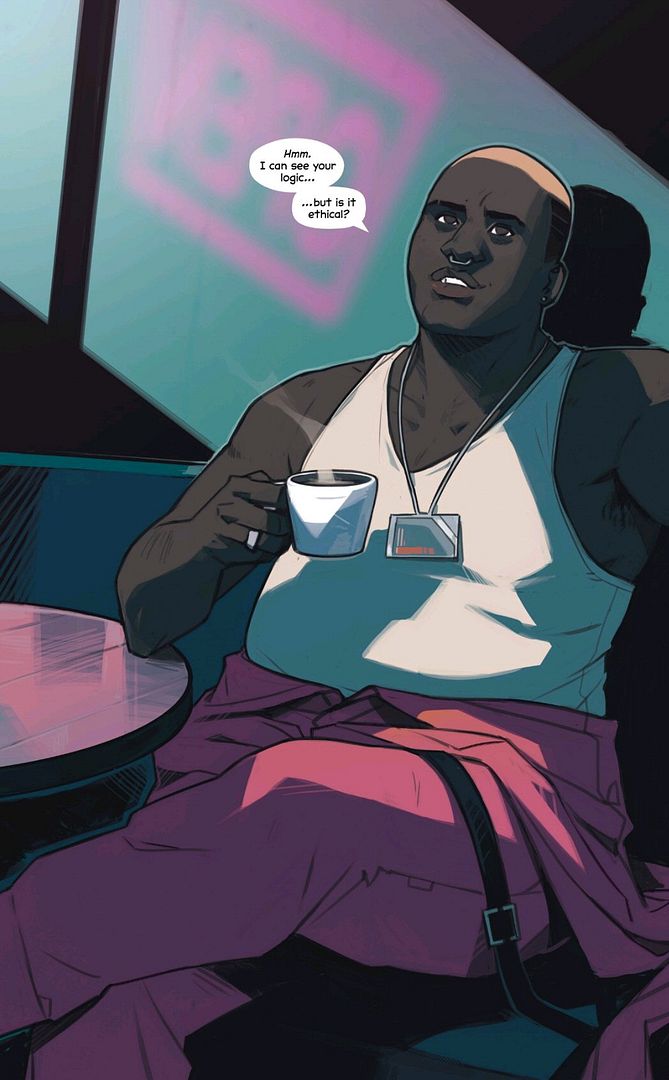
And with that, we are left on a mini-hiatus of one month until the third arc begins with issue #12.
The third arc: “The End of History”
The title of this arc is clearly a bit of a dig at Francis Fukuyama for his famous 1992 political philosophy treatise of the same name (where he overly optimistically postulated a linear progression to liberal democracy that meant an end to ideological evolution for humanity). By the same token, the attempted murder of Etienne is likely to rapidly accelerate the instability of the superpower’s power dynamic, making the end of this eventful history a lot more likely.
Before we get to that though, we are treated to a thoughtful issue (#12) that explores Etienne’s history in more detail. Valentina is fully aware that he is not dead, and seeks him out in his home base of New York. There’s a great two-page spread from Wijngaard, showing Valentina’s winding path to Etienne:
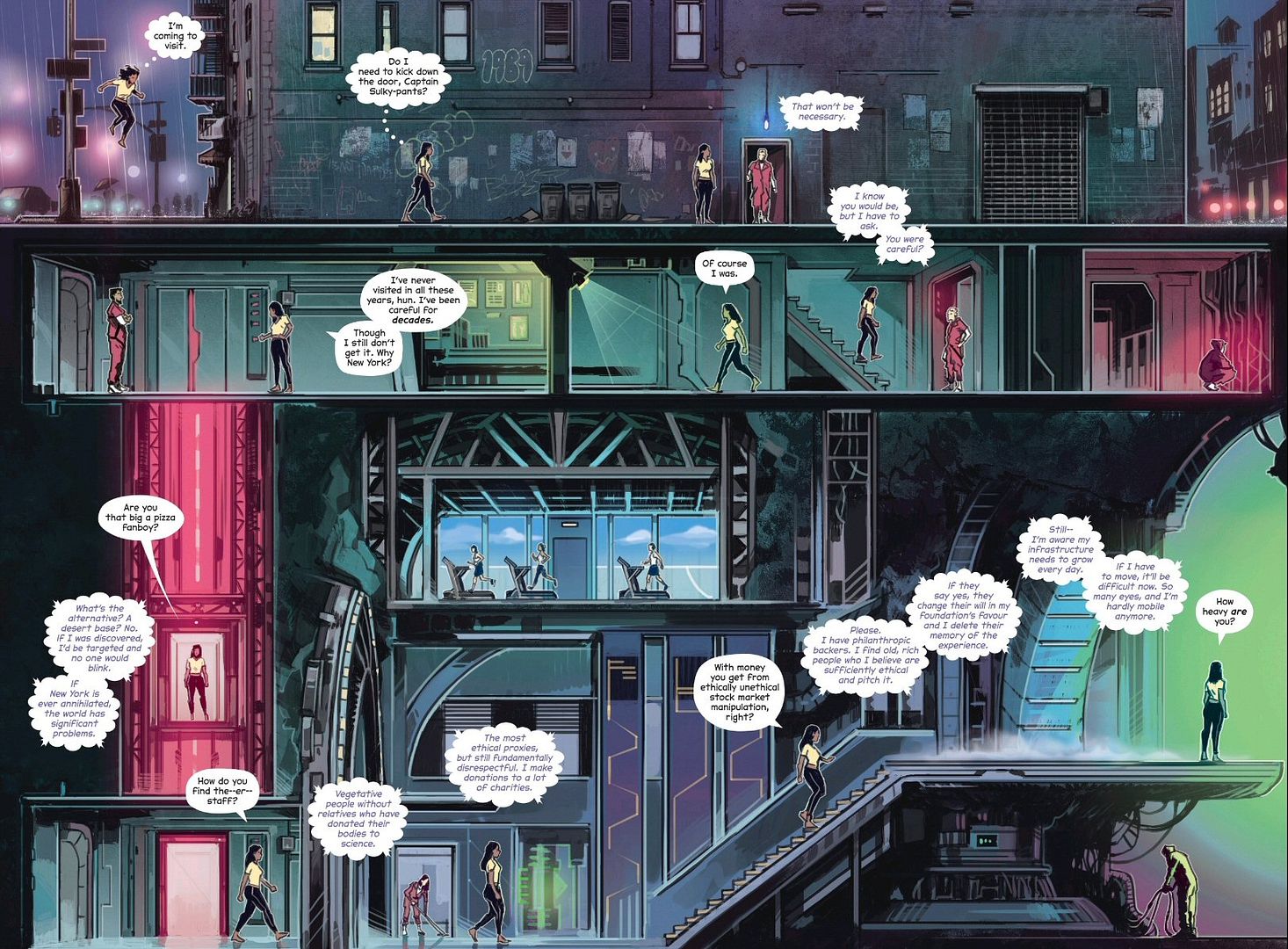
In the opening pages to this issue, we see Etienne’s origins as a seemingly catatonic newborn. He has to wait a number of years until a suitable child host body becomes available to him (the Etienne we have always known). But that was never his true form, which was growing increasingly deformed as his brain expanded far faster than his physical body.
And so, in answer to Valentina’s question above:
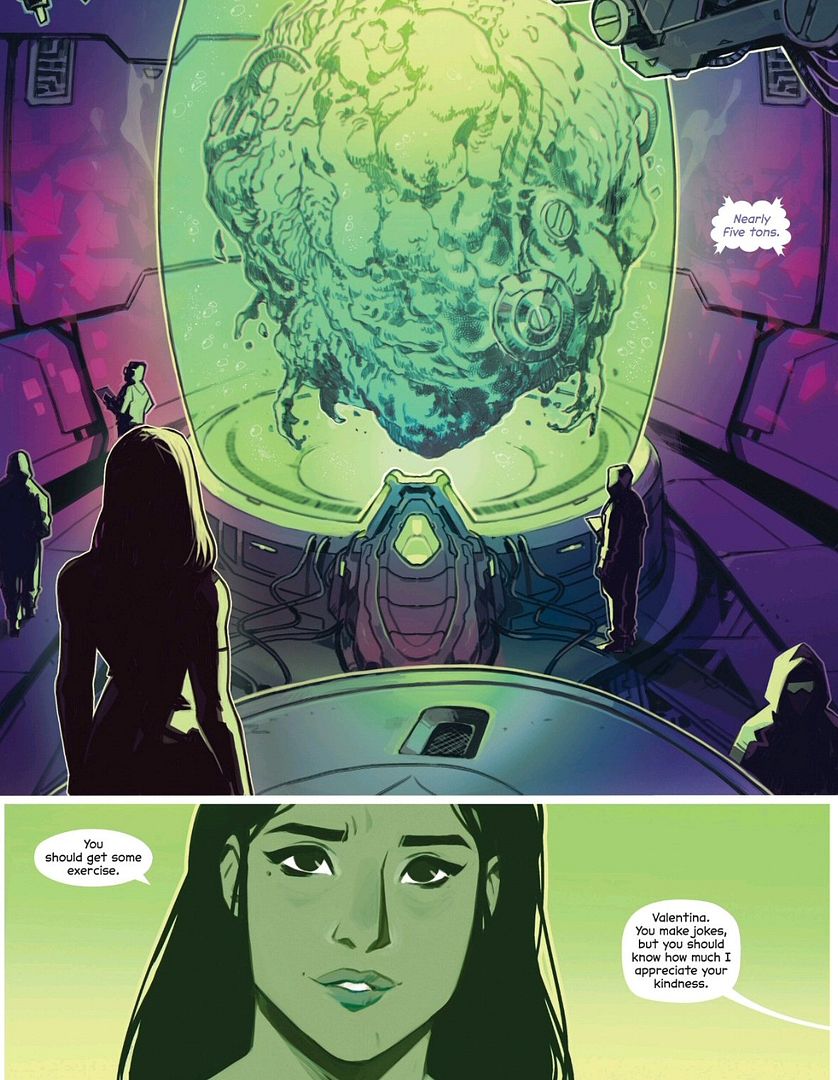
As much as I am a fan of Gillen’s writing (and that dry British wit), Wijngaard’s art continues to impress here. Note the distorted point of view from inside the vat for the next panel:
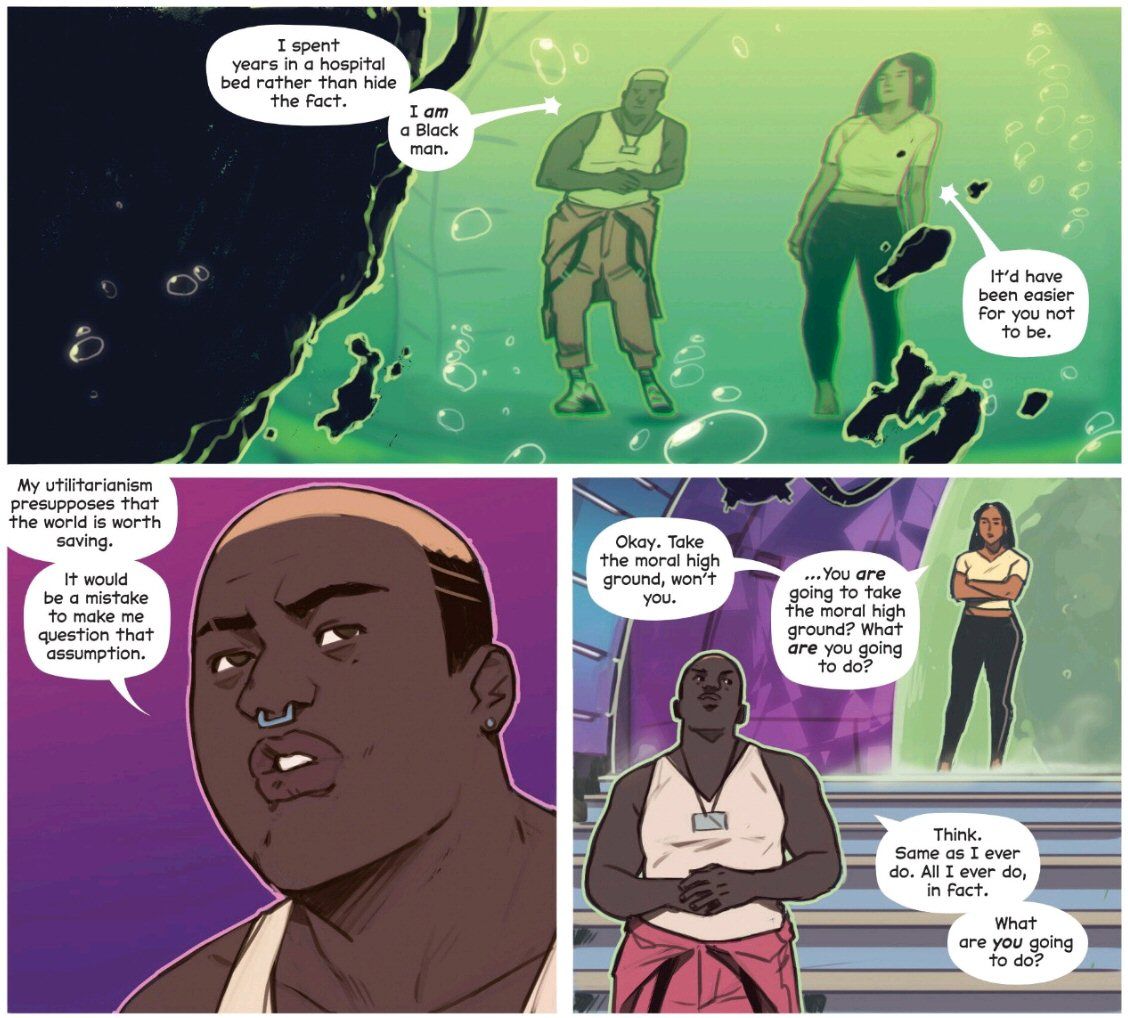
If you needed any proof that the current superpowers do not represent a meta-stable state (and Valentina’s naivete around that fact), Etienne sums it up pithily below:
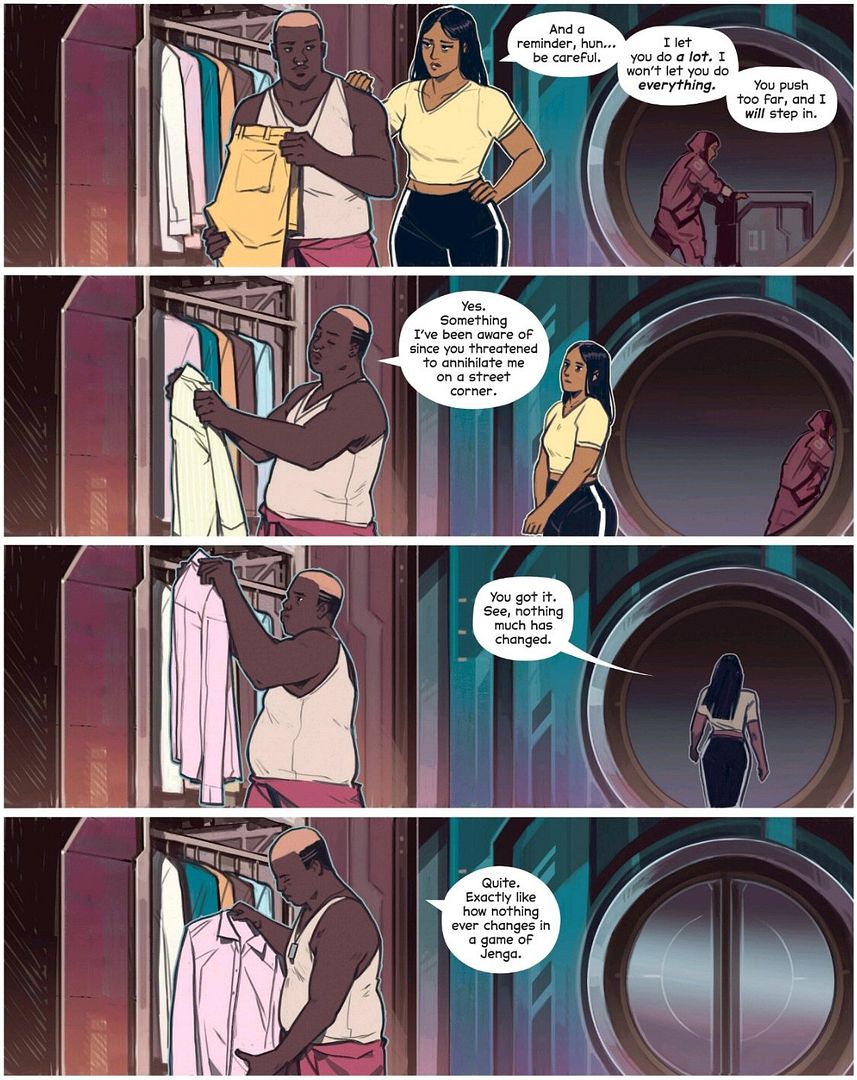
Until it does, of course.
By the end of this issue, Etienne feels ethically compelled to take the newest superpower, Heavy’s son Kid Ignition, off the board. It was previously established in issue #10 that Kid Ignition was susceptible to Etienne’s influence. And the still-in-hiding Etienne chooses to render him unresponsive, in secret.
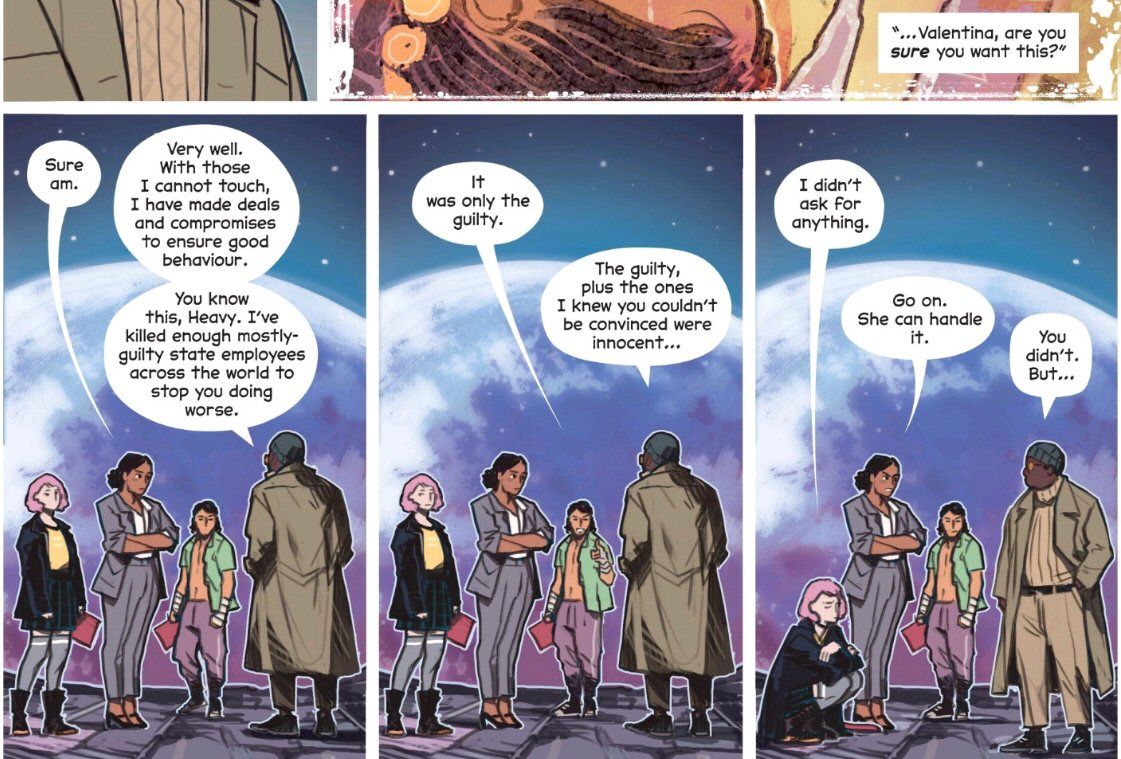
Naturally, Heavy blames Magus for this, and we see him start to dismantle the pyramid one member at a time. Seeking to avert and all-out war, Valentina stops Heavy and arranges a meeting for all the superpowers at her orbital home. From issue #12:
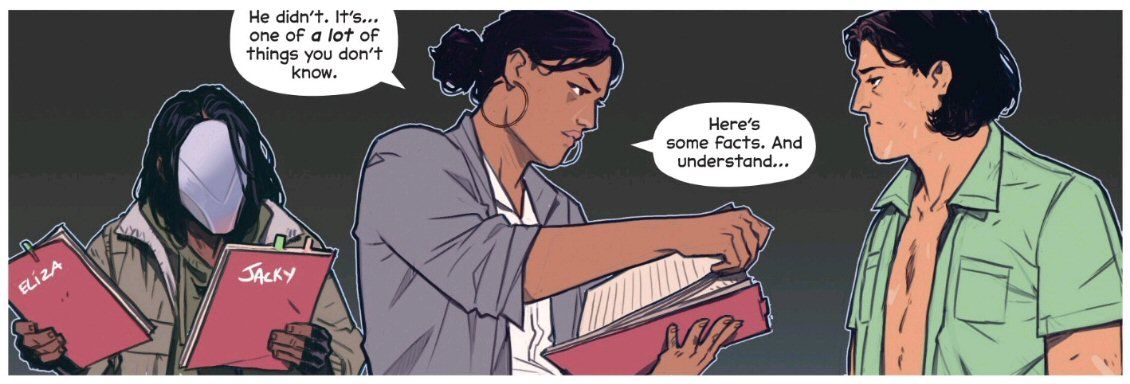
Note Valentina’s virtue ethics reasoning below:

I must admit, I was surprised to see this scene so soon after Etienne’s actions. I literally put the comic down at this point while I considered what was about to happen next.
The thought that came immediately to my mind was a scene near the end of the TV series Breaking Bad, where DEA agent Hank Schrader is wounded in the desert, and his brother-in-law, the drug kingpin and series lead Walter White, tries to save his life by bargaining with the leader of the neo-nazis holding them. After a length speech by Walt, Hank looks to him and says simply: “You’re the smartest guy I ever met, and you’re too stupid to see – he made up his mind 10 minutes ago”. Hank is then promptly shot and killed. Like Hank, I knew I was in for 10 minutes of Etienne’s speeches – and I knew there was no way Etienne was getting out of this comic alive.
But what a great set of speeches!
Etienne explains how he regretfully had to put down the psychic woman from Mumbai, and goes on to explain his editing of Isabella. He is eventually asked a direct question by Magus (Dev):
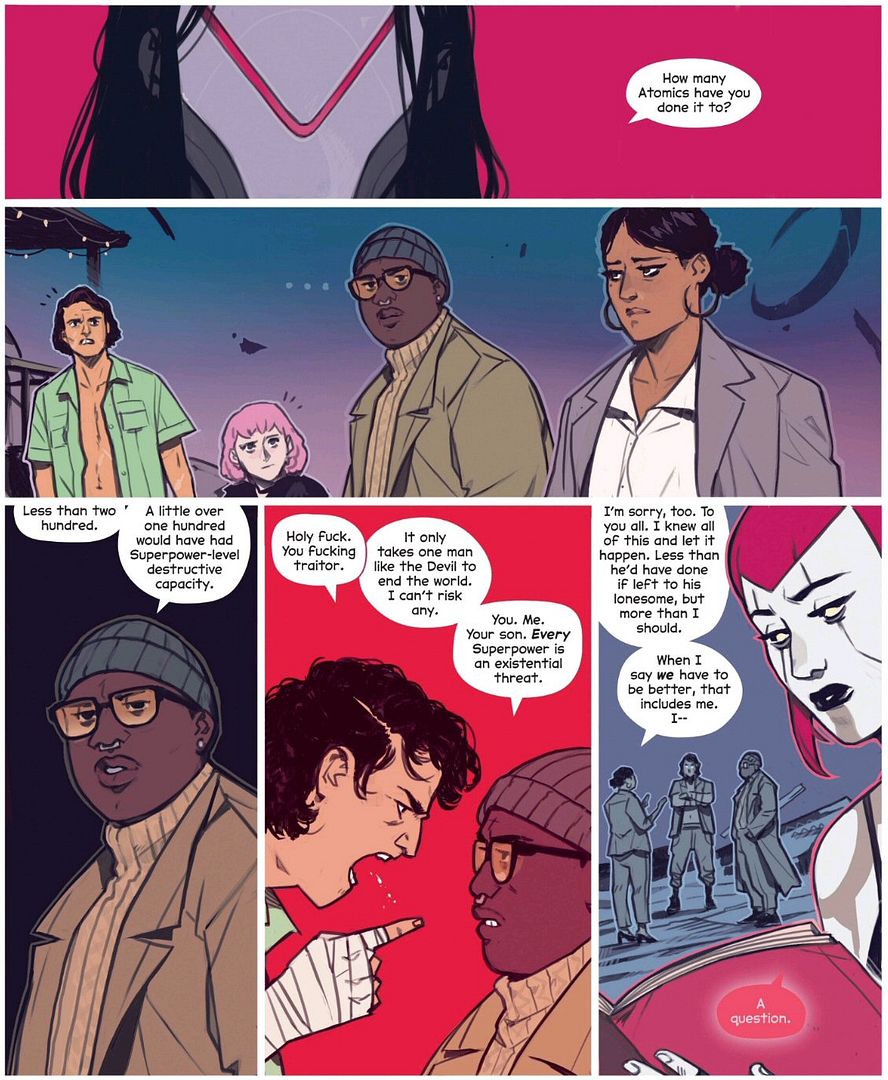
Note this is the second time that Valentina argues for a virtue ethics response – from all of them. That is, until Eliza interrupts with a question of her own – is Etienne responsible for her visions, where God has been telling her she will be saved?
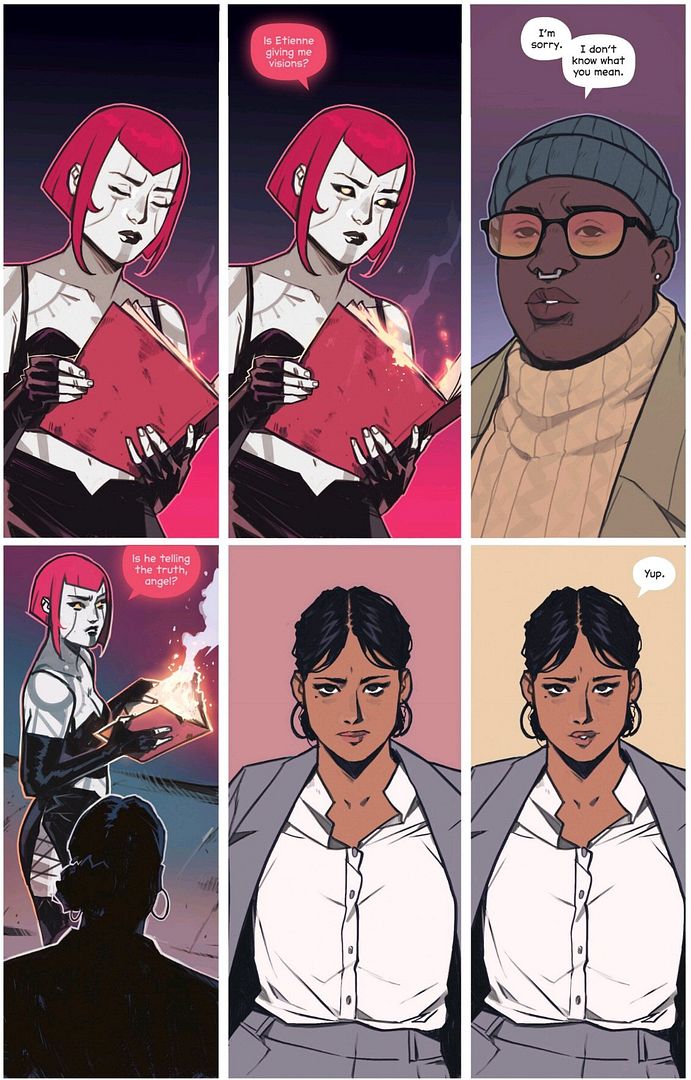
So much for the virtue ethics response! 😉
Despite being very much responsible for those visions, Etienne professes ignorance. Note that lying is very much allowed by Etienne’s act utilitarianism, so long as it is in service of the greater good (Eliza not destroying the world, in this case). But lying is morally wrong in Kantian ethics (no exceptions), and clearly not a feasible rule in rule utilitarianism. And virtue ethics? Well, if honesty is one of your core values, then truthfulness would be the corresponding virtue. You practice routinely telling the truth (when it is easy to do so) so that it becomes habitual. Then, when it is hard to tell the truth, that practice hopefully translates into truth-telling. But Valentina – despite her repeatedly stated virtue ethics goal of being better in this issue – clearly lacks practice.
Etienne takes the opportunity for a private conversation with Heavy:
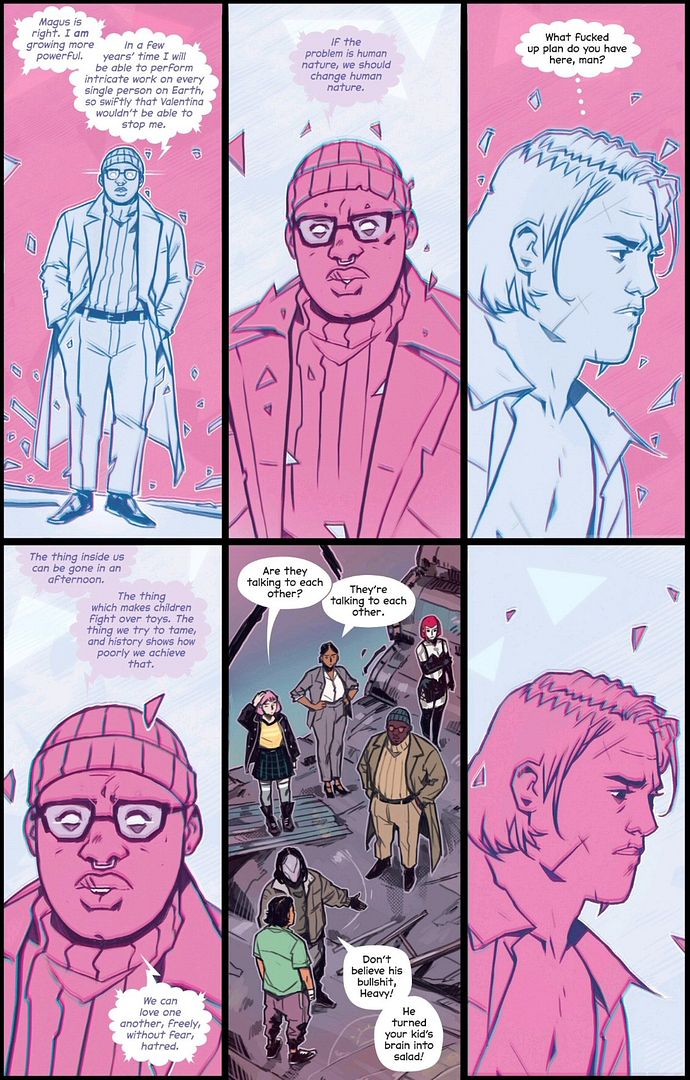
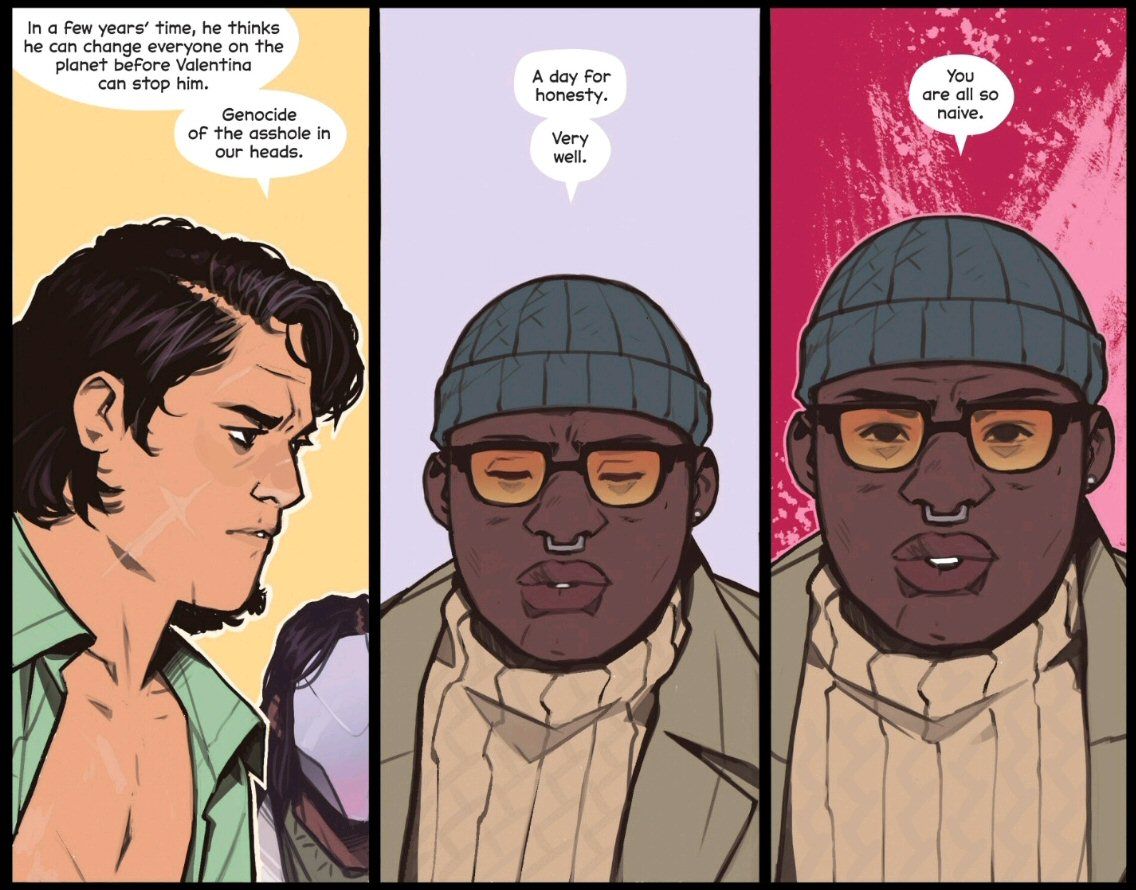
Finally – no more sugar-coating it!
I’m actually quite interested as to how this plan of Etienne’s could work. Based on the current revised dual process model of human cognition that I’ve described previously, I believe there is a very simple (and elegant) edit Etienne could make to human moral decision-making that would bring about this vision. Ironically, it involves strengthening the intuitive deontological moral intuition – and would thus bring about Immanuel Kant‘s version of utopia, the Kingdom of Ends. Consequentialist responses would still be possible in extreme circumstances (such as when humanity is threatened). He could also make it self-perpetuating, by adjusting any atomic telepath to serve as a “broadcast” relay to continue to propagate this edit in a distributed fashion.
Intrigued? I have developed the idea in a separate piece – How to lose friends and influence people – Etienne’s plan to make humanity better – to be published soon in the upcoming third issue of the Power Cut fanzine (you can check out their first and second issues on Tumblr). UPDATE: The Power Cut issue #3 is now out. My essay is on pages 55-64. I also have a follow-up point about how such a system could be perpetuated in the group discussion, on page 76.
Of course, the other superpowers aren’t keen on this plan, beginning with Valentina:
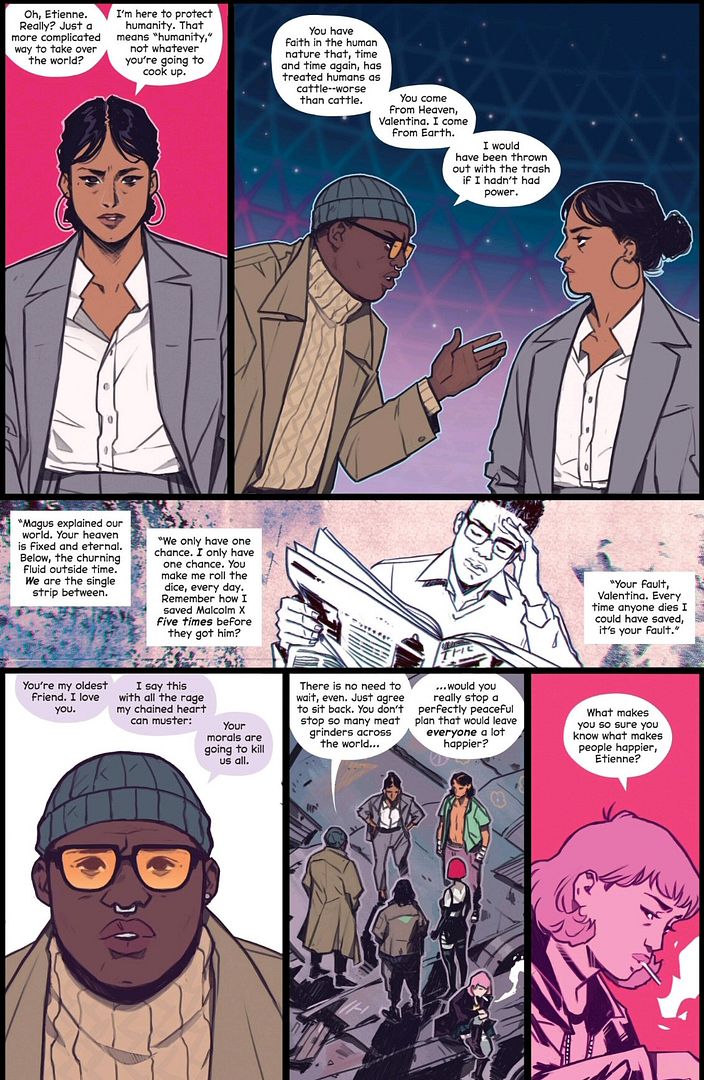
Ok, this was another point where I had to put the comic down for a few minutes.
You see, up to the final draft of my TPF introduction post, I ended my description of Valentina’s ethics with these words: “In the end, I think her morals are going to get everyone killed.” I removed that sentence right before posting, as I didn’t want to get into too much speculation of where I thought the series was going (although now wish I had left it in!).
It always seemed to me that Valentina’s inherent moral intuitionism was dangerous in this world of carefully balanced superpowers (“the balancing act”, in Etienne’s words from the first issue). Her decisions follow a very personalized code, one whose principles are not clear to the others – or potentially even herself. As I described previously, there was a flashback of their first meeting in issue #3 where Valentina gives Etienne the analogy that she is like those inflatable bumpers used to prevent kids from rolling gutter-balls in bowling alleys. Her response to Etienne’s question of what counts as a gutter-ball was chilling – “Oh, I’ll know it when I see it”.
Despite the obvious comparison to Superman, Valentina lacks any of his typical restraining devices in the comics. She has neither his strict Kantian deontological principles (in the Silver-Copper Age comics, aka Earth-1), nor his well-formed virtue ethics (in the Chrome-Modern Age comics, aka Earth-0), as I explain in detail at that link.
Indeed, I don’t think it is an accident that Gillen made the point that Valentina’s “childhood” saw her bouncing around from family to family, always asserting her own innate moral sense over those around her (again from issue #3). This is the antithesis of Superman, who was raised by good people – his human parents Jon and Martha Kent, with their values and virtue ethics perspective – and with recorded instructions from his birth parents (especially the very deontological Jor-El).
Note that I am not trying to assert some extreme familial form of exemplarist moral theory here. It is not that people only learn morality from their parents (indeed, some may adopt very different approaches from what is modeled for them). But parental instruction is such a familiar trope in the comics – especially for those with world-ending superpowers like Superman (or Valentina). And so, I can only assume that Gillen is intentionally riffing on that established expectation in this series, heightening the concern around Valentina’s go-solo moral approach.
And so, I was mentally fist-bumping Etienne when he mirrored my thoughts so exactly in that panel above. But as I thought more about it, I realized that this meant Valentina will now be the one to save everyone in the end. As I alluded in my intro above, I’ve read enough of Gillen’s work to know how he likes to structure his narratives: the obvious path is no longer the way forward once it has been explicitly stated.
We’ll come back to Valentina’s actions – and her pivotal role in this series – later in this post, when we reach issue #16. For now, let’s see who manages to take Etienne out! My money was always on Heavy, given his impetuous nature – and the fact that Etienne had just turned his son into a vegetable.
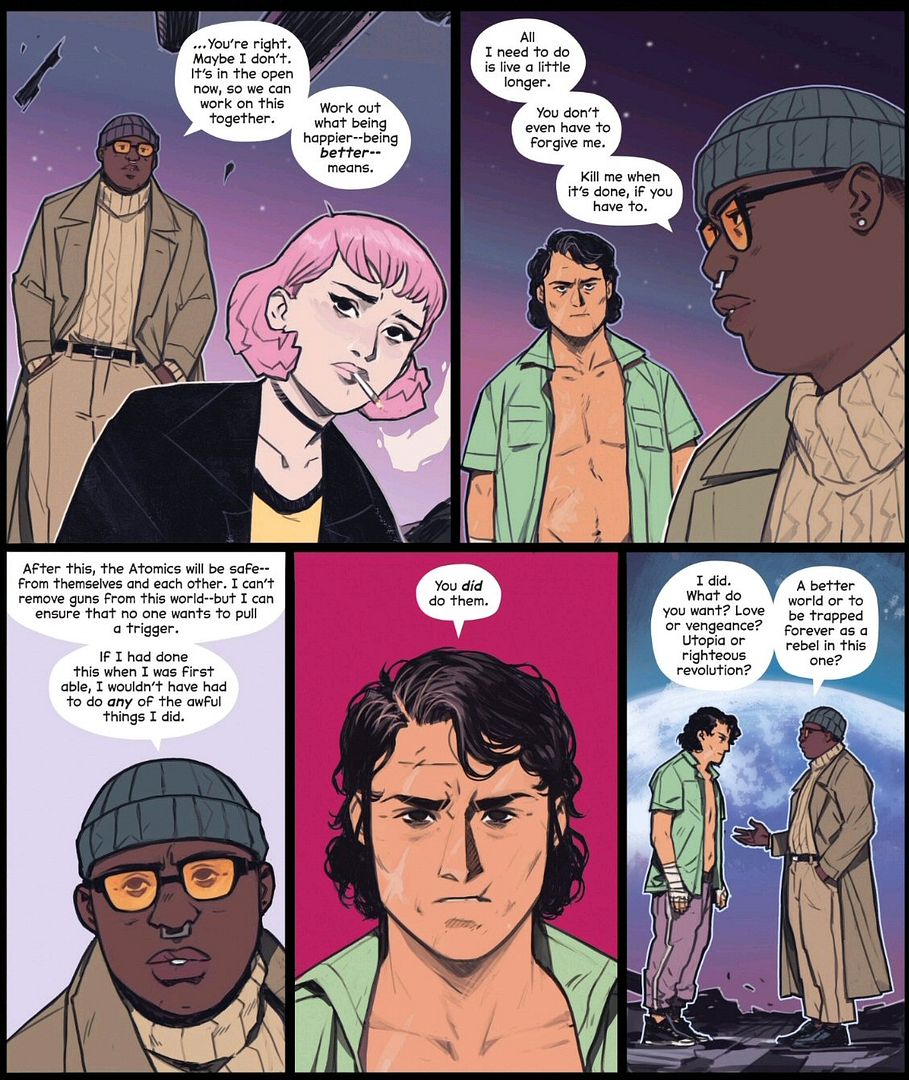
After several panels showing Heavy thoughtfully considering Etienne’s offer, he makes his decision:
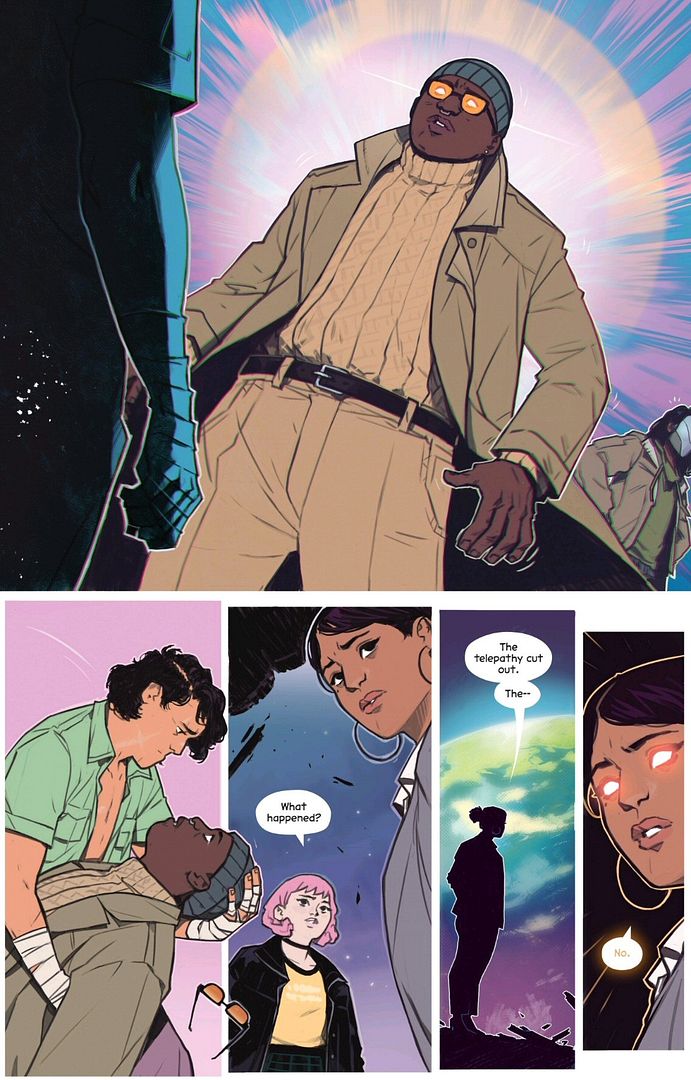
I love the panel above where Heavy rushes in to catch and gently cradle the immobilized new body that Etienne is wearing, before he hits the floor. Heavy has clearly just cut his strings – as he soon explains, he has flung the real Etienne into outer space, killing him instantly. Wijngaard’s art beautifully shows (without words) that Heavy is not a monster – he is simply doing what he feels to be right, without malice.
And Etienne’s failsafe?
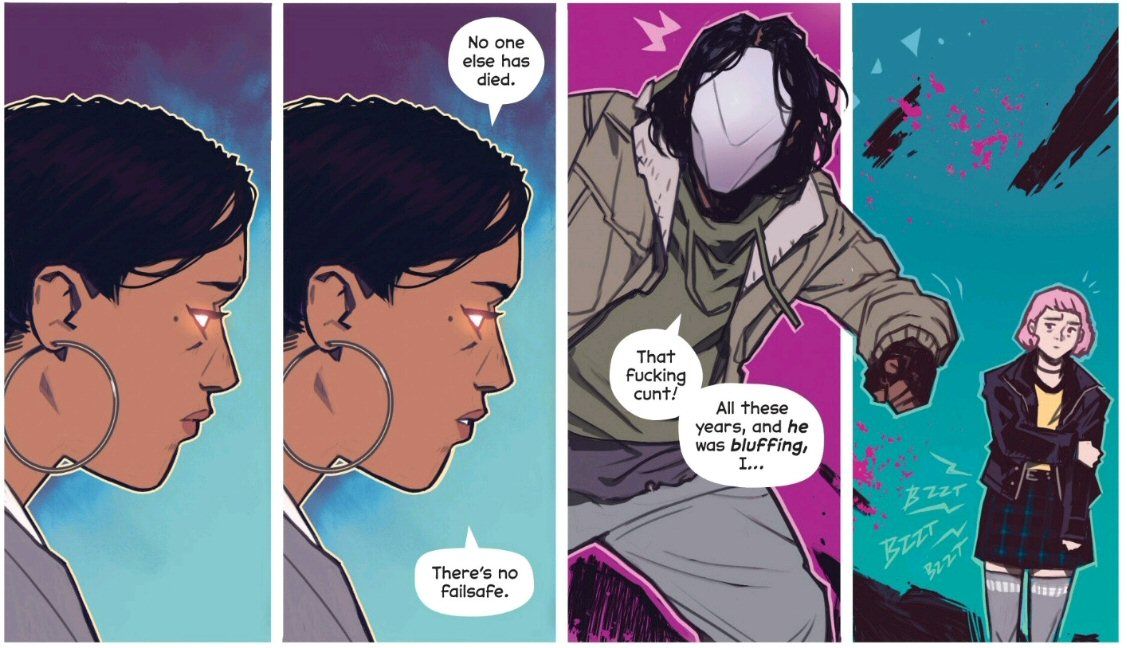
Of course Dev (in character as Magus) is quick to be annoyed at this good outcome. But it is Etienne that gets the last word, through an apparently pre-programmed text sent to Masumi:
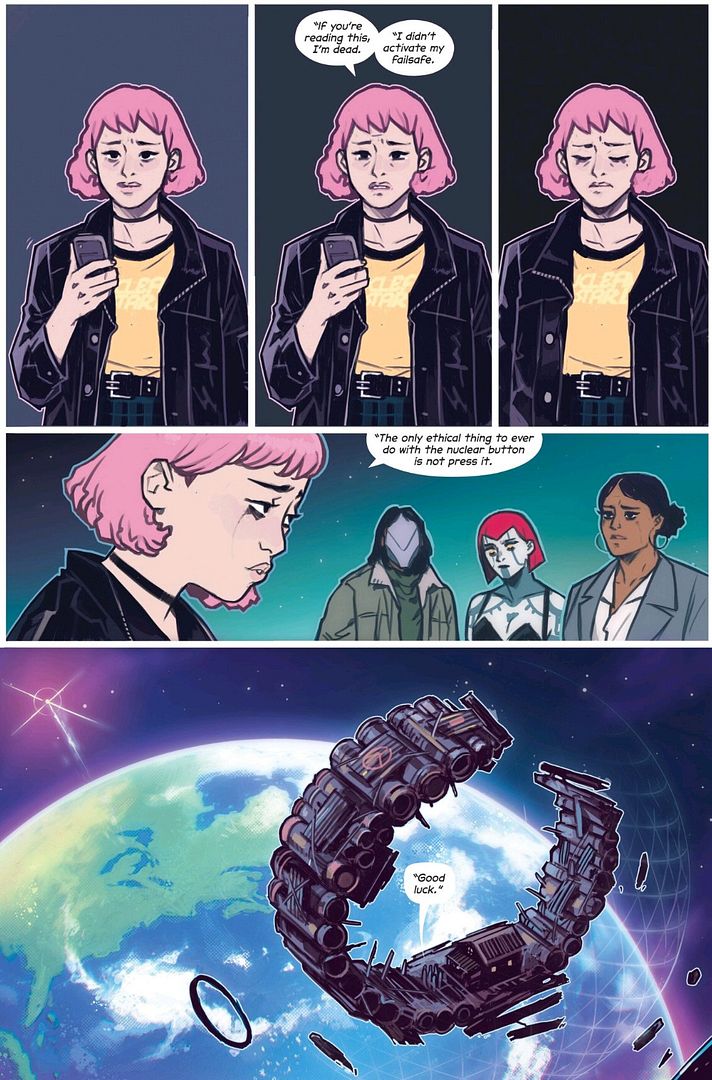
Indeed. It turns out Etienne was much more of a virtue ethicist than any of them knew.
The rush to the end
The next couple of issues deal with the breakdown of relations between the remaining superpowers. There are some early signs of hope in issue #14, such as Masumi breaking up with Isabella in order to set her free, and Dev working on a plan to try and save Eliza from her eternal damnation. But then Tonya publishes her expose on Heavy, and things start to break down quickly. As an aside, she certainly knows how to hit Heavy where it hurts:
He’s just a man. He thinks he can change the world. I think he’s right. In so far as ending the world is changing it. … I hope if it all comes crumbling down, Heavy has enough time to realize Etienne was right all along.
- Tonya, The Power Fantasy Vol 1, issue #14, 2025, written by Kieron Gillen
Things start to go really badly at the end of issue, once Eliza decides not to put her faith in Dev, and see for herself what hell is like. As the text narration at the end of the issue dramatically points out, over two pages: “Eliza holds it together. For the next three months.”
Issue #15 is a roller coaster, as Eliza increasingly begins to lose it:
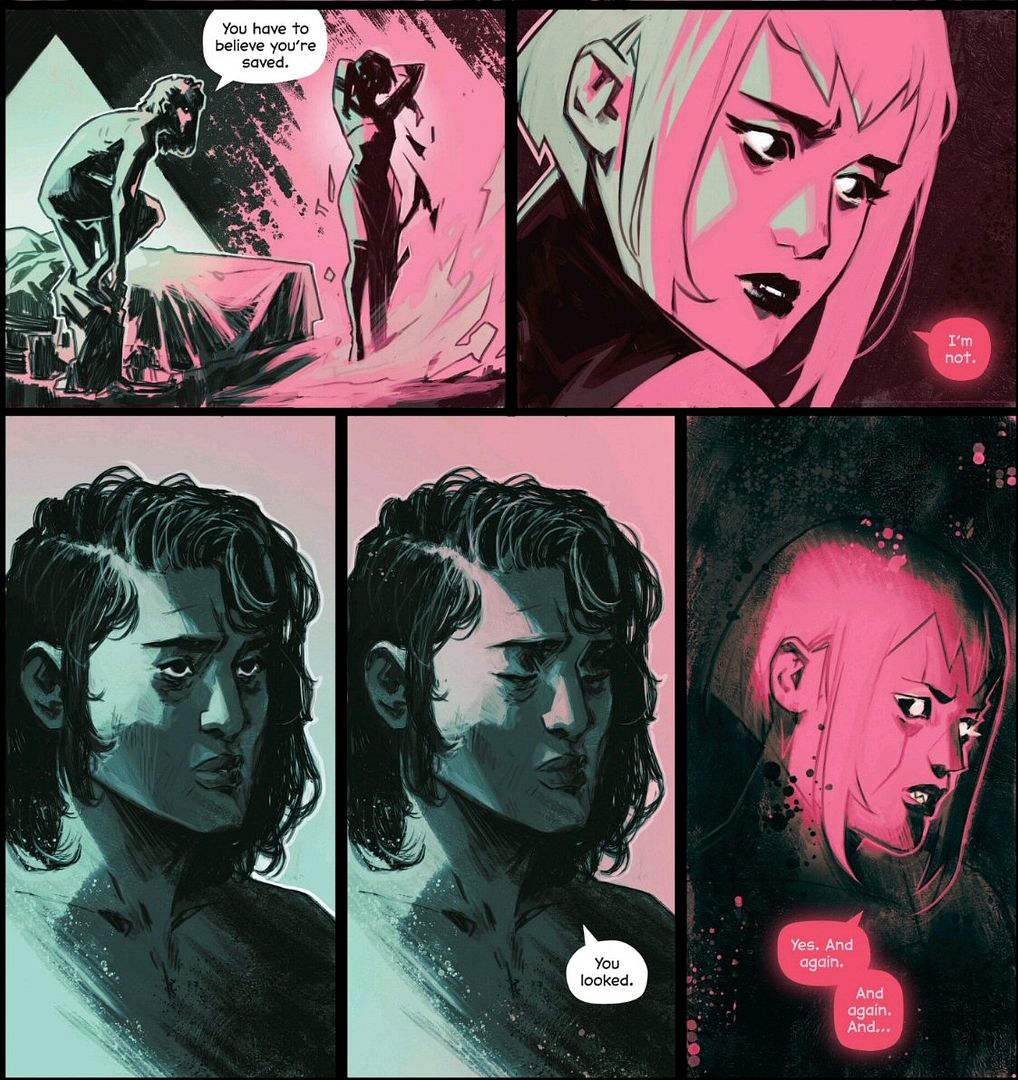
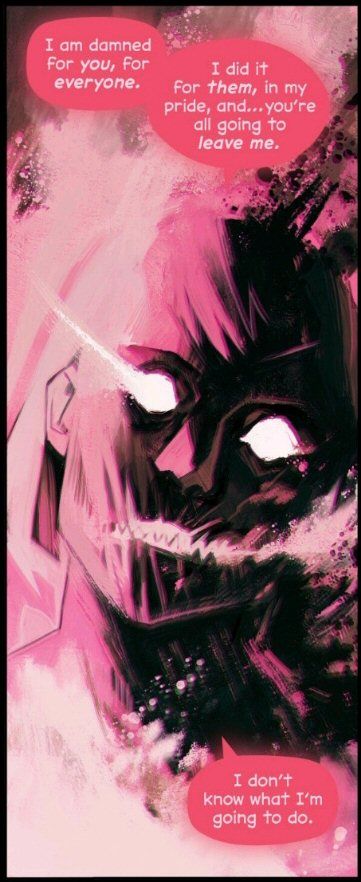
As Eliza breaks down, plans are quickly drawn for how Valentina, Heavy, and the Pyramid can kill Eliza and force her to hell. Of course, Dev balks at the end and doesn’t want to go along with it – but the Pyramid members have learned a thing or two from last time:
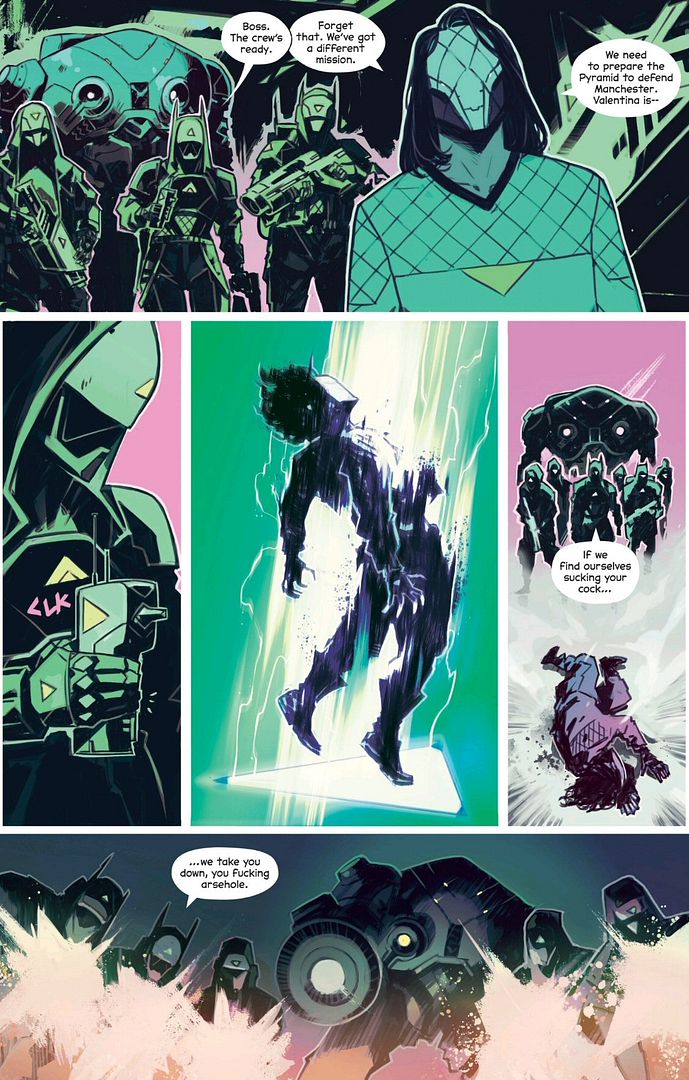
And Heavy?
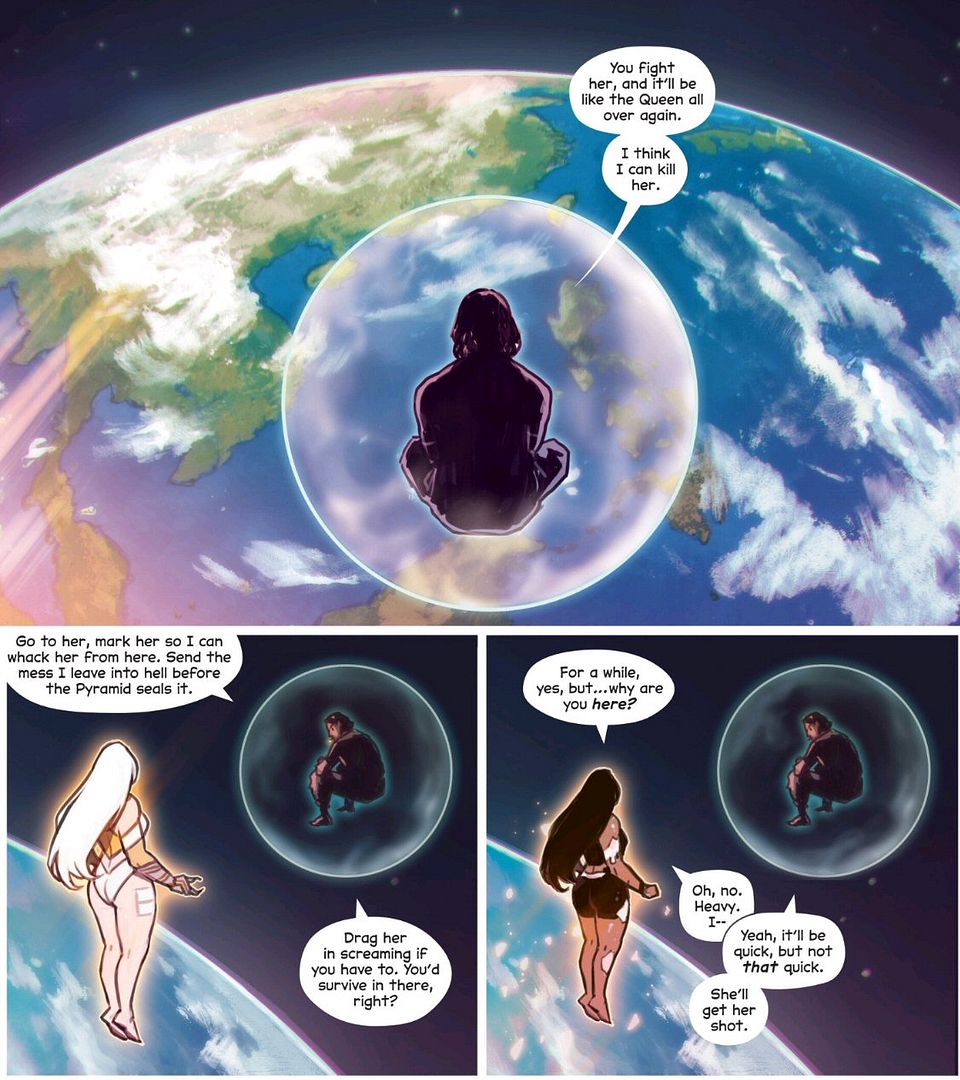
It comes down to Valentina:
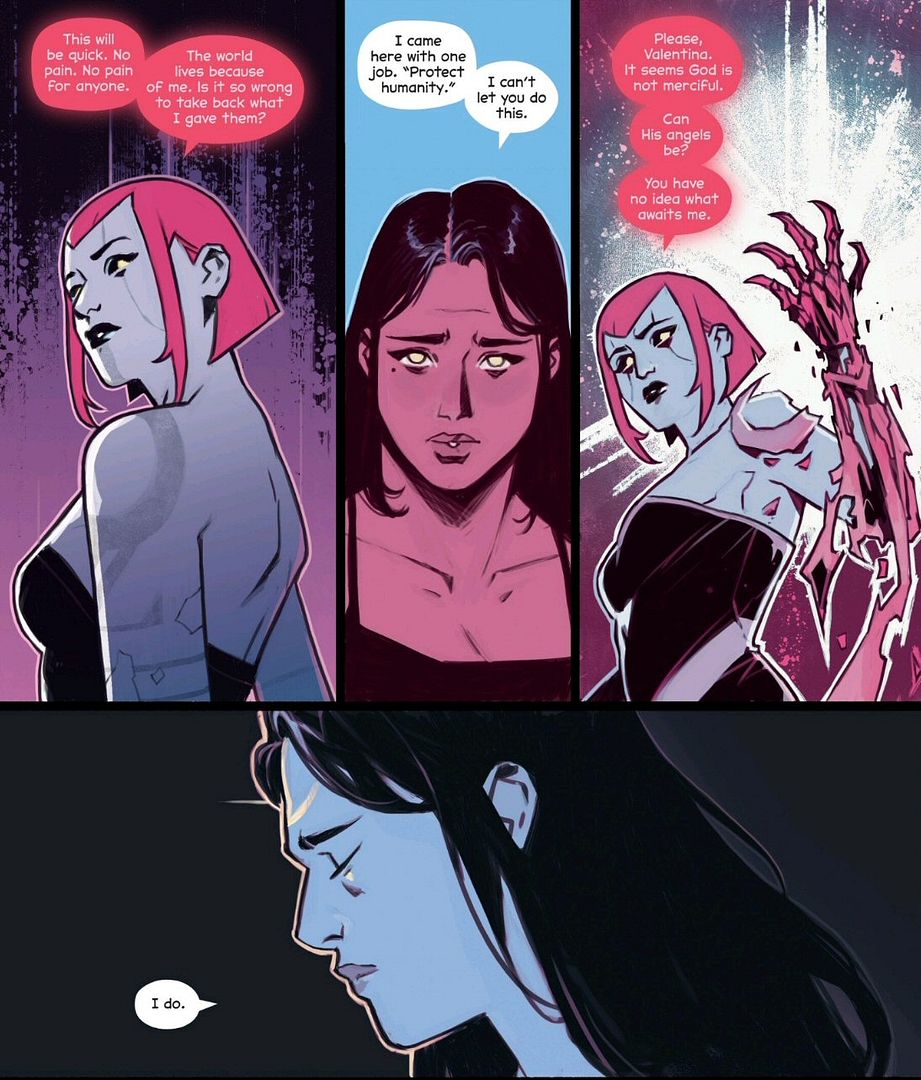
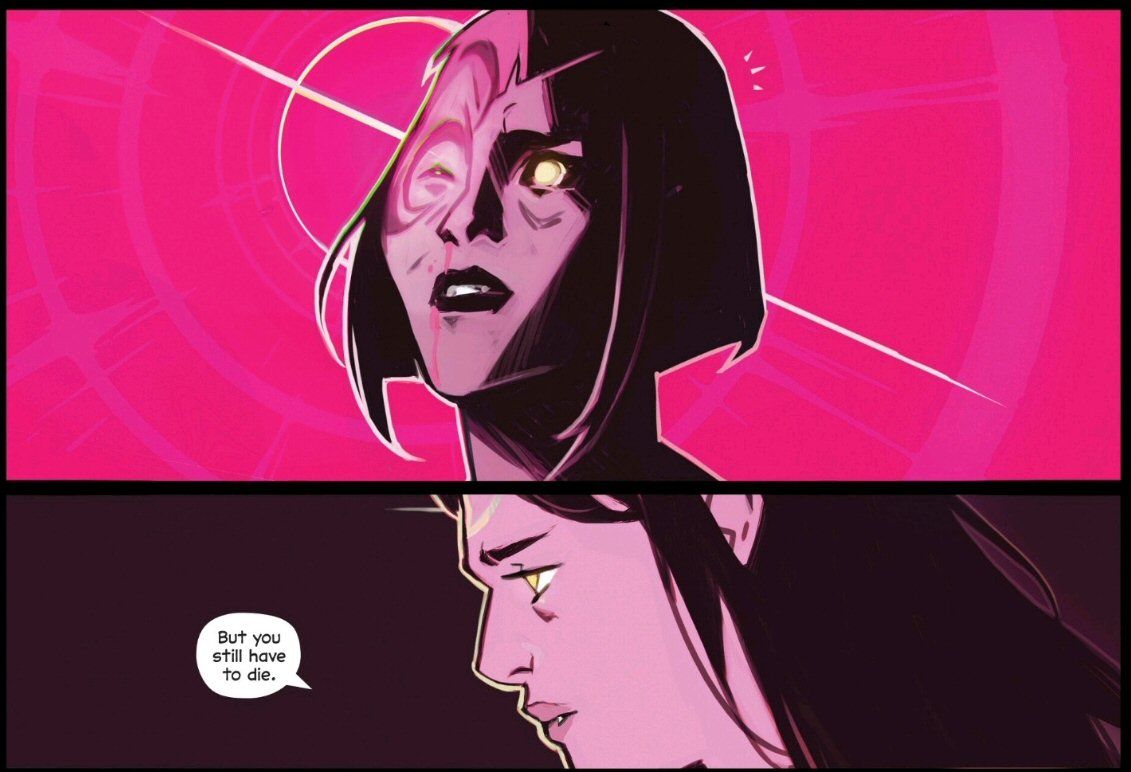
Heavy drops a singularity in Eliza’s head, as promised, but she still gets her shot at him. And his final words?
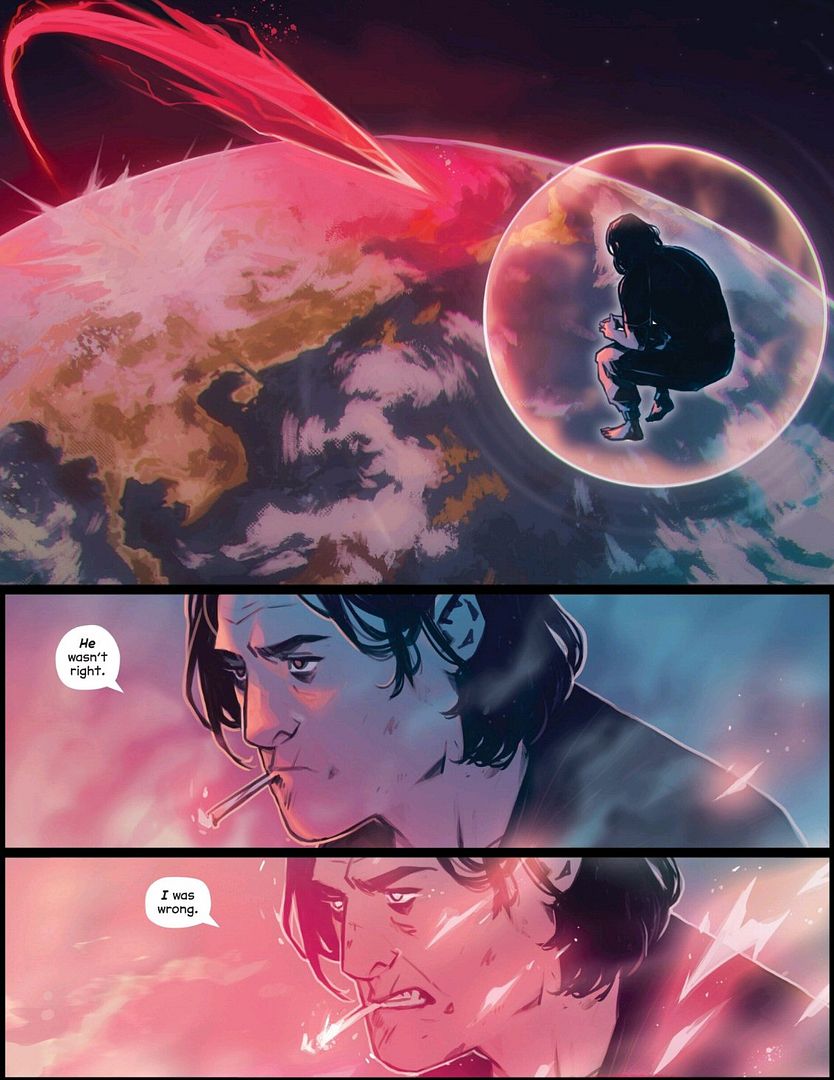
Heavy is true to himself to the end.
Needless to say, it felt like a very long wait for issue #16 to land! To recap, it is just Valentina and Eliza now, along with the Pyramid – with Masumi off in a drug-induced coma (Isabella returned to her at the end of the last issue).
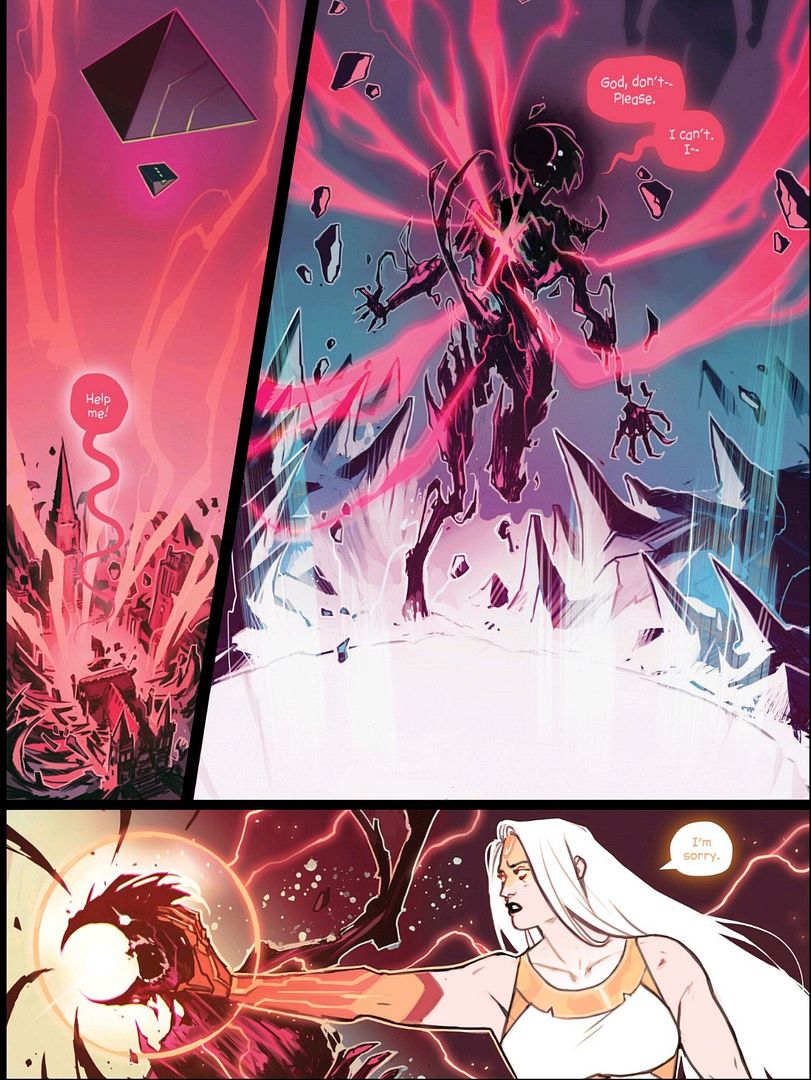
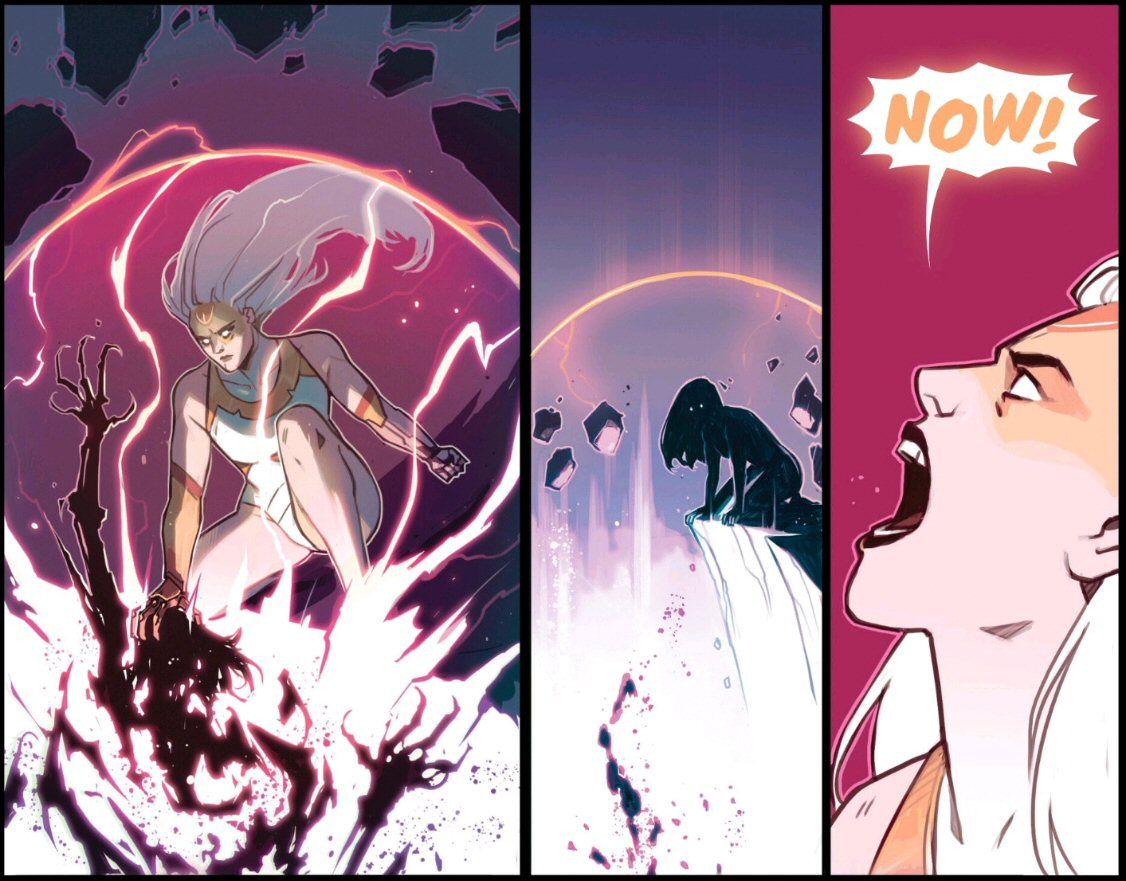
With the Pyramid’s help, Valentina is successful in sending one of her few remaining friends to hell.
First, the good news:
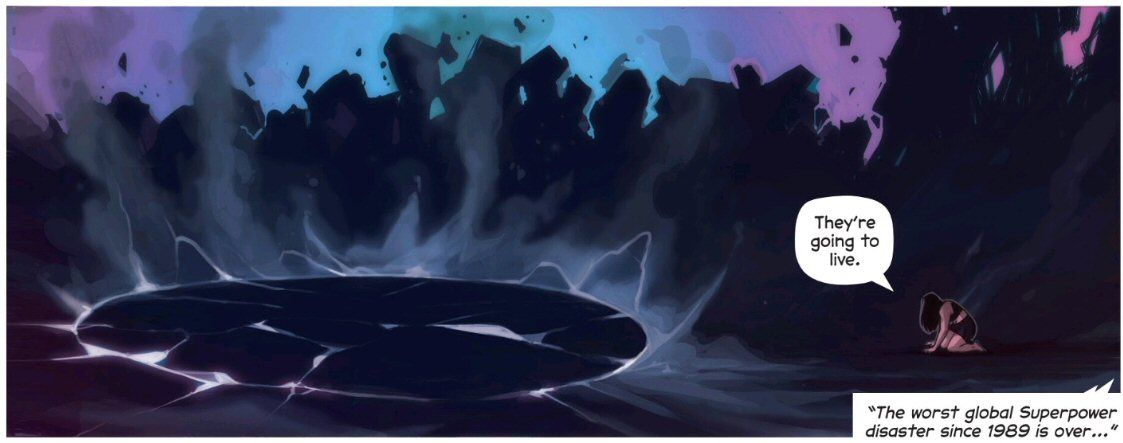
And now the repercussions:
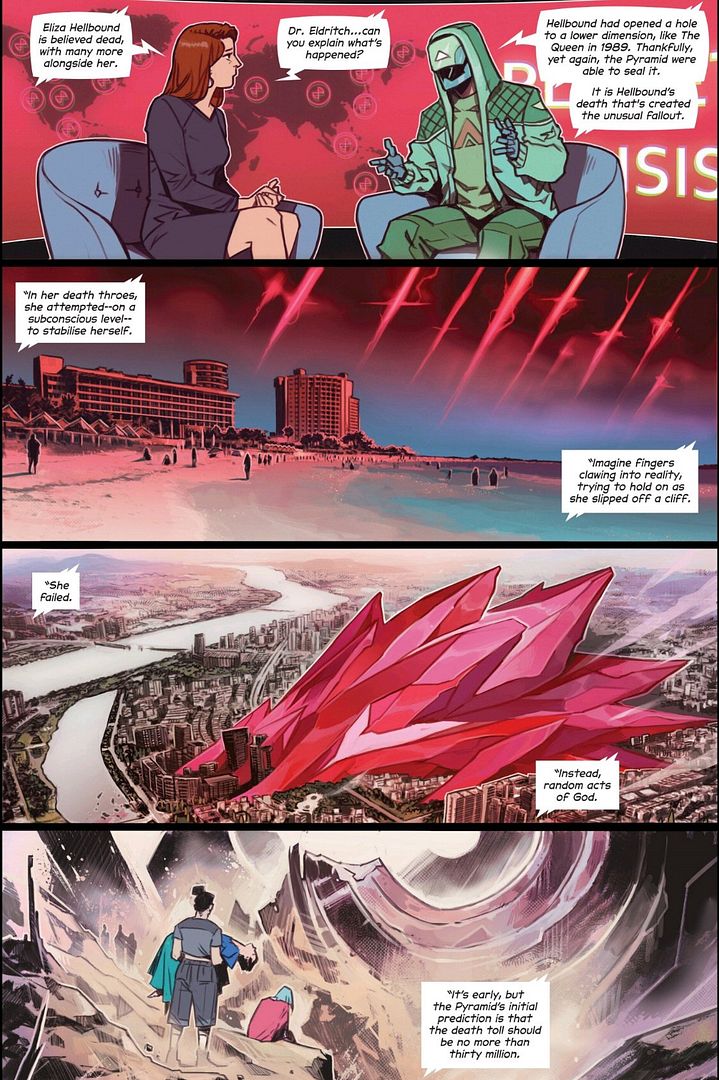
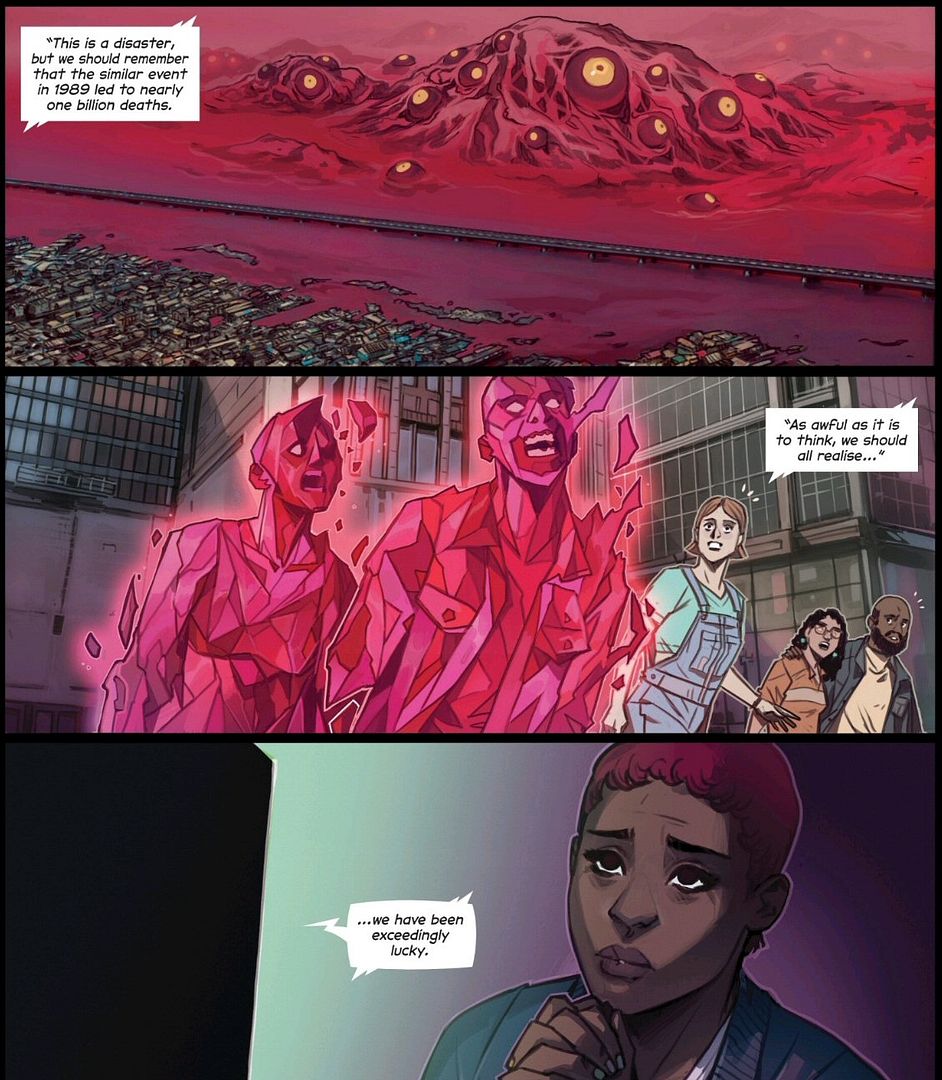
At this point, it seems like we are going to have a pretty grim ending.
But never fear, it gets worse! Masumi wakes from her drug-induced state only to discover …
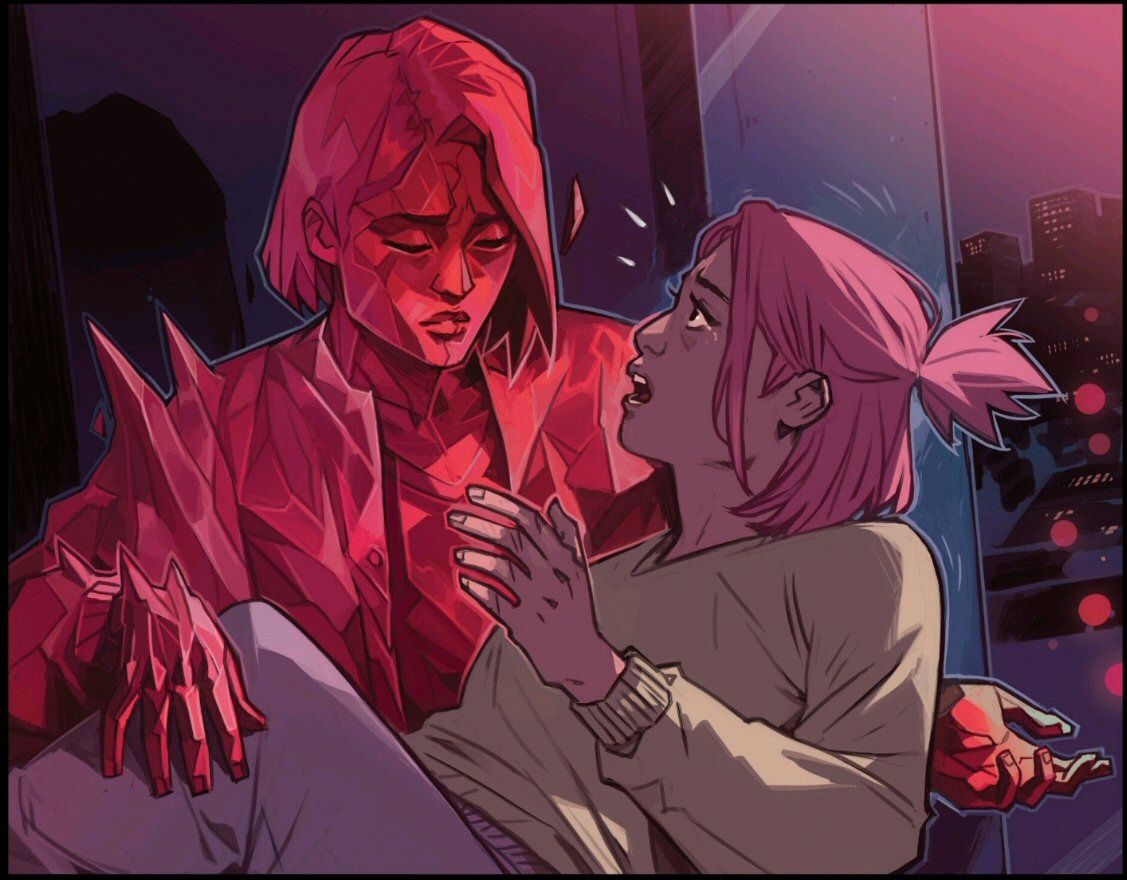
… that Isabella is one of those “acts of god” – she has been killed and turned into a ruby statue. This causes Masumi to finally succumb and release Deconstructa upon the world.
I’m not going to spoil any of those panels here – they are heart-breakingly beautiful, and worth the cost of the comic on their own. I thought Wijngaard had outdone himself in the wind-up to Eliza’s death, but those panels pale in comparison to what is coming. Buy the actual comic, I beg you.
To summarize it succinctly, Deconstructa is much more than just a large Kaiju – it is literally a world-consuming entity. Valentina, from per perspective standing on the Moon, watching the world end:
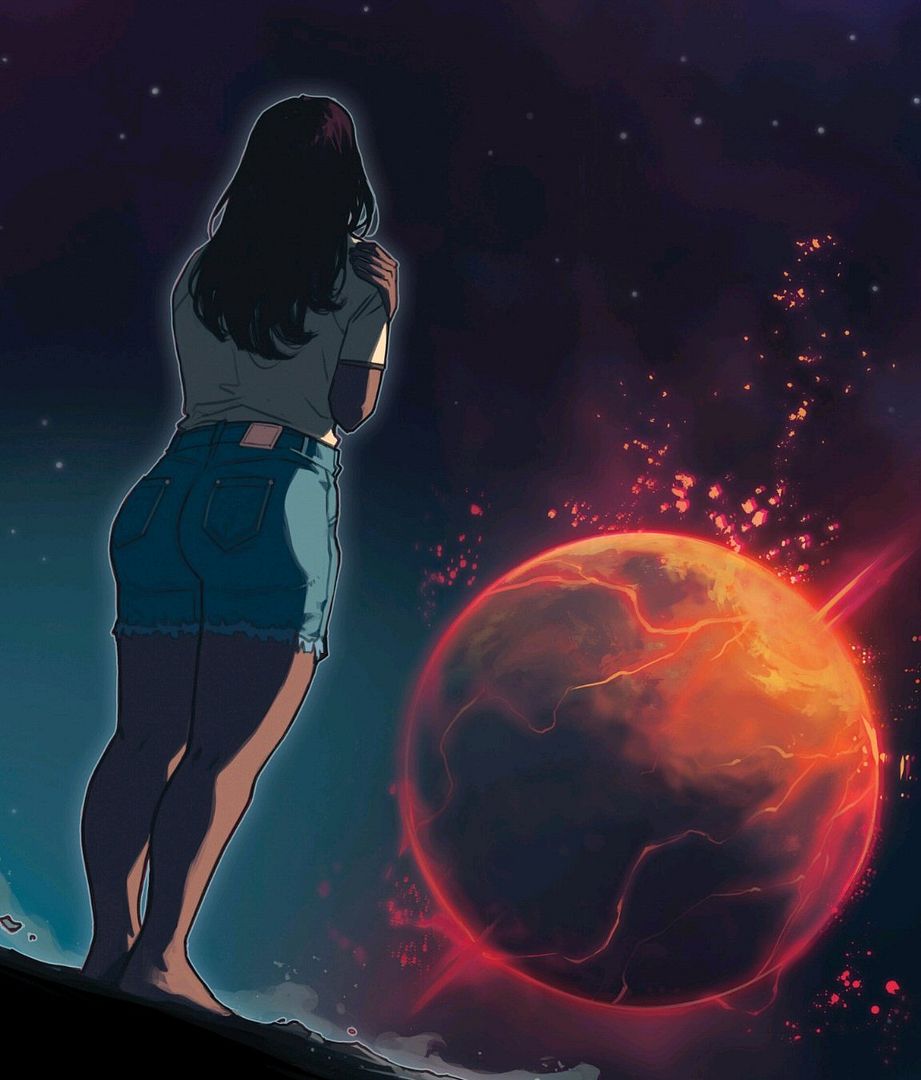
Well, it seems that god does speak to Valentina … at least on this occasion:
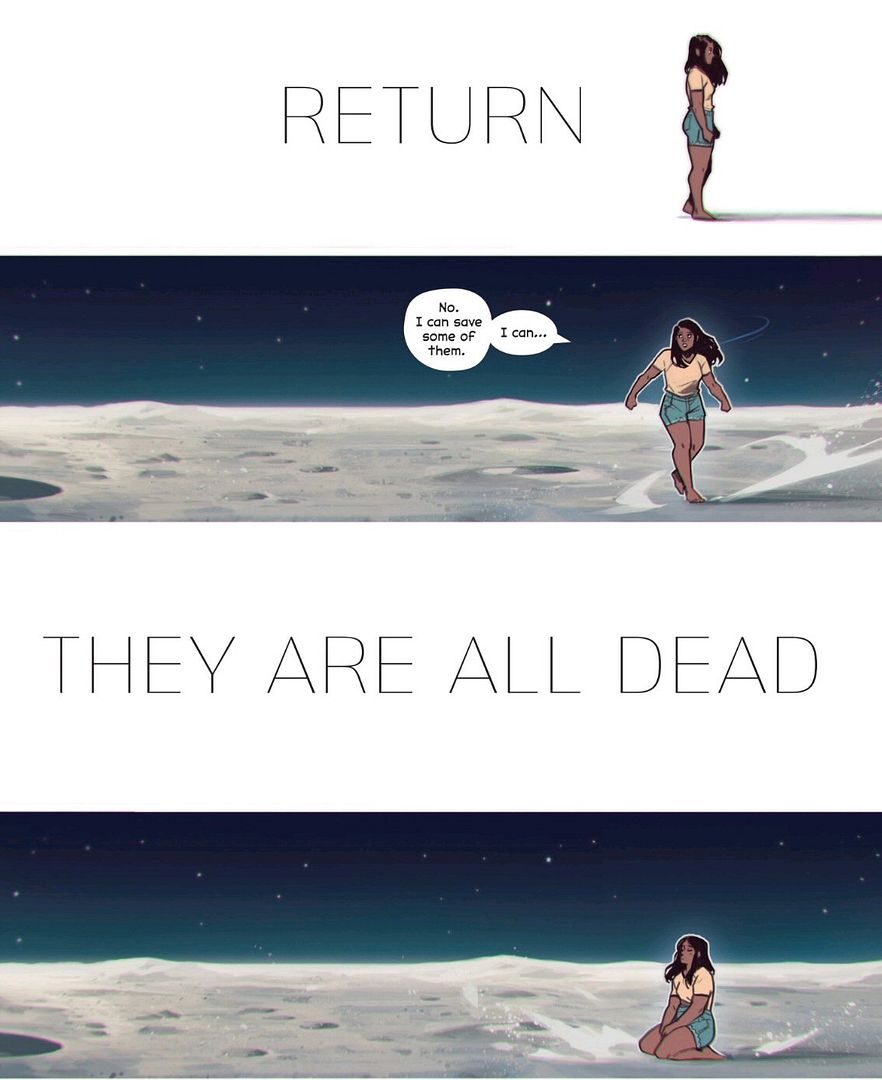
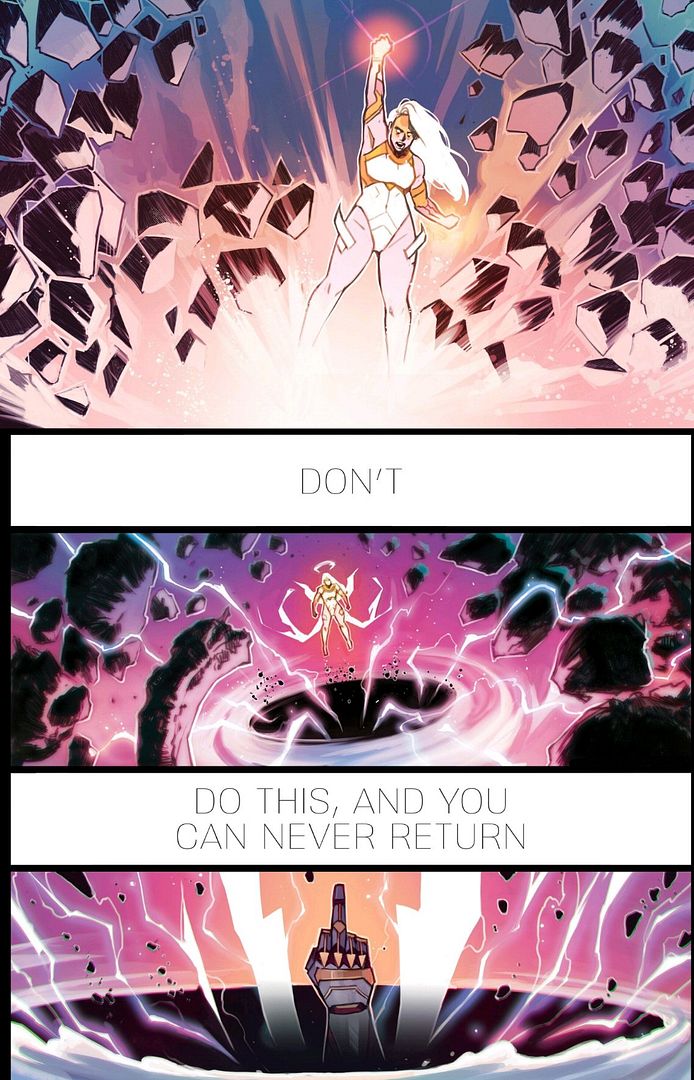
But Valentina considers a moment, as shown through a series of flashbacks (ending with the one where Etienne tells her that her “morals are going to get us all killed”), and comes up with a plan. It seems like the almighty knows what she intends, and isn’t thrilled with what she has in mind:
And her plan? I have to admit, I mentally kicked myself for not seeing it coming – the hints were always there. Valentina travels back in time to that New York city street corner in 1966 where the series began:
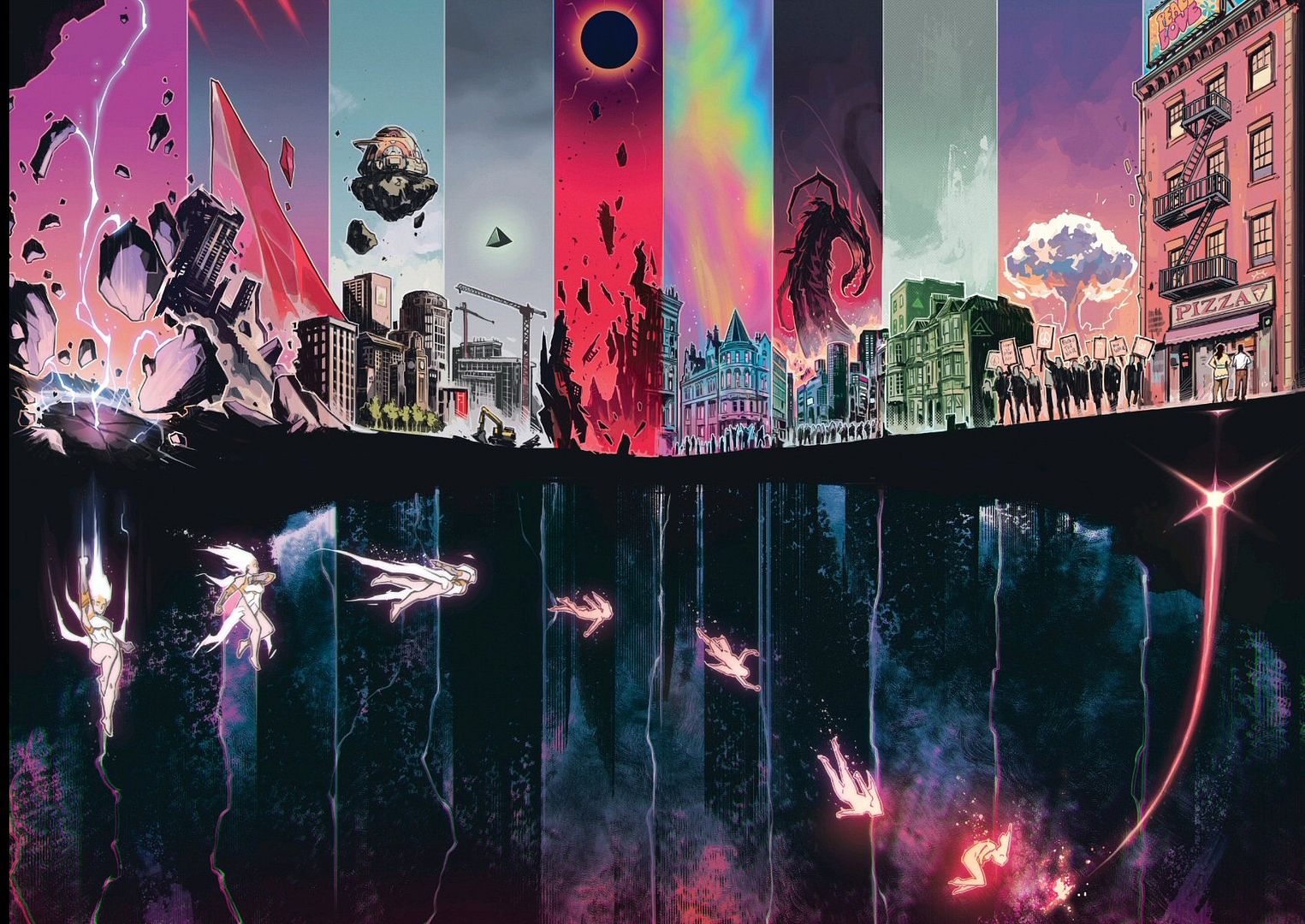
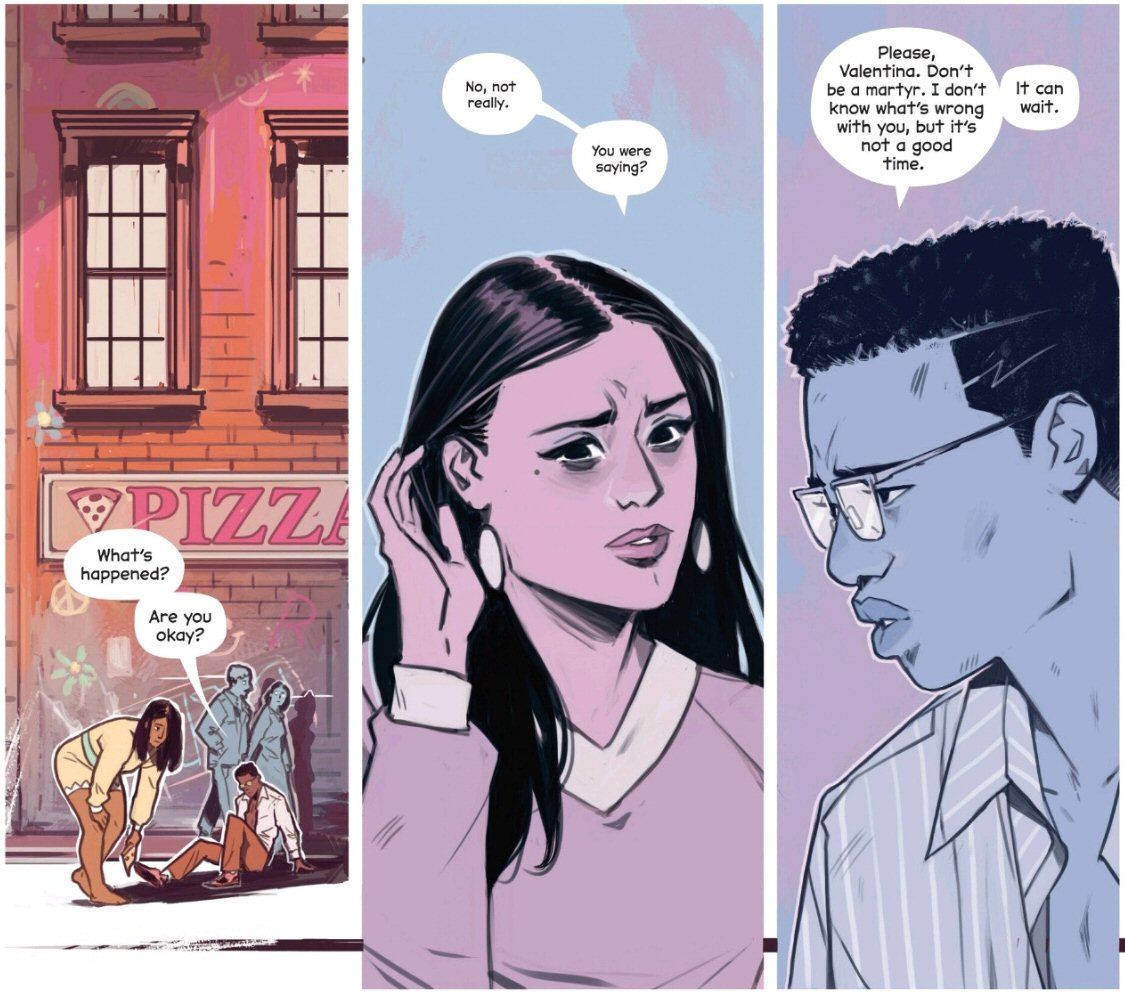

Ah, so she intends to try Etienne’s original plan to take over the world in the next go-around.
A pity it won’t work out any better for her the next time through. 😉
How do you solve a problem like Valentina?
What do I mean by that? Well, it is already too late in my view. By that point in time above (1966), she had already publicly prevented the Cuban Missile Crisis years earlier. As a result, humanity has never had to learn to deal with its own worse impulses – and the risks that nuclear brinkmanship brings.
Recall the opening pages of the first issue, leading up to that repeated scene above, when Etienne said to Valentina: “they’ll never forgive you for Cuba”. What he meant didn’t become clear until issue #3, when we discover through a flashback how Valentina interfered during the Cuban Missile Crisis of 1962:
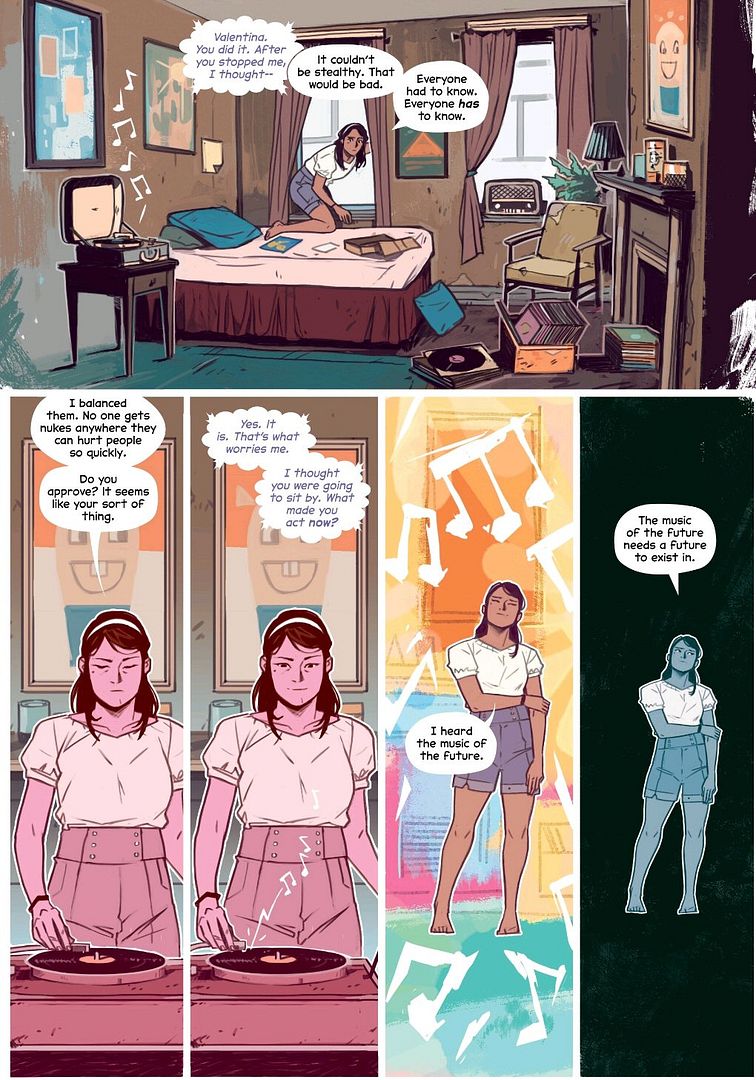
It was this scene that initially convinced me that Valentina was ultimately going to be responsible for bringing about the end of the world.
In real life, the confrontation between the United States and the Soviet Union over the Soviet missiles in Cuba (and the US missiles in Turkey) is considered the closest the world has ever come to full-scale nuclear war (so far). The fact that we have continued to exist these last 64 years speaks to the powerful de-escalation lesson world leaders learned from it (so far). But Valentina’s intervention prevented world leaders in the TPF universe from learning it. Instead, they learnt a very different lesson (once they realized they couldn’t kill her, at any rate): they can push things as far as they want, and the nice inflatable-bumper lady will always intervene to stop the world from ending.
And it’s not like this hasn’t been suggested by other characters too. Consider the original Jacky Magus’ comments from issue #10 (shown above), when he transfers everything to Dev right before his death:
My power is to know shit. The day my gift activated, I knew all the truths about reality, instantly, updated on the fly.
And his thoughts about Valentina?
She’s sweet. Good taste in records. Wouldn’t hurt a fly … but would kill a continent. As long as she’s around, the planet will never be free.
Even if don’t trust impassioned speeches by one of the superpowers (although I have no reason to doubt Jacky’s veracity in his final moments), consider the sly insertion of these two new flashback panels in issue #13, moments before Deconstructa devours the Earth:
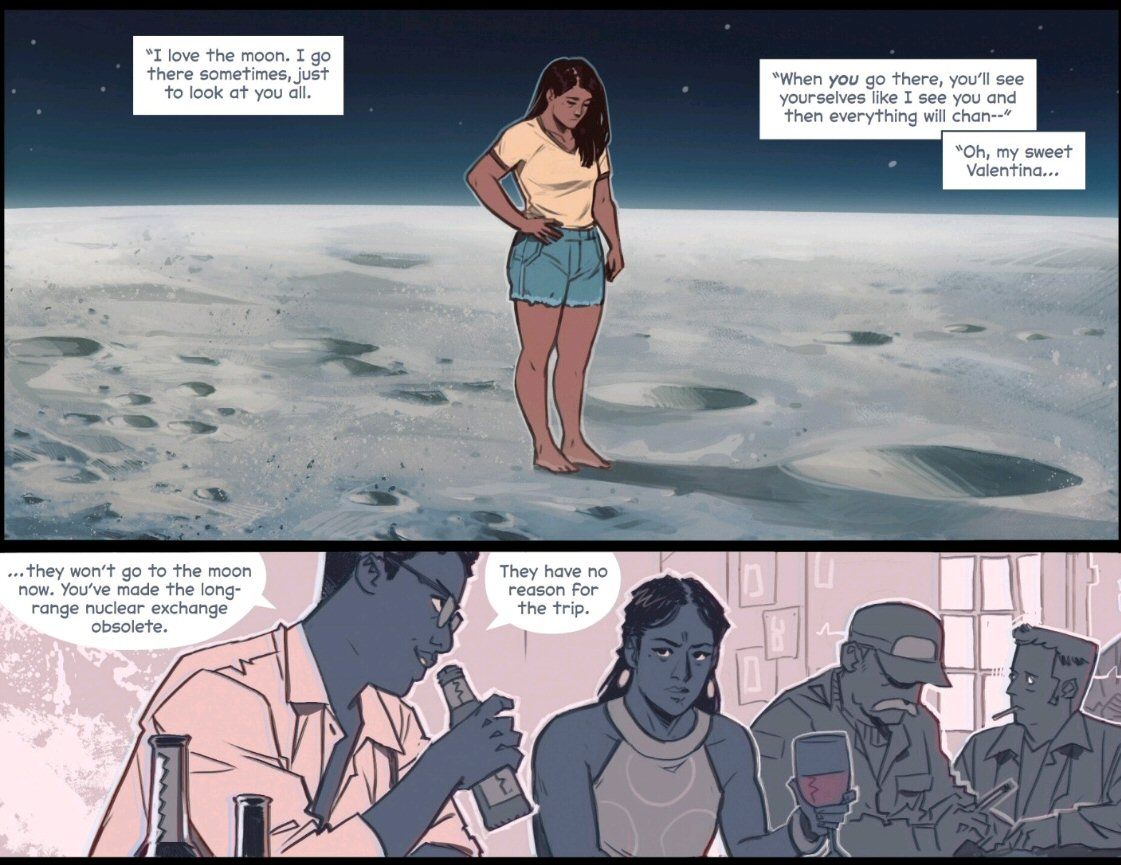
Many may have missed the significance of this quiet scene in light of the world-shattering events going on around them. Why, it is almost as if Gillen is trying to bury the lede here! 😉 But to me this is one of the key moments of this entire arc. It explains the true problem with Valentina and why I always thought her existence would ultimately doom this world: her interventions infantilize humanity.
In effect, and in keeping with the Superman motif for Valentina, it is as if we are discovering that Lex Luthor was right all along! Valentina’s presence keeps humanity infantilized, and prevented from undergoing the necessary growth that being better requires. What a great subversive reading of the classic Superman trope by Gillen.
The arrow of time
So, why was I berating myself for not anticipating this time-loop ending?
Because throughout the series (at least three times that I can recall) we have been treated to images like the one below (from issue #14), explaining the nature of reality for this series’ characters:

I always took the point of these images as contrasting the unchanging nature of heaven and the infinitely changing hell. But I should have paid better attention. I now realize that the true point of these repeated images was to tease that “little thread of linearity” in-between that both we and the TPF characters live on – the one that has a defined sense of time that the other dimensions don’t. The always-depicted arrowhead for our shared line of reality in these images was the tip-off.
You see, most of the underlying chemistry and physics that actually makes up our true reality, at a microscopic, quantum, or fundamental level (literally from Newton to Einstein!) is actually “invariant” to time. That is, it shows what is known as time-symmetry – the math works equally well to describe it going forward or backward in time.
Gravity is a good example of this – throw a ball in the air and it slows due to the gravity, eventually arcing back down to the Earth, and accelerates on the way down due to gravity. Run a video of it backwards and it look exactly the same as forwards. In contrast, consider recording a video as you knock a raw egg off the counter. The reverse video of a splat on the ground reforming itself into an egg and jumping back onto the counter is a dead give-away that you are watching a reverse video – that doesn’t happen in real life.
This is what is known in physics circles as the arrow of time problem: why does much of the macroscopic world behave with obvious time-asymmetry, when it is based on underlying time-symmetrical principles?
Put another way from my own field of neuroscience: why do we remember the past and not the future? It may seem like a ridiculous question to you (much like the splattered egg reforming!), but it actually isn’t. If you’ve read my discussion of identity and free will in my Vision overview, you will see that the only interpretation consistent with modern neuroscience is compatibilism. If you accept the causal and biological determinism that informs that position, then it becomes an open question as to why we don’t remember the future (or put another way, why do we think we can change the future but not the past?).
For the last several decades, the answer to the arrow of time problem has been clearly accepted as stemming from thermodynamics and cosmology – that is, overall entropy is always increasing in a closed system (the second law of thermodynamics) and we are on the path of an expanding universe since the Big Bang. This is the fundamental explanation as to why all the other observed arrows of time (including our memory and subjective perception of the flow of time) point in the same direction. We don’t remember the future because that would require retrocausality, and that is not the way the thermodynamic arrow of time points. This arrow of time is ultimately the reason for the non-reversibility (and thus time-asymmetry) in our brains – it literally sets the direction of information flow in neural circuits.
This creates an interesting dichotomy between a theoretical physicist and a neuroscientist. Time is ultimately an open question for a theoretical physicist. They generally try to think about the whole of spacetime as a single, unchanging four-dimensional entity (the so-called ‘block universe’, more formally known eternalism). This makes temporal matters simply a question of relative perspective, as all times are equally “real”. Traveling back in time has thus always been an area of theoretical consideration – the distinction between the past and the future simply requires you to consider thermodynamics.
For a neuroscientist, it isn’t that open: the arrow of time has physiologically oriented our thinking for us, by always pointing one way. So, we remember the past but not the future, and we feel we can change the future but not the past (although again, check out my Vision identity overview on that last point). In essence, the past no longer exists for us – the present is the only thing that feels real (although once again, our sense of the present moment is also largely a construct of our consciousness). My point here is that literal time travel to the past has always seemed like science fiction to us, by the very nature of how our brains work. After all, you can’t travel to a previous moment that no longer exists (or can no longer be changed, from our subjective experience).
This is why I (and likely most of the other readers) didn’t see where Gillen was leading us, despite his being very clear on multiple occasions. You see, Valentina comes from heaven – where it has been repeatedly stated there is no time (and thus, no time-asymmetry). As such, Valentina’s thought processes and abilities are presumably not as limited by the arrow of time that orients all of our thinking and perceptions. In essence, Valentina is the ultimate theoretical physicist coming directly from the block universe (assuming some lingering awareness of where she came from). She may thus be unbound by the restrictions the arrow of time has placed on us mere mortals, and can see spacetime for the true four-dimensional entity that it is presumed to be.
Where is this series going?
It is an interesting question to me as to why this unchanging heaven would care to maintain the strict linearity of our time-asymmetrical reality. That is, why does “god” tell Valentina not to time-travel, and threaten that she won’t be allowed to return if she does? Again, it’s hard for us to wrap our heads around this idea of eternalism, where all existence in time is equally real. But perhaps it is because of Valentina’s intent to change what has (always?) happened?
Time travel has always been theoretically feasible in the block universe, but there is disagreement among physicists as to whether that means it is static or not (or even if it is demanded by relativity). Physics is more of a process, and stasis would imply an external time variable that constrains the four-dimentional spacetime (which there is no evidence for). But that seems to be exactly what “god” in the TPF is demanding – keeping it static and linear, even though Valentina clearly has the ability to alter it.
This conundrum reminds me of the Old Testament God planting the Tree of Knowledge of Good and Evil in Eden and instructing Adam and Eve not to taste its forbidden fruit. What’s the point of providing this clear possibility to your own creation, but then demanding they deny it to themselves?
The typical interpretation of that bible story is that eating the fruit represented the transition from innocence to moral independence, where humans sought the ability to determine right and wrong for themselves, rather than relying on God. As the writer of a blog premised on how the normative ethics of comics can serve as moral philosophy primers in helping you make your own choices, that doesn’t sound like a bad thing to me. 🙂 Of course, we know how it ended for Adam and Eve in that story. But I can’t help but I wonder what this means for Valentina’s character as we go forward from here.
Gillen is a master of dealing with thorny theological questions (see my discussion of Eliza and Thomas Aquinas in my introductory post, and my earlier A.X.E.:Judgment Day conclusion). I’m sure he has thought through a rationale for all of this. Indeed, I suspect this plot development – and the implications it will have for Valentina – has a lot to do with how the series will finally wrap up. I look forward the Aquinas-level theological knots that Gillen will wrap us all up in!
This brings me back to the initial point I made in the intro to this post – Valentina is the key to understanding this series. She finally seems to be unmoored from her (previously) unchanging intuitive moral core. I can’t help but come back to this scene from issue #8, when she admits to Eliza her conflicted feelings about the Queen, and her frustration of repeatedly going around repeatedly on the same issues with the other superpowers:
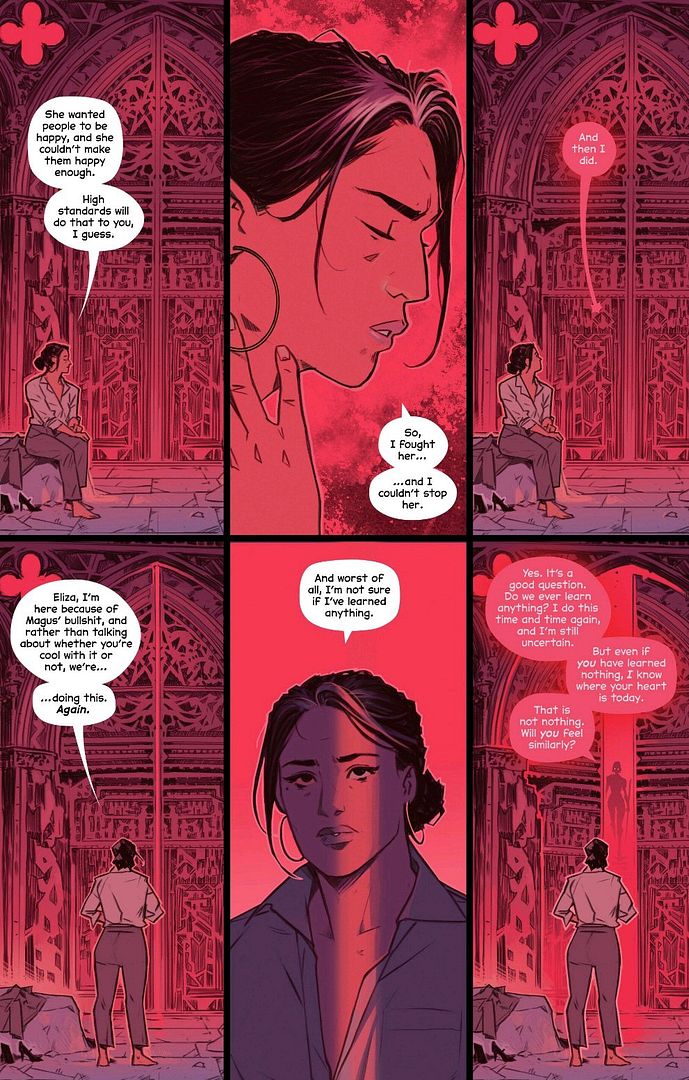
Has Valentina ever really learned anything in this series? Has she really changed before now? Oh, her biological form has always appeared to age (and her fashion sense has grown!). But she has remained stubbornly consistent across most of the run so far. Back in issue #13, she first articulated the need for a virtue ethics perspective – which requires growth. It seems we will now have the chance to see what that means for her now that the future (and the past) are no longer set.
Hopefully you can see now why I feel even more confident in saying that this series really does revolve around Valentina in the end.
The last word … for now
Continuing the literary theme from my intro, Gillen’s work on this series also reminds me of an approach taken by two well-known philosophical writers: the French philosopher Albert Camus (‘L’Etranger’, ‘La Peste’) and the American philosopher Robert Pirsig (‘Zen and the Art of Motocycle Maintenance’, ‘Lila’). Although Camus also wrote philosophical texts, they both dramatized their philosophy through works of fiction.
From those examples, I have long seen the potential value in approaching philosophical concepts indirectly. As Pirsig’s main character in his first semi-autobiographical novel eventually explains (after a shocking reveal about his past), it can often be necessary to approach these matters “sideways”. Directly addressing the issue early on would have been disastrous in that story, due to our preconceived ideas and biases. It order to get his point across, he had to take a meandering route. I feel that Gillen is doing exactly the same thing in the TPF.
This series is also a testament to the value of collaboration in the comics medium. I can’t help but be impressed by the economy of Gillen and Wijngaard’s dynamic. It feels like nothing is wasted, nothing is unnecessary in this series. There is intentionality behind every plot choice, every bit of dialogue – and potentially the framing of every panel.
That economy is even on display in the decision to continue the series beyond issue #16. Gillen had long teased that the series could end on that issue or have a full ~30-50 issue run. I suspect most assumed (like I did) that would mean leading up to a very different early ending by issue #16. But I can see now that the only thing that had to change was the afterword in that issue, where Gillen confirmed it will be continuing after a brief hiatus. They could brilliantly have ended the series right there without needing to make a single change in any of those issues up to now. Well done!
Personally, I can’t wait to see what the new time-loop will bring – and in what novel ways it will eventually fail. I expect we are in for a unique take on the Groundhog Day time-travel premise – although The Good Place might be a better analogy, as I expect we will see virtue ethics growth of all of our main characters along the way. And just like The Good Place, I’m confident this series will have something interesting to say in the end about the nature of reality in the end (beyond heaven and hell). So maybe a little teleological as well as theological.
I don’t know what Gillen has in store for us, but I do know it should be a helluva ride.
Further Reading
For more Power Fantasy: The Power Fantasy Introduction
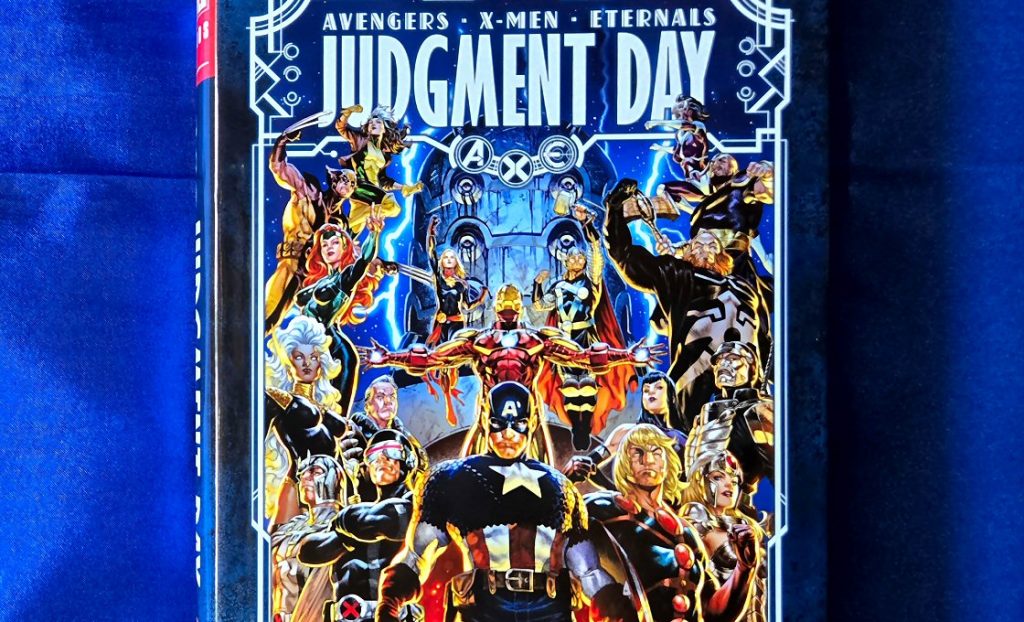
For more Kieron Gillen: A.X.E.: Judgment Day Conclusion
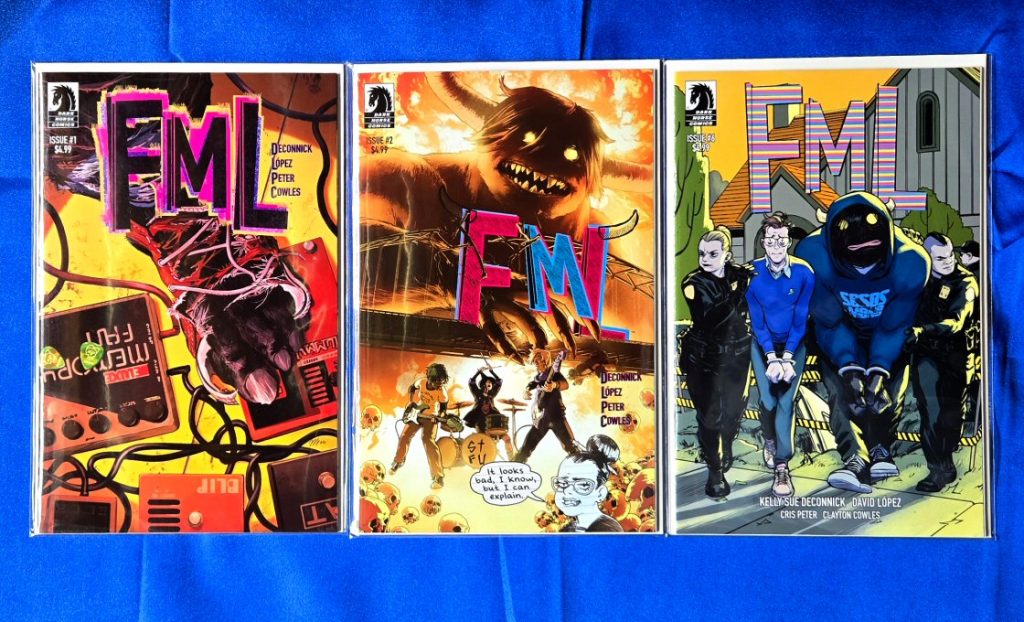
For more philosophical comics: FML
See my Glossary post for a list of the key philosophical concepts and related links on this site.
I received a good question from my Reddit post on this topic by user msr4jc: “I just finished the series and I love it! But I don’t understand how a character like Valentina wouldn’t be a good thing? How does she “infantilize humanity”? Genuinely asking, sorry”
To clarify my reasoning in a bit more detail: it’s a good question – and one that Gillen’s keeps subtle in the series.
The Cuban Missile Crisis is a good historical example – the closest we have ever come to nuclear war. Both sides engaged in one-up-man-ship, leaving little to no room for the other to back down. Once one side was caught in an untenable position (Khrushchev’s missiles in Cuba), it rapidly escalated to the point that near no-return (Kennedy’s blockade). Someone had to back down (Khrushchev) and the other made concessions (Kennedy), that eventually led to a series of agreements that de-escalated tensions.
In the TPF world, that didn’t happen because Valentina interfered first, destroying both sources of weapons that triggered the event. Rather than facing the horror of what they had almost done – and learning the valuable lesson of de-escalation – both sides were protected from that outcome. They learned that they don’t have to solve their own problems, someone else will come along and do it for them – thus remaining infantilized and protected from the outcomes of their actions.
It isn’t just the avoiding the bad outcomes – a side-effect of US-Soviet nuclear arms race was intercontinental ballistic missile development, which directly facilitated the “space race” to develop spaceflight capability, and eventually a moon landing (and ancillary and related technological development). So the Cold War competition had positive developments – which have also been prevented by Valentina’s involvement in limiting the strategic value of missile development. Gillen cleverly inserted this point during the destruction of the Earth in that flashback discussion with Etienne in issue #16.
Valentina’s (i.e., Gillen’s) own inflatable bumper analogy in bowling (issue #3) is a good one – while initially it helps by preventing kids from getting too discouraged when first learning to bowl, the bumpers soon have to come off it they are ever going to develop the skills to bowl well independently. The continued presence of those bumpers (Valentina’s continual involvement) is literally keeping the kids – and by extension all of humanity – infantilized.
Then there is my Superman analogy. Gillen knows his superhero mythos well, so I have to believe his decision to have Valentina constantly move between families in childhood was deliberate – to prevent the virtue ethics development than the Kents are always portrayed as providing to young Clark in the comics. It was a major feature of the mid-1980s Superman comics (and onward), seen as a maturing of Superman’s ethical core beyond deontology. Note the Kents don’t tell Superman what to do – he just learned the habitual practice of constantly striving to be better from their example. Some writers (like Mark Waid) prefer the Kents be dead during Superman’s adulthood, to prevent a lazy trope of having him run back for advice.
It also relates to the original explanation Lex Luthor provided for his opposition to Superman – his constant “saving” of the planet prevents humanity from developing the skills to protect themselves (and advance in their own development). By having a parental-like figure always swooping in and saving us, we are prevented from learning to stand on our own, and make better decisions. To grow, in other words.
Valentina’s presence thus stymies a virtue ethics growth for humanity, by always taking the decision out of our hands. And I don’t think she has learned that lesson yet – her plan to re-do world events from 1966 likely won’t turn out any better, as she doesn’t seem to realize yet that her presence is the problem. Jacky was right in issue #10 – humanity will never be free while Valentina is around.