

In my last post, I looked at some of the strengths and criticisms of care ethics, and made a suggestion as to how to manage conflicts between people who prefer different moral judgements (that is, who apply different normative ethics theories). In this post, I would like to give an overview of what modern neuroscience says around how we make these sorts of moral decisions.
This will be my first (and possibly last?) post without a direct comic book tie-in. But I’ll throw in a few colorful stills from the neuroanatomy coloring book shown above to tide you over. 🙂
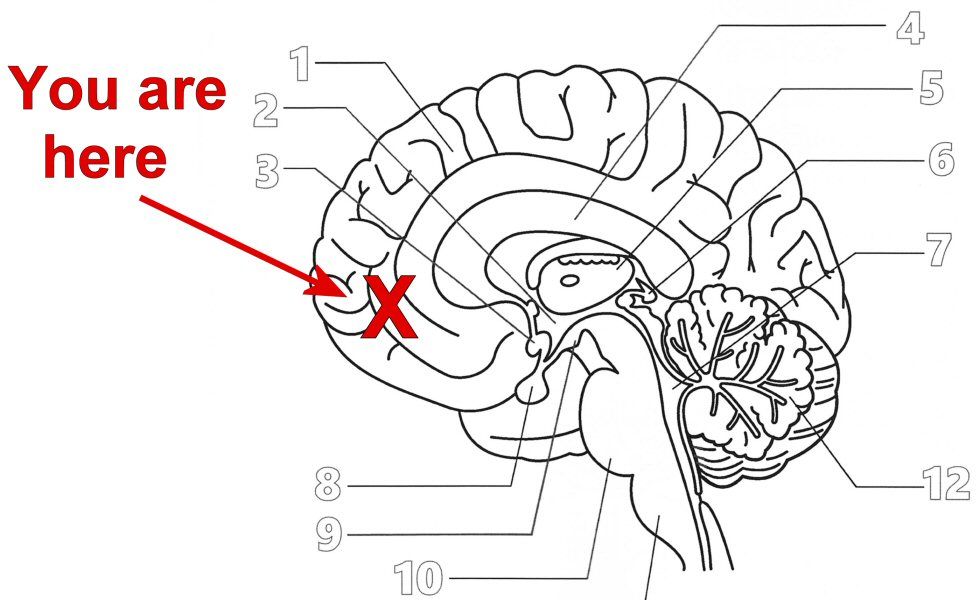
As always, if you would like to know more about the terms I’m using on this site, please follow the links throughout or check out my Ethics 101 page or Glossary post (located on the header and sidebar respectively, if you are on a computer screen).
Introduction
Some of you may recognize the play on words of my title: I’m taking it from the title of Daniel Kahneman‘s best-selling book on human cognition – Thinking, Fast and Slow – from 2011. Kahneman was an Israeli psychologist and co-winner of the 2002 Nobel Memorial Prize in Economic Sciences with Vernon Smith. Along with American psychologists Keith Stanovich and Jonathan Evans, Kahneman is considered a “founding father” of the dual process model of human cognition. Kahneman’s early research focused on cognitive biases, but the dual process model applies equally well to how we make moral decisions.
The “dual” distinction is between what is often referred to as a more intuitive (“fast”) versus a more deliberate (“slow”) mode of thinking. The original terms for these in the scientific literature were “system 1” and “system 2” (yeah, I know, we neuroscientists sound like a lot of fun at parties!). But the old labels have stuck around, along with fast/slow and intuitive/deliberate, because it’s helpful sometimes to think of these as the first (fast, efficient) approach your brain will use to solve a problem (“system 1”), and only switching to a second (slower, more energy-consuming) way of thinking about it more deeply (“system 2”) when needed.
Although this may be a new idea to many, the dual process model has actually been the dominant theory in human cognition since at least the late 1960s. The more technical “systems” language gets away from having to be specific about the precise locations in the brain, or the exact timing speed of what is fast or slow, and avoids using value-laden terms that could have different meanings (like “intuitive”). See, maybe you do want us at your parties after all!
But this advantage is also a limitation. Unless you can set some explicit parameters, you can’t rule things in or out experimentally (in the language of science, a theory needs to “falsifiable” for it to be valid). Moreover, if you jump down to the end of that Wikipedia entry on Kahneman’s book, you’ll see the section on the “replication crisis” in regards to some of the science behind his book. Note that the reproducibility crisis in psychology and neuroscience – where early published studies with positive findings (which are often based on small sample sizes) are not replicated when attempted again by later independent investigators with larger groups – is a very common problem.
But in terms of the science behind the dual process model, we now have enough replicated (and failed replication) studies over more than 50 years to develop a more sophisticated model of what is actually going on in the brain. I will explain below what that looks like in terms of the evidence on moral reasoning. But first, I do need to explain some of the terms that come up in these studies, and how the studies are designed.
Ding, ding goes the trolley …
When it comes to moral decision making, you can’t really test it in model systems (like lab animals in a cage, or tissue slices in a dish). And so, a lot of the data on moral reasoning comes from putting humans in imaging machines and directly measuring what goes on in their brains in real-time. But you also can’t create real moral problems for people while they are lying inside a brain scanner. So instead, neuroscientists have relied on the previously developed moral dilemma thought experiments created by philosophers and ethicists.
These thought experiments were originally designed as ways to make points in philosophical debates of the different normative ethics theories. They are typically highly abstract, extremely specific, and with absolute certainty as to possible outcomes – and sometimes funny or at least wryly amusing (social scientists typically look for the laughs wherever they can get them). I describe in some detail the most infamous moral thought experiment – the Trolley problem – on my Ethics 101 page.
Of course, these thought experiments are not realistic to real life and suffer from issues of validity for neuroscience experiments. But they are standardized and well studied in the social science literature and can be easily given to people lying in a scanner (with not much else to do!). Please follow the trolley problem link above for a detailed explanation and example of what these moral dilemmas are like.
As I explain in the introduction to my Ethics 101 page, I find it convenient to use the normative ethics framing when discussing moral decision making (as do virtually all the neuroscience research studies). There are three main branches of normative ethics theories as I describe on that page. Deontology is concerned with doing your duty to other people, often through the lens of universal rights or justice. These theories are often highly abstract, rule-based and focus on the moral value of the acts themselves (that is, doing the right thing). Consequentialism is often seen as the opposite view, focusing not on acts but rather on their outcomes. These theories typically focus on the moral burden of making good decisions (that is, doing the good thing). Utilitarianism is the most common form today – ensuring the greatest good of the greatest number – and is often used synonymously with consequentialism (although I prefer to use the broader label because there are other less common forms). Finally, virtue ethics shifts the focus from the act to the actor – being the best person you can be, typically by practicing virtues that align with your values and personal goals (that is, being better).
Neuroanatomy associated with moral decision making
When discussing the brain, we often talk about “circuits” or “networks” – these are connections between neurons within a defined part of the brain, or across different brain areas. There are lots of different kinds of neurons, with different neurotransmitters used to communicate with each other. You have probably heard that the brain runs on electrical impulses – which is true, but neurons are rarely directly linked electrically. Instead, they typically release chemical messengers (called neurotransmitters) that activate or inhibit the chemical or electrical activity of other neurons. This intermediate step makes things a lot more complicated, of course – but it also allows for far more sophisticated regulation and control of brain activity (this is what I studied in my early career, for dopamine neurotransmission in motor control and reward pathways).
In case you want to skip over the brain anatomy portion of this overview, you can jump right down to the dual process system model. You don’t need to understand the anatomy to follow the discussion of how the two systems work (although it helps!). Note that all references cited below are available at the end of this post.
The Wikipedia “neuromorality” page gives a pretty good introduction to the main brain regions involved in moral decision making. I’m going to highlight a few here, as they come up a lot in moral decision making studies. Note below that “cortical regions” refers to the newer and most evolutionary-developed parts of the human brain (the cortex, or cerebrum), and “subcortical regions” refer to older areas that are well-conserved across evolution for many species.
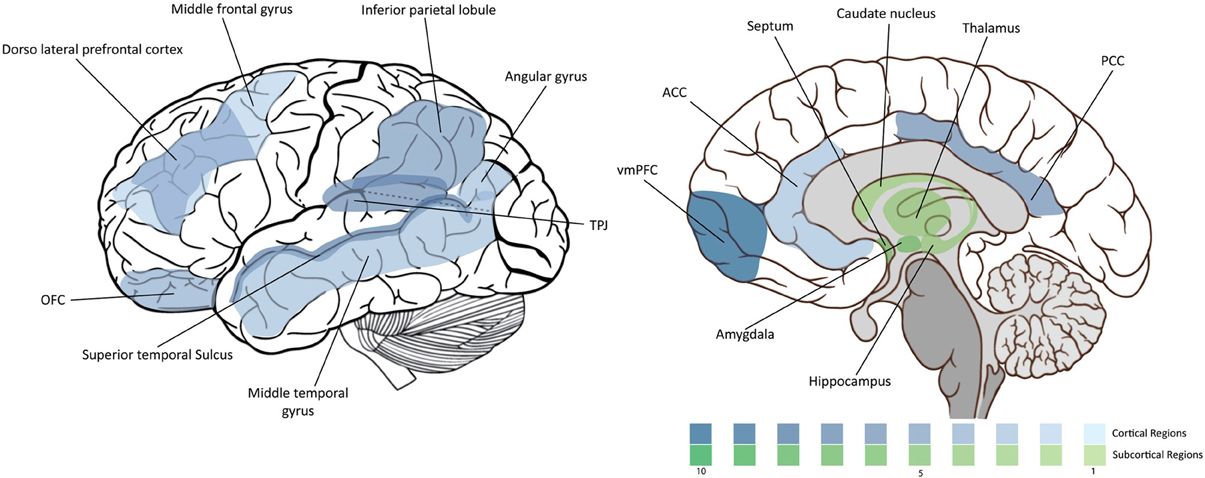
The relative shading above shows the areas that are the most involved in responding to moral dilemmas, based on brain imaging studies (darkest shades of blue-green). Arguably the most significant player in terms of moral decision making is the prefrontal cortex (PFC). This is a big part of the frontal lobe of your brain. It is responsible for what we call “executive functions” – these include planning, decision making, problem solving, paying attention, impulse control, and responding to social cues.
Simply put, the PFC is the major brain area that makes you you (hence my introductory image). If you have damage to this area, people close to you will notice you are not the same person anymore. Sure, you may still remember everything that happened to you in your life and know everything you’ve learned – but you will not be acting in the same ways as you used to. The PFC is the area that gives you the most conscious control over the entire process of moral decision making.
There are three specific regions of the prefrontal cortex (PFC) that are the most relevant for moral decision making: the ventromedial prefrontal cortex (vmPFC), the dorsolateral prefrontal cortex (dlPFC), and the orbitofrontal cortex (OFC). These sub-regions of the PFC do not have clear demarcations, and there are disagreements as to how far they extend (e.g., many would describe the vmPFC as extending more to the bottom-right in the diagram above). They are defined on the basis of the connections they have to other brain regions. Oh, and “ventromedial” and “dorsolateral” are just from the Latin words for “stomach-middle” and “back-side” (using the orientation of an animal body: your stomach is the front, your back is in the … back). So, the front-middle and back-side of the PFC, respectively. The OFC is located directly above your eyes.
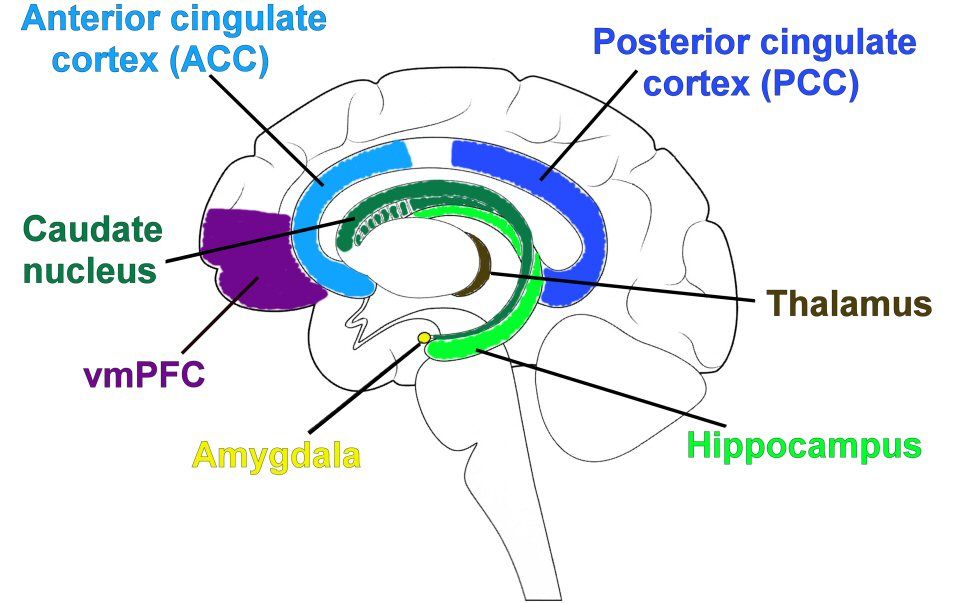
These regions of the PFC do very different things. The vmPFC is the most significant player, and integrates emotional and social information when making moral decisions. It is often described as the key area for weighing the emotional significance of actions and their outcomes. It is heavily connected to many other parts of the brain, receiving inputs from many of the key subcortical areas (known as the limbic system, including the amygdala, hippocampus, and thalamus) and in turn sends out signals to those areas and other cortical areas like the rest of the PFC and the anterior and posterior cingulate cortices (ACC and PCC). See below for my coloring of some of the key structures, from a median section showing the limbic system from the Neuroanatomy Coloring Book by Summer Q.S. Park:
Patients with damage to the vmPFC are known to have impaired emotional responses to moral dilemma problems (Ciaremelli 2007, Moretto 2010, Thomas 2011) and are a lot more likely to make seemingly utilitarian (consequentialist) judgments (Koenigs 2007). But again, that’s in terms of classic moral dilemma problems like the trolley problem (which only measures certain aspects of utilitarianism, like the willingness to coldly sacrifice others). Simply put, when people are asked to face moral dilemmas, the vmPFC seems to help to weigh the emotional consequences of different choices – and so, damage to this area impairs your ability to do that.
On the other hand, the dlPFC is involved in cognitive control and more deliberative processes. It helps in regulating impulsive responses, and seems to allow people to apply more abstract moral principles, or to make reasoned decisions. Simply put, it seems to be involved when considering the long-term consequences of moral decisions, or when adhering to social and societal norms (Garr 2024).
The OFC (which extends further inward from the PFC) similar helps integrating rational thought with emotions but also brings in reward signals. It is closely connected with the subcortical thalamus (which relays a lot of motor and sensory systems into the cortex) and the caudate nucleus (which is involved with movement and learning, but is also part of the brain’s reward system). The dopamine-driven reward networks help shape the value we place on moral decisions.
The amygdala is a critical subcortical region of the brain, known for its role in processing emotions (particularly fear, anger, and disgust) and for linking emotions to memories through the rest of the limbic system (like the hippocampus, see below). It plays a key role in responding to threats, and allows us to detect and respond to moral problems that are emotionally charged. And fun fact: amygala is derived from the Greek name for almond, reflecting its relative size and shape in humans.
Activation of the amygdala can alter the intensity moral emotions, which can in turn greatly influence how we perceive and react (Rolls 2023). Note that despite it having discrete external boundaries, it does have internal divisions, and the emotional integration that I describe above is most closely associated with the central-medial amygdala. Interestingly, patients with damage to the basolateral amygdala (which has been associated with goal-directed decision making) have been reported to make more deontological judgments (Van Honk 2022) – but of course, with the same caveats as above for the vmPFC studies.
The hippocampus is another critical sub-cortical structure – it plays a pivotal role in memory formation (specifically, it converts short-term memories into long-term ones), and in spatial navigation. Its name is derived from Greek for “seahorse”, due to its unusual appearance (I am not making this up, I swear!). If you had your hippocampus completely damaged or removed on both sides of your brain, you would lose the ability to form new memories (anterograde amnesia) – but everything you learned before you would still remember. This actually happened once (to a famous patient known as H.M., or Henry M.) who was studied for decades. It is also the basis of the fictional plot of the 2000 film Momento, by Christopher Nolan. There is evidence that patients with hippocampal damage are also more likely to give detontological responses, and for apparently emotional reasons, similar to the amygdala studies above (McCormick 2016, Verfaellie 2021). Again, see below for my artistic interpretation of these structures:
Given its location near the PFC and OFC, the anterior cingulate cortex (ACC) also helps to integrate emotional and cognitive aspects of moral decisions. It seems to primarily allow you to detect conflicts between moral values and possible actions, helping you to make more balanced decisions (Cui 2021).
The temporalparietal junction (TPJ) is at the meeting points of the temporal and parietal cortices, and helps with integrating information from internal states (through the thalamus), the rest of the limbic system, and external inputs from the body’s sensory systems. This area is important in helping you predict and interpret the behavior of others, and thus contributes to your ability to make fair and empathetic moral judgments.
Finally, the insular cortex (insula) (not shown in the diagrams above) is a hidden lobe buried deep within the lateral sulcus (in front of the TPJ). It is similarly involved in integrating internal bodily states, cognitive functions, and emotional experiences, and is a key area where these converge to form conscious feelings (including empathy, guilt and shame). The insula seems to play a major role in how you respond to harms and fairness, helping you feel the emotional weight of moral transgressions (Chen 2023, Wu 2023).
Dual process model for moral judgements
It wasn’t until the very end of the 20th century that the technology used for brain imaging studies advanced to the level where we could use it to explore in detail how our brains worked. If you looked at the initial moral decision-making studies from the first half of this millennium – and the selective brain damage ones in particular – it seemed like consequentialist and deontological judgments were driven by different brain regions and processes. Indeed, this was the conclusion of one of the most influential figures in moral decision neuroscience research, the American experimental psychologist Joshua Greene.
Greene pioneered many of these early imaging studies. He quickly came to believe that deontological judgments were typically preferred as automatic emotional responses (that is, intuitive, system 1 processes), and that consequentialist judgments were typically preferred by conscious cognitive reasoning and control (deliberate, system 2 processes) (Greene 2002). He later wrote a book describing this in some detail, Moral Tribes, along with his preference for utilitarian modes of thinking in guiding moral decision making. (Greene 2013).
The core idea to this view is that you start out by default with an emotional deontological response (system 1) to a moral dilemma. According to Greene, taking a consequentialist response requires you to engage in slower system 2 thinking, allocating cognitive resources to override the intuitive system 1 deontological response (Greene 2007, Paxton 2012). But as the moral stakes or relative risk (to ourselves or others) increase, the emotional pressure rises, causing you to switch back to the emotional deontological response.
At the time, this fit with the popular view that consequentialist approaches (like utilitarianism) required more complicated weighing of future outcomes. But as you may imagine, deontologists weren’t thrilled by this model – it made their decisions far less reasoned, and instead more rationalized after the fact. It also ultimately made deontology the slave to emotion (Kant would be spinning in his grave if that were true!).
But as it turns out, that is not the whole story – and in fact, there are some pretty big problems with this simplified model. A large international group (Cova 2018) examined 40 of the most influential neuropsychological findings of the previous decade and found that while over two thirds were successfully replicated (which is surprisingly high), Greene’s two highly cited moral decision-making papers of that time period failed to replicate.
In any case, it turns out that there are a number of greater problems with the dual process model of human cognition in general, beyond moral decision making.
A new revised dual process model
There was a review paper that made a big splash two years ago by French experimental psychologist Wim De Neys, Advancing theorizing about fast-and-slow thinking in the journal Behavioral and Brain Sciences (De Neys 2023). In this tour-de-force, De Neys rigorously summarizes the state of research into the dual process model of human cognition, and points out two big, related problems (and how to fix the model).
The first problem is what he refers to as exclusivity. A common feature of all dual process models is the presumption that the fast, intuitive system 1 and the slow, deliberative system 2 generate uniquely different responses. Moreover, everyone also assumes that the slower system 2 responses are beyond the ability of the faster system 1 to generate (by definition). But his review of the research evidence in key fields (including moral judgments) shows that there is no good basis for this exclusivity presumption. Indeed, in terms of moral judgments specifically, it turns out that the brain can generate utilitarian (consequentialist) responses pretty quickly, within the system 1 time frame (some of his own studies demonstrated this, but many other groups as well).
The second problem he identified is with the switch feature inherent in all these dual process models – how, exactly, does your brain decide to shift from the more intuitive system 1 to the more deliberate system 2 processing mode? And for that matter, how does it decide enough processing is enough and stop? I will skip the technical details here, but it turns out that all the proposed switching mechanisms in this field are problematic – in part because they all required exclusivity (which we now know is not the case). Most of them also leave the decision up to system 2, which he convincingly demonstrates is not possible.
De Neys made an incredibly powerful and novel contribution here – he proposed a more viable dual process model that is consistent with all the available evidence. And, crucially, a model that can be experimentally tested and validated further.
His basic conceptual model is captured in the first Figure below from his publication (available in free preprint form from his personal website). Don’t worry about the graphs below – I will walk you through everything step by step. From De Neys, W. (2023), Advancing theorizing about fast-and-slow thinking. Behavioral and Brain Sciences, 46, E111:
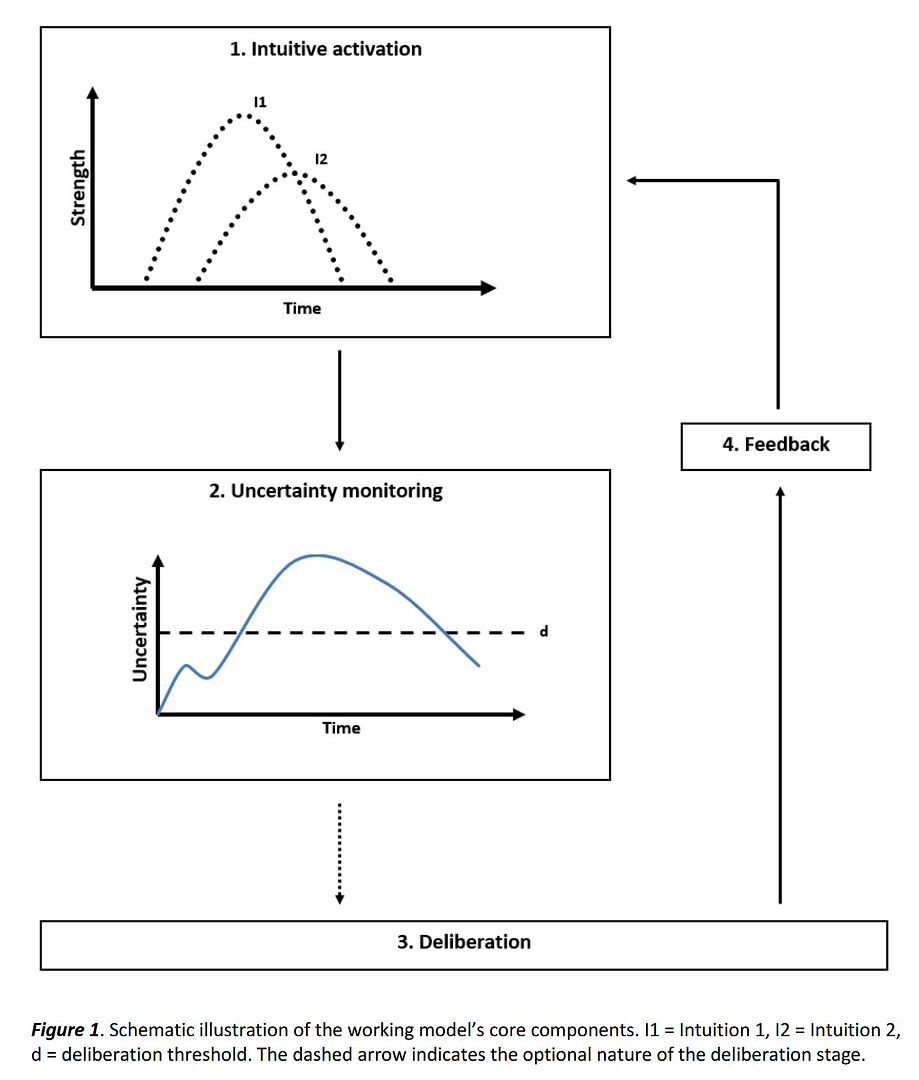
The idea is that you can have multiple system 1 intuitions (a simplified theoretical example is given in the first box above, with two intuitions, labeled as I1 and I2). These could be separate deontological and consequentialist moral intuitions, for example. The timing of these are not exactly the same – one can take longer than the other to develop in the brain – but both are relatively fast, intuitive, system 1 processes. They also don’t have to be equally strong at their peak, or last as long – one could be weaker in response than the other.
The key is the second step above, labeled uncertainty monitoring. Here, some process (contained within system 1) is comparing the relative agreement of the two intuitions. There is good precedent for this. Recall how I once explained that our brains fundamentally operate as prediction engines – and specifically look for prediction errors by matching signals that come in against what we expect? De Neys is proposing that is what is going on here too. Imagine you have a deontological intuition that starts giving one answer – but then a consequentialist intuition kicks in giving the opposite answer. As these two processes grow in strength (even if one is weaker than the other), you are going to have increasing uncertainty over time (as shown in the second box).
This uncertainty is the signal that triggers the system 2 deliberation in De Neys’ proposed model. Crucially, the deliberative system 2 processes (once triggered by system 1) continuously feed back into system 1 to adjust the relative strengths of the initial two intuitions. He shows this step in more detail in his Figure 2 from the same publication:
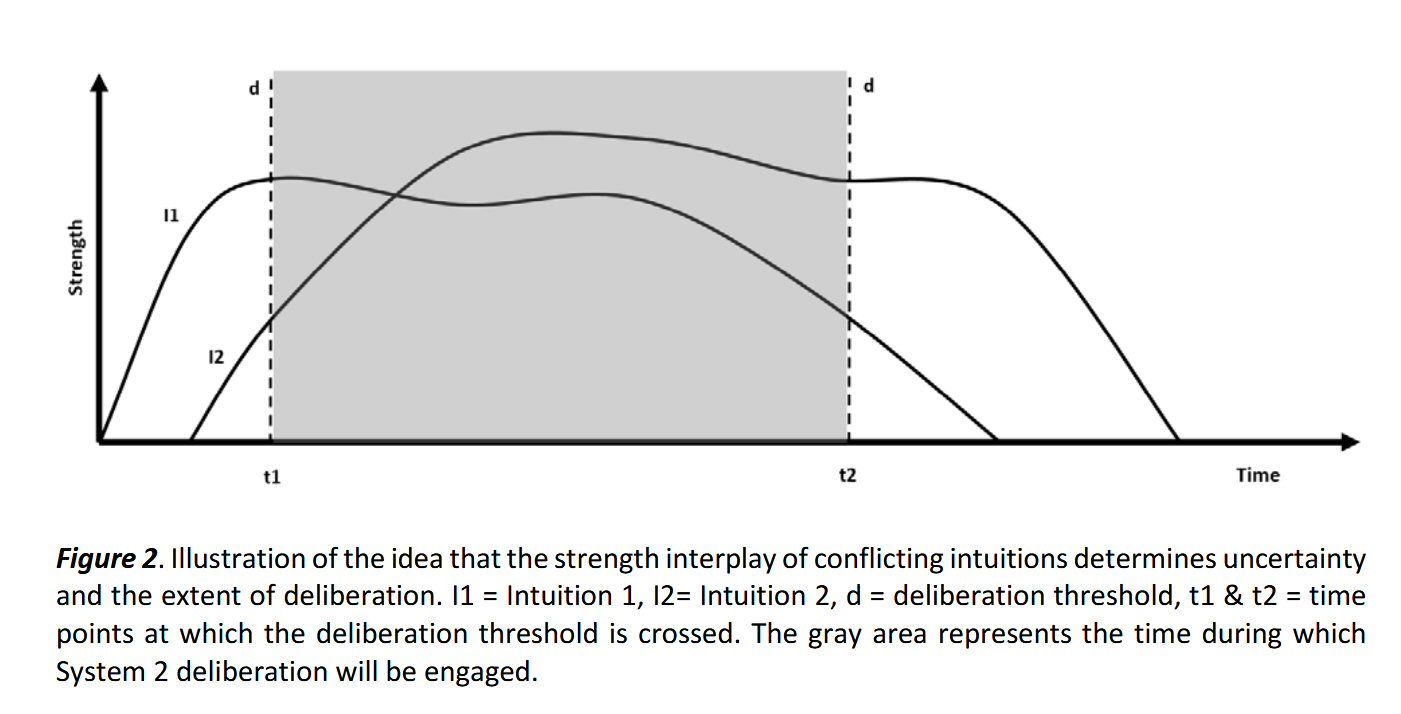
The gray shaded area is when the system 2 deliberation (labelled as d) kicks in and off in his model. To use the same example, imagine that I1 is deontological and that I2 is consequentialist. The deontological I1 intuition kicks in first and builds in strength and then starts to drop down – but then the consequentialist I2 intuition starts to kick in by that point, leading to greater uncertainty (because they are recommending opposite actions). At some point in time (labelled t1), that uncertainty is great enough that a threshold is reached within system 1, causing system 2 deliberation to kick in (at system 1’s request).
Note that system 2 doesn’t work in a vacuum in this model. Instead, it is constantly providing feedback on the intuitions in system 1. In this hypothetical example, this causes the deontological I1 to quickly level off in strength, while further enhancing the consequentialist I2 for even longer. But it is not an immediate resolution, because the relative difference between them is still too great (i.e., too much uncertainty still exists). Eventually, one of the intuitions (I1 in the case above) looses strength faster than the other (I2), and so the uncertainty drops below the threshold that triggered system 2 in the first place. At this point in time (t2) system 2 shuts off, and the decision is made: go with the now-deliberated consequentialist I2 intuition.
This elegant model does a great job of explaining the current state of the evidence in the research literature. From my reading of the subsequent responses to De Neys, it seemed to have been misunderstood by some as suggesting that the dual process model is wrong. But that is not what it is doing at all – it is providing an expanded dual process model that actually fits everything we’ve learned about how the brain makes decisions. I think what some don’t like is that it places a lot more power and responsibility back on to system 1 (as I will explain below).
The new model is also eminently testable for new theories. It could even help explain why people differ in their moral judgments to the same problem: not only do our personal fast system 1 intuitions vary in relative strength and duration (based on our experiences), but the discrimination cut-off level for system 2 deliberation could also be set higher or lower from one individual to the next. There are a lot of interesting new questions that this model raises.
Implications of the De Neys revised dual process model
While the above is of course a high-level depiction of how human cognition seems to work, it has some profound implications for how we think about moral decision making.
I particularly love how this model rescues system 1 processes. For most of the last 50+ years, the presumption in the field has been that we make bad decisions because we rely on biased system 1 processes for quick results (see my cognitive bias explanation). The system 2 processes were thus seen as a way to make better decisions through deliberation (although it was always unclear how and when these processes were magically invoked). But we have known for a long time that deliberation can also make biased or incorrect decisions. Ironically, as clever, thoughtful researchers, we were all biased to think that slow deliberative thinking is better than fast intuitive thinking – certainly in the absence of evidence either way, and sometimes even despite evidence to the contrary!
Another bias comes from the words we use to describe things – what does “intuitive” mean exactly? For a lot of people, they seem to imagine that means innate. That is, that we are born with a set of pre-programmed instructions (through evolution) that form our intuitive ways of thinking. But the evidence shows that is wrong too – it is clear now that intuitive processes can engage in simple algorithmic and hypothetical thinking, and they develop and learn from experience.
The problem is that intuitive responses are a black box to us – we know only the outcome, and we lack insight into our own intuitive reasoning processes (in the language of neuroscience, they are “cognitively non-transparent”). And so, we are dependent on our slow deliberative system 2 to give us an explanation of our own system 1 responses (which may or may not reflect the true system 1 reasoning!). This is again why I like the value-neutral labels of system 1 and system 2. System 1 is only “intuitive” in the sense that we aren’t cognitively aware of how it is working.
This raises the obvious (and fascinating) point as to whether the reasoning used in system 1 and system 2 is the same or different, regardless of what labels we use. Take the simplified case I suggested above with an intuitive system 1 deontological response and another conflicting intuitive system 1 utilitarian (consequentialist) response. When system 2 deliberation kicks in to help resolve the issue (ultimately decided in favor of the consequentialist response in the example above), how do we know if the system 2 consequentialist reasoning is the same as system 1’s original consequentialist reasoning? We don’t. That is the problem with simple labels like “deontological” or “consequentialist” – there is more than one way to be each of those things.
A lot of consequentialists seem to believe that we do a lot of explicit weighing of future options when coming to moral decisions (and thus those decisions are fairly decided based on rigorous analysis). But my experience of people who prefer consequentialism is that they often seem to decide things remarkably quickly, without time for that kind of cognitive processing. The research evidence now supports my observation – people can have very fast (system 1) consequentialist intuitions. But where do these come from?
While it is possible that those fast consequentialist system 1 intuitions are distinct and independent of the slow deliberate consequential system 2 processes, that doesn’t seem likely to me. The simplest explanation is that system 1 has learned – over time – from exposure to the preferred consequentialism of that person’s system 2 processes. System 1 may simply have found a way to quickly automate the preferred system 2 outcome for faster decision making (a learned shortcut, if you will). In any case, that is a question for more research to figure out – what we now know for certain is that no general outcome is uniquely exclusive to one system or the other. And as always, I encourage everyone to learn the true lesson from Occam’s razor.
Note the same is true for deontological processes too. While there is some evidence that deontological system 1 intuitions get triggered faster than consequentialist ones, that may not have any functional significance in the end if this new model is correct (and the evidence strongly suggests it is). Those who prefer to make deliberative deontological system 2 decisions can certainly continue to do so (and likely continue to train their fast intuitive system 1 processes). In the end, I doubt deontologists are any more slaves to their emotions than consequentialists – or virtue ethicists. We all learn to integrate our emotions with our reasoning, just as we learn to prefer different lines of reasoning.
For those of you who are interested in how deliberation (system 2) could work in more detail, De Neys has followed up this year with an exploration in Nature Reviews Pyschology (De Neys 2025). Basically, there are at least four main roles that researchers have come up with for system 2: (1) controlling or inhibiting system 1 generated responses that are not relevant, (2) generating new responses when there isn’t a system 1 response on hand, (3) justifying system 1 generated responses after the fact (since they are a black box to us), and (4) overall regulatory effort allocation (reflecting on how to allocate cognitive resources – basically, “thinking about thinking”). De Neys effectively argues that all of these are valid and not mutually exclusive (contrary to the presumptions in the literature), and that they in fact all likely share common subprocesses.
How to think about moral decision making
Despite a lot of previous pronouncements as to the seat of moral decisions in the brain, it is now clear that a lot of our moral decision making is ultimately learned across diverse systems and brain networks. That is, certain ways of thinking get strengthened from greater use, and others are weakened. Yes, we have emotional responses that influence our decisions, but these get integrated into our cognitive processes. Over time, we can adapt and change how we see things, based on experience – including within our fast, intuitive, system 1 responses. Selective damage to key parts of the brain will certainly impair moral reasoning however, leading to altered behaviors and actions.
Although I have been clear about my general preference for virtue ethics theories from the beginning of this site, I’ve tried to keep that in check and be as fair as I can to each of the other theories as they come up (see my Glossary for links to the specific discussions of individual moral theories). I do genuinely value the specific perspectives that each normative ethics theory brings. And as I revealed in my last detailed discussion of care ethics, my work experience has led me to believe that differences in moral judgments between individuals are often best handled dialogically, not dialectically (that is, fostering mutual understanding and acknowledgment of each other’s thinking, not trying to change it).
That personal experience also helped convinced me that are benefits to combining multiple approaches in our moral thinking. Initially, my reasoning for this was the lack of a clear “best” solution in moral philosophy that can apply in all cases (despite all the philosophers across millennia working to develop one!). But the current state of neuroscience research further backs up this personal perception – it is how our brains actually work to make decisions, by weighing our (trained) intuitive system 1 moral intuitions against each other and then resolving the difference through more deliberative system 2 cognitive input when needed.
The more you learn and understand the other approaches to solving moral decisions, the better equipped you will be to resolve your own internal dilemmas. Again, you can check out my Ethics 101 page’s normative ethics section for more info and links on the major theories. But it can also be worth checking out some of the minor ones that are listed on my Glossary page – like the consequentialist situational ethics based on agape (love), or the ones that seek to combine major theories, like virtue consequentialism and rule utilitarianism. Exploring the variety of options may open you up to new ideas that resonate with your experiences.
The last word … for now.
This is entirely my personal approach, and of course your mileage may vary. But I find it valuable to start with virtue ethics in terms of how to be – using a mix of both universal (Aristotelian or Stoic) and relative (care ethics) behaviors and trying through practice to make them intuitive and automatic (system 1). Layered on that is explicitly considering deontological and consequentialist approaches of how to act (and why), to complement deliberation (system 2) beyond my preferred virtue approaches. But I would also counsel you not to ignore your emotional intuitions – they provide a useful counterbalance to the (frankly) cold and calculating reason that is behind both Kantian ethics and utilitarian deliberation (to use the two most common examples of those theories).
You can certainly free to go the other way and start with deontological or consequentialist intuitions if you want, but I have concerns with that approach. The neuroscience evidence suggests that fast deontological intuitions are heavily influenced by negative emotions (specifically, fear), and psychological bias research shows it is hard to separate out our personal interests from the greater good (and thus a concern for our black-box fast consequentialist intuitions). It really seems to me that we should try to start with virtue ethics, since it is all about training yourself through the practice of virtues that align with your personal values. For example, if you value honesty, the routine practice of truthfulness should make it easier to respond honestly automatically when the situation is more challenging (without needing to engage system 2 deliberation).
But of course, the decision is yours to prioritize what ever modes of moral thinking you prefer, that best align with your values.
In any case, I hope you have enjoyed this behind-the-scenes peek into the neuroscience of moral decision making. It has been a rapidly developing field these last couple of decades, and it is great to see things finally coalesce into a cohesive revised dual process model that matches all the available evidence. It should generate many more insights in the years to come!
And with that, I will now turn my attention back to some interesting examples of normative ethics in modern comic books. 🙂
See my Glossary post for a list of the key philosophical concepts and related links on this site.
Further Reading

For more morality: Why be moral?

For more ethics theories: The Power Fantasy Introduction

For more neuroscience: Fantastic Four Vol 8, issue #4
References cited in this post
Note: You can quickly find these articles through a web search using just the DOI or PMID unique identifiers. However, most of the full-text articles on publisher websites are hidden behind firewalls that you would not be able to access without university library credentials. You can often find free full-text pre-prints of the articles on the lead authors’ personal websites or through archive repositories (like arxiv.org, biorxiv.org, psycharchives.org, etc.).
- • Chen T, Li Q, Peng M, Li X. Moral transgression modulates empathy for pain: Evidence from ERP and EEG data. Biol Psychol. 2023 Jan;176:108467. doi: 10.1016/j.biopsycho.2022.108467. Epub 2022 Nov 28. PMID: 36455804.
- • Ciaramelli E, Muccioli M, Làdavas E, di Pellegrino G. Selective deficit in personal moral judgment following damage to ventromedial prefrontal cortex. Soc Cogn Affect Neurosci. 2007 Jun;2(2):84-92. doi: 10.1093/scan/nsm001. PMID: 18985127; PMCID: PMC2555449.
- • Cova F, Strickland B, Abatista A G F, Allard A, Andow J, Attie M, … Zhou X. Estimating the Reproducibility of Experimental Philosophy. 2018 April 9. doi: 10.31234/osf.io/sxdah
- • Cui F, Huang X, Li X, Liao C, Liu J, Luo YJ. Moral Conflict in Economic Decision Making: The Role of the Anterior Cingulate Cortex-Striatum Pathway. Cereb Cortex. 2021 Oct 1;31(11):5121-5130. doi: 10.1093/cercor/bhab146. PMID: 34148081.
- • De Neys W. Advancing theorizing about fast-and-slow thinking. Behav Brain Sci. 2022 Sep 2;46:e111. doi: 10.1017/S0140525X2200142X. PMID: 36052534. (pre-print PDF)
- • De Neys W. Defining deliberation for dual-process models of reasoning. Nature Reviews Psychology 2025;4, 544-552 (pre-print PDF)
- • Garr A K. The role of the ventromedial prefrontal cortex in moral cognition: A value-centric hypothesis. Philosophical Psychology. 2023;37(4), 970–987. doi: 10.1080/09515089.2023.2166820
- • Greene J, Haidt J. How (and where) does moral judgment work? Trends Cogn Sci. 2002 Dec 1;6(12):517-523. doi: 10.1016/s1364-6613(02)02011-9. PMID: 12475712.
- • Greene JD. Why are VMPFC patients more utilitarian? A dual-process theory of moral judgment explains. Trends Cogn Sci. 2007 Aug;11(8):322-3; author reply 323-4. doi: 10.1016/j.tics.2007.06.004. Epub 2007 Jul 10. PMID: 17625951.
- • Greene JD, Morelli SA, Lowenberg K, Nystrom LE, Cohen JD. Cognitive load selectively interferes with utilitarian moral judgment. Cognition. 2008 Jun;107(3):1144-54. doi: 10.1016/j.cognition.2007.11.004. Epub 2007 Dec 26. PMID: 18158145; PMCID: PMC2429958.
- • Paxton JM, Ungar L, Greene JD. Reflection and reasoning in moral judgment. Cogn Sci. 2012 Jan-Feb;36(1):163-77. doi: 10.1111/j.1551-6709.2011.01210.x. Epub 2011 Nov 3. PMID: 22049931.
- • Greene JD. Moral tribes: Emotion, reason and the gap between us and them. Penguin Press. 2013.
- • Koenigs M, Young L, Adolphs R, Tranel D, Cushman F, Hauser M, Damasio A. Damage to the prefrontal cortex increases utilitarian moral judgements. Nature. 2007 Apr 19;446(7138):908-11. doi: 10.1038/nature05631. Epub 2007 Mar 21. PMID: 17377536; PMCID: PMC2244801.
- • McCormick C, Rosenthal CR, Miller TD, Maguire EA. Hippocampal Damage Increases Deontological Responses during Moral Decision Making. J Neurosci. 2016 Nov 30;36(48):12157-12167. doi: 10.1523/JNEUROSCI.0707-16.2016. PMID: 27903725; PMCID: PMC5148217.
- • Moretto G, Làdavas E, Mattioli F, di Pellegrino G. A psychophysiological investigation of moral judgment after ventromedial prefrontal damage. J Cogn Neurosci. 2010 Aug;22(8):1888-99. doi: 10.1162/jocn.2009.21367. PMID: 19925181.
- • Paxton JM, Ungar L, Greene JD. Reflection and reasoning in moral judgment. Cogn Sci. 2012 Jan-Feb;36(1):163-77. doi: 10.1111/j.1551-6709.2011.01210.x. Epub 2011 Nov 3. PMID: 22049931.
- • Rolls ET, Deco G, Huang CC, Feng J. Human amygdala compared to orbitofrontal cortex connectivity, and emotion. Prog Neurobiol. 2023 Jan;220:102385. doi: 10.1016/j.pneurobio.2022.102385. Epub 2022 Nov 25. PMID: 36442728.
- • Thomas BC, Croft KE, Tranel D. Harming kin to save strangers: further evidence for abnormally utilitarian moral judgments after ventromedial prefrontal damage. J Cogn Neurosci. 2011 Sep;23(9):2186-96. doi: 10.1162/jocn.2010.21591. Epub 2010 Oct 14. PMID: 20946057; PMCID: PMC3234136.
- • van Honk J, Terburg D, Montoya ER, Grafman J, Stein DJ, Morgan B. Breakdown of utilitarian moral judgement after basolateral amygdala damage. Proc Natl Acad Sci U S A. 2022 Aug 2;119(31):e2119072119. doi: 10.1073/pnas.2119072119. Epub 2022 Jul 25. PMID: 35878039; PMCID: PMC9351380.
- • Verfaellie M, Hunsberger R, Keane MM. Episodic processes in moral decisions: Evidence from medial temporal lobe amnesia. Hippocampus. 2021 Jun;31(6):569-579. doi: 10.1002/hipo.23321. Epub 2021 Mar 9. PMID: 33687125.
- • Wu X, Lu X, Zhang H, Bi Y, Gu R, Kong Y, Hu L. Sex difference in trait empathy is encoded in the human anterior insula. Cereb Cortex. 2023 Apr 25;33(9):5055-5065. doi: 10.1093/cercor/bhac398. PMID: 36190444; PMCID: PMC10151876.