

There’s something about a story that stops … but doesn’t end. It hangs in the ether. Like its whole job is to remind you that the world is big, and you are small … and the universe doesn’t owe you any answers.
- FML comics Vol 1, issue #6, 2025, by Kelly Sue DeConnick
At this stage of my comicphilosophy.com site’s life, I’m looking to move beyond the comprehensive summaries of individual superhero characters’ ethics and start considering the ethics described in specific stories and creator runs (including ongoing series). A good example is my recent review of the first ten issues of Kelly Thompson‘s excellent Absolute Wonder Woman series, with Hayden Sherman. But I will also begin to move beyond Marvel/DC superhero comics into the realm of creator-owned comics at other publishing houses.
I grew up reading superhero comics, but I realize now as an adult that I seemed to take away something a bit different from them. It seems common today to see superhero comics as a childish power fantasy – wanting to imagine yourself as something you are not, being able to exert powerful control over yourself or others. Of course, it is also possible to see comics more positively as connecting to something greater within yourself, and discovering your own power. This later view I can certainly relate to – and it remains a powerful message for adolescents in general, and especially those from marginalized groups.
But as I explained on my About Me page, I also saw comics as heightened morality plays, illustrating the common struggles we all need to deal with – living in a world of people who see things differently than we do. What does it mean to be a good person in this world, to do the right thing, to try to be better? These are the questions of moral philosophy (called normative ethics today), presented in starker relief and with higher stakes through the moral dilemmas and dramas of the superhero crowd. So it’s not surprising that my favorite superheroes as a kid were the ones with no innate special powers beyond their own minds and training (like Doctor Strange, Iron Man), or ones with lesser powers but struggling with personal demons (like Daredevil, Spider-Man), and misfits and outcasts (like the X-Men).
Which brings me to my first independent non-superhero series that covers many of these themes: Kelly Sue DeConnick‘s ongoing FML comix series with David López, at Dark Horse Comics. I had seen a lot of positive comments about this series online from other creators – described in headlines as blending teenage angst with the supernatural – but didn’t know more than that (I avoid reading the content of reviews/previews ahead of time). Being a fan of DeConnick’s work, I decided to pick up all four back issues in time for the release of issue #5 in July.
And so, I read the first four issues, back-to-back, in one sitting. My impression of what the series was about shifted from one issue to the next: from (1) this is about a teenager and his friends, to (2) this is about a teenager and his mom, to (3) this is about a family, to (4) this is about families – the ones we are born into and the ones we make for ourselves. And while this is obviously semi-autobiographical to DeConnick’s immediate family given the ages, relationships, depictions and occupations of the core family members, the themes are universal. That said, the mom Patty is a serialized newspaper cartoonist instead of a comic writer (and without DeConnick’s signature red hair). However, López’s drawings of dad Jimmy look an awful lot like DeConnick’s real-life partner, Matt Fraction. 🙂
Funny sidebar: I hadn’t given much thought to what the title of the comic meant initially. But my head had already gone down the family ethics path after the first four issues. And so, when I got to issue #5 and my wife asked me what I was reading, I responded “a comic series about family – cleverly called FML, as an acronym for family.” As in, removing all the vowel letters from family (i.e., FaMiLy).
Some of you are probably chuckling right now. But it wasn’t until I finished the letters page of issue #6 that I suddenly clued in to what EVERYONE ELSE ON THIS PLANET seems to have already realized from the start: the title is obviously the internet slang for Fuck My Life.
It just goes to show you how easy it is to fall into confirmation bias. What can I say, FML. 🙂
In addition to being hilarious, and from a creator whose stage-of-life is similar to my own (I am just two years old than DeConnick), the series depicts some interesting normative ethics theories. Including one that I have been wanting to profile for a while now but had yet to see depicted in a superhero story (for reasons that will become obvious later). This is a great opportunity for me to tie together some seemingly disparate virtue ethics theories, as told in an engaging, thrilling, side-splitting series.
As always, if you would like to know more about the terms I’m using on this site, please follow the links throughout or check out my Ethics 101 page or Glossary post (located on the header and sidebar respectively, if you on a non-mobile screen).
Introduction to the story
As I mentioned, the story is clearly building on DeConnick’s current real-life situation – including managing a successful career and being sandwiched between child and elder care responsibilities (and managing dogs from multiple households). The story takes place during an unspecified time, but integrates many aspects of 2020 as well as more recent events. It is a very heightened time, with multiple calamities unfolding simultaneously – including the COVID-19 pandemic, the extensive wildfires threatening their home in Portland, Oregon, the considerable political upheavals in the U.S. with the rise of authoritarianism (and with all its local as well as national effects, like the infamous protests in Portland), and the ongoing U.S. gun crisis affecting schools everywhere. What a great backdrop for adolescents to come of age (in the comics, that is!).
But it is also an exaggerated (and hilarious) portrayal of their family life in such a tumultuous time. I have since seen an interview where DeConnick describes it as a “wind chill version” of their lives (so, how it feels colder than the actual temperature indicates). And this series is certainly all about the emotional feels. But of course, all the characters are fictions created by DeConnick, and she makes it clear they would never put their real kids in any of dangerous situations that unfold in this series. And so, while it is obvious to see Patty as representing DeConnick in these comics, the reality is all the characters are essentially her. They are all creations of her psyche, and each reflects different aspects of her thoughts and feelings (which is perhaps why I can relate to the teen crowd so well here too, given that DeConnick is drawing on her own experience of being a teen in the mid-1980s).
Before I get into the comics’ content, a huge shout-out to David López for his outstanding artwork in this series. Along with colorist Cris Peter, letterer Clayton Cowles, and designer Laurenn McCubbin, there is such a unique style and appearance to their work – and one that beautifully complements DeConnick’s story. From issue #1:
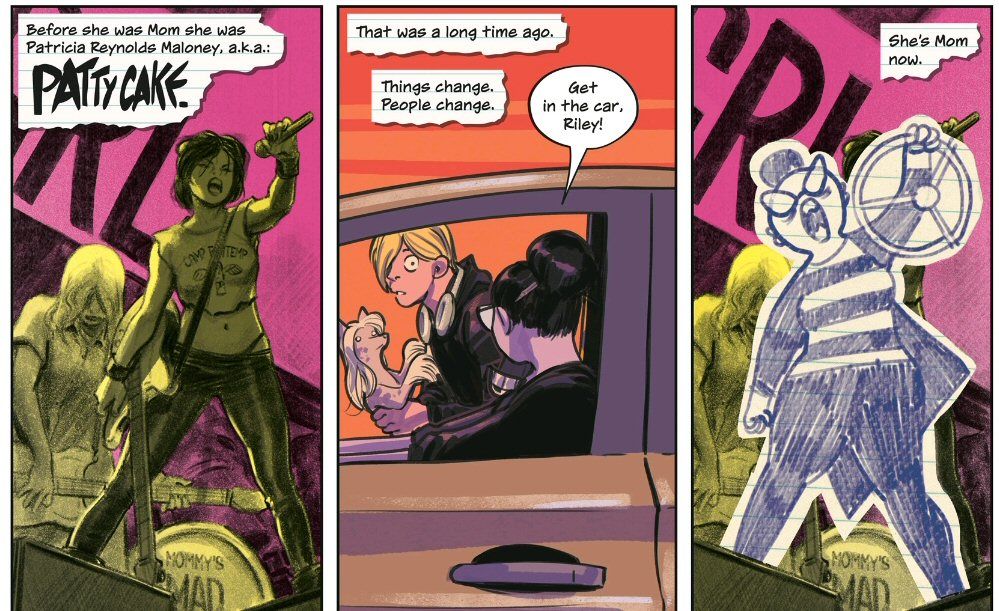
The story is told primarily from the point of view of the son Riley, although occasionally from mom Patty. Riley (shown above as a teenage boy with blond hair in his eyes) seems somewhat interested in following in his mom’s artistic career footsteps – playing heavy metal music and drawing to express his feelings and thoughts. When Riley is narrating (depicted as torn bits of blue-lined paper), you will often see his black-and-white pencil sketches overlayed over the comic’s panels (as above).
Please note that I will be (unavoidably) spoiling some key plot elements below, but will try to limit how many I cover. The main one I must get out of the way is what happens to Riley at the end of the first issue.
Riley uses his sketchbook to express his fears and worries about the world – but out of context, you could see why these panels got him sent down to the school principal’s office:
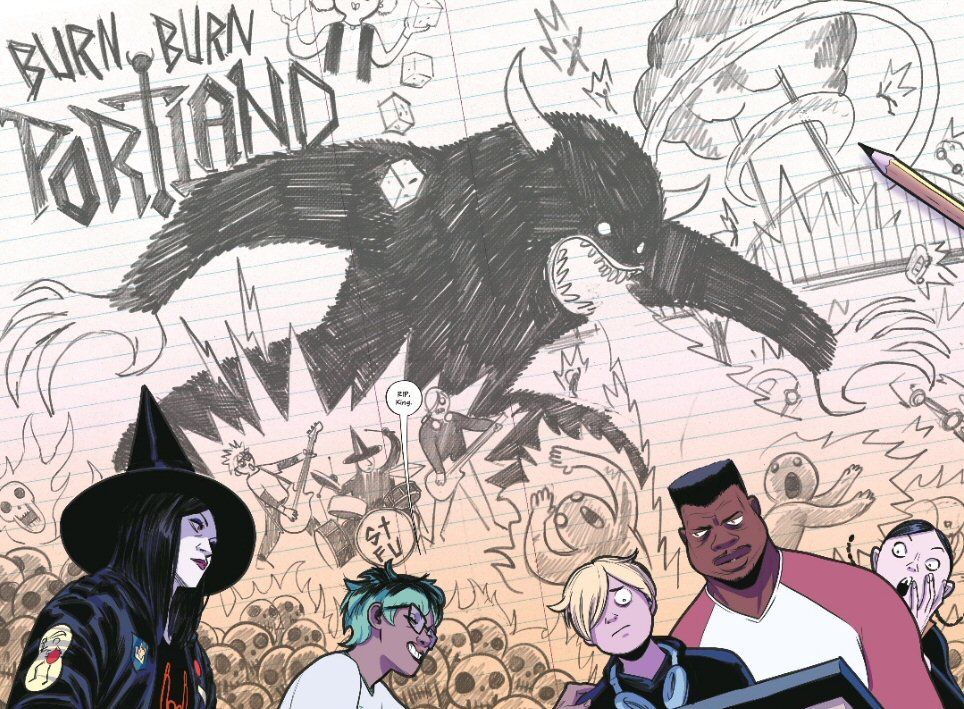
From the later call with his over-burdened mother:
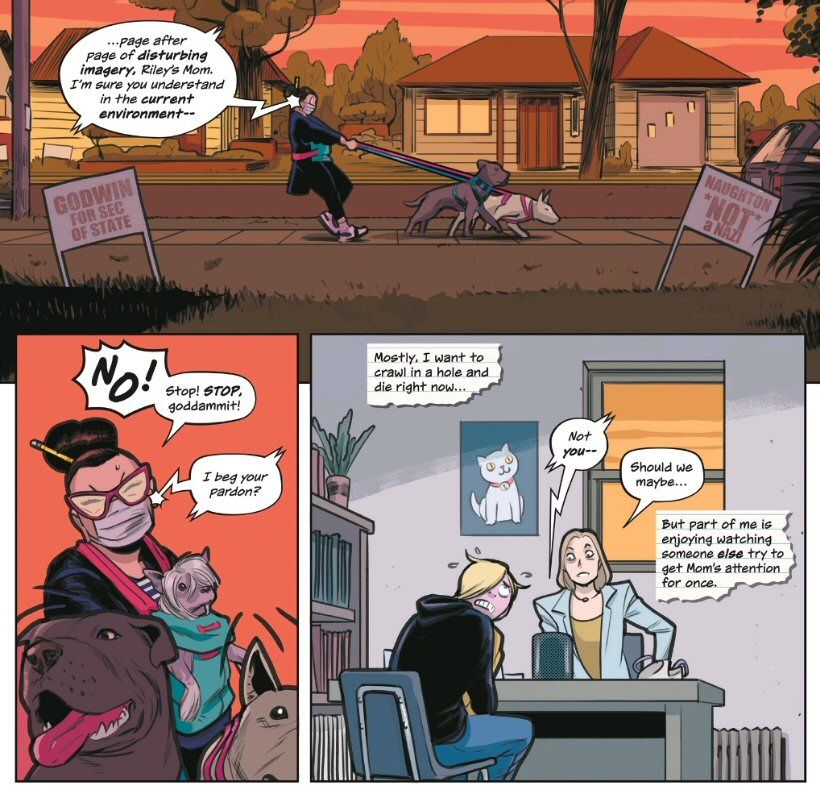
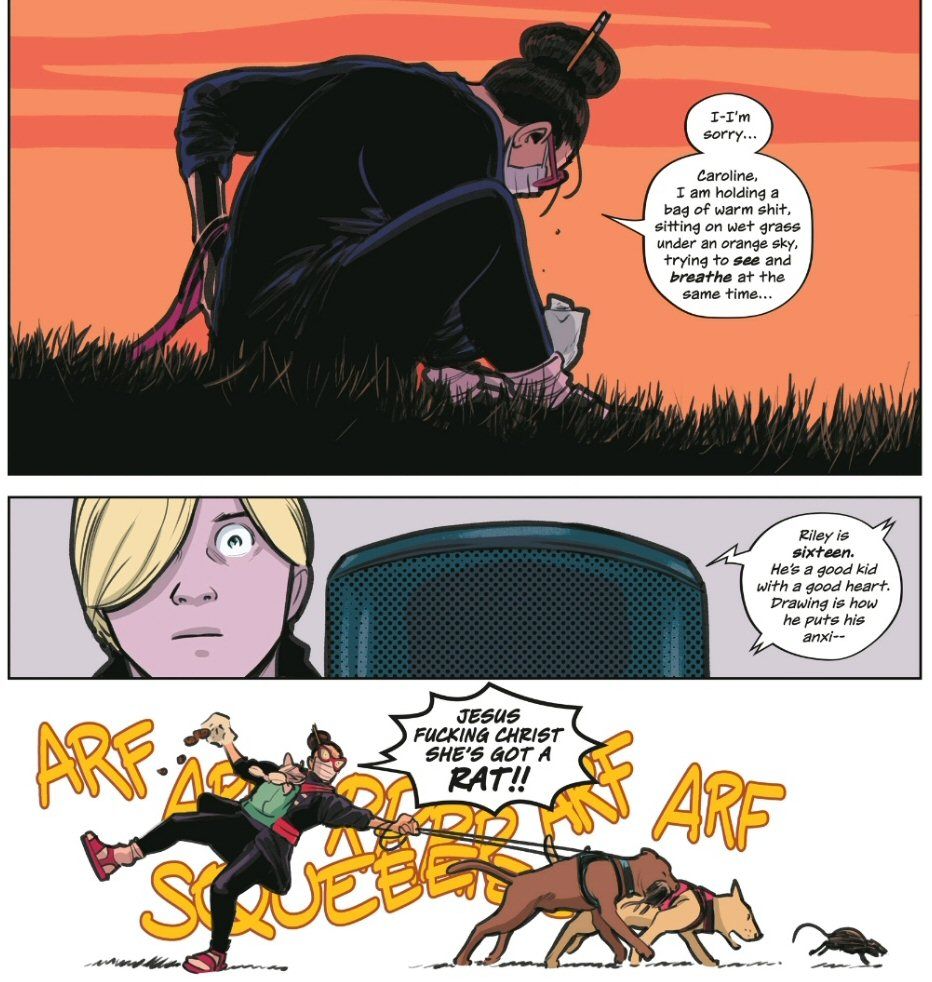
At the end of this comic, Riley and his “STFU” bandmates (and yes, ok, even I got that one!) perform a spell from one of his mom’s old zines, asking for blessings from two music spirits. The next morning, Riley awakens to a surprising new appearance as he narrates what he had hoped might happen: “… the fires … and the wars … and the pandemics … and the insanity … will just stop. And none of us will worry anymore.” …
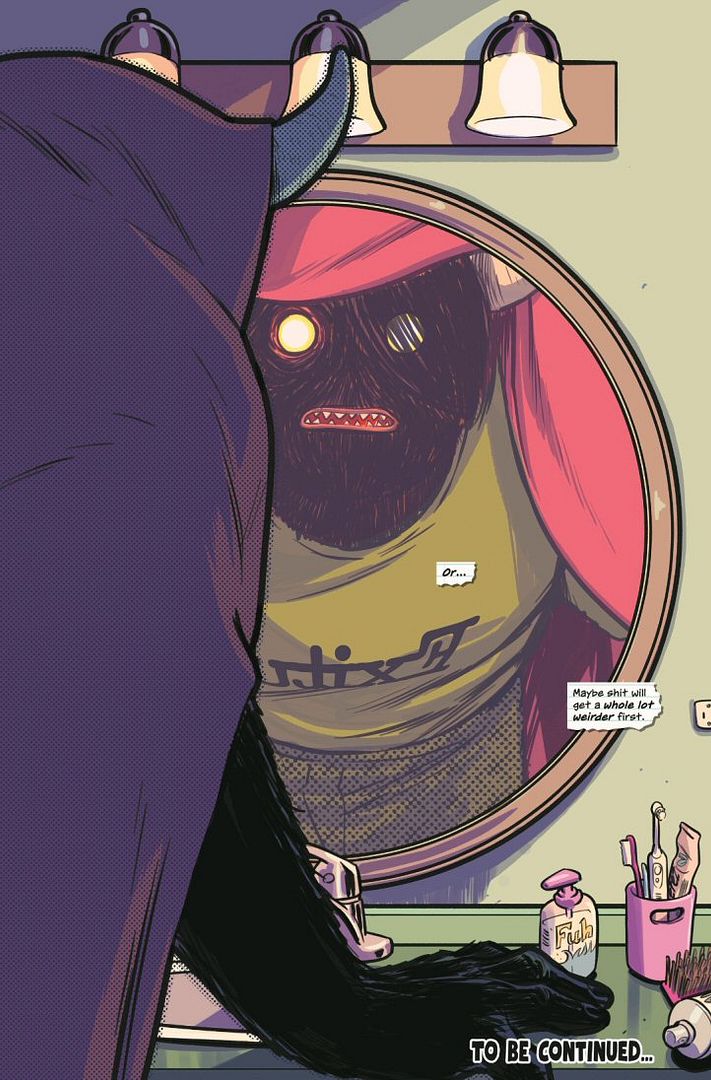
Yes, Riley has turned into the monster from his drawings. It was critical to get that transformation out of the way for the rest of panels below to make sense.
One more thing about the structure of the comic, before I get into the ethics. During times when Patty is narrating, her newspaper cartoon-style ink drawings replace or overlay the comic panels, with her own distinctive font. And often, mother and son are both breaking the fourth wall simultaneously, and so their sketches amusingly interact with one another. For example, from the opening pages of issue #3:
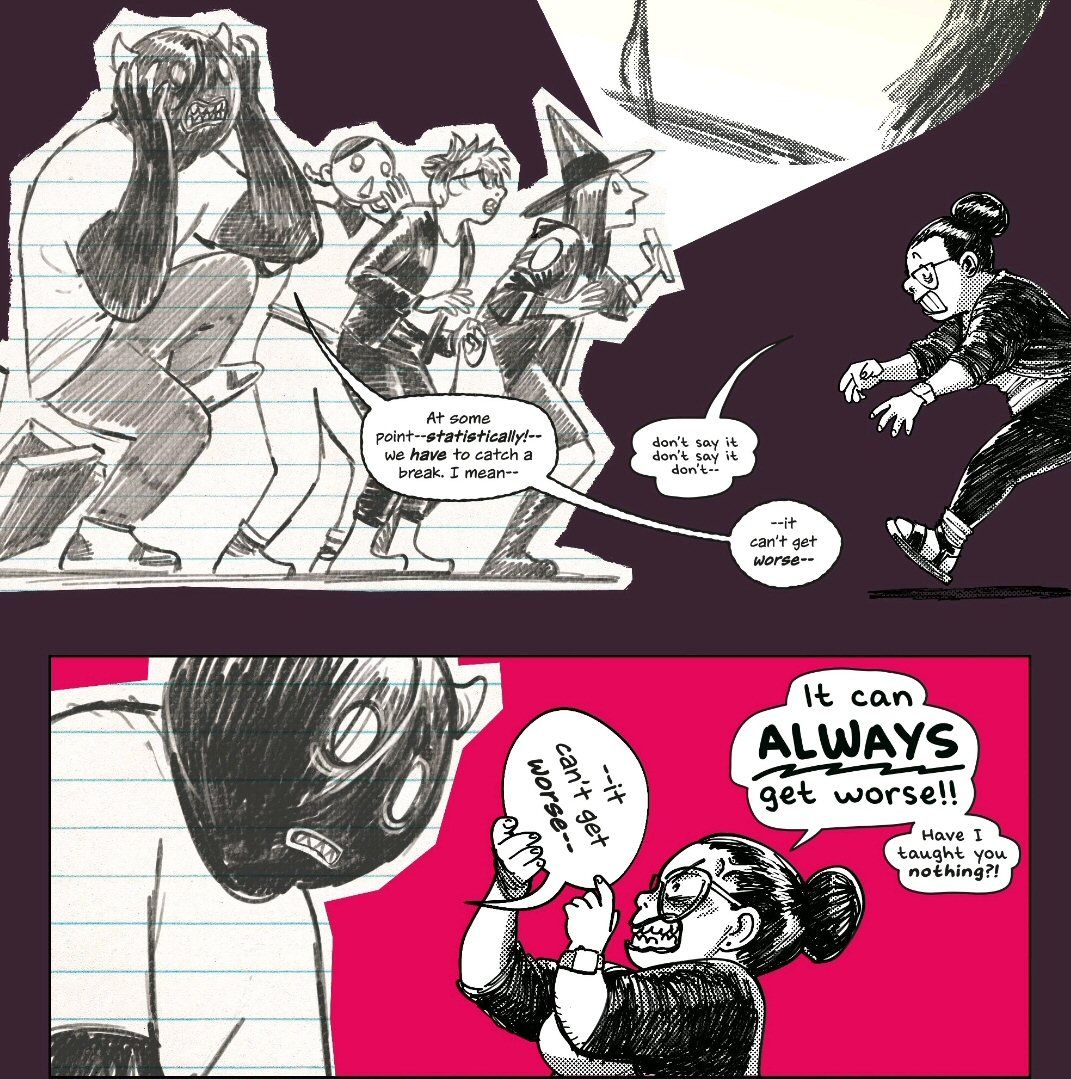
Ok, so, what kinds of normative ethics do these stories illustrate?
There are three distinct forms of virtue ethics that I can see at play here. I will take them one at a time, in the order they first appeared to me – which is roughly consistent with the order they appear in the comics (but of course, I will be jumping back forth across issues to illustrate my points). I’m also going to avoid discussing the latest issue (#6) as it sets up the conclusion to the current arc, and I don’t want to give anything away (it is also the most hilarious issue yet, and you will want to read it unspoiled!)
Care ethics
The most obvious moral philosophy observed between these characters – especially within the immediate family of mom Patty, dad Jimmy, son Riley and daughter Lil – is care ethics.
As I explain on my Ethics 101 page in the link above, care ethics emerged out of a feminist critique of the persistent gender bias in traditional ethics. Virtually all ethics theories of the last 2,500 years were developed and refined by men – and many of them were single, and a lot were without children to boot. I’ve found little historical criticism of this situation (there were some commentaries from women philosophers in the 1950s, but these were ignored or dismissed by the establishment at the time). It wasn’t until the 1970s that the tide began to turn, and the 1980s before this persistent bias was explicitly addressed with the development of a new virtue ethics theory – care ethics – by Carol Gilligan.
I plan to get into the details of care ethics in an upcoming post (UPDATE: now available here), but a key point for now is that care ethics is not reserved for women. It is a fully realized and recognized form of virtue ethics available to all, and one that differs from the universality and impartiality common to almost all classical ethical frameworks. Those two words might sound pretty good to you – who wouldn’t want their theory to be both universal and impartial? But another way to put that would be absolute, without exceptions, and unresponsive to the specific circumstances of a situation. And that goes against our innate moral intuitions.
In contrast, care ethics emphasizes the importance of responding to the relative needs of individuals that you are in a relationship with. Care ethics holds that moral action should be based on interpersonal relationships and the duty of care we have to others. Empathy and compassion for others is thus core to care ethics. I am encouraged to see it becoming quite common in modern comics – see for example Kelly Thompson‘s and Alyssa Wong‘s respective runs in Captain Marvel (a character DeConnick herself famously put on the right path), G. Willow Wilson‘s Ms. Marvel (Kamala Khan), and Jed MacKay‘s Moon Knight and Clea revivals. And it is something that is very much evident in the relationships between family members in these FML comic stories.
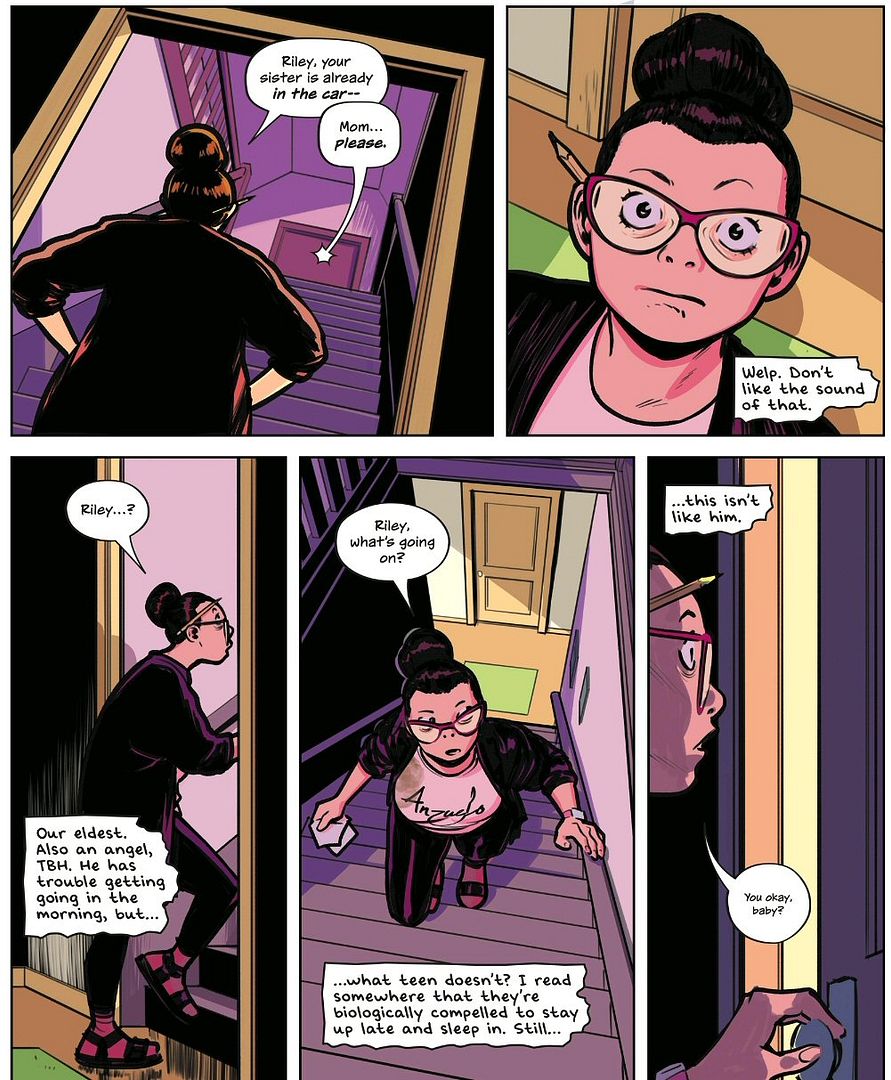
For example, consider how everyone reacts to Riley’s transformation, starting with Patty from the opening of issue #2:
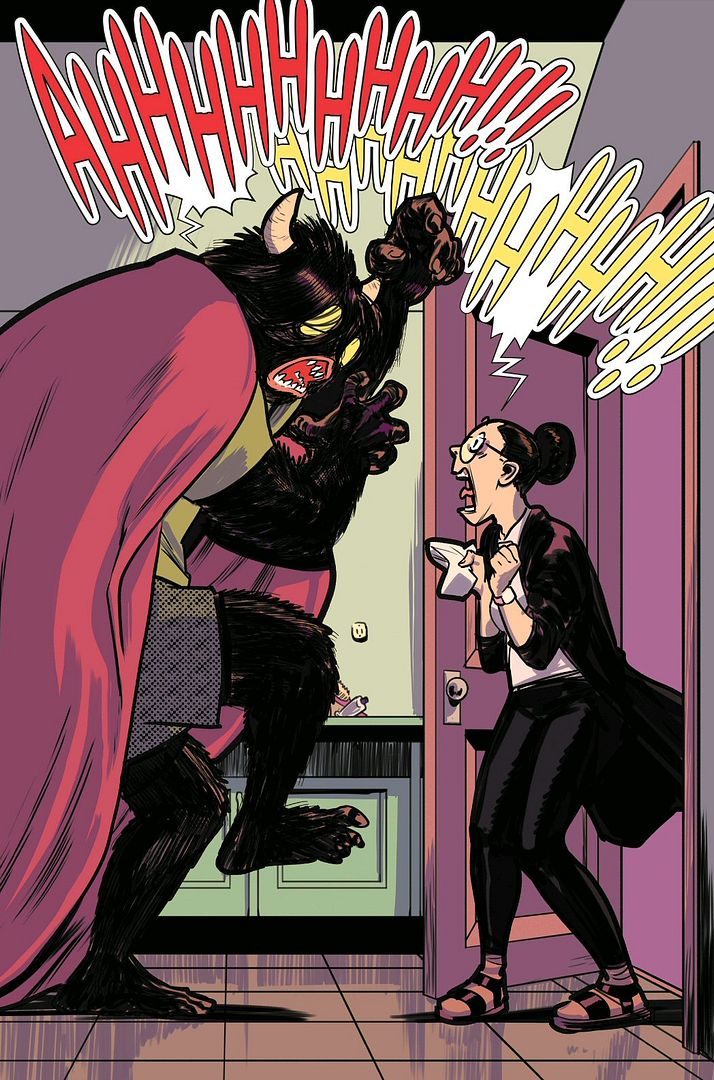
Ah, but things are not what you might expect:
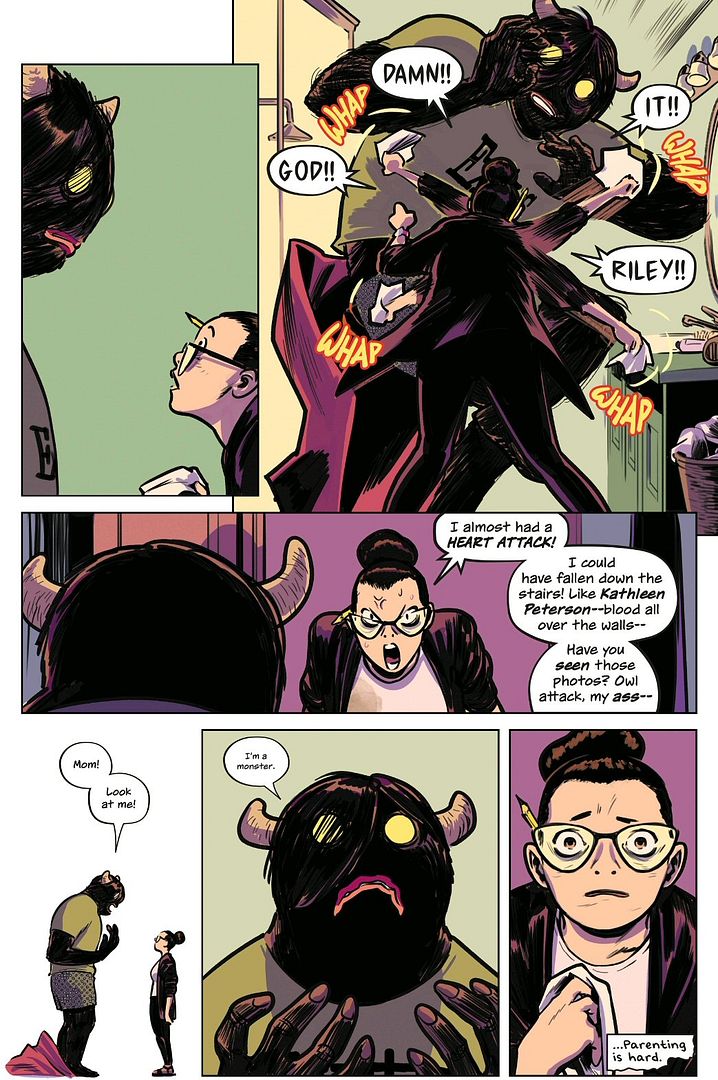
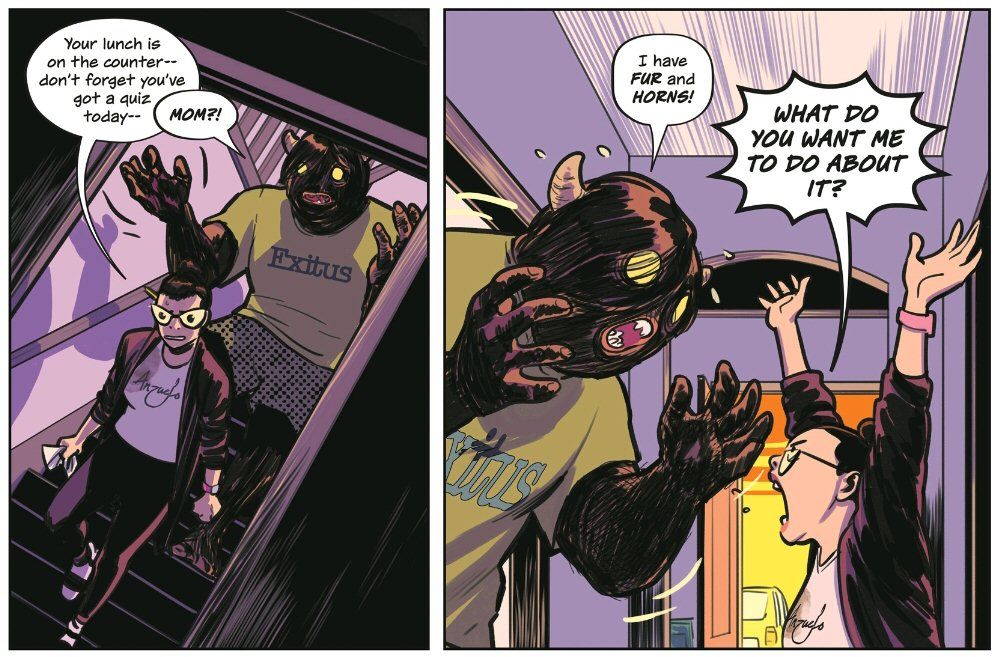
Of course, this transformation is deeply distressing for Riley … but Patty is completely accepting of who Riley is, regardless of how he looks. We will come back to the rest of these panels later, as they say a lot about Patty’s sense of ethics. Note, DeConnick (and by extension, Patty) is a huge true-crime fan (as is my wife – and so, yes, that owl defense was ridiculous). 🙂
Later this same issue, Patty gets a call from her husband Jimmy, who asks a fateful question:
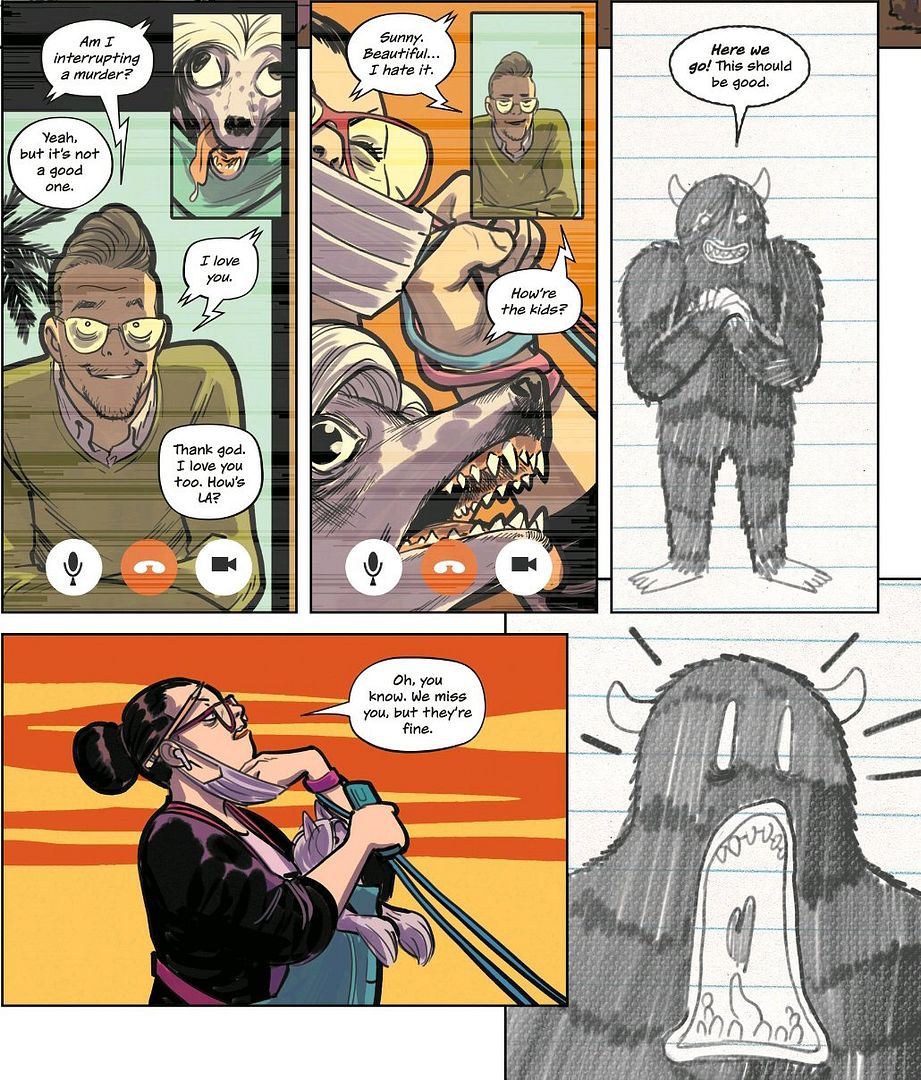
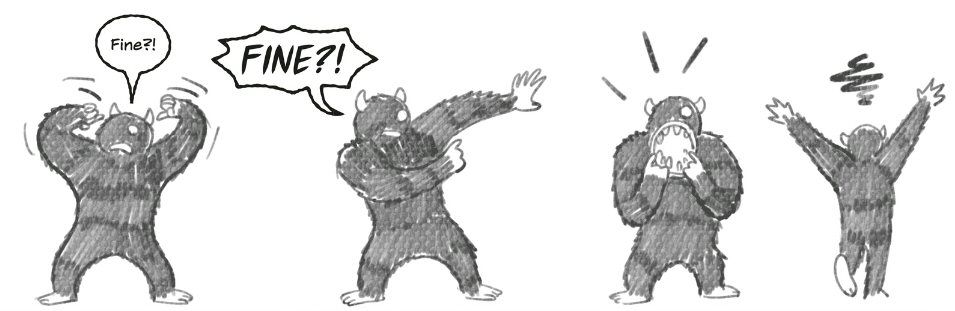
I love Riley’s incredulity above.
Note that it was a mistake for Patty to not come clean to Jimmy right away. She may have felt she was protecting Jimmy (presuming that “LA trip” was important for his career) – a mistake she repeats later when matters get even more tense. Also, she may simply be taking too much on herself, expecting to be able to handle it for the sake of others. This reveals a potential criticism of care ethics, around how one balances concepts like truth and autonomy in relationships – a topic I will return to in a future post where I explore this normative ethics theory more fully.
But in terms of the comic, this of course sets up a potentially dramatic event when – unexpectedly – a concerned Jimmy cuts short his trip and takes an early flight home without warning:
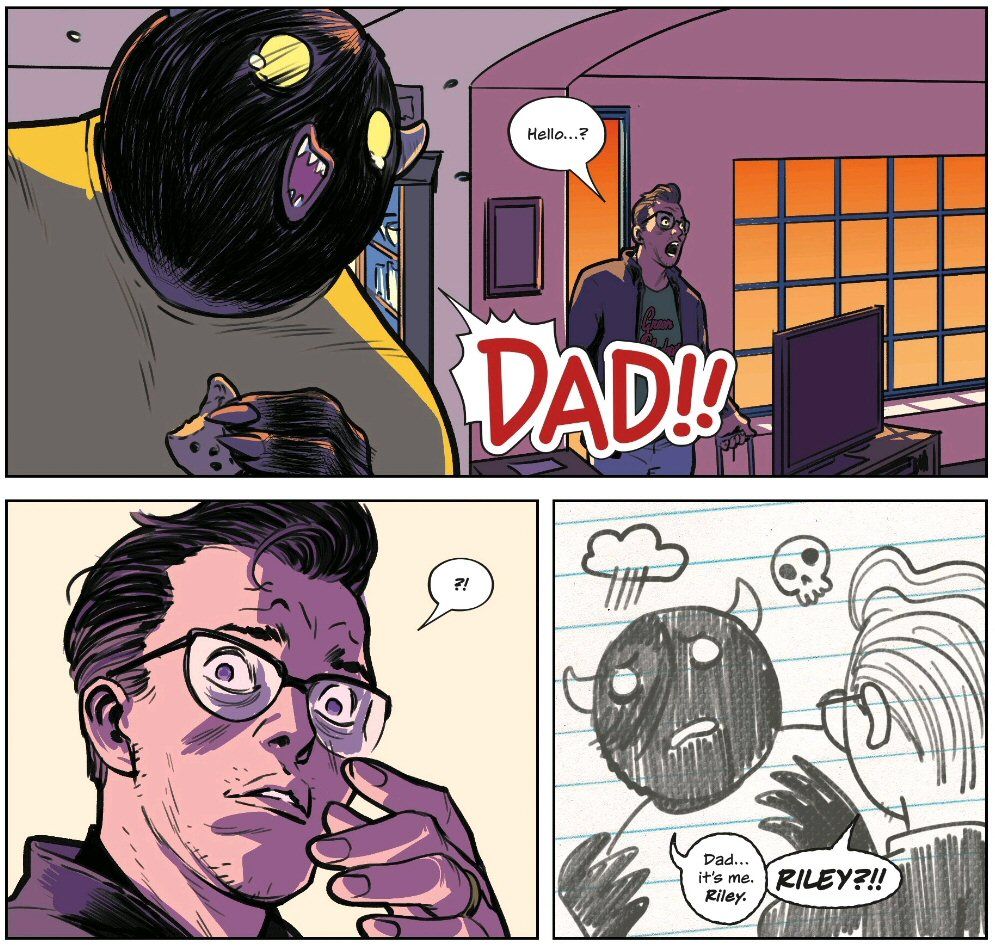
And how does the completely unprepared Jimmy respond?
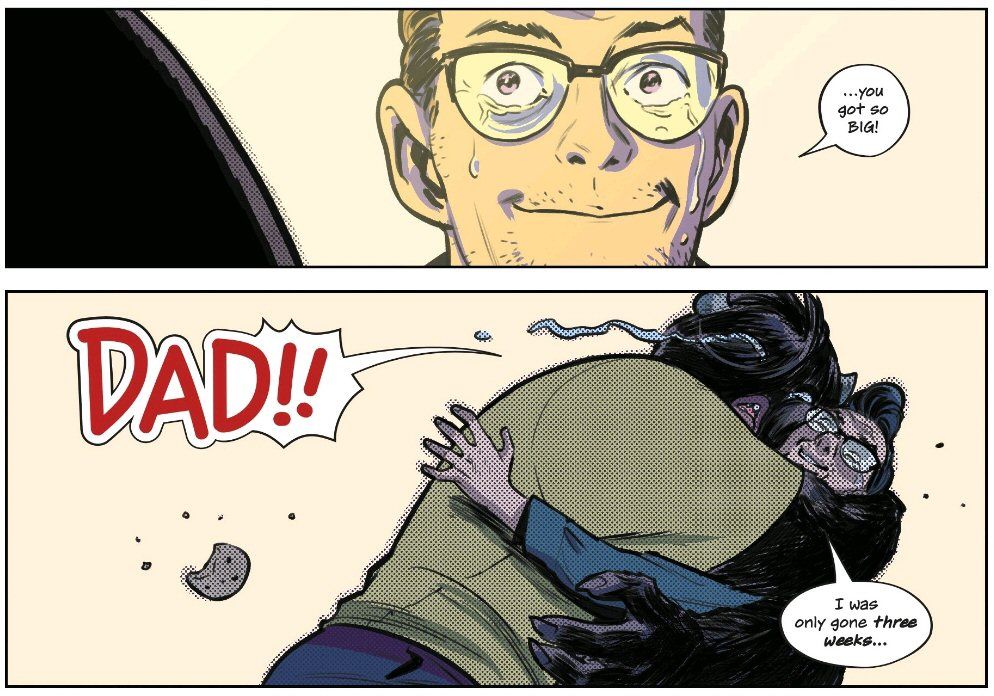
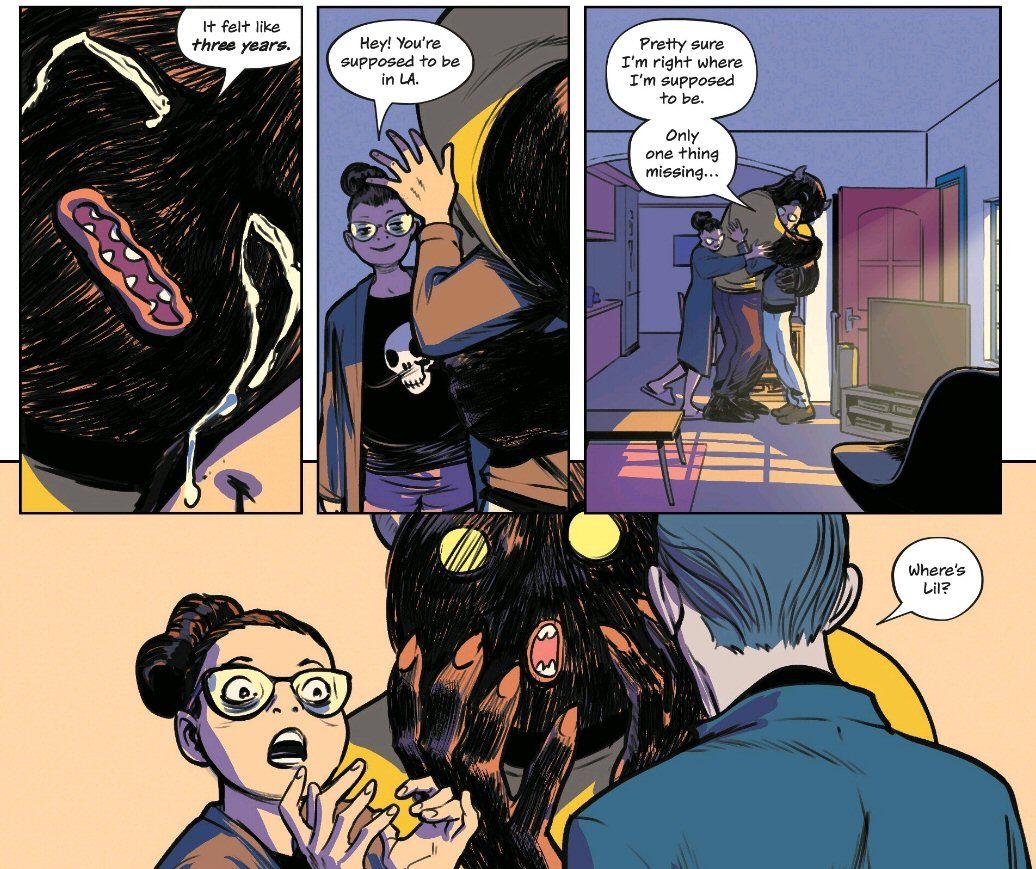
I really love these panels – despite being inadvertently set up to fail, Jimmy shows unconditional love and support for his son. Oh, and if you want to know why Patty and Riley react like that at the end, you will need to read the comic to find out. 🙂
Even Riley’s younger sister Lil is supportive, from the opening to issue #3:
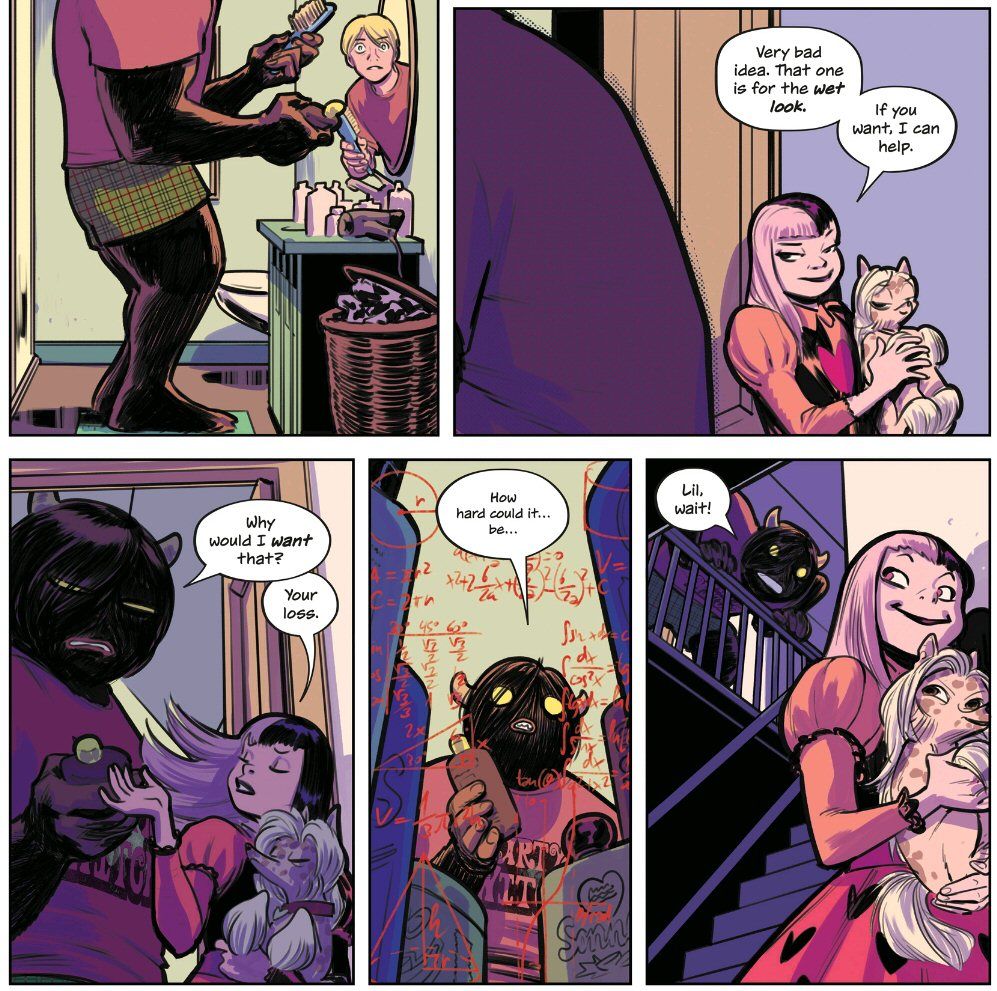
After many panels of Lil getting to work …
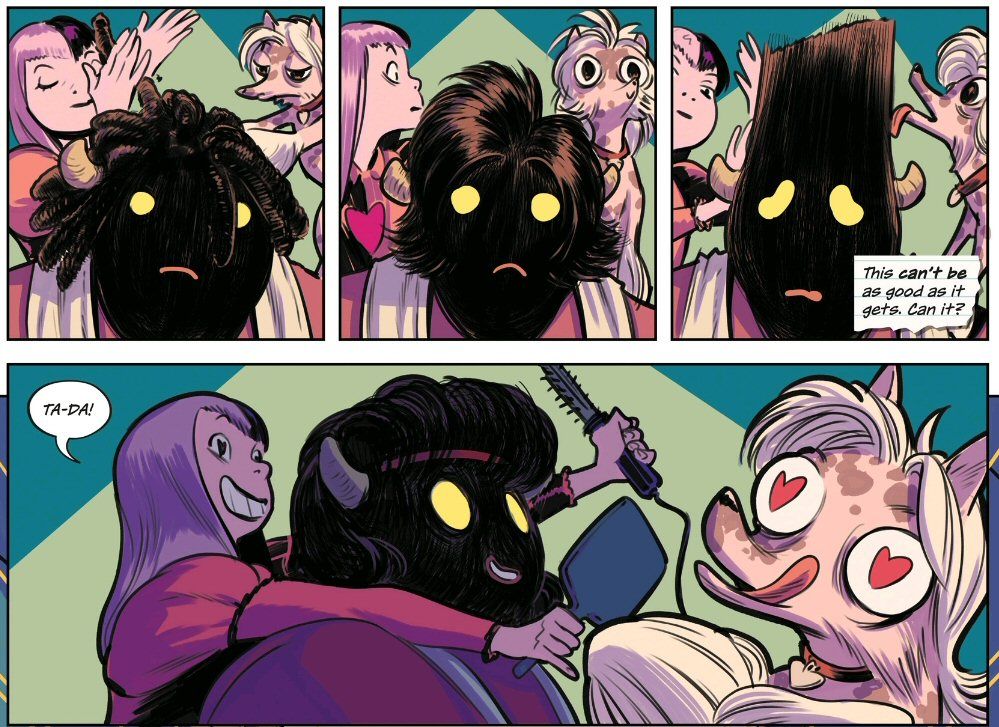
The mutual care and respect between all the family members is heart-warming to see.
And note it isn’t just Riley’s family that is ultimately accepting – I also enjoyed these panels from when they get to school (Patty thoughtfully opens the sunroof, so Riley can ride more comfortably with his head out), from issue #2:
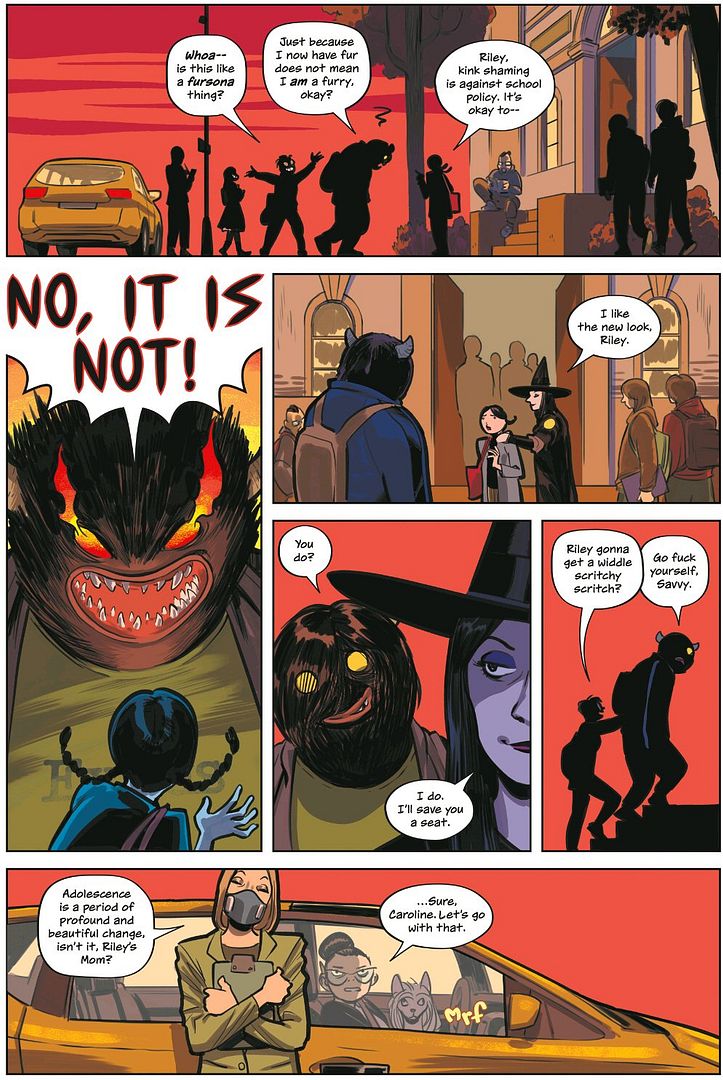
There are also a lot of caring scenes between Patty and Jimmy, for example after tensions heat up involving the kids (I will explain context for this scene a bit later). From issue #3:
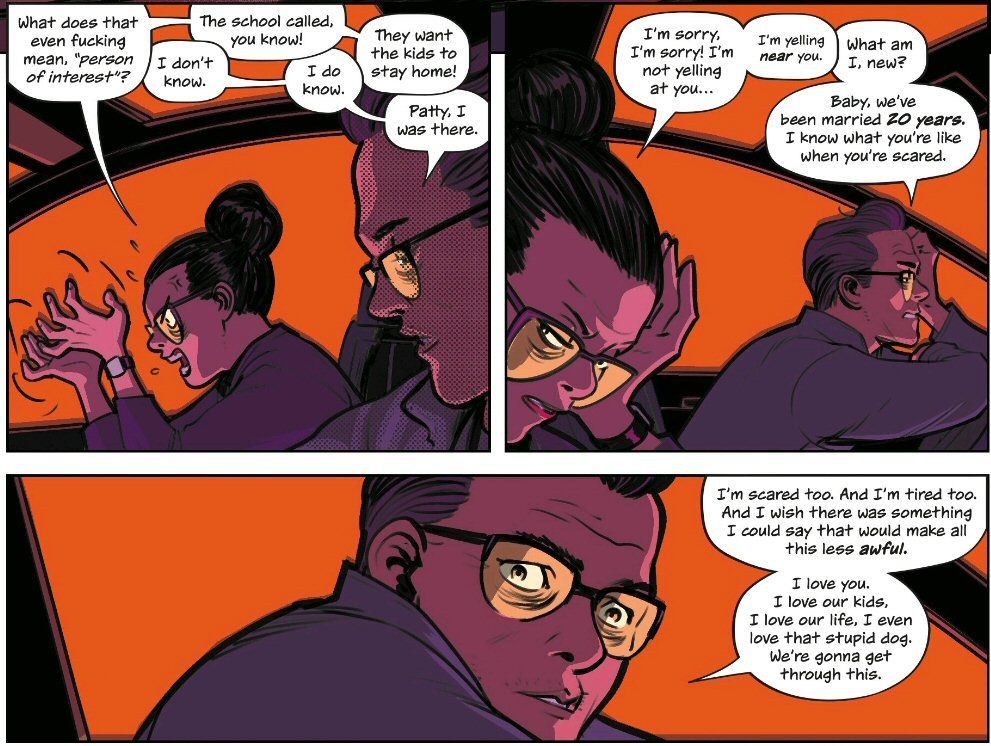
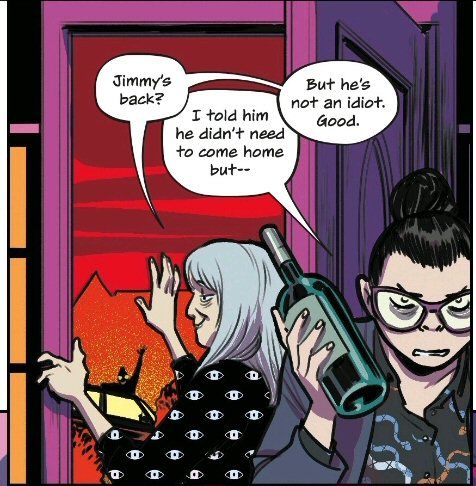
And the same is true for Patty’s friend group – most especially her best friend above, Amy. From issue #5, when unearthed secrets have triggered a crisis in their long-standing friendship:
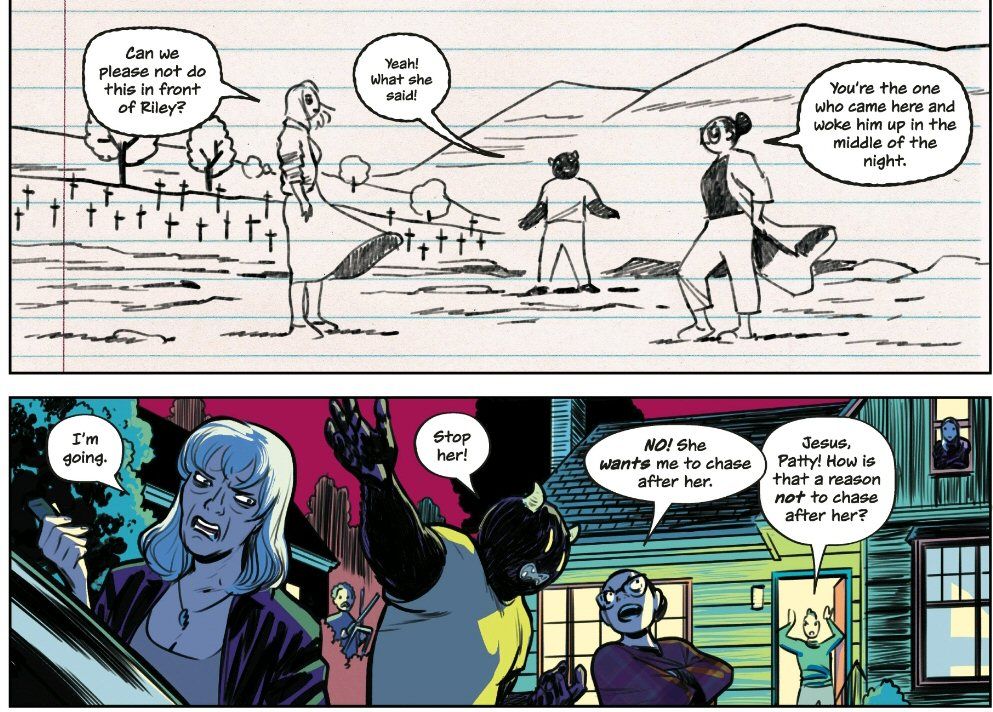
I love how both Riley and Jimmy see the context for what is going on (as can the neighbors, which becomes clear momentarily):
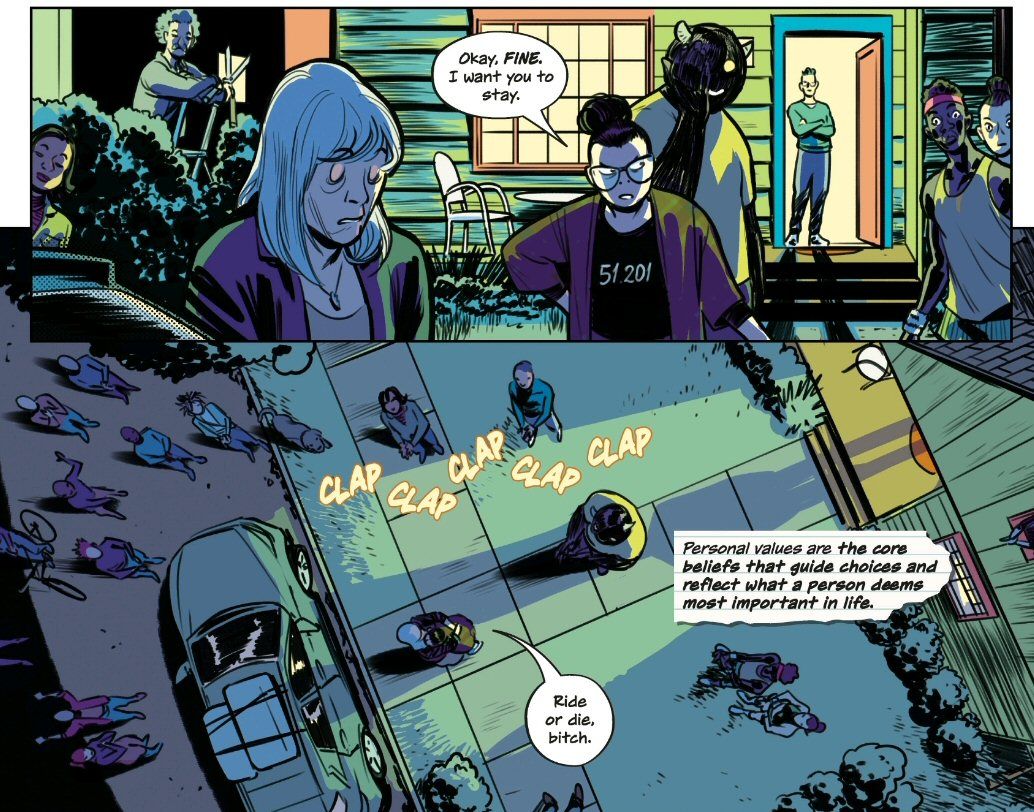
As a sidebar, Riley’s narration provides a (very good) description of what personal values are. This comes from an ongoing assignment that Riley and his bandmates have been given during their in-school suspension and remote, at-home learning – which I will now explain.
At the end of issue #3, after their successful performance at a heavy metal concert, Riley and his bandmates discover a dead body at their local hang-out in the woods. The cops react badly to the teens’ discovery, disbelieving them and accusing them of unwarranted drug use. They also don’t react well to Riley when he raises his voice in exasperation (from issue #4):
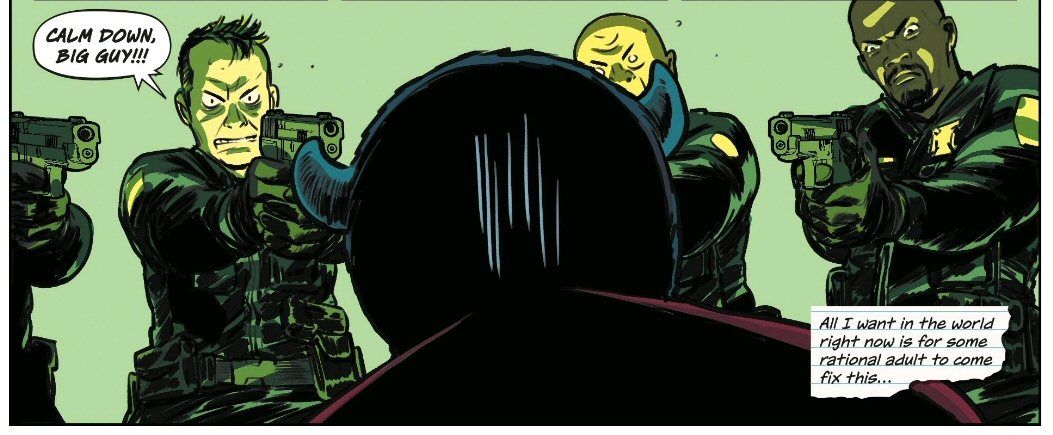
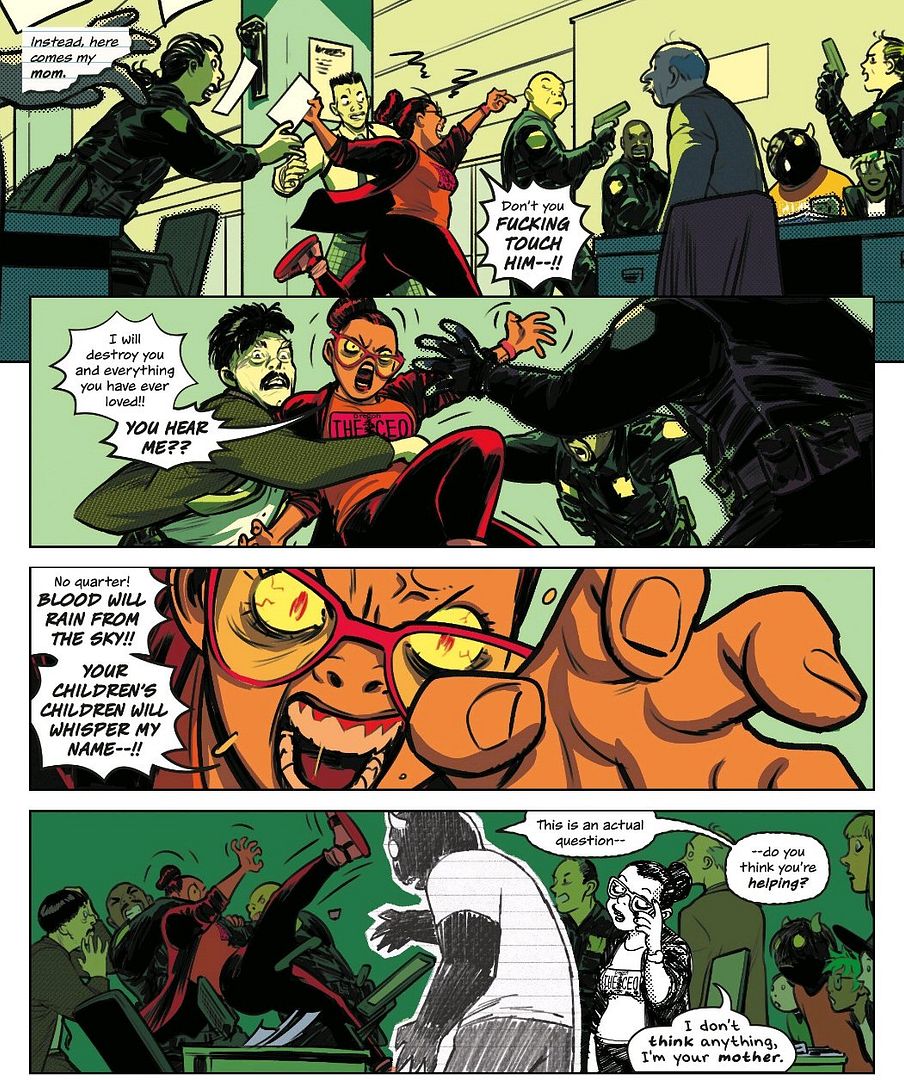
But there is a reason (or at least, an explanation) for Patty’s somewhat unhinged reaction – she had been sleeping on the couch so that she would wake up when he came home from the concert. This is what happened instead, as Patty narrates to herself:
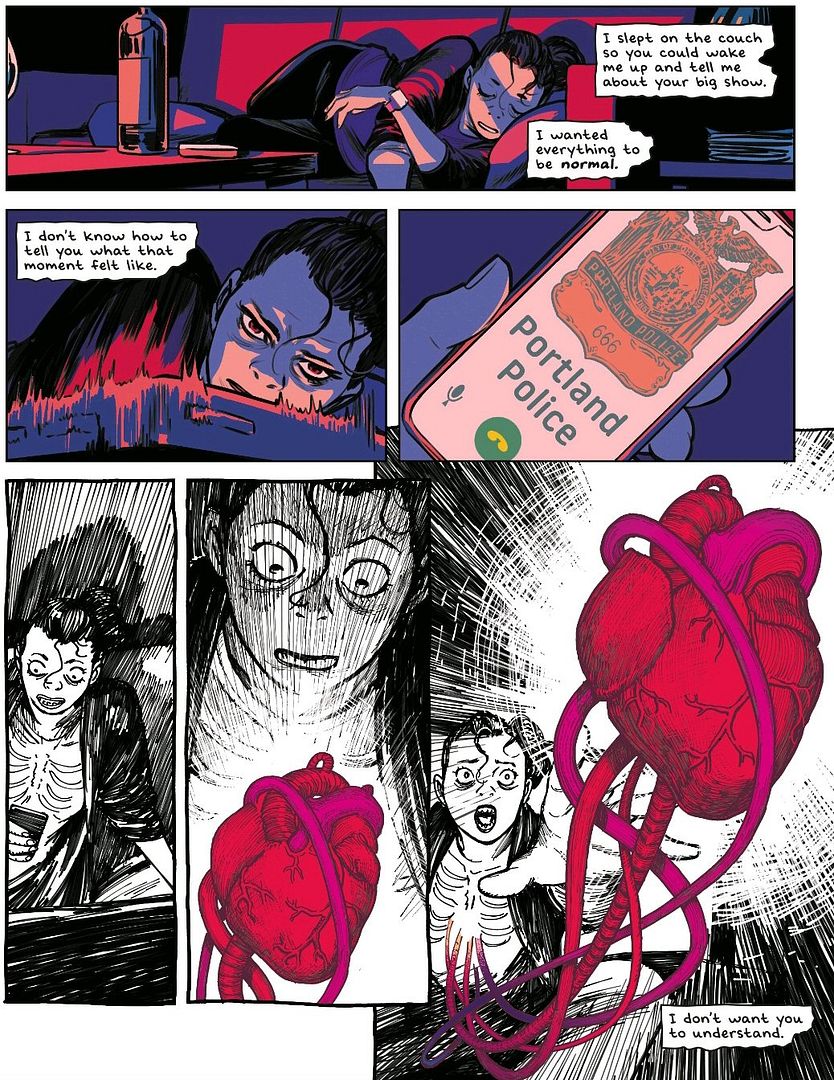
I love the visual of her heart leaving her body when she awakens to the police call – and the stated desire that she doesn’t want him to understand what that felt like. This sets up a key dynamic between them that is explored further in this issue (and one that I will come back to when I present the second ethics theory below). Once the immediate crisis is resolved and they are at home safe:
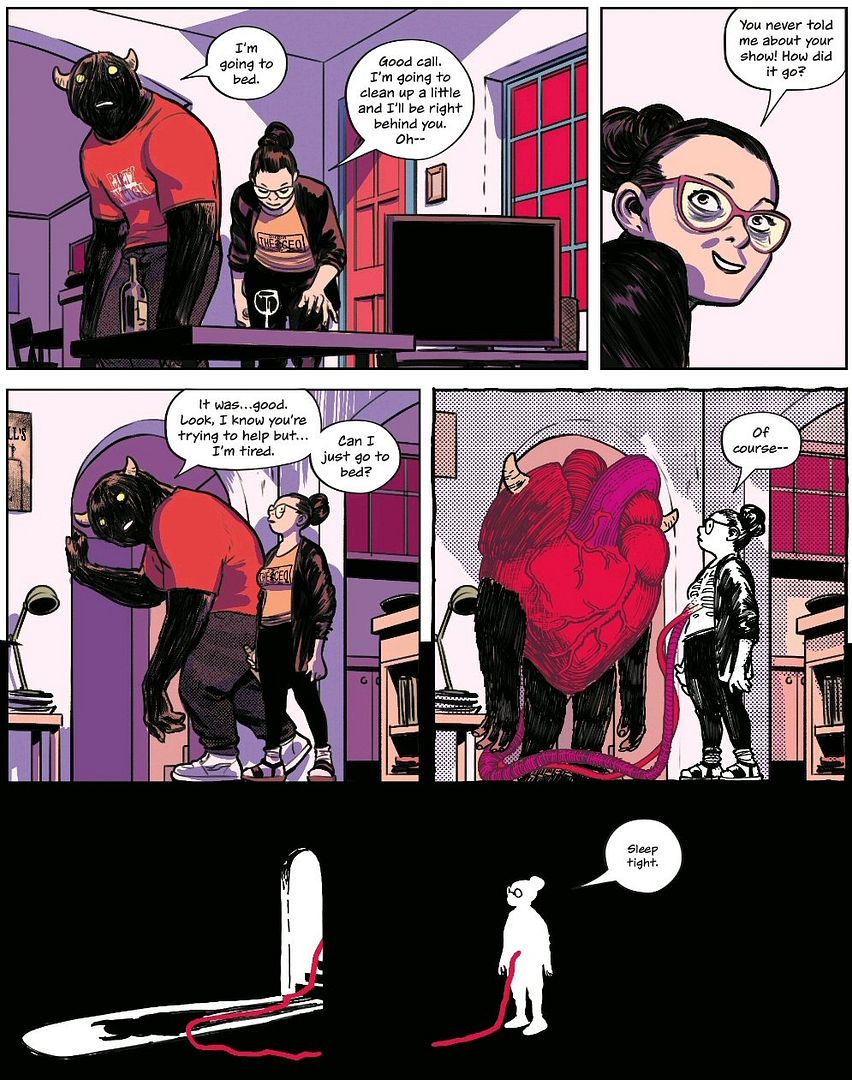
This is a beautiful depiction of what happens when you care that much about someone, and you don’t want to burden them with it. And again, kudos to the entire creative team on this series (I’ll be shocked if this comic isn’t nominated for an Eisner award for 2025).
Before moving on, I would like to go back to that earlier description from issue #5 about what personal values are, and why they are important.
The role of values in virtue ethics
I suspect a lot of comic readers are suspicious when they hear the word “values” in real life (just as they are when they hear “ethics”). The language of moral philosophy has been (in my view) inappropriately co-opted and misused by many who like to tell others what they can and cannot do (rather than reflect on their own discomfort, and where it comes from). I feel it is important to reclaim the true meaning of these words, which is determining for yourself how you want to live your life, and who you want to be. That is in part what I am trying to do with this site – to help explain how normative ethics can inform those personal choices.
In the language of moral philosophy, personal values are inextricably linked to personal virtues. And all the virtue ethics examples that I am discussing here for this comic come down to examining what we value, and why.
From the opening panels of issue #5, explaining the school assignment:
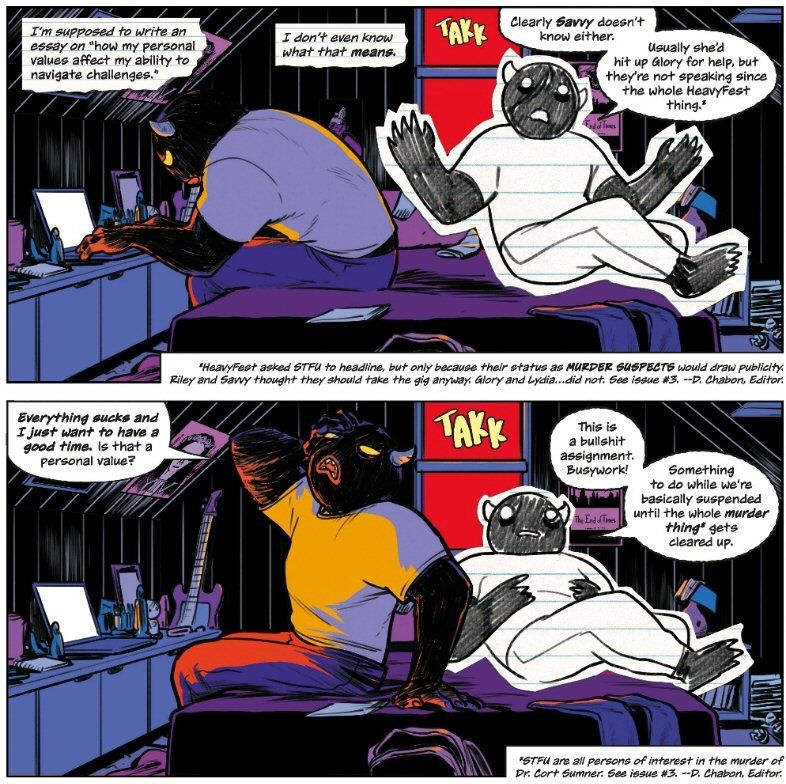
Given how the ultimate goal of many (but not all) forms of classical Greek virtue ethics is eudaimonia – a personal sense of flourishing, well-being, and happiness – it is a reasonable question that Riley is asking.
It is interesting to me that the question of values only comes up in issue #5. Just like how I jumped into a discussion of ethics right off the bat for this comic series (and on this site, in general!), the comic needed to establish some baselines for what virtuous behaviors look like first. And since I am about to get into two of the classical forms of virtue ethics, it is worth the side assignment into thinking deeply about personal values.
Values represent what we consider important or worthwhile – with common examples given like justice, honesty, courage, or compassion. They are ideals or principles that should have direct relevance to how we personally make moral decisions about right and wrong, good and bad (the stuff of moral philosophy). Or as Riley (aka DeConnick) says so eloquently in an earlier panel from issue #5, they are “core beliefs that guide choices” and “reflect what a person deems most important in life”.
And that is where virtues come in – these are character traits or attitudes that allow us to consistently act in accordance with our values (those “choices”, in Riley’s words). They are the patterns of thoughts, feelings, and behaviors that we develop over the course of our lives through practice and habits. While many people may just fall into certain ones, you can – and should, from a virtue ethics perspective – be more explicit about choosing them. For instance, if you value honesty, then the corresponding virtue would be truthfulness – one you want to practice until it becomes such an ingrained tendency that you will be honest even when it’s difficult (Patty may need to work on that one, given the story lines with Jimmy and Amy).
In essence, the relationship works like this: values provide the content or direction for moral choices (the ‘what’ we believe in), while virtues provide the means or mechanism for realizing those values (the ‘how’ we embody them in our character and actions). They are not going to be completely in sync without some effort – that is where the practice part comes in.
Of course, it is not like this is a simple matter to sort out in our complicated lives – regardless of what normative ethics you adopt. You also need to develop what the ancient Greeks called phronesis – or the practical wisdom to know how to apply those virtues in different contexts.
Which is a nice segue into the next form of virtue ethics depicted in this comic that I want to describe: Stoicism.
Stoicism
When presenting classical virtue ethics, I typically lead with Aristotelian virtue ethics, as it was the original ancient Greek form, and is typically more relevant for Western superhero comics than its ancient Chinese Confucian counterpart (although see my Fantastic Four ethics post for a good example of the latter). Also, you can check out my recent A.X.E.: Judgment Day conclusion for a discussion of the pros and cons of Aristotelian virtue ethics. Marvel comic’s Thor is a good example of Aristotelian virtue ethics in action.
The Stoics were a competing group of ancient Greek and later Roman philosophers who distilled Aristotle’s concepts down to a narrower set of just four virtues (courage, justice, temperance, and wisdom), and disagreed with him on one key point – whether external factors matter in achieving eudaimonia. Aristotle believed that while virtues are certainly a critical component, external factors like health, wealth, and social standing are also necessary for a flourishing life (and are at least somewhat outside your control). The Stoics, however, argued that virtue alone is sufficient for happiness. They were indifferent to external factors, which they felt do not actually contribute to one’s ultimate happiness – as it is under your control how you respond to them. The most famous Roman Stoics were Seneca, Epictetus, and Marcus Aurelius, who remain the ones most commonly cited and referred to today.
As I’ve mentioned in a couple of my other posts where Stoicism came up (i.e., DC’s Absolute Wonder Woman and Marvel’s 8 Deaths of Spider-Man), it has a strong connection to both the self-help movement and clinical psychotherapy. With its focus on cultivating inner strength and resilience – by specifically focusing on what is within your control (that is, internal factors) – you can re-frame your experiences (both good and bad) and work to change your perspective of them. You can see this across a wide array of modern self-help books, addiction recovery programs (e.g., the Serenity Prayer from AA is very Stoic, but with Christian overtones), and cognitive behavioral therapy (CBT).
Let’s go back to the first few pages from issue #2, when Patty initially reacts to Riley’s transformation. After yelling that there is nothing she can do about his fur and horns, and to get into the car so they aren’t late for school, we are treated to this set of panels narrated by Patty:
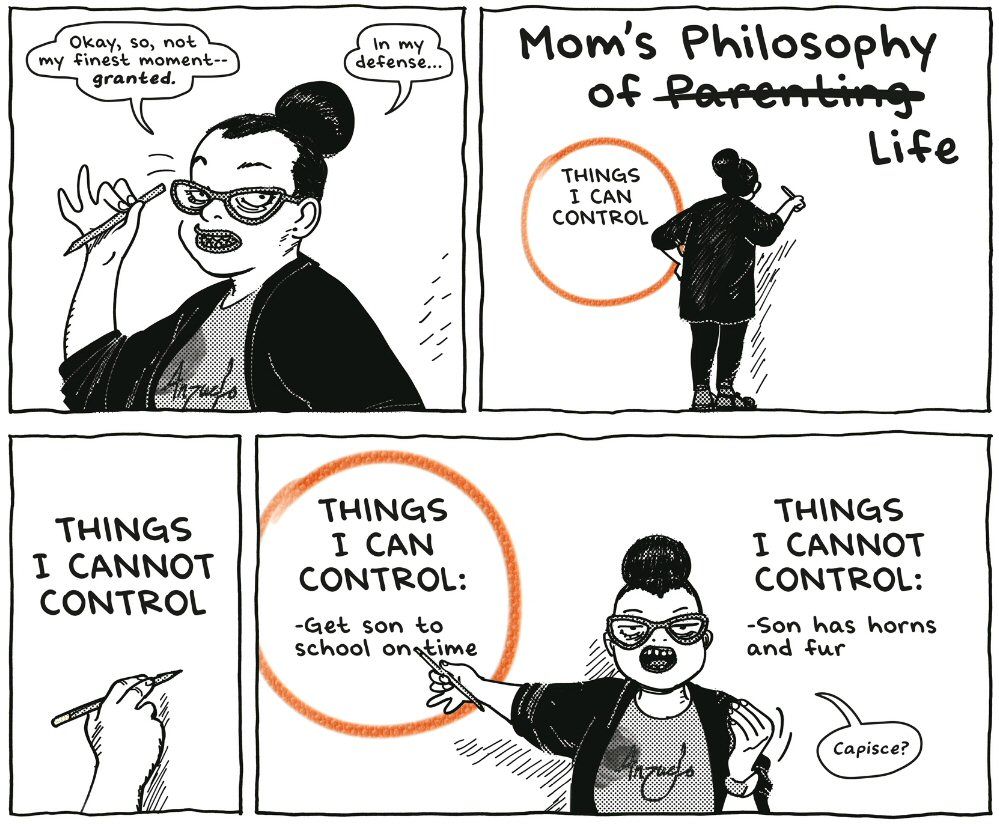
There is a lot to deconstruct here.
To begin, the separation of knowing what you can control from what you can’t is phroenis in action. Without this step, you aren’t going to get anywhere – you must explicitly consider these things. And yes, this is more than just a philosophy of parenting – it is a philosophy of life as far as the Stoics were concerned.
The key insight here is the orange circle drawn around the things that are in Patty’s control. It is not accidental that this is presented as bounded above – there are a finite number of things that fall within this category. In contrast, the rest of the wall could represent infinity. There is literally no end to the things you cannot control, and it is a mistake to focus on them if you want to change and be better. This a great introduction to Stoicism … capisce?
But consider what happens next in this issue. As shown previously, Patty is walking the extended family of dogs and taking that call from Jimmy (where she neglects to mention their son has turned into a furry monster). Suddenly, Patty narrowly misses being killed in a freak accident! I won’t spoil the surreal scene, but the point is she escapes death by literal inches. This understandably sends her reeling, and she goes into shock. She then narrates and describes the first time she ever experienced anything similar, in the presence of another brush with death:
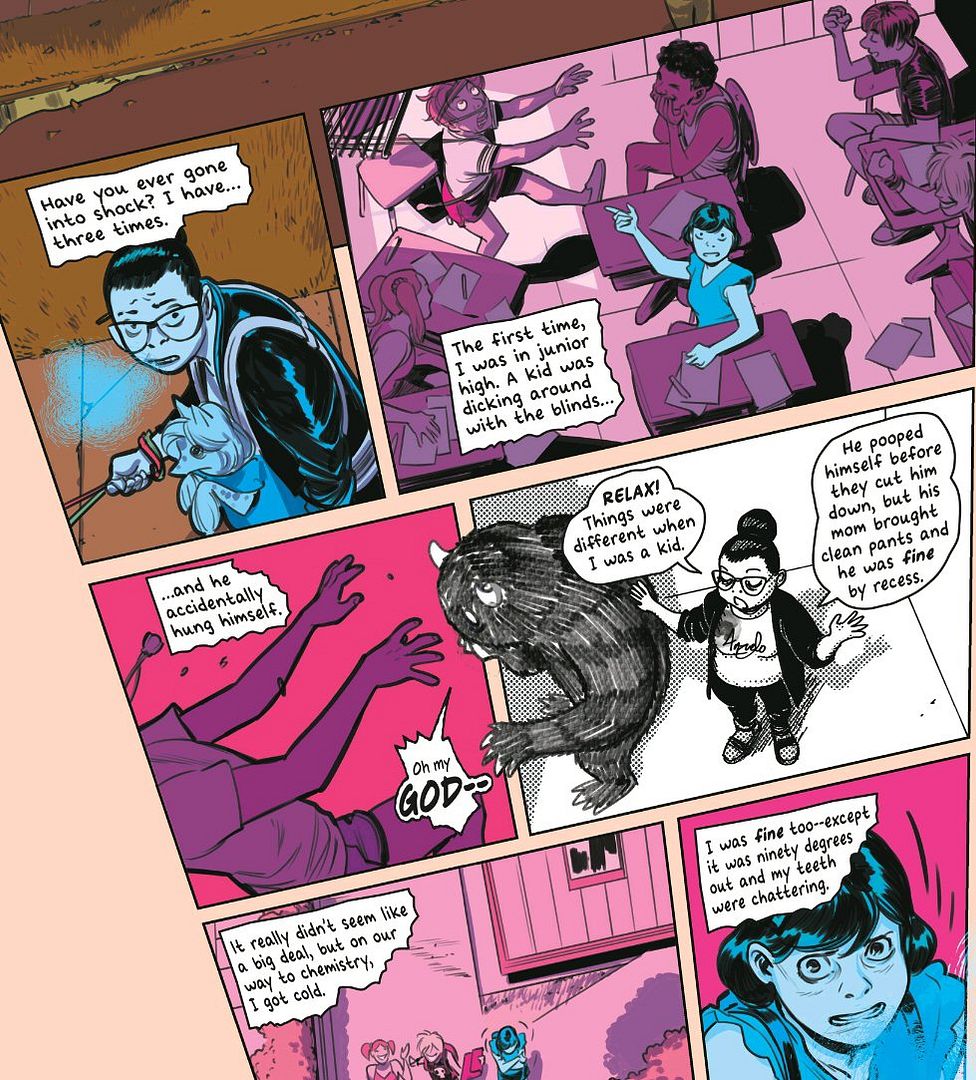
I love the insertion of Riley’s response into his mother’s narration, clarifying how times have changed! I expect most of you are probably thinking that this was inserted for dramatic effect and could never have happen in the blasé way Patty describes it. And I have no idea if DeConnick made this vignette up or if it stems from a real event. But I have to say, when and where I grew up, that is exactly the reaction I would have expected from parents and school staff (“Relax … he was fine”).
Anyway, as she sits on the curb recovering from her shock, consider the significance of these illustrations:
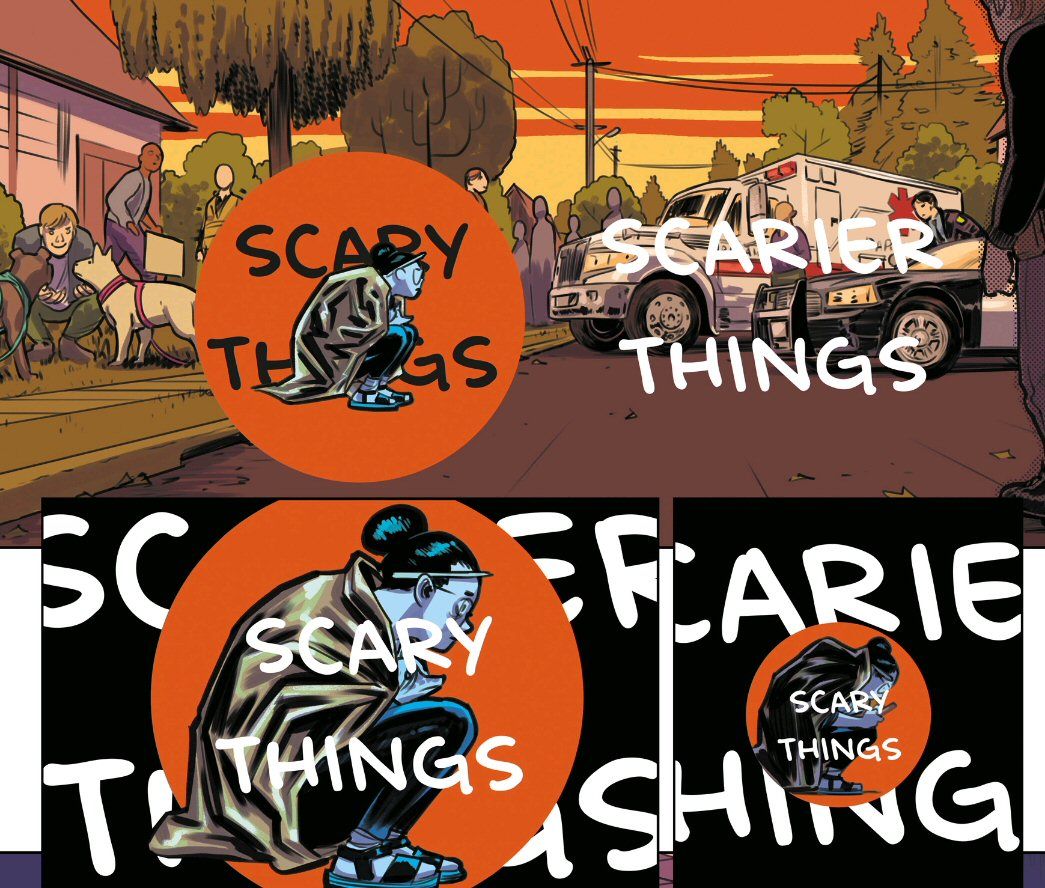
Sitting within her bounded orange circle of scary things within her control (in a larger universe of even scarier things outside her control), she takes out her phone and calls Riley at school:
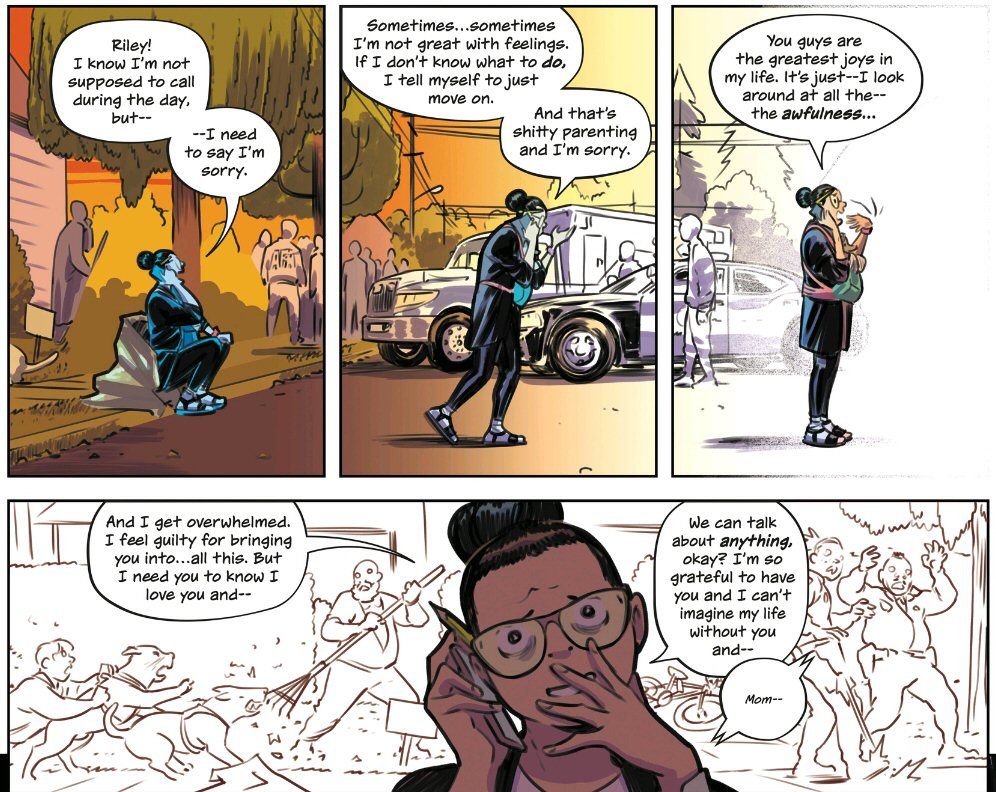
Yes, and that is exactly what a care ethicist (or stoic) would do when they realize that they were wrong in how they treated someone they care about (or about something within their control) – they acknowledge it and genuinely seek to make amends and change their behavior. This scene is a great continuation of the nature of the bond between mother and son (and I love how it visually shows Patty emerging from her blue shocked state by the practice of virtue).
I won’t spoil what Riley is up to at this same moment, but it is a hilarious set of pages that follow.
By issue #4, I realized the series was moving beyond Stoicism into another closely-related but independently developed (and otherwise quite distinct) virtue ethics theory – Buddhism.
Buddhist virtue ethics
Buddhism originated in India in the 6th century BCE, and was founded by Siddhartha Gautama (aka, the Buddha). Despite its popularity today (roughly half a billion people identify as Buddhist), Buddhism was slow to get started originally. It only gained traction in the 3rd century BCE when it was adopted by the Indian Emperor Ashoka – and subsequently spread rapidly throughout India and Southeast Asia. And fun fact: there is a parallel here to Stoicism, as when the Stoic philosopher Marcus Aurelius became the Roman Emperor in the 2nd century CE, and similarly helped spread its teachings far and wide.
Given the origins of Buddhism, it is understandably deeply rooted in ancient Eastern traditions and concepts – including the endless, cyclical nature of life (and reincarnation). As such, it might surprise you to hear that Buddhism and Stoicism share a large number of similarities – despite very different origins and ultimate goals. I remember a time nearly a decade ago when I was struck by that observation myself. I had been traveling very heavily for work. My trusty kobo (a popular ebook reader here in Canada) was a constant companion, but I had accidentally left it at home. Facing a five-hour flight and knowing that I had already exhausted the in-flight entertainment options that month on Air Canada, I perused the book options in the airport gift shop. There was a display for Mark Manson‘s best-seller at the time “The Subtle Art of Not Giving a F*ck“. Figuring this would be a self-help book based on Stoicism (the title seemed like a good tip-off!), I picked it up for my flight.
But by the time I got to the end of the opening chapter, it was clear to me that this book was not going to be about achieving the Stoic’s eudaimonia (happiness) but rather recognizing the value of suffering and the need to avoid egoism. I recall having this thought: “Oh, so this is going to be a self-help book based on Buddhist virtue ethics instead, cool”. I turned the page to chapter 2, which immediately started telling the story of the offspring of a wealthy Nepalese ruler approximately 2500 years ago … and I literally burst out laughing in my seat (as Manson explains by that chapter’s end, that was Siddhartha).
I had much the same experience when I read these panels in issue #4, where Patty explicitly spells out her philosophy of parenting life to Riley: “Keep your shit on your plate”.
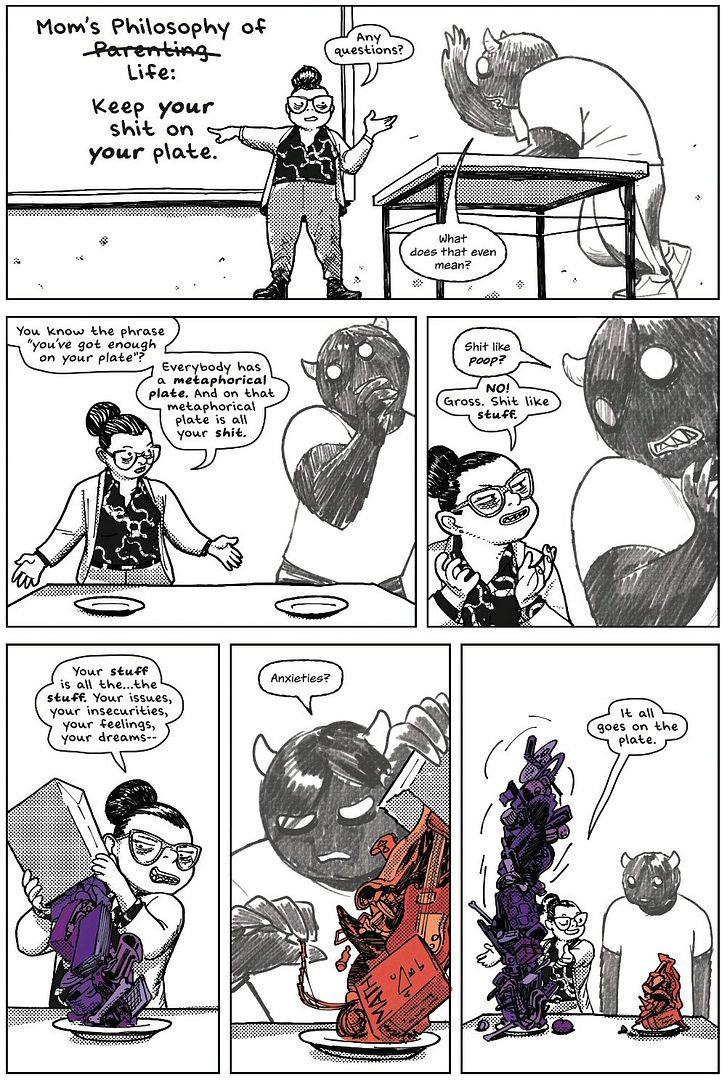
Ah, I could already see where this was going …
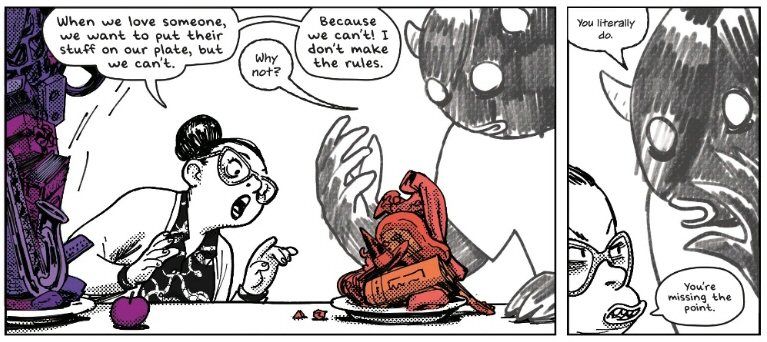
Patty is correct … the Buddha actually made the rules, and that would be a no-no, as I will explain below.
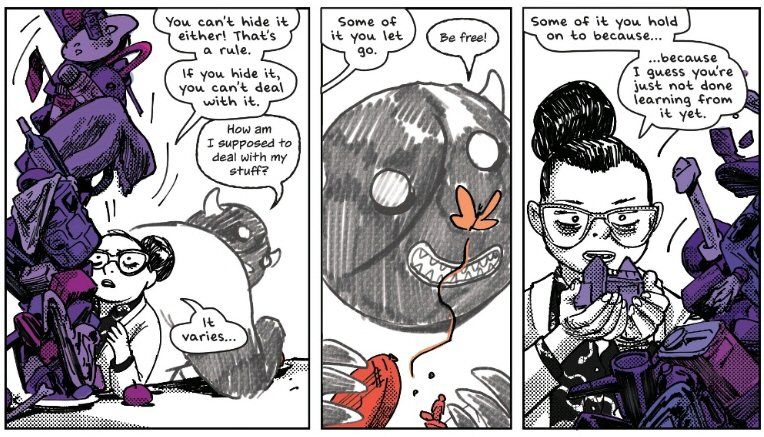
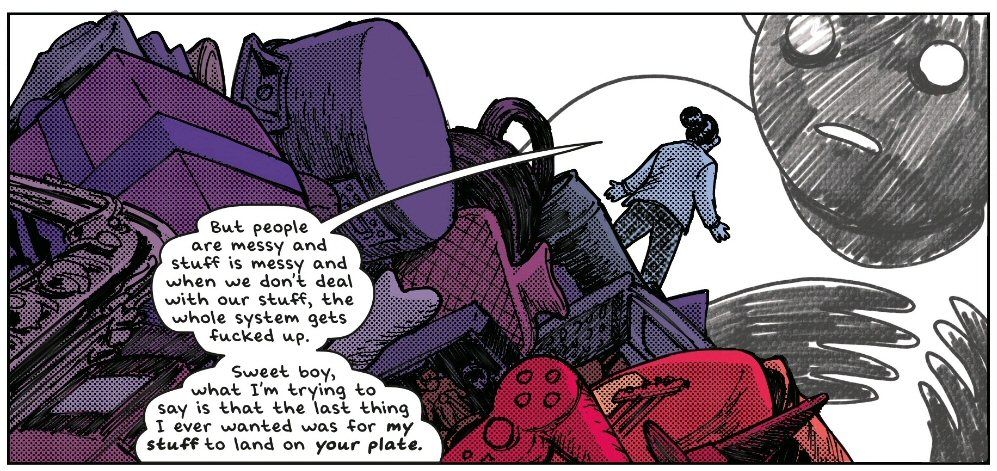
Indeed, the whole system gets fucked up when people don’t keep what is on their plate from spilling over on to others – and when they don’t work to empty what is on their own plate (one of the goals of Buddhism).
The Buddha’s insight was to recognize both the massive scale of suffering in the world overall, and over the course of a single life. Which is a real problem when everyone gets reincarnated and is thus doomed to repeat the same cycle over and over again. His teachings aimed at breaking this cycle, using a core concept known as the “Four Noble Truths”:
- • Life is suffering
- • The cause of suffering is craving
- • The end of suffering comes with the end to craving
- • There is a path which leads you away from craving and suffering
These truths provide the basis for the main purpose of Buddhism, which is to find that path away from craving and suffering, through enlightenment. As an aside, you can probably appreciate the logical flow of these four truths, which is similar to how the ancient Greeks reasoned and argued (and Jedi Master Yoda, but that’s another story).
Something I should make clear at the outset: it isn’t appropriate to try and split the religious and philosophical aspects of Buddhism apart. Being a Buddhist is not ordering off a menu, where you can simply pick and choose what appeals to you. However, this is something we in the West commonly do – and I will be doing it here too by examining only the philosophical elements!
As an aside, this splitting approach is a very old problem in Western thinking, one that goes back to the ancient Greeks – who prized universality, and who effectively split off reason (rationalism) from arete (a broader Greek concept of excellence). They had very good reasons for this and arguably were very successful as a result – ancient Greek thought is at the heart of Western philosophy, science, technology and modern society. However, this separation also contributes to the disconnect and personal unhappiness people seem to feel in modern society. I will be exploring this further in one of my upcoming posts (with another creator-comic series to back me up).
But to put that in simple terms for now, we in the West tend to think along lines of subject-object dualism – commonly described as an observer (subject) that is separate from a thing that is being observed (object). However, you’ll note this separation also puts other people into the category of “observed” (and in extreme framing can even deny them their own agency). It is also what makes it impossible for us to grasp the nature of many of Buddhism’s spiritual concepts. And again, a good example is how we try to separate the philosophical aspects of Buddhism from the spiritual. 🙂
But being a product of my culture, probably the best place for me to begin my dissection attempt is to compare and contrast Stoicism’s and Buddhism’s goals and philosophical underpinnings.
Similarities and differences between Stoicism and Buddhism
Both philosophies primarily focus on the relationship between desires and suffering. As previously explained, Stoics believe that the problem lies not in external factors, but in our reactions to them. Buddhism instead identifies attachment and craving as the root causes of all suffering (think back to Patty and Riley’s plates above). Both philosophies thus emphasize internal factors and seek emotional regulation through mental training and the practice of virtues (which is why it is easy to mistake them at times).
On the emotional front, the concept of acceptance runs deep in both philosophies. Again, Stoics drill down to separating what we can control from what we cannot, while for Buddhist acceptance involves understanding impermanence and the futility of clinging to what is ultimately transitory. They both seem somewhat “stoic” in this sense, as they seek to cultivate equanimity in the face of life’s inevitable challenges (although for different reasons and from different perspectives).
Indeed, there are significant differences in how they view and process emotions, reflecting their originating cultures. Stoics don’t seek to eliminate emotions but rather transform them through reason (which is the main tradition in our culture – and what Patty is ultimately trying to do above). This again reflects that ancient Greek separation of rationalism that I mentioned earlier, seeing humans primarily as rational beings whose highest capacity is logical thinking and reason. Buddhism typically views emotions (and reason, for that matter) more skeptically, seeing them as mental constructs that arise from attachment and a lack of understanding of ultimate truths. Emotions are to be observed and “released” (like Riley’s butterfly above) rather than dwelt on. You can see that in how Patty wants to hang on to her “stuff” more than Riley does above.
In terms of virtue ethics, both philosophies emphasize rigorous self-examination and mindfulness. Both practice what they call “meditation”, although they go about it differently. Classically, Stoics review the events of the day before bed for their moral significance, while Buddhist meditation focuses on observing thoughts and emotional reactions without identifying or reacting to them. Again, non-attachment (to your “stuff”) is a core feature of Buddhism.
Both are considered forms of virtue ethics because both focus on practicing core virtues. Stoics focus on those four classical Greek virtues mentioned earlier, while Buddhists follow the view that some behaviors lead to suffering and others lead away from it. So, they practice a broader range of ones explicitly directed toward reducing suffering – and for all self-aware beings, not just themselves (again, Buddhism wants to avoid that subject-object “othering” of people).
And that leads to me one of the core differences – why they practice those virtues. As mentioned, Stoicism aims for eudaimonia, a very personal sense of flourishing and happiness in this life. Traditionally, however, Buddhism views life as characterized by suffering and ultimately seeks liberation from the cycle of rebirth entirely (nirvana). So, it isn’t just the reduction of suffering through virtues – it is the actual elimination of suffering Buddhism is seeking. Note though that this liberation is just the ultimate spiritual goal – in practice, most Buddhists look to accumulate credit through virtuous acts (and through other Buddhist rituals and practices) in order to gain better rebirths in the interim (reincarnation). So, a very different motivation, with Buddhism reflecting the traditionally cyclical view of life common to Eastern religions and philosophy.
This profoundly different reason as to why we should practice virtues results in another different outcome: in daily practice, Stoics engage fully with social and political life, viewing civic duty as a necessary part of virtue. In fact, you see this across pretty much all ancient Greek philosophies – which is why so much of the discourse of our social and political lives in the West today has the same common structure it does. In contrast, Buddhism has often (though not always) emphasized withdrawal from worldly concerns – but that varies significantly across times, sects, traditions and cultures. Riley is certainly more inclined to want to withdraw than Patty is in the FML comics, you’ll note.
But this is a good reminder to point out that everything I’ve said about Buddhism above is in very general terms – specific traditions, practices and interpretations can differ significantly (although the four “noble truths” remain common to all). I should also point out that there also many deontological (rule-based) aspects to Buddhism as well, especially on the spiritual side.
In case you aren’t convinced that this nod toward Buddhism was intentional, this page from issue #5 might seal the deal. Patty has been having a small crisis of confidence when her new personal assistant seems to be running her household more smoothly than she does. But she is buoyed when she realizes they still need her organizing powers and leadership.
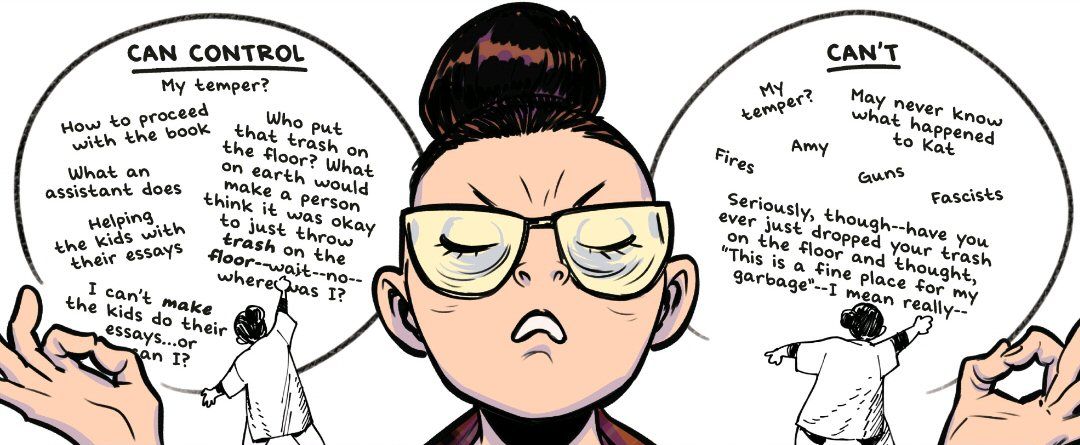
While the panel above has two circles of what she can and can’t control, Lopez has drawn Patty in what appears to be a modified Buddhist Dhyana Mudra meditative posture and hand gesture (in this case, a separated version of the mida no jōin from Zen Buddhism specifically).
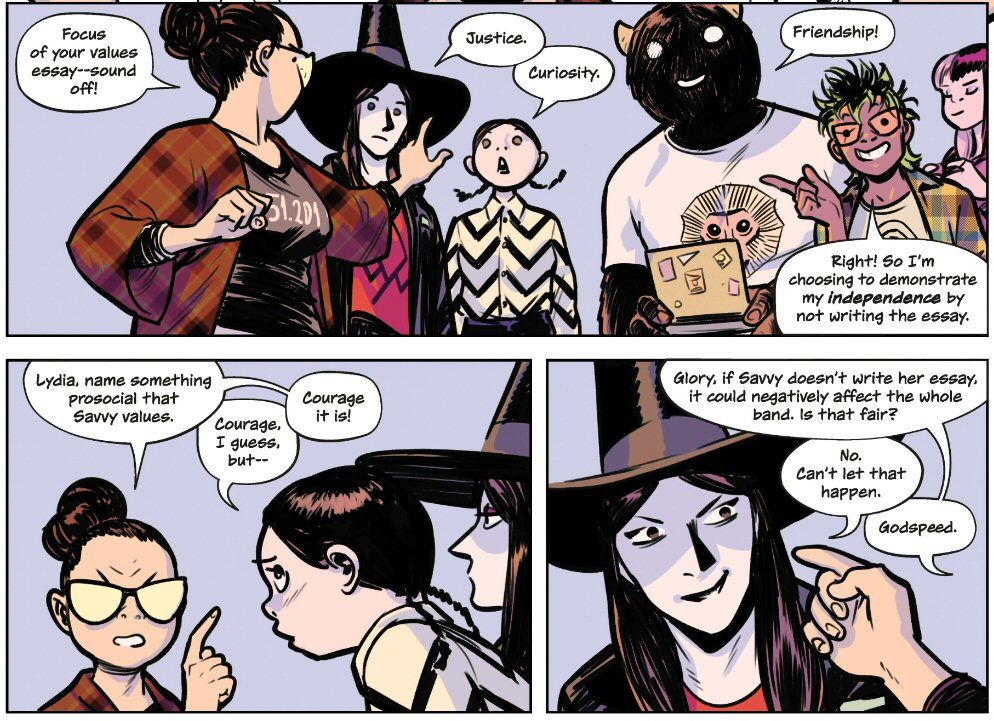
I love these panels for another reason – they show how all the characters are facets of DeConnick’s personality. Each one primarily exemplifies a single value, and Patty puts them all together to produce the greatest common good (note as well that Patty considers values to be “prosocial”, in keeping with the care ethics theme). There is another similar exchange in this issue about why so many people tune in for true-crime series and podcasts – each member of the group has their own answer, that collectively sum up to a compelling argument.
Ok, I think I’ve covered a lot of ground here. It was especially fun to finally explore Buddhism – which is not something the superhero crowd tend to go for. This is kind of by definition – superheroes are forever getting involved in others’ lives and trying to help them (often while ignoring their own problems). A Buddhist superhero would almost be a contradiction in terms!
In any case, I think this series helps show the value of moving beyond superhero stories in comics when trying to explore the broader range of human experience – and normative ethics.
The last word … for now
Issue #3 opened with a very interesting take on a Young Adult (YA) classic:
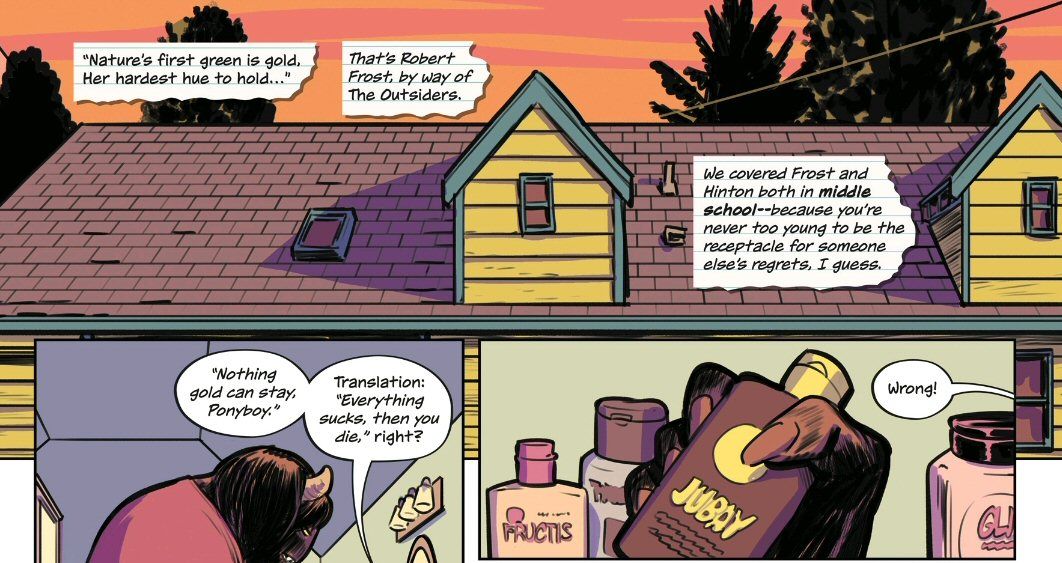
I have no idea if The Outsiders is still taught in middle schools today (it was a mainstay of Grade 8 education when I read it in early 1980s – presumably just like DeConnick). Sue Hinton was only 15 when she began writing it, and the completed novella basically created the YA fiction category. It was a personal favorite of mine, and was in fact the first (non-comic) book I ever bought – followed by an anthology of Robert Frost‘s poems.
The short 8-line poem, Nothing Gold Can Stay, has a significant place in the Outsiders story. It is easy to read it as a commentary that nothing pure or good (like the innocence of childhood) can last in this life. That sooner or later, time takes its toll on everything, and death awaits us all – with all the regrets that a lived life seems to entail. Riley certainly seems to have this dark take on the poem and book initially, consistent with the heightened feel of the FML series. But this also foreshadows the later conversation with Patty, when she makes it clear that you shouldn’t dump your “stuff” (like regrets!) onto someone else’s plate.
It’s funny, but just like how I opened this post with the observation that my perspective on the comics of my youth differs from the common view, I also took something different from this poem and novel – at the time, and to this day. To me, they have have always been a reminder of the reality of impermanence, and so why we need to appreciate those special moments when they come – precisely because they won’t last forever.
The Stoic philosopher Seneca wrote about this a lot (e.g., “True happiness is to enjoy the present, without anxious dependence upon the future”). He liked to point out how we are dying every moment of every day. Even the time you spent reading this is time you will never get back (sorry!). That time, he said, now belongs to death. But the answer is not to despair – it is to live. Live while you can. Seize the moments while they still belong to you.
I like to think that is where this series is going – but either way, I plan to enjoy the journey DeConnick and collaborators are taking us on.
P.S.: With such a strong ensemble of diverse characters – each reflecting different aspects of DeConnick’s personality – it is a fun question to ask yourself which character do you most see in yourself?
Although I can see a lot of the dad Jimmy in me (and I know my wife would agree), I can’t help but think I am closest to Lydia. From issue #4:
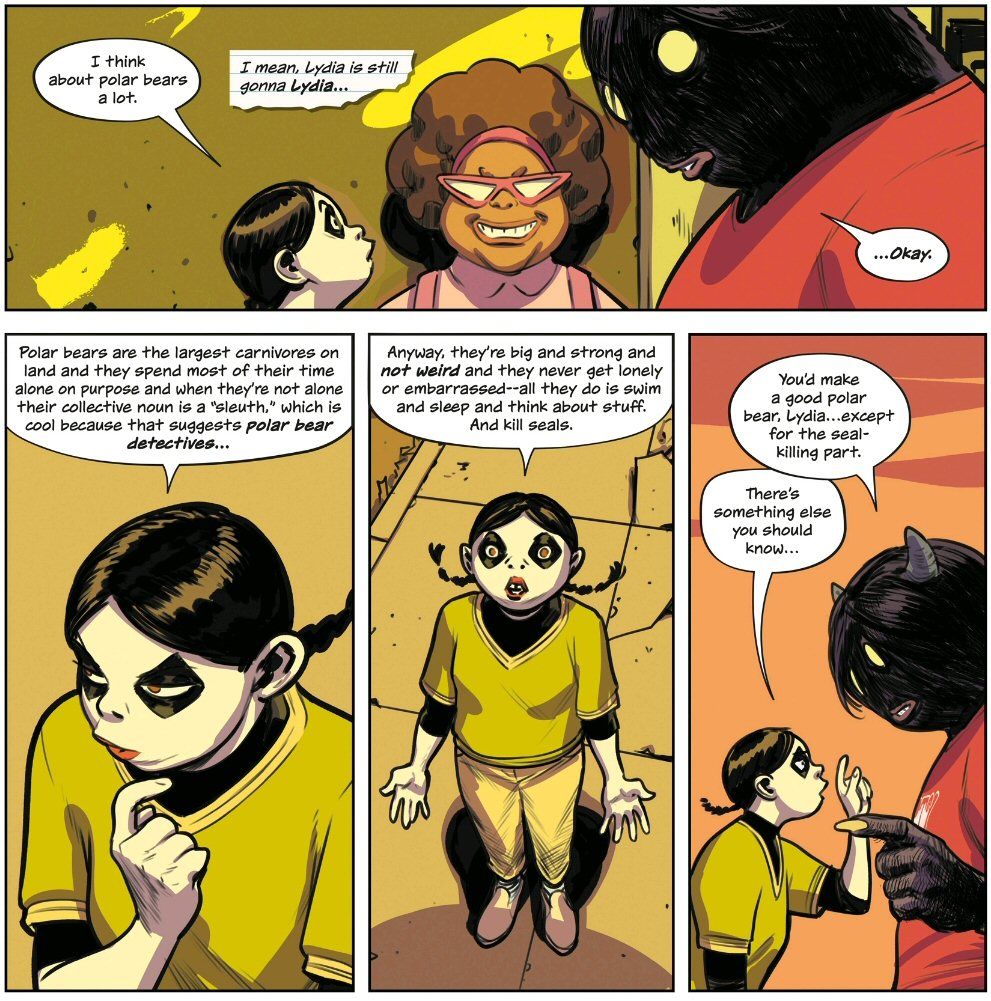
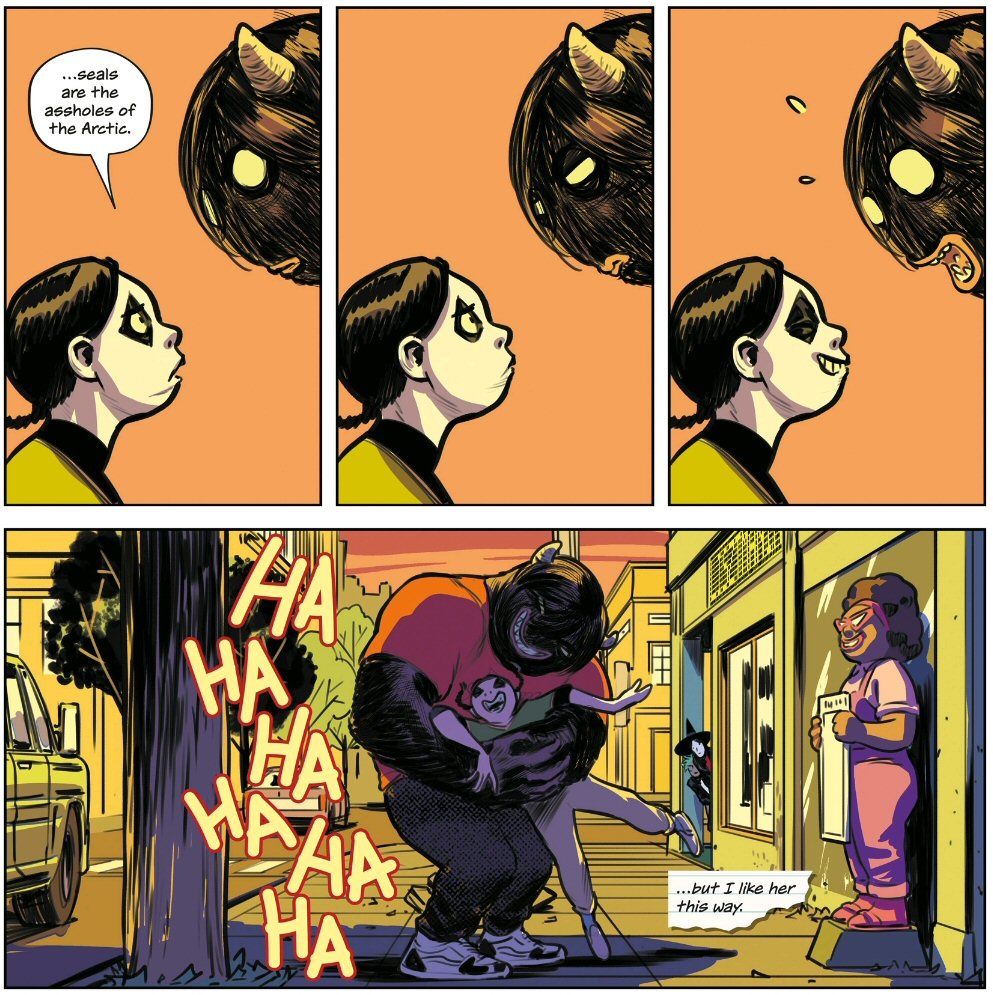
As someone who spends their free time writing about normative ethics revealed through comic book stories, I feel the Lydia parallel is unavoidable.
I hope you like it this way too. 🙂
See my Glossary post for a list of the key philosophical concepts and related links on this site.
Further Reading
More Kelly Sue DeConnick: Captain Marvel
More family ethics: Fantastic Four
More virtue ethics: A.X.E.: Judgment Day Conclusion
Wow, what a great series. I loved Kelly Sue’s work on Captain Marvel, so will have to look it up. Thanks for branching out into new characters/series I’ve never heard of (and Kelly Sue rocks!)
Yes, it is great series. If you like irreverence, and more mature themes, you should also check out DeConnick’s earlier dystopian series, Bitch Planet, with Valentine De Landro (2014-2017).
If you can find them, I strongly recommend picking up the actual comic issues (or their digital equivalents). The trade paperbacks lack all the additional commentaries at the back of the individual issues. These include behind-the-scene comments by DeConnick about each issue, as well as multiple guest essays on feminism and other topics relevant to the stories.