
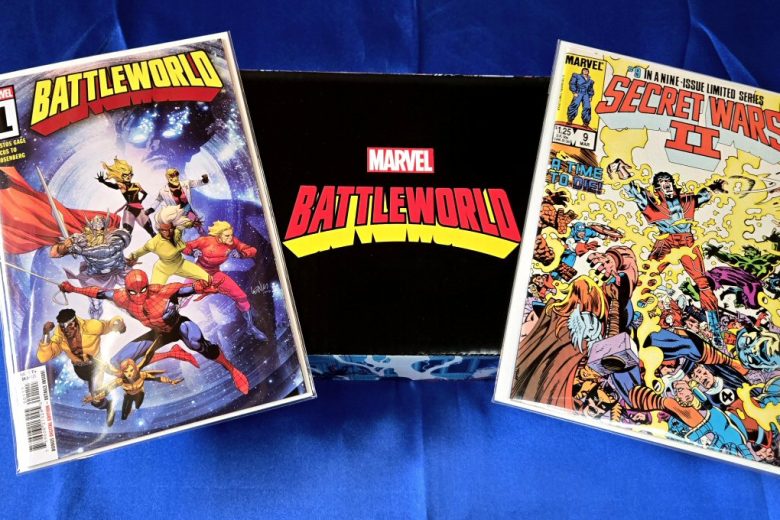
The recently completed five-issue limited series Battleworld (2025-26) by Christos N. Gage and Marcus To was a great read. It is not an exaggeration to say Gage has an encyclopedic knowledge of Marvel comics characters and history – which he puts to great use in this series. To use his own phrase from the back-matter to issue #2, “middle-aged comic book nerds” (of which I am one) will “lose their minds” at some of what he has brought back and incorporated into this story.
This series is in part a meditation on suffering, and how it is important to face one’s own pain if one is to find meaning and value in life (a virtue ethics perspective). But Gage’s revisiting of story lines from earlier eras is also an opportunity to re-contextualize those events, adding a modern perspective and integrating them into ongoing (and future) storytelling. It very successfully addresses a number of problematic stories – especially the original Marvel cross-over event that premiered the “Battleword” concept: Secret Wars (1984-85) and its sequel Secret Wars II (1985-86).
Although Battleword can easily be enjoyed on its own, the context to where it came from is worth examining here. So I will begin with a brief history of the original Secret Wars, conceived and written by Marvel’s Editor-in-Chief at the time Jim Shooter, to help you understand and appreciate the creative work by Gage and colleagues to rehabilitate the concept here. And of course, explore some moral philosophy (normative ethics) along the way!
Note that I am not referring here to the 2015-16 cross-over event also known as Secret Wars, created by Jonathan Hickman and Esad Ribić. In addition to being a dramatic and multiverse-altering event, it nicely compared and contrasted the moral perspectives of Reed Richards and Doctor Doom. Unfortunately, it didn’t do as good of a job on the Invisible Woman or the rest of the FF family dynamics (as I discuss on my Fantastic Four ethics overview).
When examining comics across different eras, it is common for earlier moral perspectives to no longer fit with modern social or cultural sensibilities (see my X-Men introduction for a good example). But this is not one of those cases. Secret Wars I & II were demonstrably bad at the time they came out – and have only gotten worse with age. And despite claims that these series have been positively reconsidered in modern times, they have also been heavily criticized. A good example is Comics Archeology, which recently gave its concluding issue #9 a 0/10 score for “standing the test of time” (along with a blistering review).
Re-reading Secret Wars I & II for this overview showed me that they were even worse than I remembered – but there are some interesting normative ethics, particularly in the second series tie-ins. There was also more going on behind-the-scenes at the time than was known to me in my youth, which is worth considering here too. After my foray into Secret Wars below, I’ll return to the Battleword story and show the clever rehabilitation applied by the modern team.
As always, if you would like to know more about the terms I’m using on this site, please follow the links throughout or check out my Ethics 101 page or Glossary of Terms post.
Introduction to the Secret Wars story
Unbeknownst to me at the time, the genesis for this comics series was actually a merchandising deal. In the early 1980s, Kenner toys had a made a fortune on its Star Wars line of figures and sets (I had many!) and had recently licensed DC comics superhero characters. Mattel approached Marvel about a similar licensing deal for their superheroes, apparently requesting a special “event” story to go with the launch. Shooter decided he was the only one who could write this story, both to give the fans what they wanted and to keep all the Marvel creators’ egos in line, according to his own admission on his old 2011 blog.
Shooter is a complex and divisive figure in the comics world. Marvel had been experiencing severe growing pains in the mid-to-late 1970s, with a revolving door of Editors-in-Chief, until Shooter took over. He fixed many of the structural issues they were having (especially in getting works out on time), and oversaw a large expansion of new titles, new talent, and major story lines. He was also an advocate for artists’ rights and ensured proper creator royalties. But his nine-year tenure was overshadowed by complaints of a dictatorial management style and numerous fights with the creative talent. This eventually led to the exodus of some of the more prominent talent to the “Distinguished Competition” of DC comics – especially immediately after the Secret Wars II event. I find his Wikipedia entry does a good job describing his time at Marvel in a fair and balanced way.
The first Secret Wars series began in each individual superhero’s respective title, with a brief scene of them being kidnapped and transported away from the Earth. But you had to pick up the Secret Wars limited series to learn what happened to them, as the next issue saw their return to their respective titles. In the twelve-issue limited series (written by Shooter, over 1984-85) it is revealed that they were sent to a patch-work planet called Battleworld by a new cosmic entity eventually known as the Beyonder. The Beyonder was a god-like being alone in his own universe. Once he became aware of our universe, he decided to bring together a large assortment of superheroes and super-villains to learn about good and evil – by seeing who would win when they were forced to fight each other.
The premise of this series is thus set up as the classic ethical conflict between consequentialism and deontology. As I explain on my Ethics 101 page, there are three branches to normative ethics (the branch of moral philosophy that focuses on how we ought to act). Deontology is concerned with doing your duty to other people, often through the lens of rights or justice. These theories are often rule-based and focus on the moral value of the acts themselves (that is, doing the right thing). Consequentialism is seen as the opposite, focusing not on the acts but rather on their outcomes. These theories typically explore the moral burden of making good decisions (that is, doing the good thing). The third branch is virtue ethics, which shifts the focus from the act to the actor – being the best person you can be, typically by practicing virtues that align with your values and goals (that is, being better).
As an adolescent with a keen interest in moral philosophy, I had high hopes for this series. But what followed was something of a muddled mess to my mind, with the superheroes generally behaving poorly. The most interesting moral observation to me was having the Beyonder place Magneto in the heroes’ camp. Shooter may have been prescient in seeing his virtuous potential, but here it simply became the wedge to divide the heroes into arguing sub-groups – and all very consequentialist ones at that. Indeed, some of the villains behave better and are treated more sympathetically than the heroes in this series! Eventually, the story devolves into an extended Doctor Doom story, who succeeds in stealing the Beyonder’s power (for a while). In the end, the most momentous outcome of this series for me was the new costume for Spider-Man (that eventually became the symbiote Venom).
The initial Secret Wars limited series was a huge financial success for Marvel, but was critically panned at the time (the toys didn’t too well either). But the financial success emboldened Shooter to develop the second series, which saw the Beyonder come to Earth and assume human form. Naturally, his god-like powers created havoc on Earth. Going even bigger this time, Shooter insisted on dedicated tie-in issues in every one of the main Marvel titles in addition to a nine-issue limited series (that he again wrote, 1985-86). Rebelling creative talent at Marvel were threatened with removal from their monthly titles if they didn’t comply, and were then forced to create stories under his direct supervision to ensure his “vision” for the series (you can see what might have sparked the exodus!).
A few of the tie-in stories were actually pretty good, as the creatives did the best they could with the assignment – but they were often disjointed from the main story. It was that core limited series written by Shooter that was a problem in my view (and many others). Not only was the Beyonder very inconsistent across the run, the the heroes also kept trying ineffective brute-force attacks with no sign of reason or strategy (and often completely unprovoked, including on the occasions when the Beyonder was behaving well).
The limited series also broadly exhibited some of the worse tropes of comics of that era, including rampant sexism that crossed over to outright misogyny. Several of the women characters behaved in infantile ways, many were either manipulative (or easily manipulated), and several were ultimately ridiculed, fat-shamed, or mind-controlled by the Beyonder. Several also repeatedly fell “in love” with the Beyonder due to his outstanding sexual prowess in bed (I’m not making this up!), with one woman killing herself after he rejects her (don’t worry, the Beyonder brings her back to life so that he can humiliate and abandon her again for another woman).
I will highlight three comics stories below – two excellent tie-in issues, and the problematic limited series conclusion – to illustrate the moral conundrum. Along the way, I will explore two philosophical concepts that I haven’t previously described here – the primacy of striving in human nature, and the perceived need for sacrifice (especially self-sacrifice) for heroes. Finally, I will show a good example of the value of self-limitation, which I recently introduced in my Powers ethics overview.
If you want an issue-by-issue description of this series, I recommend Comics Archeology for a good breakdown, from a modern perspective. You can jump down to my Battleword overview if you want to skip ahead, but I recommend considering the three philosophical concepts explored below first.
The ethics of Secret Wars II (1985-86)
My favorite Secret Wars II story was told in Doctor Strange Vol 2, issue #74 (1985) by Peter B. Gillis and Mark Badger. Series’ writer Roger Stern was wrapping up a major story arc that saw the reunion of Doctor Strange with Clea – a highly problematic relationship that he had insisted on breaking up when he took over the title in 1982 (as I explain at that link). And just at the critical point where we were to learn what would happen next between them … Stern was taken off the title and Gillis took over, starting with the Secret Wars II tie-in story (his price of admission, perhaps?). But Gillis wrote one of the best Beyonder stories – and had a great subsequent run with the good Doctor.
After efficiently wrapping up Stern’s previous story arc, Doctor Strange senses the Beyonder’s violation of his sanctum, and rushes home only to encounter an inebriated entity. I love these panels:
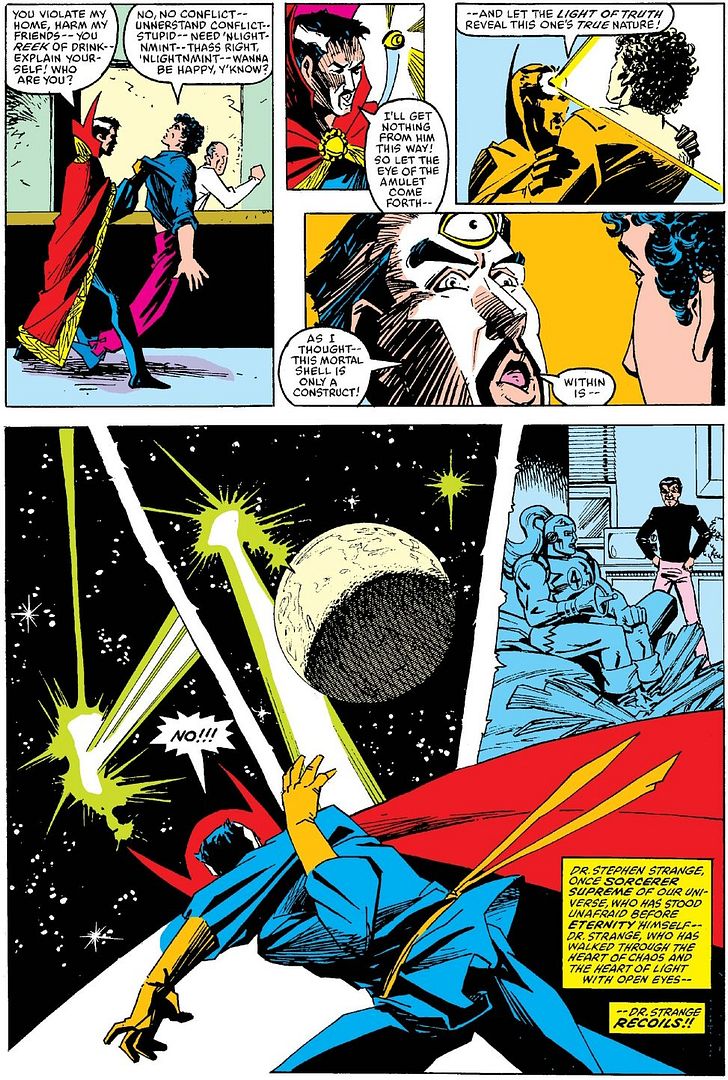
That’s a good reaction shot and description – Strange is not one to shirk from cosmic entities! Check out my Doctor Strange ethics overview to learn more about this fascinating character.
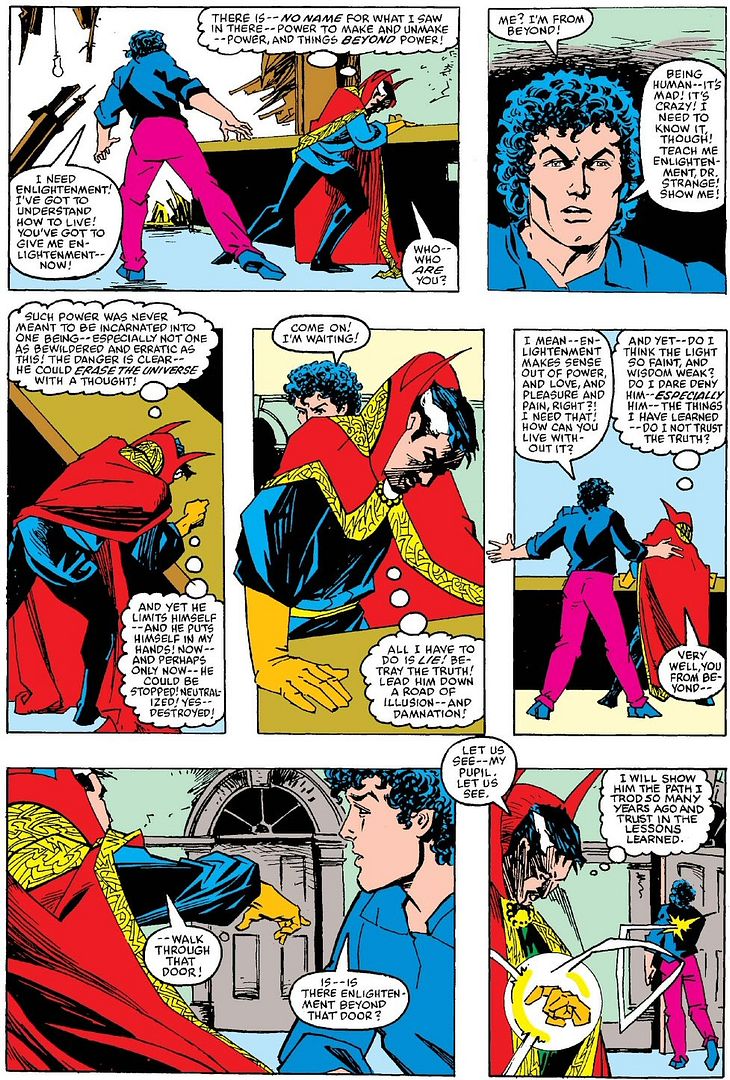
I love the reasoning Gillis’ Strange provides in these panels. He could lie and permanently stop the Beyonder given his incapacitated state. But does he so distrust his own moral growth (through virtue ethics) to not extend the same opportunity to the Beyonder?
This also gives Gillis a chance to re-tell Strange’s origin story (a common feature in the comics of my youth, given the lack of resource material available back then). When the Beyonder makes the same fateful choice as Strange to intervene at his own personal cost for the sake of the Ancient One, Strange releases him from his illusory prison:
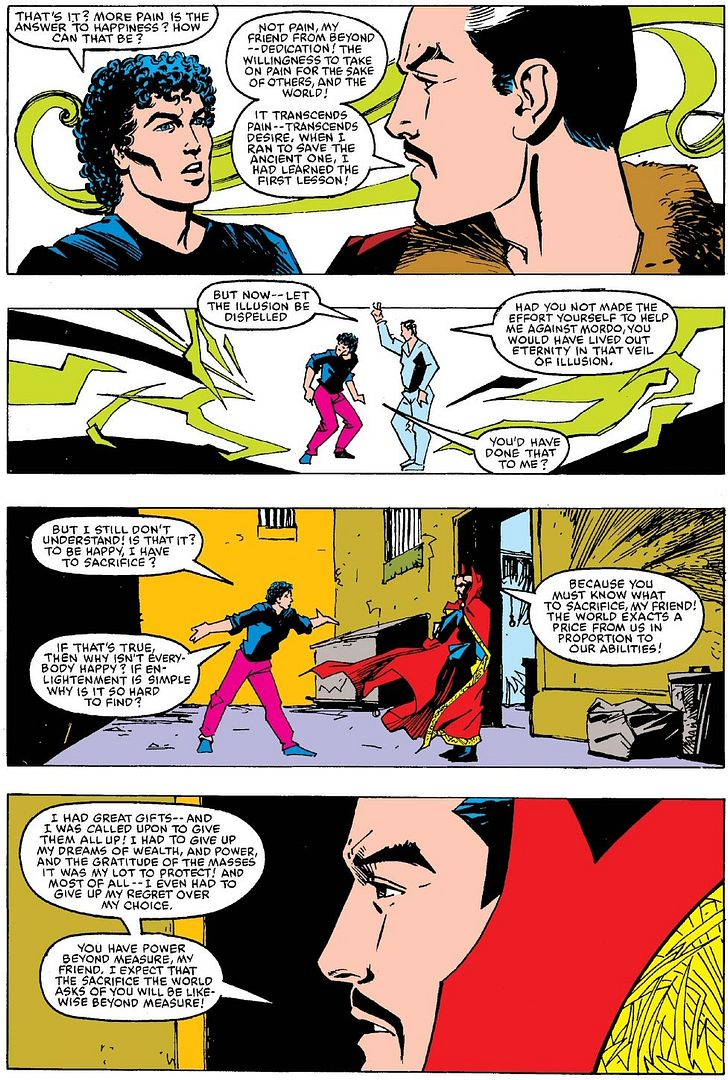
This perspective on “sacrifice” is interesting, and likely reflects Gillis’ research into the personal theology of William Blake, as part of his incomplete PhD thesis. Blake believed that humanity could only be redeemed by self-sacrifice, and he thought it was critical to seek a balance between imagination and intellect. Gillis managed to insert many of Blake’s ideas into his subsequent run of Doctor Strange – including many new character names that he lifted directly from Blake’s epic poems (like Urthona, Enitharmon, and Rintrah). Note the following observation from Gillis’ now-defunct blog in 2007:
Marvel had two spiritual characters: Dr. Strange and Captain America. Stephen Strange was Imagination, and Steve Rogers was Belief. The others were just heroic people … all the challenges to Dr. Strange were challenges to the Imagination, while all of Cap’s challenges were challenges to Belief.
Of course, all that heavy philosophy is likely a little over the Beyonder’s head at this point. So Strange reverts to the other form of normative ethics that best characterizes him, consequentialism (specifically, utilitarianism):
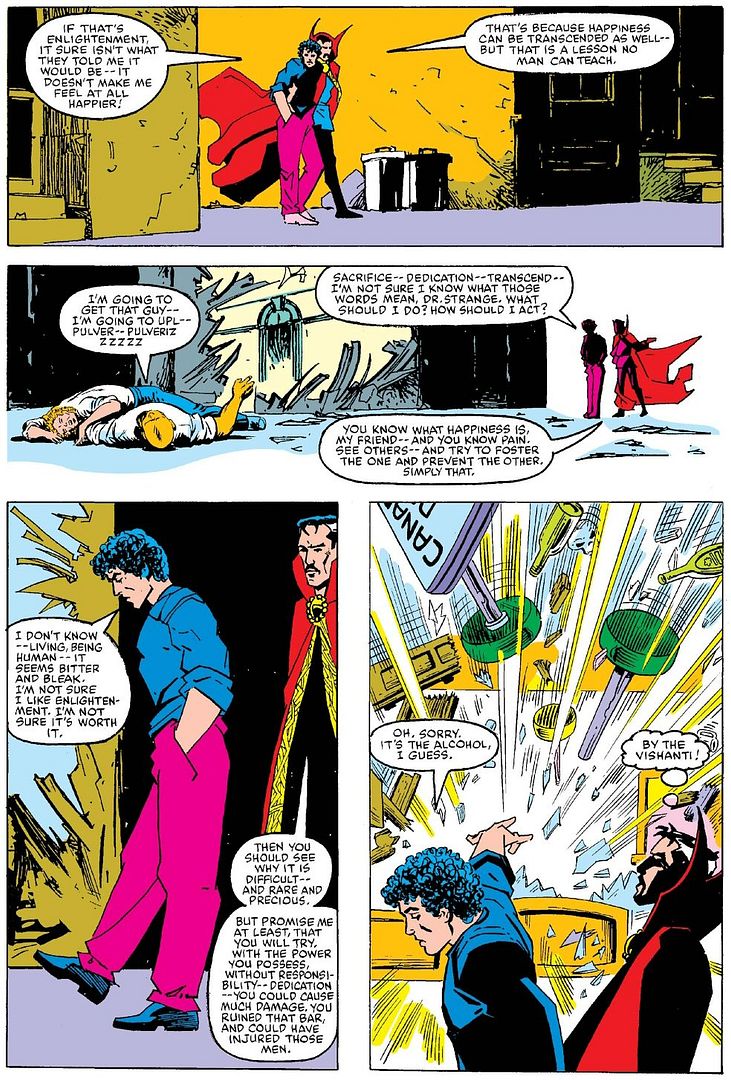
You know what happiness is my friend – and you know pain. See others – and try to foster the one and prevent the other. Simply that.
Jeremy Bentham couldn’t have put it more succinctly himself.
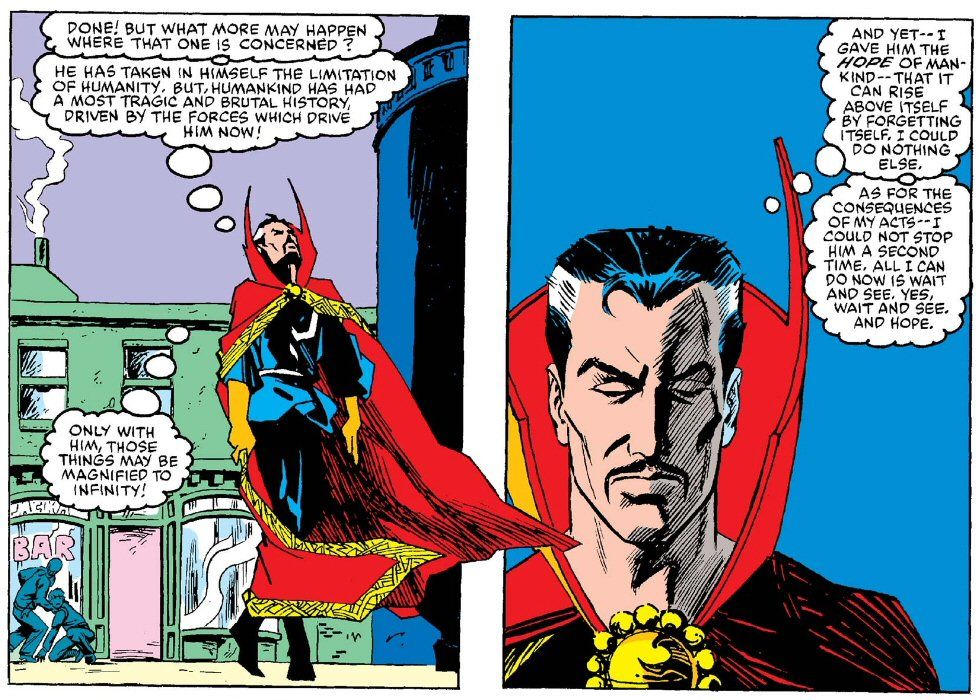
Yes, Strange worries about the consequences of his actions that day – but he still feels it is the right ethical decision to take a virtue ethics chance on the Beyonder. This is a great moral take (sadly, one of the few in Secret Wars). Although the Beyonder does behave better for a while, and tries to apply the lessons he learned from Strange (issue #6 of Shooter’s limited series), it doesn’t last long. In eventual frustration, the Beyonder decides he wants to wipe out all of existence, including his own memory of it.
From the final issue of the limited series, Secret Wars II, issue #9 (1986), we actually get some explicit philosophy through a strange scene where the Beyonder interviews himself, offering a philosophical justification for his intentions. By Shooter with art by Al Milgrom:
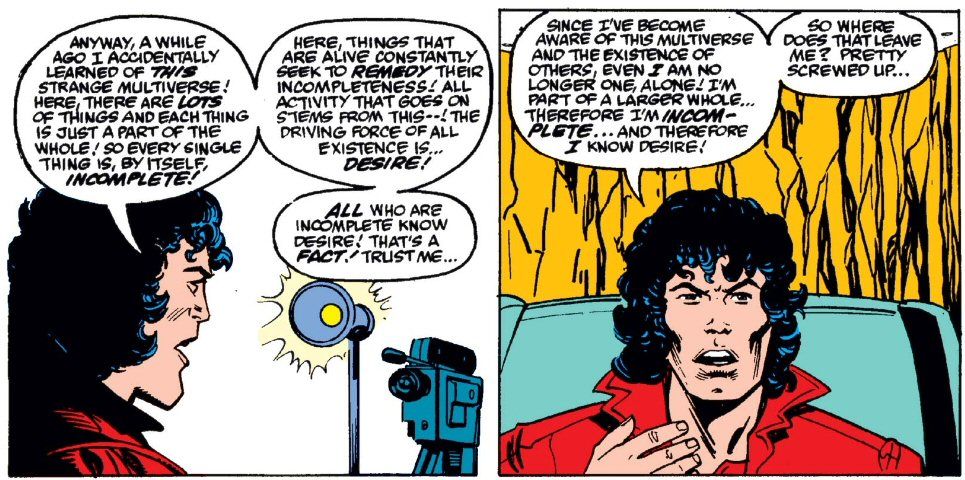
Shooter seems to be channeling the Enlightenment-era Dutch philosopher Baruch Spinoza here. In his masterwork, Ethics, Spinoza explicitly argued that “Desire is the very essence of man”.
Spinoza was a rationalist, who believed that ideas corresponded directly to reality. But he was also a naturalist, who equated God with nature and rejected all supernatural explanations. Many of his rationalist contemporaries (and predecessors, like René Descartes) treated the human mind as an exception to universal natural law. Rationalists typically saw the human mind as capable of independently discovering fundamental truths about reality (including moral good and evil) through reason, logic, and innate ideas, rather than through sensory experiences or empirical evidence (as empiricists believed). But Spinoza insisted that the human mind cannot be “outside nature”.
What Spinoza meant by desire being the “essence of man” is that every living thing, as far as it can, strives to persevere in its own existence. But this striving relates to both the body and the mind, which leads to the conscious human awareness of one’s own striving. So “desire”, as Spinoza understood it, was the combination of both striving and the consciousness of one’s own striving. The way to be free from desire (that is, happy) is not to try and suppress your desires, but to master them by contemplation.
So, it seems like the Beyonder is on the right path above (at least for Spinoza). So why does he think this leaves him “pretty screwed up”? Because he has an additional ability that we mere mortals don’t: he is also omnipotent:
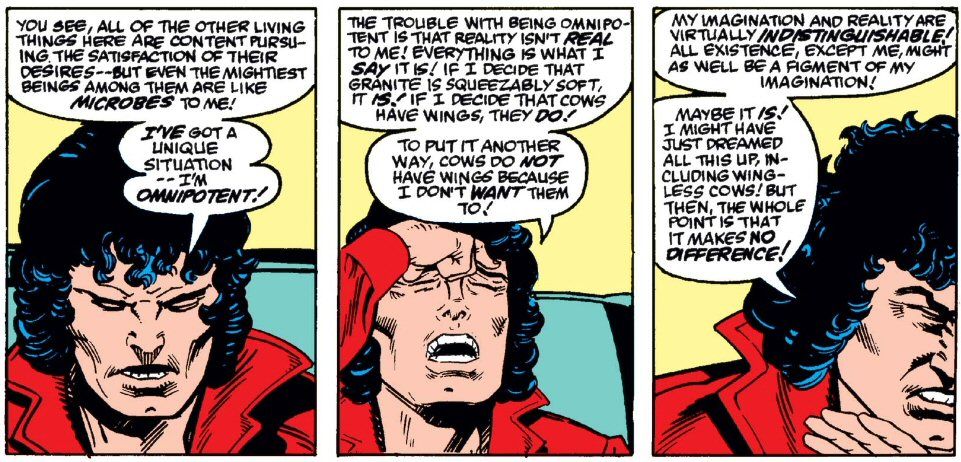
Although these scenes may seem a bit over-wrought, they are actually my favorite part of Shooter’s entire run, as they are based on a real bit of philosophy.
The direction the Beyonder is going here reminds me of another philosopher who was all about human striving – the 19th century German philosopher Friedrich Nietzsche. As I’ve mentioned previously, Nietzsche was famous for his nihilistic views. But he also saw striving as the fundamental essence of life, driven by what he called the “will to power” where individuals must constantly overcome themselves, embrace struggles, and pursue challenging (and even impossible) goals. This concept was core to his philosophy, where life is not just about existing, but pursuing an innate drive to expand, dominate, and reshape the world according to one’s own needs and desires. This led to his famous concept of the “Übermensch” (or Superman) – a person who creates their own values and transcends human limitations and superstitions.
As you might expect, these aspects of Nietzsche’s philosophy remain controversial. Many will justifiably claim that Nietzsche was misunderstood in this regard (especially along with his related “God is dead” concept). But I’ve found that a lot of people who display poor moral behavior like to use Nietzsche’s concepts to justify their actions. And it does suspiciously sound like the Beyonder is one of them.
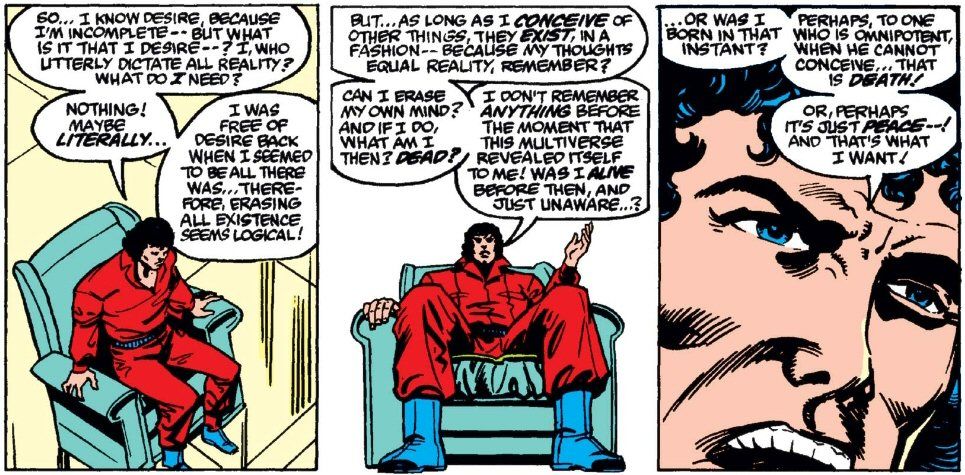
Ok, that first panel is a pretty convoluted justification for the Beyonder’s expressed desire to end all of existence, including his own awareness of it (I doubt either Spinoza or Nietzsche would have agreed with the “logic” of it!). But the rest of the panels show the Beyonder coming to realize that doing so – even if it were possible – would ultimately mean his own death, after a fashion.
So what to do instead? Miraculously, the Beyonder suddenly twigs in to what EVERY SINGLE CHARACTER has been telling him since the very start of this event: human existence is valuable precisely because it is so short and finite. Sadly, we don’t actually make it to the views of the 20th century French existentialist philosophers – like Jean-Paul Sartre and Albert Camus – who were the intellectual heirs to Nietzsche in this regard (as I discuss in my 8 Deaths of Spider-Man and Vision ethics posts). But we do get this reasoning:
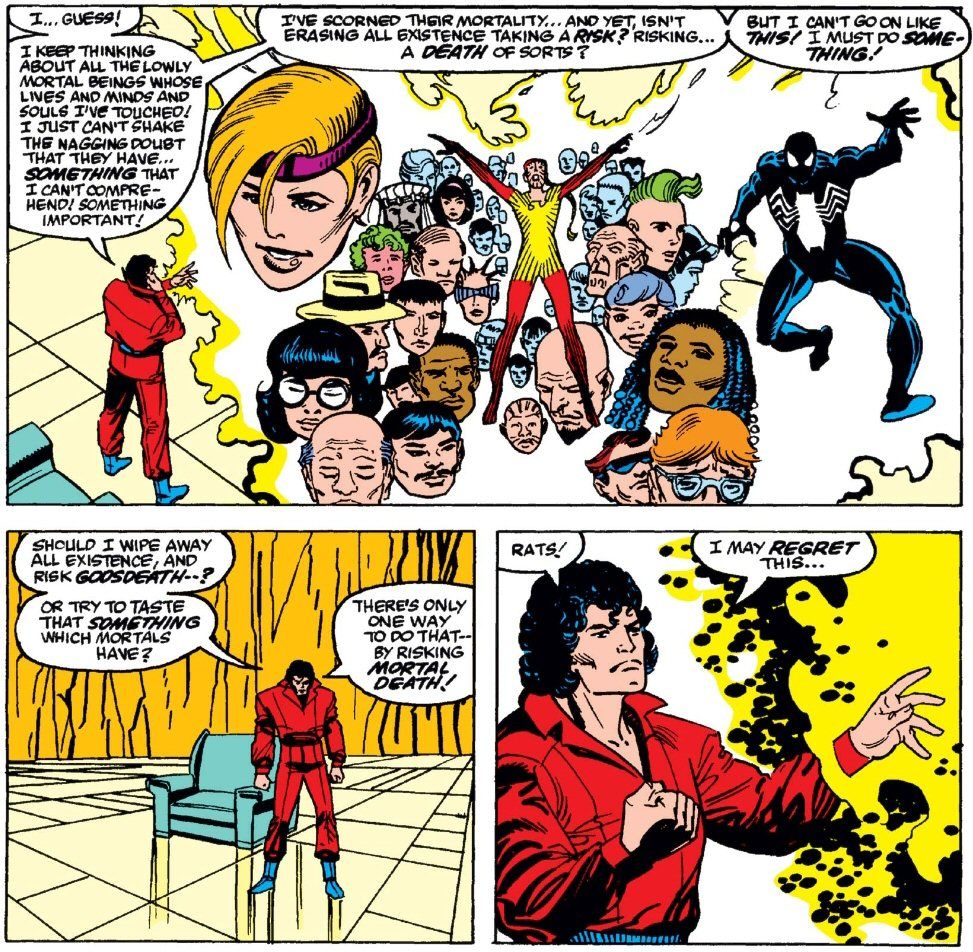
And, finally!! As an aside, I was not a fan of Milgrom’s art work in this series, but I had a good chuckle at the facial expression in that last panel. “Rats” indeed!
What follows are two abortive events by the Beyonder to turn himself into a mortal (while simultaneously fending off heroes and villains). The Beyonder finally comes up with a plan to be “reborn” as an infant through a machine of his own design (and a very Doctor Seuss-like one at that!). While at a vulnerable point, the heroes break into his cave:
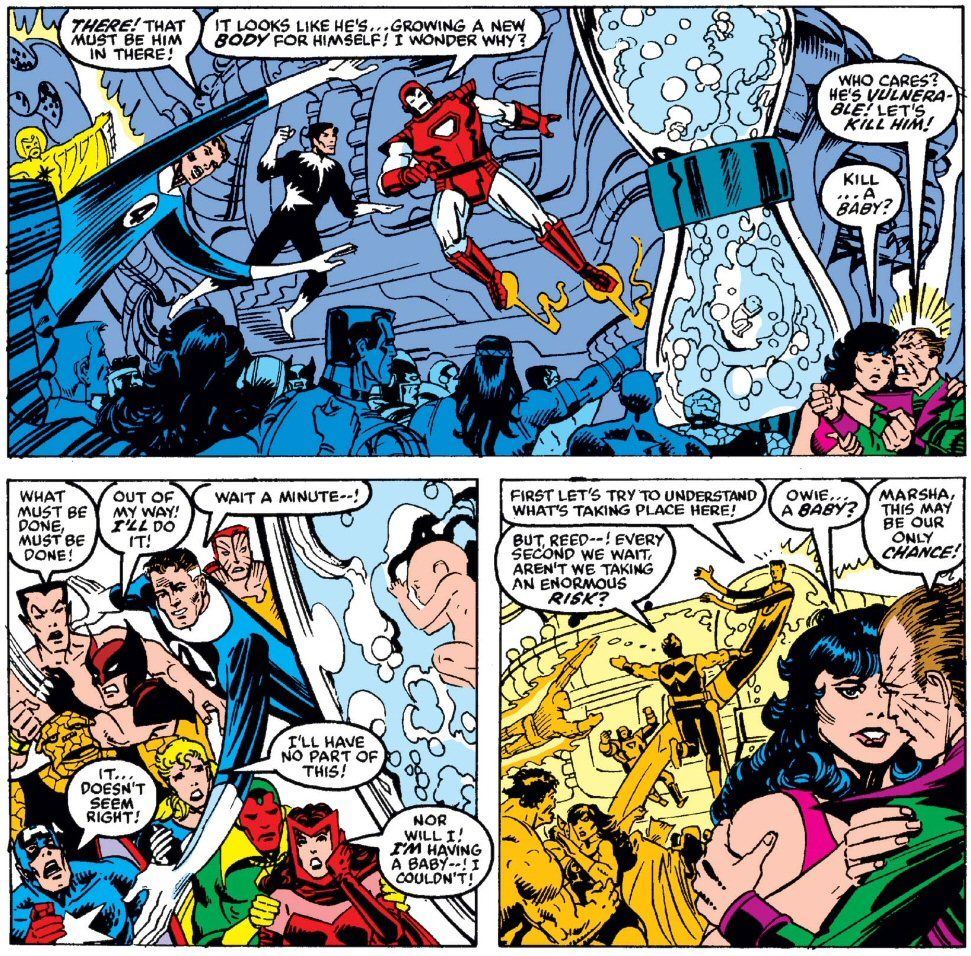
A couple of the women heroes balk at infanticide, and Captain America and Reed Richards seem a little apprehensive. But the rest are keen to attack … unfortunately, the Beyonder equipped the machine with automated defenses:
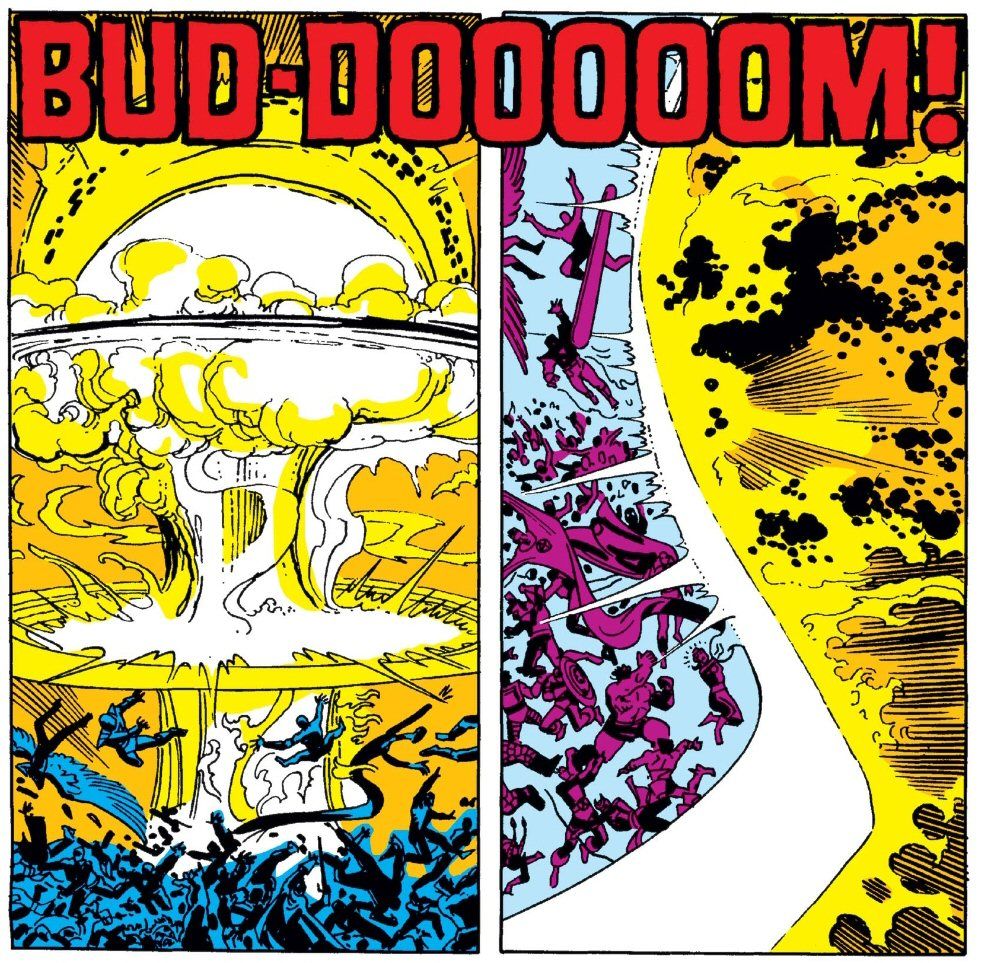
Earth’s finest are saved from the attack by the Invisible Woman, who is rendered unconscious as a result. And so what do they collectively decide to do next? Of course, mount a full-scale assault on the machine that just launched a nuke at them without any protection!
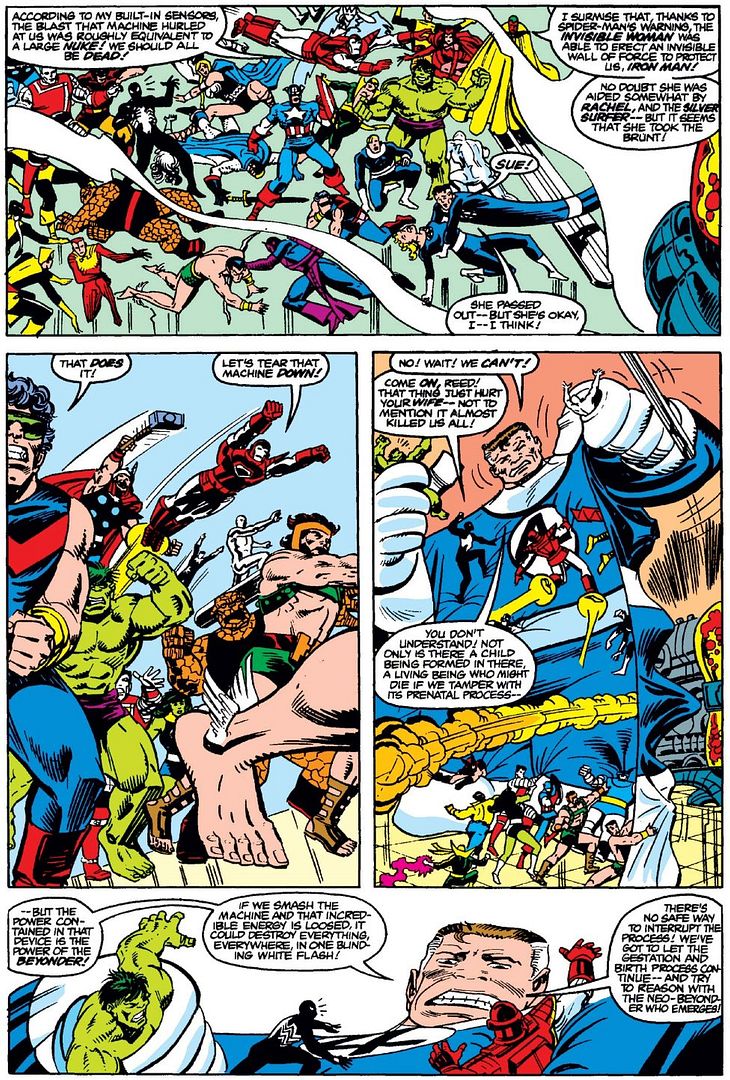
Okay, so only Reed has the good sense to realize that attacking the machine again is not a smart idea. Note this is basic logic and self-preservation – Reed it not arguing against murdering the Beyonder on the basis of any moral grounds. But the blood-thirsty band of “heroes” (including Cap!) charges ahead anyway.
As an aside, Reed capturing the Hulk in one hand, knocking the power-cosmic Silver Surfer off his board with the other (!) – all while stopping everyone else simultaneously with his body is the most ridiculous panel I can ever recall seeing.
So time to cue up the second most powerful entity in the universe after the Beyonder: the Molecule Man (Owen Reece):
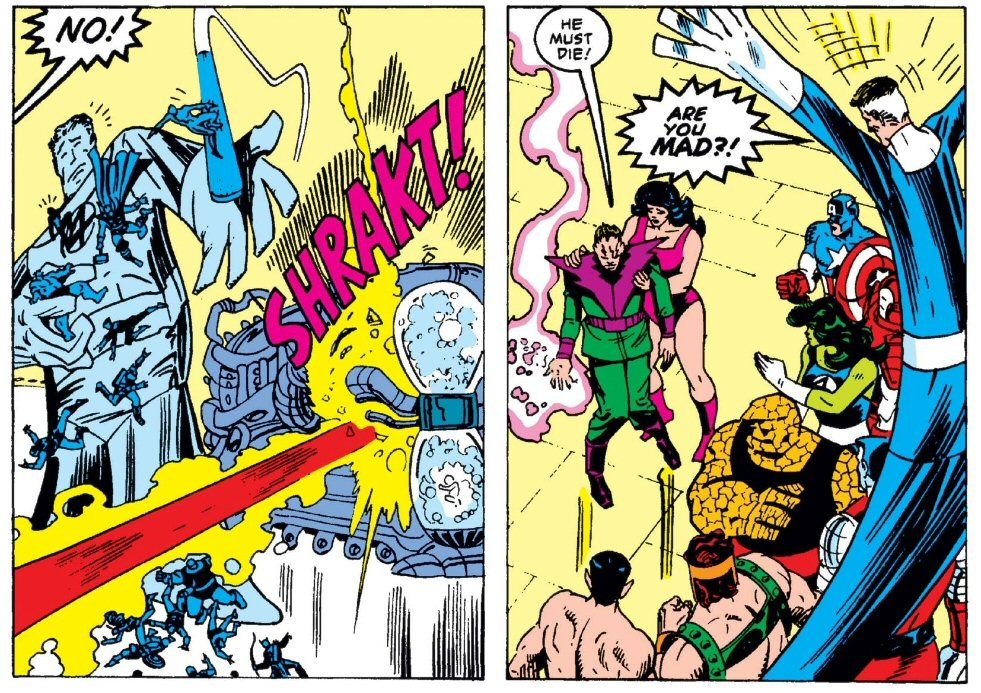
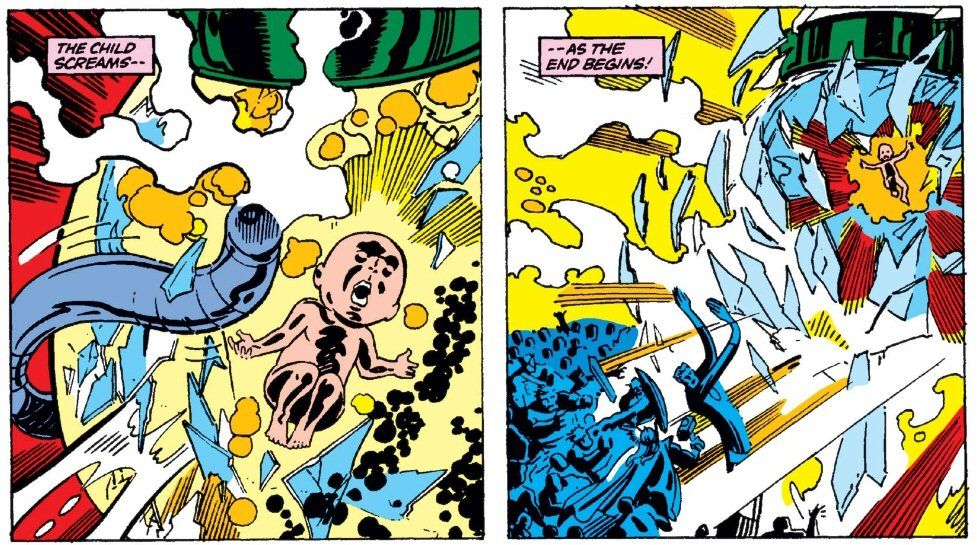
Although all of existence blinks out for a moment, it miraculously comes back:
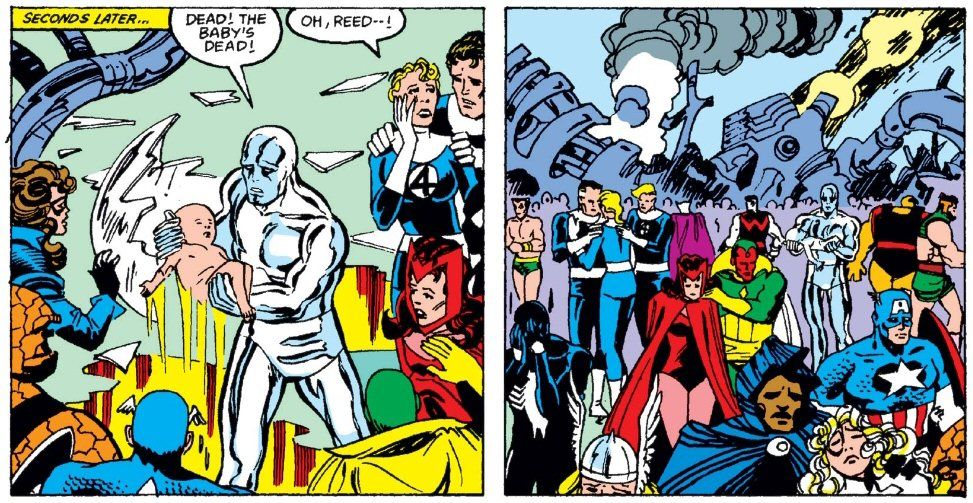
Okay, well at least the “heroes” don’t seem too happy about the situation. But then there’s this panel:
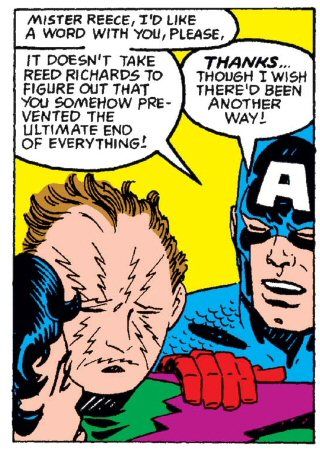
I will tell you my initial reaction as a teen when I read this panel: I flung the comic across the room!! I couldn’t believe what I was reading. Captain America – one of the most deontological superheroes in Marvel comics – the one who most stands for rights and justice, takes Reece aside to personally THANK HIM?!
Once I calmed down, I picked the comic back up and re-read the last few pages, to see if I could get through to the ending. I got as far as the next panel:
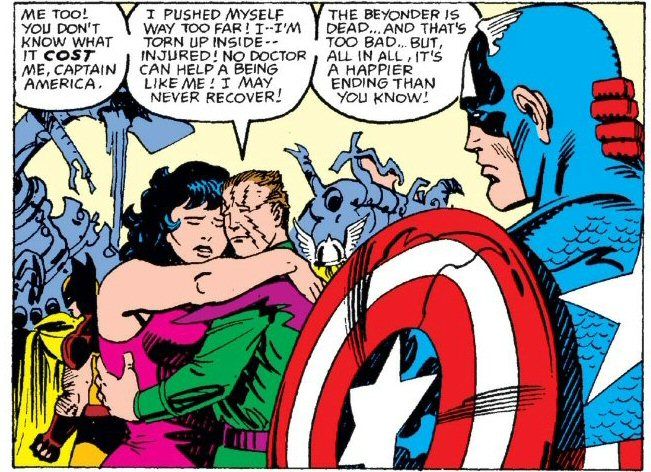
And the comic went sailing around the room again! A “happier ending than you know”?!
The third time was the charm, and I finally got through to the last two pages of the comic. Here, we learn that the Beyonder’s energy was released back into the void where he came from. There it sparked the creation of a universe where finite life could grow and evolve – into somewhat uncannily proto-human creatures:
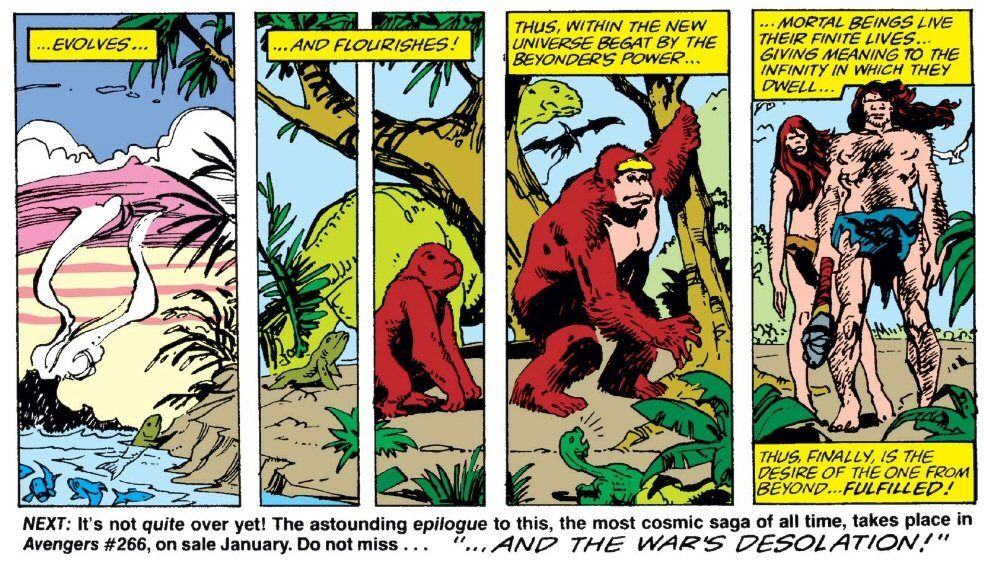
Needless to say, I was (and remain) repulsed by the premise of this ending. Reece wasn’t really a villain in this series – he was just a “regular” person who had received incredible powers and tried to do the “right” thing, even though he didn’t want to be a hero. Knowing what I know now about Shooter’s term at Marvel, I can’t help but wonder if this isn’t how he saw himself – a regular person given great power and called upon to make extraordinary decisions as best he could. And perhaps he felt he should be thanked for them as well. I’ll come back to this speculation in my Battleworld overview, as there is another character there who also seems to embody this personification.
But taking this story on its face, the idea that the Molecule Man should be thanked for having taken the decision out of the heroes’ hands – that this was in essence the “right” decision, just one they could not make – was not a form of morality I could accept. This series had a lot to do with why I stopped reading comics as an adolescent. Although I still followed some of my favorite writers sporadically for a while (especially Gillis, Stern, and J.M. DeMatteis), I stopped regularly reading and collecting comics at this point.
Which is a shame, as it meant I hadn’t read Stern’s fascinating epilogue to this event in Avengers #266 back in 1986. Reading it now, I see how Stern provided a clever revisionist conclusion to the Owen Reece story, courtesy of one of the most overtly philosophical Marvel characters, the Silver Surfer. An alien who sacrificed his freedom to save his own world (by becoming the herald of the planet-devouring Galactus), the Surfer had recently been confined to the Earth by his act of rebellion in helping save the Earth.
Although the Surfer was present at the end of Shooter’s series, he didn’t really have much of a role. This Avengers comic starts off with the damage the Beyonder caused being more severe than previously known – the Earth was on the verge of ripping itself apart. The Surfer tries, but he is unable to affect repairs on his own. So he asks the Molecule Man for help. With art by the always excellent John Buscema:
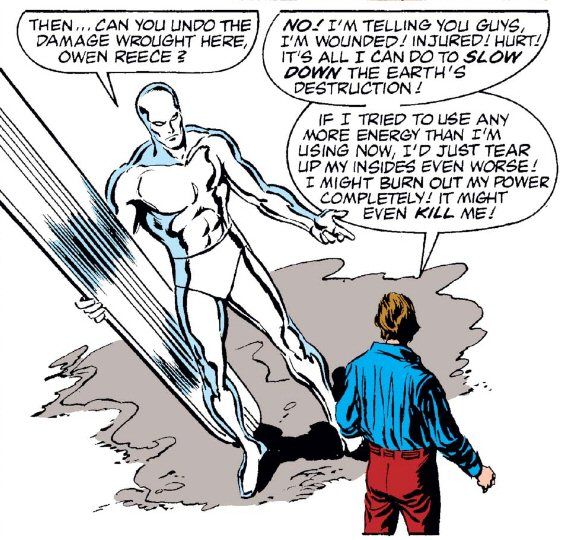
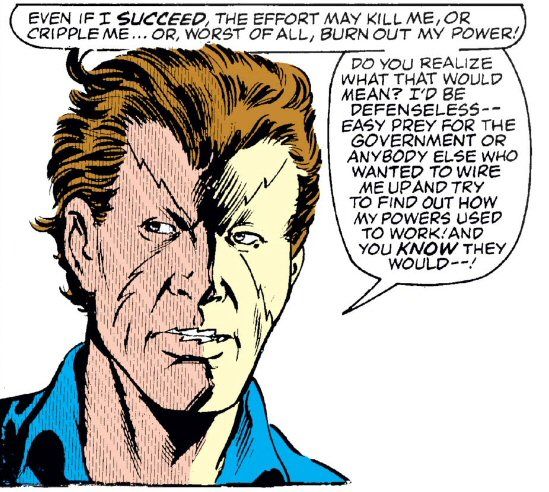
The Surfer talks Reece into joining his power with the Surfer, but he isn’t too happy about it:
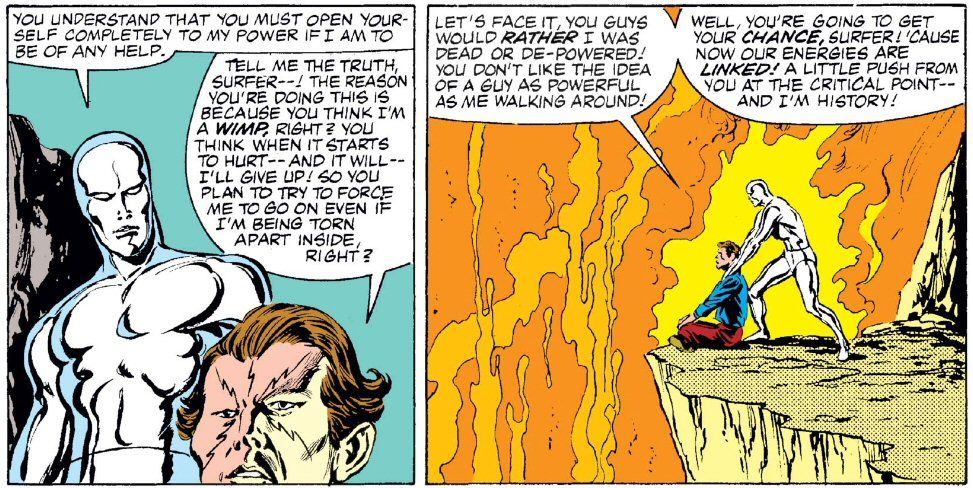
They succeed, but at what cost?
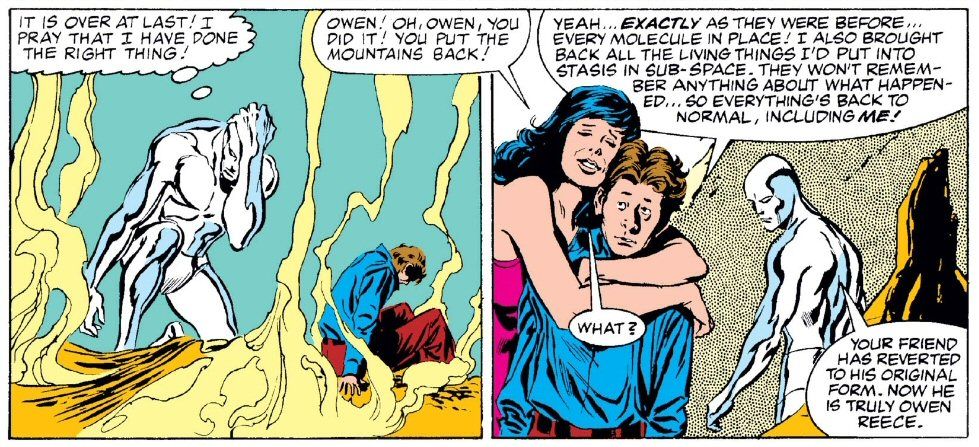
The Surfer offers to give the de-powered Owen Reece and Volcana a ride home:
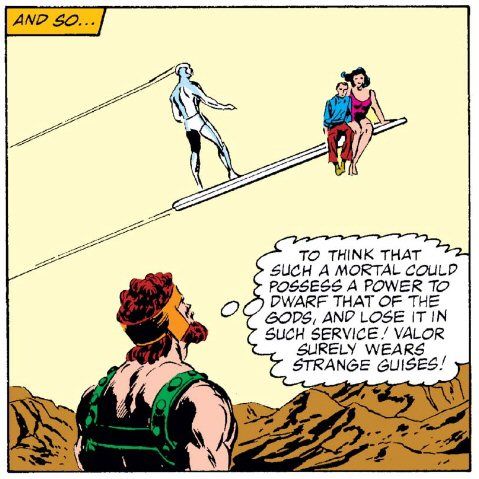
It’s a nice thought from Hercules, but all is not as it seemed. It turns out the Surfer wasn’t being truthful before:
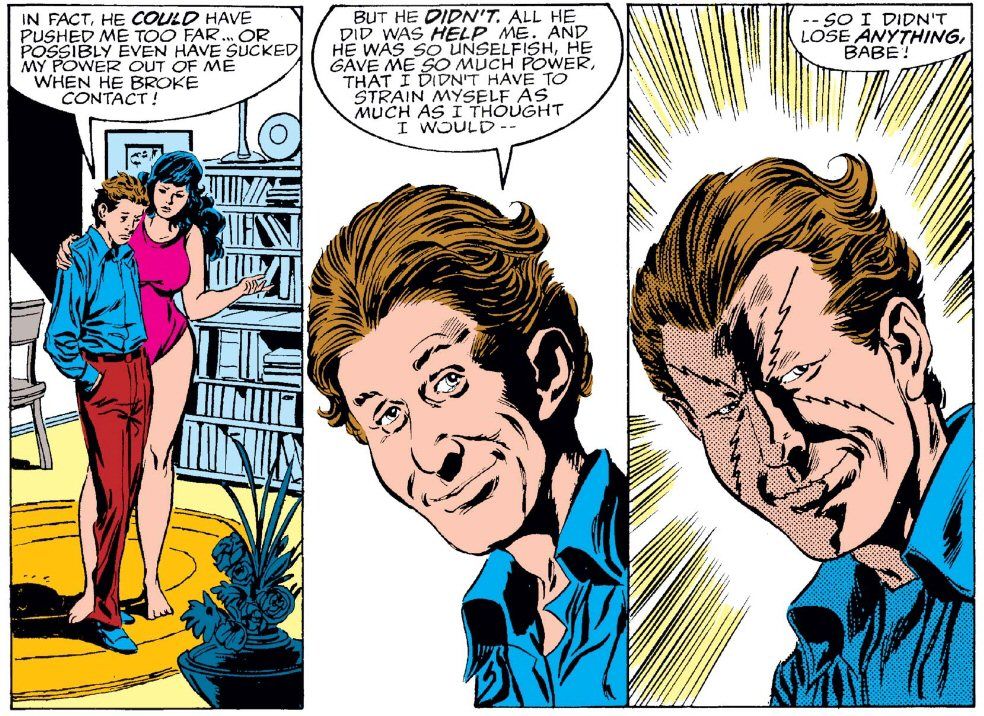
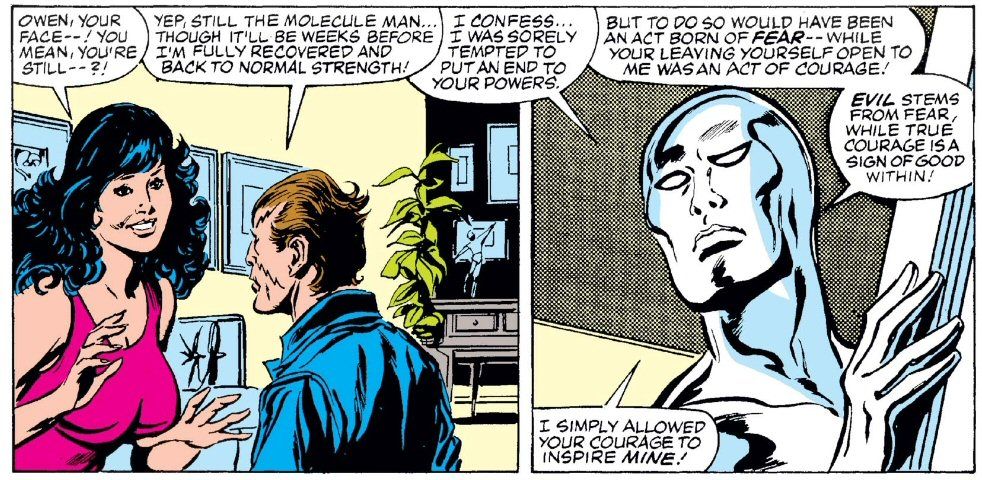
Leave it to Surfer (aka Stern!) to so eloquently articulate the opposite to the ending that Shooter wrote:
Evil stems from fear, while courage is a sign of good within! I simply allowed your courage to inspire mine!
- The Silver Surfer, Avengers #266 (1986) written by Roger Stern
Of course, there are implications to the Surfer’s act of virtue – and deception. And one last chance for the surfer to explain his reasoning to the reader:
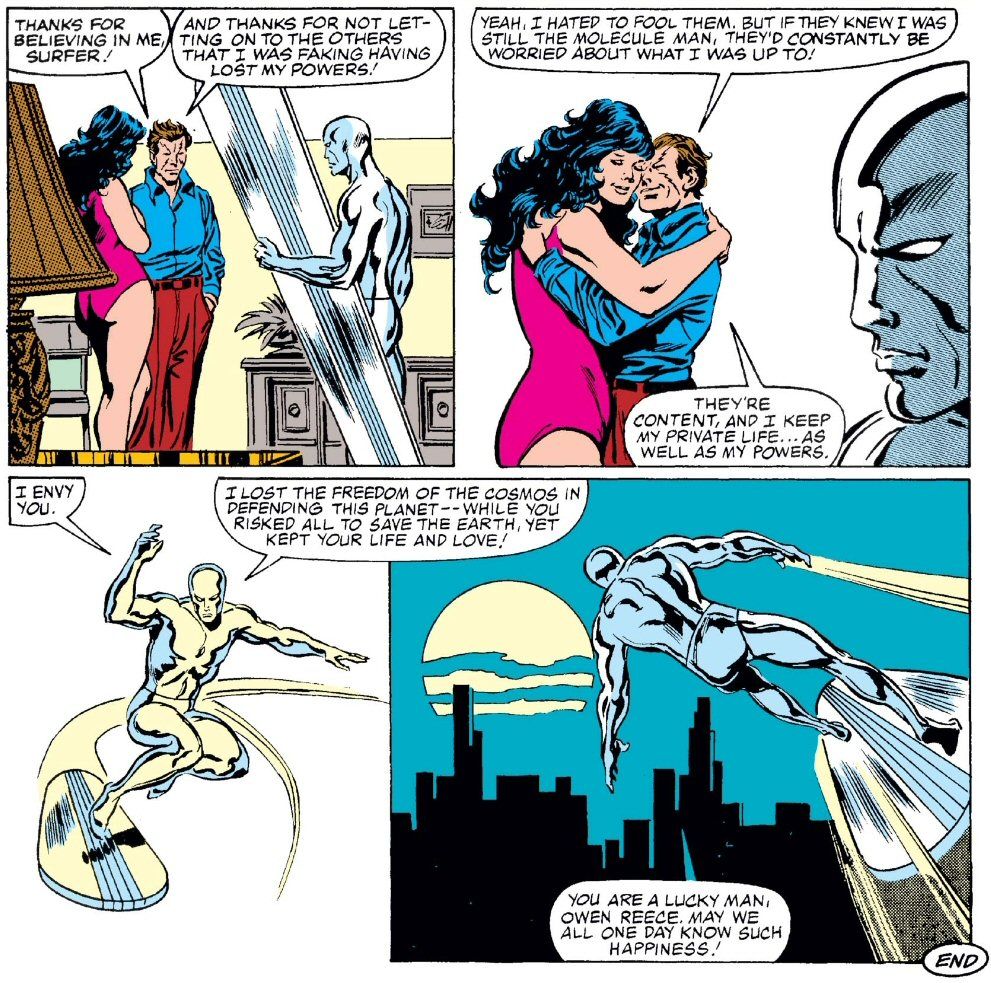
In this thoughtful epilogue, the Molecule Man chooses an ordinary life – away from all the others – which is respected and treated as a sign of personal growth and virtue. This is in contrast to the Shooter series where the Beyonder – attempting similar self-limitation – is treated as if that were a bad thing requiring his destruction. I tip my hat to Mr. Stern. I only wished I had read this epilogue at the time – I would likely have continued with Stern’s Avengers.
Although the deontological Immanuel Kant wrote about self-limitation (as part of his rational categorical imperative), the philosopher this most brings to my mind is the 19th century Danish philosopher Søren Kierkegaard. Kierkegaard is sometimes considered the “father” of existentialism – although he was a Christian who believed in God, unlike the famous atheistic 20th century French existentialists mentioned above. He was very concerned with the self, and imagined human beings as caught between the finite (e.g., our physical and mental limitations) and the infinite (e.g., our imagination). He wrote a lot about despair, which he saw as arising when the self was out of balance – getting lost in possibilities, or crushed by circumstances. To become a true self was to take a conscious stand on all these factors and create a “synthesis” – making an unconditional commitment to something concrete, finite, and temporal.
Doesn’t that sound an awful lot like what the Beyonder was trying to do, right before he was ended? It’s a pity Shooter didn’t make that connection to existentialism and allow the Beyonder the possibility to define his own meaning. Isn’t that what learning about moral philosophy is about, after all? For Kierkegaard, to be a true self is to accept, rather than try to escape, one’s own limitations. I think that would have led to a much better outcome for this series (and perhaps, Shooter’s own tenure at Marvel).
If you would like to learn more about existentialism, check out my descriptions of the key concepts and players in my Vision ethics and 8 Deaths of Spider-Man posts.
Introduction to Battleworld (2025-26)
If you skipped to this section, you might want to jump back up to read my introduction to Secret Wars, or at least my Secret Wars II ethics overview to learn more about William Blake, Baruch Spinoza, Friedrich Nietzsche, and Søren Kierkegaard. Just saying!
What sold me on buying the first issue of this series was the solicit synopsis:
THE BATTLEWORLD FROM SECRET WARS RETURNS!
“SLAY YOUR ENEMIES, PROVE YOUR WORTH AND ALL YOU DESIRE SHALL BE YOURS IN THE WORLD TO COME!”
This is clearly leaning in very heavily on the premise of the original Secret Wars – indeed, that quote is an extended version of the Beyonder’s original instruction to the heroes. But there is more to it with this version of Battleworld. From the opening pages of issue #1, by Christos Gage and Marcus To:
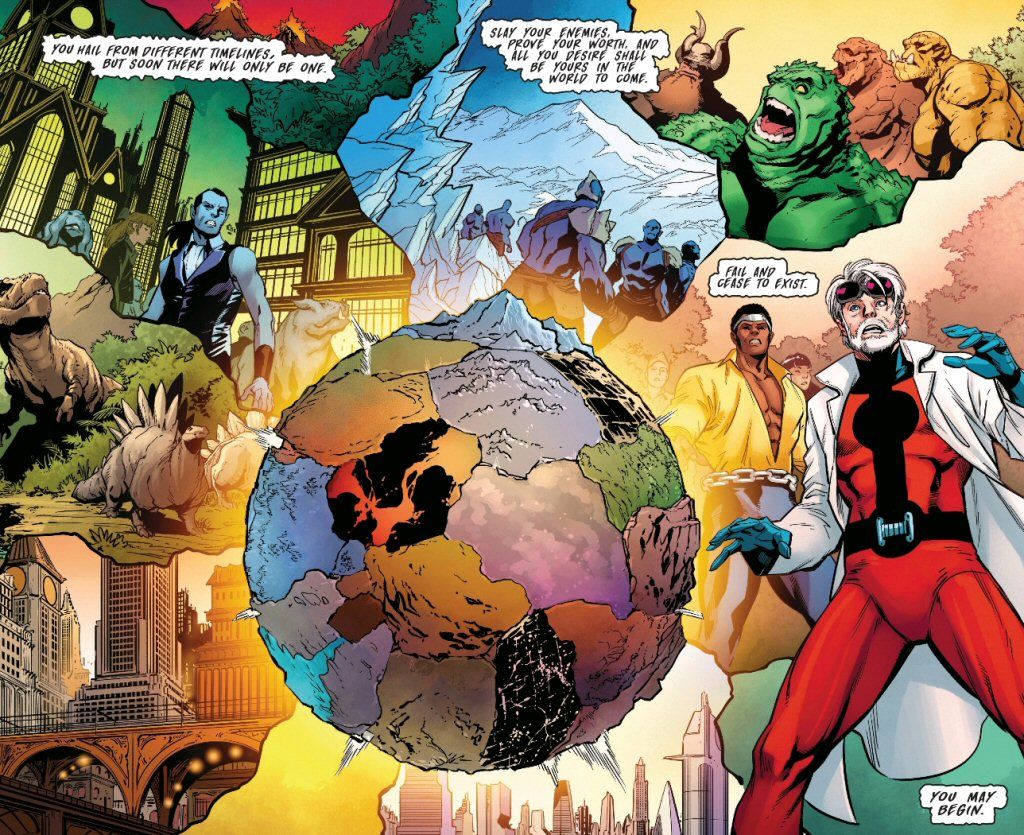
We very quickly we learn more about the heroes – and timelines – taken to this Battleworld:
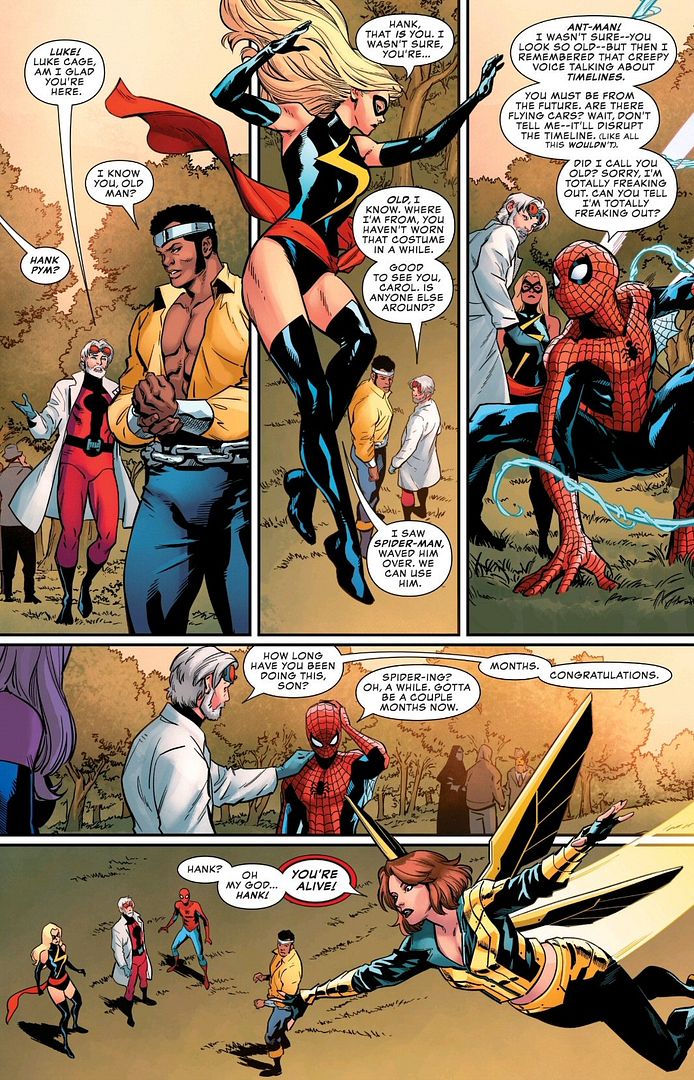
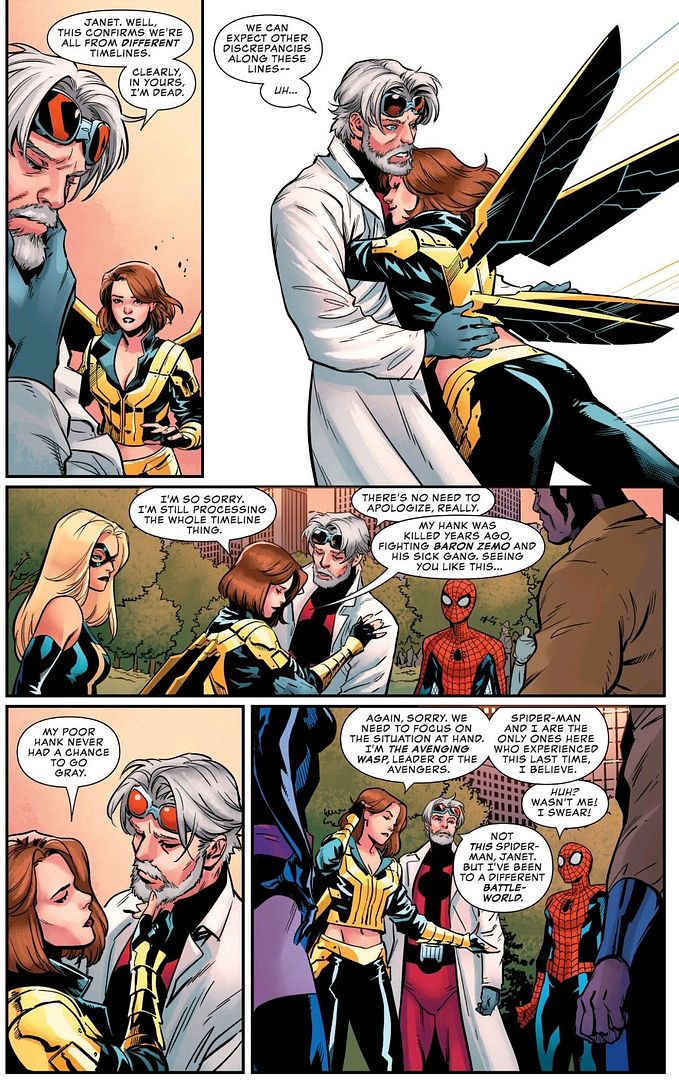
So, the heroes come from different universes in the Multiverse, as well as from different time periods. Hank Pym seems to be the only character from the current main Earth-616 universe and timeline. Personally, I was glad to see this story was going to focus on him. Hank (Ant-man/Giant-man/Yellowjacket) suffered a rather sad history in the main Earth-616 universe, and things ended badly for him. But he was recently restored – as an older version, reeling from his trauma – seen in Al Ewing‘s Avengers, Inc (2023-24) and Jed MacKay‘s Moon Knight (2025). His primary role here suggests we are in for a redemption story arc (which is typically associated with virtue ethics).
Eventually, we meet a few additional characters, as described on the title page of all future issues:
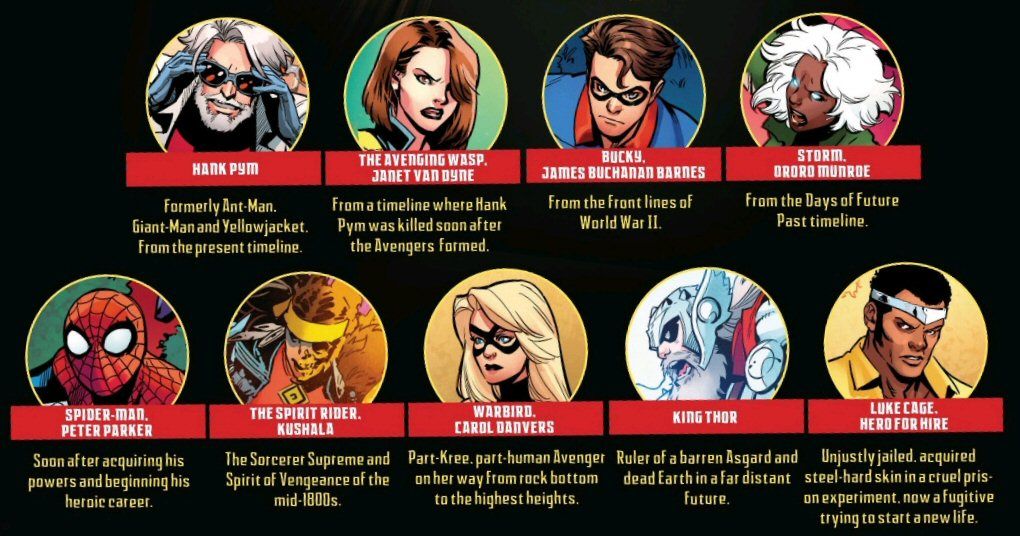
There is also a version of the Hulk (Bruce Banner) from the Future Imperfect timeline – the Maestro. This is from an alternate future where Banner’s intelligence was fused the Hulk’s darker aspects.
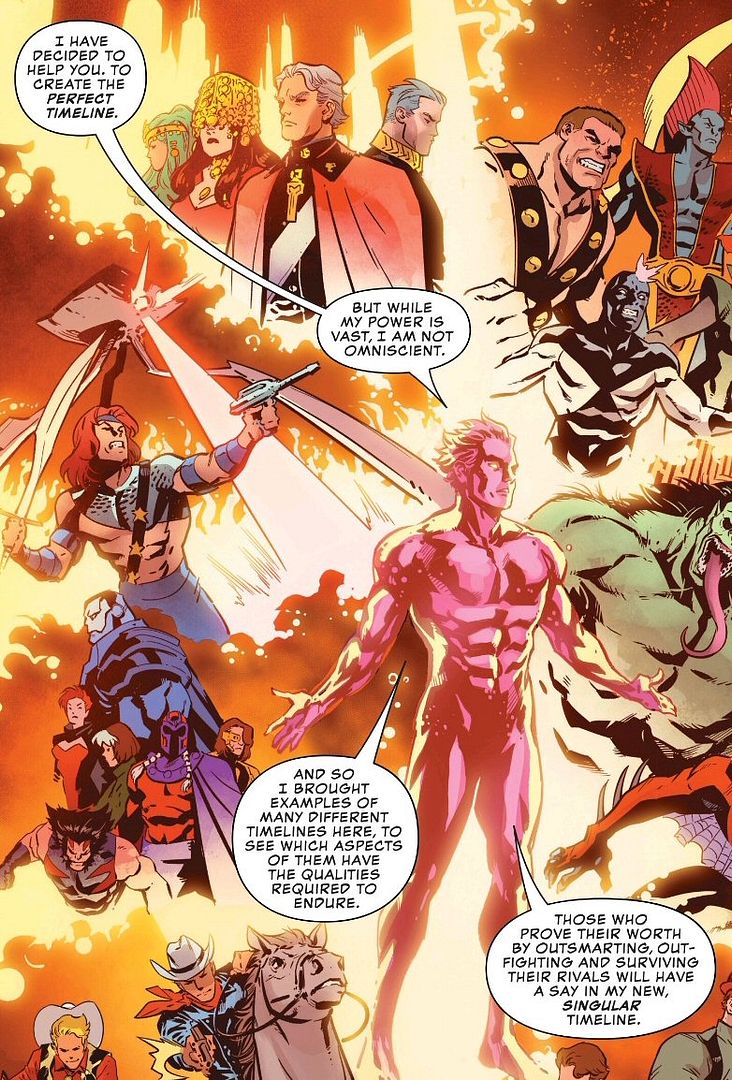
Hank quickly figures out who is responsible for bringing them together, and it isn’t the Beyonder this time. Also from issue #1:
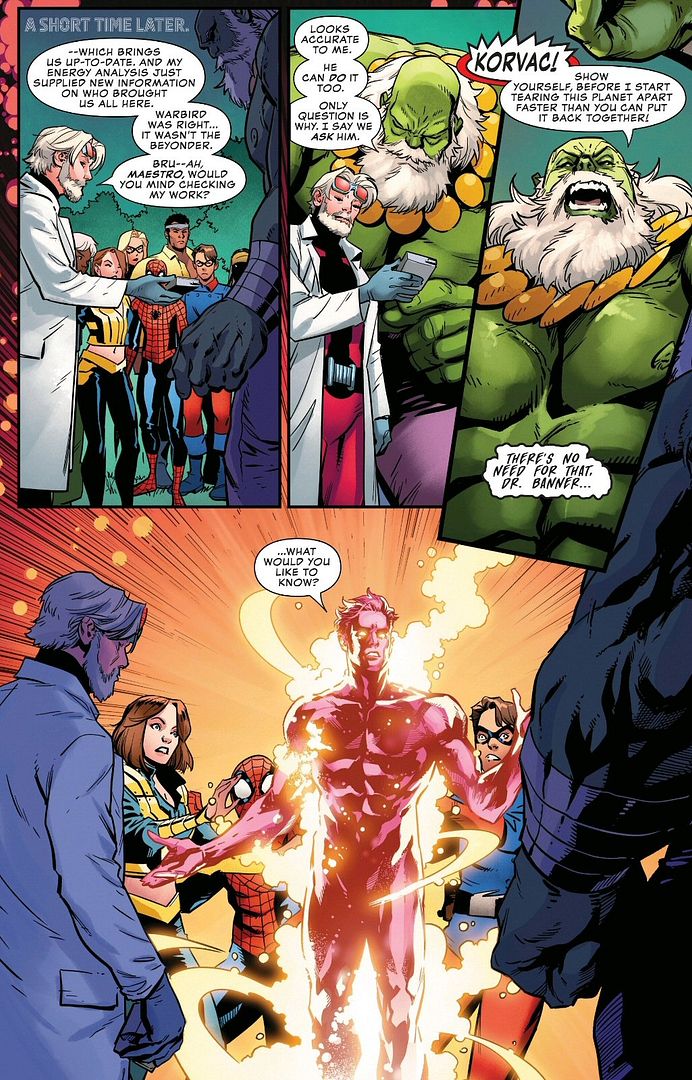
Michael Korvac was originally a human being from an alternate future timeline, who eventually gained cosmic powers and visited the main Earth-616 timeline. Interestingly, the most significant story involving this character was written by Jim Shooter when the was writing the Avengers in 1978 (the “Korvac Saga”, in Avengers Vol 1, #176-178). In that story arc, Korvac’s motivations weren’t malevolent per se – he wanted to help humanity by altering reality (which the heroes opposed). It is interesting to note that Gage had previously revisited that early Shooter story line in his Avengers Academy series, where he greatly improved on the motivation of Korvac’s wife, Carina (Avengers Academy Vol 1, #11-12, 2011) – a point which I will come back to later.
For now, the ostensible reason Korvac gives the heroes for bringing them all together is as follows:
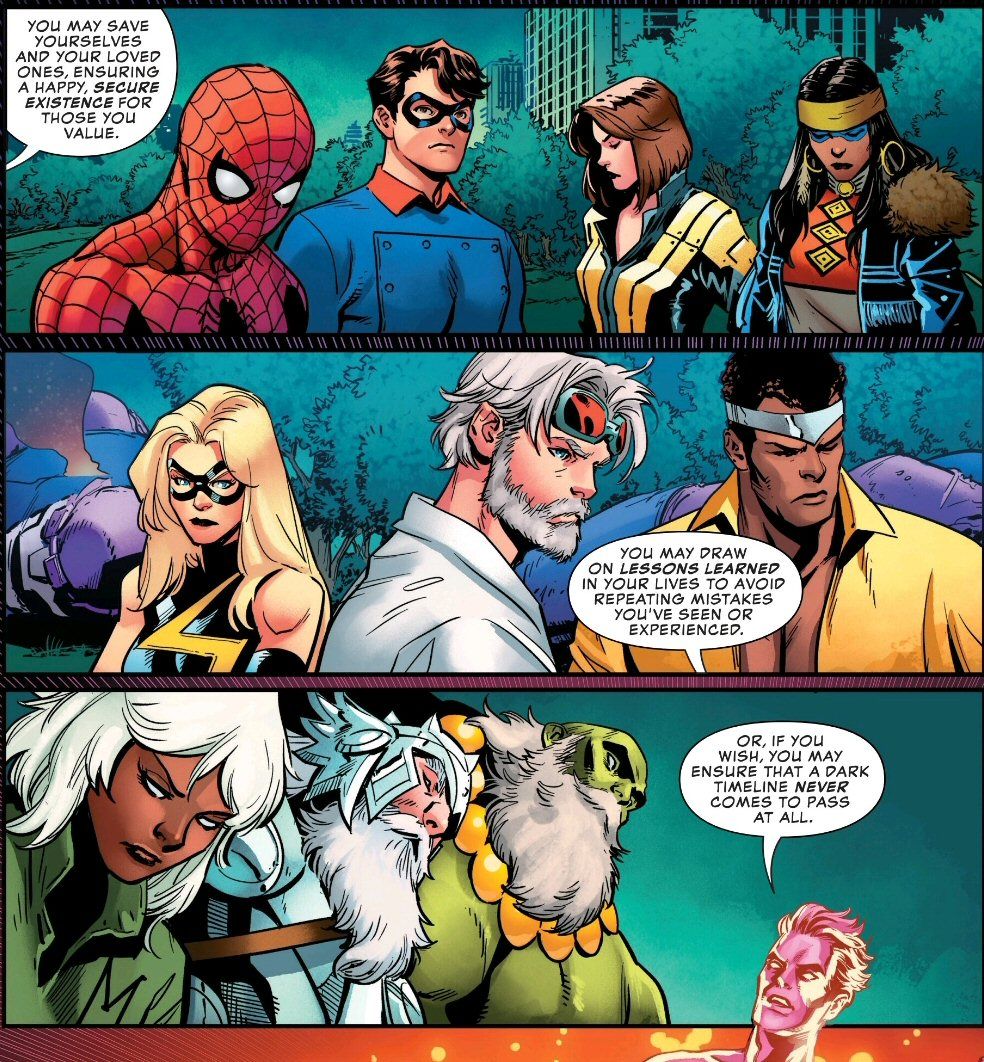
The panel structure above summarizes the heroes respective situations succinctly. Spider-Man and company (panel 1) are all early in their careers and relatively inexperienced (except for Janet). Hank and company (panel 2) are all seeking redemption for past failures at this point. And Ororo and company all come from dark or dystopian futures.
The original Secret Wars largely squandered the opportunity to explore its consequentialism versus deontology premise (implied by the ends-justify-the-means instructions from both the Beyonder and Korvac). This series has a more sophisticated plan in mind, but it does have to get this primary ethics dichotomy addressed and out of the way up front. Which it does courtesy of our not-so-friendly Hulk variant, the Maestro:
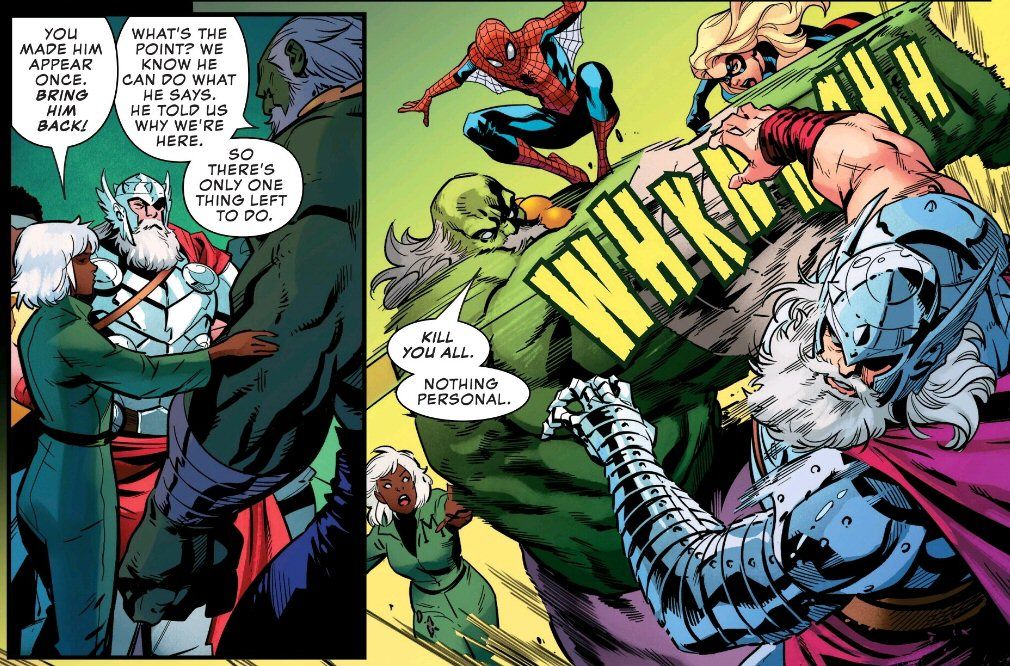
The heroes all band together against this apparently consequentialist Maestro, and succeed in subduing him. Of note, however, Hank was looking to simply incapacitate him while Janet went for the kill. In the end, Hank confirms that he will survive, but he is off the playing field for the rest of the series. This leaves the ethics of Janet worth exploring further – which the series does as it evolves.
The second issue revolves around an old X-Men villain (Arcade), but doesn’t really advance the story’s ethical conceit. Until this rather interesting exchange at the end:
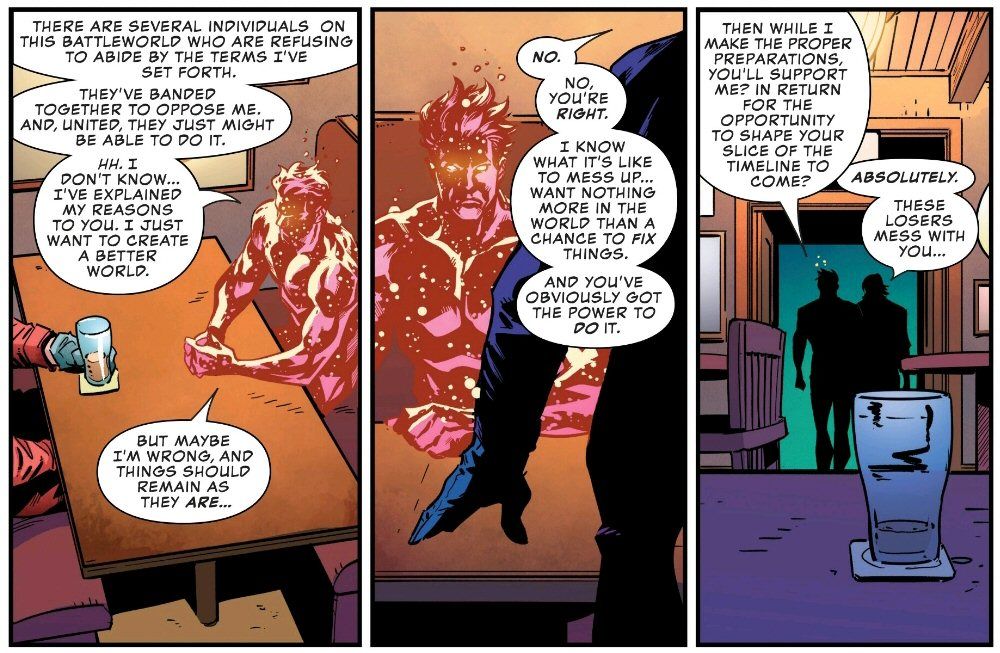
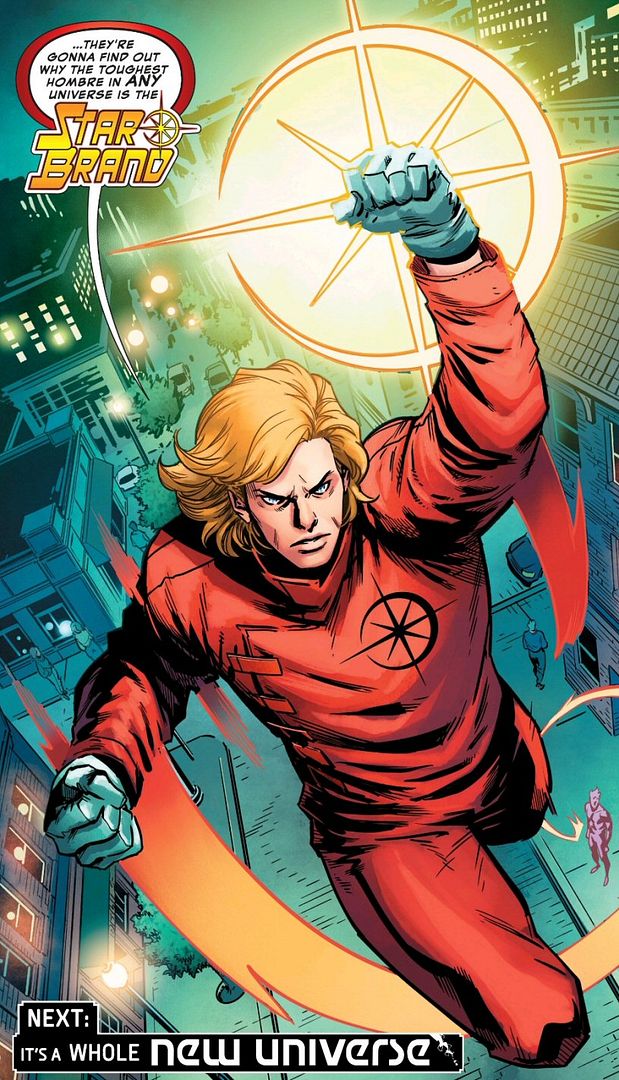
And guess who invented the Star Brand (Ken Connell) and wrote the original series in the “new universe” of Marvel in 1986? That’s right, Jim Shooter again!
It is also interesting to note that just like my earlier speculation that the Molecule Man may have served as a personal stand-in for Shooter in the original Secret Wars, current Marvel senior editor Tom Brevoort has written a thoughtful piece arguing the same for the original Star Brand in his reconstituted blog here.
The ethics of Battleworld (2025-26)
Fundamentally, I see this new Battleworld series as being mainly about virtue ethics. Along the way, it has a lot to say about seeking redemption and the importance of suffering for personal growth. Its premise also allows for a thoughtful examination of the nature of identity. And there’s also a particular focus on care ethics that I will explore at the very end. Let’s see how all of that is integrated into the story.
The plot begins to move forward in issue #3, where we see Hank make an interesting decision to give the captured “god-mode” technology from Arcade (from the previous issue) to the already powerful Carol Danvers (going by Warbird at this point in her timeline, in the old Ms Marvel costume).
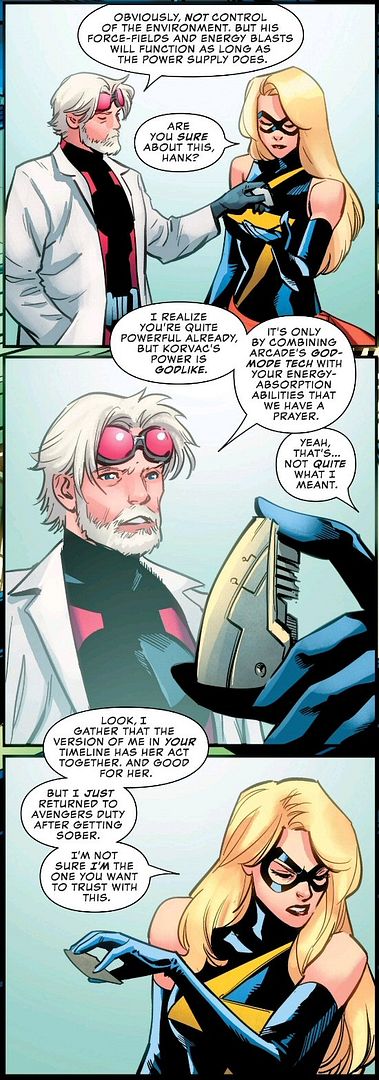
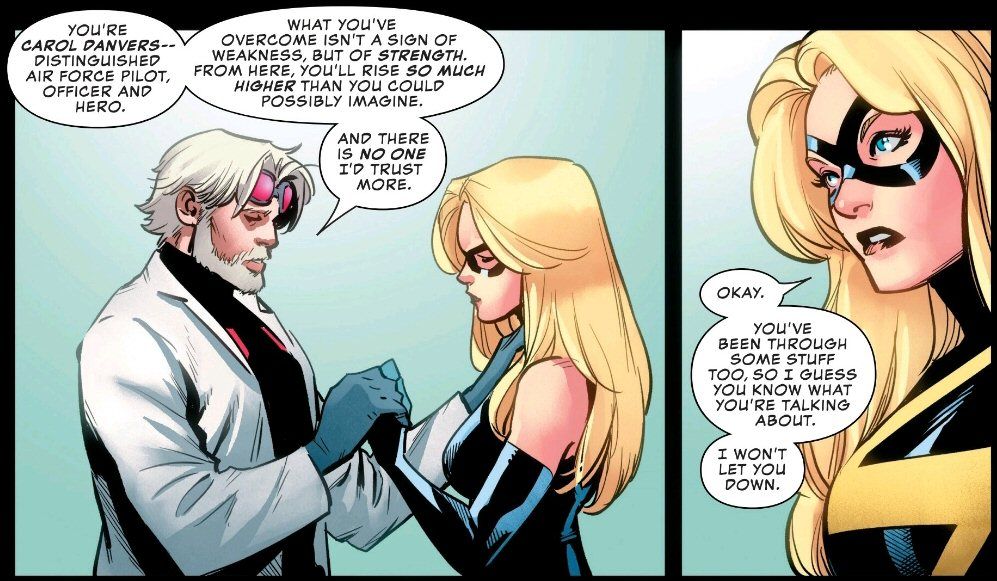
Carol’s hesitancy reflects how early she is in her own redemption arc. Hank of course knows who she will become (well, at least in his timeline, as Captain Marvel). But consider the next panels and the exchange between Janet and Hank:

“You are both a stronger and weaker man than the Hank I knew.” Yes, this tracks with where this Hank is in his personal redemption arc, coming out of those recent Avengers and Moon Knight issues I mentioned above.
Of course, there’s also plenty of wry humor along the way – like when Carol and Ken’s Star Brand meet up:
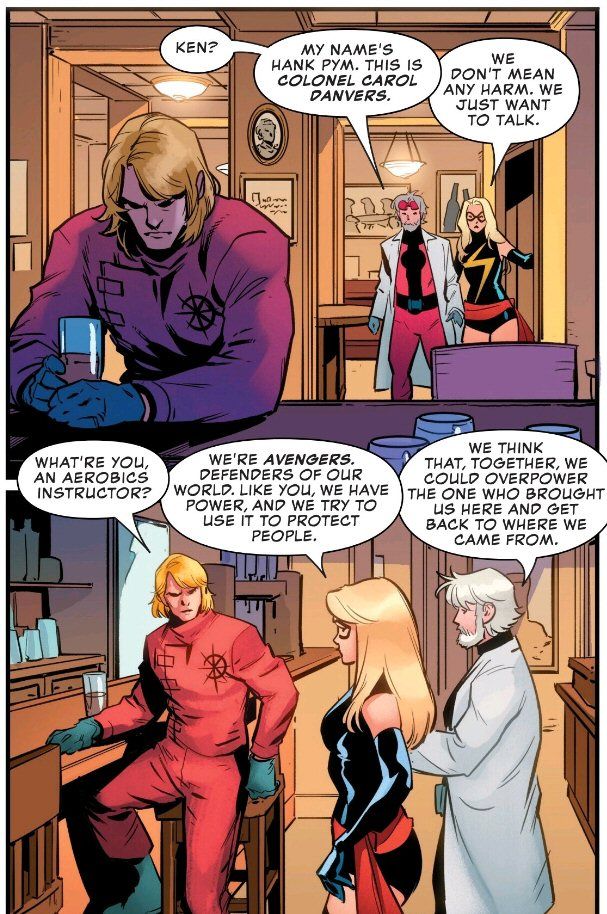
Yes, that ridiculous Ms Marvel costume (a leotard with shiny thigh-boots) was always made to appeal to men’s fantasies. I also loved this exchange once they start fighting:
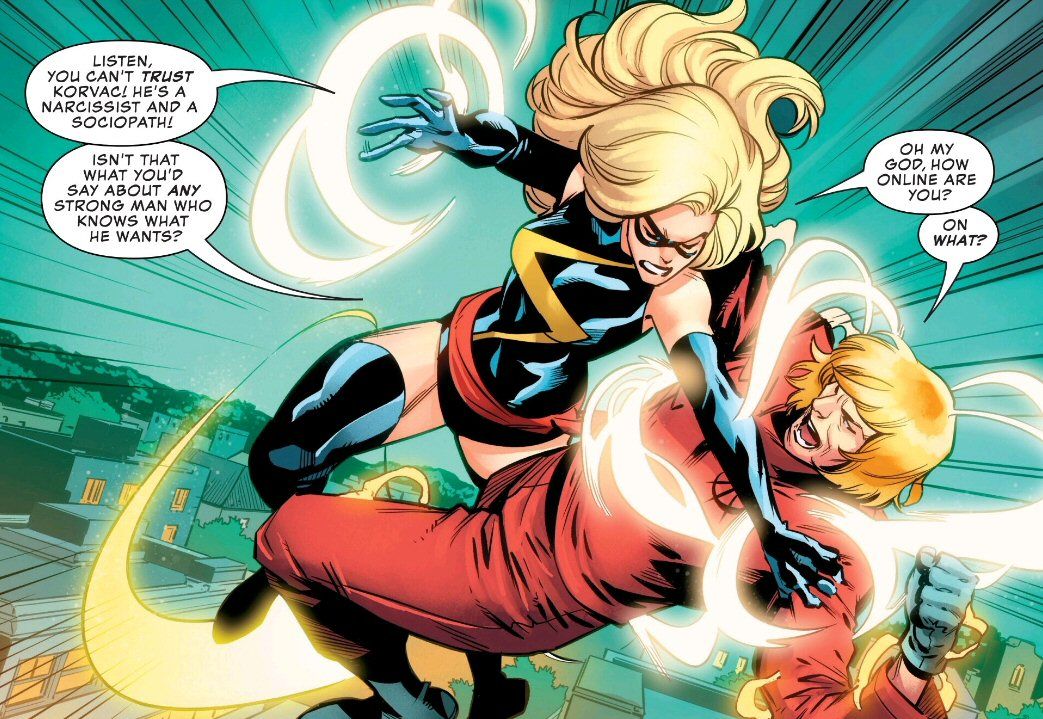
Not to quibble, but Carol’s Warbird time (1998-2005) was in the early days of the internet, well before the current toxic masculinity online era. But comics were always meant to speak to the present time. 🙂
Hank realizes Ken’s insecurities and plays on them while impersonating the alien who gave him the Star Brand powers in the first place. Of course, what he is really doing is describing how worthless he feels (as Gage points out in the back-matter to this issue, this is what writers call “subtext”):
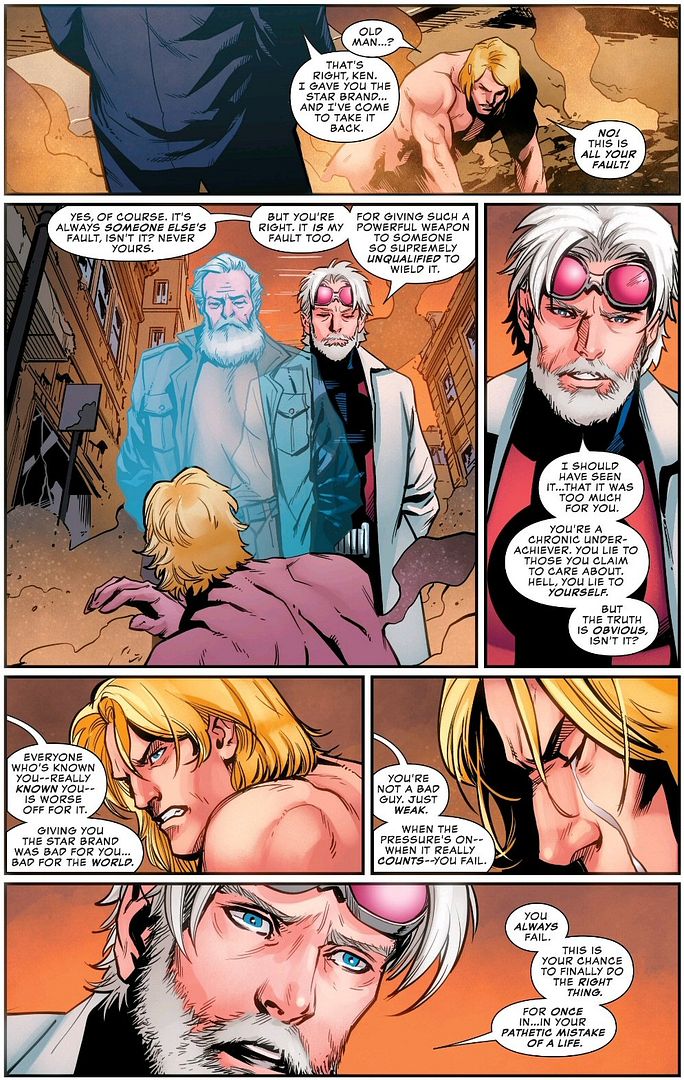
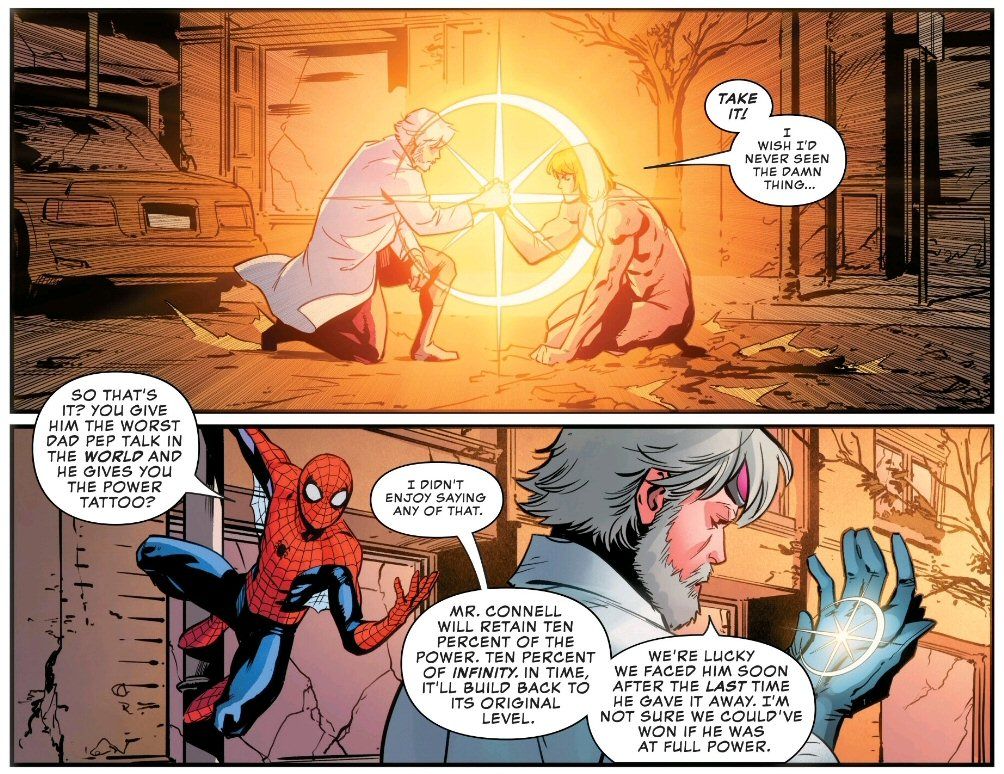
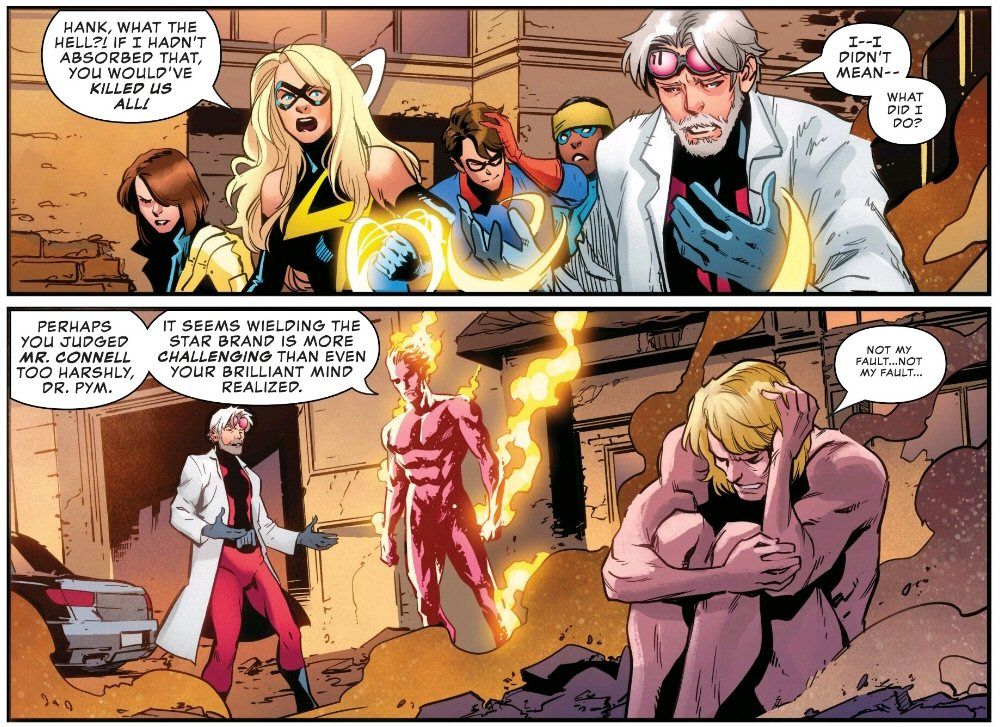
Of course, Korvac soon shows up pressing the issue, and Hank needs to use this new Star Brand powers before he has had a chance to come to terms with them. He nearly incinerates the heroes, causing him to retreat into his own insecure and hesitant state. From issue #4:
But leave it to the more self-assured and confident Janet to figure out that there is more going on here than Korvac has let on, or that the other heroes have realized:
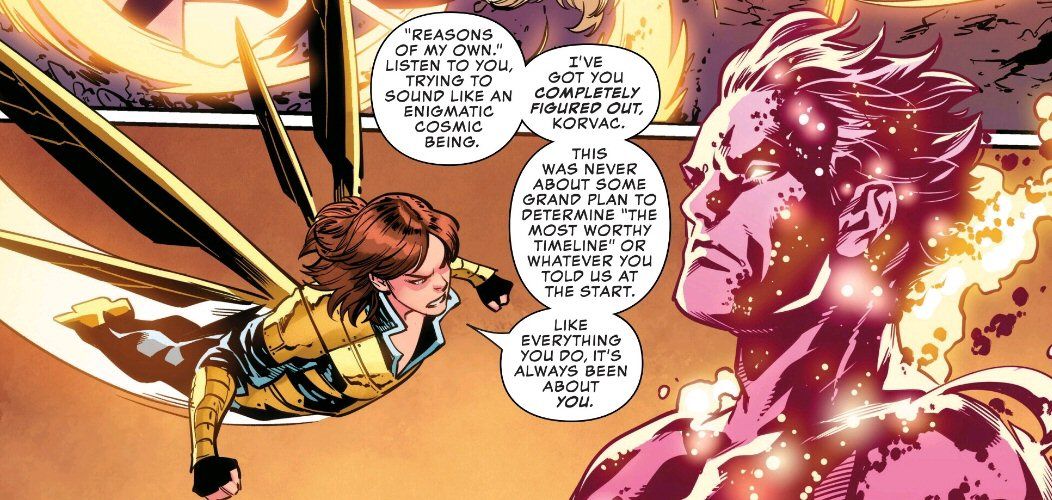
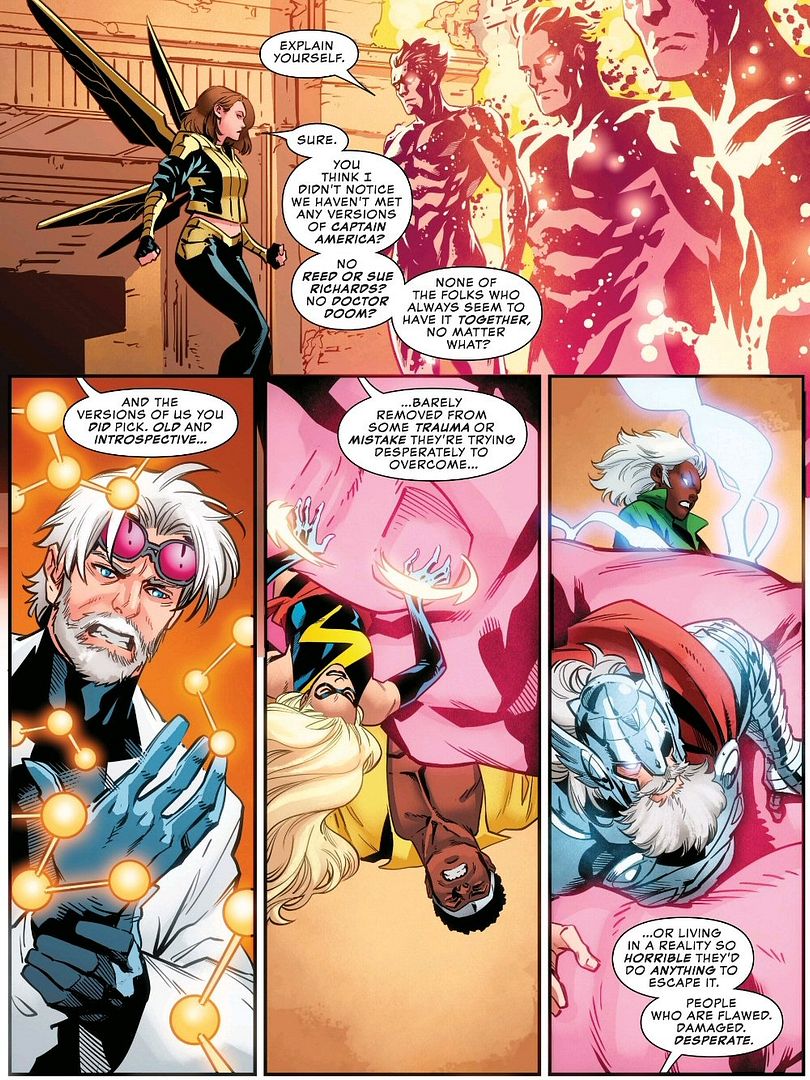
Indeed, Korvac’s choices are suspicious. And Janet’s discovery sets up an interesting plot twist to end out this penultimate issue:
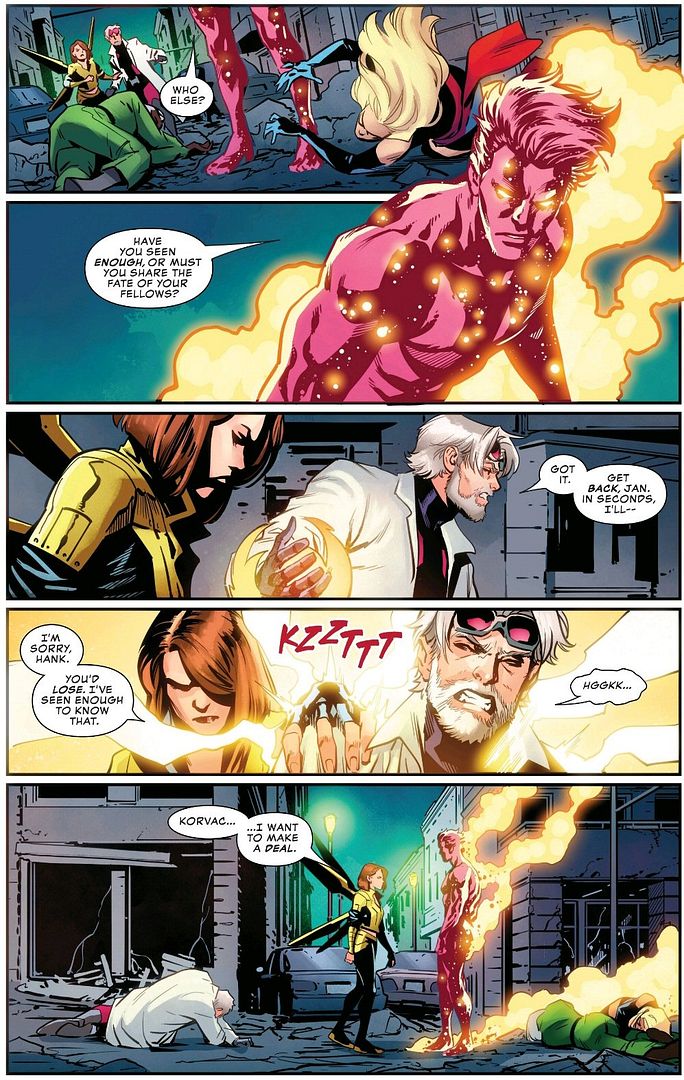
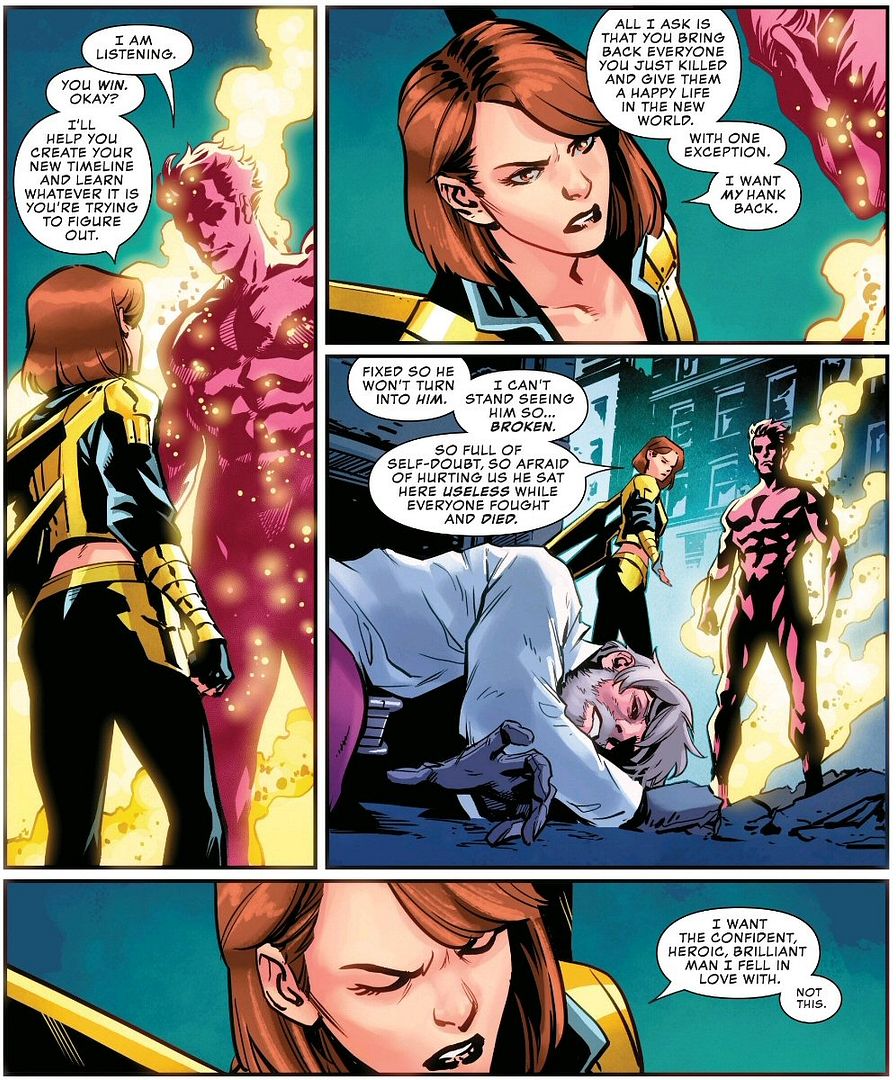
The sets up a heavily philosophical final issue, where we also learn more about Korvac’s true intentions – which relate to the original Shooter Korvac Saga story arc, and Gage’s Avengers Academy run. All of this has been because Korvac is trying to find a way to win his wife Carina back. As he explains in issue #5:
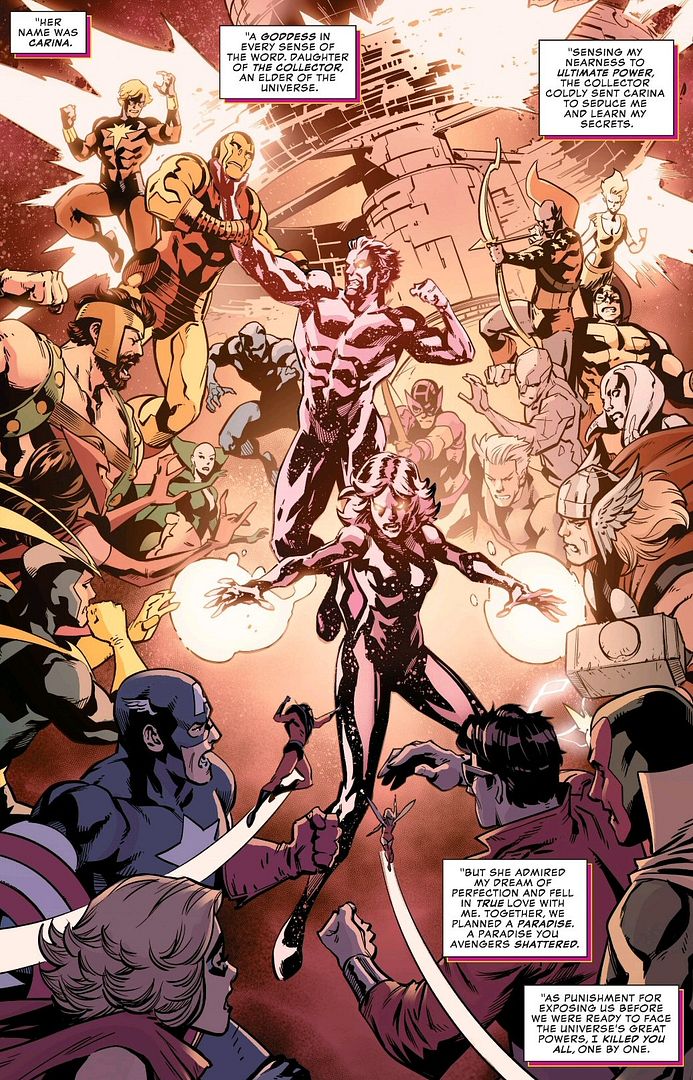
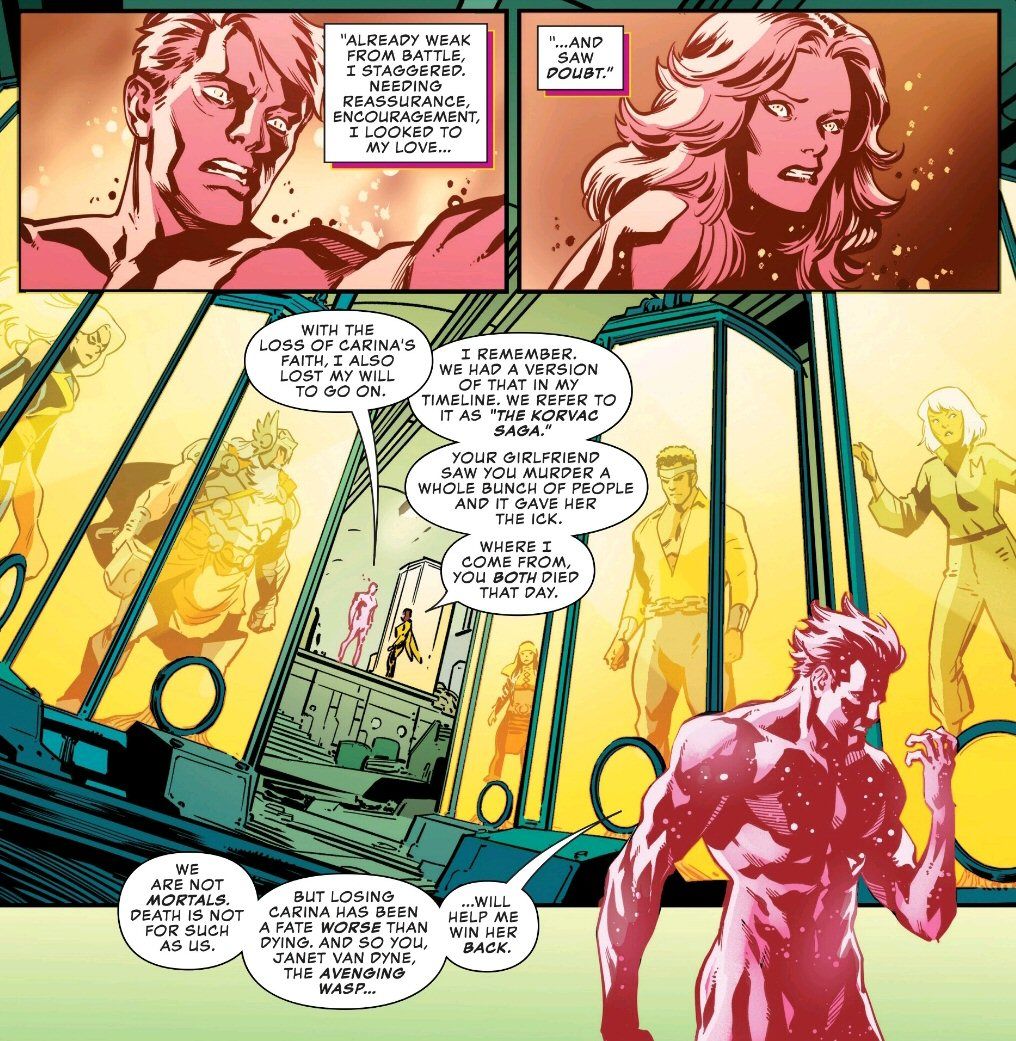
The original Korvac Saga in Avengers (Vol 1, #176-178, 1978) – succinctly summarized by Janet above – wasn’t as bad as Shooter’s Secret Wars run (especially Secret Wars II). But it was also heavily misogynistic at its core. The basic premise was that one of the Elders of the Universe, a cosmic being known as the Collector, had grown worried about “the Enemy”, Korvac. So, he sent his daughter Carina to seduce him (I know, groan!). She instead grew to love Korvac (for some unfathomable reason) and allied with him when he killed her father (well, I guess I could why see the Collector had THAT coming!). In the subsequent battle with the Avengers, she does indeed “get the ick” and lose faith in him – driving Korvac to underdo the damage he has caused and kill himself instead (something a controlling narcissist would never do, but whatever). In true Shakespearean fashion, Carina then kills herself because she can’t go on living without Korvac. Ugh.
Of course, few ever really die in the comics – especially cosmic beings. Both the Collector and Korvac were subsequently revived by later writers, and Gage himself brought Carina back in his excellent Avengers Academy run (Vol 1, #11-12, 2011). There, a younger Hank Pym inadvertently draws Carina back into the world. Carina explains that she doesn’t want to reconcile with Korvac and in fact chose nonexistence over being with him (burn!). She then acknowledges the “disgusting” morality of her father, and her naivety in accepting it – as well as ever falling for Korvac who she eventually came to see as fearful and controlling (duh!). In the end, she repudiates both men, and with her help the Avengers Academy defeat Korvac (temporarily, at least). Carina resolves to go and explore the universe on her own – and find her own place in it.
Janet suggests Korvac needs to show he’s changed to win Carina back – but Korvac points out she wasn’t too happy with how Hank had changed.
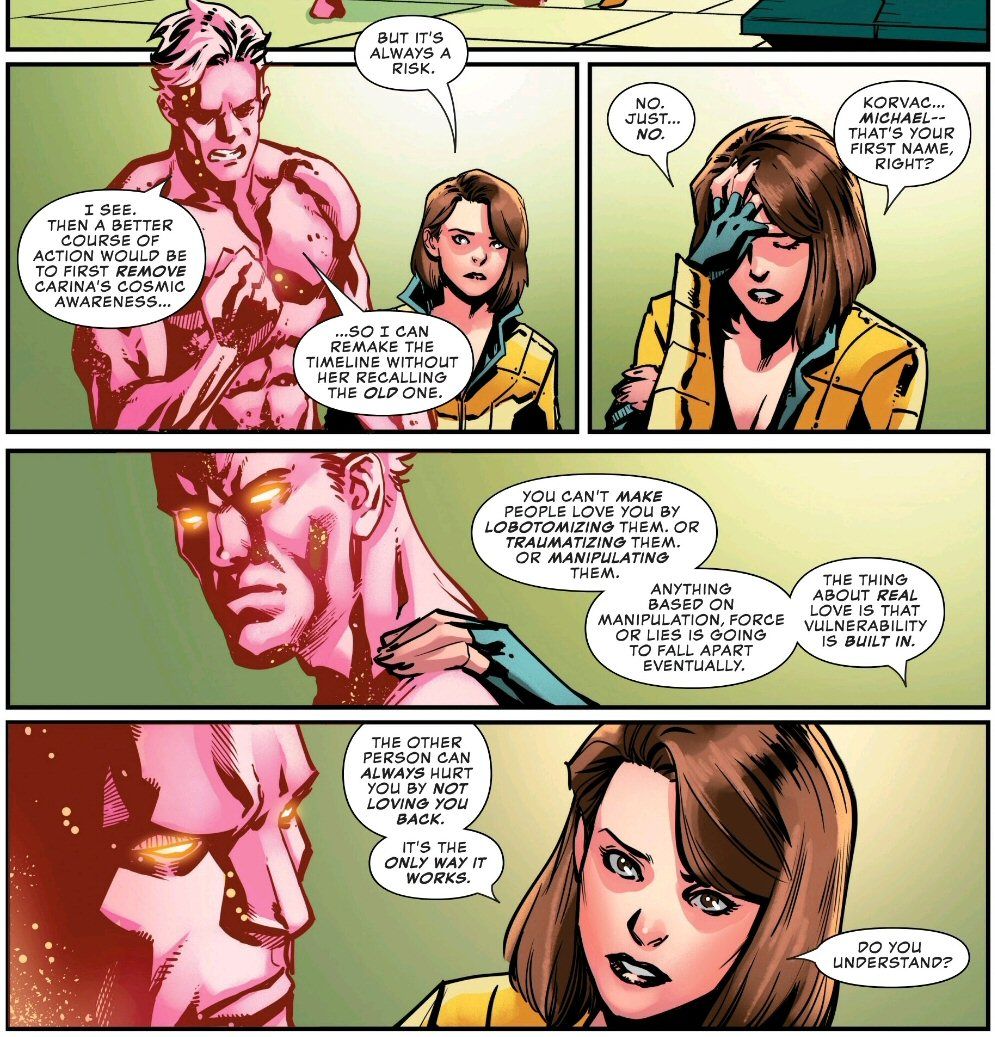
Pretty good advice, but what does Korvac make of it?
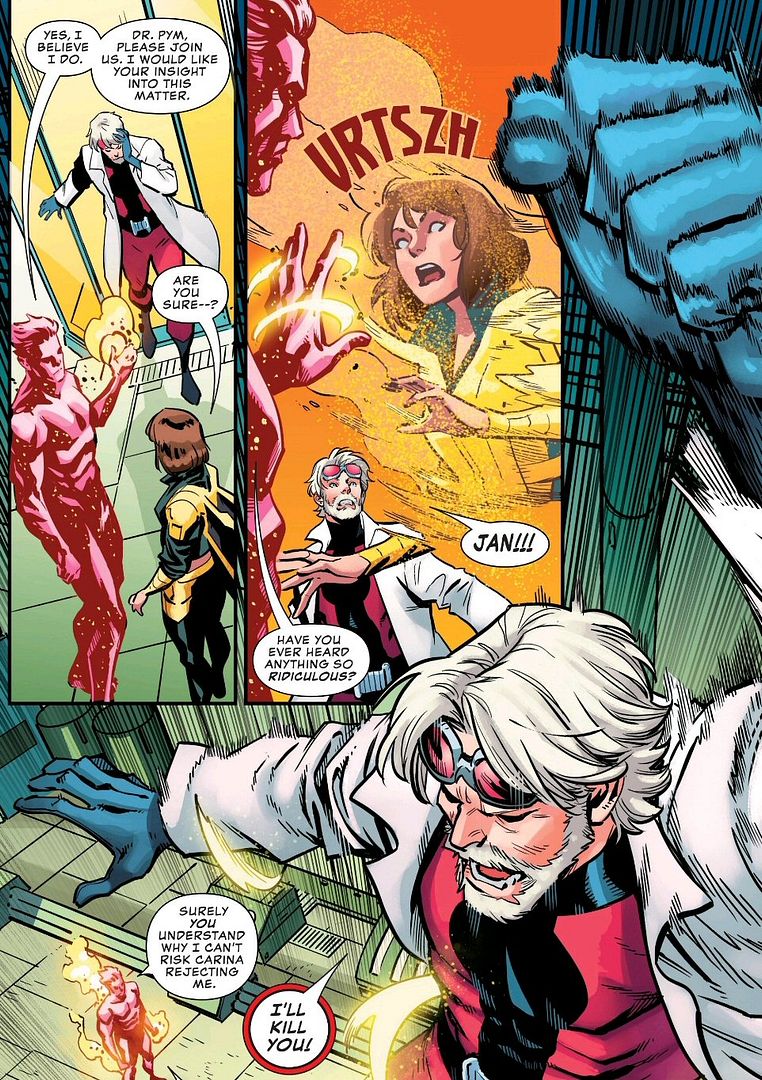
Of course.
Before the big finale, Korvac decides to share his life experiences with Hank, to show him just how much he has suffered:
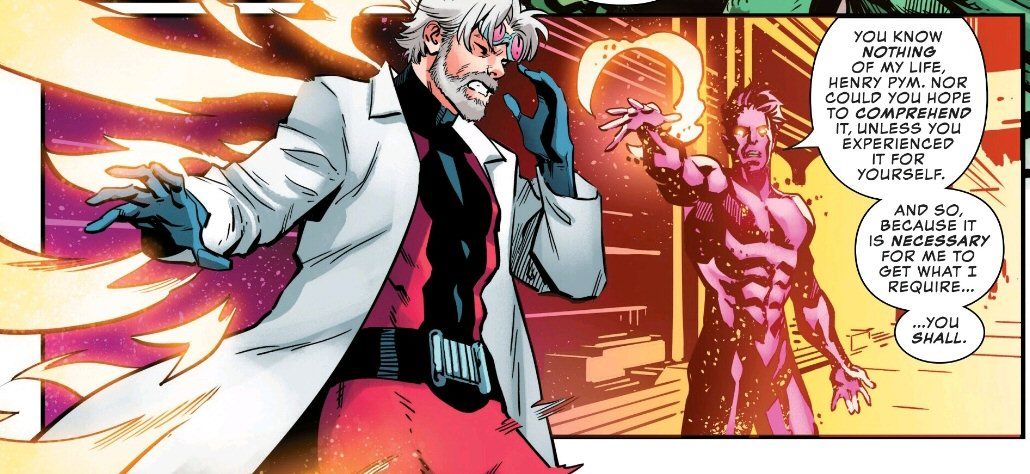
A couple of pages of backstory later:
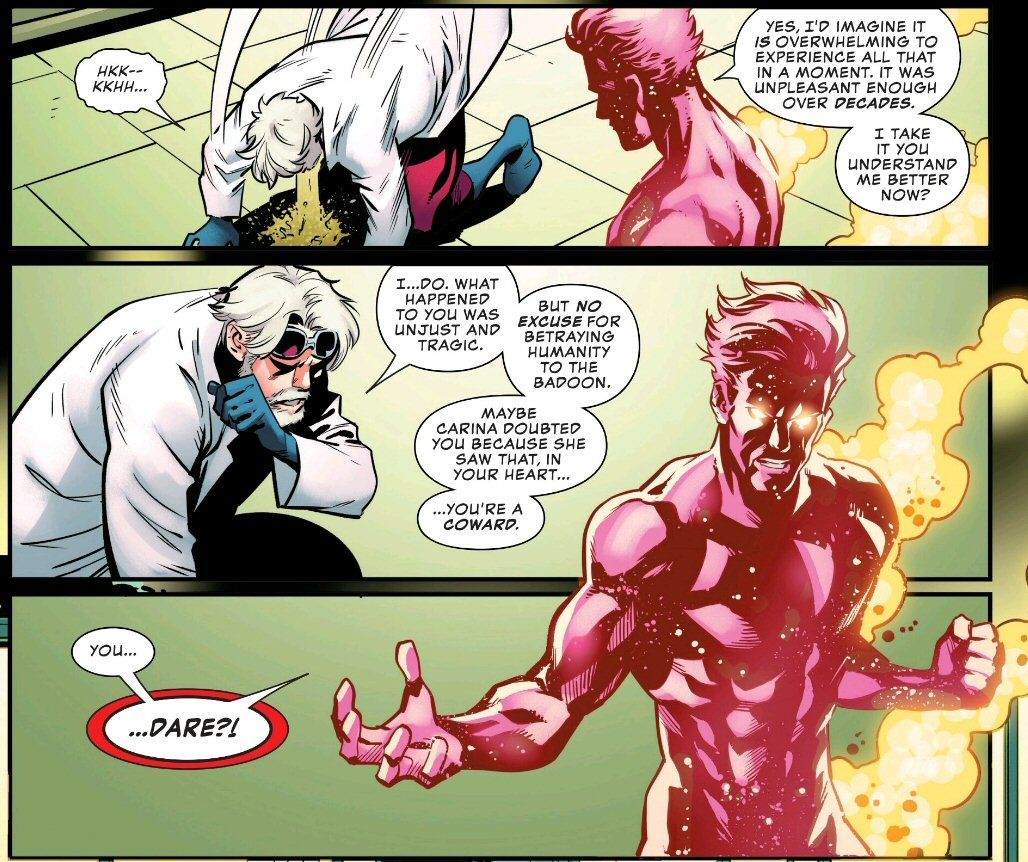
During their pitched subsequent battle, Hank makes this key observation:
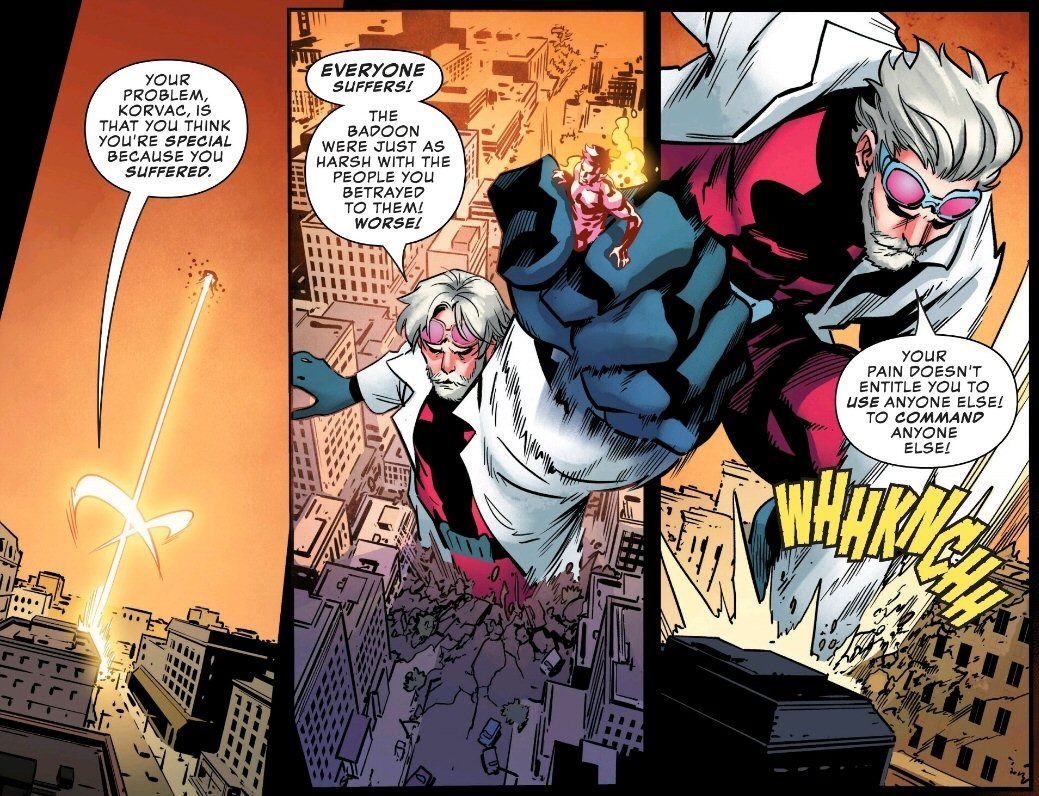
This perspective on suffering reminds me of the true-life memoir When Breath Becomes Air, by Paul Kalanithi.
Kalanithi was a young neurosurgeon – with a Masters in Philosophy as well as English Literature – who received a terminal diagnosis of metastatic lung cancer while still in his residency training. In an affirmation of life, he chose to continue and complete his residency and have a baby with his wife. He also wrote a best-selling memoir (published posthumously in 2016) that, at its core, is a sustained meditation on the nature of suffering and how it can lead to deeper empathy and meaning in life.
Kalanithi credits the Russian-American author Vladimir Nabokov with raising his “awareness of how our suffering can make us callous to the obvious suffering of another” – something he directly experienced as a physician. Having to dull yourself to the pain of others is often seen as a requirement of the job. But his own diagnosis and subsequent suffering helped him to realize that what his patients needed most from him was not his technical skill, but his empathy – having someone be willing to witness their pain without turning away. This is a theme I will be exploring further in one of my upcoming overviews (stay tuned!).
The point here is that we all suffer. That suffering can (and often does) blind us to the suffering of others – we can only see our own pain (like Korvac). But when accompanied by personal growth – through virtue ethics – it can actually allow us to better see others and empathize with their pain (like Hank).
The two fight to a stalemate. But thanks to Korvac’s recent “mind-meld” sharing of his life experience, Hank comes up with a creative way to get finally get through to him:
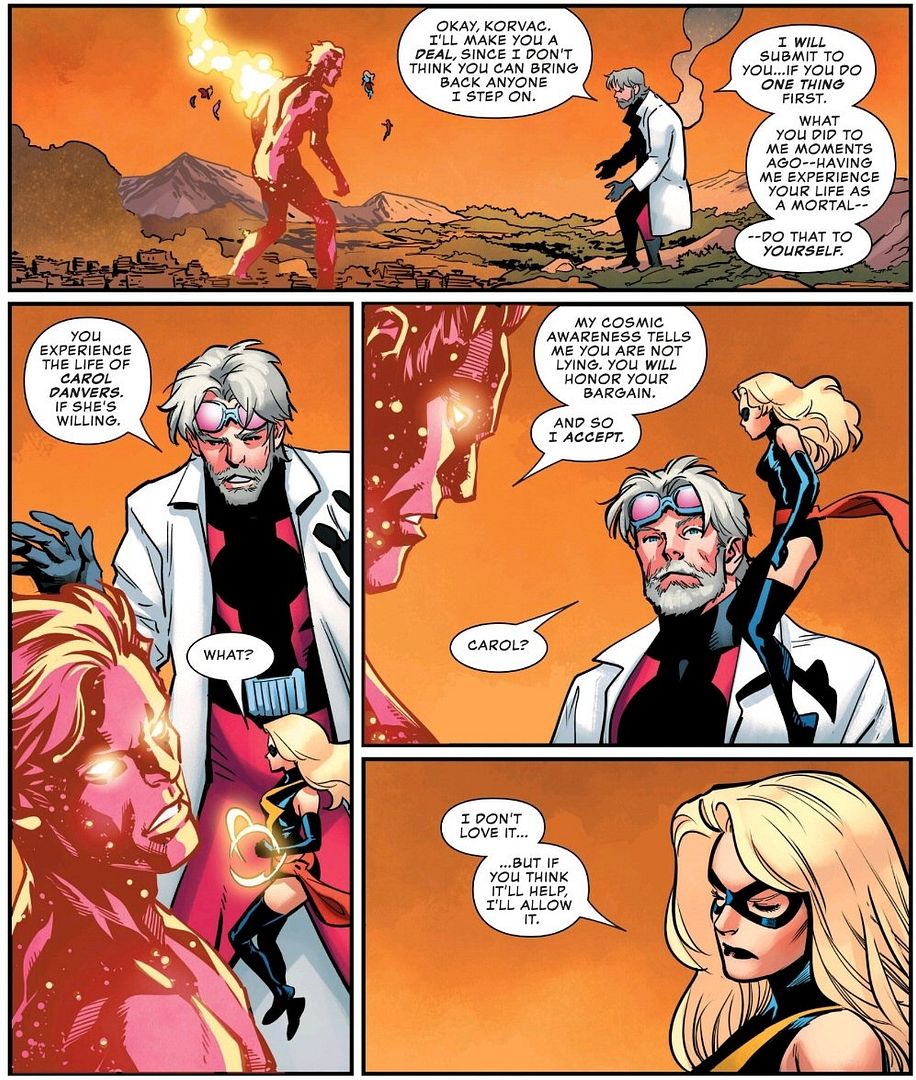
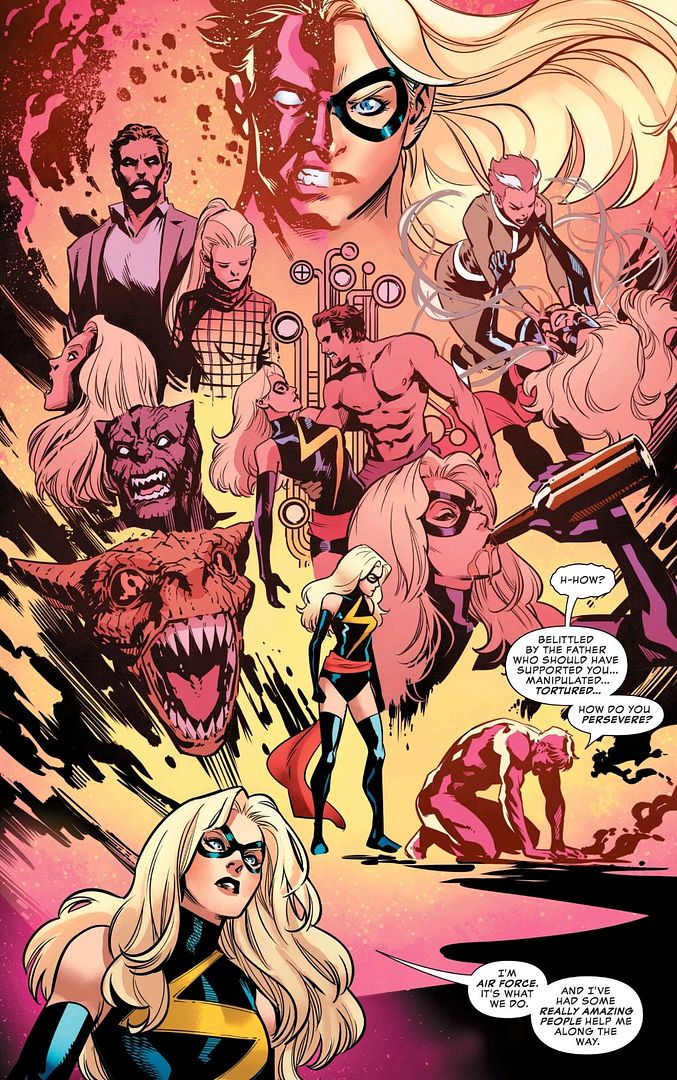
I was very happy to see this scene.
As I explained in my Captain Marvel overview, Carol Danvers’ character was subjected to many sexist and misogynistic tropes, especially in her early years. One of the worse of these can be partially attributed to … Jim Shooter.
David Michelinie took over writing the Avengers from Shooter in 1978. In 1980 (Avengers Vol 1, issues #197-199) he tried to introduce a pair of undeveloped plots for Carol Danvers that Chris Claremont had started in his earlier (cancelled) Ms Marvel run – namely, Carol becoming a single mother, and having an evil force try to use her unique physiology to breed hybrids. But when another creative team published a one-off with a similar plot, Shooter (as Editor-in-Chief) forced a re-write of this story arc’s conclusion in the special-event issue of Avengers #200. Here Shooter was credited as the main story plotter, along with George Pérez, Bob Layton, and Michelinie (in that order), with Michelinie getting an additional credit as the writer (scripter).
The revised plot they came up with – shown in the middle of the sequence above – saw Carol kidnapped, mind-controlled, raped, impregnated, memory-erased, and then forced to give birth to the consciousness of the actual man who raped her (!). Even worse, Carol was then abandoned by her fellow Avengers when she headed off to live with her abuser in another dimension at the conclusion of that issue! It remains unfathomable to me how any of these men thought that was a good story. To Shooter’s partial credit, he did allow Claremont to redress this horrific outcome in Avengers Annual #10, 1981 (appropriately entitled “By Friends — Betrayed!“). See my Captain Marvel overview for more details.
In any case, having Korvac experience the totality of Carol’s suffering does the trick here (also included above are her having her powers and personality erased, and being experimented on by the brood – two of Claremont’s actual subsequent stories with her). Korvac finally seems to face his own selfish focus:
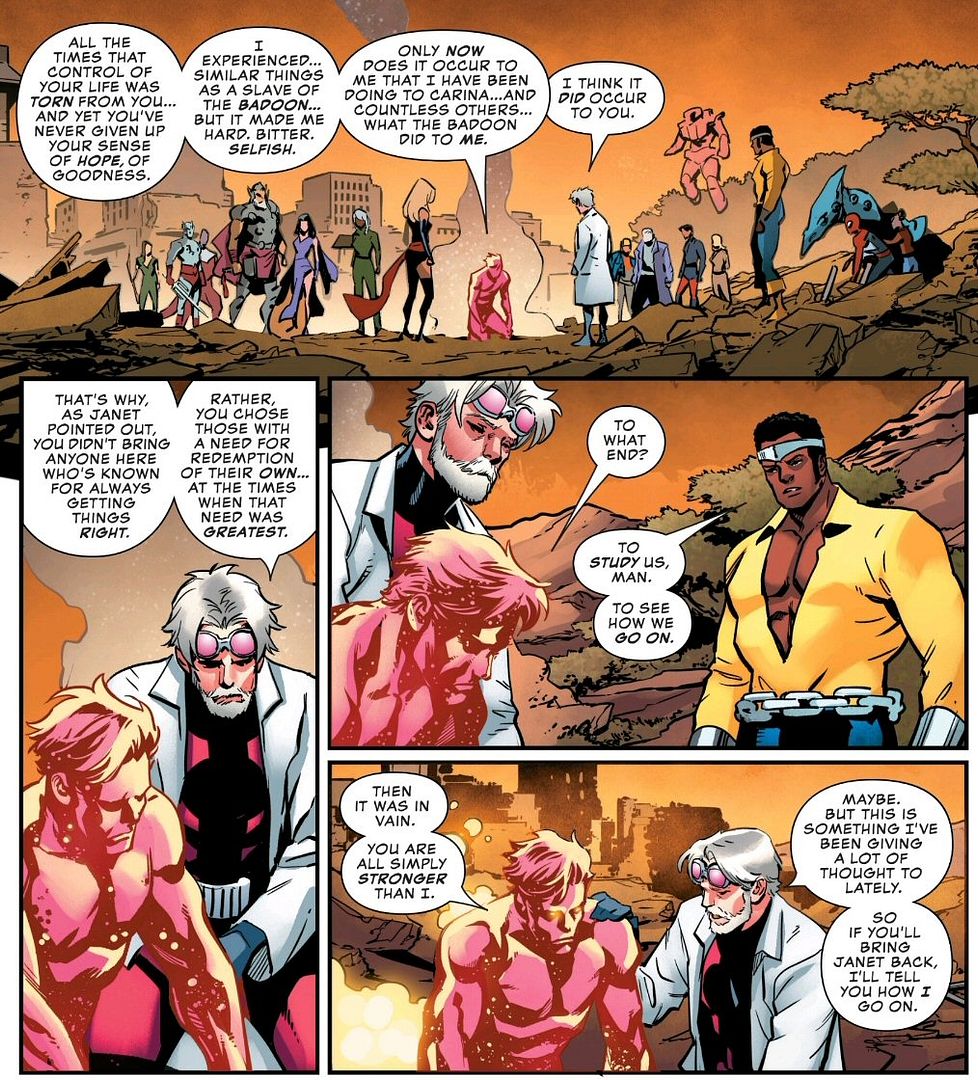
And what has Hank come to learn about himself?
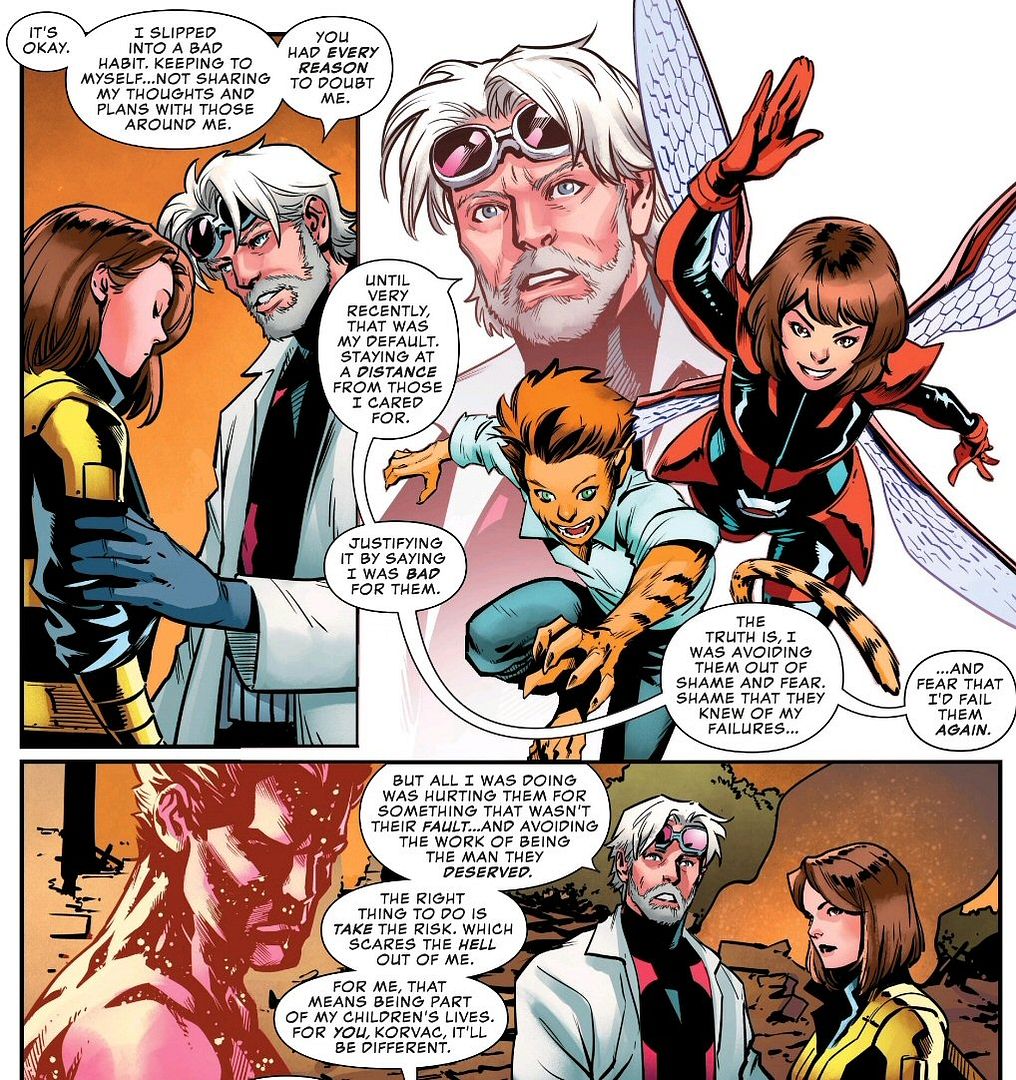
This personal growth perspective of Hank’s – being better, in virtue ethics terms – seems to inspire Korvac:
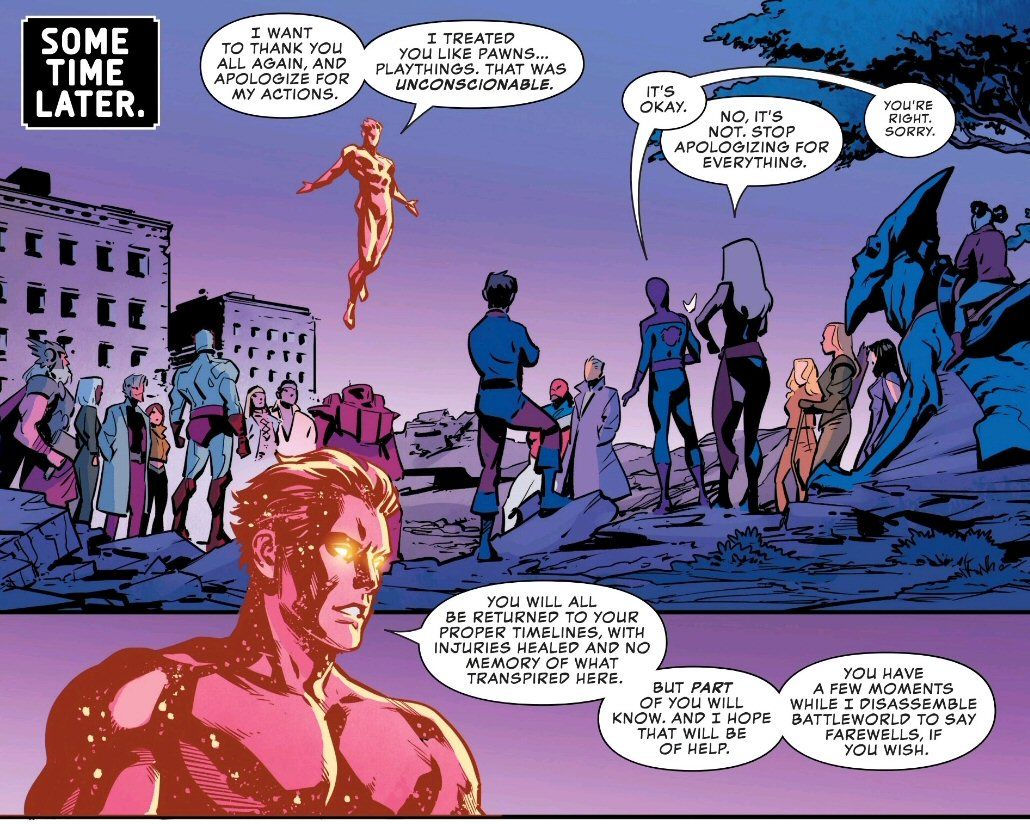
Hank also gets to open another philosophical door in his goodbye with Janet:
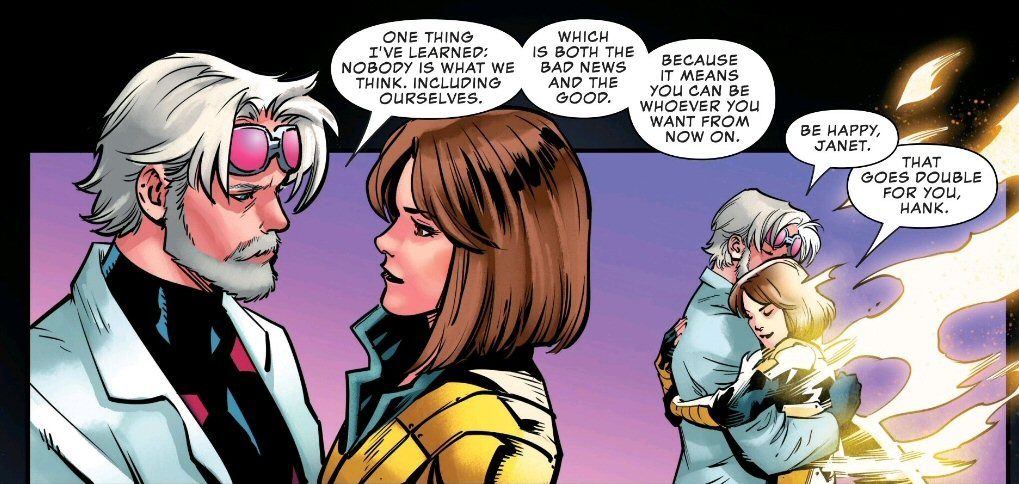
This view of identity brings to my mind the 18th century Scottish philosopher David Hume. Hume was an empiricist, and convincingly argued against rationalism‘s placing of reason as the source of all knowledge (as Descartes and Spinoza’s had done, referenced earlier).
Hume believed that we have two types of perceptions: impressions and ideas. Impressions come first, as they are the direct experiences of external reality. Ideas are but recollections of those impressions. Importantly, both impressions and ideas can be simple or complex. But our ability to combine simple impressions allows us to form complex ideas that have no basis in reality. This forming of complex but imaginary ideas may bring great insight (like philosophy!), but it is also what gets us into so much trouble.
Hume believed that our sense of self is in fact a false perception – a complex idea that we create about ourselves. The individual self is simply a long chain of changing individual impressions. And so, logically, there is no single immutable self, and thus no immortal soul (something that got Hume into a bit of hot water with the Church!). This is what Hank seems to be saying above.
As an aside, Hume’s views on the self were very compatible with Buddhism – particularly the Buddha’s view that one’s life is an unbroken chain of continuous mental and physical processes, leading to a state of continual flux. See my FML comix overview for more info about how the philosophical elements of Buddhism are another form of virtue ethics. And you can read other aspects of Hume’s philosophy in my Vision overview, and the Power Fantasy introduction.
One of Hume’s greatest contributions was revealing the fallacy of ascribing cause and effect to unrelated events. He railed against superstitious thinking – see my introduction to cognitive biases for some examples. So, I was very bemused when I came across his statue outside of the High Court on the Royal Mile in Edinburgh:

The base of this statue stands nearly seven feet off the ground, so only the protruding right toes are easily accessible to passers-by. Apparently, philosophy students at the University of Edinburgh soon began making pilgrimages to this statue, rubbing his big toe for good luck on their exams – resulting in a polishing of the bronze to a high gloss. I love the irreverence of philosophy students directly contravening one of his fundamental assertions about the world!
But back to Hank, and his parting gift to Korvac about focusing on the potential that change brings:
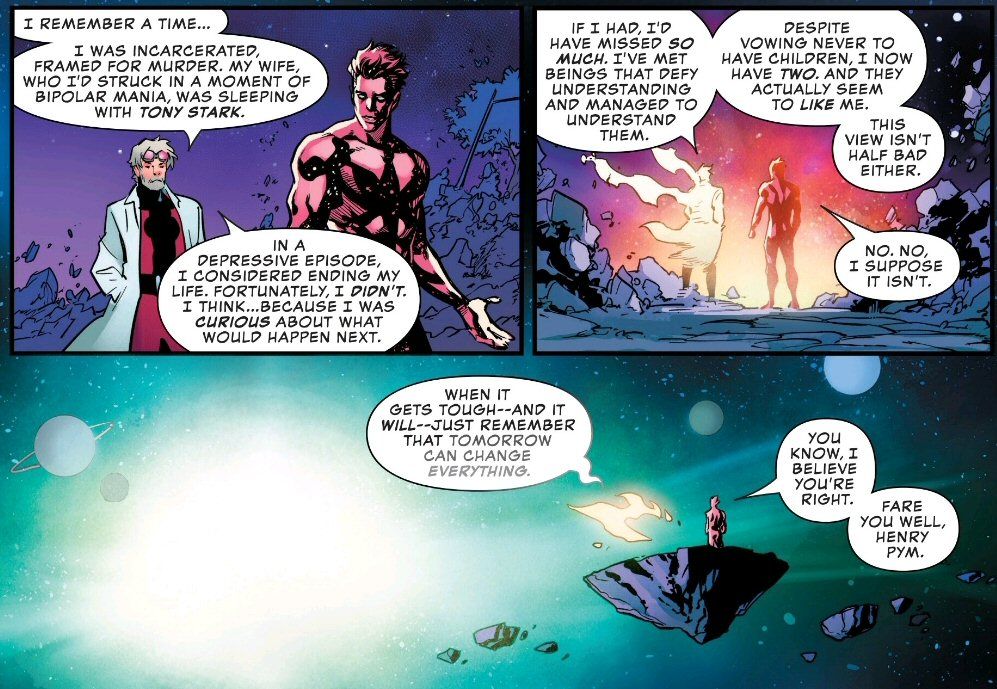
Of course, victories over ingrained patterns of thought don’t happen in a single day. The issue ends with Korvac’s immediate response, following this version of Ororo back to her dystopic Days of Future Past timeline:
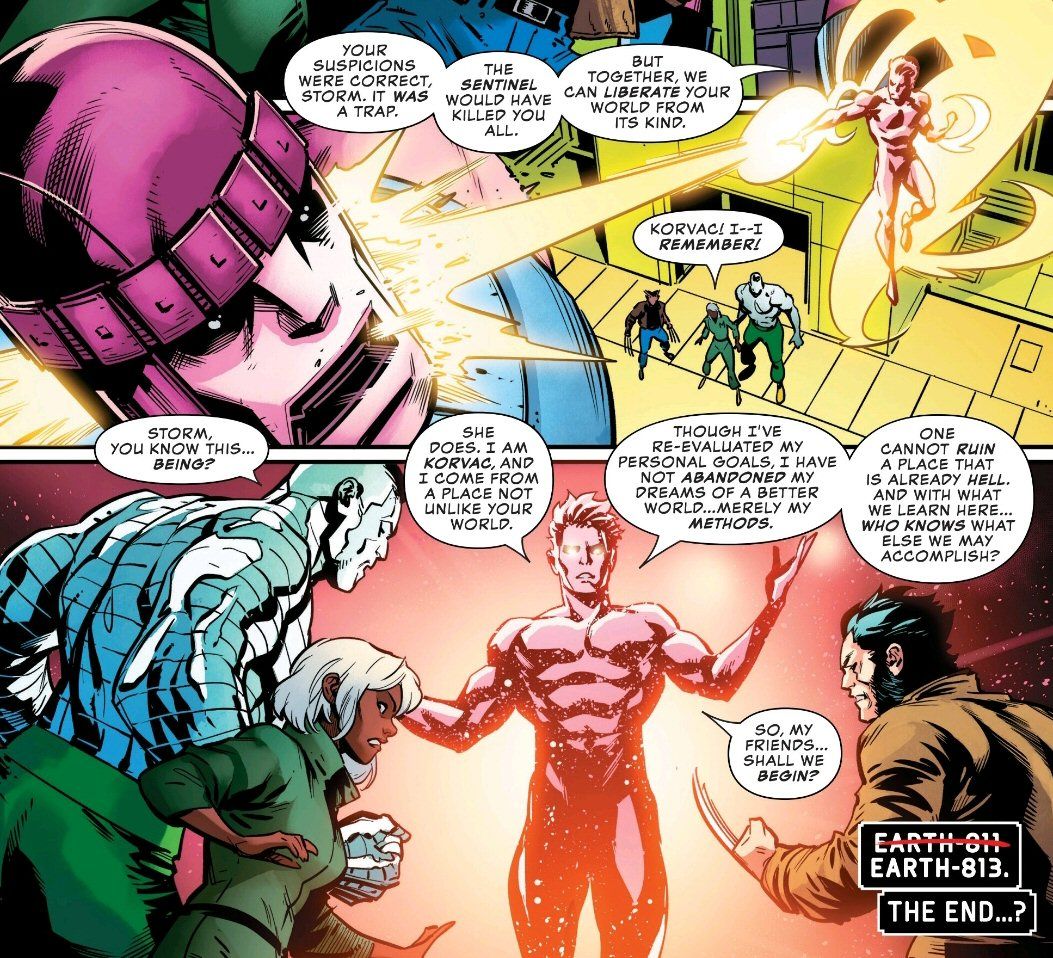
I love the side-eye from Ororo … hmmm, I guess we’ll have to wait and see how Korvac evolves in this new reality he has just created!
One last aspect that I would like to touch on – as it is critical to Hank’s rehabilitation in this series – is care ethics. As I introduced on my Ethics 101 page, care ethics is a modern form of virtue ethics that holds that moral action should be based on interpersonal relationships and the duty we have to one another. It was originally developed by feminist thinkers in the 1980s, as a direct response to the heavily abstracted and generalized forms of normative ethics typically favored by men. You can learn more about the history and application of care ethics in my Can Caring be Wrong? post.
Care ethics is not limited to women of course, and as I explain at that link above, it is in fact (encouragingly) a mainstay of modern comic book ethics. Care ethics emphasizes the importance of responding to the particulars of a situation and the needs of the individual. In essence, one has a duty of care to those you are in a relationship with, proportional to their vulnerability. The ultimate goal is to bring other people closer to you.
Hank demonstrates this throughout the series, beyond his obvious relationship with Janet (highlighted above). He is always considering other people’s feelings, and trying to explain to them what is happening, so that they will be less afraid. I’ve skipped over a lot of that to date, but there’s a reason why there are a number of lesser-powered heroes in the mix – like Spider-Man, Bucky Barnes, and Kushala – all of whom Hank encourages to be better.
Let’s go back to that early panel from issue #1:
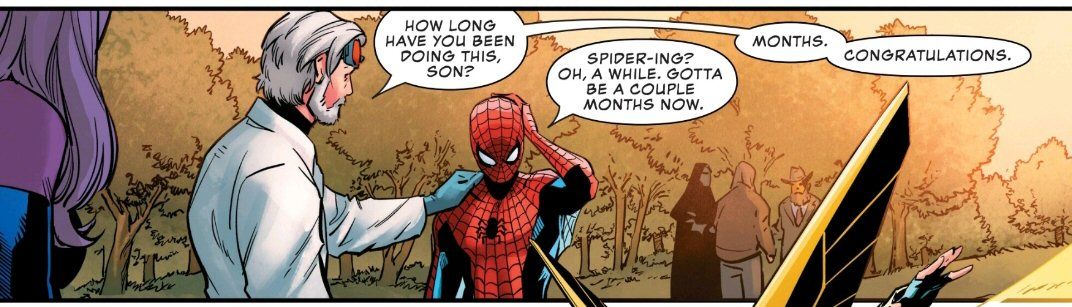
I love this single panel – it captures so much in both Cage’s writing and To’s art. Spider-Man was freaking out in the preceding panel, and Hank is physically reassuring him by the shoulder touch. When Spider-Man explains that “a while” means a couple of months, I love Hank’s reaction (the talk balloon spacing is perfect). Of course, this means Spider-Man is likely to be relatively useless to the more powerful heroes – but Hank takes the time to reassure him, and genuinely congratulate him on what he’s already come through.
There are some nice scenes between the teenage Spider-Man and Bucky Barns in the penultimate issue, where they are sent out to care for civilians while the powerful heroes battle Korvac. In that issue, they are initially attacked by characters from the CrossGen universe – but manage to win them over.
Let’s go back to that scene where Korvac is making his deal with Janet, having just wiped out the main heroes, from issue #4:
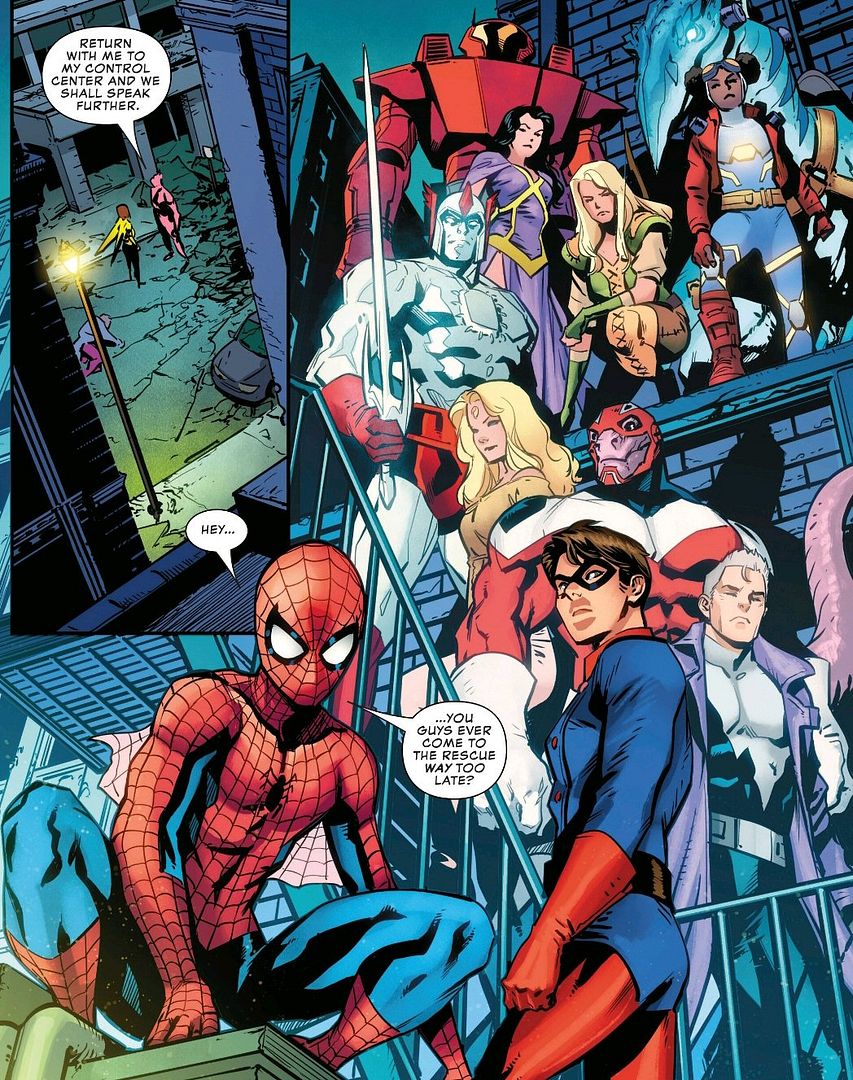
The care ethics perspective that Hank models has the desired effect – it encourages the others to exhibit the same. This is why Hank relents after initially attacking Korvac upon his subsequent restitution – Spider-Man surreptitiously communicates what they are up to. From issue #5:
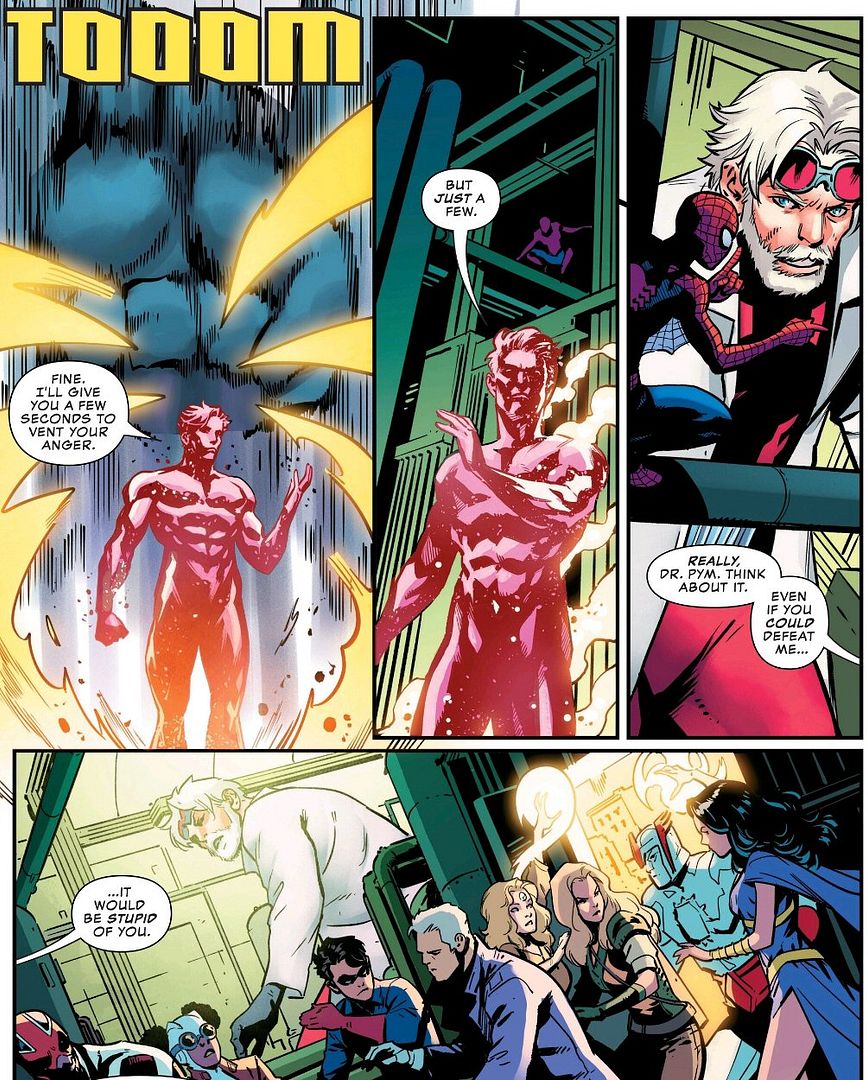
And so when Hank provokes Korvac by calling him a coward, the others are ready to strike – giving Hank the distraction he needs to activate the Star Brand powers and meaningfully engage with Korvac.
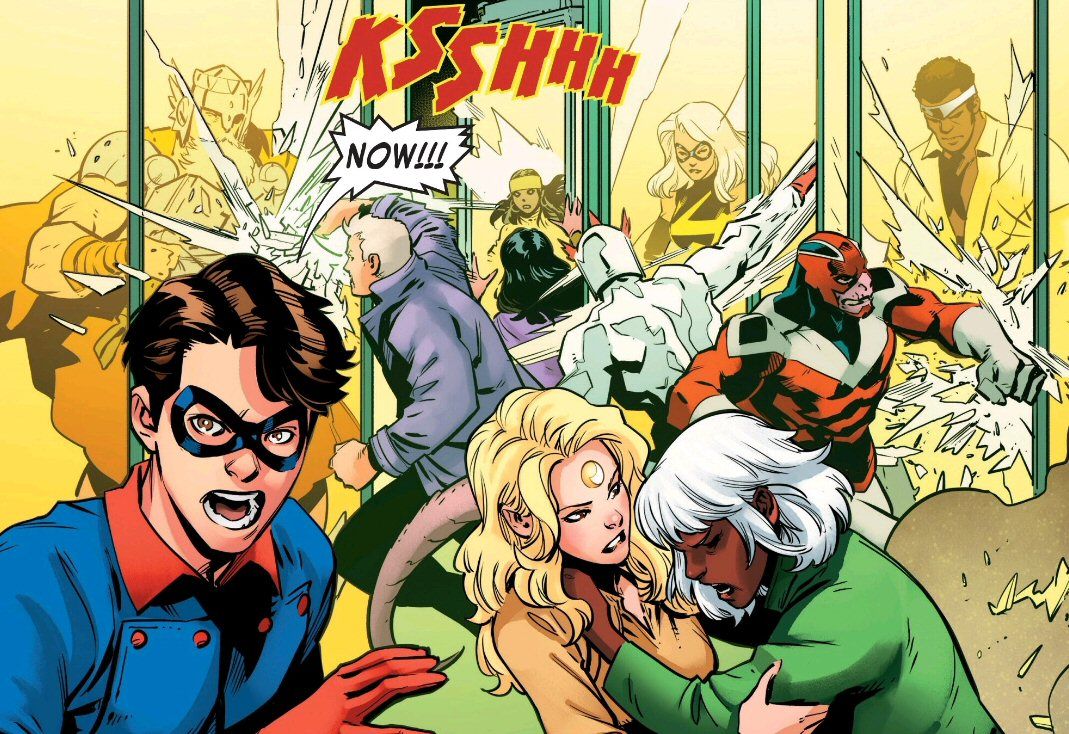
These B-plot scenes are critical to fully understanding this series. The personal demonstration of virtue ethics should serve to inspire similar virtuous behavior in others.
As an aside, I’m also a big fan of To’s artwork in this series (and Rod Reis who contributes to the last two issues). Not only do they capture all the callbacks and flashbacks to earlier stories well, but the overall style of drawing (and the construction of panels) is very reminiscent of that earlier era. It is also full of little Easter eggs throughout, if you know what to look for. The always outstanding Rachelle Rosenberg‘s colors are similarly very evocative of that earlier style – with solid bright colors for each of the characters. And VC’s Travis Lanham‘s letters similarly match. Collectively, this all reinforces a retro vibe.
The last word … for now
That was certainly a lot of philosophical ground to cover! From early rationalism and the foundations of existentialism (through Secret Wars II), to the rise of empiricism and the return to virtue ethics in modern times (through Battleworld).
I’m glad Gage so accurately depicted care ethics in this series, because I think that is the critical way forward in rehabilitating the flawed works of earlier time periods in the comics. Which brings me around to my final point: the shadow of Jim Shooter clearly looms large over this Battleworld series. And that is not surprising to me, given that Gage and I are of similar age – both first reading Marvel comics as adolescents during Shooter’s tenure as both a writer and Editor-in-Chief.
Shooter was far from the only comics creator of that time period to display blatantly sexist and misogynistic views. But his over-sized reach – and his unique position of authority – does require some careful reconsideration today.
The history of philosophy is similarly rife with sexism and misogyny. Aristotle and Thomas Aquinas were both brilliant thinkers who each had a millennial-long reach in Western thought, developing and promoting virtue ethics among other ideas. Yet they also shared the view that women were inferior to men, which perpetuated long-lasting harm to this day. David Hume (profiled above) was similarly a brilliant and influential philosopher, but his writings also showed that he was deeply racist. How can we best address these moral failings today?
I believe it starts by naming it and calling it out. But that is hard for those in the comics industry to do. There are many reasons why content creators don’t want to publicly highlight the poor moral behavior of other artists. And the same is true in philosophical circles. Ethicists and philosophers love to (endlessly) debate the finer points of philosophical arguments, but they are always careful to limit their critiques to the intellectual reasoning of others, not their behavior or character. Ad hominem attacks are the domain of internet trolls.
I usually try to stick close to normative ethics on this site, and avoid venturing too far into meta-ethics or epistemology (the branch of philosophy that asks questions like what is knowledge exactly?, or what is the truth and how would we know it if we saw it?). Mainly because I find it too abstract and analytical when you get into the weeds (plus it often gives me a headache!). But it does seem relevant here – both for how virtue ethics theories (like care ethics) should positively influence others, and how hard it is for us to name and deal with bad moral behavior.
Consider exemplarist moral theorists, philosophers who believe that we build moral concepts (that is, normative ethics’ right, good, and virtue) through the direct experience and emulation of admirable (“exemplary”) people. Even they shy away from calling out and providing counter-factuals (“anti-exemplars”). American philosopher Linda Zagzebski literally wrote the book on the subject, and yet she admits that she was “not comfortable naming names of contemptible persons”. I suspect this has a lot to do with pervasive moral relativism and cultural relativism in the humanities, which I previously decried in my X-Men Mystique post (follow the link for more info on these meta-ethics positions).
But whatever the value in calling out bad behavior, it seems to me that doing that alone is not enough. Decrying the darkness is not the same as lighting a match! So how best to illuminate the way forward?
Gage has really impressed me as a modern creator who is able to effectively recast historical abuses through a modern care ethics perspective. By showing how to bring other people closer to you, care ethics offers a great example of restorative (not retributive) justice for earlier abuses. For more good depictions of care ethics, check out any Kelly Sue DeConnick series (Bitch Planet and her current FML series are personal favorites). Or Kelly Thompson‘s excellent Captain Marvel and outstanding ongoing Absolute Wonder Woman. Or Jed Mackay‘s Clea Strange and Moon Knight runs. Or Eve Ewing‘s Exceptional X-Men run.
I would like to end with a related ethical concept that also focuses on the relative particulars of a given moral situation – the 20th century consequentialist theory known as situational ethics. Developed by Christian theologians (most prominently Joseph Fletcher), this theory was based on Jesus’ teachings as described in the New Testament. It basically swapped out the concept of “utility” in utilitarianism for the ancient Greek concept of agapē that Jesus personified – the highest form of unconditional love. I introduced this theory in my Absolute Woman Woman post, and expanded on it further in my Moon Knight post.
I first became aware of it through Isaac Asimov‘s early science fiction stories – and later much more explicitly through the Brother Cadfael book series (1977-1994) by Edith Pargeter (writing under the pseudonym Ellis Peters). The Cadfael mystery books are a very thoughtful examination of moral behavior, and I encourage everyone to read them. But I would like to give the last word to a succinct summary quote from Asimov’s 1954 science fiction novel The Caves of Steel. Here, a previously deontological robot character learns a very consequentialist lesson from the New Testament:
The destruction of what you people call evil is less just and desirable than the conversion of this evil into what you call good.
- R. Daneel Olivaw, in Isaac Asimov’s The Caves of Steel
It seems to me that that is exactly what Gage and company are doing by recasting these old morally problematic story lines through modern ethical lenses. They are taking a shameful history and turning it into an opportunity for growth and positive affirmation going forward.
Creators like this are a big part of why I am glad I found my way back to comics at this stage of my life.
See my Glossary post for a list of the key philosophical concepts and related links on this site.
Further Reading
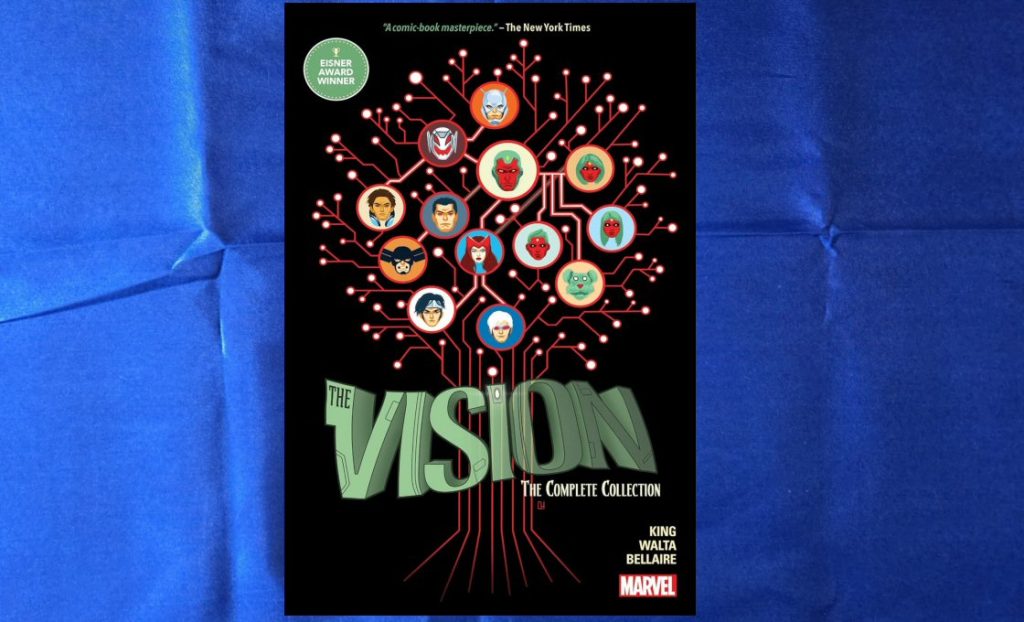
For more identity ethics: The Vision
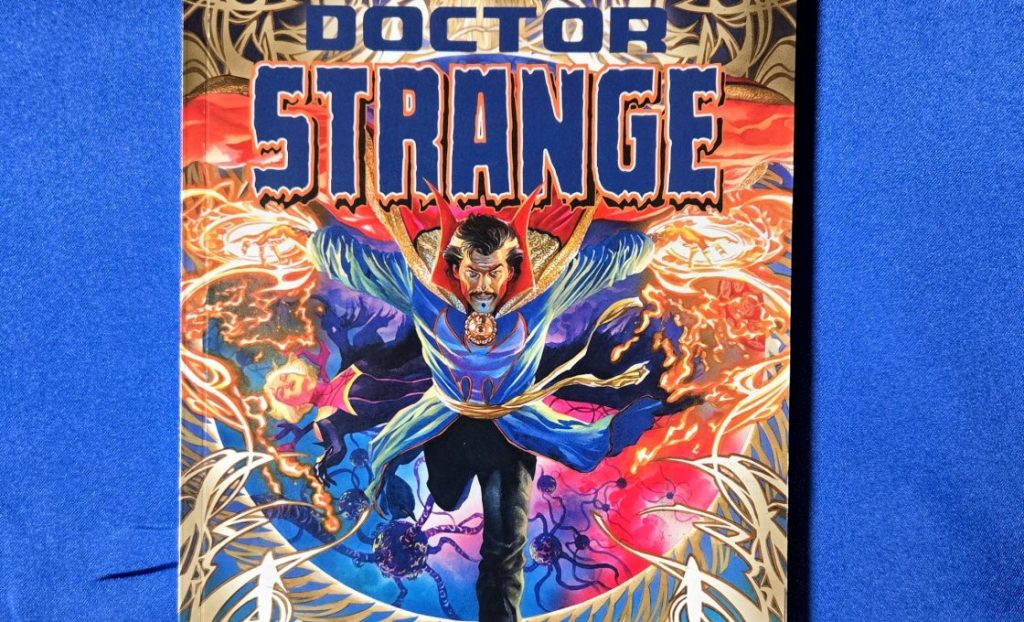
For more 80s comics: Doctor Strange

For more existential ethics: The 8 Deaths of Spider-Man Ethics
Great breakdown of the old (awful) secret wars. This battlewolrd series sounds really cool, will check it out.
And where did you get that battleworld comic stand? Are they making promotional items now?
Thanks, hope you enjoy it.

And no, that’s the lid from a Marvel short comics box. I needed an additional box, and picked this one off the shelf from my LCS because of the Miles Morales Spider-Man on it … and then saw it was actually a Battleworld-themed box. Marvel does this for a lot of its limited series. I thought it would make a good base for the title image!