

I have a long-standing interest in the brain and human behavior, including how we make moral decisions. I have a PhD in neuropsychopharmacology, which lies at the interface of understanding how the brain works (fundamental neuroscience) and the study of the effects of drugs on the mind (psychopharmacology). Simply put, it is the study of the neural mechanisms that drugs and chemical transmitters act upon to influence behavior.
I also have a long-standing interest in comic books. 🙂
Growing up, the discovery of superhero comic books in my tween/teen years (early 1980s) was a revelation. These were explicit morality plays, with many of the individual stories revolving around differing approaches to moral decision making (i.e., how one “ought” to act, what we refer to today as normative ethics). Indeed, I would argue that most of the conflict in superhero comics was either internal to the individual hero – or manifested as disagreements between the heroes. In contrast, the actual fighting with the super-villains seemed to only make up a relatively small amount of the stories at that time.
This time period of the early 1980s was critical, however. While I would argue superhero comics were always about morality, the earlier stories typically demonstrated a relatively simplistic duality between heroes and villains. Moreover, comics have always reflected broader societal values – and the North American values of the 1950s and 60s in particular included a lot of racism, sexism, misogyny and homophobia. By the late 1970s and early 80s, there was a new generation of writers who were explicitly looking to expand the medium through more complex stories and ideas – including bringing more nuanced normative ethics to the characters.
Of course, not all comic writers of that early era had progressive ideas. But while they might still have been in the minority numerically, they were ascendant in terms of the popularity of their comic titles (which I selectively collected). But even the bad writers were instructive in their own way, revealing what I would consider unethical ways of thinking through their stories. Although I didn’t fully realize it at the time, comics were actually a rich tapestry of competing moral philosophical theories.
Eventually, I moved on from comic books to science fiction (which tends to focus on many of the same themes), to philosophy and history, and eventually to neuroscience and the study of human and animal behavior. I have had a long career in neuroscience research funding, working with others (often internationally) to jointly design and fund major research initiatives. These sought to answer fundamental brain and behaviour questions, along with addressing pressing human mental health needs (you can read a bit more about that here). But I kept up my interest in philosophy, and have been pleased to see the recent expansion in fundamental neuroscience research around how we make moral decisions.
In recent years, I have returned to comic books to discover more diverse generations of writers and artists crafting very thoughtful and philosophical works – with innovative explorations of human behavior and ethics of relevance to modern times. These newer comics tend to have more mature themes, as they are largely directed to adult readers – many like myself who were fans during their adolescent years. I’m not sure how many youth could afford comics today – even in inflation-adjusted terms, they easily cost 2-3 times as much as they did when I was young. Which is a shame, as the stories now are more complex, spanning longer time frames, with typically better art and more succinct dialogue. And the commitment to exploring moral questions is even more pronounced today.
I thought I would create this site to marry my joint interests in comics and philosophy. Specifically, I am looking to explore the underlying moral philosophies illustrated through (primarily superhero) comic book stories – and how they have changed over time. Along the way, I plan to also present some of the recent key findings from fundamental neuroscience into how we make moral decisions. I’m happy to share what I’ve learned, as I continue to grow and discover more from modern philosophers, comics creators, and active neuroscientists. I hope you will take that journey into self-discovery with me.
Please check out the main pages here for more information; especially my About Site page for a more detailed explanation of the purpose of this site, my Comics page for a brief history of comic books and their relevance today, and my Ethics 101 page for a detailed primer on the various ethical theories I will be discussing here. And see my Glossary post for a list of the key philosophical concepts and related links on this site. You can also dive right into the individual blog posts on different superhero characters and their modern (re)creators.

P.S.: If you would like to support my work on this site (which is entirely self-supported, no ads or sponsors!) you can always donate me a comic or two:
My other interests
I’ve created a number of websites over the years, supporting my different interests and hobbies. Some of these were done under my online pseudonym “selfbuilt”. That was my original username on computer forums in the early days of the internet. It was a bit of a portmanteau, referring to how I had always built my own computer rigs from parts. But it also had a double-meaning, taken from the old joke about how the problem with self-made men is that they are often in awe of their creator. 😉 It’s always been a reminder to not take myself too seriously!
If you are curious, you can read more below about my statistically-valid whisky metacritic, my in-depth flashlight reviewing, or my background resources on those ancient computing devices, slide rules.


My previous hobby, the goal of this site is to help you choose your next whisky using a detailed flavor and quality assessment across an extensive range of whiskies. I haven’t been adding my own reviews lately, but the Whisky Database is still valid and the resource you want to check out. It is based on a statistically-valid, scientific meta-analysis that I created from a large number of expert whisky reviews.


An older hobby I have returned to recently, the goal here is to help you choose your next flashlight, using detailed analysis and testing of a range of makes and models. I initially focused on comparative output measures and runtimes, but eventually expanded to a full suite of testing methods for each light. An earlier version of this site (ca. 2008) simply linked to my external forum reviews, but I renovated it in 2023 when I relaunched my review career (with all new reviews held onsite now).
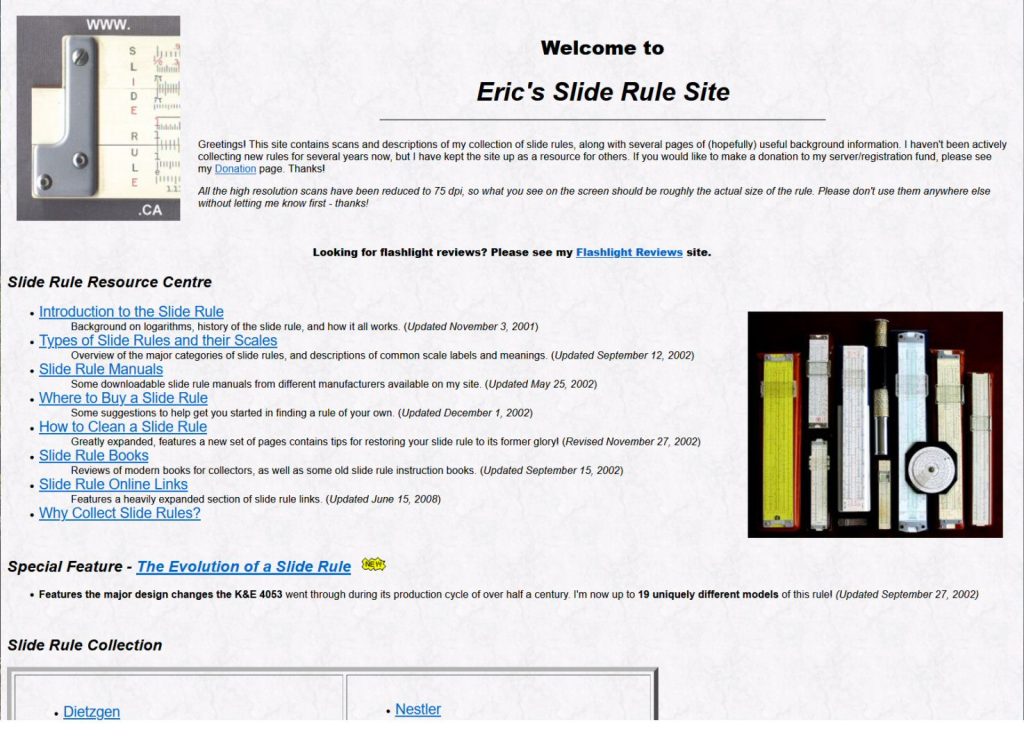
My very first website, from over 25 years ago. This site contains scans and descriptions of my collection of slide rules, along with several pages of relevant background information and resources. Although basic in design (hand-coded HTML, never bothered to update), it still serves as a valuable resource for its collection of manuals, cleaning tips, and explanation of slide rule scales and uses.
See my Glossary post for a list of the key philosophical concepts and related links on this site.
Greetings! I just came across your website and I am looking forward to reading your work on superheroes. I am an associate professor who studies the intersection of superhero media and moral development. I included my website that includes my scholarship. We should connect, and please share my site with anyone you know who may be interested. Best,
Hi Justin,
Welcome to the site. I also look forward to reviewing your site, it seems we have similar interests.
Best,
Eric