
In my introduction to one of my earlier hobbies – slide rules – I explained:
In the history of the modern world, probably no other technological instrument was so widely used for so long, only to disappear virtually overnight. The slide rule’s form and features were revised for centuries, and there are probably few people today over the age of 50 who didn’t routinely use one in school or at work at some point in their lives. Yet with the advent of inexpensive pocket calculators in the early 1970s, slide rules quickly went the way of the Dodo.
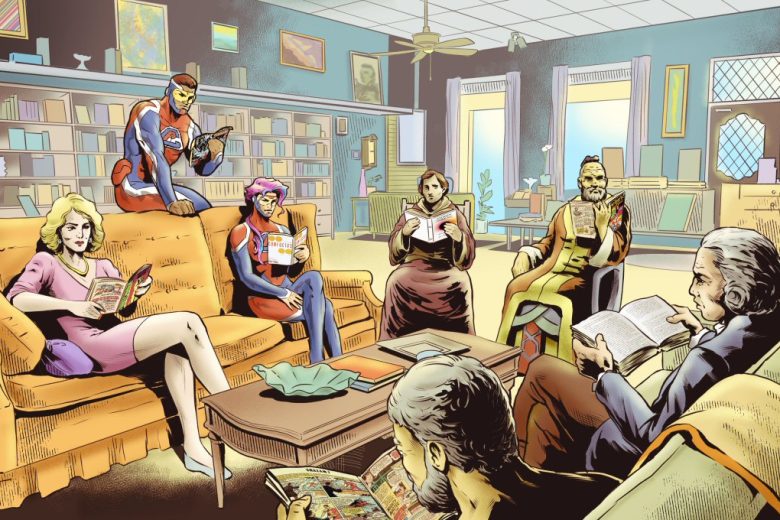
Most people in the >50 crowd today believe that comic books no longer exist. Indeed, when I told former work colleagues that I was starting a comics blog, they all asked me for movie recommendations! They had no idea that there is a vibrant print comics scene. And so I know it would shock them to discover that the number of monthly printed comics titles today is actually much higher than in our collective youth.
There are literally hundreds of new comics published each month (maybe closer to a thousand, if you include all the reprints and variants covers – as I will explain below). Although a lot of the production runs are probably in the low thousands, run in the tens of thousands are common – and some of the most popular titles still exceed a hundred thousand a month (as they did in my youth). That means total sale volumes of print comic books are in the millions each month.
How can that be, you might ask, when you don’t typically see comic books around any more (and haven’t for decades)? This lack of visibility is why many today only know of superhero characters from what they see in the movies and on TV. But the apparent demise of the industry is a misnomer, and I will explain the reasons for this briefly here.
UPDATE: If you want to learn more about the current state of the comics industry, David Harper’s excellent comics journalism site SKTCHD does bi-annual check-ins with comic book stores. You can read his latest 2025 overview here – which turned out to be a banner year for the industry.
Introduction
The comic book format has been around for a long time. While simple comic art dates back to ancient civilizations, the initial form of the comic book began in the early Victorian era – with the modern form of the American superhero comic book beginning in the early 1930s. When I was young, we tended to refer to a comic book simply as a “comic”, but I note many today refer to them as “comics” (likely to differentiate from linear comic strips).
Comic books are serial publications (periodicals) that consists of comic art in sequential panels that represent individual scenes in a developing story. These panels often include descriptive prose explaining the background along with written dialogue of the characters inside speech balloons (the latter being particularly emblematic of the comics art form). Think of them as a graphic form of serialized fiction.
There are of course a lot variations on the actual physical comic book format – the popular manga in Japan, the Franco-Belgian comics, the stand-alone “graphic novel”, the trade paperback, etc. But the form I will be addressing here is the modern American superhero comic book. Historians typically divide these comic books into defined eras. Although exact age ranges vary, these can broadly be defined as Golden age (1938 to 1955), Silver age (1956 to 1971), Bronze age (1972 to 1984), Copper age (1985 to 1991), Chrome age (1992 to 1999), and Modern age (2000 to present).
I will be focusing on this site on Modern age comic book stories, but will include examples going back to the Bronze age. I will also discuss their translation to the big and small screen in this millennium, where relevant. I will start with Marvel comics, as those are the ones that I first read and collected as a kid, but I will be branching out to other modern series (including creator-owned) as I go along. Check out my Marvel/DC page to learn more about how the respective superhero universes (and Multiverses!) of the “Big Two” publishers work.
Physically, most printed comic books remain about 32 pages long (with 10 pages of ads, so only 22 pages of art and story) although it can go up to 48 pages for special issues. Originally Golden age comic books were 7 3/4 inches wide x 10 1/2 inches tall, but they gradually shrunk in width to 6 7/8 wide by the Modern age. Comics are now produced digitally, but are still printed for the legacy world – they just aren’t as easy to find as they used to be. Of course, today you don’t have to buy an actual paper comic (still affectionately referred to as a “floppy” or single) – and a lot of readers don’t, as you can easily access comics digitally.
Comic books are a unique art form, as they have almost always been created through collaborative efforts. This is something that again surprises many people in my age demographic – they often think of the simple comic strips (in the newspapers of their youth), where each one was typically drawn and written by a single individual.
Comic book creation involves several key steps, historically performed by different individuals in sequence. The writer (sometimes divided into the plotter and the scripter) plots the story and writes the dialogue (although that final step can come quite a bit later). The penciller (now often simply called the artist) sets the comic story pacing and does the initial panel layout and artwork (exclusively in pencil originally, now fully digitally). The inker finishes the artwork in ink (initially, now digitally). The colorist initially prepared the color layers for CMYK halftone printing (often several individuals working together), and now does the actual colors digitally. And the letterer adds the captions and speech text. And let’s not forget the editor – they are responsible for making sure that everything is fit to publish in the end, including making sure the story and content is consistent with the brand and history (they typically also choose all the individuals above to work on a given comic).
I know these terms seem archaic, as comics are drafted fully digitally now. But you still need someone to do the panel layout and initial sketches, and someone to finalize the illustrations – so these old “penciller” and “inker” terms are still widely used today for these enduring complimentary roles.
Note that the writer and penciller are typically considered co-creators of the comic, as the penciller often collaborates on the plot (especially in the early days, and again today). With the exception of certain runs in the early 1980s, where writers held more sway and various “‘guest” artists stepped in for piecemeal work on individual issues, I will adopt the modern convention and typically refer to both the writer and penciller as joint creators throughout this site. Encouragingly today, all the individuals above are generally given full billing (in sequence) on the cover of modern comics.
Comic books are a creative medium, and creators have always played around with the organization and representation of visual elements and text. Consider these two pages from one of my favorite Doctor Strange stories from the early 1980s, written by Roger Stern and penciled by guest artist for that issue Michael Golden (Doctor Strange Vol 2, issue #55, 1982, pp. 13-14):
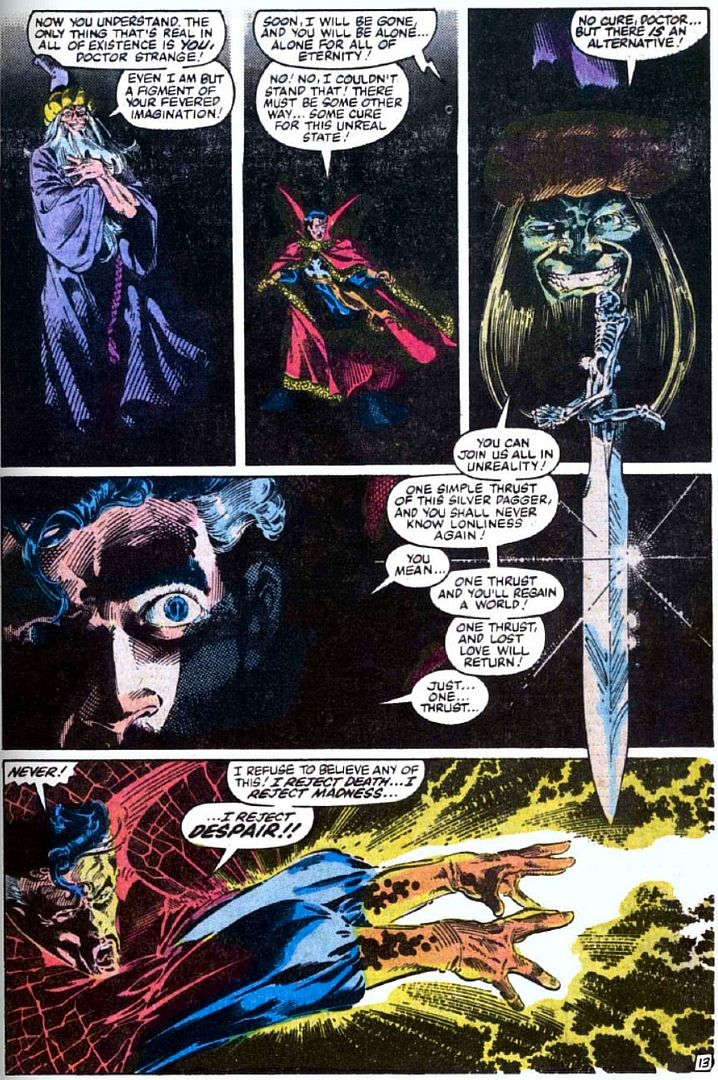
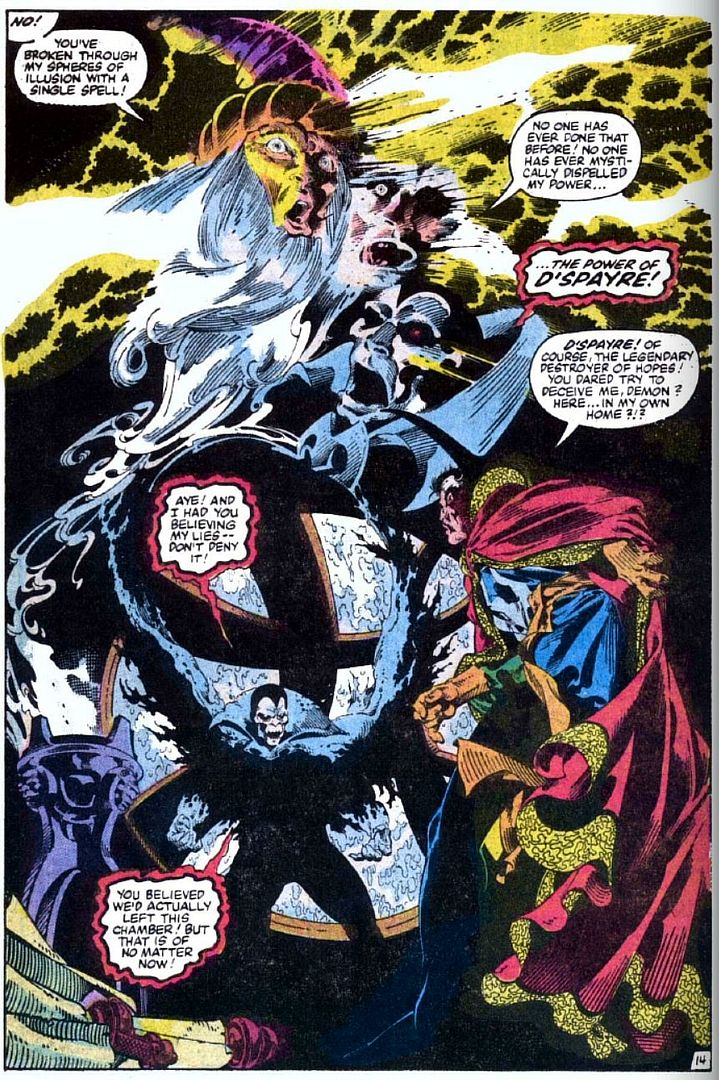
In my view, Golden was an outstanding artist for that era. There is an unusually heavy amount of shading and black in this issue, reflecting the dark place the good Doctor had found himself (the inker Terry Austin and colorist Glynis Oliver must have been less than thrilled!). I love the visual flow of the story across panels, which was quite innovative for that time period. You will also note some creative use of speech balloons, which were originally simple white, rounded, rectangular containers with printed words connected to a specific character by a tail element. The distinctive styles for both Strange and the villain D’Spayre above presages the Modern age, where character dialogue can be further differentiated by fonts, colors, or placement of text off to the sides (indicating internal monologues or commentaries).
Here are a couple of pages from a more recent Strange outing, featuring Clea as the Sorcerer Supreme, written by Jed MacKay and penciled by Marcelo Ferreira (Strange Vol 3, issue #7, 2022, pp. 10-11):
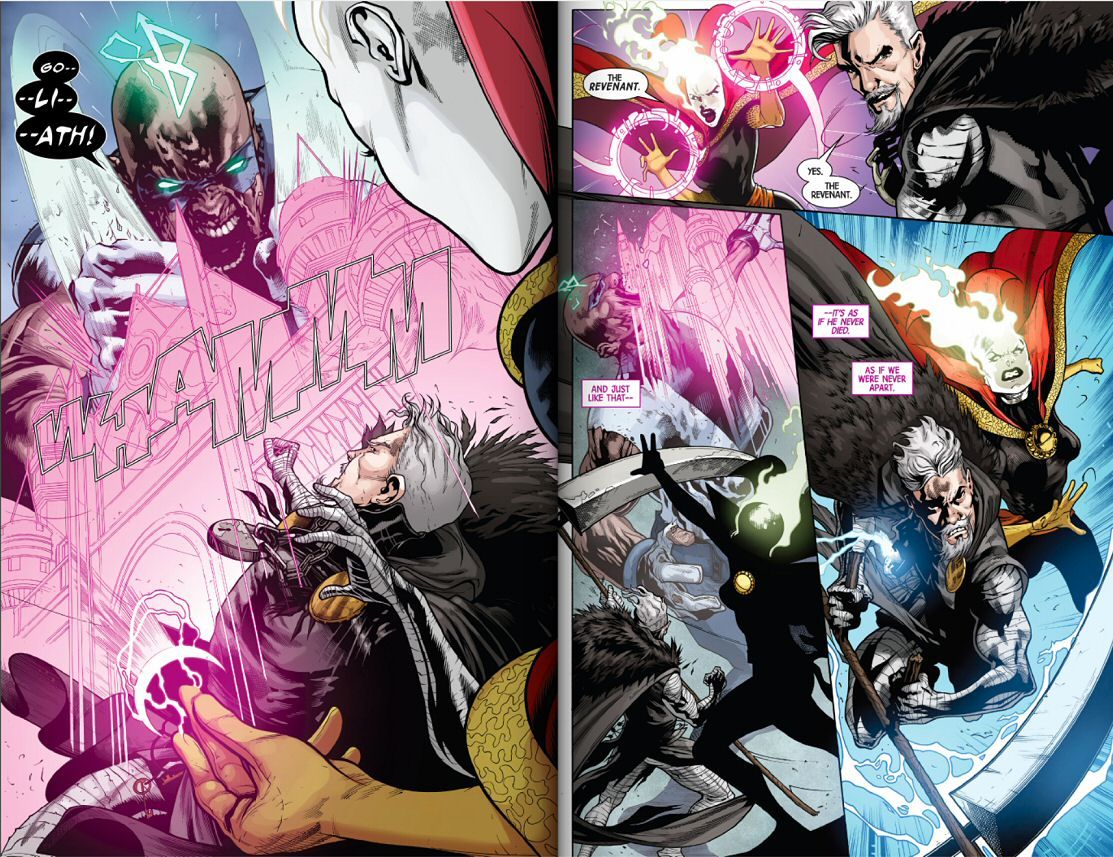
I particularly like how modern comics have much less explicit dialogue, and more internal monologues from the main character. Modern artists are also typically better at revealing emotion on faces and through motion, requiring less descriptive text. In many ways, comics seem to have returned to an earlier era where the writer and artist are truly more joint collaborators in conveying a story.
History
The history of comic books is extensive, and beyond the scope here. But you might be wondering what led to them becoming so popular – and why you don’t typically see them around in print form “floppies” any more (despite all those print runs mentioned in my opening). So I thought I would try to summarize here the key points succinctly.
Comic books were originally distributed like any other periodical, at “newsstands” (which includes convenience stores that sold newspapers and magazines). Some of you may remember those classic “spinner” racks! The economics of this model persisted for decades with little change. Newsstand owners would purchase specific comic and magazine lines from a distributor at some discount to the cover price. Whatever didn’t sell would be picked up by the distributor’s agent when they came back the next month with the new issues, and the cost fully credited against the store’s latest order. These unsold issues would then be carted off and destroyed (with the publisher ultimately absorbing the loss).
As comics became increasingly popular in the 1970s, enthusiasts would trade back issues from within their personal collections. These were rare and hard to find of course, as only a limited number of each issue was ever sold (and carefully preserved). Eventually, the buying and selling of back issues became increasingly common, and major collectors would come together to open small comic book specialty stores to facilitate this exchange.
Not missing a beat, the main comic book producers started selling comics directly to these comic book stores. But with a catch – they would offer an even greater discount, but the comics were non-returnable (i.e., the stores were stuck with whatever didn’t sell). This was actually a boon to specialty comic book stores, as it provided additional comics to put in their back issue stacks to eventually sell (preferably at a profit).
This led to even greater interest, and a positive feedback cycle took off in the early 1980s, with a massive expansion of the whole comic book industry. It also very nearly led to its destruction.
To explain why, consider that only ~10% of comics were sold by the direct distribution model in 1980. By 1985, it was roughly a 50:50 split. And by 1990, it had reversed to ~90% of comics sold through the direct market channel. On the positive side, the rise of comic book specialty stores meant that more publishers could be supported, with more comics titles, with more complex and longer story lines, on better quality paper and printing. But those last points also meant rising costs (and thus rising prices), and a greater commitment needed to see stories though over time in an increasingly crowded space.
It also took comic books out of public view, as sales dwindled in traditional newsstands. Eventually, no one was buying comic books except established (i.e., older) enthusiasts in these existing specialty stores (the direct market). By the mid to late 1990s, the whole industry virtually imploded under its own weight, with Marvel entering bankruptcy protection at the end of 1996. Ironically, how it got out of that mess is what spawned the multi-billion dollar movie industry today (see my Marvel page for more info).
But let’s go back a bit. Inflation created the first major problem for the industry. With the energy crisis and wars in the middle east, inflation took hold in the mid-1970s and remained stubbornly high well into the mid-1980s. The cover price of a standard Marvel comic book was $0.25 in 1975. It was $0.40 by 1980, $0.50 by 1981, and $0.60 by 1982. Then in late 1982, currency fluctuations meant that Canadian comics could no longer be sold at par with their US counterparts (the price jumped to $0.75 here). There’s a fascinating history on Canadian Price Variants that came about during this transition period in the early-to-mid-1980s.
To understand that, comics sold through the direct and newsstand distribution channels were initially identical, except for crossing out or leaving blank the UPC bar code box on the covers of the direct market printings (later used for artwork). By 1982, a new distributor was created for the direct market exclusively (Diamond), who changed the price indicator on those comics to support multi-prices for the different markets (not coincidentally with a diamond motif). Soon Diamond exercised unparalleled control over the industry, once the inevitable collapse of the newsstand distribution channel occurred. Since the mid-1990s, it has basically only been possible to buy comic books at (a slowly dwindling number of) specialty direct market comic stores. And while there have been newer distributors entering the scene, the main distributor Diamond entered bankruptcy protection in January 2025 (a messy and sorry state state of affairs that is still not resolved a full year later). The tectonic upheavals of this industry continue, with uncertain repercussions.
While there is growth in new readership, adolescents cannot as easily afford to buy and collect comic books today. While most of my newspaper-route and other odd-job income went into my comic hobby in the early 1980s, you would have to work a lot of after-school jobs today to buy as many comics as I did. Adjusting for inflation, comic books should only be $1.50-$2.00 today. Instead they cost two to three times that – a standard 32-page issue retails for $4 USD today, and longer issues, limited series or first editions typically cost $5 or $6 USD.
One of the obvious reasons for this is the improved quality of the comics themselves – they were literally printed on cheap newsprint with simple color halftoning during my adolescence. But the complex incentives of the industry has had all sorts of odd effects over the years. For example, the rise of digital technologies and the internet has meant that comics are produced and distributed digitally now.
So, why exactly does a digital comic online cost the same as the print one? Obviously, the comics producers don’t want to undercut themselves with their existing (sole) direct market specialty comic book stores. But long-term, it does seem untenable to continue printing physical comics without a continual influx of new readers. Fortunately, there are signs of new readership for many of the well-established stores, although the industry persists in a state of continual uncertainty. Note that there are only a couple of thousand comic book stores around nowadays.
That being said, there has been explosive growth in one category of comics: graphic novels for younger children. The Dog Man graphic novel series by Dav Pilkey (published by Scholastic) is probably the most obvious example – new issues consistently rank as best sellers (not just of children’s book, but books in general!). There are millions of copies sold globally for each issue. Scholastic (and other publishers) are busy producing a huge number of new releases in this genre, opening the door for future readership of comics by adolescents. The Cartoonists Club by Raina Telgemeier and Scott McCloud was my granddaughter’s favorite of the ones I gave her this year.
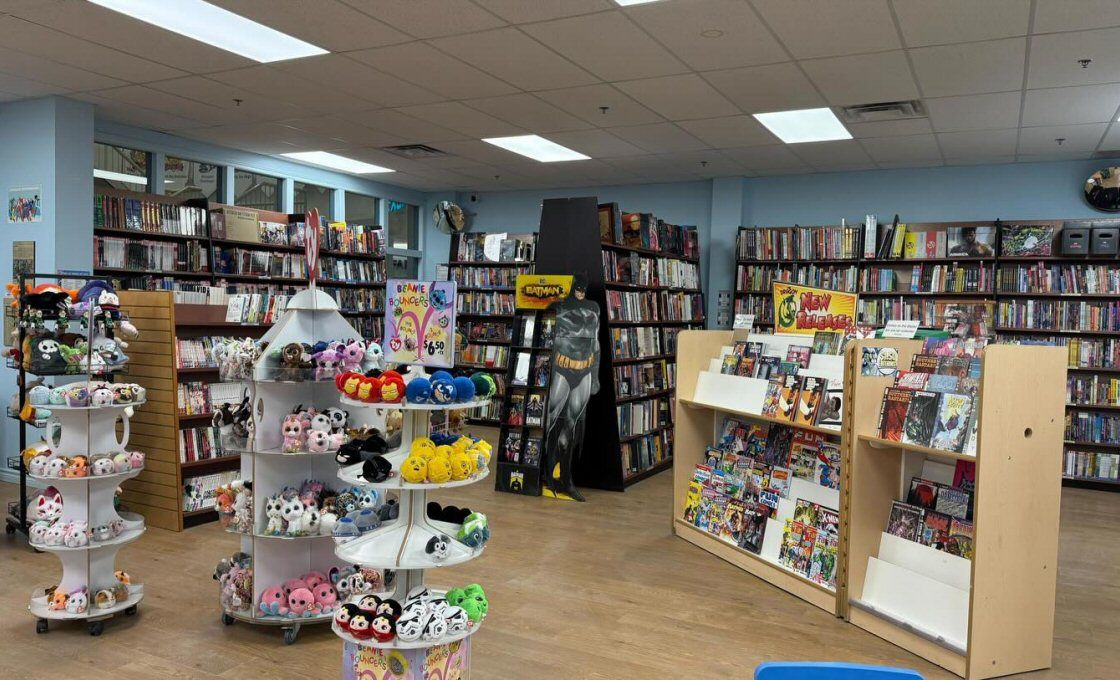
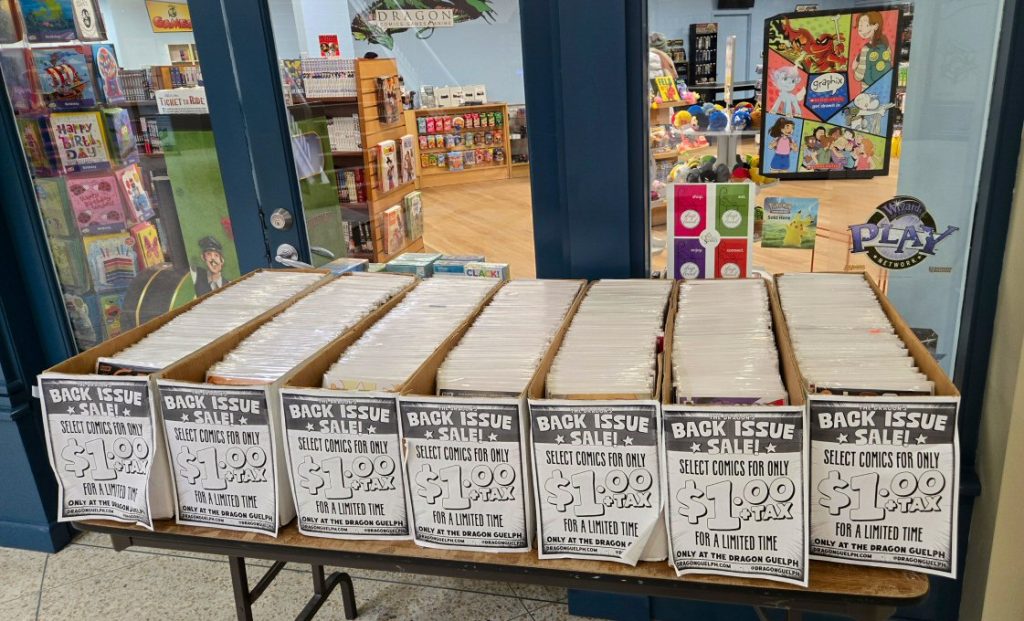
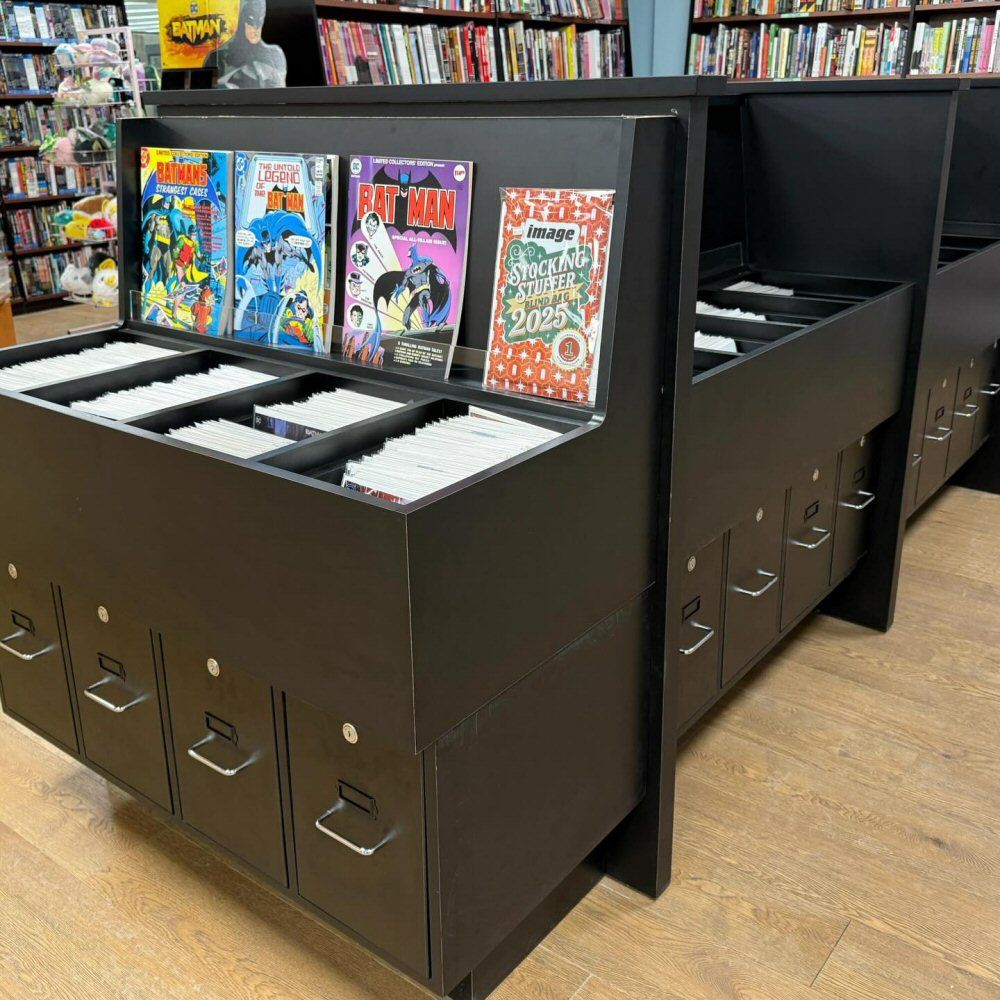
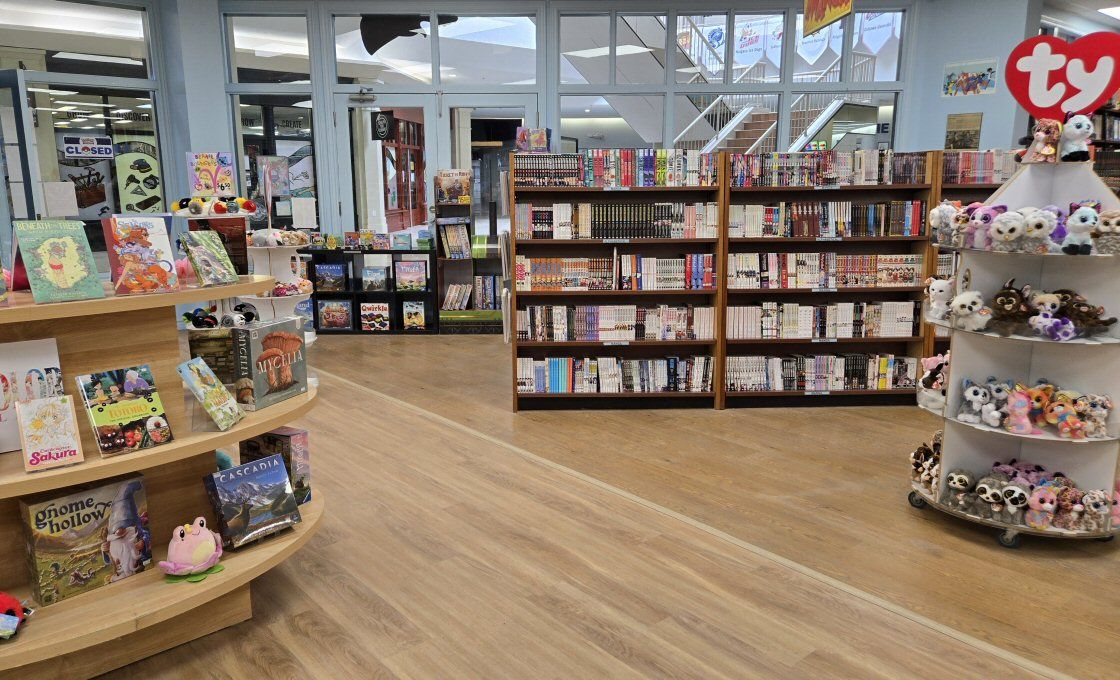
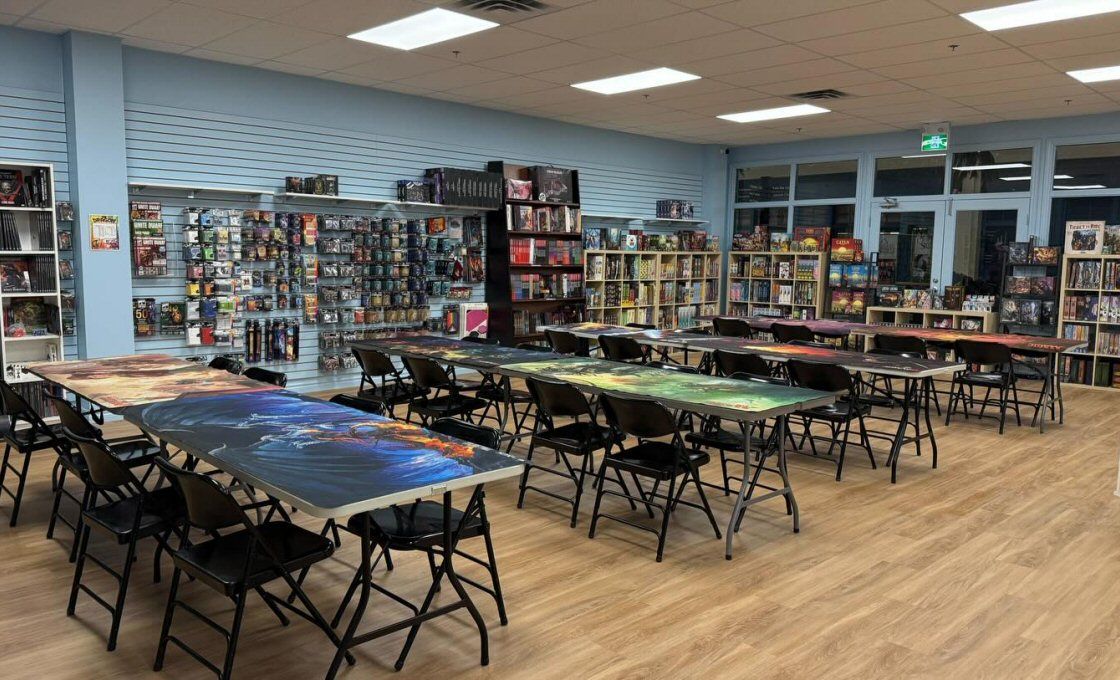
Which brings me around to all the retail pictures shown on this page – they were all taken in early 2026 at The Dragon, located in Guelph, Ontario, Canada (reproduced here with permission). You’ll see that the Dragon serves as much more than just a comic book store – they have an extensive collection of hardcover and trade paperbacks, mangas, games, and children’s books and toys. They serve as a local community hub for comics enthusiasts and gamers of all sorts, and are open in the evenings for organized play events.
The burst bubble
As I previously alluded to, comic books entered a bubble period in the 1980s, with the rise of speculative “investing” in the hopes of future price increases – that finally burst by the mid-1990s. Along the way, comic producers and distributors never failed to come up with increasingly ingenious schemes to pull even more money from the pockets of readers.
Probably my least favorite example is variant covers, where you need to buy multiple print copies of the same comic with different covers (to “collect” them all). Used judiciously, I can see these adding value – and variant covers actually did help the comic book stores, at least initially, as they increased sales (although typically only among existing customers). And they do allow the opportunity to showcase some truly beautiful artwork by established and up-and-coming artists. But as with everything, this can be taken too far. A couple of well-thought out variants can make it interesting – but >30 variants for a new “first issue” (many with less interesting art than the main cover) is another matter.
Eventually, this was further entrenched with “incentive” covers under limited release – where comic stores had to commit to buying so many regular issues before they could receive one limited edition cover variant (which they were then free to sell at a markup). And then the (offensively-named) “virgin” covers – which feature just the bare artwork “untouched” by the standard trade dress (i.e., the comic masthead, logo, price indicators, etc.). I prefer to refer to these as “clean dress” covers. These sorts of incentive measures – and more – continue unabated to this day.
How to find comics today
If after reading these pages you are curious to read actual comics today, there are plenty of options for you. Note the online environment is very dynamic, and things change rapidly.
For the Big Two producers, the best mainstream online deal right now is Marvel Unlimited ($10 USD/month, or $70 USD for one year) and DC Universe Infinite ($8 USD/month, or $75 USD a year), which have 30,000+ and 34,000+ back issues available to browse, respectively. As the names imply, you can read as many comics as you want. But there is a catch – new releases are not available for about 3-4 months. You would have to buy those, at full single print copy prices if you want to read them as soon as they come out. Indeed, I would argue you are likely better off in that case buying the new issues as actual print comics from a comics store, and redeeming the free digital copy code contained within to read them online (I’ll describe how to buy print comics below). But if you don’t mind waiting a while to get them as back issues, the official subscription options are a great value.
It’s harder to access online the smaller and independent publishing houses (of which there are many now!). There have been sites over the years that allowed you to browse multiple producers on a single subscription. The main one was Comixology, but it was bought and integrated into the Amazon’s Kindle store, and so you would need a US Prime account now for access. And unfortunately it doesn’t work for Canadian Prime subscribers – we only have access to a small comic selection in the Kindle store with our accounts. Global Comix is a competing option (though you may still need to pay incremental fees for access to some issues).
If you are in the US and have a library card, Hoopla is a good option to gain free access to a wide range of titles. Humble Bundle is a great way to buy limited-time downloadable compilations at incredibly reduced prices (while contributing to charity, to boot). I’ve caught up on a lot of back reading through Humble Bundles! Of course, the internet being what it is, there are also piracy sites that let you read or download comics for free. But I would STRONGLY encourage you to support comic creators and the direct market stores through legitimate means.
If you download digital comics (from Humble Bundle, for example) you can get them as standard PDFs. But I strongly recommend you pick the comic book format known as CBR (which is basically just a bunch of JPG images compressed together). These are typically smaller files, with equivalent or better image quality. You will need a standalone reader though – I like the free CDisplayEx lite version, which is lightweight but powerful, and easy to use, on both Android and Windows PCs.
Finding print comics
To purchase print comic books, you will need to find an actual comic book shop in person or online. There is a helpful tool for locating bricks-and-mortar stores in Canada and the US: Comicshoplocator.com. Of course, there are plenty of online comic book stores that will ship comics anywhere.

The way it works for these modern comic book stores is they offer “pre-sales” for purchases of issues ahead of their release. This allows the store to order the minimum number of issues they will need, along with some extras for walk-ins and other last minute purchasers. By buying pre-sales, you lock-in your order and guarantee receipt of the comic. You can try and wait until the comics actually come out – but popular issues can sell out very quickly (and modern custom print runs means very little extra or waste). Popular comics often have to be reprinted (sometimes multiple times) to meet subsequent demand.
The comic book stores can ship your order out immediately if you want – but that gets expensive fast. So they all offer “hold boxes”, where they will store your orders securely for you to either pick up in person, or ship all at once to save on shipping costs. All you do is request a shipping quote for your hold box when you are ready, and they will send it out to you.
Being somewhat old school, I still like buying actual print comics this way – although I prefer reading them digitally (a tablet in portrait mode is a particularly good way to go for aging eyeballs, but I’ve done it on my laptop as well). Of course, print comics take up space, but they have residual resale value (and in some cases, they do appreciate in value). And as I alluded to above, they also come with free digital access codes. So for the same price, you can buy the actual print comics as they come out and then read them online (and then give away or resell the actual comics at some point down the road).
My favorite in-person store – where I order most of my new comics today – is The Dragon in Guelph, Ontario (as described above, and shown throughout this page). Recently expanded, they have a great presence for comics and games, friendly and knowledgeable staff, and are a recipient of the prestigious Will Eisner Spirit of Comics Retailing award. They also have an extensive collection of children’s graphic novels and manga. Very highly recommended!
Another good comics store is Dungeon Comics in Burlington and Oakville, Ontario. Dungeon’s dedicated e-commerce site isn’t as advanced as some, but you can buy everything they carry though their eBay store. Three other favorite stores are CaptCan Comics (Brantford, Ontario), Knowhere Comics (Toronto, Ontario), and Cosmic Comics (Saskatoon, Saskatchewan). They all have excellent web stores, offer discounts and sales on back issues and/or pre-releases, and they all offer reward point systems through their own sites (and/or through Shopify’s Shop app). If you click the referral links above for each store, you should get $10 off your first order.
All of the above offer outstanding customer service, with great selection and prices for modern comics. If you are looking for older back issues, I suggest you look out for “warehouse” comic stores, or try eBay.
As an side, if you are looking to accurately grade your print comic books, that is a topic worthy of a site all by itself. There is a lot of misinformation online about grading, but the most useful tool that I’ve found is the appropriately named Comic Book Grading Tool. The site helps you by itemizing the highest possible grade a comic can get after considering each of over 35 possible categories of problems. This will guide you through a fair and accurate way to assess a comic’s grade, with lots of pictures to help you understand.
Trade paperbacks (TPBs)
Another economical option for those who like to hold actual books in their hands is the comic trade paperback (TPB). These are collections of comic stories reprinted in softcover book format, usually providing either a complete series, a story arc from a larger series, or a number of stories around a common theme (e.g., a cross-over event). I’ve interspersed the Strange and Jane Foster/Thor TPBs in the image below, with some single issue comics.
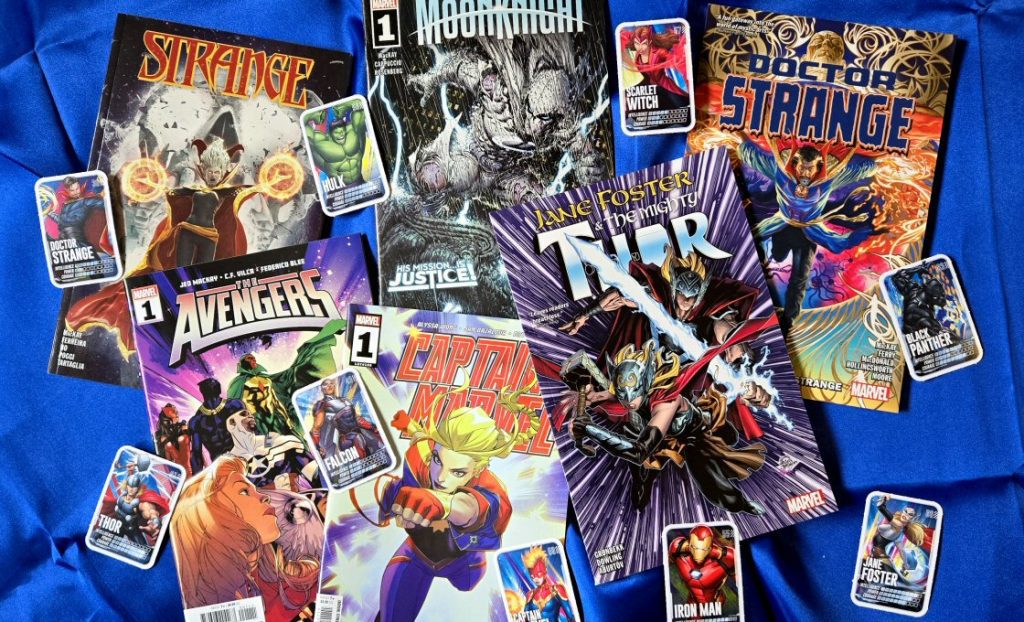
Trade paperbacks are typically published with the same high-quality paper and print quality, in the same size as the original comic books – and bonus, without the ads. But you typically lose all the “backmatter” elements of the monthly comics (e.g., individual articles by the creators, letters to the editor, previews of other comics, etc.). But you may gain additional content in the collected trade (e.g., series introduction by the author, concept art sketches, etc.). And you have to check sizes ahead of time – sometimes they are published in a smaller “digest-size” or “compact” format, or a larger-than-original format with “hardcover” binding. And TPBs of older comics might be in black-and-white (and if in color, will have been re-colored since the old CYMK half-toning model doesn’t apply any more). TPBs really dominate the industry, and comic book story arcs are typically aligned to fit this format (i.e., it is typically 5 comics to a story arc, to fit the TPB).
All modern comic book stores also sell TPBs, and I recommend you order through them to help support these stores. These are a very cost-effective way to have comic series bundled together in a print form, at a good discount. But as TPBs are considered books, you can also find them in any number of regular online book stores too. And there are sites that specialize in selling them at a discount (often remaindered copies). My favorite online stores for these are Instocktrades.com in the US and Bookcloseouts.ca in Canada. Note however that there is little “investment” value in TPBs. By definition, the publishers can reprint these as often as they want – so a TPB will typically not be worth more than its cover price (unless rare and out of print).
If you would like to know more about how the Marvel and DC comic and cinematic universes work, check out my Marvel/DC page.
P.S.: If you would like to support my work on this site (which is entirely self-supported, no ads or sponsors!) you can always donate me a comic or two:
See my Glossary post for a list of the key philosophical concepts and related links on this site.