

My name is Clea Strange. And I have watched the love my life die. I refuse to be thwarted in the pursuit of my desires. In the pursuit of LOVE. My love for a brilliant, beautiful, flawed man. No more will I suffer the constraints of mere life and death. I have the POWER, the WILL and the NERVE to shape my destiny into a form that pleases me. And I reject any fate but that which I have made for myself.
- Strange Vol 3, Issue #1, by Jed MacKay (2022)
Welcome my overview page on Clea, from the Doctor Strange comic books. Jed MacKay has described her as “the greatest of all Doctor Strange characters”, and I can’t help but agree – in his hands.
It didn’t begin that way. Clea has a long history in the Strange comics, and a lot of it is not good. But I feel a lot of that has recently been reclaimed and redeemed by MacKay.
It is important to explore not only the positive moral examples provided by comics, but also the negative ones as well. These often reflect the culture and time of the stories, which can be revealing. Depictions of women in comic books, especially in earlier eras, can often be full of all the worse tropes – often sexist, sometimes misogynistic. The arc of Clea is long, and worth exploring.
If you would like to know more about the terms I’m using on this site, please follow the links throughout or check out my Ethics 101 page or Glossary of Terms post.
Character introduction
Clea is from the Dark Dimension, another Universe in the Marvel Multiverse. She is the daughter of Prince Orini, who was the son of the former ruler of the Dark Dimension – before Dormammu and his sister Umar conquered them, and Dormammu took over as its ruler. Dormammu and Umar were fugitives from the Faltine – a dimension and race of extra-dimensional energy beings born from pure magic.
Initially, Clea is a loyal (subservient?) subject of Dormammu, until she decides to repeatedly assist Doctor Strange in his challenge to Dormammu’s cruel reign. She moves to Earth-616 for a time, and becomes the disciple of Doctor Strange.
It is eventually revealed that Clea’s mother was Umar. Thus, Clea has a dual claim to the throne – a descendant of both the hereditary rulers of the Dark Dimension, and its more recent Faltine conquerors. Clea eventually usurps Dormammu’s position and claims the throne, as the benign ruler of the Dark Dimension. Since this time, Clea is often shown with flames around her head – at least when she is exercising her Faltine powers.
There is a complex history to how Clea is portrayed in the comics – with many regrettable tropes and plot lines, including up to modern times.
Early comics
Clea was created by Steve Ditko and Stan Lee early in the run of Doctor Strange – Strange Tales Vol 1, issue #126 (1964). Here is her first appearance, where she secretly spies Strange from a distance:
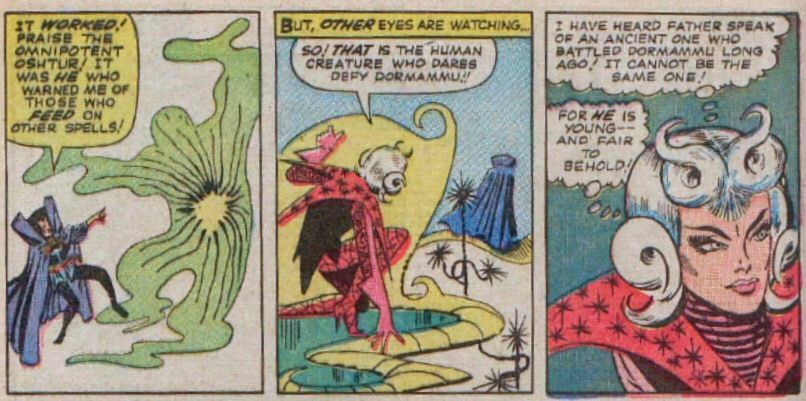
I can help but be struck by the comparison to Shakespeare’s The Tempest, where Miranda – who has grown up sheltered on the island and knows little of the outside world – first sees human sailors:
‘Oh wonder! How beauteous mankind is! Oh brave new world, that has such people in ’t.’
Clea’s infatuation with Strange leads her to interfere to try and save his life, and encouraging him to flee Dormammu. This only leads to her own imprisonment, causing Strange to rush to save her (Strange Tales Vol 1, issue #127). This same plot – of her interfering to aid him, her subsequent imprisonment and then rescue by Strange – soon repeats, over an even longer time scale (Strange Tales Vol 1, issue #134-136). And thus is set the reoccurring ‘damsel-in-distress’ trope for Clea for the rest of the Ditko run, where she is used repeatedly as a prop to drive the story – a naive girl impressed with the all-powerful conquering hero (which, I can’t help but note, was a reoccurring theme of Ayn Rand’s own writings, which so influenced Ditko).
In the Roy Thomas era of Doctor Strange Vol 1 (1968-1969), Clea eventually leaves the Dark Dimension and resettles on Earth where it is safe – but without any magical powers (at least initially). She remains a simple ward of Doctor Strange until the Marvel Premiere Vol 1 (1972-1974) run (where Thomas returned as editor). Over the course of several early stories in this run, she joins Wong to assist Strange – now as a young magical novice.
By Marvel Premiere Vol 1, issue #12 (1973) – once Steve Englehart and Frank Brunner had taken over (to much well-deserved critical success) – Clea had unfortunately graduated to both Strange’s disciple and lover:
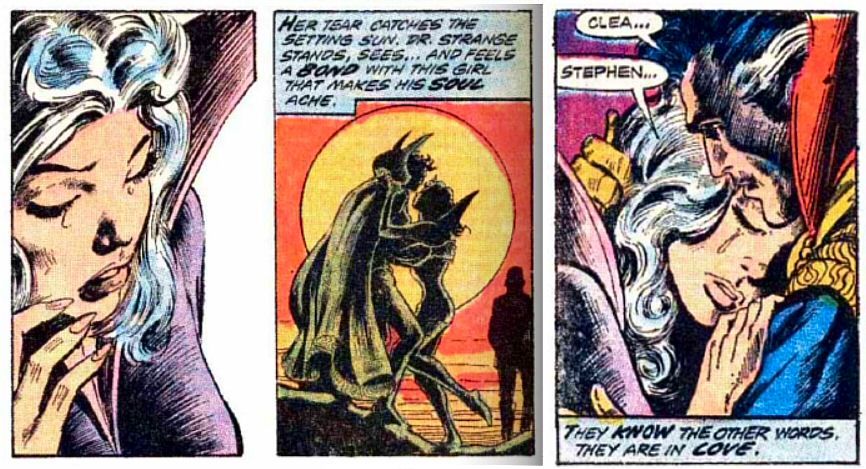
They were none too subtle about the relationship (even under the confines of the voluntary industry Comics Code Authority). Note this sequence from Doctor Strange Vol 2, issue #1 (1974):
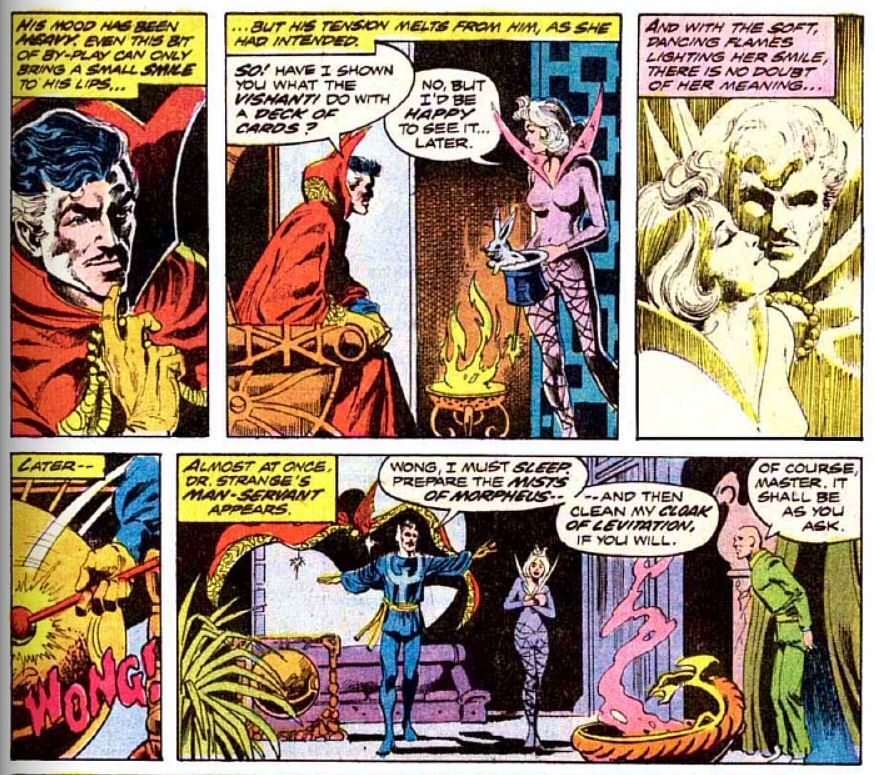
I recall a similar scene in a later issue (I can’t recall the specific issue or the creators) where Clea suggests to a frustrated Strange that they go to bed, and he responds that he isn’t tired – to which she retorts that she wasn’t proposing sleep (groan).
The ethics of this relationship were terrible, and unfortunately it didn’t end there. The next several issues set an unfortunate standard for how Clea would be used throughout the 1970s – all as a foil to hurt the good doctor. The following three panels are from issues #2, 4 and 5:
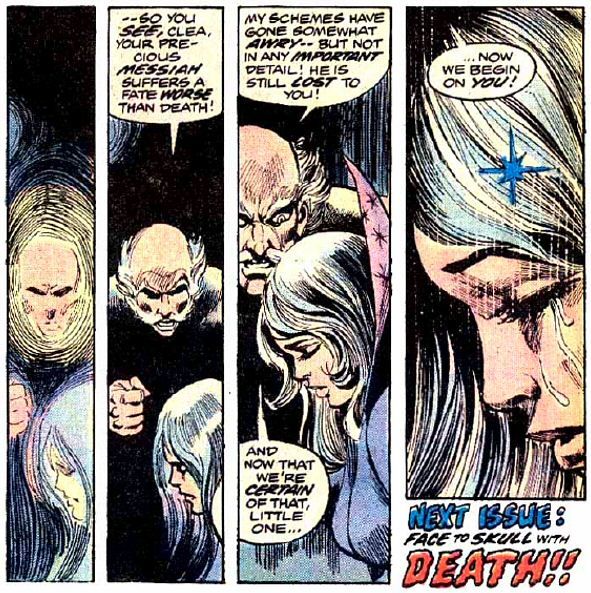
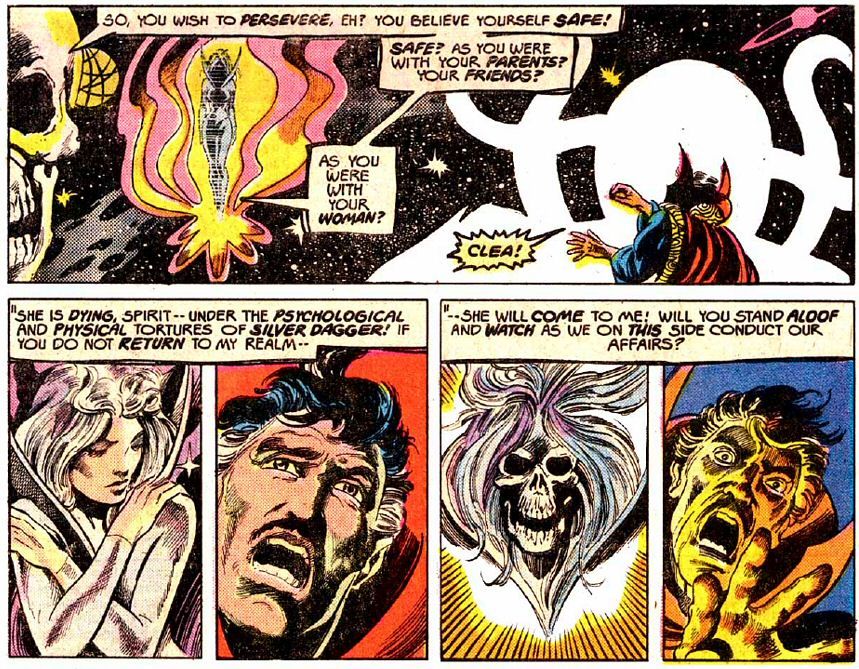
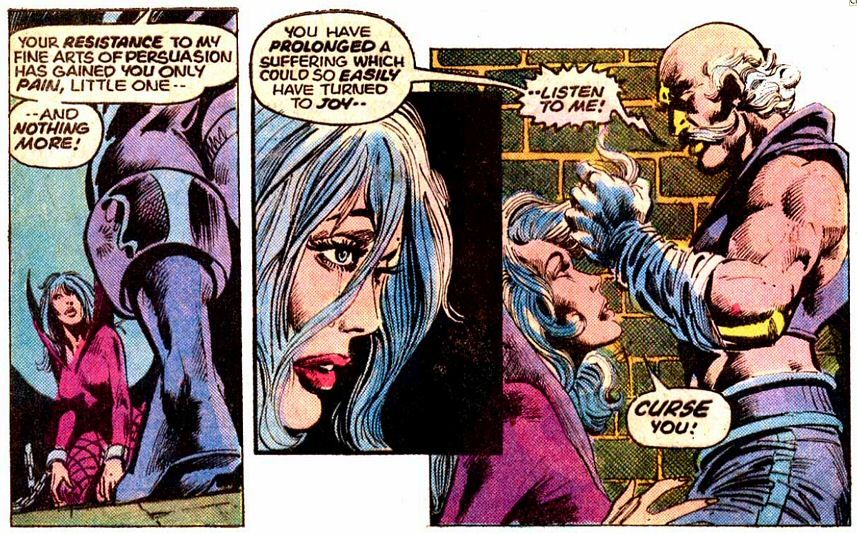
I would note this story line – “his woman”, crying, literally being mind-controlled then held in chains and “under psychological and physical torture” – lasted for over a period of six months in real life (from March to September, 1974). I have tremendous respect for what Englehart and Brunner created in Doctor Strange – the character would likely have disappeared, if not for them. But this plotting and imagery for Clea’s character is horrible.
What it makes it worse is that now that Strange had such a lover, she could be used to torment or hurt him on a regular basis. For the rest of the 1970s, in the hands of many creative teams, you could barely go a couple of issues without her being kidnapped, tortured, mentally-controlled to attack him (or to make him jealous), suffering from jealousy herself, incompetently bumbling into crises, wandering lost suffering from amnesia, etc. I’m not making this up – those were all subsequent plot lines. When was the last time Iron Man was kidnapped/tortured/mind-controlled/mind-wiped all to make Captain America jealous or lose control of his faculties in some desperate bid to to save his friend and colleague? I think we all know the answer.
Writer Chris Claremont (of X-Men fame) took over the title from issue #38 (1979), with Gene Colan returning to pencil. Claremont was working at this time to fix the sexist origins of the Jean Grey (X-Men) and Carol Danvers (Ms. Marvel) characters he was also writing, and was busy expanding their powers and scope. But he didn’t take the opportunity to fix this issue with Clea. While there were several early stories suggesting that Clea was thinking of leaving Strange, this was mainly due to her lack of confidence in her abilities. His run ended at issue #45 (1981), and he quickly wrapped up his time with an unfortunate closing set of panels:
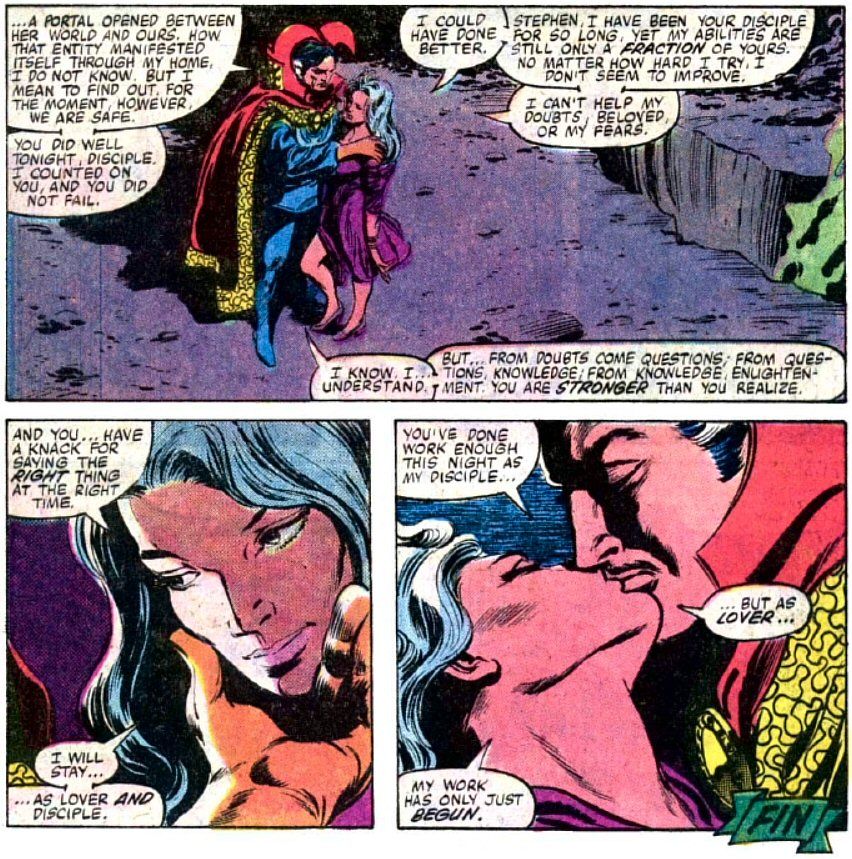
From a modern perspective, this is very hard to accept – and painful to read. There is still no recognition of the abuse of power here. Some may suggest that at least she is making the choice to stay – but I would council against that argument, given the inherent power imbalance. I also observed an even more egregious example of this on Claremont’s concurrent X-Men run, which I will discuss in an upcoming post (see here). I do want to give Claremont credit though for trying to fix the several issues with the Ms. Marvel character, including addressing the horribly misogynistic treatment she had received at the hands of other writers (see my background post on Captain Marvel for more info).
Fortunately, his successor at Doctor Strange had a more enlightened view of Clea’s situation. Roger Stern took over the Doctor Strange title (issues #47-73, 1981-1985) and promptly fixed things. From an interview he gave in 2006:
All the regular readers loved Clea, of course, but the relationship she and Doc had was not exactly an enlightened one. If Clea had just been Doc’s lover that would have been okay, but she’d also become his student, his disciple. It was a case of “I love you, Clea.” “And I love you, Master.” Not a healthy relationship … not healthy at all.
Frank Miller and I had several long conversations about that during the five minutes or so when he almost became the regular penciler on DOC. I gave that a lot of thought, and that led to the story arc Marshall Rogers wound up drawing – the one that started by introducing Morgana and culminated with Clea leaving Earth.
Stern cleverly used that plot to explore additional psychological issues for Doctor Strange (see my background post on Doctor Strange for more details). But key to this discussion is that he framed it as Clea’s decision and choice to leave, against Strange’s wishes and entreaties. It would have been nice for Strange to realize how unethical this relationship was, but I was glad to see Clea finally being given some much deserved agency.
More than that, Stern kept an eye (pen?) on Clea, and soon had her join a rebellion to unseat Umar (who ruled the Dark Dimension at that time), in Doctor Strange Vol 2, issue #58. This later became a major plot for the end of Stern’s term, as Strange planned and then journeyed to the Dark Dimension in secret, to assist in the overthrow of Umar (Doctor Strange Vol 2, issues #69-73).
At the end of issue #73, Clea was victorious in her battle against her mother – largely due to her own efforts, with Strange having helped in a minor way from behind the scenes. She and Strange were now reunited – on equal footing – as the Sorcerer’s Supreme of their respective dimensions. Unfortunately, we’ll never know how Stern intended to end this story – he was abruptly pulled from the series.
At that time, Marvel Editor-in-Chief Jim Shooter was working on his (very morally problematic) Secret Wars II cross-over event. He had passed an edict that all major Marvel titles had to do a dedicated Beyonder tie-in story, regardless of where the characters and story lines were at. Apparently, Shooter made it clear that anyone who didn’t play ball would get pulled from their titles, and they would be replaced by another creative team. I’m guessing this is what happened to Stern. I will be discussing this event in a later post (the morality of both the comic event and the behind-the-scenes turmoil is quite notable!). This ultimately caused a lot creative talent to leave Marvel – either immediately, or shortly thereafter – due to Shooter’s apparent high-handedness.
But this was also an opportunity for Peter Gillis. An up-and-coming talent at Marvel, he desperately wanted to write Doctor Strange. The Beyonder tie-in was apparently his price of admission. And he did an outstanding job. Frankly, his first issue of Doctor Strange (Vol 2, issue #74) stands out in my mind as the best Beyonder story – by far – of the entire Secret Wars II event (indeed, its morality was quite at odds to what Shooter himself did in his main limited series story line).
Of course, he couldn’t just jump away from Clea without some explanation – he needed to quickly wrap up Stern’s major Dark Dimension story line. I have no idea what Stern intended to do with Clea, but here is how Gillis decide to roll with it (guest pencils and ink by Mark Badger):
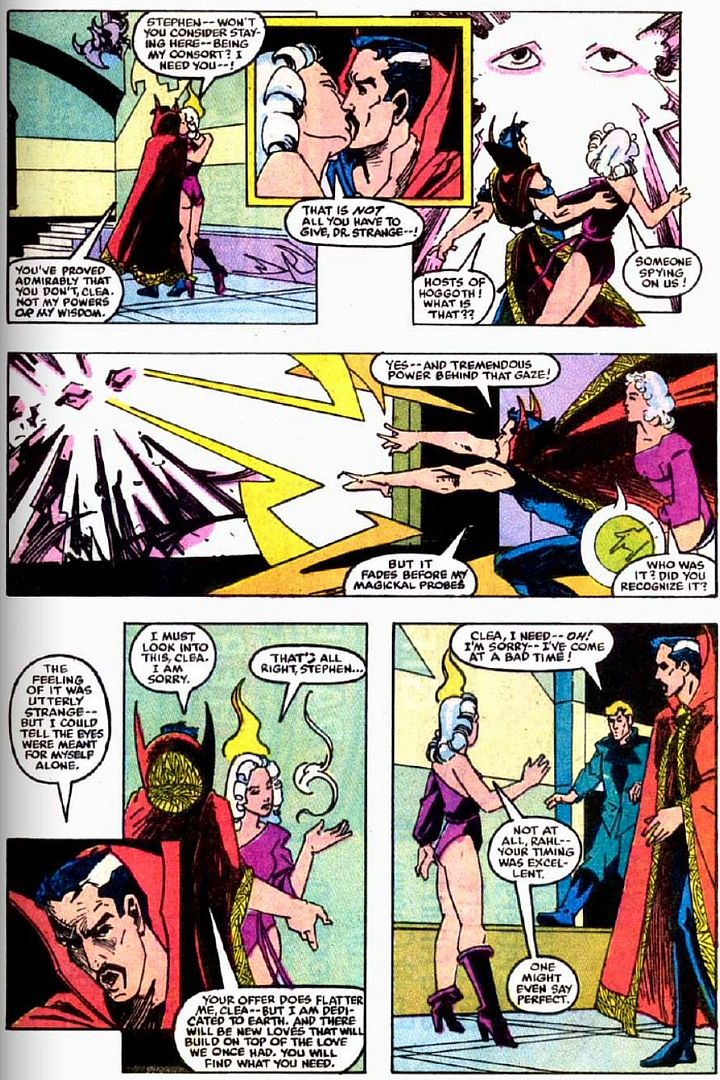
That is quite the brush off – my guess here is that Gillis wanted nothing to do with Clea (at this point), and was just keen to get this story out of the way and move in the direction he wanted to go. And what a direction that was – let’s just say that the good Doctor was in for a rough few years (I’ll be describing Gillis’ very philosophical tenure on Doctor Strange in a later post).
As an aside, I doubt there were any hard feelings on behalf of the writers themselves. I recall a thoughtful comment from Gillis about Stern, during his memorial post on Marshall Rogers:
But Marshall made the unprecedented offer [of drawing a full 12 issues of Doctor Strange], and Roger (a really smart guy and an underrated writer – sometimes, I think, for his constant preference for what’s appropriate for the character over flashier moves) … eagerly agreed and rose to the occasion by doing some of the best writing of his career.
Toward the end of Gillis’ run, he clearly reconsidered the Clea and Strange relationship. After a lot of personal struggles (and a rather bizarre romantic story line) he had the good Doctor meet up with Clea again and admit that he was done trying to suppress love in his life – and wanted to rekindle it with her. Acknowledging the difficulties of a long-distance relationship, they decide to wed (Doctor Strange, Sorcerer Supreme, issue #3, 1989):
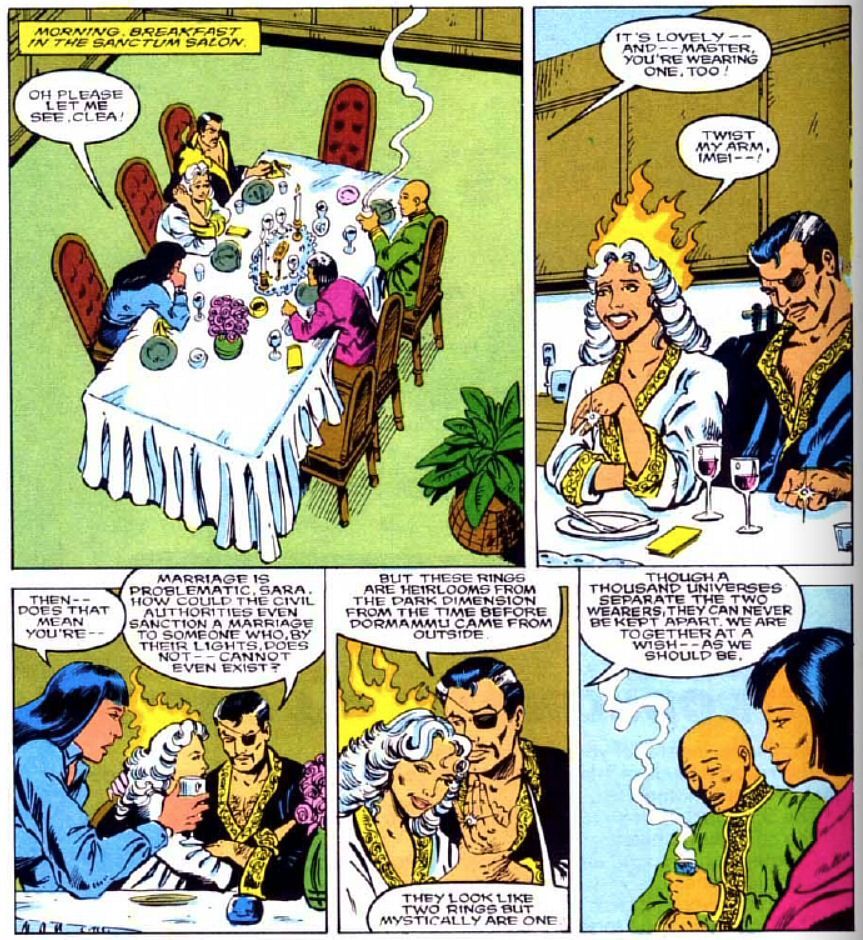
I don’t know where Gillis planned to go with this story line – he was removed from the title after the next issue. And guess who took over – Roy Thomas (author from late 1960s) along his wife Dann. They started by undoing or retconning a number of Gillis’ plot lines, but their early stories weren’t bad. That is, until they turned their attention to Clea – where they repeated some of the worse tropes of the 1970s.
By issue #15 (1990) of that title, they had retconned an earlier Gillis plot line (where Strange had let former love interest Morgana Blessing down gently) into actually being Clea in magical disguise as Strange, acting out of jealousy against a perceived romantic rival (!). That issues ends with another sorcerer taking over Clea’s mind and trying to get her to kill Strange. And that mind-controlled Clea story persists on the back-burner over several issues and only gets revolved when Dormammu kidnaps her and takes over her mind instead), and then physically tortures her and Strange (issue #21, 1990). Yowza!
Frankly, I marvel at the Thomas’ ability to jam-pack into so few issues so much of what was wrong about depicting Clea previously. Fortunately, they soon tired of her, and Clea made fewer and fewer appearances in their stories (or the later writers on this title). That Doctor Strange title was mercifully cancelled in 1996.
Modern comics
Clea similarly made few appearances of relevance in the intervening years when there was no Doctor Strange title (1996-2015), and Strange was relegated to minor player status in other stories. After the successful title relaunch under Jason Aaron in 2015, Clea did start popping up a bit more. Generally, these stories understandably focused on how their separated relationship status remained tense (e.g., Doctor Strange Annual Vol 2 issue #1, 2016).
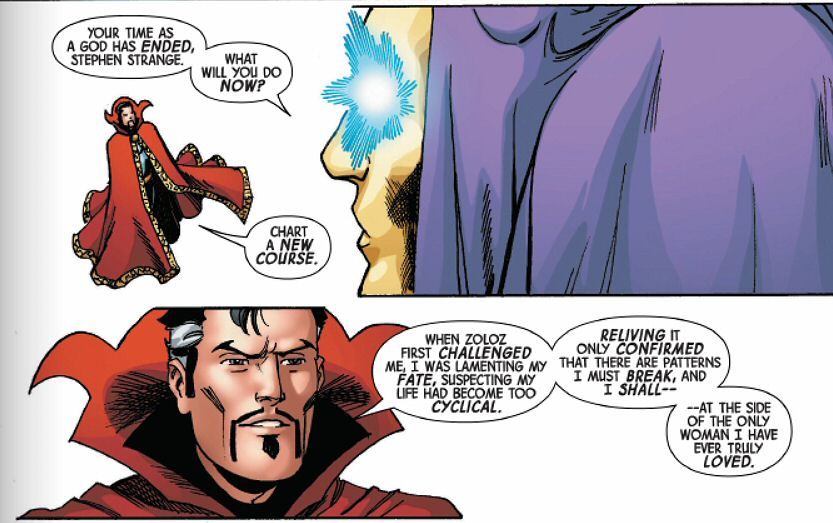
However, that changed during Mark Waid‘s tenure with Doctor Strange Vol 5 (2018-2019). Their relationship started to warm up again, around the time when Strange was called upon to save the Universe. Strange had to make a deal with the devil Mephisto (well, technically an extra-dimensional demon), who of course cheats. Strange was able to not only save the day, but undo Mephisto’s malign influence as well – all while keeping his end of the bargain. After getting kudos from both the Living Tribunal and Eternity, Strange announces his intent to rekindle his relation with Clea (all panels below from Doctor Strange Vol 5, issue #17, 2019):
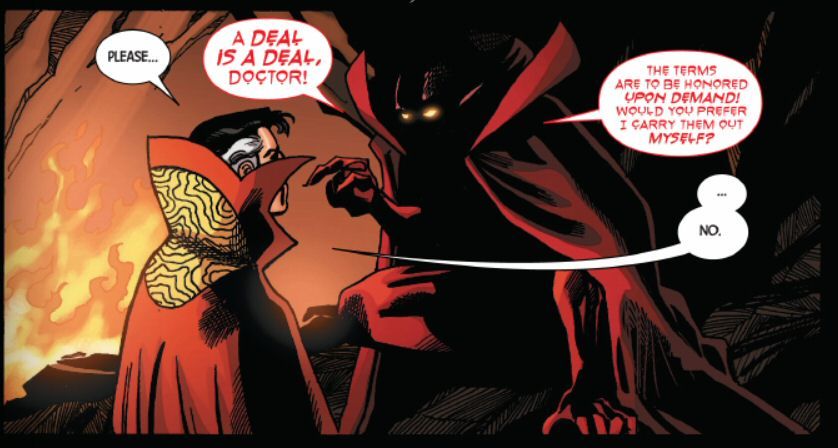
But of course, the devil double-cheats. He abducts Strange to point out that Strange didn’t fully fulfill his bargain, and thus supposedly still owes him a debt (I found the reasoning here completely unbelievable, by the way). And he means to collect what matters the most to Strange – the part of his soul that is the love of Clea:
And what does Strange do? I’ll let Waid explain it to you himself:
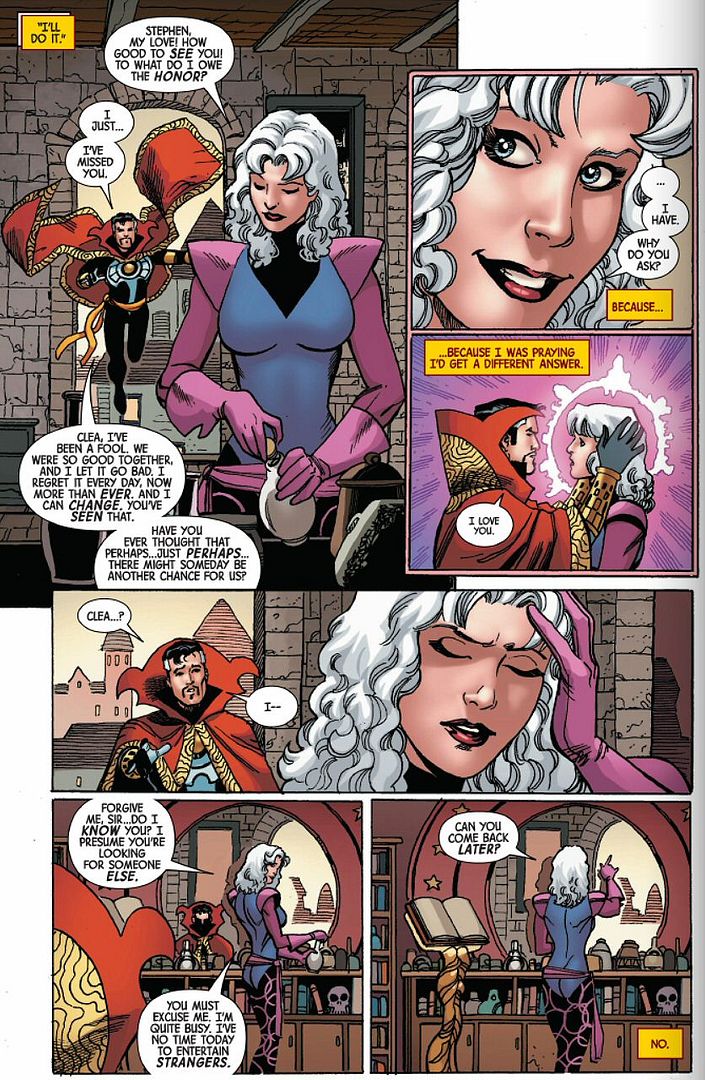
This is very hard to take. Rather than finding a solution to Mephisto’s double-dealing, or refusing to be a part of it, or coming clean to Clea and telling her what is going on, Strange instead opts to do Mephisto’s dirty work for him. Strange takes on personally denying the integrity and agency of Clea, and making the decision for her to steal her memories and thus violate her personal autonomy. All for the cost of increasing his personal torment, it seems.
Whatever allowances you are willing to make for the characterization of Clea in the 1970s (and again in the 1990s), I would remind you that the above panels are from 2019. Moreover, this has some aspects of the discouraging comic trope had been given a name by comic writer Gail Simone more than twenty years earlier – “women in refrigerators” (or more colloquially, “fridging”). Its name derives from a particularly gratuitous and degrading example from DC comic’s Green Lantern, where the hero’s girlfriend is killed and stuffed in his refrigerator for him (and the reader) to shockingly discover without warning. This trope is rife throughout Marvel comics as well – where women characters face disproportionate violence (such as death, maiming, depowering, assault, or other violations of personal integrity), to serve as plot devices to motivate the superhero men.
Part of what I find particularly galling with “fridging” is how the superhero man typically experiences a noble outcome for his actions. Here, Strange is shown in the final panels enduring all this personal suffering (i.e., confirming she still has feelings for him, but wiping her mind anyway) – so it is not an exact match, as it used to harm Strange. But consistent with that trope, the violence done against the woman is against her will and has long-lasting consequences for her character.
It’s hard to see a way out of this – for both Strange and Clea’s characters – but Jed MacKay found one. A small spoiler below for his outstanding Death of Doctor Strange mini-series (2021-2022). After subverting expectations by killing Strange off in the opening pages of the first issue, MacKay finds an ingenious way to rehabilitate his flawed character by going back to beginning – having a “temporal remnant” of Strange from the early Ditko stories appear as a planned fail-safe mechanism upon his untimely death.
I don’t want to give away more than is necessary, but I love this panel from the second issue, when Clea unexpected ‘drops in’:
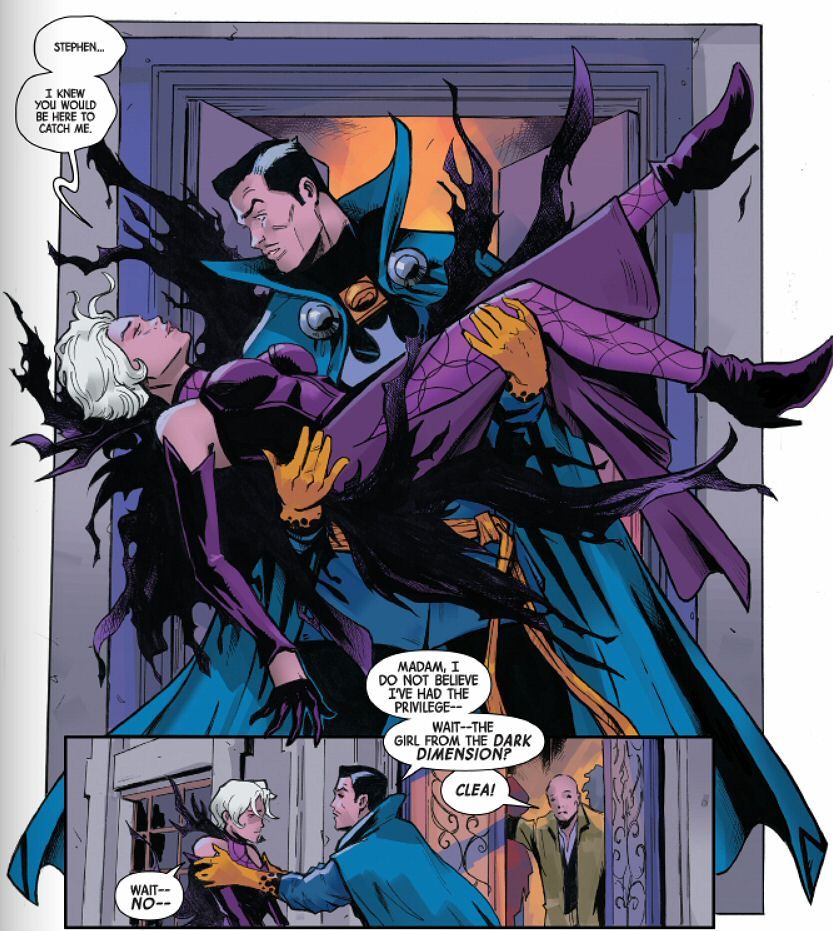
Cleverly, this visual recreates the old Ditko trope of Strange rescuing the ‘damsel-in-distress’ Clea (from the 1960s). But it is quickly revealed that all is not at as it seems.
The two characters soon get a chance to discuss their situation in this issue, as Clea explains to the former Strange what his future self did to her:
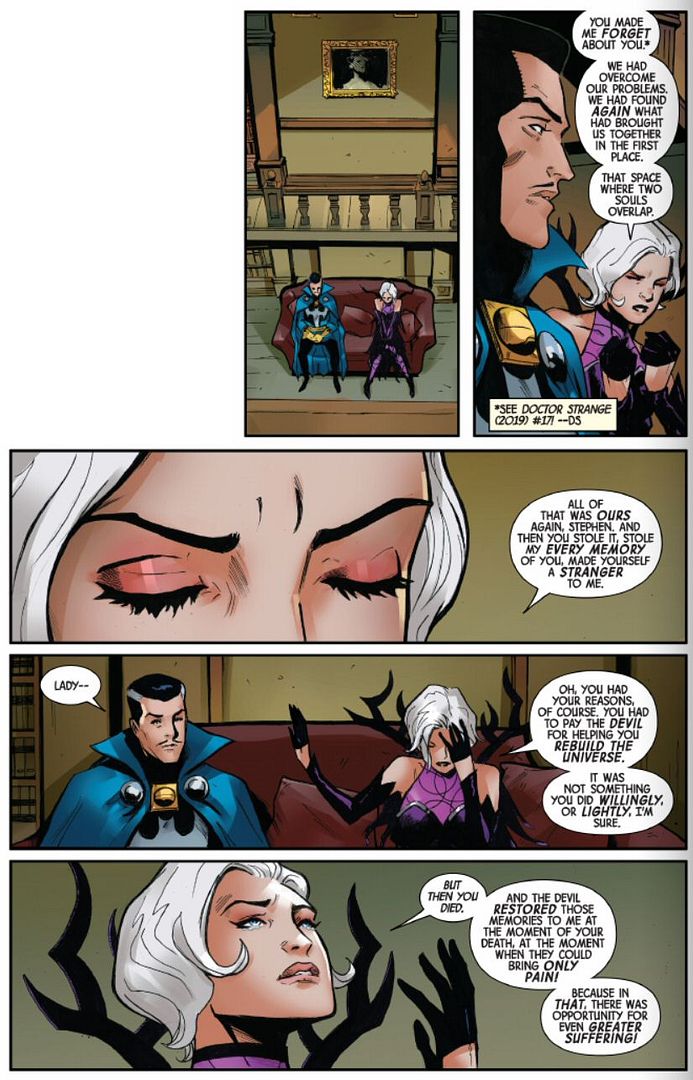
Ah, the devil never misses a trick, does he? Where do we go from here? I’ve blanked out a few talk balloons to avoid some unnecessary spoilers:
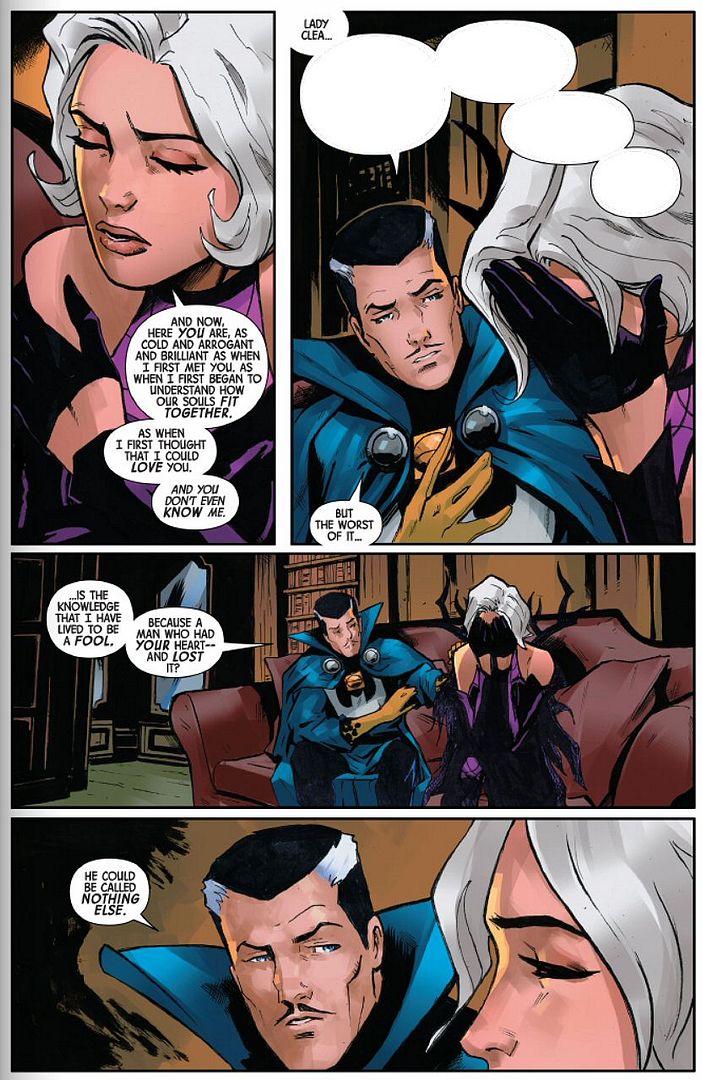
And thus begins the redemption arc for Strange – although it is much more complicated than it appears (and by the way, huge kudos to Lee Garbett for the outstanding art above). At the end of this series, when it appears that there will be a “happy ending”, MacKay again subverts expectations by killing both the younger and modern Strange (the latter for a second time). In the hands of a lesser writer, that would have been used to cause Clea unnecessary pain. But instead, he creates an opportunity for a larger redemption arc – with the relaunch of a new Strange title (Strange Vol 3, issues #1-10, 2022-2023), and with Clea in charge now as the new Sorcerer Supreme of Earth-616.
In Clea’s own words, in response to her first challenger demanding the Sorcerer Supreme title, from issue #1 of that series (with outstanding pencils from Marcelo Ferreira):
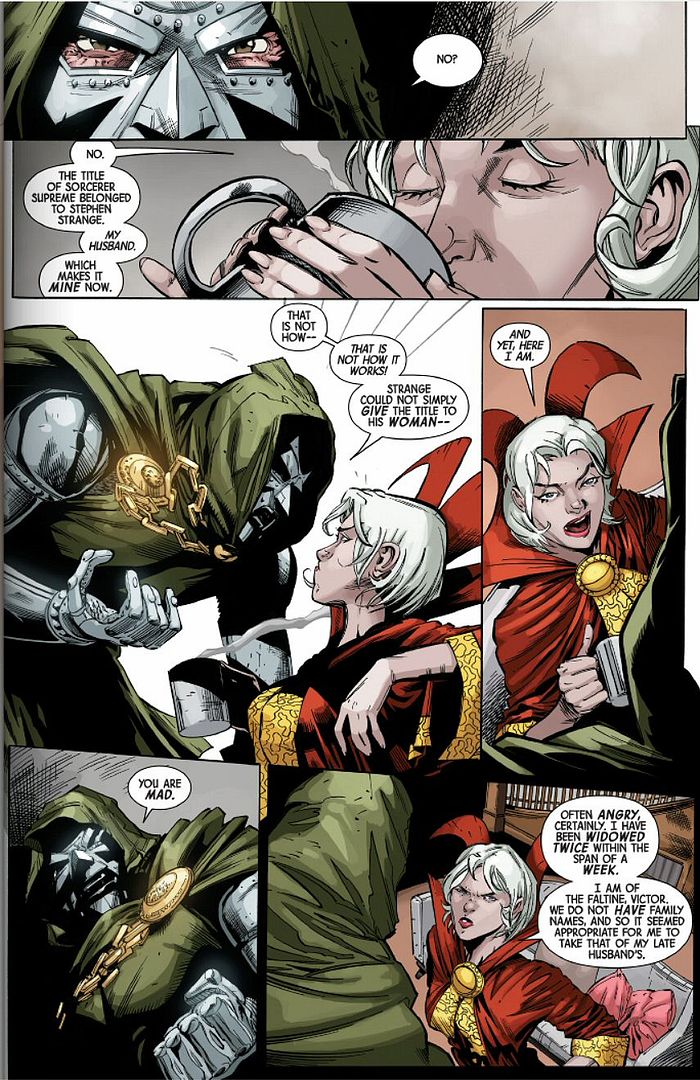
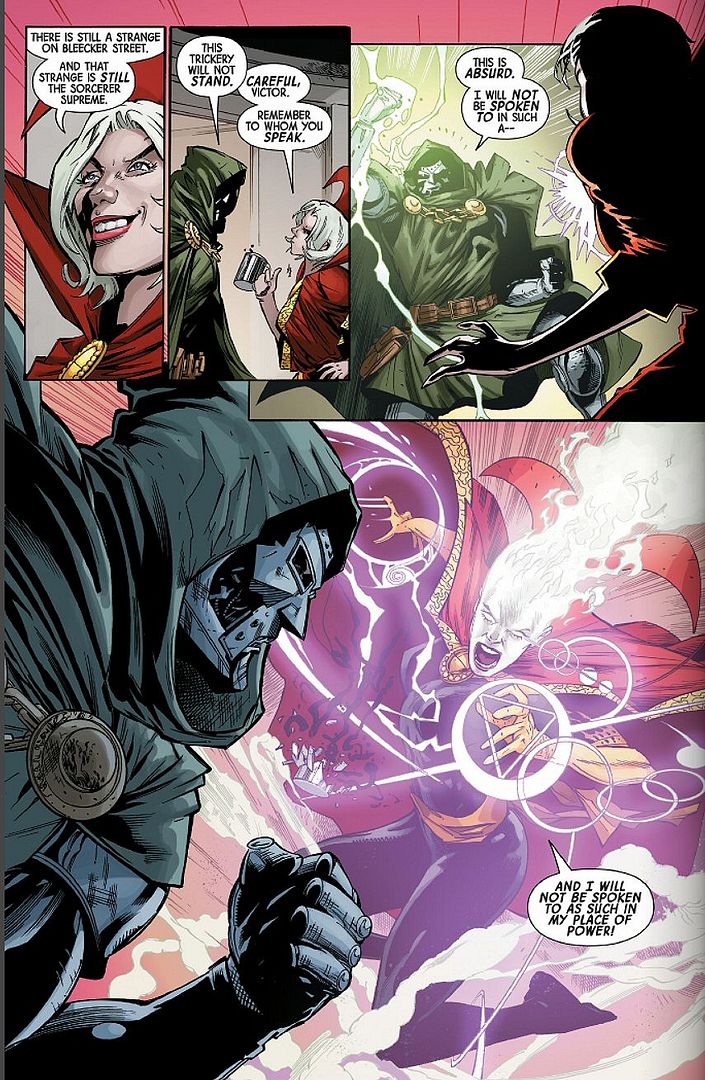
I love the way this makes it clear how Clea is in charge now – sitting calmly drinking her coffee while Doom rants and raves above her – until she flashes her power (and he turns tail and leaves). Yes, this does foreshadow problems with Doom down the road, but it firmly recasts Clea as a person of power, and in control.
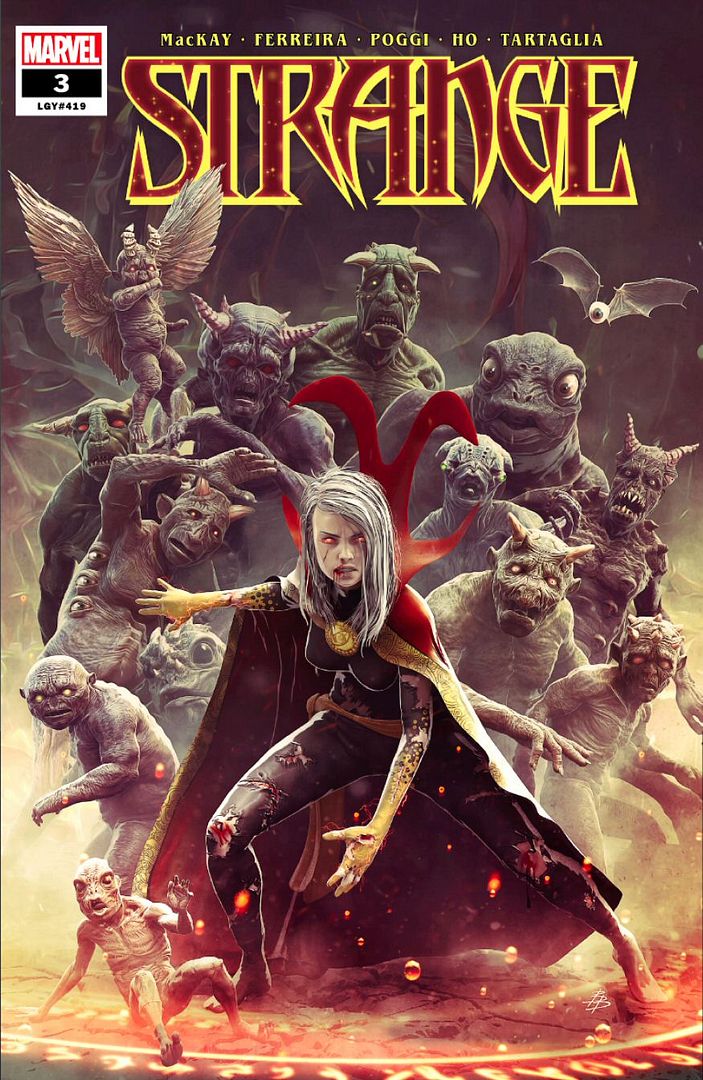
This series (Strange Vol 3, issues #1-10) is an outstanding tour-de-force for MacKay – I cannot recommend it enough. If finally gives an opportunity for Clea to come into her own as a character and a hero. Yes, a big part of the main story line is her attempt to resurrect Stephen (see opening quote on this page). But along the way she has other mysteries to solve, villains to fight – and most importantly – people to protect (see issue #3 cover below, with excellent art by Björn Barends).
There is a very strong Care ethics philosophy to Clea in this series. This normative ethical theory falls under virtue ethics and holds that moral action should be based on interpersonal relationships and the duty of care we have to others. Classic consequentialist and deontological ethical theories both emphasize generalizable standards and impartiality, whereas care ethics emphasizes the importance of responding to the needs of the individual.
In essence, one has a duty of care to those you are in a relationship with (proportional to their vulnerability), where their needs become a burden for you to meet. Empathy and compassion for them is thus core to care ethics, and very much present in Clea’s personal interactions in this series.
As an aside, I see care ethics as a fundamental moral component of many of MacKay’s stories. Indeed, I will argue in other posts that his very popular (and ongoing) Moon Knight run also demonstrates an underlying care ethics drive for that character. Not surprisingly, Clea and Moon Knight will develop a friendship of sorts over his subsequent stories.
None of this is to say these stories lack action or drama – indeed, another common feature of both MacKay’s Clea and Moon Knight is their facility with using violence and inflicting pain – not to mention their willingness to kill in response to murder. But in Clea’s case at least, this is very much a direct tit-for-tat response to being challenged. Regardless, their comfort with killing (even if justified in their own minds) makes them both somewhat unique in the pantheon of Marvel heroes. Expect several upcoming posts on the moral philosophy of MacKay’s writing.
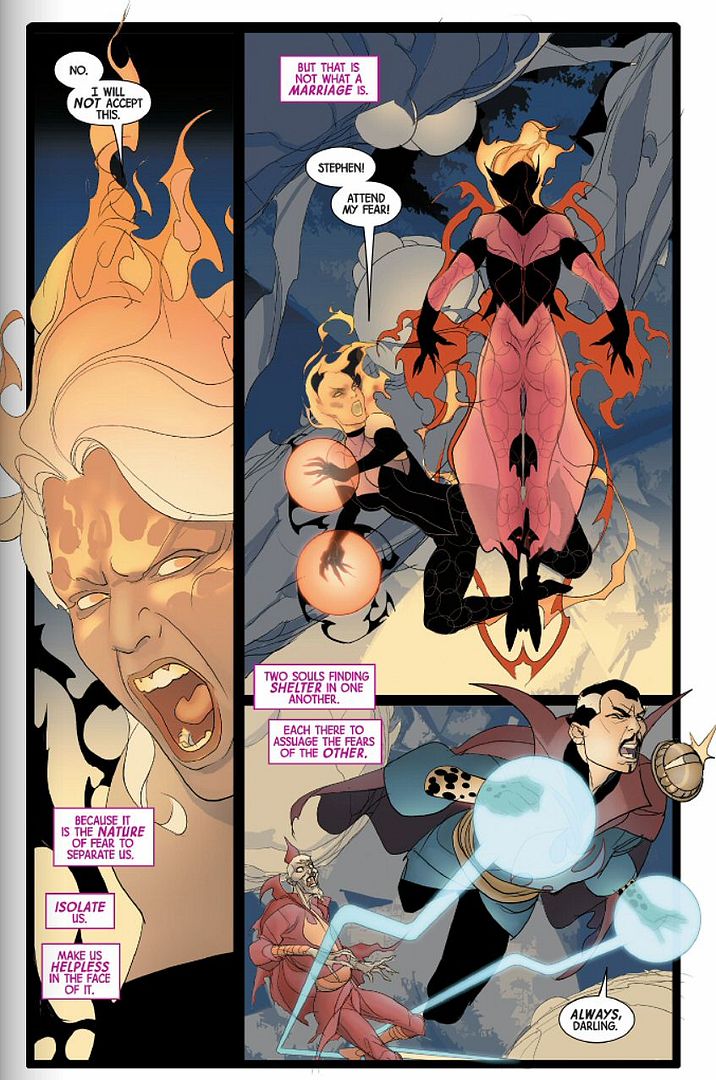
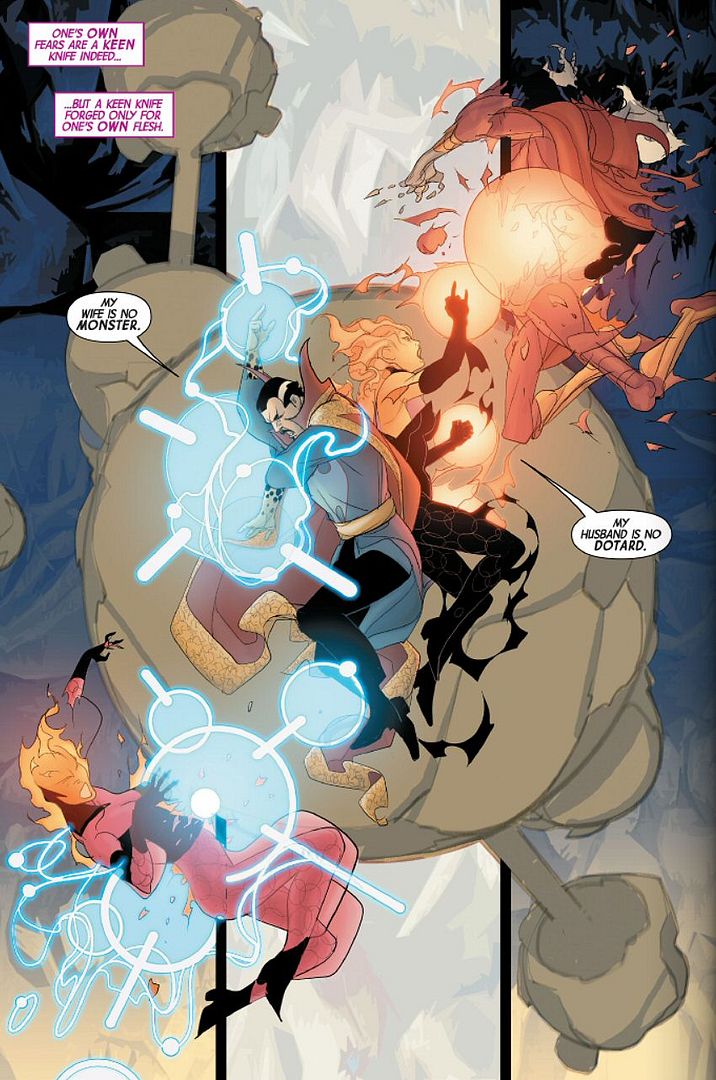
Although no longer the Sorcerer Supreme, Clea did have a major role – as a true partner – to Doctor Strange in MacKay and Pasqual Ferry’s Doctor Strange Vol 6 (2023-2024). This series continued to explore her warlord-born nature, and what it means for them to be a couple. See these two pages from the first issue, where they are each being attacked by beings who prey on their innermost fears, with Clea figuring a way out:
I wish them well on their continued adventures together.
Current ethical framework: V/c


Despite a long history, Clea’s character was until recently very under-developed in the comics, serving largely as a foil for driving Doctor Strange stories along. It is only in the MacKay era (since 2021) that she came into her own as a character, so my assessment here is based on a limited number of modern stories.
I would consider Clea as using primarily a care ethics (virtue ethics) framework for moral decisions. Clea prioritizes the quality of relationships – and the responsibilities that come with them – throughout the modern stories. She seems acutely aware of the inter-connectness and interdependence of sentient beings, and undertakes her actions with empathy and compassion for those who are suffering (although she has a marked lack of empathy or compassion for any abuser). Indeed, that latter point is interesting – Clea is quite willing to apply lethal force against her enemies, but directly proportionate to the magnitude of their transgressions against those she cares for. The shows a contextual morality on her part, where ethical decisions are made based on the specific circumstances and relationships involved.
Like Doctor Strange, she also has a strong utilitarian (consequentialist) streak. She is often looking for outcomes that bring about the greatest good for the greatest number. I consider this secondary to her care ethics focus however, as it is clear that not everyone’s happiness matters equally to her. As presented in the opening quote on this page for example, she is quite comfortable articulating her wants and needs – and her intention of pursuing them. But the happiness of those closest to her does matter a great deal, consistent with care ethics. Unlike Strange, there is no evidence that deontological rules (e.g., the established norms and rules for magical beings) matter to her much at all.
Given all of that, I would say the modern Clea is a V/c on my superhero description system.
Again, the purpose of this site is not to provide a definitive normative ethics framework for each character – that is impossible, given all the creative hands each character has passed through. My goal on these background pages is to provide a sufficient overview of the main ethical drives for the character over time, to help prepare for upcoming posts where I will examine specific comic stories in more detail, to show how they illustrate key normative ethics theories.
The last word
It would be easy to see this long history as mirroring the slow cultural growth and increasing recognition of women’s autonomy with time – with only occasional setbacks or bumps in the road. I hope that is true, but I would advise caution.
In terms of the comics, that is only true because of certain specific creators (and in Clea’s case, all of them men) that the worse tropes of women in comics were course-corrected. I have fears for the future, given the persistent – and in many cases – rising resentment and intolerance shown to women and gender minorities across the world.
I also worry in part because Clea and Strange now exist in the Marvel Universe without a title – and they are free to be referenced in others stories. Let me give you a recent example from the return of star comics writer Jonathan Hickman to Marvel. This is from his G.O.D.S. series (2023-2024), where he tried to re-imagine the fundamental magical/scientific basis of the main Earth-616 Universe:
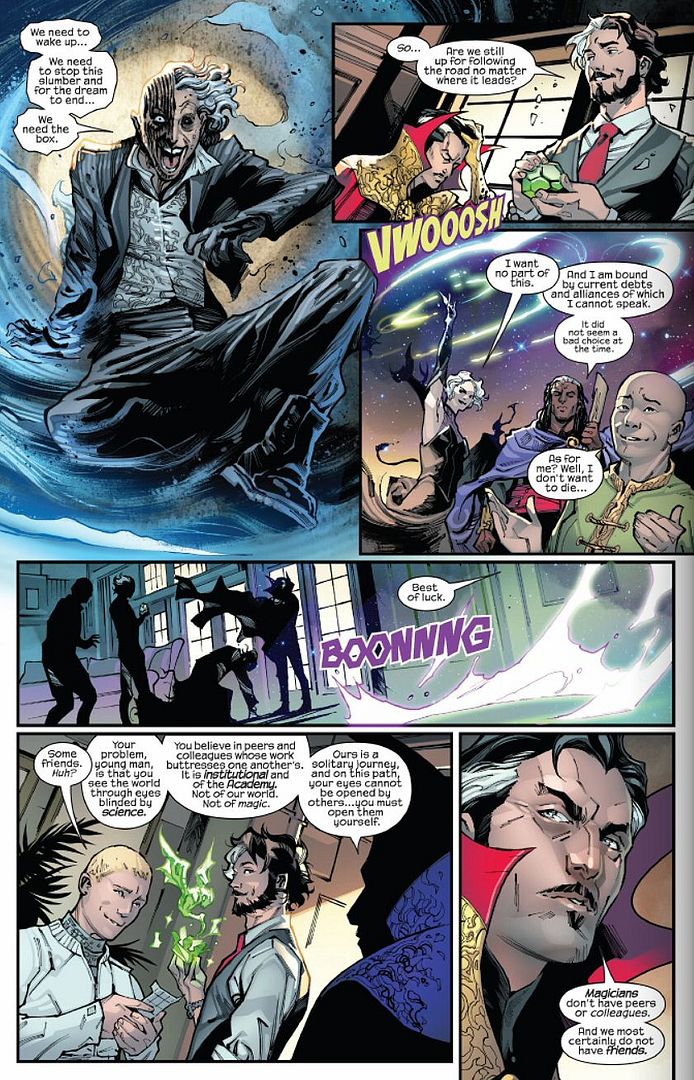
So – Doctor Voodoo, Wong and CLEA (!) all choosing to abandon Stephen at the start of an Earth-shattering event. Really? I have a lot of respect for Hickman’s work on the earlier Earth-1610 Ultimate Marvel and Secret Wars series, and his new Earth-6160 Ultimates series. But I’ve long found his characterization of Strange to be inconsistent with the character’s history (especially the Black Order business in 2013’s New Avengers, and some Strange’s role in the 2015 Secret Wars event). More to the point, he constantly seems to be trying to recast Strange as a different character than who he has historically (and currently) is, as demonstrated by the panels above (with that nonsense about magicians not having friends, please).
It wouldn’t have been so bad if this characterization was in a different Universe than Earth-616 – although personally, I find setting up this kind of extreme dichotomy between science and magic characters unhelpful to say the least. But my main concern is that Marvel’s editorial staff allowed this to fly concurrent with the major Clea story lines in MacKay’s Doctor Strange titles. It doesn’t bode well when high-profile writers can change established character traits for the sake of their pet projects. While I’m enjoying Hickman’s current run on the Earth-6160 Ultimates series, and otherwise try to read everything that references Strange and Clea, I abandoned the G.O.D.S. series.
My advice to readers of this site is to directly SUPPORT the authors whose work you enjoy by buying their comics through advanced pre-sales. It is in all of our best interests to ensure they remain gainfully employed in writing the kinds of stories we would like to see. I hope we will continue to see an evolution of Clea’s hero role and her care ethics drive in Marvel comics. But it will only happen if we continue to “vote with out feet” (and dollars).
See my Glossary post for a list of the key philosophical concepts and related links on this site.
This is a fascinating deep dive into a character I’ll admit I never gave much serious thought to before. As someone who grew up reading comics in the 80s, I remember Clea mostly as Doctor Strange’s previous magical girlfriend. I did read a bunch of 70s back issues, where she seemed to get kidnapped or mind-controlled every few issues. Reading this analysis makes me realize how much I accepted those tired tropes without really questioning them.
What really strikes me is how this mirrors broader cultural shifts around women’s roles and agency that I’ve witnessed in my own lifetime. The author does an excellent job showing how Clea’s treatment wasn’t just poor storytelling – it was reflective of some pretty problematic attitudes about women that were baked into popular culture for decades. The “damsel in distress” pattern that started in the 60s and persisted well into the 90s is pretty damning when you see laid out chronologically like this.
I found myself shocked at the modern storyline from 2019 where Strange erases Clea’s memories. That’s not ancient history – that’s recent enough that there’s really no excuse for that kind of paternalistic nonsense. The fact that this was framed as some kind of noble sacrifice on Strange’s part makes it even worse.
The redemption arc under Jed MacKay sounds genuinely compelling though. I’m intrigued by the note that Clea is now “quite willing to apply lethal force” proportionate to transgressions. This seems like a significant departure from typical Marvel heroes who usually have strong no-kill codes. Is this a more realistic approach to superhero ethics, or does it risk undermining the moral high ground that heroes traditionally represent?
I have to say, this analysis has made me want to track down some of those MacKay issues to see how this character evolution plays out. Thanks for another great overview.
Thank you again for the kind words.
In terms of Clea’s willingness to kill, I suspect that was done in part to show the difference between her and Strange. Leaning in on her “warlord-born” back story, MacKay is showing how typical human morality doesn’t always translate to superhumans. In this sense, Clea is very similar to his Moon Knight (who has been influenced by an ancient Egyptian god). The differing views of Clea and Strange need to be resolved at the climax of this story.
I’ll talk more about this in my upcoming Moon Knight ethics overview. Death can still be consistent with human ethical theories, in certain specific circumstances – such as a punishment for murder (although it is generally left to the state, not individuals). But as both Clea and Moon Knight have been called to a higher duty, you could make an argument they are justified in exercising this right by virtue of their positions.
Not a character I had heard of before, found it from the excellent Captain Marvel summary here. This is another incredibly detailed, insightful overview – thank you. I don’t think I’ve read a male feminist before!
🙂