

Once, I set myself apart from the world, on a place above it and above all the people in it. Homo superior, I called myself. And I played judge and jury for human and mutant alike in my clean white cape. And when the world I helped to build was no longer to my liking — too much pain, too many compromises — I choose to wash my hands of it and walk away. I was wrong. And now I must make amends.
- Resurrection of Magneto, 2024, by Al Ewing
Marvel’s Magneto is an interesting character to profile for normative ethics, as he has gone through a lot of cycles of redemption and reversion over his long run in the comics. He has very much been on the upswing in modern times though, as the opening quote makes clear.
As introduced on my X-Men Ethics – Introduction page, the character of Magneto was created by Stan Lee and Jack Kirby as a main villain for the X-Men in X-Men Vol 1, issue #1, 1963. Over time, it was established that he is one of the most powerful mutants. He has control over all forms of magnetism, with potentially unlimitled range. See the detailed character history on the Marvel Fandom site for more info on his abilities.
If you would like to know more about the terms I’m using on this site, please follow the links throughout or check out my Ethics 101 page or Glossary post.
Early comics
As originally written, Magneto was a very simple and straightforward villain – attacking humans in order to ensure the dominance of his “homo superior” mutant race. Both Kirby and Lee stated in later interviews that they wanted him to be seen as someone who was traumatized by other people. And they were successful – in the hands of later writers, Magneto has arguably become the most popular Marvel antagonist of all time (in keeping with the explosive growth of the X-Men franchise).
Magneto’s back story wasn’t fleshed out until legendary X-Men writer Chris Claremont gave him the history of a child Holocaust survivor. This became critical for humanizing the character, by understanding his motivation to “never again” allow his mutantkind to suffer a similar fate at the hands of normal humans. This was first revealed in Uncanny X-Men Vol 1, issue #150, 1981, by Claremont and Dave Cockrum, where Magneto (incorrectly) believes he has killed Katherine (Kitty) Pryde:
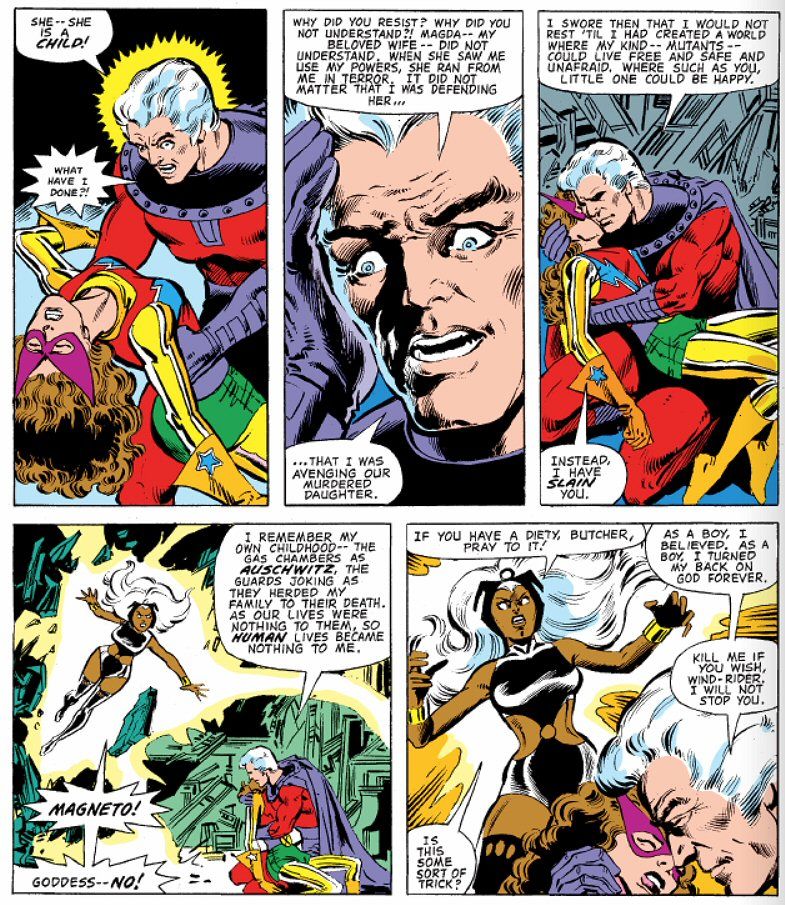
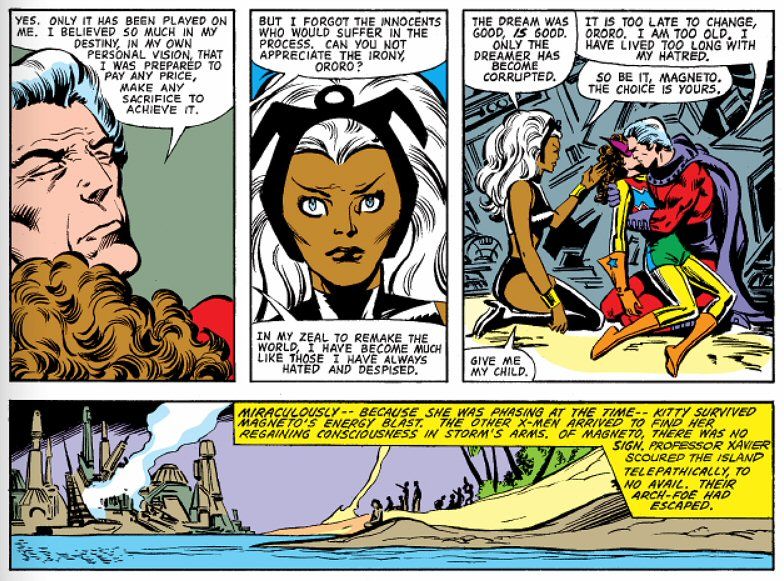
These panels make it clear that Claremont was looking to broaden and redeem Magneto’s character. The reformation of his character began in 1981, and has continued (fitfully) to the present day. I say fitfully because his value as a tortured villain and foil for the X-Men meant that subsequent writers often reverted Magneto to a more villainous state – only to begin their own redemptive story arcs. In some ways, it’s a bit like what I noted with Carol Danvers (Captain Marvel) – the same repetitive struggles and traumas kept reoccurring for the character in the hands of later writers.
One difference here is that in addition to repeating general story lines, the various X-Men writers also kept retconning (and then reversing) Magneto’s back history – including changing his real name, his religion, his birth country and his ethnicity over the decades. Since there is no comprehensive guide for this online, I thought I would provide some of the key changes here, drawing on the actual issues for reference.
Magneto was first given a personal name – “Magnus” – during my time reading the comics as a kid. Specifically in the famous “Days of Future Past” story line of 1981, in Uncanny X-Men Vol 1, issue #141, by Claremont and John Byrne. His connection to Charles Xavier was later established in issue #161 (1982) in an extended flashback story showing how Charles first met him as “Magnus” in Israel after the war. It is heavily implied (though not explicitly stated) that Magneto is Jewish in these Claremont stories, especially in the lead-up of the “Trial of Magneto” story line in issue #199 in 1985.
After Claremont’s departure, Fabian Nicieza gave Magneto the full name of “Erik Magnus Lehnsherr” in 1993, and changed his ethnicity to a Sinti Gypsy (but still had him as a survivor of the camps at Auschwitz) in X-Men Unlimited Vol 1, issue #2. It’s explained in this issue that he adopted use of his middle name “Magnus” after the war, to disguise his true identity (thus retconning the use of “Magnus” in the earlier stories). This doesn’t seem to have sat well with the fans – both for the change to a Gypsy background, and the use of the Lehnsherr name (which means “feudal lord” in German).
The next significant reversal and retcon was when Joe Kelly took over writing the X-Men in 1998. In X-Men Vol 2, issue #72, the previous change was largely undone by restoring Magneto’s “Magnus” original name, with the Sinte “Erik Lehnsherr” name and ethnicity now becoming a forgery Magneto adopted when he was fleeing from the authorities and searching for his missing Romani Gypsy wife, Magda. It is strongly implied that Magneto is Jewish again. Note that Charles now typically referred to him as “Erik” and not “Magnus” in the comic stories by this time, as the name (but not the ethnicity) seems to have stuck with the writers. “Erik Lehnsherr” was also the name given to Magneto in the X-Men movie (released in 2000), which also heavily implied that he was Jewish through the visuals, but didn’t come out and state it.
In 2008, Greg Pak working with editor Warren Simons decided to create a definitive original story for Magneto in X-Men: Magneto Testament – including confirming him as a German Jewish character, and giving him a new full name. Working with the Simon Wiesenthal Center, they wanted to create a historically accurate back story for a Jewish character. They decided to have Magneto come from a well-off Jewish family from Nurnberg, Germany, with the birth name of “Max Eisenhardt” (German for “strong as iron”, used by Ashkenazic Jewish people). After he and Magda survive the camps at Aushwitz, Max decides to abandon his true name. In 2011, Paul Jenkins is the first writer to have Magneto express a desire to return to being called by his true birth name, “Max”, in X-Men: Prelude to Schism Vol 1, issue #2.
From X-Men: Magneto Testament Vol 1, issue #1, 2008, by Pak and Carmine Di Giandomenico:
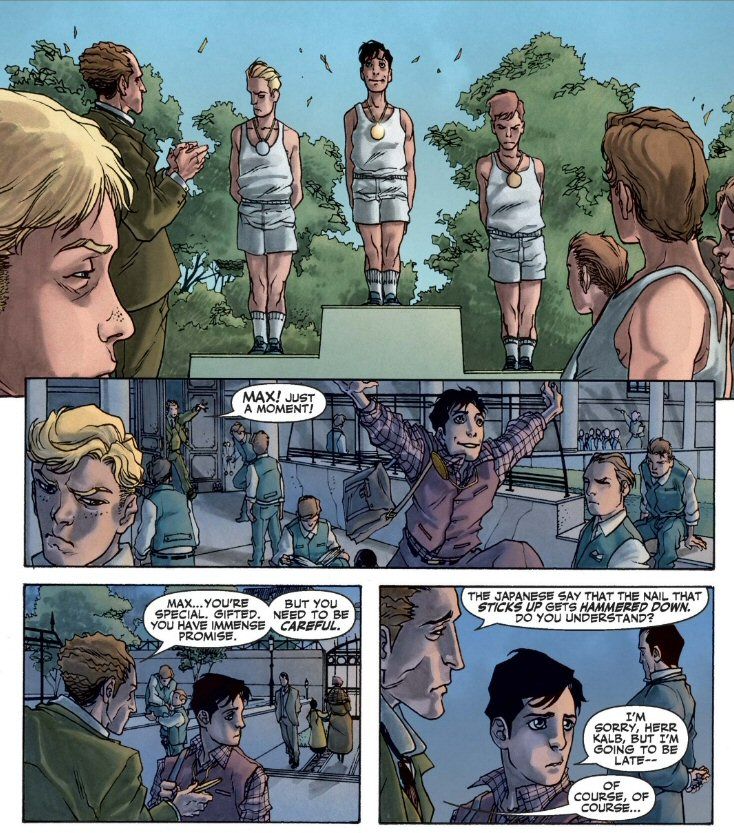
To explain all of this within the currently accepted in-story continuity for the character: Magneto is Jewish and was born in Germany as Max Eisenhardt, but adopted the named Magnus after being the only member of his family to survive the concentration camps at Auschwitz. He and his wife Magda (a Romani Gypsi) fled Germany and had a child together, Anya. Following the first manifestation of his mutant powers, a mob burnt down their home with Anya trapped inside. In his grief, Magneto lashed out with his powers, killing the arson mob for having murdered his child. Afraid of her husband, Magda left him and fled (unknowingly to Max, pregnant with twins at the time – later known as Wanda and Pietro Maximoff). Max adopted the Sinti alias “Eric Magnus Lehnsherr” while searching for Magda. He kept this alias for many years, including when he first met Charles Xavier (hence why Charles refers to him as either Erik or Magnus, depending on the time period and writer). It is only in the last couple of years that Magneto’s stated request to be called Max is honored by all the in-story characters (aka, all the Marvel writers and editors).
Introduction to Magneto’s ethics
As I explained on my X-Men Ethics – Introduction post, the original normative ethics premise for the early X-Men stories was a (seemingly) straightforward deontological-consequentialist conflict. On the one hand, you had the primarily deontological Professor X (Charles Xavier) and his superhero X-Men team, working to achieve his “dream” of protecting mutants and promoting peaceful coexistence with humans. On the other, you had consequentialist Magneto and his Brotherhood of Evil Mutants, seeking to ensure mutant supremacy and the subjugation of humans. Magneto would have been considered an egoistic consequentialist (also known as ethical egoism), as he puts the best for mutants ahead of others. Specifically, he prioritized the survival, security, and advancement of mutants like himself above all else. This is a very common normative ethics theory used by villains across the ages – although it is usually for more selfish purposes. Magneto is unusual as he pursues not his personal good, but the “greater good” of his in-group – mutantkind. This is partly why his eventual slipping into a more general heroic utilitarianism is not surprising.
But I should clarify the mutant divide was never that simple, as each camp had characteristics of the other from the beginning. Charles’ dream of peaceful coexistence and mutual understanding between mutants and humans is fundamentally utilitarian, as it promotes the greatest good for the greatest number. Magneto was also somewhat deontological, with strong beliefs about the inherent value of mutants and their rights. He literally saw mutants as a superior form of human (he called them “Homo Superior” in his first appearance), and believed they deserve to be treated with respect above regular humans. From the early comics, I would have pegged Magneto as a C/d on my Superhero normative ethics rating scales.
Still, with the background above, you can understand why it didn’t take long before the ethics of both Magneto and Professor X began to change, and even blend into one another.
The growth and evolution of Magneto’s character began with Claremont’s re-framing his motivations as primarily protective, through his experiences as a Holocaust survivor. Another early insight into Magneto’s moral character comes from 1984-85 cross-event known as Secret Wars. Written by Marvel Editor-in-Chief Jim Shooter, this series had a cosmic being known as the Beyonder abduct Earth’s superheroes and supervillains and bring them to a constructed Battleword. There, he forced them to fight in order to learn the difference between human “good” and “evil”. Surprising all the heroes, Magneto was placed in the heroes’ camp. The implication was that Magneto’s motivation is more consistent with the heroes than the villains – namely, he wishes to help others as opposed to pursuing his own selfish desires. This key insight into Magneto’s character is about the only insight I think Shooter displayed in this series.
Claremont has publicly said that the inspiration for his revised Magneto was the former Israeli Prime Minister Menachem Begin – someone who started out as a militant “terrorist”, in some eyes, and eventually turned into a statesman and ultimately a Nobel Peace Prize winner. This reasoning was part of the explicit defense of Magneto in Claremont’s “Trial of Magneto” story line in Uncanny X-Men Vol 1, issue #200, 1985.
As discussed on the Magneto’s Wikipedia page, the comparison to Malcolm X and the U.S. civil rights movement is also particularly apt for Magneto (with Charles Xavier serving as Dr. Martin Luther King, Jr.). Again, see my X-Men Ethics – Introduction page for a greater discussion of the rights-based perspective for mutant-human conflict in the X-Men comics.
Over time, beginning with Claremont and continuing through later Marvel writers, Magneto has developed many virtues from classic virtue ethics – while also shifting his original egoistic consequentialism into a more general utilitarianism, as mentioned above. He has also increasingly expressed remorse and regret over his previous behavior, making him very much the angst-ridden hero now.
One interesting story line near the end of Claremont’s term saw Charles Xavier written out of the stories, with Magneto taking over as head of his school (at Charles’ request). Along with Claremont’s long-time friend and former editor Louise Simonson, there was an extended run as Magneto trains the New Mutants for a couple of years (1986-89). Eventually, this ends poorly for the Magneto character – but for a while, he seems on quite the redemption arc.
Interestingly, this headmaster time period was later retconned by J.M. DeMatteis in his 2023-2024 series Magneto Vol 4, with art by Todd Nauck (entitled “Magneto was right”). Here is a page from the first issue, where Magneto “reveals” that all is not as it seemed in his first appearance in 1963’s X-Men #1 (with Magneto narrating):
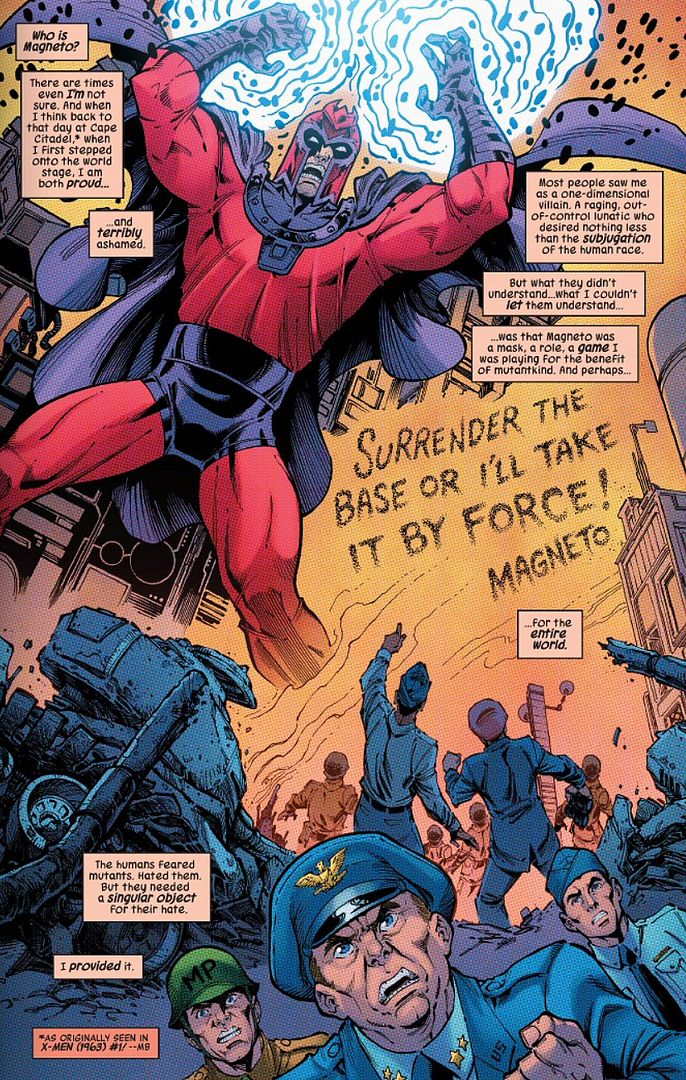
He goes on to explain his (retconned) true motivation and plan in this first appearance:
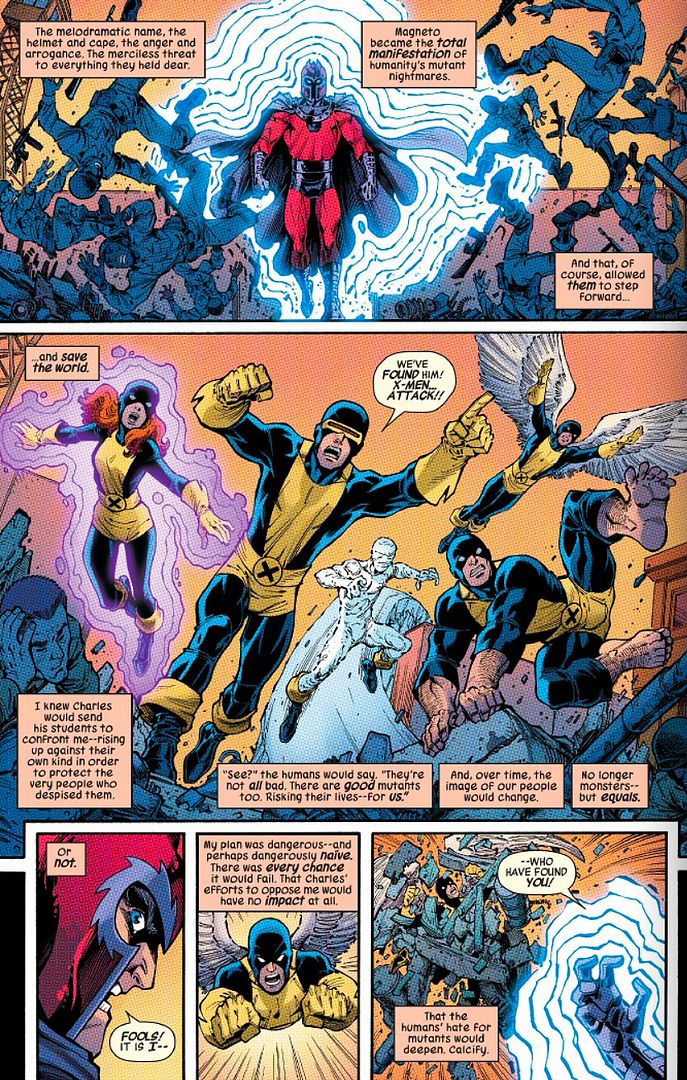
In this retelling, it is revealed that Magneto’s original persona was in always part of an act – to provide a target for human fear, knowing that Charles and his X-Men would oppose him and thus demonstrate to the world the value of “good” mutants. But the the alternative was still a possibility …
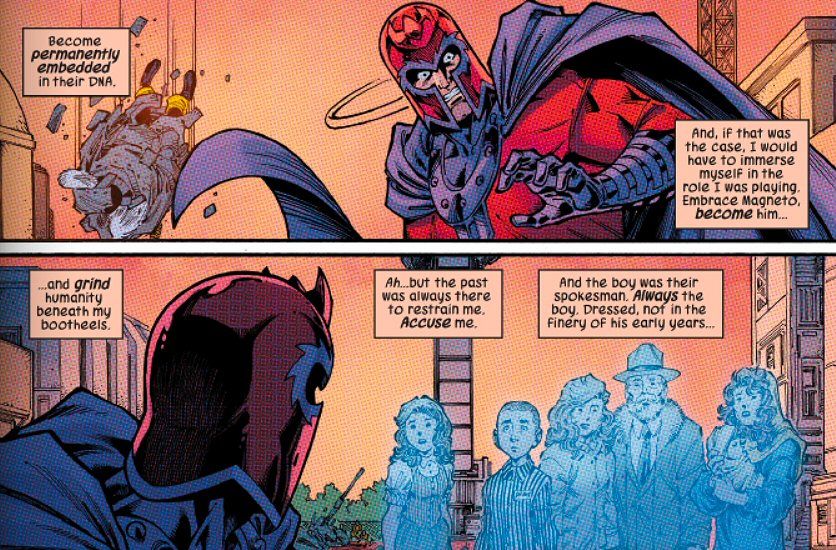
And so, in this latest retcon, he was actually hedging his bets between egoistic and utilitarian consequentialism (i.e., he would take over the world by force if he needed to, but was happy to “play” the villain if it meant a better outcome for all instead). And as a result, he has been tortured ever since by the ghosts of his lost loved ones – and his own lost innocence.
It’s an interesting retroactive correction – but it is only possible because Magneto was on quite the heroic upswing at this point in time in the comics (2023), and had become increasingly virtuous over the previous few years. As we will see going forward, he soon eschews his former thinking in terms of using force against humans (making this retconning a clever intermediate step in his ultimate redemption from his tortured past).
There is a lot to Magneto’s history between the Claremont era and the present time, consistent with his enduring popularity. But I think it is fair to characterize it as repeated cycles of reformation and regression over the long run (and many writers) in the comics. I suggest you check out the Magneto Wikipedia page or the Marvel Fandom one for an extensive in-story description. But in terms of the character’s ethics, what you really see is a fitful progression to a more virtuous and utilitarian Magneto.
Before I jump to the modern times, there was one development in 2003 that has had amusing real-life implications. In New X-Men Vol 1, issue #135, by Grant Morrison and Frank Quitely, Xavier is trying to shut down student dissent at his X-Men school. One of the particularly rebellious students is Quentin Quire (Kid Omega), who decides to flaunt Xavier’s authority in his own unique style:
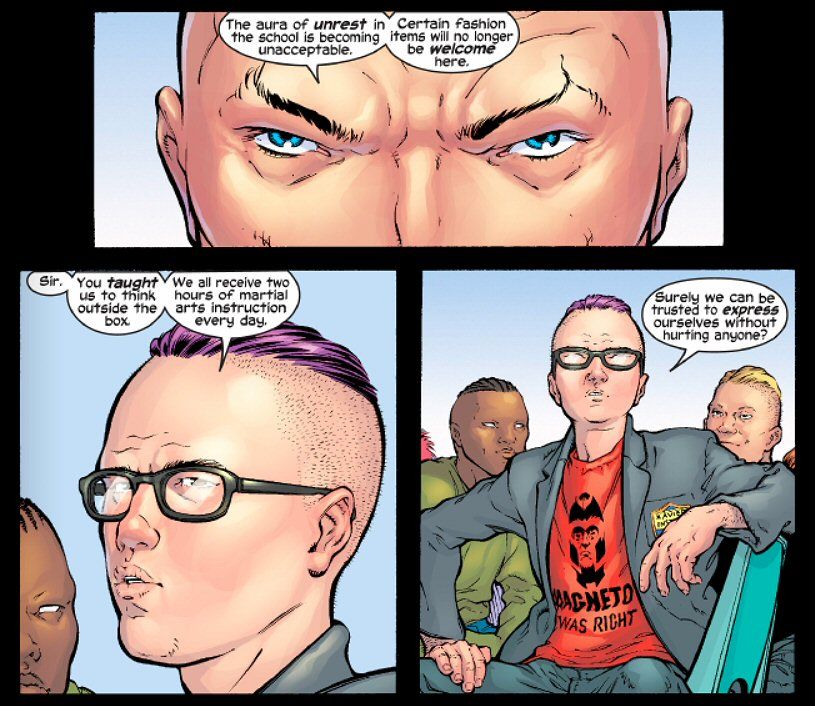
Quentin’s knock-off Che-Guevara-style red t-shirt displayed the provocative catchphrase “Magneto was right” (in his early militant views, presumably). This quickly became a popular iconic phrase in-story as a symbol of the philosophical divide between the two camps. And it continues to this day (I recently spotted Magik wearing a t-shirt with the slogan in the opening issue of Magik Vol 2, 2025, by Ashley Allen and Germán Peralta). Of course, matching fan-made t-shirts quickly caught on in the real world as well.
Mind you, Quentin plays more the role of an edgelord than any serious form of rebellion in the stories. He went on to sport all sorts of mocking or ironic t-shirts over the years (as a left-handed person, I prefer his later “Magneto was left” shirt).
Modern comics
The most notable place to seek to understand Magneto’s current normative ethics is the Krakoan Age. As I explained on my X-Men Ethics – Introduction page, this was the most massive X-Men event in history – spanning 5 years (2019-2024) and over 500 comics. It had significant effects on the lives of all the mutants in the Marvel Universe, with noticeable normative ethics shifts in a number of them. Magneto plays a significant role in this event, as I will briefly explain.
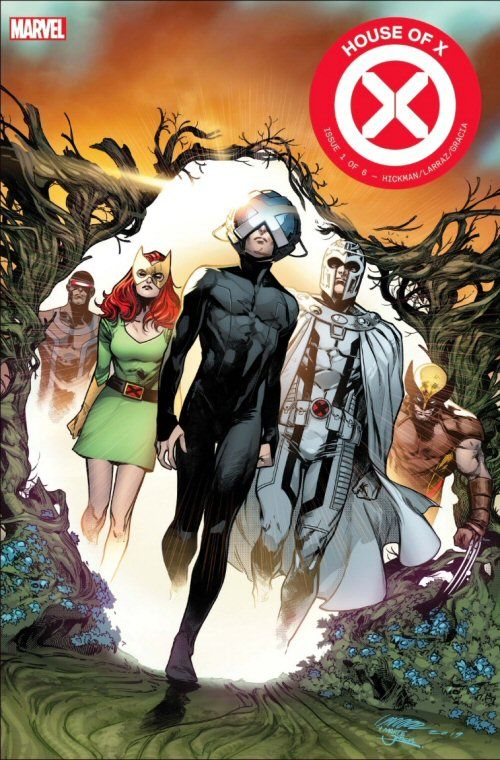
In 2019, Jonathan Hickman spearheaded the opening narrative chapters of the Krakoan Age, beginning with the House of X series and related story lines. Along with Charles Xavier and Moira MacTaggert, Magneto set about creating a new mutant paradise on the alive and self-aware island of Krakoa. This new mutant nation secured recognition of its place internationally by offering other nations around the world cures to various human ailments that were developed on Krakoa. Magneto initially helped draft the governing rules for this new nation, and had a seat on its governing council.
Magneto also eventually came up with the solution for their conflict with the mutant Arraki on Krakoa’s twin island of Arrako – resettlement on a terraformed Mars (renamed Arrako). After a number of challenges with governing Krakoa, and with increasingly complicated politics, Magneto left it to Charles to deal with and “retired” to Arrako.
A.X.E.: Judgment Day
This brings us to the middle of the Krakoan Age, when things took a turn for worse due to the events described in my A,X,E,: Judgment Day Introduction, the major 2022 Marvel cross-over event created by Kieron Gillen (who was now also one of the lead writers for the X-Men). The premise is that to ward off a genocidal attack by the Eternals against all mutants, a god-like Celestial known as the Progenitor is revived. Unfortunately, it takes it upon itself to decide the fate of the whole world by weighing the morality of every human being.
During this event, Magneto valiantly fought to save Arakko from the onslaught by the most powerful Eternal, Uranos. Literally having his heart ripped out, Magneto was able to keep himself going for awhile though use of his magnetism to keep his circulation flowing. He eventually helped to turn the tide, but at the cost of his own life (as he had forsworn any further use of the mutant resurrection technology at this time).
Interestingly, Magneto uses his dying words to impress upon Storm how Charles Xavier is no longer to be trusted. This foreshadows Charles’ descent during the Fall of X story line two years later, marking the end of the Krakoan Age. From X-Men: Red Vol 2, issue #7, 2022, by Al Ewing and Stefano Caselli:
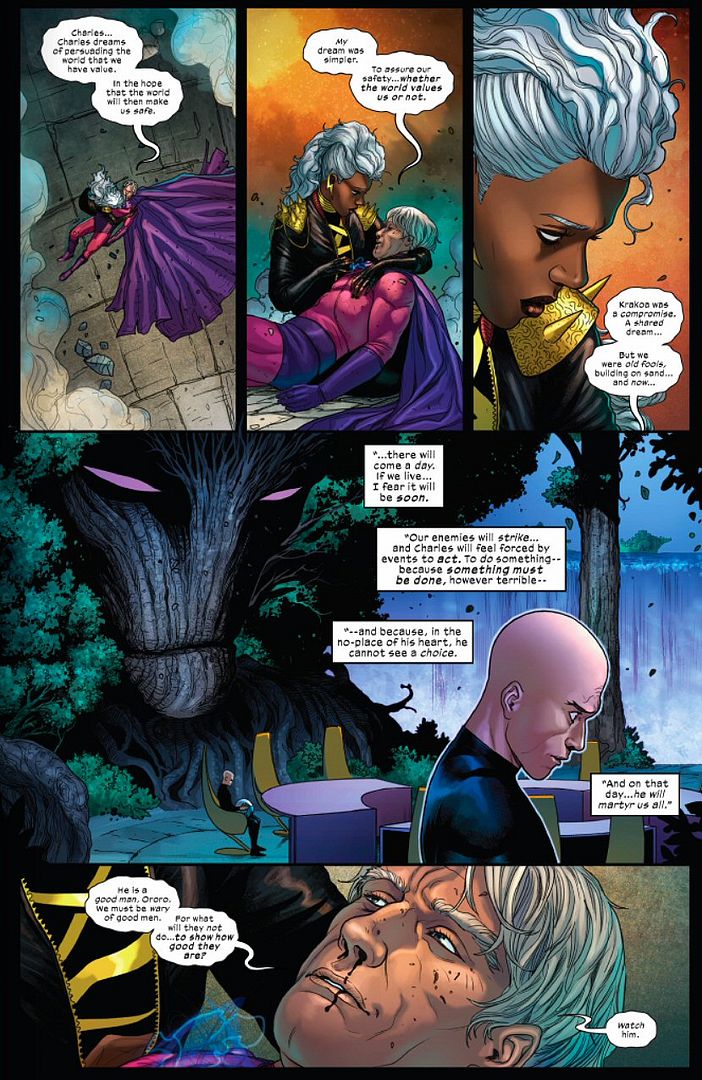
This scene helps impress just how much Magneto has changed by how he now recognizes the dangers of the unrestrained utilitarian Charles has become (lacking a deontological moral compass or virtue ethic – something I will discuss in my Charles Xavier ethics post). To me, this is another sign of Magneto’s own rising virtue ethics at play.
What does the Progenitor think of all of this? There are a couple of nice panels within the main A.X.E.: Judgement Day issue #4 (by Gillen, Valerio Schiti, and Marte Gracia), where you get to hear the Progenitor’s narration as he tests the dying Magneto:
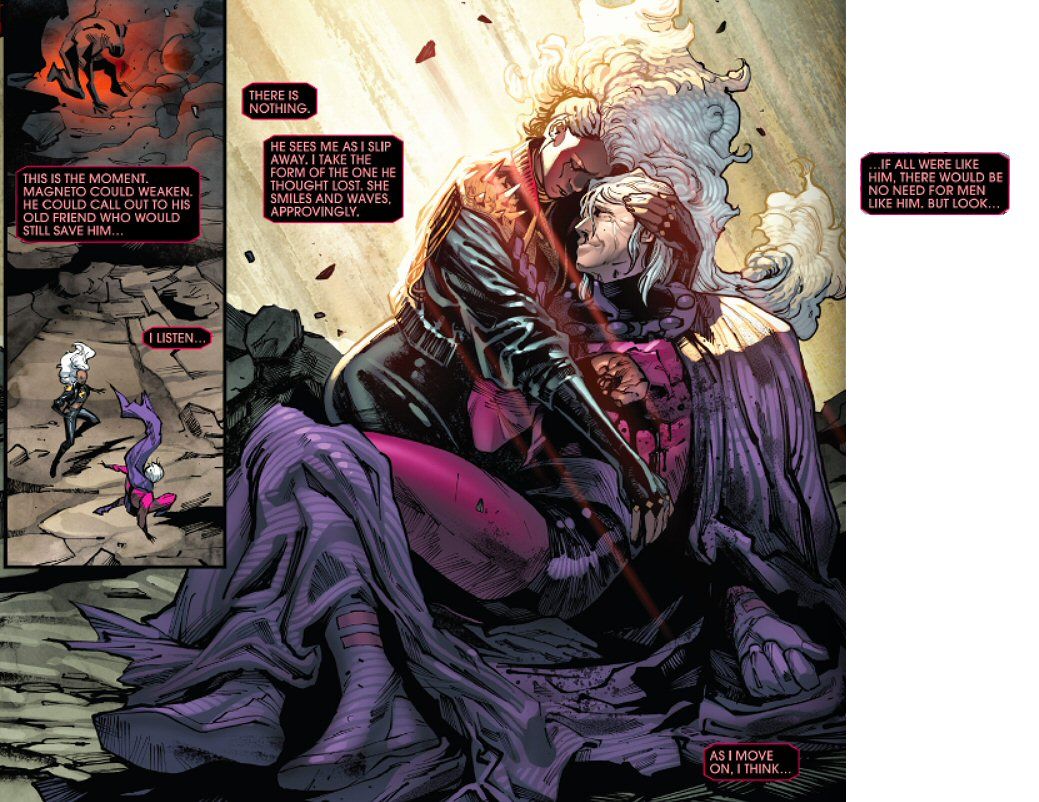
If all were like him, there would be no need for men like him.
- Progenitor, A.X.E.: Judgement Day, 2022
High praise indeed, worthy of a virtue ethicist! I find this acknowledgement of how far Magneto has come quite significant.
So how does Magneto return from the dead? Before the end of the Krakoan Age there is a fabulous limited series appropriately called The Resurrection of Magneto (early 2024, by Al Ewing and Luciano Vecchio). Here, Magneto – currently existing in the after-life – decides he needs to return to the land of the living to help both humans and mutants. I particularly like these panels from issue #3 where he is being tormented by the Shadow King in various guises:
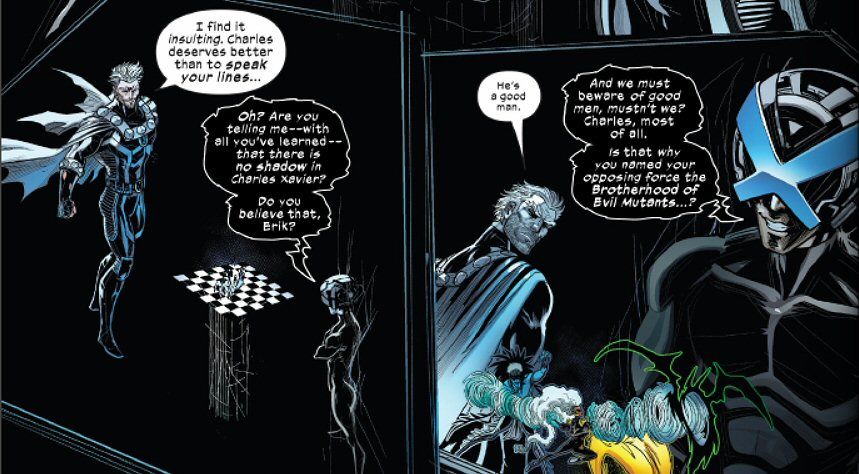
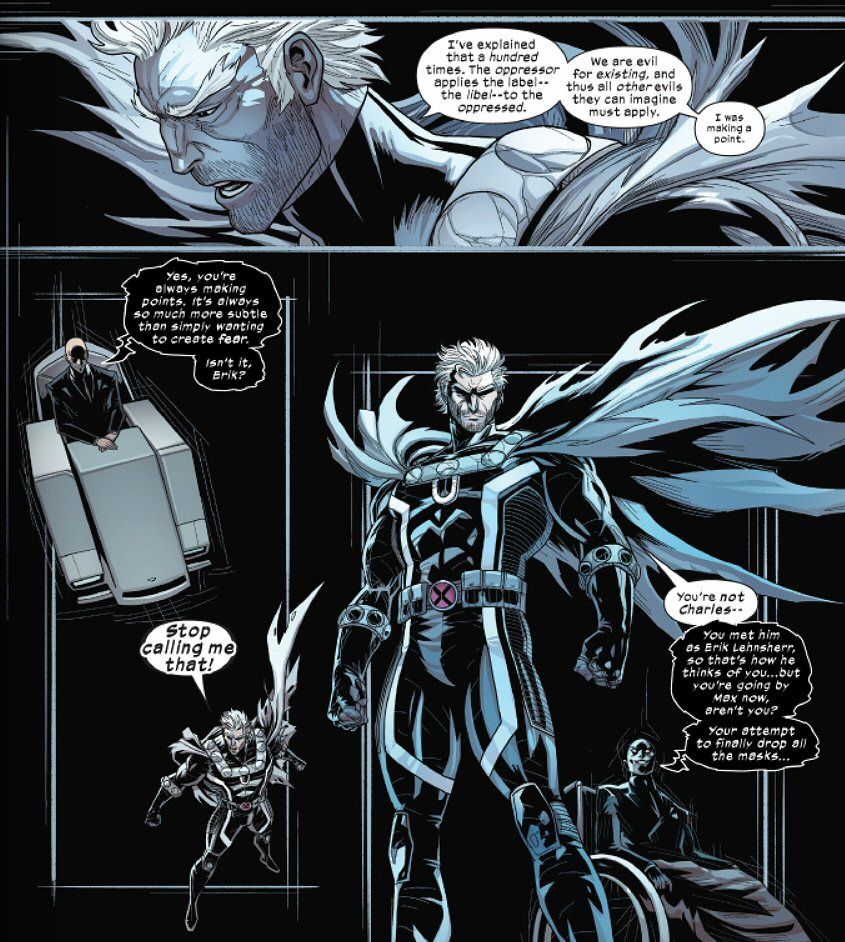
The above speaks to a nice little retcon – the Brotherhood of (Evil) Mutants were never actually “evil” after all, it seems.
The Shadow King then confronts Magneto with his own image – and words – over the next several pages. FYI, the Shadow King’s projected Magneto speech is literally taken directly from the first appearances of Magneto in the 1963 X-Men comics (Stan Lee was a big fan of exclamation points!!). Here’s an excerpt:
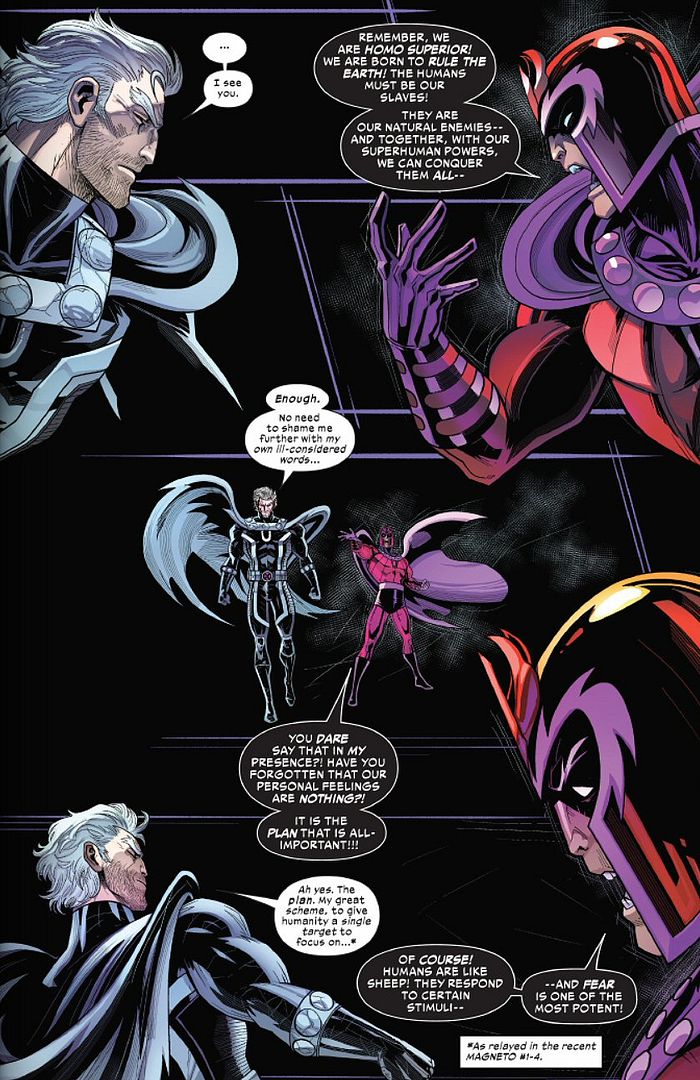
The “great scheme” above is a reference to the DeMatteis retconning in the 2023-24 Magneto limited series described earlier.
Magneto eventually comes around in this series to acknowledging his former self – and recognizing he cannot run from it.
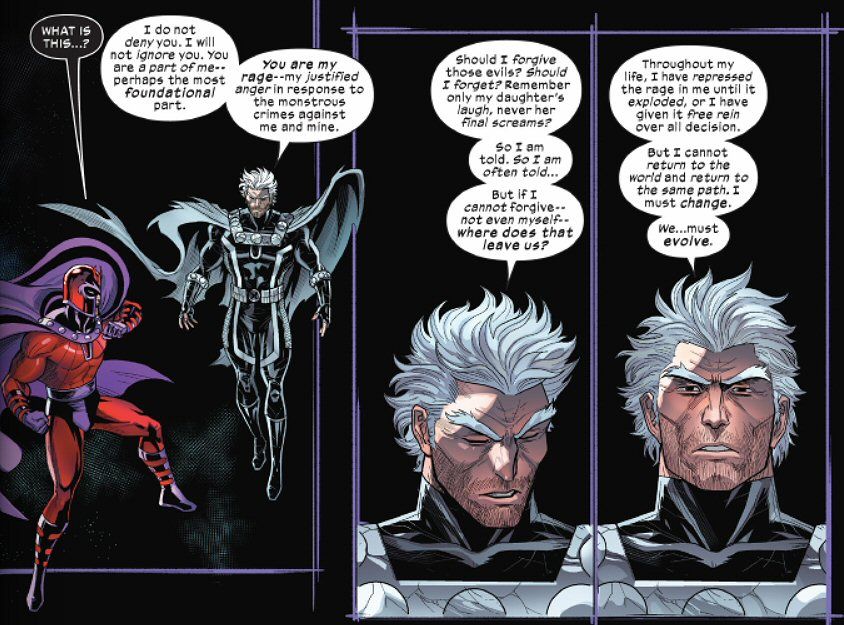
And so finally – he has to admit his past, and evolve beyond what he was. Magneto’s conversion into a primary virtue ethicist is now firmly established in my mind. And I’m not the only one seeing this redemption arc setting him up as a hero going forward.
As I will explain in detail on my Charles Xavier ethics post, just as Magneto rises to being more than he was (by adopting virtues), I would argue Charles descends into being less by eschewing any deontological or virtue ethics, and turning into an unrestrained utilitarian. All normative ethics theories have strengths and weaknesses, and there are some specific challenges for utilitarians that I think make it untenable for someone with Charles’ mutant abilities (again, see my upcoming post for details).
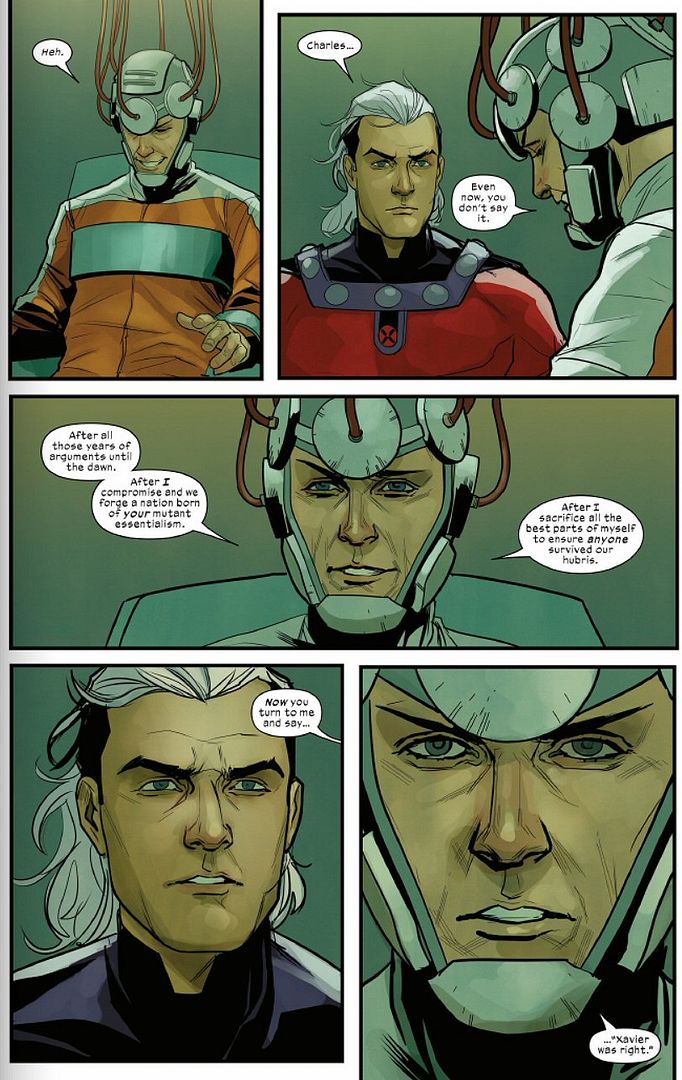
As Magneto’s resurrection comes near the end of the Krakoan Age, they don’t get a reunion until after Charles’ arrest for (apparent) human mass murder. The final scene between these two old friends is very telling, as we see how far each has come down his own path. From X-Men Vol 6, issue #35 (by Gerry Duggan, Ewing, and Gillen):
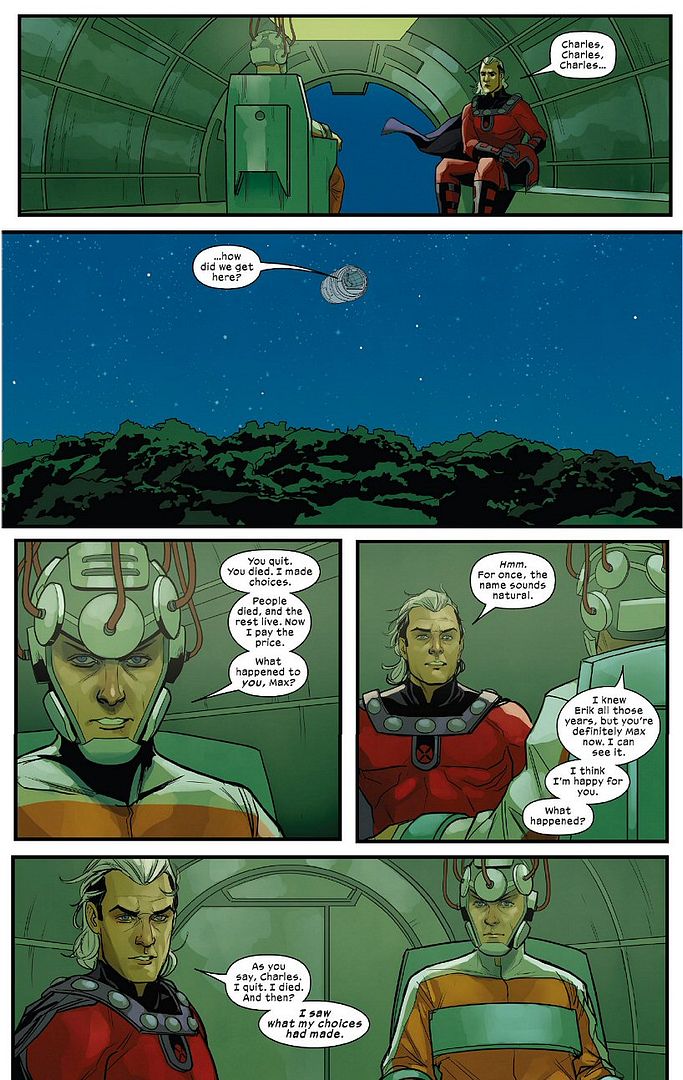
Xavier gives a pretty succinct summary of events – “You quit. You died. I made choices. People died, and the rest live. Now I pay the price.” In his very utilitarian way, he is implying (as Magneto predicted) that circumstances forced him to make the choices he did to save as many as possible – the classic ends-justify-the-means defense. I’ll skip ahead a few panels to get to the substance of Magneto’s new perspective:
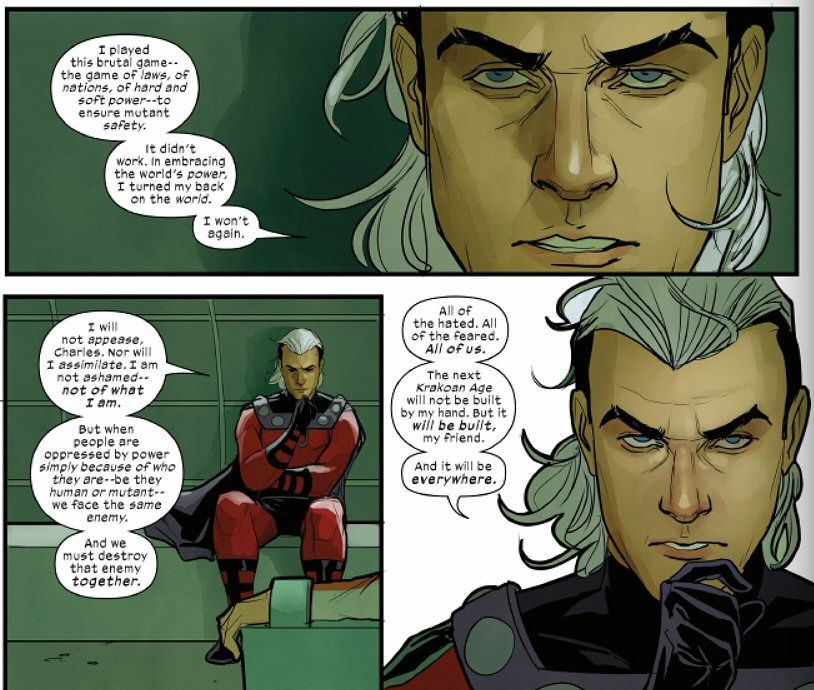
It is pretty remarkable just how far Magneto has come at this point in time – espousing a view that repudiates his previously held beliefs, and shows his commitment to virtuous change. This is the most substantial change in the character’s world view since his creation over sixty years earlier. Of course, Charles of all people is bound to see the irony in that:
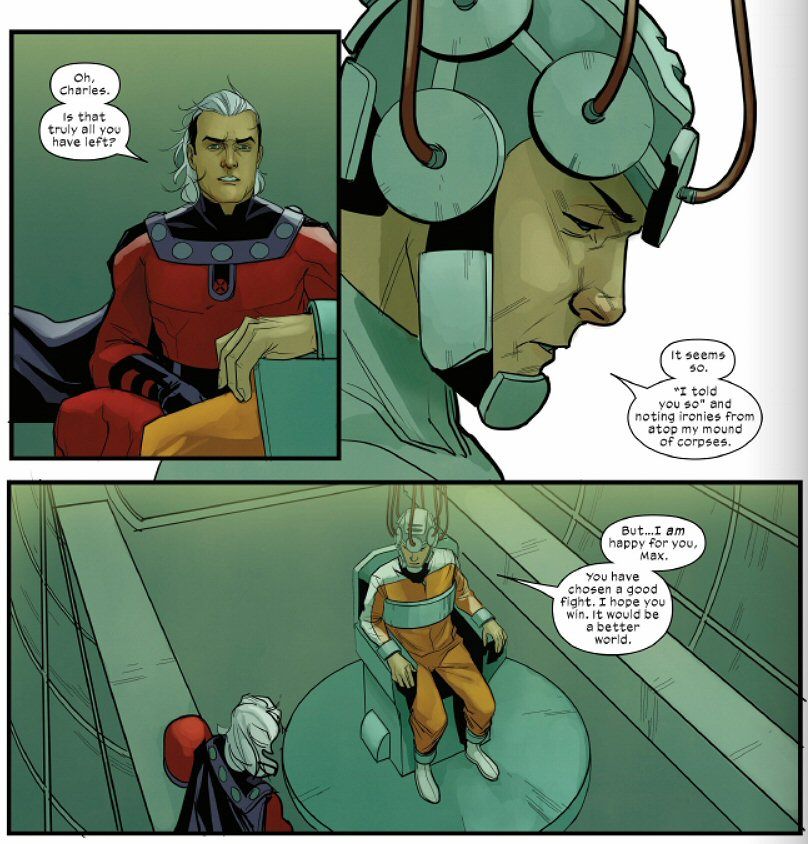
So, as of mid-2024, we have come full circle – Magneto now fully embraces Charles’ original dream of protecting the rights of all, and Charles has (apparently) destroyed himself by his unrestrained utilitarian pursuit of the best for mutants.
Of course, this being the comics, there is more than meets the eye to Charles’ situation, as I will be explaining in my Charles Xavier ethics post.
With the end of the Krakoan Age, we have now entered the X-Men: From the Ashes Age, with the new main X-Men series written by Jed MacKay, Gail Simone, and Eve Ewing. Magneto is part of Mackay’s X-Men Vol 7 (2024 to present) series, with art by Ryan Stegman. In these stories, MacKay seems to have continued the tradition of reverting Magneto’s character somewhat – at least in terms of making him more deliberately intimidating. From the first issue, it is made clear that Magneto seeks to instill fear in others. There is a good flashback sequence in issue #7, showing when Magneto first approached Scott to lead the new team:
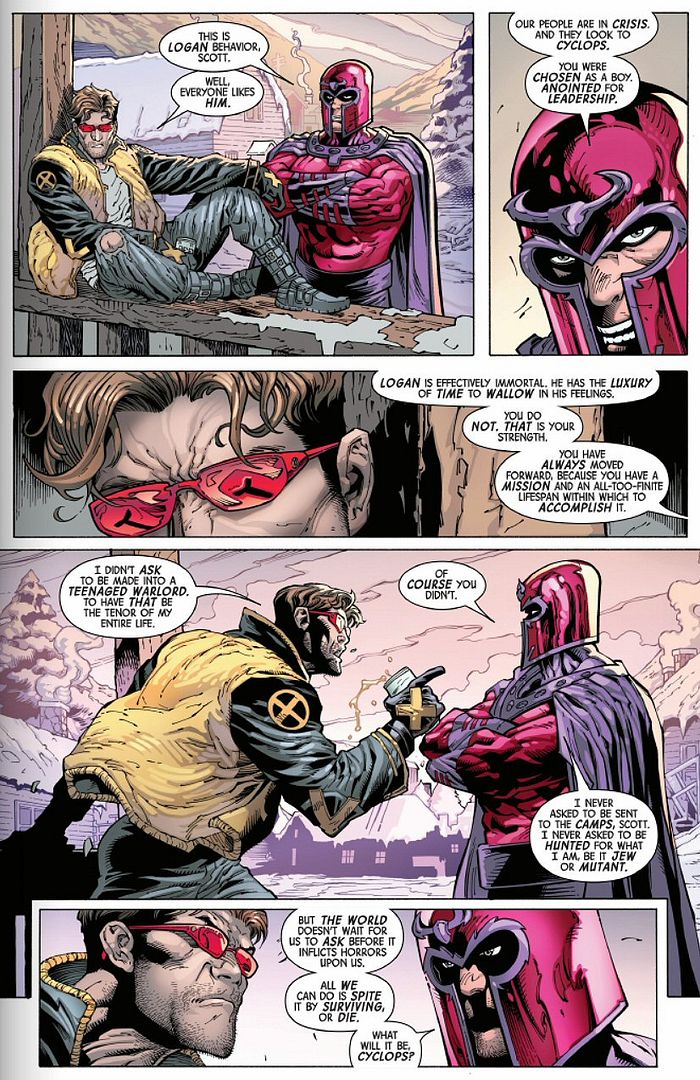
I am not suggesting MacKay is reverting Magneto back to a villain. But he is definitely writing a much grimmer and gruffer version of Magneto, more in keeping with his historical “average” persona rather than the enlightened one we were seeing at the end of the Krakoan Age a few month earlier.
Interestingly, this series begins with Magneto being effectively depowered – he is wheelchair bound and unable to use his powers. It’s explained that he has a new mutant disorder – “Resurrection-Linked Degenerative Sickness” – causing him to lose control of his powers if he tries to use them (as demonstrated later in that flashback sequence above). But Magneto’s physical condition appears to be deteriorating, and the prognosis is grim if the Beast (Henry McCoy) can’t find a cure in time (note that resurrection is no longer available to mutantdom). This is an interesting plot development, but it is hard to know what this means for character’s normative ethics going forward.
Marvel Cinematic Universe (MCU)
Magneto was very well portrayed in the X-Men movies by both Sir Ian McKellen (in the first decade of this millennium) and Michael Fassbender (in the second decade) for the rebooted origin stories. But since both sets of movies only portray Magneto from earlier comic book story lines of the late 20th century, I don’t feel they are too relevant to a discussion of his current normative ethics. I will say that both actors depicted him well as a tortured, conflicted character – but his redemption in the comics in recent years is not fully captured in the films.
Current ethical framework: V/c (historically, C/d)


I really feel that the past few years – especially over the Krakoan Age – moved Magneto firmly into the hero camp, with a primarily virtue ethics core. Yes, he still has very strong utilitarian (consequentialist) streak, but there are certainly still aspects of his original deontological duty drive. But his overwhelming virtues – including courage, justice, compassion, and selflessness – really come to the fore now. I would even say he is doing a good job working on magnanimity, given how prideful he used to be. And that’s the key point to me – his commitment to change makes him very unusual for a comic book character, and very much in keeping with a virtue ethics approach.
There is a really good panel in the final issue of the Resurrection of Magneto Vol 1, issue #4, 2024, by Ewing and Vecchio. Magneto must decide on a course of action when there is no good outcome. Will he decide with the black helmet (his original egoistic consequentialist self), the white helmet (when he adopted Charles’ shared dream), or a third new way of this moment?
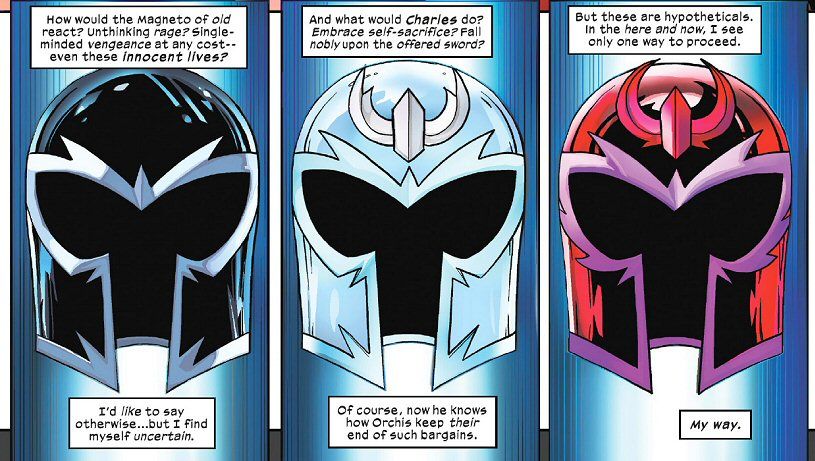
A key feature of virtue ethics is to not engage in “hypotheticals” (e.g., all the thought experiments considering actions and outcomes that deontologist in particular seem to love), but rather to decide on the basis of what feels the most virtuous for you.
The last word … for now.
It remains to be seen how things will progress for Magneto’s character in the current From the Ashes Age. But there is one very interesting recent story by Alex Paknadel that gives me hope.
Paknadel has been penning most of the issues of the X-Men: From the Ashes Infinity Comic that is concurrent to the main X-Men titles. Infinity comics are one of the key value drivers for the Marvel Unlimited subscription – beyond the full back catalog of 30,000 published comics. These online-exclusive Infinity comics are shorter stories that delve deeply into specific characters, and are meant to be viewed on a phone (as they scroll in an “infinite” continuous roll). Beyond the significant character development, these stories sometimes have critical plot developments that you need to read to fully understand the main comic story lines. Many find it understandably frustrating to have sign up for a subscription to access these, but I’ve noticed Marvel has started publishing these as stand alone comics eventually.
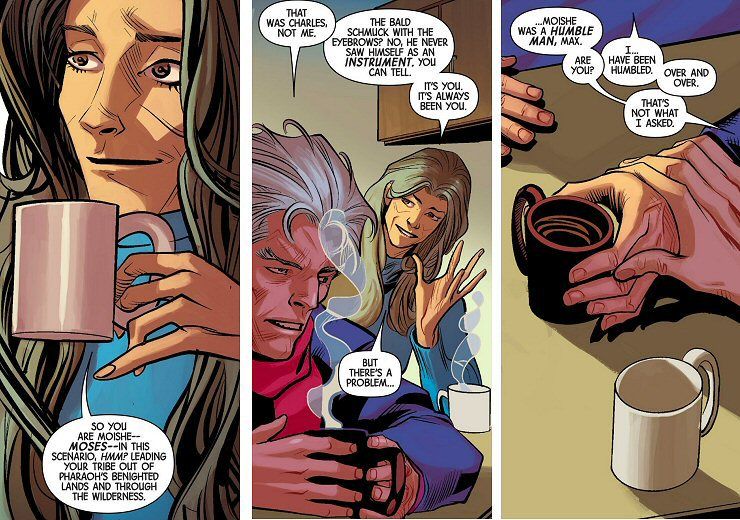
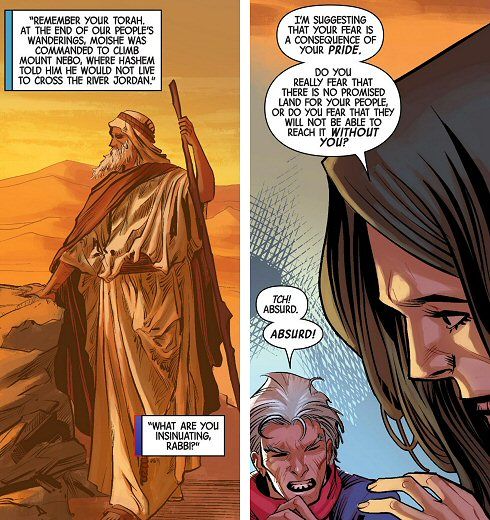
I’ve taken some screenshots below of the Magneto story arc in issues #13-14 of this Infinity comic (Sept 2 and Sept 9, 2024), written by Paknadel with art by Diogenes Neves. Here, Magneto’s degenerative condition provides a good opportunity to have him confront his own mortality (again). Magneto ventures into the nearby town of Merle, Alaska, and meets with the town’s rabbi. He is having a crisis of faith in the now-shared dream – specifically, that he is running out of time to make it come to fruition. Rabbi Rachel illustrates the famous religious parallel to his situation:
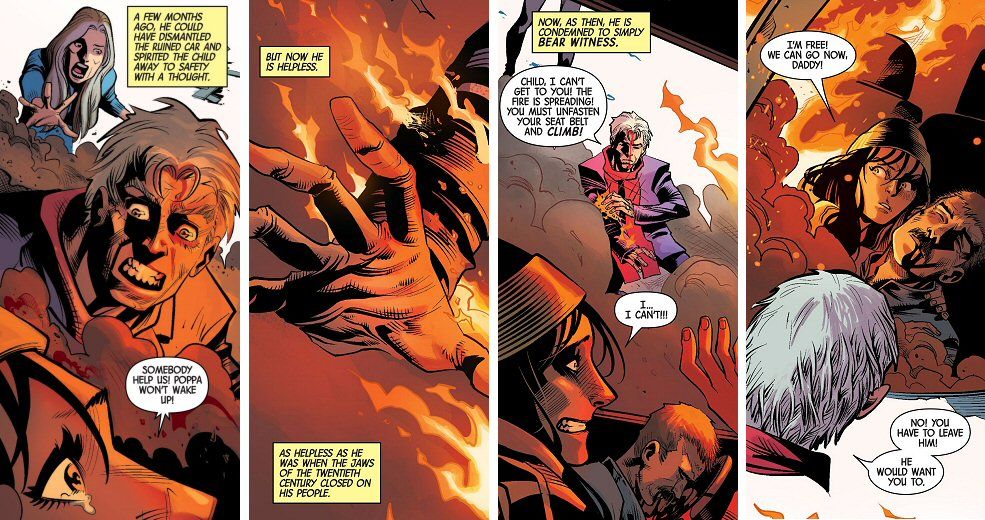
After leaving temple in a huff, Magneto is hit by a car, which then crashes and catches fire. He is unable to use his powers, and instead has to help coax a trapped, frightened child out. Some individual panels over a much longer extended sequence, showing his turmoil:
Everyone is saved in the end, and he gets to have a quiet word with the rabbi as he recovers:
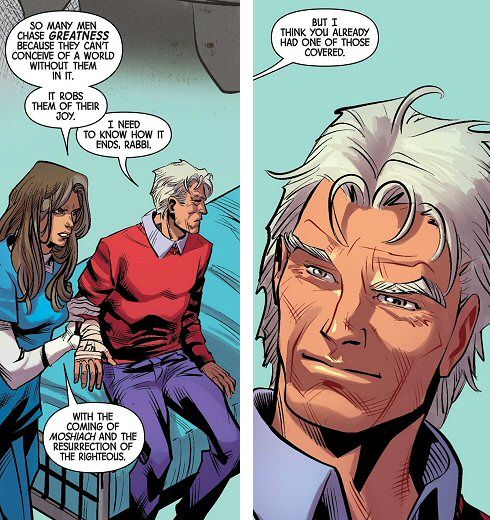
Yes, I think the “resurrection of the righteous” describes Magneto’s return well. The “righteous” can be defined as as the morally right or just – but they can also be defined as the morally virtuous.
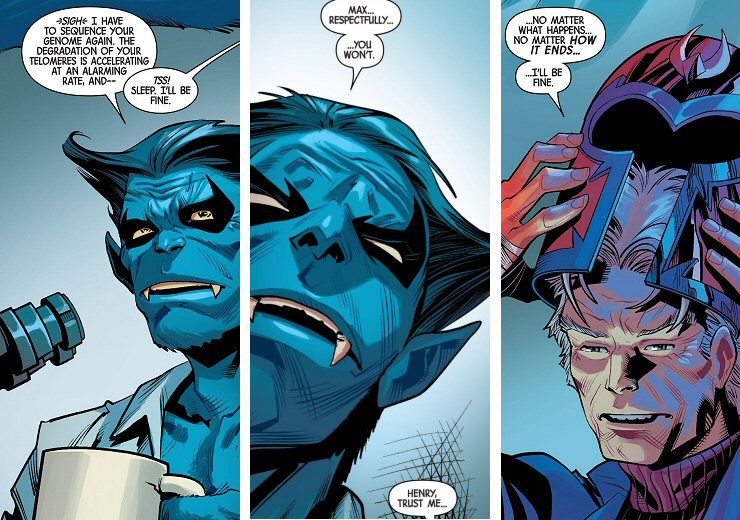
This is a nice example of Magneto coming to terms with his life and his role. I hope it remains a long and full one in the comics!
See my Glossary post for a list of the key philosophical concepts and related links on this site.

THANK YOU, THANK YOU, THANK YOU
Magneto has always been one of my favorite characters and he never gets enough love. I’ve been reading him for over 30 years, and there have been so many great stories showing how he has grown. I don’t get why every body doesn’t see him as a hero.
You might want to check out the Trial of Magneto limited series (2022?). Some good stuff about his character (but some not so great, with his daughters). Also always loved this story:
https://www.reddit.com/r/xmen/comments/17xhjsu/i_love_how_this_shows_accurate_sides_too_both/#lightbox
Keep up the good work, looking forward to going through the rest of your sight!
Thank you, I’m glad you are enjoying the site.
I know not everyone sees him as a hero (maybe an anti-hero, or anti-villain). But I think a lot of that is due the earlier stories where he was responsible for killing people (including innocent people). I feel this was effectively redressed in the Resurrection of Magneto, where you see him struggling with those deaths – and resolving to do better.
I’ve read the X-Men: Trial of Magneto Vol 1, from 2021. And I agree – there is some good stuff there, but also some that’s inconsistent (I presumed the later was his acting out to cover his secret promise to Wanda). I really like the image from that Reddit thread, I’ll look up the full issue – thanks.
Also thanks for the inifinity comic, I never heard of that story. Are you sure it is canon? The Jewish thing isn’t talked about much, surprised to see it there.
I guess I’ll have to sign up for the marvel unlimited. I see they have a free month option, guess I will see how much I can read fast. lol.
Yes, all the Infinity comics are “canon”, and part of the official Marvel literature. In fact, there are some you need to read to fully understand the modern plots. I’m thinking of Blood Hunt from last summer, where you need to read the Doctor Strange Infinity comic to find out where the ghost of his dead brother came from.
And there is an even more relevant example here, with the immediate retconning of Professor X at the end of the Krakoan Age. That one was so significant that they eventually reprinted it as a stand-alone comic (as it’s necessary to understand the current X-Manhunt event). I’m working on my Prof X posts now, and will be posting something soon on that one.
As for the Jewish thing, I agree that Magneto was largely written as a secular Jew in the comics. But I personally don’t see this as being too far out of character for him – again, given the recent evolution we have seen. In fact, I would argue that the main virtue he has acquired over the Krakoan Age was humility. And that would fit well with this Parknadel comic, which is really a lesson in developing his humility further.