

People of Earth. Listen. You are bickering children. This planet is ruined. You have acted with unrelenting unkindness to one another. You leave me no option. This is your Judgment Day. You have 24 hours to justify yourselves. You will be judged individually. You will be judged as a collective. If there is more that is just than wicked, you will live. But if you are found lacking, there will be no tomorrow.
See? You ARE all important. Every single one of you.
- Progenitor
A.X.E. Judgement Day was the major 2022 Marvel cross-over event, created by Kieron Gillen (writer), Valerio Schiti (pencils and ink), Marte Gracia (colors), and Clayton Cowles (letters), with contributions by many others in the tie-ins and side-stories.
It brought together all the threads of conflict between the Avengers, the X-Men, and the Eternals (hence, A.X.E.). But it is unique in my experience, as each of the heroes is subjected to moral judgement at the hands of revived god-like being – a Celestial known as the Progenitor (whose origin is explained on my Marvel background page). It’s pretty rare to see competing normative ethics being explicitly compared (and judged!) in a major comic event. (UPDATE: My conclusion post for this event is now available here)
If you would like to know more about the terms I’m using on this site, please follow the links throughout or check out my Ethics 101 page or Glossary post.
First, a bit of background on the Eternals, as they less well known than the other two teams. The Eternals are an old evolutionary offshoot of proto-humans that were granted superhuman powers by the Celestials long ago, and tasked to look after life on this planet. Their role and priorities were clarified by Gillen in his Eternals Vol 5 series (2021-2022, with art by Esad Ribić). There are 100 immortal Eternals that have lived for millennia unchanged – largely in seclusion, and rarely interfering with humanity. When one of them dies, they are immediately resurrected by the Machine that is Earth. The Celestials had simultaneously created 100 Deviants – heavily mutated versions of proto-humans – whose very diverse descendants persist to this day in underground caves in a kingdom known as Lemuria.
Significantly, the Eternals had some very deontological principles ingrained into them by their Celestial creators. In rank order:
- Protect Celestials: Eternals cannot attack a Celestial, even if they want to. They also have to obey its commands.
- Protect the Machine Eternals must maintain the Machine that is Earth.
- Correct Excess Deviation: Apparently, the Celestials had meant the Eternals to “correct” (i.e., destroy) any Deviant descendents who were experiencing dangerous spontaneous mutations. But due to the vagueness around “excess”, this has been used by some of the Eternals leaders to justify various attacks on others – and even genocide on occasion.
The genesis of the event is the integration of three long-running story lines in the Avengers, the X-Men, and the Eternals, that together bring about a superhero war. The X-Men (mutants) had recently achieved immortality, though kept that secret from the other heroes and general population. The immortal Eternals had recently reconsidered their primary motivation, and had decided that mutants were actually an offshoot of the Deviants they oppose. The Avengers had come into direct conflict with the Celestials and were currently using a dead Celestial host (the Progenitor) as their new base of operations, slowly learning its secrets. This all comes to a violent head when discovery of the mutants new-found immortality leads the current leadership of the Eternals to launch an ill-conceived and all-out assault to destroy mutantkind. Caught in the middle of an escalating conflict, the Avengers, along with a group of renegade Eternals, decide to try to reactivate the Progenitor in order to have it stop the Eternals (whose first principle is to protect and obey Celestial commands), thus shutting down the conflict.
But what happens when your newly revived god has other ideas?
That quote from the top of the page is what the Progenitor has to say to the people of Earth-616 once it has been revived, at the end of A.X.E.: Judgment Day issue #2. I am not going to spoil how the event ends in this post, because a lot gets explained (or, more accurately, revealed) as the story plays out. Instead, I want to treat this introductory post as a jumping off point to explore what it means for each of the Marvel characters. I am still writing the background ethics pages for the main characters that I am profiling on this site (and will discuss their personal Progenitor judgments on those pages). Once that is that done, I will return to this event and write up my conclusions in a separate post as to what it all means.
From A.X.E.: Judgment Day Vol 1, issue #2, 2022, by Kieron Gillen, Valerio Schiti, and Marte Gracia:
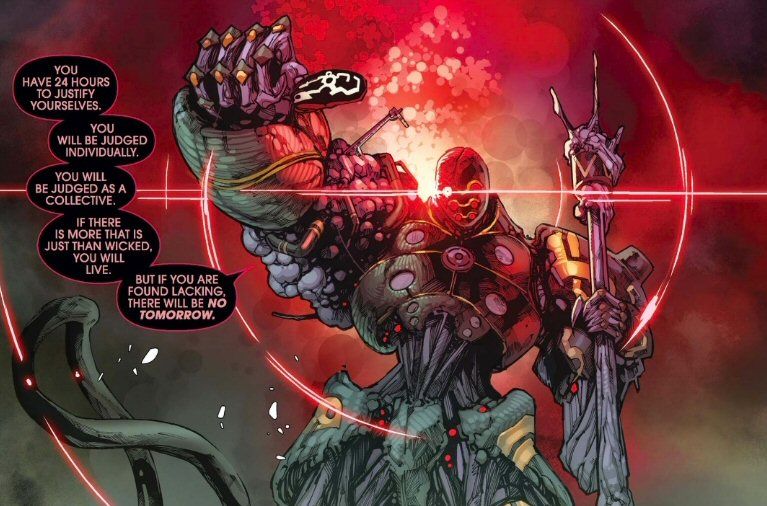
The framing of this event is made clear in that opening quote. Every individual on Earth will be judged by the Progenitor over the course of a day, with a very binary pass/fail system. If more fail than pass, the Earth will be immediately destroyed. In a cute stylistic touch hearkening back back to the Roman emperors and circus, the Progenitor holds his fist out before every person with the thumb horizontal to the ground. Once he makes his decision, you either get the thumb-up pass, or the thumb-down fail. Sometimes the Progenitor appears as itself, but often prefers to show up in disguise as an important person in each individual’s life as it weighs their fate and/or tests them.
So, on what basis does the Progenitor make these judgments?
This being a comic book story, it is repeatedly stated that the motivation and reasoning behind the god-like Celestial’s judgements must be inscrutable and beyond the understanding of us mere mortals (and to be fair, there are many religions that work this same way). But given that comics are written (and perhaps even more importantly edited) by human beings, there has to be underlying agreed-upon motivation and reasoning for the Progenitor character (even if not revealed). After all, if the characters pass or fail at random, or under the whims of different writers, the narrative is going to fall apart under its own weight. On what basis could the Progenitor (aka, the Marvel creators and editors) make moral judgments on the characters in this Universe?
Hmmm, I dunno, does this sound like a job for normative ethics maybe? (UPDATE: My conclusion post examining the normative ethics of this event is now available here)
Before I get into that, the heroes (and the First Priest of the Eternals, Ajax) are clearly quite surprised by this turn of events. From issue #3 of the main event, page 1:
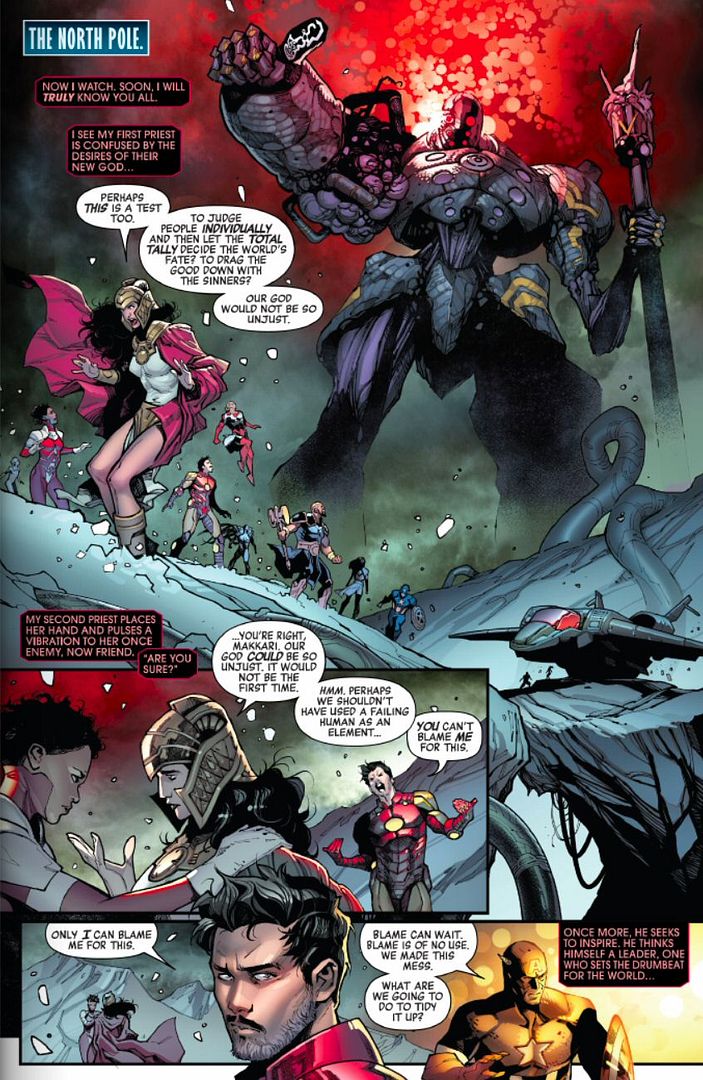
Reading online, I see a lot of commentary that the superheroes the Progenitor judges harshly are ones who have a lot of self-doubt. But this is clearly untrue, as it also passes a number who are known for their high-degree of self-doubt (and fails many who seem quite confident in their moral decision making). To that point, I would like to turn the page and reveal here the first superhero the Progenitor decides to judge – and how it judges him.
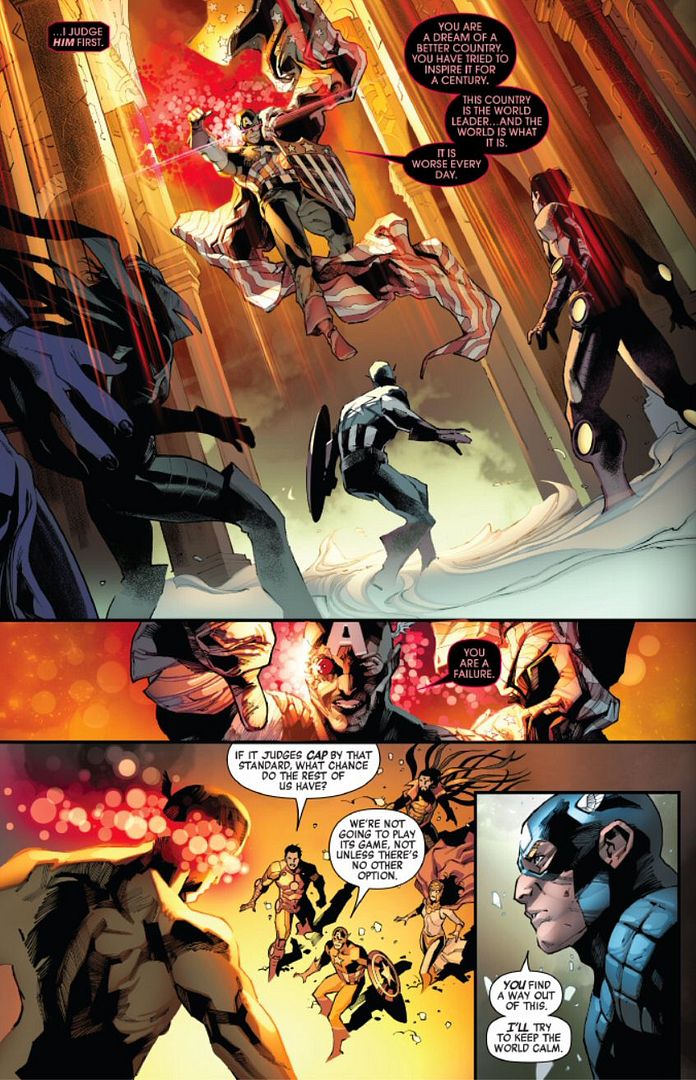
Online, a lot of discussion also proposes that the characters who are the most honest and/or true to themselves pass. But this is largely because of a few villains who seem to easily pass by dismissing the Progenitor (e.g., Doctor Doom). Like with the proponents of the self-doubt theory, you have to do an awful lot of mental gymnastics to argue that Captain America is riddled with self-doubt or is not true to himself. Cap is among the most righteous of Marvel superheroes – and one that everyone looks to as a moral role model – which is why everyone is so demoralized when they see him being negatively judged. He is a character I consider primarily deontological, though with some classic virtue ethicist virtues.
Once I draft all the main character ethics posts here, I will return to this event in a new post with a ‘scorecard’, to see if an obvious pattern emerges on how the Progenitor judges. But if you have read the normative ethics section of my Ethics 101 page, and the background on the origin of the Multiverse on my Marvel page, you can probably make a pretty good guess as to what framework(s) the Progenitor will likely use to judge everyone.



But no spoilers right now.
I highly recommend this series to anyone reading this site. Beyond the ethics theme, the spacing of the stories is very fast-paced, with a lot of ground covered quickly. This series moves, but still with time for some heart-felt moments. The artwork is beautiful, and Schiti and Garcia pull out all the stops here, with a lot happening on the pages (especially in the last couple of issues). And kudos to Clayton Cowles as well, for excellent lettering throughout.
If you do want to read this event online, through a Marvel subscription, I recommend you stick with at least the main event comics (in the right order, see below). As with all cross-over events, there are lots of additional tie-ins within the various character’s ongoing series (created by other writer/artist teams, but under common editorial control). Most of these are extended stories where that character gets judged, and are generally optional. But I strongly recommend you include at least the Avengers tie-in (Vol 8, issue #60), as I will be discussing that issue in an upcoming post.
Here is what I consider the best order, with most relevant tie-ins (the comics in bold are the minimal set you would need to read). You can find the full list with all tie-ins on the Marvel Fandom site.
- Free Comic Book Day 2022: Avengers/X-Men #1
- AXE: Eve of Judgment #1
- AXE: Judgment Day #1
- Immortal X-Men #5
- X-Men: Red (Vol 2) #5
- AXE: Judgment Day #2
- AXE: Death to the Mutants #1
- AXE: Judgment Day #3
- AXE: Death to the Mutants #2
- Immortal X-Men #6
- X-Men: Red (Vol 2) #6
- Amazing Spider-Man (Vol 6) #10
- Avengers (Vol 8) #60
- Captain Marvel (Vol. 11) #42
- Fantastic Four (Vol. 6) #47–48
- AXE: Judgment Day #4
- X-Men: Red (Vol 2) #7
- Legion of X #6
- AXE: Judgment Day #5
- AXE: Avengers #1
- AXE: X-Men #1
- AXE: Eternals #1
- AXE: Death to the Mutants #3
- Immortal X-Men #7
- AXE: Starfox #1
- AXE: Judgment Day #6
- AXE: Judgment Day Omega #1
You’ll note above that in addition to the prologue (“AXE: Eve of Judgement”) and the afterword (“AXE: Judgment Day Omega”), there are three important tie-ins that you need to read between the main issues #5 and #6 (AXE: Avengers #1, AXE: X-Men #1, and AXE: Eternals #1). Apparently, these were considered “story-critical” tie-ins and are essentially issues #5a, #5b, and #5c of the main title. The reason they are not in the main series is because the lead artist, Valerio Schiti, became a father at around this time. And so, different artists were selected to draw these three individual one-offs, to get the stories out without overworking him.
I will be back with additional posts related to this event soon. Stay tuned!
UPDATE: I have a follow-up post for this event on my Why Be Moral? page, and please see my conclusion post for an analysis of the normative ethics of the Progenitor.
See my Glossary post for a list of the key philosophical concepts and related links on this site.
Further Reading
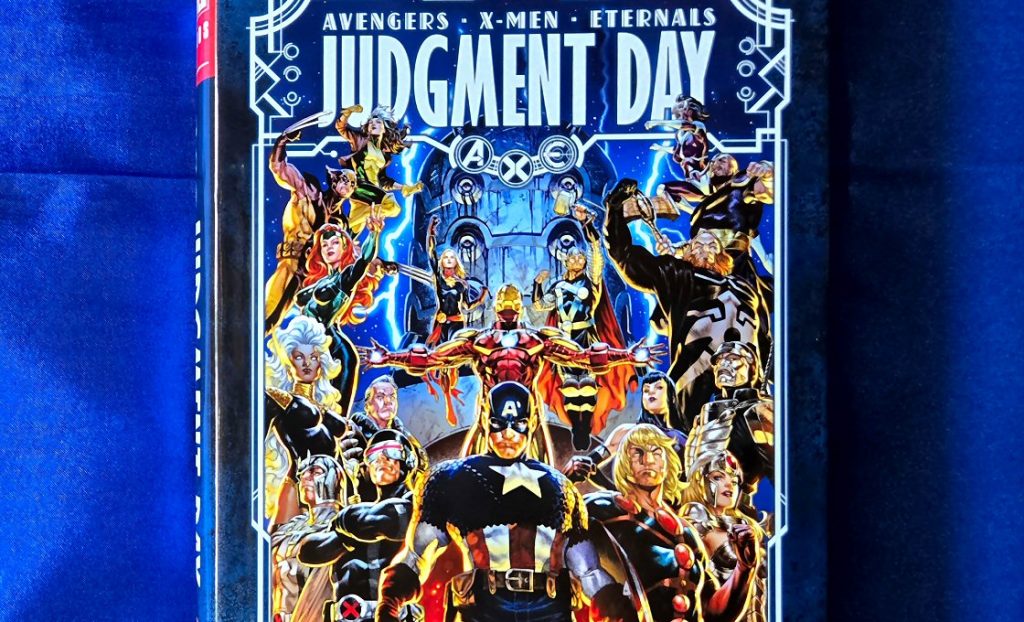
For more Kieron Gillen: A.X.E.: Judgment Day Conclusion
For more Kieron Gillen: The Power Fantasy Introduction
For more virtue ethics: Thor