
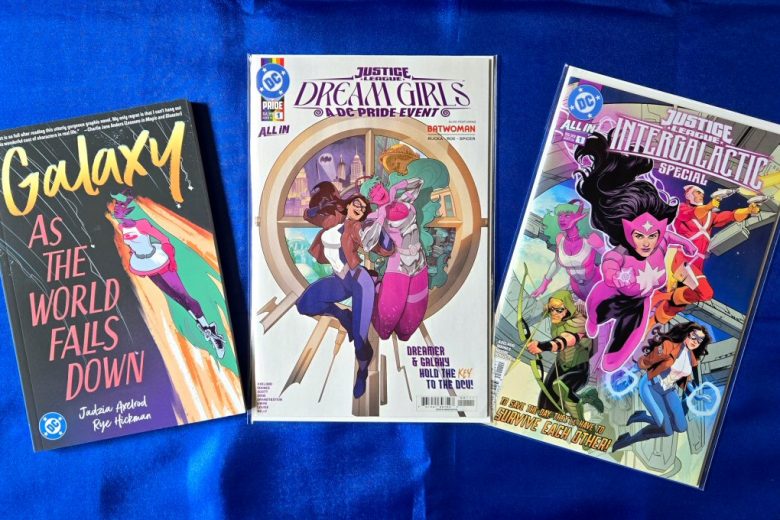
Being “normal” was never, NEVER going to save me! (Galaxy: The Prettiest Star, 2022)
But being normal is never going to save anyone. (Galaxy: As the World Falls Down, 2026)
- Galaxy, coming full circle across her two graphic novels, written by Jadzia Axelrod
As part of DC’s Pride event this year, they are front-lining two of my favorite newer DC superheroes, Dreamer and Galaxy. Rather than the typical one-off issue, DC’s Justice League: Dream Girls Vol 1 is a four-issue limited series running each week this month (June, 2026), picking up from the excellent Justice League Intergalactic Special #1.
Dreamer was the first transgender superheroine on TV, created for the Arrowverse CW series Supergirl, portrayed by Nicole Maines. She was later introduced into the main DC Universe comics continuity in 2021 as a half-alien precognitive superhero, written by Maines herself. Galaxy was created and written by Jadzia Axelrod in 2022, as a alien princess energy-manipulator who is queer, lesbian and transgender, living on DC Comics’ Prime Earth.
I normally review the ethics of superhero characters one at a time (or as a dedicated team, where relevant). But Galaxy’s and Dreamer’s histories are so intertwined that it makes sense to consider them together – especially in light of the new joint Dream Girls series.
I have really enjoyed how Maines and Axelrod have developed their respective characters over the last few years, with each doing a great job writing the appearance of other character in their own stories. But I find there is something very meaningful (from a philosophical perspective) and magical (from a narrative perspective) that comes out when they collaborate on joint issues, like Dream Girls.
Both characters demonstrate a fundamentally positive ethics view, despite their respective challenges and obstacles in finding their way as young superheroines. I would recommend both characters for younger adolescent readers. And it seems that DC comics agrees with me, as the origin stories for each character have recently been published through DC Graphic Novels for Young Adults, which is their imprint that presents traditional DC Universe (DCU) characters to young adult readers. I will describe these novels as well as the characters’ more recent adult adventures below.
I have previously called out the cishet men bias of philosophy on this site, and the importance of feminist thinkers in developing the modern form of virtue ethics known as care ethics. Note that care ethics is not specific to gender, and is refreshingly applied by writers of all backgrounds in modern comics. As we will see below, it is one common lens through which to view modern superhero ethics, and aspects of it are clearly displayed by both of these characters. This overview will also be an opportunity to profile one of my favorite existentialist philosophers and writers, Simone de Beauvoir, who pioneered thinking around gender identity and ethics.
These two superheroines are among the most powerful and prominent LGBTQ+ characters in main continuity at the Big Two publishers, and both have been developed by transgender creatives. Given how well written and drawn they are, it is great to see these characters receive greater prominence this year. The ethics of the characters is instructive for the superhero genre, as I will describe below.
And as always, if you would like to know more about the terms I’m using on this site, please follow the links throughout or check out my Ethics 101 page or Glossary of Terms post.
Brief introduction to the Dream Girls
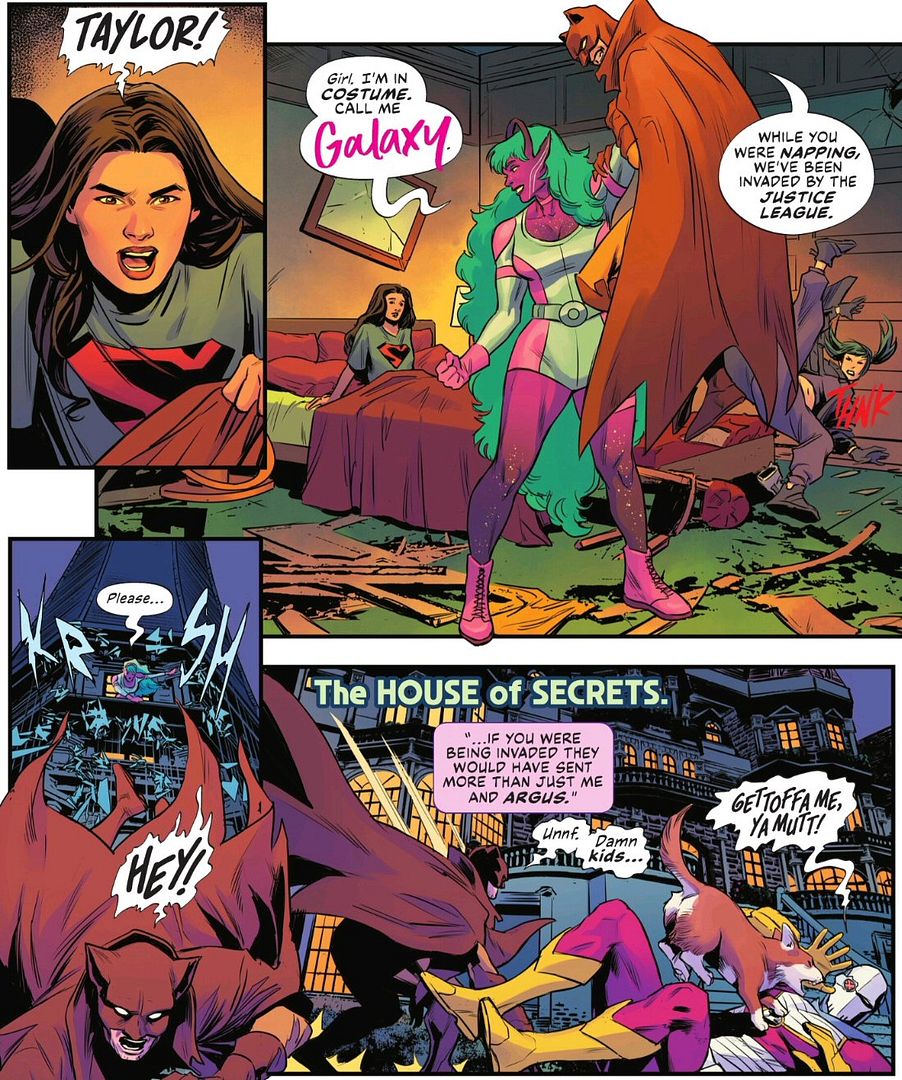
Before picking up the Justice League: Dream Girls series, you really need to read the Justice League Intergalactic Special #1 from last month – written by Jadzia Axelrod and Nicole Maines, with art by Travis Moore.
The issue begins in the present time of the DCU, with Nia Nal (Dreamer) having a prophetic dream where her close friend Taylor Barzelay (Galaxy) is controlled by a malevolent entity and wipes out the Green Lantern Corps and Justice League on Naltor. Nia awakens to find:
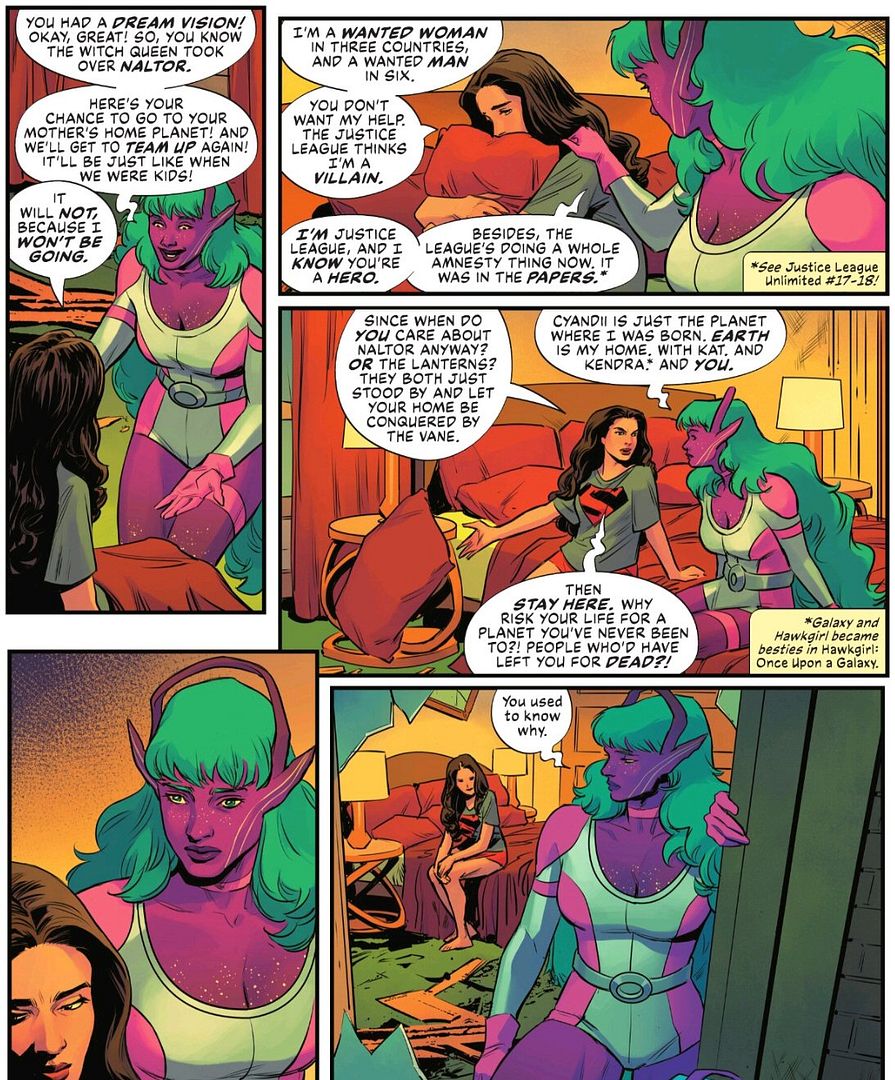
Nia, who is presently living with the Secret Six vigilantes (for reasons I will explain below) reveals that she knows the mission Taylor is on for the Justice League (as one of its newest members):
Out of concern for her friend, Nia dream walks into their mission and helps save their lives:
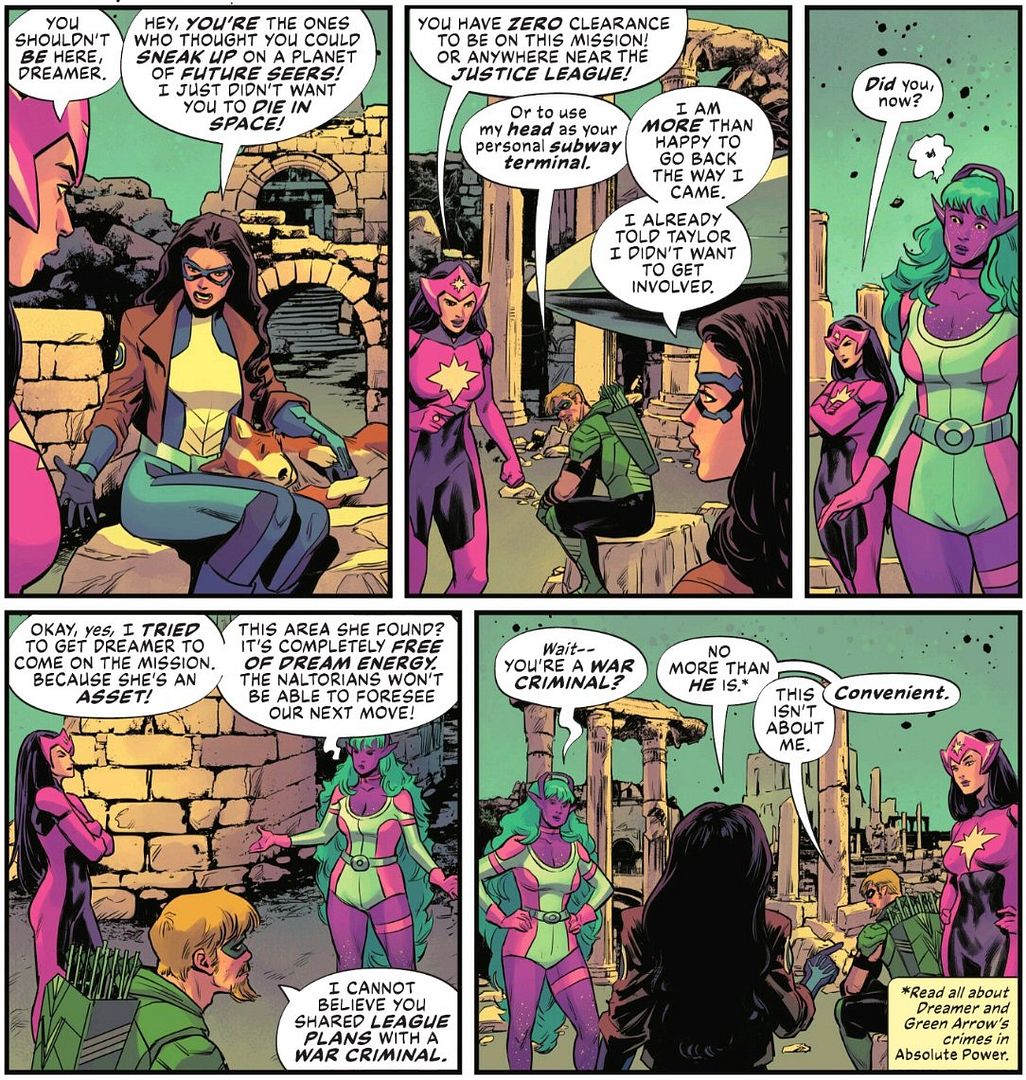
As I will explain further down, I have always felt that both characters are at their best when learning from the experiences and perspective of the other. But in this story, each remains firmly entrenched in a view that doesn’t allow the other in – they are arguing at cross purposes from one another, and not really listening to the other.
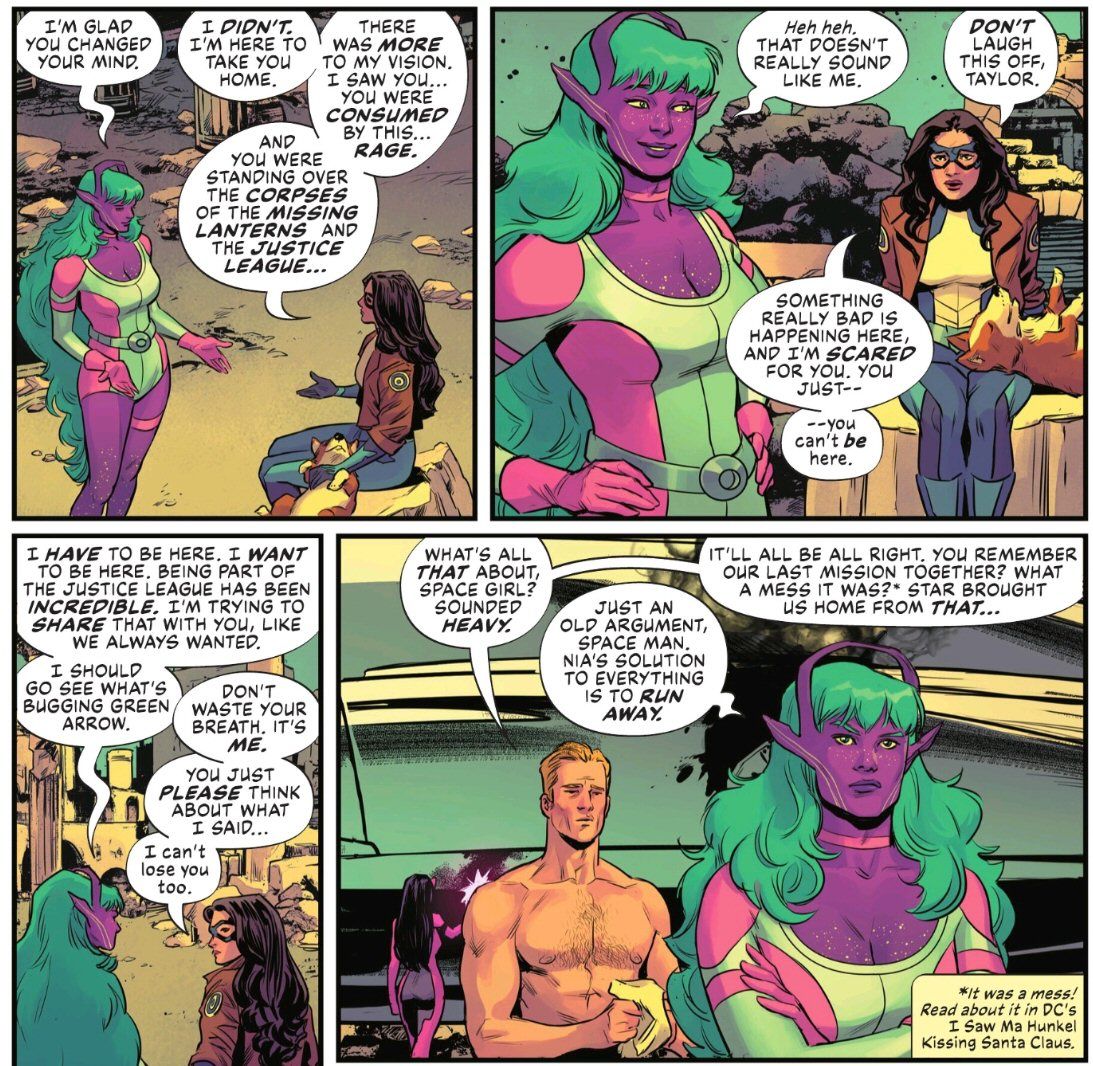
(of course, that doesn’t stop Taylor’s not-a-dog Argus from getting all the lovings from Nia) 🙂
I will come back to the source of this conflict – and the significance it has for the Dream Girls series – after reviewing the background history and ethics of the two characters in detail. But first, I need to introduce some general ethics concepts, including around gender and identity.
Introduction to gender identity and ethics
I have previously provided an overview of some of the main concepts related to identity and ethics in my overview of the Marvel superhero character Vision – including the famous Ship of Theseus thought experiment, an introduction to existentialism, and a detailed discussion of identity meta-ethics and free will. Please follow those links if you are curious to learn more. Here, I want to look more closely at the emerging fields of ethics that concern gender, and most especially transgender.
The best place to begin is with one of the first significant philosophical thinkers about gender identity – Simone de Beauvoir. De Beauvoir was a well known existentialist writer and philosopher, although often over-shadowed in this regard by her famous first partner, Jean-Paul Sartre. But I’ve always felt de Beauvoir has had a greater long-term impact – both on existentialism and through her careful thinking about gender and identity.
De Beauvoir is probably best known for her groundbreaking book The Second Sex (1949), which is often seen as the starting point for second-wave feminism. Her main ethics theme was that women’s oppression is not just a sign of social injustice, but a moral problem because it prevents women from freely choosing and defining themselves. In de Beauvoir’s view, women are socially made through gender norms, institutions and expectations – as epitomized by her famous opening line to the second part of the book: “On ne naît pas femme : on le devient” (“One is not born a woman, one becomes one”).
De Beauvoir didn’t deny a biological role, but argued that “man” had traditionally been defined as the norm in society, with “woman” relegated to other status – making women secondary, dependent, and defined in relation to men. The Second Sex was ultimately a critique of how social expectations turn gender differences into a hierarchy. De Beauvoir wanted to make women’s freedom explicit in all aspects of society, including work, politics, and sexuality. The connection to her form of existentialism (which I will describe below) was in exploring the question of how people can actually live freely when subjected to oppression and social constraints – which is sadly more relevant than ever for trans and non-binary people.
Ultimately, de Beauvoir’s philosophy provided the early underpinnings for understanding the trans experience – by supporting the idea that gender identity is shaped through lived experience and social recognition, not just biology. Later feminist and queer thinkers, like Judith Butler, took this a step further by arguing more radically that gender had no stable core (unlike de Beauvoir’s concept of embodied experience), and is produced through repeated acts and norms in society. Butler referred to this as performativity – an ongoing performance sustained by repeated social conventions. This revised view has become central to modern queer and trans philosophy.
As impactful as The Second Sex was, I have always been especially impressed by an earlier book of de Beauvoir’s – The Ethics of Ambiguity (1947). This was her second major foray into existentialist ethics, where she argued that all human life is fundamentally ambiguous – that is, we are both free subjects who choose and also embodied beings who are shaped by our circumstances. From there she built up an existentialist ethics theory where the goal is not to follow fixed moral absolutes, but to respond to situations by affirming one’s own freedom to choose while also recognizing and supporting the freedom of others: Se vouloir libre, c’est vouloir les autres libres (“To will oneself free is also to will others free”).
This key point – the necessity of willing the freedom of others – was her particularly novel contribution to the field of existential ethics (and one that her men counterparts Jean-Paul Sartre and Albert Camus seemed to have missed). For de Beauvoir, any honest ethical theory must start from the fundamental tension between freedom and restriction, as people are always choosing in the context of specific situations rather than from perfectly neutral or abstract starting points.
To me, these are signs of her innovative feminist thinking, as she foreshadowed two key aspects of care ethics developed in the 1980s – ethics should be specific to the circumstances of a situation, and considered through our relation to others (follow that link to learn more about this modern form of virtue ethics). As we will see below, this is extremely relevant to both Dreamer’s and Galaxy’s journey to becoming superheroines.
And I don’t know about you, but I think we would all be a lot better off if people accepted de Beauvoir’s central claim that freedom is not just personal self-expression – it only becomes ethical when it is linked to concern for other people’s freedom. Valuing your own freedom while denying others is ultimately self-defeating and morally degrading.
A brief consideration of ethics, including trans ethics
Trans philosophy is a very broad domain of meta-ethics, and is concerned with trans experiences, culture, history, and politics – critically, as seen though the lens of trans lives themselves. As with any philosophical field linked to a marginalized community, trans philosophy offers a fundamental critique of the practice of philosophy as it has been traditionally applied (see again my background comments about the historical and persistent cishet men bias of philosophy as a starting point).
The inclusion of trans voices here is key. The rallying cry “Nothing about us without us” (Nihil de nobis, sine nobis) has a long political history, and has been increasingly used by activists for many disadvantaged groups – including, in modern times, those suffering from discrimination due to disability, skin color, ethnicity, age, and gender. Trans philosophy has thus developed as a critical theory, which looks to analyze and challenge systemic power dynamics and relationships in society. By reconsidering traditional questions of philosophy, it generates new avenues of thinking to explore.
In terms of superhero comic book stories however, my position remains that they predominantly provide guidance and insight into normative ethics thinking, not meta-ethics. Note the use of the word “normative” here doesn’t imply any sort of default or preferred state – it is simply what moral philosophy is called today, as it seeks to establish “norms” (i.e., standards, rules, or principles) for human moral behavior. As I explain on my Ethics 101 page, normative ethics considers the question of what people should or ought to do.
There are the three branches to normative ethics. Deontology is concerned with doing your duty to other people, often through the lens of rights or justice. These theories are often principle- or rule-based, and focus on the moral value of the acts themselves (that is, doing the right thing). Consequentialism is seen as the opposite, focusing not on the acts but rather on their outcomes. These theories typically explore the moral burden of making good decisions (that is, doing the good thing). The third branch is virtue ethics, which shifts the focus from the act to the actor – being the best person you can be, typically by practicing virtues that align with your values and goals (that is, being better).
You can see all of these in the disagreements between superheroes, when they argue about which of them is morally right, or how their actions should be judged. As always, I will highlight examples of each of the three for both Galaxy and Dreamer below. But there is an additional approach to trans normative ethics that is somewhat unique and can also be reflected in the comics: how should trans people be treated by others?
This is typically seen through the lens of applied ethics today, especially in medicine and law, with a common four-principle framework:
- • Autonomy, or respecting a person’s right to make their own decisions about their identity and gender
- • Justice, or ensuring respectful and non-discriminatory treatment of all persons, including the fair and equitable access to gender-affirming care
- • Beneficence, or supporting a person’s well-being, which includes gender-affirming care
- • Nonmaleficence, or avoiding harm, including the harm from stigma or unnecessary barriers to care, and mitigating any risks from care
As I’ve previously explained, applied ethics is typically very deontological in its approach. The first two principles above are very consistent with the general rights and justice focus of most deontological theories. For a good general example of the latter two principles, check out my discussion of moral intuitionism in my Jeff the Land Shark overview.
Like in moral intuitionism, none of the principles above are absolute or over-rule the others. You will often see academic arguments about how to balance them, especially in cases involving minors. But I find these are increasingly not good faith debates in our modern era of right-wing politicization and attacks on trans people (especially resurgent in the US and UK). Denying or delaying care to trans youth is a NOT a neutral position as some claim, as it can cause moral, physical, and psychological harm. Trans rights are human rights, and gender-affirming care should be the baseline offered to all people.
Introduction to the characters
I will start with Nia Nal (Dreamer) first – not only because the character appeared earlier, but because exploring key aspects of her ethical core will help inform when we get to Taylor Barzelay (Galaxy). If you really want to skip ahead, you can jump down to my Galaxy introduction, or the combined Dream Girls interaction discussion at the end.
Dreamer – Nia Nal
As previously mentioned, the character of Nia Nal (Dreamer) was created for the CW television show Supergirl (part of the Arrowverse) in 2018, and played by Nicole Maines. The character was an updated version of an old comics character, Nual Nal (Dream Girl), from the 31st century Legion of Super-Heroes. In-series continuity placed Nia as an early ancestor of Nual.
Nia made her jump to the comics in the short story “Date Night” in DC Pride Vol 1, issue #1 (2021), written by Maines herself, and drawn by Rachael Stott. But the first appearance of the character in the main DCU continuity was in Superman: Son of Kal-El Vol 1, issue #13 (2022), written by Maines and Tom Taylor, with art by Clayton Henry.
Here is her opening splash page, where the young heroine – still new in her career – has just apparently broken into Superman’s “impregnable” Fortress of Solitude, and is met by Jon Kent (the son of Superman) and his boyfriend Jay Nakamura:
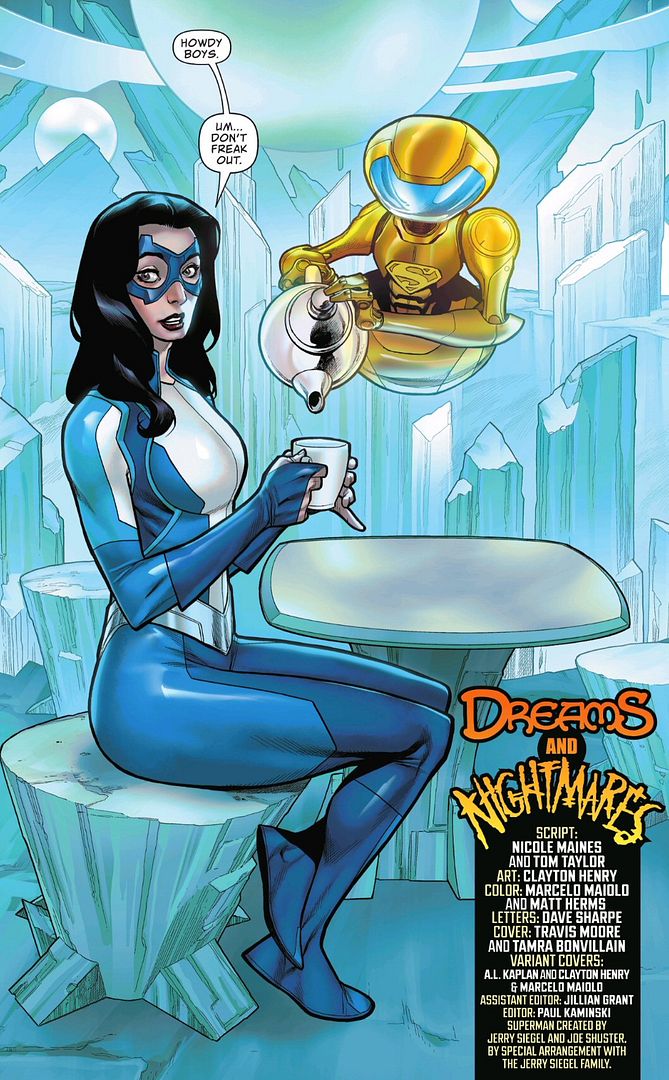
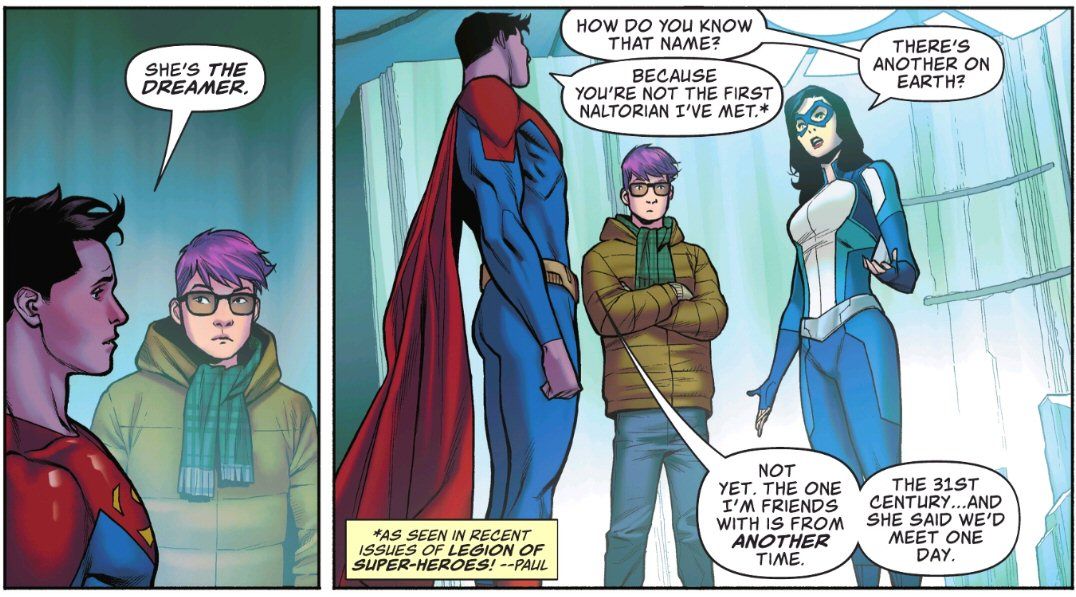
Dreamer is here to warn them of a risk to the Justice League. Note that at this point in time, Jon was also going by the name Superman (it’s a long story). And it turns out Jon recognizes her:
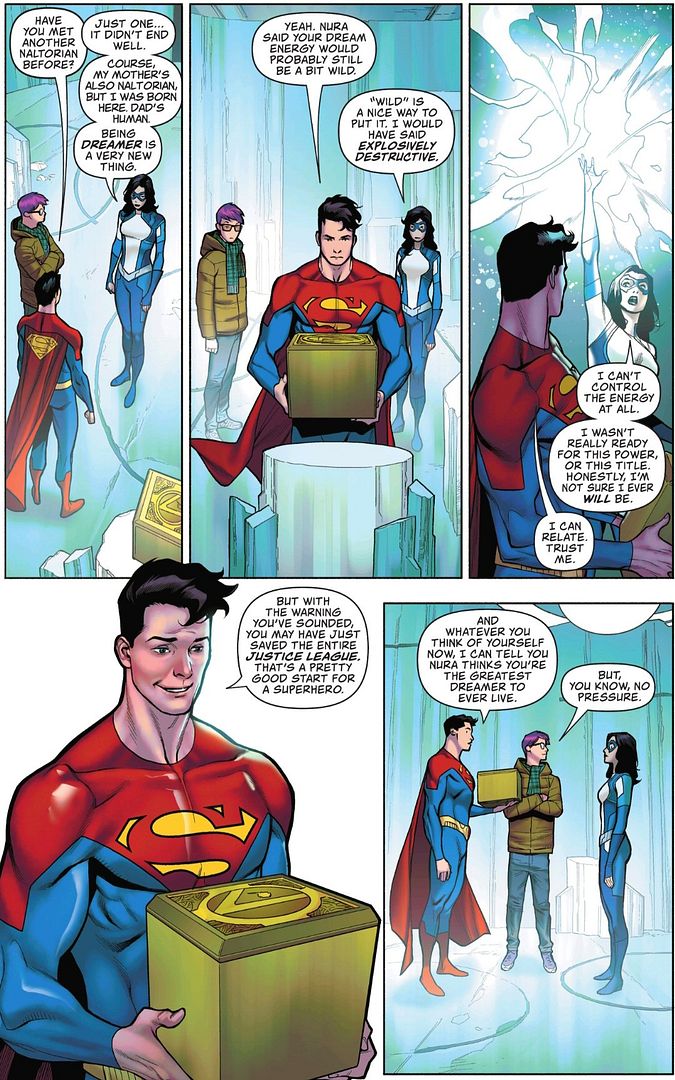
I’ll come back to the present time in the DCU comics in a bit, but it’s helpful to first explore her origin story in the more recent Bad Dream: A Dreamer Story (2024) YA graphic novel, by Maines and Rye Hickman.
The novel starts off with an adolescent Nia before her powers first manifest. Confirming the earlier story above, Nia self-identifies as a half-human and half-naltorian hybrid who was born and grew up in a protected sanctuary on Earth:

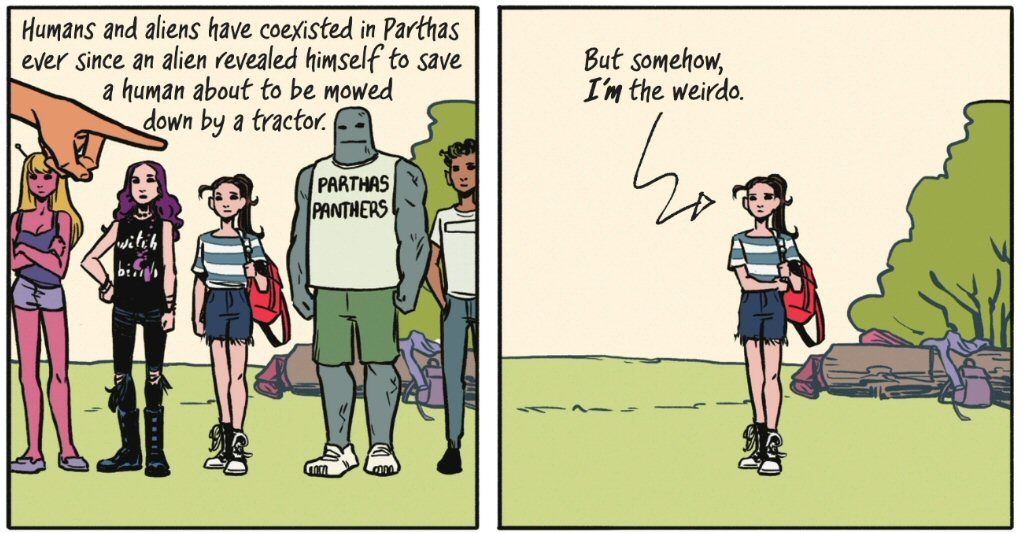
While accepted by her family, Nia still encounters stigma and discrimination in her small community. Indeed, it is a sign of their hostility that triggers the onset of her powers (and the broken nose she is shown with for the rest of the novel).
Nia has always been attracted to stories of her mother’s people – the Seers, guardians that protect their home planet of Naltor from the “dangers of foreseen futures”. The Seers practice an inherited form oneiromancy – divination through dreams – and Nia’s mother Isabel had long foreseen that her eldest daughter Maeve (Nia’s sister) wouldn’t inherit her gifts – and more.
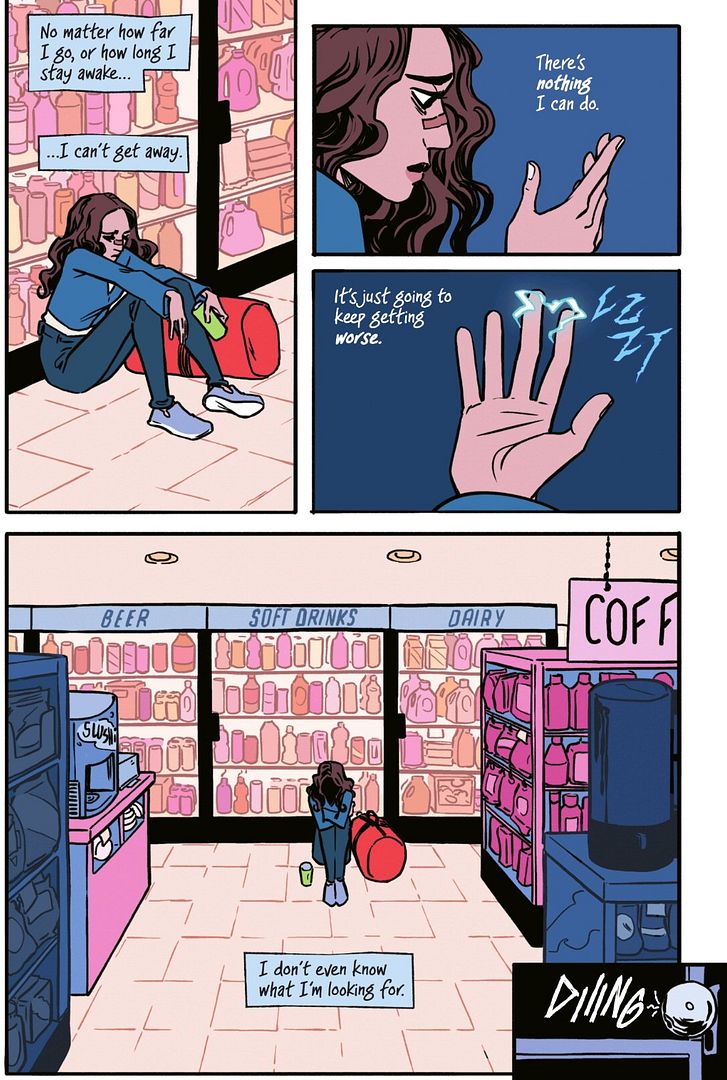
Ashamed of having seemingly ‘stolen’ her sister’s long-sought legacy, Nia runs away and leaves for the nearest big city (Metropolis). There she chugs energy drinks, trying to keep herself awake and not experience her disturbing dreams. Until a chance encounter alters her future:
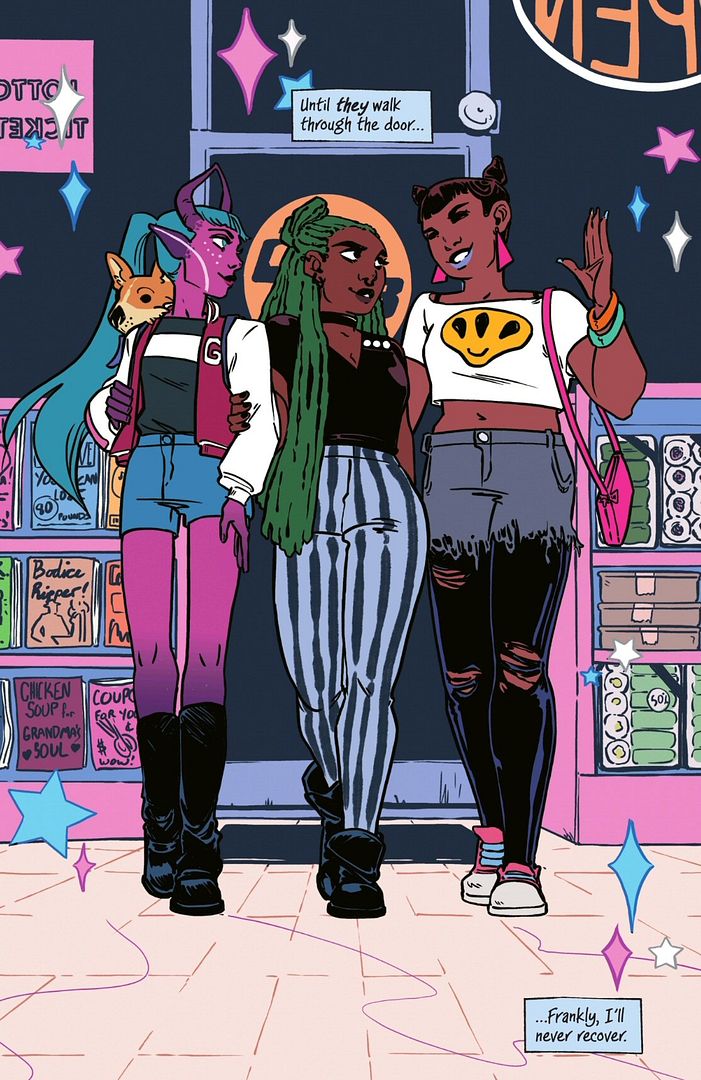
In walked Taylor Barzelay (Galaxy), her girlfriend Kat, and their friend Yvette. Yvette had already appeared by this point in the comics as a close friend of Nia’s, and Taylor and Kat made their debut in Galaxy: The Prettiest Star (2022). The events of this novel thus take place not long after Galaxy’s origin story novel.
The trio take Nia under their wing and help her navigate her new situation. There is soon a very significant point about the hostility that trans (and other non-heteronormative) individuals face:

This is a powerful point about authenticity, about standing up to assert your truth despite any opposition – and how others can react to that.
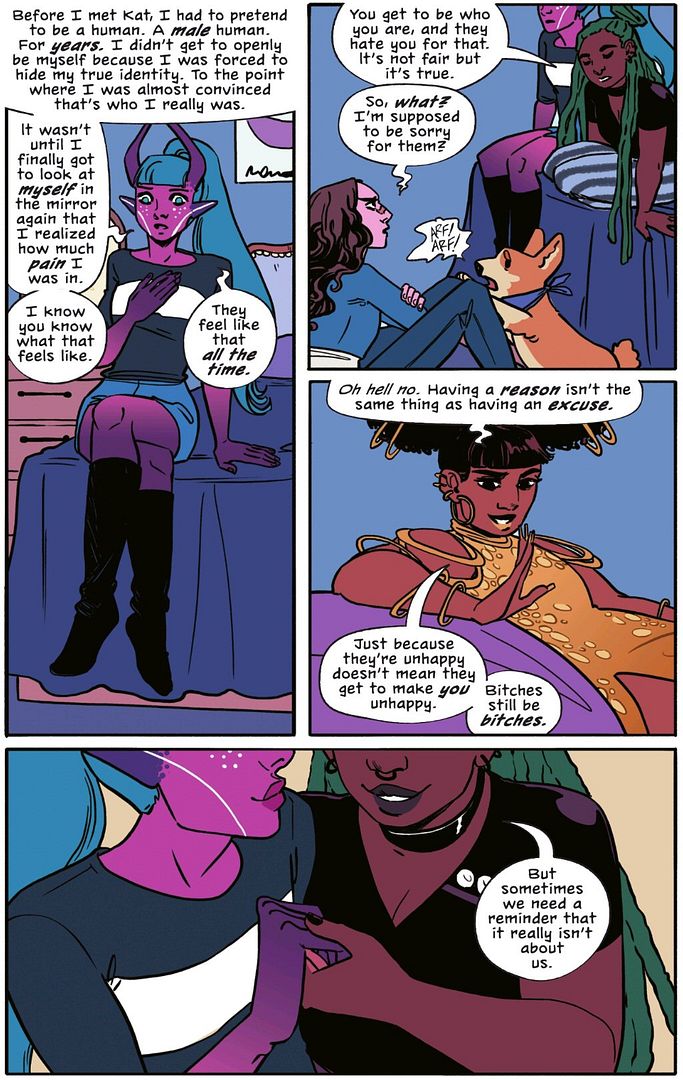
I love these pages. It is a thoughtful and reaffirming position, and highlights the complementary perspectives the trio brings: Taylor uses this as a starting point for empathy, Kat for understanding, and Yvette for activism.
Eventually, once removed from Parthas’ protective shell, Nia is discovered by the Naltorian Sybyll who has been searching the galaxy for Nia’s mother Isabel.
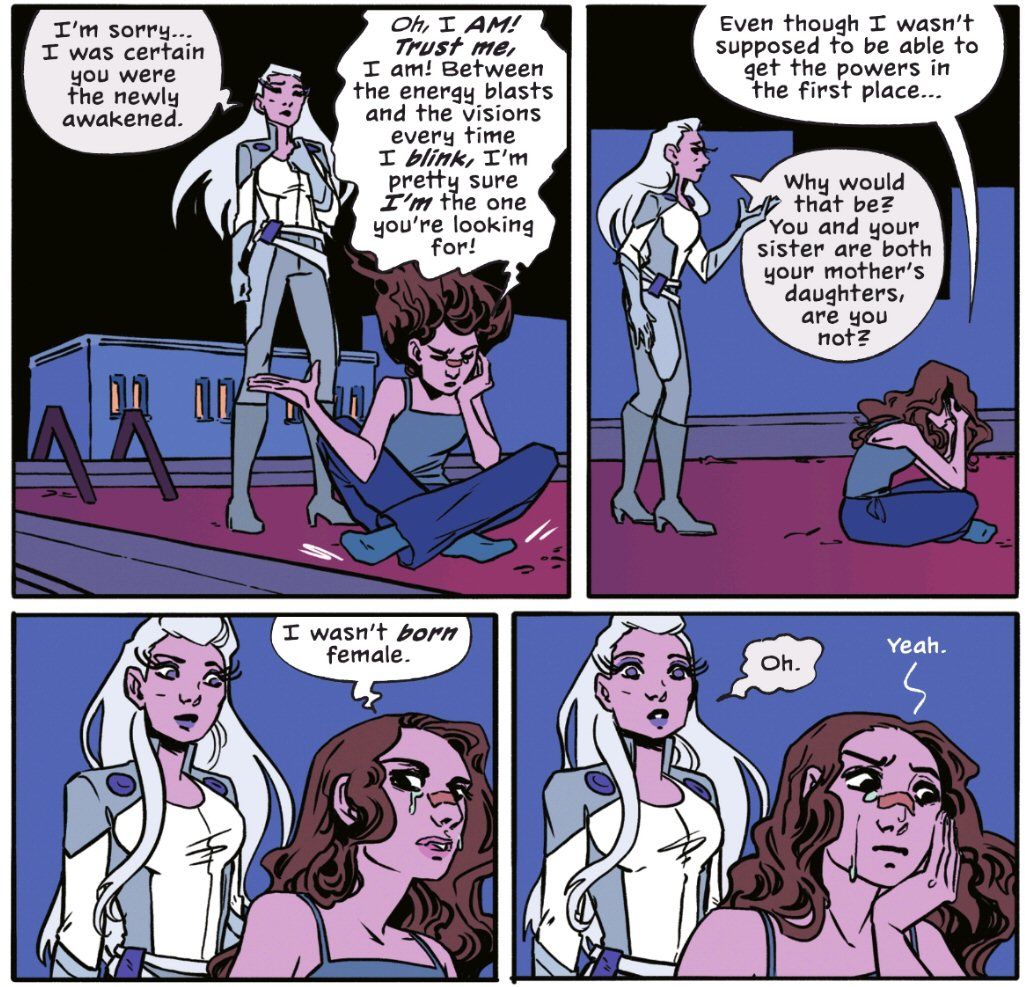
Once Nia explains her early interest in the Seers, Sybyll comes to understand:
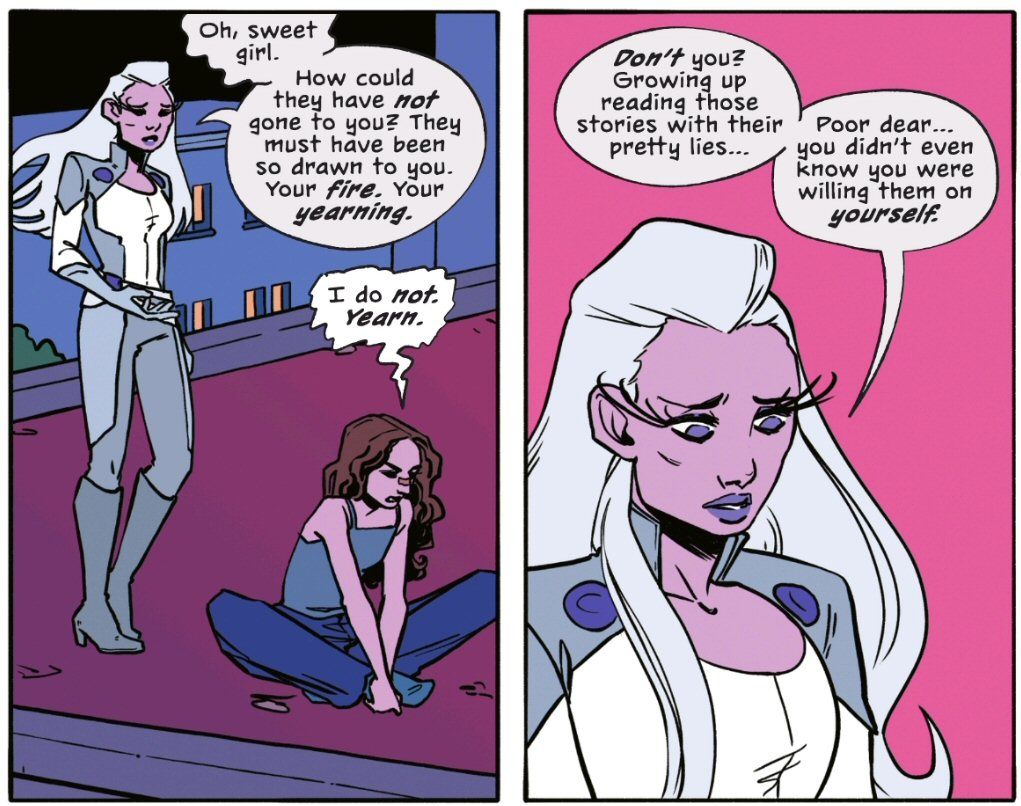
This idea of willing your own power is a powerful one, and a great metaphor for what Nia experiences.
However, Nia was not prepared for all this particular transition entailed. Nia comes to the (false) conclusion that she can go back and will her powers away to her sister Maeve. With her new friends in tow, she returns to Parthas. But things don’t go well when she admits to the situation.
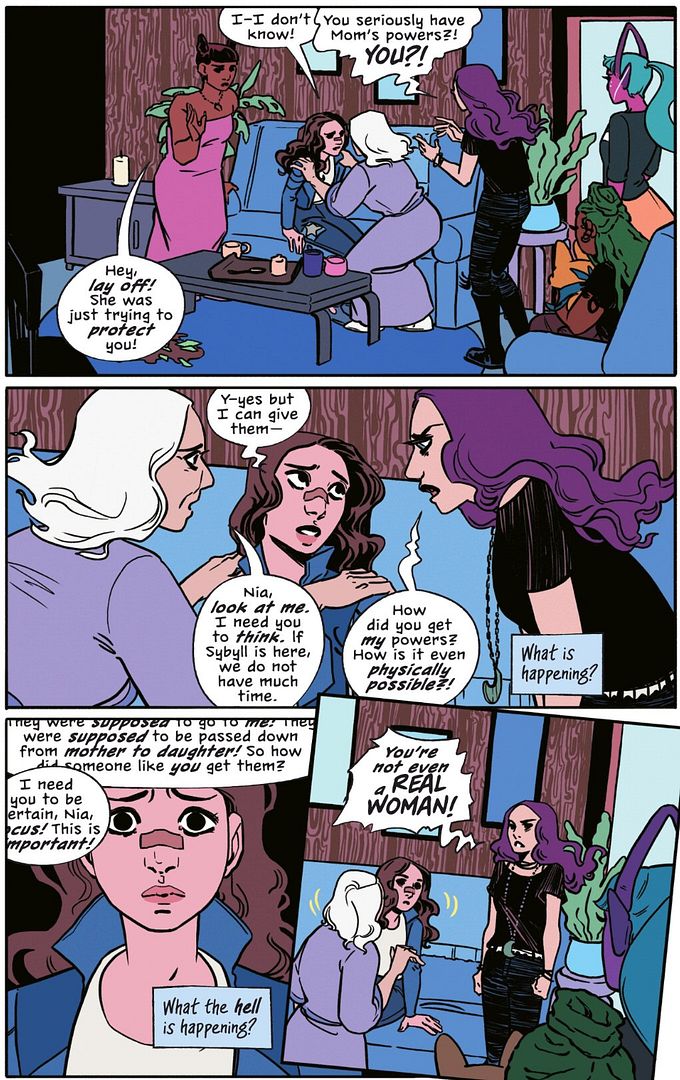
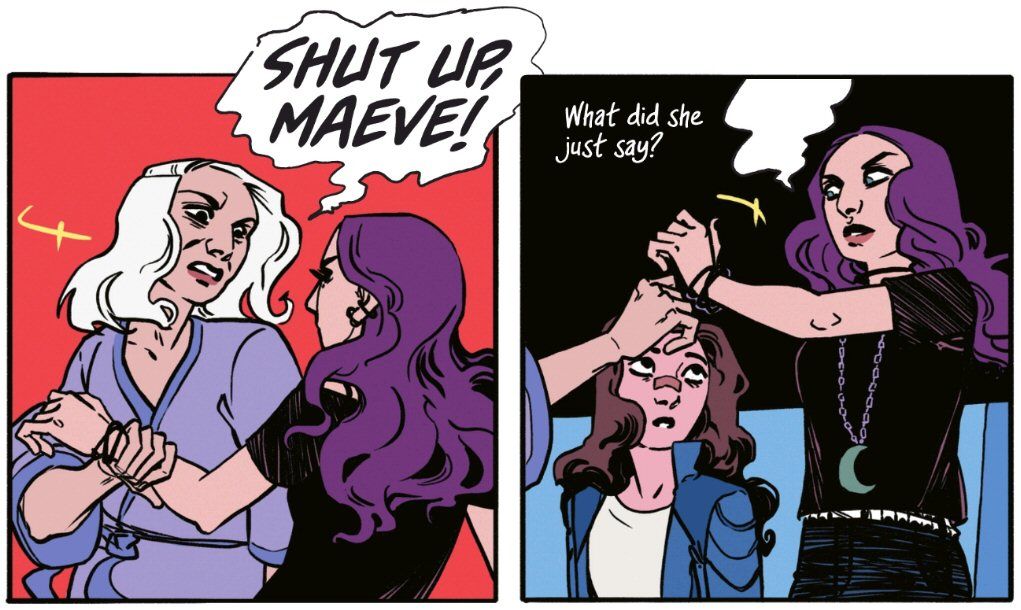
Nia soon passes out from the events above, and she and her mother Isabel get to have some quality time in the dream-space.
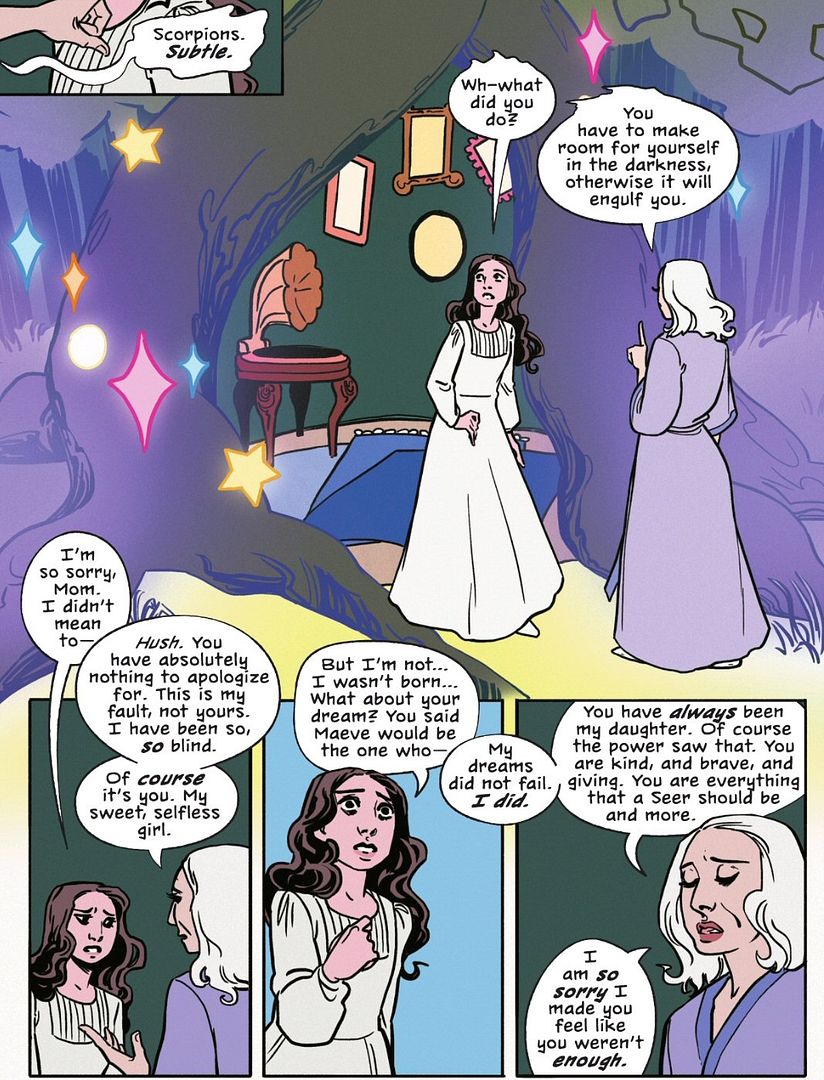
Isabel points out there are infinite possibility for the future, but Nia needs to focus on just two: will she accept this as part of herself, or not?
While Nia considers, it turns out that Sybyll was not being honest about her reasons for tracking down Isabel – she had actually come to kill her and steal her place as the leader of the Seers. In the ensuing battle, her mother soon falters, and Nia awakens just in time to find her mother killed by Sybyll – who then sets her sights on her:
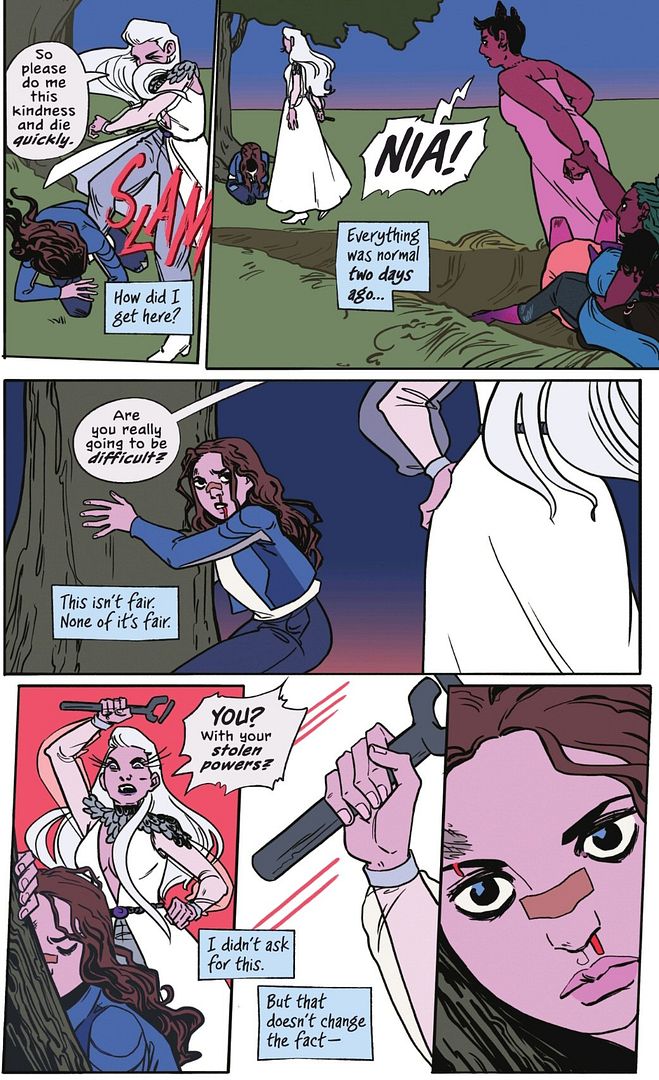
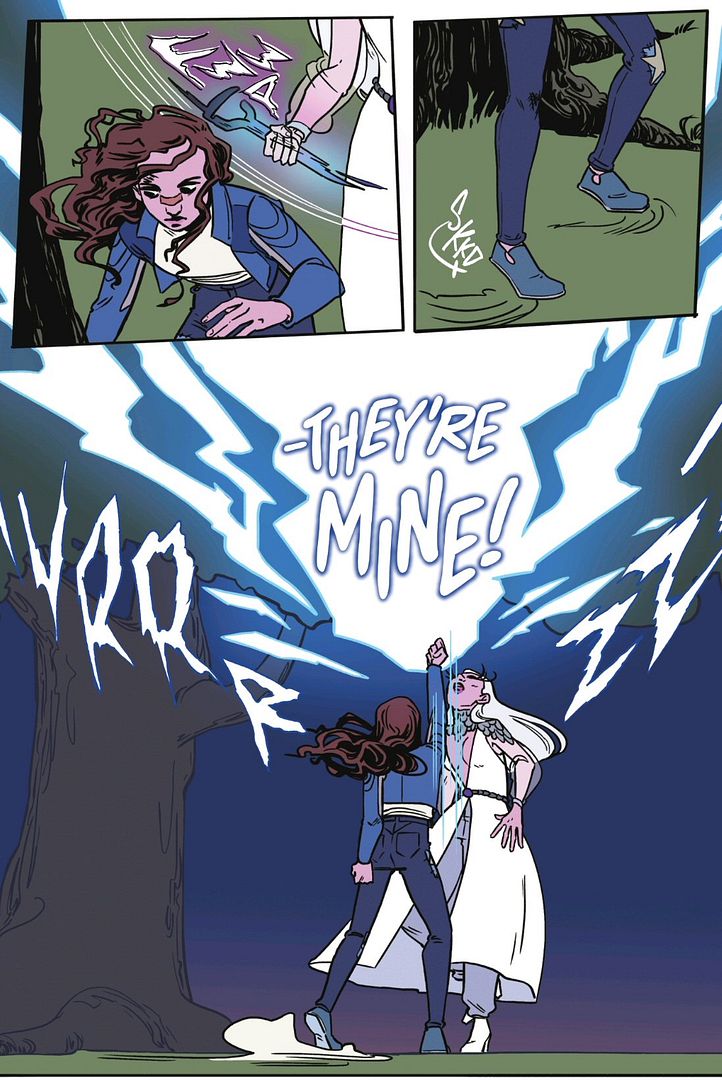
Nia makes her choice, and defeats Sybyll. But the aftermath for her family? Maeve leaves:

This guilt is something that Nia carries with her, and it affects her future development, as we will see.
I like this honest statement as the novel closes:
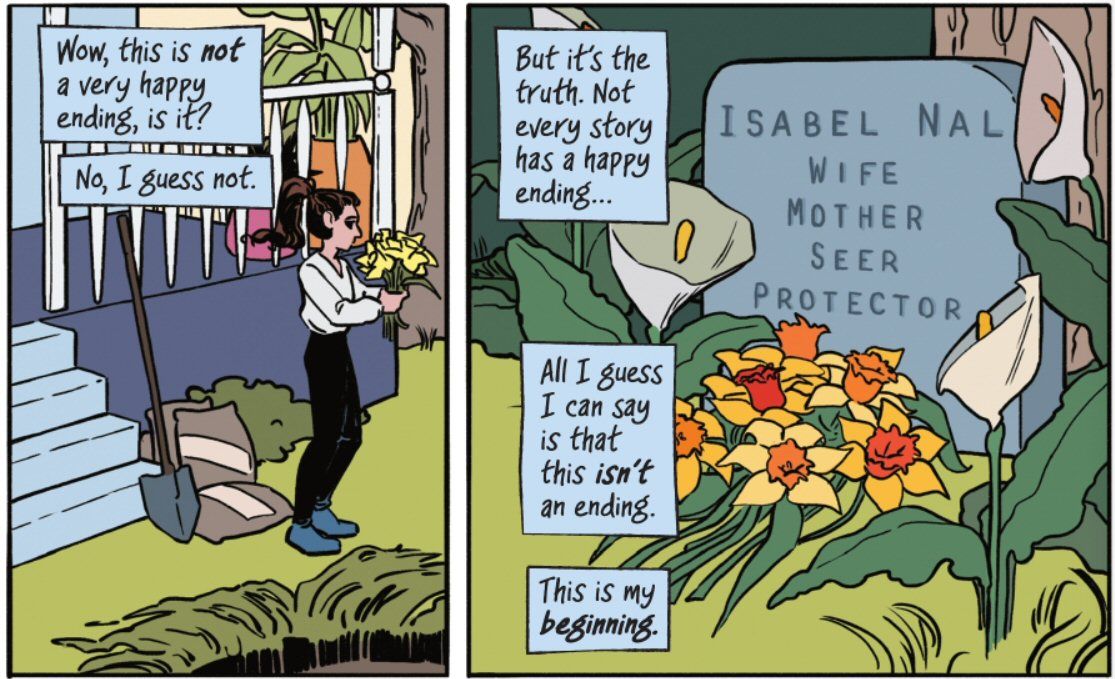
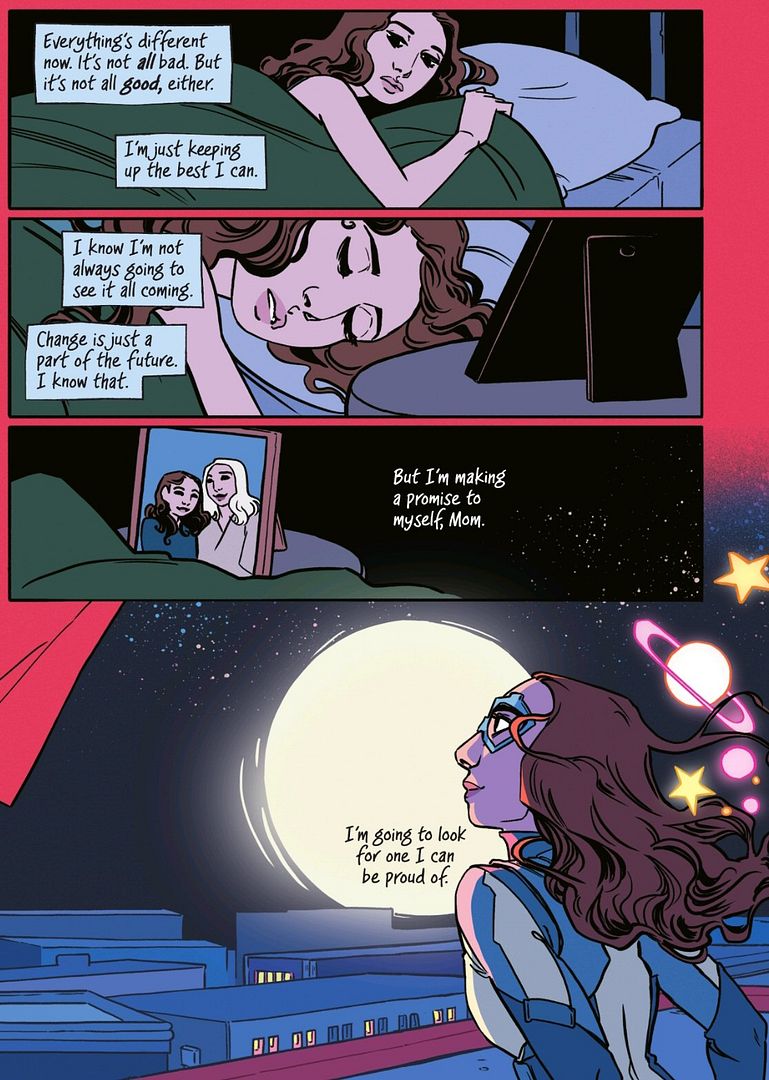
This was a great origin story. Unfortunately, the subsequent adventures of Nia as a new superheroine got off to a rocky start.
Here are a few panels from the Beast World event, summarizing her first outing as part of the Lazarus event. From Titans: Beast World Tour: Metropolis Vol 1, issue #1 (2024), by Maines and Steve Orlando, with art by Fico Ossio
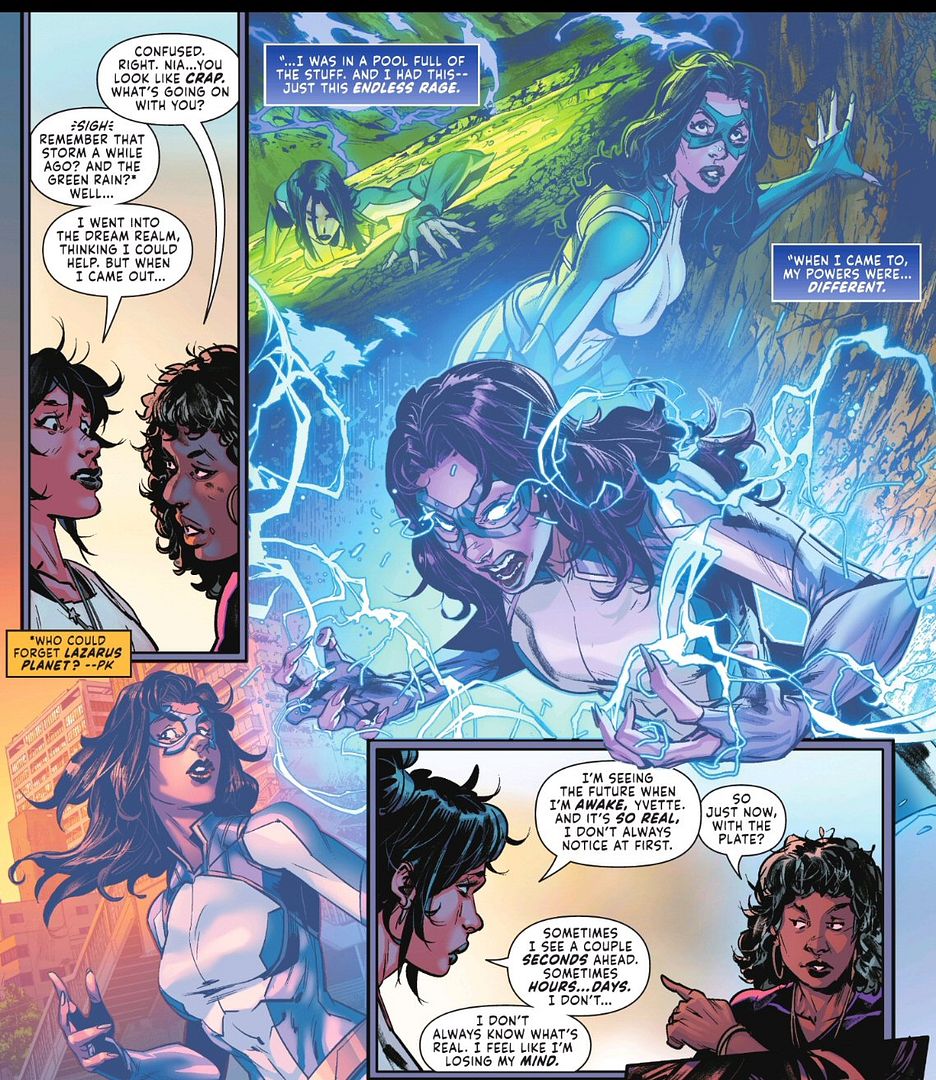
With Jon’s help again, and despite her self-doubt, Nia manages to save the residents of Metropolis – but inadvertently reveals her presence to one who has been searching for her:
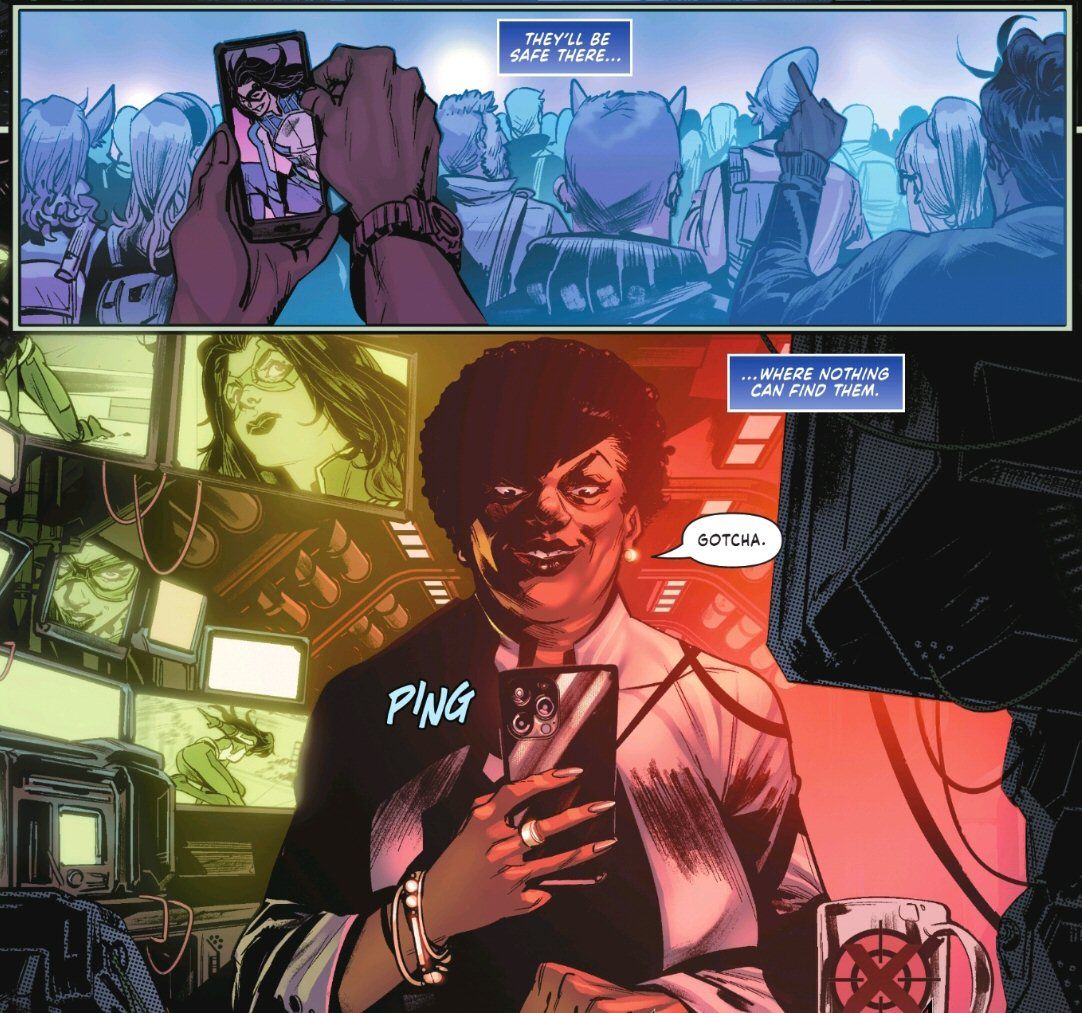
Amanda Waller is a complex figure in the comics. Notice below how she begins by blackmailing Nia, threatening to reveal the location of Parthas. From Action Comics Vol 1, issue #1060 (2024), “Squad Dreams” by Maines, Orlando, and Ossio:
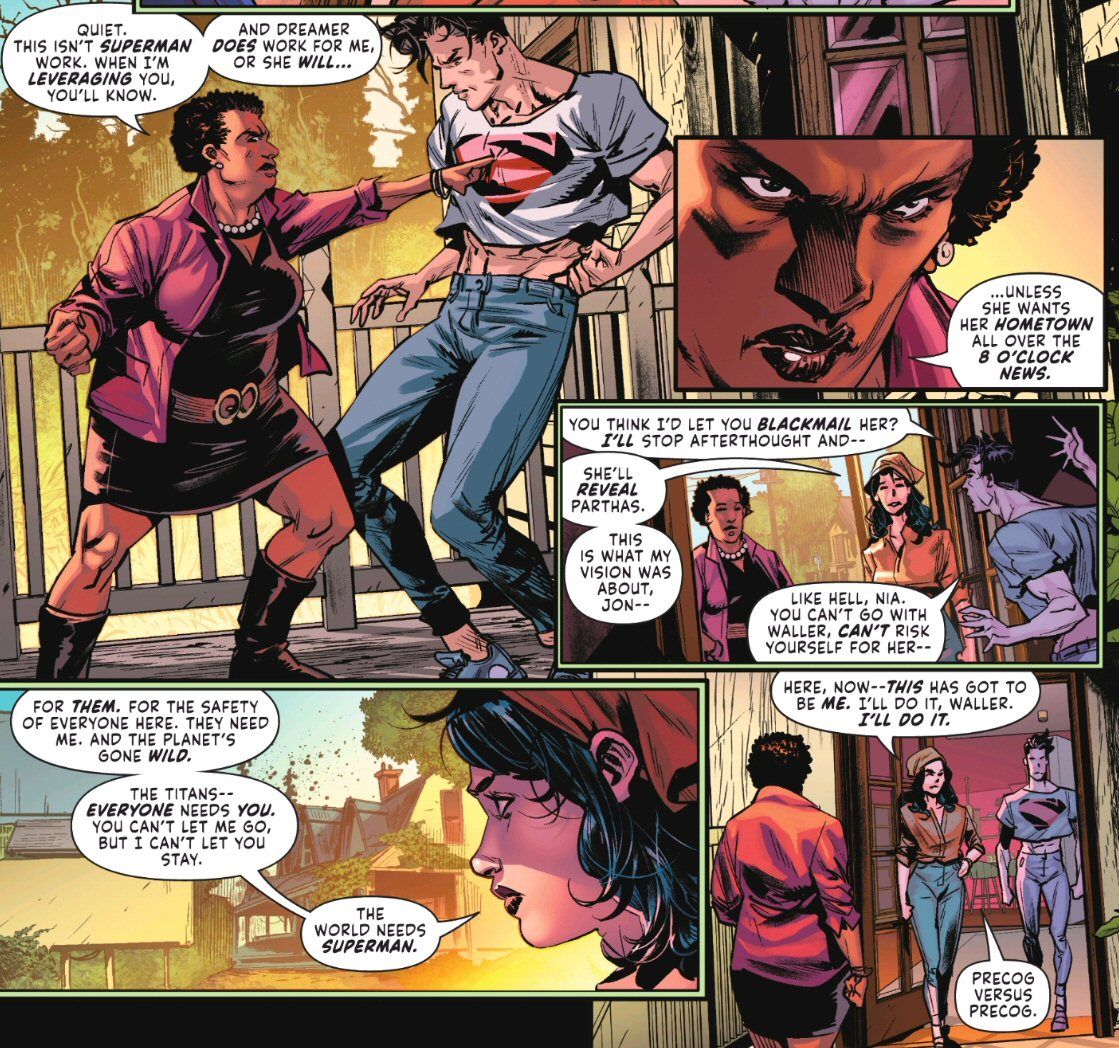
Waller’s successful manipulation of Nia ultimately leads to this reveal of her true intentions:
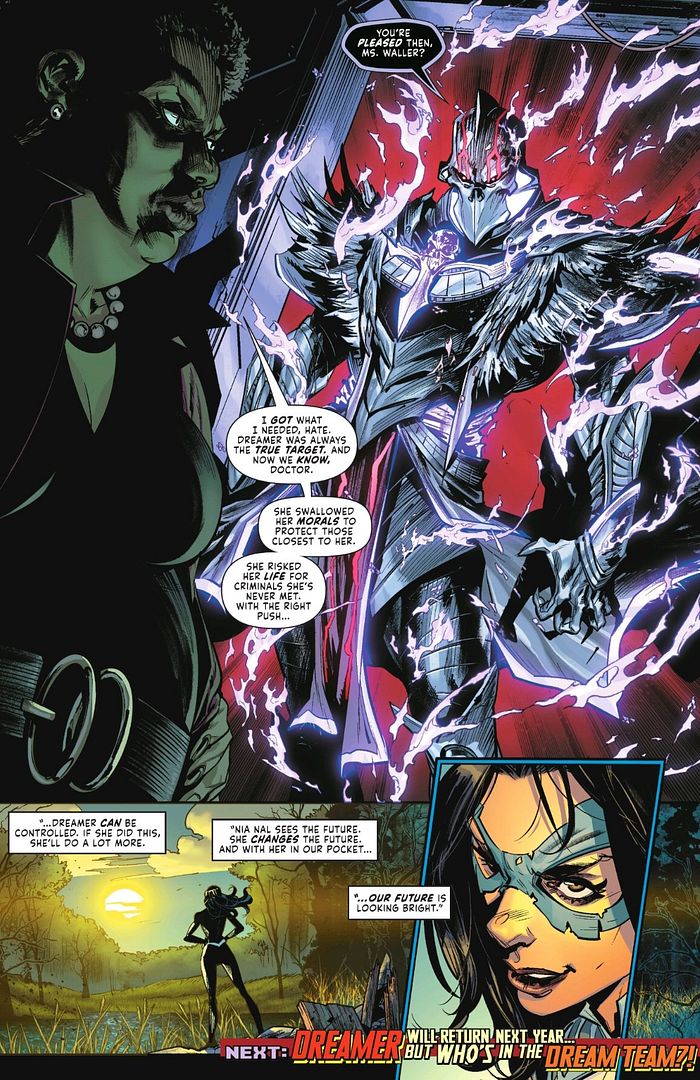
Nia (and Maines) then get their own dedicated Dreamer series (Suicide Squad: Dream Team), where Nia leads the Suicide Squad on a mission for Waller. Of course, things don’t go well from the start, when Nia inadvertently kills a host she dream walks through.
This leads to a nice scene with a very understanding Harley Quinn, who Nia opens up to. From Suicide Squad: Dream Team Vol 1, issue #1 (2024), by Maines and Eddy Barrows
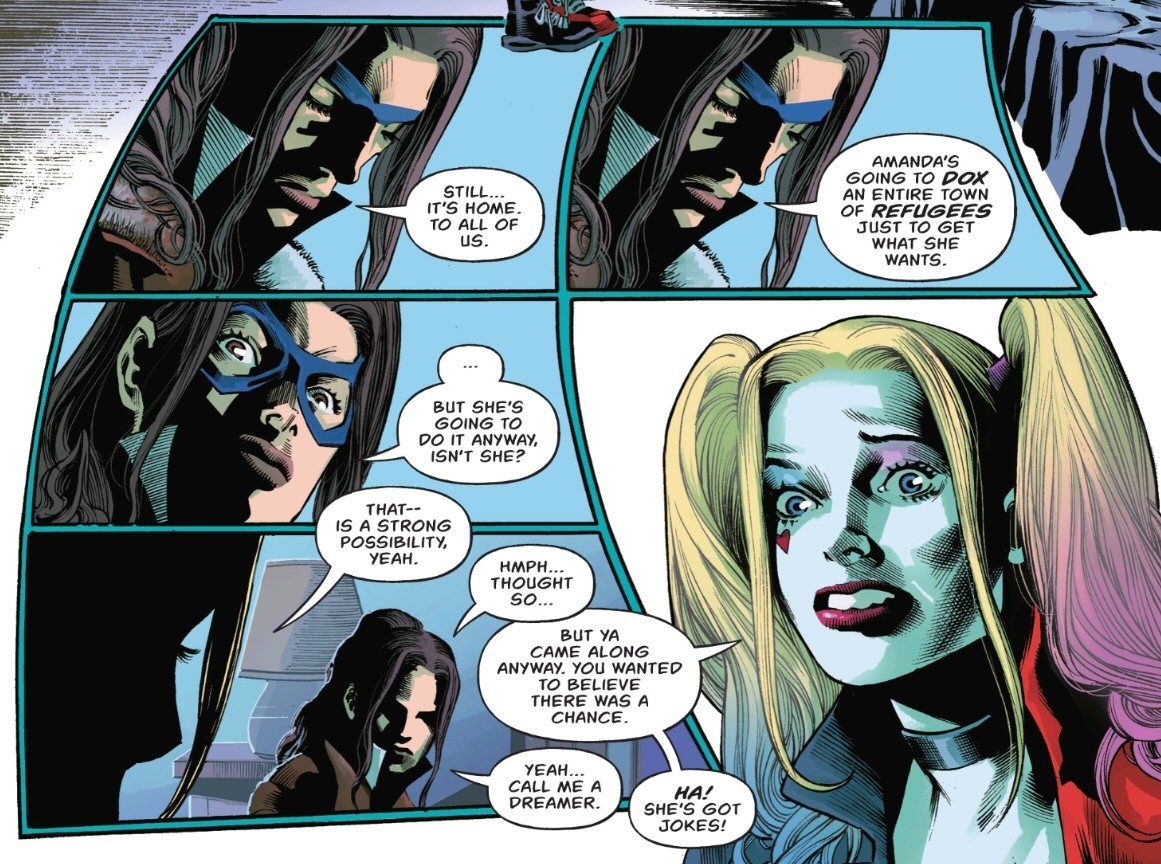
There interactions are a lot of fun – and I didn’t expect Harley to be the voice of reason on superhero ethics!
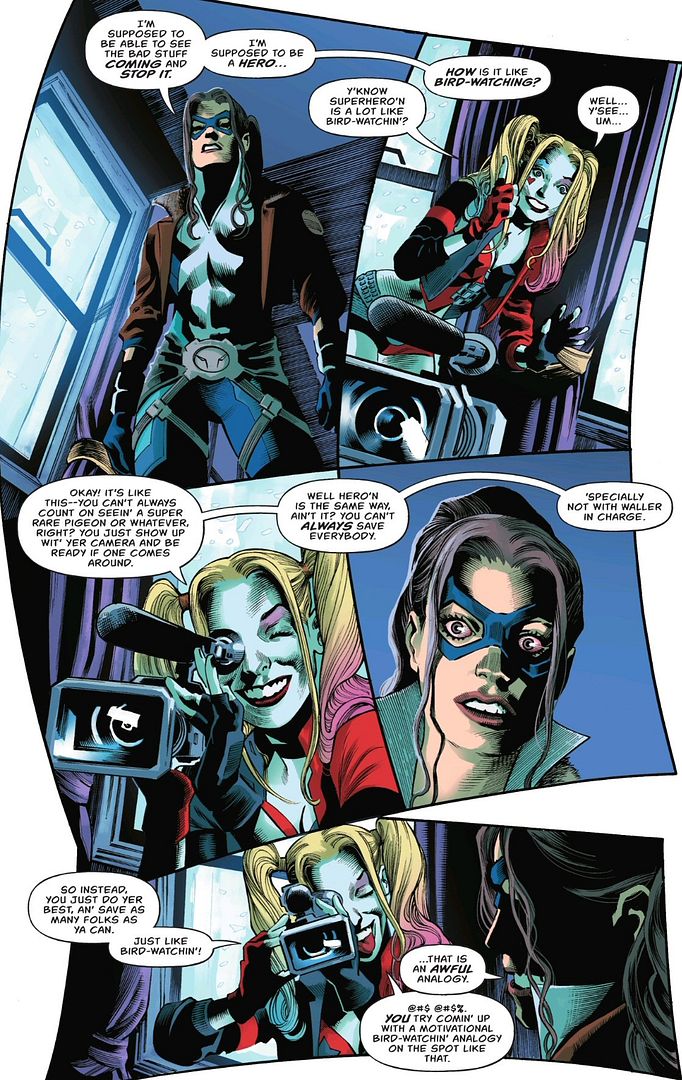
Fundamentally, Nia’s challenge is that she is torn between the three main conflicting ethics theories.
On one hand, her early ideals (expressed through her origin story above, and that of Galaxy‘s below) show her wanting a future she can be “proud of”. You can also see this in her close relationships to Yvette and Jon Kent – she has a strong desire to do the right thing and bring about justice. Trying to live according to a set of principles like that is very deontological, much like his father’s early Kantian ethics phase (as I’ve previously described for Superman here).
But her precognitive powers give her the unique ability to see potential outcomes. She has thus come to adopt a consequentialist outlook where she is trying to help bring about better outcomes – to do the good thing for as many as possible.
A common problem with these classically opposing ethics positions is that they are both very abstract and universal in their application. They must always apply to everyone and everything (and to the exclusion of the other). But Harley challenges her to consider a more relational perspective, in line with virtue ethics (“just do yer best“). And Nia does have some clear tendencies in that regard, as evidenced by her motivation when first joining Waller – protecting the townsfolk of her home (which seems very care ethics).
While Nia has been struggling to work through these competing ethics drives, she has unfortunately been slow to realize who she is dealing with. Waller’s egoistic consequentialism makes her a classic comic book villain – in the mold of Lex Luthor, or Marvel’s Doctor Doom or the early Magneto. Waller will use anyone or anything to advance her concept of the greater good, and has none of the ethical qualms that paralyze Nia.
Nia does try to get out of her present difficulty, but her lack of understanding of Waller means that her attempt to call Waller out on her consequentialism doesn’t go well. Indeed, Waller explains how Nia’s participation on this mission gives her one more thing to to blackmail Nia with. From issue #2, also by Maines and Barrows
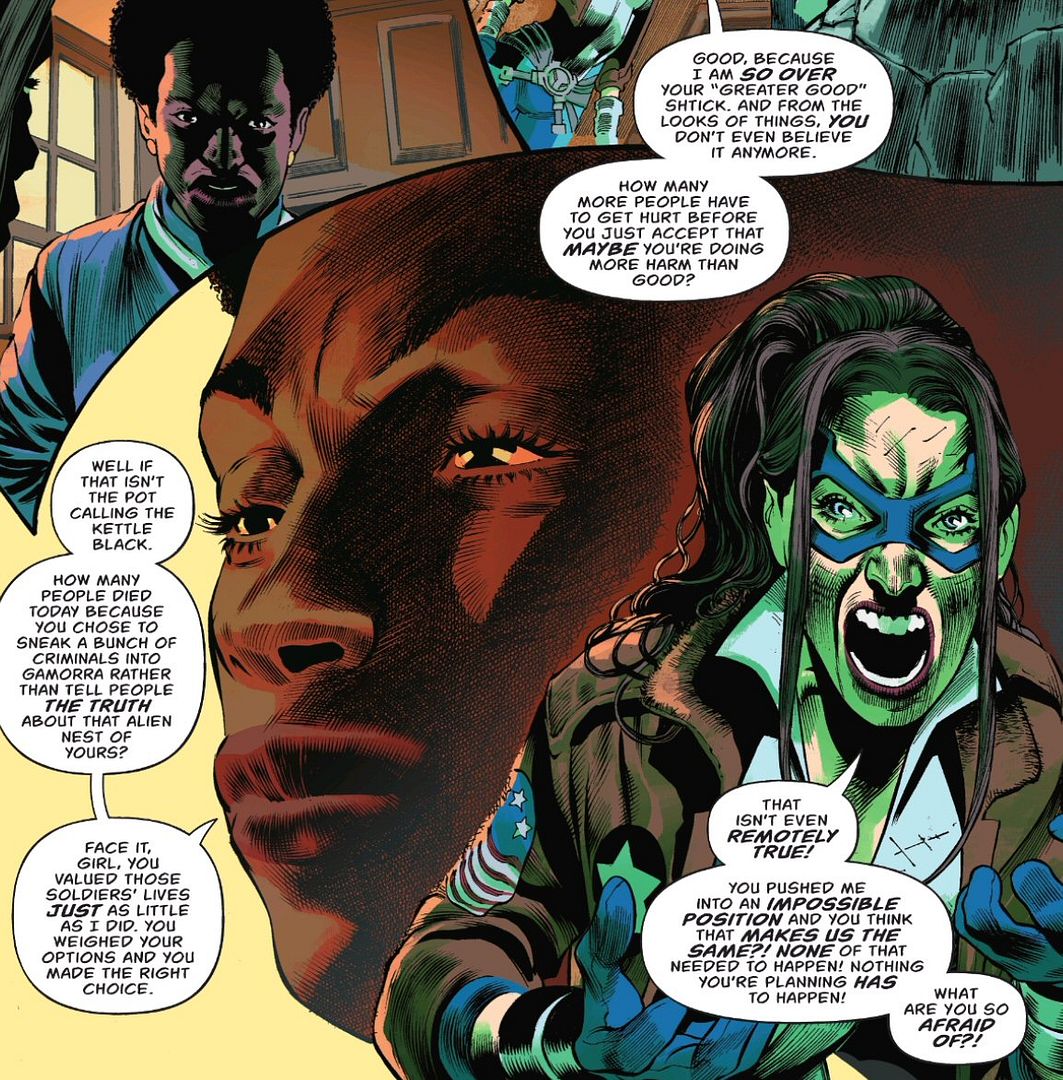
Even worse for Nia, this entire exchange reveals another fundamental weakness of her position – one that Waller is quick to recognize and exploit:

Nia similarly doesn’t have a lot of luck convincing her teammates to rebel against Waller. From issue #3, story by Maines and art by Barrows and José Luis
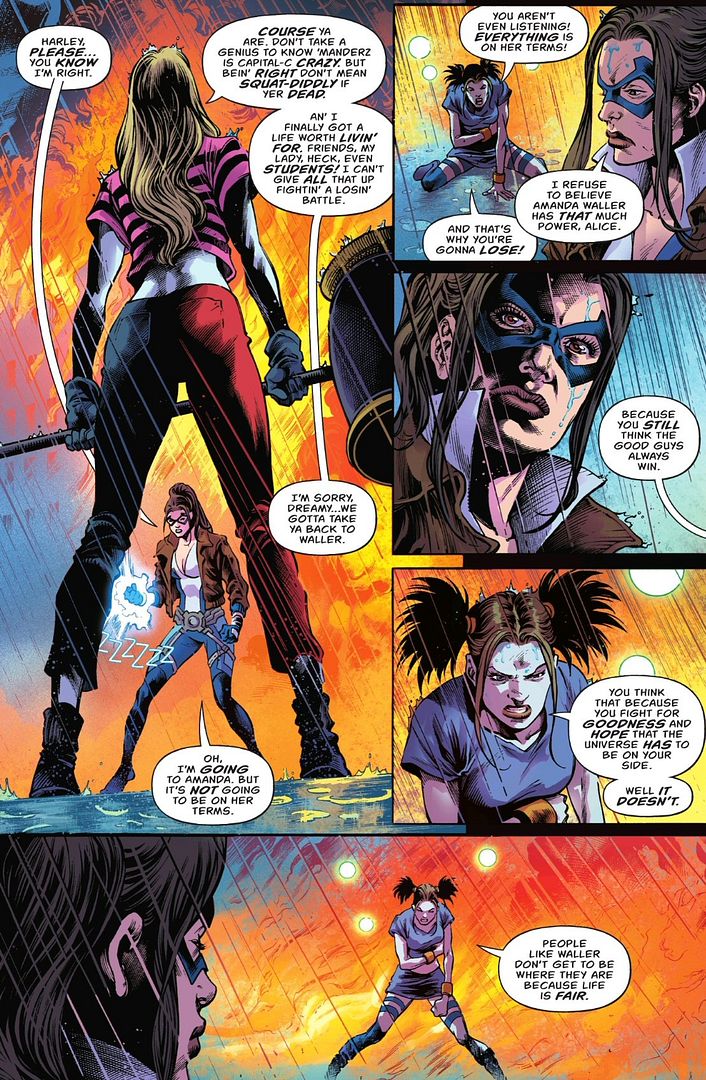
Sadly, her teammates – Black Alice above, in particular – are correct. Nia has naively walked into a common ethics trap – she has assumed her own good intentions and desires will lead to good outcomes. But not when you are up against a ruthless and skilled manipulator like Waller.
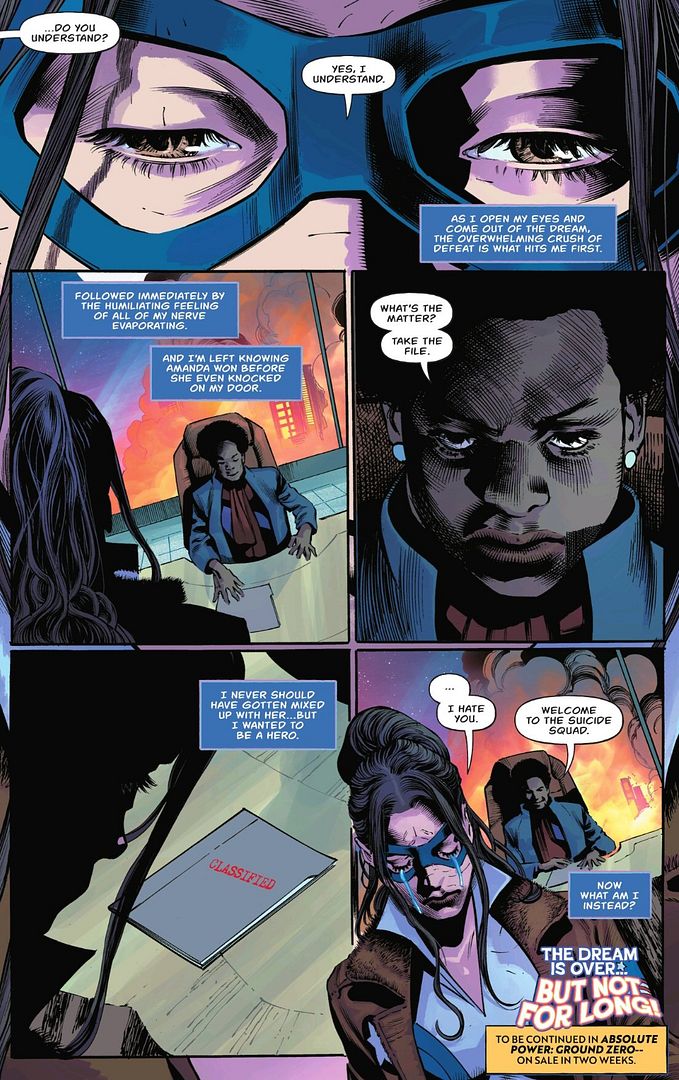
At the end of the mission, Nia realizes she has been used as part of a much larger scheme that Waller has – to take over the world (which included killing her friend Jay’s mother along the way). Nia then dreams of killing Waller – but learns that Waller has planned for that too, by implanting tech in Nia’s father and sister that will kill them instantly if Waller dies. Nia realizes she is completely stymied at the end of issue #4, story by Maines, art by Barrows and Eber Ferreira:

The prelude to the Absolute Power event has Nia help Waller catch Jay. She comes to see him in jail, revealing the truth of his mother’s death to her. It doesn’t go well. From Absolute Power: Ground Zero Vol 1, issue #1 (2024), story by Maines and Mark Waid, art by Skylar Patridge
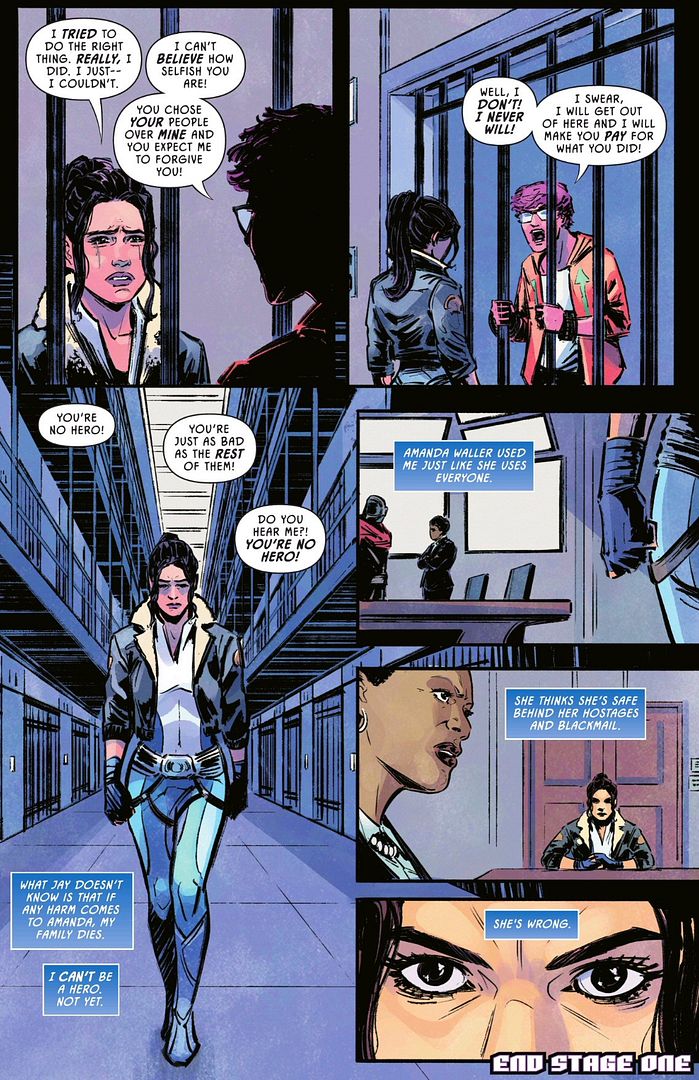
Note Nia’s stated desire to be deontological (“I tried to do the right thing”) – and Jay’s condemnation of her for her narrow care ethics decisions (“You chose your people over mine”).
It turns out that Nia is critical to Waller’s plans for world domination – which involves discrediting superheroes and ultimately stealing their powers (detailed in the Absolute Power event). On the run, the remaining supes fall back to Superman’s Fortress … but as we’ve already established, both Jon and Nia have access to it. Jon, under cyborgified control by the Brainiac Queen, breaks in with her and directly attacks, while Nia secretly dream walks in with Global Guardian, who starts draining all of their powers.
Horrified at what she has done – and what Waller has turned Jon into – Nia finally rebels, freeing Superman from the Brainiac Queen and allowing him to be transported out with the remaining heroes. Superman had initiated the Fortress’ auto-destruct, and Nia stays behind in an (ultimately futile) attempt to stop the Brainiac Queen. From Absolute Power Vol 1, issue#2 (2024), story by Waid with art by Dan Mora
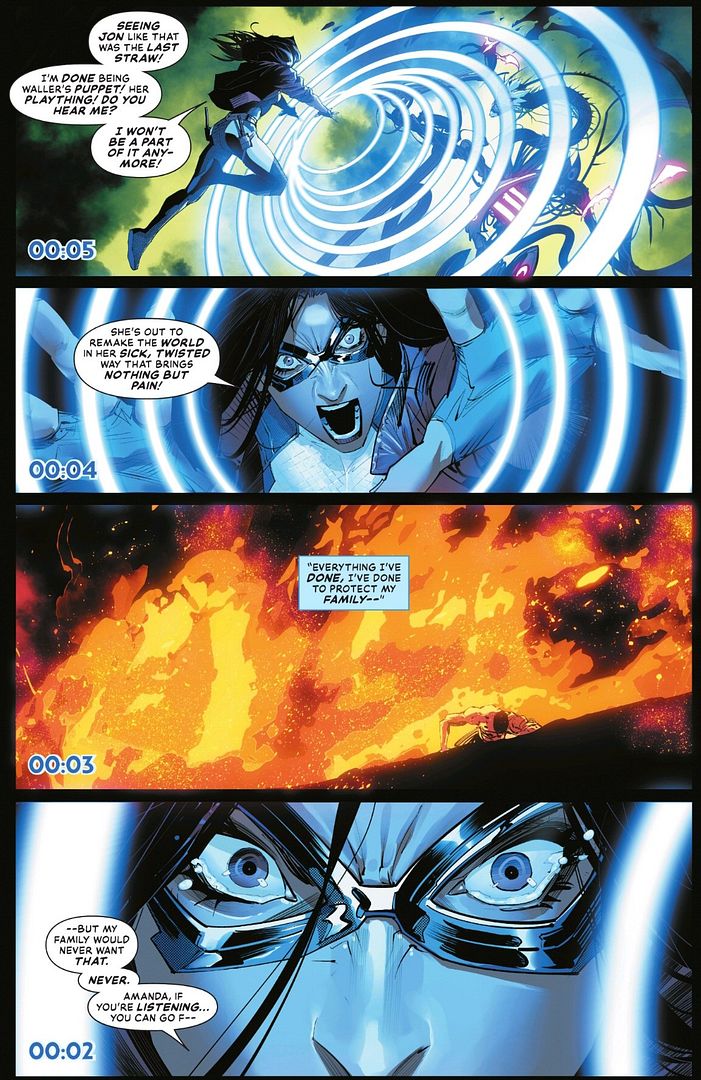
Nia physically dies in the explosion, but the Brainiac Queen is able to quickly restore herself.
However, it turns out the cyborgified Jon had reached out to Nia in the dreamscape, where he mentally fled while his body was being controlled. There is a great one-off story co-written by Maines on their time together, as the Brainiac Queen tries to break through his last psychic defenses. From Absolute Power: Super Son Vol 1, issue #1 (2024), story by Sina Grace and Maines, art by Travis Mercer and John Timms:
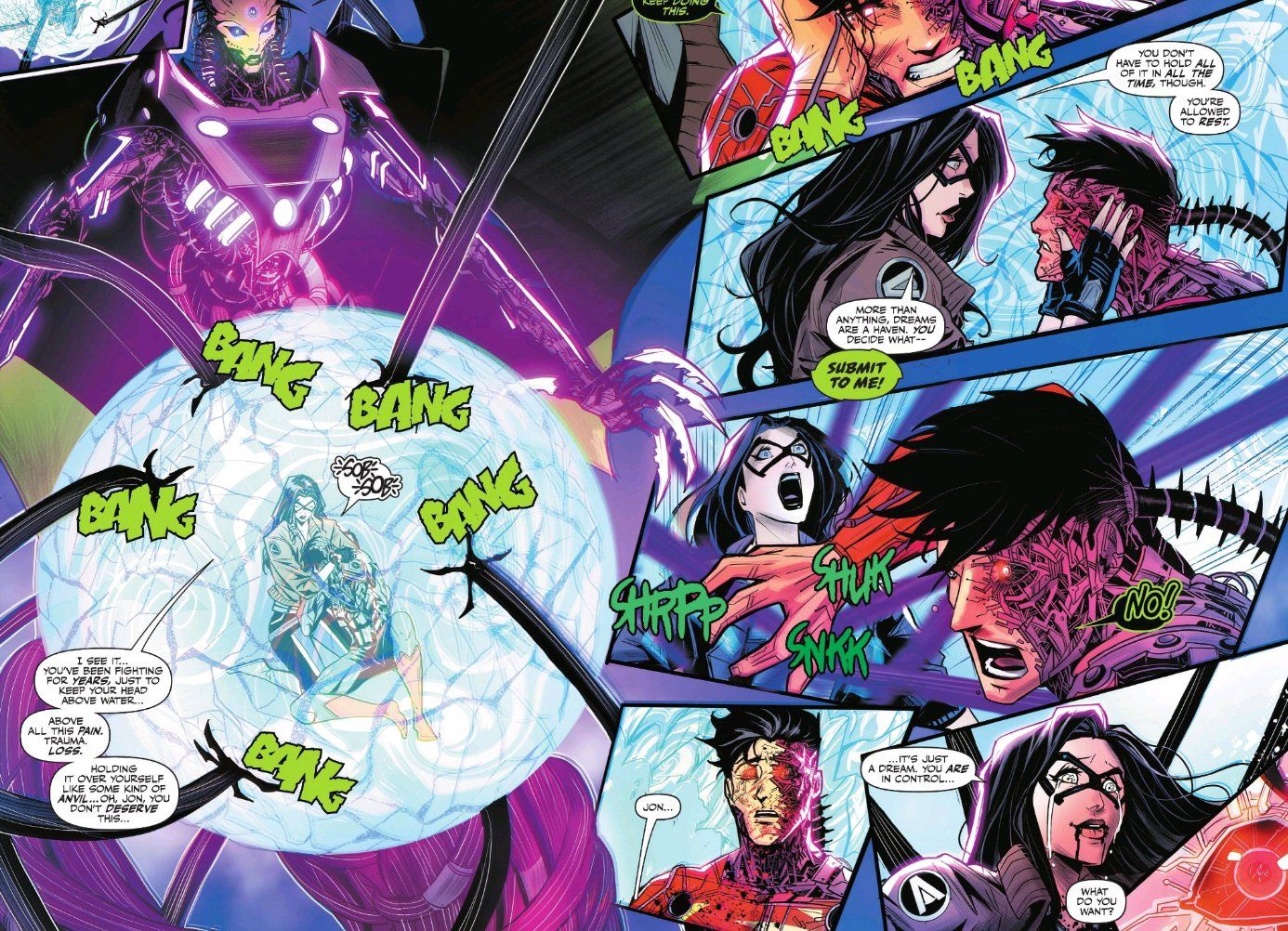
Eventually, the Brainiac Queen is defeated, and Jon regains control. Of course, he had seen Nia in the Fortress, and realizes she is dead in the real world now. We are treated to this lovely scene at the end:
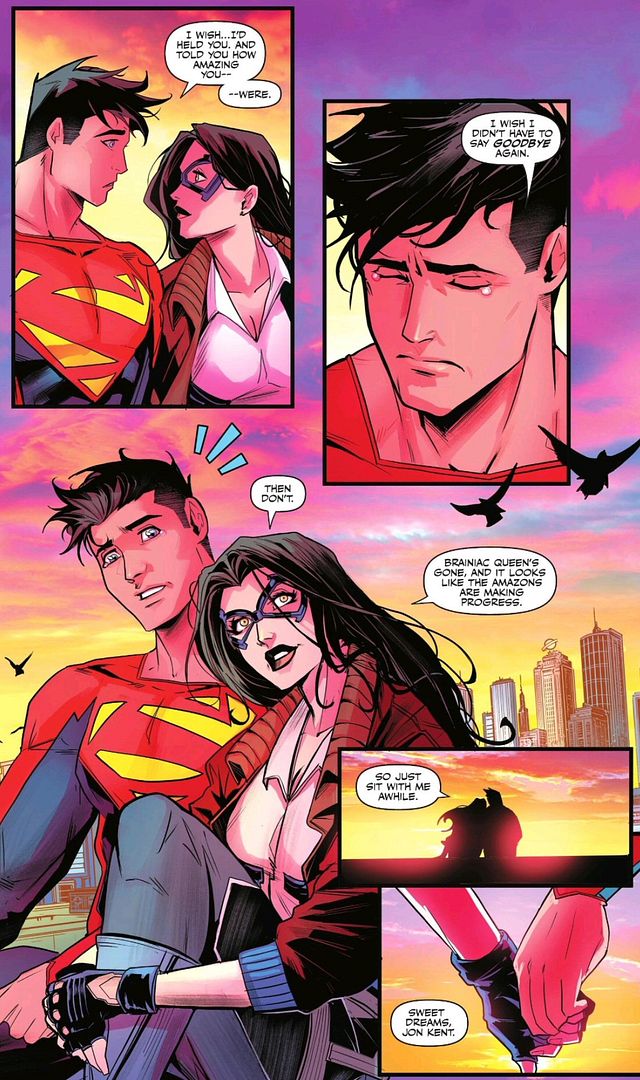
It turns out it is hard to kill a dream too!
I like how this issue hints at Nia and Jon’s burgeoning feelings for each other. It becomes increasingly clear over the subsequent stories that they both have strong feelings for one another. And I love the little touches throughout the stories that tie-in to that point (recall the Superman t-shirt Nia was sleeping in at the start of the Justice League International Special?). It seems obvious to me that Nia is secretly in love with him now, and Jon likely reciprocates.
But how does Nia survive? The conclusion of Absolute Power, with issue #4 (2024), by Waid and Mora:

As always with these sorts of events, the heroes eventually prevail, and things go back to pretty much the way they were before (more or less). But how to deal with Waller? It turns out, Nia had an … interesting … solution.
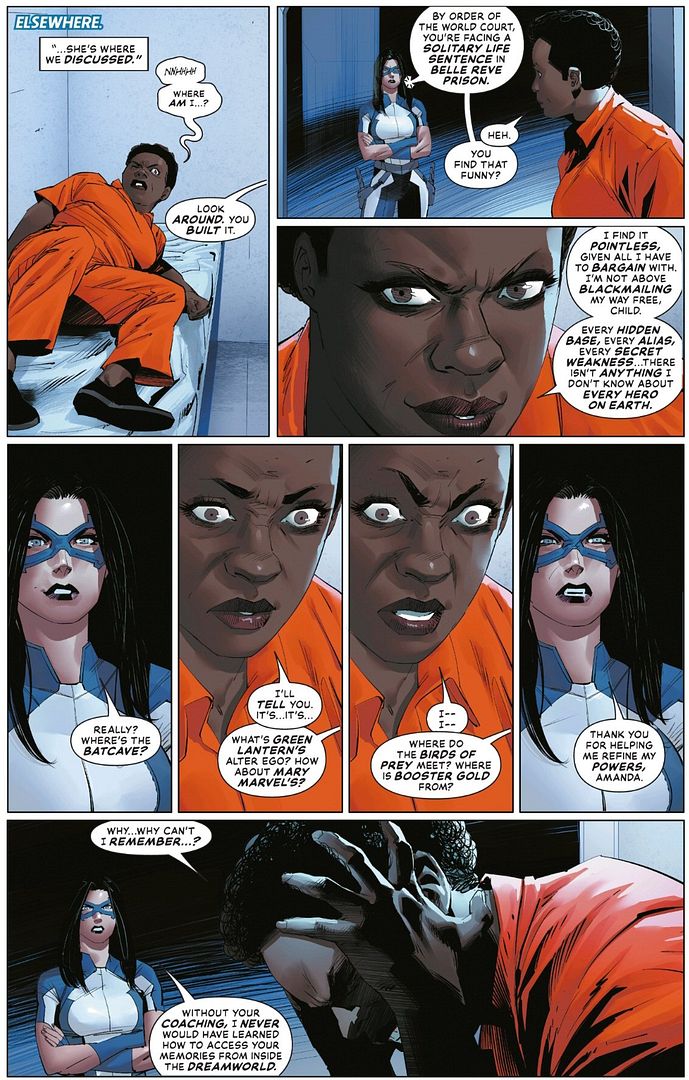
That’s an unexpected expansion of Nia’s powers. But their use?
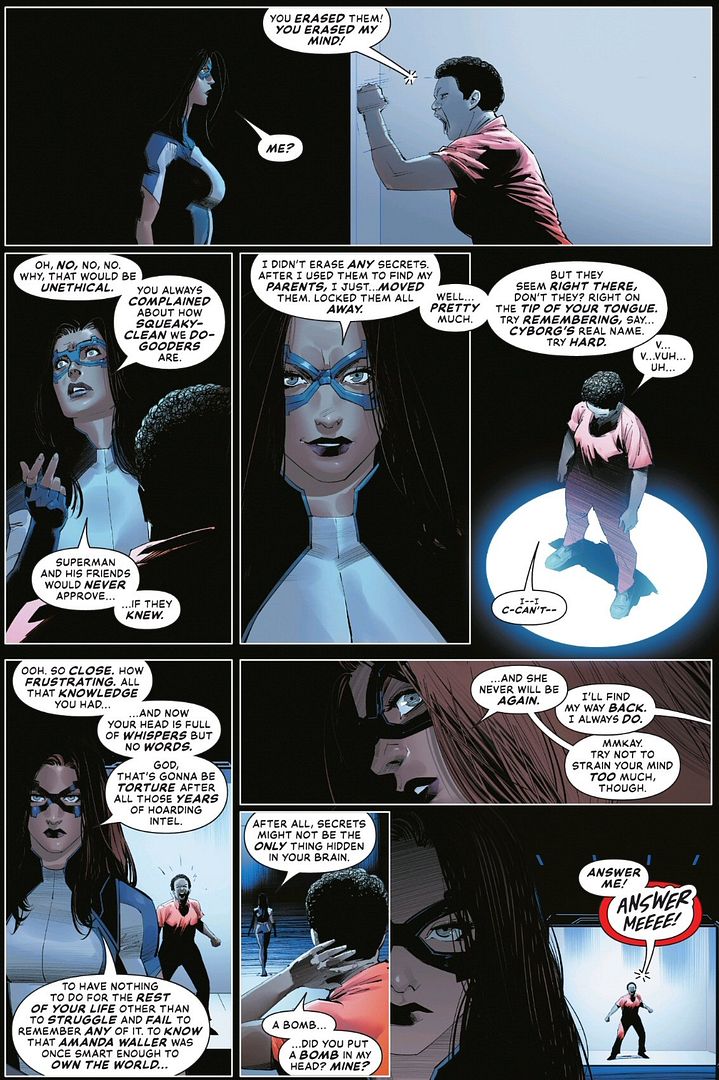
While Nia has certainly suffered at Waller’s hands, this seems to be a needlessly cruel response from Nia. It certainly doesn’t square with any of the established forms of ethics shown to date (as Nia herself points out, it wouldn’t be accepted by Superman and the others).
I will admit, I found this turn of events surprising, as it is putting Nia clearly down a dark path away from being a heroine. I also can’t help but note that the main event series above was written by Waid (and not Maines).
But it does set up a potential redemption arc for Nia, which we get to see in her second dedicated series, Secret Six Vol 5 (2025), written by Maines. These stories focus on the aftermath of Nia’s decisions – both in terms of Waller, and her friendship with Jon and Jay. First a little recap, from issue #1 (2025) by Maines with art by the always excellent Stephen Segovia:
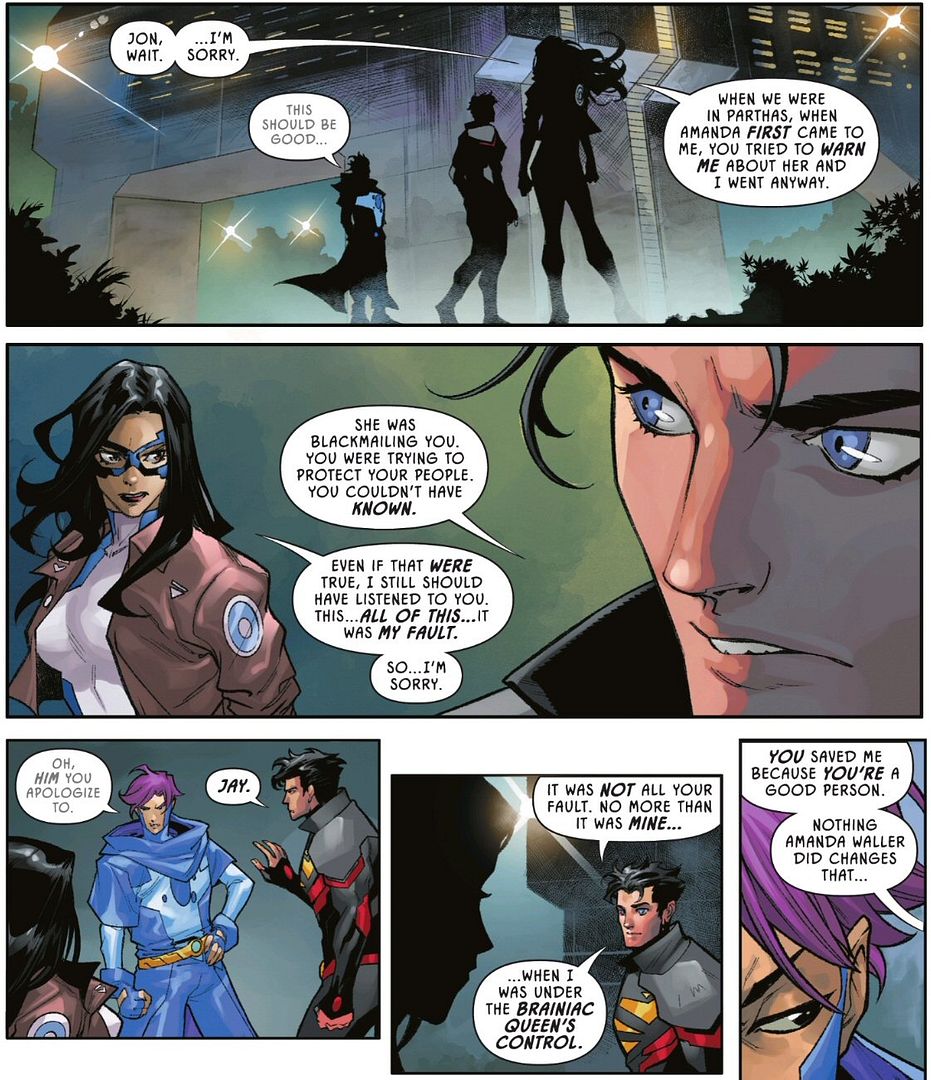
Jay is not shy about expressing his feelings toward Nia. But I do find her attempt to mend fences with him interesting. As context, the main plot driver of this series is that someone has broken Waller out of prison, and Nia has had a dream vision of them attempting to restore her memories. What does Nia intend to do? From issue #2, also by Maines and Sergovia:
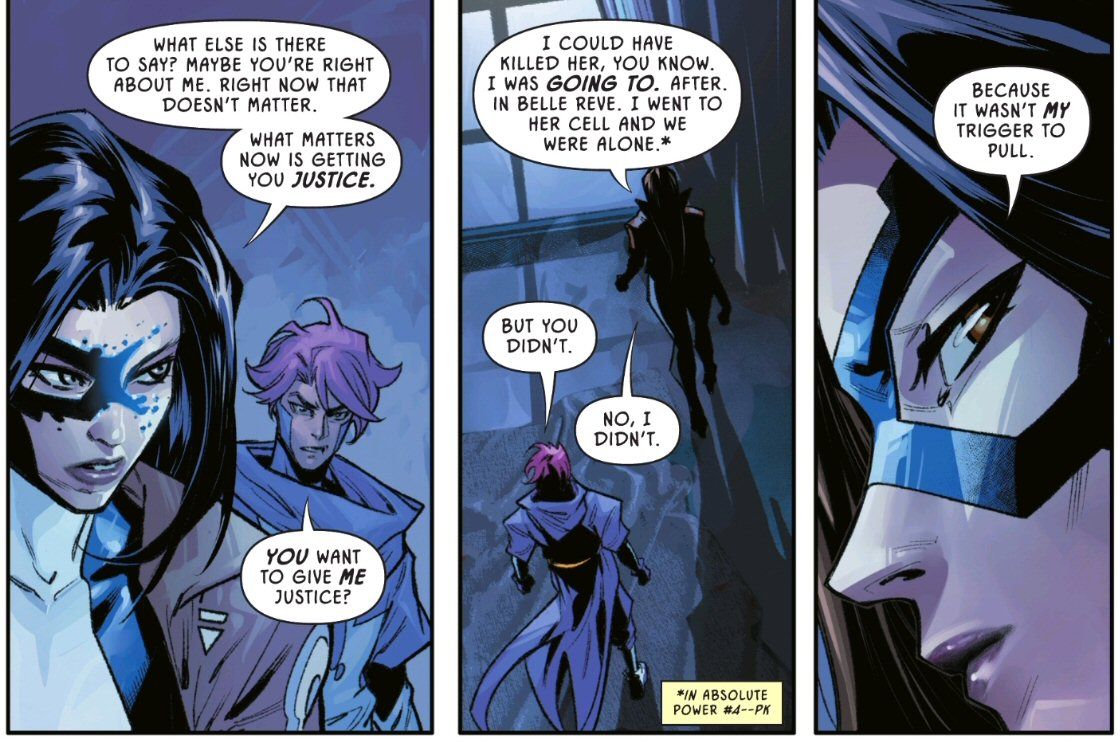
Even this implied “justice” for Jay is not enough to mollify him, and he continues to provoke her. Including this interesting scene where Jay specifically outs Nia to Jon, presumably trying to drive a wedge between them, from issue #3, also by Maines and Sergovia:

This revelation shocks Jon, who displays a similar mix of his father’s virtue ethics and deontology (see my extensive Superman ethics for more info). That is, he strives to be better – and help other people be better too – while also always trying to do the right thing.
Indeed, in exasperation, he attempts to articulate everyone’s personal responsibility on the next page – although it is hard for Nia to hear:
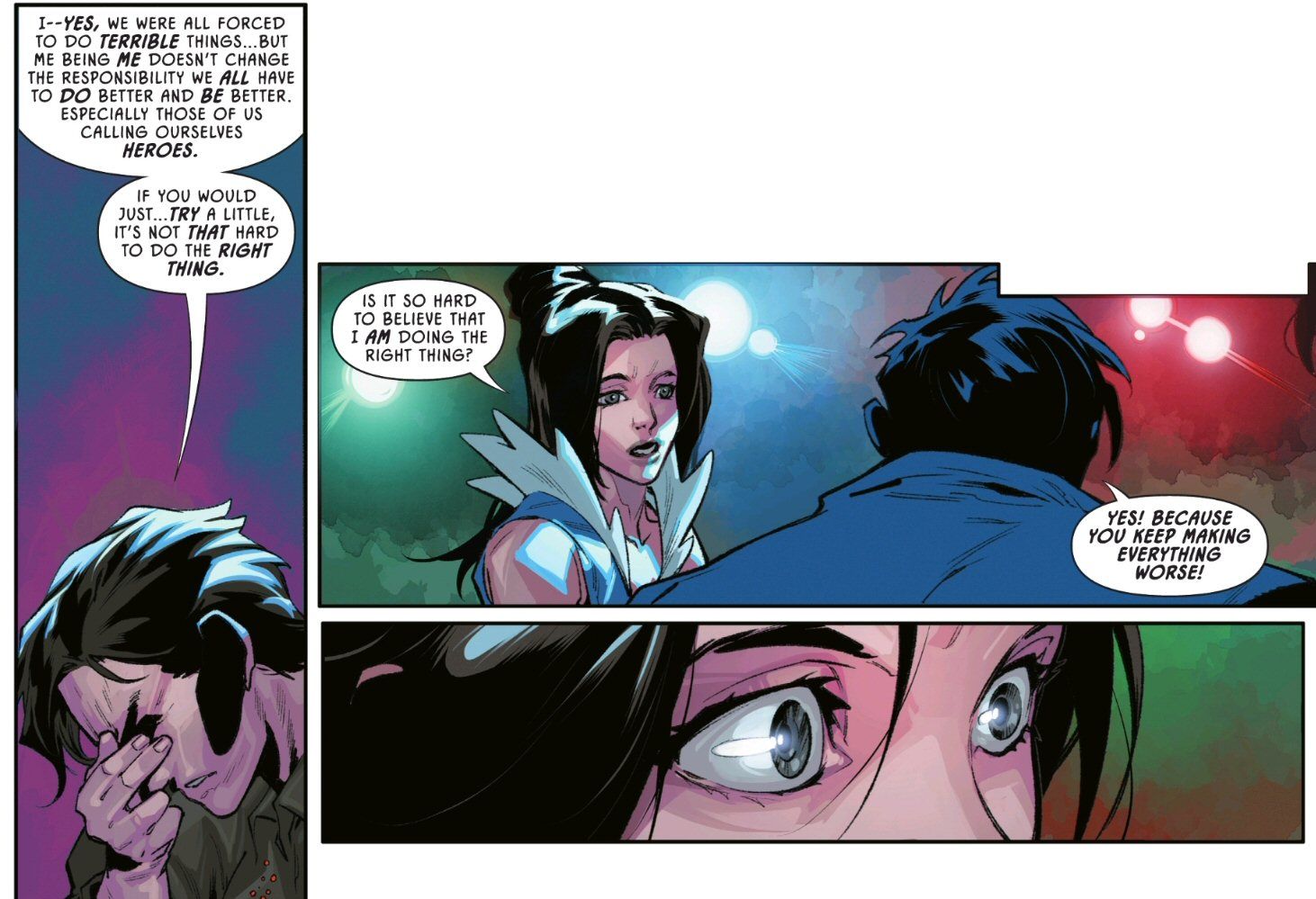
I don’t think Jon literally means that in a consequentialist sense – more that it keeps moving Nia, and those around her, further down a dark path away from virtue.
Eventually, the main plot comes to a head in the penultimate issue, where we learn that the sinister forces that took Waller want to extract all her memories, and then punish her. They ask for Nia’s help to lower her wards to facilitate the permanent extraction, but she decides to blast them instead and break out with Waller. From issue #5, by Maines and Roger Cruz:
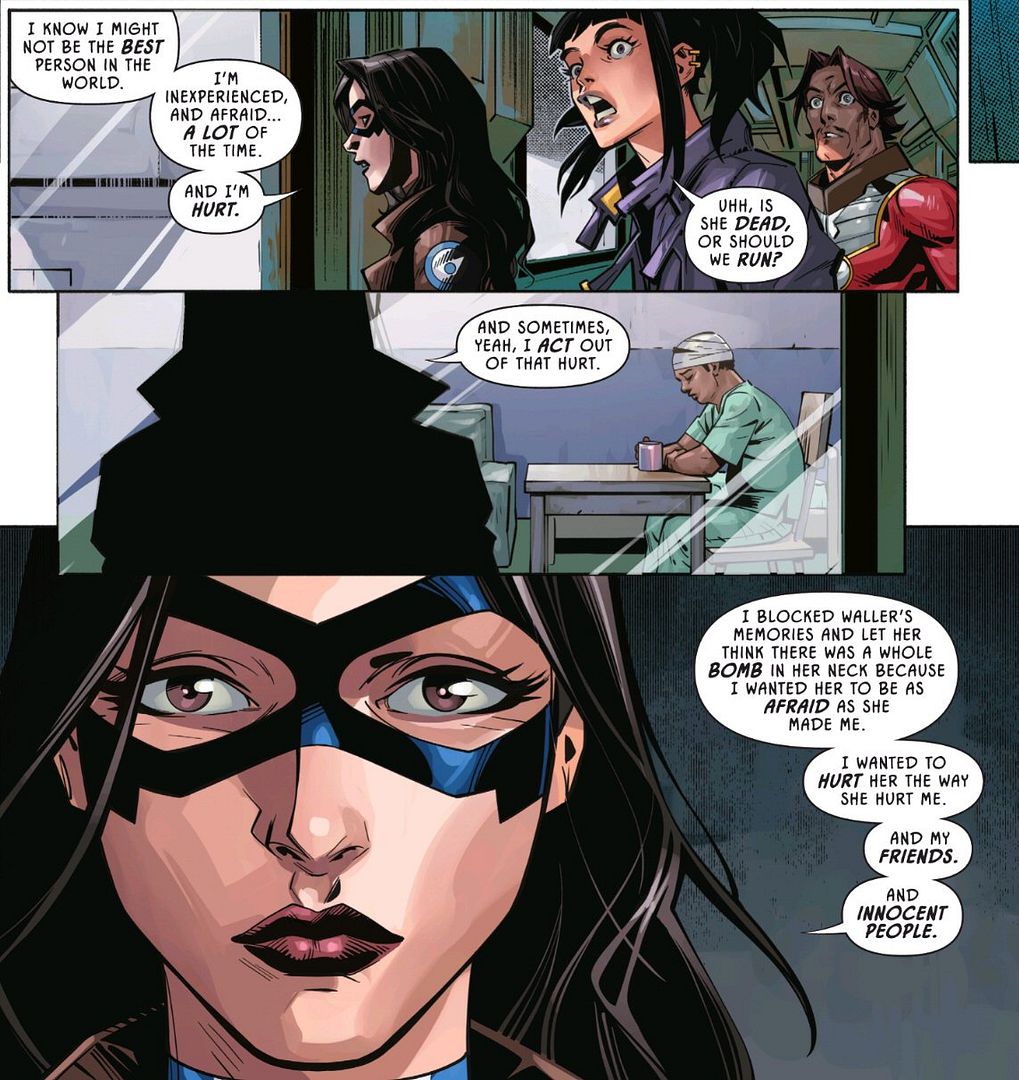

I like the way Maines has addressed the elephant in the room regarding Waid’s ending to Absolute Power while still keeping Nia’s current intentions somewhat ambiguous here. Of course, most would assume she wants to restore Waller’s memories and then kill her (like her teammate Alice presumes, for example).
Meanwhile, Jay discovers the US government authorized all of Waller’s activities. Nia stops him from killing Waller (still in her blocked-memory state):
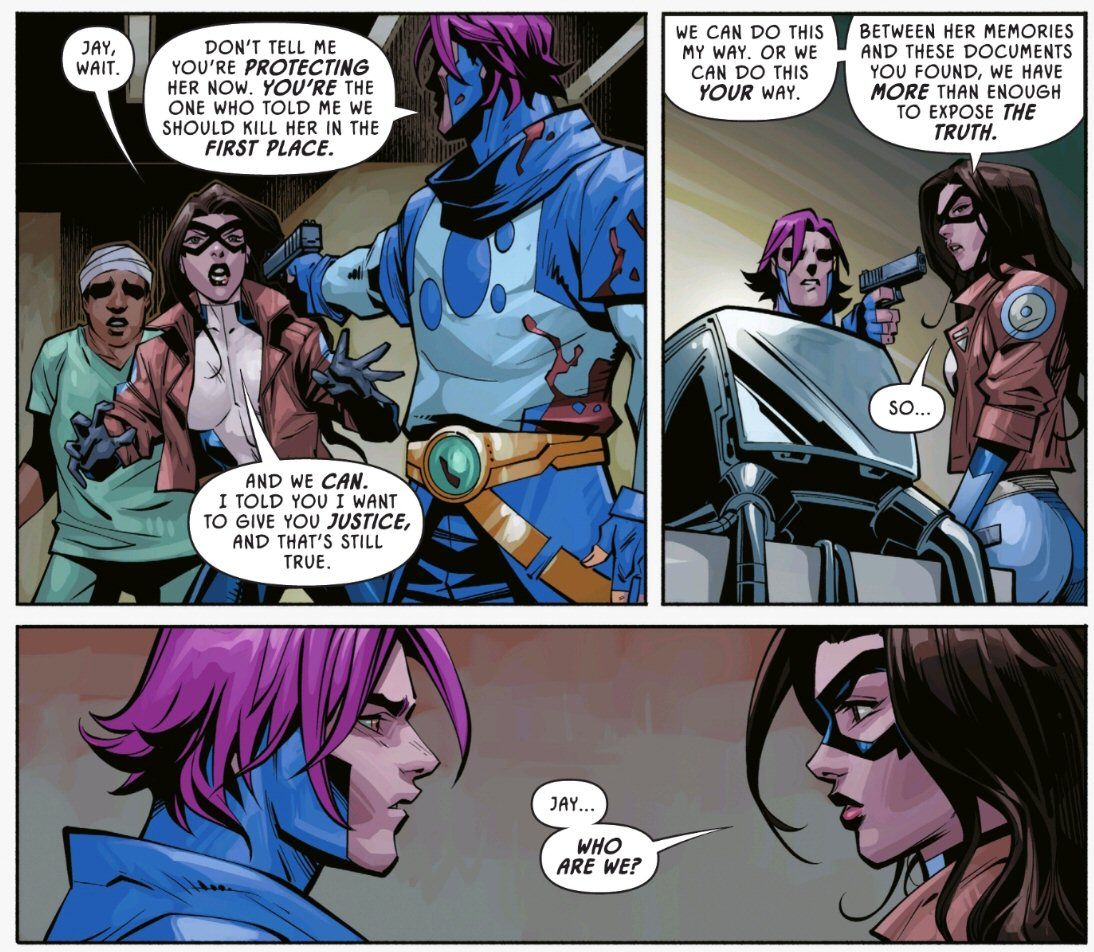
Instead, Jay uses the device to extract all her memories, bringing us to the final issue, issue #6, by Maines and Sergovia:

Nia seems to believe this resolves the issue and provides justice – the Waller they knew is gone (at Jay’s hand), and they have all the evidence of her culpability they need.
But that isn’t good enough for Jay – who pulls a gun on Nia, and demands she hand over Waller to be executed. Nia appeals to their friendship, but Jay responds by pulling the trigger at Nia:
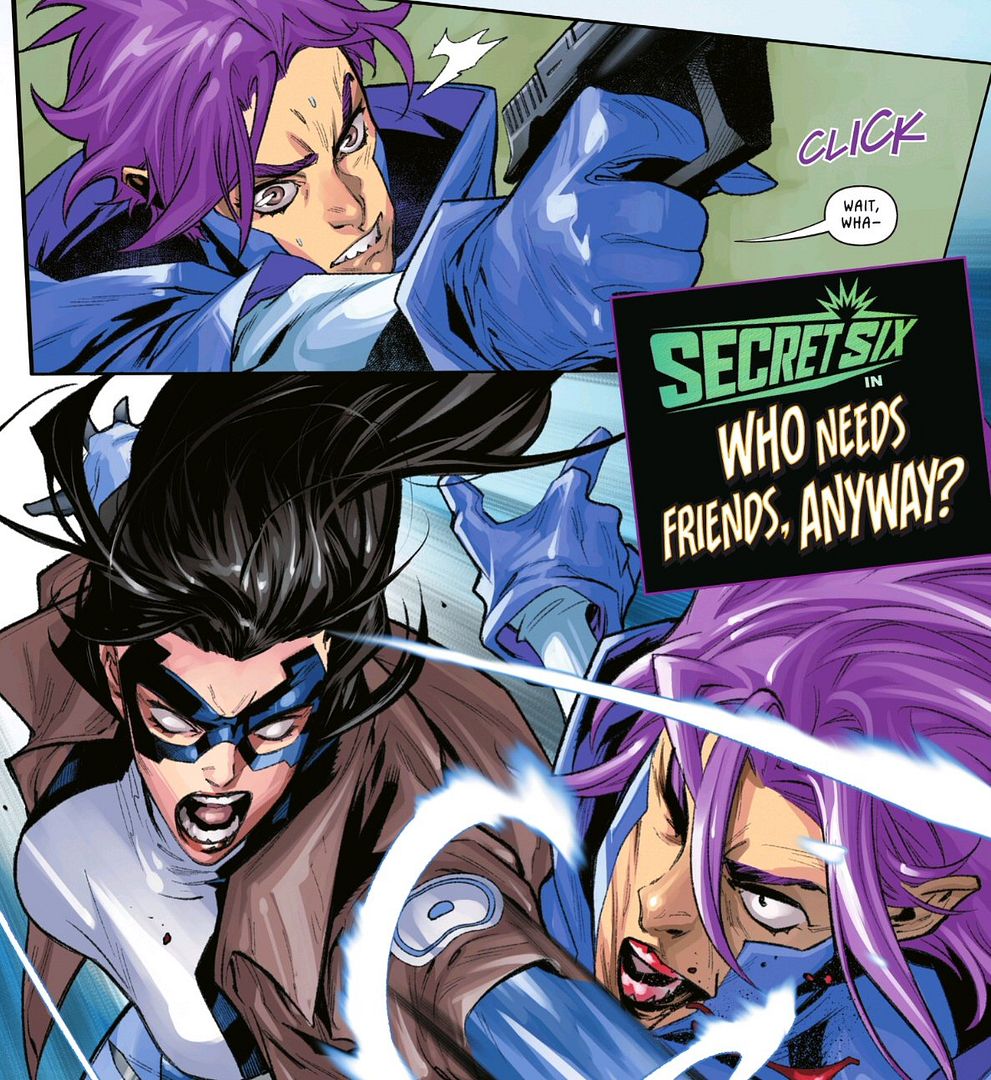
Of course, it’s hard to surprise a precog …
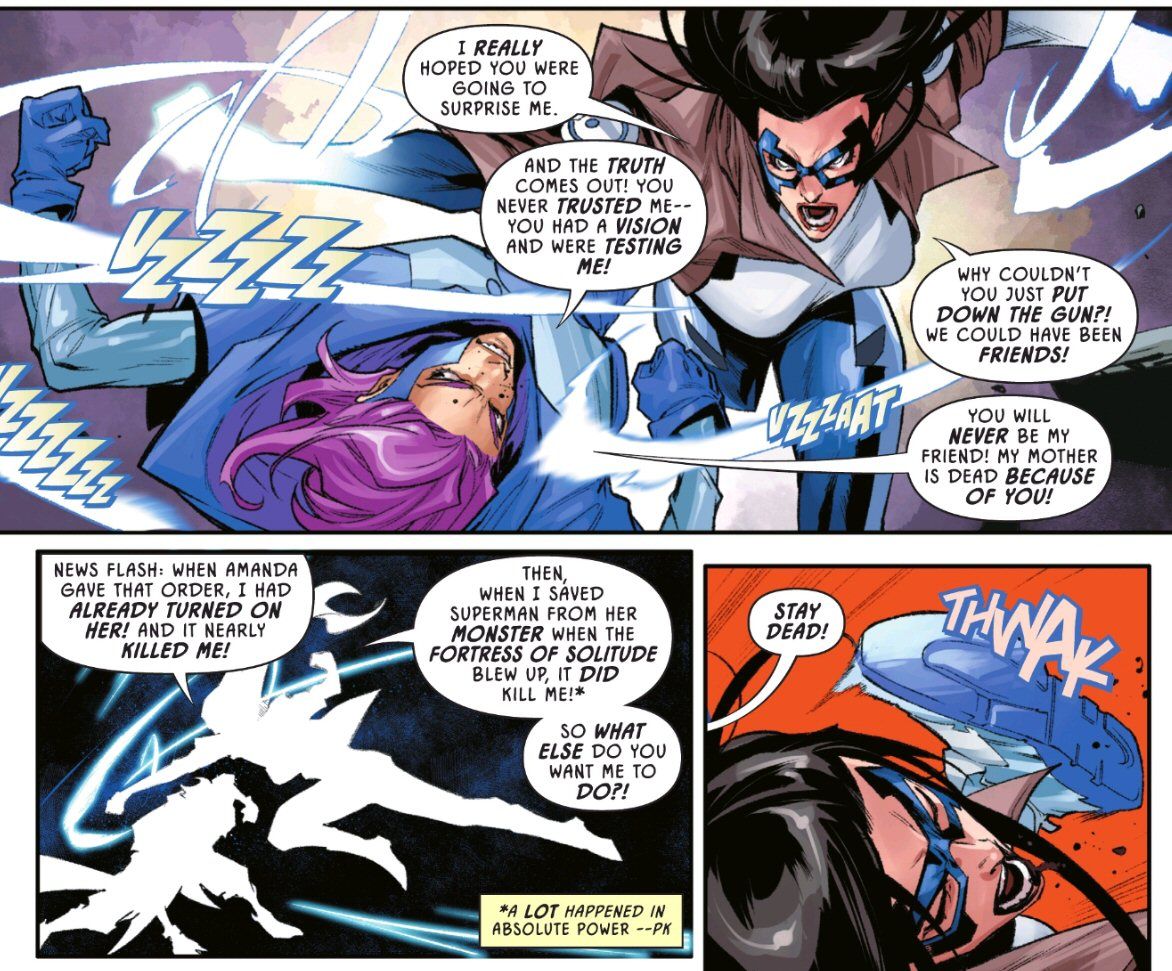
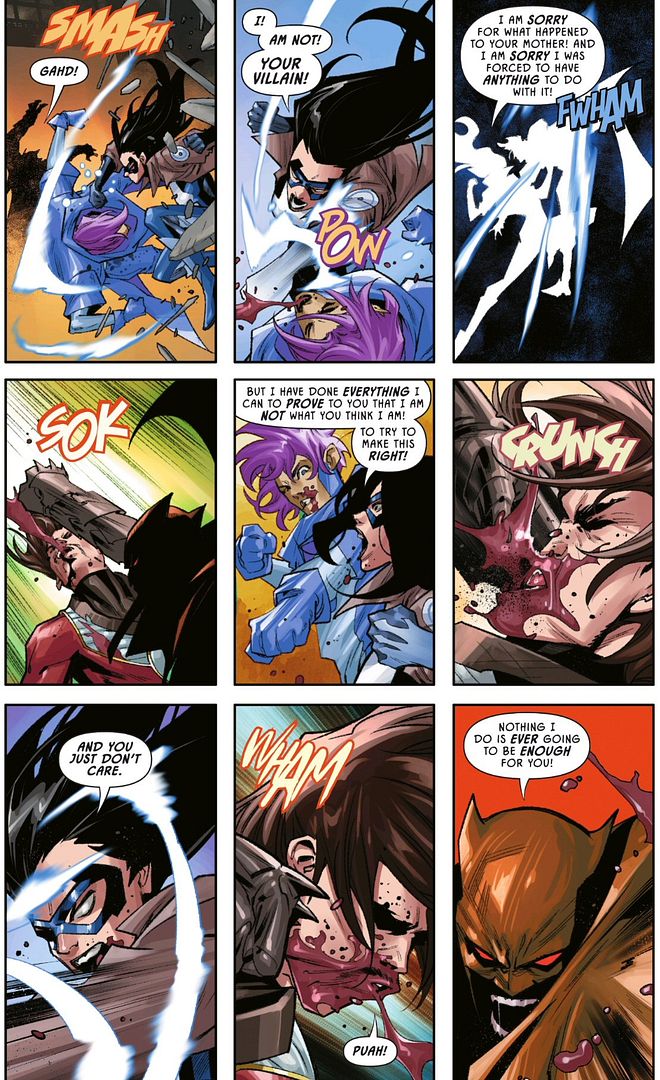
The issue ends with Jay breaking up with Jon, and swearing to bring down the US government.
Which brings us the Justice League Intergalactic Special #1 shown at the top of this post. I will come back to where we go from here after reviewing Galaxy’s origin and ethics below.
Galaxy – Taylor Barzelay (née Taelyr Ilextrix-spiir Biarxiiai)
If you have skipped ahead, you can jump back to my Dreamer introduction, or jump ahead to their combined Dream Girls interaction.
Taylor was created by writer Jadzia Axelrod and artist Jess Taylor, and first appeared in preview in Galaxy: The Prettiest Star Special Edition #1 released on Free Comic Book Day 2022, in advance of the full graphic novel that arrived a couple weeks later (published by DC Graphic Novels for Young Adults). The book’s initial run quickly sold out, with DC releasing a second print run in 2023.
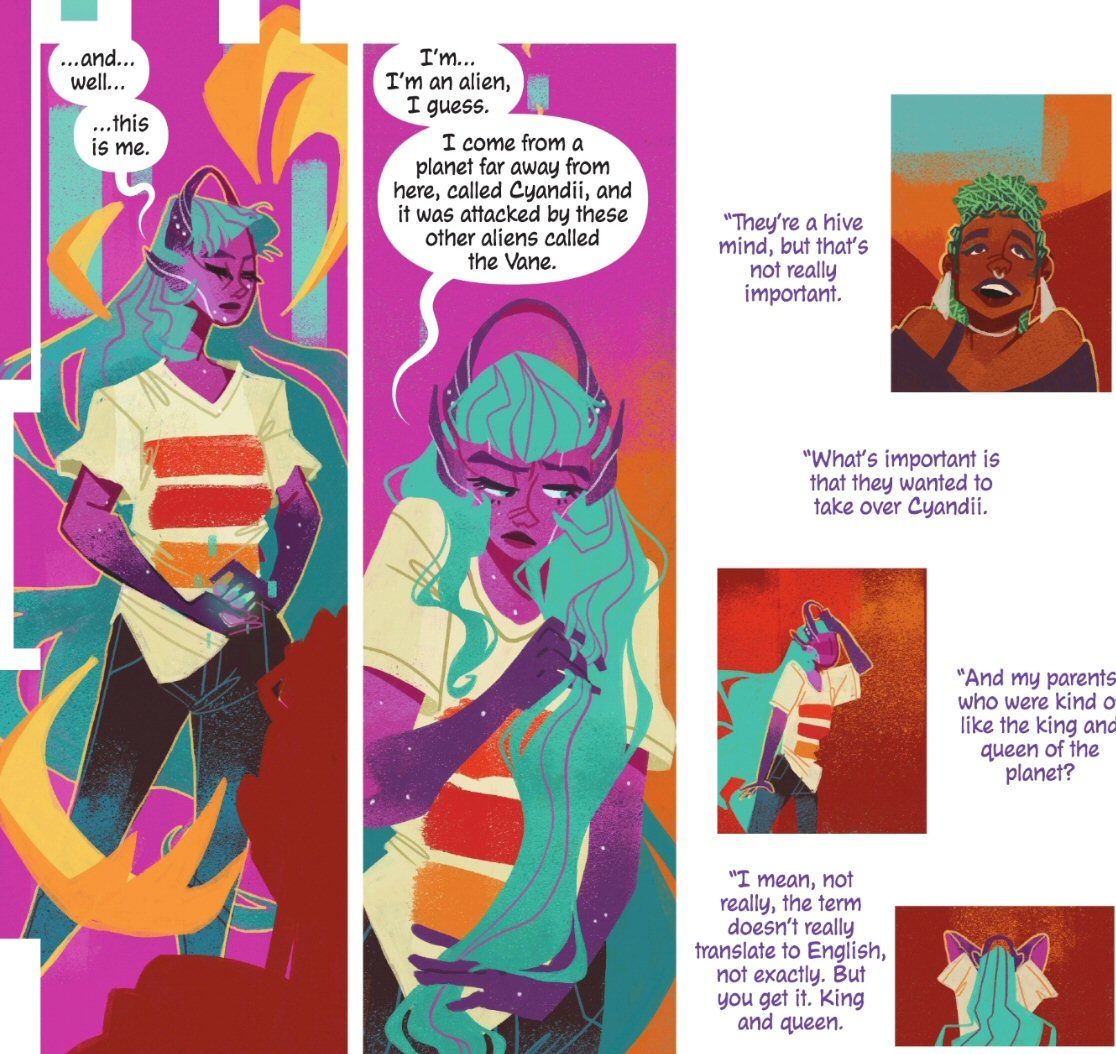
The character of Taylor (Taelyr) is an alien born in space to the royal family of the planet Cyandii during a conflict with an invading alien hivemind species known as the Vane. Taelyr was assigned male at birth, but realized in early childhood that she identified as a girl (as later explained in Axelrod’s Hawkgirl Vol 2 series, where Taylor played a major supporting role). Cyandii was subsequently destroyed by the Vane, and the orphaned Taelyr was sent to Earth with a handful of other refugees in secret, where she was forced to take on a male identity to better hide and integrate into Earth society.
Galaxy: The Prettiest Star begins with the adolescent boy-presenting Taylor wanting to express her true transgendered Cyandii persona, but afraid of attracting attention. It is the introduction of Kat – a potential love interest – that stimulates Taylor to reveal her true identity. From the Galaxy: The Prettiest Star (2022) graphic novel, written by Jadzia Axelrod and beautifully illustrated by Jess Taylor:
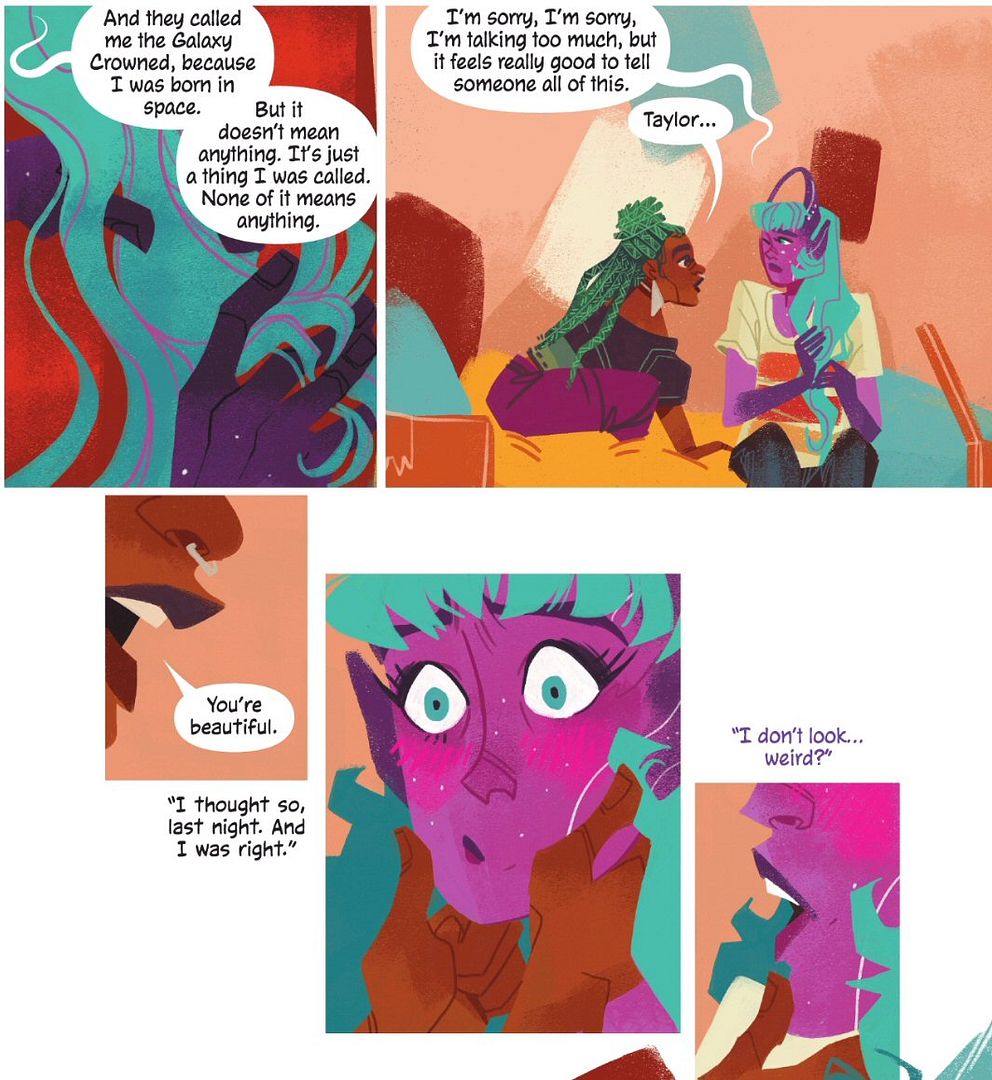
Eventually, Taylor gets locked into her true form – which is exactly what she wanted, but against her “family’s” wishes. The story comes a head around a homecoming dance that Taylor is insistent on attending with Kat, despite being banned by the school.
He “father” insists it is not safe to expose herself in her true form. She responds that she knows very well the risks with the Vane, and in fact can never escape that knowledge – she always has (and always will) have to live with the fear that they could show up at any moment. But that can’t stop her from living her life:
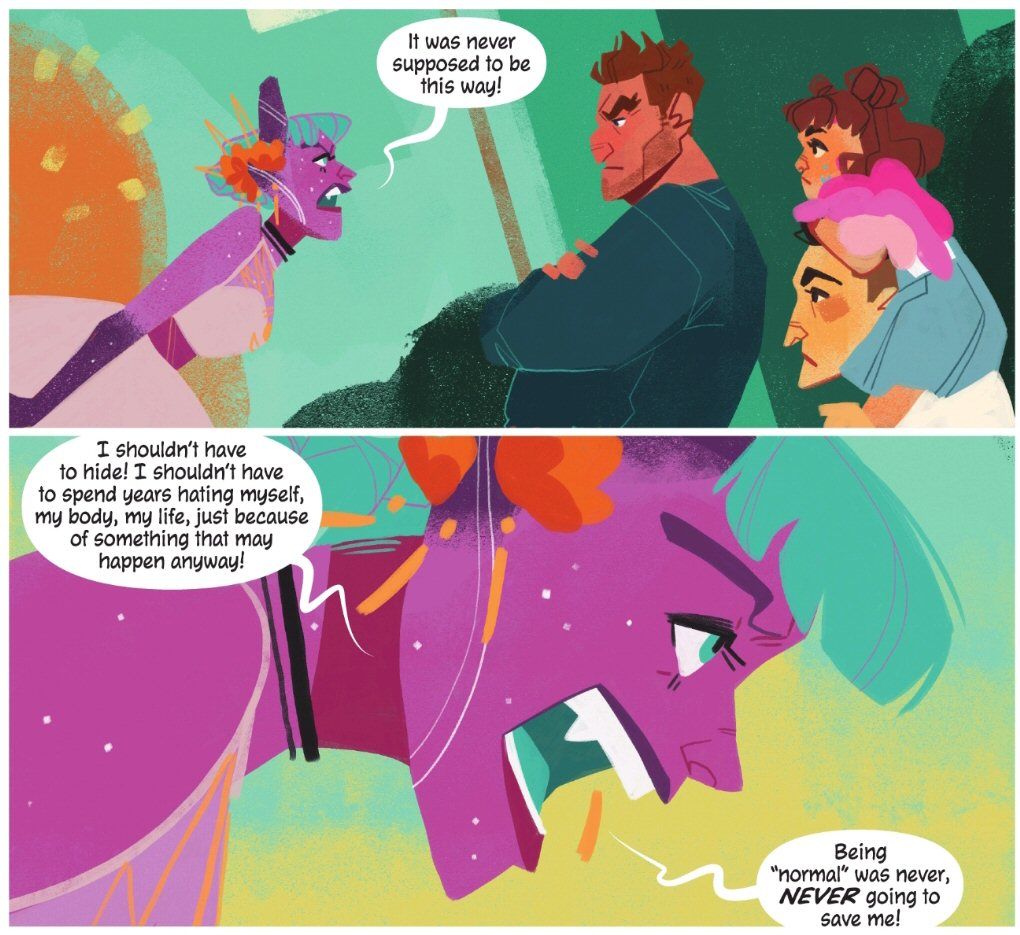
It’s a profound recognition that hiding who she truly is was never going to keep her safe. In a touching moment, her family members all come around to supporting her choice.
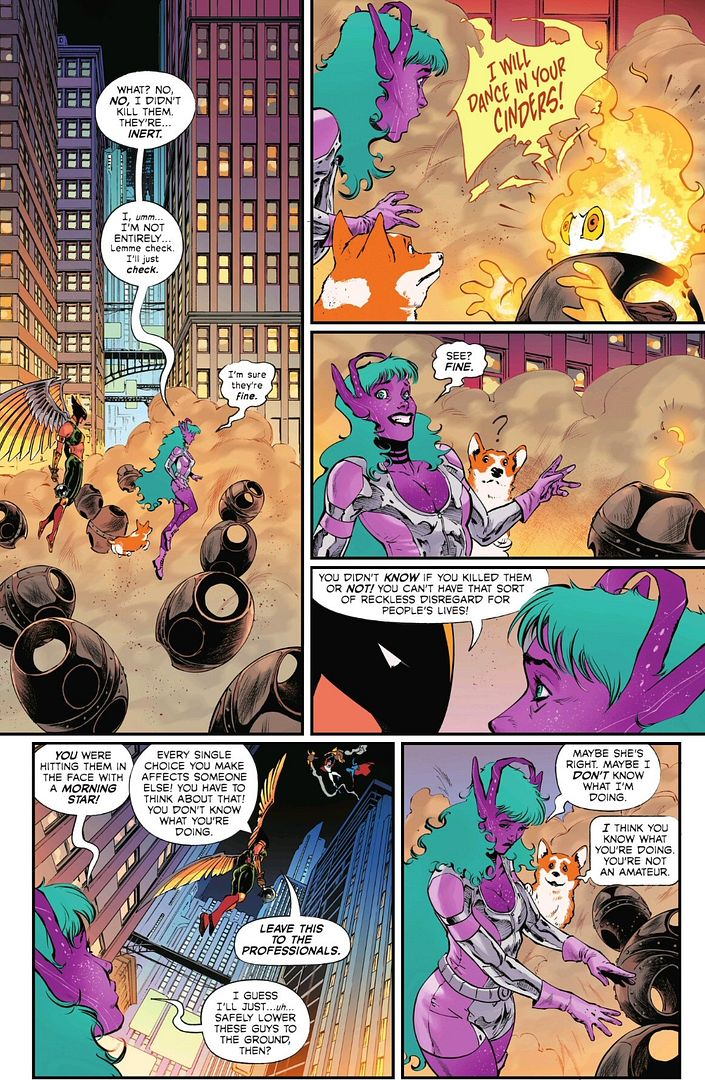
From this point, Axelrod jumps ahead a few years in time to develop Taylor as an adult superheroine in her Hawkgirl Vol 2 series (2023) with Amancay Nahuelpan. Initially, Taylor’s naive attempts to intervene gets her the scorn of Kendra (Hawkgirl):
Eventually, by the end of this series Taylor and Kendra become fast friends, and Taylor is instrumental in resolving the main story issue (and saving Kendra). Along the way though, I love this charming exchange in issue #3, which is just so Taylor (and so Batman):

As great as that series is, in terms of Taylor’s ethics I would like focus in more detail on her early development in the second prequel graphic novel, Galaxy: As the World Falls Down (2026) with Rye Hickman. In terms of chronology, this graphic novel takes place shortly after the events of Bad Dream: A Dreamer’s Story (2024) by Maines and Hickman – which in turn followed shortly after the events of Galaxy’s premiere story.
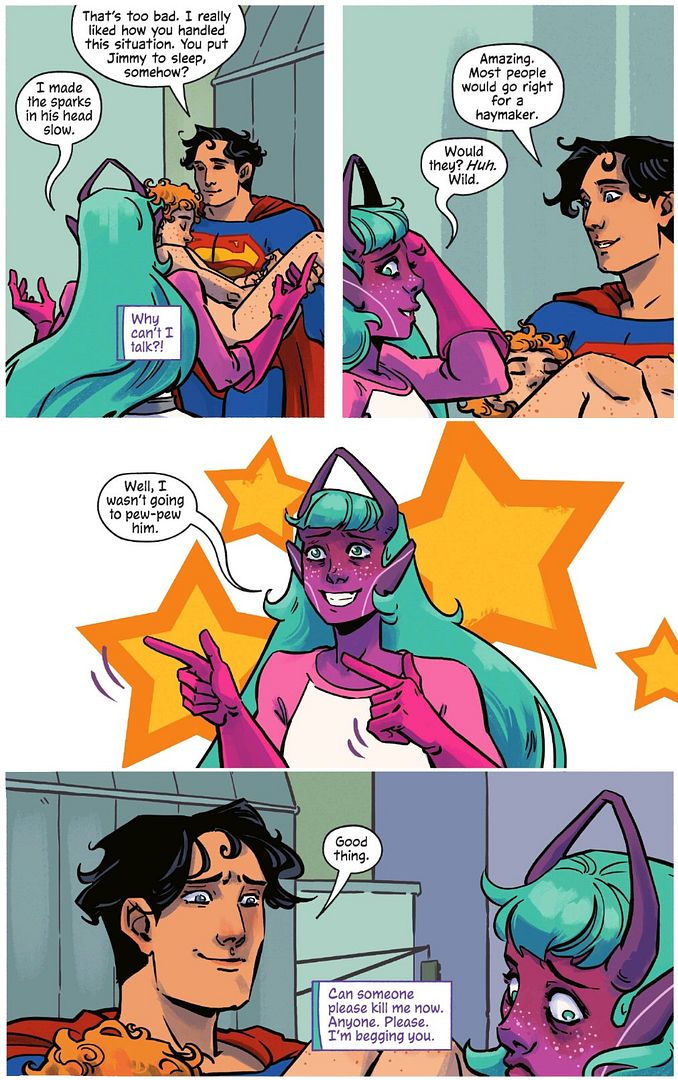
Consider this early scene – Taylor is visiting Metropolis and she steps in to take down a giant Kaiju who is roaming the streets. After discovering that hitting the creature only makes matters worse, Taylor uses her abilities to calm the creature – finding, to her surprise, that it reverts back to a human being (Superman’s pal Jimmy Olsen). Superman then shows up to take over, thanking Taylor for her efforts:
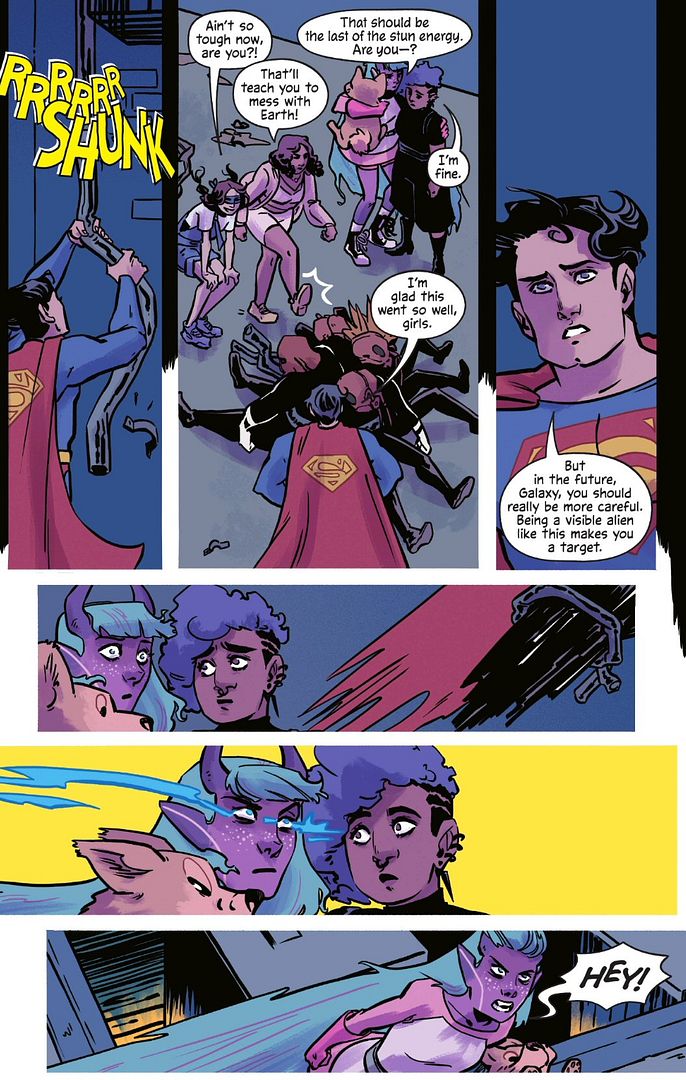
Taylor’s worse fears are realized when the Vane detect her energy signature, and a scout ship arrives and attacks her and her friends when they are out clubbing. Note that the teenage Nia has joined Taylor, Kat and Yvette. The girls hold their own pretty well initially, but Superman’s arrival on the scene is critical to subduing the Vane scouts.
As we will see, Superman’s condescending attitude helps Taylor finally find her voice around him – and speak her truth:
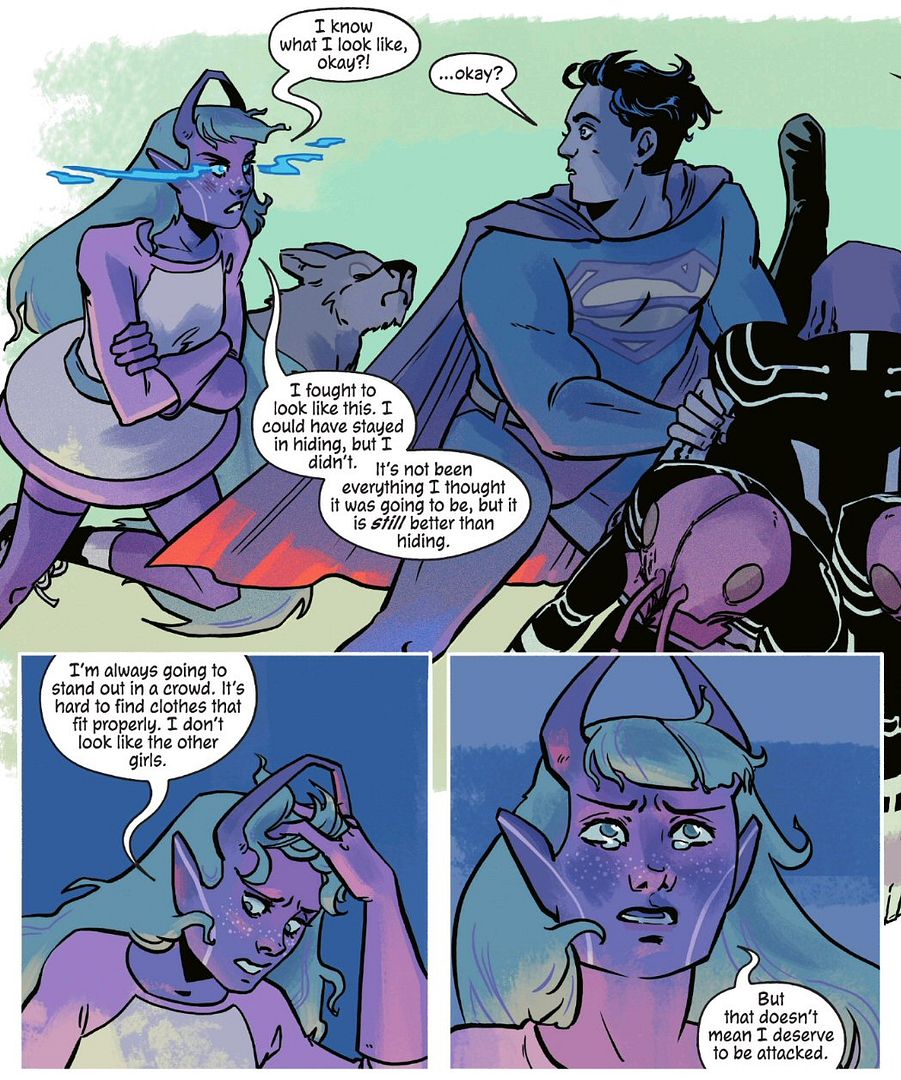
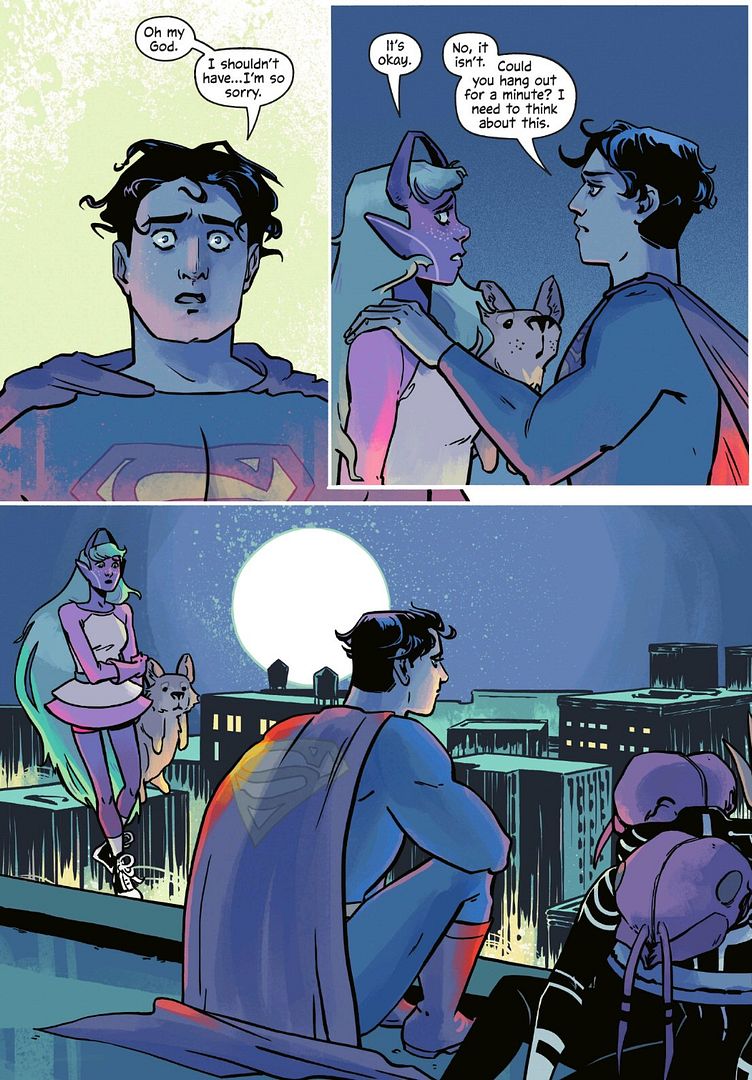
I love how Axelrod takes the time to allow Superman to have a think – and Hickman does a great job showing everyone’s body language during this exchange (especially Taylor and Argus).
And what does Superman come to realize?
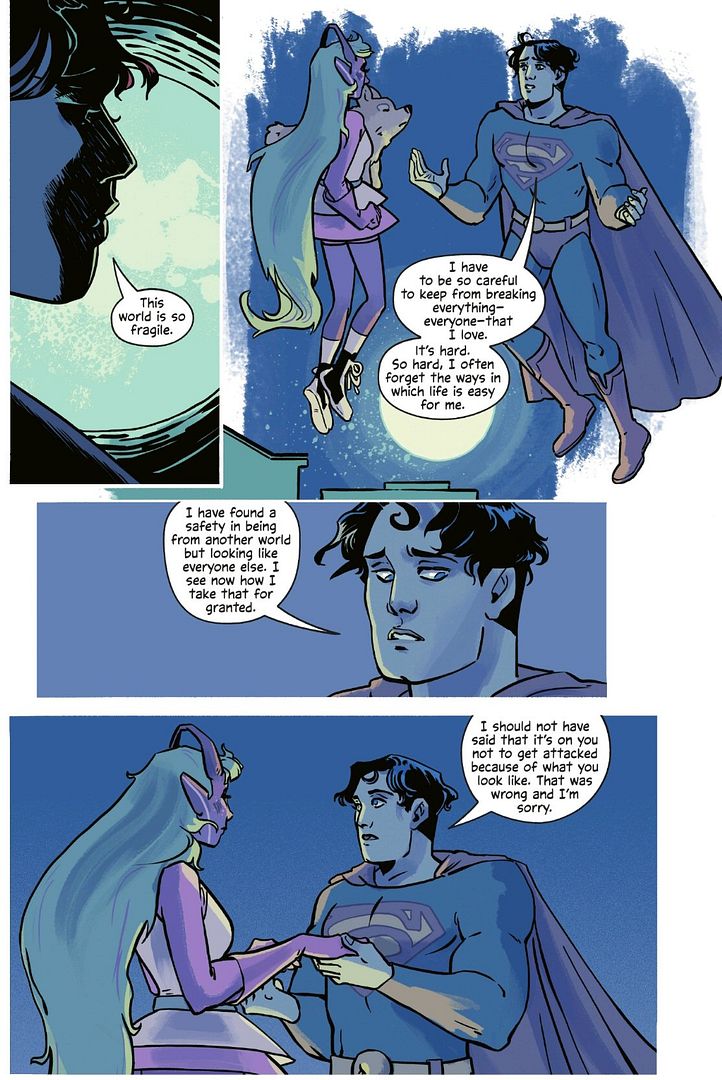
This great scene brings to my mind intersectionality, which is a modern framework for understanding how one’s various social identities form unique patterns of discrimination and privilege. Superman is articulating how his alien nature and abilities have made his life on Earth hard. But he now realizes how his gender and human physical appearance have also made his life comparatively easy (his relative privilege) – something he previously took for granted. And so, he offers Taylor a heartfelt apology for his comments.
This is the value of taking an intersectionality approach – it allows you to see how each person’s (or group’s) unique combination of identities can lead to both empowerment and oppression. You can be both privileged in some ways and be victimized in others. It also reminds me of the value of suffering for personal growth in virtue ethics, as I discussed in my Battleworld overview.
The point is that we all suffer in life. But it is a mistake to only focus on our own pain – it can blind you to the (even greater) suffering of others. Intersectionality and an awareness of suffering can bring about great empathy and an understanding of others.
Superman also takes Taylor aside to offer a key perspective and piece of advice if she is going to continue down the path of superheroism:
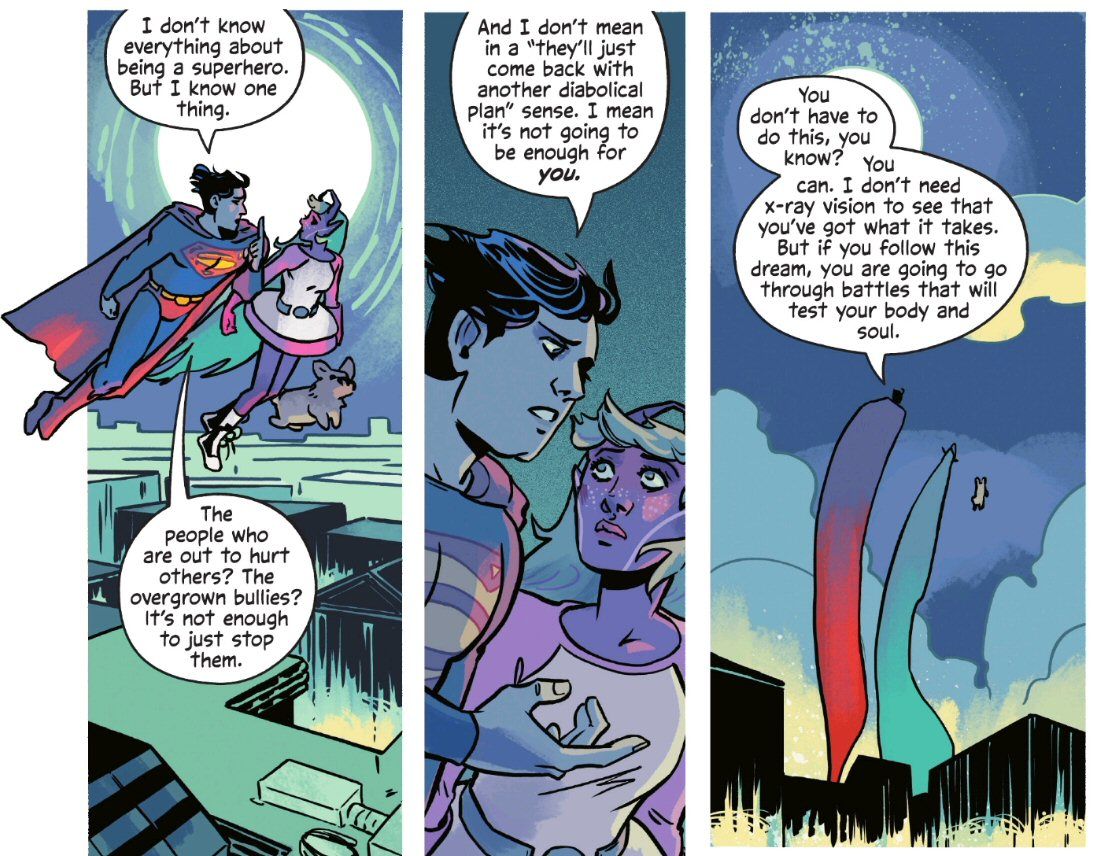

It seems to me that this strong care ethics perspective encapsulates a core difference in the development and philosophies of Taylor and Nia – and why Nia seems to suffer more from her choices. Again, scroll back up to my Dreamer entry for a discussion of how focusing on outcomes can get you into trouble when when you also believe in universal abstract principles like justice or rights. There is great value in appreciating the relational between people. Taylor epitomizes in her stories, showing a commitment to personal loyalty, honesty and community.
Note that it is still not an easy road for Taylor, of course. She continues to doubt her abilities and capabilities, as shown on this subsequent page:
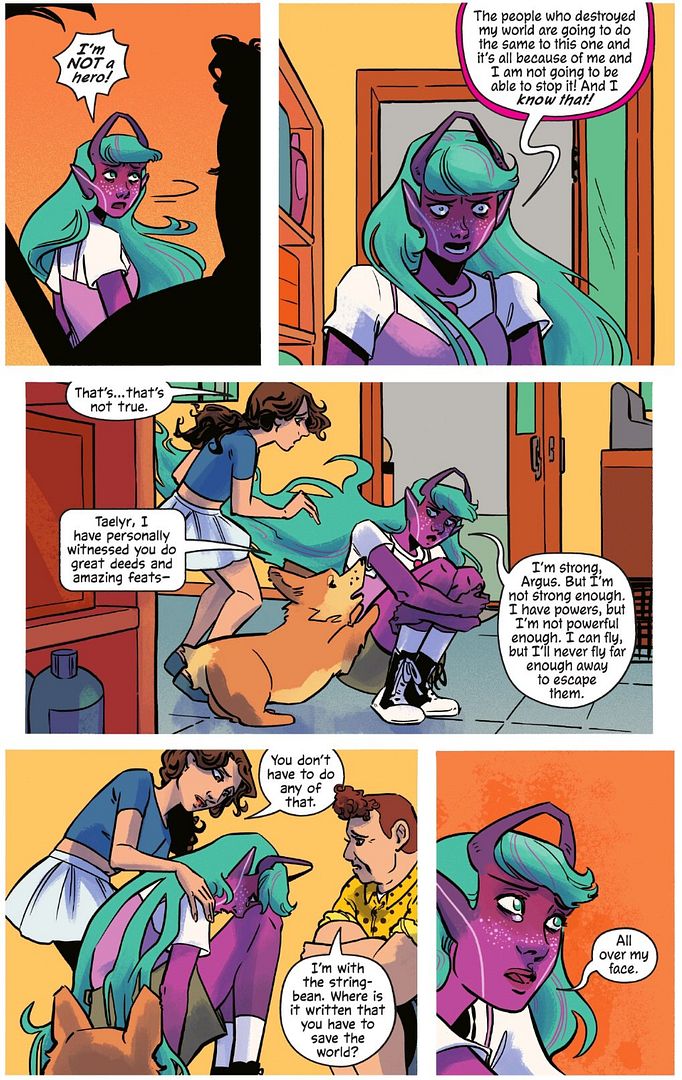
The responsibility she feels to save everyone is overwhelming. Fortunately, she also has Kat’s mother to offer some sage advice:
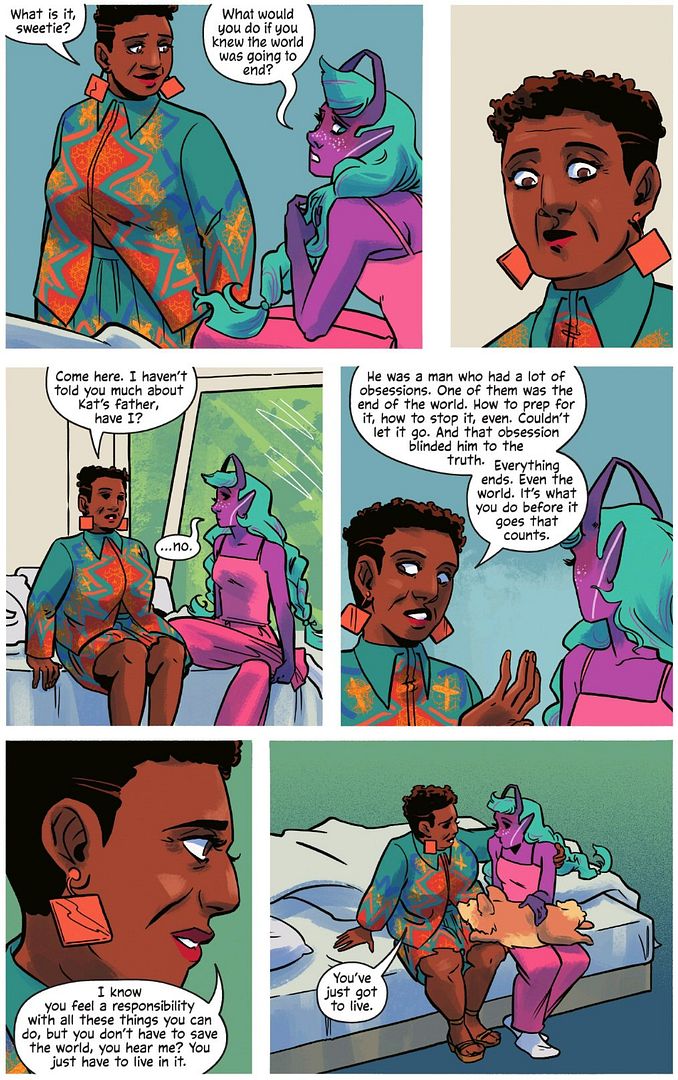
These panels help to illustrate a key difference between Taylor and Nia. Taylor repeatedly reaches out to others for help, learning from their experiences. Her ethics are primarily care ethics. Nia, in contrast, often tries to go it alone, bottling up her fears as she tries to balance the larger abstract demands of deontology and consequentialism with her care ethics. At the end of the day, what typically draws Nia back from the brink is the reminder from her friends – most especially Taylor (and Jon, to a lesser degree).
In this story, things soon get rough as the Vane restore themselves and return with an invasion force behind them. Taylor and her friends initiate a plan to try and repel the Vane. But despite their heroic efforts, it all falls apart and Taylor is left alone with Kat right before the end. Taylor articulates the horror of the situation they are facing – but surprisingly, Kat laughs.
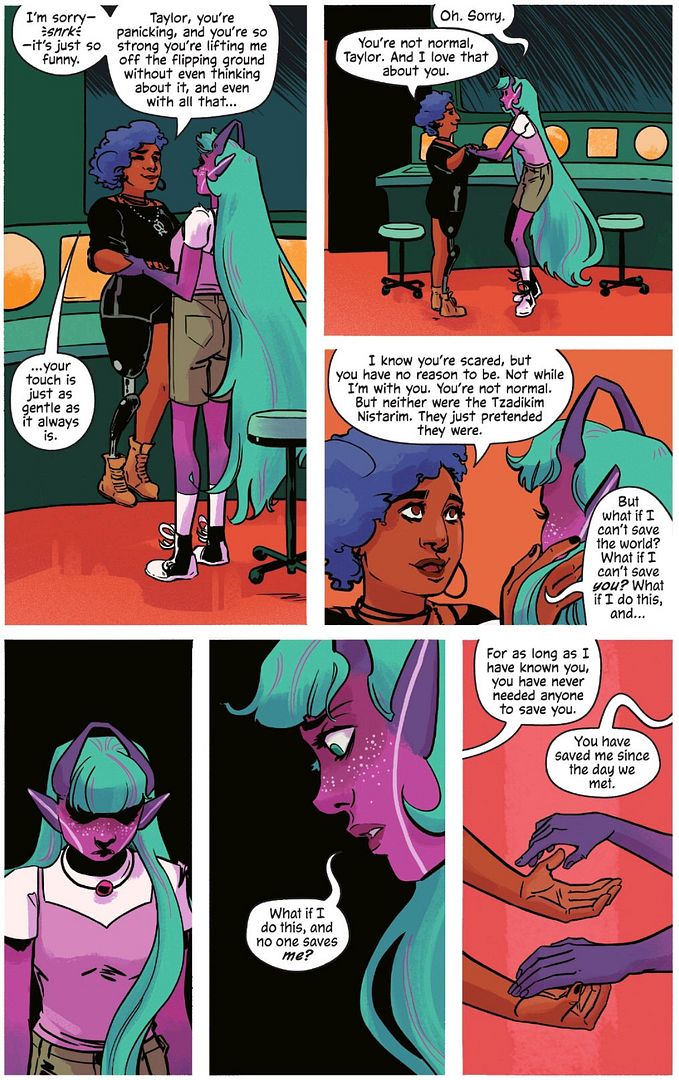
It’s a beautiful scene. Taylor’s ethics are firmly grounded in her personal relationships, her virtuous character, and her drive to remain authentic in the face of challenges. And even though Kat is soon taken over by the Vane as well, it gives Taylor the idea she had missed until now – it is ultimately all about love. Moreover …
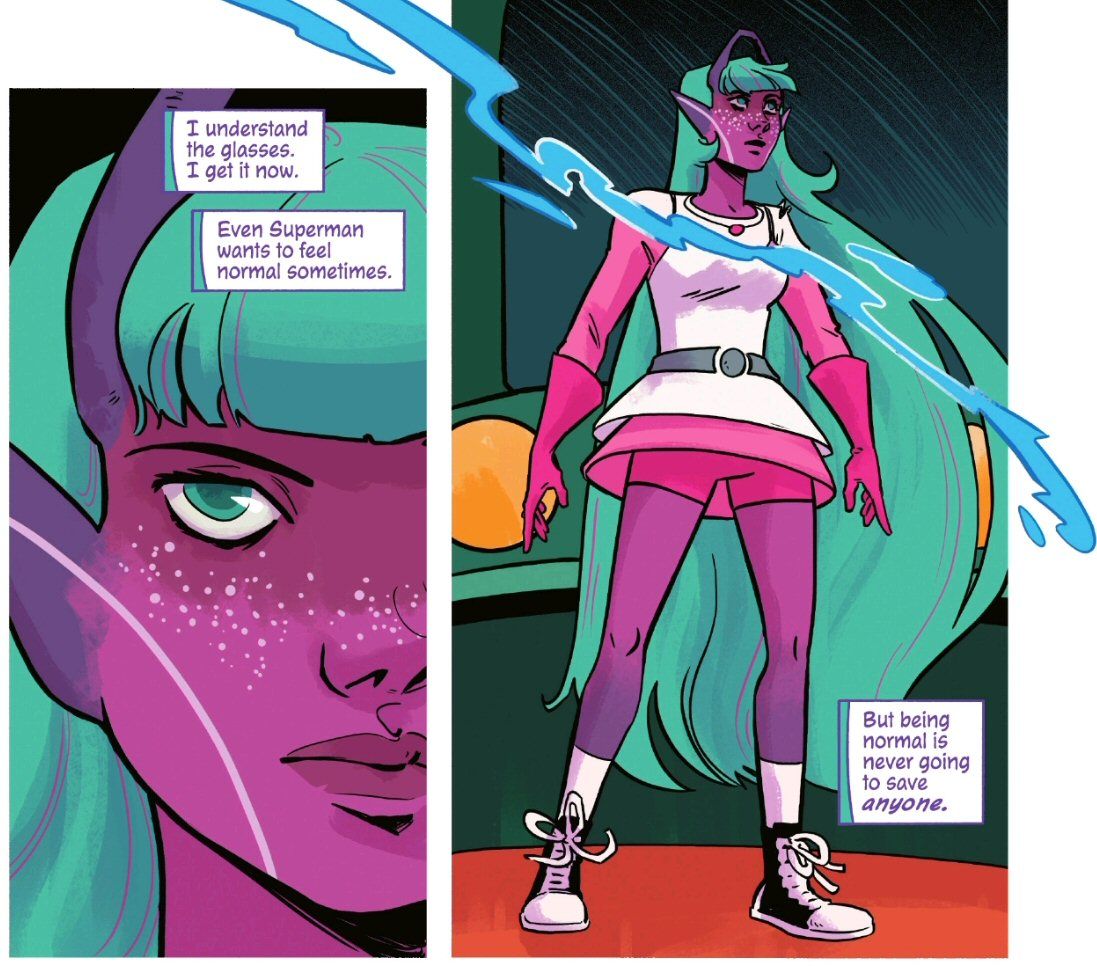
And there it is! We have come full circle in Taylor’s understanding of her true situation. As she learned at the end of Galaxy: The Prettiest Star, being “normal” was never going to save her. Now she realizes it was never going to save anyone else either.
It is time for her to embrace her true power, and channel the energy of everyone’s love:
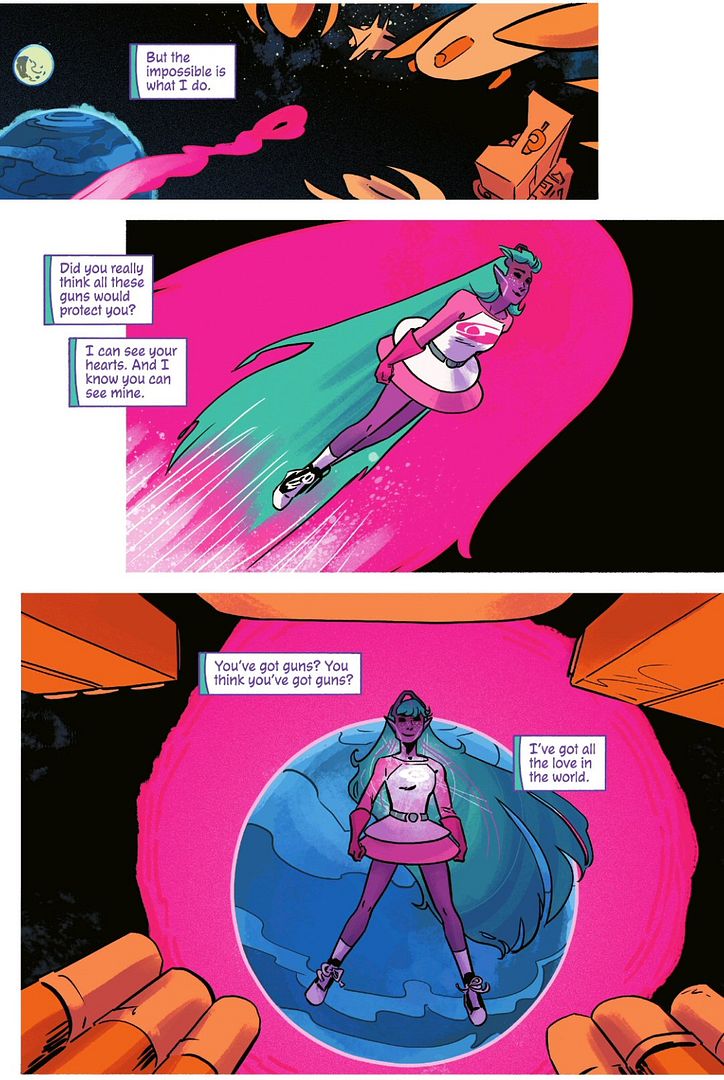
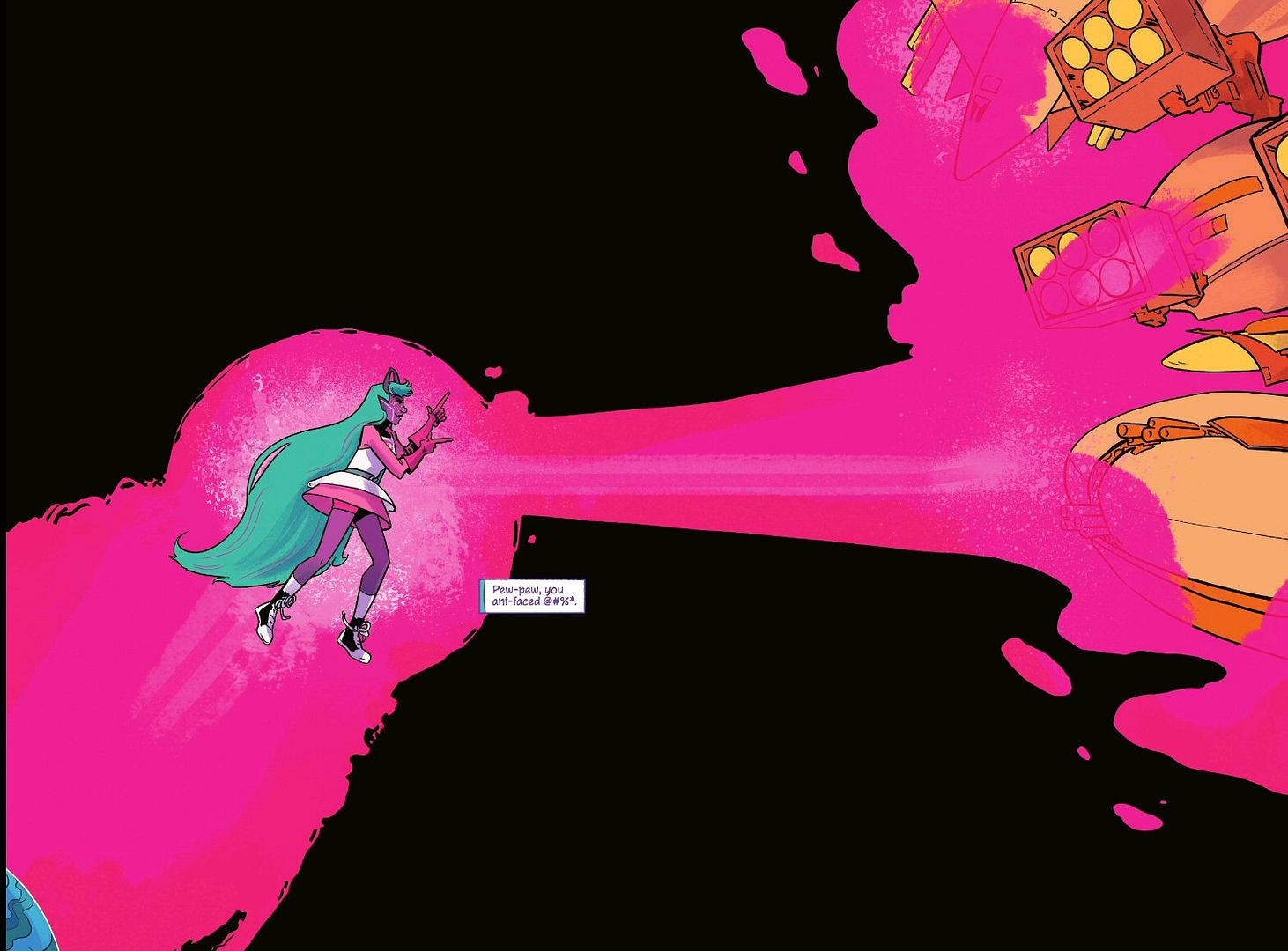
That two-page splash broke my heart and had me burst out laughing simultaneously. Finger guns to the rescue, pew-pew! 🙂
Dreamer and Galaxy’s interactions – the Dream Girls
If you have skipped forward, you can jump back to my detailed Dreamer and Galaxy overviews and ethics.
What do I mean when I say that I find Nia and Taylor’s interactions to be so significant? Let’s start by considering this example when Nia joins Taylor in a dream, midway through the Galaxy: As the World Falls Down graphic novel by Axelrod and Hickman:
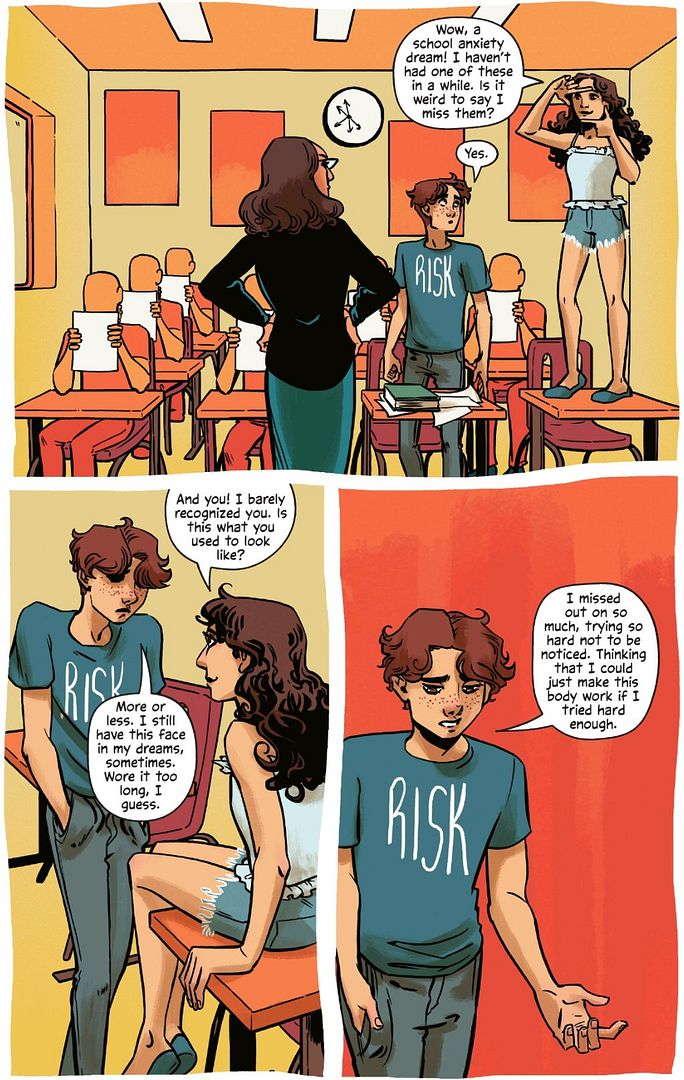
I really appreciate Axelrod sharing this insight. It makes perfect sense that people who transition later in life would still experience dreams as their former selves. And how distressing that must be for so many.
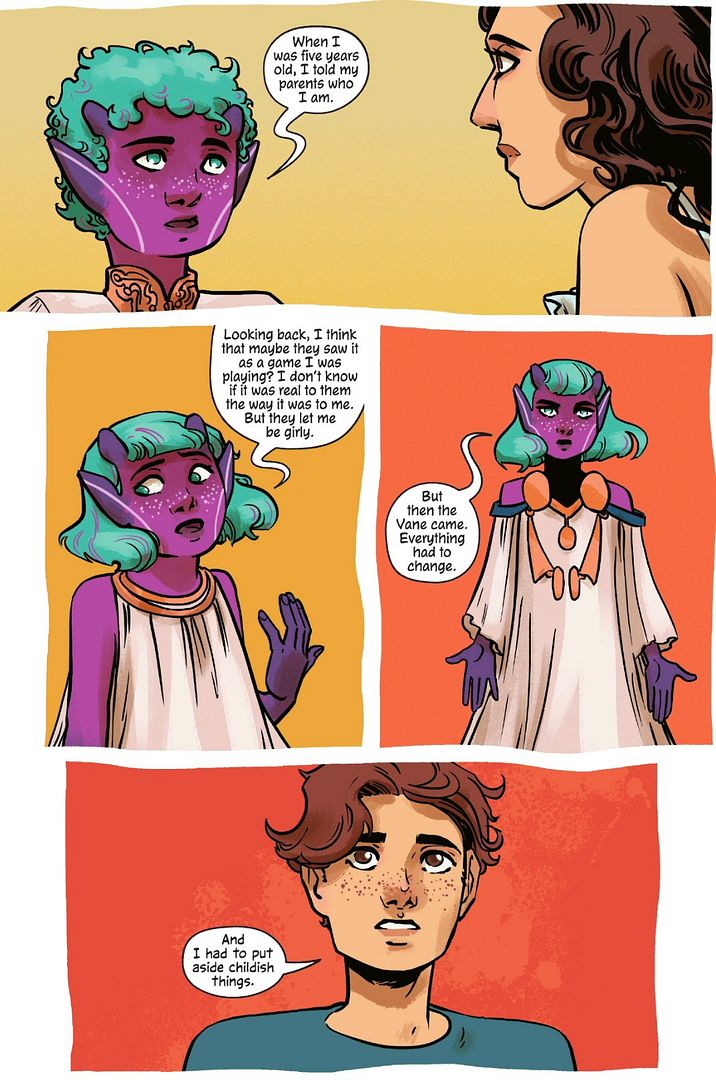
It breaks my heart to see that transition back to a boy in Taylor’s own dream. It underscores the pressures she was under to maintain that fiction her whole early life.
And I’m sure it is not an accident that Axelrod chose that famous passage from the bible – from Paul’s first lecture to the Corinthians, in 1 Corinthians 13:11. Note the similar phrasing in the Christian Standard Bible translation:
When I was a child, I spoke like a child, I thought like a child, I reasoned like a child. When I became a man, I put aside childish things.
The bible has long been used by many religious adherents to justify their oppression of marginalized groups – despite the great and sad irony that the actual message of Jesus Christ literally contradicts this. See my discussion of situational ethics in my Absolute Wonder Woman and Battleworld posts to learn more about a modern form of consequentialism that was developed based on Christ’s true message – one that seeks to bring about the greatest amount of love.
Indeed, although many may not realize it, that passage from 1 Corinthians actually speaks to that same form of love described in situational ethics (agape) – Paul’s message was we should be charitable and love others because of the imperfect knowledge we have in this life.
Axelrod goes to on articulate another interesting aspect of the trans experience:
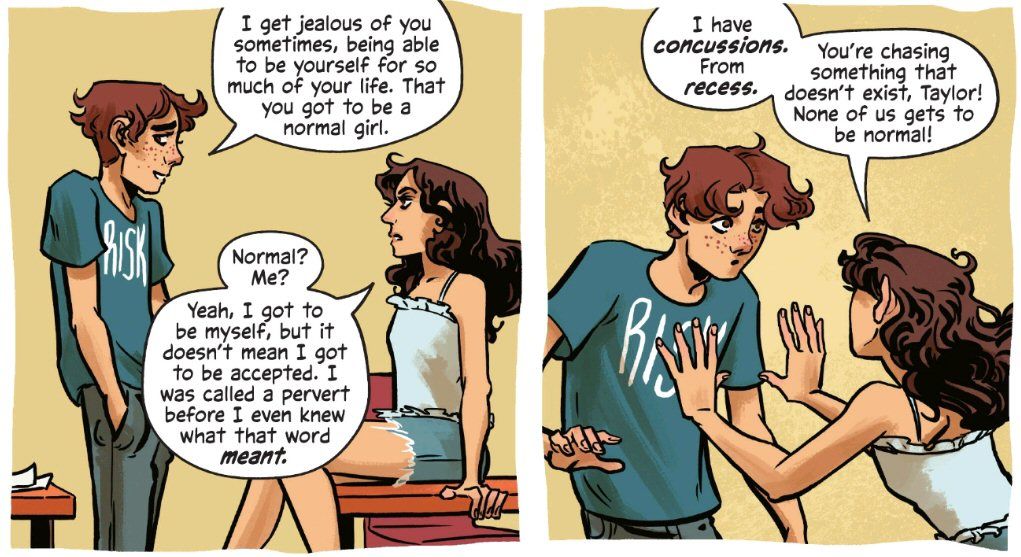
It makes sense that Taylor would initially have been jealous of Nia – who got to experience her true gender self at a younger age. But Nia appropriately pushes back with the reality of her personal situation. Getting back to the themes of intersectionality and suffering described above for Taylor, this is in fact an opportunity to develop greater understanding and empathy for others.
I love that Nia is the one to provide this lesson for Taylor, and she feels she has learned equally as much from her:
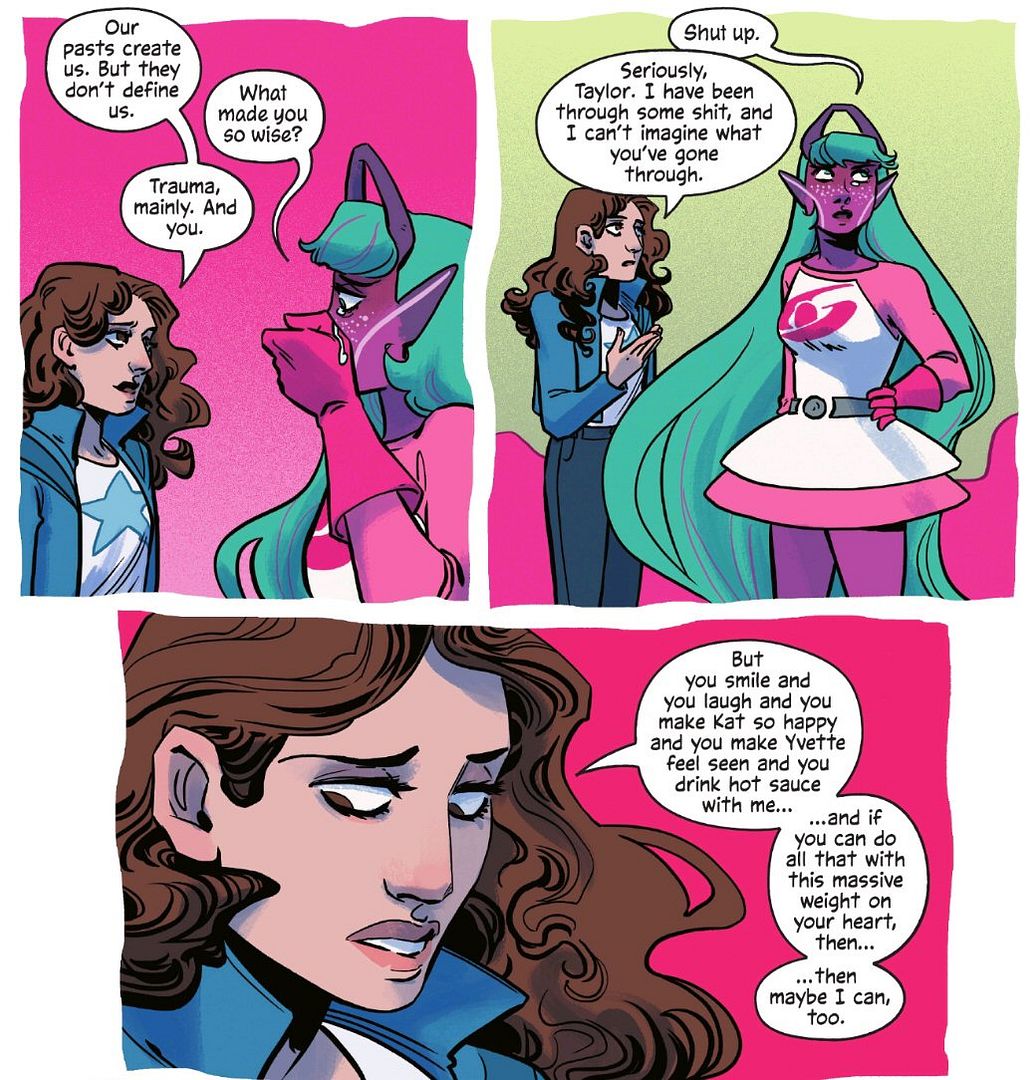
Which brings me back now, finally, to the conclusion of that Justice League Intergalactic Special that I introduced at the start of this post.
Nia fails to dissuade Taylor from her plans to help her teammates deal with the Dream Witch – with Taylor in fact displaying a somewhat toxic sense of positivity about the whole issue. Nia calls her out for this lack of authenticity – and the danger it brings. From Justice League Intergalactic Special #1 (2026) by Jadzia Axelrod and Nicole Maines, with art Travis Moore:
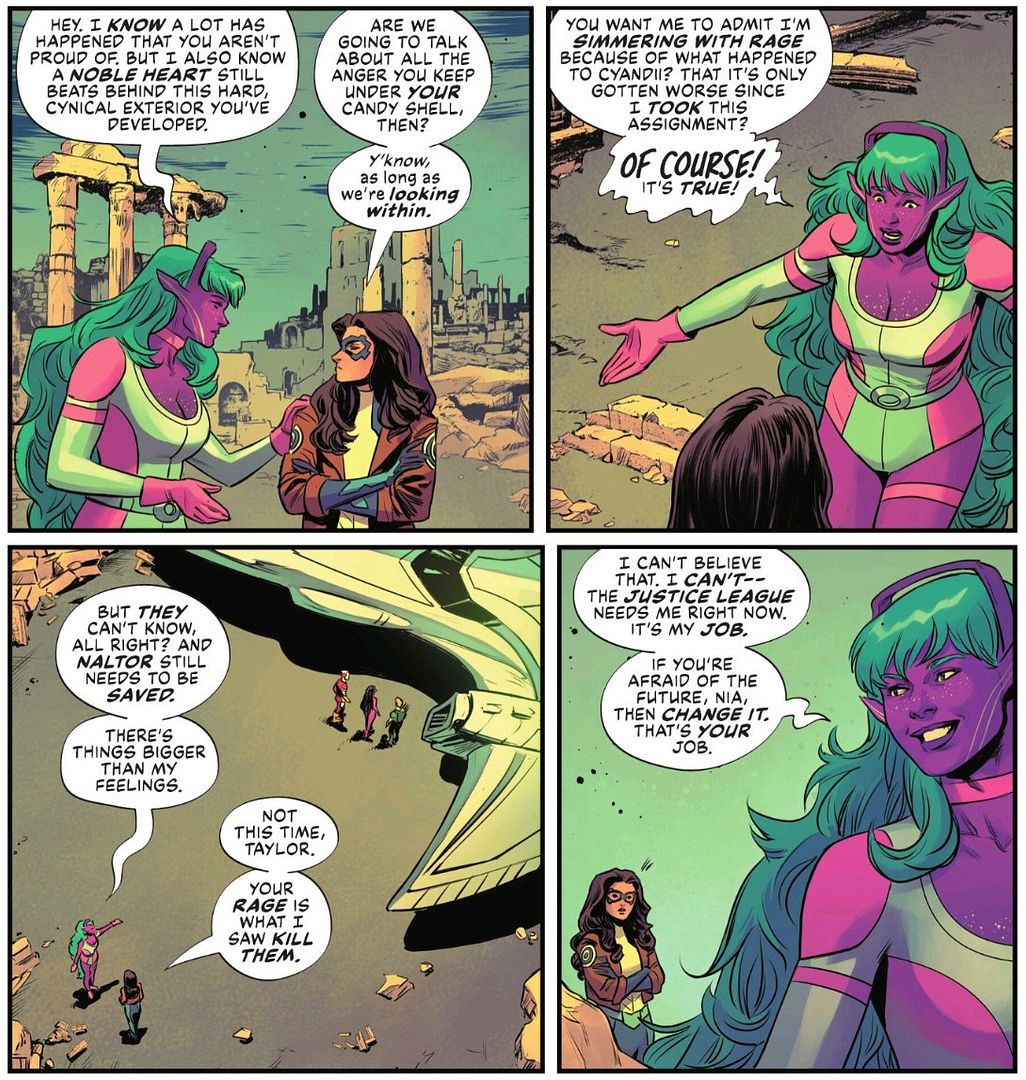
While it is true that Nia is exceedingly hard on herself in this series (for the events described in my Dreamer overview above), this inauthentic attitude bodes poorly for Taylor.
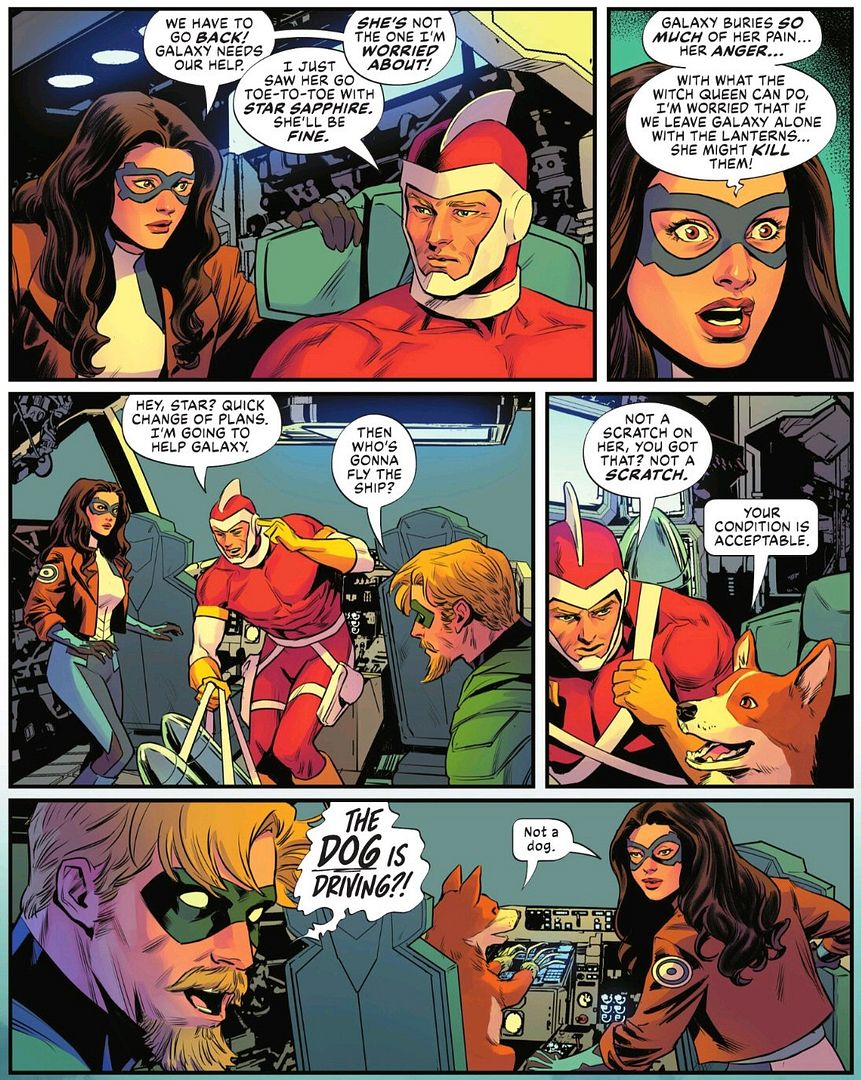
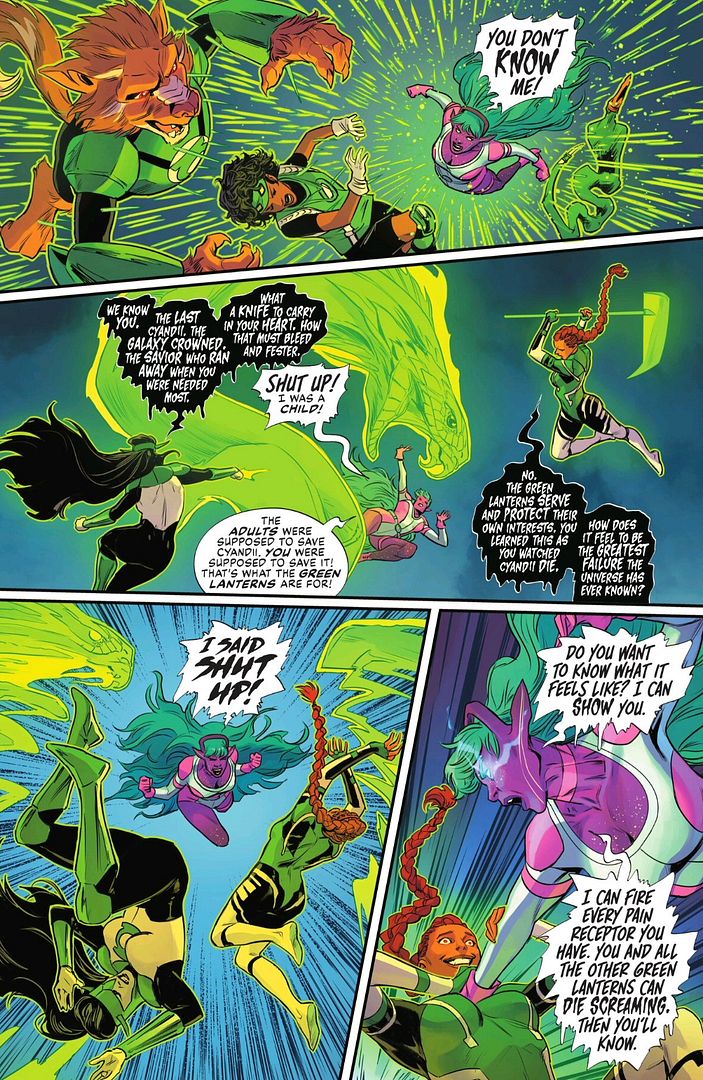
While Argus gets to have his moment, as predicted things don’t go well for Taylor:
Fortunately, Adam Strange intervenes at just the right moment, thanks to Nia’s prodding:
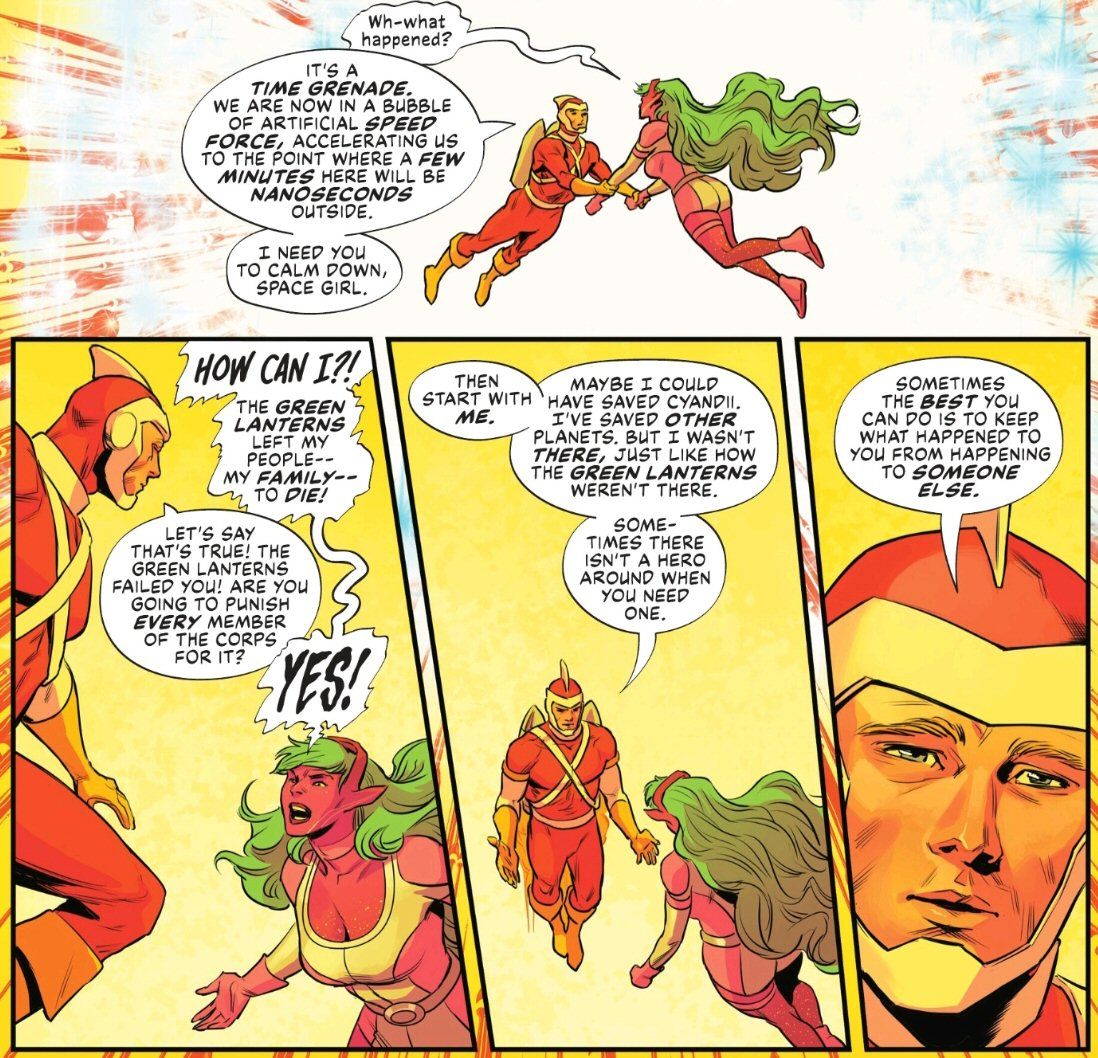
Just like Harley Quinn tried to explain to Nia (again, see my Dreamer overview above)
In the end, Nia and Green Arrow succeed in taking down the Dream Witch – just before the calvary bursts in:
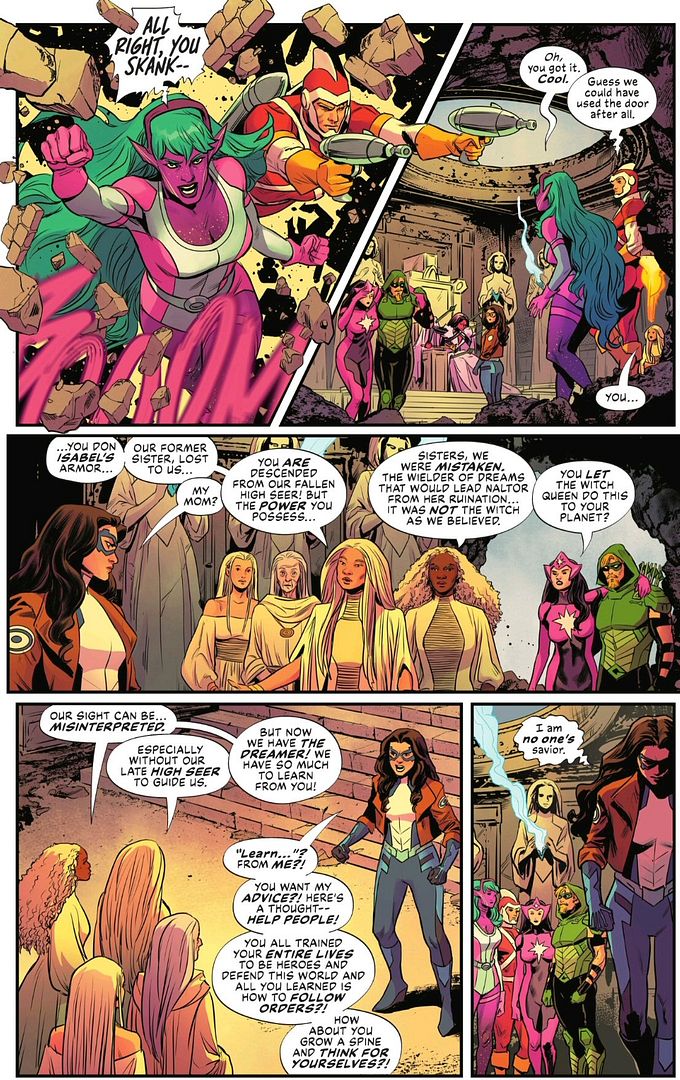
Nia – with her significant self-loathing by this point – has no apparent interest in becoming the savior of the Naltorian people. But I’ve no doubt this theme will continued to be explored.
But if anyone was hoping for a happy ending between these two friends, it was not to be in this issue:

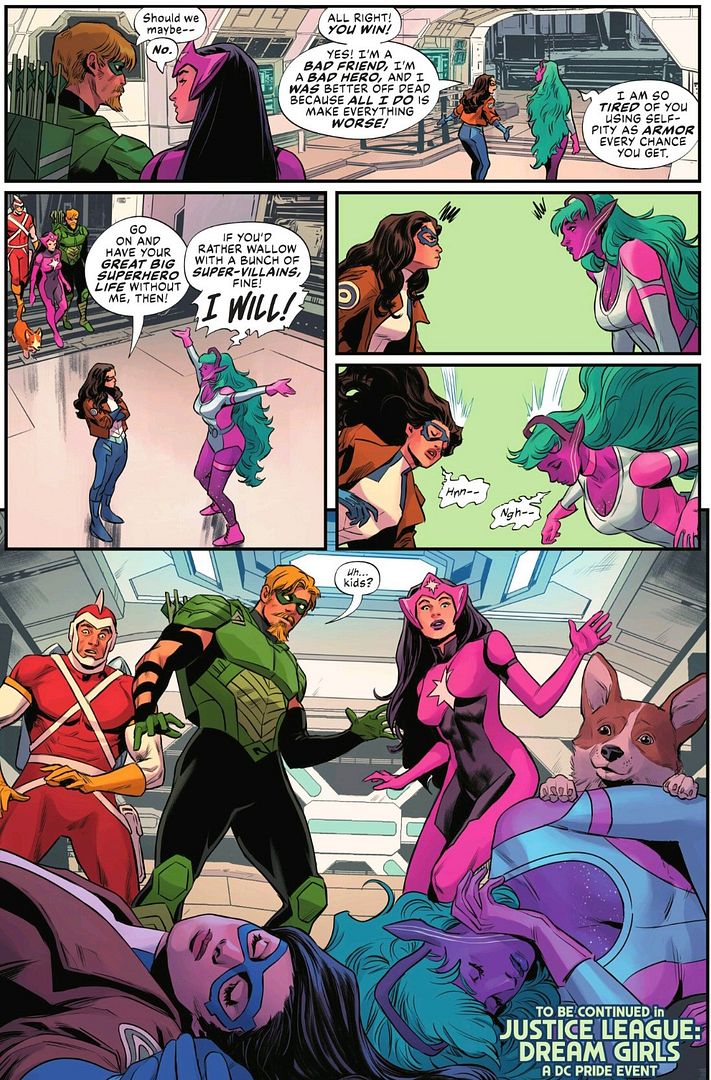
The reason I find this so significant is that up until now the interactions between Nia and Taylor were a great example of the dialectic in comics.
This ancient Greek concept involves the proactive use of disagreements to overcome conflict and reach a new shared understanding and perspective that didn’t exist before. This is a powerful – and rare – experience in life (or literature).
Often the best we can hope for is the more limited dialogic. Dialogical processes involve the open exchange of views, with mutually respectful understanding of each others’ perspectives, without requiring coming together to a common consensus. In the case of personal ethics, this is often the best you can hope for (see my care ethics post for an example from my previous life).
But Nia and Taylor have been such a great example to date of helping each other see greater truths. Axelrod and Maines write them both so well – and even better together here, as it feels like the two firends are having real disagreements. Each one’s voice sounds authentic and urgent in this issue. And I have great hope that a return to the dialectic is exactly what we will see over the course of the Justice League: Dream Girls series.
The last word … for now
I know that was a lot of character background – and ethics. But hopefully it helps you feel prepared to tackle the great opening issues of Justice League: Dream Girls – A DC Pride Event Vol 1 (2026). Two issues have dropped already (they are coming out every Wednesday this month).
I don’t want to give too much away about this series – it is best you experience it directly. So if you don’t want to know more, I suggest you stop reading now.
*** SPOILER ALERT ****
I will say that the series has a very novel take on the anthology format. The continuing story is written by Axelrod and Maines, with Nia and Taylor being taken on one wild ride after another through fantasy dream worlds by the series’ super-villain (known as The Key, who specializes in the use psychoactive compounds). Each escapade is drawn, colored and lettered by different art teams – which is really cool.
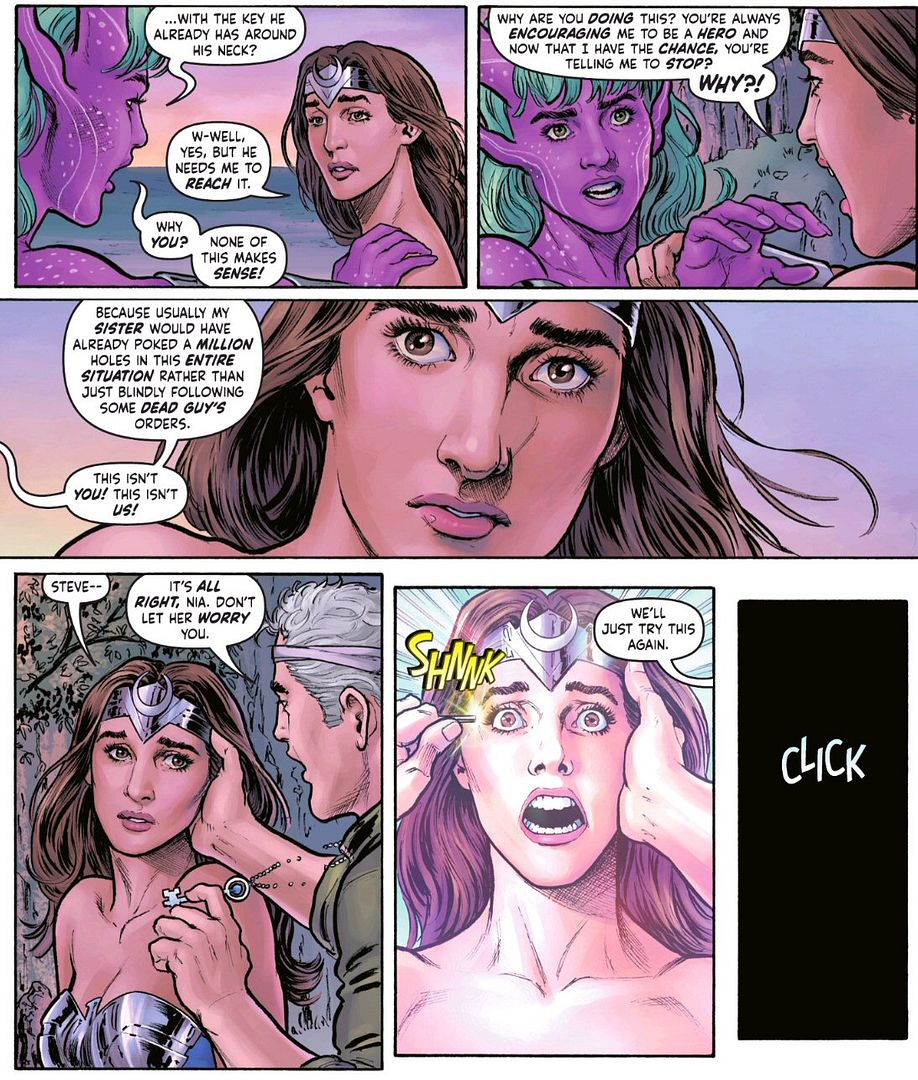
The first issue shows Nia and Taylor first as Wonder Woman and her sister, with The Key impersonating Steve Trevor upon his arrival at Themyscira, trying to seduce Nia to his plans (drawn by Nicola Scott in a sweeping realistic format). Taylor is the one who suspects their memories and perceptions have been altered, and tries repeatedly to get through to Nia:
The story then shifts to Gotham, where Nia and Taylor appear as a hybrid Dreamer-Batgirl and Galaxy-Supergirl versions of themselves, drawn by J. Bone is an amusing animated cartoon series format.
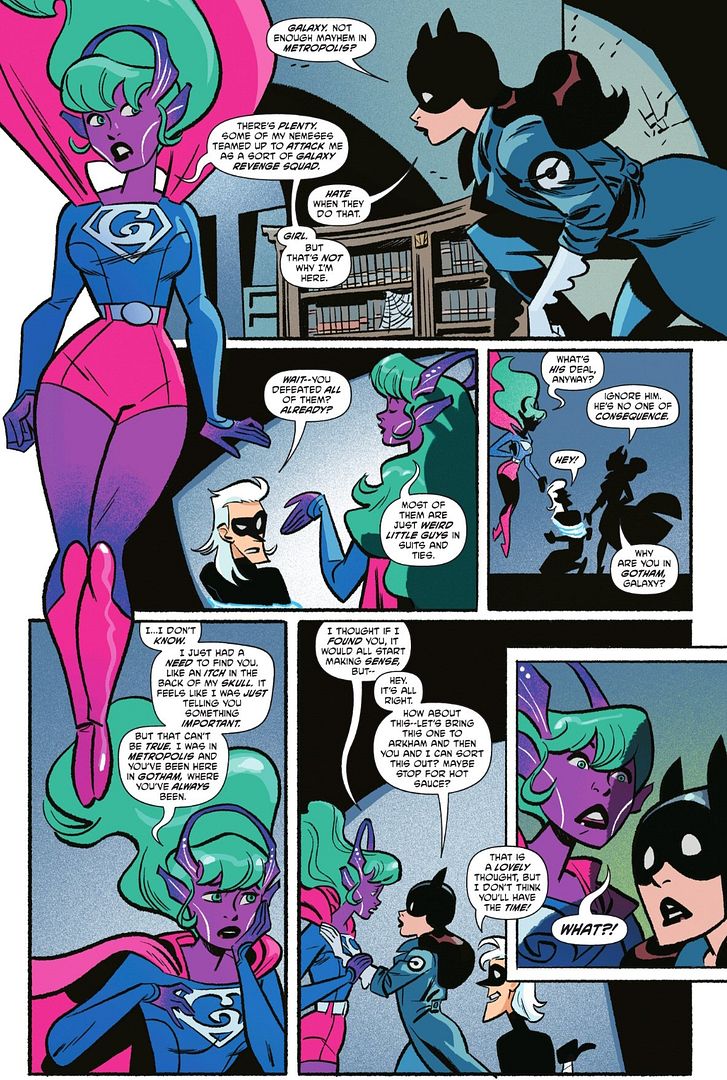
As strong trans women who fought so hard for their identities, it is heart-breaking to see them go through this. And again, Taylor is the one see through things quickly:

Despite this realization, The Key is still calling the shots in this dream wolrd …
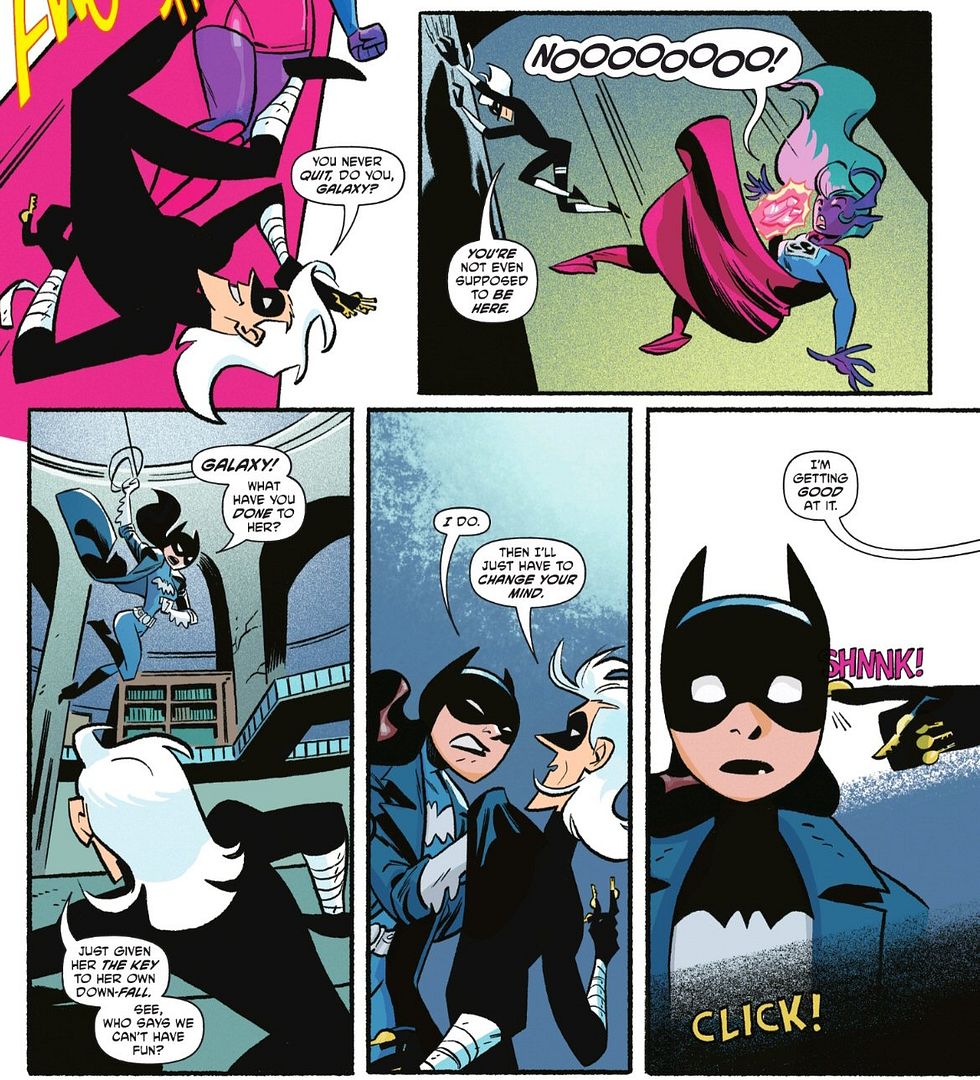
The second issue has some of the most heart-wrenching scenes, as Nia’s subconscious begins exerting more control over the fantasy dream world (with art by Stephen Sadowski, Vincent Cecil, Ted Brandt & Ro Stein, Dan Jurgens & Norm Rafmund, and Joe Quinones).
We are treated to Dream-Blue Lantern and Galaxy-Green Arrow hybrid characters protecting Pride demonstrators who are being attacked by police (likely a reference to the famous New York Stonewall riots from 1969):
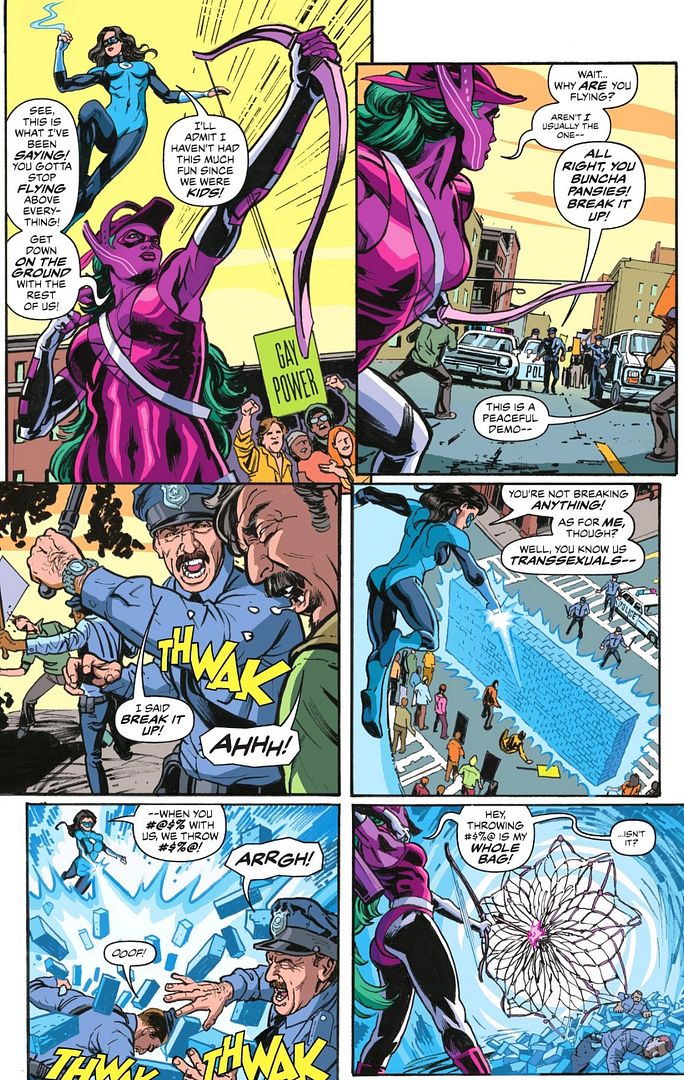
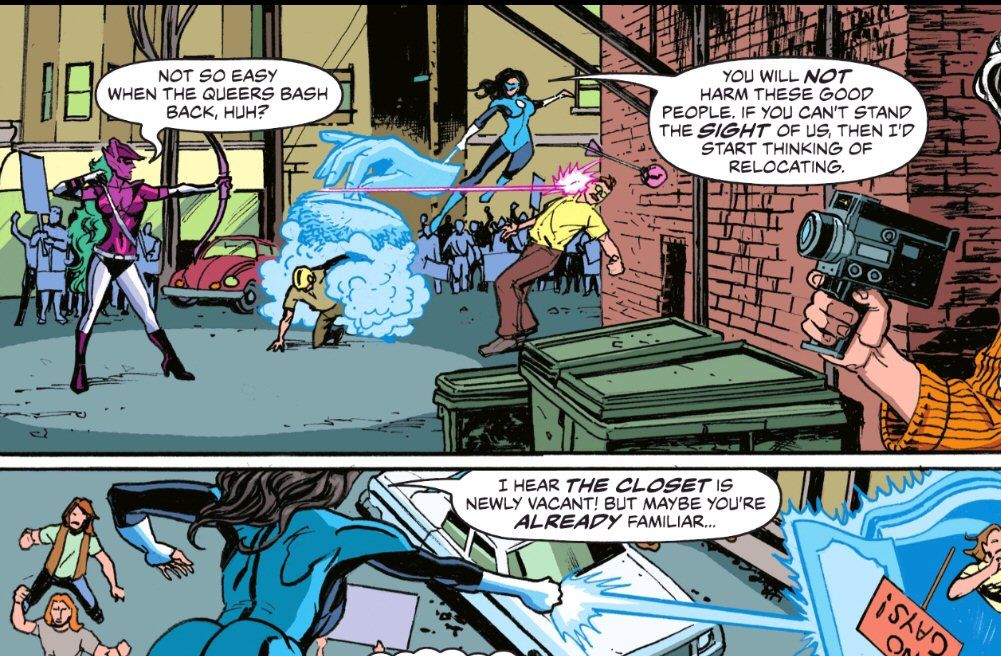
As entertaining as these scenes are – watching the Dream Girls kick ass – there is some very real trauma behind them.
This continues as we move through various other characters and scenarios, until we end up with a Nia-John Constantine (!) and Galaxy-Zatanna. The Nia/Constantine pairing is interesting, as it accentuates the cynical, dark and morose sides of Nia. Taylor, on the other hand, has had enough fantasy and exerts enough self-control by this point to reform as herself. She and Nia have a gut-wrenching conversation. Just a few panels, to express the sense of loss and despair that Nia is feeling.
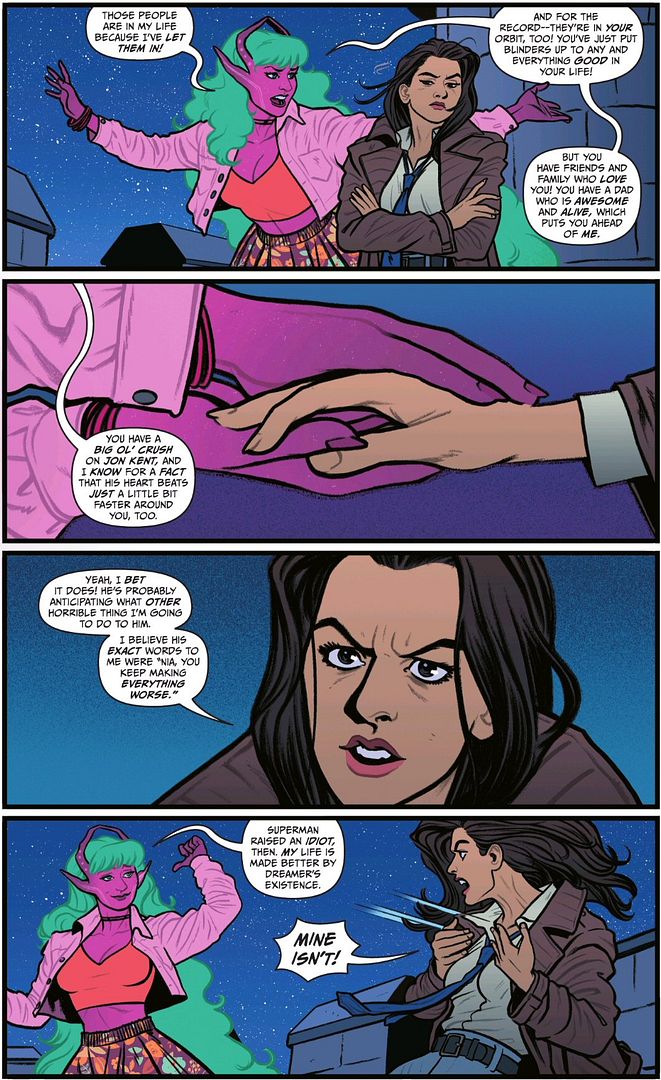
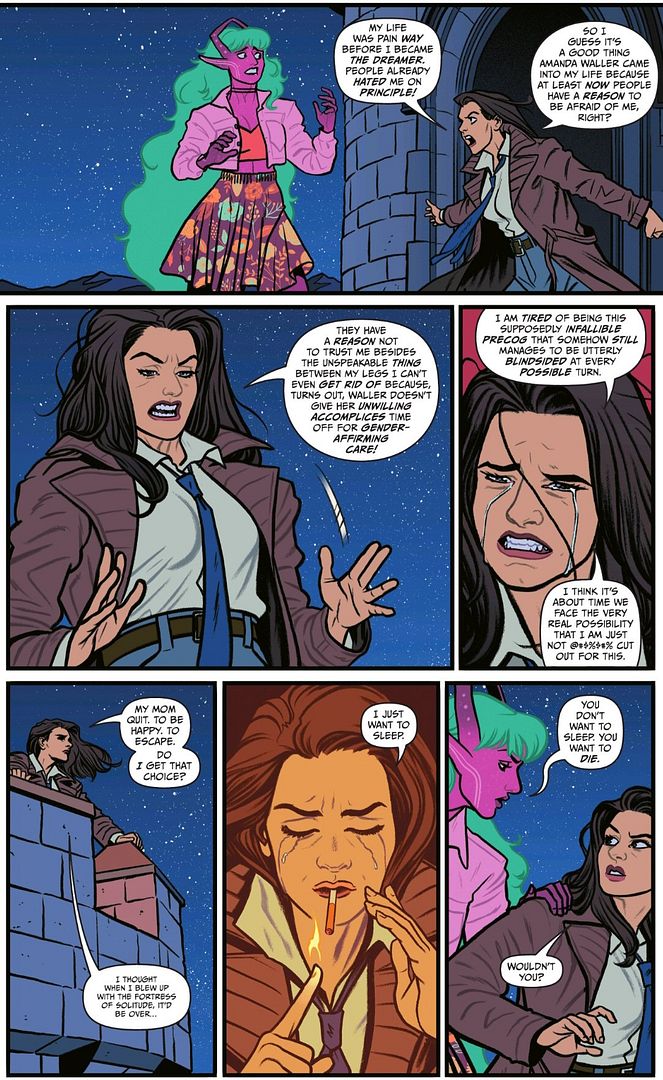
I won’t share any more, as you really need to read this ongoing story itself.
I don’t think I’ve seen such emotionally powerful and honestly frank scenes with trans characters in the Big Two publishers before. With deep respect and gratitude to all involved in crafting these stories in such open and caring terms. This series is a credit to DC Comics – and all involved.
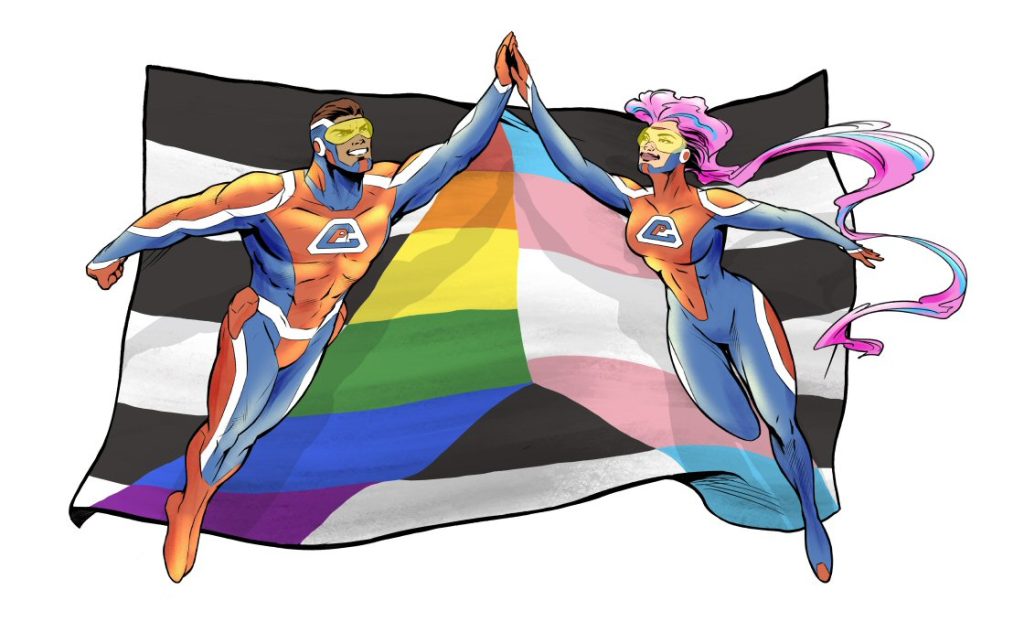
In honor of Pride Month, shown above is a variant of the classic LGBTQ+ Ally flag with Comic Philosophy’s two superheroes coming together – drawn as always by the supremely talented Pablo Alcalde. I had Pablo alter the flag to include the traditional transgender colors this year. Not coincidental with the rise of authoritarianism and fascism in many countries, I find all non-heteronormative and binary gender identities are under increasing attack. But trans men and women seem to be bearing the greatest brunt of backlash, with an unprecedented attempt at public erasure that is not only threatening their identities but their very lives.
But as awful as current events are, seeing stories like these in print gives me hope for the future. I can’t wait to see what Maines and Axelrod have in store for us!
Epilogue (2026-06-24)
The Dream Girls series has just completed, and it was a great story arc. I don’t want to give anything away about the ending, but rest assured it follows the traditional pattern of most fiction and sequential art – things get tough and go badly for our heroes in the middle, but they persevere and reach a greater understanding in the end.
Galaxy and Dreamer are positive role models for today’s youth – indeed, for all who feel marginalized or denied their basic rights – by demonstrating the importance of friendships and the need for self-agency (and self-care). But this series speaks directly to what it means to be a trans woman in today’s world. The panels above are clearly informed from some real emotional trauma, and may thus be triggering for those who have their own trauma experiences.
As always, if you or someone you care about is at risk or experiencing a mental health crisis, please dial or text the mental health hotline 9-8-8 in Canada (988.ca) and the U.S. (or equivalent service in your country). The 988 system integrates previously separate hotlines (including suicide-prevention hotlines) into a consolidated, 24/7 national service staffed by trauma-informed counselors.
In Canada, Integrated Youth Services (IYS) combine free, youth-friendly health, wellness, and social services under a single roof. Follow the link above to find a local IYS hub in your area. Hubs are walk-in, self-referral, and typically serve young people aged 12 to 25 (and up to 29 in some jurisdictions). They can provide access to primary care, mental health services, substance use counseling, peer/family support, sexual health services, housing/social supports, employment/education resources, and culturally specific Indigenous practices.
Similar in-person youth hub programs exist in Australia and the UK. The US doesn’t have a national system of youth hubs, but the National Alliance on Mental Illness site can provide relevant mental health resources for youths and adults.
Take care of yourself and others out there!
See my Glossary post for a list of the key philosophical concepts and related links on this site.
Further Reading
For more ethics: Absolute Wonder Woman
For more identity ethics: The Vision
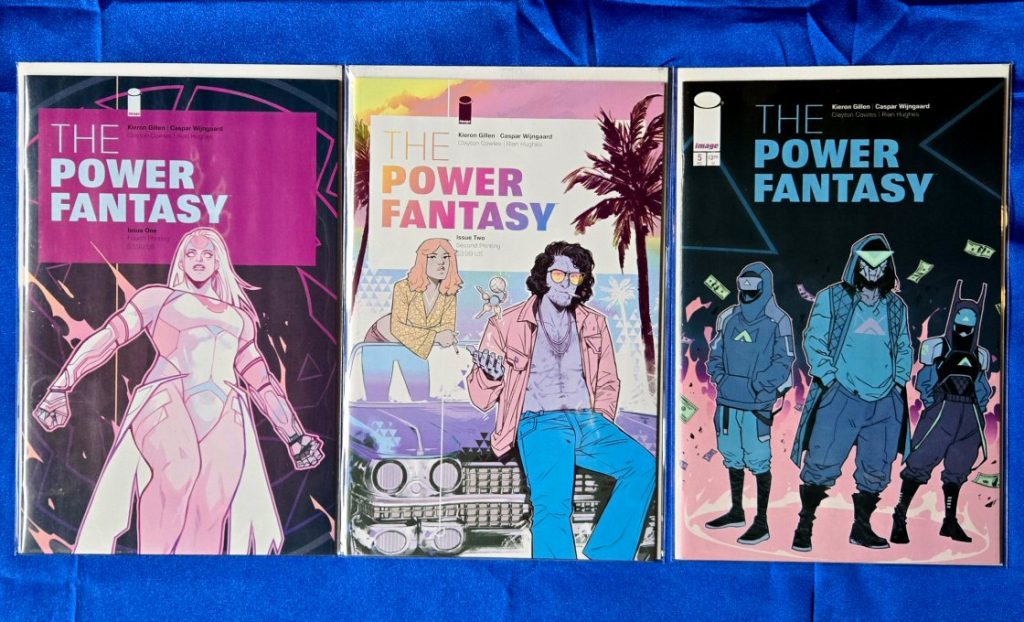
For more superpowers ethics: The Power Fantasy Introduction