

Sue Storm: “Who are we? It’s simpler than that. Me. The man I love. My brother. Our best friend. We are adventurers. And we’re on the greatest adventure of all. Being part of a FAMILY.”
- Dan Slott, Fantastic Four Vol 6, issue #1, 2018.
Most of these ethics overviews are of individual characters. But for Marvel’s Fantastic Four (FF) franchise, it doesn’t make sense to consider them individually. They are more than just a team of superheroes – they are a family, and one whose inter-relationships precede the origin of their powers. I am going to explain here how their individual moral cores can best be understood under the broader, collective familial relationship.
Since this is going to be a longer read than usual, I thought I’d break it into the main sections in the links below, to help you quickly find your interests. But I encourage you to read through the introduction and overview of the team’s ethics before diving into the individual characters, as I cover topics in a logical, inter-related order (I like to think, anyway!)
As always, if you would like to know more about the terms I’m using on this site, please follow the links throughout or check out my Ethics 101 page or Glossary post (located on the header and sidebar respectively, if you are on a computer screen).
Introduction
Created in 1961 by Jack Kirby and Stan Lee (in Fantastic Four Vol 1, issue #1), the FF ushered in the modern age of Marvel Comics. The FF are fundamentally a team of adventurers who accidentally received their powers from cosmic rays during a space trip in their first issue. The team consists of the brilliant scientist Reed Richards (aka Mister Fantastic), Reed’s girlfriend (later wife) Sue Storm (aka the Invisible Girl, later Woman), Susan’s brother Johnny Storm (aka the Human Torch), and their best friend and ship’s pilot Ben Grimm (aka the Thing).
Although their origin has been extensively retconned over the years, the fundamental details above remain unchanged. And while there have been some temporary changes to the team over the years (with members briefly losing their powers, for example, or other heroes joining them), they have remained remarkably consistent as a family of hero adventurers. Eventually, Sue and Reed welcomed two children, Franklin (aka Powerhouse) and Valeria (aka Brainstorm), who have their own unique abilities and gifts (as their hero names imply).
There are a number of adversaries the family has faced, including their earthly nemesis Victor Von Doom (aka Doctor Doom), and the cosmic entity Galactus, the Devourer of Worlds. Along the way they have also made some significant allies, such as the Silver Surfer – and of course, the New York City contingent of Marvel superheroes. I plan to profile these significant characters later. But the FF stand apart from the other superpowered beings and see themselves more as an explorer family who help where and when they can. The family has been at the center of a number of major Marvel Multiverse events – including, most significantly, the collapse of the Multiverse and the reformation of the Seventh cosmos as part of the Secret Wars (2015-2016) major cross-over event.
As a result, this overview will look a little different than most. It is also an opportunity for me to explore an aspect of relational ethics that doesn’t come up in the other stories and series – the unique position that family holds in our moral lives. I will then examine what the various creative teams have had to say about each of the individual team members, and show how it fits within this family framework.
Commercially, I should note that the FF has always been a key property for Marvel (and a popular and successful one at that). This is why it was one of the first properties it sold off the film rights for (in 1986), although no commercial release ever came out from that first production company. Eventually, it was sub-licensed to 20th Century Fox, and a series of major theatrical releases ensued in the early 21st century – although they didn’t fare particularly well commercially (or with critics).
In 2019, Marvel re-acquired the film rights, and the first rebooted MCU film – Fantastic Four: First Steps – came out to commercial success earlier this year (2025). Note this film is set in an earlier time period, in an alternate Universe. You can jump down to my discussion of this MCU film for an explanation of how it relates to the comics described below.
Introduction to the FF’s ethics
The early comic stories took a while to establish the characters. Kirby seemed to be trying to take this family in a different direction than their other groups (who were either quite solitary heroes, or more “found families” of similar interests/abilities). As such, I found their early ethics somewhat muddled (as I will describe in some of the individual character entries below). But their family group dynamics eventually became much clearer.
As I explain in my Ethics 101 introductory primer on ethics, it’s convenient to use the normative ethics framing for discussions of moral philosophy. There are three main branches of normative ethics theories. Deontology is concerned with doing your duty to other people, often through the lens of rights or justice. These theories are often rule-based and focus on the moral value of the acts themselves (that is, doing the right thing). Consequentialism is often seen as the opposite view, focusing not on acts but rather on their outcomes. These theories typically focus on the moral burden of making good decisions (that is, doing the good thing). Finally, virtue ethics shifts the focus from the act to the actor – being the best person you can be, typically by practicing virtues that align with your values and goals (that is, being better).
Given the nature of family, it is important to start our FF moral journey within the domain of relational ethics, which is a branch of virtue ethics. In these overviews I frequently refer to either the classic virtue ethics framing by Aristotle (or the Stoics) that is very impartial and universal, or the modern care ethics relational framing. But there are other relational virtue ethics theories to consider, and the strong family-focus of the FF makes me think of Confucianism.
Founded by the ancient Chinese philosopher Confucius in the circa 500 BCE era (and expanded by many later Chinese thinkers), Confucianism focuses on virtue, familial responsibility, and social harmony. It is broader than most normative ethics, as it integrates philosophy, ethics, and societal governance. But like a number of virtue ethics theories, its precepts are enjoying a bit of a resurgence these days.
From a modern perspective, Confucianism’s appeal stems from its emphasis on the “relational self” – the idea that a person can’t be understood in isolation from their connections with those around them. And that is very true for the members of the FF.
For the earliest Confucians, family roles were primary. The values that we learn from good relationships within our families form the basic building blocks that we use to create societies where people treat one another well. Family is key, in this view, as it first shows us how to be a member of a group that is held together by bonds of mutual consideration. Ultimately, helping those within (and later outside) your family is how an enlightened person becomes established as a moral person.
The key caveat to the above, of course, is having “good relationships” with family. As with modern care ethics – another form of virtue ethics that emphasizes interpersonal relationships – mutual consideration and respect is crucial. There are inherent power imbalances in all relationships – and most especially within families. It’s beyond the scope of this overview, but I do plan to come back to some of the common challenges to both care ethics and Confucianism in later posts (UPDATE: see my discussion of care ethics history and challenges here).
This is where the “social harmony” part of Confucianism comes in, with its emphasis on making sure that all the different members of the group have what they need to succeed. Note that in this framing, “harmony” doesn’t mean agreement or consensus. Instead, harmony is a quality that is revealed when people in different roles complement and support one another. And this is why it occurred to me in relation to the FF – they bring complementary roles to the family team and are always there for each other.
By their very individualistic nature, superhero comic book stories don’t often emphasize this inter-relational aspect of virtue ethics. You will see it in some of the superhero team adventures (the Avengers for example), where complementarity of skills and perspectives are a core feature. But even there, members tend to come and go over successive story lines. The FF are different as they have maintained their close familial bond over the years – one that continues into the next generation with their children in the modern stories (who are explicitly being trained in relation to family bonds).
A FF creator who gets this dynamic well is Dan Slott, who wrote the FF from 2018-2022 (Fantastic Four Vol 6, issues #1-46, with Sara Pichelli and other artists). When Slott took over, the FF had been without their own dedicated team title for 3 years. Several of the FF members featured heavily in the Earth-shattering events of Jonathan Hickman‘s Secret Wars (2015-2016). That event ended with Reed, Sue, and their two children Franklin and Valeria staying away from the Earth for an extended period, in order to rebuild the Multiverse. This left Johnny and Ben alone on Earth-616, with no knowledge of what happened to their lost family members – although they tried to figure it out in Chip Zdarksy‘s Marvel 2-in-One (2017-2018).
Appropriately, Fantastic Four Vol 6, issue #1, 2018, by Slott and Pichelli begins a year or so later in Earth-616 time, with this opening page (the style of the speech balloons should make it clear who is narrating each portion):
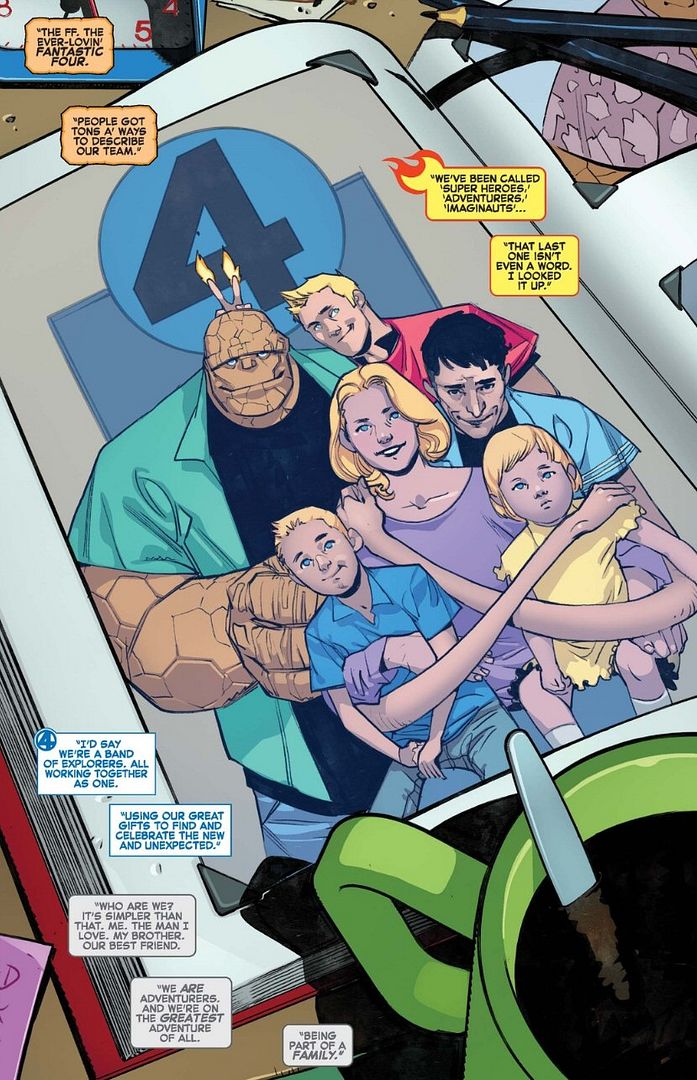
It’s a great way to capture their voices – and reiterate my main thesis that they are all complementary members of a family (with Sue at the heart of it, as I’ll describe below).
They are finally reunited in issue #3 of this series (by Slott, Pichelli, and Nico Leon):
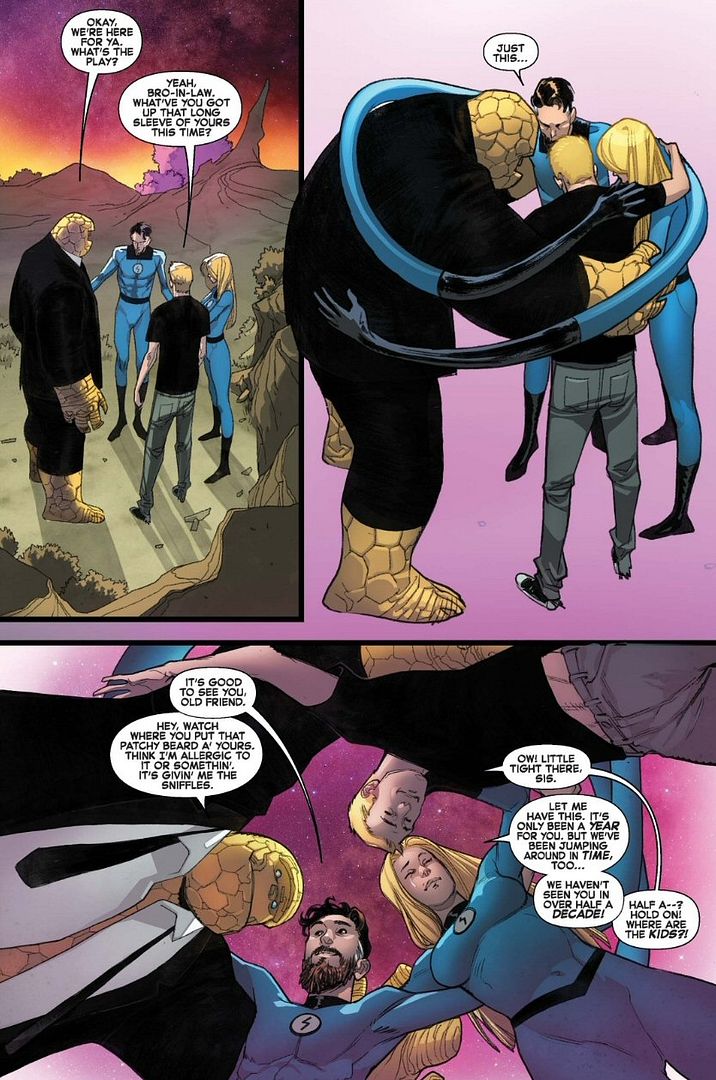
Yes, the kids are older now – and much more integrated into the family. I think this was a good call, as it allowed for some more mature story lines. Including fighting off a new cosmic entity known as the Griever at the End of All Things in these issues. This was a great new villain invented by Slott and Pichelli, who makes her first appearance in issue #2. The Griever is the personal embodiment of entropy, heat death, and the end of the Multiverse – and is fun to read, given she has a lot of sass and swagger.
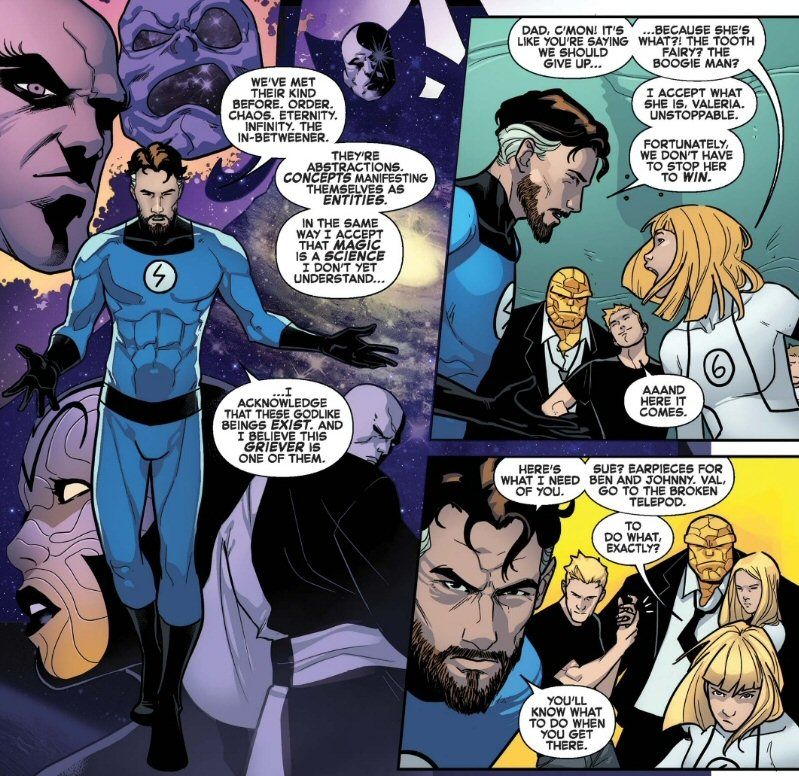
The key to Reed’s plan is to step back and simply let each of his family members do what they do best – “You’ll know what to do when you get there” is for more than just Valeria. This involves letting them all take some risks, and face their personal demons, but as part of a family who has each other’s backs.
The Griever thinks she cottons on to what they are up to, but actually walks into Reed’s trap:
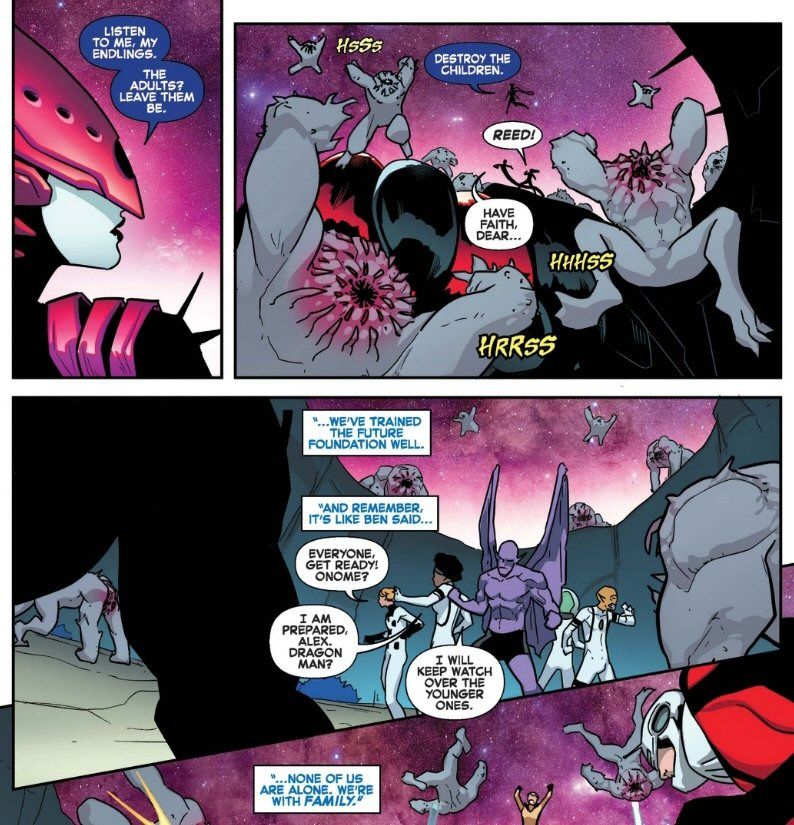
There’s another good example down below in my entry on Ben for him and Franklin, but I’ll share this later sequence here when the Griever grabs Franklin:
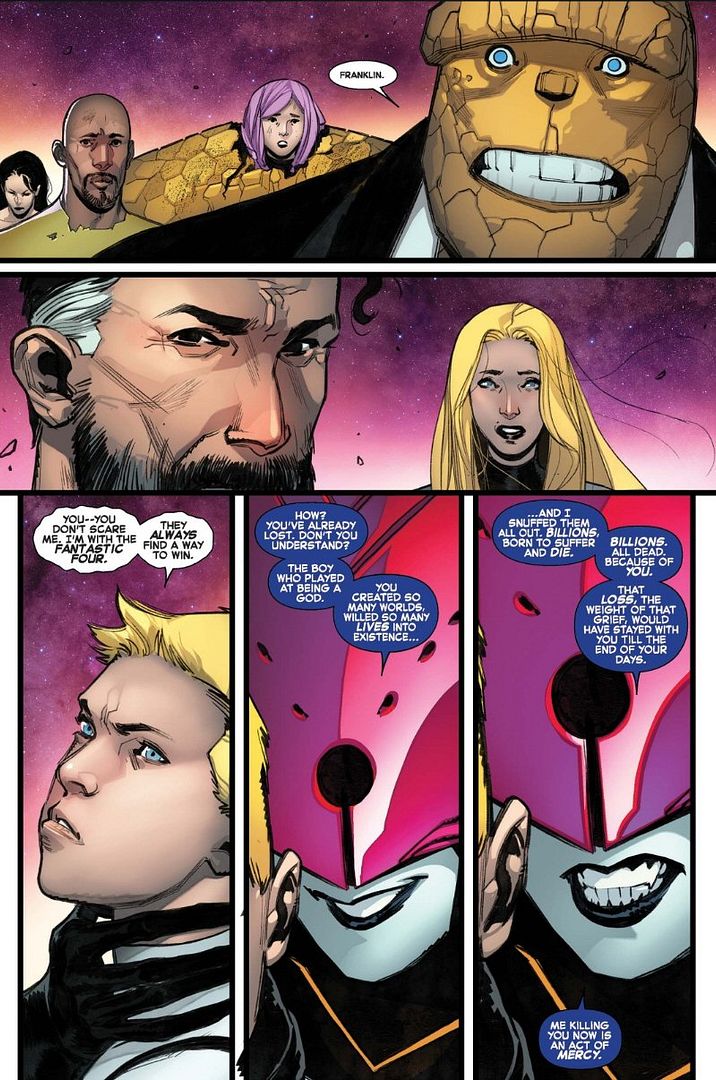
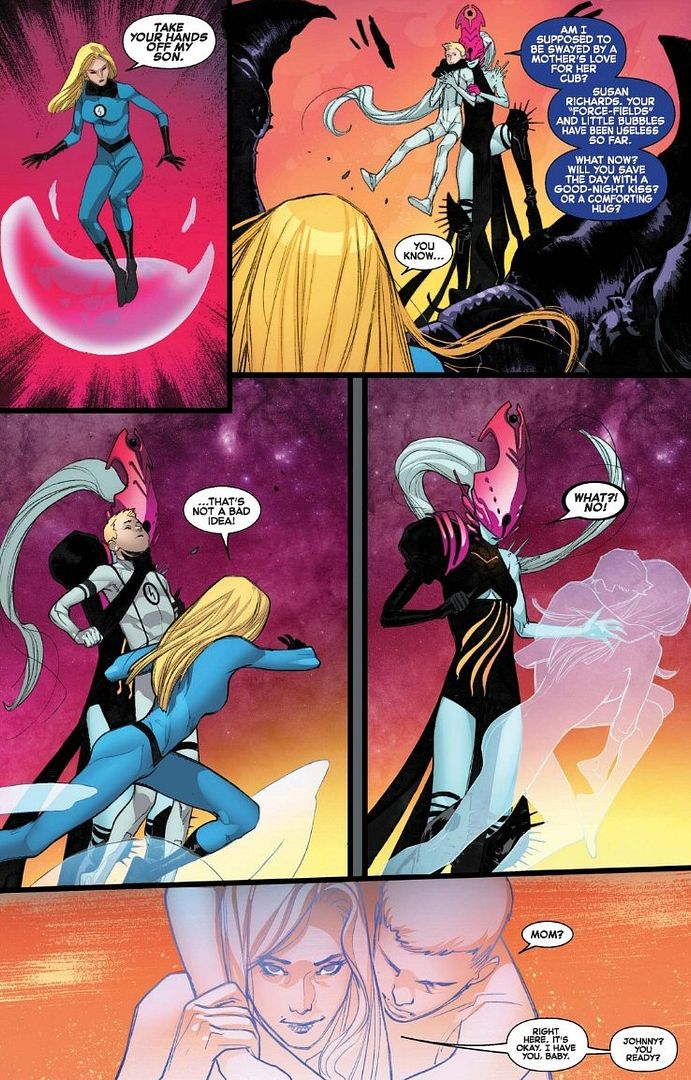
This issue ends on a nice note. After forcing the Griever to retreat, they are able (with Valeria’s skills) to all go home again finally:
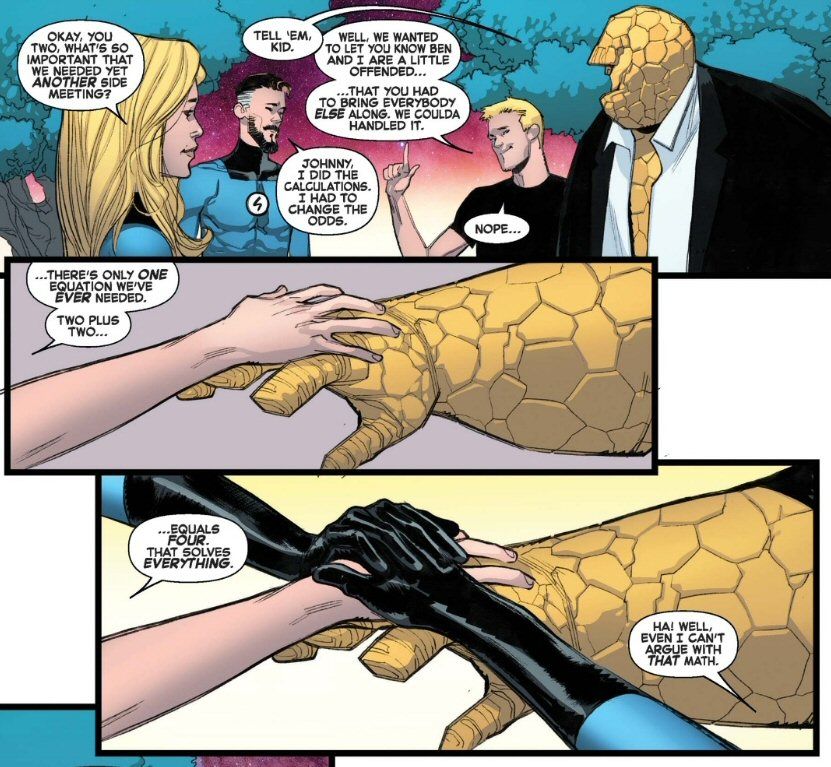
My kudos to the entire creative team for the issues above, as they really got the fundamental ethical nature of this family right. And a belated shout-out to Marte Gracia, who did outstanding work coloring the issues above. I highly recommend you check out this series. However, there was more involved in resolving the outcome of Secret Wars on this family, and I recommend you check out my Ben entry for a greater discussion.
A.X.E.: Judgment Day
I’m going to go a little out of my usual sequence, and talk about the A.X.E. Judgment Day event, the major 2022 Marvel cross-over event scripted by Kieron Gillen, with art by Valerio Schiti, and Marte Gracia. The reason for this is the FF are collectively judged as a family, which I find very significant.
I have created an introductory post on this event, and recently concluded it once once I finished profiling the ethics of the major heroes involved. The premise is that a revived god-like being, a Celestial known as the Progenitor, is deciding the fate of the world by weighing the morality of every Earth being. Although some characters get a single panel or two in the main series, others get their own dedicated issue in their own title – as is the case for the FF, who get a dedicated two-parter in their main title.
The timing is significant, as the Judgment Day event happened just as Slott finished his run (Fantastic Four Vol 6, 2018-2022, with Sara Pichelli in the early years), but before Ryan North had started his new run (Fantastic Four Vol 7, 2023-Present, with Iban Coello). Guest writer David Pepose and artist Juan Cabal pitched in for the two-part A.X.E. Judgment Day event issues, tacked on to the end of the Fantastic Four Vol 6 run (issues #47-48, 2022). And they too did an excellent job in summarizing the ethical core of this family. From the opening pages of issue #47:
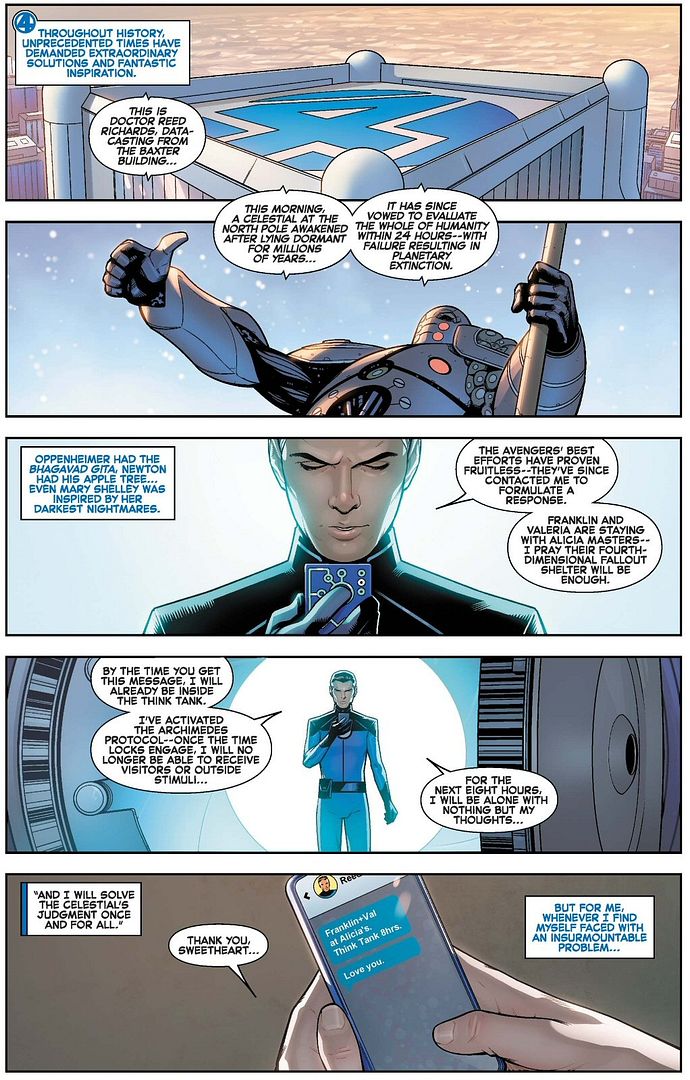
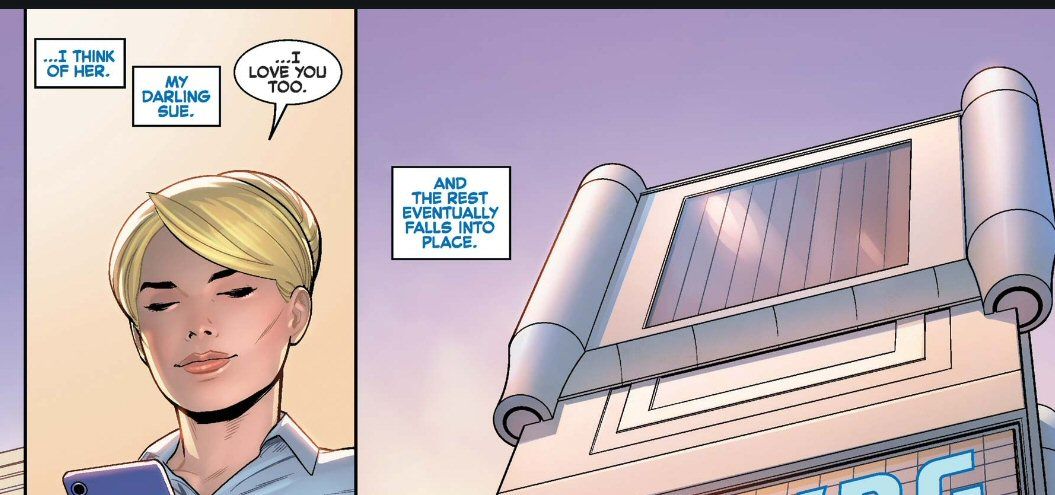
I had a good chuckle at the “Archimedes Protocol” … now there was a man who certainly appreciated the insights that come from isolation (and one’s personal bath time).
In all seriousness, I don’t know if this plot device has even been used before, but it opened the door for a fun Sue Storm-focused action adventure story, The Taking Of Baxter 1-2-3-4 (which is a heist story, in the style of The Taking of Pelham 1-2-3). I’ll skip the details for now – but it is a fun read, scroll down for my entry on Sue for more details. With the heist foiled, and the Baxter Building back in the FF’s control, what has Reed come up with?
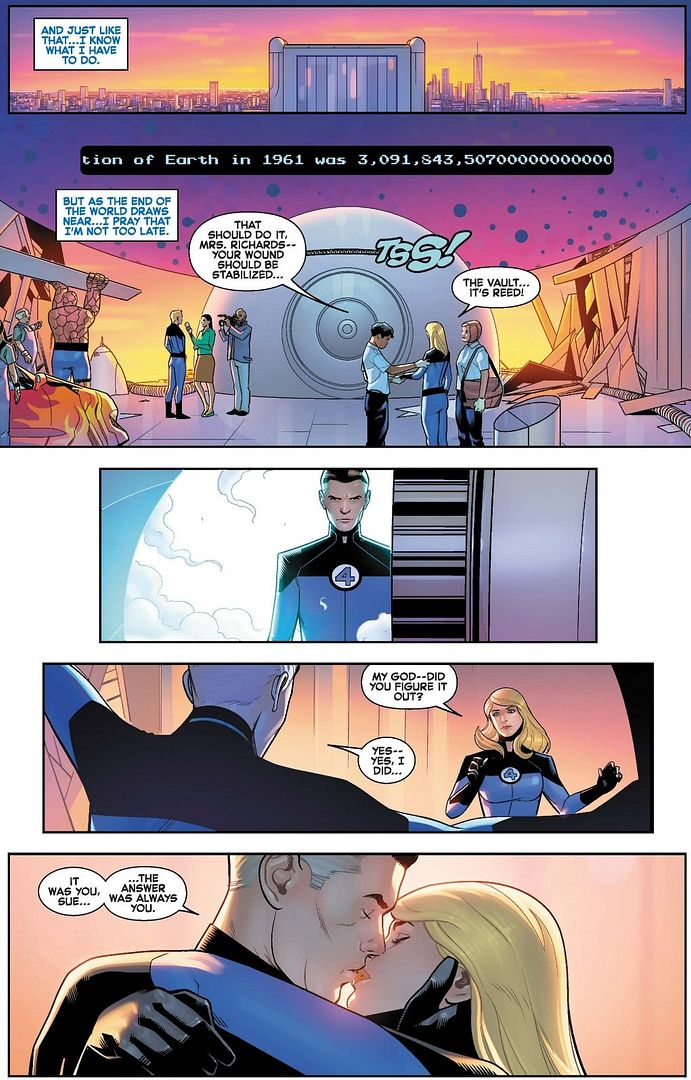
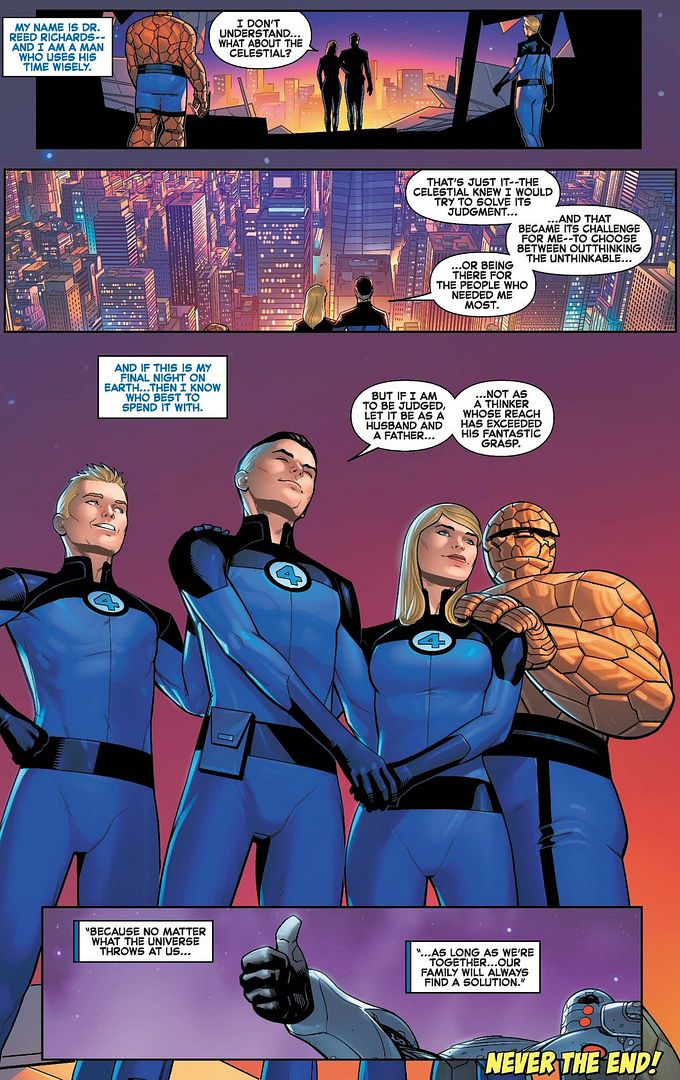
And so Reed has successfully passed the Progenitor’s test by forgoing his typical consequentialist reasoning – and accepting Sue‘s relational care ethics perspective instead. As you will see below, this is a reoccurring theme with Reed’s character, with many writers coming to the same conclusion as Pepose does (I’ll show you at least two other examples below).
Note that the standard interpretation of this ending is that the Progenitor has passed the whole family above. It seems they are a package deal in this as in all things! Check out my conclusion to the A.X.E.: Judgment Day event if you want to know more about how the Progenitor made its decisions. Which leads me to now consider their individual ethical frameworks.
Individual FF Character Ethics
Let’s begin with the most powerful FF member, the one that holds the team together:
Sue Storm, the Invisible Woman
What, you thought I was going to say someone else? Although I will have a lot to say about Reed Richards below, Sue is critical to understanding why the FF family works as a team, and has stayed together all these years.
Sue’s exposure to cosmic rays gave her the ability to manipulate energy for a variety of effects, including rendering herself and other objects invisible, and the construction of solid but invisible force fields. Along with these abilities, she can also alter other people’s visual perceptions (changing colors, inducing blindness, etc.), and can use her powers to sense things by their electromagnetic radiation (kind of like Daredevil’s radar sense, which works even if her own vision is blocked). Her force field abilities can be used in a variety of subtle ways as well – from creating shock waves or inducing internal blockages inside people.
Sue’s powers have potentially unlimited range. It has been established across numerous story lines that it is only her own reserve and reluctance to fully explore the potential of her abilities that holds her back. It has been a slow process over 60+ years, but Sue’s growth in abilities now makes her the most powerful and versatile member of the team. You can read more about her background and abilities on the Marvel Fandom Wiki site.
From an ethics perspective, Sue has always tended toward relational morality – and, most especially in recent years, care ethics. She displays a high level of emotional intelligence, and her decisions are heavily influenced by protecting and nurturing her family and other close relationships (although this often expands to humanity in general, or vulnerable alien species). She clearly serves as the emotional center of the team, making choices based on maintaining bonds and caring for those she loves.
But Sue’s role is greater than this – she also serves as the team’s moral compass and direction-setter. Unlike her husband and brother (who both tend to be more self-centered, see below), Sue understands that feelings and emotional well-being are crucial for relationships – and important components of ethical decision-making. As such, they often look to her for guidance, recognizing the key insights she brings to the team (and family).
In a funny way, her powers metaphorically reflect this role – she literally protects others through her force field barriers, and her invisibility and barriers often help support them in avoiding direct confrontations.
However, it probably won’t surprise you to learn that the early FF story lines were not very progressive in regard to Sue. She was often taken as (and described both by herself and the other characters) as the weakest member of the team. And you don’t need to take my word for it – about a year into his epochal 1980s run, John Byrne had a lot to say in a stand-out issue where Sue gets to save the day after her FF teammates had all been incapacitated. That issue starts with Sue being interviewed by a TV Barbara Walters-like examiner (selected panels from Fantastic Four Vol 1, issue #245, 1982, story and art by Byrne):
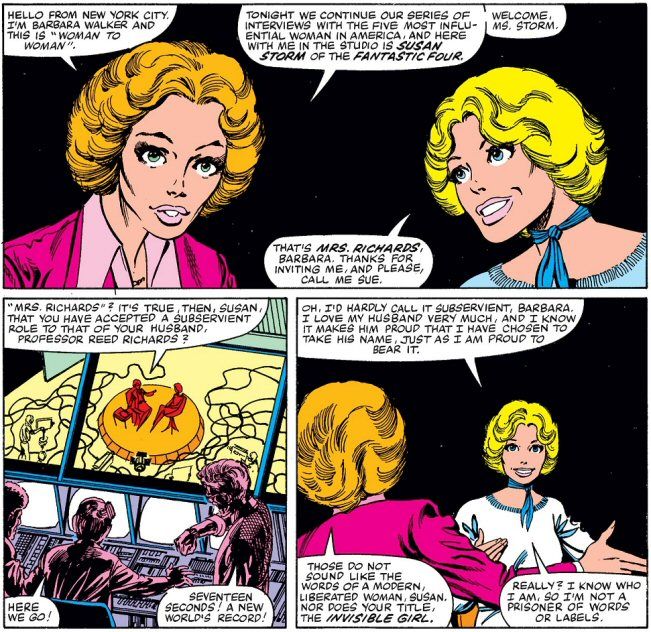
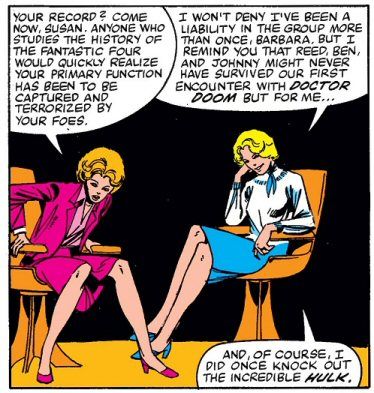
Exactly right. In the 1960s and 70s, Sue performed the same function for Reed as Clea did for Doctor Strange – the much younger love interest, whose “primary function” was “to be captured and terrorized” by their foes (!). And like Clea, when she wasn’t serving as a huge liability, she was displaying her overwhelming insecurities – questioning her own competence and fearing that her older and smarter lover would soon lose interest in her.
This was a painful trope of the early comics, and I really enjoyed seeing Byrne attack it head on. Also, although Sue appears quite comfortable with her status in that interview, that issue went on to show Sue stretch herself in the use of her powers (which are more substantial than she previously realized). But it is actually her caring and empathetic nature that saves the day – another reoccurring theme for a character who is much stronger than she was initially depicted.
Although Byrne would go on to greatly expand Sue’s power and character over his run, this unfortunately involved another common comic trope – having Sue suffer through repeated mind-control and torture. For example, a few years later Sue has been turned into the villain Malice. Here are some panels from Fantastic Four Vol 1, issue #281, 1985, by Byrne and Jerry Ordway:
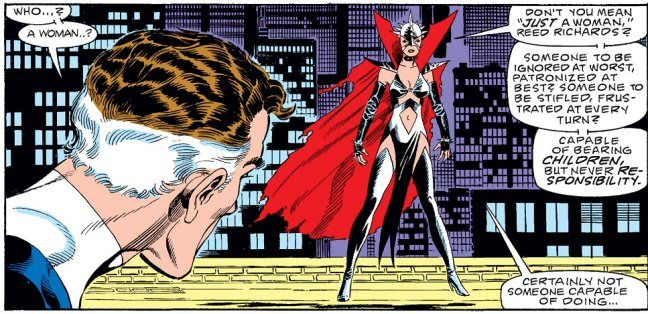
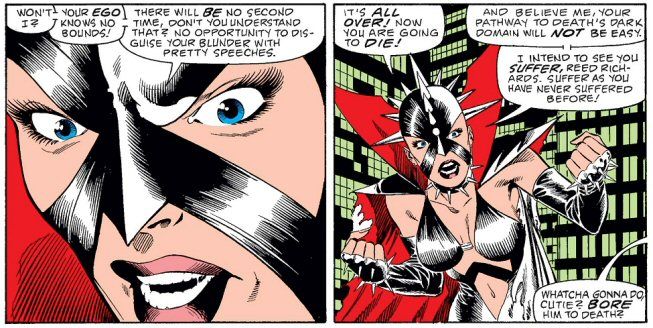
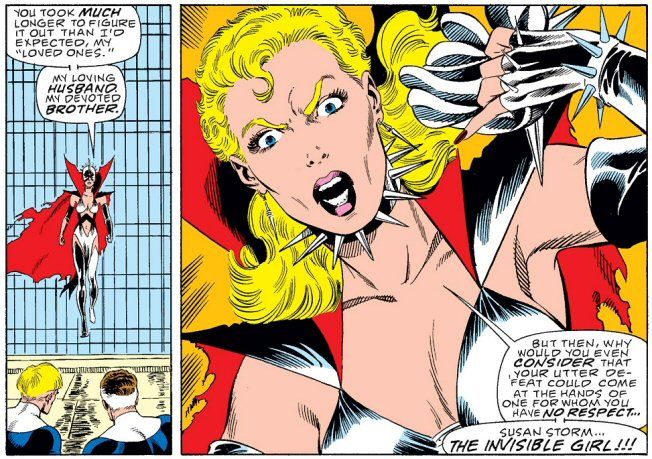
Did we really need to go the full S&M costume route here?
As a plot device, I have always found this trope very disturbing. It is certainly true that all superhero characters suffer in the comics. That suffering is used to show the character’s drive and motivation (and sometimes growth). But it is almost exclusively the women characters who go through this mind-control/mind-erasure, as I discussed on both my Clea page and my Carol Danvers (Captain Marvel) page. There is also a disturbing parallel to the Gabrielle Haller relationship with Charles Xavier (Professor X) in this time period.
To Byrne’s credit though, he does allow Sue the opportunity to voice exactly why she has found this so traumatic – explaining to her rather obtuse husband and brother how this mental assault is worse than the constant threat of physical assault that women are always under. From Fantastic Four Vol 1, issue #282, 1985, by Byrne and Ordway:
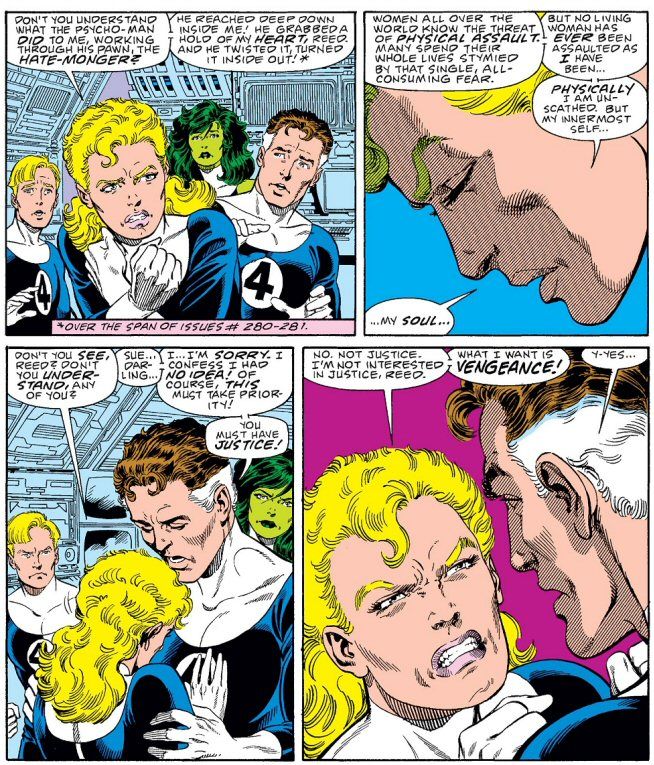
At the time, I found this an encouraging sequence, as Byrne seems to be calling out what I now recognize as the misogyny that was often present in the comic books of my youth.
Unfortunately, Byrne wasn’t done with torturing Sue. Note the repeated symbolism from the next issue’s opening page and a later interior page, with the big heavy Psycho-Man, in Fantastic Four Vol 1, issue #283, 1985, by Byrne and Ordway:
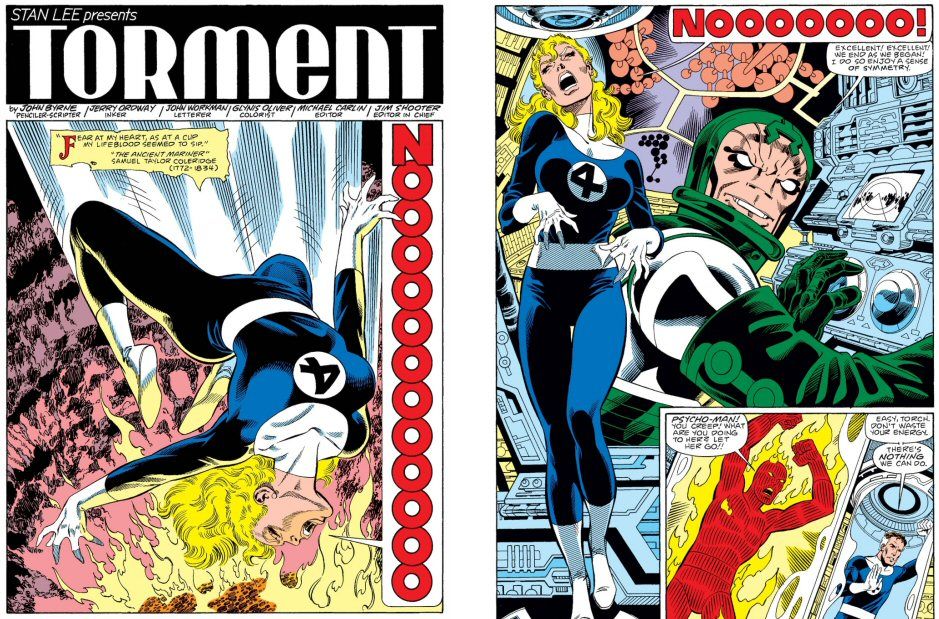
Seriously, a “sense of symmetry”? Fortunately, this story line was wrapped up in the next issue – where it is heavily implied that Sue subjects the Psycho-Man to perpetual torment using his own device (!). That issue ends with this panel, from Fantastic Four Vol 1, issue #284, 1985, by Byrne and Al Gordon:
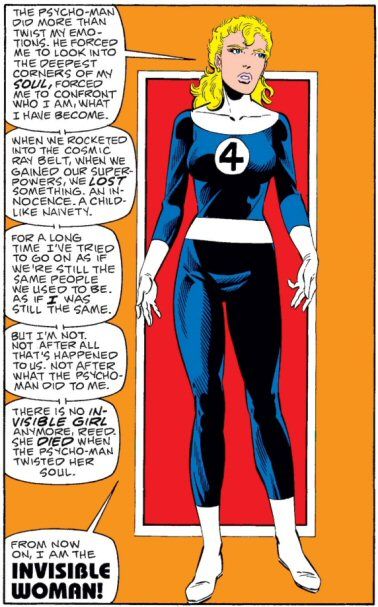
On the one hand, I was glad to see Sue’s character mature into a stronger version over Byrne’s run. But reading these panels again today, it is hard to accept the means by which that growth occurs.
Her character growth continued under Tom Defalco‘s run in the early 1990s, where Sue takes over the leadership of the FF for several years when Reed is presumed dead. Unfortunately, there is also an extended period here again where her Malice persona returns and is influencing her (groan).
Encouragingly, over the subsequent decades Sue’s ethical evolution continued to develop, and she was often depicted as challenging Reed‘s unilateral utilitarian decision-making. She increasingly asserted her growing care ethics, demanding respect for others’ autonomy and involving them in decisions that affect their lives. In my view, her growing assertiveness represented a maturing of her moral framework – and had a very positive effect on her family.
The impact she had on the others can be inferred by panels like the one below, where Reed had gotten deeply involved with the very utilitarian star-chamber known as the Illuminati, in the lead up to Mark Milar‘s Civil War (2006-07) cross-over event. From New Avengers: Illuminati Vol 1, issue #1, 2006, by Brian Michael Bendis and Alex Maleev, where Reed sides with extremely utilitarian Iron Man:
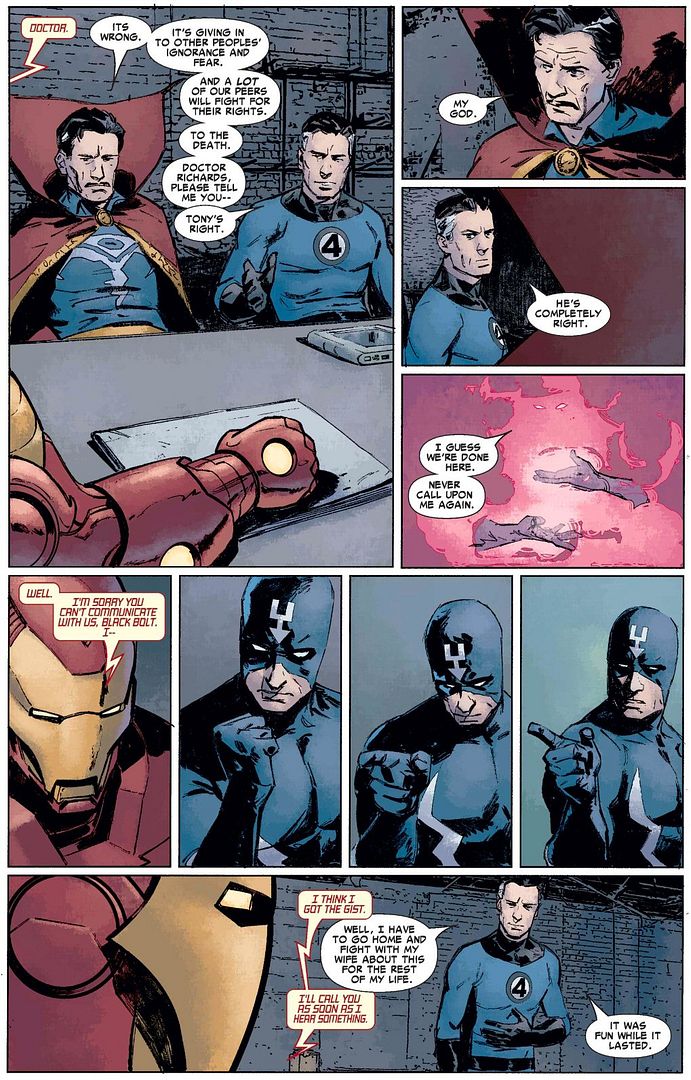
Bendis accurately captured how Reed knew Sue would find this wrong. As expected, Sue and Reed found themselves on opposite sides of the Civil War event, with Sue joining the resistance against superhero registration (led by Reed and Iron Man). Eventually the couple reconciled, went to therapy, and reunited following the war.
But the Illuminati weren’t done, and Jonathan Hickman reunited them ahead of his Secret Wars (2015-16) cross-over event. Unfortunately, I found Hickman’s characterization of Sue rather unbelievable in the lead-up and delivery of this event (I preferred Hickman’s earlier FF family depictions in his 2009-2012 run in Fantastic Four Vol 1 – scroll down for a discussion under Reed‘s character summary). In the Secret Wars run-up, Hickman had Sue play a double-agent role – pretending to be on Captain America’s side but secretly helping her husband. From Avengers Vol 5, issue #37, 2014, by Hickman and Mike Deodato:
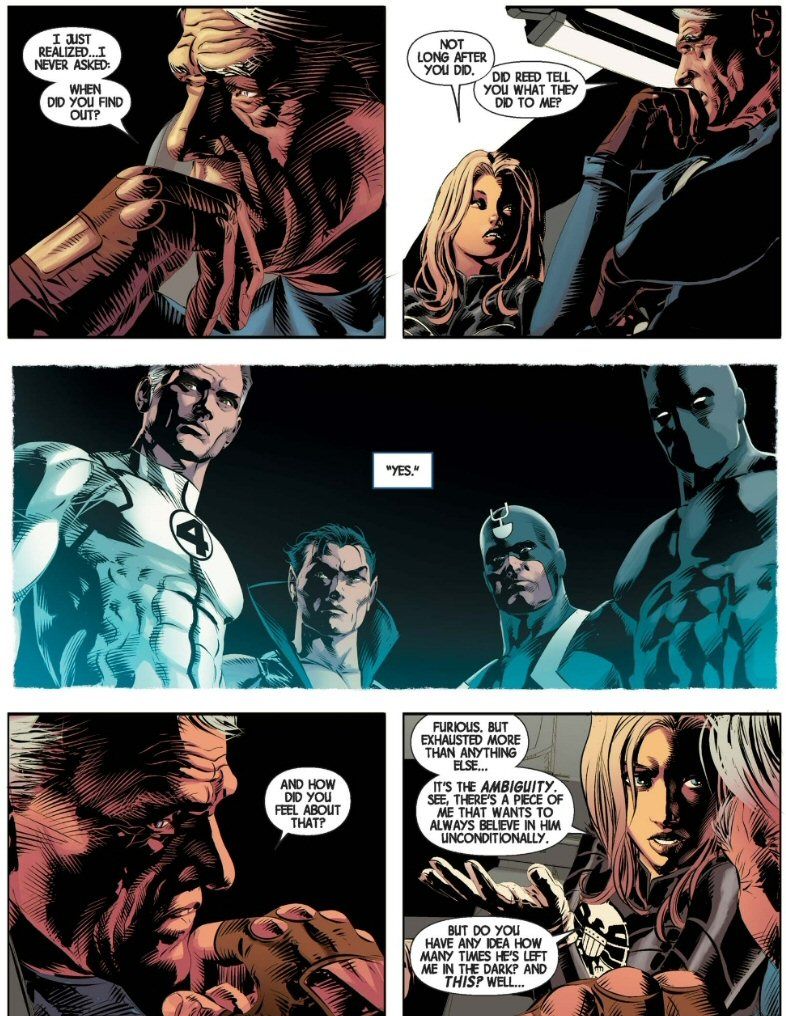
The story referred to above is when the Illuminati tried to enlist Cap’s help in their plans to destroy whole worlds (to survive the incursion events leading to Secret Wars), and then mind-wiped him when he refused and tried to talk them out of it. Sue’s professed view above is quite believable, based on the Civil War event. But later in that same issue, she meets up with Reed for a warm embrace, where the two talk about just how good a deceiver she is (!), as double-agent in Cap’s camp. That sequence ends with this exchange:
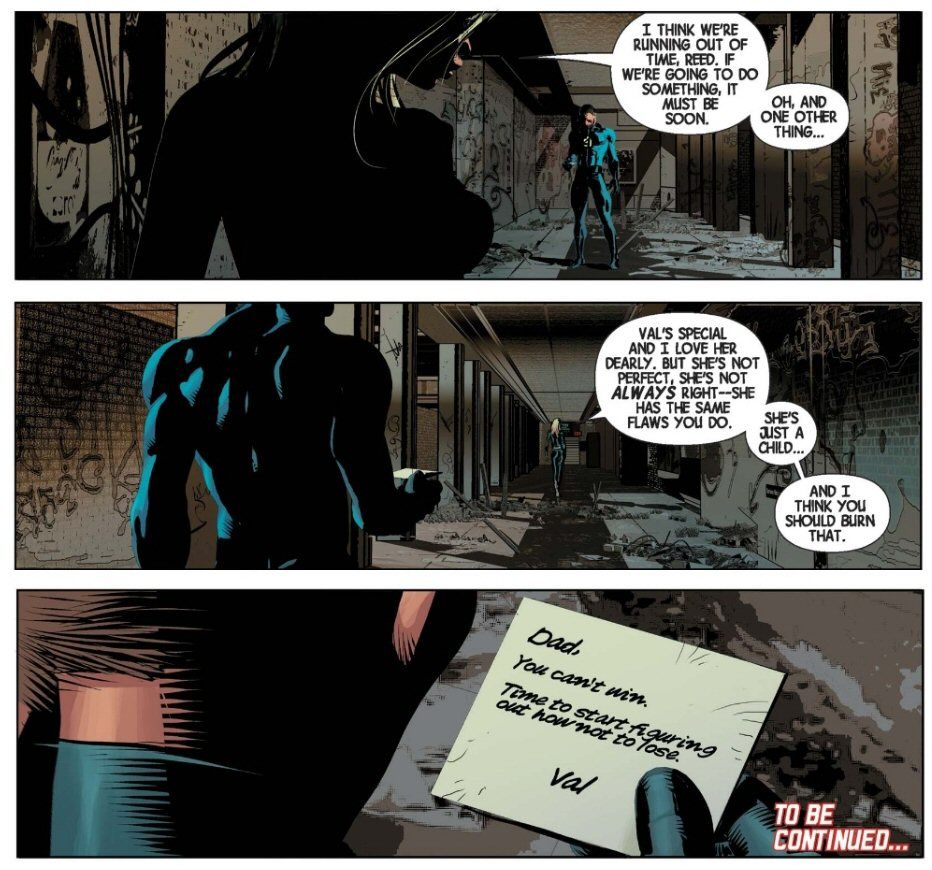
While I like the dig at the end about Reed’s flaws, I found it very hard to accept Sue going along with Reed’s plans (again, scroll down for a discussion of Reed‘s time on the Illuminati and Secret Wars).
As another example of problematic ethics for Sue, Mark Waid soon wrote a story that established Sue as serving as a secret S.H.I.E.L.D. spy, without the knowledge of her family (in S.H.I.E.L.D. Vol 3, issue #4, 2015, with art by Chris Sprouse and Karl Story). Waid picked up on this story line in Sue’s first limited series run, The Invisible Woman Vol 1, 2019. Unbelievably, Sue had now been given a background of having engaged in espionage missions with a partner (“Aidan Tintreach”) in total secrecy from her family. In this series, Sue embarks on a rescue mission to save her former partner – only to discover he has gone rogue, and she must stop him. From their final confrontation in issue #5, by Waid and Mattia De Iulis:
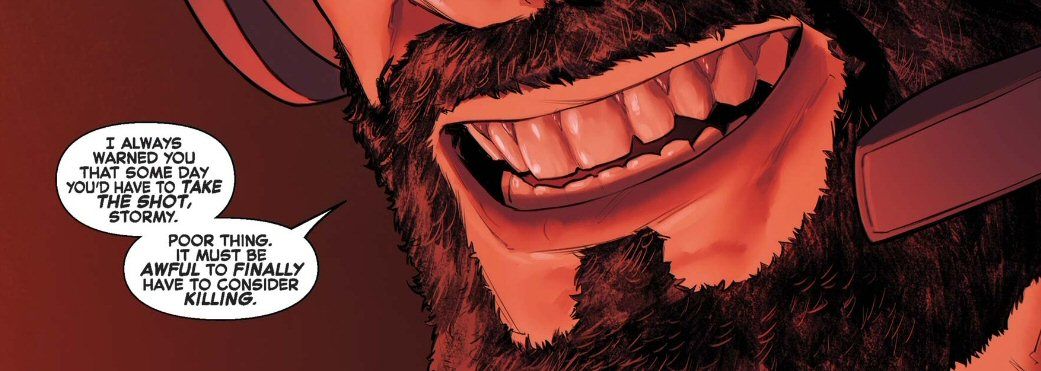
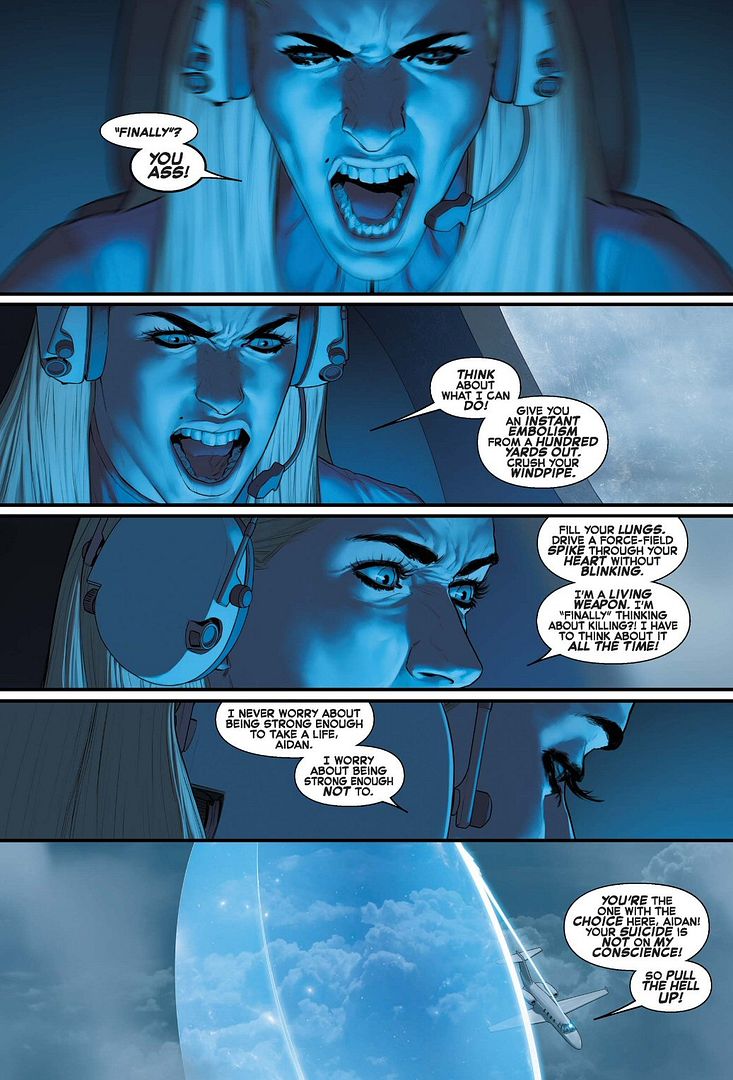
Aidan chooses to commit suicide, and the series wraps up as follows:
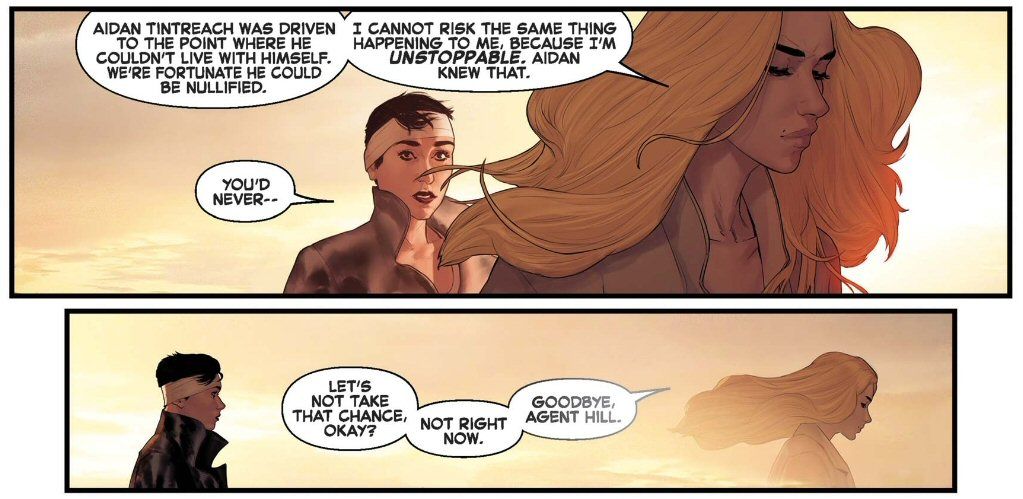
Again, I found Waid’s earlier FF run (2002-2005) better captured the family dynamics (scroll down for an example focused on Ben). I do appreciate how these newer collected stories helped to increase Sue’s powers and abilities – and her will to control them. But Sue’s motivations in this stand-alone series is inconsistent with her virtue care ethics (at least in the series conception and initial execution).
It is hardly uncommon to see a character’s ethics twisted for major story events. Sue is no different. I find it is in the regular (non-Earth-shattering) ongoing group story lines where her ethical nature comes through most clearly and consistently.
As such, I was pleased to see Dan Slott bring this unfortunate secret agent backstory back up – and then dismiss it quickly. In my mind, it is not reasonable to assume that Reed and Sue are unaware of each other’s extra-curricular activities. From Slott’s excellent Fantastic Four Vol 6, issue #25, 2020, with art by R.B. Silva:
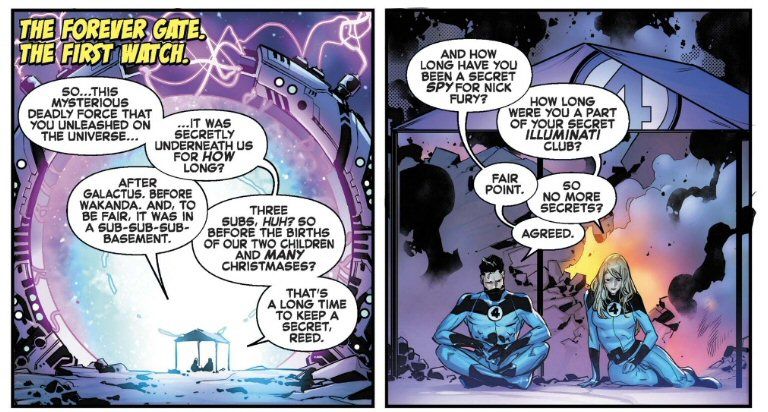
Like Jed MacKay did for Doctor Strange and Clea (and Eve L. Ewing did for Kitty Pryde), this is how you deal with problematic character developments – you have the characters acknowledge them as a mistake, and then just move on from there.
A good modern example consistent with Sue’s care ethics is the A.X.E.: Judgment Day issues I described previously (Fantastic Four Vol 6, issues #47-48, 2022, by David Pepose and Juan Cabal). The main story line has Sue defending the Baxter building against a would-be thief – Oubliette Midas (aka the Exterminatrix). At the end of the first issue, she reveals to Sue the prize she is there for:
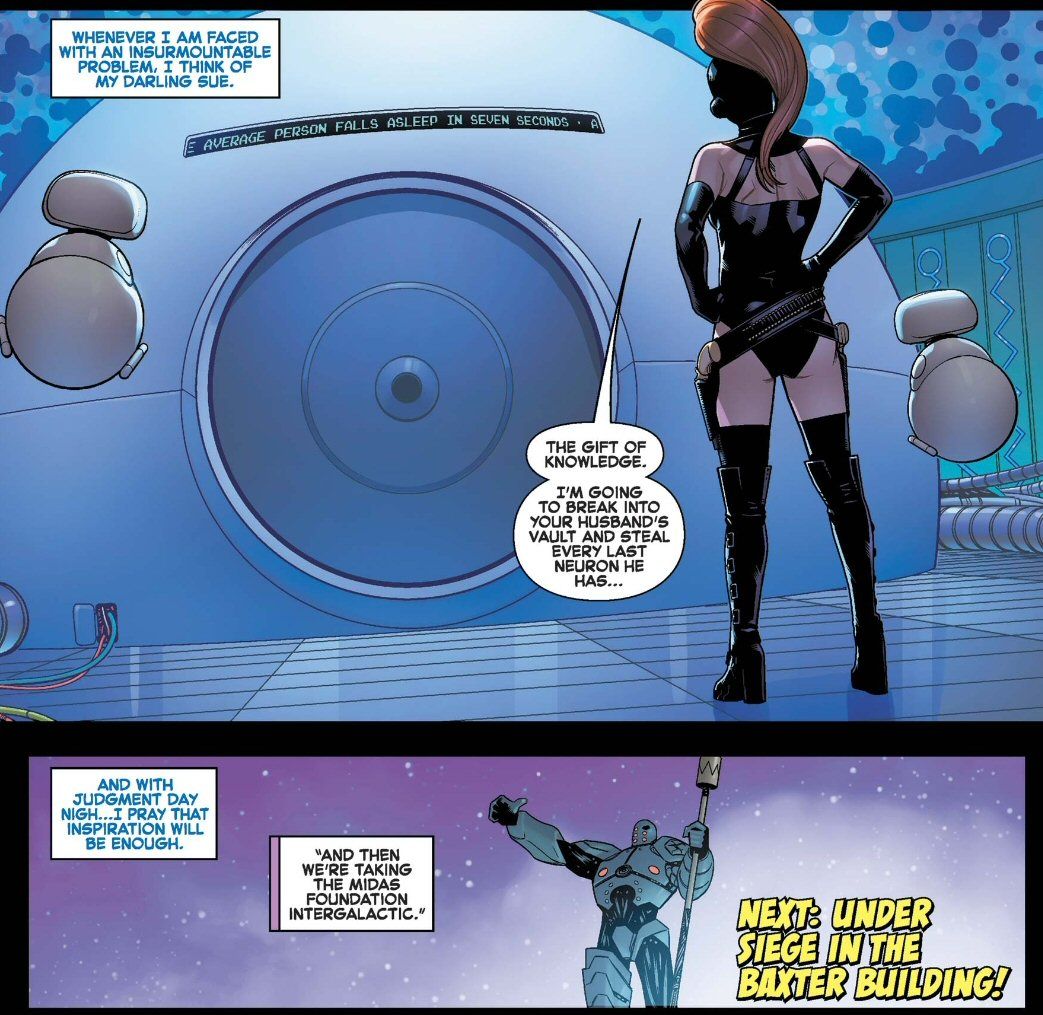
Despite Oubliette’s goal – and the damage she inflicts on Sue and others in the building (including Sue getting shot with a bullet that is turning her into gold) – Sue continues to strive to help her. From the end of this portion of the story in issue #48, where we learn for the first time some of Oubliette’s tragic backstory:
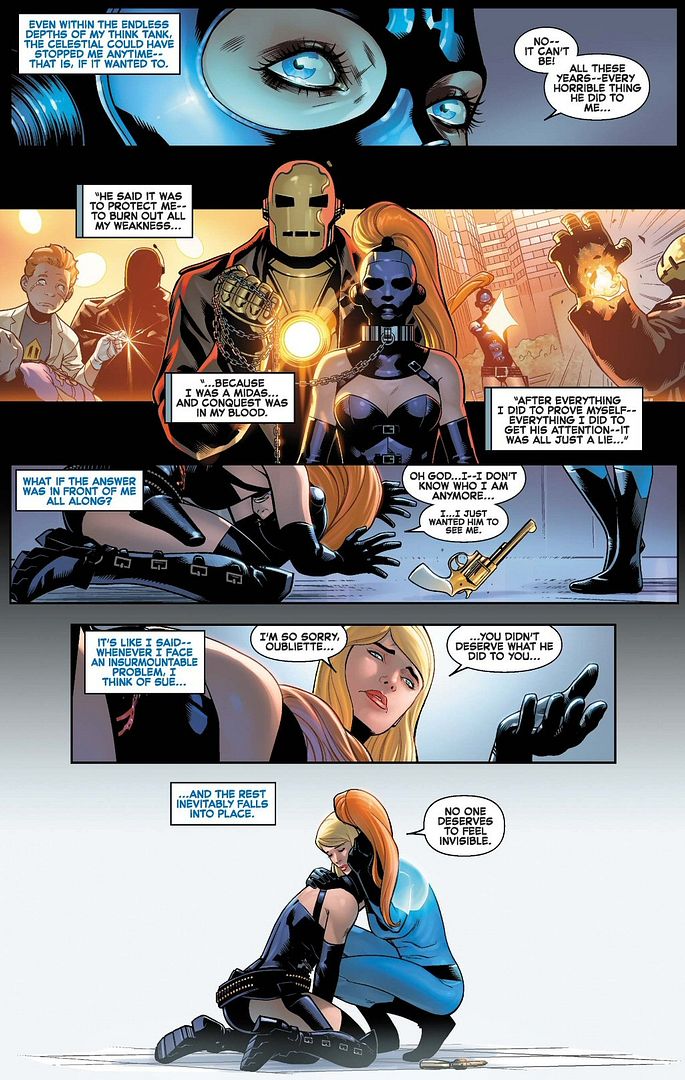
This is great example of Sue’s compassion and empathy, under challenging circumstances (to put it mildly). Kudos to Pepose and the whole creative team on these issues.
My point to all of the above is to show that a character’s development is never going to be linear. Not all creative teams have an appreciation of (or desire to maintain/evolve) the ethical core of the characters they work on. Indeed, some often want to purposely redefine a character to suit their very specific story plans. So, it is hardly uncommon to see these sorts of reversals and corrections over the extended run of a long-standing character. But I’m pleased to say there has been a lot of FF writers in recent years who have prized both continuity and coherent ethical growth (like Dan Slott, Chip Zdarsky, David Pepose, Ryan North, etc.). And Sue’s overall arc has been to have her grow as the moral heart of the team.
As a last note, I can help but smile at the small aside from Slott’s last issue of the FF, where Sue deals with a Psycho-Man attack on her own (largely off-panel). It is resolved by this hilarious sequence, from Fantastic Four Vol 6, issue #45, by Slott and Farid Karami).
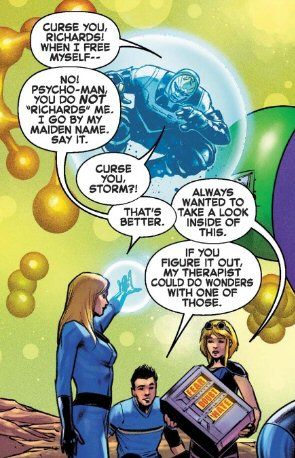
Slott and I are of similar age, so I suspect he too was quite familiar with those old Byrne issues that I opened this profile with.
Reed Richards (Mister Fantastic)
Dr. Reed Richards is a scientist and inventor, currently considered to be the smartest man on Earth (and sometimes, one of the smartest in the Universe). His exposure to cosmic rays gave him the ability to stretch, inflate and mold any part of his body into any shape and form at will. Reed’s skin is virtually impervious to cuts or punctures and can absorb great force and impacts without harm. He can also use his abilities to alter his appearance and potentially imitate others. Given his intellectual gifts, he has played a major role in many intergalactic crises over the years (and many major Marvel cross-over story events). You can read more about his background and abilities on the Marvel Fandom Wiki site.
Like many brilliant minds in the comics (and fiction more generally), Reed demonstrates an extreme form of consequentialist ethics – namely, act utilitarianism. I give a very detailed description of how act utilitarianism works in my Charles Xavier (Professor X) introduction. These characters differ in that Reed has a more broadly humanist perspective than Charles, trying to come up with solutions that will benefit everyone (or as many as possible). He also – critically – has a family that repeatedly pulls him back from the brink of extreme decisions (as opposed to what I referred to as the “unrestrained utilitarianism” in Professor X’s case).
To summarize it succinctly for Reed, his innate tendency is to make decisions based on calculated outcomes for the greatest good of the greatest number. Consistent with that logical reasoning, he is emotionally-detached (although the degree varies on the writer) and is often willing to sacrifice individual relationships or his own personal happiness for what he sees as broader benefits. His approach to scientific research and problem-solving reflect this – he’ll pursue dangerous experiments or make morally-ambiguous choices if the potential payoff could help humanity. This frequently puts him at odds with his family, as his (at times) impersonal logic clashes with their more personal and relational concerns. The use of family (in particular Sue, but sometimes also Ben) as an ethics restraining device is not only broadly effective but also opens the door to successfully exploring interpersonal conflict (and how to resolve it) in the stories.
Before I get into all of that with examples from the FF stories, you can find a more general description of the problems with act utilitarianism (including negative responsibility) in my subsequent Redemption of Charles Xavier post.
Also, another caveat to consider – readers familiar with only the modern 21st century comic version of the consequentialist Reed Richards might be a bit surprised by how he was depicted initially. For a supposed brilliant mind, Reed did not seem to know what was going on in a lot of the early stories. This was the nature of early superhero comics, where the need for some higher authority (e.g. the Watcher) to explain everything to the reader left all the characters seeming not particularly bright.
Eventually, they fell into a rhythm where Reed alone would figure things out, and the rest of the family became the foil(s) for him to reveal his brilliance (to them, and to the reader). This is a familiar trope in a lot of fiction – especially expository dialogue-heavy comic books and sci-fi (like early Doctor Who, etc.).
But the supposed evidence of his actual reasoning prowess was still somewhat murky by the 1980s, when I was reading FF as an adolescent. I recall the major story line from John Byrne‘s run where Reed purposefully saved a dying Galactus’ life (over the protestations of many). As a result, he was predictably put on trial by the Shi’ar empire and representatives of the worlds Galactus destroyed. Fun factoid – it must have been obvious, since I predicted it in my fan letter to the editor, published in issue #264 (!). I included that issue in the title image for this page, as it was one of two times I was published in the Marvel letters page as an adolescent – although it is very painful to read these now (and even worse to see them tracked in the Marvel Fandom wiki).
But back to the story …. from Fantastic Four Vol 1, issue #262, 1983, story and art by John Byrne:
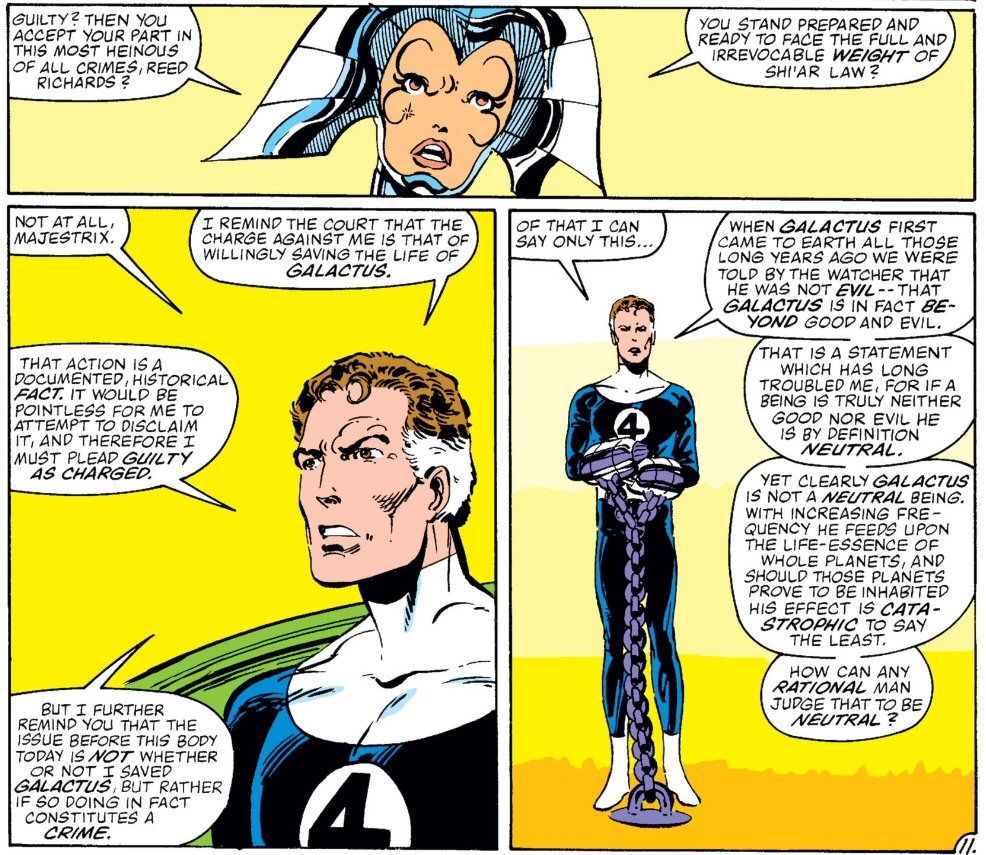
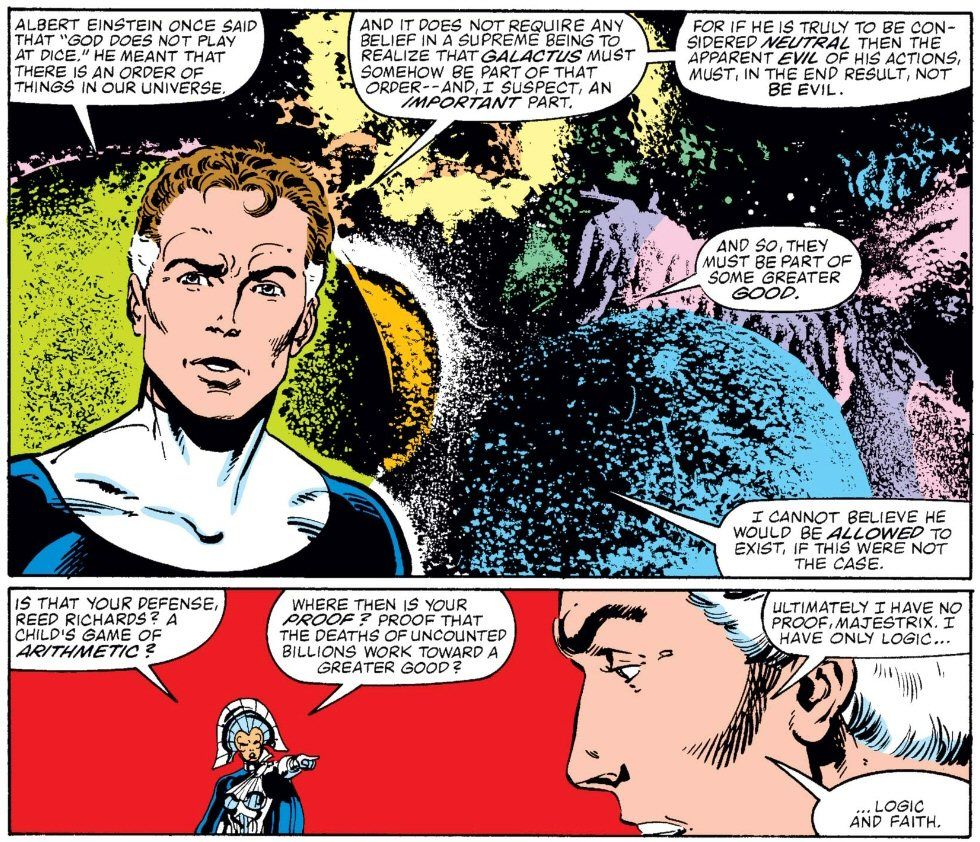
Ok, there’s a lot to unpack there – and little of it involves logic. Einstein’s famous quote refers to his issue with the probabilistic nature of quantum physics given the evidently deterministic nature of the actual universe we live in (see my Vision discussion on this point, and my Ethics 101 page for background). I’m going to side with Empress Lilandra here – there is no “logic” in assuming that some higher power is allowing Galactus to live (and also apparently needs Reed’s help to do it!).
Eternity appears in the issue to show them all what Galactus’ role is in the grand plan of the Universe. But because everyone’s limited mortal mind can’t contain the knowledge, everyone forgets it immediately afterwards – but remembers they were convinced at the time, so they let Reed go (!). And since the issue’s writer falls into the same category, the reader never finds out the reason either. Needless to say, my adolescent self was not very amused by this (non-)resolution. It only took over 40 years, but J. Michael Straczynski came up with a quite reasonable justification for Galactus’ continued existence. In his recent one-off, Ghost Rider vs. Galactus Vol 1, issue #1, 2025, with art by Juan Ferreyra, we travel back to that time period – and are treated to an explicit explanation (courtesy of the Watcher). It’s well worth picking up if you are a fan of the FF (and/or are still harboring the frustration of the original event!).
Getting past this event, Reed’s ethics otherwise hew closely to scientific rationalism and act utilitarianism. Despite often coming up with creative, world-saving solutions, it is also not hard to find examples of his being paternalistic across the long run of comic stories. Despite meaning well by his family, it does seem to be a reoccurring theme where he makes unilateral choices for his team and family, apparently believing his superior intellect gives him the right (and responsibility) to decide what’s best for everyone else. Whether by omission or commission, it is not uncommon for him to withhold information from the others, and even manipulate situations for the best outcome (in his calculus) – although I warrant that was often used for “dramatic effect” by earlier writers. This creates significant tension within the family, and is an ongoing source of conflict with Sue in particular.
This is why Doctor Doom has always served well as the chief villain for the FF. He is like Reed in being extremely consequentialist – although I would argue with a stronger streak of rational egoism that overwhelms his similar utilitarian impulses (thus making him more of an egoistic consequentialist). He is also more insecure than Reed, driving him to over-compensate (and thus frequently fail in their direct confrontations). In essence, Doom serves as the moral warning to Reed of what happens if you let go of all human attachments and relational morality. By the same token though, Reed’s innate moral flexibility allows him to work collaboratively with Doom when circumstances require it. Reed’s moral flexibility (which stops short of the moral relativism described on my Mystique page) is still a risky component of his ethical makeup. But it is also the one that allows him to the persuaded by his family (and Sue in particular, with her strong relational care ethics perspective).
Probably the best example of what can go wrong with somebody who has Reed’s intelligence, consequentialism, and moral flexibility is his parallel universe counterpart, The Maker. Created by Mark Millar, Brian Michael Bendis, and Adam Kubert as part of the Ultimates Universe reboot of Marvel (Earth-1610), this unrestrained-by-family version of Reed becomes the ultimate supreme supervillain on his Earth. I’ll talk more about the Maker in an upcoming post, but his creation is a thoughtful exploration of the dark side of the ethics framework espoused by Reed (and gets back to my similar concern for Professor X in the main Earth-616 Universe).
The need for a restraining device for Reed was thoughtfully explored by Jonathan Hickman during his time with these characters – both his own run in the FF (2009-2012), his Secret Wars 2015-16 cross-over event, and his subsequent rebooting of the Maker’s version of the Ultimates Universe on Earth-6160 (currently). Here’s a quote from Hickman, in the first issue of the main FF title, recounting an earlier meeting with FF editor Tom Brevoort:
[Tom: tell me what you think is wrong with the book right now] Well, one of the biggest problems I see is it’s not perceived as a book about the Fantastic Four anymore. I think … the entire FF Universe … has become, by inclusion or exclusion, completely Reed-centric … almost like it’s Mr. Richards and his merry band of heroes.
[Tom: So, what do you have in mind for your first arc?] A stand-alone story about Reed.
- Jonathan Hickman, Fantastic Four Vol 1, issue #570, 2009.
Hickman had started his time with the FF with Dark Reign: Fantastic Four Vol 1, 2009, with art by Sean Chen and Lorenzo Ruggiero. This story involves Reed building an interdimensional portal device called the Bridge, to allow him to see what has happened in other universes of the Multiverse. Sue convinces him to destroy the machine – but he soon rebuilds it in secret. From Fantastic Four Vol 1, issue #570, 2009, by Hickman and Dale Eaglesham:
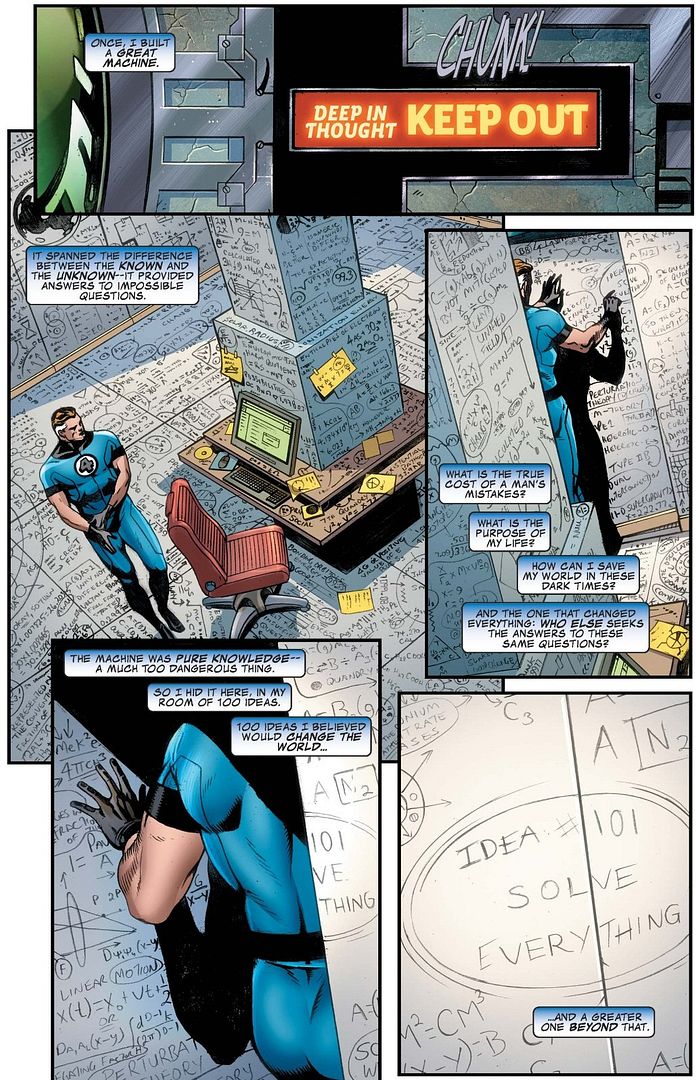
Reed becomes aware of a mysterious group monitoring his activities – soon revealed to be the Council of Reeds. They are an organization composed of Multiversal counterparts of Reed who similarly developed interdimensional portal technology, and who now work collaboratively to “solve everything”. But in addition to their positive results, they also introduce our Reed to some less savory activities (from Fantastic Four Vol 1, issue #571, 2009, by Hickman and Eaglesham):
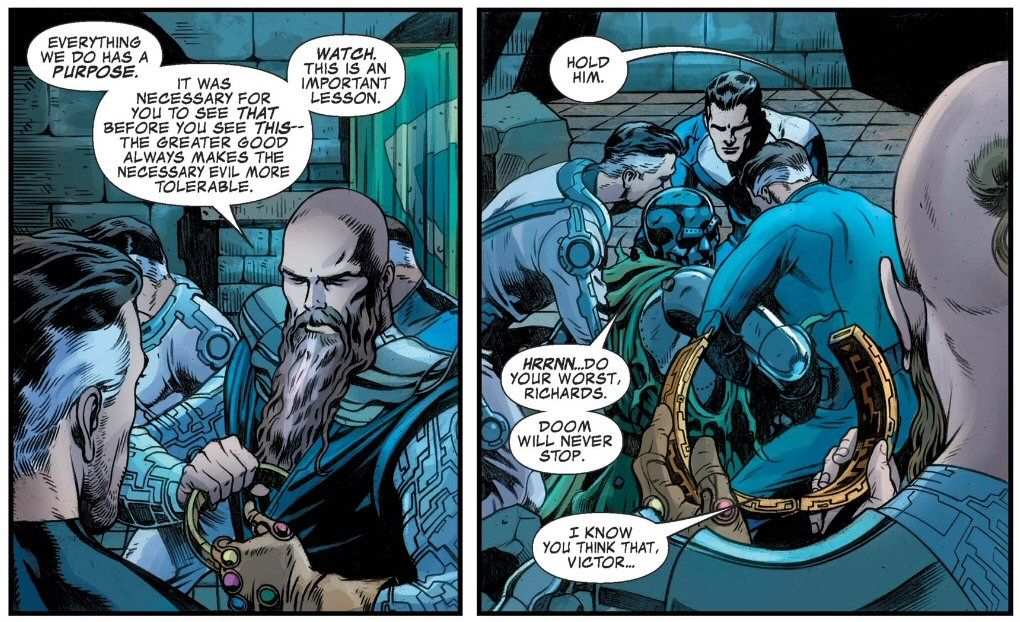
It turns out the council is lobotomizing Dooms across the Multiverse, as a means of pacifying them.
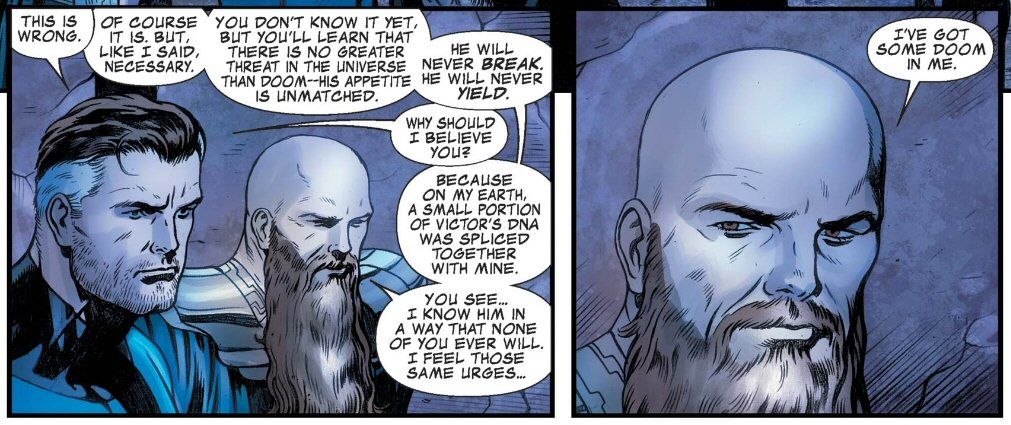
Of course, things don’t go well for the council – their work attracts the attention of a group of mad Celestials, who set about destroying them. Earth-616’s Reed helps ward off the first wave of attacks with weapons from his arsenal. From Fantastic Four Vol 1, issue #572, 2009, by Hickman and Eaglesham
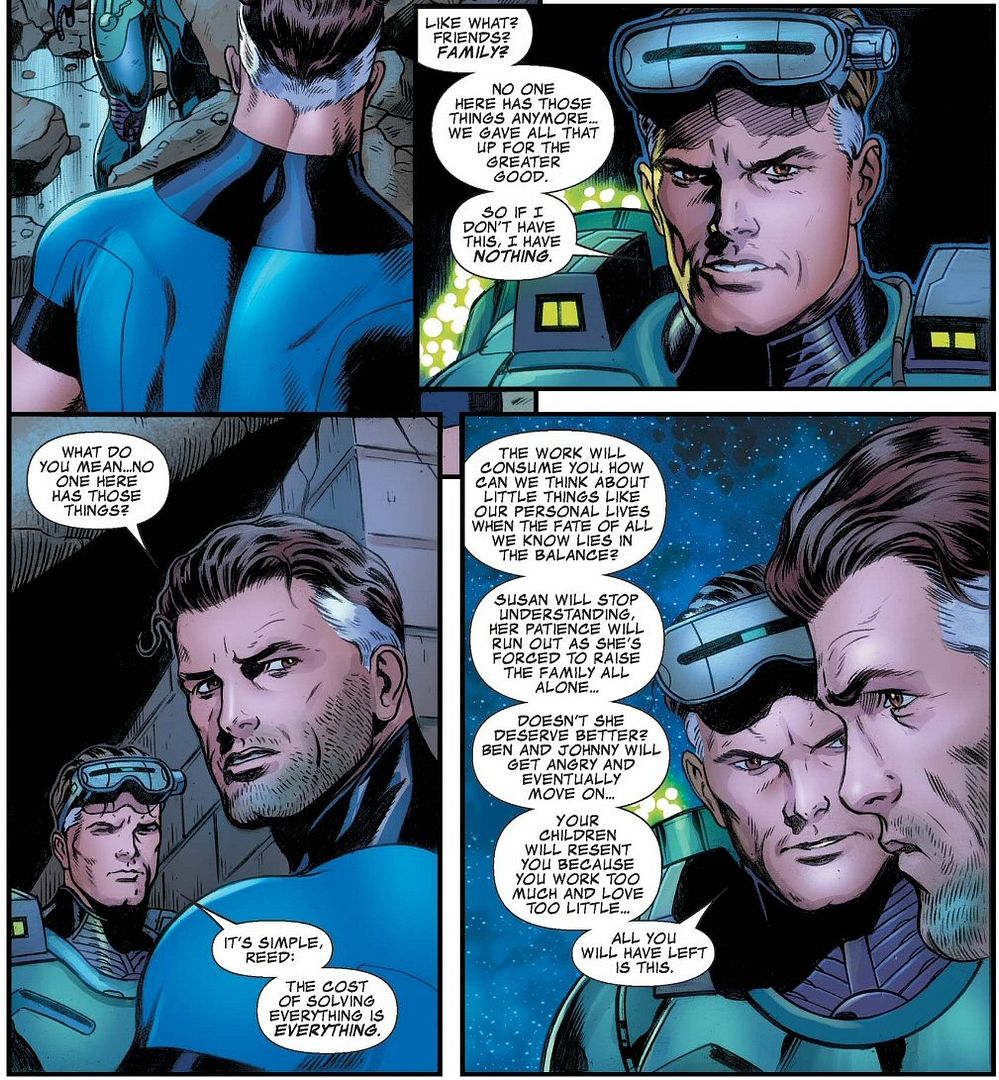
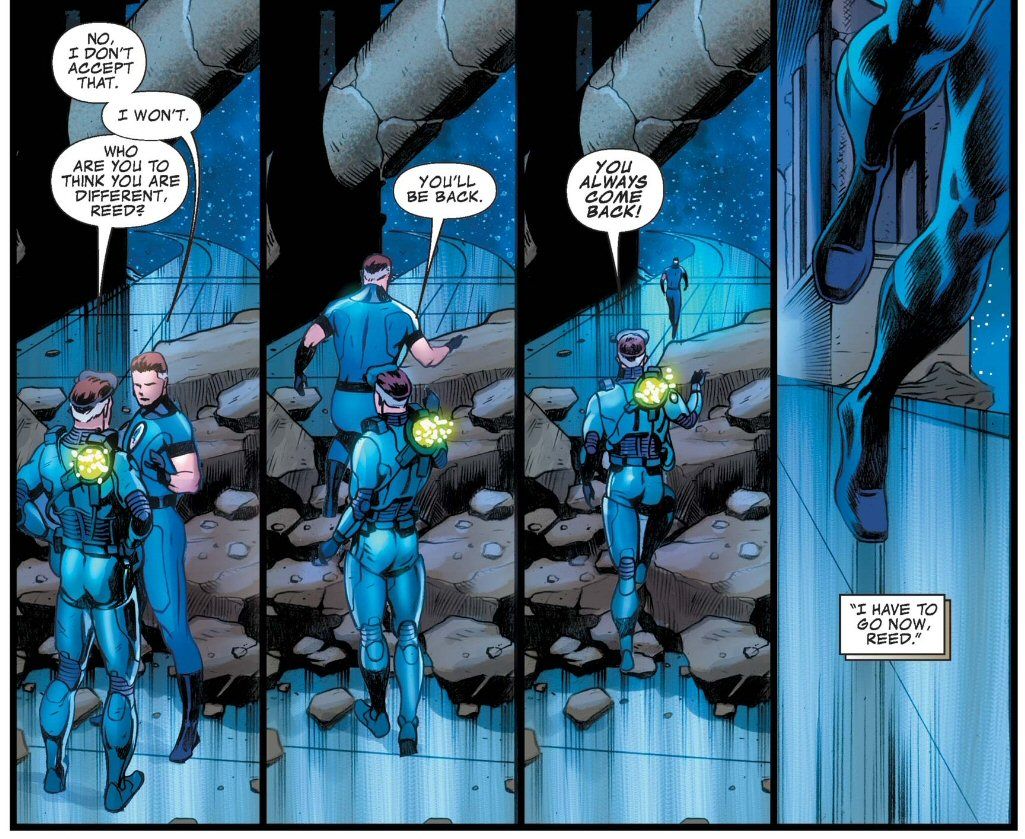
What is different about our Earth-616’s Reed is that he had an early moral guide in terms of his father, as he recalls in the scenes below:
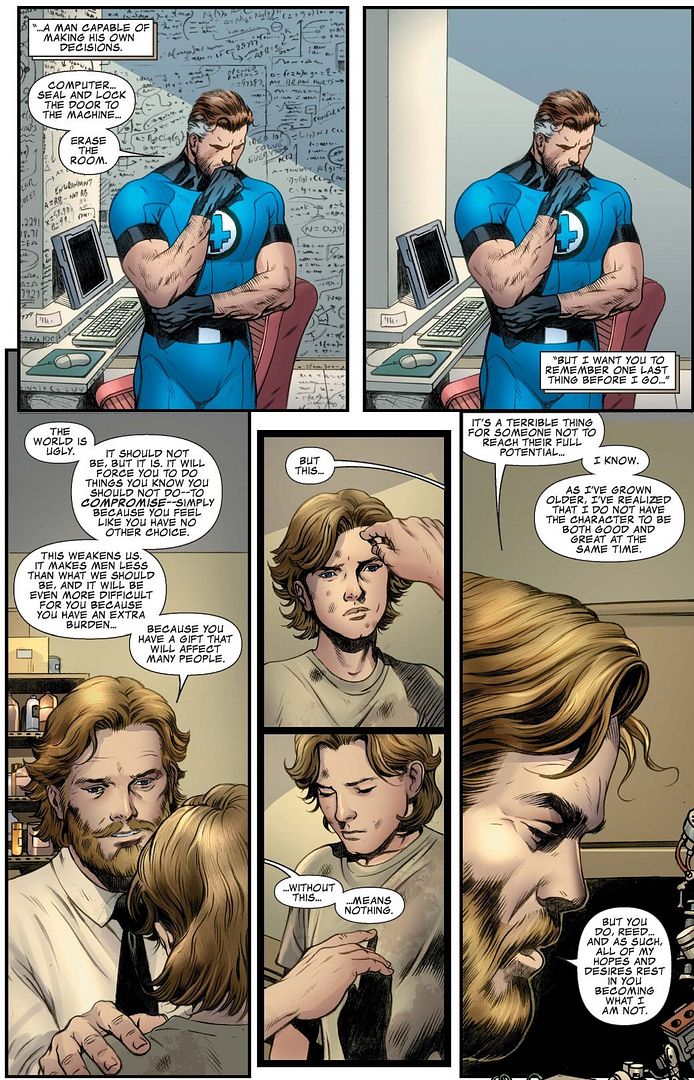
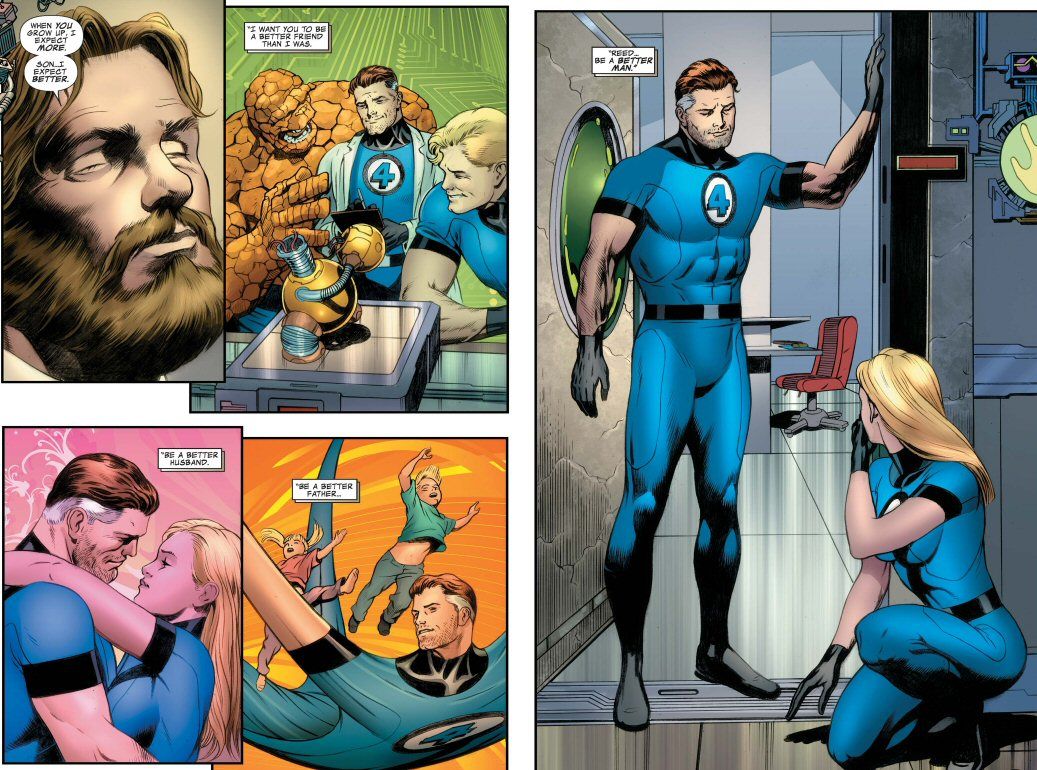
This reckoning with what he might become is the impetus for our Reed to shut down the Bridge and resolve to be a better man (that is, to a adopt a virtue ethics perspective, like Sue).
This is the theme that you will see play out over and over again in the FF across the years – Reed takes his consequentialist views too far, and steps back before the end for the sake of his family (most especially Sue and his children). The 2022 A.X.E.: Judgment Day story by David Pepose and Juan Cabal is a good example – one of many – when it is Sue‘s care ethics that saves the day. As I observed on my Launch post, the “monomyth” as applied to comic books often sees characters repeat their heroic journeys – including their ethical ones – over and over again across successive time periods. Reed is like Magneto in that sense (although our Earth-616 Reed never falls into villain/anti-hero territory), forever re-learning the same lesson.
As you might guess, Hickman wasn’t done with the Council of Reeds (well, the survivors at any rate). A year later, a curious Valeria stumbles upon and reactivates the Bridge. Valeria is described throughout the FF extended run as being a lot like Reed (and even smarter, in fact). So it’s not surprising that she also repeatedly makes the same mistakes he does. From Fantastic Four Vol 1, issue #583, 2010, by Hickman and Steve Epting:
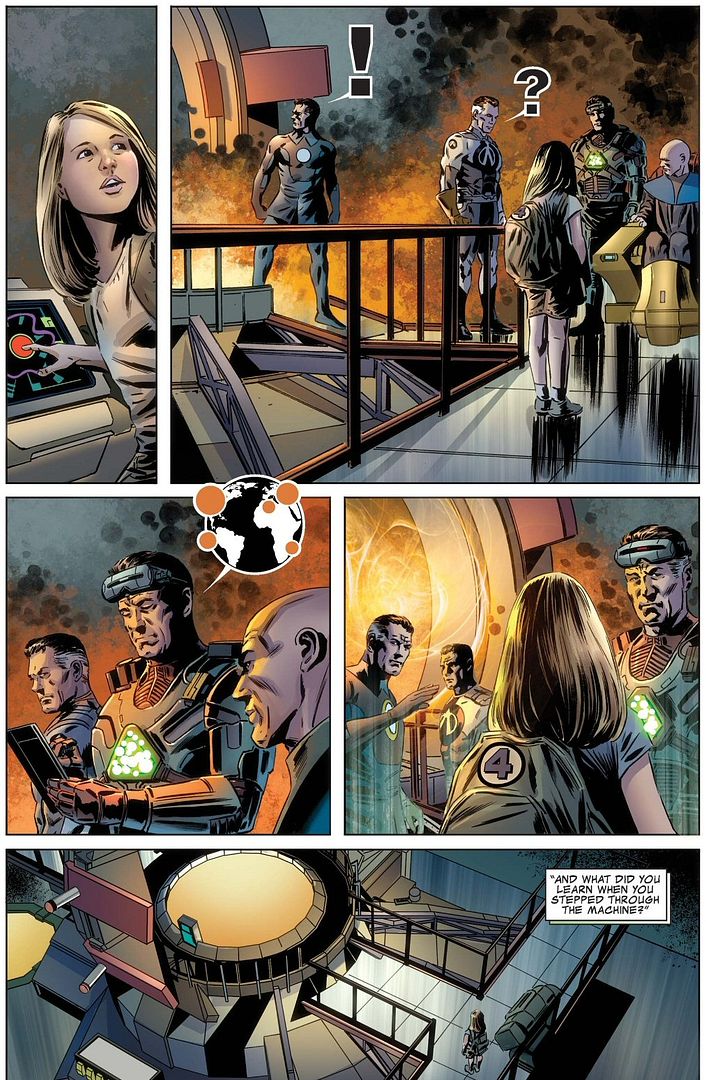
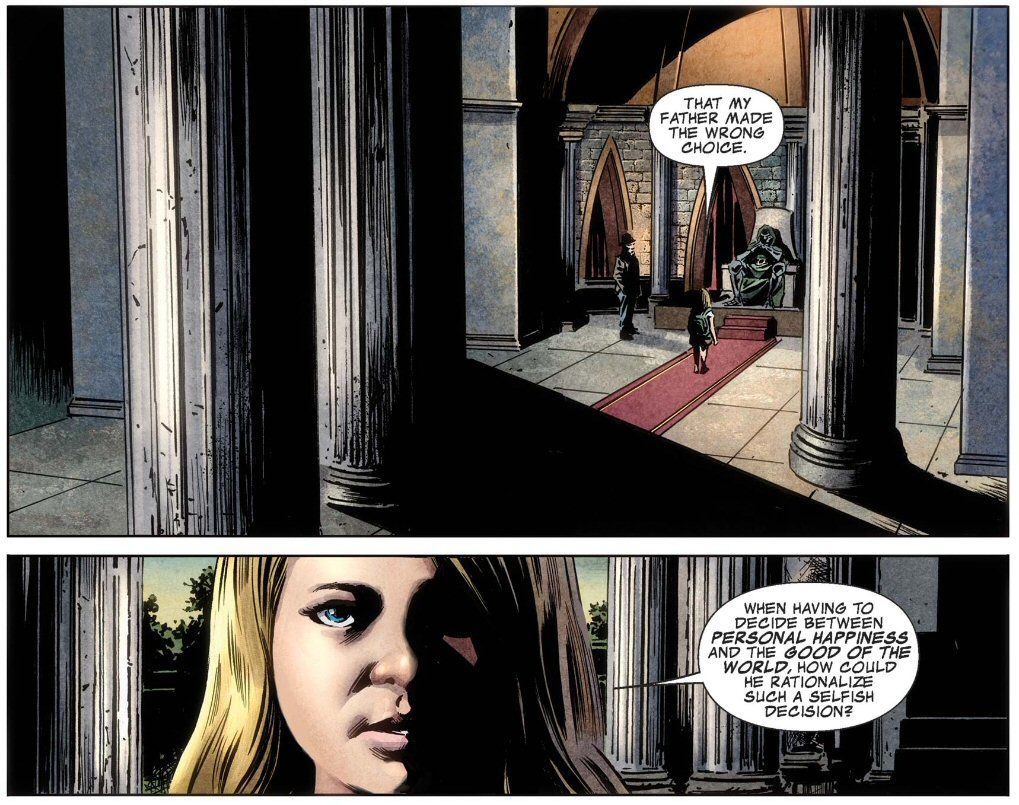
Ah, the fruit doesn’t fall far from the tree, does it? Both Valeria and Reed and have a lot to learn (repeatedly). But Hickman wasn’t done with Reed, even when his time penning FF came to an end.
Previously, back in 2005, Brian Michael Bendis and Steve McNiven had created the Illuminati – a secret cabal/star-chamber of consequentialist superheroes seeking to proactively address Earth’s major threats. Reed was a founding member. A disastrous opening tactic backfired on the group, directly leading to the Secret Invasion cross-over event (2006-07) I mentioned previously. They were also outed for their unethical behavior in the World War Hulk (2006-07) story line. The group broke apart in the run-up to the Civil War (2007) cross-over event, as I described previously in my Sue entry above.
But in the lead-up to his 2015-16 Secret Wars cross-over event, Hickman had re-established the Illuminati, and Reed played a leading role in their plans to save Earth-616 by destroying the other Earths from Multiversal “incursions”. From a flashback from Avengers Vol 5, issue #39, 2014, by Hickman and Mike Deodato:
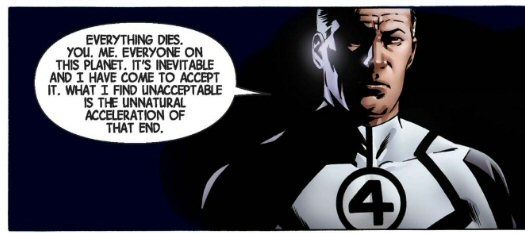
Reed’s trajectory over the course of this event is not dissimilar to what the equally consequentialist Charles Xavier (Professor X) goes through during Hickman’s mutant Krakoan Age a few years later. But again, Reed has family (somewhat) keeping him in check.
The ending to Secret Wars is interesting, as it all comes down to a contest between Reed and Doctor Doom at the end of Multiverse (as moderated by Owen Reece, the Molecule Man). From Secret Wars Vol 1, issue #9, 2016, by Jonathan Hickman and Esad Ribić:
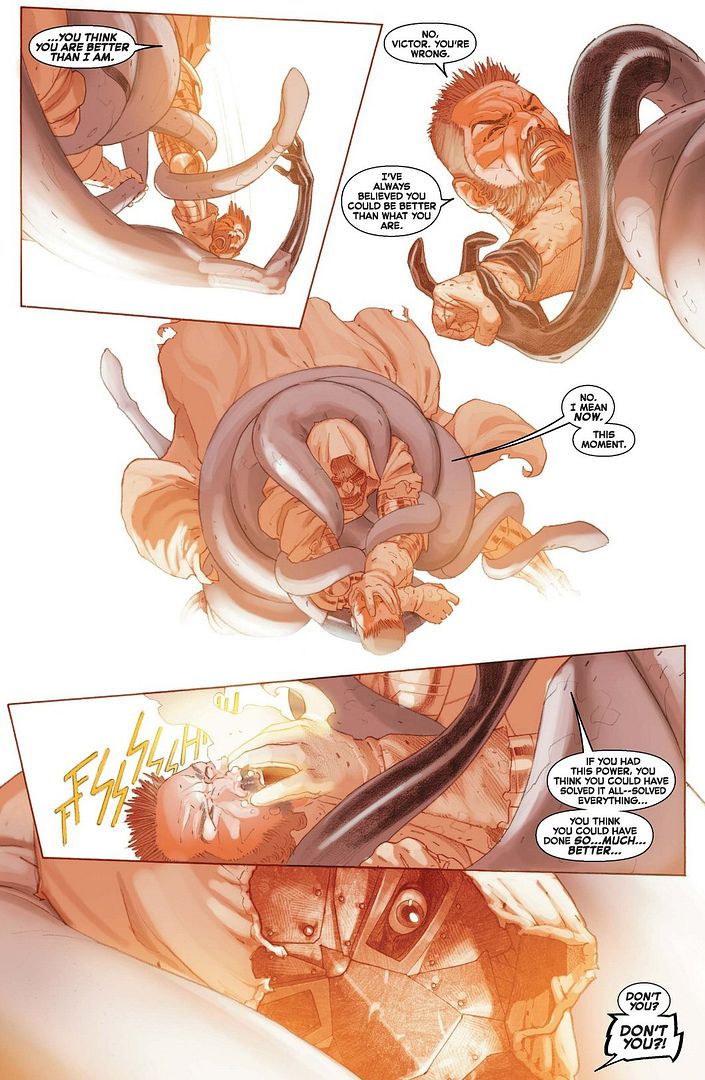
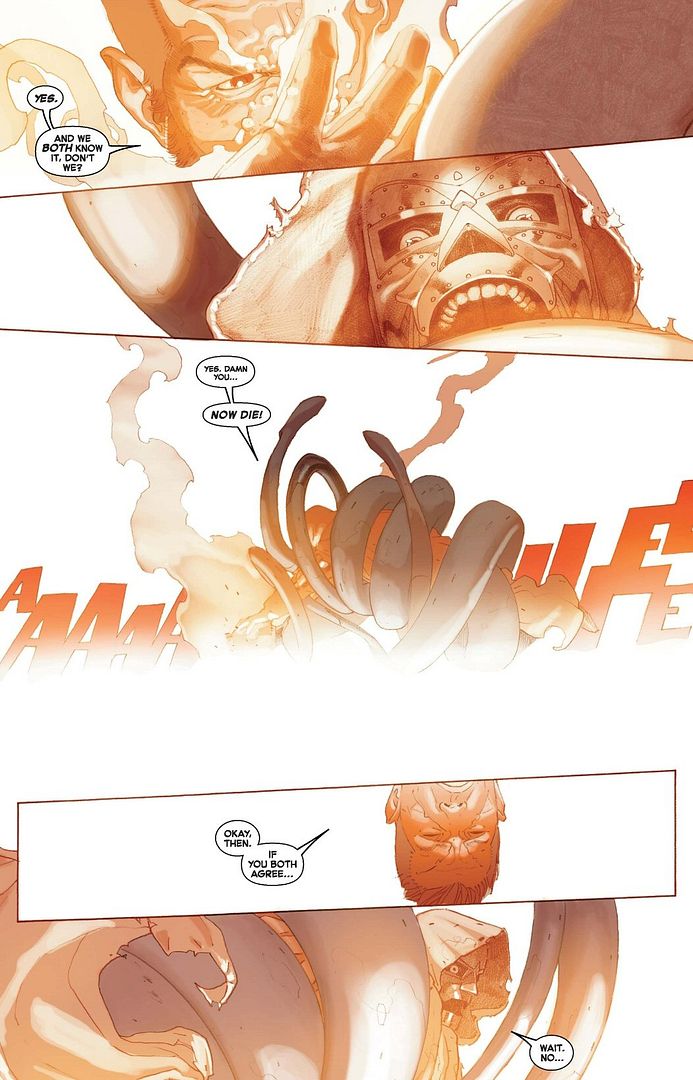
Owen transfers his flag (and powers) to Reed, who along with his children (Franklin in particular) are able to gradually re-start the Seventh Cosmos from before the incursions. From later that same issue (after a page stating it is eight months later):
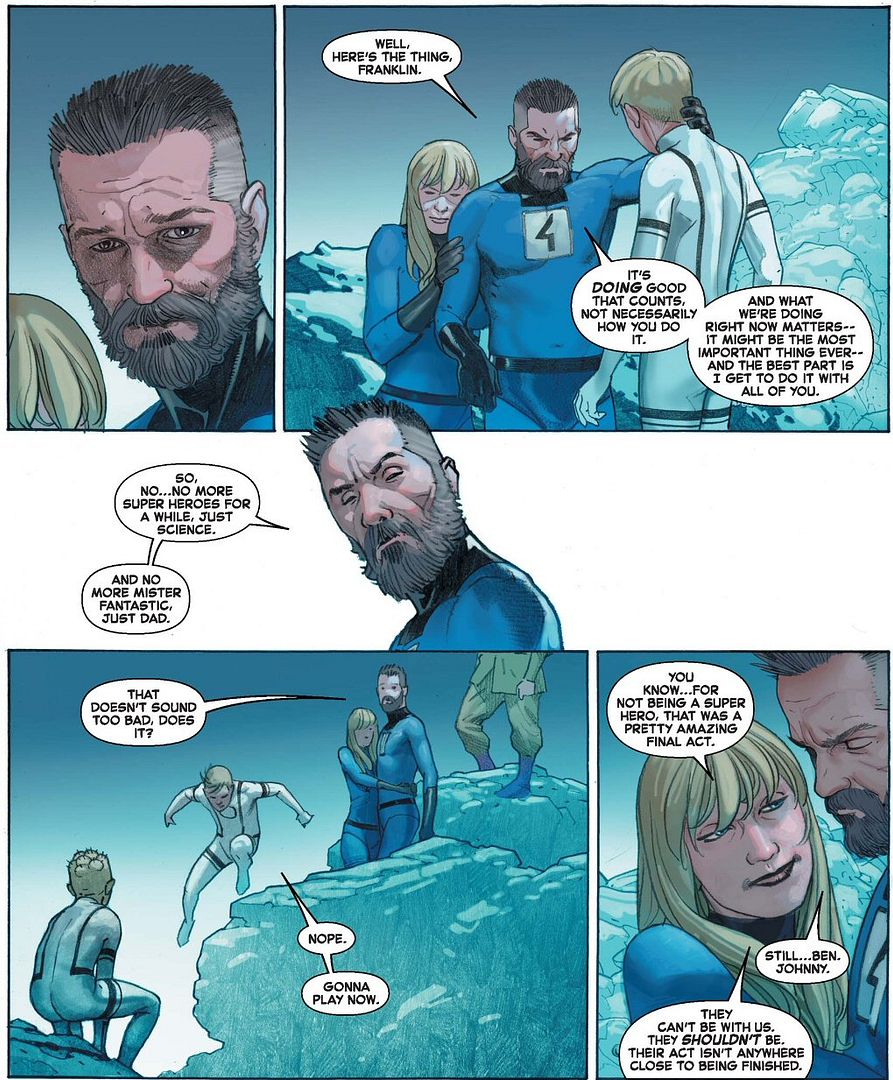
I find this page very disturbing, on several levels. First, Reed’s message to his son is very disconcerting from an ethics perspective. Teaching children that simply doing good – and not worrying about the how (i.e., ethics) – doesn’t sound like good advice to me! Especially when you consider Franklin has the power to imagine whole universes into being. It seems to me that you want him to grow up being more than a little concerned about how, exactly, one should go about doing good.
Normally I would expect Sue to help provide a counter-point – through the long run of the FF, she has served as a grounding influence. But instead, we are provided with a completely inconsistent characterization of Sue here. In Hickman and Ribić’s depiction above, she seems very besotted and subservient (and I didn’t even include the preceding pages where she comes off as particularly dim-witted asking Valeria to explain things to her again – for the sake of the reader).
Finally, having Sue argue it was appropriate to leave Ben and Johnny behind (and in the dark as to their family’s fate) is cruel beyond measure. Johnny and Ben have no idea if Reed, Sue, Franklin, and Valeria survived the cataclysmic ending to Secret Wars. Sue encouraging Reed to abandon key members of their family to go off on adventures (that she admits she doesn’t fully understand) beggars belief. Something went very wrong here, and it was left to later writers to clean it up. Scroll down to my Ben section to see how Chip Zdarksy addressed this in his Marvel 2-in-One series (2017-18). As an aside, Zdarsky understands Reed’s consequentialism well, as shown by his guest appearance in his Daredevil run.
I know there was a lot of speculation at the time that Secret Wars ended this way due to behind-the-scenes wrangling about the termination of the main FF title (which had been published on an ongoing basis since inception). This is generally believed to be due to consternation over Marvel not being able to reclaim the FF movie rights (there is a recent detailed discussion of what happened on the ComicTropes YouTube channel). But regardless of the rationale, there was no need to end Secret Wars like this. While a thoughtful and intriguing series overall, Secret Wars did a disservice to Sue’s character – and her pivotal role in the team/family. Jump to my Sue section for some better examples of her ethical development.
As previously mentioned, the overall arc of Reed’s journey – and ethical development – is his need to repeatedly learn that in matters of morals, Sue is generally right, and he needs to develop a virtue ethics perspective. Here is a good example a few years later near the end of Dan Slott‘s excellent run in FF – the Reckoning War event precipitated by the Watchers. Reed is dying by having looked too deeply into the minds of the Watchers (and is slowly turning into one as a result). From Fantastic Four Vol 6, issue #44, 2022, by Slott, Andrea Di Vito, Davide Tinto, and Rachael Stott:
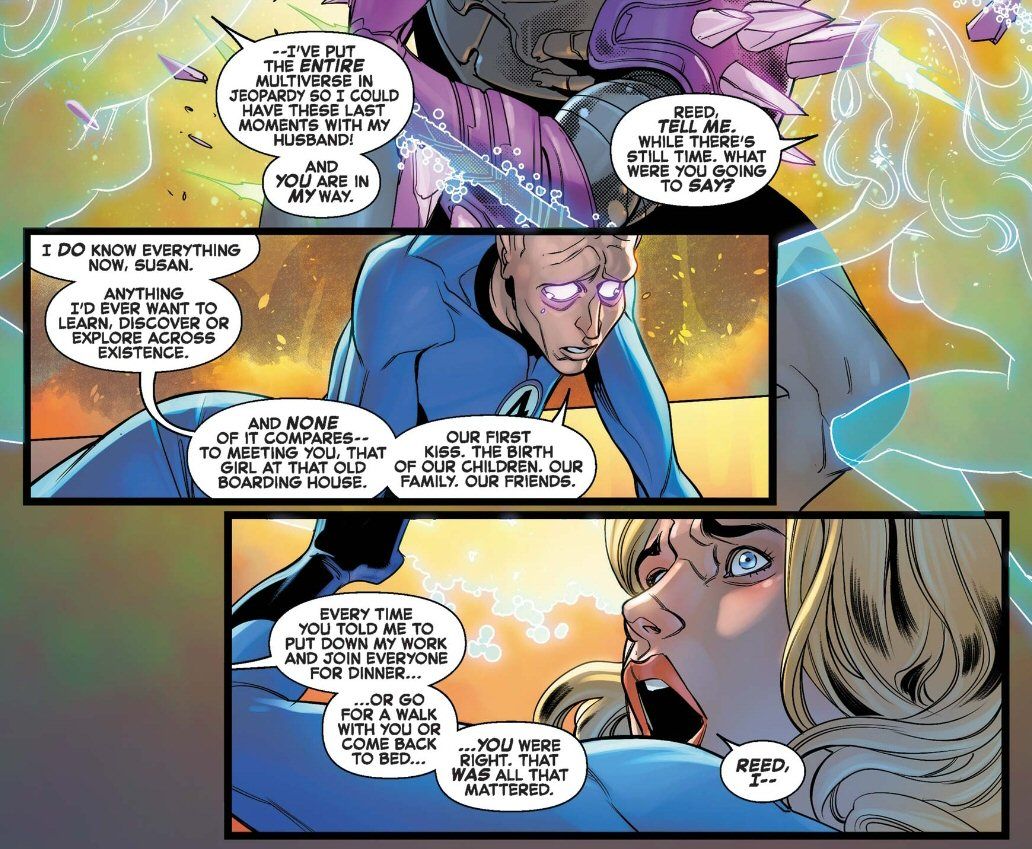
And so, what does Reed do with hard-learned knowledge?
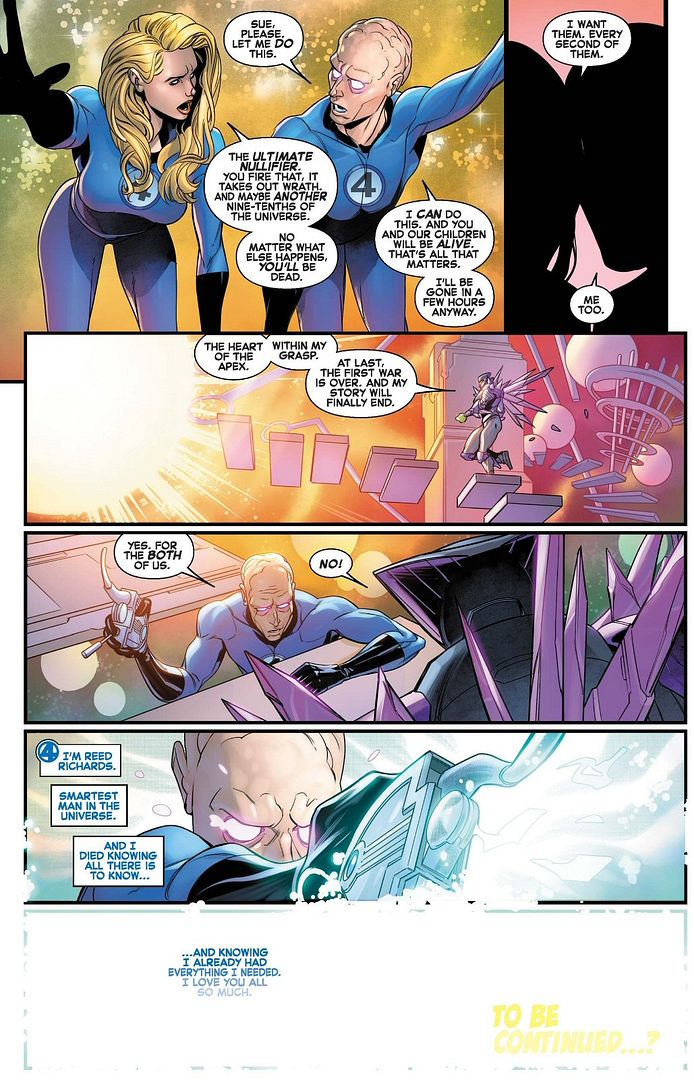
Kudos to Slott, Di Vito, Tinto, Stott and the rest of the team that put this series together!
I know this character overview has gotten long, but I would be remiss if I didn’t include Ryan North‘s current FF run (2023-present). North is another writer who is very sympathetic to the family dynamics of the FF – indeed, that has been the focus from the beginning of his run. One quick example in regard to Reed that I like is below. This is from the 2024 Blood Hunt cross-over event, where Reed and Alicia (Ben Grimm’s blind wife) are having a moment together when Alicia points out the obvious to him (it was rare to see these two interact before North’s tenure). From Fantastic Four Vol 7, issue #21, 2024, by North and Ivan Fiorelli:
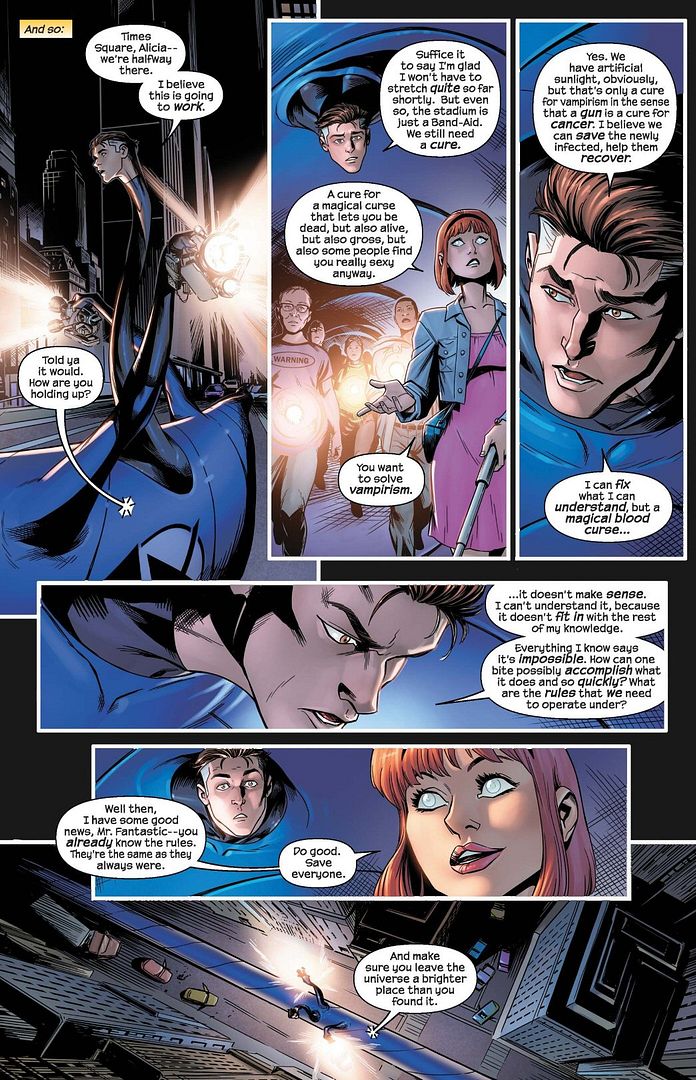
North certainly gets Reed’s intellectual detachment (in fact, he writes it to a greater degree than most FF writers). But his Reed is also clear from the beginning in acknowledging the superior moral world view of Sue (and here, Alicia) and lets himself be guided by it (I love his stunned look above, doh!). Reed’s progression over North’s series is very positive, and he now clearly exhibits some virtue ethics/care ethics elements himself (check out my Johnny entry for an example). And his relationship with Sue is much more a true partnership now, which is a refreshing change from some earlier time periods. Another highly recommended series. (UPDATE: Ryan North continues to impress as he develops all these characters further in his latest FF series)
I was particularly struck by these panels discussing Doctor Doom in last month’s issue, Fantastic Four Vol 8, issue #3, 2025, by North and Humberto Ramos. Spoilers below if you haven’t kept up with the recent One World Under Doom Vol 1 series, and the recent FF stories
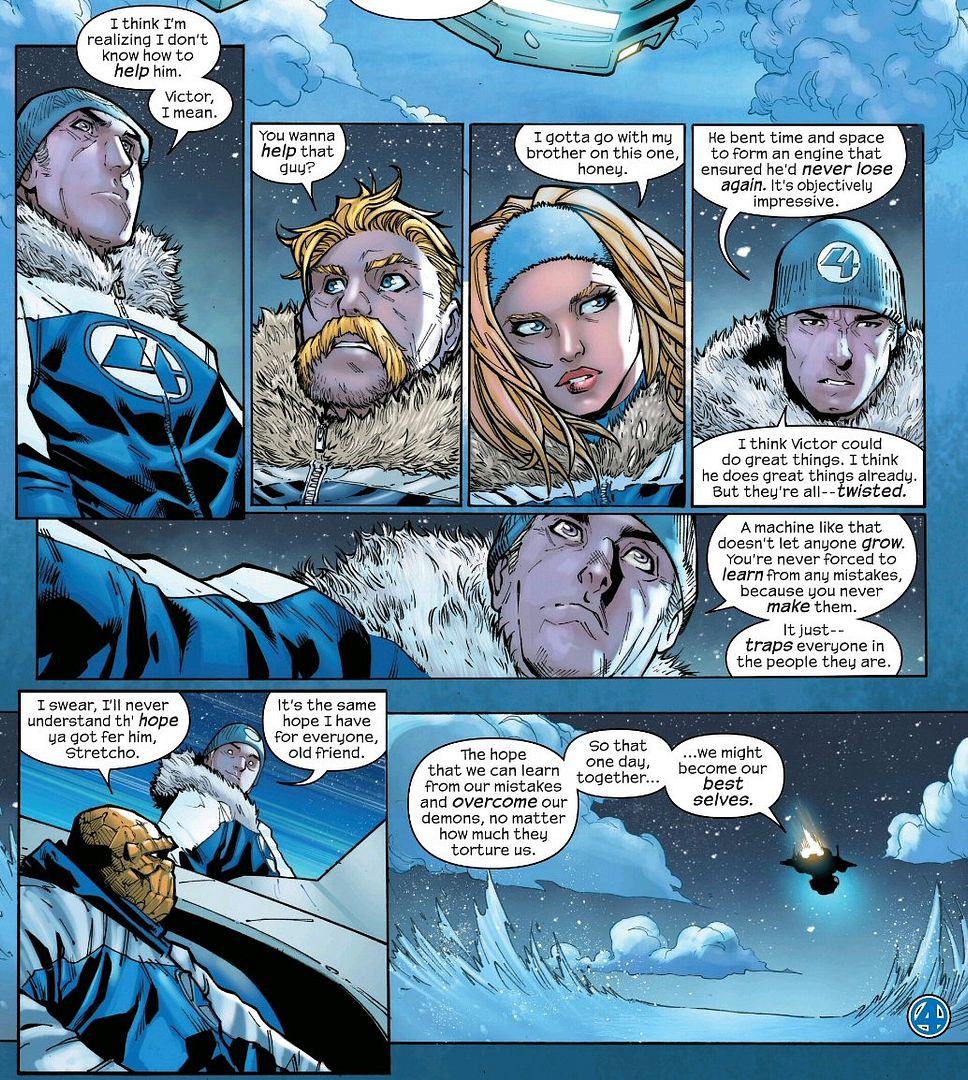
Doom’s magical+technological machine was restarting the timeline to a previous “saved state” every time he lost a battle. With only Doom remembering, he could adapt and re-do the event to win on the subsequent times through (just like in a computer game, or the plot of the 2014 movie, Edge of Tomorrow). This explains why Doom has been able to successfully repeal all assaults in the comics (which had seemed rather unbelievable until this explanation).
What I find impressive here is North’s depiction of Reed’s clearly internalized virtue ethics response: it is important that everyone be given the chance to learn to be better. It is great to see the growth in Reed’s moral character.
And if you want another great adventure story featuring Reed and Alicia, check out my review of Fantastic Four Vol 8, issue #4 by North and Ramos.
Ben Grimm (The Thing)
Ben is one of the most beloved members of the FF (indeed, of the Marvel universe more generally). He’s a frequent guest character in other stories, and even had his own team-up comic series for a decade (Marvel Two-in-One, 1974-83). I have heard him described as having the purest heart and soul, and just generally being a stand-up guy. In keeping with his working-class origins, he is very plain spoken – but also extremely direct, and quite funny in his delivery of the obvious. I think for a lot of people, Ben is the one character they can see themselves sitting having a beer with – a fun guy to be around. And from an ethics perspective, he seems to be the most consistently written and authentic member of the team.
Ben’s exposure to cosmic rays turned into a big, craggy, orange, rock-like monster with massive strength and physical endurance (appropriately known as “The Thing”). He is considered one of the strongest beings on Earth (or the Universe for that matter), but not quite as strong or durable as an angry Hulk at full power. He heals quickly and no longer ages (making him effectively immortal). He has lost his powers (and been reverted to human form) a number of times in the stories. At present, due to a treatment discovered by the Future Foundation, he now predictably reverts to human form once a year for a brief period of time.
Despite his great physical strength, he is often seen as an underdog in contests with other heavy-hitters (like the Hulk, for example). But Ben is also one of the most determined characters in the Marvel universe and never gives up. He always fights for his family, and what he feels is right. And he never shies away from a confrontation – as epitomized by his infamous catchphrase: “It’s clobberin’ time!”.
Personally, I find Ben operates from primarily a virtue ethics perspective, but with a secondary deontological (duty- or rights-based) perspective. Ben displays a character-based moral system, rooted in deep personal values and his Jewish faith. He often references the values he learned from his upbringing, and emphasizes character traits like loyalty, courage, honesty, and doing what’s right regardless of the consequences. He seems particular focused on justice – especially for the little guy, who often looses out when going against the powerful.
That said, he is also a man of strong principles, like protecting the innocent and always looking out for family. His personal sense of honor and straightforward moral compass makes him another moral anchor for the team, often calling Reed out when his utilitarian calculus goes too far (and in a humorous and disarming way). Of course, he has his own challenges – he is famously hot-tempered, and often makes impetuous decisions that he comes to regret. He can be a bit gruff and sarcastic at times, causing others to take offence. But his innate decency and character leads others to quickly forgive and accept his occasionally surly demeanor.
He is currently married to his long-time love interest, Alicia Masters, and they have two adopted stepchildren, Jo and Nikki (Kree and Skrull offspring, respectively). You can read more about his background and abilities on the Marvel Fandom Wiki site.
You really could pick any time period for a very consistent depiction of Ben – although usually he plays a largely supportive role (and some comic relief). A good series that focused more on him (or rather, his role in helping glue the team together) was during Mark Waid‘s era (2003-2005). Here Ben dies in a battle with Doctor Doom. The team quickly fractures and falls apart – until Reed discovers there is still a spark of life in the The Thing’s body. He reunites the team, and they make a trip to “Heaven” – where Ben’s spirit is trapped just outside its gates. It appears that Reed’s persistence in not letting his body die is preventing Ben’s spirit from moving on. The team falls apart again, and the emotional impact causes the pre-Heaven space to begin to disintegrate. Quickly, Ben comes to realize that he himself is the one unwilling to move on and has been unfairly blaming Reed for it. From the conclusion of this arc, in Fantastic Four Vol 1, issue #511, 2004, by Waid, Mike Wieringo, and Karl Kesel:
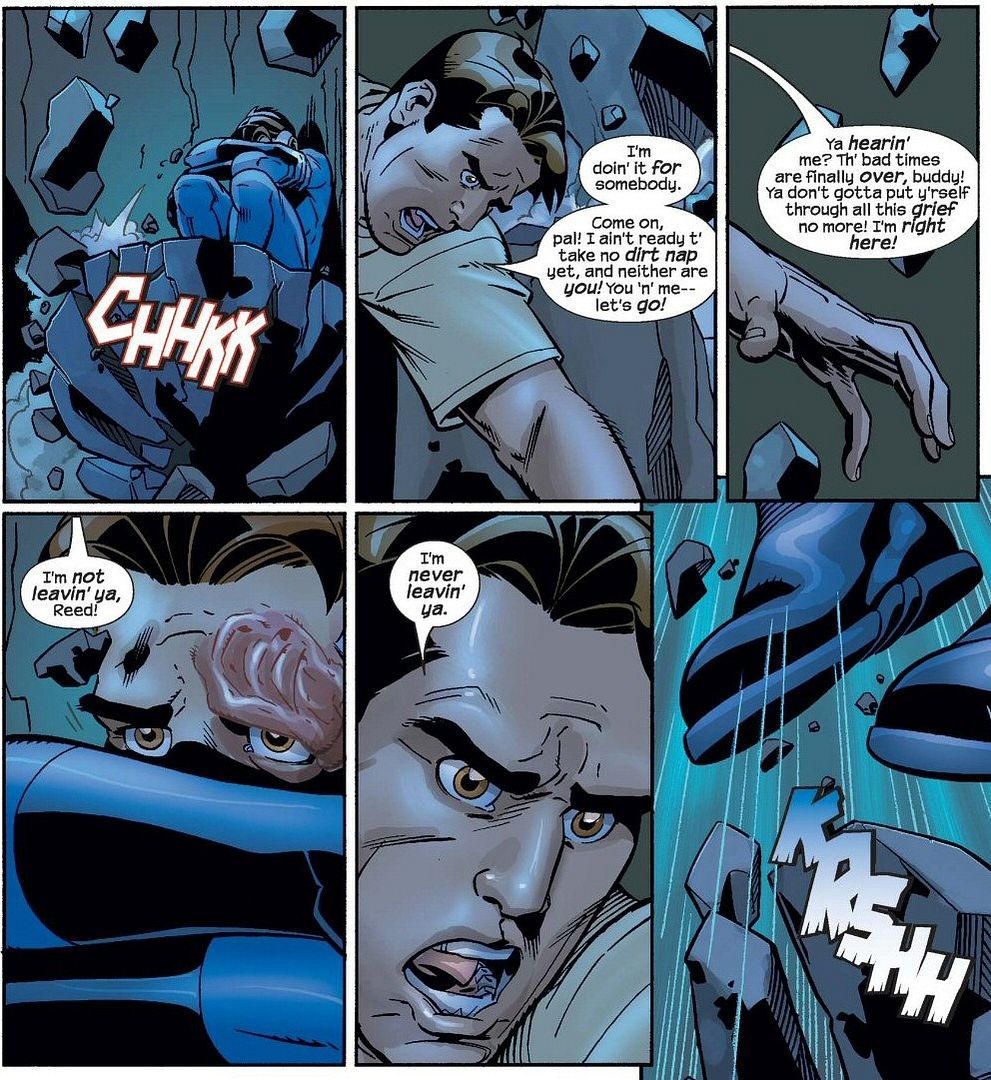
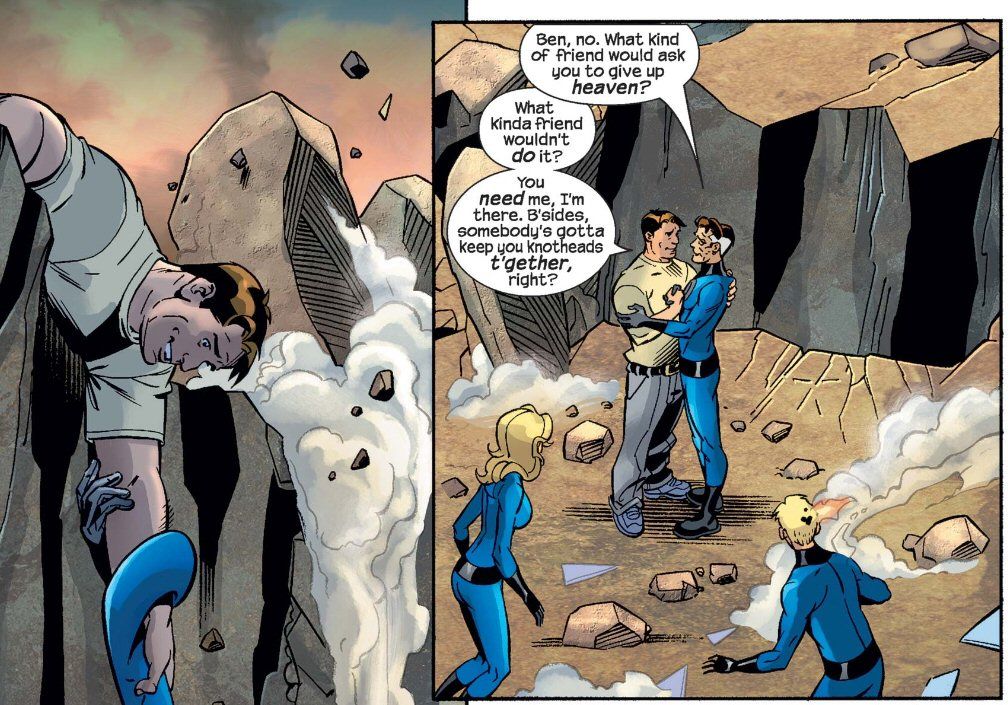
I find Waid got the FF family dynamics right in these early stories. But I also enjoyed this concluding episode for what happens next. The FF are allowed a moment with their “creator”. I found these pages hilarious, and quite touching. It is clear from the art that their “creator” is none other than legendary Marvel (and FF) creator Jack Kirby:
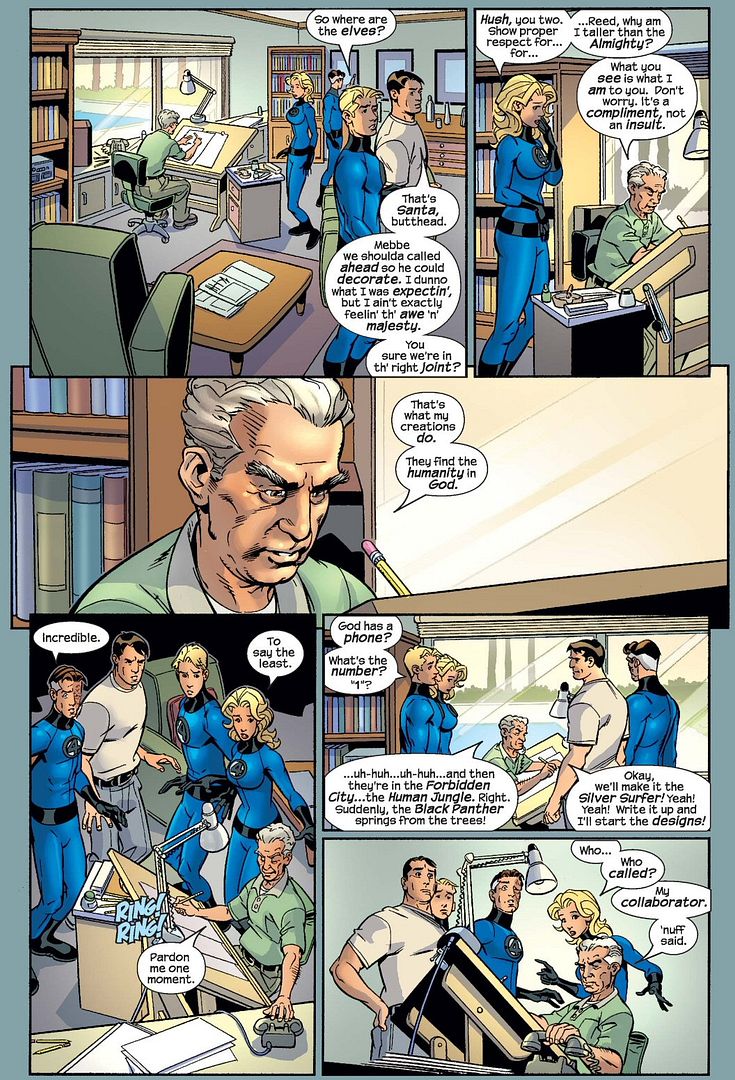
[That would be his long-time collaborator and partner at Marvel, Stan Lee – ’nuff said]
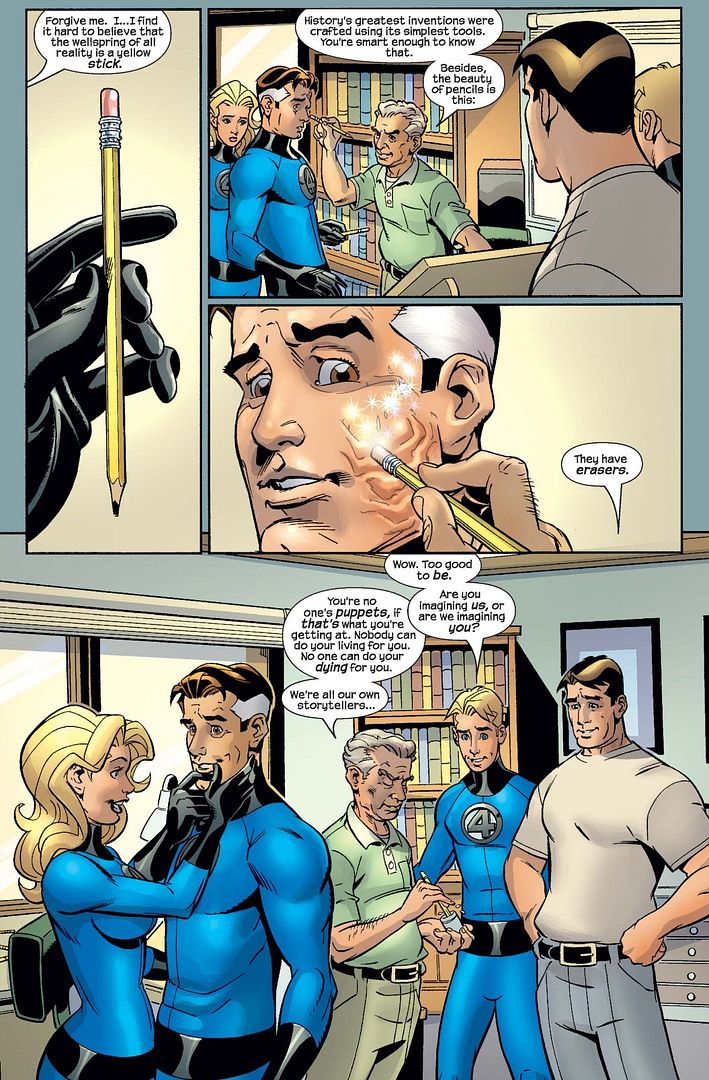
On one hand, this seems like a cheat (by undoing Ben’s death and even restoring Reed’s face from his scarring by Doom). But I like the symbolism and nod to Kirby.
Some good examples of Ben’s character come from the reunification of the team after the Secret Wars (2015-16) cross-over event. As mentioned previously, the FF had been without their own title for several years at this point. Ben and Johnny had been separated from the others for over a year (from their perspective). Their reunion with the rest of the FF team is shown in both Marvel 2-in-One Vol 1 (2017-2018) by Chip Zdarsky and various artists, and the Fantastic Four Vol 6 (2018-2022) by Dan Slott and Sara Pichelli (and other artists).
Here is a nice example of Ben’s ethical core from Fantastic Four Vol 6, issue #3, 2018, by Slott, Pichelli, and Nico Leon. The odds are against them, and Reed needs young Franklin to step up and face an enemy who had already defeated him once before. Ben objects, as shown here:
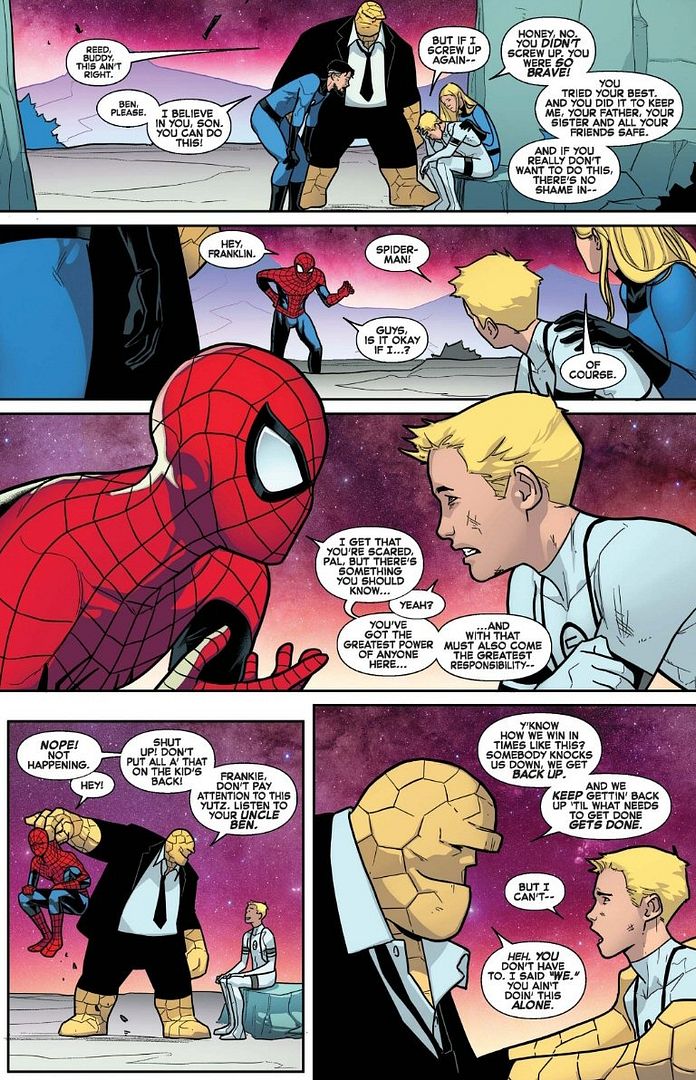
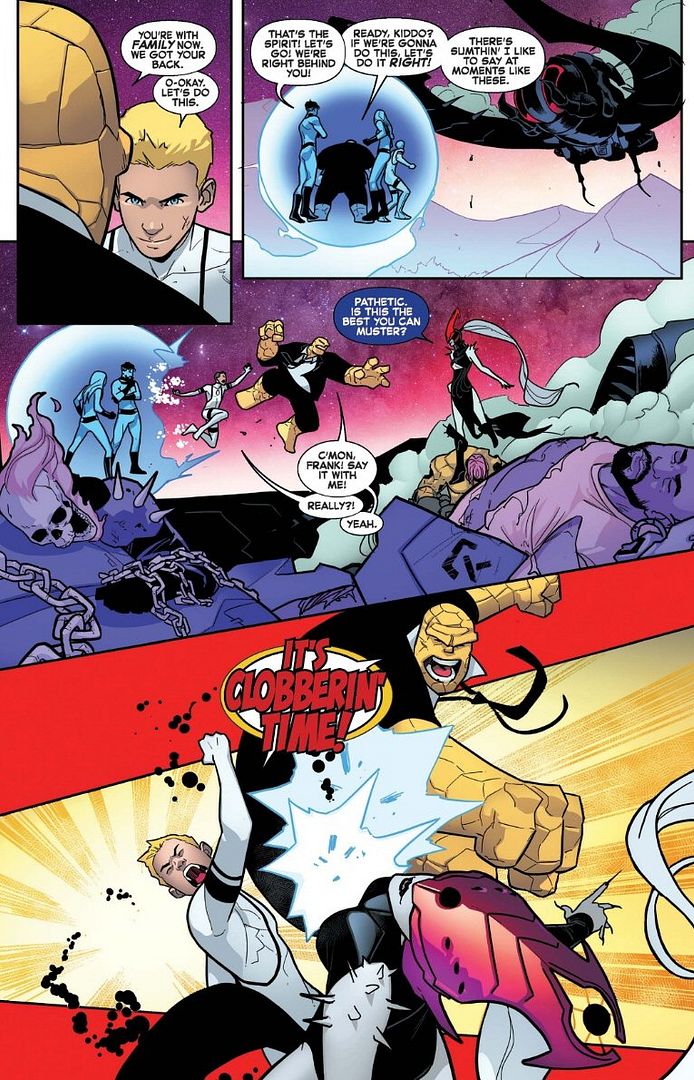
This clearly fits with the virtue ethics perspective of Ben – he is not a fan of laying Spidey’s deontological catchphrase on Franklin. Much better to adopt the family’s virtue ethics ethos.
But we still need to resolve the ethical inconsistencies created by the Hickman ending of Secret Wars. How to explain Reed and Sue keeping Ben and Johnny in the dark about their survival this whole time? In Marvel 2-In-One Annual Vol 1, issue #1, 2018, by Chip Zdarsky and Declan Shalvey, Doctor Doom (with his restored face) has been traveling with Ben and Johnny, and stumbles onto a reformed Council of Reeds. This group values their families, and work to ethically fix things. One of the Reeds offers to show Doom what really happened at the end of Secret Wars:
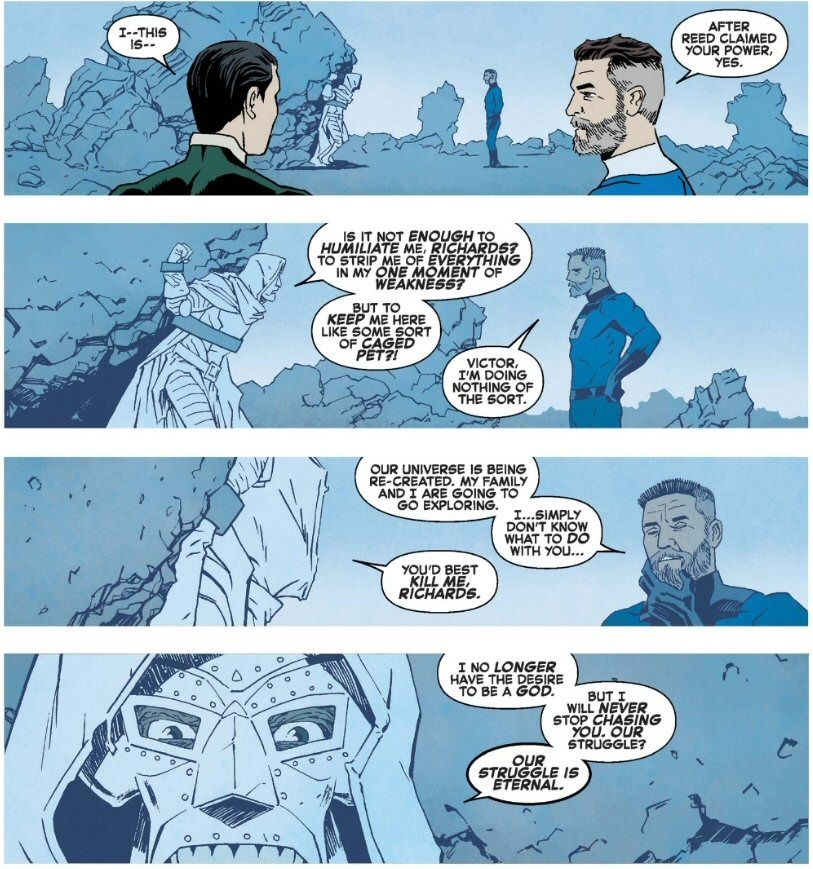
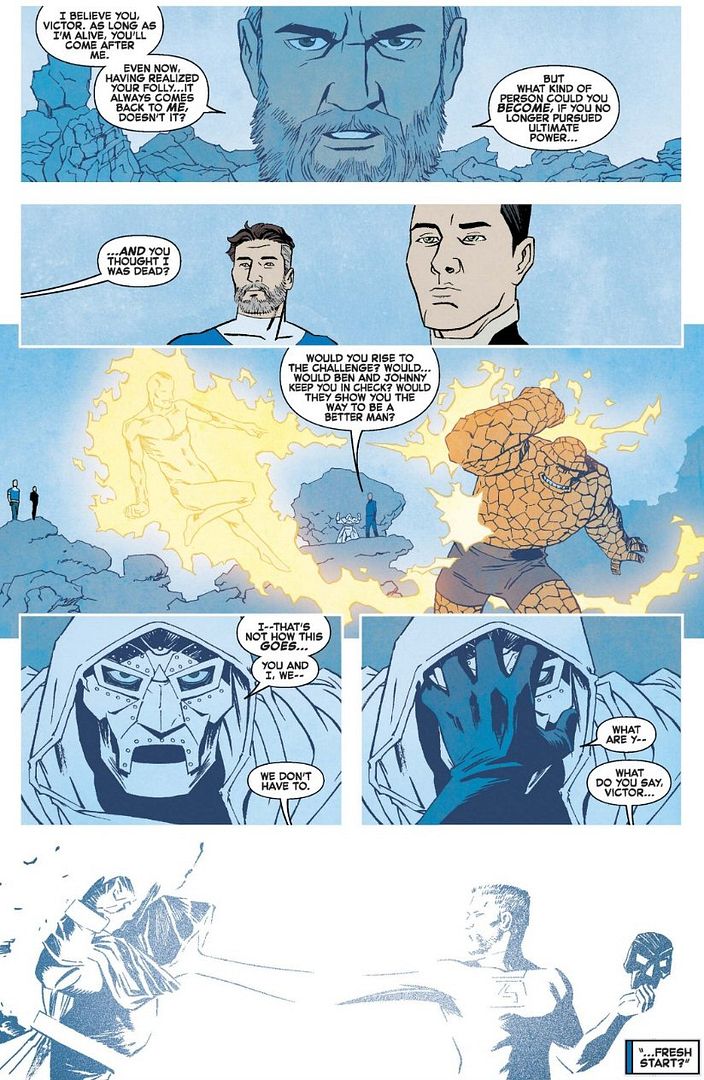
So, in this very creative retconning, Reed chose to let them all think he and his immediate family were dead, to see if Doom could rise above his background and learn to be a better man from Ben and Johnny.
Needless to say, that is still going to have consequences. From Marvel 2-In-One Vol 1, issue #11, 2018, by Zdarsky and Ramón Pérez:
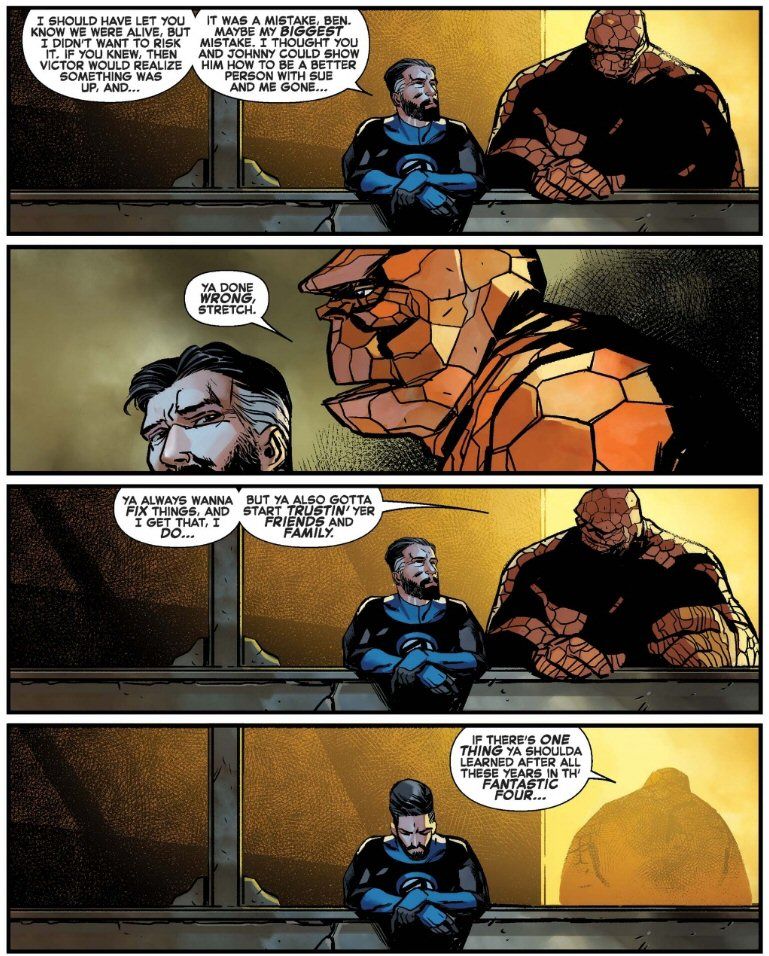

This is another example of the reoccurring pattern of Reed‘s ethical evolution – although he tends toward virtue ethics over time (as this apology demonstrates), he repeatedly falls short whenever he reverts to his consequentialist ways.
One of my favorite Ben stories is actually a short cameo that he makes in Jed MacKay‘s Vengeance of the Moon Knight series. This series takes place right after Marc Spector’s death at the end of Moon Knight Vol 9 (2021-2023). Ben and Marc are two of the relatively few openly Jewish characters in the Marvel universe. Marc’s compatriots are suffering from his loss and reach out to the only person they can think of to help sit Shiva for him. From Vengeance of the Moon Knight Vol 2, issue #1, 2024, by Jed MacKay and Alessandro Cappuccio:
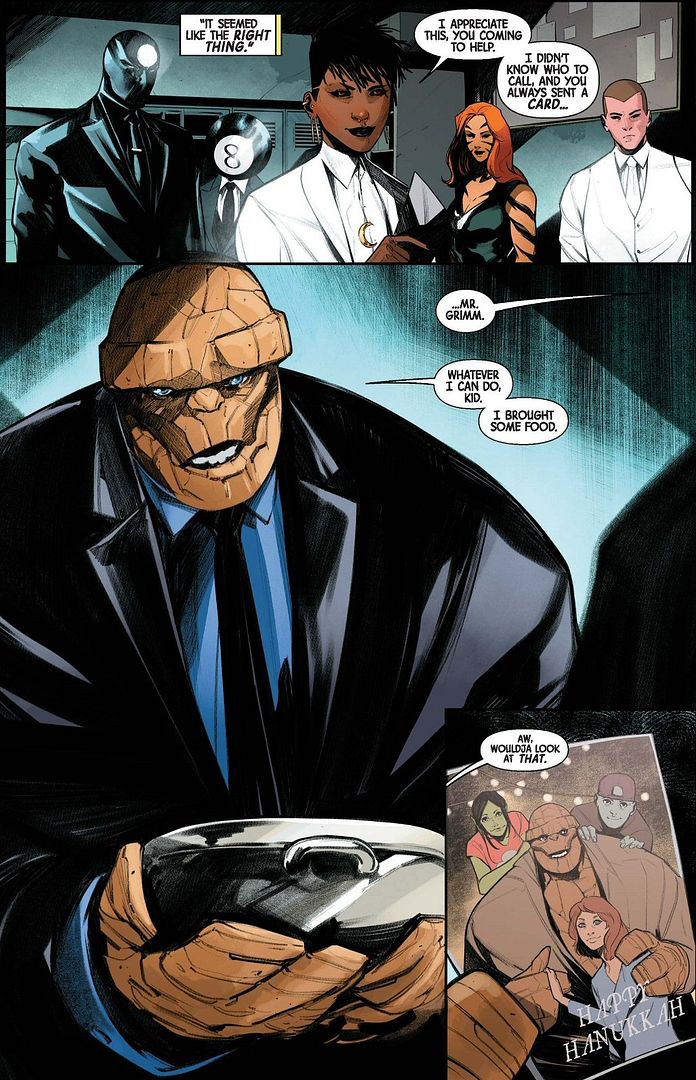
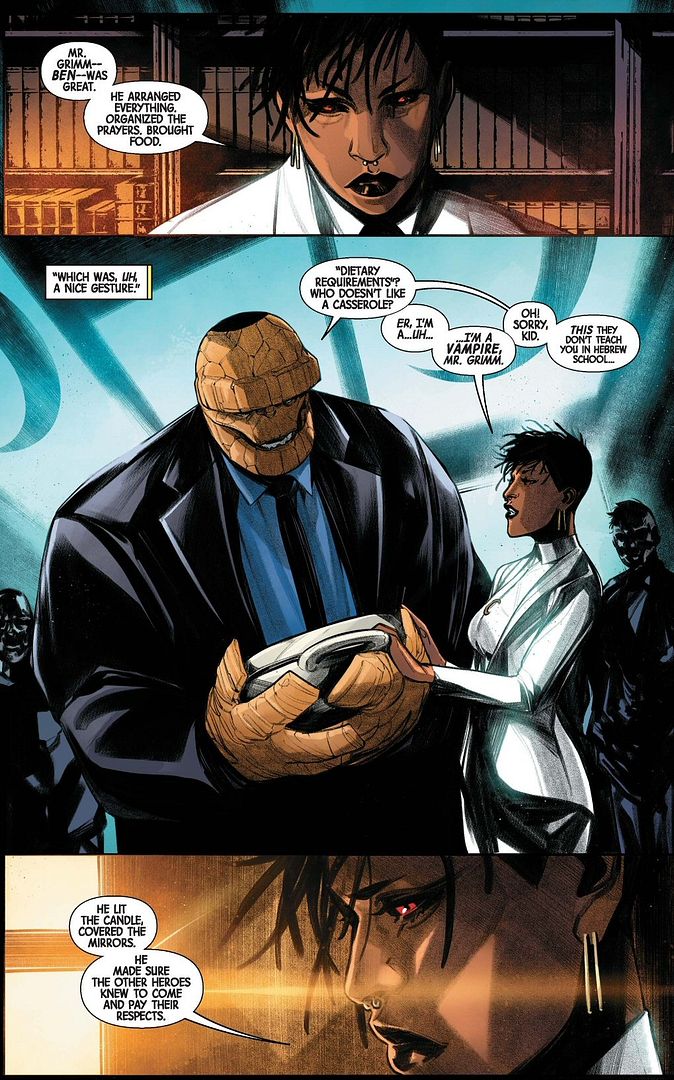
This is a side of Ben you don’t often see in the main FF stories – but I think it fits beautifully with his measure as a virtue ethicist. As an aside, there is a great piece by Jessica Plummer on Book Riot from a couple of years ago that traces the evolution of Ben’s Jewish faith. It’s a great read, especially for its depiction of the comics issue where it was first explicitly described, Fantastic Four Vol 3, issue #56, 2002, by Karl Kesel and Stuart Immonen.
I could go all day about Ben – he really is a great character. But there’s one more key member of the team I need to cover before we can wrap up this post.
Johnny Storm (the Human Torch)
The youngest member of the team, Johnny was still in high school when he joined his big sister Sue, Reed, and Ben aboard the ill-fated space trip that exposed them to high doses of cosmic rays. In Johnny’s case, those rays gave him the ability to both control nearby ambient heat, and to turn his entire body, or portions of it, into a fiery plasma-like state at will.
Johnny has exquisite control over the temperature of his flaming body, and can shape the flame into many projecting forms, such as streams, spheres or even skywriting. When aflame, he can float and fly in the air pyrokinetically. Even when not aflame, Johnny can manipulate and absorb the heat (and thus, the cold) of nearby objects. You can read more about his background and abilities on the Marvel Fandom Wiki site.
In terms of ethics, Johnny differs from the rest of the team as he fundamentally represents a more individualistic perspective – consistent with his young, outgoing and flamboyant personality. This has evolved throughout the stories of course, and I have found his character has moved away from his initial exclusive focus on personal freedom and self-expression, and asserting of his own rights, into gradually developing a stronger sense of duty and responsibility. Eventually taking a more fundamental rights-based approach, he has become increasingly deontological – but still with a strong individual streak, making decisions based on personal conviction rather than external imperatives. Overall, his ethical journey has been about proving himself and asserting his autonomy (and growing duty-based perspective), while also developing a greater desire to be respected as a full member of the team.
A really good example of his growing duty- and rights-based perspective is in the Human Torch mini-series from early in this century, by Karl Kesel and Skottie Young. Here, Johnny’s current decision making is contrasted with his early behavior upon first obtaining his powers. Specifically, this series begins with the reveal that he had badly burnt and disfigured a fellow student (Mike) before he had full control over his powers. But this secret has never come to light, as Mike has kept his silence, for his own reasons. Things come to a head when a series of mysterious fires and deaths – centered around people in Mike’s life – is eventually revealed to be due to Mike’s wife (Rose) developing mutant fire abilities that she can’t fully control. This story arc is brought to a conclusion in Human Torch Vol 3, issue #6, 2003, by Kesel, Young, and Joe Seung:
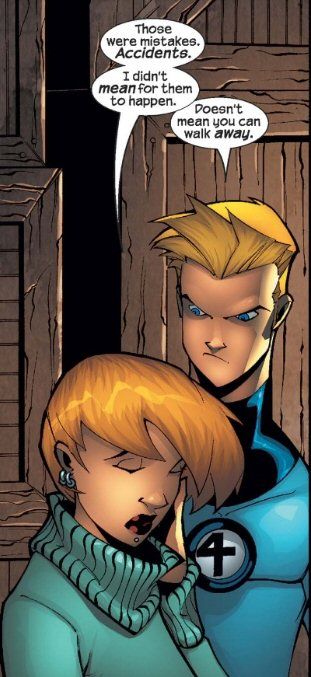
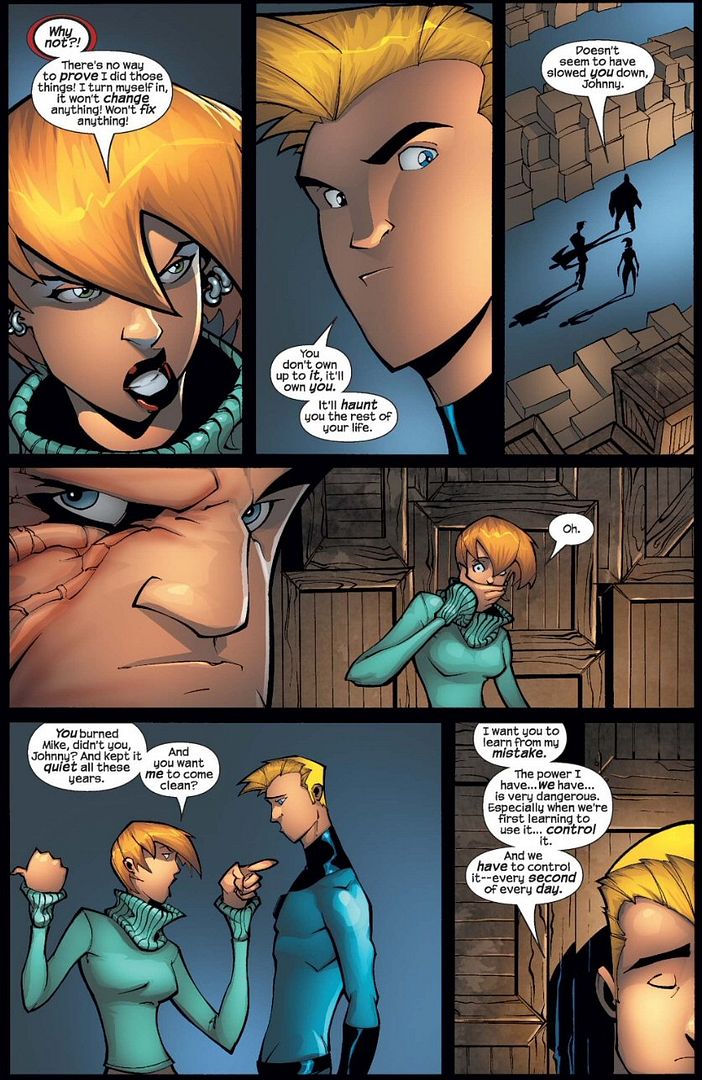
You’ll note the self-serving consequentialist reasoning that Rose uses above – but Johnny’s argument is interesting: she needs to turn herself in for her own benefit. Johnny’s sense of justice – learned from personal experience – is that you must take personal responsibility for your actions and abilities.
Of course, Rose disagrees – she snuffs out Johnny’s flame, and makes a run for it, causing him to chase her on foot.
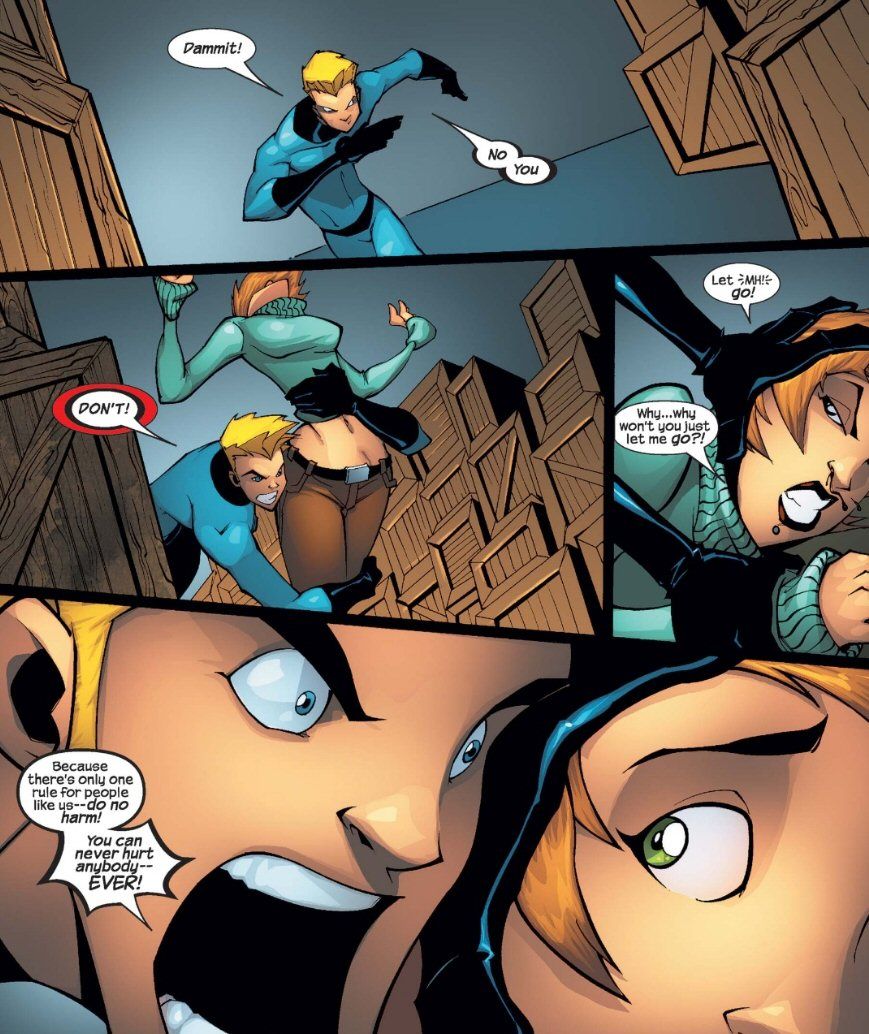
And there it is – the very deontological rule that Johnny lives by now: first, do no harm.
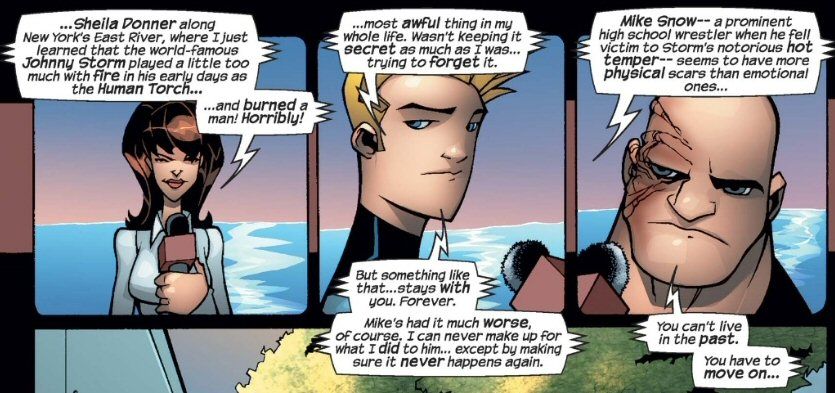
Of course, Rose had a point above about how Johnny himself never came clean. After Rose decides to apparently kill herself rather than reveal the truth about her actions, Johnny and Mike come forward with their story:
A more recent run involving Johnny that also looked at the ethics of super-powered beings is Chip Zdarsky‘s Marvel 2-in-One, from 2017-18. As previously introduced in my Reed entry, and discussed in some detail in my Ben entry, the ending of the Secret Wars (2015-16) cross-over event left a very morally inconsistent ending for the FF. It was left to Zdarsky to explain the apparently unethical behavior of Reed and Sue at the end of that event, and the impact it had on Ben and Johnny (which that series focused on).
To my knowledge, it was also Zdarsky who came up with the idea that the FF family members’ powers fade when they are separated from each other for sustained periods. This was used to great effect in his Marvel 2-in-One series, as well as Ryan North‘s One World Under Doom series and story line in his FF run (Fantastic Four Vols 7 & 8).
Here’s what happens when Ben and Johnny go to a brilliant scientist (Rachna) who helps superheroes get their powers back – for a fee. Things get interesting when they learn she also helps super-villains (who can typically better afford her prices!), including one of their old enemies who doesn’t react well to seeing Johnny. From Marvel 2-In-One Vol 1, issue #3, 2018, by Zdarsky and Valerio Schiti:
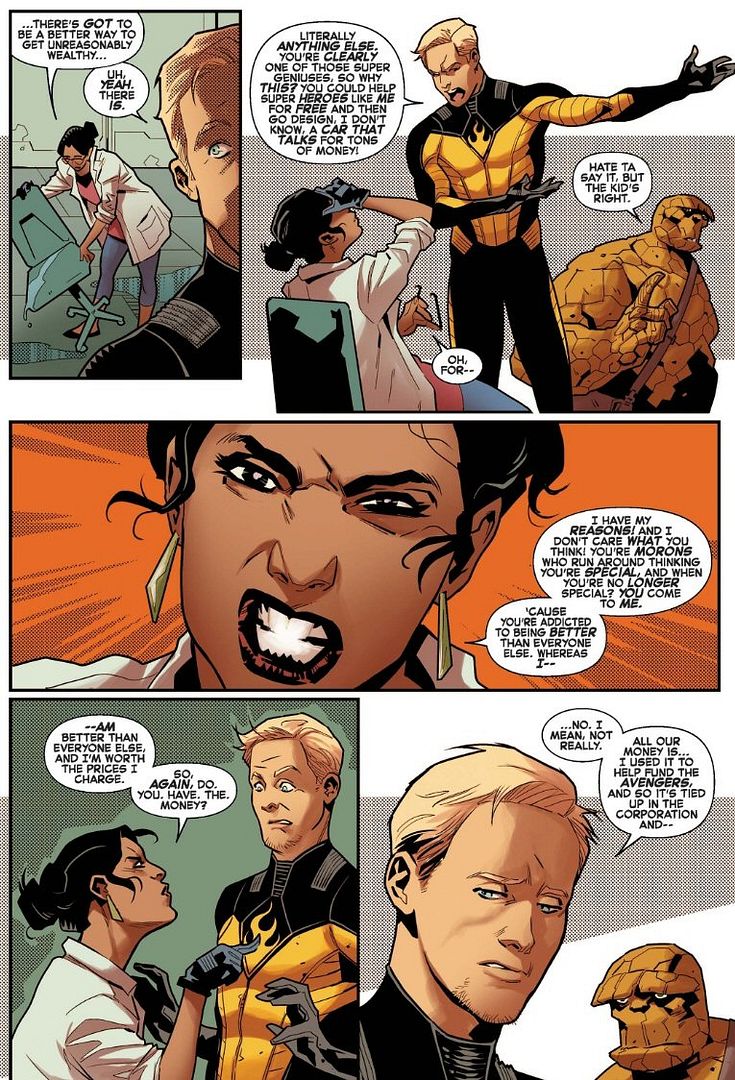
It’s rare to see someone articulate such an obviously mercenary (and mercantile) perspective in the comics! There is some truth to her criticism of the heroes, who have become somewhat addicted to the power their abilities bring – although from a virtue ethics perspective, the point is to simply be better (and not “than everyone else”, which is what her selfish perspective assumes).
After some Multiverse-misadventures together, the full FF family is finally reunited toward the end of this series (and the concurrent Dan Slott and Sara Pichelli Fantastic Four Vol 7, 2018-2022). The reunion is told a bit differently in the two series, as Zdarsky takes more time to flesh out the revised ending to the Secret Wars event (as described above under my Ben entry) – and the impacts it had on the two stars of his series, Ben and Johnny.
Appropriately, Johnny confronts his sister for their mistreatment of him (just like Ben did for Reed), in Marvel 2-In-One Vol 1, issue #12, 2018, by Zdarsky and Ramón Pérez:
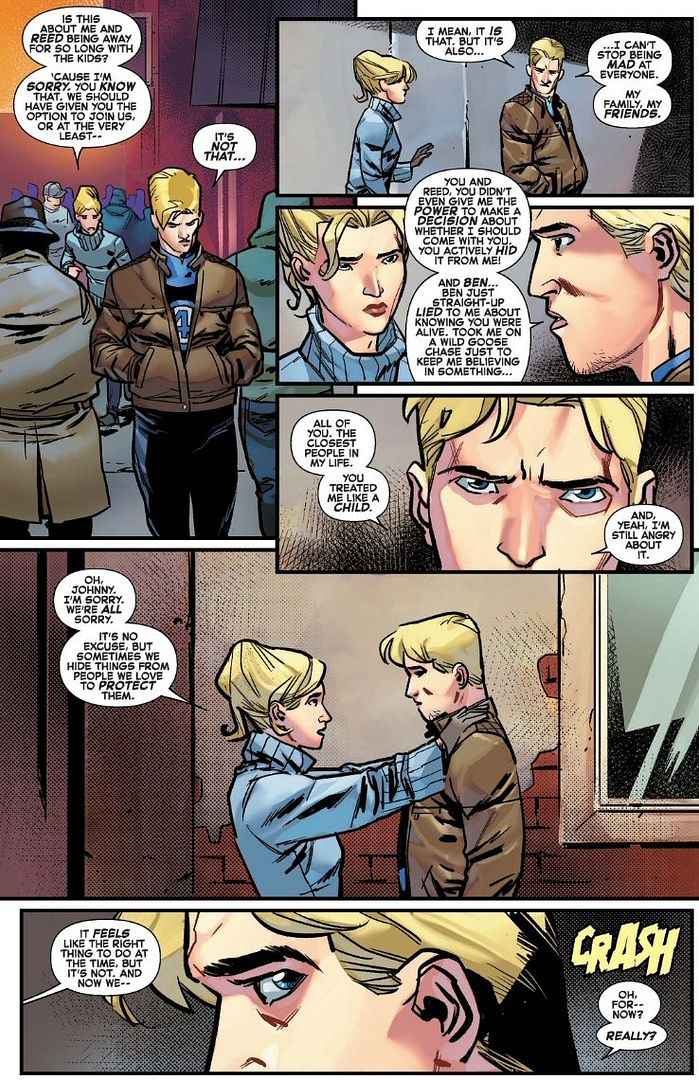
This is still not a great sequence for Sue (as she did more than just hide things – her conscious acts caused Johnny great pain, just as she could have reasonably expected it to). Again, as I explained in my Sue entry, I found that whole Secret Wars ending completely unbelievable for her character. And as such, it is really hard to have a sequence where she explains/defends it – which is why the scene cuts away so quickly, I expect.
But for Johnny, this sequence fits with the reoccurring theme of his seeking autonomy – and respect – that is so core to his ethical character. And in keeping with my thesis that Ben remains the one character who is always so much easier to forgive, from later that same issue:
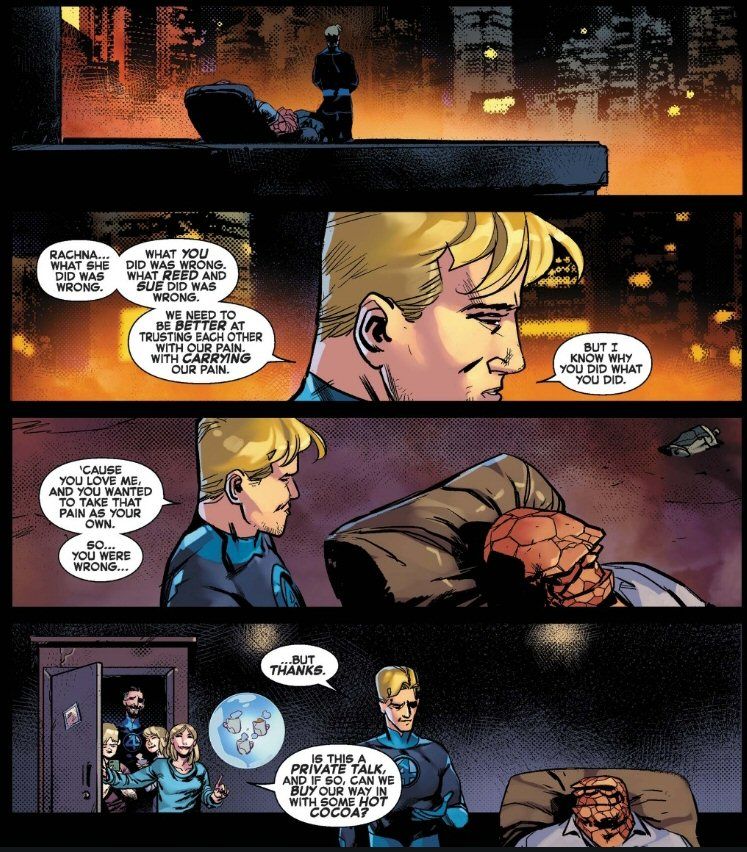
Yes, Ben’s lying to him came from a place of love – and therefore, much more understandable and forgivable.
One thing that has always frustrated me about the way Johnny is portrayed in the comics is his relationship with women. He is shown to be quite the “ladies’ man”, having a lot of superficial relationships with women, and then bailing or sabotaging the relationship when things start getting serious. This apparent fear of intimacy (while desperately craving emotional connection) makes for a tired trope in my view.
It is also inconsistent, since – as the above panels illustrate – Johnny is arguably the most emotionally direct member of the team. He is otherwise fully willing to express anger, frustration, and hurt feelings rather than suppressing them or stewing on them (as Ben is sometimes likely to do). I would argue that this emotional authenticity is a core component of his ethical make-up – yet one that is effectively disparaged by a long litany of failed relationships (which he is often chided for by his friends and family).
This is why one of my favorite Johnny-centered stories is from the lead-up to the One World Under Doom event of this year, when the FF make a disastrous attempt to break into Latveria. Doom’s automated defences send the FF somewhere very … far … away, where they encounter a very different habitable world populated by peaceful creatures. Trapped there for an extended period, while they wait for a narrow window to determine their location, Johnny enters into a unique new relationship with the FF’s local liaison, Angelica of the Shore. Some select panels from Fantastic Four Vol 7, issue #25, 2025, by Ryan North and Carlos Gómez:
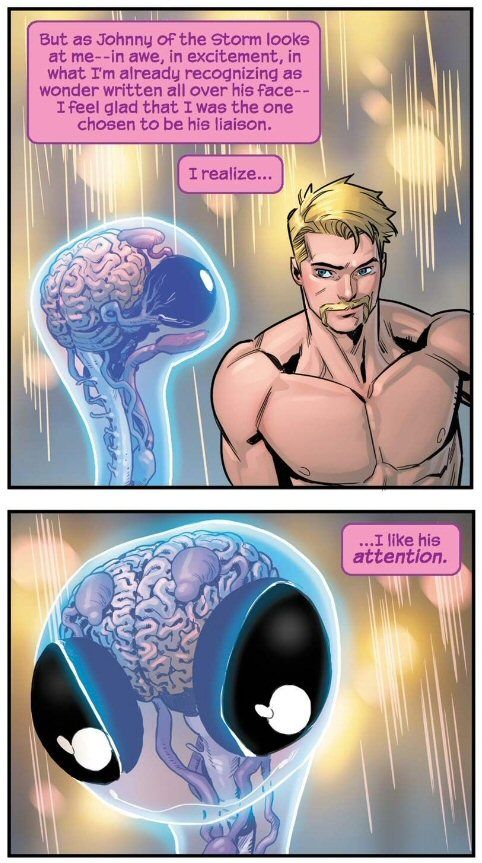
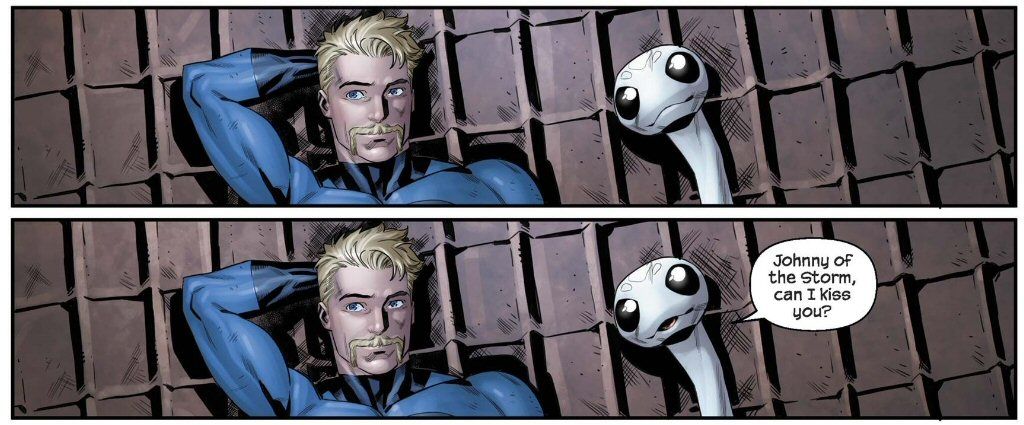
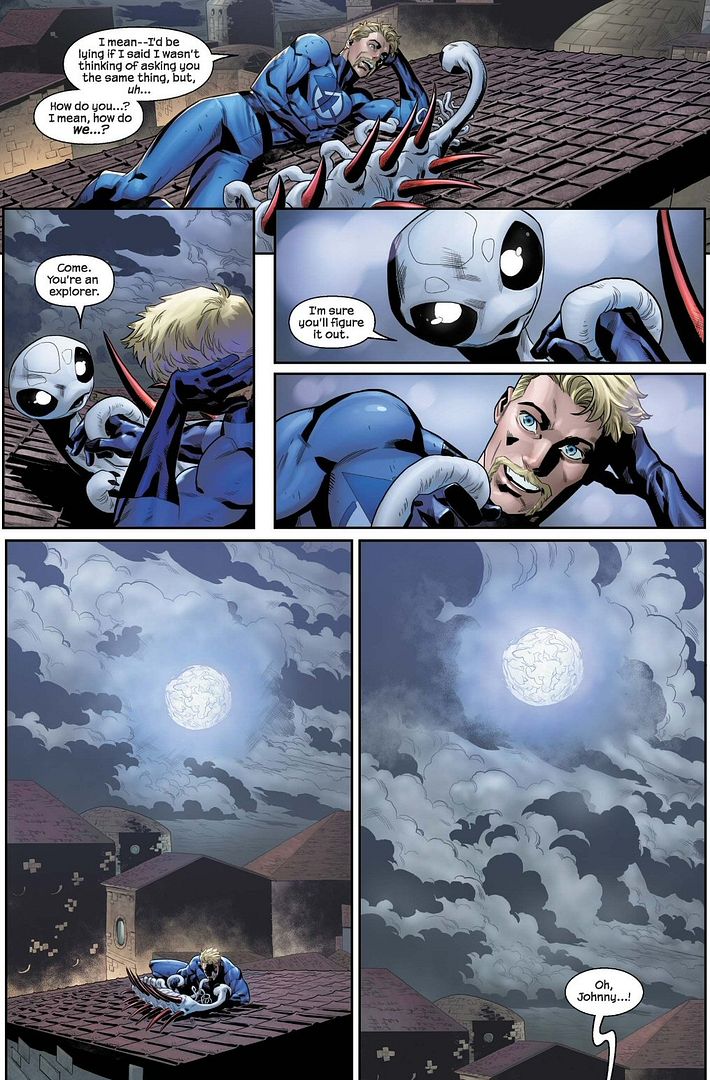
Eventually, Reed figures out that they are in fact on Earth – but an alternate timeline version that was created as a result of a temporal shift caused by the very same defences that led to their expulsion. I like how Sue steps in at this point to negotiate the implications of “undoing” those events:
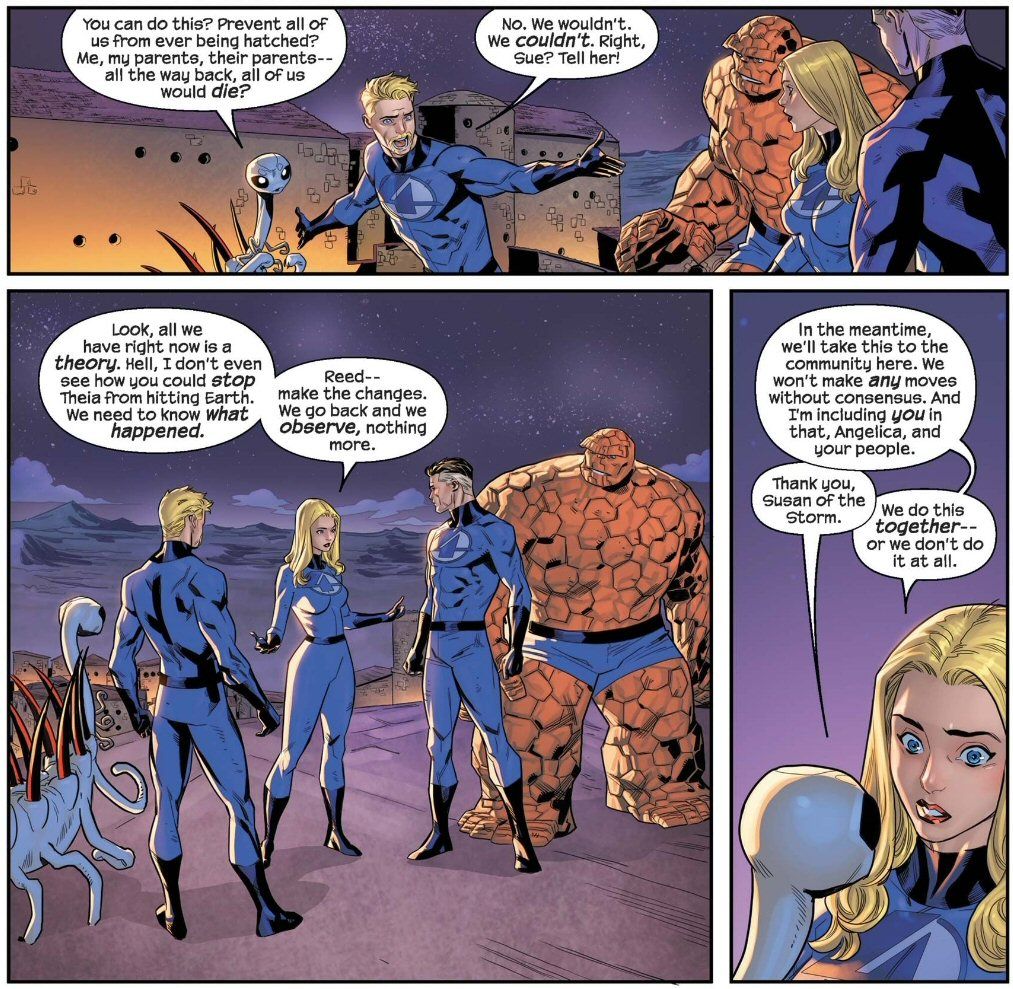
It’s a great example of Sue‘s care ethics at work – which include everyone on this alternate Earth, just not only her family. But of course, they do find out what went wrong, and a way to restore their timeline – and thus wipe out this one.
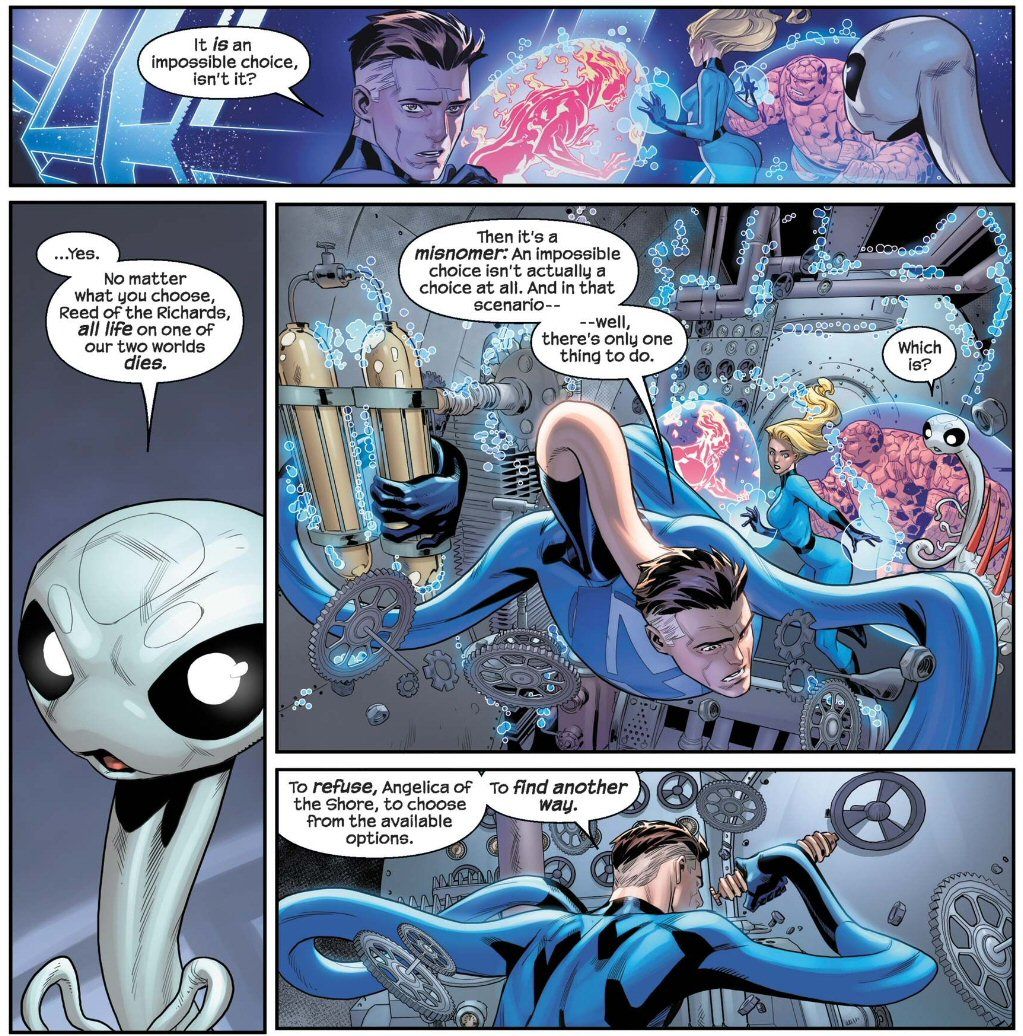
It is nice to see Reed make the right decision here, unbidden. This is another example to me of his evolving moral character under North’s run (building on the idea Pepose presented in the A.X.E.: Judgment Day issues, where Reed looks to Sue for moral guidance). A core component of virtue ethics is personal growth, and it seems to me that Reed is on such a journey during North’s tenure.
What Reed comes up with is creative – but risky – and it has one inescapable consequence: both timestreams can continue independently but can never interact again in any way (without risking the destruction of both). So, Johnny and Angelica’s relationship must end, permanently, for the fate of two worlds. Johnny understandably doesn’t take this well:
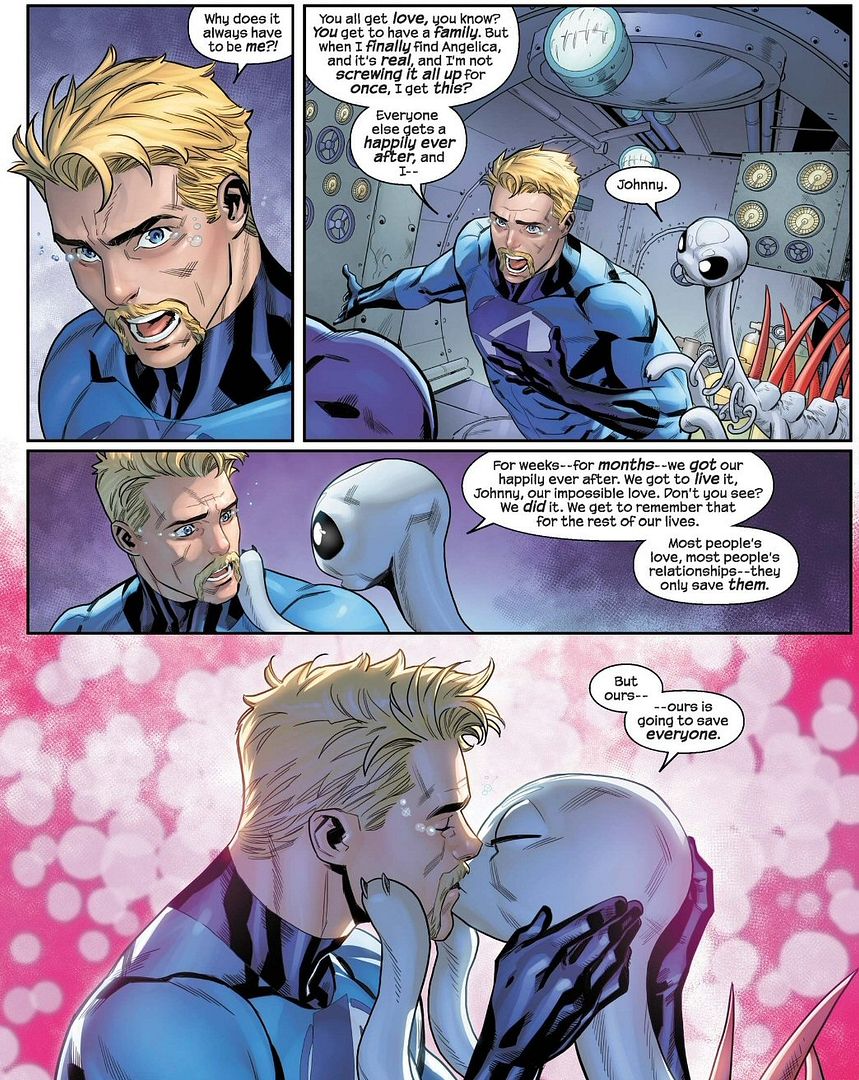
I found this story really touching. In addition to North, huge kudos to the art team on this issue – the alternate Earth (and Angelica) are gorgeously illustrated by Gómez and beautifully colored by Jesus Aburtov. This could have potentially come across as a goofy issue otherwise, but Gómez and Aburtov really sold it.
Marvel Cinematic Universe (MCU): Fantastic Four – First Steps (2025)
Marvel Studios’ release of the first FF film under their own banner was a great success this past summer: Fantastic Four – First Steps (2025). It’s great to see these heroes finally added to the Marvel Cinematic Universe (MCU), with the opportunity to interact now with the rest of the MCU.
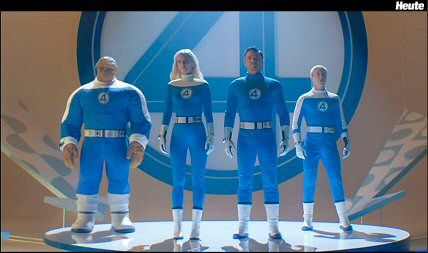
Of course, there is a catch. These heroes actually stem from Earth-828 and not Earth-616 (which, as I explain here, is the prime Earth in the comic books, later adapted as the internal name of the Earth in the MCU, which is actually known as Earth-199,999 externally). And in a great homage to Jack Kirby they use his birthday (August 28) for this Earth. It was an early tradition (subsequently abandoned) to number the alternate Earths in the Multiverse according to the birth month and day of the story creator. This Earth-828 appears to be back in the 1960s, but with a very retro-chic aesthetic and super-advanced technology in the hands of the FF (who seem to be this world’s only superheroes). But we already know that at some point this FF team will travel to the MCU’s Earth-616, given the end-credit scene from the MCU’s Thunderbolt* (New Avengers) film of earlier this year.
I thought this one of the best Marvel movies in years. By disconnecting from the current period of the MCU’s (or comic’s) Earth-616, they were able to introduce all sorts of new and varied items from the history of the FF, adapted to fit a coherent world view. Most impressive to me was the moral character work on the four family members, and the nature of their inter-relationships. The writers (Josh Friedman, Eric Pearson, and Jeff Kaplan) really got the core of these characters right, and the actors really delivered on the script.
While the characters are all recognizable, there are some significant differences. Ben is presented as more thoughtful and intelligent – and less curmudgeonly – than he often is in the stories (I loved the running gag about the source of his catchphrase). Similarly, Johnny is also presented as someone who can reason and make decisions independently, despite his otherwise tempestuous nature. Sue is shown as more decisive, with more leadership ability than she sometimes appears in the comics. And Reed recognizes the limits of his intellect – and moral consequentialism – in making decisions.
There are two scenes that I found particularly well-done in regards to Reed’s moral character. The first is the family’s discussion of how the citizens of this world want the FF to hand over baby Franklin to Galactus in order to save the world.
From 59:00 mins into the movie’s run, when Reed is explaining why he understands the angry crowd’s perspective:
Reed: We don’t have a workable plan. And the clock is ticking. So their plan looks good. It’s mathematical, it’s ethical, and it’s available.
Sue: What are you saying?
Reed: I’m not saying anything.(Franklin cries off camera, and Sue goes to comfort him. Reed follows.)
Reed: I would never give him up to Galactus. I would never do that.
Sue: “Mathematical? Ethical? Available?” It was just so easy for you to say that.
Reed: It means nothing.
Sue: It means I know you. I know how your brain works. It means you’ve thought about it. It means you’ve rolled it around in your head, and you worked the problem.
Reed: Which means nothing. It is my job to think terrible things so that terrible things don’t happen.
Sue: It’s not your job Reed. That’s you.
Reed: Okay. You’re right, it is me. I don’t dream. I don’t wonder. I invite the worst possible thing into my head to figure out how to hurt them before they hurt anybody else.
Sue: And you know what? Sometimes … sometimes, you being you hurts me.
Reed: Well, I don’t mean to.(Franklin fusses)
Reed: Listen, I am going to solve this. I am going to make it right.
Sue: Hmm. We don’t know what he is or what he might become … but I am NOT giving him up.
By “mathematical” and “ethical”, Reed of course means by act utilitarian (consequentialist) standards. As Sue makes clear in her eloquent care ethics fashion, that moral reasoning hurts those you are in a close relationship with.
This leads to a very impressive moment later on, where Reed gives up on trying to scan Franklin for abnormalities. From 1:07:30 into the run:
(Reed in the lab talking to Franklin)
Reed: I built this to see what you looked like. You see, most fathers want their sons to look exactly like them, inside and out. But … I don’t want you to be like me. There’s something wrong with me, always has been. The more I look at you, the less I know. And the less I know, the more scared I am. So you know what? I’m not gonna look anymore. I’m going to let you tell me who you are. And if you’d like to tell me now, that’d be helpful, especially if you’re an all-powerful space god. I’d like to know that sooner rather than later, if you don’t mind. Hmm. Oh, no. You’re busy peeing. You’re a very good boy.
This Reed’s view that there is something “wrong with me, always has been” – in regards to his vaunted consequentialism – is a great modern framing for the character. It underscores the main thesis of my overview here: namely that the characters grow together into a more relational sense of moral decision making (like Confucianism or care ethics).
The last word (for now)
Wow, this was a long one! I didn’t expect to go quite as deep as I did into each of the four main characters of the FF, but once I got started, I realized how much each character arc affected the others. It thus seems only fitting to spend so much time on each of them individually, as well as collectively.
I’m planning to do a follow up post with some of the other major FF-associated characters (like Doom, the Maker, the Silver Surfer, etc.), but that will have to wait while I continue with some other major character overviews first.
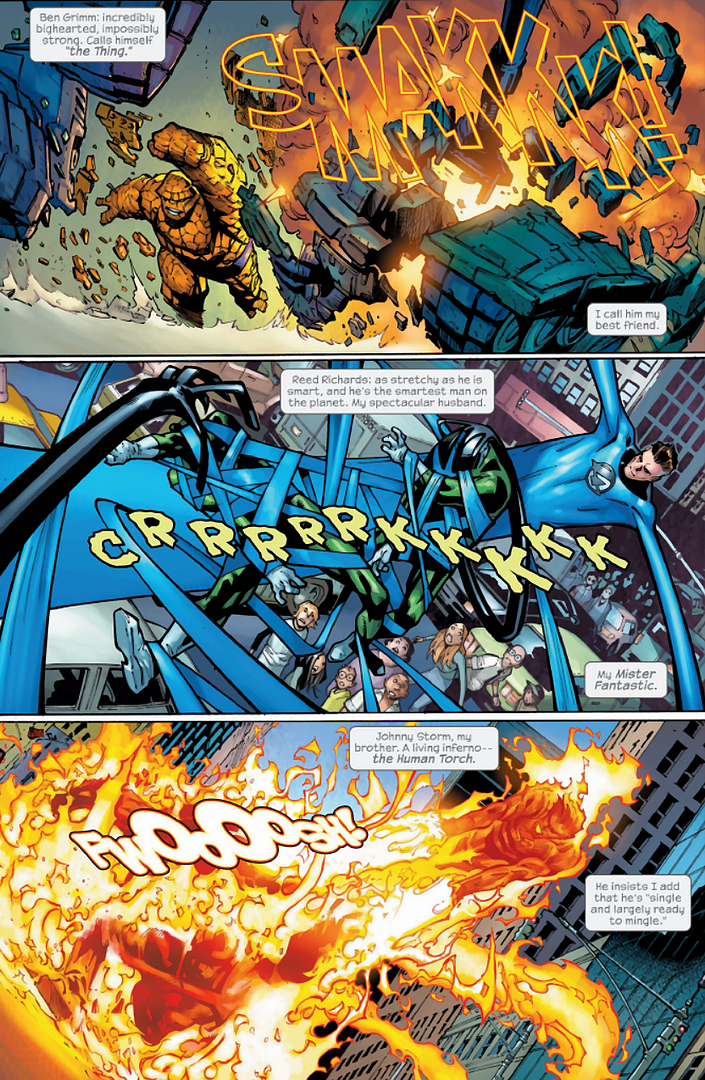
In the meantime, I would like to leave you with the opening introductory panels from Ryan North‘s recently re-launched title, Fantastic Four Vol 8 (2025-ongoing). Ostensibly, the restarted numbering is to help new readers become acquainted with the characters. I suspect this has a lot to do with the new Marvel MCU movie that came out the same month (which must be expected to drive new readership).
From Fantastic Four Vol 8, issue #1, 2025, by North and new regular artists Humberto Ramos and Victor Olazaba, introducing the team to a new generation of readers:
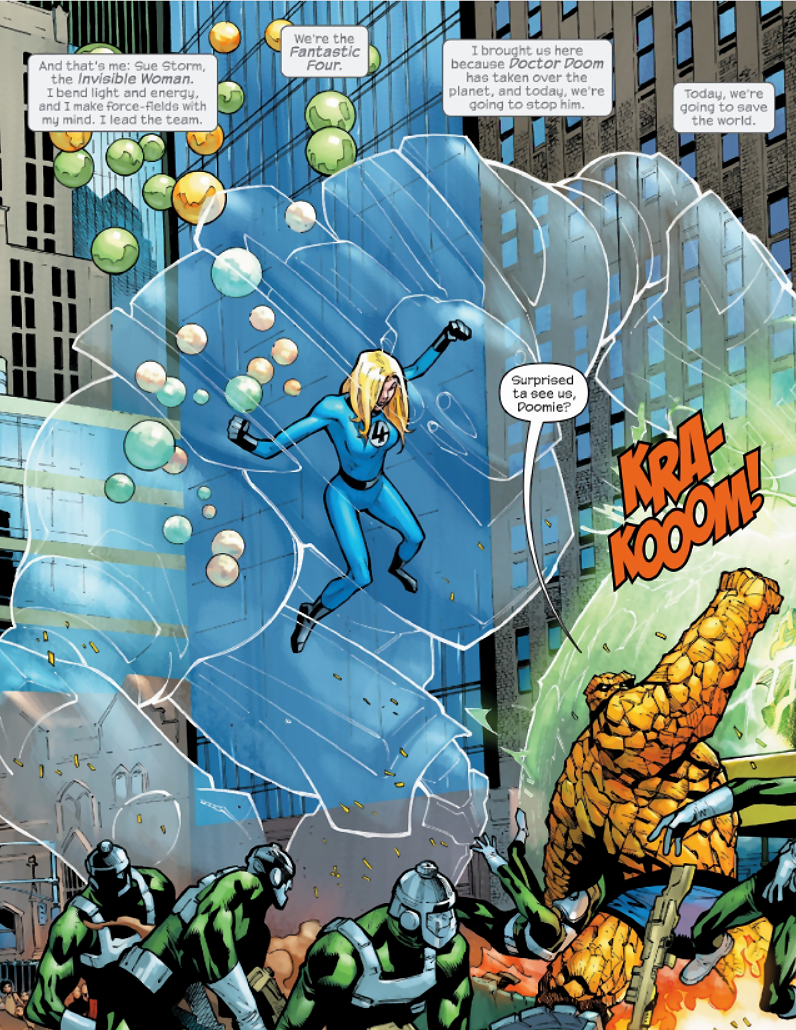
Although there were several stories in North’s earlier run that intimated Sue was the leader of the team, this is the first time that I’ve seen it explicitly stated. And I think it is great time to call attention to what I have always maintained (as explained in my Sue entry above, and general introduction to the team): Sue Storm is the moral leader of this team and family, and all look to her for the way forward.
As an aside, I expect a few regular readers were a bit puzzled here in terms of plot. Previously, the FF attempted a disastrous full-frontal assault on Doom (One World Under Doom Vol 1, issue #2) that left Ben – and eventually, the rest of the team – bereft of powers (as depicted in Fantastic Four Vol 7 issues #30-33). So, it seems odd that the first thing they do when they regain their powers is to try another direct frontal assault on Doom, with no apparent strategy. But all will be explained over the next several issues (as I describe in my update to my Reed entry above). Not unexpectedly, their assault works out very similarly as it did the first time – only now they are each stranded in a different time period (and all slowly losing their powers):
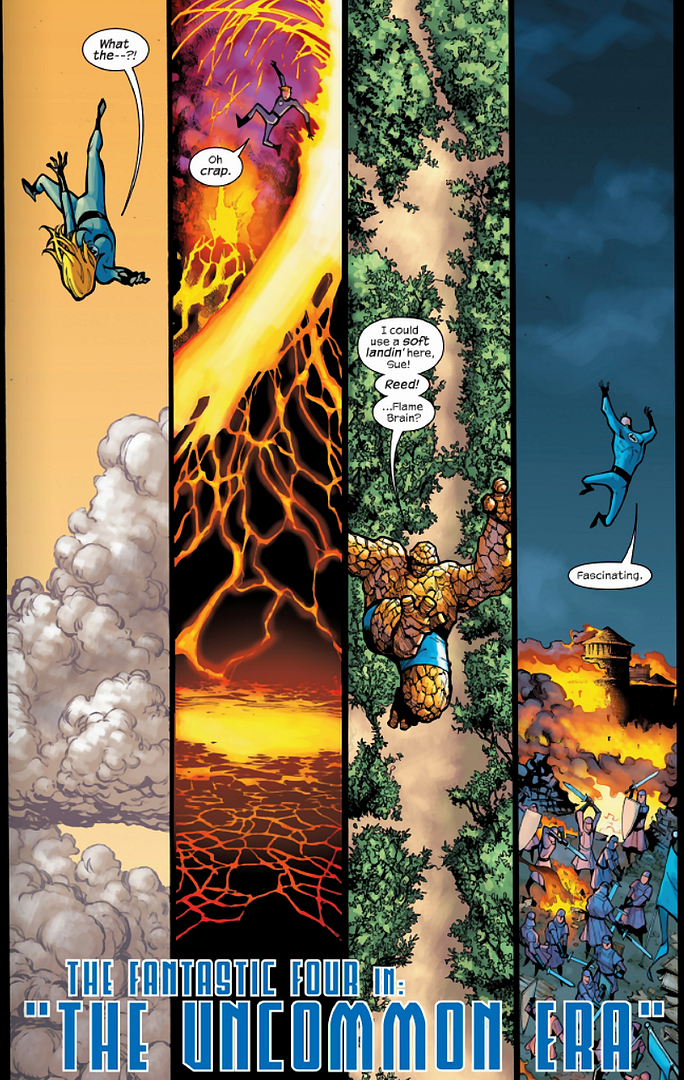
It is a great series of adventures from here, and I am really enjoying North and Ramos’ ongoing FF run!
See my Glossary post for a list of the key philosophical concepts and related links on this site.
Further Reading
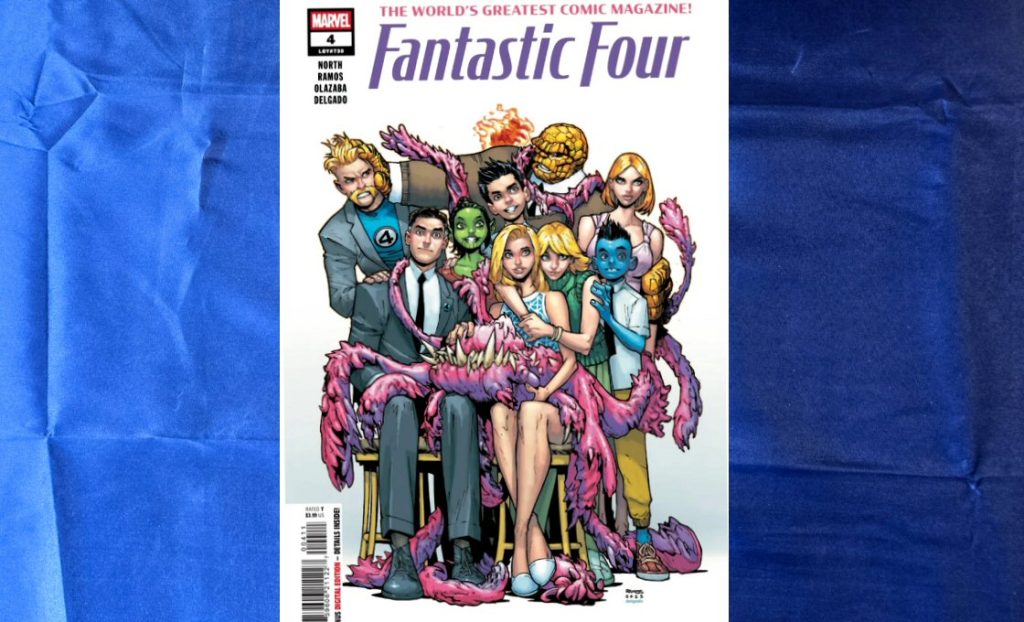
For more Fantastic Four: FF Vol 8, issue #4
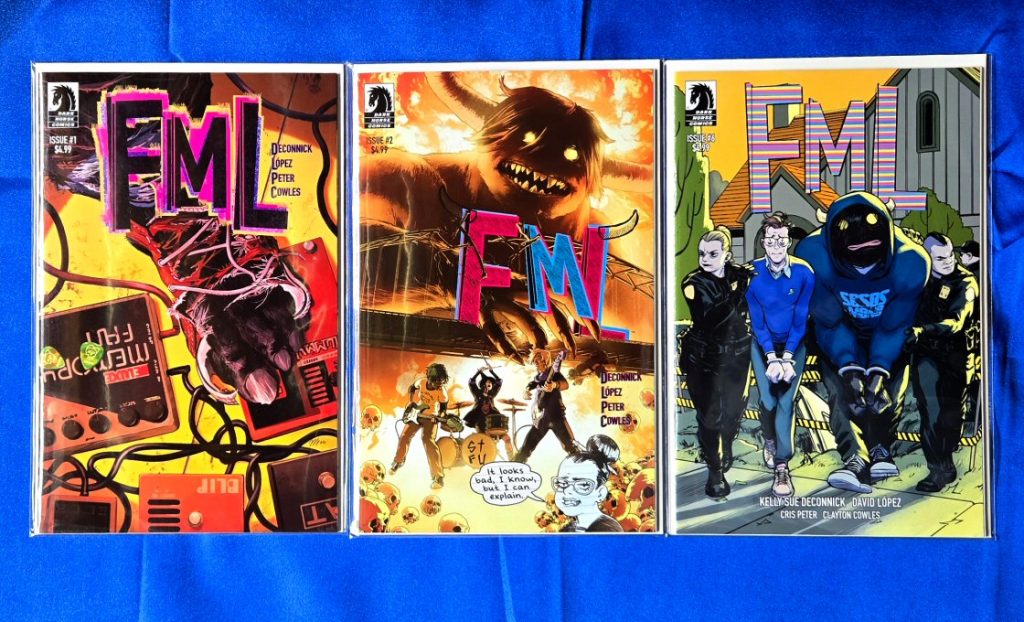
For more family ethics: FML comix

For more morality: Why be moral?
Another great overview, thanks. Loved the all the ethics comic examples, especially for the Invisible Woman. Great to see another strong woman profiled!
You must really read a lot of comics to do these … how do you find such relevant stories to profile?
Thanks. And yes, I am a power user of the Marvel Unlimited subscription!
In terms of the comics, I am of course familiar with the ones from my youth, and have been actively following the modern stories for the last few years. For the stories in between, some I’ve found while researching the background of modern stories. But I typically look at discussion forums to find fan-favorite series of earlier runs, and start there. In preparation for these profiles, I also tend to read the first few issues of each new writer on the main title over the years. It is from all of that that I come up with the basis of my ethics opinion.
As an aside, I sometimes find some real gems in my search of series that don’t get a lot of attention. The Chip Zdarsky Marvel 2-in-One run (2018) is a good example. Not a lot discussion of this one online, but he really leaned in on the ethics of the Secret Wars ending – and the impact/repercussions on the characters.
Given your interest in strong women characters, another good example (from when I was researching Thor) was the Jane Foster & the Mighty Thor (2022) series by Torunn Gronbekk. This series focuses mainly on the Foster Valkyrie character (which I will profile one of these days). Highly recommended, Gronbekk’s work is outstanding.
Just saw this in today’s newsletter, and I was genuinely impressed – well done! As usual, it’s a smart, well-balanced analysis that treats these characters not just as superheroes, but as moral agents navigating complex ethical terrain. Great job connecting Reed, Sue, Johnny, and Ben to frameworks like care ethics and consequentialism, without losing sight of the human side of their stories. I am not as familiar with Confucianism, so that part was interesting.
I especially appreciated the emphasis on Sue Storm as the team’s moral compass – something that’s often overlooked in mainstream discussions. As usual, the writing is insightful, well-informed, and refreshingly accessible. A solid read for anyone who enjoys comics with a little philosophical depth.
And great timing with the upcoming movie. I am sure many viewers with find this overview helpful. Keep ’em coming!
Thanks, appreciate the support.
I’m not sure how the FF movie will fit into the comic stories (or the other MCU movies), given it seems to be taking place in another universe of the Multiverse, and in the 1960s.
Given the “success” of my Absolute Wonder Woman post on Reddit, I thought I would try a similar thread on the r/FantasticFour forum.
Here I asked when people thought Sue became the leader of the team – both ‘officially’ and more importantly, morally. I meant this genuinely, as while I have tried to read everything FF related as of 2015’s Secret Wars, my knowledge between then and the mid-1980s is spottier.
I took it for granted that most would accept that Sue is the current leader, given the clear trend since Secret Wars (across multiple writers) – including the latest issue of FF (vol 8, issue #1, 2025) which explicitly states this (all as shown on this page).
Hoo-boy, seems some folks didn’t like that – but I also got a lot of thoughtful responses. After 24 hours, the post has hit 23K views (!), 133 upvotes, and 47 comments.
https://www.reddit.com/r/FantasticFour/comments/1mjbk6s/so_when_do_you_feel_sue_became_the_leader_of_the/
Honestly didn’t expect that to be so controversial … I guess there are a few fragile male egos on Reddit who insist on traditional gender roles (who knew). 😉
Update: after 48 hours, the post has topped out at 32K views (!), 148 upvotes, and 53 comments. Yowza!
Thank you for the very interesting article. And website!