
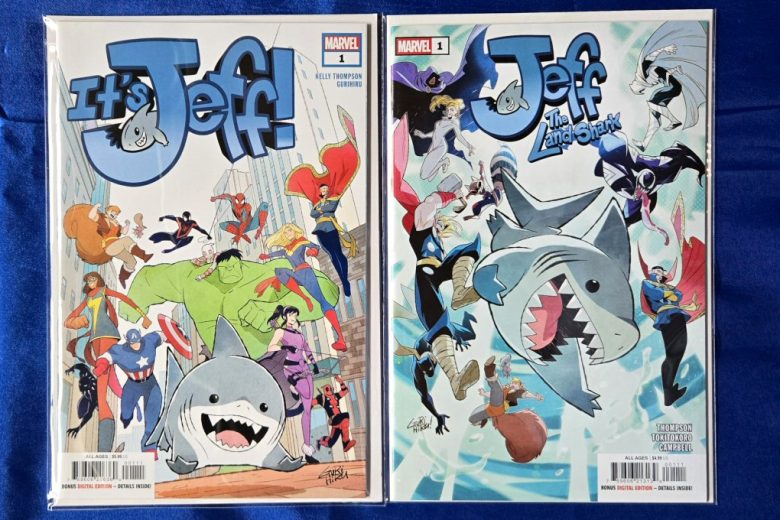
With Jeff, nobody needed him. He wasn’t needed for a story. He was just something that happened. But I think that makes his creation even more pure somehow? And it certainly makes his ascension even more impressive. He had no epic stories or books or plans … but people just loved him.
- Kelly Thompson, Jeff co-creator, Secret Origin: Jeff!, 1979semifinalist substack, 2021
I have long been a fan of the adorable Marvel character Jeff the Land Shark, created by Kelly Thompson and Daniele Di Nicuolo in 2019. Although initially appearing as a comedic sidekick to a number of West Coast Avengers (and later Deadpool), he became famous through his own adventures in the all-ages Marvel Unlimited It’s Jeff Infinity Comic series created by Thompson and the Japanese comic artist duo Gurihiru (2021 to present). Thompson and Gurihiru won the well-deserved 2024 Eisner award for Best Humor Publication for this series.
Amazingly for such a humorous all-ages beginning, Jeff has since become one of the most popular characters to play in the breakout Marvel third-person hero shooter video game Marvel Rivals. Unfortunately, I find he isn’t drawn in the game with same charm as the classic Gurihiru comic version of Jeff. But I am glad to see new Marvel artists pick up the Gurihiru style – additional Jeff series have now been drawn by the Japanese comic artists Tokitokoro and Nao Fuji.
The Jeff comics have also been a great way for me to introduce my granddaughter to comics. Although always a voracious page-book and chapter-book reader, it really wasn’t until Jeff that she developed an interest in comic books (I think the infinity scroll on my Unlimited account was a good way to get her started). She has since read all the print Jeff comic books, and is an avid reader of all the “Marvel Tails” superhero pets, along with the Dog Man graphic novels, etc.
Consistent with the ethos of this site, you know I am going to find a moral philosophy dimension to the Jeff character that I think helps explain his increasing popularity. And in fact, with the completion of his first standard-length printed comic mini-series (Jeff the Land Shark Vol 1, issues #1-5, 2025, by Thompson and Tokitokoro), I can now point to examples from all three domains of normative ethics (which is how we refer to moral philosophy today). Is Jeff really “a good boy”? Let’s find out!
I realize it may seem odd to subject a humorous children’s character to an ethical analysis, but I will argue below that it is useful from both a character perspective as well as from an understanding of human ethics perspective. After introducing the character in a little more detail below, I will walk you through what I consider to be Jeff’s main ethical make-up and evolution over time. I will then end with my first ever poll so that you can cast your vote on the burning question of our times: is Jeff more like a cat or a dog? 🙂
As always, if you would like to know more about the terms I’m using on this site, please follow the links throughout or check out my Ethics 101 page or Glossary post.
Introduction to the character
Kelly Thompson wrote a great “secret origin” post on the creation and early history of Jeff on her substack newsletter a few years ago (where the quote at the top of this page comes from). As Thompson explained, she has had a part in creating a lot of comic characters over the years – but “none of them have even come close to the popularity of … JEFF THE LANDSHARK!”
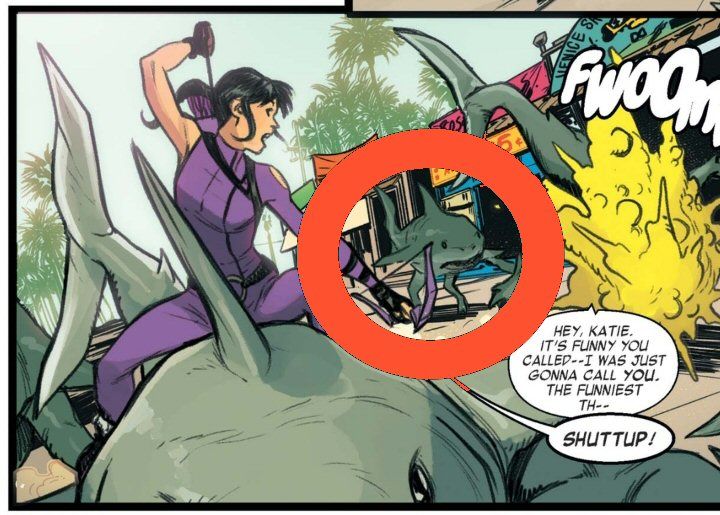
Thompson was writing West Coast Avengers Vol 3 (2018-2019). There was a flashback story in the first issue of the team fighting a bunch of “land sharks” engineered by B.R.O.D.O.K (a variant of M.O.D.O.K). Stefano Caselli‘s art included a very concerned looking fellow, circled below:
Thompson apparently couldn’t help but keep thinking of him – and how much he looked like he didn’t want to be there. She subsequently adopted two kittens in real life, and the idea of creating the playful yet troublesome Jeff the land shark gelled. Thompson introduced him in issue #7 of her WCA series, drawn by Daniele Di Nicuolo. Here, Jeff is introduced when he gets adopted by Gwendolyn Poole (Gwenpool):
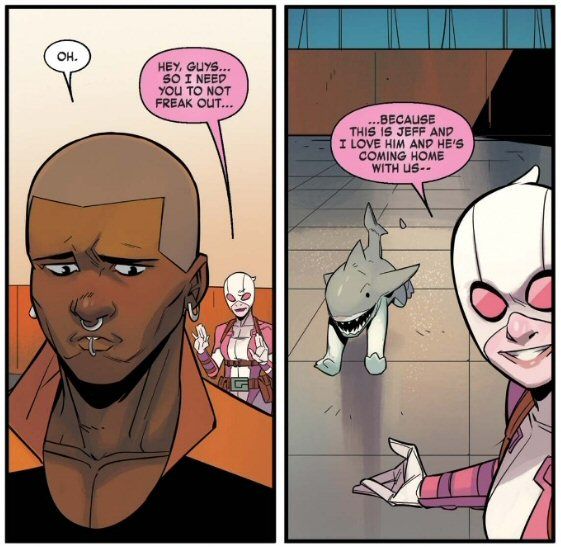
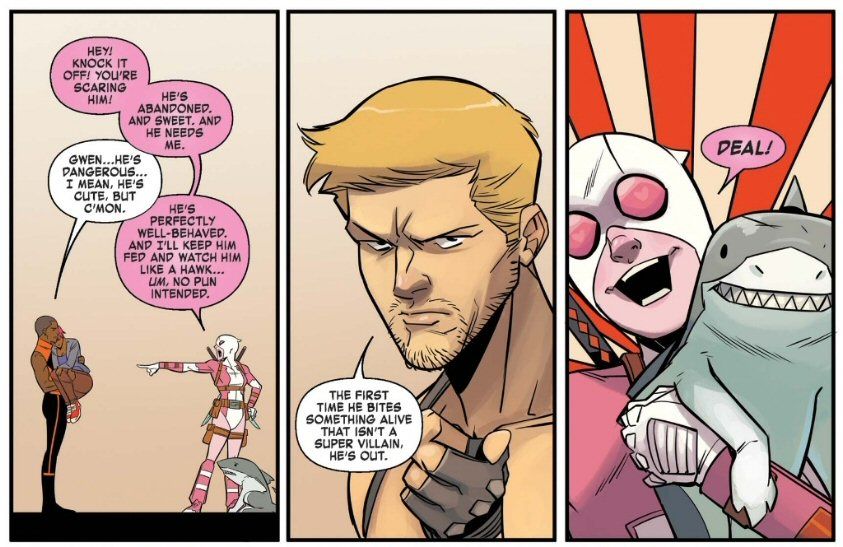
Jeff was a little long-limbed in those days (and had separate side flippers). His design changed and grew in the hands of subsequent artists, like Chris Bachalo, Gerardo Sandoval, Kevin Libranda, and Pepe Larraz – until eventually, Gurihiru turned him into the form we all know and love.
When Thompson took over writing Deadpool (Vol 7, 2019-2020), she also transferred Jeff over as well. From issue #1, with Chris Bachalo:
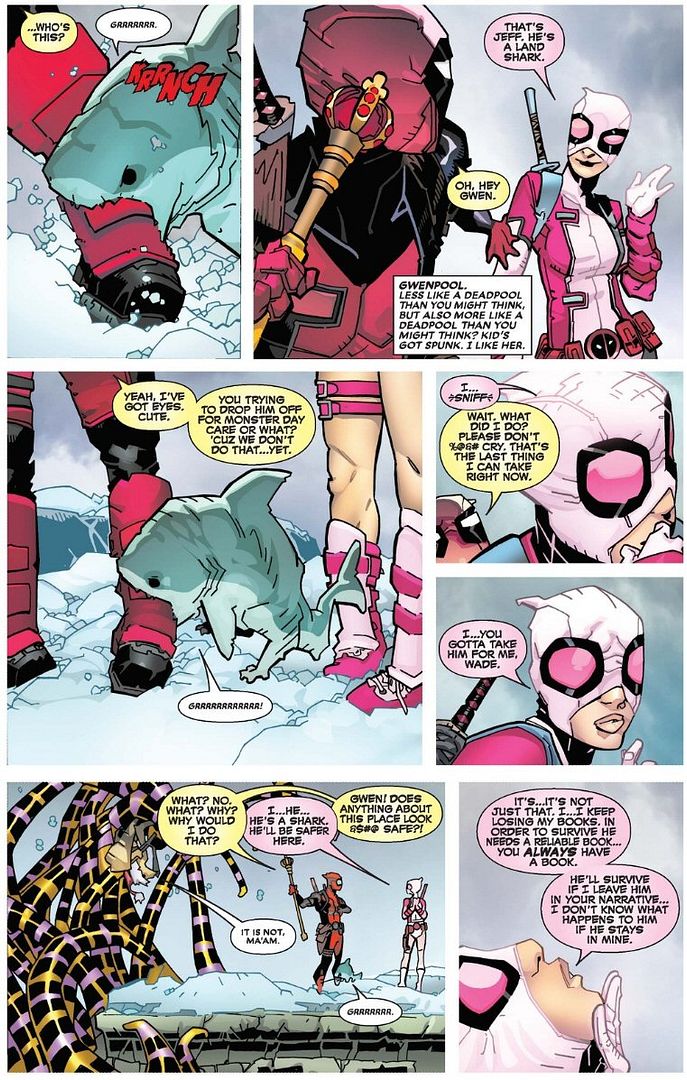
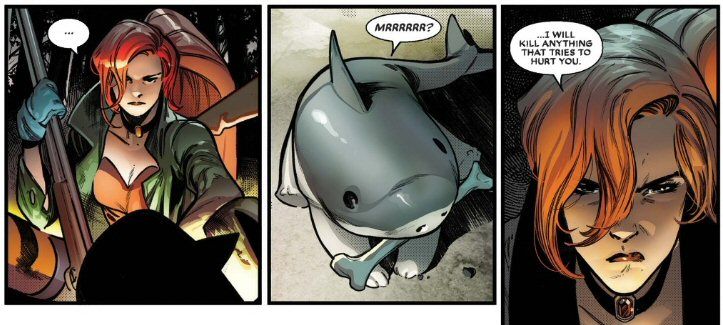
That is a funny rationale from Gwenpool (who is actually from a near-identical world to our own, and so is very aware of how comic books work). Jeff appeared in all 10 issues of Thompson’s Deadpool run. In a separate stand-alone story around this time, Elsa Bloodstone also seemed to briefly look after Jeff (in Marvel Comics Vol 1, issue #1000, 2019, by Thompson and by Pepe Larraz):
Which brings us to the It’s Jeff Infinity Comics created by Thompson and Gurihiru (2021 to present). In these stories, Jeff appears to be living with his old West Coast Avengers pals, Kate Bishop (Hawkeye) and Gwen Poole, alternately. They do not seem to be roommates (at least, I can’t recall seeing them together in the stories), so perhaps they have some sort of split/shared custody of Jeff?
It is understandable why a lot of people would see Jeff as something of a pet in these relationships, rather than as his own moral entity. Despite Thompson’s kitten inspiration, I think the question of whether he is more like a dog or cat is a fun one that we will come back to at the end – when you can cast your own vote!
Consider these two representative It’s Jeff Infinity Comic Vol 1 stories for Kate and Gwen respectively. Let’s begin with issue #11, “Jeffsgiving“, 2021, by Thompson and Gurihiru. Kate is hosting a Thanksgiving dinner for her superhero friends.
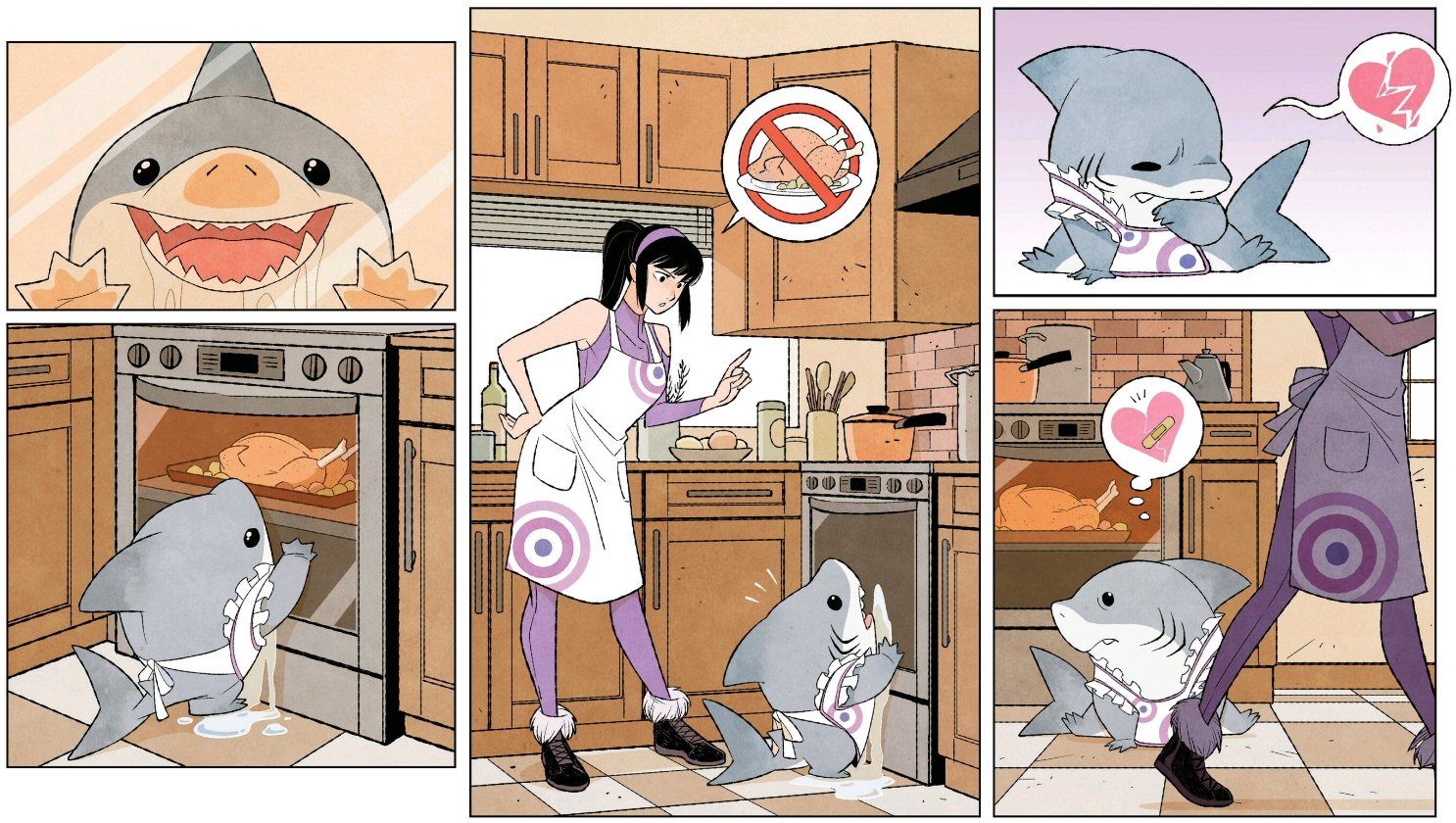
Jeff is drooling over the turkey dinner in the oven. He gets over his heartbreak quickly, once Kate leaves the kitchen:
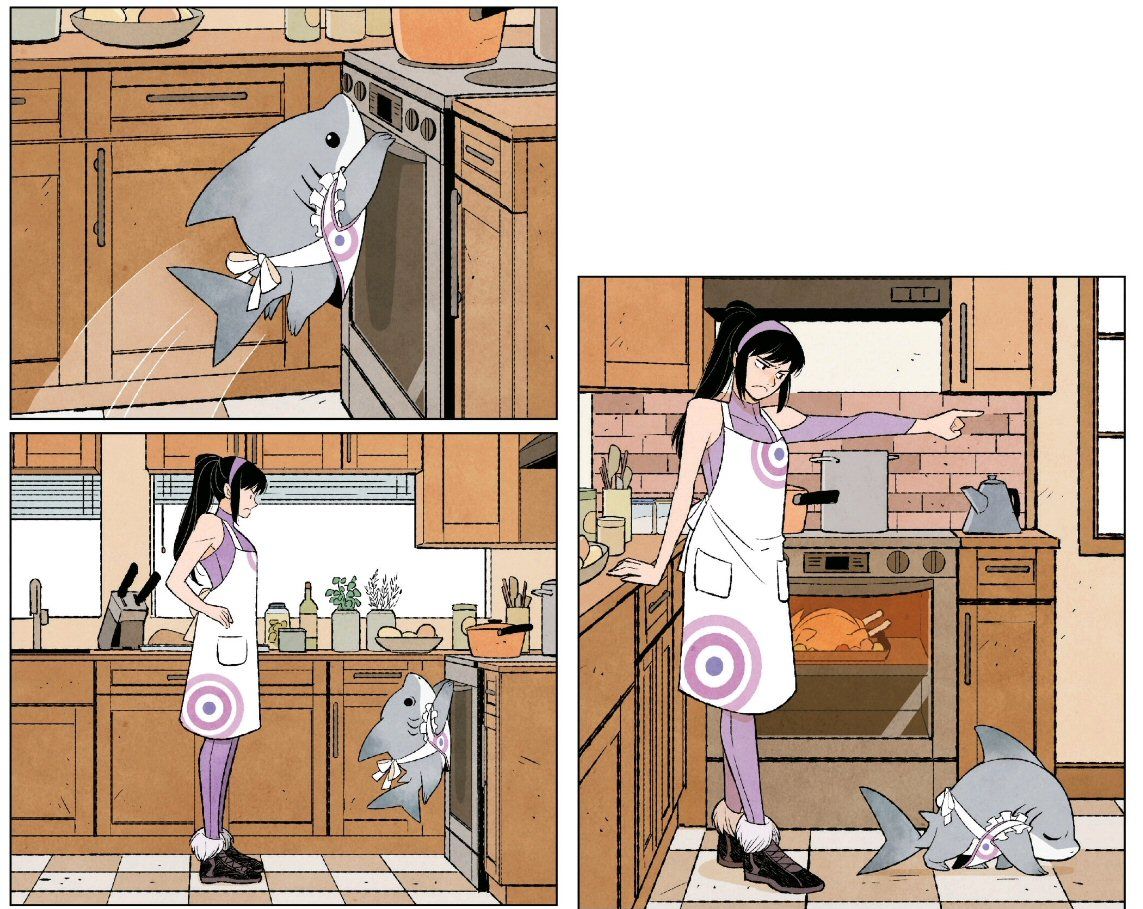
As an aside, I love their matching Hawkeye aprons! Once the turkey is cooked, Kate brings out the serving plate with a covered lid. Here is the reaction of everyone to the big reveal:
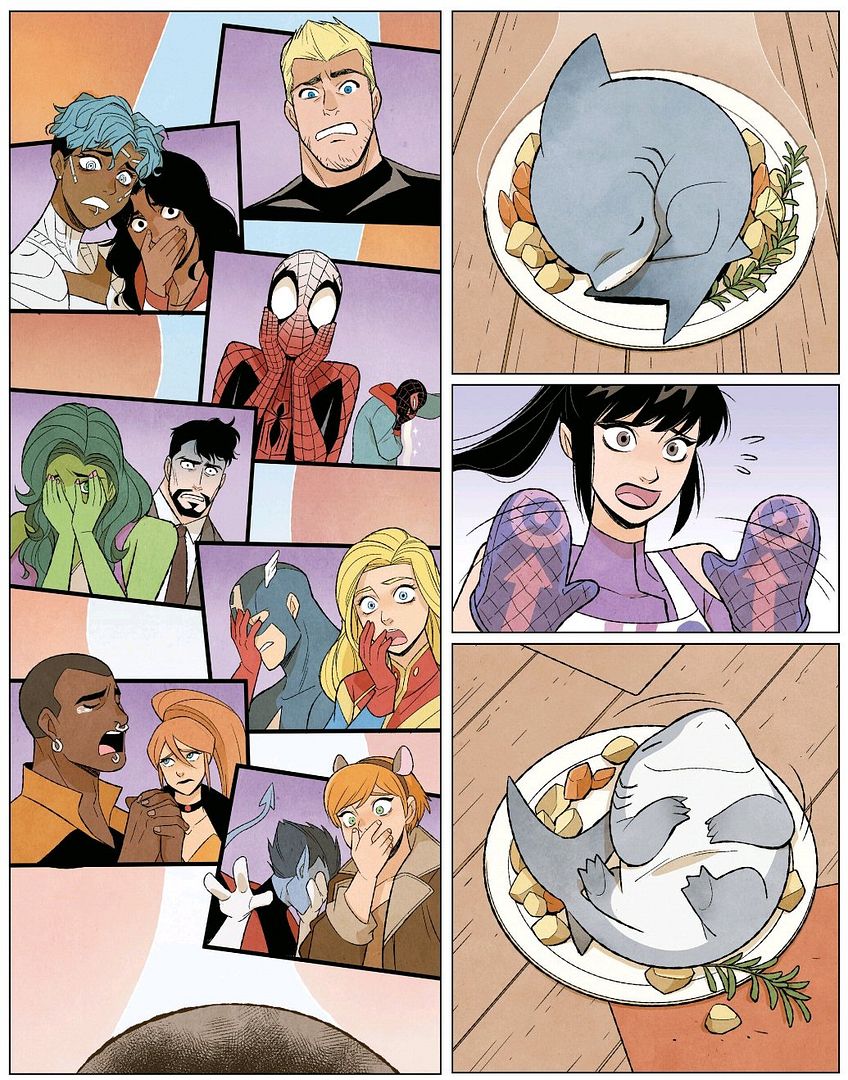
Everyone is horrified at first – obviously thinking Jeff has just been cooked! Until he rolls over, and the relief is apparent …
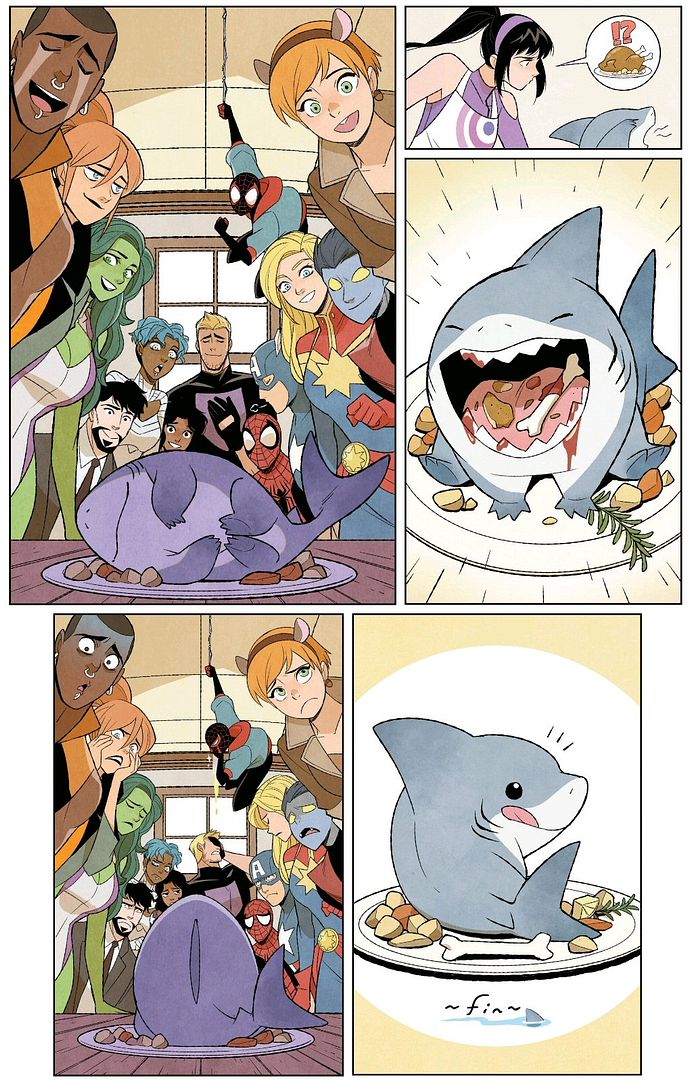
… until it becomes clear that Jeff has eaten the whole turkey!
In a similar vein, consider this later story with his other human companion, Gwen. From issue #38, “Food Crimes“, 2024, by Thompson and Gurihiru:
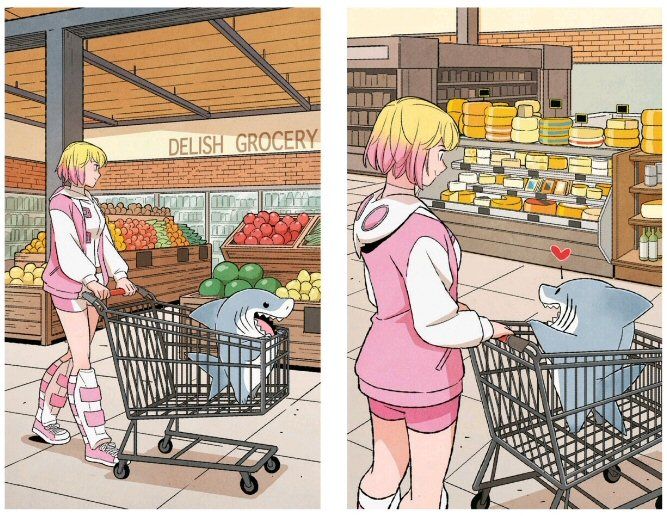
Apparently, the grocery store manager is not happy to see Jeff again. He and Gwen have quite different perspectives:
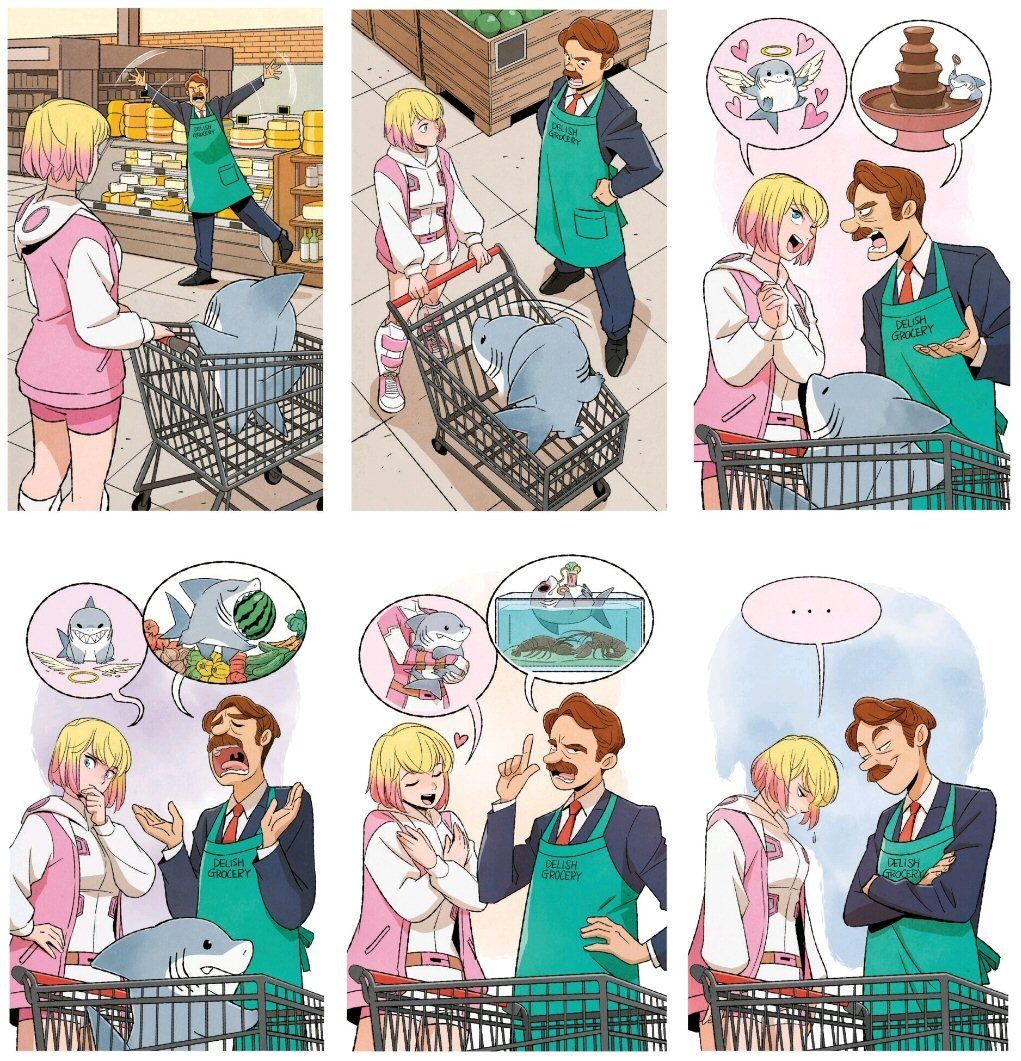
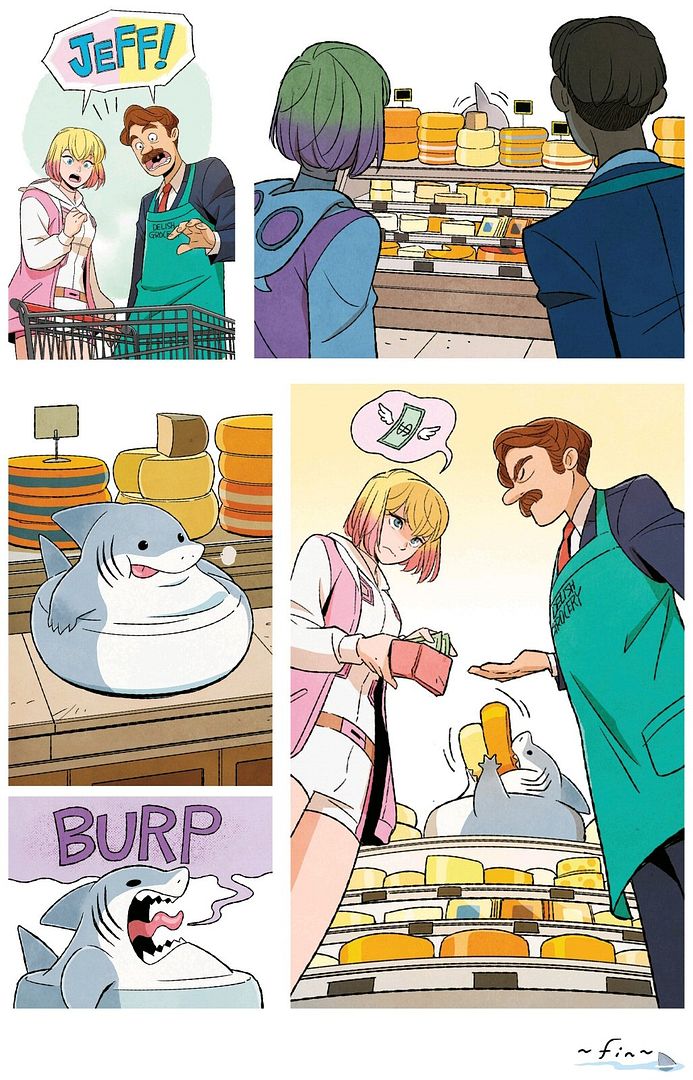
Ok, so the message here seems to be that Jeff is a glutton who is ruled by his stomach! At a minimum, he has very poor impulse control, and his need to satisfy his food cravings can override any consideration of others (including his beloved companions).
This message is easy to internalize, and I note it in my own granddaughter. Below is her first attempt to draw her very own Jeff story – with, I can’t help but note, herself in the place of Gwen or Kate:
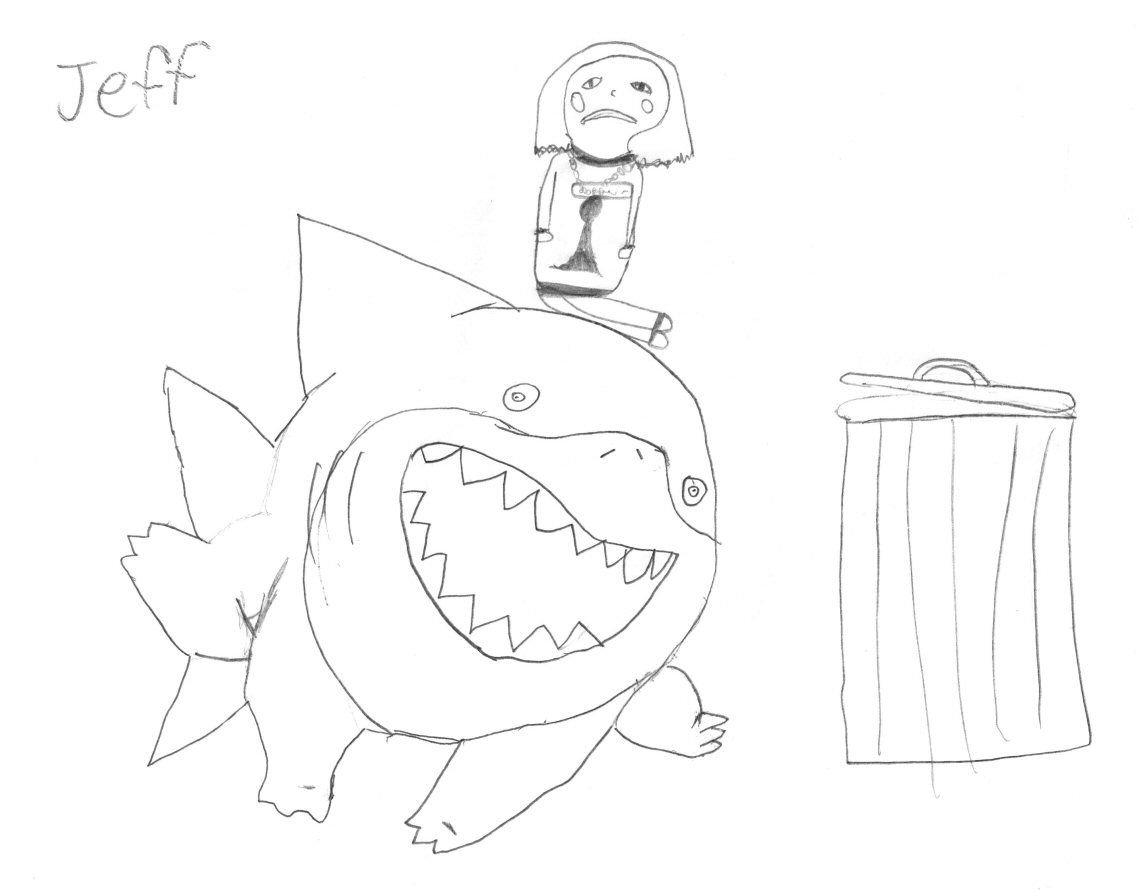
When I asked her to describe the scene to me, she explained that she was sad in it because she had gotten all dressed up for a walk with Jeff, but Jeff had just thrown her flying into the air by jumping unexpectedly into a garbage can!
The theme that Jeff can inconsiderately disappoint his loving companions, due to his voracious appetite, is clearly one that she has picked up on in the stories. But to my (pleasant) surprise, she has also picked up on how caring he can be – as I will explain at the end of this post.
Jeff’s ethics
As a largely non-verbal character who initially functioned as both comic relief and something of a pet to established superheroes, it is reasonable to question: does Jeff even have a coherent moral core?
I will argue here that he does – and one that has been evolving over the charming stories of the It’s Jeff Infinity Comic series (2021 to present). This is a testament to the collaboration between Thompson and Gurihiru (and Fuji and Tokitokoro as well) – it is no mean feat to portray a moral character who doesn’t talk (beyond grunts, purrs and growls)!
As I explain in my Ethics 101 introductory primer on ethics, it’s convenient to use the normative ethics framing for discussions of moral philosophy (it is called “normative” because it leads to norms or standards of behavior). There are three branches of normative ethics theories. Deontology is concerned with doing your duty to other people, often through the lens of rights or justice. These theories are often rule-based and focus on the moral value of the acts themselves (that is, doing the right thing). Consequentialism is often seen as the opposite view, focusing not on acts but rather on their outcomes. These theories typically focus on the moral burden of making good decisions (that is, doing the good thing). Finally, virtue ethics shifts the focus from the act to the actor – being the best person you can be, typically by practicing virtues that align with your values and goals (that is, being better).
Although ethicists often seem to want you pick just one theory and use it exclusively, that is not how our brains work (as I have recently explored in my Moral Thinking, Fast and Slow post). And as I argue in my preceding overview on the virtue ethics theory known as care ethics (Can Caring be Wrong?), I think you are better off cultivating intentional preferences in all three domains of normative ethics. Most would agree that, by definition, a complete person must include an ethical sense of self. And as normative ethics theories are, at their core, aligned with the ways we tend to think, it is worth giving explicit thought to which ways of thinking we would like to strengthen and make more automatic within ourselves (in the language of human cognition research, training our fast “system 1” intuitions).
Why is this relevant for a comic book character? Well, good characters are generally complex – with conflicting internal drives that need to be resolved through explicit consideration (our slow “system 2” deliberations). A simplistic cartoon hero (or villain) is not going to generate the kind of growing popularity that we have seen with Jeff – clearly, something more is going on here. And with the completion of the Jeff the Land Shark (2025) comic series, I can now see in Jeff clear examples from all three branches of normative ethics (sometimes multiple ones).
Jeff’s as a consequentialist
I think the best place to start with exploring Jeff’s moral worldview is with consequentialism. Specifically, I would argue that Jeff is an example of ethical hedonism – an early forerunner to modern forms of consequentialism (like utilitarianism).
Hedonism is family of philosophical views where your personal pleasures are given the highest priority. Ethical hedonism is the normative theory that proposes that the pursuit of pleasure and the avoidance of pain are the highest moral purpose. It is a little more sophisticated than it sounds though, as I will explain below.
There is no doubt from the two stories I shared above that that Jeff has hedonistic tendencies. The question is does he have ethical/moral ones? Based on just those two stories above, I grant it is not looking good for Jeff!
But let’s go back to the very first outing for Jeff in this series – It’s Jeff Vol 1, issue #1, “Pool Party“, 2021, by Thompson and Gurihiru. Jeff has been invited to superhero pool party, and has come dressed for the occasion:
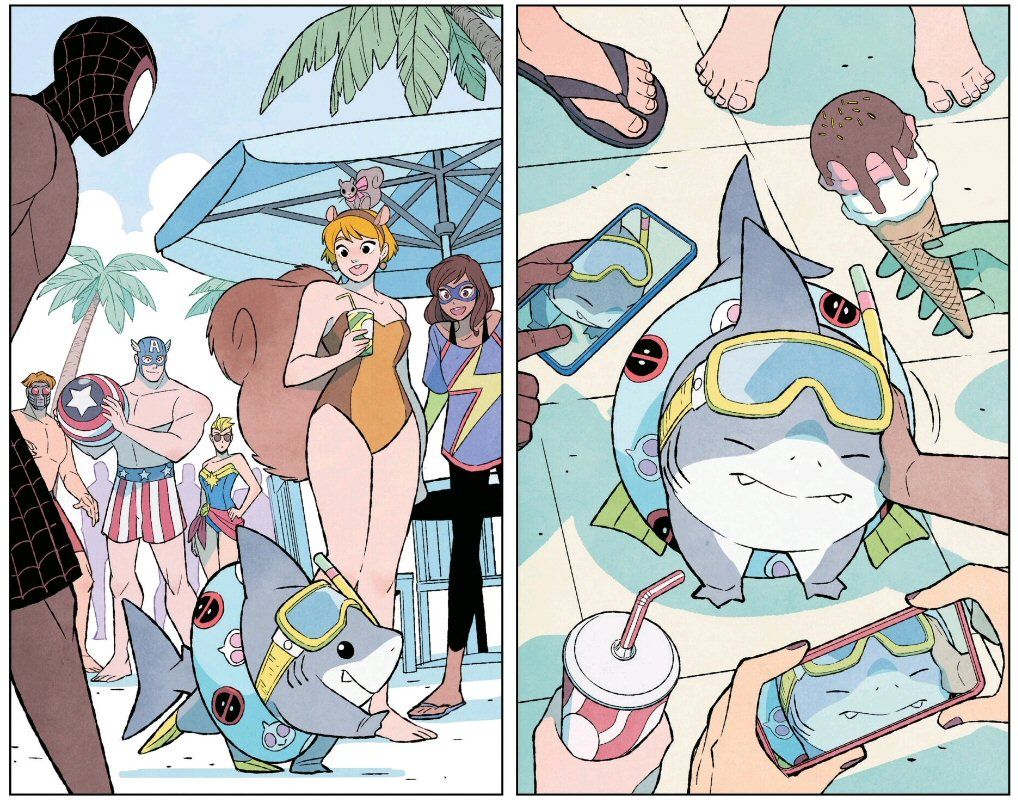
Jeff is clearly loving all the attention he is getting for his cute outfit. He frolics with the pool guests for a while – but then he gets carried away and ditches all his gear. This inadvertently triggers the typical fear response to a shark in the water:
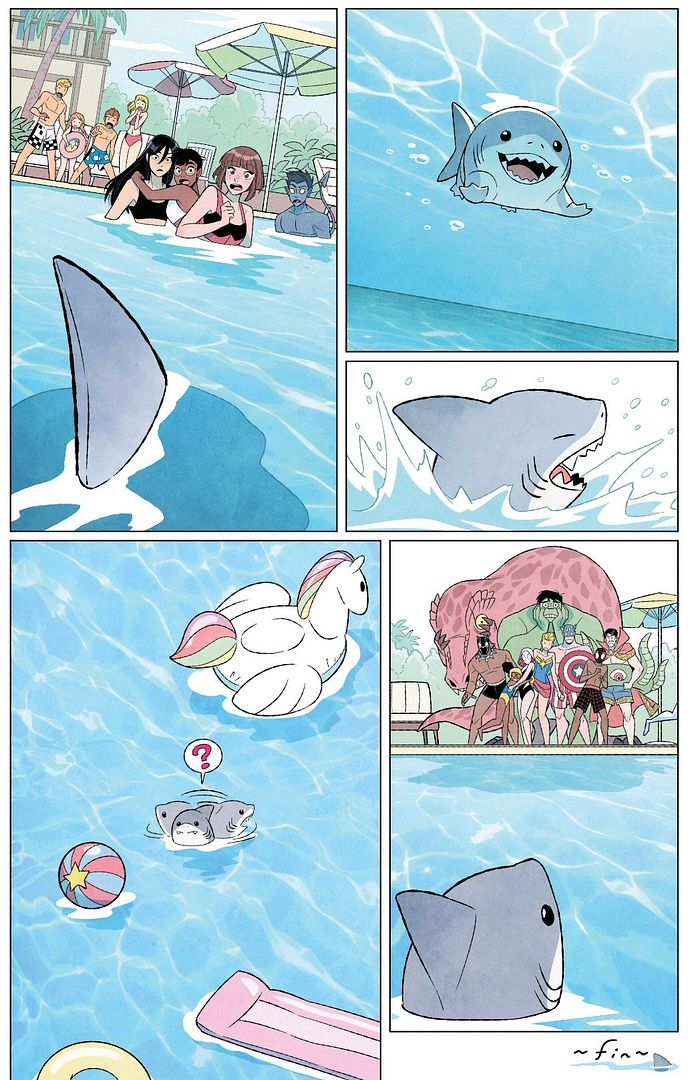
How does Jeff feel about this turn of events? It looks like he might be sad that the fun is over. But Jeff clearly has the ability to learn from his experiences, as shown in his subsequent visit to the beach in issue #3, “Sheep’s Clothing“, 2021, by Thompson and Gurihiru:
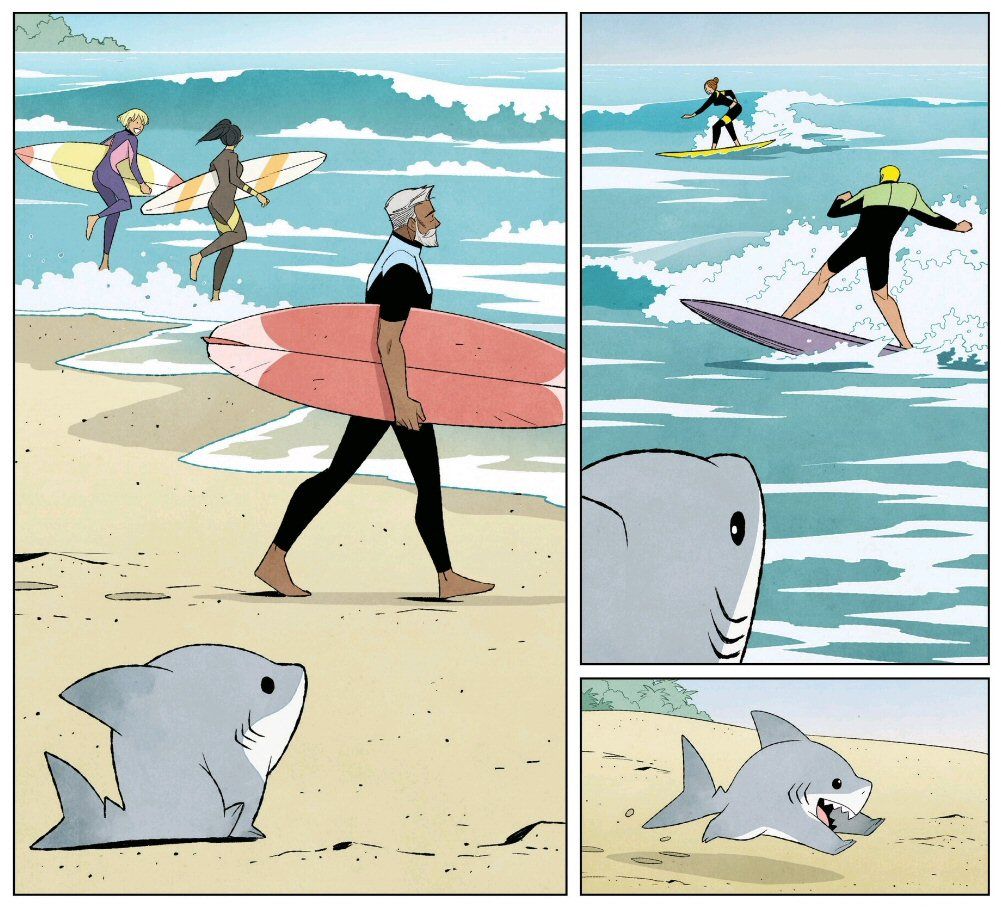
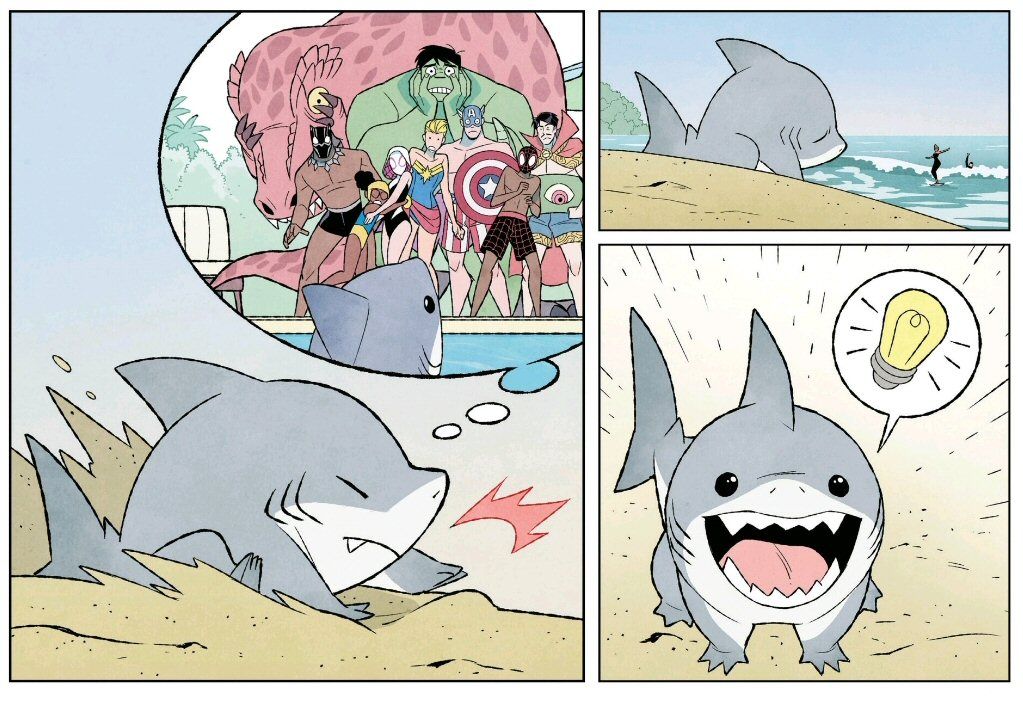
Jeff’s brilliant idea causes him to head back into town and visit his favorite costume store. He leaves with a purchase in a bag, and heads back to the beach – where his outfit is soon revealed:
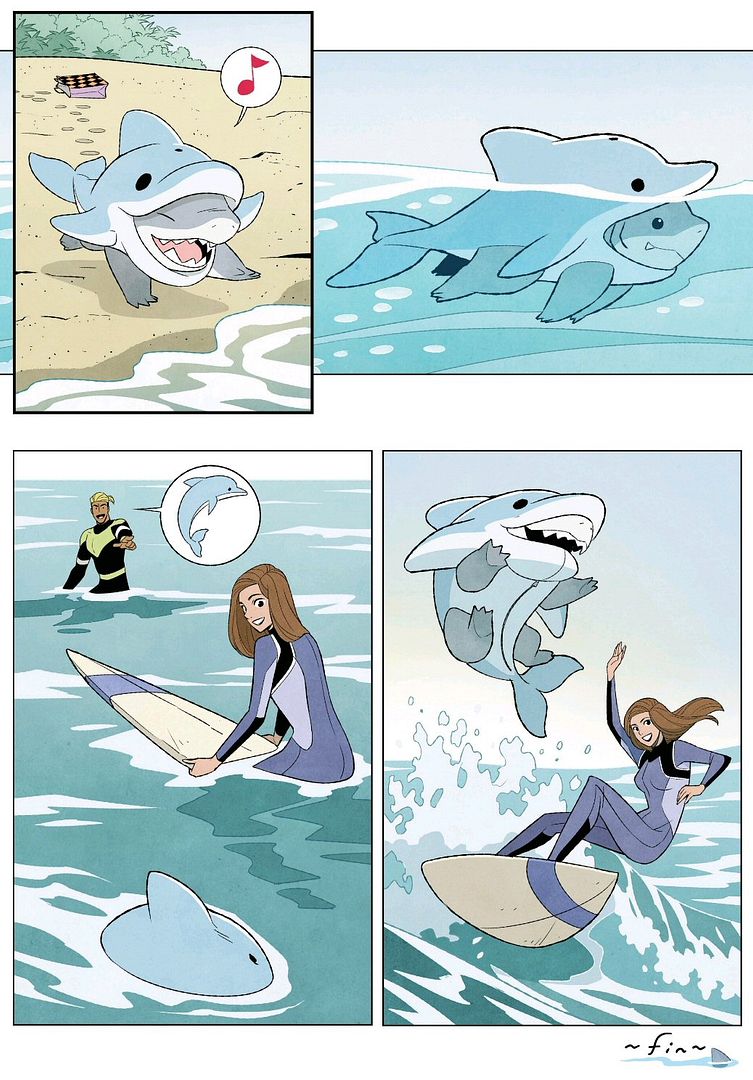
And everyone is happy now, including Jeff. Clearly, Jeff highly values friendship and camaraderie!
What I find interesting is that Jeff is not only able to learn new behaviors to get what he wants, he is also able to generalize to other contexts. This is a requirement for moral development. Consider the subsequent story in issue #5, “Holland-dayz”, where Jeff goes for a walk in a tulip park.
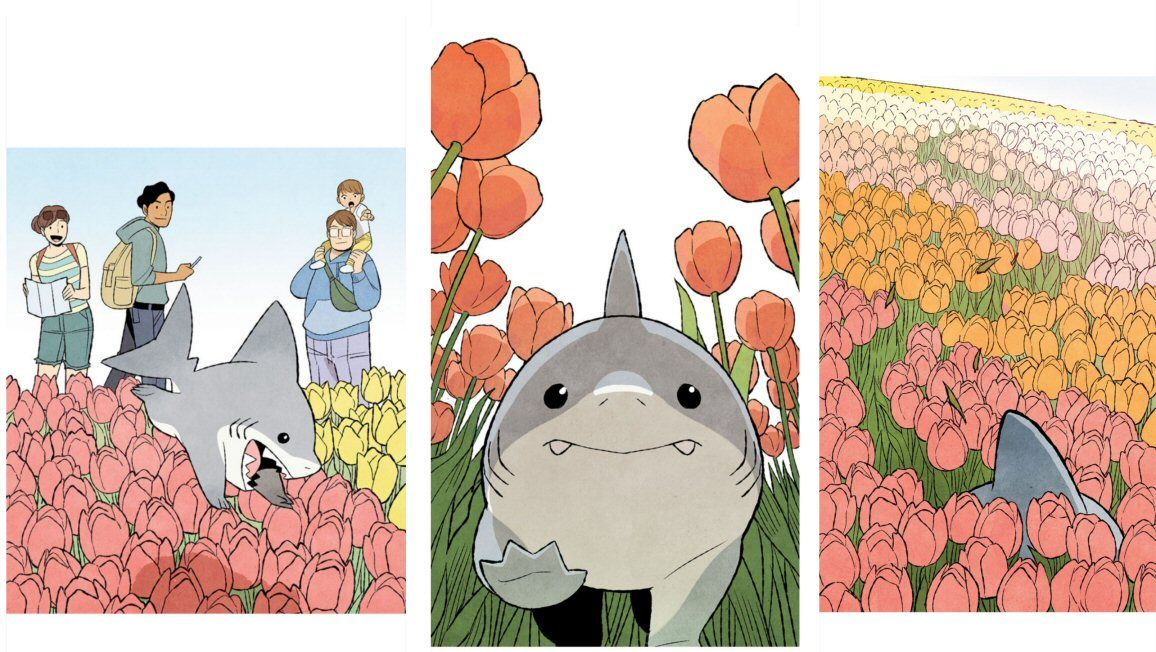
Not hard for us to guess what happens next …
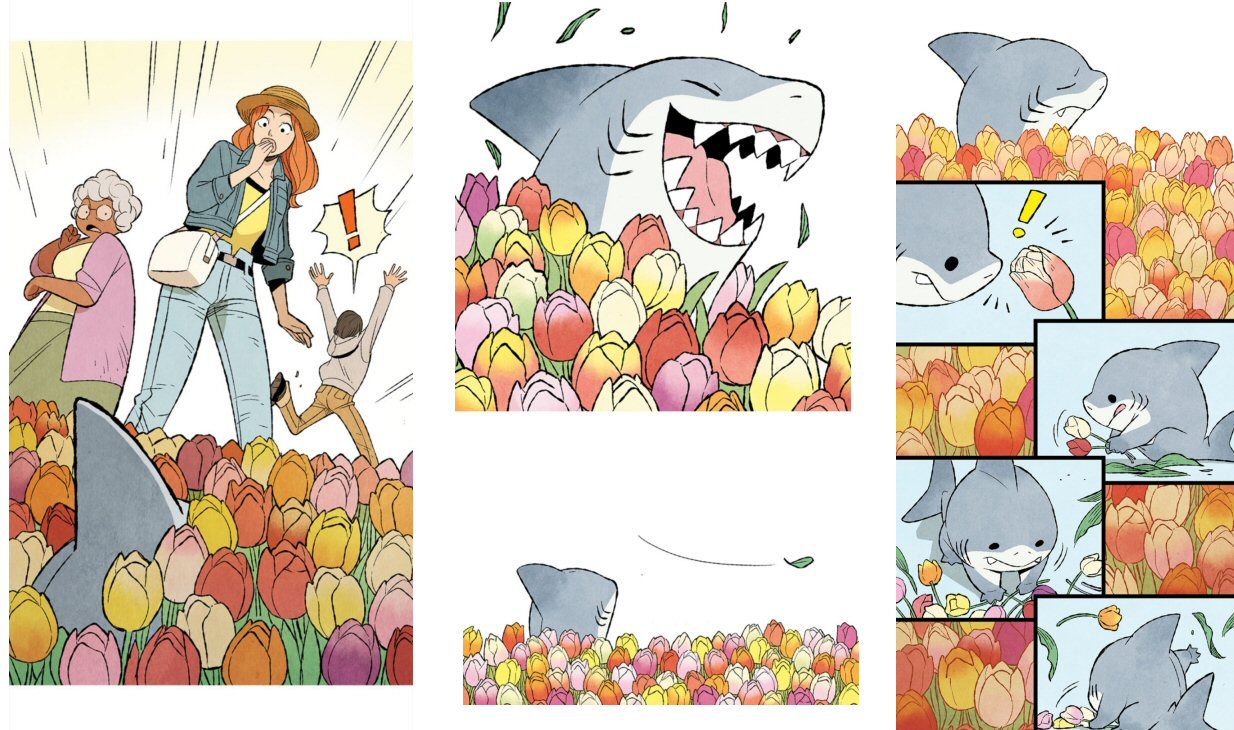
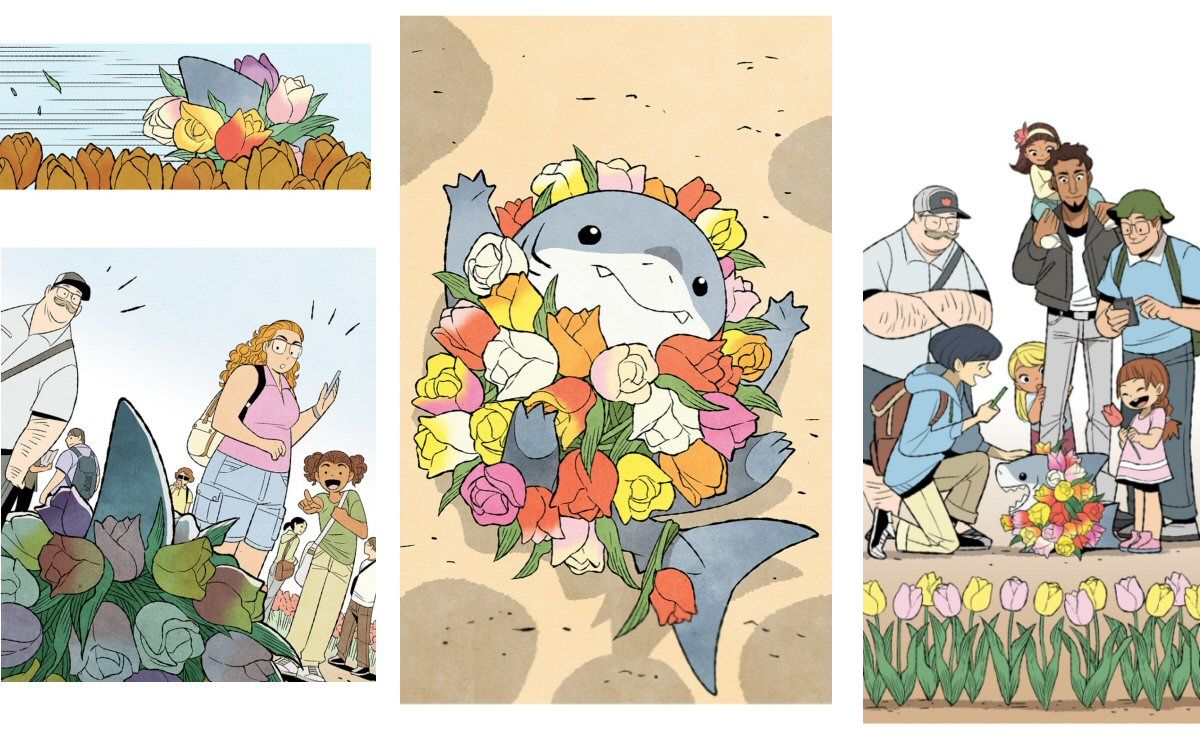
And just like the pool party opening, he is back to having everyone’s approval again. And in further symbolism to the opening story, they all get out their phones to take pictures of him.
These stories raise an interesting question: if Jeff is indeed capable of ethical hedonism, what form does it take? Typically, all types of modern consequentialism can be divided along lines of whether the needs of the self are weighed above others (egoism), equal to others (as in utilitarianism), or below others (altruism). The latter category doesn’t make a lot of sense for ethical hedonism, so it is often presented in ethics sources as coming down to egoistic hedonism or utilitarian hedonism (using the language of modern consequentialism).
I don’t think either of these are actually a good fit for Jeff, and so will take you back to an earlier form of ethical hedonism instead. But first, it’s worth explicitly considering why these modern concepts don’t fit him.
From the first two stories I showed (with Gwen and Kate), it seems Jeff would fail as a utilitarian hedonist. It requires a person to maximize the sum total of happiness of everyone around them. While this includes their own happiness, it can get no special treatment – everyone’s happiness matters equally. It is clear from those earlier examples that Jeff prioritizes his own happiness over his friends on occasion. But the pool, beach, and flower garden stories seem to suggest that Jeff can consider other’s feelings as well as his own. Does that redeem him as a utilitarian hedonist?
Not necessarily. It is also possible Jeff may simply be an egoistic hedonist. According to this selfish form, a person only has a moral reason to care about the happiness of others if it impacts their own well-being. In the pursuit of their own pleasure, a person could certainly do things to avoid triggering their own unpleasant feelings – like the guilt from hurting others (or loneliness from being left alone). So, in this sense, Jeff could simply be maximizing his own pleasure by trying not to scare others – it keeps the good times going. Note the significance of how much he seems to really enjoy the attention (and selfies!) he gets from people who are happy with him. On the whole, I would stay these stories so far better support egoistic hedonism.
But as an ultimately selfish perspective, egoistic hedonism seems unlikely to be enough to endear Jeff to so many readers. Significantly, he can also demonstrate behaviors that rise above both forms and seem more altruistic. Let’s consider issue #8, “Jeff the Magnanimous“, 2021, by Thompson and Gurihiru. This is one my favorite Jeff stories. Jeff is out for a stroll in town, and wanders into the local fish shop – were he soon spots an unwanted intruder:

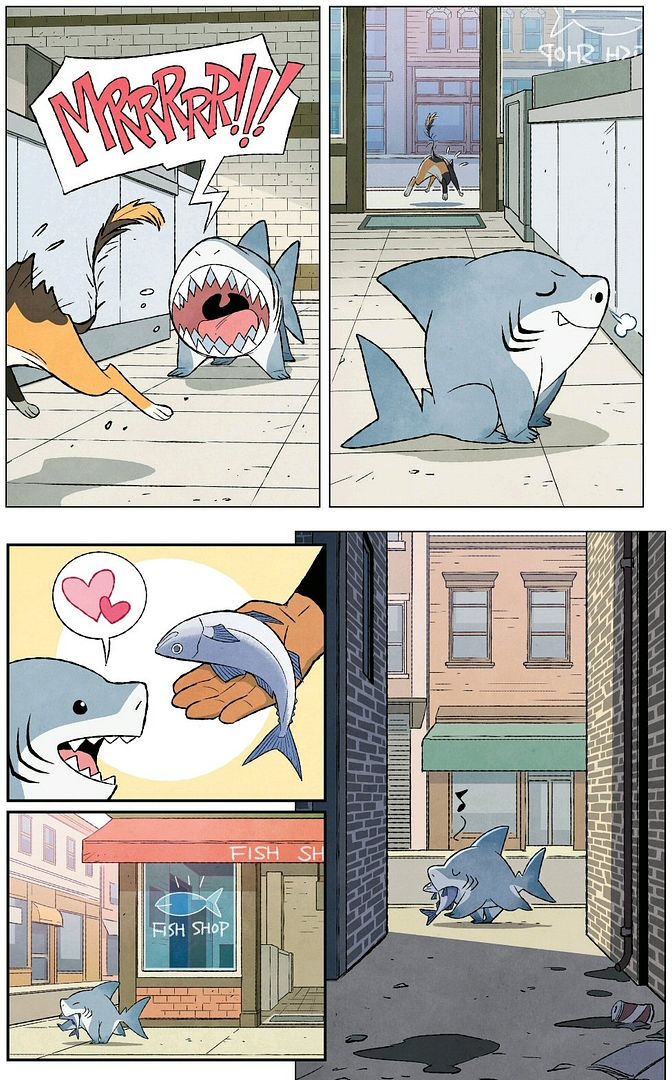
You can see how proud Jeff is of his actions. He even gets a reward from the shop owner for his help in safeguarding the store. He walks away with his prize, all happy, whistling to himself. Until …
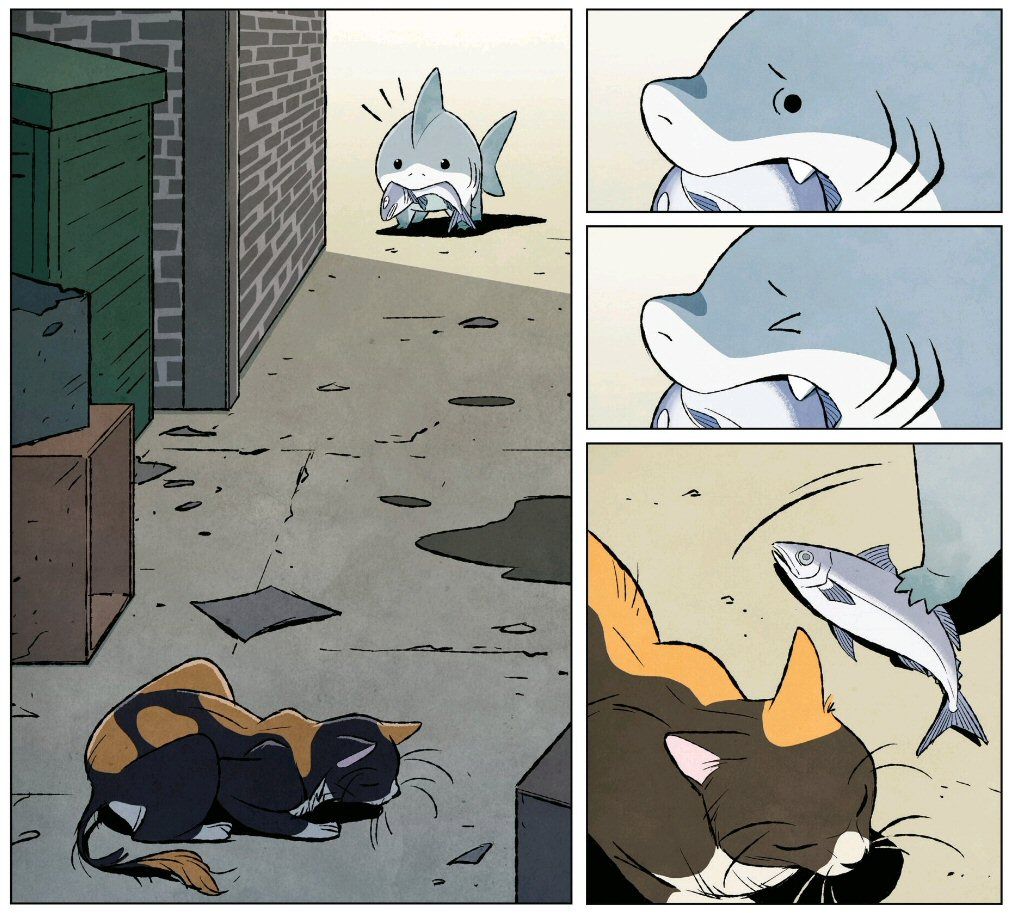
Now this seems like an odd turn of events. Why does Jeff do a double-take and offer up his reward to the same stray alley cat he had chased away? The answer is soon revealed:
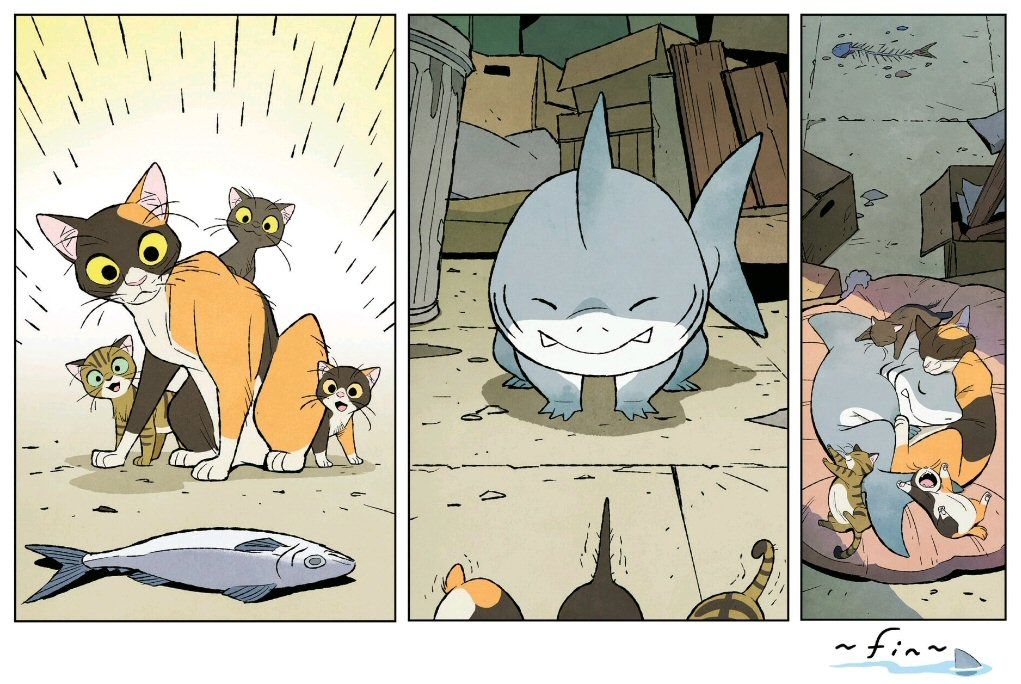
Jeff realizes the stray cat was simply a struggling mother trying to provide for her kittens. You can see the joy in his face in the second panel above, when the kittens all happily feed on his freely offered-up fish. The strip ends with the incredibly cute panel of everyone taking a nap together (which I’m sure Jeff enjoyed!).
But the key point to me here is that Jeff is happily offering them his food before he gets anything in return. Knowing how much he is ruled by his stomach, this story is a powerful argument for how Jeff can potentially consider the needs of others even above his own. How to make sense of this in terms of ethical hedonism?
This story makes me think that Jeff is actually an Epicurean ethical hedonist. Epicureanism is a classical Greek philosophy based on the teachings of Epicurus. Although it has broader philosophical elements, its moral aspects are a great early example of ethical hedonism. Indeed, it is arguably the most coherent and nuanced form of ethical hedonism of the classical world.
Let me get one this out of the way up front: Epicurus’ teachings (and personal way of living) promoted a tranquil state of mind, cultivated through moderation of one’s appetites, as the path to the greatest overall happiness. I warrant that doesn’t sound a lot like Jeff (at least not the “moderation” part). But the actual Greek concept at play here is ataraxia, which can perhaps be better translated as a sense of “unperturbedness” or “equanimity” (this is also a popular concept for Stoicism).
Interestingly, Jeff, can demonstrate a state of calm equanimity, free from worries or cares – and can shrug off others’ demands for reactivity. This is hard to get across in the short form It’s Jeff Infinity Comics, so consider the opening pages of Jeff’s first full-length comic adventure, Jeff the Land Shark Vol 1, issue #1, 2025, by Thompson and Tokitokoro:
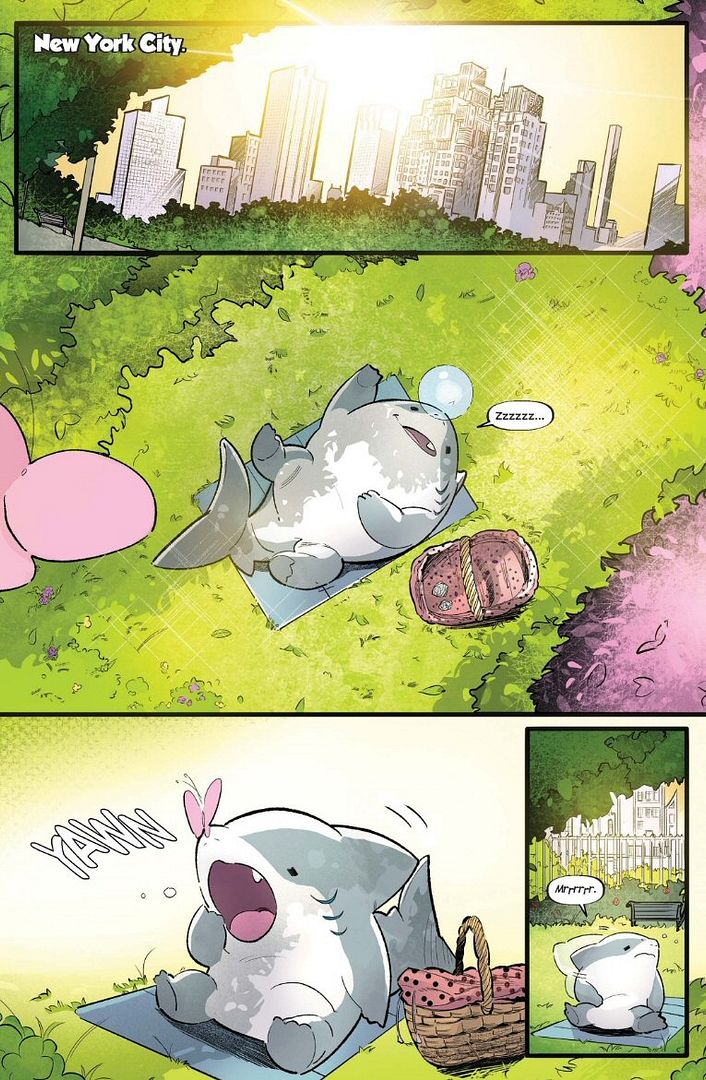
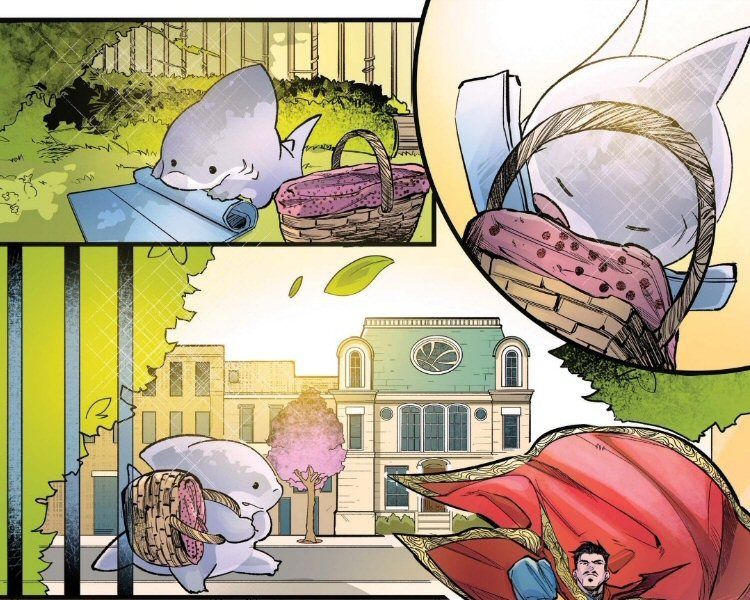
As you can see, Jeff is quite comfortable taking a picnic by himself. On his way home, he passes by his friend’s home – Doctor Strange’s Sanctum Sanctorum. This is where this story’s adventure begins (with his slipping into the Sanctum for reasons – and repercussions – I will describe later in this post).
Note the reaction Jeff gives to Strange’s two sassy pet snakes, Anton and Aleister, who insult him and question his presence in the Sanctum:
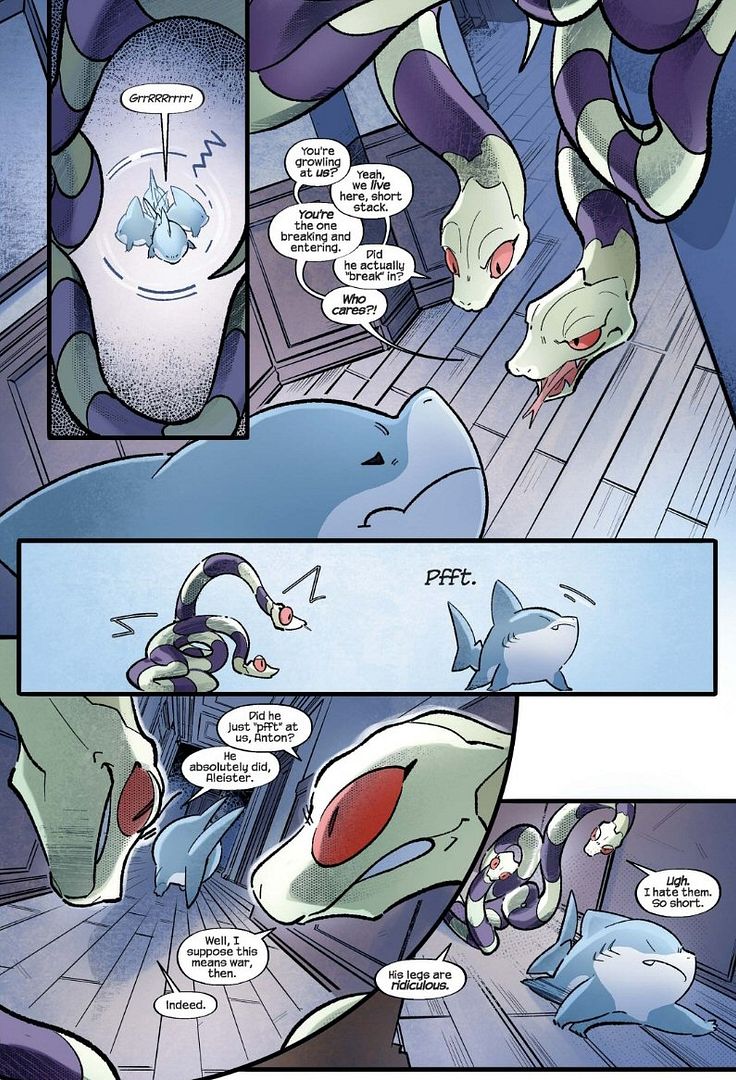
“Pfft” indeed!
Although the word “Epicurean” today typically means enjoying the finest foods and drink, Epicurus actually lived a very modest life. He never married, but formed a small commune of friends and students who shared home responsibilities (his home was also his school). They grew an extensive garden for their own food and sold the the surplus at market (to finance their other basic needs).
Epicurus advocated living in way that could produce the greatest amount of pleasure over the full course of your life – and so, avoiding the suffering that comes from overindulgence (clearly, Jeff needs to work on this part!). Indeed, this is a key general point of distinctiveness – the focus of Epicurean ethics was on the avoidance of pain rather than the seeking of pleasures. Pleasures of the body were pleasures of the moment, and came from satisfying bodily needs (like eating really good food) and being in a state of comfort, free from physical pain. Pleasures of the mind were greater though, as they exist in the past, present, and future. These involve mental states, like the feeling of joy, the experience of comradery, the lack of fear, and pleasant memories or anticipations of future events. Epicurus emphasized friendship as a key component of happiness.
It is in this latter sense that I see Jeff fitting best. Jeff is quite content with the simpler things in life. He actually enjoys a lot of alone time, and he revels in simple companionship. He certainly remembers past pleasurable experiences – and he anticipates future ones in many of the stories. Significantly, these memories and anticipations almost invariably involve other people or animals.
Ethical hedonism was a direct forerunner to the modern concept of utilitarianism – which in contrast is very explicit in weighing possible outcomes for achieving the greatest good of the greatest number. I think you’ll agree that Jeff takes the ancient naturalistic approach over the modern mathematical one in making moral decisions. Jeff would certainly be right at home in Epicurus’ commune of friends … although I fear they would need to greatly expand the garden!
Jeff as a virtue ethicist
Jeff does possess a few of the classic Aristotelian virtues, like courage and loyalty, and maybe even sacrifice on occasion. But he fails on some – temperance and patience most notably! He also tends toward the unhealthy extreme on others (e.g., self-confidence bordering on arrogance, deception instead of honesty, etc.). Others very much depend on the story – he can be both quite selfish and selfless, on different occasions.
For an example of bravery, consider the two-part It’s Jeff issues #35-36, “Taste Test“, 2024, by Thompson and Gurihiru. This story is critical to understanding the plot of the full-length comic series Jeff the Land Shark Vol 1 from 2025 (which features a notable expansion of his ethics, which I will describe in a bit). While simply hanging out with his friend Doctor Strange, Jeff gets enticed by the magical colored gems on the table:
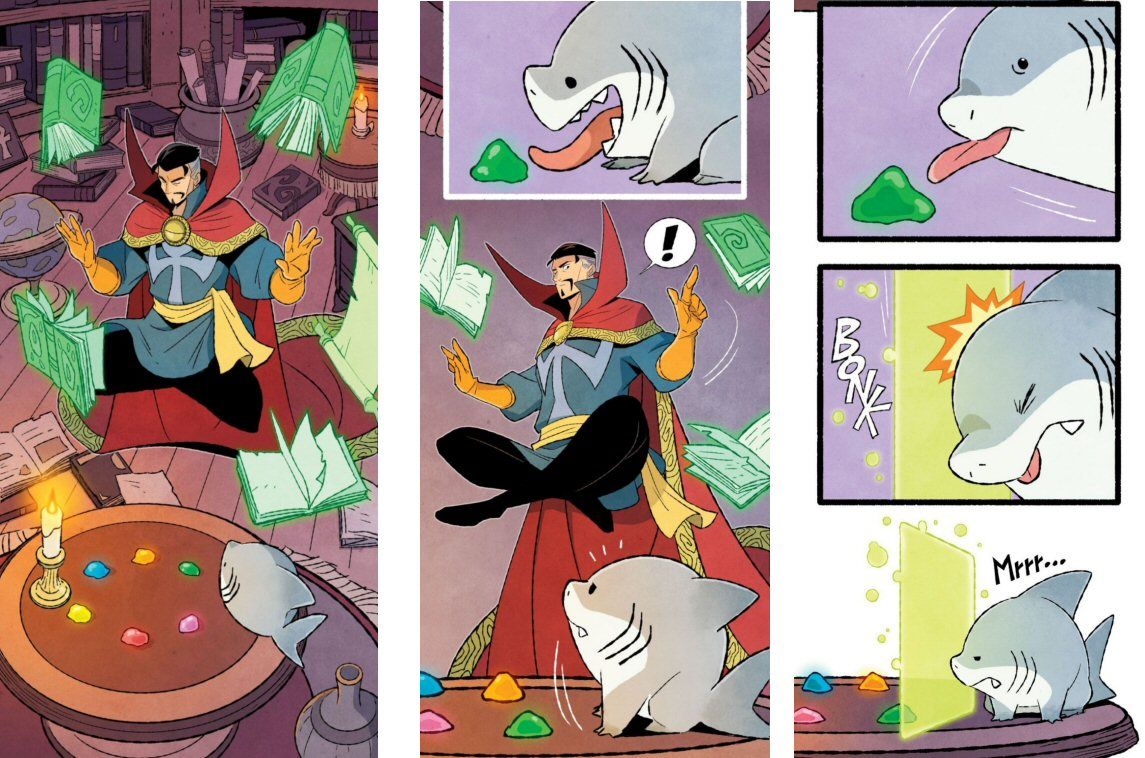
Doctor Strange puts up a shield to block him, but Strange soon get distracted by something else going on inside his Sanctum:
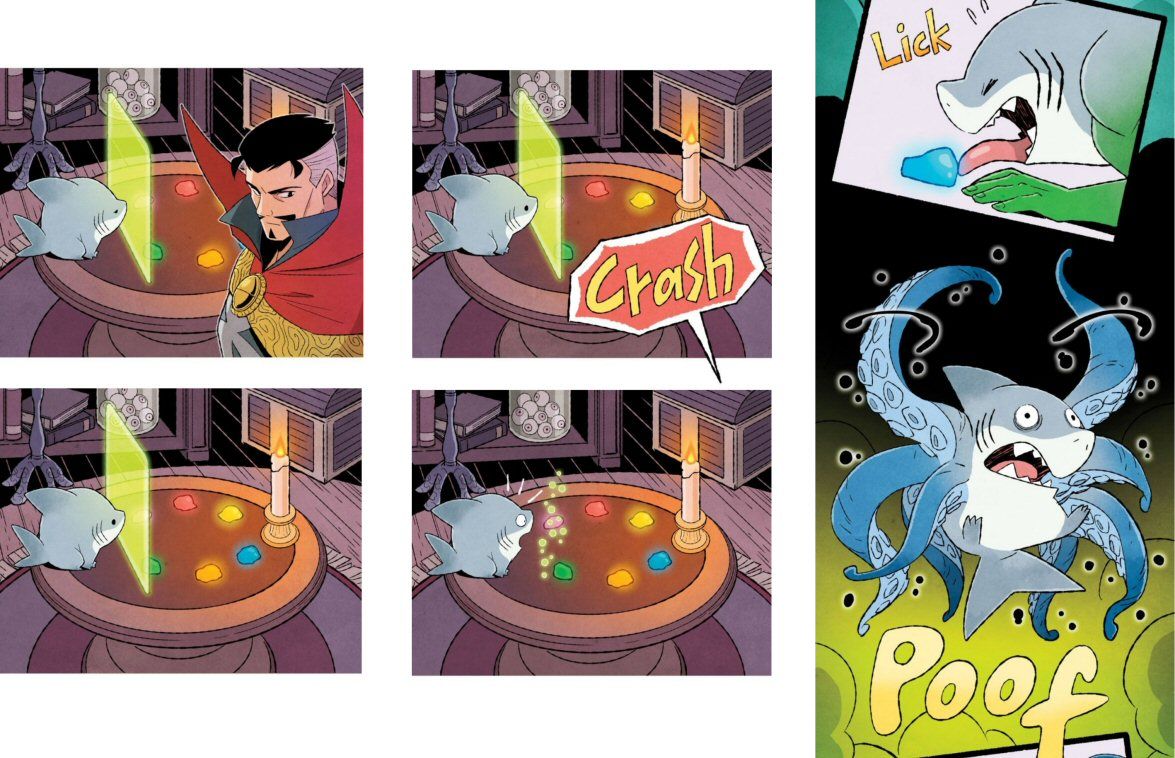
With the shield mysteriously down, Jeff now starts sampling all the gems on the table one at a time. I’ve just shown the effects of blue gem above as it seems to be the longest lasting – giving him giant blue octopus tentacles. Eventually, however, the crashing sounds come closer, and Jeff realizes Strange is in trouble. He quickly hatches a plan to save his friend, summarized below:
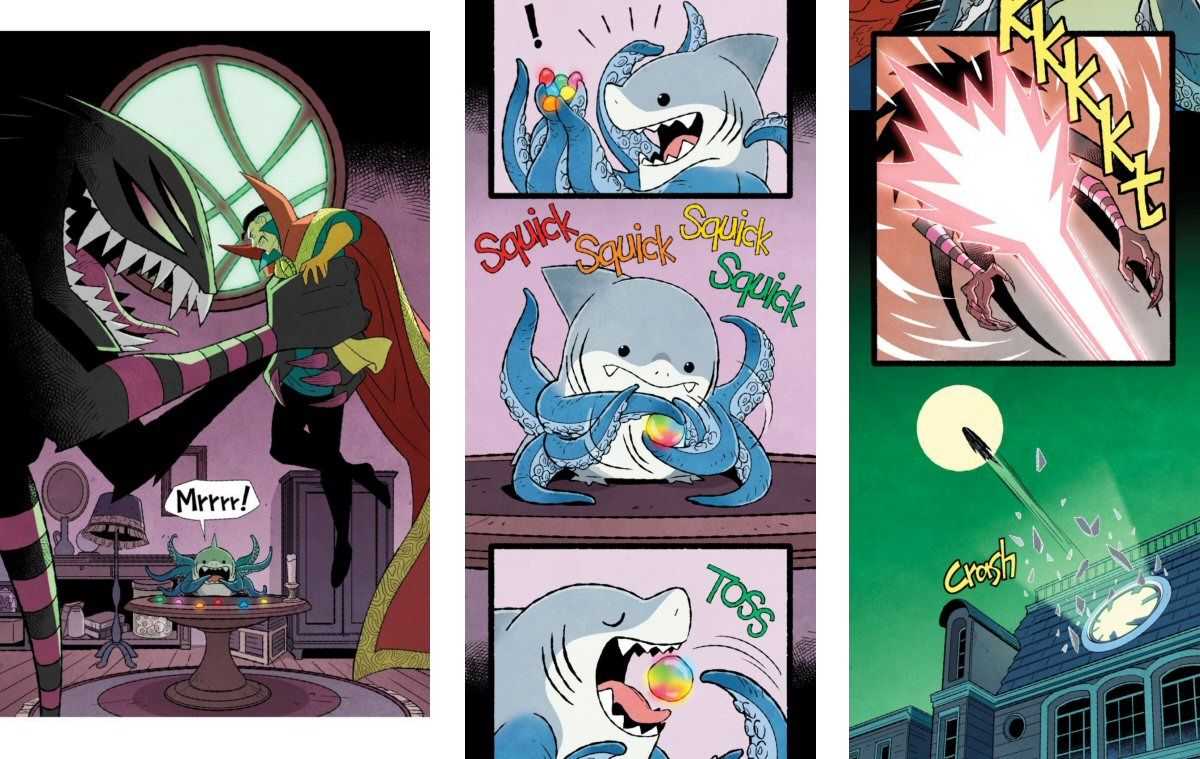
After acquiring all the gem powers simultaneously, he attacks the invading monster. After a pitched battle he forcibly expels him from the Sanctum (I like the laser death ray eyes!). He then turns his attention to the unconscious Strange:
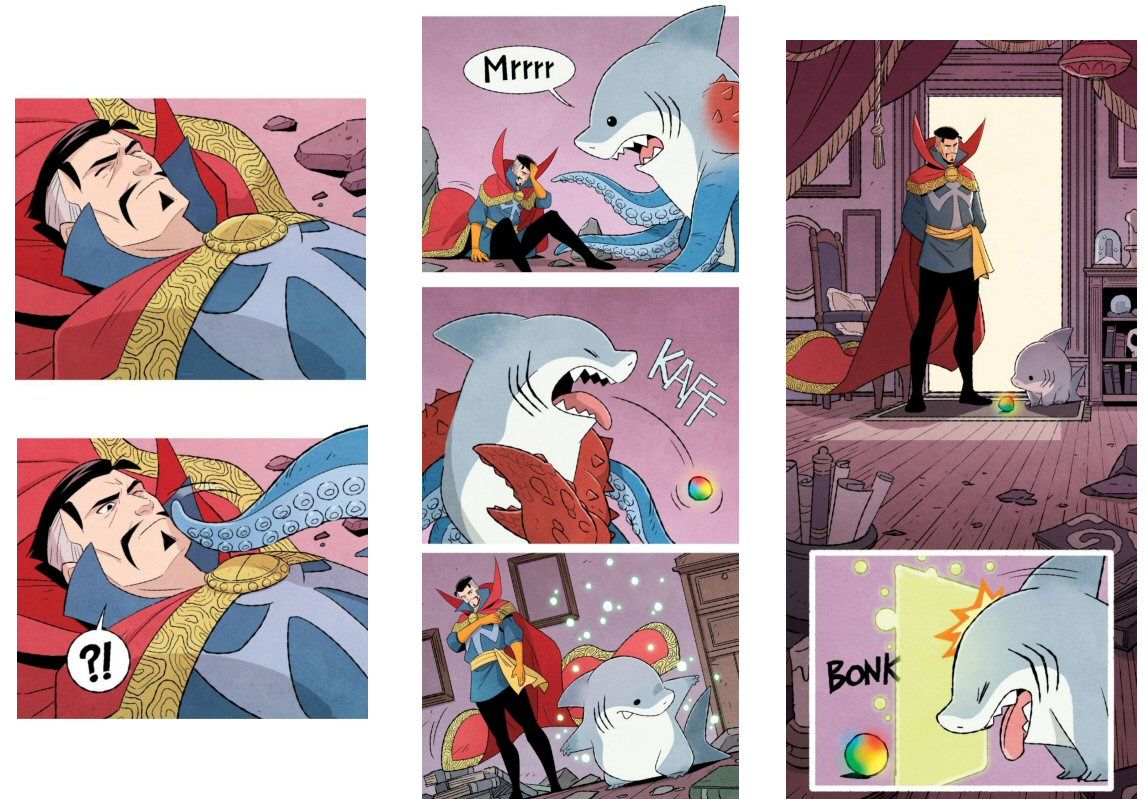
Despite having just spat out the combined gems, Jeff can’t resist trying to eat it again in the last panel! This is the kick-off point to the Jeff the Land Shark series, given his long memory and perseverance.
In terms of virtue ethics, I’ve always seen Jeff much more in care ethics terms, as proposed by Carol Gilligan. Care ethics is a relatively modern theory (late 20th century) and differs from all the classical ethical frameworks that prized universality and impartiality. Care ethics instead emphasizes the importance of responding to the relative needs of individuals that you are in a relationship with, and the duty of care you have to others. Empathy and compassion are thus core to care ethics. I have observed a care ethics component in a number of the comic characters Thompson has written – like Captain Marvel and Wonder Woman. Check out my Glossary for some other excellent examples in modern comics.
Let me show you one example from the It’s Jeff series, issue #28, “Shark-sized“, 2023, by Thompson and Fuji. Jeff observes that Kate (Hawkeye) is packing for a trip.
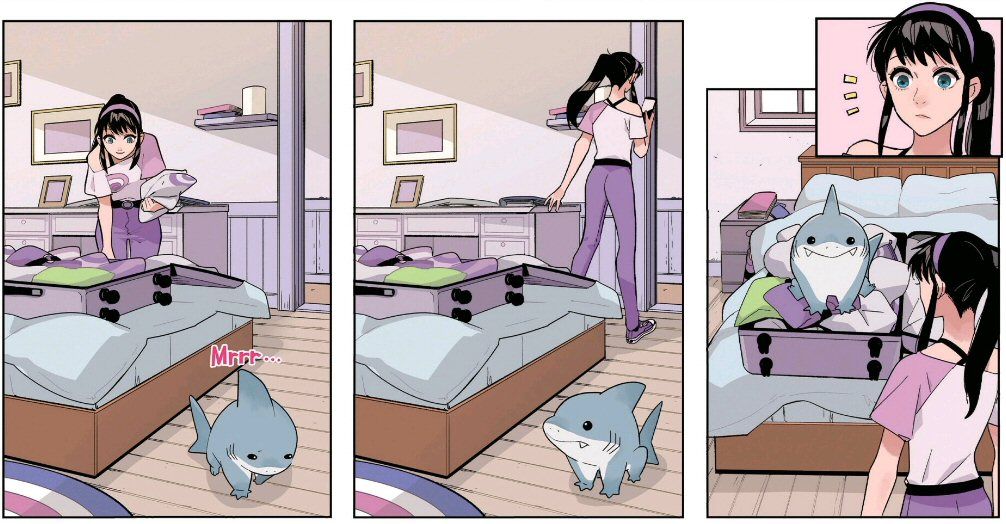
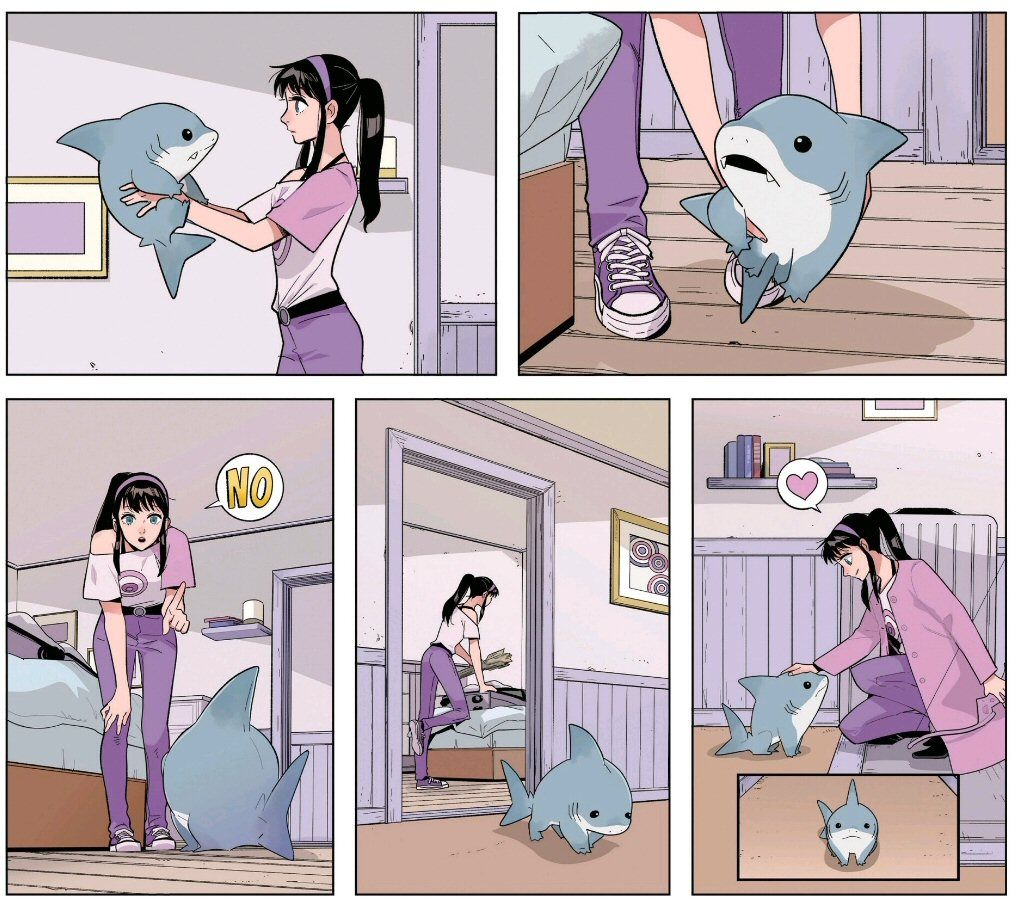
Jeff dejectedly watches Kate leave the house. Interestingly, Kate also seems to be sad to leave him (although he is nowhere to be seen when she looks back from the driveway). Note the panels below from the taxi and airplane, where Kate seems sad.

I really love the last panel, where the two friends are reunited and happily watching TV, side-by-side on the hotel bed, surrounded by generous amounts of room service.
But there’s another issue from this series that shows the general principles of care ethics very well – Jeff’s visit to a dog park in issue #21, “Shark Park“, 2022, by Thompson and Gurihiru. Jeff immediately joins in on the fun, and there are many panels of him running and playing with the big dogs (an argument for how Jeff is dog-like!):
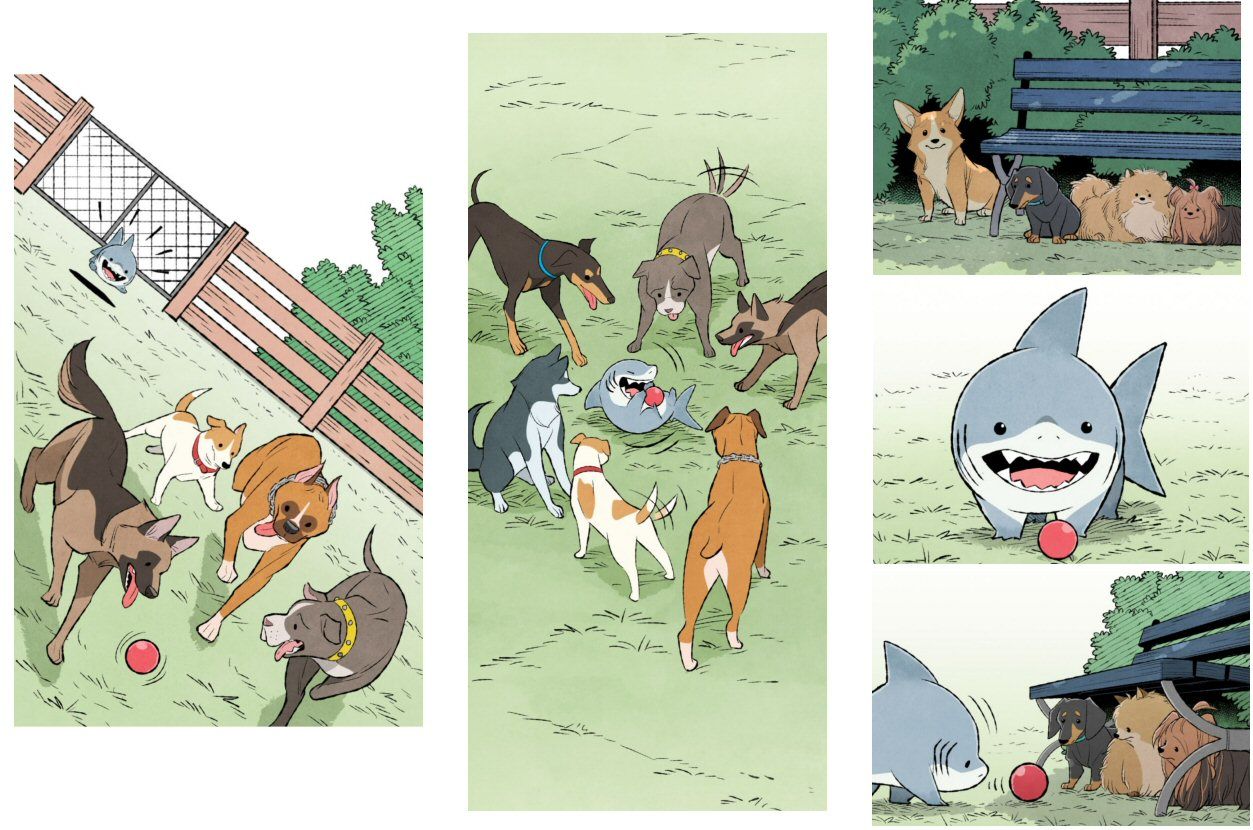
But Jeff then notices the shy smaller dogs hiding under a park bench. Jeff naturally extends the ball to them, inviting them to play. Until he discovers the reason why they are afraid:
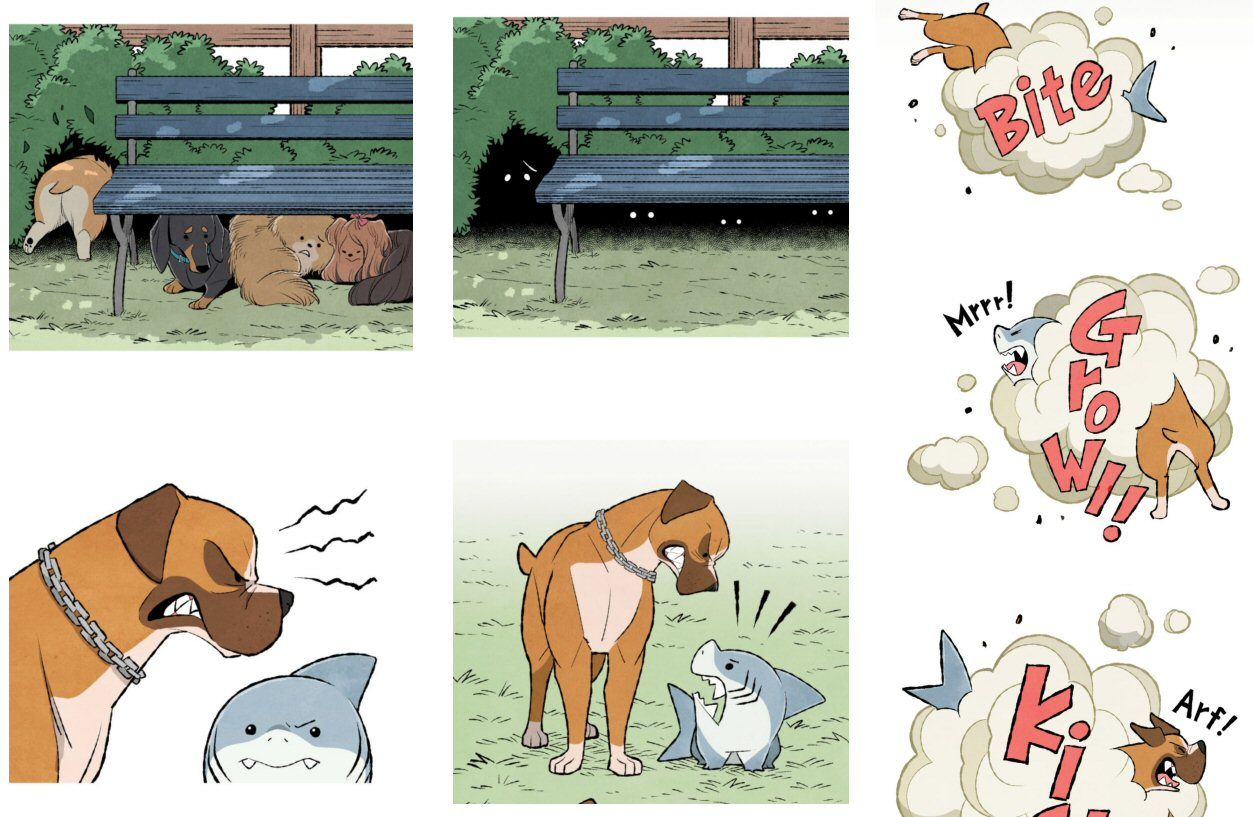
The boxer is a real bruiser and a bully, yet Jeff is not shy about taking him on. Note how this issue ends:
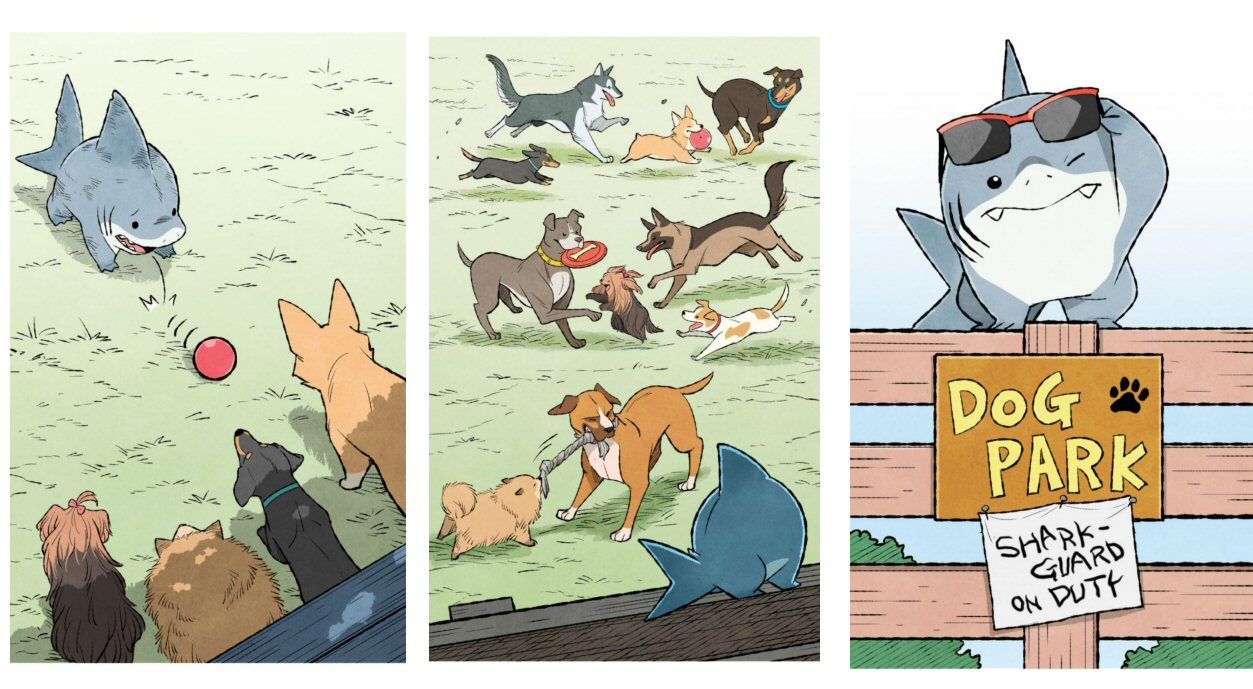
Not only does Jeff succeed in getting the small dogs involved and playing, but the bully boxer is playing with them as well! This is at the heart of care ethics – it is not about abstract justice or punishing offenders, it is about bringing everyone closer together. This is a happy care ethics ending!
It is interesting to see the note tacked on the dog park sign – Jeff as a shark-(life)-guard is an amusing image. And it is a nice segue into the third form of normative ethics I want to discuss, deontology.
Jeff as a deontologist
Admittedly, this was the hardest branch of normative ethics to see in Jeff initially. The “Shark Park” story above is one of the few examples where Jeff seems at all interested in asserting rules or acting on duty. But I would argue that story was fundamentally about Jeff’s sense of relational care ethics and fairness (that is, in the Aristotelian virtue ethics sense of justice as opposed to the deontological duty or rule-based version).
But there’s a very specific from of deontology that I can now see for Jeff, thanks to the Jeff the Land Shark Vol 1, 2025, series by Thompson and Tokitokoro. The premise of this series is that Jeff sneaks into the Sanctum, to get those colorful gems from the earlier It’s Jeff story above.
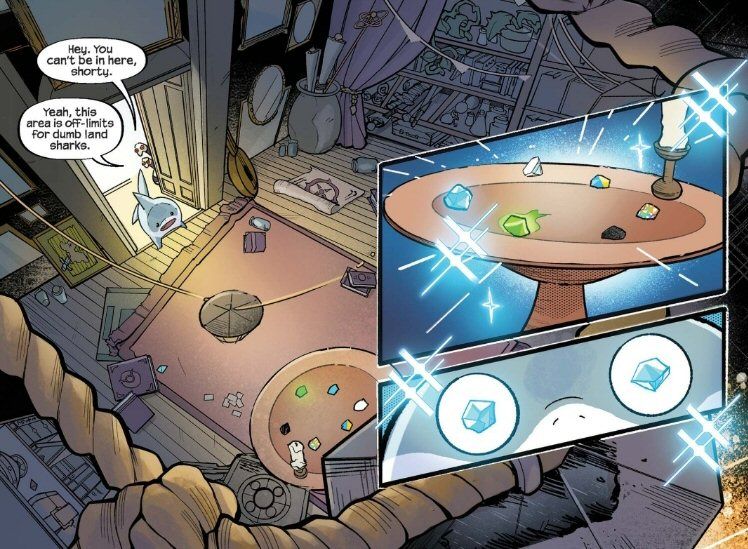
This time, things go awry when Strange’s snakes try to stop Jeff:
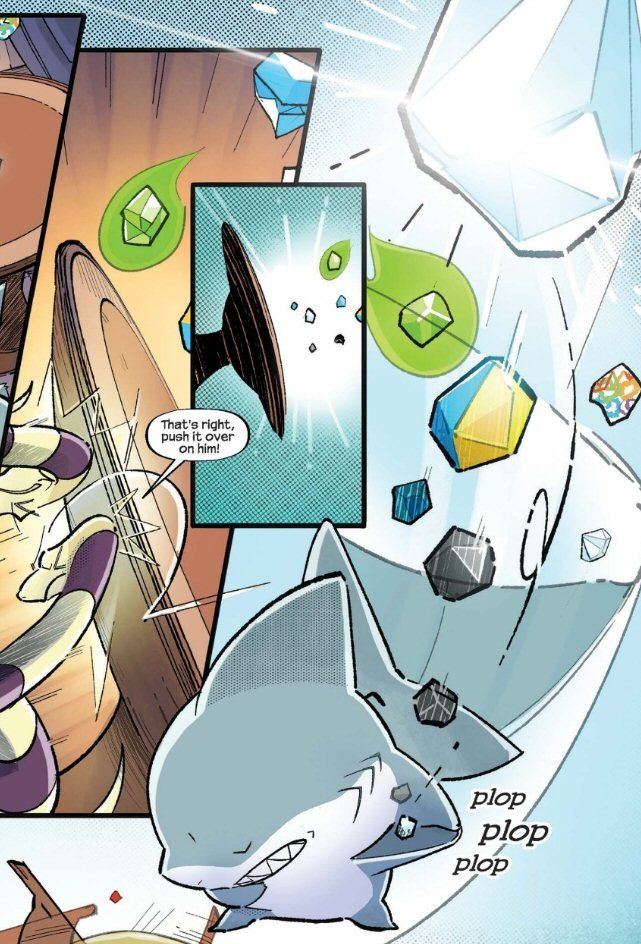
Anton and Aleister inadvertently help Jeff acquire the gems – but then cause a ruckus when they attack him, inadvertently breaking open a sealed vial:
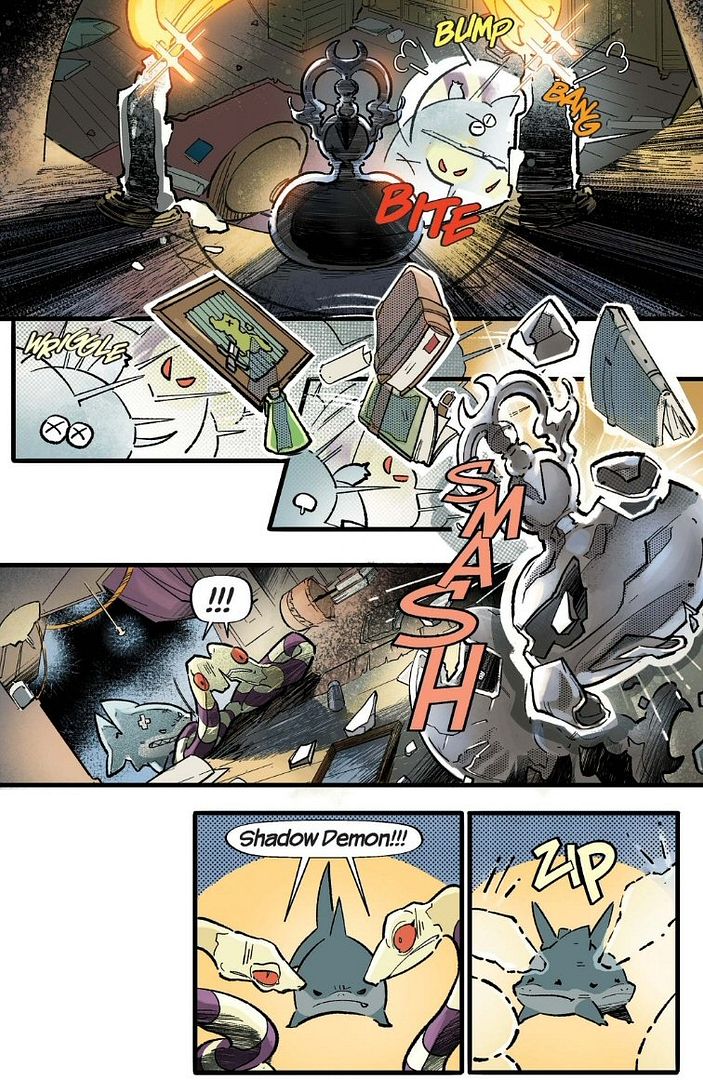
Anton and Aleister disappear, leaving an unsuspecting Jeff in the hands of a shadow demon – who steals Jeff’s shadow:
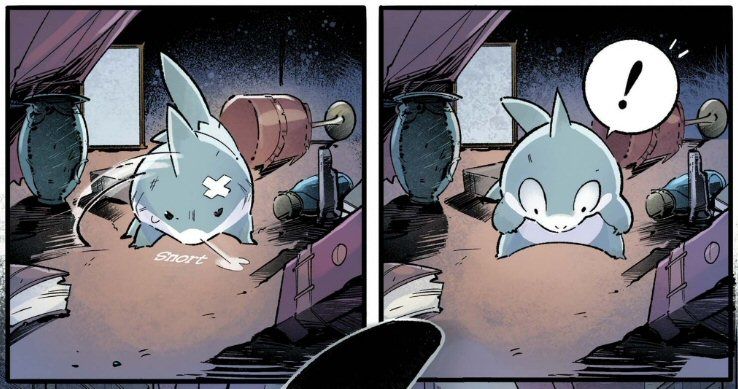
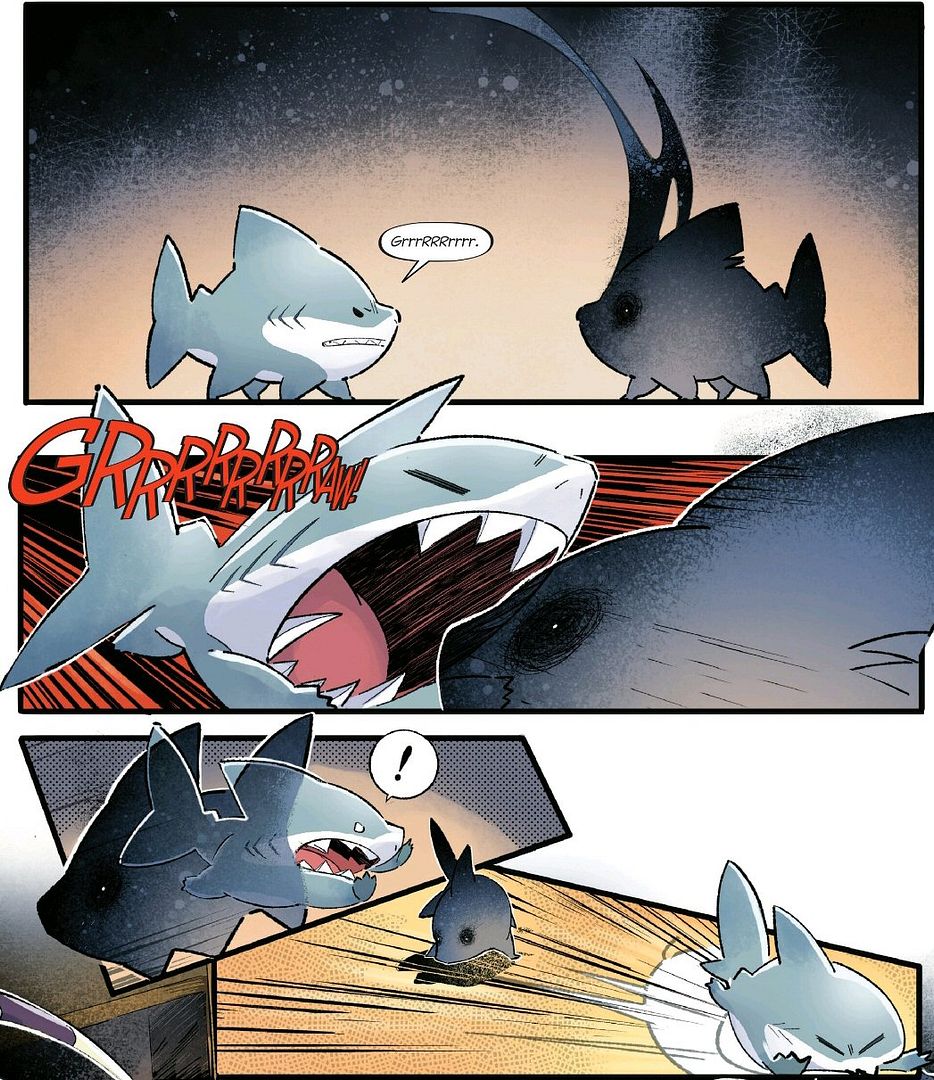
Jeff reacts angrily to the demon taking his form, and keeps trying to fight him (only to sail past, without effect). The demon opens some sort of portal to leave, and Jeff instinctively jumps through after him.
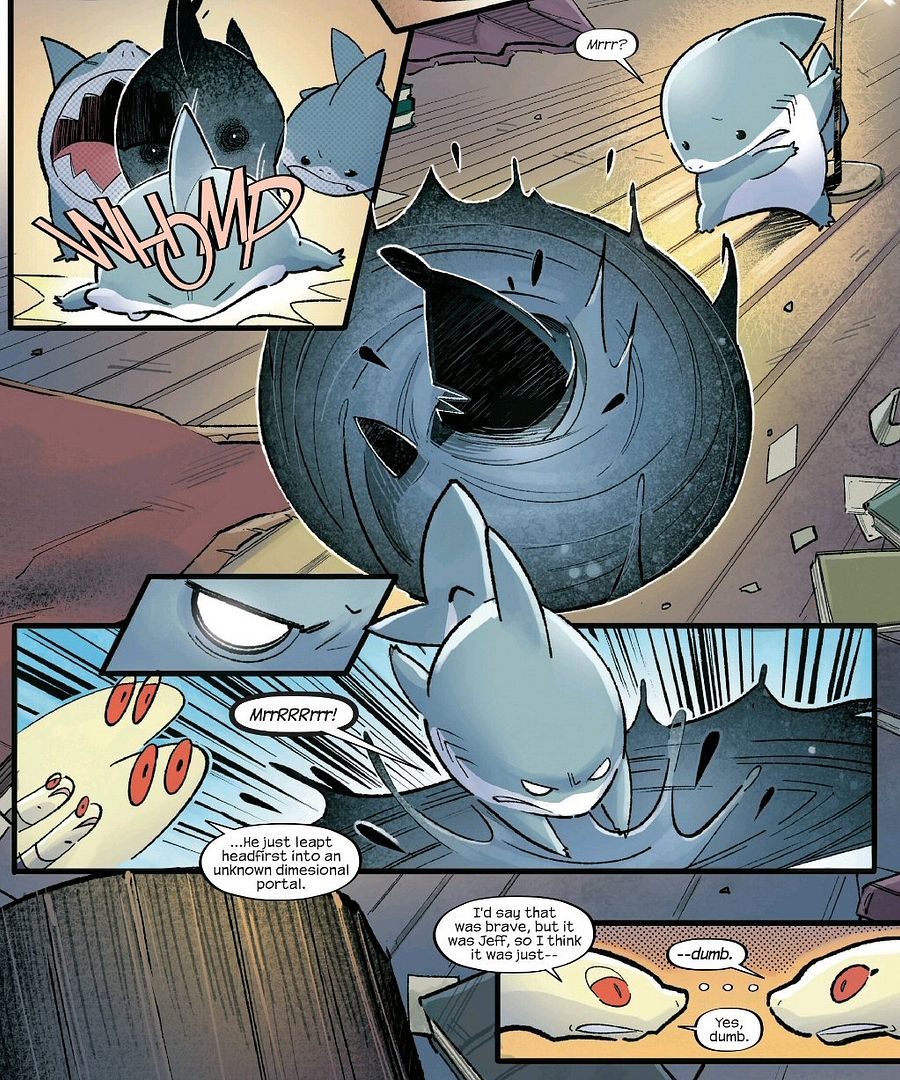
And thus begins the ongoing adventure of this series. The demon (who has plans that are revealed over time) is chased by Jeff through a series of portals that bring Jeff into contact with some of his old superhero friends. While there are many cute interactions, there is also a lot of frustration on Jeff’s part. These are key to the point that I want to discuss here, along with how Jeff’s pursuit of the demon is fundamentally instinctive – he doesn’t like it taking his form, by stealing his shadow.
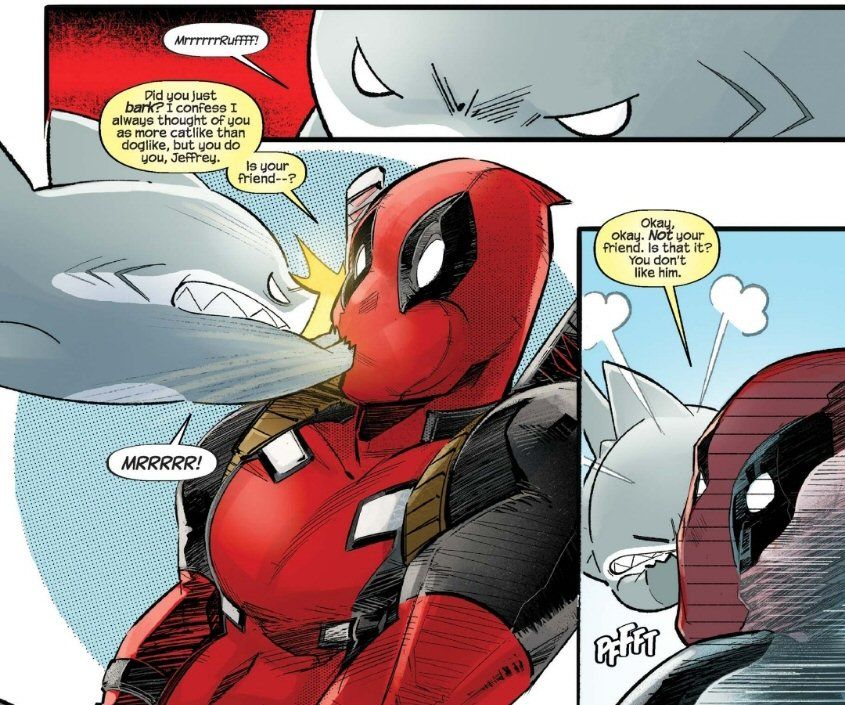
There are two reoccurring themes with all these friend encounters – starting with the first jump, when the demon passes by a startled Deadpool, and Jeff lands in his arms:
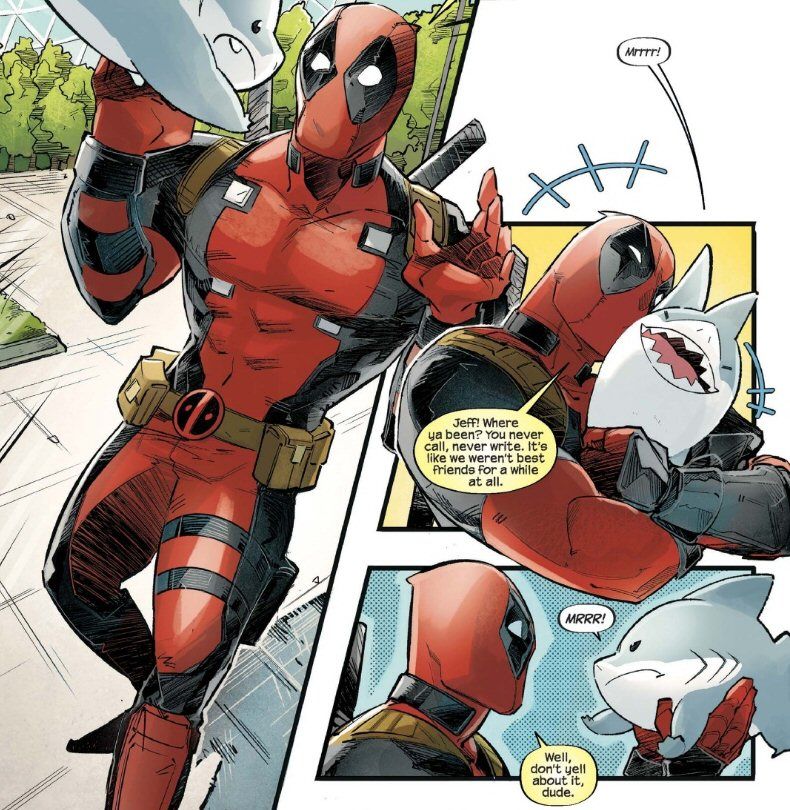
Jeff has a lot on his mind here – but note his frustration with Deadpool making a joke that seems a bit at Jeff’s expense. Of course, Jeff can’t write or call, as he doesn’t communicate verbally. This communication difficulty is the first thing Jeff reacts badly to when he encounters any of his friends in this series.
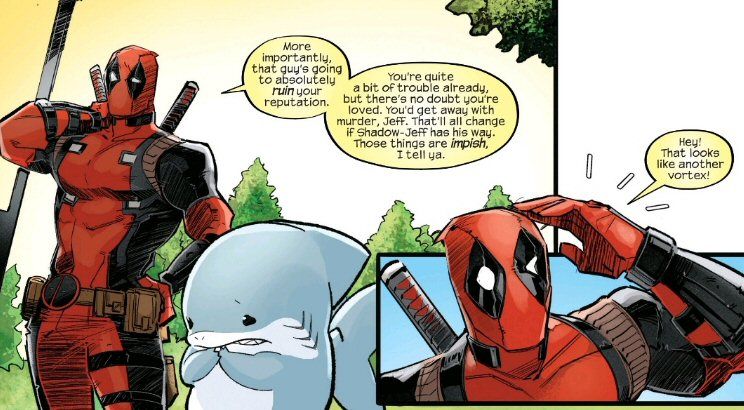
The second source of frustration for Jeff is the suggestion that he and the Demon are friends in some way, or that Jeff is in any way responsible for what is going on here:
Deadpool also sets the stakes for Jeff, and the concern if he doesn’t get his shadow back:
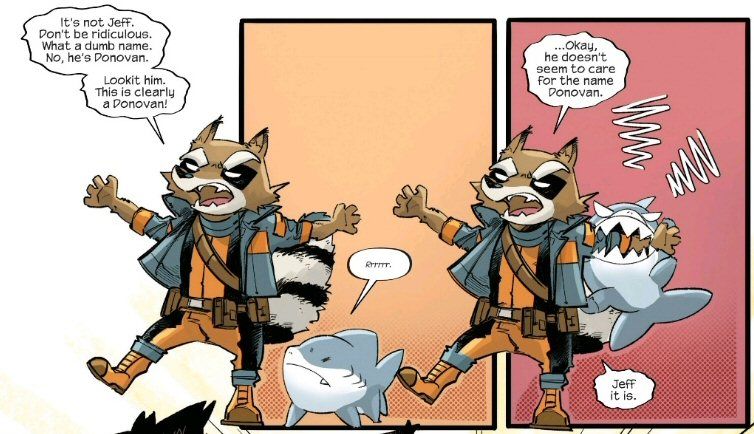
The communication issue is also flagged on the second jump, where he meets Groot and Rocket Raccoon (issue #2). Recall that only those who know Groot well understand what he is saying (to the rest of us, it just sounds like “I am Groot”). Rocket keeps misnaming Jeff as “Donovan” because he thinks it is a better name:
Rocket tries to adapt a universal translator to understand Jeff:
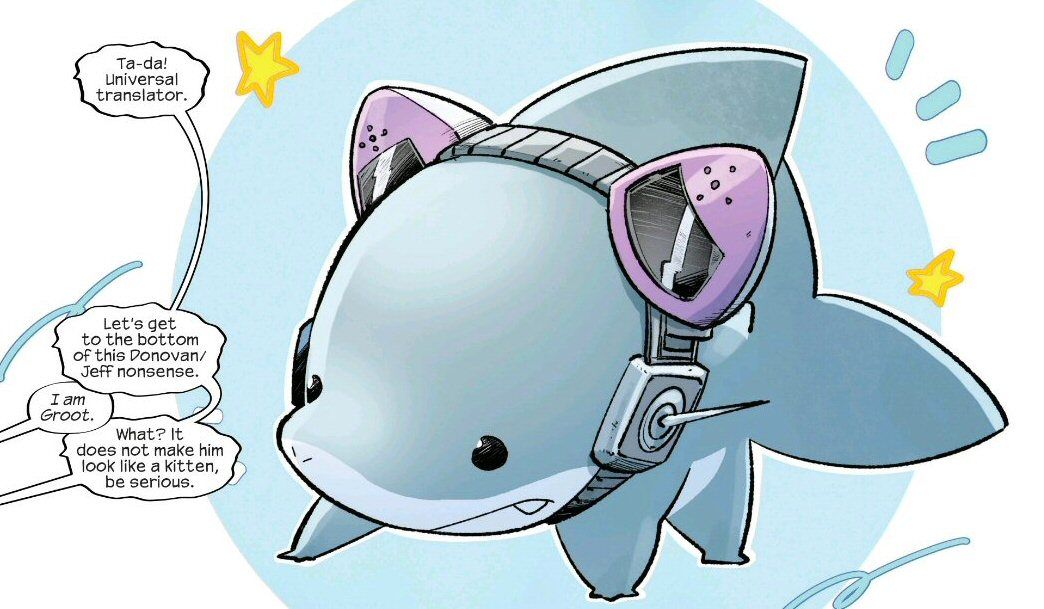
Unfortunately, the translator doesn’t work because of the proprietary nature of M.O.D.O.K.’s design (the land sharks’ evil creator). So Jeff experiences the additional indignity of looking like a kitten for no good effect.
He gets some satisfaction when he crashes in on Rogue and Gambit in issue #3, where we are treated to this cute scene:
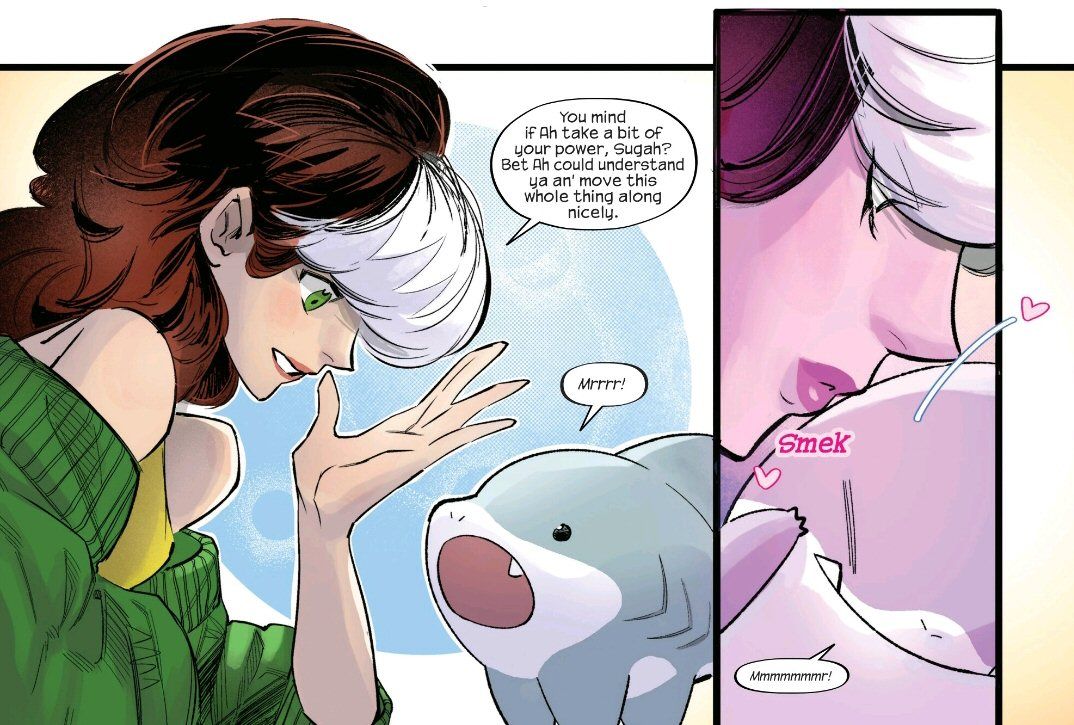
The power transfer works, and Rogue is able to translate what has been going on for Gambit, who is making dinner. Rogue writes down the story so far in a note Jeff can take with him, to help prevent future misunderstandings. But it doesn’t take long for Jeff’s frustrations to rise again:


Again, Jeff gets upset when people talk about him (and not to him) in his presence, and when he is questioned about his behavior (in this case, the theft of the gems and his responsibility for the portal).
You see this latter point again in issue #4, with Luna Snow:
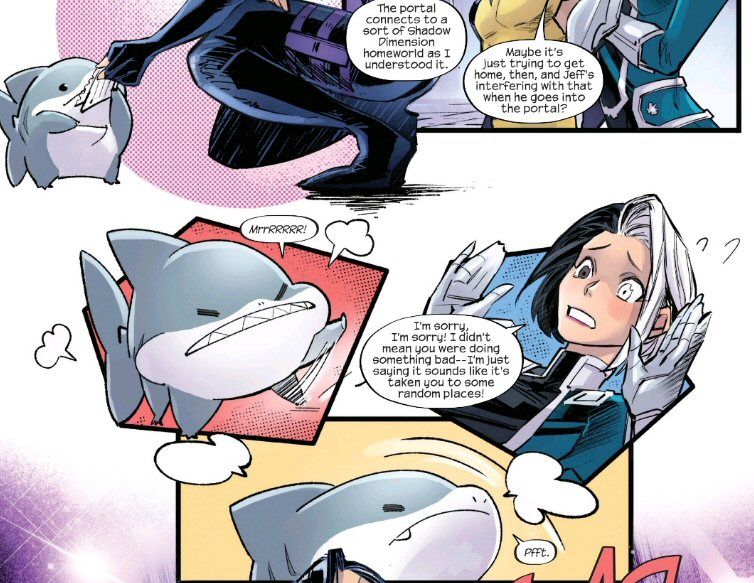
My point with all these examples is that Jeff seems to have an intuitive moral sense of what is right (like, taking the gems, chasing the demon, and trying to communicate) and what is wrong (being stopped, criticized or ignored for those things). This is a side to Jeff we haven’t really seen before, at least not to this degree.
This reminds of a moral philosophy concept originally known as moral intuitionism (now called ethical intuitionism, consistent with the modern ethics framing). While this is normally considered a meta-ethical position today (or an epistemological one), it does come in normative forms as well. Specifically, Jeff in this series reminds me of the deontological version of moral intuitionism developed by W.D. Ross. It is a pleasure to be able to articulate it here, as I’ve always had a lot of sympathy for Ross’ ethical position – and have recently begun to find it increasingly compelling (for reasons I will explain below).
I have previously mentioned Bernard Williams, who was one of my favorite philosophical thinkers of the latter half of the 20th century – Ross holds a similar place for me in the first half. Like Williams, Ross also objected to the absolutism of the two dominant forms deontological and consequentialist ethics – Kantian ethics and utilitarianism, respectively. Williams came up with some devastating critiques of utilitarianism (in my view), and Ross did similarly for Kantian ethics. Williams and Ross were both heavily influenced by Aristotelian virtue ethics (Ross wrote and edited many translations of Aristotle’s works). But whereas Williams never developed his own cogent normative ethics theory, Ross created a unique deontological form of moral intuitionism that was highly regarded in its time. Although Ross’s work fell out of favor in the mid-to-late 20th century, more recent work on meta-ethical and normative ethical intuitionism seems to have renewed interest in it (as I am seeing it referenced again in the literature).
The core of Ross’ deontological moral intuitionism was described in his highly-influential book, The Right and the Good (1930). I’ll start with the “good” – Ross argued that intuition self-evidently shows four kinds of things that are intrinsically good: virtue, knowledge, justice, and pleasure (in that relative order). Note that Ross was specifically referring to the feelings that each of these invoke within us, and not the concepts themselves (e.g., he defined justice as “happiness apportioned to merit or virtue”). That is why they are intuitive and self-evident – we feel them to be good, and therefore we need no further deliberation or logical inference to convince ourselves. You will also note how pleasure is included in this list – but is given a lower status (like in Epicureanism, previously covered).
On the “right” side, Ross’ argued these good things lead to obvious obligations for us. He referred to these as “prima facie duties” (from Latin for at first appearance, or on its face). This was an unfortunate term that people got hung up on, and he himself realized was less than ideal (he meant these as true objective duties that flowed obviously from the intuitive goods). But the key points are that there are multiple distinct duties (in the language of philosophy, his theory was “pluralistic“), and none of them are absolute (as Kantian and pretty much all other deontological ethics theories require). Instead, these are duties that we all feel some relative degree of obligation to – but none are exceptionless, and none automatically over-ride the others.
Ross came up with five core, foundational duties, although he realized these weren’t necessarily exhaustive: fidelity (that is, a duty to keep our promises), reparation (that is, a duty to correct previous wrongs we have done), gratitude (that is, a duty to return favors from those we have received them from), beneficence (that is, a duty to maximize the general good), and non-maleficence (that is, a duty not to harm or injure others). Notice how he has included an aspect of utilitarianism in his deontological duties (beneficence) – and he was explicit that this included increasing our own happiness, and aggregating with other peoples. As an aside, the Wikipedia link I provided above states seven duties – because he did provide two additional ones (justice and self-improvement), but he ultimately realized these could be slotted under beneficence.
The point is that in any given situation, different duties may apply – and may in fact conflict with each other in the case of ethical dilemmas. For example, you may have to break a promise (fidelity) if it means increasing the greater good (beneficence) or not hurting others (non-maleficence). But to Ross, there could never be true, irreconcilable ethical dilemmas – in the case of any conflict, one of the prima facie duties would rise to the top and ultimately over-rule the others. As a starting position, Ross felt that these started out with different relative weighs within us – with non-maleficence being the strongest, and beneficence the weakest. But since there is no absolute guide or judge to weighing these, all we can do is to consult our own perception (to use Aristotle’s phrasing) to decide which relative duty has the highest normative weight in any particular case. Ross saw this as a very common-sense view of morality – in contrast with the extreme absolutist views of many of his competitors (before and since).
As you might expect, this theory was ultimately criticized for the lack of guidance on how, exactly, one was supposed to make the selection of the absolute duty from the prima facie ones. But I actually see that as a point in its favor – and one that fits very well with what modern neuroscience is showing us about how we make moral decisions (see my description of the revised dual process model in Moral Thinking, Fast and Slow).
And doesn’t that sound a lot like our favorite land shark in this series? Isn’t Jeff using his own moral intuitions to decide what his absolute duty is (in this case, beneficence – by keeping the gems and regaining his shadow)? If this analysis is correct, then you can see why Jeff objects so strongly to the differing perspectives and criticisms of his many friends – they are arguing in opposition to his intuitive sense of his highest duty.
This deontological theory also fits very well with the interesting ending to this series.
As this series raced to its conclusion, it turned out the shadow demon was trying to free a fellow demon – one that may have been its child (it took the form of a baby Jeff shadow). Eventually, Jeff was on the run from the demons – and continued to draw in more allies in his battle to regain his shadow, like Elsa Bloodstone and Gwen Poole. From issue #5:
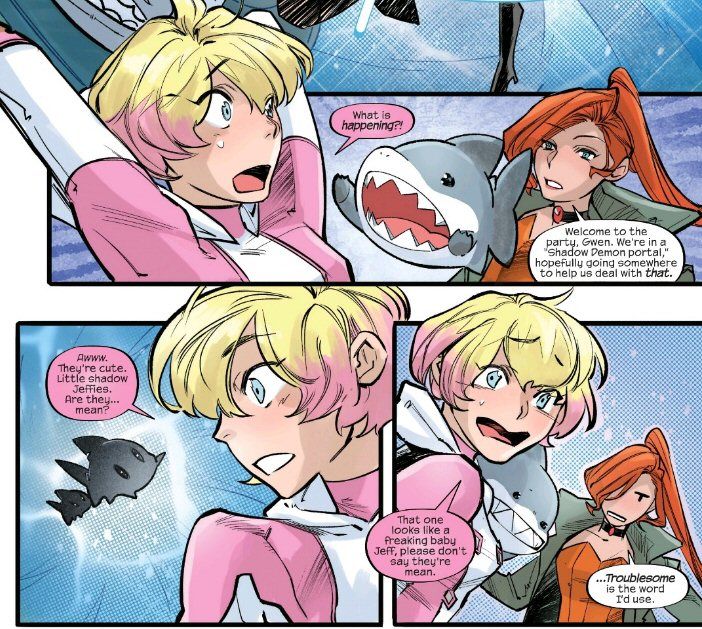
Everyone is lured back to the Sanctum, where the other magic-wielding heroes (Doctor Voodoo, Magik, and the Scarlet Witch) come up with a plan to imprison the two demons back into storage vials. But as the Scarlet Witch starts to implement it, Jeff demurs:
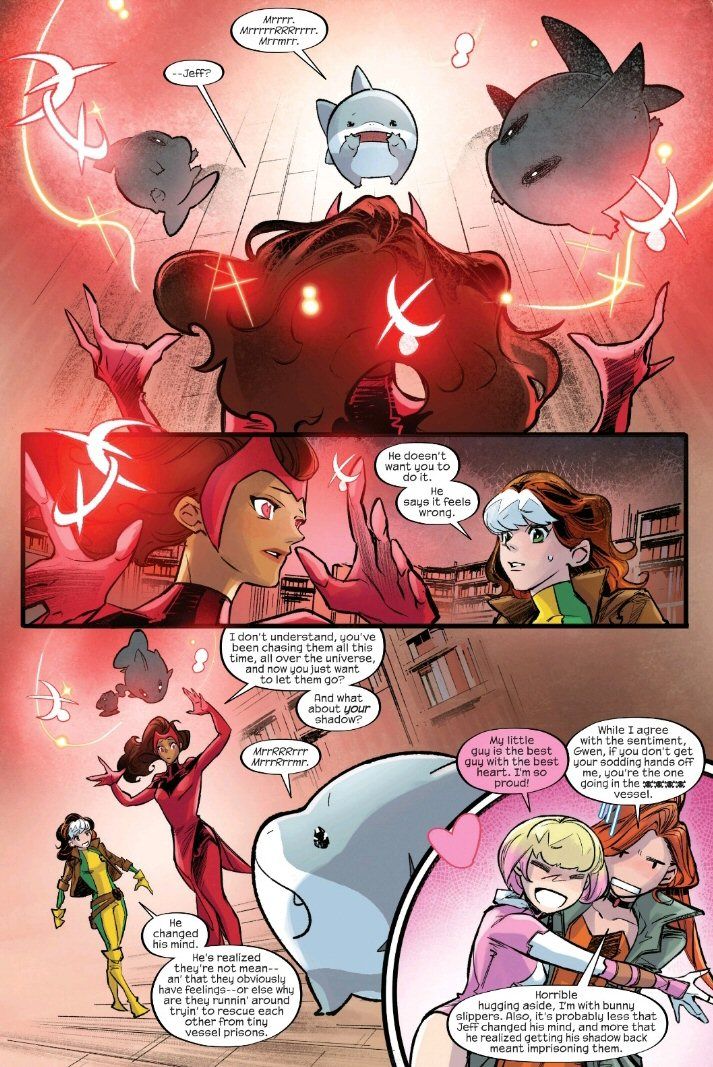
So, through Rogue’s translation, Jeff says “it feels wrong”, and “he changed his mind”. Gwen takes this as a sign of Jeff’s “best heart” (a care ethics perspective). However, Elsa argues differently: “it’s probably less that Jeff changed his mind, and more that he realized getting his shadow back meant imprisoning them”.
Yes, I agree with Elsa – which is entirely consistent with Ross’ deontological moral intuitionism. A different prima facie duty has risen to the top for Jeff now that more is known about what is going on – namely, non-maleficence (not harming sentient creatures with their own feelings).
The Scarlet Witch confirms the consequences for Jeff, which he accepts:
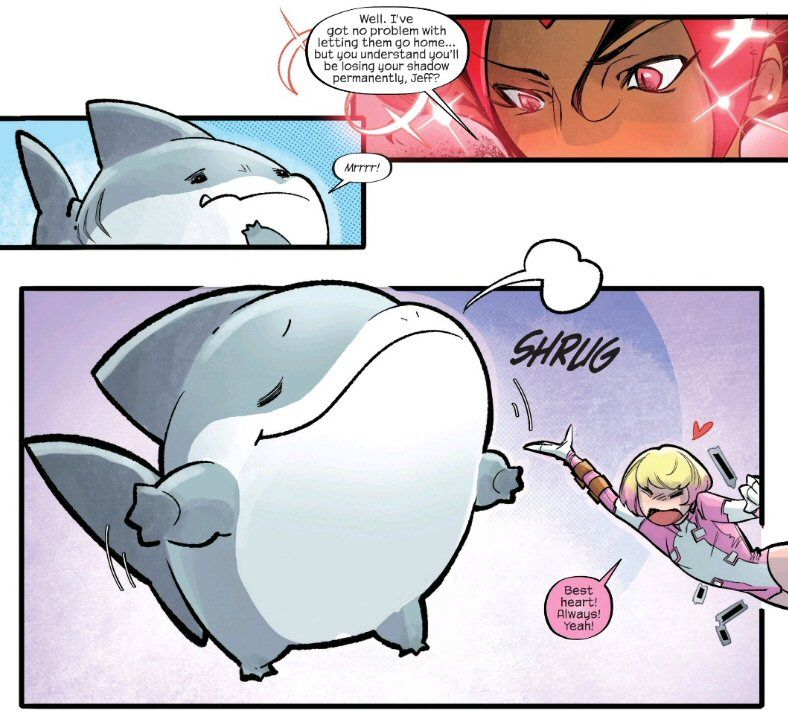
But we aren’t done with the prima facie duties – in addition to non-maleficence, it seems that Jeff feels that reparation is also required:

Jeff felt the need to apologize for his actions (the result of his previous top duty, now revised). This is another point Ross made – these duties all have a valence, both positive and negative. And that valence persists even when a duty is outweighed by another one. So if you break a promise, you owe compensation for that, regardless of which duty rises to the top as the final outcome. Note that Jeff also appears to be offering up the black portal gem above (which the shadow demons wanted from him).
But the assembled heroes aren’t done with Jeff. They come up with a plan to each donate a little portion of their shadows to help rebuild Jeff’s (Magik travels back to Limbo for an army of further volunteers). In the end, the Scarlet Witch knits it altogether for Jeff:
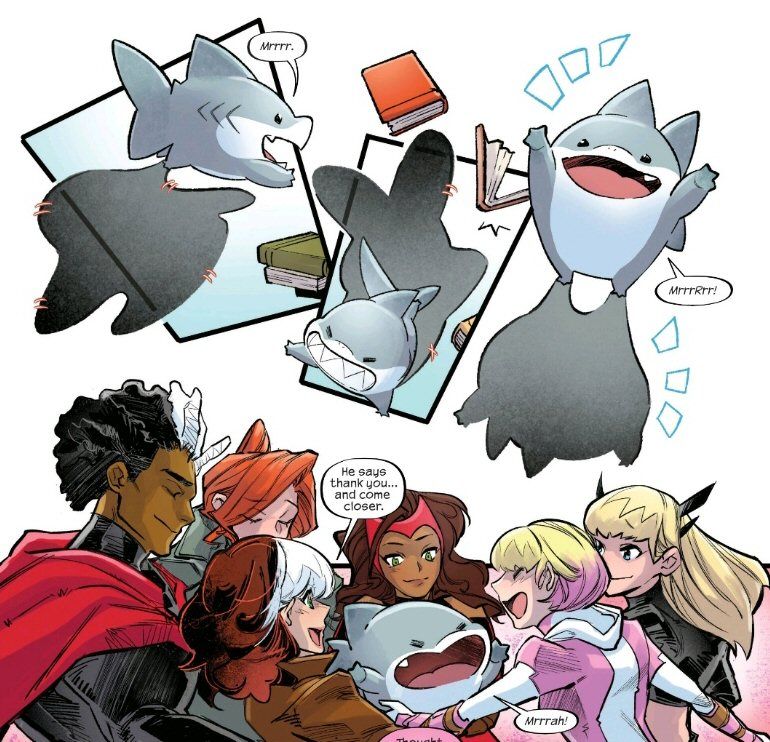
And so, once everything is resolved, a final example of the prima facie duty of gratitude. 🙂
Although this ending fits beautifully with Ross’ theory, there are other ways you can look at it. Gwen is clearly arguing for a care ethics perspective throughout (it is clearly how she sees Jeff). And Elsa’s comments – and the reactions of the other heroes – are also consistent with a classic virtue ethics perspective of Jeff showing self-improvement and being better.
Either way, a happy ending for everyone. Well, at least until Doctor Strange gets home on the last page of this issue. 😉
Ethics wrap-up
That was a whirlwind tour – I honestly didn’t expect it to get so detailed when I started, but there is a lot more than meets the eye to everyone’s favorite land shark! Between consequentialist ethical hedonism, deontological moral intuitionism, and both classic virtue ethics and care ethics, Jeff has a moral core as complex as any other Marvel character. For a largely non-verbal character designed to appeal to children, that’s an impressive feat! And so, yes, I would say Jeff is a “good boy”.
I also found this to be a good opportunity to resurrect a couple of older normative ethics theories – ethical hedonism (specifically, the Epicureanism form) and moral intuitionism (Ross’ deontological form). As I explained in my recent Can Caring Be Wrong? post, none of the modern normative ethics theories offer a universal theory applicable in all situations (despite the claims of some proponents). And as I further explained in Moral Thinking, Fast and Slow, that is just not how our minds work anyway – we weigh different normative intuitions, and it seems we train those intuitions over time.
As such, I think it is valuable to keep trying to bolster our moral intuitions by training them on additional theories, beyond just the dominant modern forms. I was happy to do this in my Absolute Wonder Woman post when I described situational ethics (a short-lived competitor to utilitarianism, from the late 20th century).
Similarly, I think Ross’ deontological moral intuitionism from the early 20th century remains a great defense of a pluralistic form of deontology, and one that brings in some of the better elements of utilitarianism (consequentialism). Another way to look at it is that it is an attempt to avoid the limitations of utilitarianism without embracing the extremism of Kantian ethics. I think it has continued value today – not just for philosophical reasons, but for what we now know about how our brains weigh moral decisions. For an alternative hybrid approach (that brings some deontological aspects into consequentialism), check out my discussion of Richard Brandt‘s rule utilitarianism.
Whether you approach this from a strictly philosophical perspective, or from a neuroscience one, I think it helps you better appreciate and understand your own preferred way(s) of ethical thinking by considering these variants. And as always, it’s pretty impressive to see so many possible ethical theories through Thompson and colleagues’ creative work. Kudos to all involved in creating (and evolving) this great moral character!
The last word … for now
I know Jeff would give me a big old “Pfffttt!” for this question – but I want to know, do you think Jeff is more like a cat or a dog?
I’ve had many of each in my life and can see both sides. But I currently have a Frenchie-Boston cross who reminds me a lot of Jeff: chest always puffed up, head held high, ready to bark at anything – but rolls over to anyone he knows and chirps and whines for pets. And I’ve always thought Gurihiru’s final Jeff style looked a lot like a Shiba Inu (especially the smile) – and that is a very intelligent and independent dog breed. So my vote goes to dog.
In contrast, my granddaughter (who has also had both kind of pets) has voted for cat. When I asked why, she brought up the It’s Jeff issue #8 (“Jeff the Magnanimous“), where he feeds the stray alley cat and her kittens. I hadn’t realized this was also a favorite story of hers! She explained to me that this story made Jeff seem like the cat father to her, feeding his family. She also mentioned how he sleeps just like a cat with all of them at the end. Can’t argue with that! And I’m glad to see my granddaughter has also seen Jeff’s better moral qualities. 🙂
If it helps you decide, I remember a joke told by a clinical psychologist once:
A dog looks up at you and thinks: “Wow. You feed me, you provide me shelter, you show me affection. You must be a god!”. A cat looks up at you and thinks: “Wow. You feed me, you provide me shelter, you show me affection. I must be a god!” 🙂
Either way, I suppose Deadpool had it right: “I confess I always thought of you as more catlike than doglike, but you do you, Jeffrey!”. The final vote is yours:
See my Glossary post for a list of the key philosophical concepts and related links on this site.
Further Reading

For more Kelly Thompson: Absolute Wonder Woman

For more adult family ethics: FML comix

For more ethics: The Power Fantasy Introduction
What a great (detailed!) review. I love Jeff, read the comics with my daughter. Thanks for doing this (I voted cat, btw).