

Doctor Strange embodies a lot of things you can’t necessarily have in other Marvel comics – a character who is old in a world of youth … who speaks with fun, florid language in a world of relatable, realistic voices. Doctor Strange is a character who is an outsider in Marvel’s publishing slate … he’s a perennial guest star … who lives in the strange half world of magic while most others exist in the World Outside Your Windows … someone who defies modernization, redolent with the charm of the best parts of a bygone era. Basically, he’s perfect.
- Jed MacKay, Doctor Strange writer, 2021-2024 (Doctor Strange Vol 6, Issue #18)
Doctor Strange was one of my favorite characters growing up. I was hooked from my second issue, and eagerly sought out back issues to learn more about the history of this fascinating character (editorial comment: this was before the internet).
Here was a person of incredible power and responsibility, but all acquired through experience, judgment and learning. He had no special physical abilities, beyond his formidable intellect and some magical objects of power. Yet he was as critical, if not more so, for keeping Earth safe as any of its mightiest superpowered beings. He often seemed quite fearless – taking on much more powerful adversaries at great personal risk, and always managing to outwit and outmaneuver them.
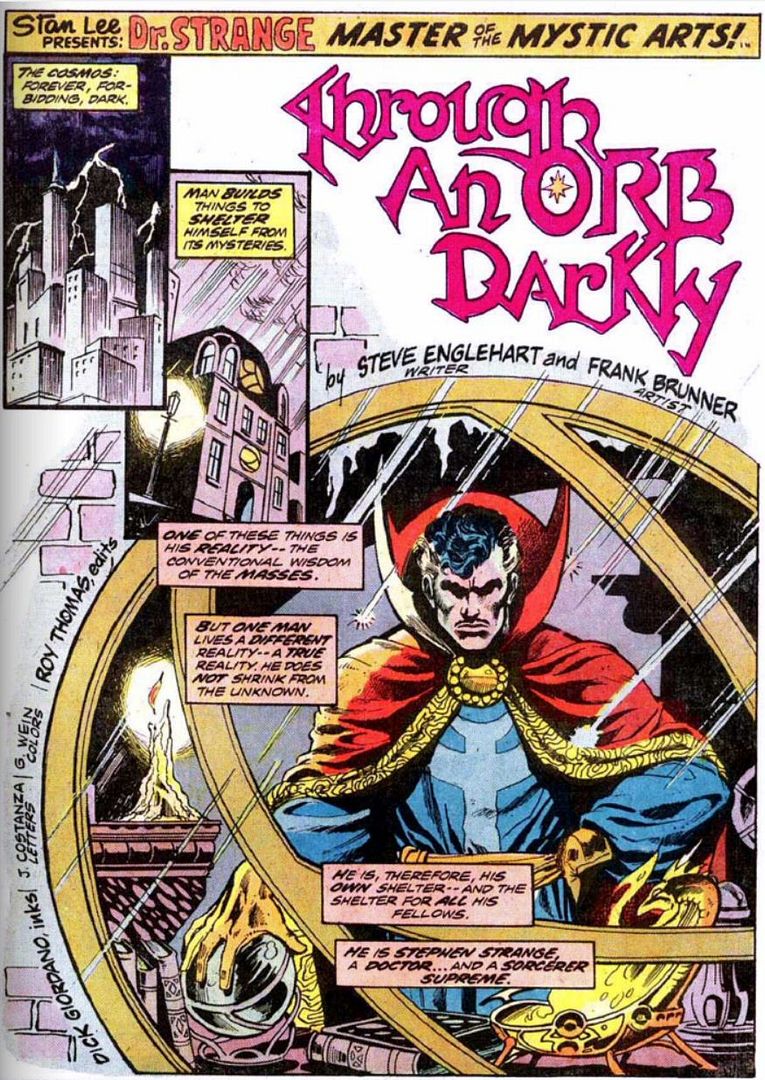
But he was also a haunted individual, ashamed of his past, and keenly feeling all of his failures – in particular, the burden of all those he wasn’t able to save, which seemed to constantly risk overwhelming him. He was always trying to keep tight control over his emotions, lest he slip up in a moment of weakness and fail in his duties. As Sorcerer Supreme for our dimension, the pressures on him were extreme. This opening panel from the first issue of Doctor Strange Vol 2, 1974, by Steve Englehart and Frank Brunner captures that early ethos well:
But it wasn’t all gloom and duty – there was also humor, especially in the florid language of his spells. It was always great fun reading all the rhyming verses that different writers came up with. I remember trying as a kid to make up a list of all his spells to keep track of his powers (before realizing it was just writers amusing themselves for the most part, with no real consistency).
I am going to have a lot to say about Doctor Strange on this site – expect a number of posts to follow, where I will profile the varying perspectives of different writers over the years. But for now, I will provide a general overview of the character and his core normative ethics.
Interestingly, Strange has remained one of the most ethically consistent characters over his long 60+ years run in the comics, likely reflecting his specific role as Sorcerer Supreme, and the generally similar normative ethics of magical beings in the Marvel Universe. This is still going to be a very long post, as I’m setting the stage here for major character developments over time to help you understand the more focused pieces I will be writing.
If you would like to know more about the terms I’m using on this site, please follow the links throughout or check out my Ethics 101 page or Glossary of Terms post.
Character introduction
On Earth-616, Doctor Stephen Strange was a brilliant but extremely arrogant Neurosurgeon, until a car accident crippled his hands and prevented him from operating. Exhausting all Western medicine treatments, he traveled to Tibet, hoping to be cured by the Ancient One. Rebuffed initially, Strange was taken on as a disciple once he had demonstrated a willingness to sacrifice himself for others. He eventually became a Master of the Mystic Arts. Returning to New York, he settled into the Sanctum Sanctorum in Greenwich Village, where he became one of Earth’s main protectors from mystical threats. Through most of his time in the comics, he has been the Earth’s Sorcerer Supreme – although he has lost or temporarily given up that position on several occasions (including at the present time, early 2025).
Beyond his extensive array of magical abilities and artifacts, he also has the ability to separate and project his “astral form” (or consciousness) at will, facilitating his ability to communicate with those not in his physical presence. Two of his key magical artifacts are the Eye of Agamotto amulet and his Cloak of Levitation – although in modern times, both are specifically associated with the holder of the Sorcerer Supreme title.
Early comics
The character was created by Steve Ditko and Stan Lee in 1963, as a reoccurring character in the Strange Tales Vol 1 anthology series (starting in issue #110). The early stories (which were largely written and drawn by Ditko) were apparently popular with older adolescents, especially college and University age readers. The visuals (while simple by today’s standards) were very “trippy”, with a lot of bright colors and psychedelic imagery. Some of the early philosophy, however, has not aged well.
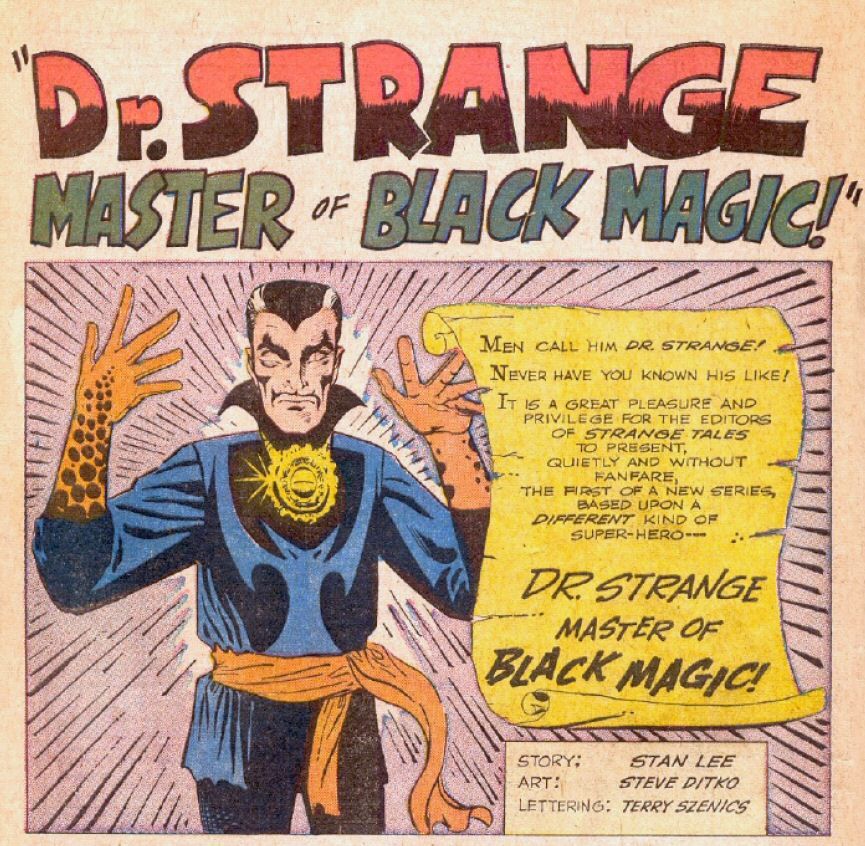
Ditko became quite enamored with the writings of Ayn Rand, who eventually proposed a philosophical set of principles that has become known as “objectivism”. Objectivism is a not a fully realized philosophical framework, but more of a closed system of inter-linked beliefs, such as that reality exists independent of human consciousness, that humans have access to reality through direct perception, and that reason is the only absolute standard to obtain objective knowledge. These latter traits were particularly emblematic of his Doctor Strange.
Unfortunately, objectivism doesn’t end there, and further insists that the only moral purpose of one’s life is the pursuit of one’s own happiness (known as rational egoism, or egoistic consequentialism in normative ethics), and that the only moral social system is one that displays absolute respect for individual rights (namely laissez-faire capitalism). As a result, objectivism is quite the darling philosophy of right-wing libertarians today. But objectivism’s lack of intellectual rigor means it finds little purchase in academic or intellectual circles. Fortunately, these later characteristics are absent from Doctor Strange, but you will find egoistic consequentialism comes up often in many of the comic villains (indeed, egoistic consequentialism has a long history with fictional villains).
These early Strange comics from Ditko and other rotating authors (Strange Tales Vol 1, issues #110-168, 1963-1968) also set Strange up as a something of mystical Sherlock Holmes – solving metaphysical problems through reason, with little emotion.
Personally, I would suggest you skip over the these early comics, unless you are a hard-core fan. The same goes for the first Doctor Strange Vol 1 series, which was just a renamed version of Strange Tales, continuing the numbering (Doctor Strange Vol 1, issues #169-183, 1968-1969). These were largely written by Roy Thomas, and had a number of increasingly inconsistent story lines as flagging comic book sales spurred them to try increasingly desperate attempts to raise interest. This included trying to turn him into a superhero with a hood and a secret identity (although this made him look more like a WWE wrestler!). The best thing about this series was the art – I think the ‘moody’ style of Gene Colan‘s pencils really suited the character (well, until he donned the blue hood anyway).
The best entry point for the character is when Thomas brought him back (now as an editor, not the writer) in Marvel Tales Vol 1, issue #3, 1972. Although the first few issues (with rotating authors again) were inconsistent, Thomas hit on winning combination when he put Steve Englehart and Frank Brunner together starting on issue #9, in 1973. The comic was in danger of being cancelled again at this point, but those early Englehart and Brunner stories really took hold and rapidly raised interest in the character. By 1974, Marvel Tales was discontinued and Doctor Strange Vol 2 was restarted with issue #1 (and that opening panel I showed at the top of the page).
Englehart and Brunner have co-writing credit for their stories, and seemed to have formed a true partnership. Englehart was an established writer for Marvel, and really leaned in to the religious mysticism aspects for this character. Brunner was an up-and-coming artist, and his pencils were right up there with Colan’s in creating gothic, moody style imagery (Colan eventually returned and joined Englehart when Brunner moved on after issue #5). But their stories together had a much larger scale and tableau (e.g., the creation of the Universe, Eternity, and conquering Death) that was unlike anything seen in Marvel comics up to that time.
I plan to explore the Englehart/Brunner time with the character in an upcoming post, as there is a lot to discuss about these stories, despite their relatively short time together. They certainly made Strange into a much more mature character, and set up some of the major elements of his world view. Unfortunately, they also began a story line – presumably to appeal to their older readers – that is not ethically defensible today: Strange enters into a romantic relationship with his disciple, Clea. This relationship is used repeatedly (and artificially) to create tension and drama by subsequent authors in stories throughout the 1970s. Check out my Clea ethics post for a more detailed discussion.
Doctor Strange Vol 2 went through a lot of writers and artists after Englehart and Colan departed together (issue #18, 1976). There are a number of good stories in the late 1970s, intermixed with many more not-so-great ones (see above). The revolving door of writers also meant that some story lines simply disappeared without explanation. Colan did make a limited return – with legendary writer Chris Claremont (of X-Men fame) on issues #38-45 (1979-1981).
The era that I know best (as it coincides with when I was actively collecting) is when Roger Stern took over as writer, issues #47-75 (1981-1985), with a key exception of issue #74 (which I will discuss further in a stand-alone post). Stern was initially joined by Marshall Rogers on pencils and Terry Austin on inks, with Paul Smith eventually taking over on pencils on issue #56. But there were a lot of guest artists during this era (frankly it became a bit of a revolving door, as the main artists were too much in demand on other titles).
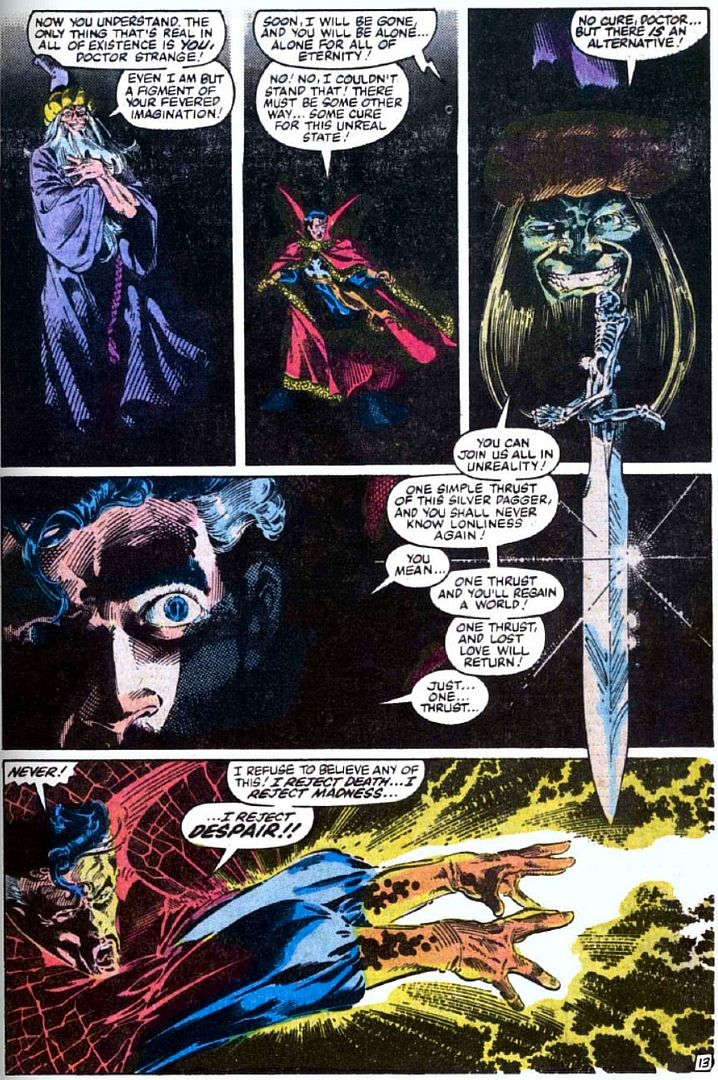
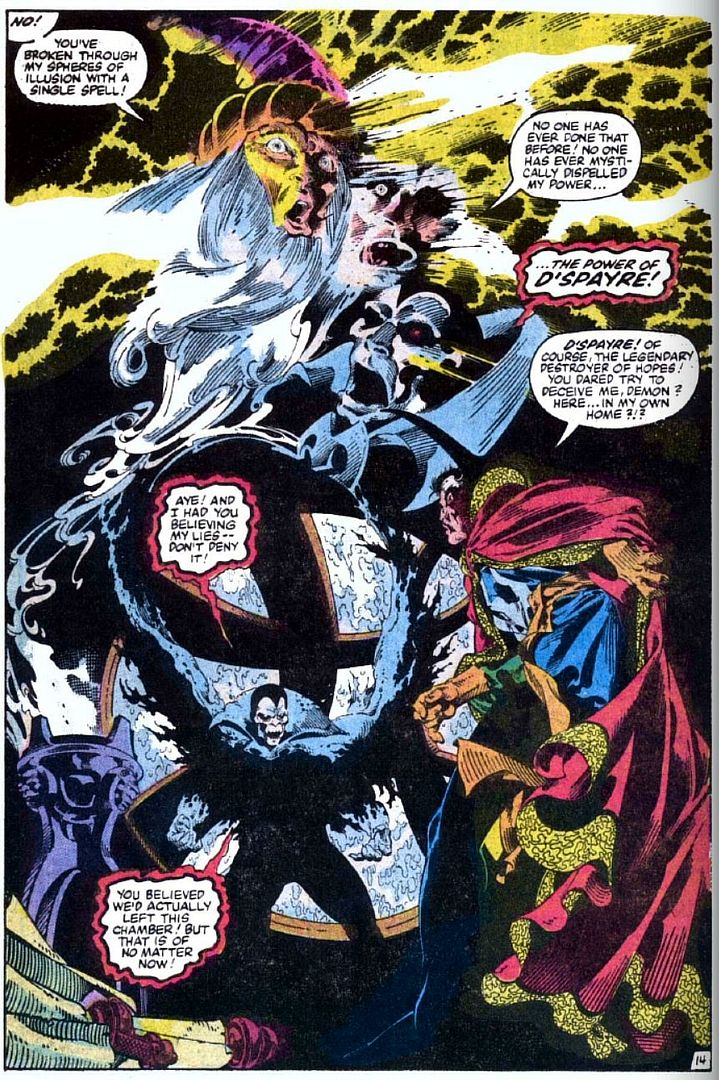
The Stern era was very impactful, as he really focused on the heart of the character, and solidified his moral core. Apparently, one of his requirements for taking the gig was undoing the unethical relationship Strange had with Clea (again, see my Clea overview). This actually gave him the opportunity to explore a number of important moral and psychological themes; see for example the two pages from issue #55 below, where Strange is reeling from her departure. This is the second issue that I read as a kid, and the one that hooked me. Guest pencils by the outstanding Michael Golden:
Similarly, the Peter Gillis era (1985-1989) is a favorite of mine, although I didn’t read most of it until my return to comic books a few years ago. Even darker in tone, there is a lot meaty stuff in this era, and it desperately needs its own post and analysis given the heavy philosophical bent he brought to the character. Gillis knew his normative ethics well – he held a Masters in English Literature (and had met most of the requirements for a PhD, but never actually completed his thesis).
Gillis’ first outing was in issue #74, where he wrote the best Beyonder story of the (very morally problematic) 1985 Secret Wars II cross-over event. As context, the god-like Beyonder had sought out Strange to seek “enlightenment” on what it means to be alive, and Strange puts him through the ringer of living through his own origin story (a great means to reestablish the Strange character’s moral core). I will discuss Gillis’ tenure in a separate post, but this one panel has always stood out for me (UPDATE: A fuller discussion of this this story line, and Gillis’ philosophical approach to the character, is now available in my Battleworld vs Secret Wars post):
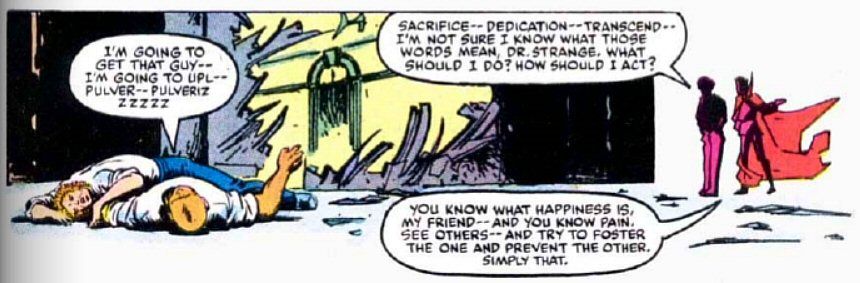
The succinct statement about fostering happiness and preventing pain – by looking to other people – just blew my teenage mind (I couldn’t believe I was reading this meaningful insight in a comic book!). It wasn’t until a few years later that I realized this is almost a direct quote from Jeremy Bentham, the “father” of utilitarianism.
I look forward to exploring in another post the various philosophical elements Gillis brought to the character over the multiple series he wrote; wrapping up Doctor Strange Vol 2 with Issues #74,76-81 (1985-1988), directly followed by the rebooted anthology series Strange Tales Vol 2, Issues #1-19 (1988-1989), and then the first issues of the relaunched stand-alone Doctor Strange, Sorcerer Supreme, Issues #1-4 (1989).
Roy Thomas then returned as writer, along with his wife Dann, for Issues #5-47 (1989-1992). The Thomases retconned a number of Gillis’ choices – some of which I can appreciate, like having Agamatto save all of Strange’s relics, and bringing Rintrah back as a disciple. But it wasn’t long before they turned Clea’s character back into the same awful tropes as the 1970s stories (with her acting out of jealousy, mind control, etc.). And at one point they even brought back the ridiculous secret-identity hooded Strange from that late 1960s Thomas run (groan). Their run was followed by another revolving cast of writers and artists that make up the remainder of this series – with some frankly bizarre plots and character development – until the (merciful) cancellation with issue #90 in 1996.
The Doctor Strange, Sorcerer Supreme series overall – outside of the initial Gillis stories, and some of the early Thomas’ ones – isn’t worth your time. One possible exception is the War of the Seven Spheres story line that was presented in issues #48-49 (1992), at the start of the Len Kaminski era. Although this story line seemed to be largely dropped, it was picked back up again briefly when Warren Ellis took over on issue #80 (1995). I didn’t think much of how this story line was handled back then. But then Jed MacKay revived it and made it into a much more interesting and significant plot line in his Doctor Strange Vol 6 series (2023-2024), so you might want to check out the earlier bits – but only if you are a hard core Strange enthusiast.
Modern comics era
Following the cancellation of his stand-alone title in 1996, Doctor Strange largely became a guest star in other series for the next 20 years. He did have an interesting role in a number of Avengers stories, with the fallout from the Civil War cross-over event, and eventually gave up the mantle of Sorcerer Supreme for a while. In particular, I found star Marvel writer Brian Michael Bendis‘ depiction of Strange in the Illuminati and New Avengers series (2006-2008) quite thoughtful and interesting. However, the subsequent Strange story lines in New Avengers by Jonathan Hickman (2012-2015) were inconsistent with the character’s history in my view. Similarly, while I liked Hickman’s 2015 Secret Wars cross-over event overall, I found his depiction of Strange was the weakest (and most unbelievable) element. It’s always a bit hit-and-miss when you are more of a bystander than a major character in an ensemble piece.
There were some limited series attempts to reboot Doctor Strange during this time, but I don’t find any of them particularly interesting or compelling. Oddly to me, some online “best of Doctor Strange” lists include the five-issue limited series The Oath (2006-2007) by Brian K. Vaughn. But you tell me – it begins with Strange being shot in the heart and mortally wounded with silver bullets from Adolph Hitler’s gun (since, naturally, that is one thing that can get past magical defenses, right?). I’m not making this up. Worse, the whole plot revolves around a magical elixir that could cure cancer for all time, but that Strange wastes in order to save Wong’s life. While I have greatly enjoyed some of Vaughn’s later works (like Paper Girls, and Saga), I find this series to be at odds with the long-standing moral basis of Strange’s character – and Wong’s! Recommend a pass.
But Doctor Strange got another shot at life in his own title when interest peaked after it was announced that Doctor Strange would be made into a stand-alone Marvel MCU movie starring Benedict Cumberbatch (see below for more on this movie).
Star comic book writer Jason Aaron was pegged to reboot the character, with Doctor Strange Vol 4 (2015-2017). Although I am a big fan of many of Aaron’s other runs, I don’t personally like where he took Doctor Strange. At his request, he was given permission by Marvel editors to “re-imagine” the rules of magic in the Marvel universe. While what he came up with might seem reasonable from a story-telling perspective, it was cumbersome and had the effect of hamstringing all future magical developments. Most of his innovations were gradually abandoned by subsequent writers. Although I did like how Skottie Young and Humberto Ramos integrated the best aspects into Strange Academy Vol 1 (2020-2024). While Strange rarely appeared in that series, it was a great addition to the larger magical aspects of the Marvel Universe (and with some great new characters).
Doctor Strange Vol 4 was finished off by Dennis Hallum and then John Barber, before Marvel made the ill-conceived decision to revise all comic book numbering according to its problematic “legacy” numbering system. The relaunched Doctor Strange Vol 1, issues #381-390 (2018) were written by Donny Cates – and were actually kind of fun, with a Loki-driven swith-er-roo plot. But you have to put aside some strange bits like Doctor Strange becoming a veterinarian with “Doctor Doolittle” abilities to speak to animals. But we did get a great new companion for the Doc – the ghost of a basset hound named Bats, which has helped to humanize him and bring some levity to the weighty stories.
Marvel abandoned its legacy numbering, and Mark Waid took over writing Doctor Strange Vol 5 (2018-2019). Although there were some interesting ideas introduced here (and one terrible one in regards to Clea, which I’ll explain on my Clea Ethics background page), the overall premise of this series was ridiculous to me (Strange becomes an astronaut!). And then Waid penned a new series, Dr Strange, Surgeon Supreme (2020), where Doctor Strange (unbelievably) goes back to being a neurosurgeon, part-time. That was mercifully cancelled early, after just six issues.
Things looked bleak at this point. By 2021, I feared the character was destined for the dust bin of the Marvel universe again.
And then rising star Jed MacKay asked for permission to revive a Doctor Strange series. MacKay is a long-time fan, with an extensive knowledge of Marvel comic history. I will be writing a number of posts on MacKay, as I really like his approach of cleverly rehabilitating characters who have convoluted and inconsistent histories (Moon Knight and Doctor Strange in particular, but Black Cat too). Apparently, the editorial response on Doctor Strange was not quite what he initially had in mind: “Sure, we’re going to kill him, and you can be the one to do it.”
And so he did, along with artist Lee Garbett in their excellent The Death of Doctor Strange limited series (2021-2022). Although only five issues in length, there were numerous tie-in issues in other Marvel comic titles, some of which MacKay also penned. As you can imagine, the death of the Sorcerer Supreme had all sorts of impacts throughout the Marvel Universe. But MacKay’s genius was in not only telling a compelling story – but integrating some of the best (and worse!) story ideas from previous iterations of Doctor Strange, and tying them all together seamlessly and quite ingeniously into a positive, cohesive whole. I don’t want to give away too much (beyond the panels below from issue #1), but I STRONGLY urge you to pick up and read this series.
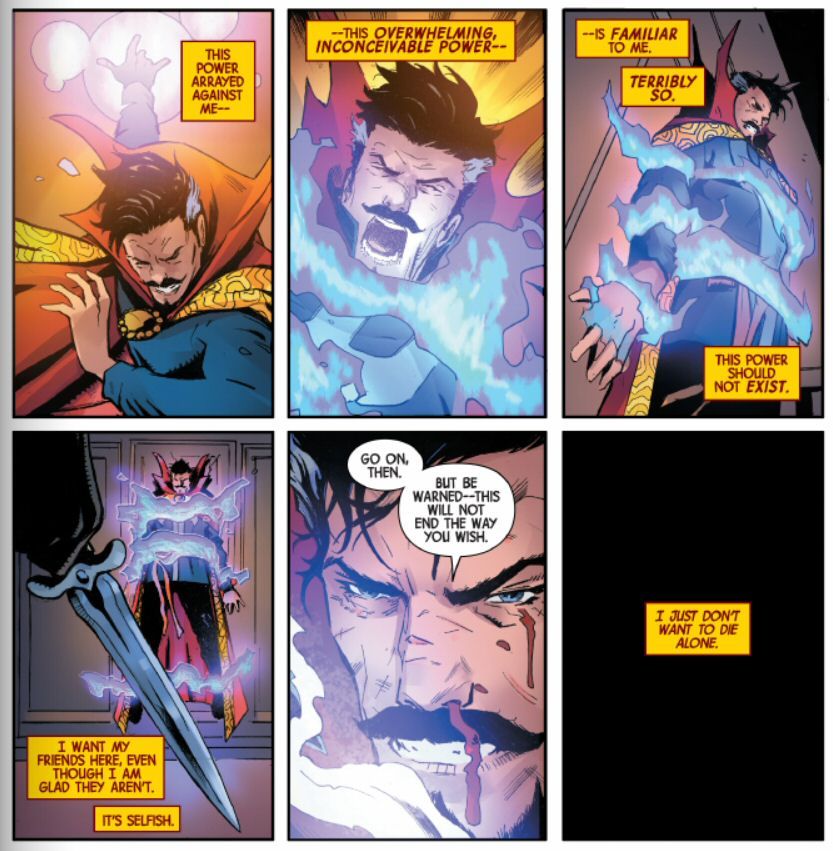
Don’t worry, this is just the opening salvo – MacKay knows how to upend expectations when telling a story. As an aside, it was previously established (in the Englehart/Brunner era) that Doctor Strange no longer ages. Having conquered his fear of death when he obtained the mantle of Sorcerer Supreme, he could no longer die from “natural causes”. But death from magical ends was still possible, hence the panels above. But as we all know, death is rarely permanent in the Marvel Universe.
Another key thing MacKay did was restore and renew Clea‘s character. Gillis had the pair marry before his run ended – something later writers didn’t seem to know what to do with (other than repeat the worse examples of relationship drama from the 1970s comics in the 1990s and modern times). Please see my Clea ethics background post for an overview of the trials and tribulations of this character.
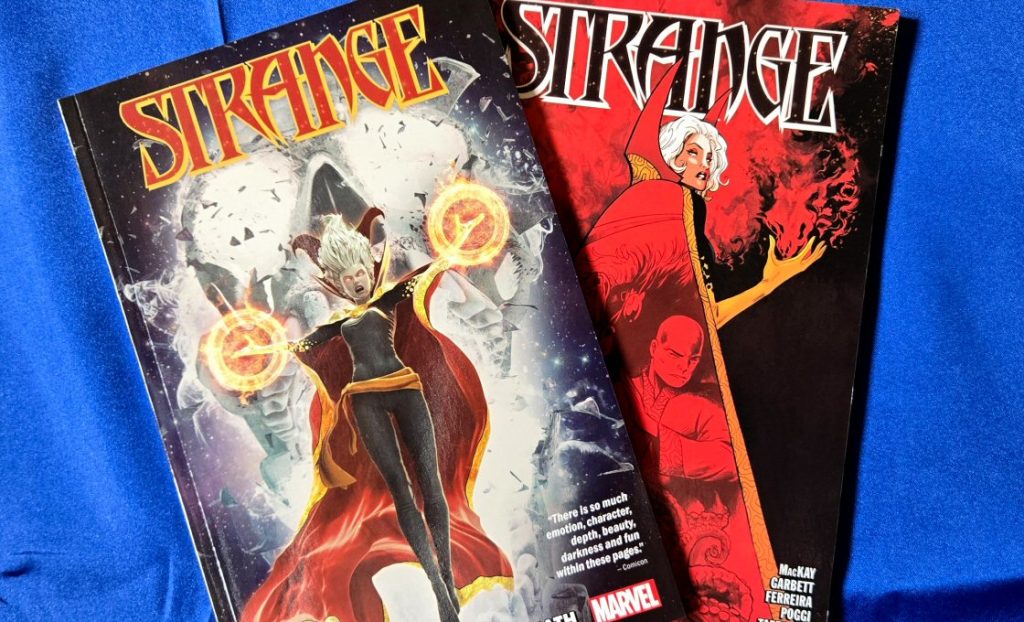
MacKay made Clea the focus of his follow-up series, Strange Vol 3 (2022-2023), with artist Marcelo Ferreira – with Clea taking over as Sorcerer Supreme of Earth-616. It is a phenomenal series, with MacKay’s signature care ethics perspective shinning through. Again, see my Clea overview for more details.
Following that series, MacKay and Pasqual Ferry relaunched Doctor Strange Vol 6 (2023-2024), which successfully addressed Strange and Clea’s ongoing relationship as equals. Sadly, that series recently wrapped up with the major 2024 cross-over event Blood Hunt – also created by MacKay (busy man!). I don’t want to spoil the outcome, but it is a wild ride (and the ending feels well earned).
A new series is about to begin shortly, penned by Derek Landy – Doctor Strange of Asgard. Another up-and-coming talent at Marvel, I’ve been very impressed by a number of Landy’s stories – and so have high hopes for this series, despite the somewhat odd premise. (UPDATE: my Doctor Strange of Asgard Ethics post is now up!)
Marvel Cinematic Universe (MCU) Doctor Strange
As previously mentioned, the development and release of the MCU stand-alone Doctor Strange film in 2016 was a critical event in restarting the the good Doctor’s comic career. The film was directed by Scott Derrickson from a screenplay he wrote with Jon Spaihts and C. Robert Cargill, based off an earlier draft by Thomas Dean Donnelly and Joshua Oppenheimer. There are a pair of key take-away points in regards to Doctor Strange’s moral philosophy in the MCU films.
The first involves his mentor – the Ancient One – played against stereotype here by Tilda Swinton as a woman and Celtic mystic. The Ancient One is revealed mid-feature to be inappropriately drawing power from the Dark Dimension to keep herself alive. The Ancient One’s other disciple Karl Mordo (a very different character in the comics) is horrified at this violation of the “laws of nature”. From the Ancient One’s explanation to Strange:
Ancient One: I’ve hated drawing power from the Dark Dimension, but as you well know, sometimes one must break the rules in order to serve the greater good.
Strange: Mordo won’t see it that way.
The Ancient One: Mordo’s soul is rigid and unmovable, forged by the fires of his youth. He needs your flexibility, just as you need his strength.
Strange does indeed learn from the Ancient One, and comes up with his own innovative solution to stopping the big villain, Dormammu. Strange places them both in a time loop, with Strange dying over and over again (in increasingly gruesome ways). But this effectively stymies Dormammu, who points out to Strange that he can never win this way. Strange retorts: “No. But I can lose. Again. And again. And again. Forever. That makes you my prisoner … I’ve come to bargain.” Dormammu eventually agrees to Strange’s terms to leave the MCU Universe alone, and Strange stops the loop.
The point to all of this is that Strange (and the Ancient One) are both extremely utilitarian in their ethical approach in this film. Strange is willing to not only break every rule, but also incur immense suffering, all for the sake of saving the Universe. In direct contrast, Mordo is extremely deontological in his views, and cannot accept the Ancient One and Strange’s “ends-justify-the-means” philosophy. Some key observations from Mordo, first about the Ancient One, and then about Strange’s morally-flexible solution:
Mordo: The bill comes due. Don’t you see? Her transgressions led to the Zealots, to Dormammu. Kaecilius was her fault! And here we are – in the consequence of her deception. A world on fire.
Mordo: You think there will be no consequences, Strange? No price to pay? We broke our rules, just like her. The bill comes due. Always. A reckoning. I will follow this path no longer.
The end-credit scene then sets Mordo up to be a major ongoing “villain” for Doctor Strange.
This film does an excellent job of both showing and describing the contrast – and conflict – inherent between consequentialist and deontological ethical theories. Note however that these depictions of the characters are bit more extreme than what you will typically find in the comics (where it can often be more nuanced).
Current ethical framework: C/d


Across a very long history, I find Doctor Strange has consistently applied a primarily utilitarian (consequentialist) ethical framework, in both the comics and the films (Doctor Strange – Utilitarian Supreme!). When having to make difficult or morally ambiguous choices, he inevitably makes decisions based on the anticipated outcomes, aiming to minimize suffering and maximize the well-being of the greatest number of people. He is also quite selfless, and is frequently willing to sacrifice his own well-being and interests for the sake of others (the 2016 film described above is a particularly good example of this).
However, these is a clear vein of deontology that runs through the character, beginning with his initial medical training (medical ethics are very deontological in their basis, all the way back to the Hippocratic oath’s “first do no harm”). You can see this in his protector role as Sorcerer Supreme, where he has a duty and responsibility to safeguard the Earth from mystical threats. There are also frequent allusions to the rules of magic in the stories, and the consequences for any who break them (Strange is more of a bend-the-rules kind of guy, as opposed to outright breaking of them, at least in the comics). Although how much this is emphasized (or downplayed) by different writers can vary, at the end of the day you can trust him to always do what he thinks will bring about the best outcome, confirming the primary consequentialist framing.
And so, it is a consistent C/d on my superhero description system.
Again, the purpose of this site is not to provide a definitive normative ethics framework for each character – that is impossible, given all the creative hands each character has passed through. My goal on these background pages is to provide a sufficient overview of the main ethical drives for the character over time. This is to help prepare for upcoming posts where I will examine specific comic stories in more detail, to show how they illustrate key normative ethics theories.
The last word
What a ride Doctor Strange has had in over 60 years at Marvel!
Much like the many regenerations of British sci-fi hero Doctor Who (another favorite of mine), Doctor Strange never stops doing what he is known for – looking out for people, protecting people, and trying to do what is best for everyone. His utilitarian streak runs deep – which is in keeping with his creative use of reason and logic in making decisions. As I will discuss in more detail in future posts, there is a reason why the most intellectual characters in the Marvel Universe (both hero and villain) are also among the most consequentialist.
But I think it is only fitting that I give the last word to Jed MacKay, who so successfully revived and restored both Strange and Clea in his time with the characters. From the same farewell notice in Doctor Strange Vol 6, issue #18, 2024:
But most importantly, we’ve seen how the people in his life suffer for his absence, take joy in his presence and help him to compensate for his flaws. Because Stephen Strange is more than the perennial guest star – he’s a pillar of the Marvel Universe, a fascinating character around whom an entire constellation of characters and concepts revolve. I may be leaving him, but the Doctor remains, as always, in,
- Jed MacKay, Doctor Strange writer, 2021-2024
There will be a lot more to come … stay tuned for some detailed examinations of the ethics of Doctor Strange in the comics and movies!
See my Glossary post for a list of the key philosophical concepts and related links on this site.
Further Reading

For more Doctor Strange: Doctor Strange of Asgard
For more Doctor Strange: Clea

For more Doctor Strange: Secret Wars
Hey, just catchin up on the older movies, this one was good. So like, do you think Doctor Strange was right to mess with time and reality even though he kinda knew it could lead to some serious consequences? I mean, he really was playing with people’s lives. So, where do we draw the line between doing what’s necessary and messing things up for everyone else?
Thanks for the question. That is certainly one Mordo is asking in the film!
To be fair, it was set up that Strange didn’t have a lot of choice – it was either watch the earth fall, or do something. And what he choose was certainly putting him in the path of a lot of pain. But the criticism that he is always quick to come up with utilitarian solution is also fair.
In the comics, Strange has enough of a deontological streak to never take it too far. But in the movies, you can see how easy it is for him to get carried away (have you seen the sequel yet, the Multiverse of Madness?). This shows how he can be dangerous in that sense – in the movies, at least.
Just watched it, can’t help but feel the ethical dilemmas in that film were kinda brushed aside. Like, there’s this whole thing about the multiverse and the consequences of meddling with magic, but it feels like the characters just hop from one crazy reality to another without considering the real impact of their actions. It’s like, yeah, cool visuals and all, but what about the lives they’re messing with everywhere? The various doctor stranges make some seriously questionable choices, and instead of facing the consequences, it seems like they just move on. Liked the dark themes and the action, but not as satisfying somehow.
I found this page while searching for Doctor Strange’s ethics. This is a fascinating deep dive! The author really knows their comics and does a great job tracing how Doctor Strange’s moral framework has evolved over six decades.
As someone who grew up reading comics in the 80s, I appreciate how the author distinguishes between the different creative eras and their philosophical approaches. The Stern era stuff really resonated – those were some of the first comics that made me realize superhero stories could tackle genuinely complex moral questions (here, and in Spider-Man too).
The analysis of Strange as primarily utilitarian makes perfect sense when you think about it. Here’s a guy who’s literally tasked with protecting an entire dimension – of course he’s going to make decisions based on maximizing overall well-being rather than strict adherence to rules. But I think the author undersells how much that deontological streak matters, especially in background as a doctor. That “first do no harm” principle has to create some serious internal conflict when he’s deciding whether to let one person die to save millions.
What really struck me was the discussion of the MCU version being more extreme in his utilitarian approach. The time loop scene with Dormamu is a perfect example – comic Strange might have looked for another way, but movie Strange goes straight to the “torture myself forever if necessary” option. It makes for great cinema, but it does raise questions about where that kind of thinking leads.
The contrast with the MCU Mordo is brilliant too. You’ve got this perfect philosophical tension between someone who believes in absolute moral rules versus someone who thinks outcomes matter more than methods. Mordo becomes antagonistic because he can’t accept rule-breaking for the greater good. But isn’t he kind of right that there have to be consequences? How do you balance necessary flexibility with maintaining moral boundaries? Of course, in real life, most of us probably fall somewhere in between, but fiction lets you explore what happens when you push these worldviews to their extremes.
The author’s point about intellectual characters trending toward consequentialism is intriguing too. Makes you wonder if that’s because smart people are better at calculating outcomes, or if it’s just easier to write compelling moral dilemmas when your character is willing to break rules for the greater good.
Looking forward to the promised deep dives into specific storylines. The Jed MacKay era sounds particularly interesting – always appreciate when a writer can take decades of contradictory character development and weave it into something coherent!
Thanks for the great site. I look forward to reading the other character profiles here.
Thanks for the support – I’m glad you enjoyed this analysis.
Strange has always been one of my favorite characters, and I enjoyed doing the deep dive here. You make a good point that I may have understated his deontological characteristics (given that you are also a child of the 1980s). But I when I got back into comics during the pandemic, I started by reading the entire back catalogue of the character – including the nearly two decades that he didn’t have his own title. Those stories increasing showed a troubled man, bearing the weight of his (largely) consequentialist choices. So I may have been influenced by his subsequent character development.
As for Mordo, I agree it was a clever framing for the MCU movie. I hope we see more him in future cinematic outings (Chiwetel Ejiofor is a great actor too). And yes, I do have a lot of sympathy for his view – it makes sense that he can no longer stand by the lack of deontological ethics. Of course, that doesn’t explain why he would seemingly turn into a villain! But let’s see how this plays out in any future outings.
Hope you enjoy the rest of the site!
Okay this was SUCH a deep dive! I’ve been a casual Strange fan for years but honestly had no idea about half of Clea’s character development (from your other even more detailed post on her). Really like the way you traced their relationship evolution from those early Ditko issues all the way through the modern runs.
Also really like how you managed to make sense of all that continuity chaos. Let’s be real, Marvel’s timeline with these characters is … a lot. Definitely bookmarking this for future reference when I inevitably get into debates about comic relationships lol.
Thanks for putting in the work on this. It clearly took forever to research and write. More content like this please!
Thanks. Yes, it can be hard to sort out the continuity for many of the long-standing characters due to all the revisions.
The Marvel Fandom Wiki site is a good attempt at in-story continuity. But I think an actual chronological continuity is more valuable here, to help people understand what happened – and why – across the different series. I’m glad you found it useful.