

Let me cut right to it. I know Khonshu is unworthy of my worship or anyone’s. I know he tried to take over the world. I know he deserves to be imprisoned wherever the Aesir are keeping him, off in Asgard. But unworthy or not, I am his fist. I am the high priest of a god I am estranged from.
Mr. Knight, Moon Knight Vol 9, issue #1, by Jed MacKay
I’ve been looking forward to this overview for a while now, as I’m a big fan of Jed MacKay‘s current run of Marvel’s Moon Knight character. And I am clearly not alone – he recently passed the 50 consecutive issue mark, which is exceedingly rare in the modern comic world. That issue (Moon Knight: Fist of Khonshu Vol 1, issue #10, 2025) just happened to be the 250th issue of Moon Knight by the Marvel legacy numbering system – in this 50th year for the character. That means that over the last four years, MacKay has written a full fifth of all the main Moon Knight stories (but in less than one twelfth of the character’s history). Clearly, he is on to something!
Exploring the moral philosophy of Moon Knight is also an opportunity to consider some less common normative ethics, especially on the deontological side – namely, divine command theory and retributive justice. The former is very rare in comics, and the latter is more commonly found among anti-heroes or villains. I will argue that Moon Knight does not fall into that category – but he isn’t your typical superhero either. In fact, he some may argue (including Moon Knight himself!) that he really isn’t a superhero at all, since he doesn’t have super-powers. Unless of course you want to count not dying as a super-power (which, it kinda is).
One reason I have held off until now is that the character’s history is complex, with lots of retcons, revisions, and sometimes outright dismissals of earlier stories. The other reason relates to why that history is so muddled – the sensitive issue of mental health, which not all creators have known what to do with. As I have previously observed in my Doctor Strange and Clea ethics overviews, MacKay is particularly adept at rescuing characters with troubled or inconsistent histories, and weaving it all into a modern form that just works.
This overview is going to be a lengthy one, so you could skip the early comic and modern comic histories below if you aren’t interested, as I will reiterate the main points later in my section on MacKay‘s run of Moon Knight. Of course, a big point of this article is to explain the ethics (moral philosophy) of this highly unusual character at the end. And I have a final extra section on the science of mental health, if you are interested.
As always, if you would like to know more about the terms I’m using on this site, please follow the links throughout or check out my Ethics 101 page or Glossary post.
Character introduction
The first appearance of Moon Knight was in Werewolf by Night Vol 1, issues #32-33, 1975, created by Doug Moench and Don Perlin.
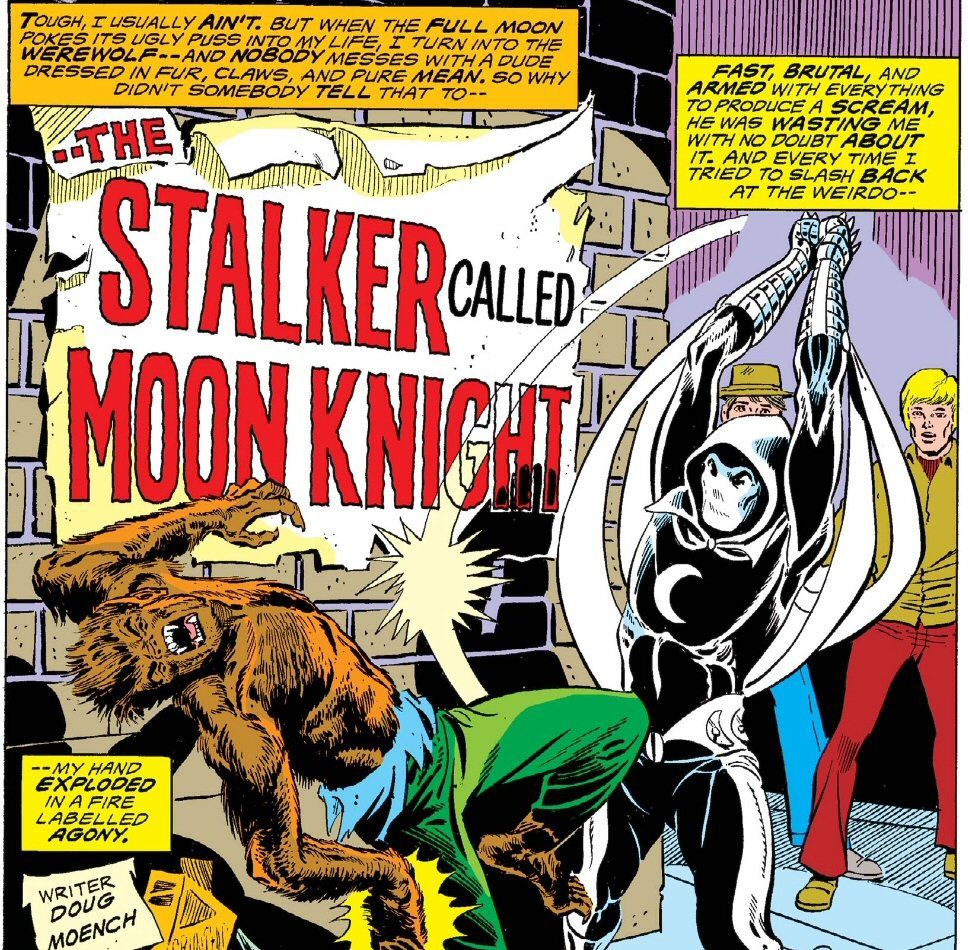
As the above opening panel illustrates, this was a different type of character originally (“the stalker called Moon Knight”). Here, “Mark” Spector was simply a mercenary who would take jobs-for-hire from unsavory characters, including the shadowy villains of this series (“The Committee”).
Of note, these older Moon Knight stories – up to and including the fist issue of Moon Knight Vol 1 in 1980 – portray certain cultures (and members of society) in very stereotypical terms that are painful to read. They also all have the following warning message on the Marvel Unlimited site:
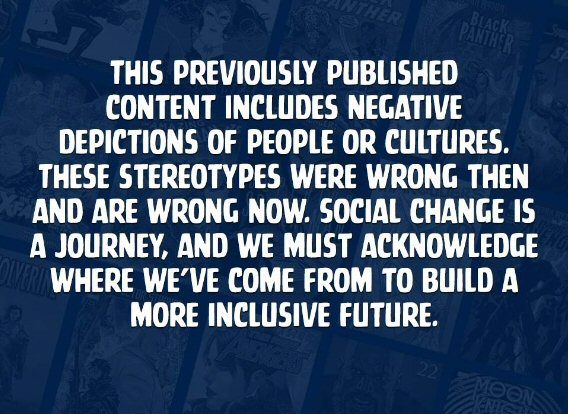
Although I don’t think they are explicitly referring to the depiction of Marc’s mental illness in these comics, that could also be covered in the broad message above too. Let’s dig in …
Early comics
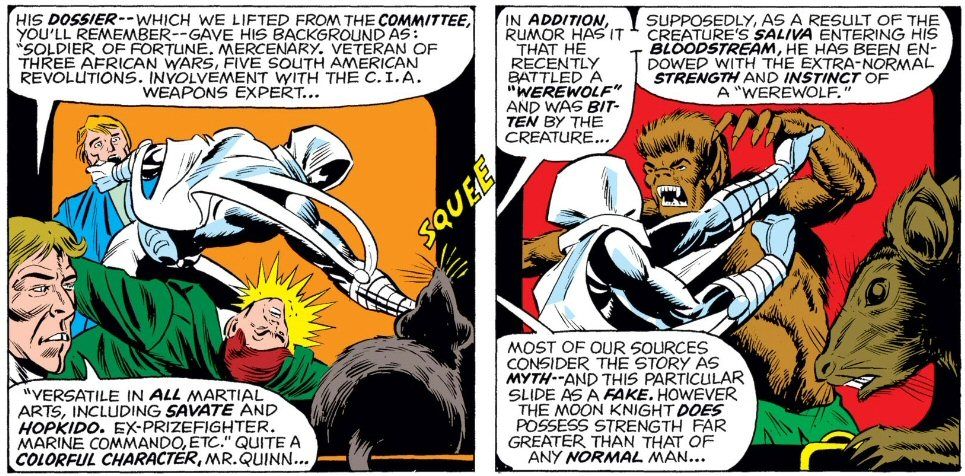
We get a proper introduction to the character in Marvel Spotlight Vol 1, issue #28, 1976, again by Doug Moench and Don Perlin. Now, Moon Knight is “Marc” Spector, a self-styled vigilante. Moon Knight’s (slightly revised) history and background are explained in a series of expository panels by a henchman of this series’ villain (a very Bond-like Blofeld character, only with rats instead of cats):
This is also where his multiple identities are first described – with Steven Grant specifically named below:
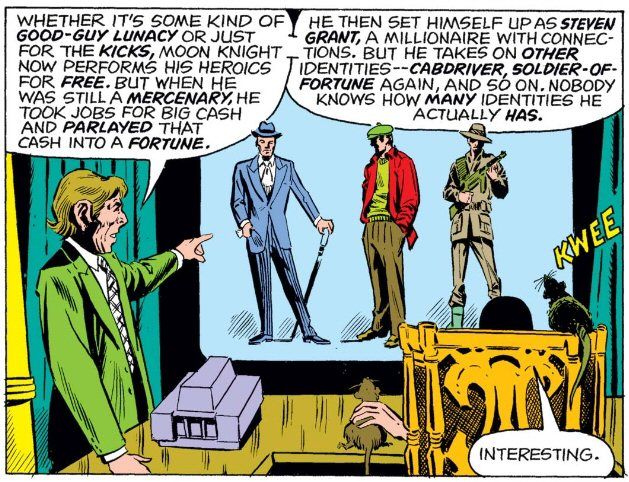
This is also the first indication that these identities may not be conscious alternate identities, but some sort of “lunacy” (groan). Later in this issue, we are introduced to the now-named cab-driver identity, Jake Lockley:
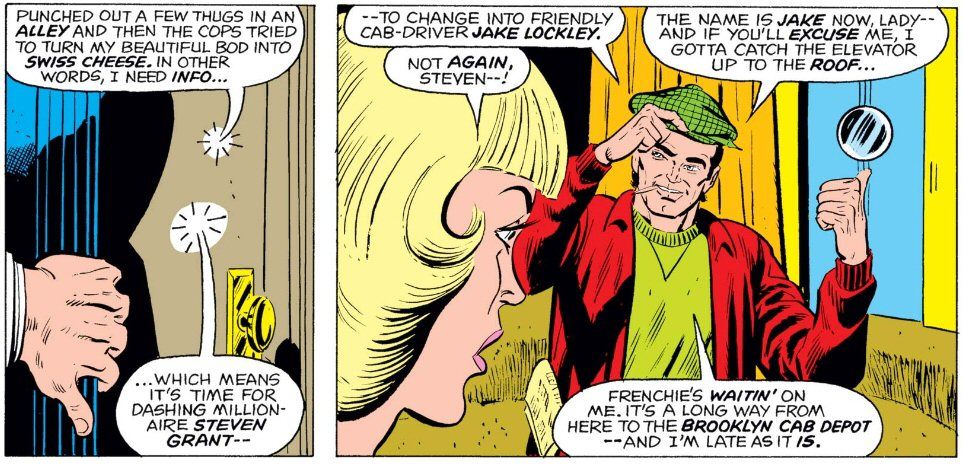
Although Marc’s personality shifts considerably, it still isn’t entirely clear if he is putting on a role or has literally “switched” identities involuntarily (although the later is implied). This next series of panels seems to clear that up though, when millionaire Steven Grant has to switch into Moon Knight at a party:
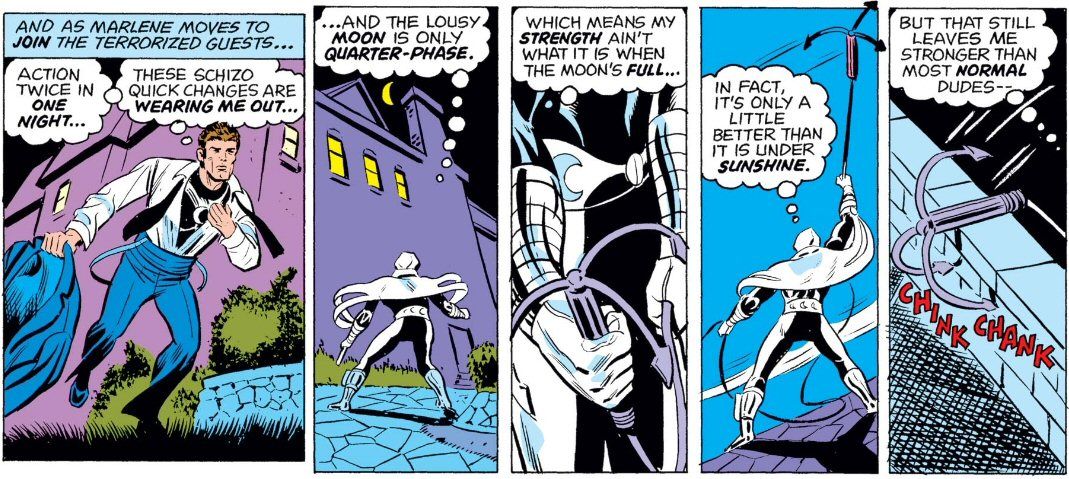
Use of the term “schizo” (presumably for schizophrenia) strongly implies an intended mental illness at play in terms of these various personas. These panels also indicate that he gets his powers from the moon, which hadn’t been established previously.
I suspect Moench was going for a “multiple personality” type illness for Moon Knight, along the lines of the popular American TV movie Sybil that was released later that same year (based on the 1973 book of the same name by Flora Schreiber). This movie, along with the earlier film The Three Faces of Eve (with a book of the same name by Corbett Thigpen and Hervey Cleckley) were considered to be based on true cases, and cemented the idea of “Multiple Personality Disorder” in American popular culture. But the research behind these cases was flawed, as briefly described here for the fraudulent case of the Sybil book. Scroll down or jump to my Moon Knight mental health section at the end for an explanation of this mental disorder (which was renamed Dissociative Identity Disorder – DID – in the 1990s).
The Moon Knight character makes a few guest appearances in the Defenders and Spider-Man stories of this era, before being somewhat rebooted with the launch of his own title: Moon Knight Vol 1, issue #1, 1980, by Doug Moench and Bill Sienkiewicz. Sienkiewicz’ moody and action-oriented art style proved to be very popular with fans – it is still often alluded to today as particularly emblematic for the Moon Knight character.
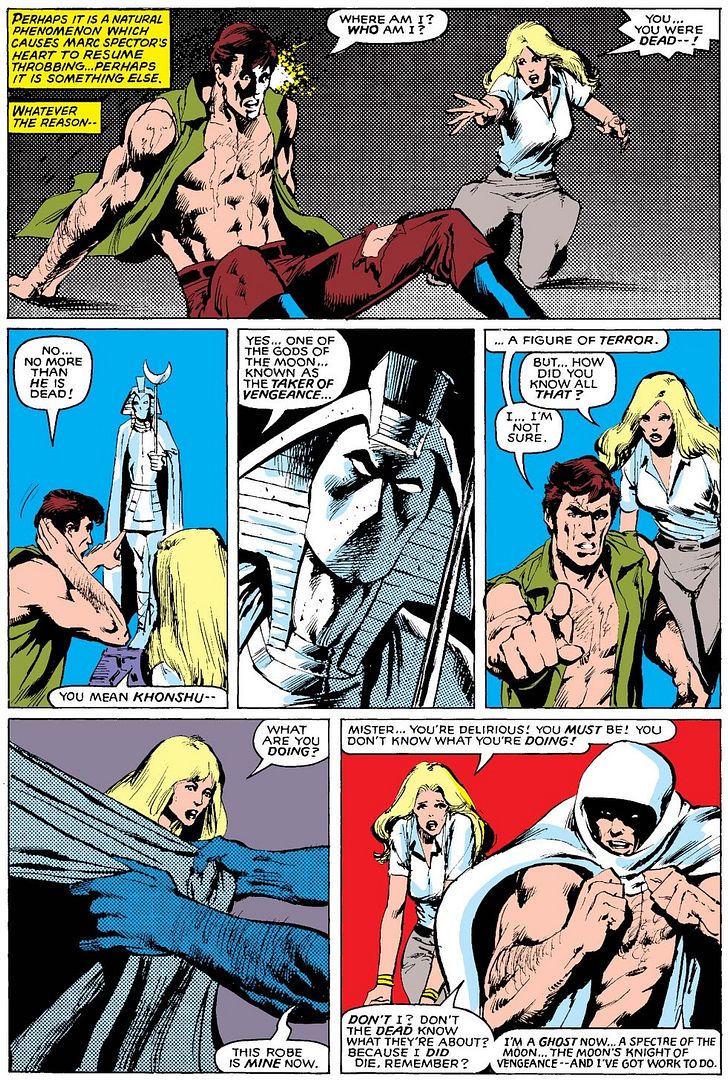
This series started with a new, more-detailed origin story, where mercenary Marc Spector (who seems like a pretty decent person, under the circumstances) died on a mission in Egypt, and was miraculously reborn at the foot of a statue of Khonshu, to become the “moon’s Knight of Vengeance”:
It was soon explained to the reader who his allies were – and his two specific alternate identities:
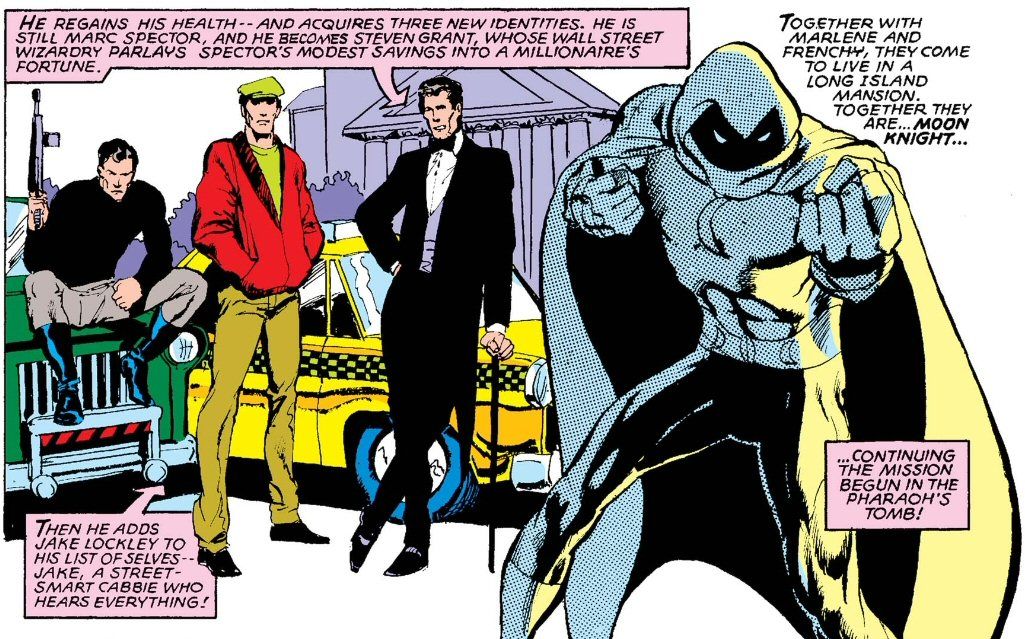
Note there is nothing in this issue to explicitly suggest he was mentally ill. But the theme that these alternate identities were not under his conscious control quickly resurfaced in this series. Eventually, they were referred to “alters”, using the same language as the Sybil story and movie.
After a few years, Alan Zelenetz took over the title (having recently departed Thor), and his first action was to try and stabilize the character around the Steven Grant identity. I was a big fan of Doctor Strange in this era, so I couldn’t miss his first appearance in the first issue of Zelenetz’ run, Moon Knight Vol 1, issue #36, 1984, by Zelenetz and Bo Hampton. Here, Steven attempted to deny his previous reincarnation by Khonshu:
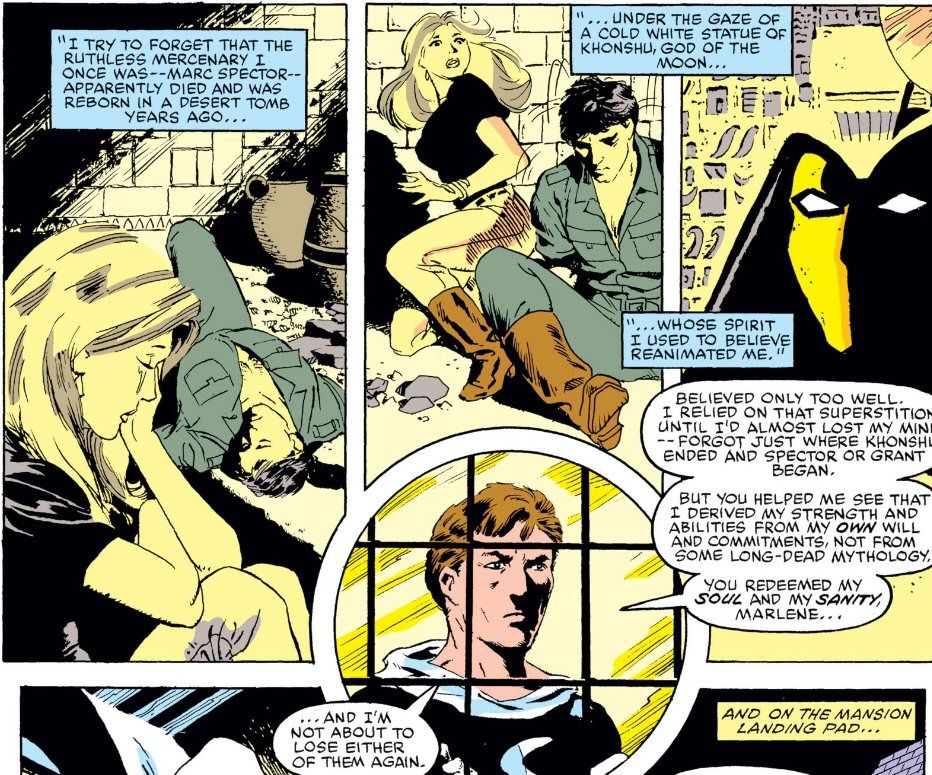
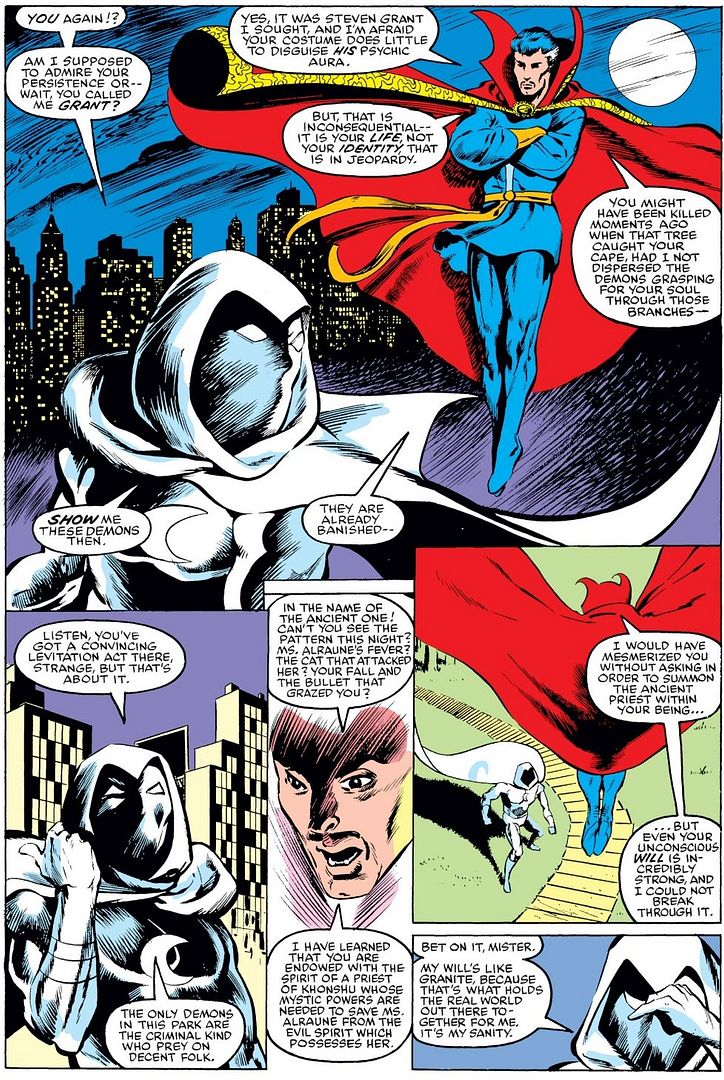
Doctor Strange (as an established magical authority) is thus a useful vehicle for Zelenetz to officially clarify Moon Knight’s relationship to Khonshu:
In the end, it seemed as if Moon Knight would continue as the “complete man” Stephen Grant:
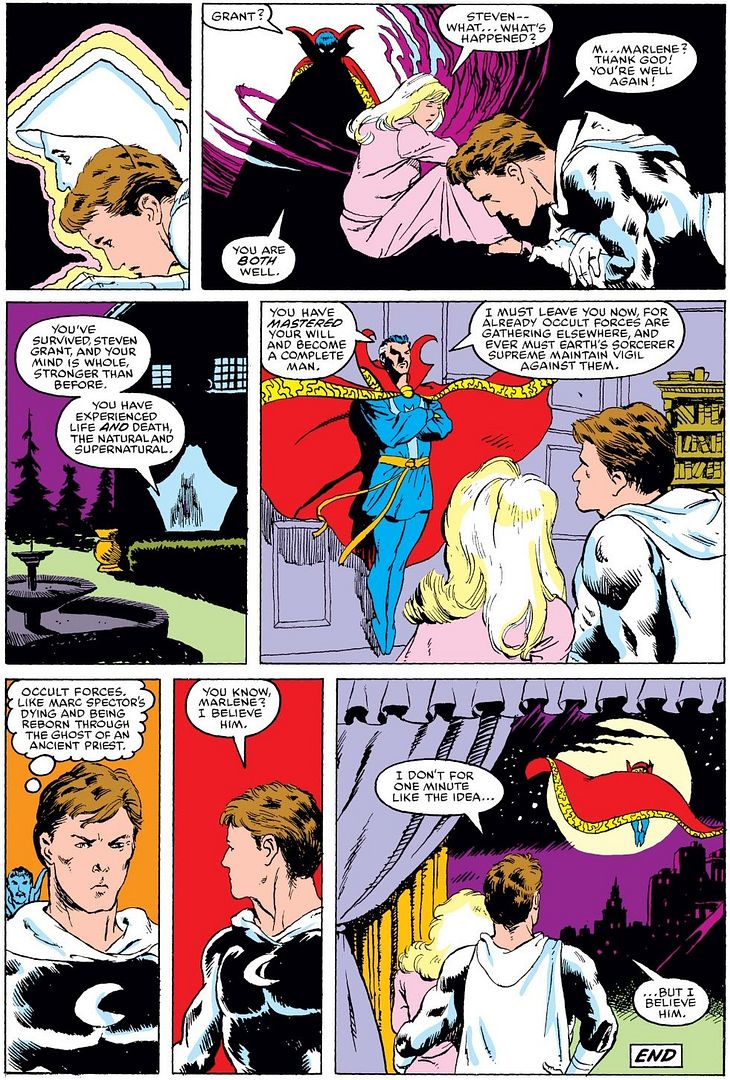
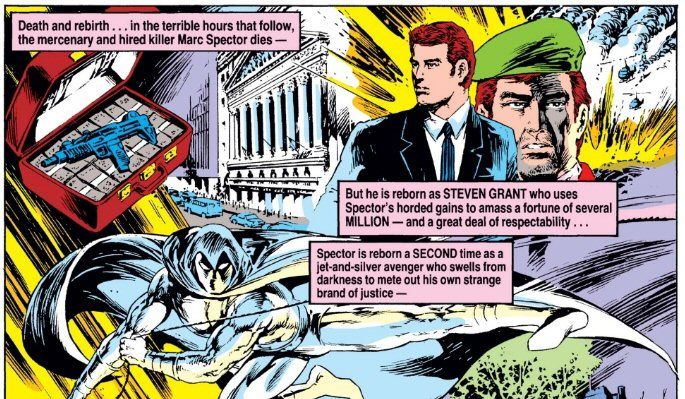
This struck me at the time as a very sensible move for Zelenetz. So, I’m not sure why this didn’t stick – for some reason, Zelenetz soon relented, and he became Marc Spector again a few issues later – just in time for Zelenetz’ relaunched new series Moon Knight Vol 2, 1985 (which only ran for six issues). From issue #1, by Zelenetz, Chris Warner and E.R. Cruz, which seemed to imply that Grant was just a phase in Moon Knight’s evolution:
Here, Zelenetz fully leaned into the mysticism aspects of Moon Knight, with some magical artifact upgrades in this issue (although is it just me, or does he also look more like a WWE wrestler now?):
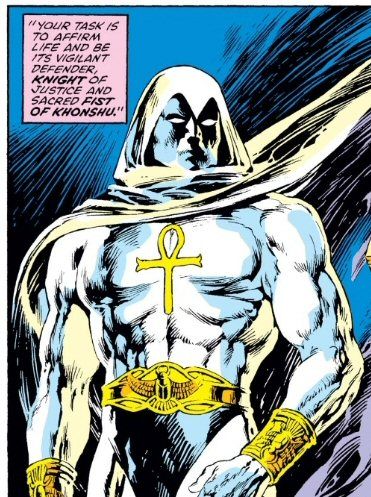
Also, I believe this is the first time he has been referred to as the “Fist of Khonshu”.
Once this series ended, we didn’t see Moon Knight for a couple of years until he joined the West Coast Avengers (1987). This is followed a couple of years later with a new longer-running series: Marc Spector: Moon Knight Vol 1, issues #1-60, 1989–1994, initially by Chuck Dixon and Sal Velluto. I guess they really wanted the Marc Spector name to stick!
During these years, he seemed to be a more traditional character, based simply on Marc Spector (I didn’t notice any mention of the other two identities). This series did introduce Marc’s brother Randall, who fights against Marc as the ShadowKnight. Marc dies at the end of this series, but was resurrected four years later in a limited series, Moon Knight Vol 3, issues #1-4, 1998, by character co-creator Doug Moench with Tommy Lee Edwards. In this series Moench reestablished his earlier “multiple personality” version of the Moon Knight character (sigh).
There was a follow up limited series, Moon Knight Vol 4, issues #1-4, 1999, by Moench and Mark Texeira. But after that, Moon Knight had another extended slow period where he turned up in the Marvel Knights series (2000-2001) and as a guest character here and there in other series.
Modern comics
Moon Knight didn’t get his own series again until Moon Knight Vol 5, issues #1-30, 2006-2009, initially by Charlie Huston and David Finch. This series was very different in tone and style. It quickly ventured into gruesome, body horror-like territory, with a very physically and psychologically damaged Marc trying to regain his status. It was also revealed that Khonshu had been working behind the scenes to further torture Marc – in hopes of driving him to further extremes in his service as Khonshu’s instrument of vengeance. This series was significant as it first showed Khonshu as an explicit presence in Marc’s life (and painted him in a very negative light at that).
This series was restarted (with a continuing story line) as Vengeance of the Moon Knight Vol 1, issues #1-10, 2009-2010, by Gregg Hurwitz and Jerome Opeña. This series further expanded on Khonshu being an explicitly malign force within Marc, and one that his alternate identities (specifically Jake) were trying to push away from. From the issue #2 opening title page, which summed up the current situation well:
As Moon Knight, Spector prowls the night, meeting out brutal justice to those would prey on the innocent. But years of trauma have left Spector mentally unstable and he is haunted by visions of Khonshu, begging him to become the killer he once was. Now it’s up to his few friends and his on-again/off-again lover Marlene to remind him of his innate humanity and to pull him back from the brink of madness …
Eventually, this series ended with Marc stabilizing somewhat, and becoming a Secret Avenger, during Brian Michael Bendis‘ Avengers run and Siege cross-over event. However, Hurwitz and Bong Dazo then took the character for a 3-issue limited series (Shadowlands: Moon Knight Vol 1, 2010). In this series, a possessed Daredevil sicked the ShadowKnight (Marc’s bother Randall) on Marc. Marc had to enlist Khonshu’s help in trying to stop his brother but was forced by events to kill Randall instead – dealing another blow to his mental health.
At this point, Bendis took over the character for an extended Avenger-era period in Moon Knight Vol 6, issues #1-12, 2011-2012, written by Bendis, with art by Alex Maleev. These stories (mercifully) focused on Marc simply being an Avenger.
After a brief pause, Moon Knight returned in a significant series, Moon Knight Vol 7, issues #1-17, by Warren Ellis and Declan Shalvey. The first story arc featured the first appearance of the Mr. Knight persona, and reframed his complicated relationship with Khonshu (and other alternate identities). It began with this opening series introduction:
Mercenary Marc Spector died in Egypt, under a statue of the ancient deity Khonshu. He returned to life in the shadow of the moon god, and wore his aspect to fight crime for his own redemption. He went completely insane, and disappeared. This is what happened next.
Ok, that was a pretty blunt way to put it! Marc was seeing a psychotherapist in this series, who quickly concluded in the first issue that Marc didn’t have DID. From issue #1:
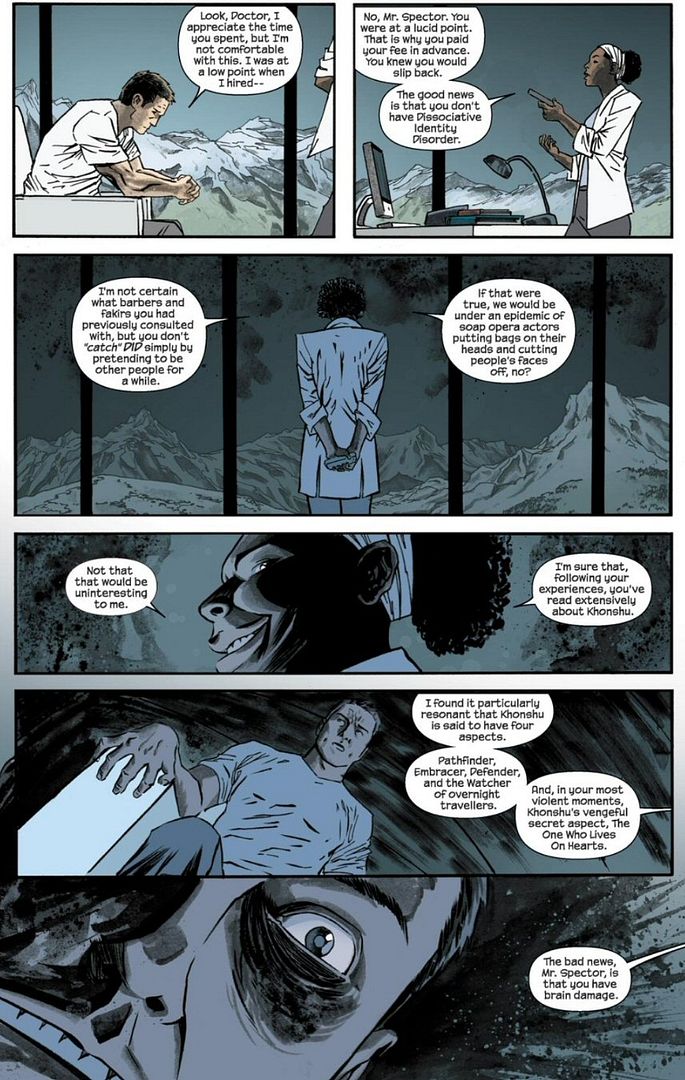
This was a new twist – and a very welcome one from my perspective. So, in this new retelling, Marc was actually suffering from brain damage from his exposure to Khonshu. The psychotherapist goes on to explain that as Marc cycled through the (newly defined) four aspects of Khonshu (Pathfinder, Embracer, Defender, and Watcher of overnight Travelers), his mind responded by creating explanations in the form of new identities. This is probably the best way to integrate a dissociative identity disorder into the character (jump or scroll down to the section on Moon Knight’s mental health for more info on DID).
This series also had a great second story arc (issues #7-12, 2014-15) by Brian Wood and Greg Smallwood. Marc’s psychotherapist was revealed to be Elisa Warsame (with a complicated family history to Marc’s past life as a mercenary). Warsame betrayed Marc and succeeded in “stealing” Khonshu away from him for a while. Marc recovered himself – and Khonshu – and stopped Warsame. From issue #12:
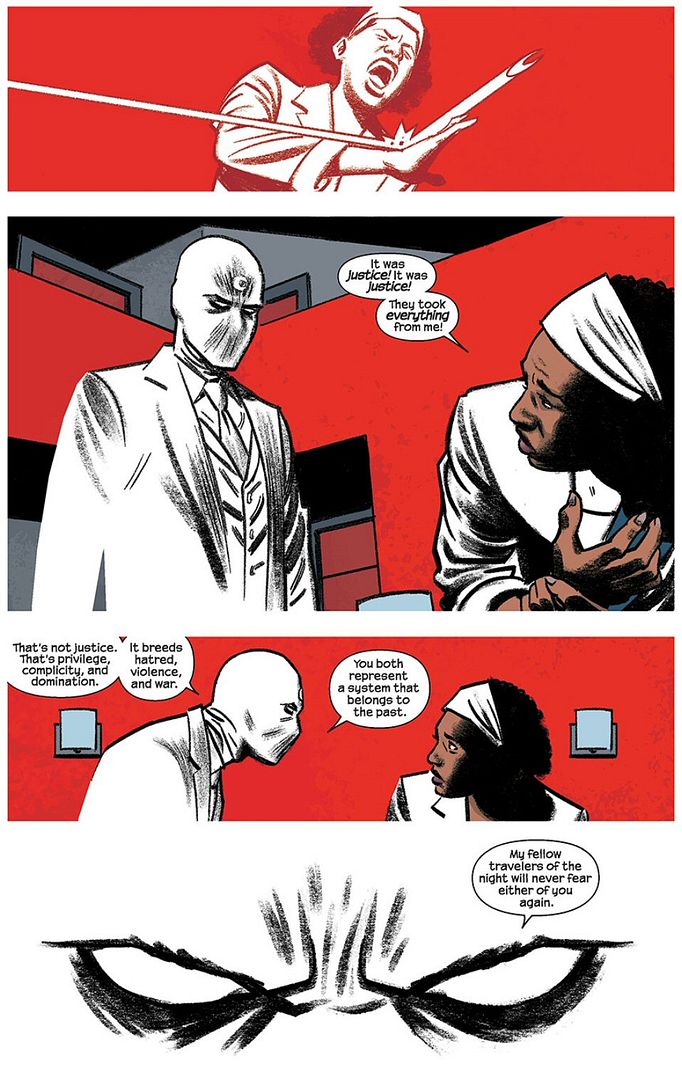
This story put Marc back on the path as the official Fist of Khonshu – and, I would argue, represented the true modern origin for the character (and later, the jumping off point for Jed MacKay). The series ended with a third story arc by Cullen Bunn and Ron Ackins, ending at issue #17.
Not much happened until a … distinctive … new series came along a year later – which blew everything up again. Moon Knight Vol 8, issues #1-14, 2016-2017, by Jeff Lemire and Greg Smallwood, began with Marc finding himself in a mental hospital, unclear of what was real and what wasn’t. Events get increasingly surreal across the first story arc. By the second story arc, you can see how the previous series’ opening description had changed (from Vol 8, issue #10):
Mercenary Marc Spector died in Egypt under a statue of the moon god Khonshu. In the shadow of the ancient diety, Marc returned to life and took on Khonshu’s aspect to fight crime for his own redemption. In time, the many different identities he had carefully maintained began to slip out of his control … and so did his grip on reality itself.
Despite a successful resolution to Moon Knight Vol 7, this new Vol 8 series basically showed Marc as being unable to distinguish delusion from reality, and he became a completely unreliable narrator of his own life. In this retelling, Khonshu had also visited Marc far earlier in his life, claiming to be Marc’s true “progenitor”. But this series did show Marc being at odds with Khonshu, and attempting to resist his influence.
I don’t have much more to say about this series – in part because I don’t think it was a helpful addition to the canon, but also because everything that happened was immediately retconned when a new team took over. Coinciding with the return to the Marvel Legacy numbering, the new Moon Knight Vol 8, issues #188-200, 2018, by Max Bemis and Jacen Burrows upended everything, with the entire previous run wiped out as Marc being simply delusional. Here is a quote from Bemis on the subject:
Everything in the last arc took place in Marc’s head or as an abstraction. Reconciling his illness left Marc able to reappropriate Khonshu.
- Max Bemis, 2017, Twitter.
In this series, Bemis tried going in a whole new direction. Now, there was a very traumatic event from Marc’s childhood: a rabbi and close friend of the family turned out not be a holocaust survivor like Marc’s father, but rather a sadistic Nazi named Ernst who continued to hunt, torture and murder Jews – and escaped justice yet again. In this latest retelling, this discovery was the trigger for Marc’s alternate identities. The retconned use of an early trauma to explain his supposed mental illness is unfortunate in my view – jump down to my section on Moon Knight mental health if you want to learn more.
To be honest, I think it would have been better if both the Lemire and Bemis story lines had not occurred – things were left off in a much better place at the end of Ellis’ excellent Vol 7 run in 2015.
But onward and upward … with the Age of Konshu in Avengers Vol 8, issues #33-37, 2020, by Jason Aaron and Javier Garrón. This major story line (by one of Marvel’s top writers) had Earth-shattering effects. From early in the opening issue #33:
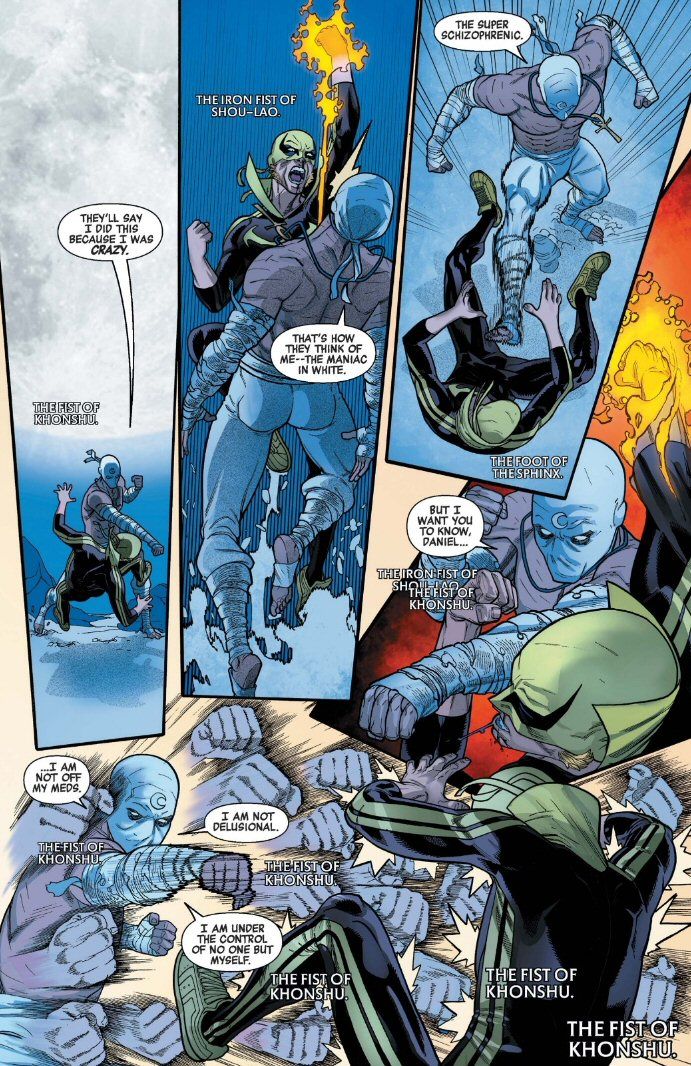
Over the course of this series, it is revealed that both Marc and Khonshu have had their own visions of Mephisto’s evil scheming and plans to take over the world. Marc agreed to steal the various powers Khonshu would need to take over the world – in order to save it from Mephisto.
Marc defeated various heroes and stole their powers – including (in an increasingly unbelievable order) Iron Fist, Ghost Rider, Doctor Strange, Thor (and taking Mjolnir!) and finally the Phoenix (!!). There was an interesting ethics angle to this event, as Marc argued he is not being controlled by Khonshu, but actually agreed with him. From an argument with a chained Black Panther, from issue #34 (by Jason Aaron and
Javier Garrón):
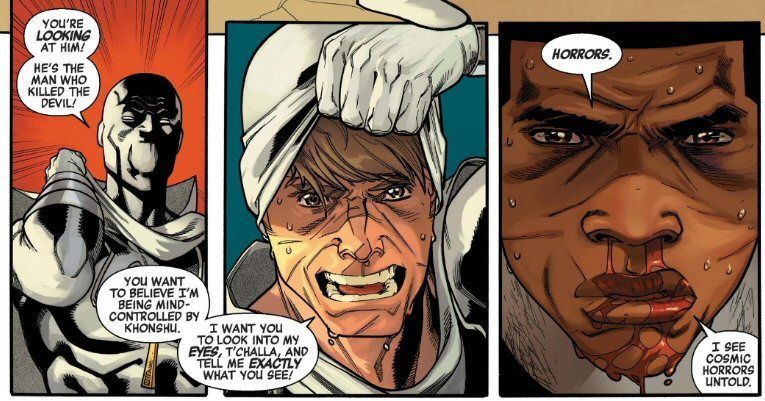
This was no divine command theory in action (scroll or jump down to my ethics section below). While Marc’s actions were hard for his former friends to accept, he initially justified them by some very utilitarian (consequentialist) reasoning – it was all for the greater good of stopping Mephisto.
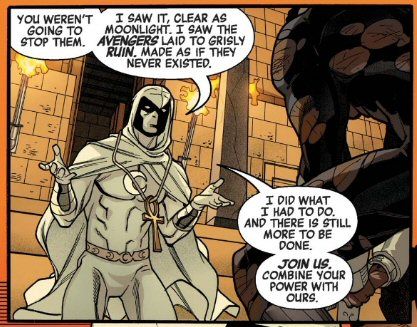
As this series unfolded, Khonshu became increasingly unhinged in creating his moon god-utopia on Earth, and Marc came around to finally seeing he was wrong to help him. Working with the remaining Avengers (and some of the acquired powers he kept for himself) Marc helped defeat Khonshu – who was then imprisoned by the Aesir in Asgard.
And that sets up everything you need to know to understand the new MacKay era, which really helped to put everything on much better footing.
Jed Mackay Era (2021 to present)
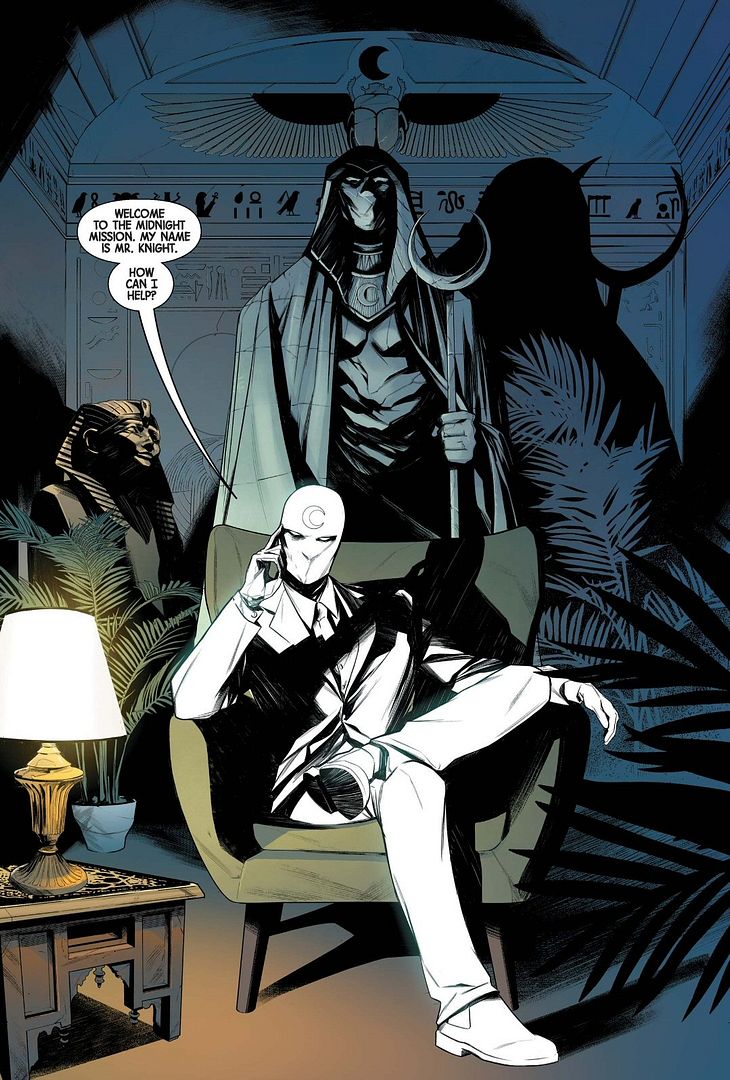
Thus begins the first issue of Jed MacKay and Alessandro Cappuccio‘s run: Moon Knight Vol 9, issue #1, 2021. This series ran from 2021-2024, ending in issue #30 (before continuing in the next series of the ongoing story line, Vengeance of the Moon Knight Vol 2). I’m going to spend a bit of time on this issue, because it sets up a lot of what is to come.
The opening splash page tells you a lot right out of the gate. The Mr. Knight persona (created by Warren Ellis for the Moon Knight Vol 7 era, 2014-15) is a great starting point, as he seemed a particularly stable new identity. The watchful eye of a statue of Khonshu suggests he has made some sort of peace with his currently imprisoned resurrector. And Mr. Knight seems to be engaged in the role of protector of those who travel by night – given the lighting, his offering of help, and the name of his new “Midnight Mission”.
I’ve observed before that MacKay is the master of recovering complex, inconsistent, and heavily revised/retconned characters (see my Doctor Strange and Clea overviews). He seems to have an encyclopedic knowledge of the characters he takes over, and knows just the right parts of their back histories to focus on in their rehabilitation (without contradicting other elements). I’m hard-pressed to imagine a greater challenge to tackle than Moon Knight!
Marc jumps right into an action as Moon Knight on the next page, taking out a group of vampire cultists who seem to be engaged in a multi-level marketing (MLM) scam of new vampire creation:
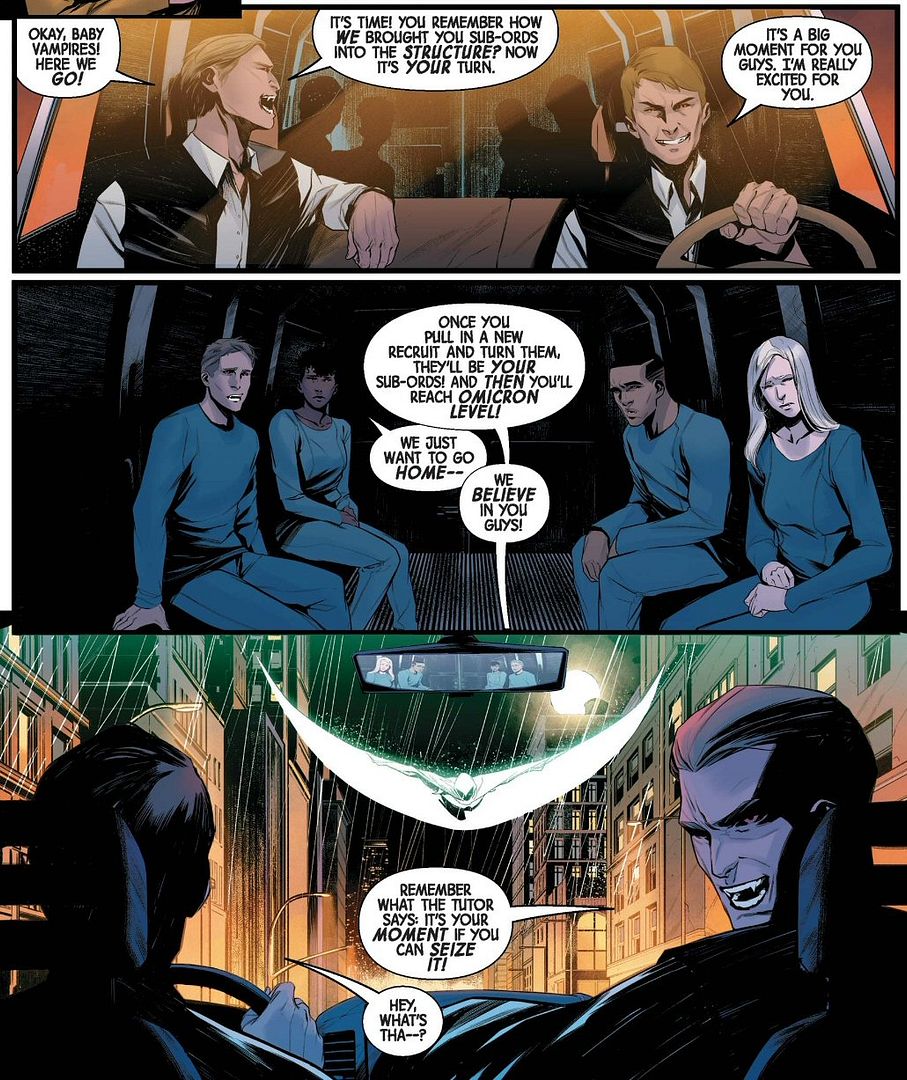
As an aside, this is a hilarious depiction of the “structure” – I don’t think I’ve seen vampirism so explicitly compared to MLM before, but it certainly fits!
As a classic example of a group that preys on travelers by night, Moon Knight quickly kills the vampires driving the van. But then something interesting happens: he spares the “baby vampires”.
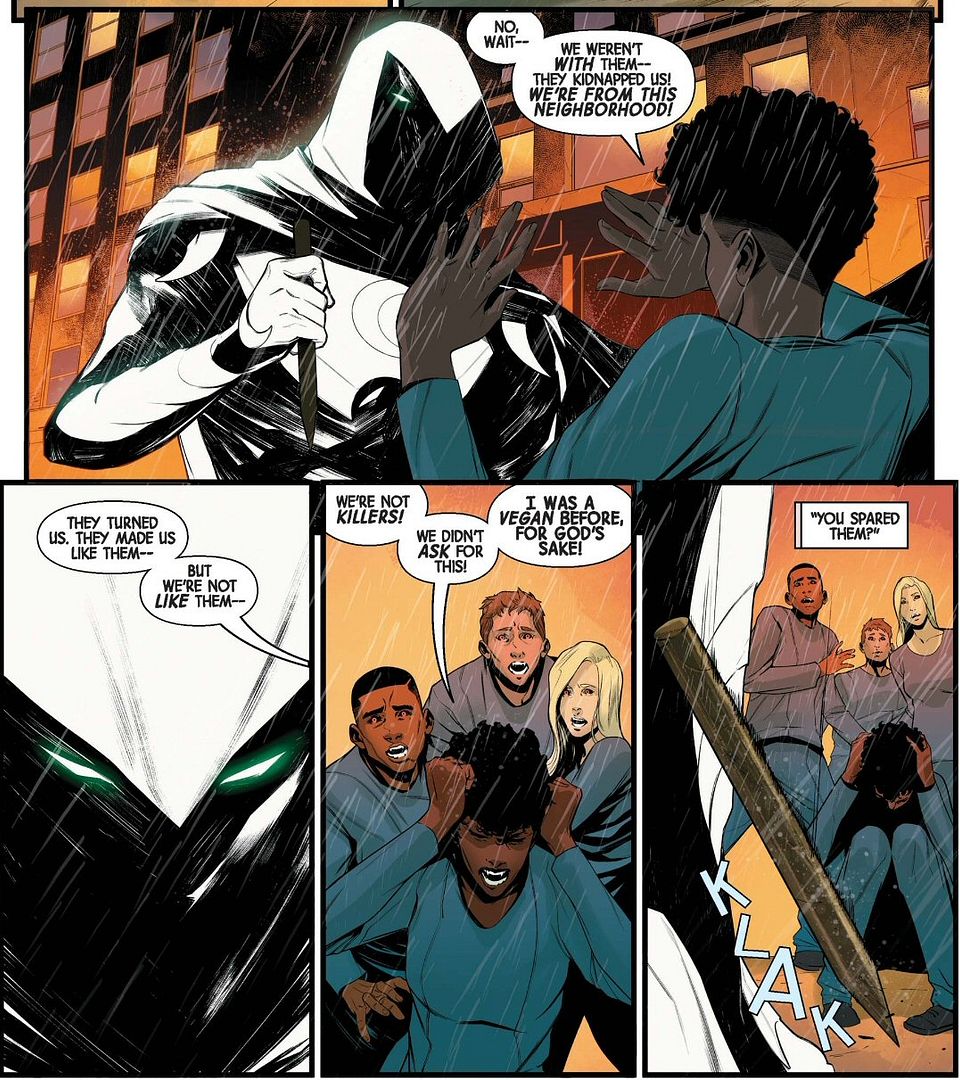
One of the ones he spared above was Reese (the former vegan), who comes to work for Mr. Knight and his Midnight Mission. But the last panel also leads to the introduction of Marc’s new psychiatrist – Dr. Andrea Sterman.
Interestingly, MacKay didn’t create an entirely new character here. Dr. Sterman was a minor character created in an early 1990s series, brought back for two turn-of-the-millennium series, and then forgotten until MacKay brought her back briefly in a series he wrote a couple of years earlier. She has since become a series regular and has also appeared in the X-Men: From the Ashes infinity comic.
On the next page, we get to hear Marc’s reasoning. Note that although he goes exclusively by “Marc Spector” now, you only see him in either his Mr. Knight or Moon Knight form. His therapy sessions and Midnight Mission community activities are all done as Mr. Knight (although those who know him all call him Marc).
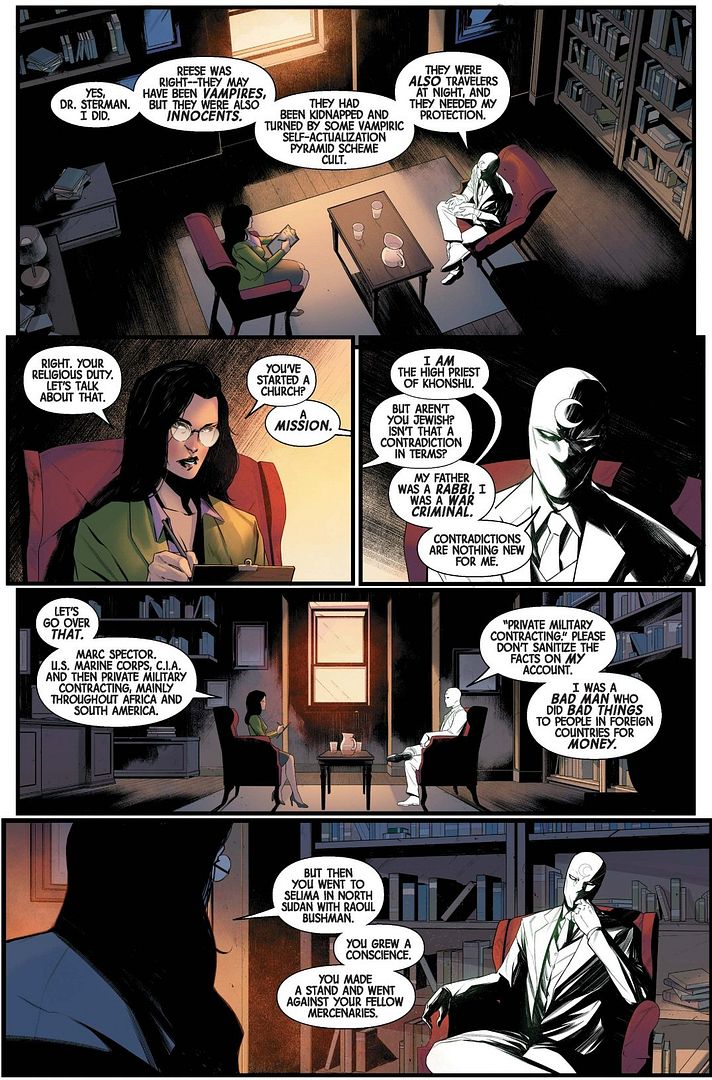
This is a pretty good retelling of Marc’s past, although the “high priest of Khonshu” bit is new to me. It is an interesting addition to the many roles Marc plays. I will discuss Marc’s “religious duty” in my ethics section below.
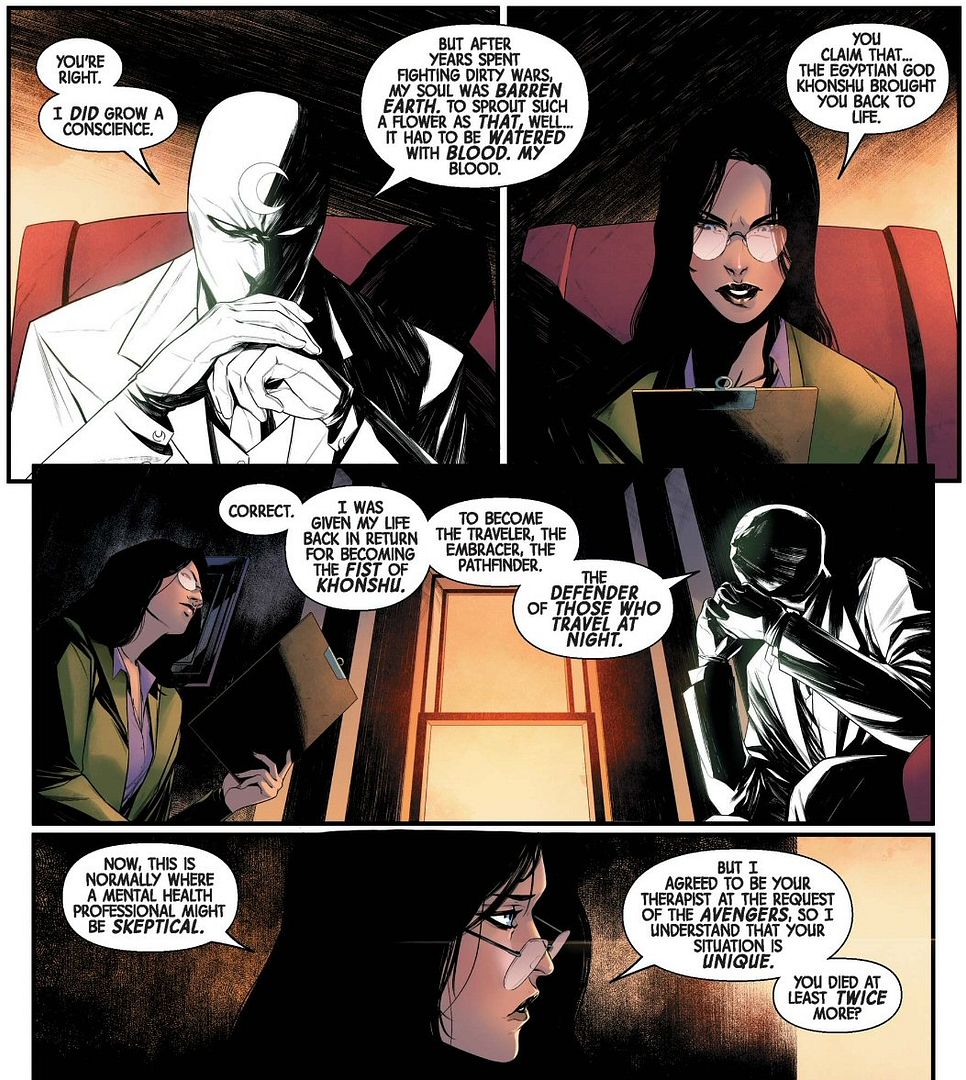
This is an interesting (and effective) updating of Ellis’ earlier description of the four aspects of Khonshu (“Pathfinder, Embracer, Defender, and Watcher of overnight travelers”). Now, MacKay’s Moon Knight is the Traveler, Pathfinder, Embracer, and Defender of those who travel at night.
But what is even more important – and a new key feature of MacKay’s Moon Knight run – is Marc being under the psychiatric care of Dr. Sterman (ostensibly to reassure the Avengers after the events of Jason Aaron’s Age of Khonshu story line). But that’s just an excuse. The fact is that Dr. Sterman fulfills a key role in reassuring the reader of what is going on here. Indeed, her role and participation increase over MacKay’s run – long after the Avengers issue matters to anyone.
Over the long, convoluted history of Moon Knight, Marc (or whomever he goes by) is not to be trusted as a reliable narrator of his own story. Many previous runs pulled the carpet out from under readers by upending what Marc was saying/doing/perceiving. The point of the “therapy” sessions here is not necessarily to simulate therapy: it’s really about clearing up the incredibly inconsistent background for the character and reset under a new agreed-upon coherent and consistent story. And by having it discussed and validated/challenged by Dr. Sterman, the reader can finally be reassured what is happening in these stories is real.
A key aspect of Marc’s personality is quickly established in the following pages of this issue. A elderly resident of an apartment building comes to the Mission to ask for help with monsters who come out at night. Marc quickly identifies them as Vermin clones, a historical Spider-Man/Captain America villain. But unlike Spidey and Cap, Marc’s Moon Knight doesn’t seem to have a problem with killing one of them:
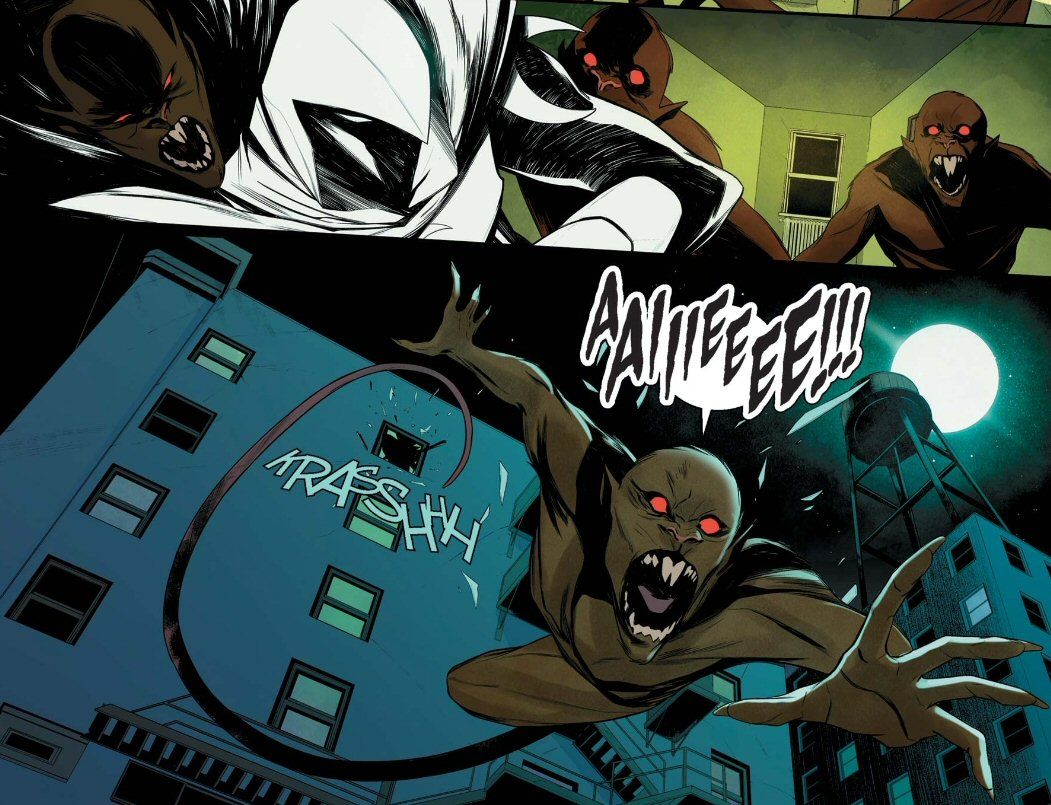
That apparent murder gets their collective attention. As Moon Knight stands in front of the window he just threw one of them out of, he explains his reasoning:
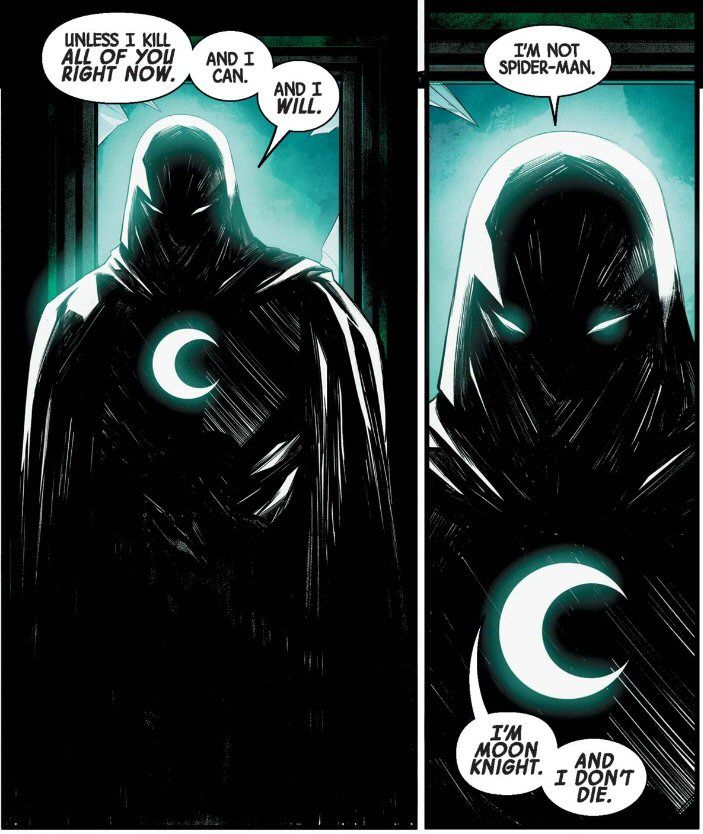
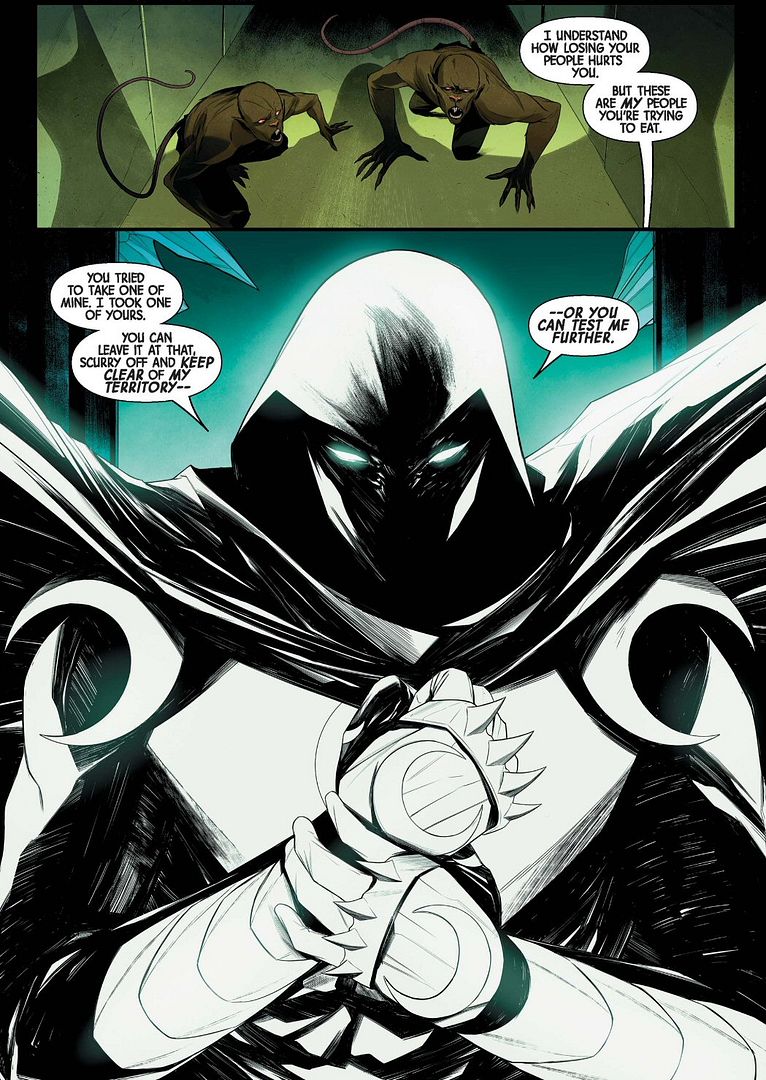
As MacKay’s Moon Knight observes, he is not like other superheroes. He is quite comfortable killing, but seemingly only in direct retribution – or for preventing further violence. This tit-for-tat (or “eye-for-an-eye”) philosophy is very similar to MacKay’s Clea. And not surprisingly, these two characters soon have a cross-over adventure and seem to get on quite well (much to Doctor Strange’s chagrin, given his recent history with Moon Knight in Avengers’ Age of Khonshu). I’ll discuss the retributive justice aspects of the character in my ethics section below.
Interestingly, there is no immediate discussion of Marc’s DID. Later in this issue, Dr. Sterman tells Marc a story of the earliest English poet, Caedmon, whose supposed exposure to God’s angels changed his mind and abilities.
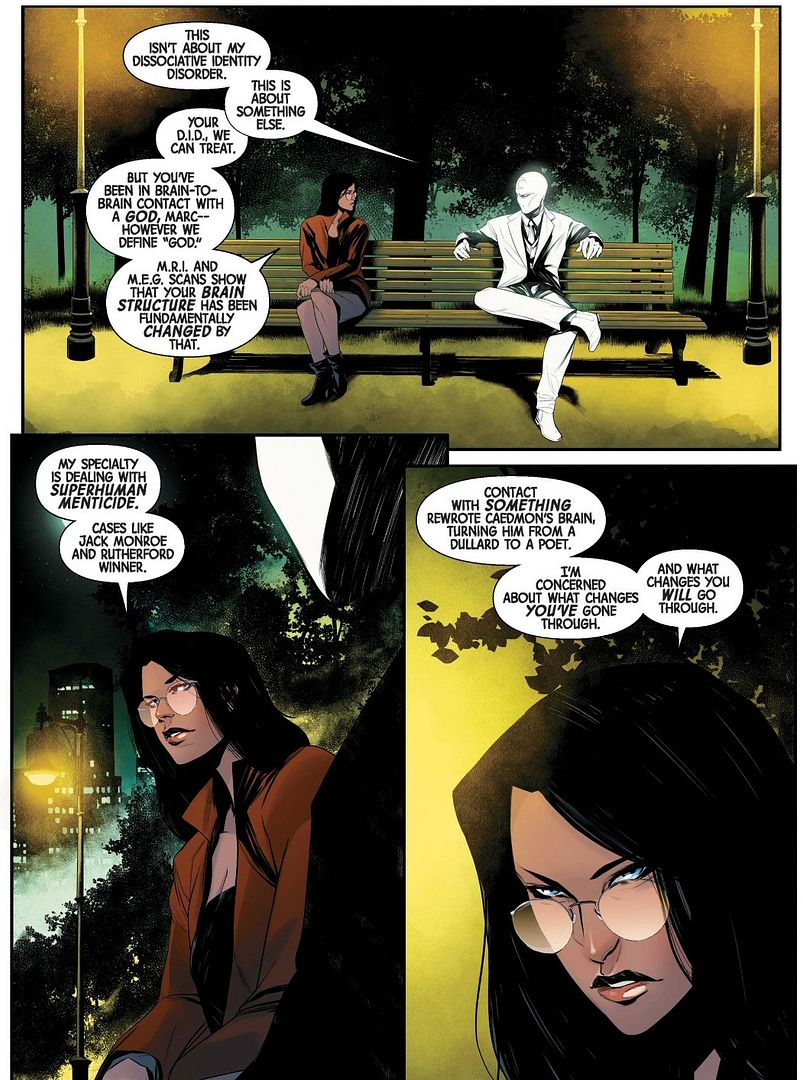
This again hearkens back to the earlier Ellis’ run, where it was established that direct mental contact with a god (however defined) had permanently altered Marc’s brain. But MacKay wisely and adroitly sidesteps the whole confusing and inconsistent issue of when/how Marc’s DID develop (at least for now). His DID diagnosis is simply a separate issue, and one they are not going to deal with right now while there is so much to set up for this new series.
At this point, Marc points out that his previous psychotherapist told him something similar (again from the Ellis run) … “But once she began trying to kill me, we never followed up on it” (from Brian Woods’ subsequent run). 🙂
The first issue ends with the confirmation that a new character introduced this issue, Dr. Badr, is in fact Hunter’s Moon, another Fish of Khonshu (as he observes, most of us have two fists after all!). Hunter’s Moon is not happy with Marc’s attitude and approach, and seeks correction. Eventually, they establish a detente and work together, but it adds some ongoing tension to the series.
As great as MacKay’s writing is in explaining how Moon Knight will now operate, Alessandro Cappuccio‘s drawings and Rachelle Rosenberg colors really seal the deal here. The pairing of these three creators was editorial genius. Cappuccio’s angular and foreboding style – equally at home in frenetic action scenes and quiet discussion moments – works so well with MacKay’s scripting. Combined with Rosenberg’s vivid and evocative coloring – I couldn’t have imagined a better collaboration.
Another significant character (and departure for Moon Knight) was the introduction of a very old entity from early in the Doctor Strange comics – the House of Shadows. First created in 1964, it reappeared a couple of times (the last time in Doctor Strange, Sorcerer Supreme Annual Vol 1, issue #2, 1992). In Moon Knight Vol 9, issue #9, Marc investigates the top floor of a building where people enter – but no one exits. Marc is trapped there for days until the predatory entity that is masquerading as the top floor contacts his mind – but finds Marc toxic given his connection to Khonshu and expels him from the building.
Marc returns, intending to kill the entity (by destroying the building). However, he comes to realize something instead (from issue #9, by MacKay and Cappuccio):
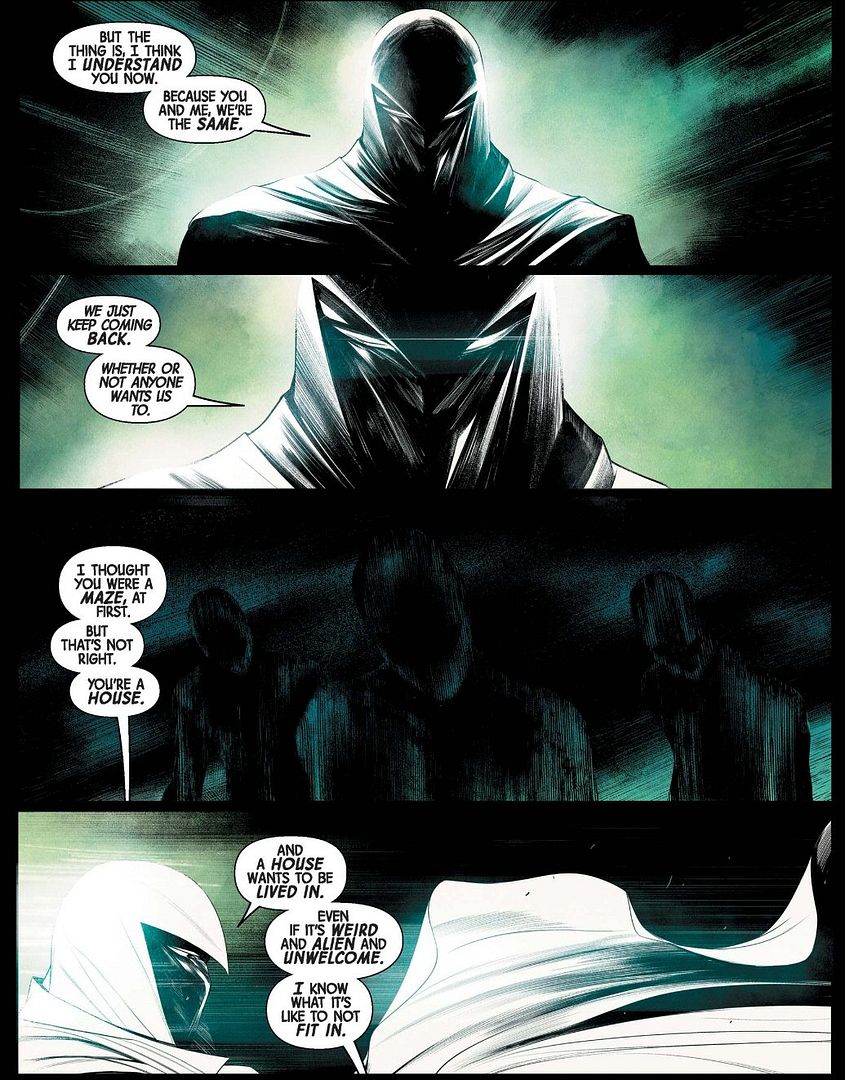
So Marc makes the entity an offer – release the people it had captured and join him and his allies for a new sense of belonging and purpose (a new mission, you might say). Note that by this point in MacKay’s run, Marc and his allies have drawn a lot of attention – and attacks – the most recent having virtually destroyed the Midnight Mission building. And so …
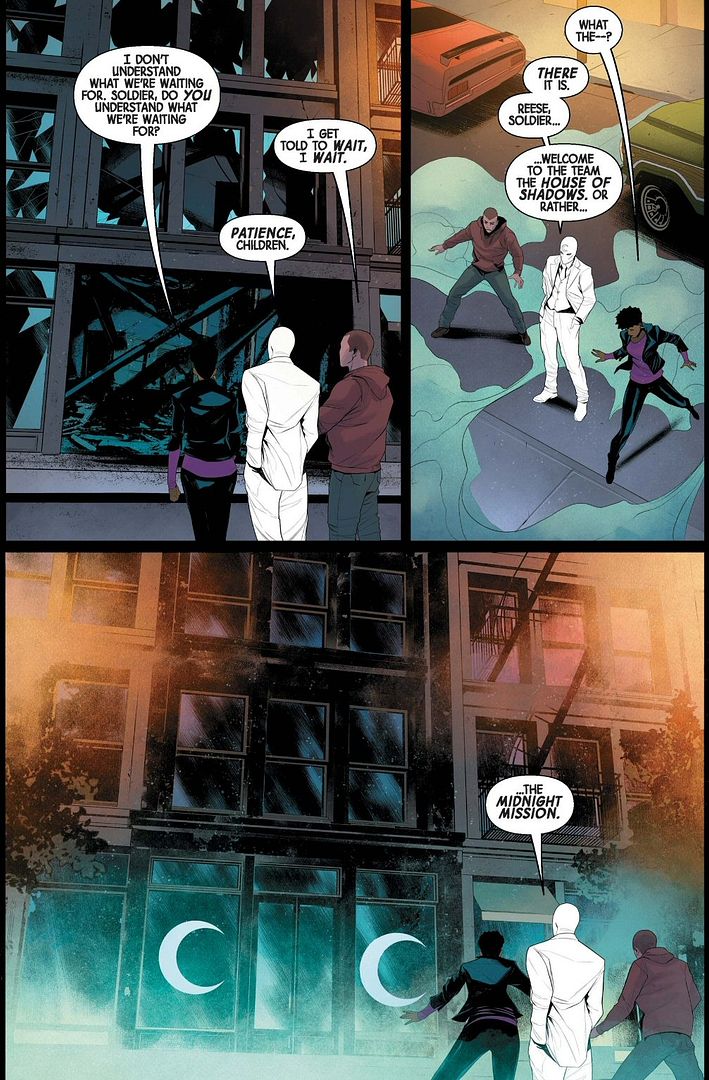
This latest example of care and compassion from Marc explains why he is able to construct such a dedicated team. It is also an example of the care ethics he displays (as I will discuss further in my ethics section). Other members also join the group this first year, including Soldier (a reformed former HYDRA agent), the oddball ex-con “8-ball”, and Marc’s old West Coast Avengers colleague and lover, Tigra (Greer Nelson).
But the darkness inside Mark is quickly revealed in the next couple of issues. As implied previously, Dr. Sterman has been kidnapped – and Marc now realizes she has been replaced with a double. From issue #10 (by MacKay and Cappuccio):
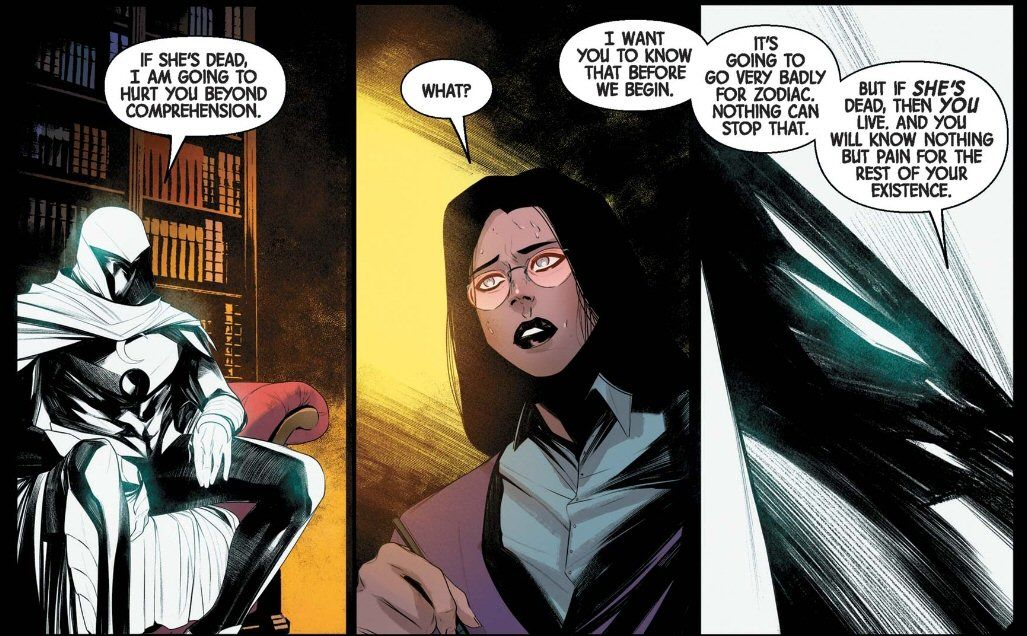
The double is an old enemy of Marc’s known as Waxman. Marc overpowers him, and comes up with an interesting way to torment him:
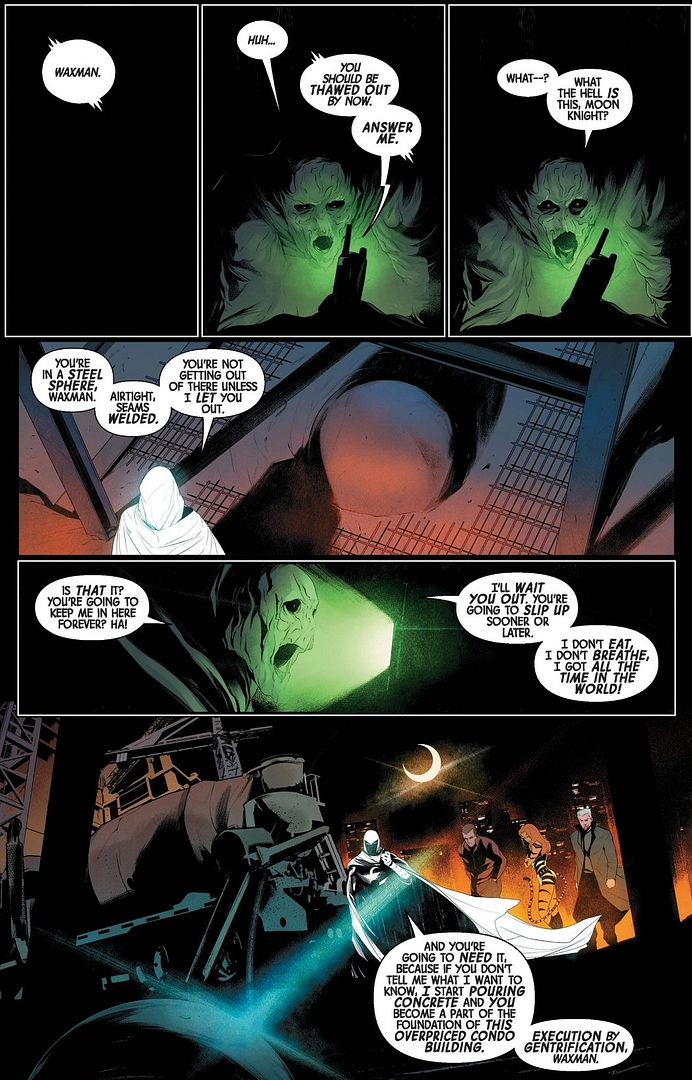
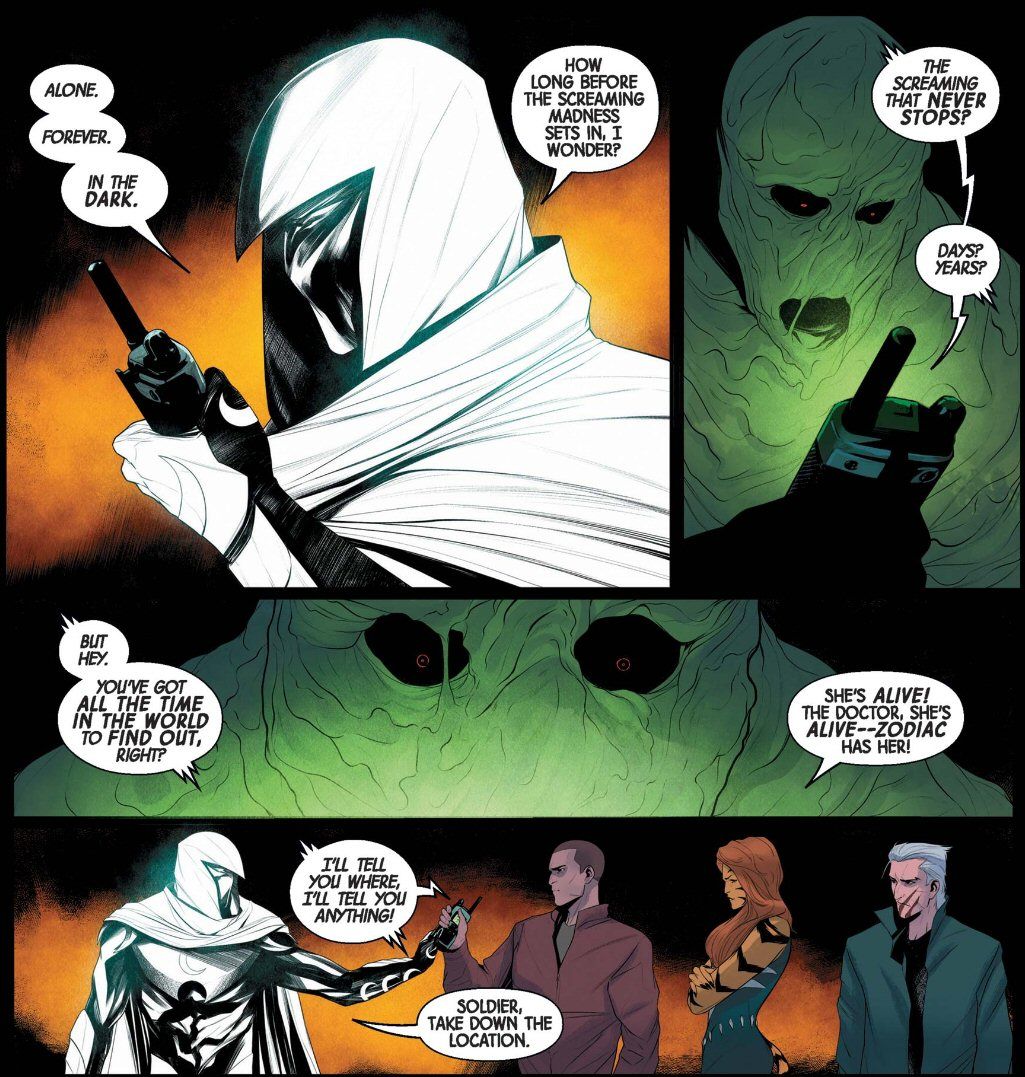
But rather than release him, Marc goes back on his word and sets the cement pouring in:
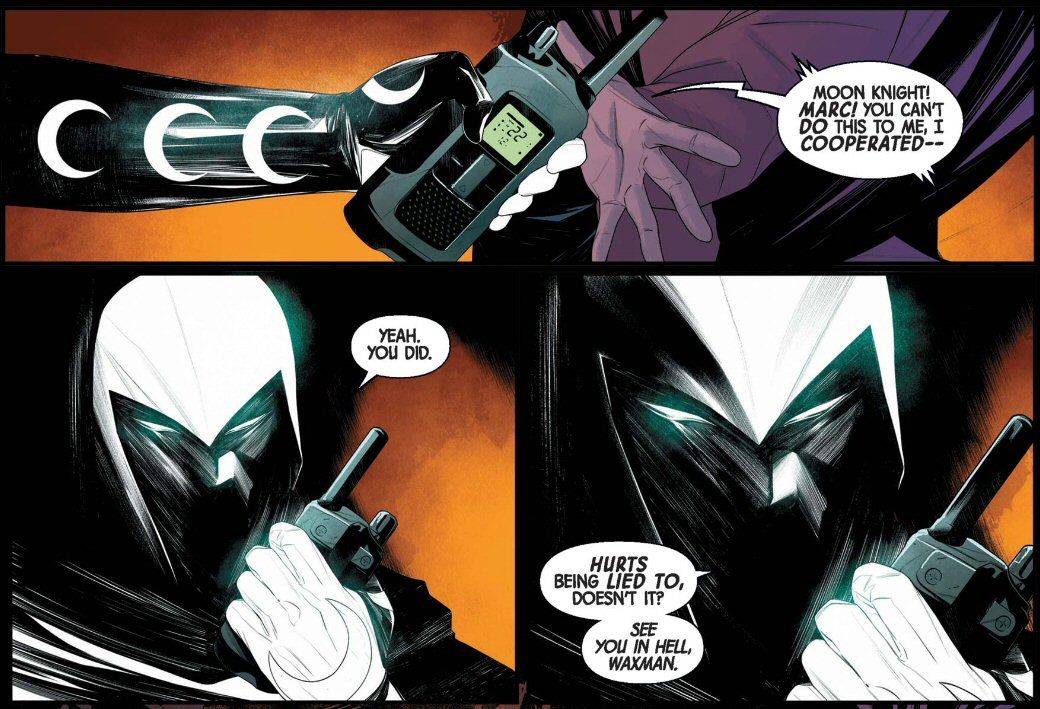
Some of his compatriots seem a bit surprised by this new direction for Marc. I’ll show some additional panels from this scene below in my ethics section. But for now, it establishes how Marc is willing to stop at nothing for what he wants.
By the end of the first year, we come the point where Marc’s main adversary for this run (Zodiac) has been stopped – but apparently at the cost of one of their compatriots, Soldier. From the end of issue #12, where Reese and then Marc have caught up with Zodiac (by MacKay and Cappuccio):
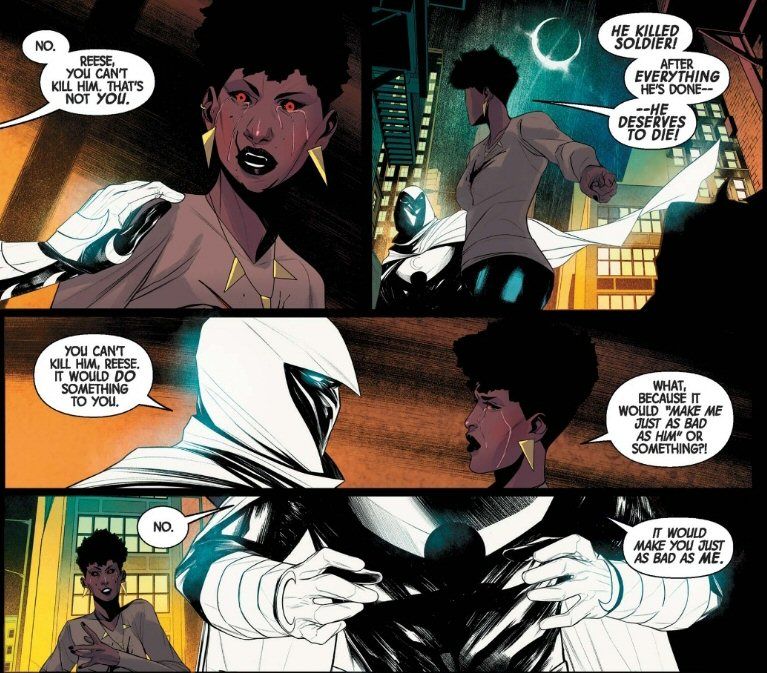
Marc begins to choke Zodiac, and is on the verge of killing him when:
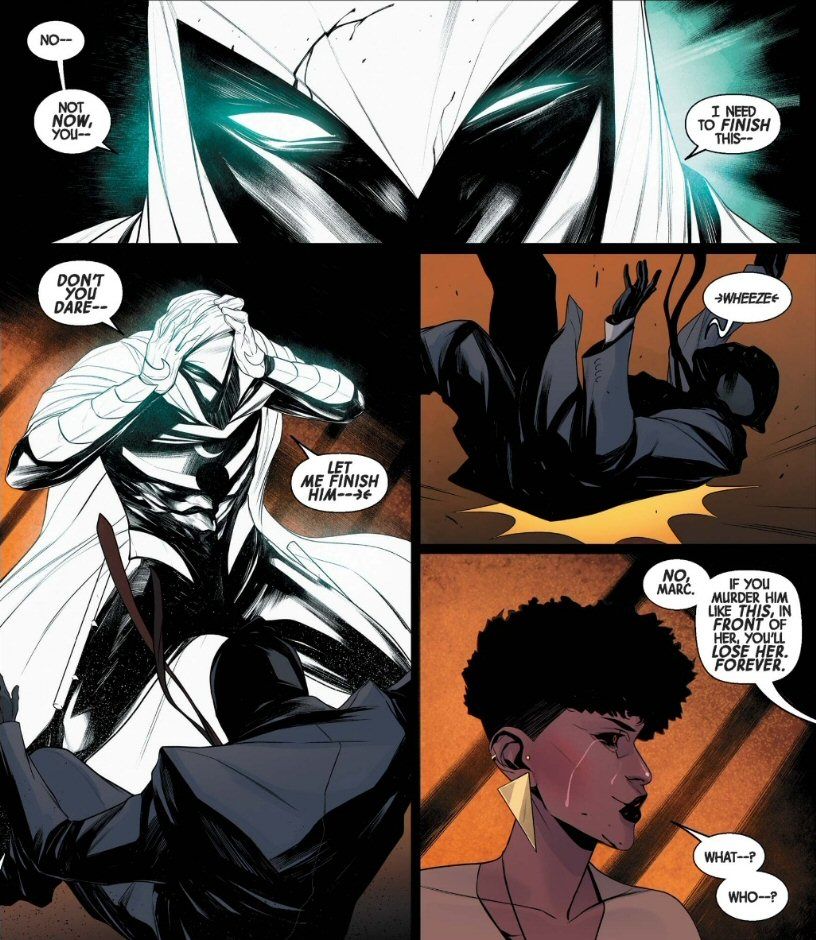
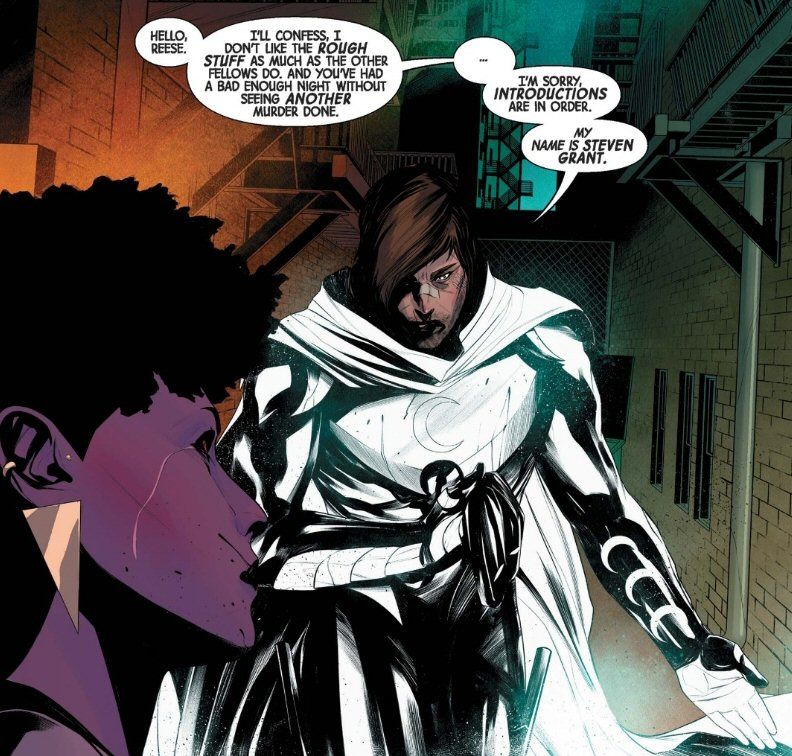
The alternate identities had to come up sooner or later – and this seems like an organic way to do it. Yes, historically Marc and Jake are a lot more comfortable with “the rough stuff” than Steven is. I briefly describe their different ethics below.
Marc tries to put off explaining his DID to Reese, but realizes at the end of the next issue that it is time to talk directly with his two other identities. Issue #14 is an extended exchange between the three of them, over a montage of Marc getting the crap beat out of him by two new villains. By the end, Marc comes to a realization. Cue a conversation with Dr. Sterman about the very topic they have avoid until now, from issue #15 (by MacKay and Cappuccio):
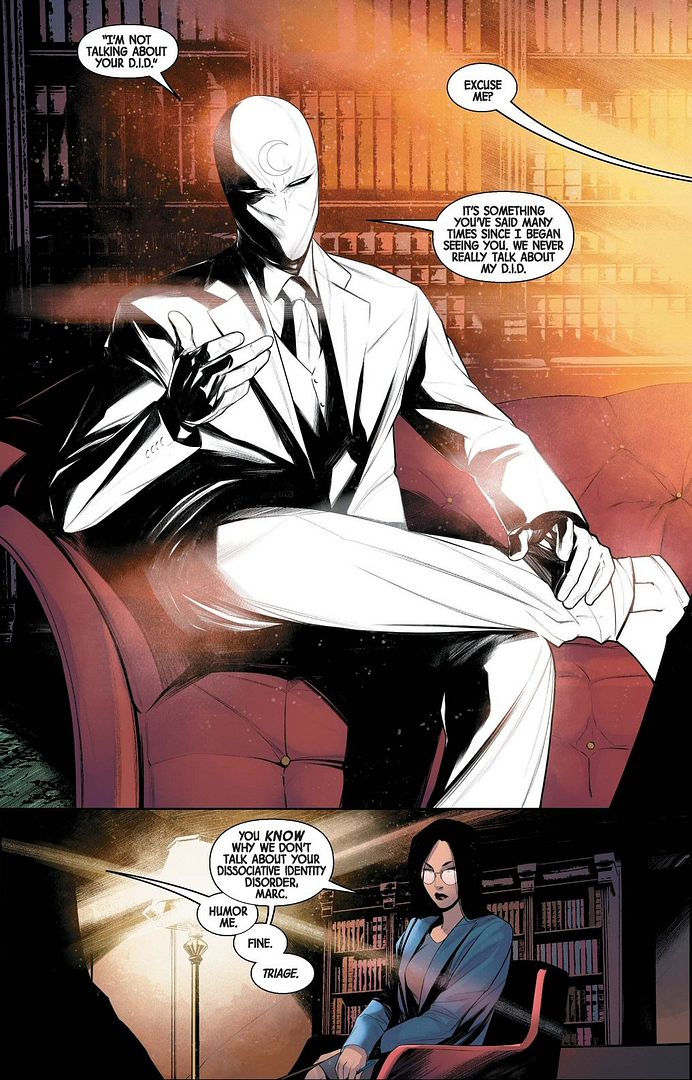
Dr. Sterman explains what she was hired for exactly, and continues …
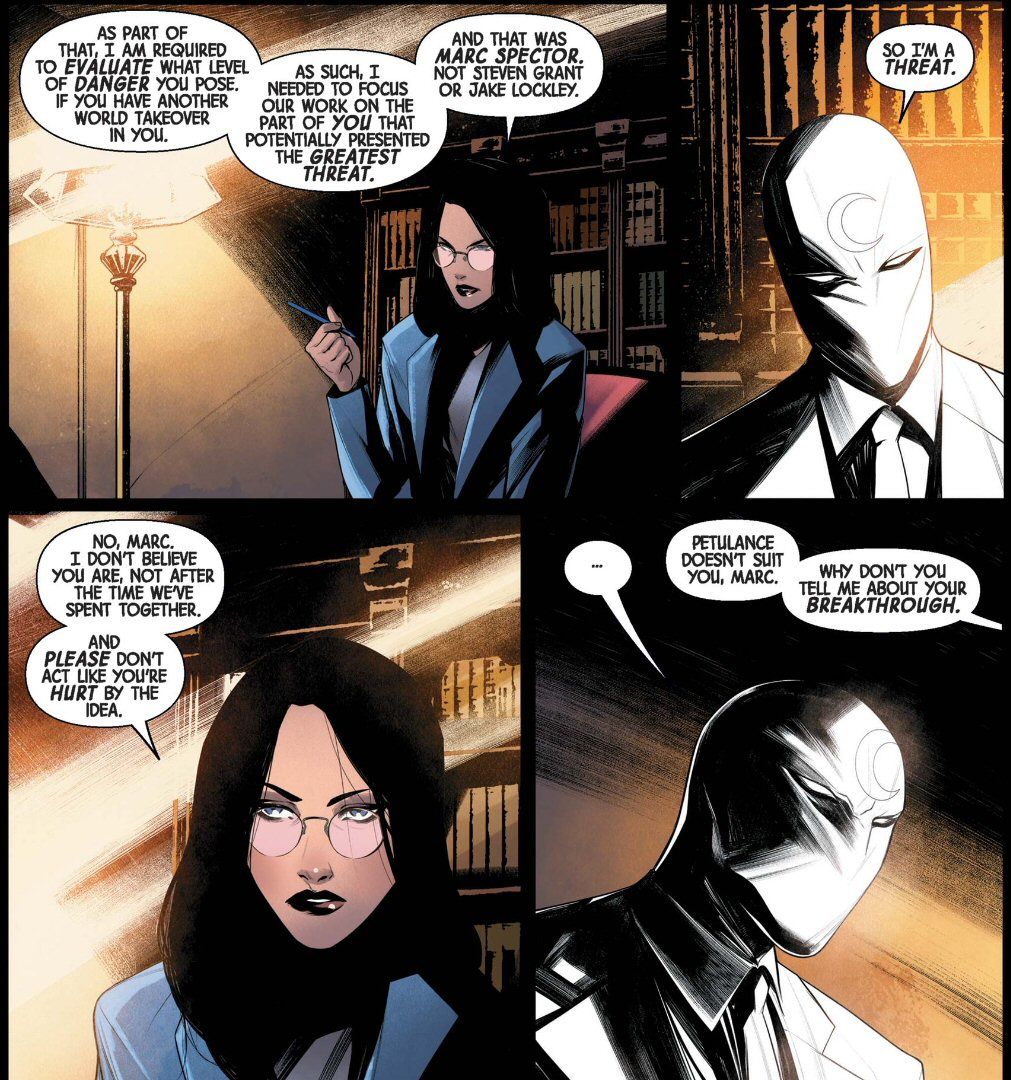
Steven and Jake had made a compelling case in the previous issue for how they should all work together now, instead of letting Marc drive their body solo (as has been case so far in MacKay’s run). And so, Steven and Jake agree to assist Marc in his mission, by rising to the surface when their skills are needed.
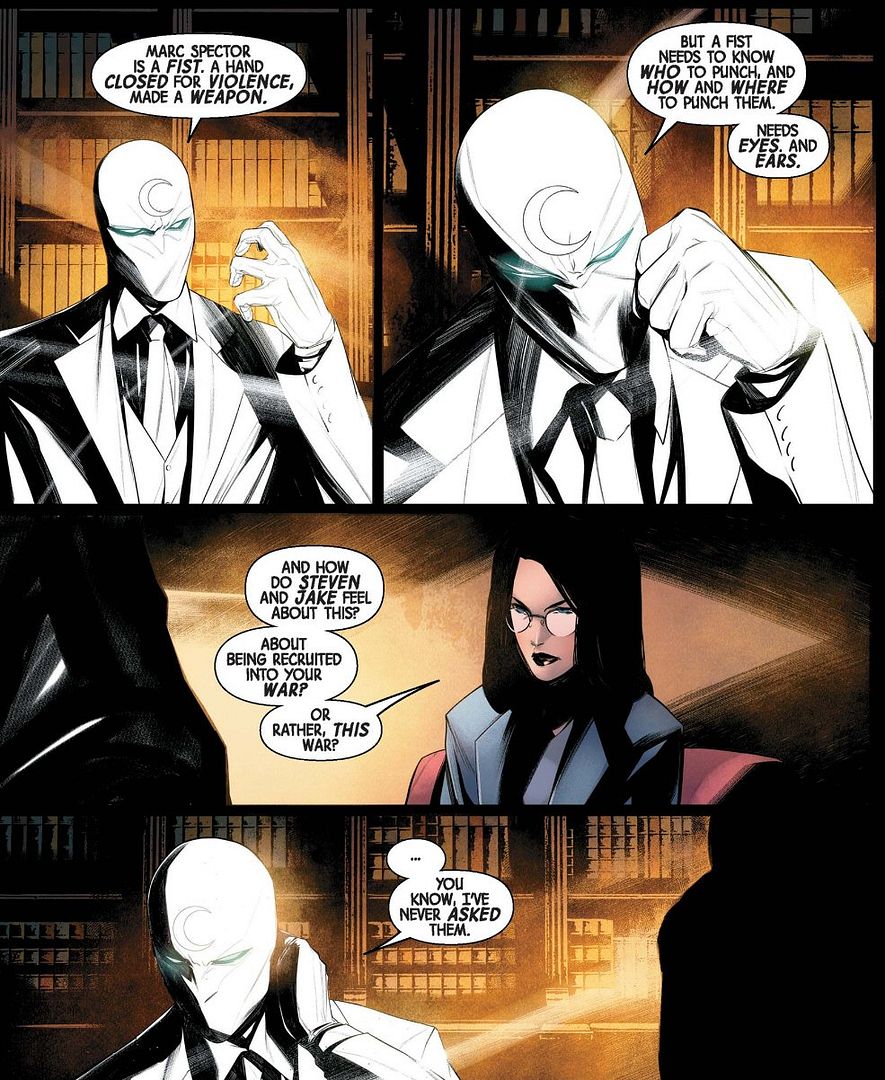
That last panel is a clever way to reiterate that despite the return of the other two identities, Marc remains the one in charge of directing their combined lives.
The rest of the issue shows the various team members’ reactions. The last is Reese:
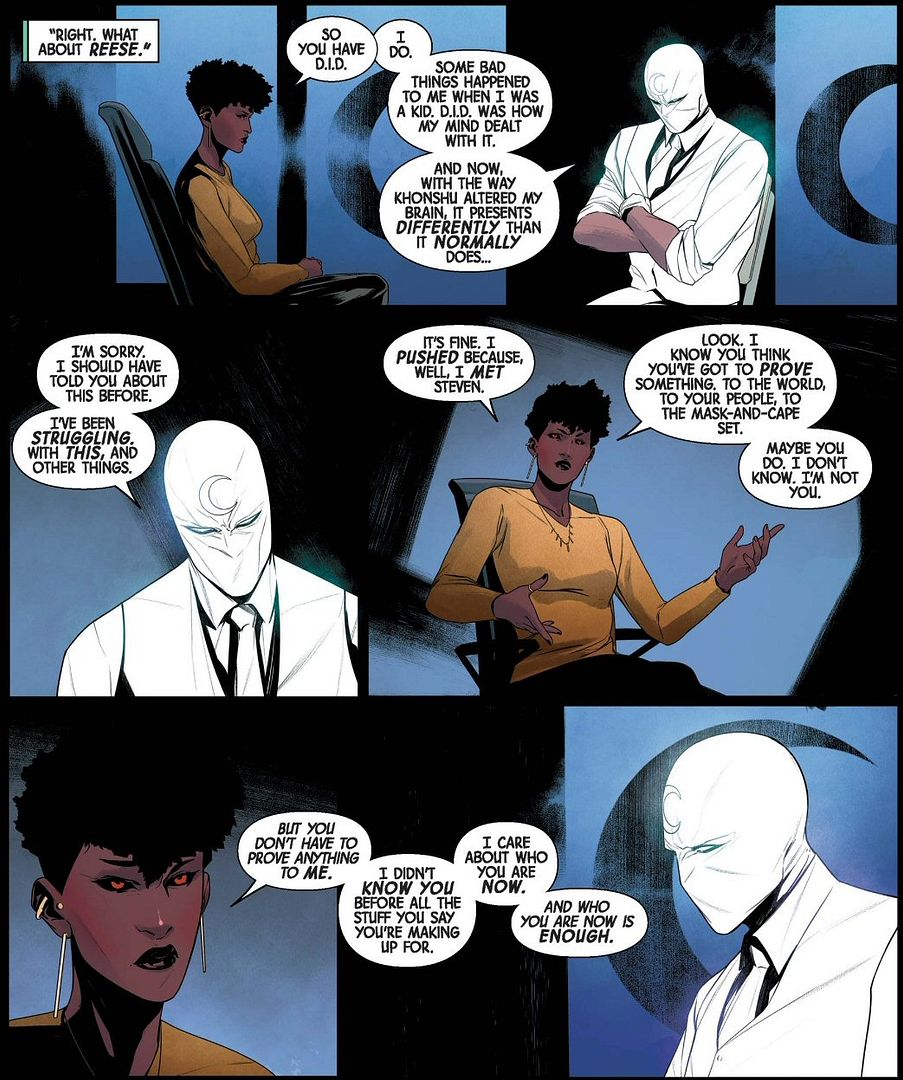
This is an interesting way that MacKay has framed it. Personally, I would have preferred that they had wiped out the Bemis stories. But as they are canon, it was understandable why they had to keep the childhood trauma story line in place – but then clarify that the earlier Ellis stories take priority in terms of how his brain has been altered by contact with Khonshu. A reasonable compromise, under the circumstances.
The MLM vampirism story line is resolved over the next several issues (and the solution is frankly hilarious in my view). It’s a lot of fun, and I don’t want to spoil it.
One thing that I haven’t mentioned so far – Khonshu is in mental contact with Marc (and Hunter’s Moon), but his powers are very limited by his imprisonment. It is made clear that if Marc dies, Khonshu will not be able to bring him back. As you might imagine, this series comes to just such an end in issue #30 – where Marc dies to save all of New York.
This leads directly into Vengeance of the Moon Knight Vol 2, issues #1-9, 2024, by Jed MacKay and Alessandro Cappuccio (with guest art by Devmalya Pramanik in several of the later issues). The series deals with the repercussions of Marc’s death – and how the team has to deal with a Moon Knight impersonator running around. There are a few nice panels in my overview of the Fantastic Four’s The Thing, if you are curious.
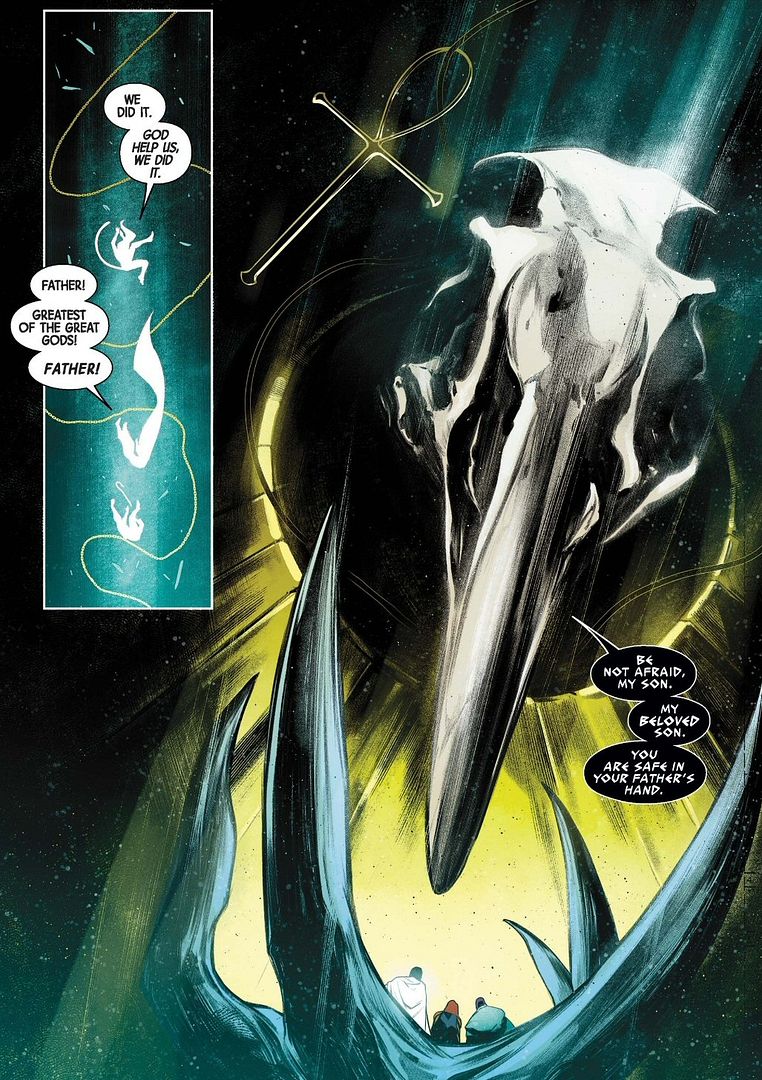
Things comes to a climax at the same time as MacKay’s Blood Hunt story line (the major Marvel cross-over event of 2024 – MacKay was a busy man!). As part of the resistance to the endless night, Hunter’s Moon and Tigra arrange a jailbreak of Khonshu – to enlist his help in the war on vampires. From issue #7, by MacKay and Cappuccio:
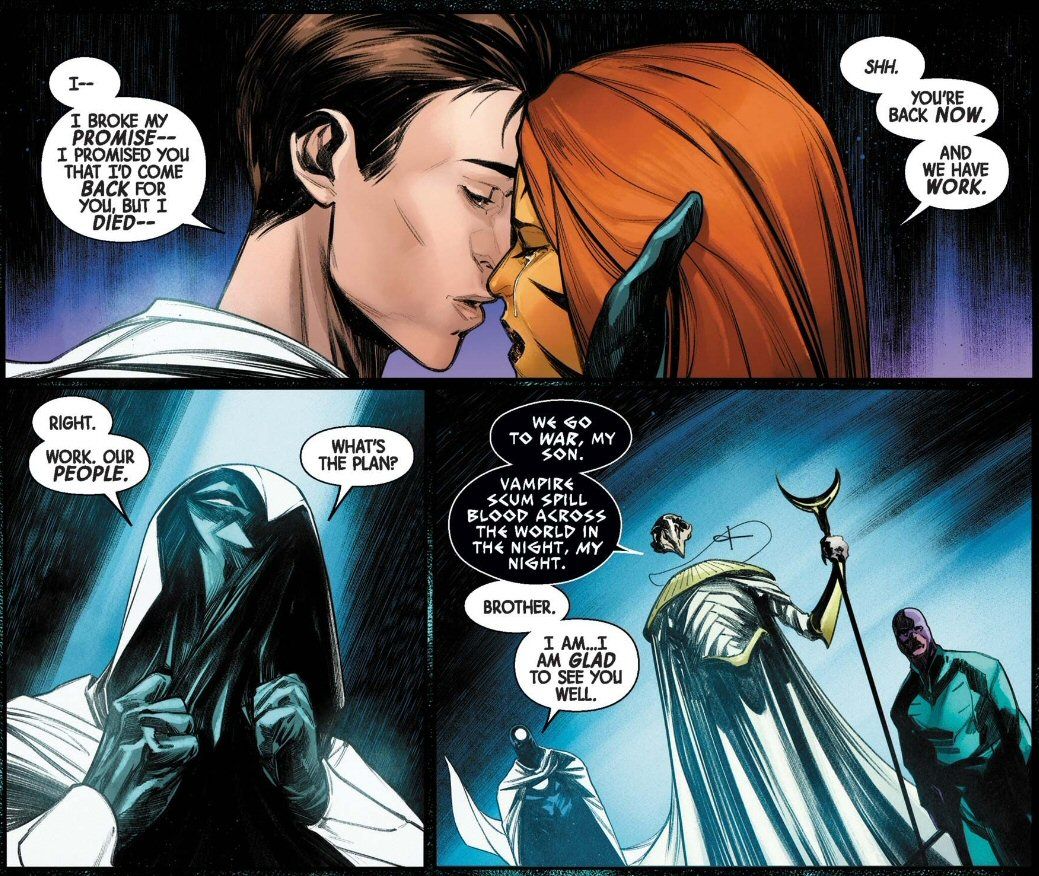
And of course, his first action is to resurrect Marc, to lead his army of dead Fists:
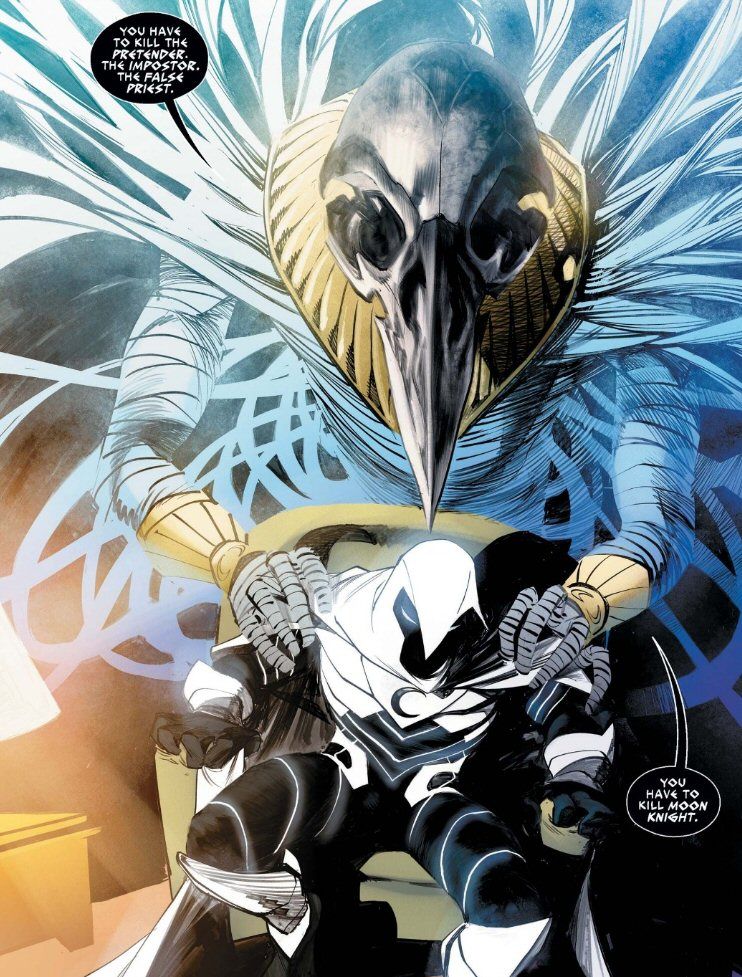
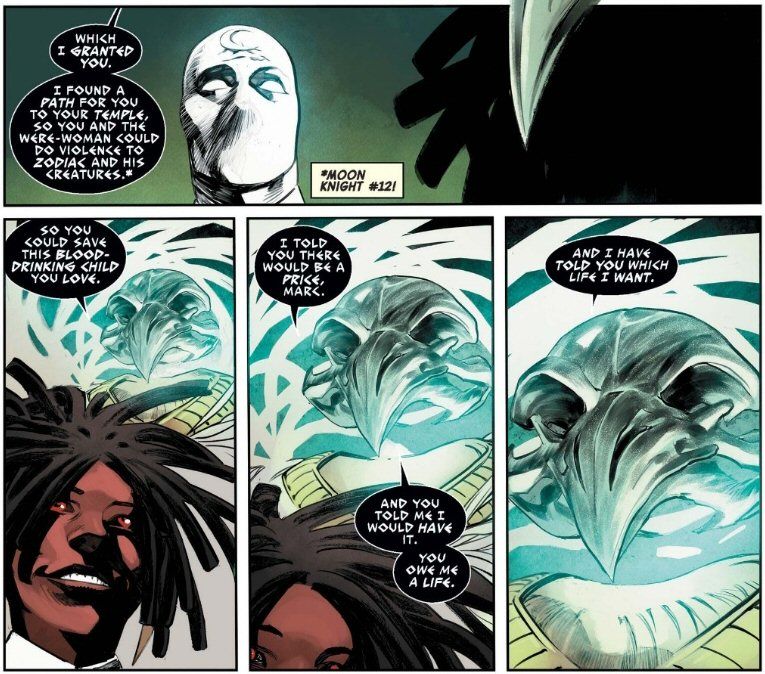
With the Blood Hunt story line soon resolved, this series ends with Khonshu commanding Marc to kill the imposter who masqueraded as Moon Knight in Marc’s absence – setting up a huge conflict between Marc’s innate consequentialism/virtue ethics and deontology (divine command theory). Scroll down to my ethics section to learn how Marc and Hunter’s Moon come up with an interesting solution to this dilemma.
With Marc’s return, this series was rebooted as Moon Knight: Fist of Khonshu Vol 1 (2024 to present). Although initially drawn by Alessandro Cappuccio, the art official switched to Devmalya Pramanik in issue #3 (with guest art in some issues by Domenico Carbone). Pramanik is a worthy successor to Cappuccio, and the vibe remains much the same.
I think I’ve covered the core elements of MacKay’s run. The ongoing adventures remain a fun read, and I encourage fans to pick them up. But I do recommend you start from the beginning of MacKay’s run (2021). If that isn’t possible, then Moon Knight: Fist of Khonshu Vol 1, issue #0 is not a bad place to start. This secret “bonus” issue released ahead of the relaunched Moon Knight: Fist of Khonshu series is narrated entirely by Khonshu, and gives his perspective on the events (and characters) across MacKay’s earlier ~40 issue run.
MacKay’s excellent characterization of Moon Knight greatly facilitates the examination of the character’s moral decision-making and ethics, which I will now turn to.
Moon Knight’s ethics
As always, please check out the normative ethics section of my Ethics 101 page for an explanation of the key terms used here. There is also my Glossary for more detailed information.
Deontology (duty-based ethics: doing right)
The best place to begin to explore Moon Knight’s ethics is with deontolgy – given his “religious duty” as the high priest and fist of the god Khonshu. And so, back to Dr. Sterman in issue #1 (by MacKay and Cappuccio), as we sort out Marc’s “mission” and his relationship to Khonshu. For context, this scene happens right after Moon Knight defenestrated Vermin (as an aside, I love Marc taking time out to water the fern!):
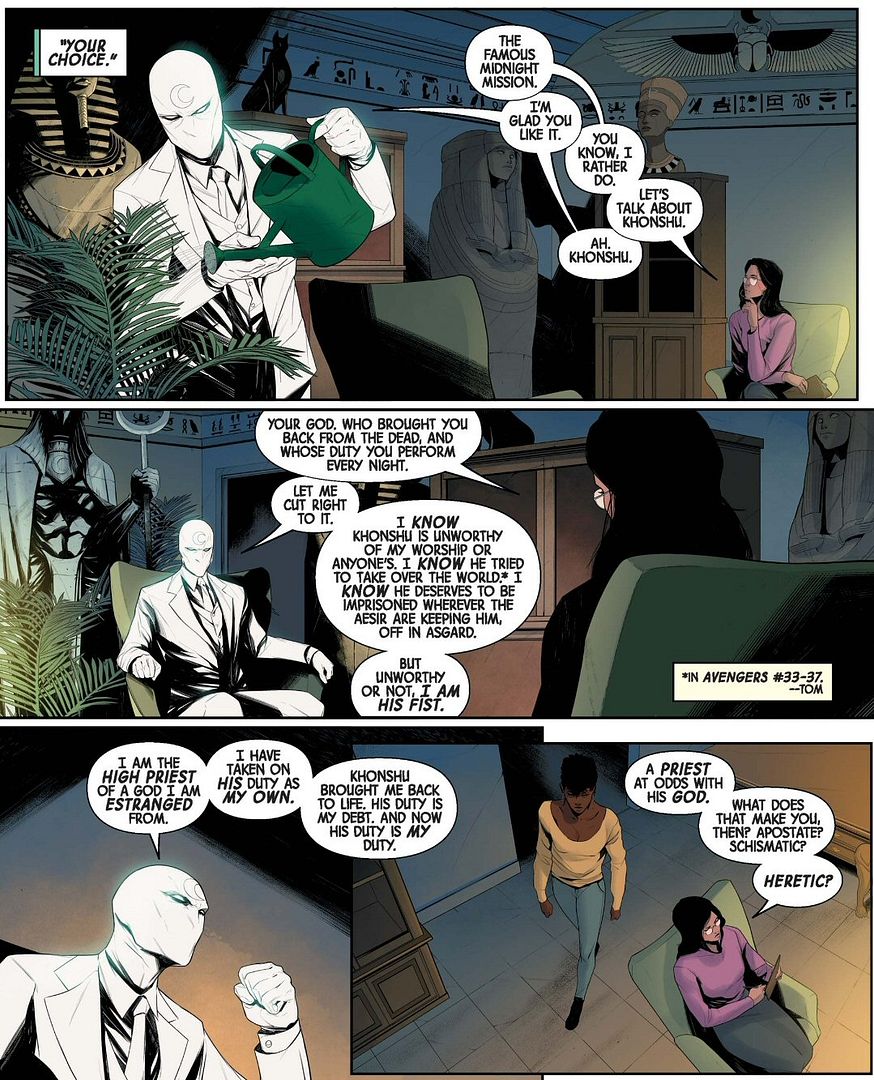
This gets to the deontological duty core of the character’s ethics. But a high priest estranged from his own god? This puts a new wrinkle on divine command theory.
Divine command theory is a very old deontological ethics theory, and one that persists to this day in some form in many modern religions (where it is better known now as theological voluntarism). Note that this ethics theory can be considered in both meta-ethical and normative ethical forms (despite the opening sentence in that Wikipedia link above). It is the more restrictive normative sense that I am using throughout this site.
In its common normative form, it asserts that human beings are obligated to do what their god asks of them, and to do so because their god commands it (and not because there is some underlying system of morality that it might reflect). In this strong form, to be moral means to follow god’s commands, period (Thomas Aquinas would be a good example of this school of though). But it is more accurate to call it a class of theories, as there are many variants depending on whether god simply wills versus actually commands, and how non-obligatory acts are considered (for example, the modified divine command theory of Robert Adams). So, in more general terms, what all members of this class have in common is that god’s will is critical to determining the moral status of something.
I find the wording in the panels above from MacKay’s first issue very interesting. In the earlier stories, Marc commonly framed his actions as carrying out divine justice (or retribution, which I will explain below). This suggests a form of divine command theory, where moral rightness would be derived from Khonshu. But Mackay’s Marc clearly finds his god unworthy of devotion, and claims to be estranged from him. Yet Marc is still committed to duty. But rather than duty to Khonshu’s commands, Marc sees himself as taking over Khonshu’s duty (“I have taken on his duty as my own”). This is an interesting reversal of divine command theory – Marc has apparently taken on for himself the responsibilities that are in fact his god’s (presumptuous, I know). And that sounds a lot more like the duty of care you will find in care ethics – a modern form of virtue ethics, which I will describe below.
There are of course many other forms of deontological ethics – such as the reason-based Kantian ethics that currently dominates the field (and which I explored briefly in my recent Why be Moral? post). But something I find common to a lot of deontological theories is retributive justice – punishing wrongdoers proportional to their crimes. And Marc certainly displays this kind of thinking throughout the long run of Moon Knight – including MacKay’s term (for example, that killing of one of the Vermin clones in retribution for their attempts to kill one of the humans Marc feels responsible for, in issue #1). It might surprise some today, but Immanuel Kant himself was also very big on retributive justice – including capital punishment for murderers, which he saw as an absolute imperative. It’s not relevant to this profile, but I do plan to talk more about Kantian ethics in an upcoming post. (UPDATE: see my exploration in The Power Fantasy)
Interestingly though, MacKay’s Marc also shows strong signs of restorative justice. His saving of Reese and the other baby vampires in the opening pages of issue #1. The integration of Solider, 8-Ball, and the House of Shadows into his Mission over the subsequent issues. Even more generally, his protection of the marginalized in his community shows elements of restorative thinking – focusing on restoring his community rather than just punishing offenders. But that may simply be because he sees their potential to be redeemed. His deontological ethics do seem more focused on prioritizing the protection of future potential victims over preserving the lives of those he considers irredeemable in the present.
Speaking of irredeemable, let’s revisit those earlier panels from issue #10 (by MacKay and Cappuccio), where Marc intends to inter the indestructible Waxman indefinitely in the foundation of a building – despite offering up the info Marc was looking for. His compatriots are shocked my Marc’s actions, and he admits that he knows he is doing “a terrible thing”:
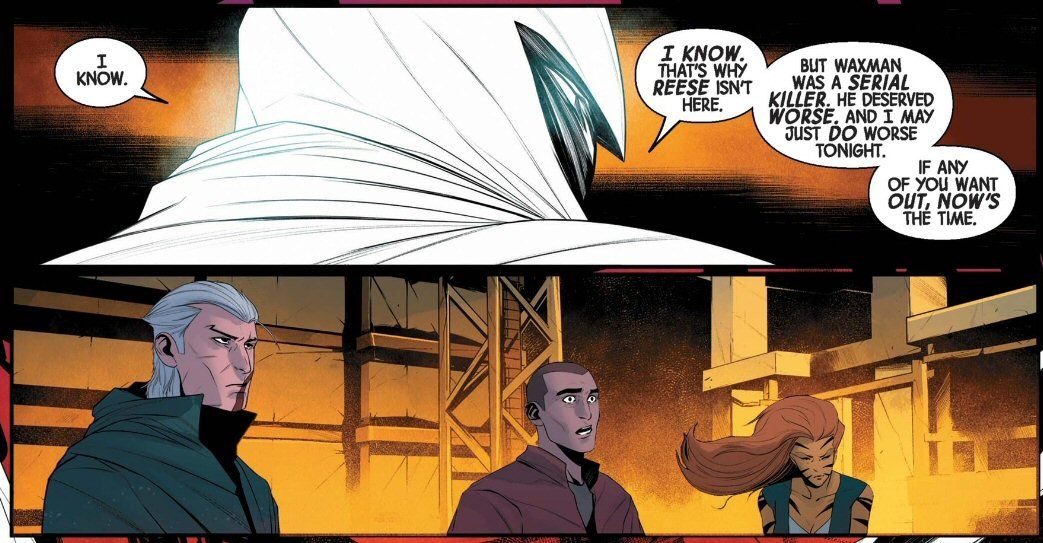
This scene reveals a number of things about Marc, beyond his deontological sense of retributive justice. He’s also willing to go to any lengths when those he cares about are threatened. But he knows he can count on only these compatriots to see this through with him – he would lose Reese if she saw this side of him. This is an interesting segue to the care ethics aspects of the character. But before I get to that, I would like to point out the strong consequentialism at the heart of this character.
Consequentialism (outcomes-based ethics: doing good)
As previously described, Marc stopped Reese from killing Zodiac – because it would change her, and make her as bad as Marc is. Marc then proceeded to kill Zodiac – until his Steven Grant identity asserted itself to stop him, so that Marc wouldn’t lose Reese. The pivotal position of Reese in all this all shows up at the end of the Vengeance of the Moon Knight Vol 2, when the freed Khonshu makes clear what he wants from Marc – the death of the imposter Moon Knight. From the last page issue #8 of this series (by MacKay and Pramanik):
Marc refuses to do this, so Khonshu ups the ante, by reminding Marc of the bargain he made with Khonshu earlier to save Reese’s life. From the last issue of this series, issue #9 (by MacKay and Pramanik):
Marc needs Hunter’s Moon’s help for the next step of his plan:
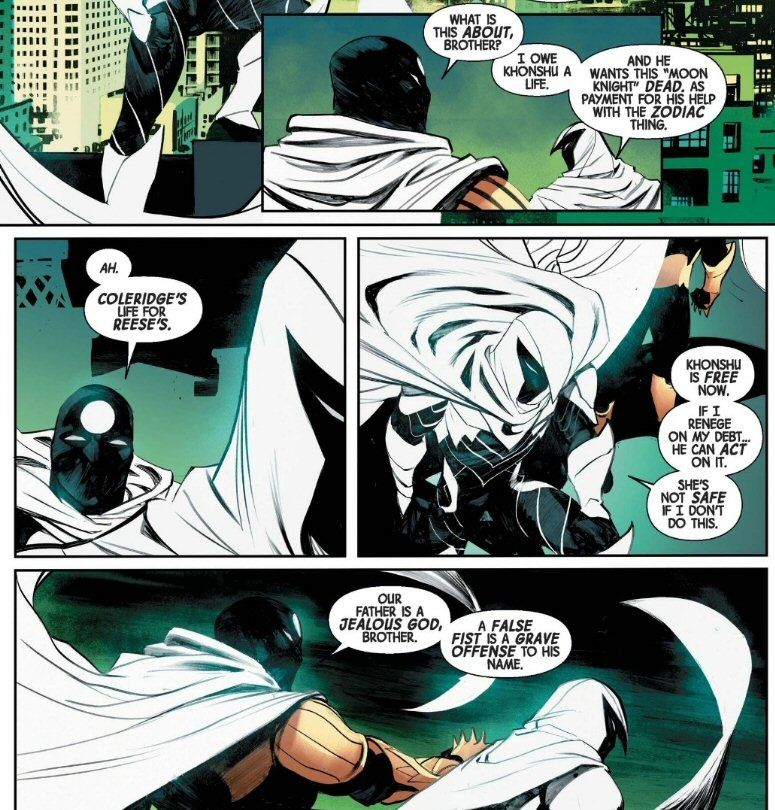
Marc’s creative solution is to kill the false Moon Knight (the mentally ill but remorseful Max Coleridge, formerly the Shroud) – but then have Hunter’s Moon (who is a doctor in his alternate identity) immediately resuscitate him. As an aside, I can’t help but wonder if MacKay hadn’t planned this from the beginning, given the early step of making Hunter’s Moon a doctor.
To the outside world, it appears that Marc has killed the false Moon Knight. Of course, that is not exactly what Khonshu wanted. From the final pages of issue #9:
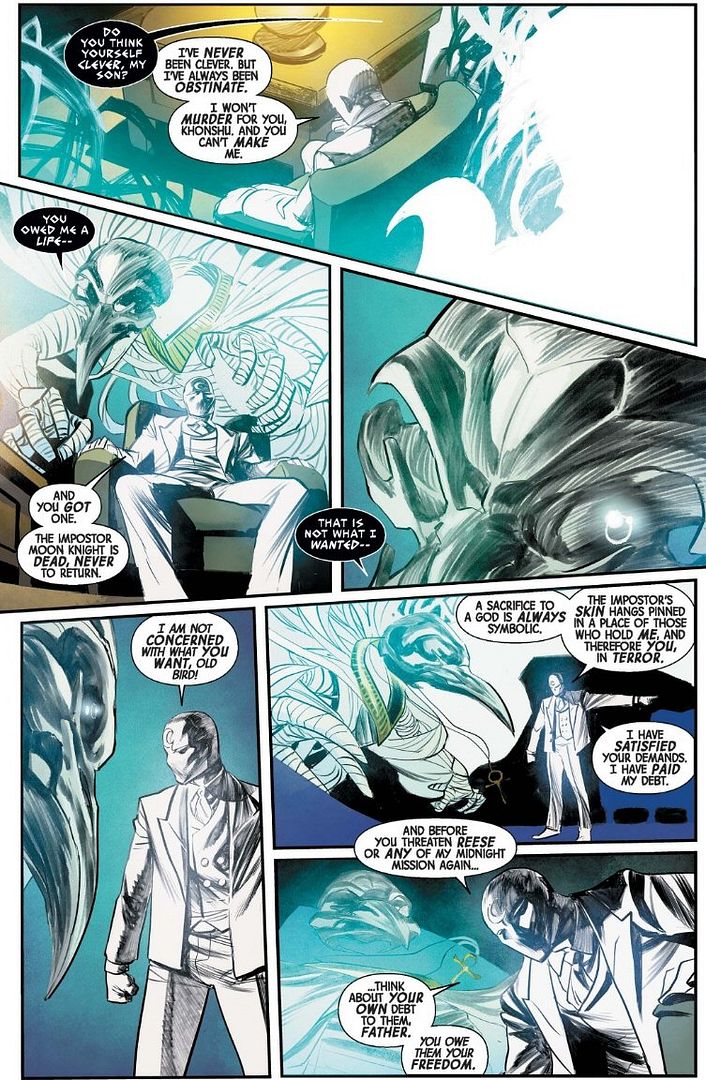
As an aside, I think these panels show that Pramanik is a worthy successor to Cappuccio.
I find it interesting that Marc is willing to murder (as part of retributive justice) but won’t murder for Khonshu’s sake (or at his command). This makes it clear once again that Marc is not really deontological, and will assert for himself what he will morally undertake. And the rest of the panels above make it clear that Marc still has strong consequentialist leanings in his thinking. Across the long run of Moon Knight, we’ve seen Marc’s willingness to use extreme violence and intimidation if it prevents greater harm or protects the innocent. Here, we see this very utilitarian calculus on display – using this opportunity to enhance his reputation for brutality to deter crime through fear. As he points out, this benefits both him and Khonshu.
But Marc’s consequentialism runs even deeper, if we turn back a page to see this exchange with Max Coleridge:
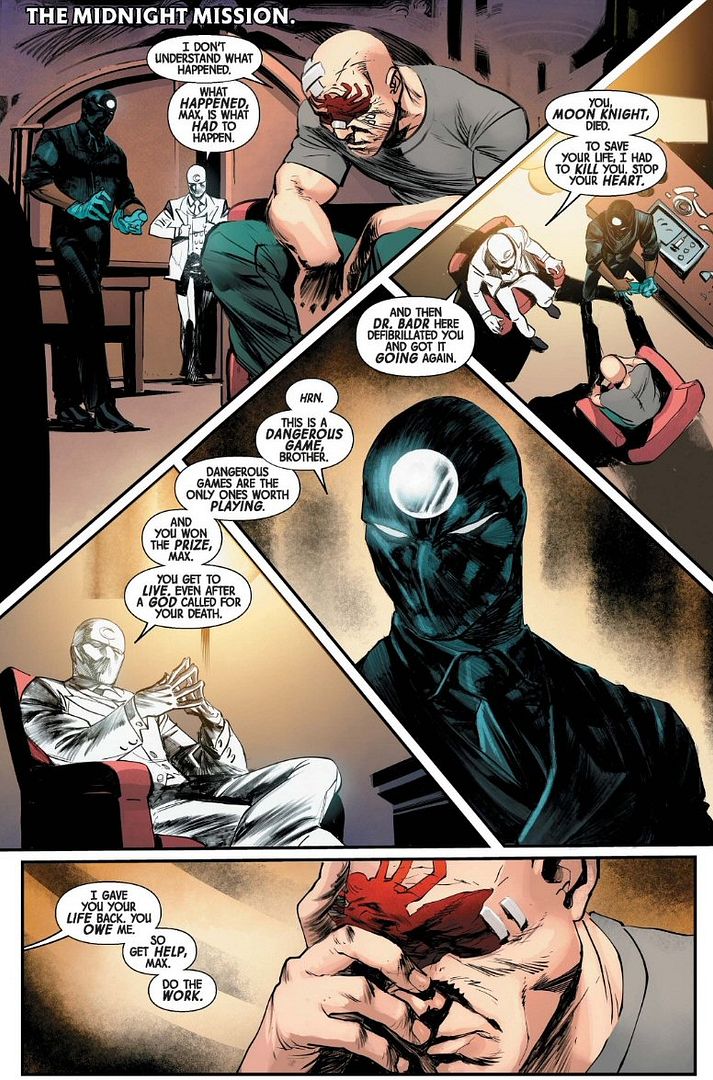
The last panel above is also very consequentialist but in an entirely different way – saving Max to allow him to “do the work” to get better. This reminds me of a famous Gospel story in the New Testament. I explained situational ethics in my recent Absolute Wonder Woman ethics overview (please follow the link for a detailed discussion). Briefly, this is a consequentialist form of ethics that was developed by Christian theologians in the mid-20th century, and is based on the New Testament’s depiction of Jesus Christ and the Greek concept of agape, or the highest form of unconditional love.
I realize that religion is potentially touchy subject for many. But I am simply referring here to the implied moral reasoning expressed in the New Testament. At their core, both the Old and New Testaments are moral philosophy primers – but very inconsistent ones, given all the different people and time periods that went into their crafting (not unlike comic books, but over a much greater scale).
So, consider the Gospel story in John 8:6-11, when a woman has been brought before Jesus by the Pharisees after being caught “in the act” of adultery. There is no question about whether she is legally guilty. And the Old Testament law is explicit on this point: death by stoning is the punishment for adultery (in Leviticus 20:10 and Deuteronomy 22:22 – although I can’t help put point out that both parties are supposed to be stoned).
Jesus realizes the Pharisees are trying to catch him in a moral bind if he refuses to punish her by Old Testament standards. So, Jesus ignores them and goes back to doodling in the sand with a stick (a fascinating side detail, I’ve always wondered why it was included – something about the impermanence of writing?). Eventually, when pressed further, he makes the famous statement that those among them who are without sin should cast the first stone.
One by one, the crowd disperses (presumably as they each recognize their own sin). In the end, Jesus looks around and asks the (now lone) woman who accuses her. She answers that no one does. Jesus responds: “Neither do I condemn thee: go, and sin no more.” (Pardon my use of the King James version, I like the poetry).
The point of this story is often presented (in religious terms) as a call to repentance and to a new, transformed life in Christ, rather than a command for sinless perfection. But from an ethics perspective, I like to think of it as pointing out that having the right to do something is not the same as meaning it is the best option. Or in the very consequentialist way that I remember it being put at the end of Isaac Asimov‘s The Caves of Steel, when the deontological robot R. Daneel Olivaw develops a consequentialist moral sense after learning this Gospel story: “The destruction of what you people call evil is less just and desirable than the conversion of this evil into what you call good”.
Asimov wrote very moral stories (and also knew his Bible well, as he wrote several books of interpretation of it). Many of his characters would often articulate a consequentialist perspective (consistent with his strong sense of secular humanism). But the main point I always took from this book (and many of his others) was that rather than working to eliminate wrong doing, it is more virtuous to find a way to transform negative thoughts, actions and outcomes into positive ones. In other words, a focus on growth and being better in addition to doing good. Which brings me around, finally, to a discussion of virtue ethics.
Virtue ethics (character-based ethics: being better)
To be clear, I don’t see a lot of evidence of classic (Aristotelian) virtue ethics in Moon Knight. Indeed, as the panels above indicate, Marc is not a growth-focused character and is in fact proud of his obstinance (“I’ve never been clever. But I’ve always been obstinate”). Moon Knight has always been an extreme character. His strong sense of self – and purpose – is largely unchanged across MacKay’s run. And I would argue that this has been true across all eras and all creators. Consider the Alan Zelenetz panels from the 1980s presented earlier (“My will’s like granite, because that’s what holds the real world out there together for me. It’s my sanity.”)
But what does change for MacKay’s Marc is his relationship to other people. Marc develops from a complete loner at the start of this series (with none of the earlier Moon Knight companions) to having assembled a remarkably strong and diverse team who decide to carry on his mission even after his death (and his subsequent resurrection). Consider this panel from Vengeance of the Moon Knight Vol 2, issue #1, by MacKay and Cappuccio:
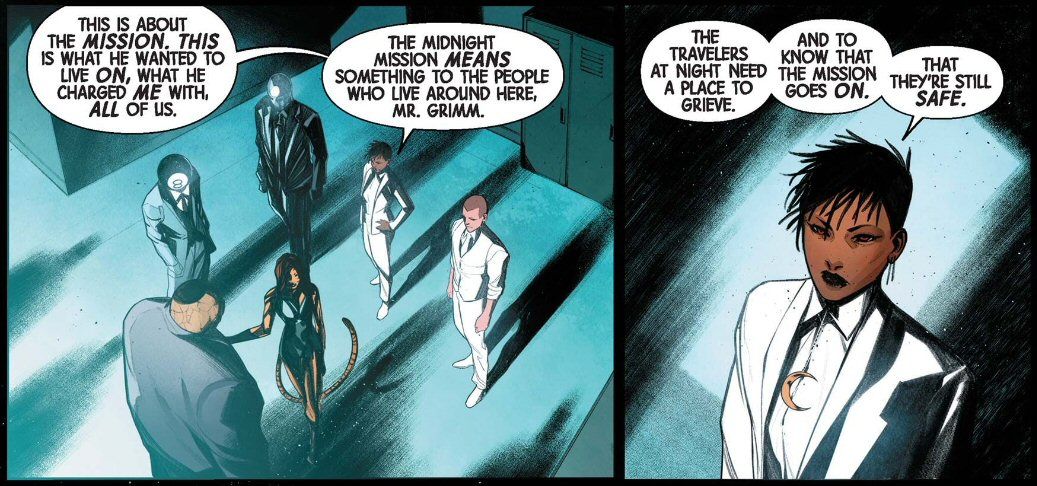
Reese becomes the natural leader in his absence. Now consider how much their relationship has changed, starting from these panels from the first issue Moon Knight Vol 9 (2021, by MacKay and Cappuccio), where Marc reiterates his desire not to change:
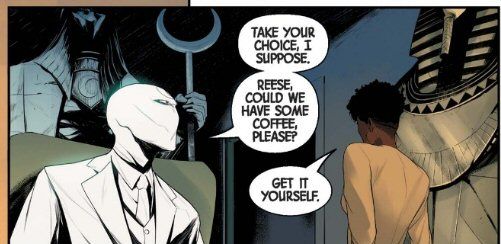
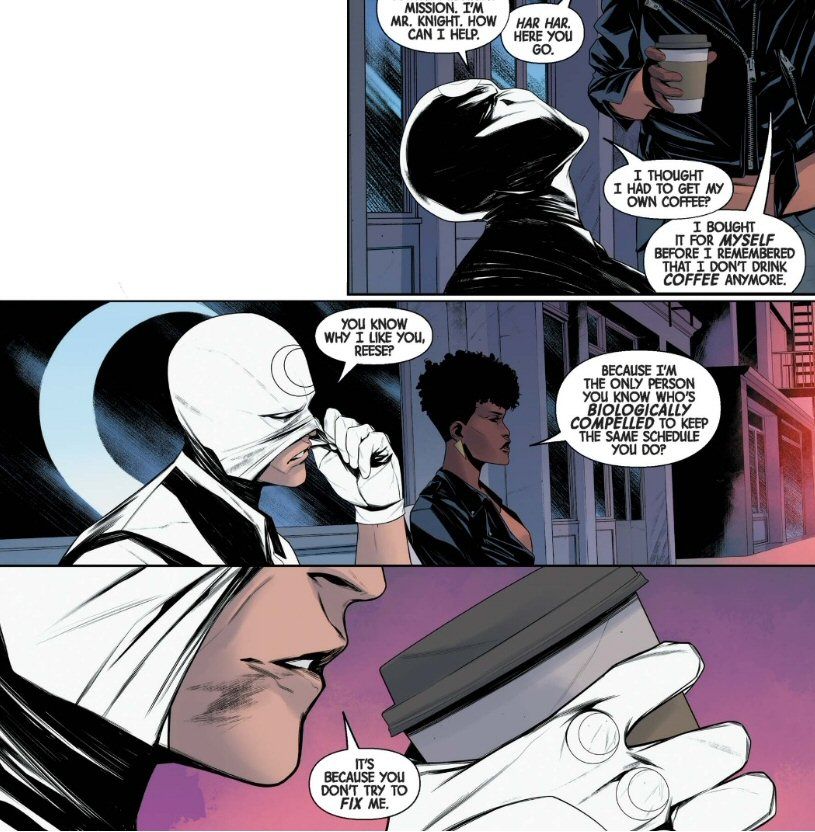
And then later, after the scene I described previously where Marc expresses vulnerability in revealing his DID diagnosis to her in issue #15 (2022, also by MacKay and Cappuccio), and Reese reassures him that he is enough for her as he is:
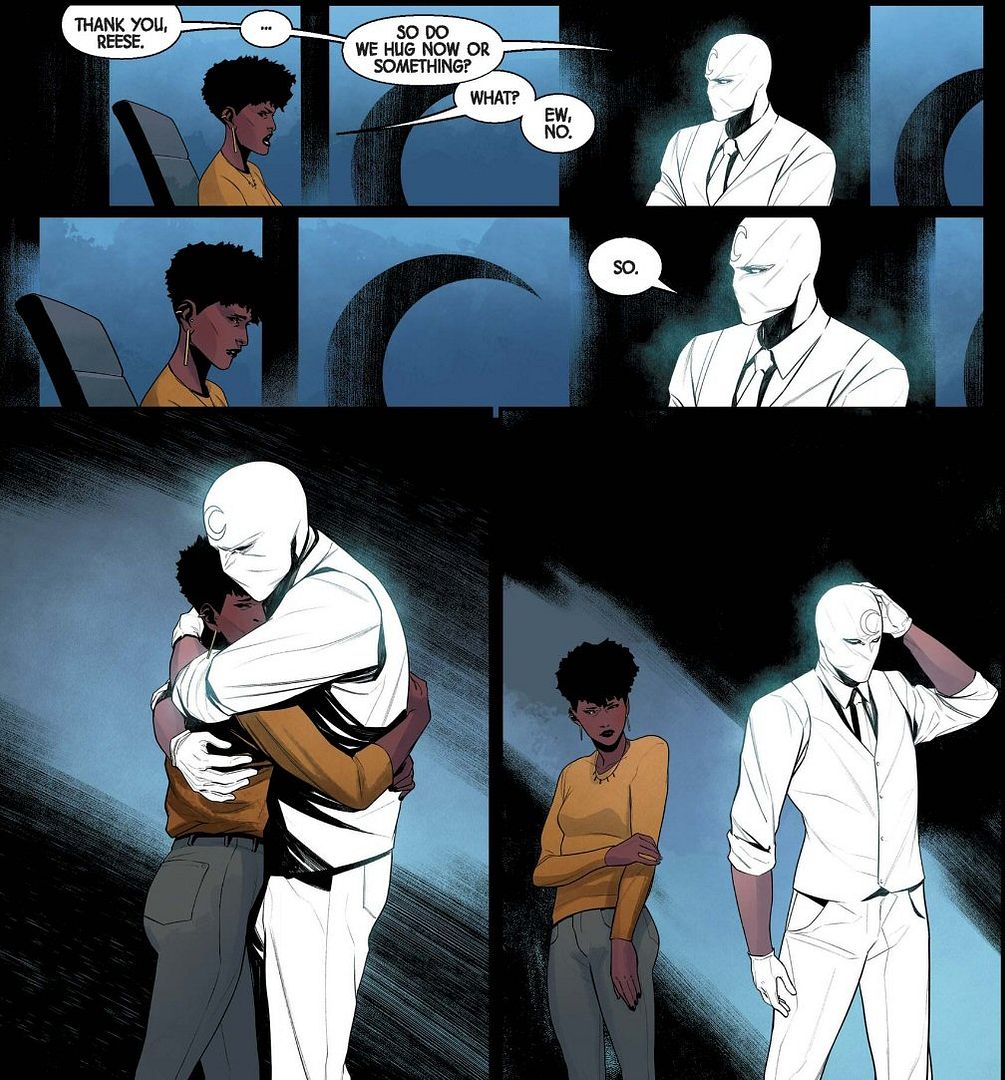
I love the awkwardness above. But compare that to when he returns from the dead in Vengeance of the Moon Knight vol 2, issue #8 (2024, by MacKay and Pramanik), and Reese sees him again for the first time:
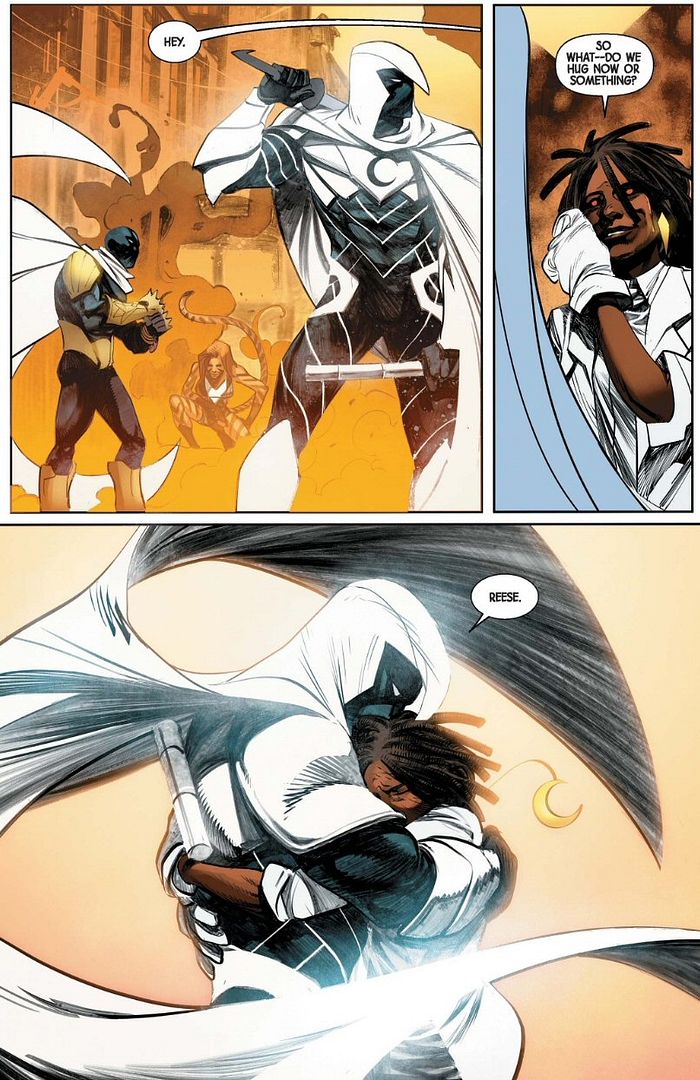
I use Reese above as it is the most extreme example of the growth in platonic love that Marc both inspires and feels in this series (but I could also have used Solider, or 8-Ball, or even Dr. Sterman). He has created a community of care – one that looks out for each other, and for those around them – and is even willing to continue that mission in Marc’s absence.
This provides evidence for a very strong care ethics philosophy to Marc in this series, which is not something I have really seen before for the character (care ethics a modern form of virtue ethics proposed by Carol Gilligan). As I explain on my Ethics 101 page in the link above, care ethics holds that moral action should be based on interpersonal relationships and the duty of care we have to others. It differs from older forms of classic virtue ethics by its emphasis on the importance of responding to the relative needs of the individual (as opposed to the universal application and impartiality of other classical ethical frameworks). Empathy and compassion for others is thus core to care ethics, and something that is much more apparent for MacKay’s Moon Knight.
I will describing care ethics in more detail in an upcoming post – stay tuned for details! (UPDATE: My Can Caring be Wrong? post is now up)
Ethics of Moon Knight’s alternate identities
Up until now, I have focused exclusively on Marc in this ethics overview (as the main character through all modern series). But his alternate identities do express somewhat different ethics. Using the revised nomenclature for the aspects of Khonshu that MacKay assigned to his identities (from Fist of Khonshu: Moon Knight Vol 1, issue #0, 2024): Marc is the Traveller (“who has fought and killed his way across the world”), Steven is the Pathfinder (“who paves the way forward, with money as his weapon”), and Jake is the Embracer (“who so loves the poor, the ignored, the forgotten”).
It is hard to distill down a simplified ethics for Marc, given that he is such a complex (and historically complicated) character – as described in detail above. But at least in the modern era, it does seem like Marc’s character hews more closely to a consequentialist (particularly utilitarian) way of thinking about things. Although earlier time periods might have shown a deontological secondary streak, that really isn’t present any more for the character outside of his retributive justice. Instead, the overall arc of MacKay’s run with the character has been for Marc to display a strong care ethics perspective – although I would argue that it is still secondary to his consequentialism overall.
Consistent with that, Steven is the primarily care ethics identity now (note how he intervened to stop Marc killing Zodiac in order the save their relationship with Reese). In his internal arguments with Marc – and his philosophy more broadly across many series – he emphasizes dignity, compassion, and consideration of others. His wealthy philanthropist persona isn’t just a cover – it does seem reflect genuine commitment to social justice and encouraging systemic change. Steven also serves as something of the moral conscience for the combined character, seemingly experiencing genuine moral distress about the brutality that Marc (and Jake) employ to achieve their consequentialist aims (recall, he is not a fan of “the rough stuff”).
Jake has always been the more street-smart pragmatist – although with both care ethics and consequentialist tendencies. He is certainly happy to bend the rules to achieve what he considers justice – but again, that justice is more personalized and relates to the most marginalized members of society (whom he considers his “people”). Violence is at least as core to Jake’s perspective as Marc’s (perhaps even more so), as brutality is a necessary tool at the margins of society where he operates (i.e., the language that criminals understand and respond to). Early in the comics, he may have had secondary deontological leanings – but like the other two, he has most explicitly parted ways with being concerned about Khonshu’s wishes.
Current overall ethical framework: C/v


In a way, the various ethics displayed by Moon Knight’s distinct identities combine to create the overall ethical framework for the character (though dominated by Marc’s ethics, as the main identity). On the balance of the modern stories, I think it makes the most sense to still see him as predominantly consequentialist – but with a very strong secondary care ethics drive. The only real remnant of deontology is in the character’s persistent retributive justice.
And so, a C/v for now on my superhero description system. But I could easily see that flipping over time, as the care ethics aspects of the character continue to strengthen.
Again, the purpose of this site is not to provide a definitive normative ethics framework for any character. That is impossible, given all the creative hands each character has passed through – and especially so in Moon Knight’s case given his mental illness (and the inconsistent attention that has received).
Which brings me to my last thoughts …
Moon Knight’s Mental Health
The preceding sections detail the long history of Moon Knight’s mental illness – at least, how it was characterized by various creative teams over 50 years in the comics. In this section, I would like to explain a little bit about what happened in the real world of mental health research during that time, based on my experience as a neuroscience researcher and senior administrator.
As I explained on my About Me and About Site pages, I’m looking to bring a modern neuroscience research lens to some of my articles here – in terms of ethics and moral decision-making especially, but also when other relevant topics come up. And I think the neuroscience of mental illness qualifies – although note that I am not a mental health professional. If you are experiencing distress, contact the National Alliance on Mental Illness hotline (in the U.S.), or dial 9-8-8 (in Canada and the U.S.) to speak to trained counselors.
The idea that humans could suffer from distinct “multiple personalities” has been around for a long time, but in the modern era it has often been conflated with disorders that actually result in the fragmentation of identity (like dissociative disorders or schizophrenia). The concept of “Multiple Personality Disorder” had a brief and limited use in the clinical research literature – especially as it was heavily popularized through the film The Three Faces of Eve (1957) and the TV movie Sybil (1976). As previously mentioned, while purported to be based on real cases, the research behind these stories was flawed, with evidence of outright fraudulence in the case of Sybil.
In 1994, “Multiple Personality Disorder” was officially renamed “Dissociative Identity Disorder” (DID) in the fourth edition of the Diagnostic and Statistical Manual of Mental Disorders (DSM), a handbook published by the American Psychiatric Association (APA) that serves as a reference for classifying and diagnosing mental health conditions. But this was more than a name change. The DSM-IV classification as a dissociative disorder was meant to reflect the revised understanding of the condition by mental health professionals at that time – namely, that it is characterized by fragmentation or splintering of identity, rather than by proliferation or growth of separate personalities (as commonly perceived in popular media – including comic books).
Although DID persists in the DSM to this day (DSM-5-TR, updated in 2022), it is fair to say that DID remains among the most controversial of not only the dissociative disorders, but of all the disorders found in the DSM-5-TR. Although I often link to common public-sourced reference sites for comics info, I don’t recommend you try to research mental health issues that way (as different camps fight to control aspects of a page’s content). For example, the current Wikipedia page on DID may give you a misleading impression that the arguments for and against DID are balanced, or differ only as to their “cause”. In fact, the existence of DID has remained controversial for mental health professionals, with many having attributed it over the years to misdiagnosis, popular culture social contagion, or therapist-induced hypnotic suggestion.
On that later point, the 1990s in particular were a fraught decade in psychiatry, as all sorts of hypnosis-induced effects were called into disrepute (including the ability to supposedly recover hidden or “repressed” memories). There was never any compelling evidence for that idea, and by the end of the decade there was plenty of evidence that false memories can be easily implanted (even unintentionally) in people without even needing the highly suggestive state of hypnosis. Although well-intentioned, the dogged search for “repressed” childhood abuse or trauma to explain adult mental illness undoubtedly caused much additional suffering to patients and their families.
Today, there is no doubt that people have a range of dissociative experiences, and some people behave as if they have multiple, distinct identities. Does that mean DID exists? That depends on what we mean by “exists”. You could certainly say that DID exists if we mean there are people who complain of its symptoms and suffer its consequences. But some mental health professionals think that there are people who dissociate so badly – either on their own, or as a result of therapeutic intervention – that the most convincing way for them to interpret their own experiences is to see it as if it were happening to other people. But of course, that is not the pop culture depiction of “multiple personalities” we are used to.
A key point to understanding this controversy is to realize that it won’t be solved by proponents of the diagnosis arguing with those who point out a lack of rigor or validity of their studies, or other plausible explanations. And so, this is why Wikipedia or other balanced lay attempts at “reporting” on the controversy won’t help you. It comes down to what the research evidence has to say. But this is where we get into a broader conflict in the modern field of psychiatry – those who focus on symptoms, and those who try to understand the underlying biological basis of mental illness.
A major escalation of the tension between the symptom-based and biology-based camps in psychiatry occurred with the release of the next major DSM revision (DSM-5) back in 2013. The opening salvo came in the form of a blog post from the Director of the National Institute of Mental Health (NIMH) at the time, Dr. Tom Insel. Some quotes from Dr. Insel’s now-infamous post about the DSM-5 (emphasis mine, throughout):
This volume will tweak several current diagnostic categories, from autism spectrum disorders to mood disorders. While many of these changes have been contentious, the final product involves mostly modest alterations of the previous edition, based on new insights emerging from research since 1990 when DSM-IV was published.
As an aside, the autism change was contentious as it removed the myriad sub-categories and specialized disorders (like Asperger’s), and instead characterized it based on a three-level scale of severity across a spectrum (hence the new name, autism spectrum disorders). He went on to explain however what exactly the DSM really is:
While DSM has been described as a “Bible” for the field, it is, at best, a dictionary, creating a set of labels and defining each. The strength of each of the editions of DSM has been “reliability” – each edition has ensured that clinicians use the same terms in the same ways. The weakness is its lack of validity.
This is a key point to understanding what the DSM is – and isn’t. Just because the APA has managed to reach (a sometimes fraught) clinical consensus on how to sub-divide mental illness doesn’t mean these disorders or categories truly exist as labelled or described. They are just convenient, agreed-upon conventions. Dr. Insel went on:
Unlike our definitions of ischemic heart disease, lymphoma, or AIDS, the DSM diagnoses are based on a consensus about clusters of clinical symptoms, not any objective laboratory measure. In the rest of medicine, this would be equivalent to creating diagnostic systems based on the nature of chest pain or the quality of fever. Indeed, symptom-based diagnosis, once common in other areas of medicine, has been largely replaced in the past half century as we have understood that symptoms alone rarely indicate the best choice of treatment.
Patients with mental disorders deserve better.
It is certainly true that no one today would suggest you diagnose cardiac issues by the type of pain patients report (which is frustratingly non-specific to the underlying condition). And we know fever is simply a non-specific response to infection – it tells you nothing of the infectious agent. But you can probably see why many in the mental health community began to take exception with this depiction of the current state of their field – even if all would agree that patients need and deserve better treatments.
The NIMH’s solution to this challenge was to launch the Research Domain Criteria (RDoC) project, to eventually try to transform mental health diagnosis into an objective classification system based on reliable and accurate biomarkers of mental health disorders (including from genetics, brain imaging, cognitive science, and other disciplines). Note however that this work cannot be done in isolation, while DSM categories still dominate clinical treatment and research. Dr. Insel continued:
But it is critical to realize that we cannot succeed if we use DSM categories as the “gold standard.” The diagnostic system has to be based on the emerging research data, not on the current symptom-based categories. Imagine deciding that EKGs were not useful because many patients with chest pain did not have EKG changes. That is what we have been doing for decades when we reject a biomarker because it does not detect a DSM category. We need to begin collecting the genetic, imaging, physiologic, and cognitive data to see how all the data – not just the symptoms – cluster and how these clusters relate to treatment response.
Needless to say, this evoked a certain amount of outrage in the symptom-based mental health practitioner community. But the point Dr. Insel was making was a valid one: EKGs would never have been discovered, validated and adopted if the lack of chest pain meant they were ignored from the outset. In other words, following the DSM is actually an impediment to understanding the fundamental underlying basis of mental illness.
This conflict between symptom-based and biology-based diagnosis and treatment in mental health continues to this day. But in some ways, it is also a distraction. The most important thing – if you feel you may have a mental health issue, or if you are concerned for others – is to seek professional help from those who have extensive training in the field. And of course, a “second opinion” from another mental health professional is always recommended, especially given the range of potential perspectives offered for mental health.
Please do not rely on self-guided online searches or discussion forums. If you or someone you care about is at risk, please contact the National Alliance on Mental Illness hotline (in the U.S.), or dial 9-8-8 (in Canada and the U.S.) to speak to trained counselors.
My own research field overlapped with both mental health and neurological health, and I will never forget the advice a senior research neurologist offered when asked what younger professional colleagues entering the field needed most: “Empathy, judgment, and a hot prescription pad”. By the latter he meant not being afraid to keep trying different therapies to see what works best for the individual patient – which applies equally well to non-pharmacological prescriptions, I would think. When it comes to our own health and health care, those are exactly the characteristics we should all be looking for in health care professionals.
See my Glossary post for a list of the key philosophical concepts and related links on this site.
Further Reading
More neuroscience: Moral Thinking, Fast and Slow
More character recovery: Captain Marvel
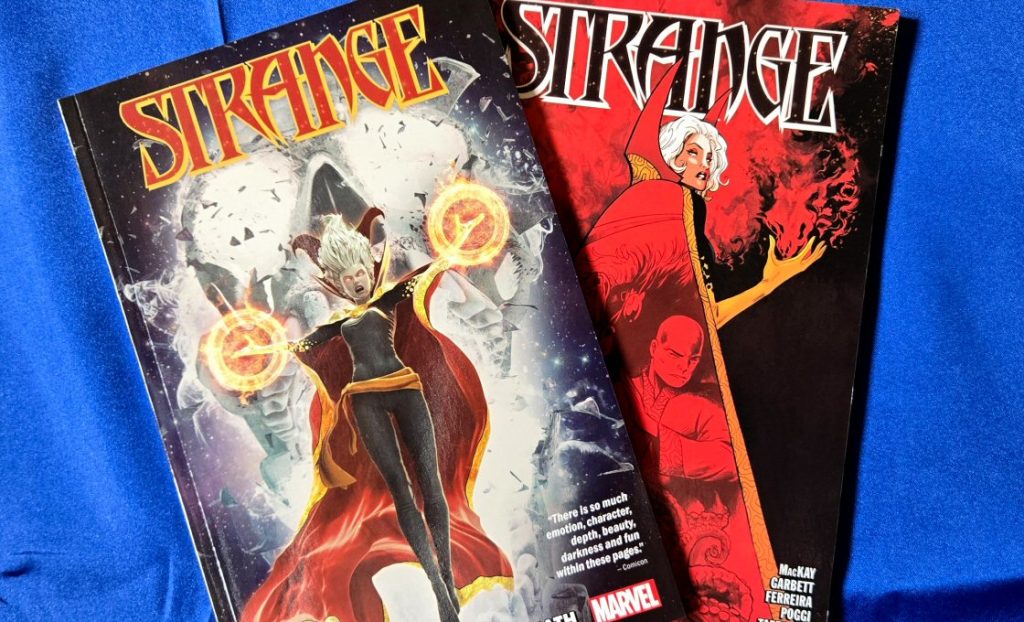
More Jed MacKay: Clea
OMG thank you SO much for tackling Moon Knight, because honestly? It’s been such a mess across different writers and I’ve been lowkey frustrated about it for YEARS.
You actually explained the difference between how MacKay has written Marc’s DID versus how some earlier writers just… completely misunderstood the assignment and turned it into “crazy violent man” tropes… yikes.
The timeline you laid out showing which runs actually did their research versus which ones just used mental illness as a plot device was genuinely eye-opening. Like I knew some of the older stuff was problematic but seeing it all mapped out like that really shows the pattern.
This is exactly the kind of analysis the character deserves instead of just “Batman but with multiple personalities” takes. Thank you for doing the work!
Wow, that was a long one! Thanks though, never really knew much about Moon Knight. He always seemed a bit, well, crazy? (sorry if I can’t say that).
Mackay’s run sounds interesting, I will have to take a look.
Yes, Moon Knight’s history is particularly complex. This is one case where I don’t recommend trying to follow the in-story continuity on the Fandom Wiki site (with all later the retcons/revisions altering his past). I think it’s important here to focus on the actual chronology of the creative teams. Or, just skip all that and start with the MacKay era – he’s really made it all more coherent. 🙂
I’m also very sympathetic to the creative teams that struggled to deal with the character’s mental illness. It is very hard when you don’t have professional training to present mental illness accurately or fairly. And this was an issue from the very beginning. That said, I was impressed with Warren Ellis’ attempted reboot in Vol 7. And again, MacKay has done a great job integrating all the canon source material up to the present time.