

Bronze: Who is Xavier?
Kitty Pryde: He was … he is … many things. Some good. Some … bad.
- Eve L. Ewing, Exceptional X-Men Vol 1, issue #7, 2025
I think Professor Ewing has summed up Charles Xavier (Professor X) … petty … darn … well.
The normative ethics of this character has always harbored underlying issues, dating back to the creation of the X-Men. As I explained on my X-Men Ethics – Introduction page, the initial actions of Charles Xavier have since been reconsidered in the intervening decades. Specifically, taking children from their homes and training them to fight others’ battles – creating a children’ army – in support of his “dream” of peaceful mutant-human coexistence is a violation of their personal rights and autonomy. Putting adolescent mutants at risk – and potentially sacrificing their lives – to demonstrate to humans the value of “good” mutants is generally seen as morally wrong today.
But as I described further on my detailed X-Men Ethics – Professor X (Charles Xavier) post, the modern ethics of this character also have an inherent contradiction. His general behavior across many years in the comics reveal him to use primarily act utilitarianism in his moral decision making. But his dream is inherently longtermist in perspective – which is incompatible with act utilitarianism as one requires you to consider the only the immediate, direct consequences of your actions (act utilitarianism) and the other the longer-term, indirect consequences (longtermism).
In this follow-up post, I plan to show how a third feature of this fictional character – his vaunted telepathy – also puts him in unavoidable conflict with act utilitarianism. Along the way, I’m going to explore one of the specific modern criticisms of act utilitarianism. I will then provide recent examples of how the current X-Men creators have tried to reconcile the character’s behavior – and explain why I think it is not enough (and what they should consider instead).
As always, if you would like to know more about the terms I’m using on this site, please follow the links throughout or check out my Ethics 101 page or Glossary post.
The unique ethical challenge of utilitarianism
This post is also an opportunity to introduce one of my favorite thinkers about ethics – the British philosopher Bernard Williams (1929-2003).
Williams was critical of both utilitarianism and Kantian deontology – the former for being too abstract and indifferent to the individual, and latter for not being universal in moral action (i.e., you can apply a universal categorical imperative for thought, but still act rationally in a uniquely personal way). While Williams didn’t describe himself as a virtue ethicist (or create a new systematic virtue theory), his work paved the way for the late 20th century revival of virtue ethics – including the development of care ethics. Williams drew heavily on Aristotle (who was a virtue ethicist) and emphasized personal character, integrity, agency, and the importance of inter-personal relationships.
He was also critical of metaethics, with its detached view of “second order” abstract problems (as am I – see my introduction on my Ethics 101 page). Williams thought that ethics should get out of the ivory tower of academic theory and focus on real-life human experience, motivations and concerns. In essence, he focused on the subjective experience, integrating human psychology and history into ethics. You can see why I so relate to him, as a neuroscientist wanting to explain ethics through comic book stories! 🙂
Williams came up with a couple of interesting thought experiments which show how act utlitarianism is incompatible with personal integrity, and unhealthy psychologically. Perhaps his most famous one involves Jim and Pedro. In this scenario, you are Jim – a North American botanist conducting field research in a South American country run by a brutal dictator. You stumble across the military officer Pedro outside a small indigenous village in the rainforest. Pedro has just rounded up 20 indigenous villagers who he has accused of treason. But in honor of your arrival as a distinguished foreign guest, he will let 19 of them go free if you kill one of them. If you refuse to kill one, he will kill all 20. What should you do? Act utilitarianism (a la Professor X) tells you to kill one to save the other 19, even if this violates your personal integrity.
This brings up a very odd problem that is unique to utilitarianism – you are apparently not only responsible for your own actions, but also all the actions of others as well. In essence, the above thought experiment is a no-win scenario, where you will feel guilty no matter what you do (i.e., whether you take Pedro’s gun and kill one, or do nothing and watch him kill 20 – you lose either way). Our utilitarian moral intuition seems to be putting us into a bind here. Williams referred to this as negative responsibility – and questioned how could it be possible that we are always responsible for what other people choose to do?
The solution, according to Williams, is to recognize that there is a crucial distinction between a person being killed by Jim, or being killed by Pedro due to an act (or omission) of Jim’s. Pedro, if he chooses to go ahead and kill, is NOT simply some manifestation of Jim’s effect on the universe. Pedro is a moral actor here – a person with their own intentions and agency. In essence, act utilitarianism seems to require us to lose that distinction and give up our personal agency, turning us simply into empty vessels by which other people’s consequences occur (or vice-versa). It seems Williams has put his finger on an innate moral cognitive bias that we have when we try to apply act utilitarianism.
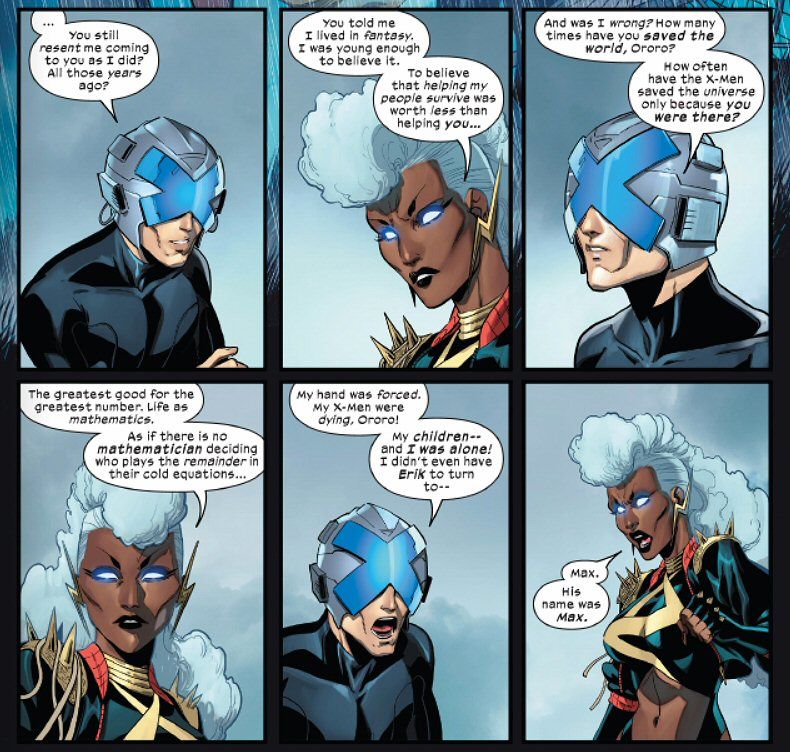
Instead, Williams argued that moral decisions must preserve our psychological identity and personal integrity. As such, we should reject any normative ethics theory that reduces moral decision making to an algorithm. Which brings me back to Charles Xavier, and Storm’s rebuke of his mathematical thinking, from X-Men: Red Vol 2, issue #11, 2022, by Al Ewing, Stefano Caselli and Jacopo Camagni:
As an aside, I did get a thoughtful response once when I presented the Jim-Pedro problem to a group. One person pointed out that there aren’t just 20 lives at stake here, but 22 – Jim and Pedro included. Anyone who would happily murder 20 people is not a good person, nor one who can be trusted to honor their bargain. In fact, Pedro is likely to kill Jim along with all 20 natives, rather than leave a witness to his atrocity. Since Jim’s life is in danger here too, the best solution for all – from an act utilitarian way of thinking – is to take the gun and shoot Pedro! That way, all 21 innocent people get to live, and only the one truly guilty person dies. That should lessen Jim’s guilt considerably. 🙂
UPDATE: If you want to learn about Williams’ similarly effective take-down of Kantian ethics, check my review of Jesse Lonergan’s Drome for the concept of “moral luck”.
Why Charles Xavier must abandon act utilitarianism
This raises a key point – and one that is critical to the examination of Charles Xavier’s ethics specifically (see, I told you I would get back to this).
As I explained on my overview of the Trolley thought problem, these types of dilemmas present moral decision making as a bounded zero-sum game, where the decisions of others are fully known in advance (and catastrophe is inevitably waiting for someone – or everyone). Williams’ thought problem (and my friends’ keen observation in her response to it) shows that we do NOT know with certainty what any other moral actor will choose to do in response to our actions. Just as we are not empty vessels for the consequences of their choices, they are not for ours. In the end, we only know what we will (or will not) accept for ourselves, and therefore are only responsible for our own direct actions.
Unless you are a telepath, like Charles Xavier.
You see, we don’t KNOW for sure what Pedro will do – we are simply going by what he SAYS he will do. Charles, however, has a particular insight which we lack – he knows with certainty what Pedro will do (well, with as much certainty as Pedro himself has, at any rate). Given that Charles has this unique knowledge, it puts him into a true negative responsibility bind that all of us normal humans can all wriggle out of. If Charles chooses to live by act utilitarianism, then he has no choice but to use his powers to know – with certainty – what all the outcomes will be (regardless of who is acting). His telepathy thus puts him into an inescapable bind of negative responsibility for everyone else’s actions.
And this explains why he is always violating his personal moral integrity (and other peoples’!). The combination of his utilitarian ethics and his telepathic powers demand it.
The way forward for Charles Xavier
Since Charles is considered one of the strongest telepaths on Earth in the comics, removing his telepathic abilities is not really an option. So what to do instead? It makes more sense to alter his ethical approach. One option the Marvel editors and writers could take is to revert Charles back to who he was at the start of the X-Men comics – back when he had more of a deontological streak. You could then develop him more along those lines going forward. But that would be an extreme character reversion, and its hard to see how it could be justified.
Alternatively, they could finally stop ignoring the applied ethics that Charles’ chosen profession requires of him (legally and morally), and let that put the breaks on his unrestrained utilitarianism. Applied ethics are all heavily deontological in their basis, and the specific ones developed for psychologists and psychotherapists would be the most relevant here. But as the editors and writers are not trained psychotherapists, I suppose it is a bit much to expect them all to take a crash course on the relevant applied ethics. Plus it puts a real damper on the action and drama if a character takes a principled stand to do nothing (repeatedly) to safeguard others’ rights!
So I think a better practical way to go is to follow the path of Charles’ best buddy Magneto and look to cultivate virtues. Being a supposed scholar, Charles could choose to brush up on his Aristotle (or Aquinas). Or perhaps he can learn something by looking – with permission – deeply into the mind of a modern care ethicist (preferably Captain Marvel, as Clea and Moon Knight both have a fairly ruthless utilitarian streak). But for that matter, he could decide to go on a Buddhist retreat – and take a vow to not use his mutant power along with a vow of silence. A core tenet of Buddhism is that some behaviors lead to suffering and others to happiness – which is very in keeping with virtue ethics (and even rule utilitarianism).
Putting self-imposed limits (for virtue reasons) on when and how he uses his mutant powers are really critical here if any amount of utilitarianism is in use (even rule utilitarianism). I know Rome wasn’t built in a day, but you have start somewhere in getting him to change. It remains completely untenable to have Charles be a longtermist, an act utilitarian, and a telepath. Something must give, otherwise Marvel’s creators are going to be stuck forever having to resort to retconing, narrative tricks, or other sleight-of-hand maneuvers. Which brings me to …
The current From the Ashes Age stories and X-Manhunt event
As discussed in my X-Men Ethics: Professor X post, the conclusion to the Krakoan Age (mid-2024) saw Charles Xavier imprisoned for his (apparent) crimes against humans (but with a backdoor, to allow him to observe and influence outside events). It is not said often enough, but I think Kieron Gillen, Gerry Duggan and Al Ewing did an amazing job in wrapping up the Krakoan Age story lines. It was no easy feat given the extensive world building that Jonathan Hickman started, and the senior writers who finished it up stayed very true to the ethical cores of the characters (especially the most conflicted ones).
This ending should have given the Marvel editors and new X-Men comic writers some breathing space, as they crafted their plans for the From the Ashes Age (which launched that same summer). Instead, for some reason, it was decided to immediately retcon that successful ending, in terms of providing a defense and justification for Charles’ actions.
I would like to preamble my comments here by saying that I have the utmost respect for all the current X-Men creators of the From the Ashes Age. The lead writers of the three main X-Men titles – Jed MacKay, Gail Simone, and Professor Eve L. Ewing – have always struck me as very thoughtful, considerate and responsible writers. They have done a great job of developing characters from historically disadvantaged groups in the comics, as well as rehabilitating established characters who weren’t treated well by earlier creators. All have really leaned in on care ethics in particular, which is a welcome respite from some of the heavily individualistic writers of earlier times. And many of the limited series writers are outstanding as well.
But … without fixing the fundamental ethics incompatibility at the core of Charles Xavier character, the current Marvel creators have been left to resort to various narrative devices that I feel just don’t work. Let me highlight some of the recent examples here, including the recently completed X-Manhunt story arc (featuring Charles’ escape from prison). Again, I do this not to criticize, but to explain why I think any narrative approach is insufficient without addressing the core normative ethics issue.
X-Men: From the Ashes Infinity Comic
Although it was likely missed by many at the time, the X-Men From the Ashes Infinity comic that ran as the Krakoan Age finished (summer 2024) immediately retconned the ending for Charles. This series was written by Alex Paknadel, who is a particularly sympathetic writer of these X-Men characters. His story arcs for Magneto (issues #13-14), Madelyne Prior and Havok (issues #7-9), Cyclops and Phoenix (issues #1-3) and the Beast (issues #15-18) are all must-reads in my opinion. Very insightful and thoughtful, these story lines all expand on the underlying motivations and current concerns for these characters. Paknadel and Diogenes Neves‘ X-Men Infinity Comic is a true value-add for a Marvel Unlimited subscription.
Unfortunately, the retconned Charles Xavier arc (issues #4-6) is deeply problematic. Here are some panels from X-Men: Xavier’s Secret, Vol 1, issue #1, 2025 (which is a reprint of the From the Ashes Infinity comic, issue #6, July 2024), by Paknadel and Neves. Charles is mentally speaking from his cell with a reporter who has been looking into inconsistencies with the dead crew members of the ship Charles destroyed during the end of the Krakoan Age:
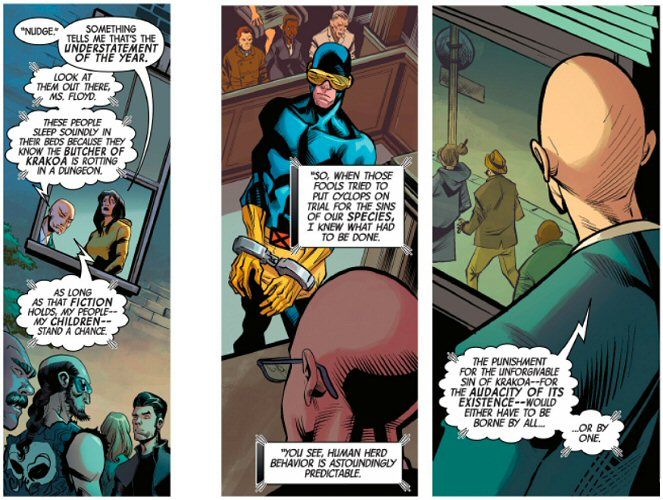
So far, I have no problem with this reasoning – as it quite consistent with the similar J.M. DeMatteis Magneto retcon from Magneto, Vol 4, 2023 (i.e., opting to make oneself a necessary villain). But it goes on further …
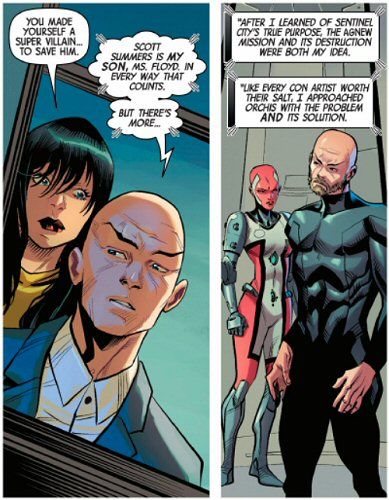
So now we find out that Charles’ original reaching out to Orchis was all a con, designed to make him the apparent villain (and sacrificial mutant offering) in the eyes of the world for killing innocent humans. Except those weren’t actual humans now:
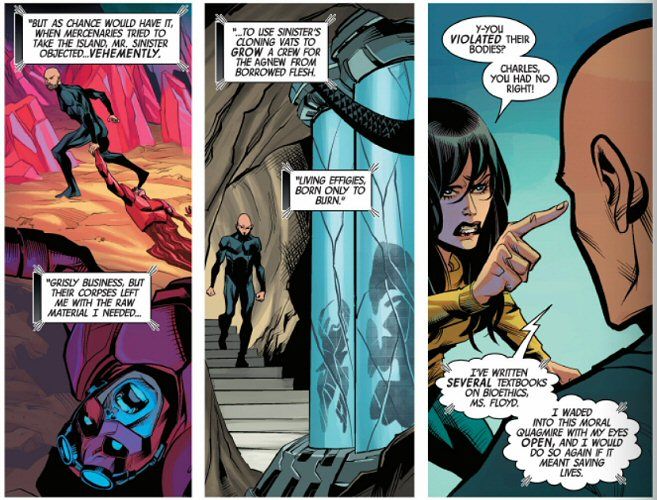
So, those who died on the ship were clones of dead Orchis agents regrown to a mindless state that Charles used like puppets. All so he could take the unwarranted blame for (apparent) mass murder.
As an aside, the hand-waving away of the ethical implications of Charles behavior in that last panel above is an example of a narrative trick. This is actually the opposite of bioethics, which came about because of unrestrained consequentialist reasoning. By the 1960s and 70s, there were numerous examples of clinical researchers having violating people’s right and autonomy in pursuit of what they justified at the time as ultimately having the potential to save other lives. These atrocities are what bioethics was created to prevent. Like much of applied ethics, bioethics is rights-based and duty-based, not outcome-based.
But back to the story …
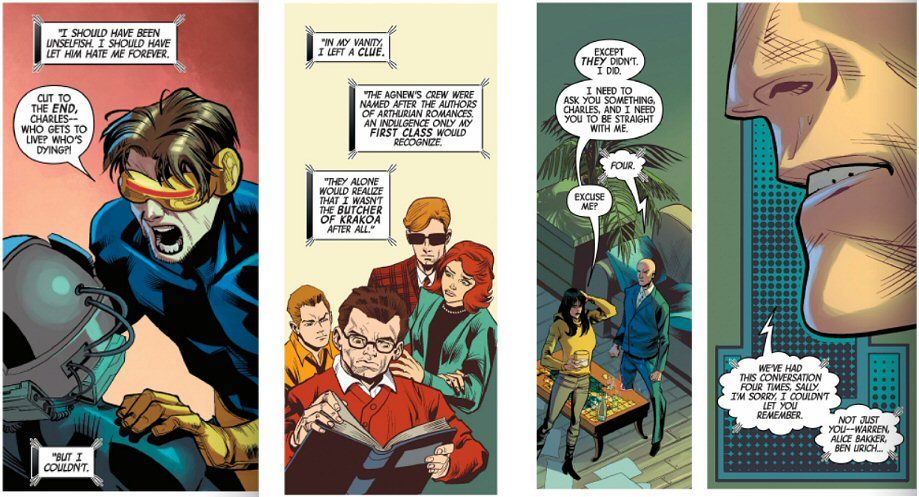
So we are now to believe that although Charles wanted to be publicly blamed, he also left a hidden clue to his “First Class” X-Men (who include Cyclops and Angel) so they would know the truth that he is innocent.
Except this retcon doesn’t work given the rest of the story. Charles explicitly showed Cyclops that he was murdering humans in Fall of X Vol 1, issue #4, 2024 – which was published before this retcon, but happened in-story after the now retconned clue was left. It doesn’t make sense that Charles would purposefully choose to lie to Cyclops, if he had already left a clue for Cyclops to find that disproves this lie. Charles would simply not have shown Cyclops anything, or showed him the actual truth.
Similarly, as indicated above Warren (aka Angel) is getting his mind and memories interfered with by Charles currently – at the risk of permanent brain damage, it is revealed here – to stop him from finding out the truth. So this retcon demands that we accept that Charles went out of his way to leave a clue that only four people would recognize, and then subsequently lied to and erased the awareness of it from two of those four people. This is not reasonable for a retcon in my view.
And we have the protagonist of this series, the investigative reporter Sally, who has figured it out instead – four times now. What to do with Sally?
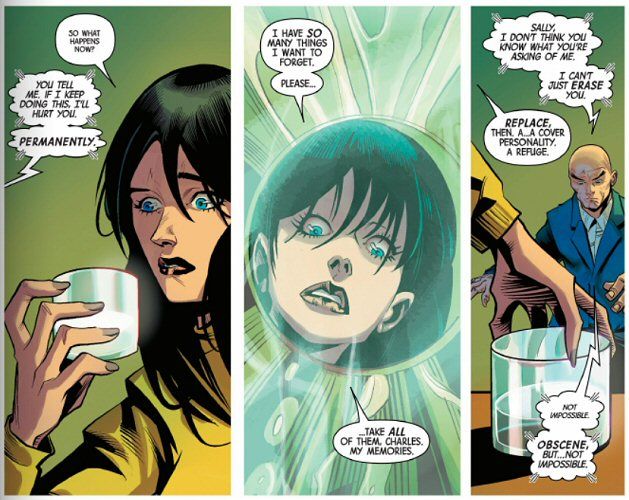
This comic series had established Sally as an alcoholic. And so, she asks Charles to not only erase her knowledge of events (for a fourth time), but also her whole personality as well this time (!). And Charles agrees, adding a block so that she doesn’t drink any more. “Obscene” indeed! This is extremely offensive, given that Charles is responsible for having left the clue she found in the first place.
Paknadel is a very skilled writer, but he can’t pull off all the required logical, narrative, and ethical knots this retcon demands. I don’t know what happened to cause this retcon to be rushed through at the end of the Krakoan Age, but I consider it to be ill-conceived. And at the end of the day, it is the editorial team that is ultimately responsible for approving these kinds of major story shifts (in this case, rapidly undoing the ending of the Krakoan Age and making Charles Xavier a “hero” again). I note the senior X-Men editor currently is Tom Brevoort.
X-Manhunt event
It was subsequently established in the main X-Men titles that Charles was being held at Graymalkin prison on his former school grounds. The Alaskan and Louisiana X-Men teams fight over freeing him, but in the end he decides to remain imprisoned (X-Men Vol 7, issue #9, 2025). This story set up the core dynamic that would be used to generate drama and fighting around the big X-Men cross-over event of this spring; X-Manhunt. Here, Charles escapes the prison and goes on the run – with all the diverse X-Men teams either trying to catch him and return him back to prison, or help him in his plans (and stopping their friends from dragging him back to prison).
The underlying premise for this cross-over event, as explained in the first issue (Uncanny X-Men, Vol 6, issue #11, 2025, by Gail Simone), is that Xavier gets a psychic distress call from his “daughter”, the Empress Xandra Neramani of the Shi’ar Empire. And so he will do anything and risk anyone in his desperate attempts to escape Earth and help her. Heightening the drama, he has a mutant brain tumor that is killing him and driving bystanders around him insane (plus distorting his own perceptions and memories). This is used to provide either further impetus for those trying to stop him, or further sympathy for those trying to help him.
This premise just doesn’t work in my opinion. We would have to accept that a good number of former X-Men out there will put their lives on the line to help this wildly erratic telepath escape (despite being dangerous to innocent civilians) and risk injuring or killing their friends, who are equally committed in trying to stop him at all costs. How to explain this extremely binary dichotomy of views – all for a man they all believe is a murderer (since the Infinity comic retcon is unknown to all the in-story characters)? Some of the supporters are unaware of his mutant tumor effects, one is under the influence of a cosmic entity, and the rest typically have rather vague motivations (along the lines of Charles was the first person to believe in them, trust them, etc.). This is simply not believable, and I feel deeply sorry for all the writers who had to somehow craft stories in support of the indefensible.
There are certainly some good action sequences along the way. Jed MacKay’s core X-Manhunt issue (X-Men Vol 7, issue #13, 2025, with art by Netho Diaz and Sean Parsons) conveniently focused on the action and the nature of team work. I particularly loved the running gag with Magneto’s helmet and the telepathic face-off between Charles and Kid Omega (Quentin Quire). Here, MacKay gets to ask and answer a great what-if question: who wins in a mental battle between two equally-matched Omega-level telepaths? Charles convincingly argues it is the one with the most experience, and quickly turns the tables on Quentin. He also expresses some self-loathing, which I appreciated:
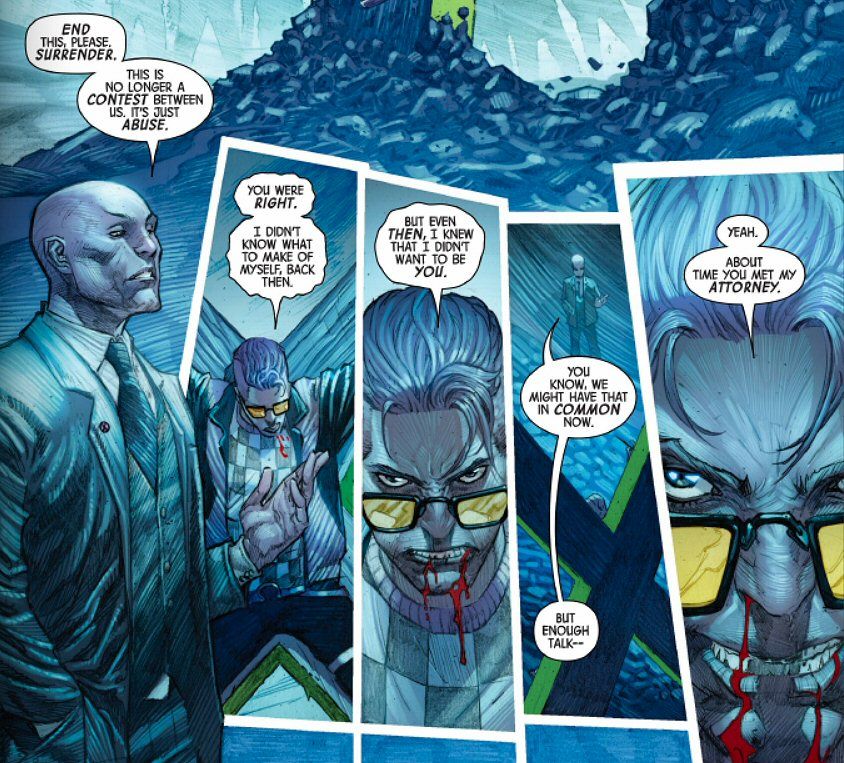
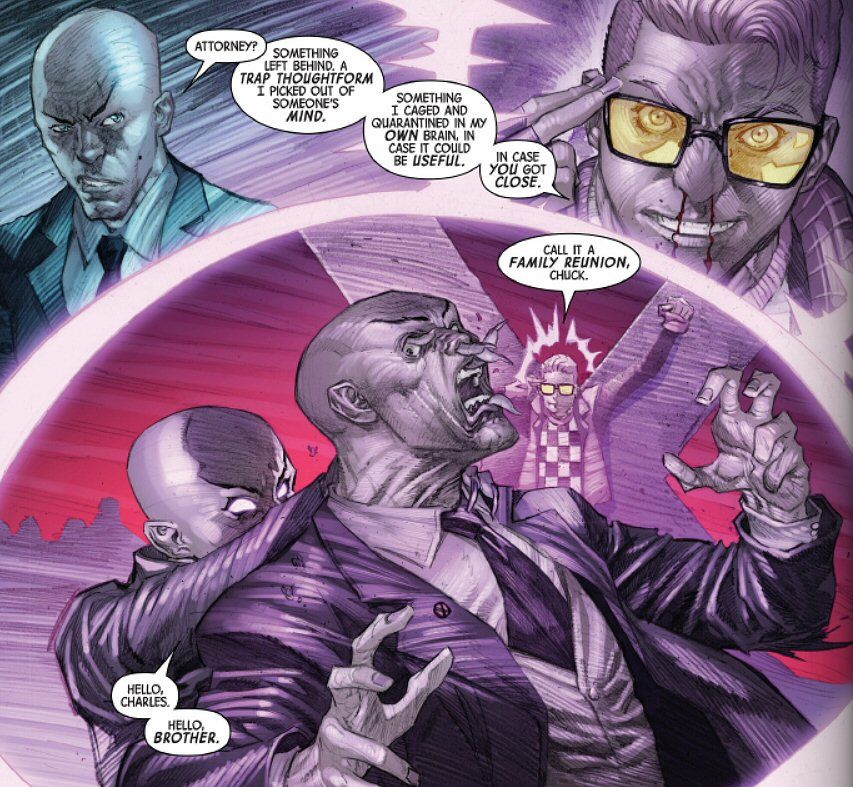
I’m not always Team Quentin, but the obnoxious edgelord does have his moments – and this example of “cheating” is very in-character for him.
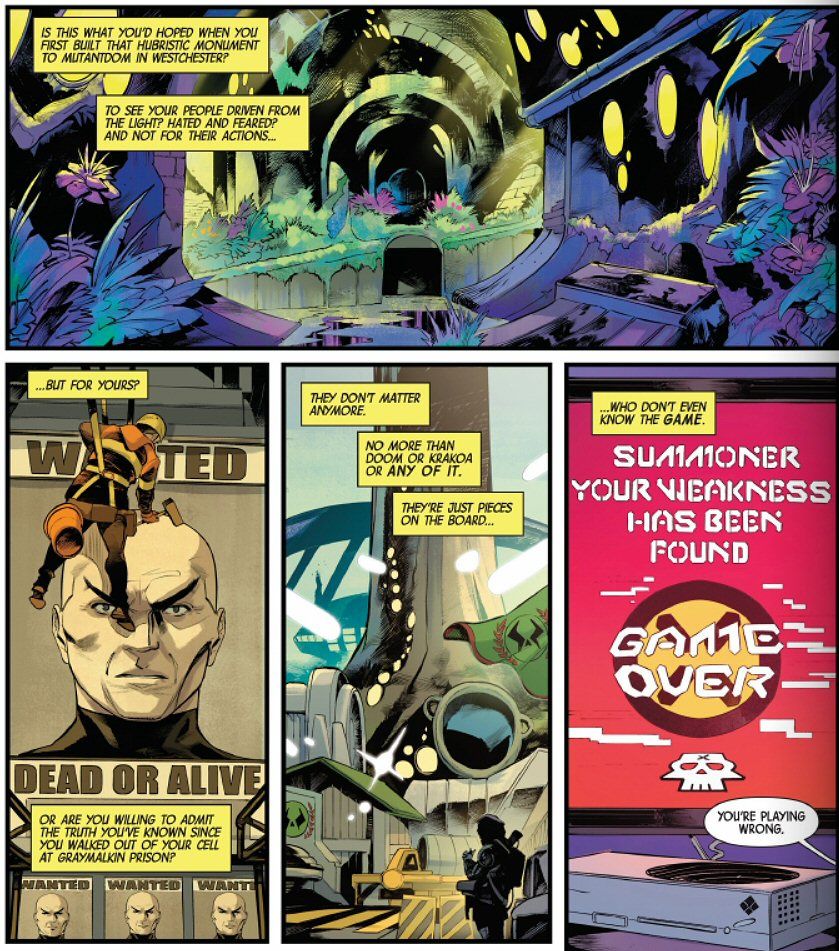
The other X-Manhunt issue that I would recommend is NYX Vol 2, issue #9, 2025, written by the Hivemind duo of Collin Kelly and Jackson Lanzing, with art by Francesco Mortarino. Here, we dispense with the (very inconsistently applied) mutant tumor effects, and instead have a mystery story where Charles is after one thing, but manipulates others to think they are in pursuit of something else. And we have a mysterious narrator who really seems to know Charles well. From the opening panels:
Charles attempts to manipulate the NYX mutants to help him in his supposed quest. Of course, he lies to them about his true intentions. And in the process puts the young mutants Ms. Marvel and Anole in grave peril when he eventually betrays them – as he had always planned to do:
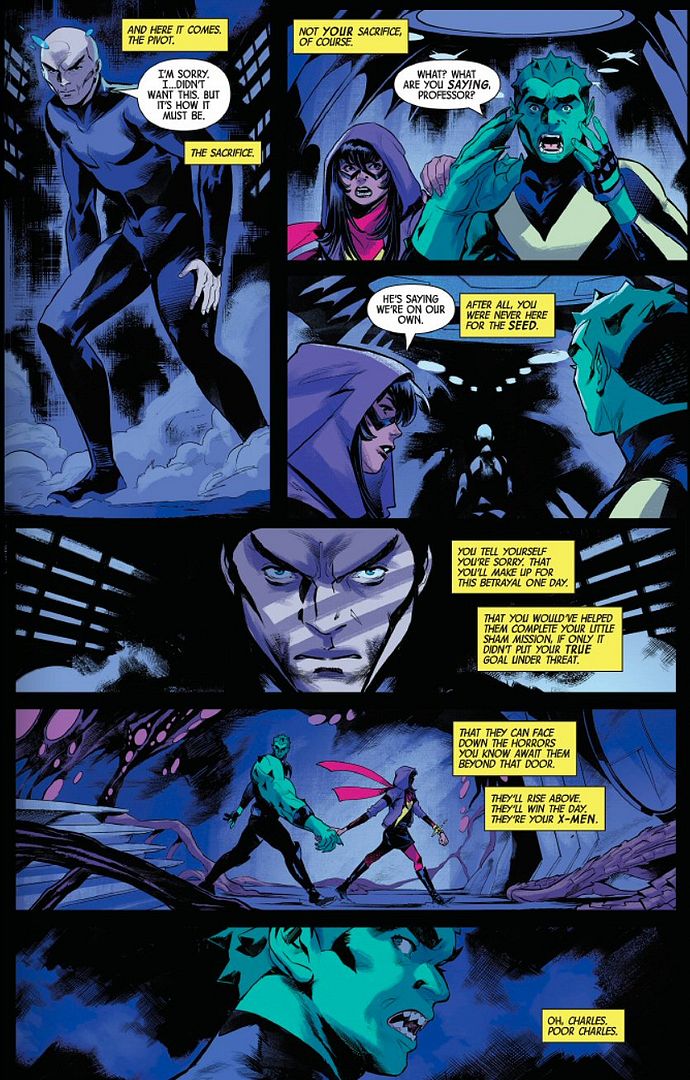
Charles is really after the last surviving Cerebro device for his own purposes, leaving them to fail in their worthwhile mission. Our mysterious narrator is quite on point. But who this is mysterious narrator? From the closing panels on the heist part of this story:
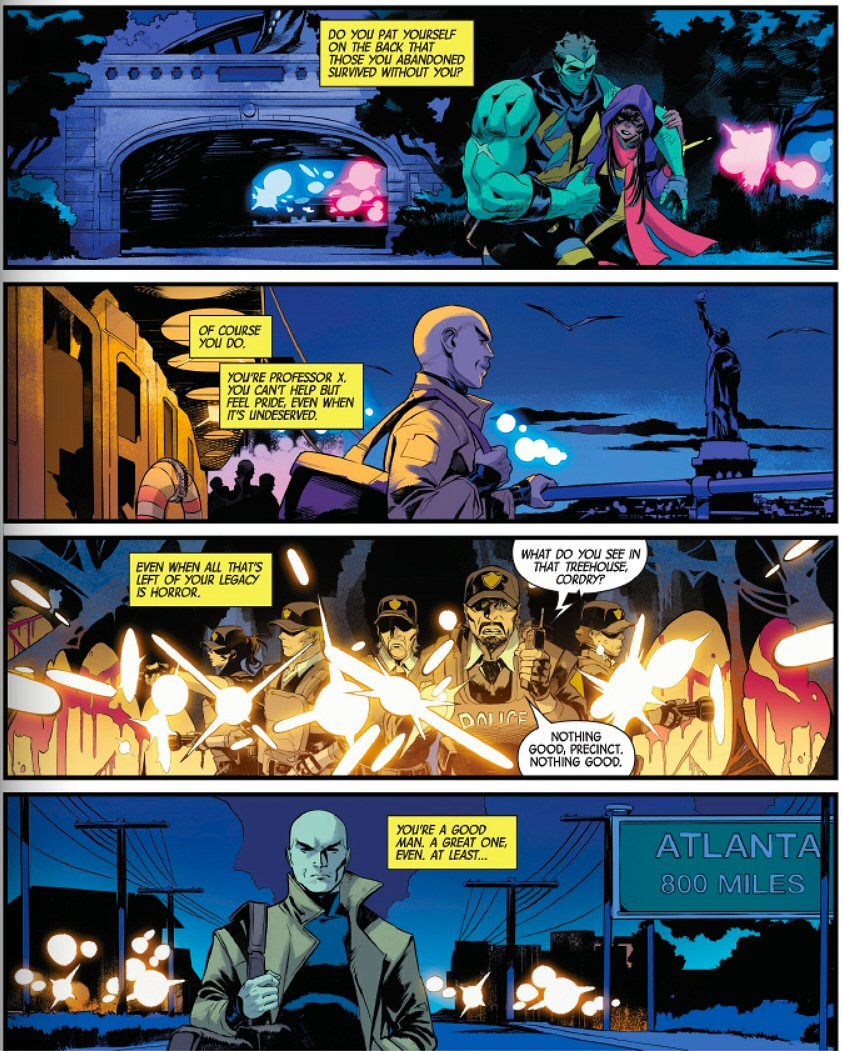
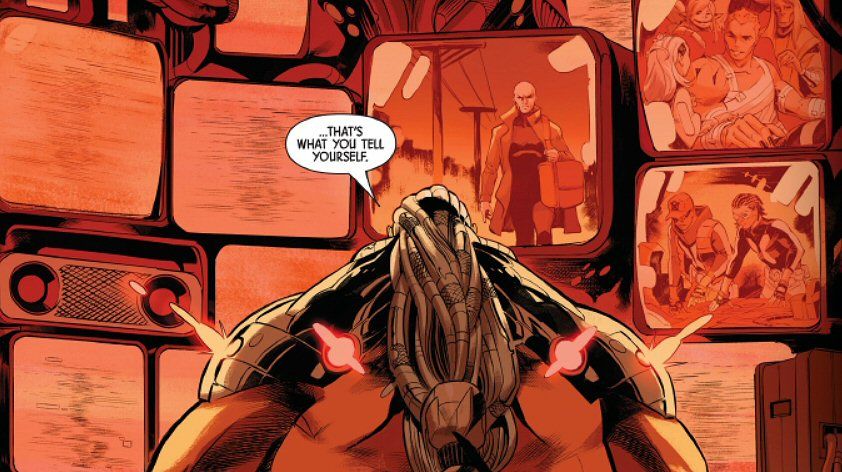
This is doubly-clever narrative ploy. Although everything the narrator says is objectively true, the cumulative effect of the repetition is enough to make you feel sorry for Charles. You might even come to suspect that it is his own guilty conscience speaking, further heightening your sympathy. But with the reveal that the narrator is in fact the villain of this series, well, now you definitely feel sorry for Charles. It’s the most brilliant narrative trick of this whole event. Of course, it is also highly manipulative, as Mojo is absolutely correct in pointing out all of Charles’ horribly unethical behavior – including this sacrificing of young mutants in pursuit of his long-term (selfish) goal of helping his daughter. I’ll come back to the significance of this narrative structure at the very end of this post.
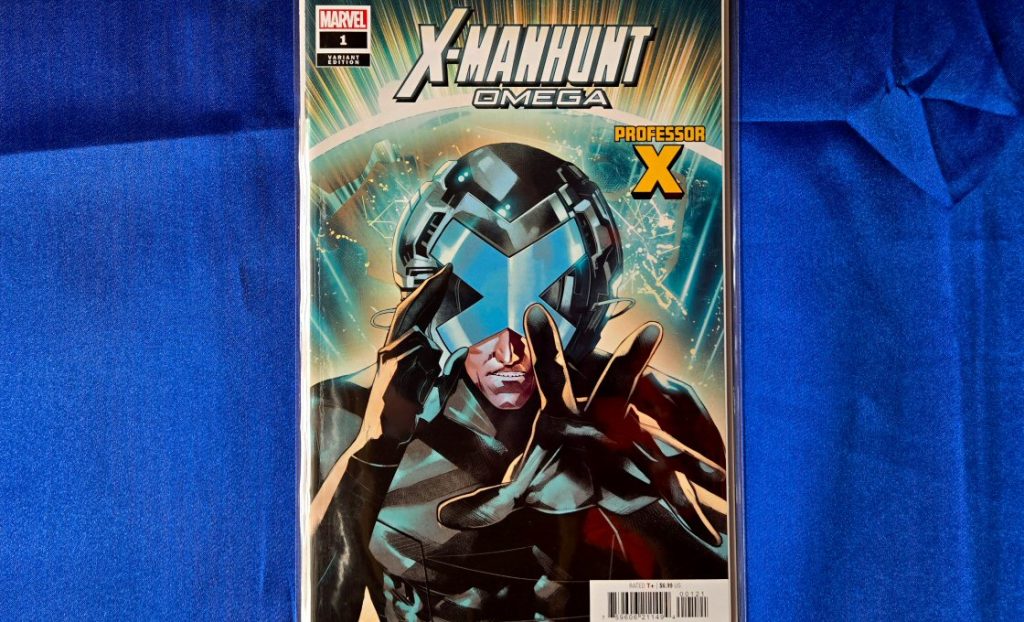
The X-Manhunt event ends in X-Manhunt Omega Vol 1, issue #1, 2025, written by Murewa Ayodele and Gail Simone, with art by Gleb Melnikov, Federica Mancin, and Enid Balam. Here, the supporters of Charles go to extreme (and dangerous) lengths to secure his release. We also get to witness this rather strange scene of Charles taunting Cyclops, ending in this sequence:
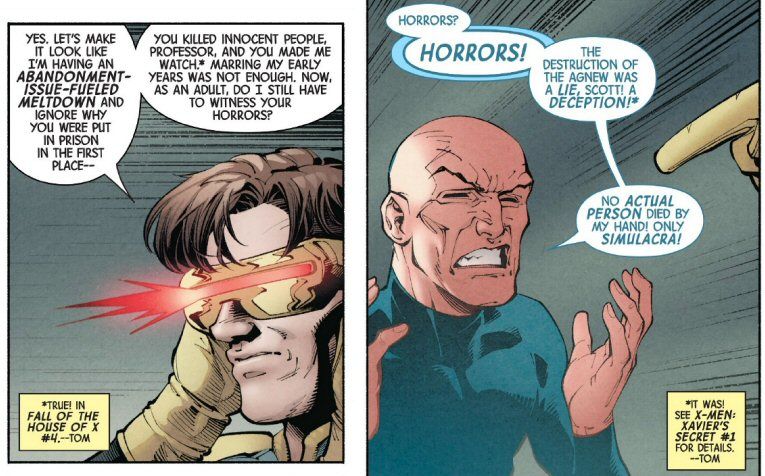
That’s an odd level of indignation from Charles, as he is the one who purposefully hid the deception from Cyclops and everyone else in the retconned story about the destruction of cloned humans on the Agnew (!). The editorial notes above from Tom Brevoort again suggest that the editorial team approved this oddly inconsistent retcon and story line.
As an aside, I find this issue somewhat unfair in its characterization of Cyclops. Cyclops has not always been a favorite character of mine, given the very inconsistent ways he has been written over the years. In my time reading him as a youth he went from humorless and morally high-handed, to insecure and indecisive, to a cad who abandons his wife and infant child. Although there is a lot of growth in the intervening years, there are also some setbacks as well. I find MacKay writes him sympathetically in his X-Men Vol 7 series, but he seems to be treated with relatively little compassion here. For example, when Charles makes his escape in this issue, you have these two panels – which accurately capture Cyclops’ dilemma:
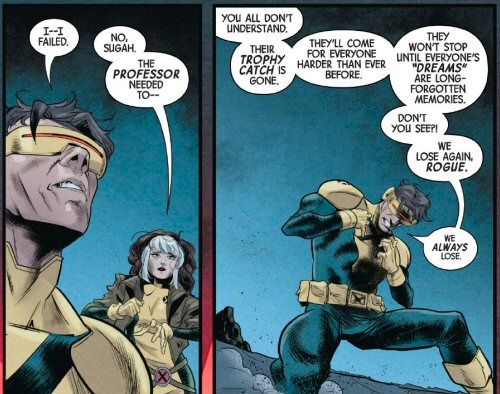
This shows the burden on Cyclops – yet the next thing that happens is that he loses control in some sort of unprecedented panic attack, and needs to be subdued by Wolverine who stabs him while calling him a “boy scout” who needs to “wake up” (although bizarrely that’s all forgiven later in the issue, and Scott seems unaffected for having been stabbed in the gut!).
But rather than end it here, with Charles’ escape, the comic shifts gears and a somewhat remorseful Charles – with his tumor now fully removed – returns to Earth for a last farewell and a sweet goodbye scene with everyone. This final scene is handled delicately, and is a good example of care ethics in action (UPDATE: see my detailed discussion of it here). Despite that, I find the ending here unbelievable, as ALL the characters break down in tears to see him now go – including Cyclops and Magik (who both almost got killed by their fellow mutants in this issue). And most shockingly of all to me, Emma Frost:
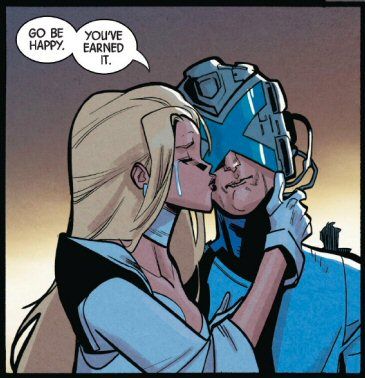
Emma has been inconsistently written over the years, but her disdain for Charles’ methods and approach has always been clear. This moment is purportedly to show that even Emma wishes him well – as he has “earned it” – which feels completely unearned to me. Looking online, I see that even comic fans who don’t like Emma’s character feel bad about seeing her written this way! I will come back to an alternate way this could have gone at the end of this post.
As an aside, I can appreciate why the current X-Men creators opted for this end scene. Many of them display a strong care ethics perspective, and this ending is very much in line with the care ethics desire to draw people closer together. Charles’ impassioned speech is actually a well-written description of care ethics, but other characters’ responses illustrate (perhaps inadvertently) one of the main criticisms of care ethics – as I describe in a subsequent post, as this one has already gotten exceedingly long! (UPDATE: now available here: Can Caring be Wrong?)
I realize it may seem like I am being harsh in my condemnation of Charles (or the writers!). I do actually have some sympathy for what the character has experienced over his long run (and a lot of sympathy for the writers here). Charles – especially in his most recent history – is clearly suffering from his choices. But I see this pain as the inevitable consequence of rigidly following a consequentualism form of ethics given the character’s abilities and world view.
This reasoning stems from another criticism that Williams had for utilitarianism – that it robs people of having their own individual moral outlook, and makes them slaves to a narrow and limited system of making calculations. Following Aristotle’s concept of virtue ethics, this means that you are effectively degrading the opportunity for virtue in the individual – the very thing that makes us uniquely human, and that leads to happiness (eudaimonia). From this it follows that strictly following act utilitarianism is a really a means to bring about pain for the individual practising it, not happiness.
You can see this in why Charles is unhappy with how his life has turned out to date. He has sacrificed his own integrity in a slavish pursuit of a utilitarian dream, leading to his own suffering. The conundrum for the writers is how to fairly express this. In my opinion, having every single mutant shed a tear for Charles and wish him well is completely unbelievable, given the wide range of normative ethics theories the other characters exhibit.
Personally, I look forward to getting back to the core X-Men stories here on Earth, sans Charles Xavier – now that this retcon and cross-over event are finally over. I have no doubt that this time has been trying for all the Marvel creators, and I would like to shout out the otherwise excellent work of Alex Paknadel in X-Men: From the Ashes infinity comic, Jed MacKay in X-Men Vol 7, Gail Simone in Uncanny X-Men Vol 6, and Professor Eve Ewing in Exceptional X-Men Vol 1 in their ongoing stories. Also a quick shout-out to some of my favorite X-Men limited series writers – Hivemind on NYX Vol 2, Alyssa Wong on Psylocke Vol 2, Erica Schultz on Laura Kinney: Wolverine Vol 1, and Ashley Allen on Magik Vol 2.
We’ll see what the future brings for Charles Xavier, but I really hope the Marvel editors and creative teams give serious thought to correcting the underlying ethics incompatibility of the character if they are going to bring him back.
The last word … for now
I can’t help but be struck by the similarity of the current From the Ashes Age with the fallout from the House of M/M-Day/Decimation event earlier this millennium. During the Mike Carey era writing the X-Men (2006-2011), it was a similarly dark period for mutants – with many risks in the new world ahead, and many fractured alliances.
But there was also a story line where Charles was shot in the head, and believed to be dead. He survives, and although he loses most of his memories, he still retains his abilities. Here are a few hopeful panels from X-Men: Legacy Vol 1, issue #210, 2008, written by Carey with art by Scot Eaton and Greg Land.
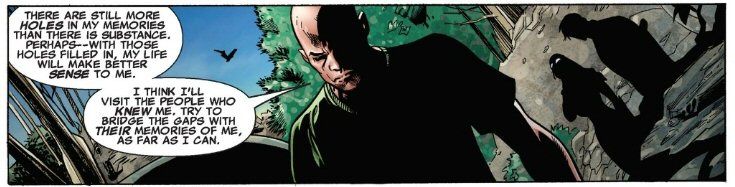
As Magneto points out, he might be in for a few surprises.
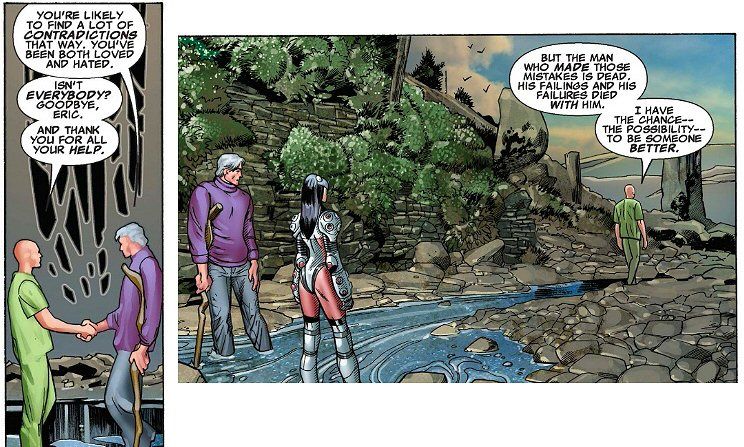
This premise could have been a good opportunity to have Charles develop a new path – as these hopeful panels illustrate. But of course, Charles being Charles, he soon falls back into old patterns of messing with peoples’ minds (all for the greater good, of course). Issue #215 is a great one, where he has manipulated Scott (Cyclops) for a meeting (written by Carey, with art by Eaton and Marco Checchetto).
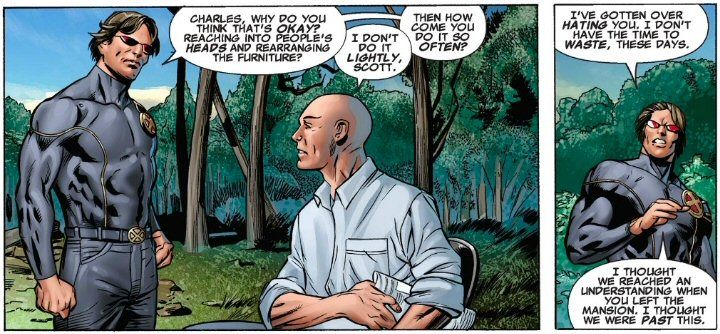
Charles is worried that Sinister has left controls behind in various people, including Scott. After immobilizing Scott against his will and preventing him from leaving, his former pupil is none too pleased:
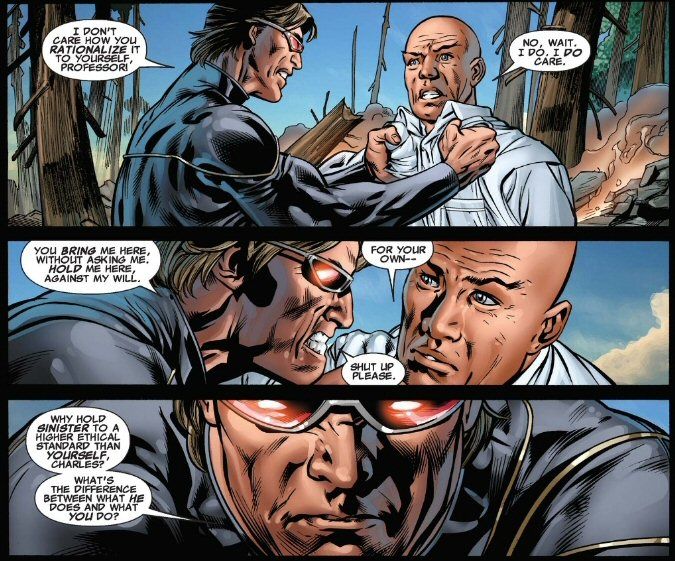
Charles is at a loss for an answer at first, but eventually settles on “motive” as his defense – he did it all for the sake of the “dream”. Recall that the original framing for Charles was more deontological in the very early X-Men. But Scott then gives him a lecture on how it was morally wrong for him to have created his children’s army in service of that dream.
Soon Emma shows up, and routs around in Charles’ mind to make sure Sinister is not exerting control over him. I loved this scene, which is so much more earnest and honest than the one above for X-Manhunt (from issue #216, by Carey and Phil Briones). After seeing evidence of his manipulative behavior in the past, Charles agrees it may be best that he doesn’t recover all his memories:
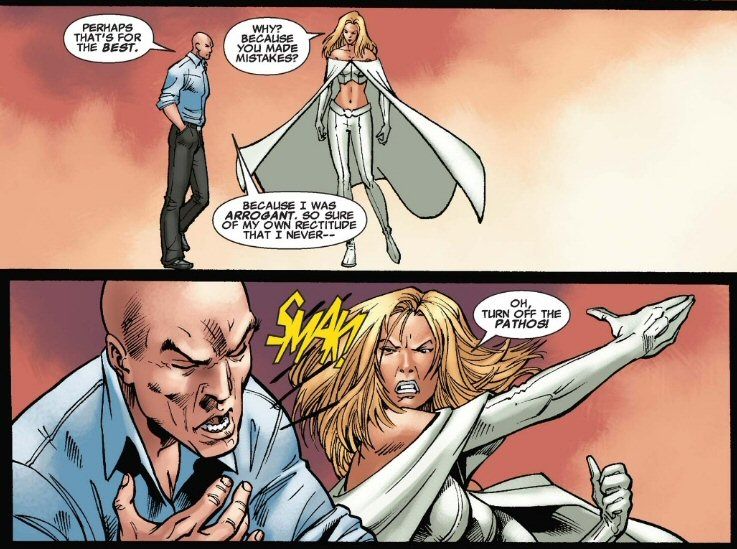
Now that response from Emma seems far more likely to me than what we saw in X-Manhunt’s conclusion.
As a final point, this panel reminds me that it was established by Aristotle, in his Rhetoric, that the modes of persuasion for an audience require three core elements: ethos (ethics, but appeals to credibility more generally), pathos (emotion, appeals to sympathy), and logos (reason, or logical appeal).
It pains me to say this, but I find the ethos and logos of Charles’ arc in the From the Ashes Age are both deficient. The conclusion to the X-Manhunt event in particular seems to me to be almost exclusively an exercise in pathos. But without a sufficient grounding in the other two, it was never going to be satisfying.
Ethos needs to have its day.
See my Glossary post for a list of the key philosophical concepts and related links on this site.
Further Reading

For more Xavier: Charles Xavier Introduction
For more Xavier: Can Caring Be Wrong?

For more X-Men: Magneto
Really interesting. I’ve never seen a comic blog/review site quite like this.
Are you planning to profile Thor? He’s one of my favorites.
Yes actually. I’m just finishing up one right now, but plan to focus on Thor and Valkyrie (Jane Foster) for my next ones. Stay tuned!
As someone who considers themselves a utilitarian, this post raises some interesting concerns. But what about the main benefits, particularly in addressing societal issues? It could genuinely lead to fairer outcomes for all, if everyone applied it. I get the point that being telepathic could lead to invading privacy and make relationships super complicated, as seems the case here. But if you could read minds, it seems like that could also lead to a lot of understanding and empathy. I don’t see that being addressed here.
Thanks for your comments, I really appreciate the perspective.
And you make a couple of very good points. If everyone adopted a more utilitarian perspective, that could certainly lead to fairer outcomes for everyone (instead of the current system, which advantages the wealthy and further diminishes the poor, for example). But I guess I would worry if it would truly lead to fairer outcomes, or if could risk further marginalizing the rights of those already the most disadvantaged? It certainly seems like a humanist/utilitarian world would be a fairer one, if you were starting from scratch – just not sure how well that would work starting from the world we have (although I think this world works better than most give it credit for). Check out Hans Rosling’s “Factfulness” for a sobering evidence-based read of just how much the world has improved in the last century.
Your second point is really good one too – I hadn’t thought of that, but yes, telepathy could certainly bring about a lot empathy and understanding in the one who had it. But my point here was that it hasn’t in the X-Men comics. Instead, Professor X has gotten progressively worse in terms of violating peoples’ autonomy, integrity and rights. Maybe that is just a failure of imagination on the part of the writers too … if any of them ever read this blog, I hope they scroll down to these comments. That could be an interesting read if a telepathic character developed overwhelming compassion and empathy as a result.
As an aside, that is kind of what happened in the Isaac Asimov “Robot” novels, where a robot develops the ability to read and alter human minds. In the original short story, that robot deactivates itself to save humans. But in the later novels, when this happens again, it instead goes on to seed a race of robots like itself who help guide humanity out of its chaos and strife. Ironically, that sounds like a way to achieve your first point about a fairer society!
Interesting thought …
Thank you for the response. I will look into those books you mentioned. I would like to return the favor with a great book for helping to understand utilitarians: “Utilitarianism: A Very Short Introduction” by Katarzyna de Lazari-Radek and Peter Singer
Thanks. I have a lot of respect for Peter Singer – he has brought a lot of new ideas forward, especially in the consideration of non-human animals.
If you are curious about Bernard Williams’ critique, a good example is Utilitarianism: For and Against, 1973, by by J.J.C. Smart and Williams. This one is a little more approachable than some of his other more academic works (still geared to University-level).