

Spider-Man: God … oh my god … help me … help …
Doctor Strange: I’ve never been accused of having a good bedside manner … do people want the good news or the bad first?
Spider-Man: Doctor Strange … good please … g-good …
Doctor Strange: You’re alive and in perfect health. Bad news is you have to fight and defeat the rest of the Scions of Cyttorak … likely dying in the process … rebirthing … seven more times. If you don’t … the earth falls.
- Amazing Spider-Man Vol 6, issue #61, 2025, by Joe Kelly
This great story arc recently came to an end in the Amazing Spider-Man, Vol 6, series by Marvel comics. The main story line was written by Joe Kelly and Justina Ireland, with tie-in issues by Derek Landy and Christos Gage. The series deals very explicitly with the topic of death, and how to come to terms with it. As I will explain below, it gives a very good description of an existential crisis, and of two philosophical approaches to revolving one – nihilism and existentialism. Along the way, we see how nihilism can be mistaken for stoicism. We are also treated to an interesting take on a common criticism of John Locke‘s “memory theory” of personal identity.
Please see my earlier Spider-Man (Peter Parker) Ethics post for the background and history of this popular Marvel character. As I explain on that page, I personally see Spider-Man’s moral philosophy across his long run as primarily virtue ethics-driven, with secondary deontological features. This story line further reinforces that view, as it is precisely his sense of virtue that comes under attack in this series, triggering his existential crisis. If he were primarily duty-driven, then it would be harder to understand why the events of this series pushed him over the edge.
As always, if you would like to know more about the terms I’m using on this site, please follow the links throughout or check out my Ethics 101 page or Glossary post.
Introduction to the story
Following on the major cross-over event of last summer (Blood Hunt by Jed MacKay), Doctor Doom took over as Sorcerer Supreme of Earth from Doctor Strange. He laid low for a while, until he resurfaced in the 8 Deaths of Spider-Man story line – which marks the start of Joe Kelly taking over from Zeb Wells in Amazing Spider-Man Vol 6 (issue #61, 2025, by Kelly with art by Ed McGuinness, Niko Henrichon, Mark Farmer, and Marcio Menyz). Turns out, Doom has a job that he figures Spider-Man is perfect for:
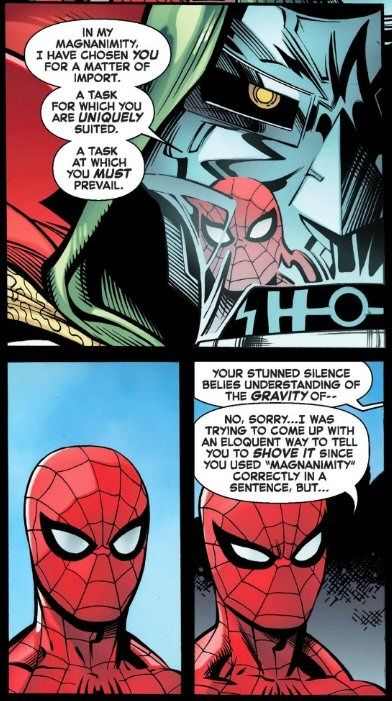
Initially rebuffing Doom, Spider-Man eventually reluctantly agrees to help, once he sees the rampaging godling terrorizing his city.
The premise of this story line, as explained by Doom, is that Doctor Strange previously entered into a “covenant” with the powerful extra-dimensional god-like being known as Cyttorak (he of the infamous crimson bands). Strange erected the “unassailable crimson casket of Cyttorak” to protect Earth-616, and the deal requires Earth’s champion to regularly combat the “eight scions of Cyttorak” (his godling offspring). Strange undertook this duty himself, armed with the “Reeds of Raggadorr” (from Cyttorak’s oldest foe), which allowed him to be resurrected every time he died fighting a scion. But Doom is a master delegator, as he explains to Spider-Man:
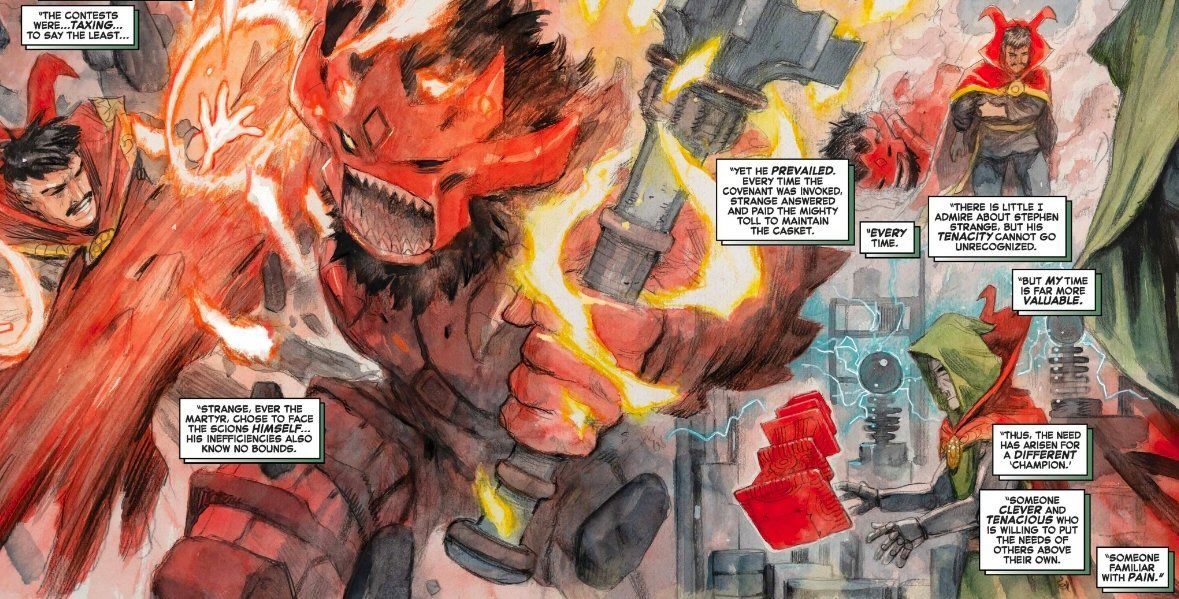
Sounds like a job for Spidey! As an aside, it seems that Doom – who is an egoistic consequentialist (also known as ethical egoism), always seeking to maximize what is good for him – agrees with my assessment of Peter as a virtue ethicist, always willing to sacrifice himself for the sake of others.
In exchange for Spider-Man agreeing the uphold the covenant, Doom gives him some magically-upgraded armor and the resurrection Reeds. But the first death Spider-Man experiences at the end of this issue isn’t pretty:
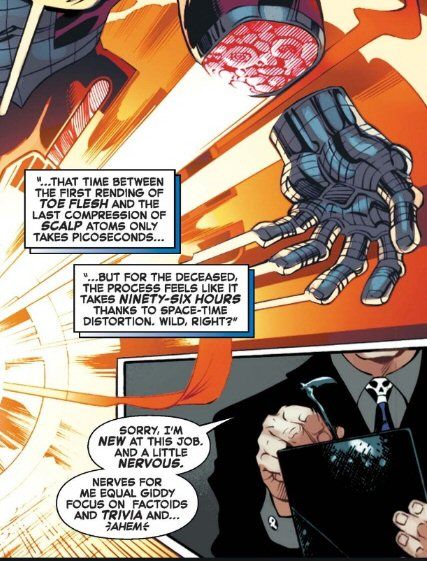
That new character in the scene above is former S.H.I.E.L.D. agent Phil Coulson, who was recently resurrected (sorta) by Derek Landy in his new Infinity Watch story line. Landy has had the Infinity Stones each find their own personal hosts. The Death Stone (created by Thanos after subduing his former lover, Lady Death) migrated to and reanimated Coulson. This has given him the role as the official emissary of death (aka, the Grim Reaper). As you might guess, he plays a significant role in this series.
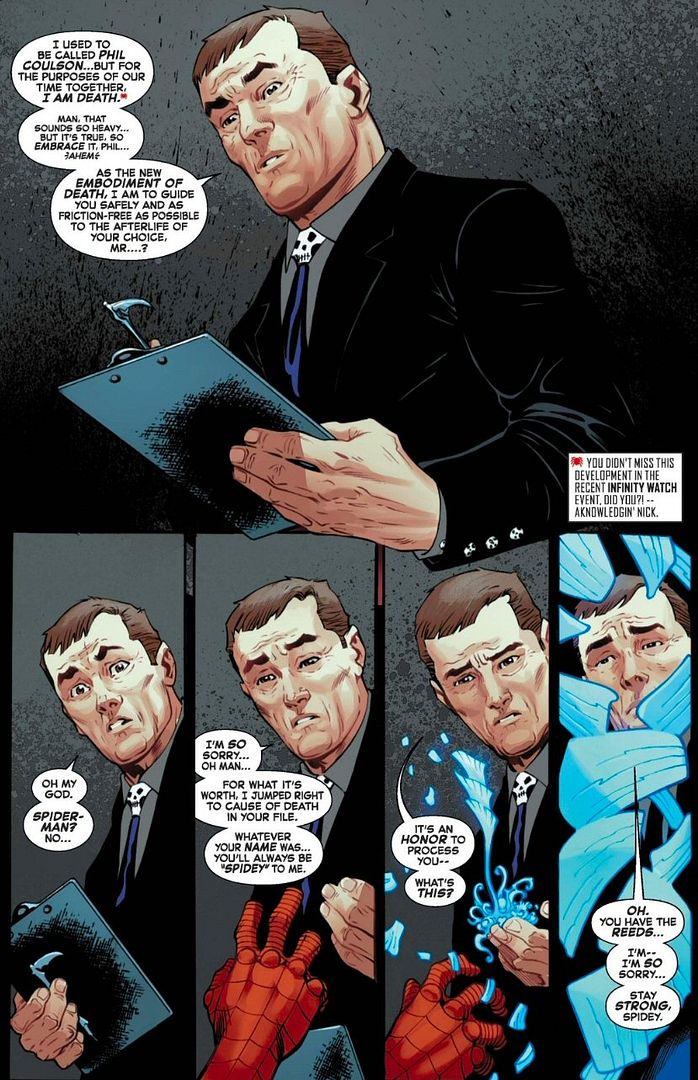
The reason Coulson feels sorry for him is that he knows the resurrection process is hardly painless (I’ll save you the gruesome panels where Spidey’s body is reformed from scratch). As he describes it – “pain, inconceivable pain”. Which brings us to the opening quote at the top of this page, where the astral form of Doctor Strange delivers the good news/bad news situation to the reborn Spider-Man.
In the next issue #62 (by Kelly with art by McGuinness, Cliff Rathburn, Farmer, and Wade von Grawbadger), Strange explains the score:
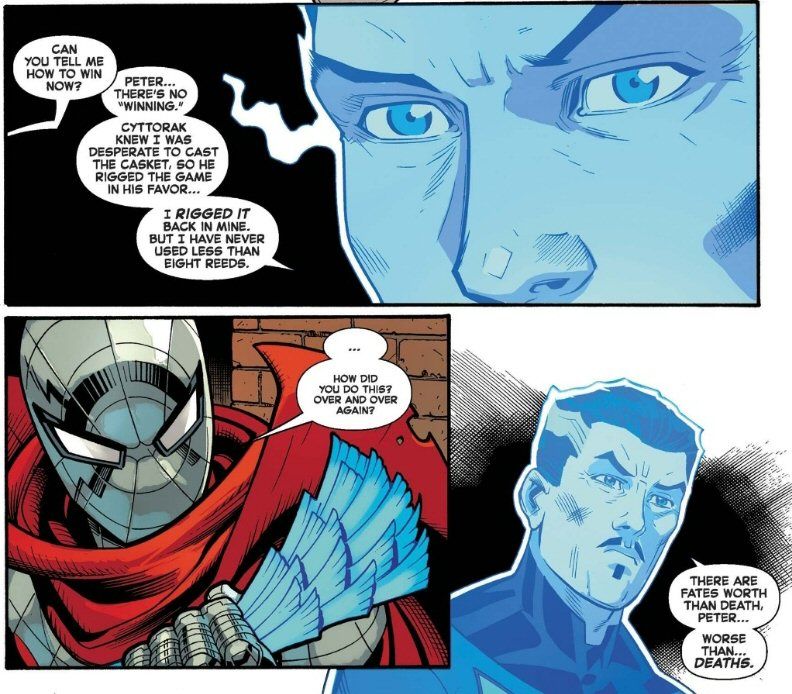
Over the next several issues, Spider-Man uses his wits (and nascent magical skills, under Strange’s tutelage) to defeat the next several scions. But he is unable to prevent his (increasingly gruesome) death each time, and has to rely on the reeds for resurrection (just as Strange always had). But then in issue #65, he faces an unusual scion foe: Cyra.
The scions all seem to have major daddy issues, and are each desperate to impress Cyttorak with how capable they are by defeating Earth’s champion. But Cyra seems bored with the whole endeavor, and just wants to get things over with. Her challenge to Spidey is very straightforward – face the inevitably of death. From issue #65, by Kelly and CAFU:

The sphere begins by showing Spidey the sad future death of his beloved Aunt May. Spidey is unimpressed.
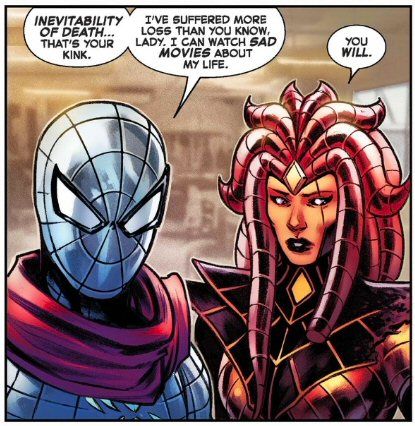
Next up is the death of Mary-Jane Watson, who is clearly dissatisfied by her life at the end:
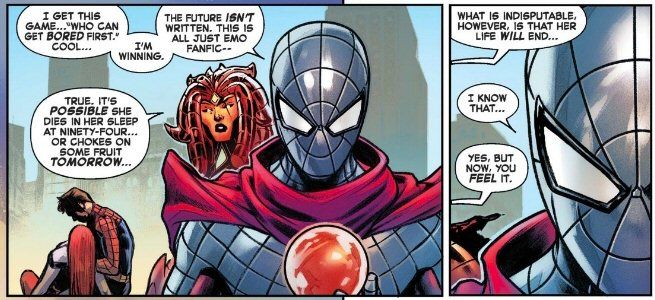
But then he sees the future deaths of all his loved ones – including watching all the innocent younger Spider-people (like Spider-Boy, Spider-Gwen, Miles Morales, etc.) get wiped out – he really begins to feel it. He tries to intervene, but Coulson shrugs him off. Cyra narrates for Peter over many, many more deaths:

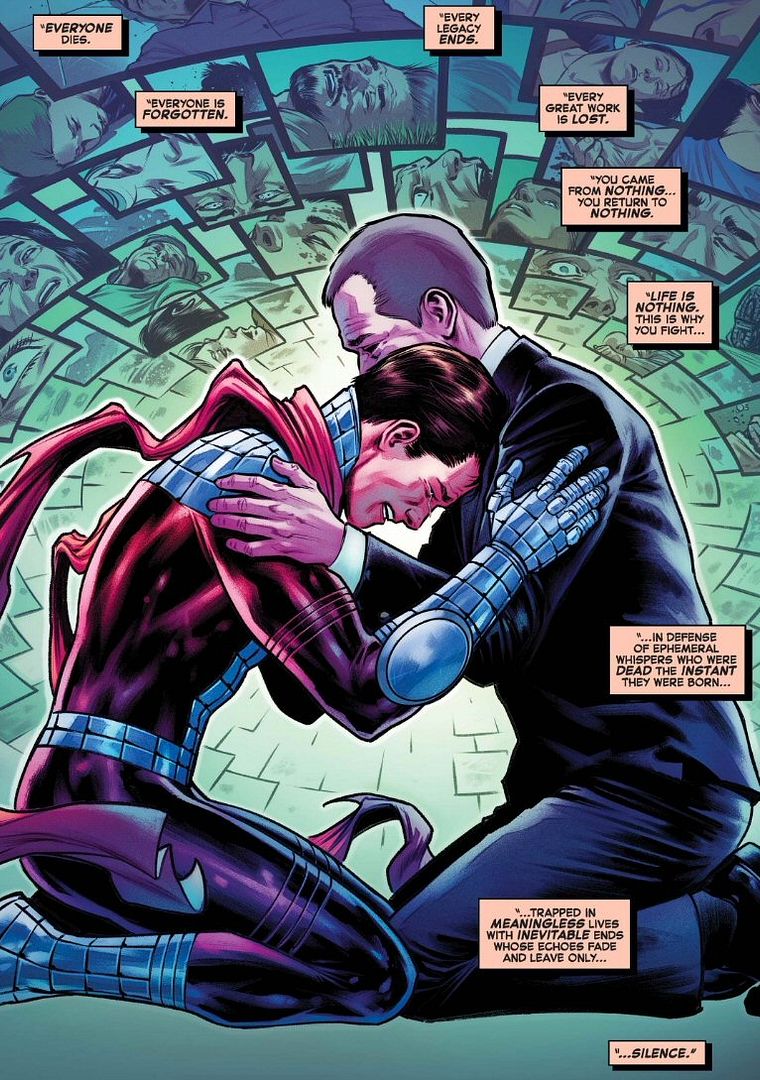
Given the scions are immortal godlings with that long “view of the horizon of the cosmos”, you can see why every individual life is utterly meaningless to them. The narration in the last panel above is very reminiscent to me of the bleak view of Irish playwright Samuel Beckett in his famous play Waiting for Godot – “They give birth astride of a grave, the light gleams an instant, then it’s night once more“. Beckett’s world-view during this period was very aligned with existentialism and absurdism, as I will explain below.
This experience has an unexpected effect on Peter. The issue ends on a twist, when Strange visits Peter and tells him he needs to get over this latest trauma, and redouble his efforts for the remaining (more difficult) scions to come. Peter asks him why.
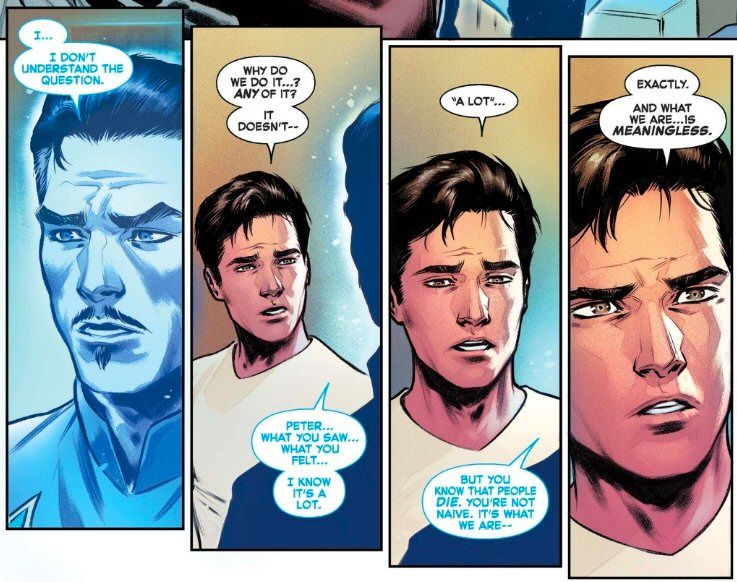
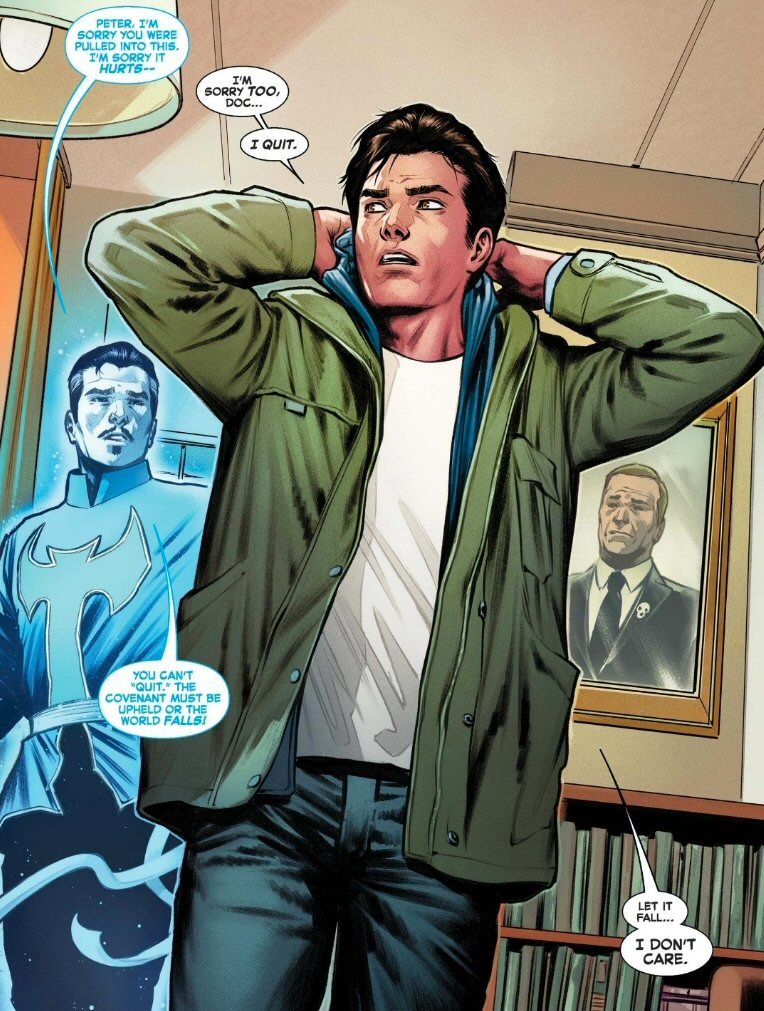
This is not a minor issue for Peter – his behavior radically shifts into a detached, indifferent, and seemingly depressed person for the next several issues (“Emo Peter”, as Felicia Hardy the Black Cat refers to him). And Strange seems completely mystified as to why.
I’ve always enjoyed the interactions between Strange and Peter over the years. As noted on my Spider-Man Ethics page, the two do seem to have an affinity and closeness – despite their differences. But Strange often seems puzzled by Peter’s behavior, and this series is no different. I chalk a lot of this up to their very different normative ethics – Strange is primarily utilitarian (focusing on the action that leads to best outcome for all), while Peter is primarily a virtue ethicist (focusing on exercising his personal virtues). It is the assault on Peter’s character that is at issue here – any option to explore virtue appears to have been taken away from him. If nothing he ever does actually matters, then why keep trying? Note that this is not a question a deontologist would ask, as it is simply one’s duty to carry on.
The ultimate source of the existential crisis Peter is experiencing becomes clearer over the next several issues, especially the first tie-in issue, numbered “Issue #65.DEATHS”. I presume this is to suggest you can read the whole series without the two optional DEATHS issues (with the numbering telling you where they are inserted in the main reading order). But skipping these would be a mistake – issue #65.DEATHS is one of the best issue in the series, in my philosophical view. Written by Derek Landy with art by Kev Walker and Wade Von Grawbadger, this issue pick up immediately after the scene above – when Strange turns to have a conversation with the man-in-the-mirror, Phil Coulston, emissary of death.
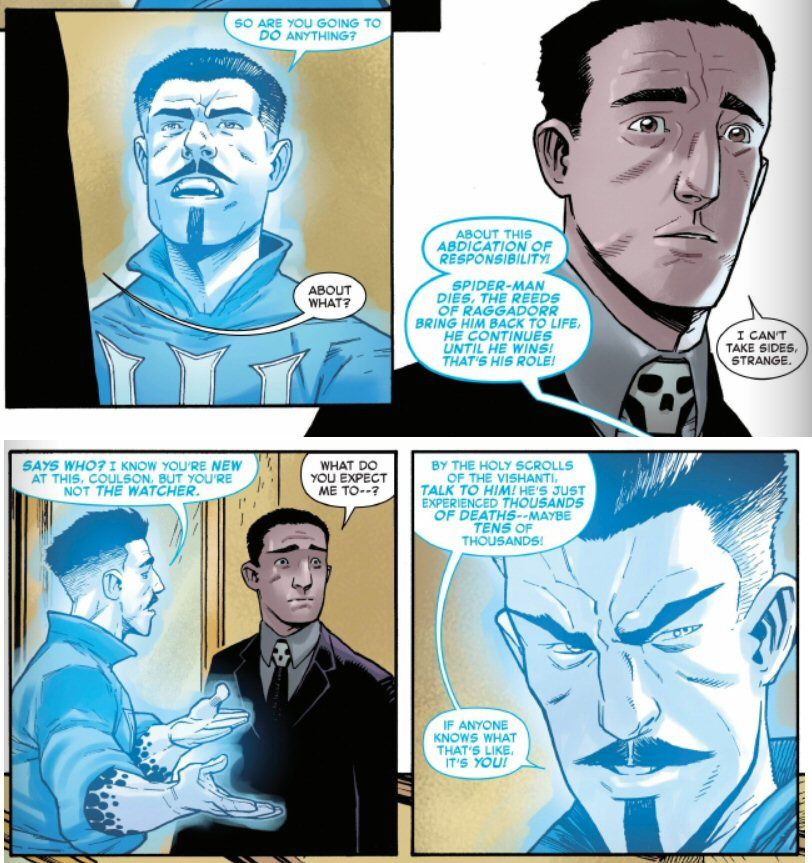
Actually, this issue begins with a flashback of young Phil Coulson at age six, finding his grandfather dead – with current Coulson narrating how death changes everything about our personal universe. Something happened to Coulson at that point, which we come back to later in this issue. This story isn’t just pivotal to understanding Peter’s crisis in this series – it is also critical to understanding the evolution of Coulson’s character, and ultimately, why the Death Stone chose him to be her emissary.
As bidden by Strange, Coulson goes to see Peter, to try and help him process his grief – but he is rejected. Coulston uses his powers to see Peter’s personal life and history in detail, to understand his identity better. He sees Peter’s fundamental trauma (the “unimaginable, impossible guilt” at the death of Uncle Ben), and how all the subsequent deaths of loved ones (“another lifetime’s worth of love denied to him because the universe, it seems, cannot let Spider-Man be happy. It needs him driven by guilt and fear and recrimination”). But as every death shaped Peter, Coulson can eventually gleam a larger purpose – they were necessary to drive him to be a hero: “He wonders that without all this death … would Spider-Man be able to save all this life?”
Throughout this tour of his life, Peter sits unfazed on the couch – looking bored, in fact. In the end, Peter insists none of that matters, as everyone dies anyway, usually awfully. This tour helps Coulson realize a way to open a locked door in his own memory – what happened right after he found his grandfather’s dead body. It turns out his six-year old self saw the personification of Death herself then. And Death was surprised by that. As she notes: “How interesting. Only a handful of beings have ever been able to see me when I have no intention of being seen”. She goes on for the next two fantastic pages:
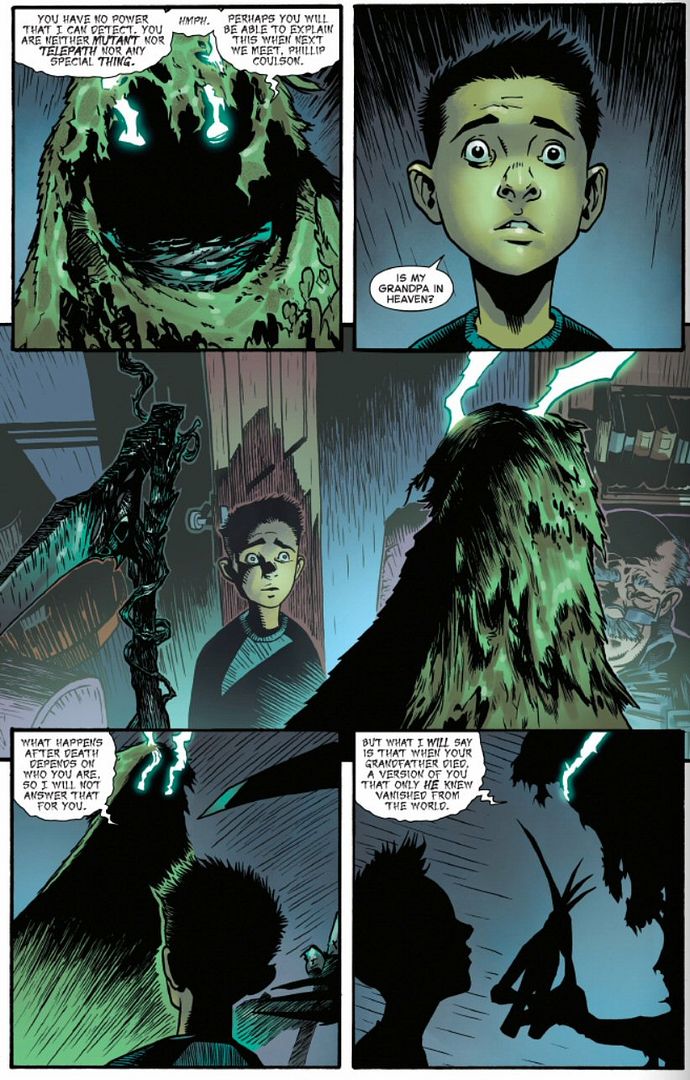
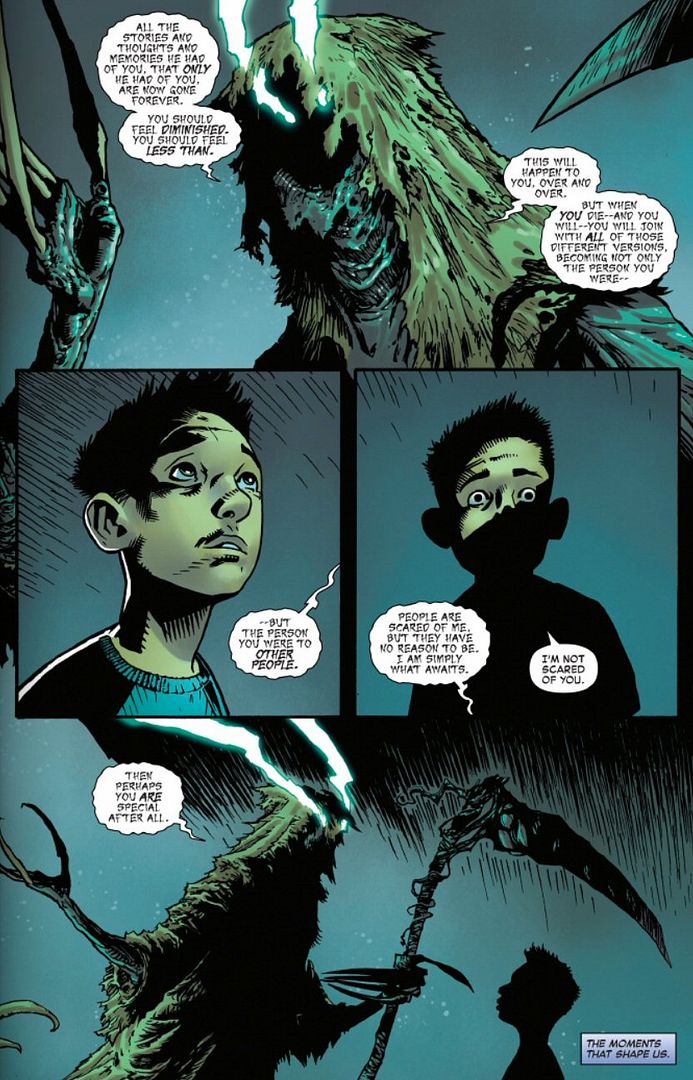
I love the panel right after young Coulson asks if his grandpa is in heaven … you don’t see Death’s reaction for a beat, until she explains this very interesting perspective of what death is.
Death (personified) is a long-standing character in the Marvel Universe. Her motives and perspective are usually left quite mysterious. I don’t think I’ve seen this explanation for what happens after death before – but it does remind me a lot of a common criticism of John Locke‘s “memory theory” of personal identity.
Locke was a 17th century English philosopher, and is known as one of most influential empiricists of the Renaissance era. Empiricists believed that true knowledge comes from sensory experience or empirical evidence – exclusively, or primarily, depending on the philosopher. I’ve always had a lot of sympathy for this general view, given the well-known human cognitive biases that get in the way of using logical reasoning exclusively (as many rationalists proposed).
For a broader discussion of identity metaethics, please see my discussion of the Ship of Theseus thought experiment from my Vision Ethics post.
According to Locke’s memory theory, a person’s identity is defined by their memory of past experiences. Note that this is not just a contributing factor to Locke – for him, the extent of a person’s identity is limited by what they can remember. This of course means that as a person loses their memories, their sense of self diminishes too, until they no longer are the same person. Psychologists have long tried to provide support for this view. For example, it’s known that impairments in autobiographical memory (that is remembering the events of one’s life) in dementia leads to reduced measures in the strength and quality of identity.
But I started studying cognitive neuroscience before I read Locke – and so for me, this theory never held up empirically. There is more than a century’s worth of neuropsychological evidence that people who suffer memory impairments without generalized reductions in cognitive function (e.g., without dementia) do not loose their sense of self. There is an even more extensive research literature of specific brain impairments that do not alter memory but lead to profound changes in personality, behavior (including moral behavior) and sense of self.
Even among Locke’s contemporaries, and those that soon came after him, there were obvious problems with his view, given its exclusive focus on the internal memory of the individual (which is limited, fallible, changeable, and fades with time). Early criticism of his theory looked to the value of external memory (sometimes called witness testimony), which Locke dismissed. But practically, events do not cease to exist if we loose our internal memories of them. Locke’s intransigence on this obvious point called into question his empiricism, as he seems to suffering from idealism here. And as later philosophers noted, you quickly get into paradoxical conclusions with Locke’s theory when you bring external observers into the mix.
Which brings me back to Landy’s rather novel reinterpretation that death is when all memories of you – internal and external – are reunited into a whole. Locke would not have been amused, but I find this a clever and interesting philosophical view. As an aside, it it exactly these kind of gems that as an adolescent I found so interesting about comics – you never knew when someone was going to expand your perspective with an unexpected twist.
Getting back to main event, by the next issue Cyra seems to feel bad for Peter – and reaches out to her former foe Doctor Strange to discuss the matter. A couple of panels from issue #66, by Ireland and Andrea Broccardo, explaining what is going on:
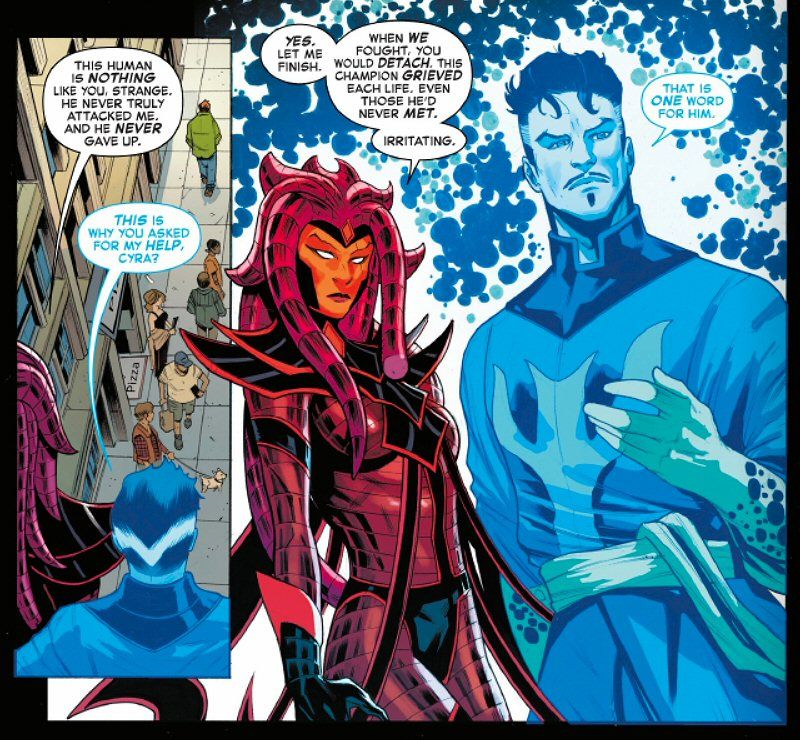
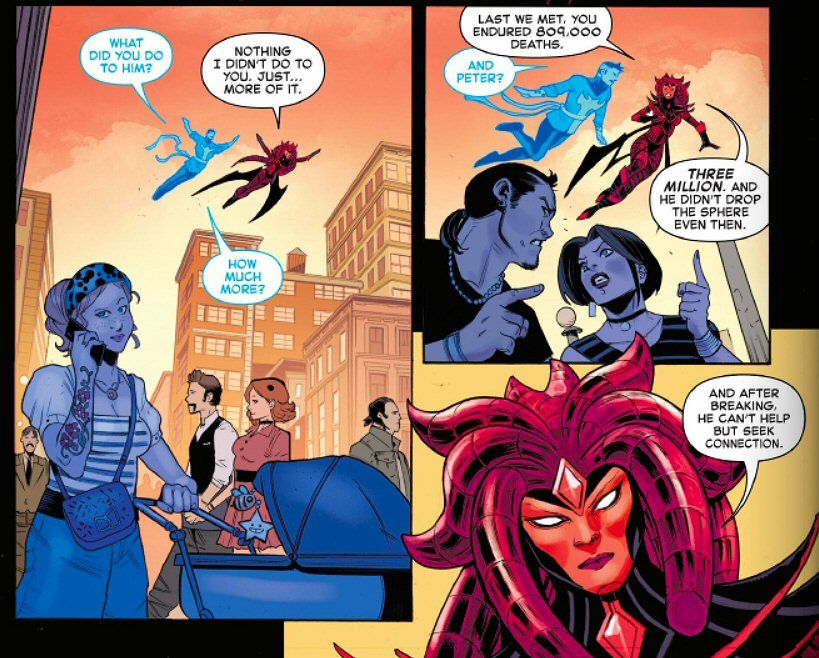
As Cyra explains above, Strange simply detached from the deaths he was forced to witness, on the previous times he served as Earth’s champion. Strange’s rational and utilitarian perspective allowed him keep focused on achieving the best outcomes. But Peter can’t do that, as his virtuous nature requires him to feel – to empathize – with the suffering of others.
So what does Peter do for the next several issues? Not much. As part of his existential crisis, Peter displays indifference, lack of motivation, and a highly detached view of worldly concerns – including the survival of the world itself. He spends most of his time ignoring what is going on around him, watching TV, eating pizza, and hanging out with the Black Cat – leaving other heroes (such as the X-Men) to do the heavy lifting with the remaining scions. In other words, Peter is displaying nihilistic characteristics.
As I explained on my Vision Ethics post, nihilism, existentialism, and absurdism all address the same underlying conflict between an individual’s struggle to find meaning in life and the recognition that we live in a meaningless universe. But they differ in the conclusions they draw from this, and the recommendations as to how we as sentient beings should respond. That Vision limited series looked more to absurdism (specifically Albert Camus‘ version), but nihilism and existentialism are much more relevant here.
Nihilism is the oldest of the three, and asserts that life is inherently meaningless and that there are no objective truths. In its existential form, it also asserts that there are no objective values, and that morality is a human construct with no basis in reality. In this view, it is not possible to lead a meaningful life, and everything we do is ultimately pointless. Nihilism forms the core of 19th century German philosopher Friedrich Nietzsche‘s thinking. It also seems to be the (depressing) rut Peter that has suddenly found himself in. One immediate way out of this will be to consider an existentialist approach instead.
For an existentialist, the fundamental meaningless of the universe could more accurately be restated as the universe doesn’t have any inherent meaning. As such, it it up to us, through free will, personal responsibility and choice, to assign our own meaning to our lives. That is the view of the 20th century French philosopher Jean-Paul Sartre, who was one of the main proponents of existentialism. For an existentialist, the uncomfortable feeling that arises when we face the conflict between believing that our life has meaning and recognizing that the universe is meaningless is always present in the back of our minds (this feeling is known as the “absurd”). Absurdists takes this a step further and put the absurd at the forefront of our consciousness. They assert that the whole of life is absurd, and it is only by rebelling against it that we can find happiness and freedom.
The key point is that while existentialists and absurdists both recognize absurdity, they do not despair as a result – like nihilist do. Instead, they embrace the present, and seek to find joy in determining their own meaning (existentialism) or in the struggle against absurdity (absurdism).
But worry not – Peter remains a virtue ethicist by the conclusion of this story, and there is someone else who will be swapping nihilism for existentialism shortly. Peter snaps out of his funk rather abruptly at the start of issue #68, by Ireland and Broccardo, once he sees the consequences of his inaction:
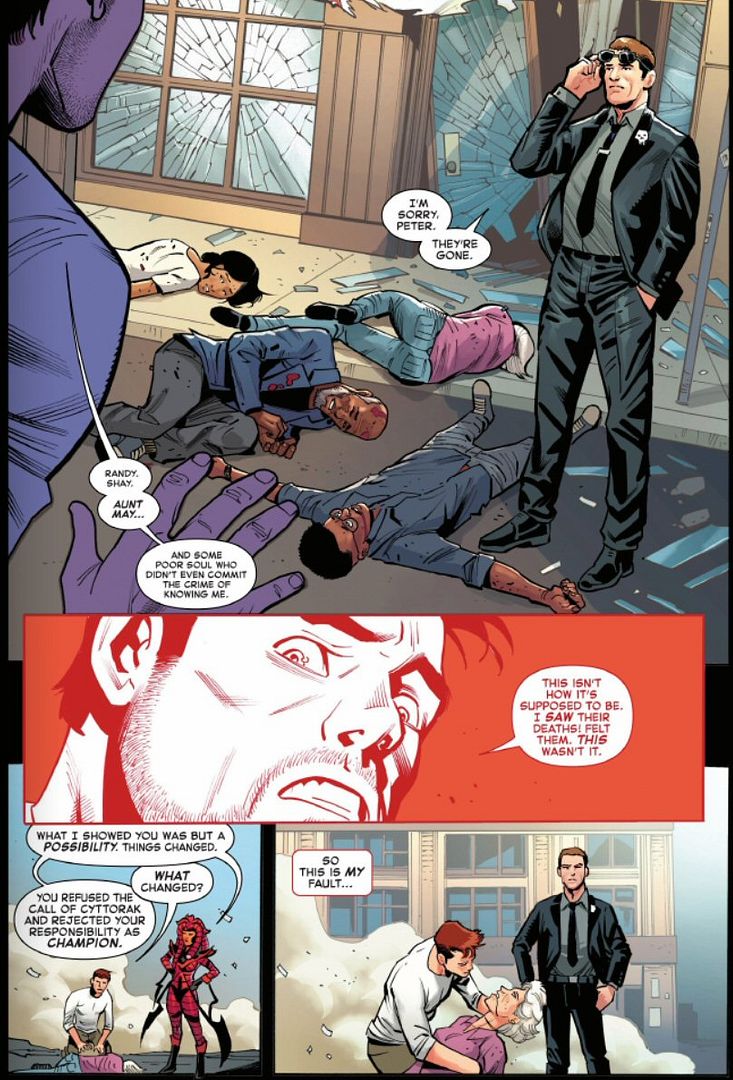
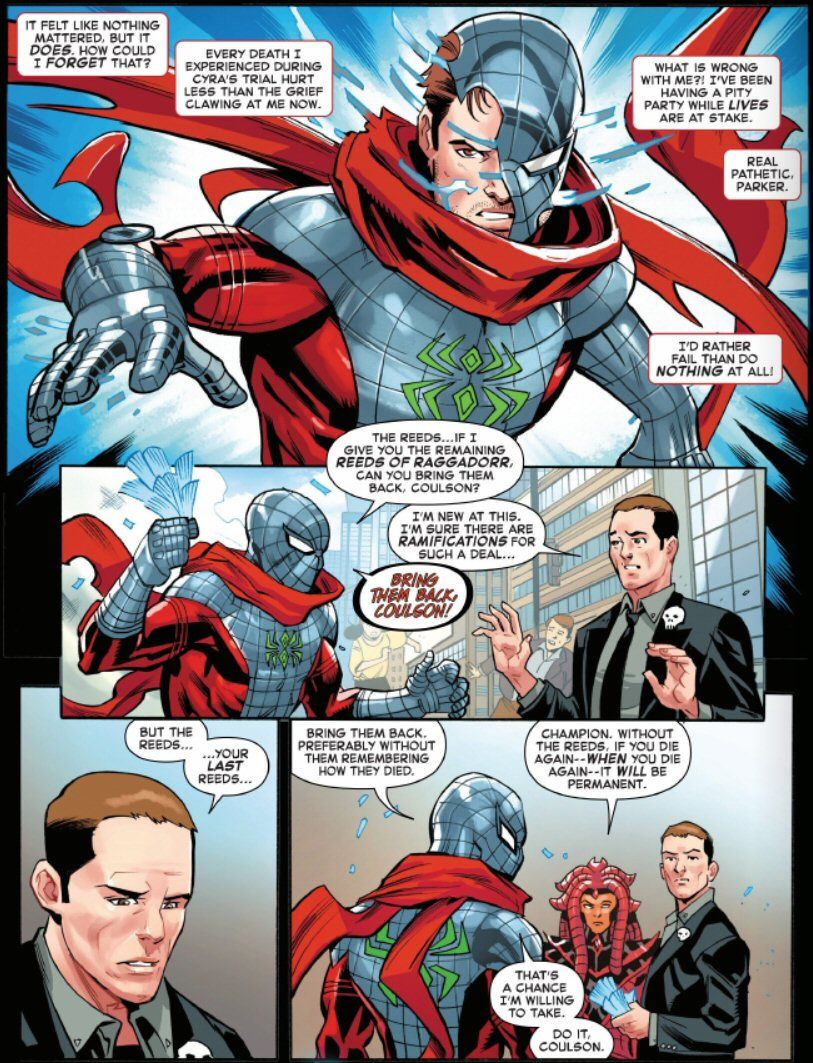
And just like that, Peter is back to his former self. I must say, I found this reversal to be the most unsatisfying part of this entire series. It is extremely sudden, and doesn’t feel well justified. But a virtue ethics Peter is better than a nilistic, existential, or absurdist Peter – so I welcome his return.
Against Cyra and Coulson’s advice above, Peter insists on using his remaining reeds to restore his friends and family. This means that he can no longer be brought back if he dies again. And dies he does at the end of this issue.
This allows a chance to turn the attention to a more interesting character shift – Cyra, and ultimately her father Cyttorak. We know from the past issues that Cyra is intrigued by Peter, and feels bad for him. But what about her own nihilistic view of the meaninglessness of existence? As Coulson observes in issue #69 (by Kelly, McGuinness, and Farmer), things have changed for her – with what I would describe as a growing shift to existentialism and a focus on the present:
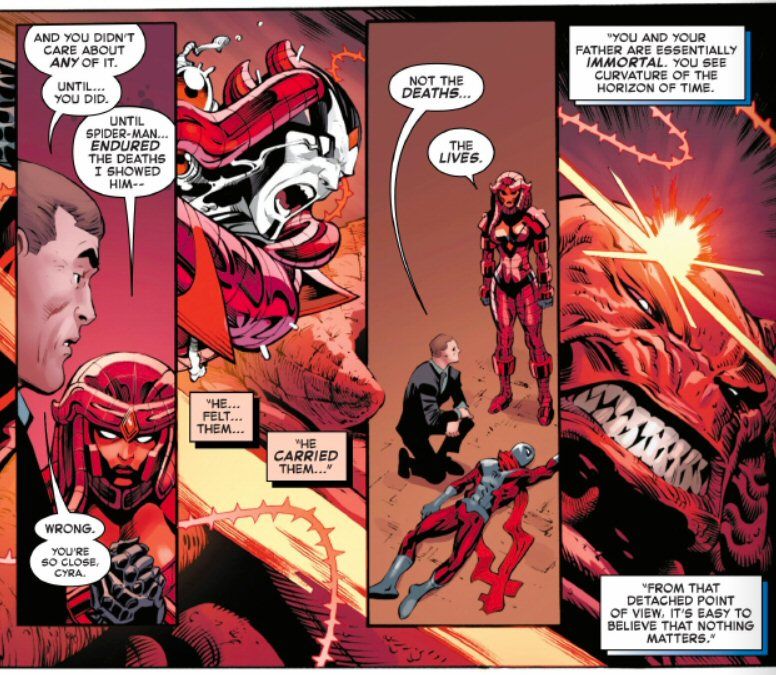
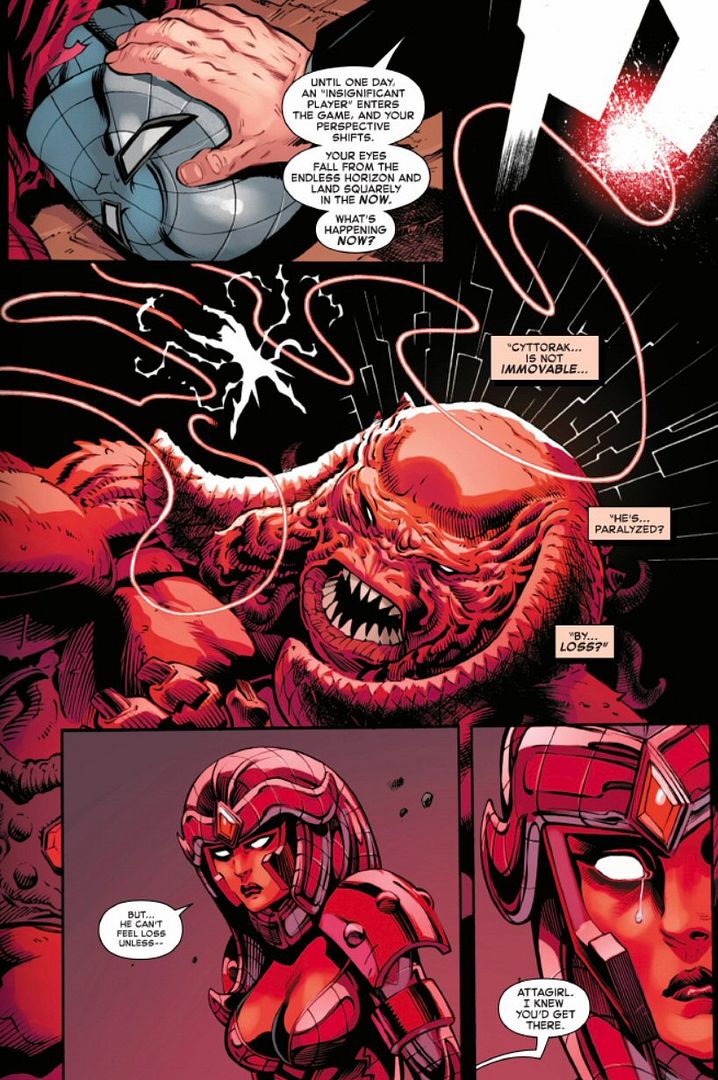
And now we come to the existentialist conclusion that this series has been moving to. As explained by Coulson: “You can’t feel loss unless you have felt love.” But not just any specific individual love – rather, a love for live itself is the meaning that is being applied here:
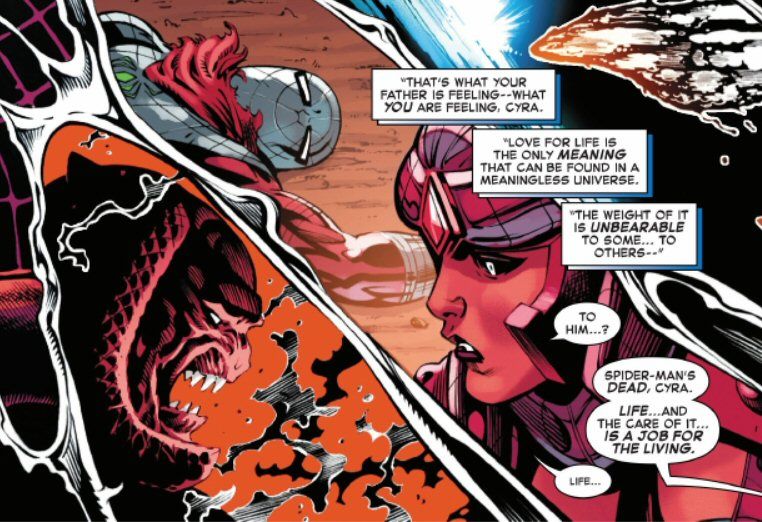
“Love for life is the only meaning that can be found in a meaningless universe“. This is the core philosophical resolution of this series.
And with that existential revelation, Cyra make a very interesting choice:
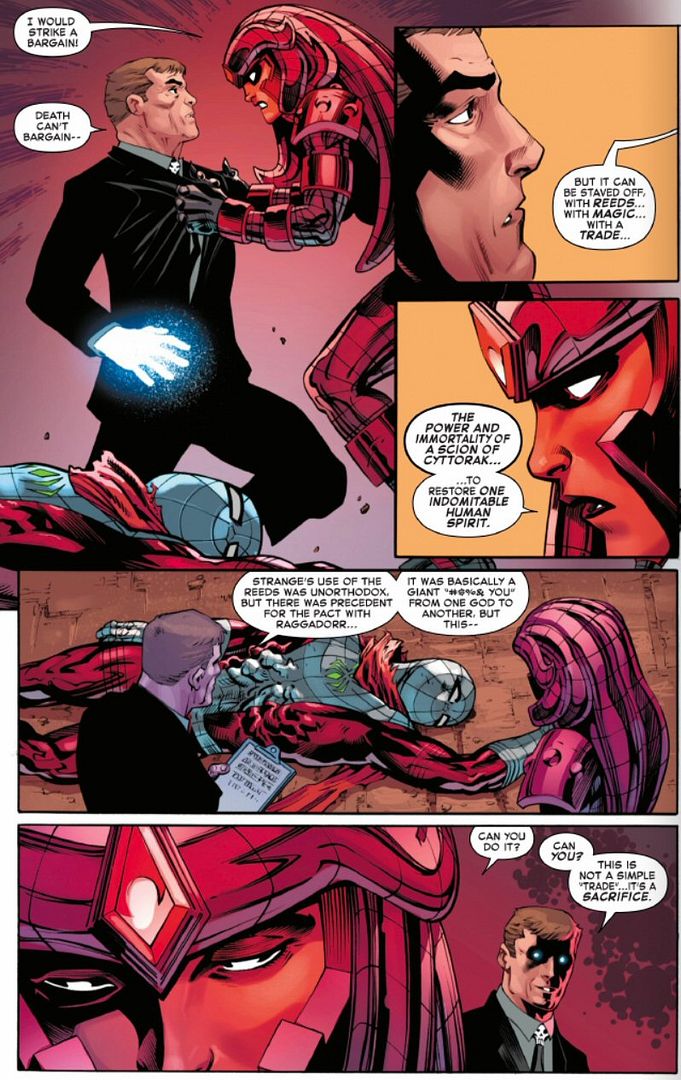
But Cyra is determined, and Coulson acquiesces and breaks the rules (“Okay … this might sting”, he wryly observes):
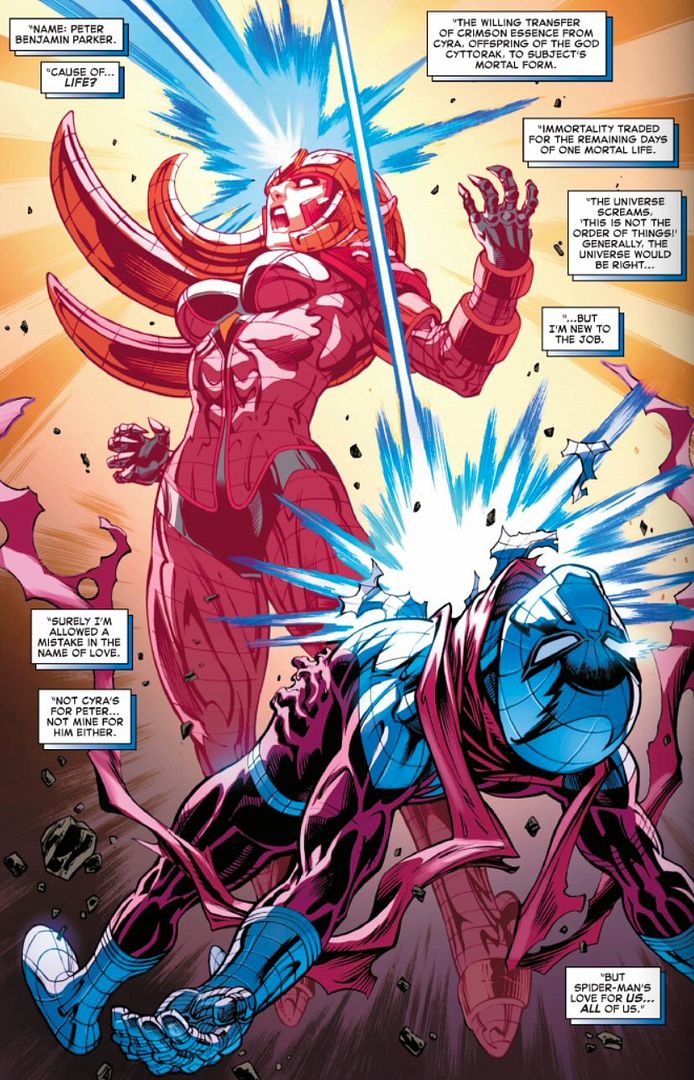
Of course, no one is more surprised by this turn of events than Peter himself:
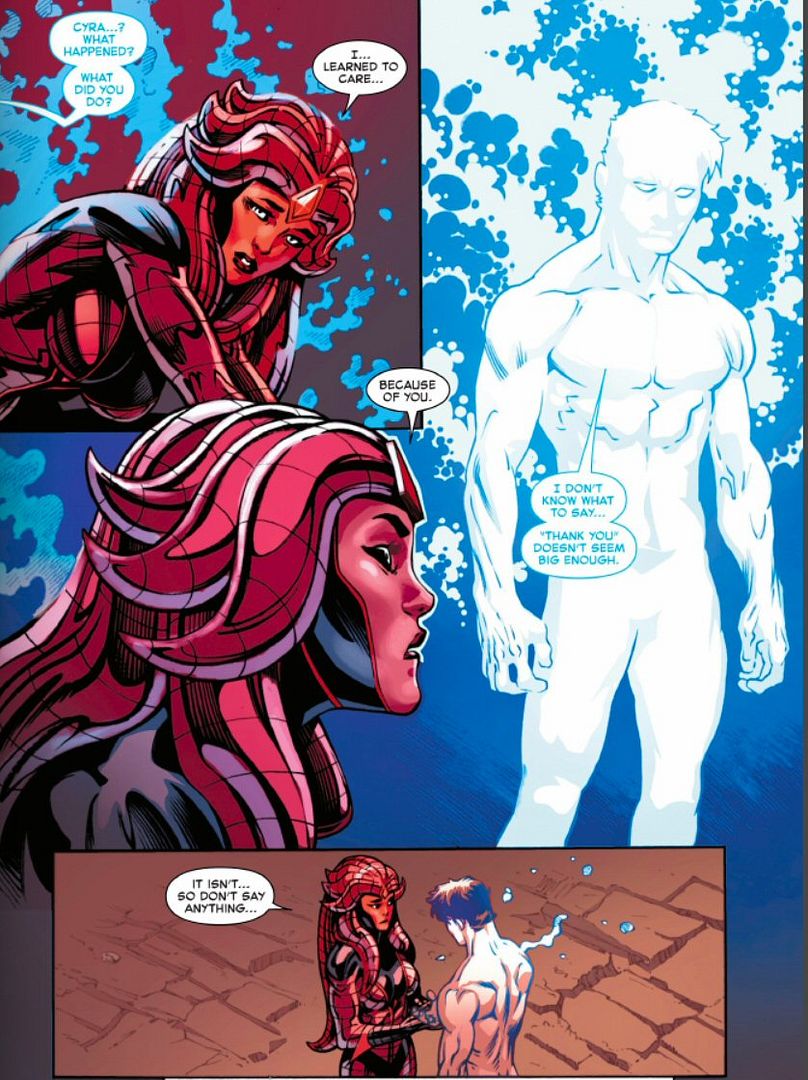
Cyra implores Peter to become what he must to save everyone he loves.
Which brings us to the last issue of this series, issue #70, also by Kelly, McGuinness, and Farmer. Here, Cyra confronts her father, and shames him with her decision to sacrifice her immortality for the sake of a human champion:
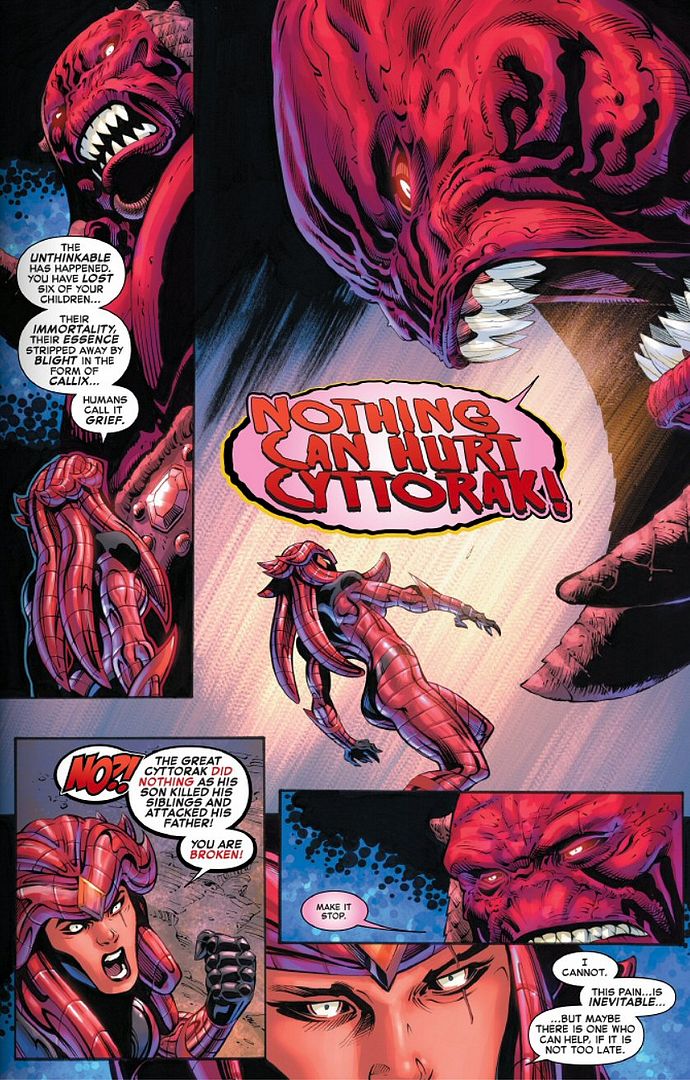
To me, Cyra really is the other star stand-out character of this series, along with Coulson. It would be easy – indeed, I think many other writers have encouraged – thinking that Cyttorak’s famed immovability was a form of stoicism. But this philosophical view is relatively rare in Marvel comics – although there are aspects of it in Thor’s virtue ethics and Daredevil‘s deontology.
Stoicism comes from the ancient Greeks, and is basically a minimalist set of Aristotelian virtues that, when applied rigorously, are believed to be sufficient to achieve eudaimonia. Like all approaches to virtue ethics, stoicism requires dedicated commitment to practicing virtues in everyday life. In this case, they have boiled down the core Aristotelian virtues to just four cardinal ones for stoics – prudence, fortitude, temperance, and justice – that they feel reflect the natural world.
A key tenet of stoicism is accepting that some things are beyond your control. As an aside, this may explain its relative rarity in comic books – superheroes almost always feel that there is something that they can (and should) do. In real life, the idea is that once you accept the things that are outside your control, you can then focus on things that are within your control.
Stoicism is having a moment today. Along with Buddhism (another form of virtue ethics which also requires acceptance, and a dedicated daily commitment to practicing a minimal set of virtues, developed by The Buddha). These ancient philosophies feel like an antidote to much of the hollowness and confusion of frenetic modern life. In particular, they make up the core of virtually all Western modern self-help philosophies, and are an important component to many forms of psychotherapy.
I personally find this very encouraging. I grew up in the 1980s, when the self-help movement seemed largely focused on being kind to yourself and looking to your past for childhood traumas to explain your current unhappiness. While that can be an important component for healing for some, I can’t help but feel that it is insufficient without a commitment to forging strong virtue practices going forward (which is the hard part!).
It is easy to call yourself a stoic (or a Buddhist), but the daily commitment required is much more stringent than many may be willing to commit. I’ve always appreciated the appeal of stoicism, especially as espoused by the later Roman stoics like Seneca, Epictetus, and Marcus Aurelius. But I find their core virtues a little limiting, and feel some of the other Aristotelian virtues (like courage, truthfulness, and compassion, for example) are also required for a meaningful life.
In any case, these virtue ethics approaches are very different from existentialism, which requires you to create your own values and determine the meaning of your own life (and which seems a more popular tack with many comic writers). In this sense, existentialism is at odds with classic virtue ethics as it proposes that existence precedes “essence” (that is, your existence comes first and values are a human construct). This is in direct opposition to a preexisting essence from which character virtue is derived, as Aristotle and Thomas Aquinas believed for virtue ethics.
Getting back to this comic, Peter comes up with an interesting solution in the end – he uses his crimson powers from Cyra to continuously rebuild the casket protecting the Earth. But as a mortal, this sacrifice of the rest of his life is only a temporary solution. And so, Cyttorak asks Peter, why bother?
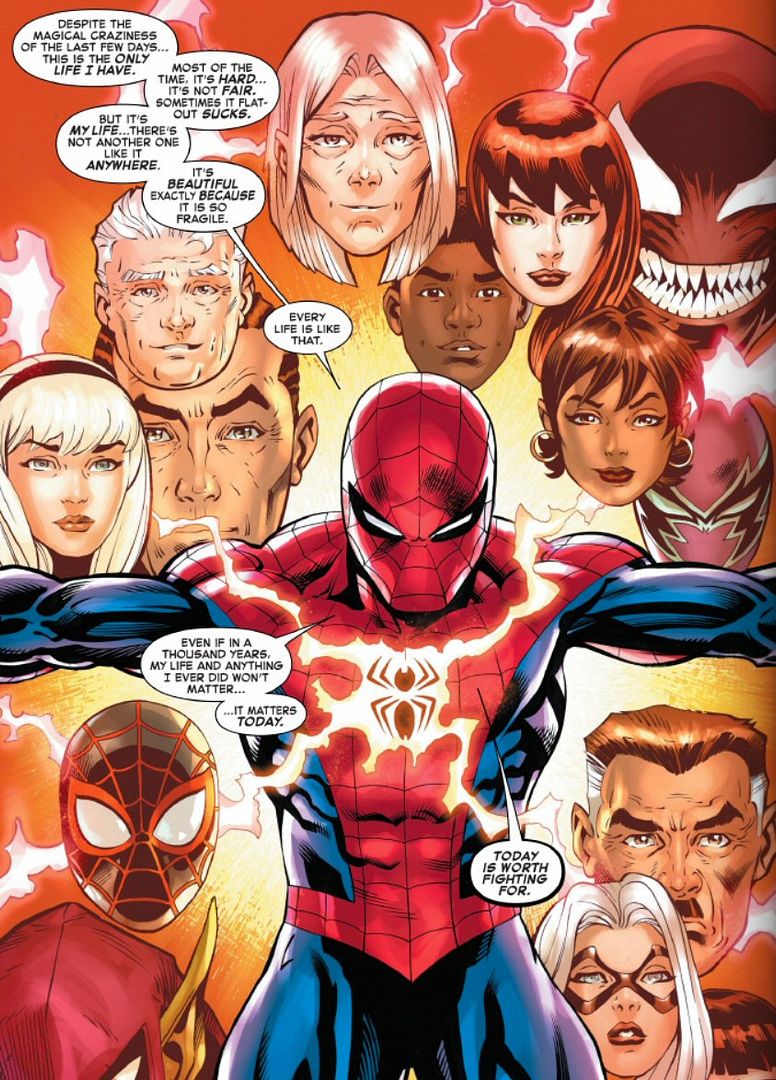
And so – like for the existentialists and absurdists – the moment is what matters. What happens next is interesting:
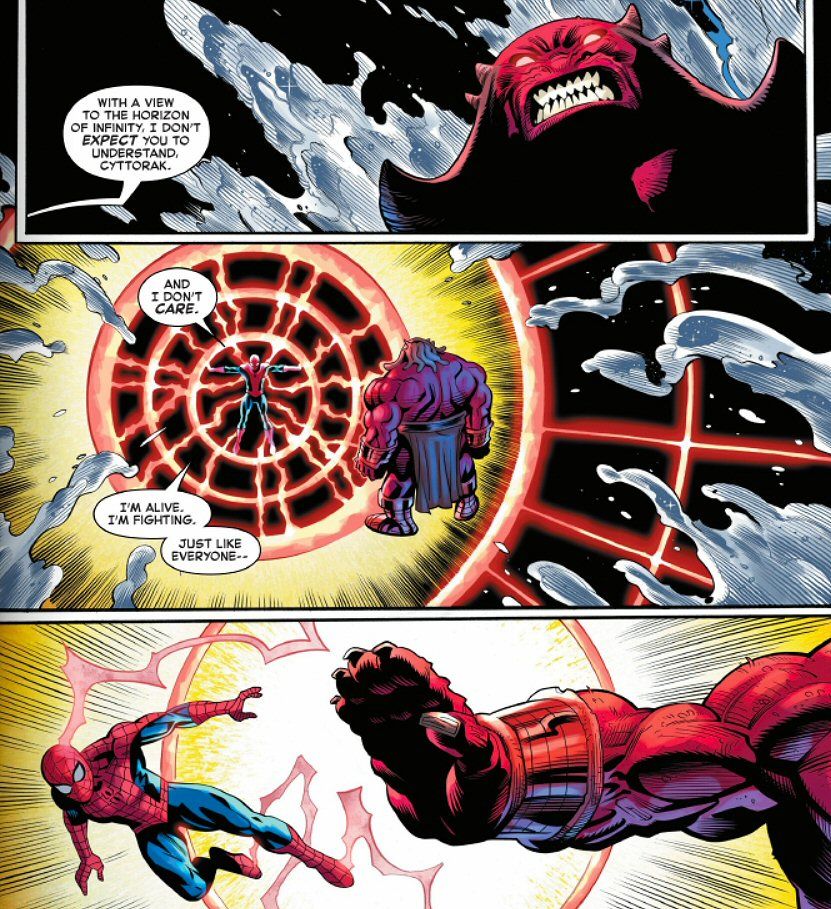
Immortal Cyttorak shoves Spider-Man out of the way, and takes his place – thus preserving the casket protecting Earth for all time. The old covenant is broken, and immovable Cyttorak takes up this mantle voluntarily.
The series wraps up with Peter attending a funeral for one of the civilians who died in the scion attacks. In the final narration, the priest intones over scenes from Peter’s life:
And I want you to hear me — really hear me on this … Kenny’s passing, though unexpected and too soon … will not define his life. The love he shared with his familly … the care he showed his friends … the compilation of all the kindness he shared with the world … these are small but indelible marks a man leaves on the world. A lasting message we carry in our hearts … “I was here. I was loved. My life mattered.”
The last word
This has been a fun series to profile and post. For me, it really helps solidify the incompatibility between a virtue ethics approach and an existentialist one. But both can be captured well by different characters in one story line.
In a way, Peter is more incidental than integral to this story. At its heart, he is really the example or catalyst that convinces Cyra, and ultimately her father Cyttorak, to adjust their philosophical perspective. Truthfully, I often find these to be the most fulfilling stories. You have to be careful in how far you can push an established character without breaking things, and I was glad to see Cyra and Cyttorak do the heavy lifting here in the end.
Not that Peter does still suffer of course. As I observed in my Spider-Man Ethics post (and Coulson confirmed in-story here), the Universe (aka Marvel writers and editors) can’t seem to ever let Peter be happy. This remains an ongoing issue, since a virtue ethicist like Peter should get more of a break in life! In any case, it was good to explore Coulson’s new role as the emissary of Death in more detail here. I have a feeling that will be important for the upcoming Infinity Watch stories.
It was also fun to finally slip in stoicism, given its frequent invocation today – but relative absence from superhero comic stories. Naturally, not all philosophies will be a good fit with characters constantly striving to the save the world! But comics are still capable of providing some interesting detours down other philosophical paths.
See my Glossary post for a list of the key philosophical concepts and related links on this site.
Excelente. Espero leer mucho más de tus análisis en próximas historias de nuestro amigable vecino cabeza de red.
¡Gracias! Agradezco tus amables palabras.
I am planning to do more posts on some of the other spider-people (starting with Miles). Lots of good stories out there!