
“Whosoever holds this hammer, if they be worthy, shall possess the power of Thor.”
- Mjolnir’s current enchantment
Ah, but what makes one worthy? The ethics of Marvel’s Thor are very much centered around this point – worthiness. What is it exactly, and who decides if you have it?
Thor is a bit of a different character in the Marvel Universe of superheroes. He is not from Earth, and is considered by some to be a god (as I’ll explain below). He is certainly among the most powerful mortal (though very long-lived) beings in the Marvel Universe. In this post, I will cover the origin, history, and normative ethics of this comics character – inspired by Norse mythology – along with his race, the Asgardians.
Thor is also distinctive as he one of the clearest examples of virtue ethics among the early suite of Marvel characters – and the closest to the classic Aristotelian version of a virtue ethicist.
As always, if you would like to know more about the terms I’m using on this site, please follow the links throughout or check out my Ethics 101 page or Glossary post.
Character introduction
Thor was created by Stan Lee, Larry Lieber, and Jack Kirby, and first appeared in the June 1962 issue of Journey Into Mystery (issue #83). However, his origin story and early years have been extensively retconned since then, with many inconsistent and unresolved story lines. I’ll briefly cover the generally accepted bits, but for more info you can check out the simplified Thor page from the Fandom Marvel Wiki, or the expanded history page.
Marvel’s Thor is part of the royal family of Asgard (Crown Prince originally, later King). In the Marvel Universe, Earth is just one of ten realms (dimensions) – with Earth referred to as Midgard by the other realms. Thor’s father, Odin, is the king of Asgard, one of the smallest realms but the one that (sorta) rules over everything. Typically, the other realms only show up in stories related to the Asgardians – but all ten realms are encompassed within each Universe of the Multiverse. The ten realms are linked are by an energy field that is known as Yggdrasill, or the world tree (or tree of life), in each Universe. The Asgardians can travel among the realms through use of the Bifrost, or Rainbow Bridge. In the Marvel Cinematic Universe (MCU), the Bifrost is considered a “wormhole” or “Einstein-Rosen bridge” that allows shortcuts connecting two separate points in spacetime.
Odin is unquestionably Thor’s father, and Thor often goes by “Odinson” in the comics. Thor was raised by Odin’s wife – originally known as Frigga in the comics (a derivative variant of Frigg), now correctly identified as Freya. In Norse mythology, Frigg and Freya are often mistaken, but most experts agree were likely meant to refer to separate people, with the later being Odin’s wife.
During my adolescence reading the comics in the early 1980s, a significant retcon occurred in Thor Annual Vol 1, issue #11, 1983, by Alan Zelenetz, Bob Hall and Vince Colletta. Here it was established that unbeknownst to Thor, who always thought Freya was his mother, his true birth mother was Jord, Goddess of the Earth (later known as Gaea). Gaea is one of the Elder Gods of the Earth, the first powerful beings to emerge early in its creation around four billion years ago. Today she is typically depicted as somewhat Swampthing-like, but was originally drawn in a more “pleasing … guise”, as shown below for when Odin came to woo her in the origin retelling in this issue:
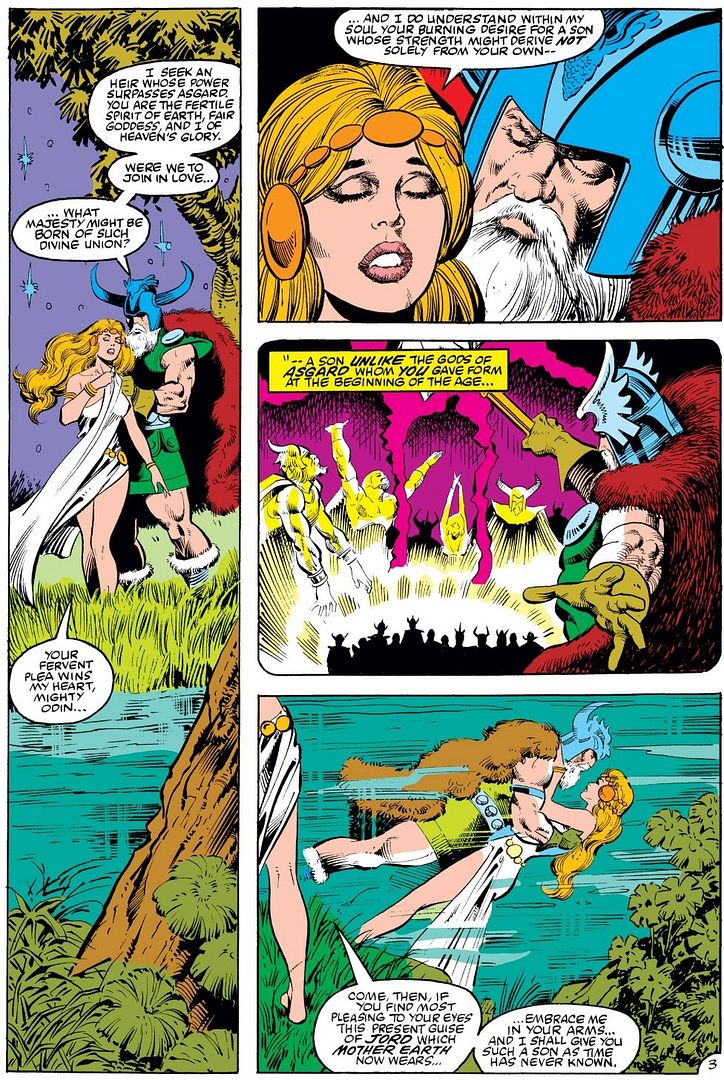
Yes, that is what passed for wooing in the Thor comics of my youth.
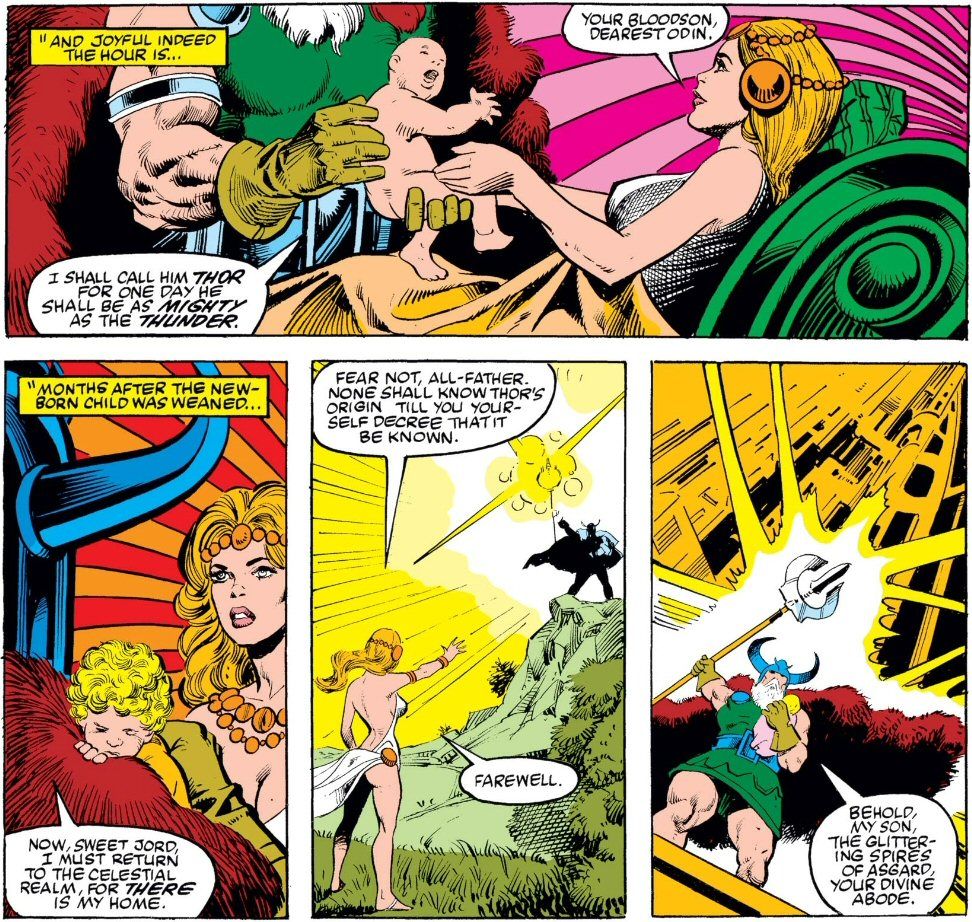
Oddly enough, Gaea (Jord at the time) was surprisingly chill with not only yielding to Odin’s “charms” above, but in actually letting Thor go and never seeing him again (once he was weaned, of course):
Even more surprising to me, Freya (Frigga at the time) was also cool with Odin having “shared his celestial substance” (!) in this way, and agreed to raise his Midgard love-child:
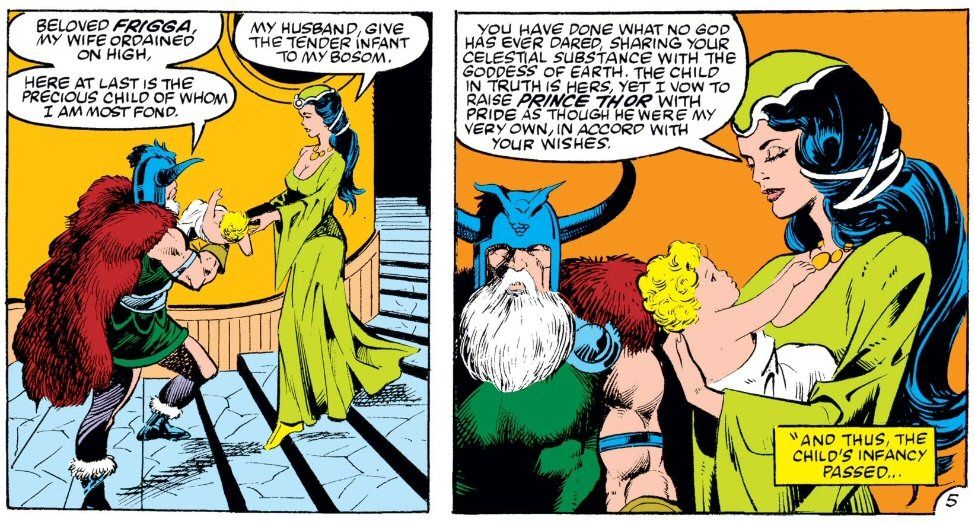
And thus, my childhood passed as well …
I stopped reading Thor after this issue. I was never impressed with Thor comics in the Zelenetz era, and only sporadically picked up issues as a result. After a run of less-than-great issues (ending with this Annual), I finally gave up for good. Unknown to me though, this was coincidentally Zelenetz’s last issue as well. Walt Simonson took over in the main Thor title, in what proved to be one an iconic run of the character. I completely missed it at the time, as I had moved on to other characters (I had limited funds from my newspaper route and odd jobs, and those earlier Thor comics were a real disappointment).
As a final word on his parentage, another retcon a few years ago suggested Odin had lied and the Phoenix Force (through an early avatar) was actually his mother. In the end, it was clarified that Gaea was his birth mother – but the Phoenix Force was her midwife, and resurrected Thor upon his murder as an infant. As a result, some her power remains imbued within him, and he now considers the Phoenix Force as a sort of surrogate mother. Must make Mother’s Day interesting for him!
Thor’s abilities and powers
The Asgardians are not typically considered true gods in the Marvel Universe. That is to say, they are not all-powerful, immortal supernatural beings – however they are all very long-lived with considerable strength, and some of them have specific powers and abilities (like Thor and Odin). In the Marvel Universe, it is eventually explained that the powerful Asgardians came to be worshiped by the Vikings and thus became part of Norse mythology – but their abilities and relative strength have been inconsistently described in the comics.
Thor and Odin are among the most powerful Asgardians – but immortal cosmic entities in the Marvel Universe often refer to them as “little gods” or “godlings” (which may be more accurate, given their limited range). It is also unclear how strong the regular Asgardian citizens are. While it is generally accepted they are bigger and physically stronger than humans, there are many stories where regular humans without super-powers are able to defeat them in personal combat (although inconsistently, other stories show even super-powered humans being overpowered by regular Asgardian citizens).
As the son of Odin (All-Father to the Asgardians) and of Gaea (Elder God of Earth), with a bit of Phoenix Force thrown in, Thor’s natural Asgardian abilities are greatly enhanced – he is arguably the strongest and post powerful Asgardian. As his Norse namesake implies, he is the God of Thunder, and controls the weather, unleashing storms and lightning on command. Physically he is among the strongest of all the characters in the Marvel Universe (although this is again inconsistently applied). He is nearly invulnerable to injury or illness, and possesses a rapid healing factor and regenerative abilities when wounded. Certain artifacts are able to increase his strength and abilities further (including the Odinforce, when it has been passed to him). But by far the most significant contributor to his abilities is the enchanted hammer he wields, Mjolnir.
Mjolnir also has a complex history, with a large number of retcons and revisions. It is made of Uru, which is a metal from the beginning of the Universe, said to be the strongest substance in existence. Although Thor doesn’t need the hammer to use his Thunder God powers, it does serve to further enhance and focus them – and is an impressive weapon in its own right. It is not indestructible however, and has been damaged (or destroyed) on many occasions and then repaired (or rebuilt).
At one time, Mjolnir had demonstrated sentience, due to a retcon of the God Tempest having been imprisoned within it. Interestingly, the hammer is able to grant the powers of Thor to any who are deemed “worthy”, through an enchantment Odin had placed on it. What this means in practice gets to the heart of this post – who decides who is worthy, and how? Not to repeatedly flog the issue, but this too has been inconsistently applied in the comics, as I will explain below. But it also means that other characters in the Marvel Universe have also wielded Mjolnir on occasion (and been granted Thor-like powers as a result). Due to another enchantment Odin had placed on it, these other wielders lose their Thor powers if separated from the hammer for more than one minute.
This complex dynamic has driven much of Thor’s search for “worthiness” in the comics, with varying conclusions offered by different writers over the years. To understand the confusion, we need to consider the normative ethics of Asgardians in general – and the specific demands placed on Thor.
Introduction to Thor’s ethics
Thor is one of the clearest examples of classic (Aristotelian) virtue ethics in the Marvel Universe. This third form of normative ethics was relatively rare in the comics of my youth, which tended to focus on the conflict between consequentialist (especially utilitarian) and deontological (typically Kantian) thinking among superheroes. As I explain on my Ethics 101 page, consequentialism and deontology are both focused on the characteristic of actions (namely only considering the outcome or the action itself). Classic virtue ethics is focused on the character of the actor, with an emphasis on practising virtuous behaviors in daily life.
A caveat before I begin – just like Spider-Man, Thor is an incomplete presentation of classic Aristotelian virtue ethics. A key feature of classic virtue ethics is the achievement of eudaimonia, a general sense of well-being and flourishing. In this concept, a virtuous person is one who strives to live a fulfilling and meaningful life by cultivating and practising virtues, which ultimately leads to their overall happiness and well-being. But comic books never allow their heroes to reach that state – despite all their virtuous behaviors and all their striving to do better, they are always repeatedly laid low and made to suffer. This is hardly the stuff to make you want to choose virtue ethics!
As a general group, I would argue that Asgardians are primarily deontological in their approach to life. They live by a fairly strict code of duty, and have internalized a coherent set of rules consistent with warrior honor. This is very much in keeping with the Norse mythology origins of this group (although in the comics, it is the other way around – the Asgardians inspired Norse mythology). Many Asgardians in positions of authority (with superior powers) also display a commitment to virtous behaviors, but not all. Loyalty to family and peer-bonds are also highly prized in Asgardian society, consistent with both deontological and virtue ethics. But these virtues are not universal, and there are many examples of Asgardians behaving badly, especially in terms of a “might makes right” philosophy and a lack of respect for the rights (or life!) of beings in other cultures.
As the heir to the throne (and currently King in the comics), Thor exemplifies virtue ethics for his people. His actions – and character – are guided by developing and displaying classic Aristotelian virtues like courage, honesty, selflessness, loyalty and sacrifice. He tries to avoid vices such as arrogance, over-indulgence, and impatience (which are the extreme ends of the virtues of self-confidence, temperance, and patience). In this sense, he fits the Aristotelian concept of finding the “golden mean” between the two extremes for each virtue. Unlike most of his subjects, Thor does not feel particularly bound by strict rules (deontology). And unlike a lot of his superhero friends, he is similarly not concerned with achieving specific outcomes (consequentialism). His main overwhelming concern appears to be in achieving and demonstrating his “worthiness” through virtue.
And therein lies the problem for this character.
In a classic Aritotelian sense, the concept of arete is also important here. Although relevant in general to much of ancient Greek thought, here it refers to a state of excellence in a particular aspect or domain of one’s moral life, closely tied to virtue. This is not something anyone else can define or achieve for you. In essence, “worthiness” in Aristotelian virtue ethics is not determined by external rules or perceptions, but is internal to the judgment of the individual. It comes about by the development of a virtuous character and the ability to make sound (excellent) judgments accordingly.
But this view of worthiness is particularly narrowly focused. There are other forms of virtue ethics where the focus is not on character traits developed in isolation, but ones shaped by the communities that individuals are a part of. Close relationships – such as family, friends, and social/peer groups – all influence the development and application of virtues (modern care ethics is a good example of this). In a more general sense, there is no single universal authority who decides worthiness for a virtue ethicist. Rather, it is a process of self-reflection and judgment balanced by engagement with one’s community/culture, incorporating a personal commitment to excellence.
To put it simply, Thor’s problem across a long run in the comics is that he looks too hard for external validation of his worthiness. This is demonstrated repeatedly in his relationship with both Odin and Mjolnir in the comics, as I will demonstrate below.
Early and modern comics
I’m going to skip a discussion of the early comics (before Walt Simonson took over in 1983) for two reasons. First, a lot of the early stories were retconned by subsequent writers, leading to a very messy continuity for the character (and those around him – like Odin and Mjolnir). Secondly, I found those early stories rather tedious – and frankly boring. As I observed on my Captain America Ethics post (a character who is primarily deontological but with notable virtues), being a paragon of virtue may earn you a lot of respect – but it doesn’t necessarily earn you a lot of friends who want to hang out with you.
Similarly here, I found Thor always talking about how virtuous he was frankly a bit obnoxious. And for someone who had supposedly been around for many centuries (and understands every known human language), he seemed remarkably obtuse in the ways of humans. A lot of the scrapes he got into seemed to come about because of his failure to read the situation and understand what was likely to happen next. To me today, this is a failure of the early writers (up to and including Zelenetz) to deal with virtue ethics fairly and honestly in dramatic story telling. As a kid however, it led me to conclude that Thor simply wasn’t very bright.
The earliest place I would recommend you even consider to start a Thor journey is with Simonson’s run (Thor Vol 1, issues #337-382, 1983-1987). He leaned more into classic Norse mythology, creating some new reoccurring villains, and some interesting challenges for both Thor and Odin to overcome. This includes introducing the first character who could wield Mjolnir – Beta Ray Bill – much to Odin and Thor’s surprise.
Beyond that, there are some unusual stories through the 1990s into and around the new Millennium. This came to eventful end when Thor stopped the cycle of destruction and rebirth known as Ragnarok – by seemingly destroying Yggdrasil and the other nine realms, aside from Earth (Midgard) at the end of Thor Vol 2 in 2004.
Another potential entry point for Thor is the J. Michael Straczynski Thor Vol 3 series beginning in 2007. J.M.S. took his time restarting Asgard and the other realms, introducing some new modern ideas along with the traditional back history. For example, he placed the reformed Asgard on Earth (or more accurately, floating above Oklahoma). He also reincarnated Loki as a woman for the first time. The revised world-building was extensive here, but a lot of it was left seemingly unfinished when his run ended (apparently early?) at the end of 2009, when Kieron Gillen took over the main Thor title and took it in a different direction. For those who are interested in the J.M.S. era, there is a significant wrap-up of some dropped story lines at the end of his recent run in Captain America (Vol 11, issues #14-16, 2024-2025). There you will find out what ultimately happened to Broxton, Oklahoma, and the lovers Zelda and Bill.
But by far the most significant run was when Jason Aaron took over with a new Thor title in 2012. Aaron led Thor until the end of 2019. During those seven years, Aaron put Thor through the ringer, leading to an extended period where he considered himself “unworthy”, and the Thor name and powers passed to another. Given my focus on the ethics of Thor, this is a critical time period to explore what “worthiness” means to the character.
The fall and rise of Thor’s worthiness
There are two things to help you understand this time period. One is Thor’s relationship with Odin is no longer as harmonious as it was depicted in the early comics. Up to an including the Simonson era of the mid-1980s, Thor and Odin had a mutually respectful relationship, with Thor very much looking up to the authoritative Odin. But much like broader trends in Western society, Thor’s upbringing in this modern era has increasingly been recast as him suffering under an authoritarian and overly demanding Odin. This gradual retconning of their relationship in the new Millennium results in psychological issues that Thor needs to face. Specifically, the unfair expectations Odin placed on him growing up eventually leads to a period of self-loathing for Thor (his “unworthy” phase) in the middle of Aaron’s run.
Coincident with this, Mjolnir’s back story has also been updated. Originally in the comics, Odin wielded Mjolnir, until Thor reached a level of heroic “worthiness” to be able to lift it himself. During these early years, the apparent criteria by which “worthiness” was assessed by Mjolnir was whether it agreed with Odin’s personal judgment! But in the modern era, this has been revised such that Mjolnir has always been quite wilful in deciding for itself who was worthy, and would rarely let Odin wield the hammer (and doesn’t at all any more). Mjolnir was thus kept on ice, so to speak, until Thor became worthy enough to wield it. The rationale for this change was a retcon that the God Tempest had been imprisoned by Odin within the hammer, adding a level of apparent sentience.
Both of these changes are nicely illustrated by these pages from a relatively early part of Aaron’s run, Thor: God of Thunder Vol 1, issue #15, 2014, by Aaron and Ron Garney:
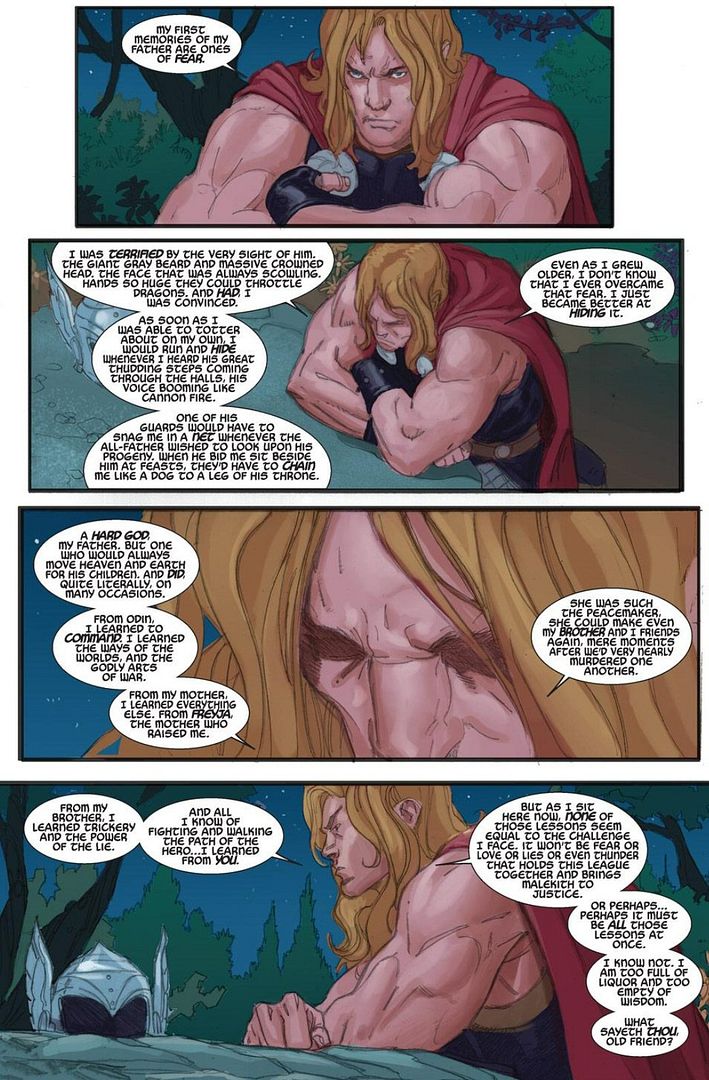
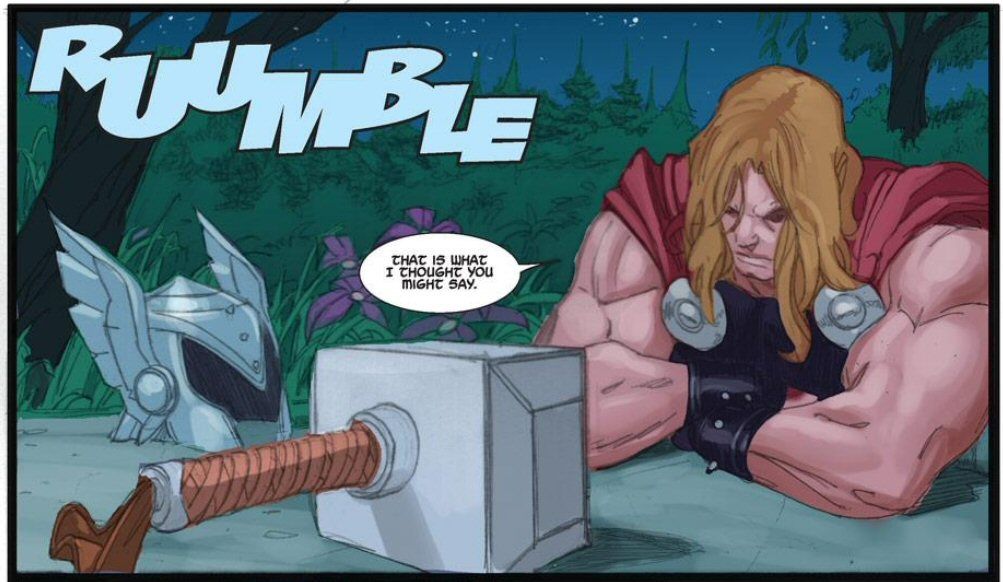
This scene portends Thor’s future challenges.
To go back to the beginning, the opening story line for Aaron’s run involved the creation of Gorr the God Butcher. Born of a planet ravaged by starvation, the pious Gorr had to endure the loss of his parents, wife and his children, leading him to resent the gods he believed had forsaken him. He set upon a quest to kill all gods, culminating in his creation of a Godbomb. Thor, with the help of a future Thor (King Thor of Earth-14412) and past Thor (young Viking god Thor) managed to defeat Gorr.
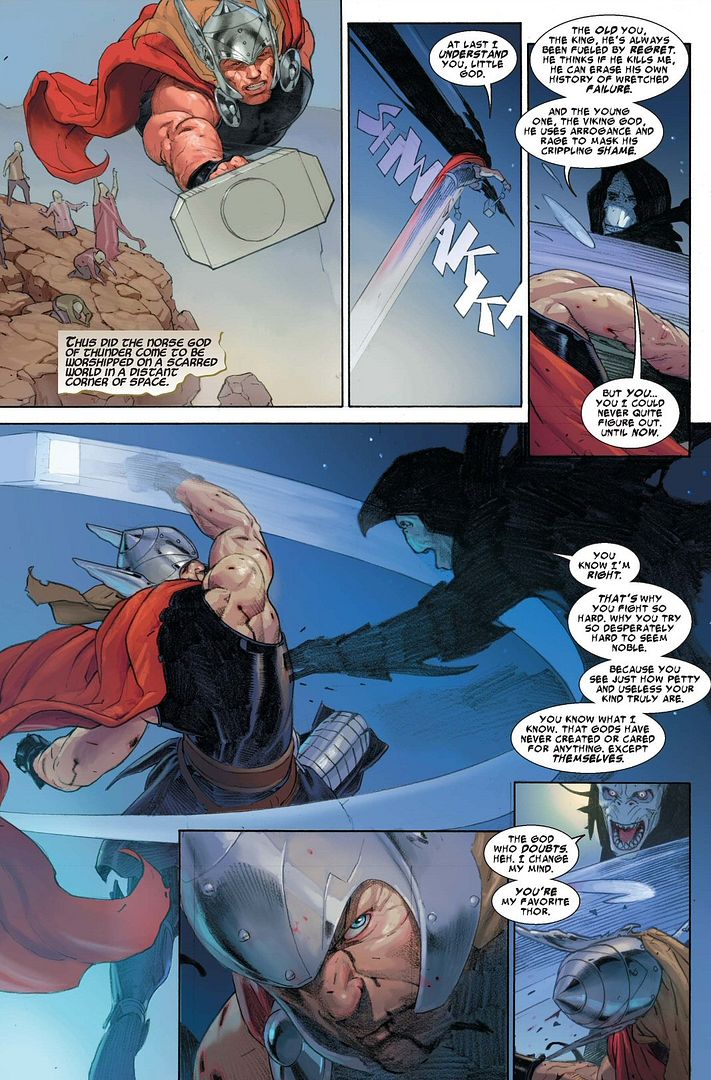
Along the way, there is a critical page where Gorr taunts our Thor about his rising doubts. From Thor: God of Thunder Vol 1, issue #9, 2013, by Aaron and Esad Ribić:
And from the final issue of this story, issue #15, by Aaron and Ribić, when Gorr is defeated:
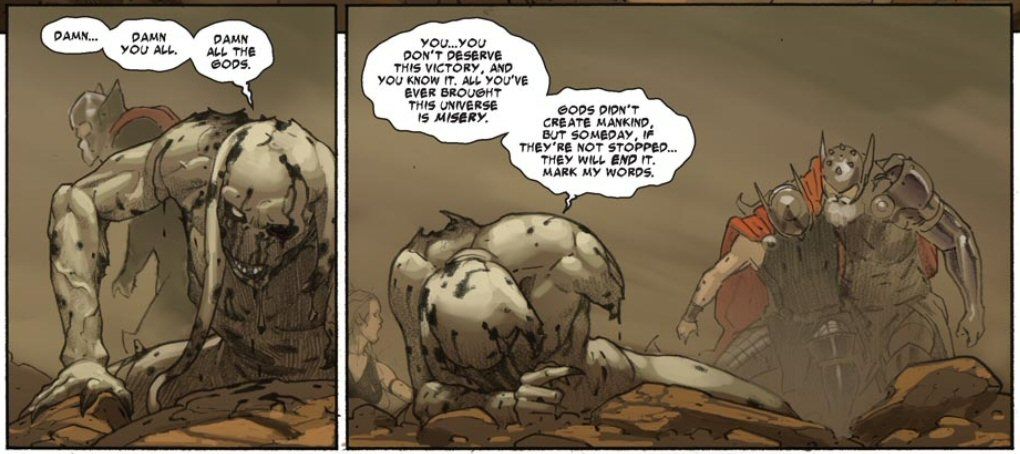
“You know what I know. That Gods have never created or cared for anything. Except themselves.”
“Gods didn’t create mankind. But someday, if they’re not stopped … they will end it”
- Gorr, the God Butcher
We’ll come back to this in a bit.
The subsequent story line, The Accursed (issues #13-17), where Malekith returns and Thor is unable to defeat him, marks Thor’s initial descent into self-doubt. It ends with an interesting narration in its last two panels, issue #17, by Aaron, Garney, and Emanuela Lupacchino:
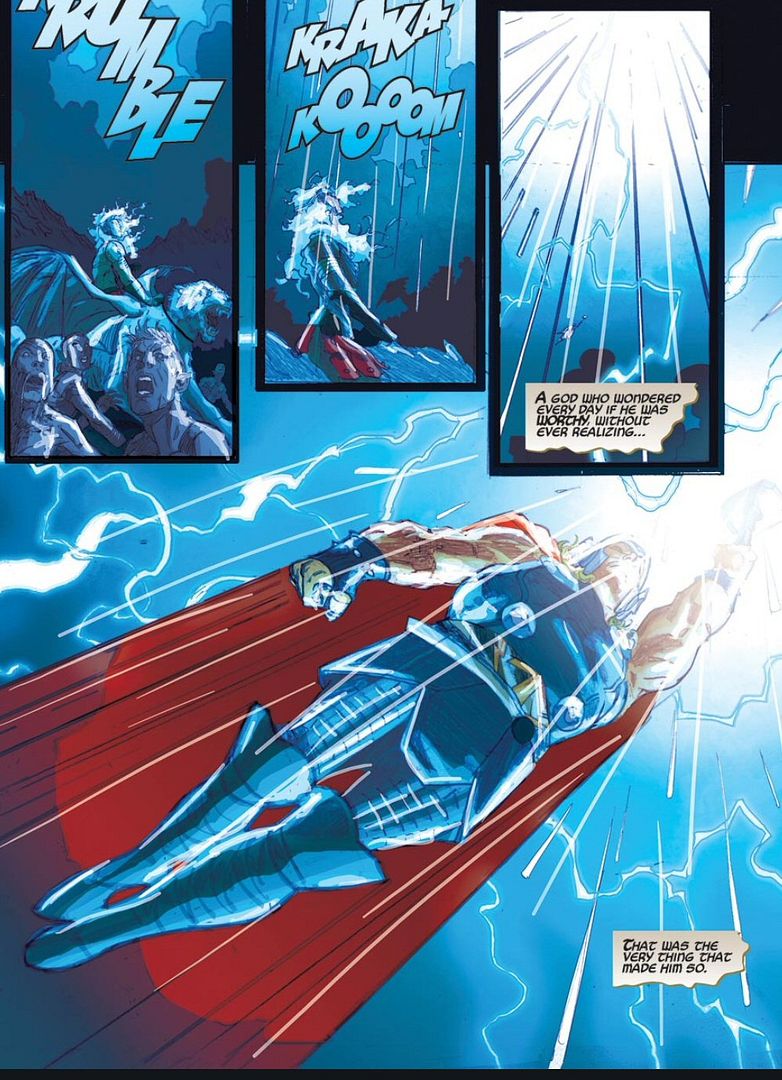
That narration is remarkably similar to Heimdall’s parting words to Daredevil at the end Aaron’s War of Realm story line in 2019: “And in the Kitchen of Hel, a hero will soon torment himself as never before. Without realizing … that is the very thing that makes him a hero”. It’s a thoughtful parallel, and one that will be critical to the resolution of this era.
In Aaron’s 2014 series Original Sin, the Watcher (Uatu) is found dead on the moon by Thor. He brings together the Avengers, and they task Nick Fury, director of S.H.I.E.L.D with leading the investigation. Unbeknownst to them all, Nick’s history is not what it seemed – and his utilitarianism is far more extreme than any could imagine. It turns out he is the one who actually killed Uatu. In the process, he has learned all the Watcher’s secrets. And he uses these to bring Thor down. From issue #7, by Aaron and Mike Deodato:
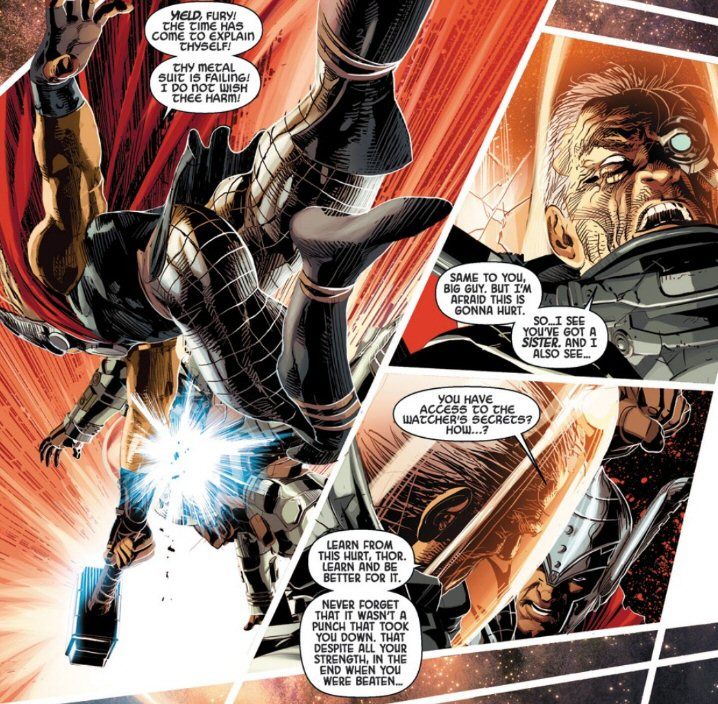
The reference to Thor’s secret sister is something Thor has just become aware of himself, through the events of this series. This predisposes him to believe what Fury says, given that Fury knows all the Watcher’s secrets now. As it continues:
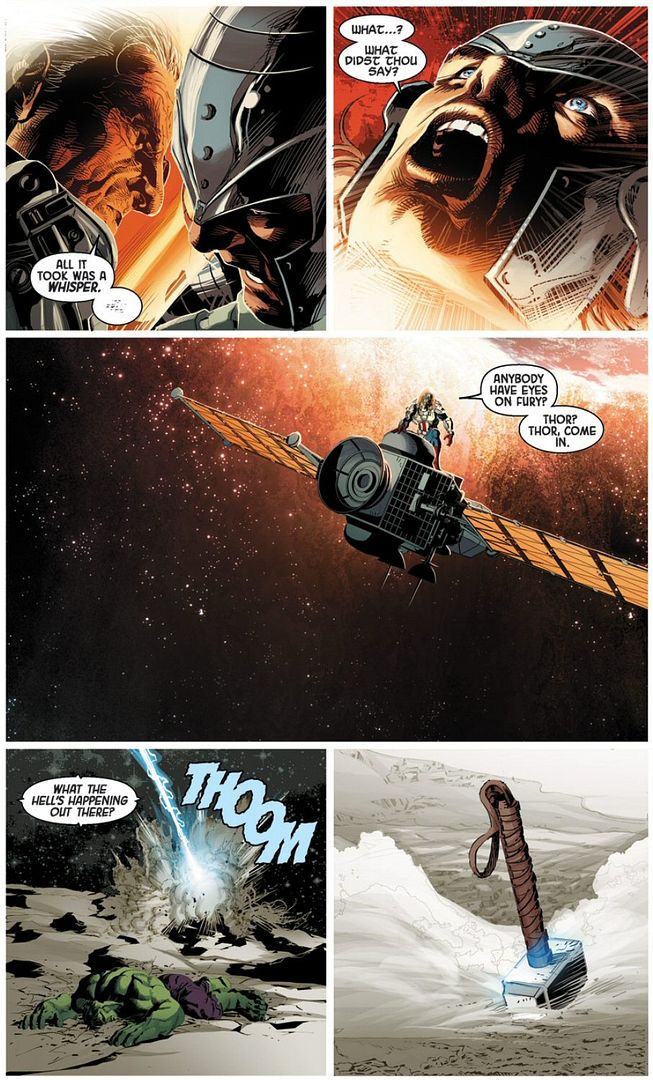
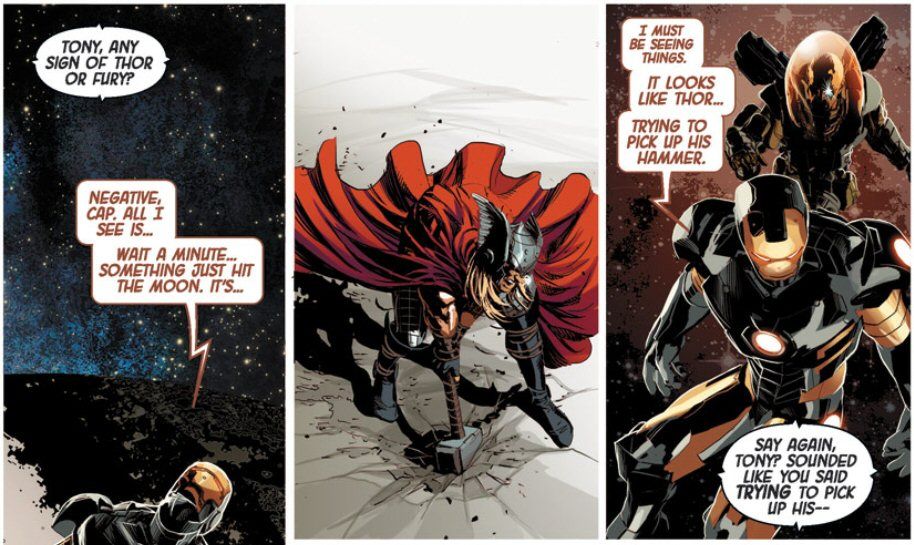
Aaron plays a long game here. From this moment on, Thor is rendered “unworthy” and is unable to pick up Mjolnir – which remains stranded on the moon (temporarily). But it isn’t until 2017, in the final issue of Aaron’s Unworthy Thor series that we learned what Fury had whispered to him:
“Gorr was right.”
- Nick Fury’s whisper
That was it.
Personally, I wouldn’t trust what Fury said he ate for breakfast. Fury makes it abundantly clear in this series that he will lie to anyone about anything if it means he can continue his utilitarian mission to keep Earth safe. But Thor has been harboring barely concealed doubts and a rising belief that Gorr was right about selfish gods not caring about mortals, and how we would have been better off without them. In this moment, that confirmation from Fury was enough to tip Thor over the edge and cause him to lose his confidence in his own worthiness – and consequently his ability to wield Mjolnir. In a later series, what is left of Fury expresses remorse for what did to Thor here – even though he admits it was indeed the truth he spoke.
Although this might seem unbelievable to a casual reader (hence perhaps the delay in the whisper reveal), it does get back to my key point – Thor has never had a sufficiently internalized sense of worthiness. He has been relying on either Odin or Mjolnir to confirm his worthiness. Aaron is the first writer who seems to have truly grasped this long-standing underlying problem with Thor’s virtue ethics. Up until now, how exactly his worthiness has been determined has always been hand-waved away.
And Fury actually gave Thor a very good piece of advice before the whisper: “Learn from this hurt Thor. Learn and be better for it.” If Thor can find a new framework for internally deciding his worthiness, he will be much better off.
Aaron soon leans into the idea of sentience for Mjolnir, which I find complicates the issue. It shouldn’t be Mjolnir that decides who gets to wield it – the enchantment should only be that Mjolnir recognizes who believes themselves to be worthy. This gets muddled by the sentient Mjolnir reaching out to select the next Thor – which happens at the end of the first issue of the new Thor Vol 4, 2014. A woman’s hand reaches down and picks Mjolnir up – transforming into a woman Thor with a helmet-disguised face – as the enchantment changes from the original “if he be worthy” to “if she be worthy”. Don’t get me wrong – I think this is an excellent story line, and I really liked the new Thor – it is just from a virtue ethics perspective that a sentient Mjolnir choosing Thor is problematic.
Neither the original Thor nor Odin are very happy with this turn of events (Odin repeatedly refers to her as a “thief” until the end of this run). But the original Thor soon comes to accept that Mjolnir has chosen her – so she must be worthy. But he takes it a step further and renounces his claim to the name “Thor” and decides to known only as “Odinson” until he can regain his worthiness. It isn’t until the final issue of this series seven months later that the new Thor’s identity is revealed to the readers to be Jane Foster, a former love interest of Odinson.
The action shifts to the adventures of this new Thor for the next couple of years (Mighty Thor Vol 3, 2015-2017), while Odinson completely recedes from view. I’ll have more to say about this period in my upcoming Jane Foster Valkyrie Ethics post. But the general gist is that Jane shows no doubt about being worthy. Unlike Odinson, she was not raised to question her worthiness, or meet some unreasonable set of parental expectations. She simply lives her life – Mjonir called to her, and she answered. And even though others question her, she doesn’t ever doubt herself.
This is the key difference to Odinson – he always seemed to trust too much in Mjonir (or Odin), not in his own sense of worthiness. Jane is certainly proud that Mjonir picked her, but she doesn’t rely on that to determine her worth. Odinson returns in a limited series, Unworthy Thor (which ends with the “whisper” reveal). This is a difficult series to read for Thor fans – Odinson is in a shame spiral that he seems unable to break, alienating all his friends.
Eventually, Jane needs to give up being Thor (for health reasons – it’s a long story, see my upcoming Jane Foster post). Her stint as Thor ends with her saving Asgard from the Mangog – and the (apparent) destruction of Mjolnir in 2018.
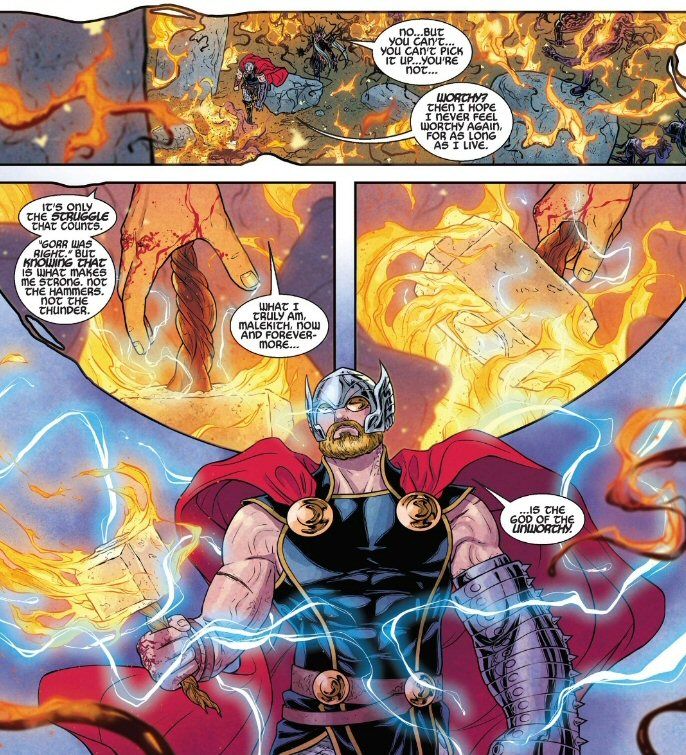
Eventually, as the action moves into the War of the Realms cross-over event of early 2019, Odinson accepts his unworthiness, which is a first step back. He manages to recast Mjolnir from the sun where it was destroyed – with the updated enchantment “if they be worthy”. This brings us to Thor’s new revelation of what makes one worthy – from War of the Realms Vol 1, issue #6, 2019, by Aaron and Russell Dauterman:
In the next issue of the main Thor title, the reunited pair get to have some quality quiet time together. From Thor Vol 5, issue #15, 2019, by Aaron and Michael Del Mundo:
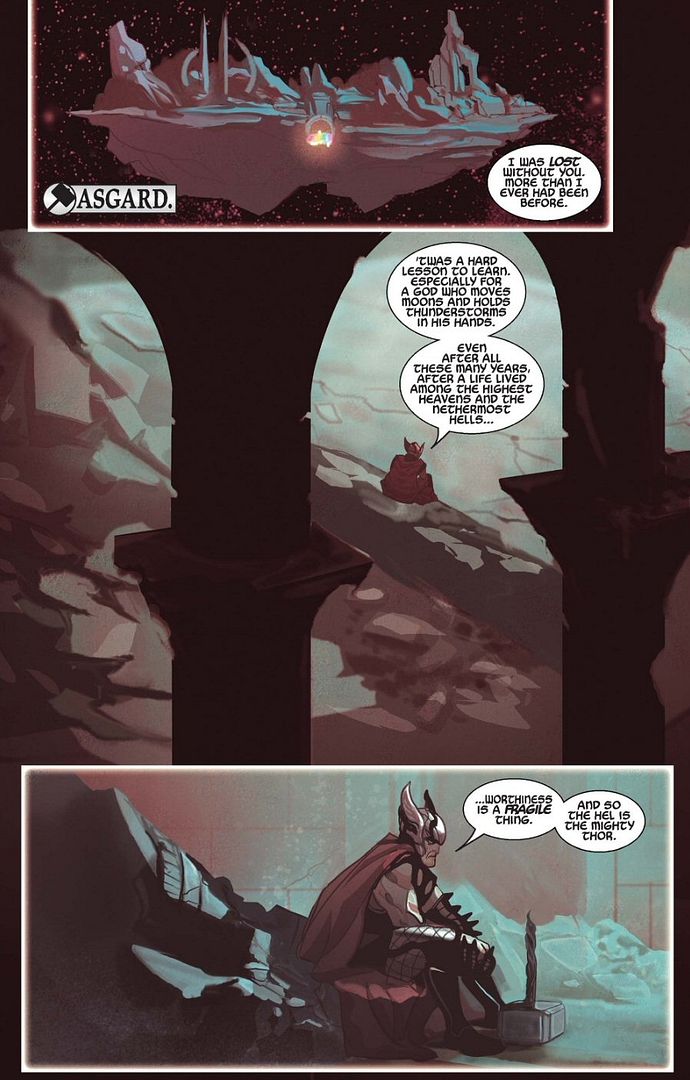
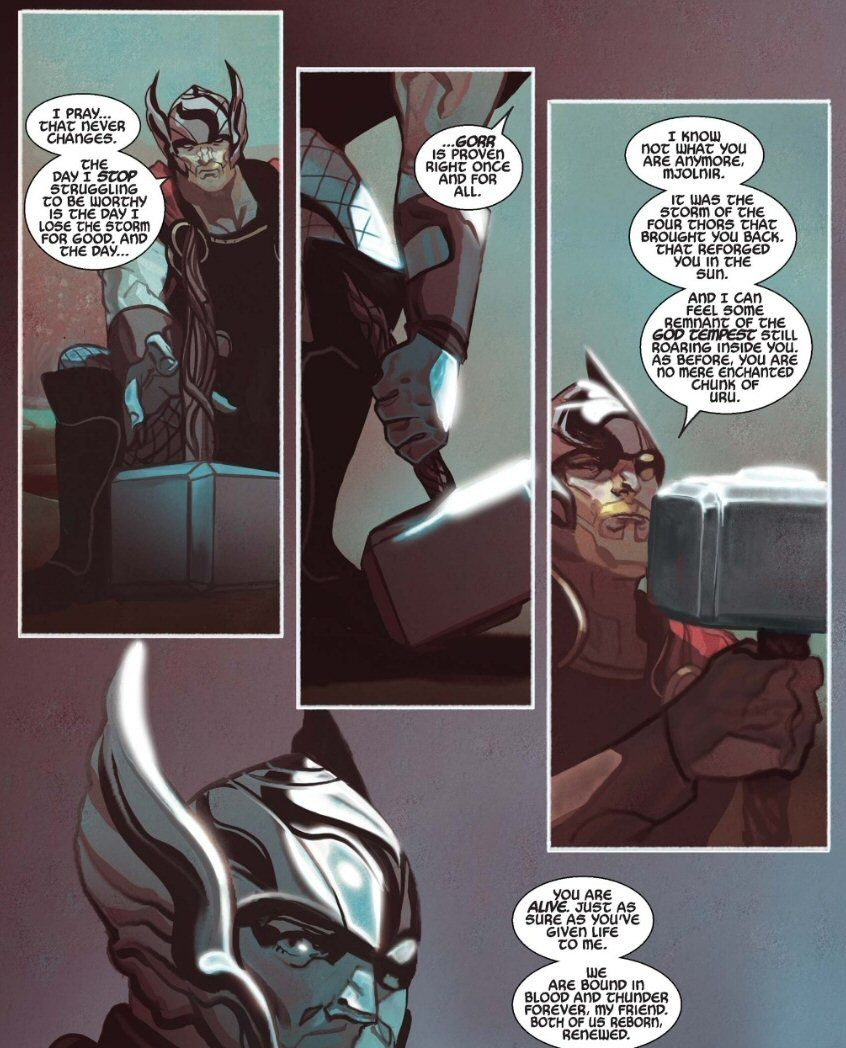
It seems to me that Aaron’s Thor has only partially gotten to where he needs to be (from a virtue ethics perspective). Yes, the daily struggle to be worthy is indeed a core component of all forms of virtue ethics. You must continually practice the behaviors and virtues that lead to eudaimonia. But again, Thor is still looking too much to Mjolnir for external validation (i.e., he was “lost” without him).
This ending reminds me a bit of the common misunderstanding of Stephen Crane’s Red Badge of Courage, a staple of high school literature in my day. Throughout this U.S. civil war story, the young protagonist goes through many phases of delusion in seeking his “red badge” of courage (i.e., a war wound). The novel ends with the protagonist appearing to have finally come (rather abruptly) to a mature understanding of life and the foolishness of his previous thinking. Indeed, this is how the novel is often mistakenly taught in schools. But you could just as easily argue that he is still as deluded as ever, and has stumbled onto yet another fleeting perspective that just happens to match the reader’s expectations of maturity. Crane intended this ambiguous interpretation, as he was seeking to explore courage as a human response rather than as a heroic virtue (and was apparently aghast at what became the standard Cliff Notes high school interpretation of his novel).
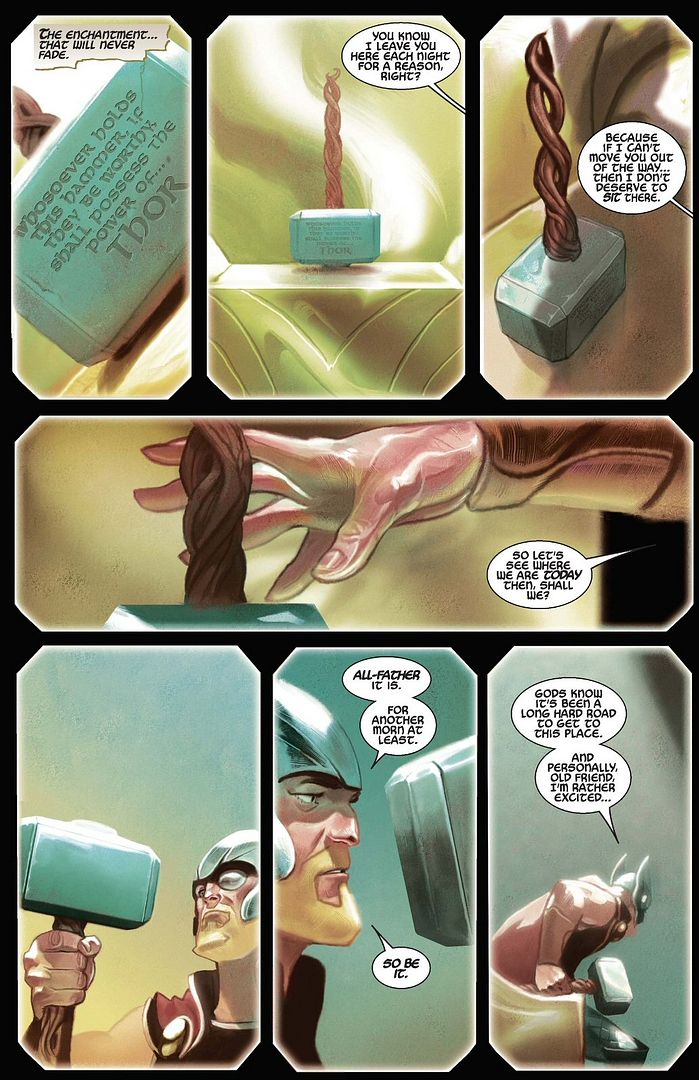
But that’s just me – the author of a comic book ethics blog. 🙂 Aaron’s motivation for the character is different, as he explains very well in his afterword to his final issue of Thor, a compilation of stories that make up King Thor Vol 1, issue #4, 2020, with art by all the artists he worked with over his run. A few pages reveal a lot about what Mjolnir means to Thor.
First up are the final panels of our Thor, now King and All-Father of Asgard:
And the elderly King Thor from Earth-14412, a Universe at the very end of time (a reoccurring character who fought alongside our Thor and a younger Viking Thor from Earth-616 in Aaron’s stories). His Universe is facing the heat-death of entropy, and he is about to die to save it. Before he says his goodbyes to his beloved granddaughters, he shares this moment with his Mjolnir:
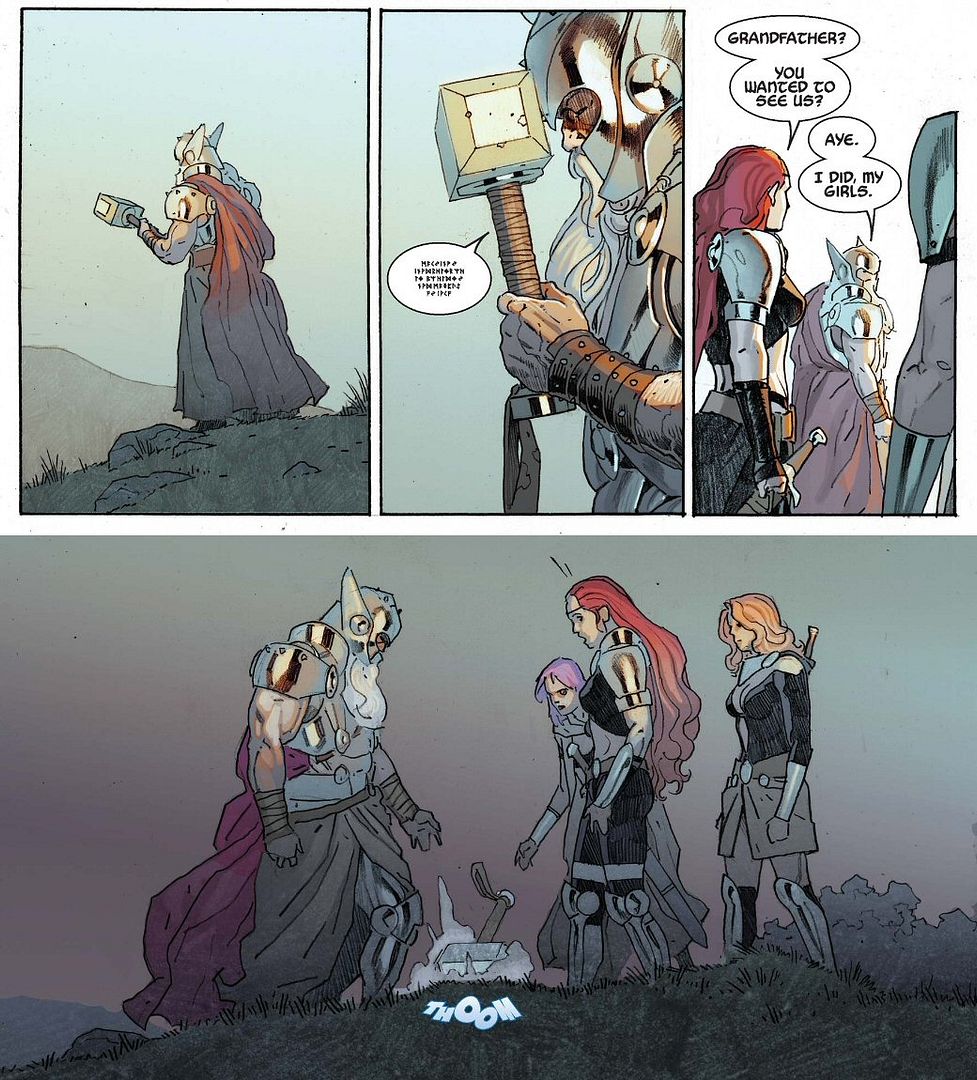
As the narration on the subsequent page makes clear: “The final words Thor shared with Mjolnir were for Mjolnir alone”.
These final moments of Aaron’s run make clear that Mjolnir was never just a tool to his Thor(s). It is an integral part to who they are, their truest friend. It is not something that they can just part with. So I can appreciate why Aaron is unwilling/unable to separate Mjolnir’s judgement from Thor’s internal compass – they are one in his philosophy.
As an aside, this extended run was not popular with a lot of Thor fans. Many did not like seeing him laid low for so long (I recall complaints online of how it seemed that Aaron “didn’t even like Thor”). These complaints strike me as missing the point, and I would encourage detractors to read Aaron’s final words at the end of this issue. To me, Aaron should be credited with recognizing the fundamental flaw with the Thor character’s previous concept of worthiness (even if his lack of separation between Mjolnir and Thor doesn’t fully stick the landing from my personal normative ethics perspective).
There was of course also the expected misogyny in some quarters from having Thor replaced by a more worthy woman. Personally, I found the Jane Foster character arc the most interesting part of this era. And not just for her stint as Thor, but for what Aaron created for her afterwards – replacing Brunhilde as the Valkyrie. The subsequent Valkyrie series, which Aaron typically co-wrote with the outstanding Torunn Grønbekk (until she took over both Valkyrie and Thor titles solo) are a very … worthy … read. Stay tuned for my upcoming post on the development of this excellent character.
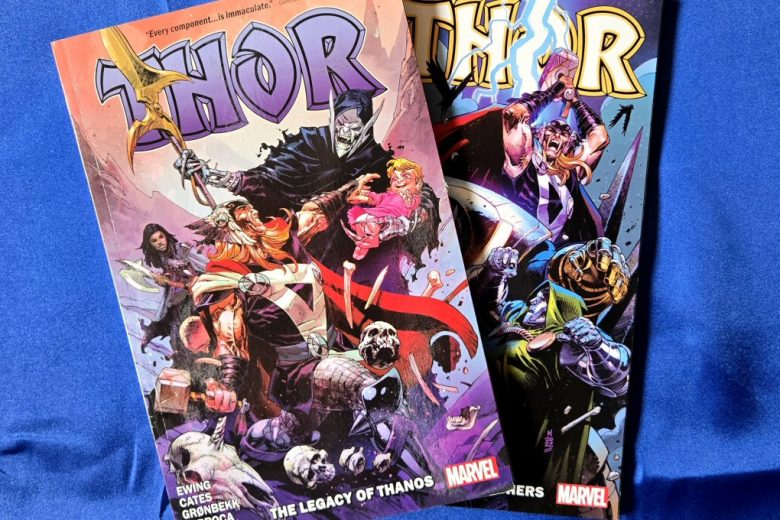
This post has gone on long enough, so I’ll end this section by saying Thor passed into the hands of some other excellent writers at Marvel (Donny Cates, Grønbekk, and Al Ewing), and all are worth reading.
A.X.E.: Judgment Day
So, how does Thor fare in the A.X.E.: Judgment Day event, the major 2022 Marvel cross-over event created by Kieron Gillen, Valerio Schiti, and Marte Gracia? I have created an introductory post on this event, and plan to conclude it once I have finished profiling the ethics of the major heroes involved. The premise is that a revived god-like being, a Celestial known as the Progenitor, is deciding the fate of the world by weighing the morality of every being.
Thor gets a single panel in issue #4 of the main series:
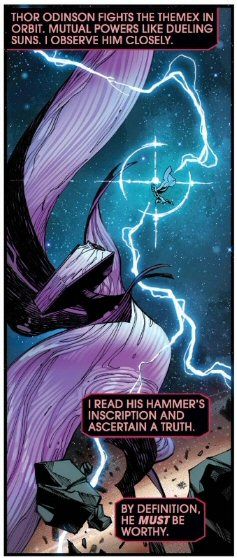
The Progenitor’s reasoning is cute – taking the enchantment of Mjolnir as sufficient proof of Thor’s worthiness. Again, I’ll have more to say about what this reveals about the Progenitor’s own judgment process in a follow-up post for this event.
Marvel Cinematic (MCU)
I’ve generally enjoyed the Thor MCU movies starring Chris Hemsworth – the first one (2011) in particular, directed by Kenneth Branagh and written by Ashley Edward Miller, Zack Stentz and Don Payne. This film is a good origin story for all the main Thor characters (especially Thor and Loki), and shows the brash younger Thor learning a few lessons. I liked the scene when Odin places the enchantment on Mjolnir to teach Thor a lesson in humility and worthiness. Odinson achieves worthiness once he is really to sacrifice himself for the sake of humans. Although different from the comics of course, the movie holds together well both thematically and structurally, and has a good mix of action, humor, and world-building.
The last film, Thor: Love and Thunder (2022) was a disappointment for me. Directed by Taika Waititi, who co-wrote the screenplay with Jennifer Kaytin Robinson, this film is very loosely based on the Aaron run – featuring Gorr the God-Butcher and Jane Foster wielding Mjolnir. Unfortunately, it is so goofy and silly in parts that it verges on slapstick – I initially stopped watching after 25 minutes. I’ve gone back to watch it for this post, and it doesn’t improve. It implies in a flashback scene (through a glowing enchantment symbol) that Mjolnir was enchanted by Thor to look after Jane – thus making Thor’s judgment the arbiter of worthiness (!) and undercutting Jane’s innate virtues. Moreover, Thor states that Jane is what made him worthy initially – which seems to over-simplify and cheapen his actions in the first film. And the ending for Jane removes the agency and drive she demonstrated in the comics (which led to her recovery and ultimate appointment as Valkyrie). A less than worthy outing for all, I’m afraid.
Current ethical framework: V

Thor is one of those rare Marvel characters who consistently falls within a single normative ethics theory – in this case virtue ethics. He is a model of the classic Aristotelian virtues of courage, honesty, selflessness, loyalty and sacrifice. And while he may not always succeed, he struggles to find the “golden mean” of others like self-confidence, temperance, and patience (his greatest challenges). My only real complaint is the confounding effect of Mjolnir – a true virtue ethicist (in the classic sense) should be looking inward for self-validation of his worthiness, and the comic Thor is always concerned with Mjolnir’s external validation of him. But that is just an ethics nerd’s issue. 🙂
And so, a V on my superhero description system.
Again, the purpose of this site is not to provide a definitive normative ethics framework for each character, as that is typically not feasible given all the creative hands each character has passed through. But Thor is the rare exception.
The last word … for now
This post has gone longer than I intended, but it does set the stage and provide the necessary background for some of the more focused posts I’ll be writing about Thor and the other Asgardians. Next up will the be the current Valkyrie, Jane Foster (created by Aaron, and continued by Grønbekk).
And on that note, I would like to give the final word to Grønbekk’s Thor, in her final issue of Thor (Thor Vol 6, issue #35, 2023, by Grønbekk, Sergio Dávila, and Juan Gedeon). After fighting alongside Odin (trapped in Mjolnir, it’s a long story for another post) and his grandfather Bor, Thor is finally alone as King and All-Father of Asgard.
As is typical of Grønbekk’s care ethics approach to her characters, she seeks to humanize Thor’s fractious relationship with Odin in her final two pages:
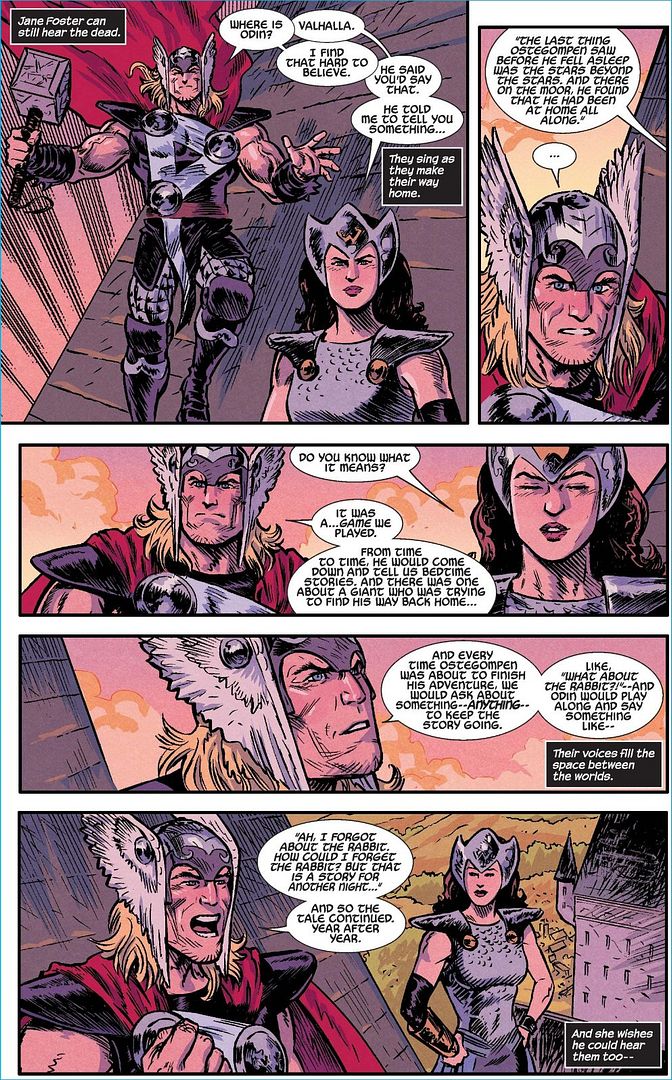
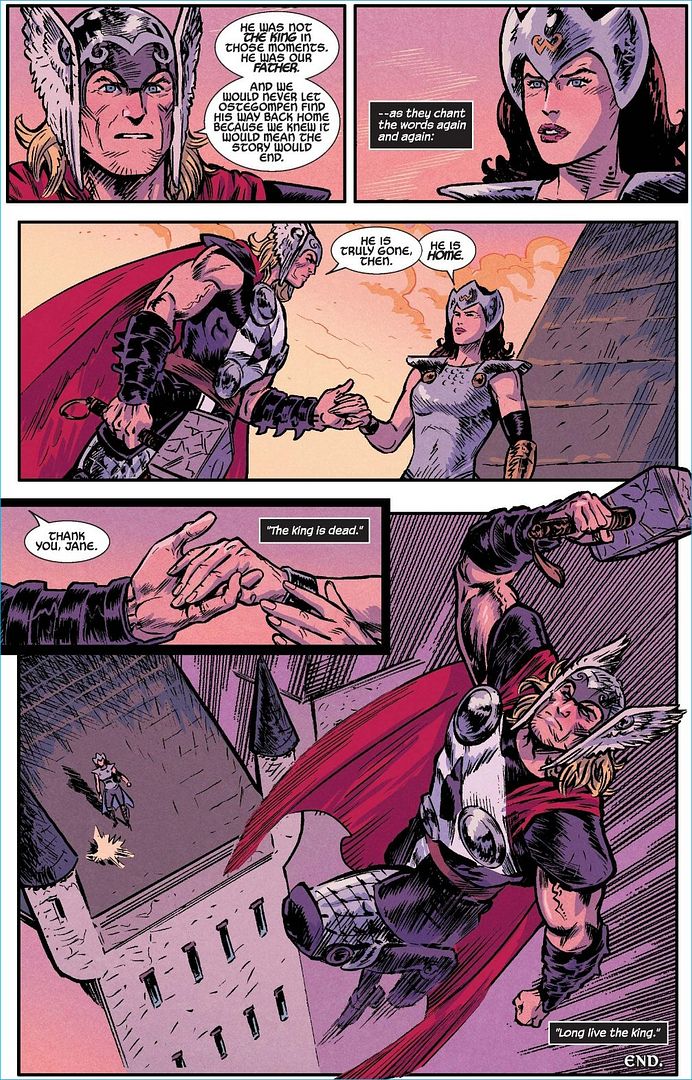
In Grønbekk’s blog, she explains how the inspiration for this ending came from her own childhood experiences with her father telling made-up stories (including “Ostegompen”) to amuse his children. How fitting for a writer whose name (Torunn) literally means “the one who is loved by Thor”. I highly recommend all her Valkyrie and Thor stories.
See my Glossary post for a list of the key philosophical concepts and related links on this site.
Further Reading
For more virtue ethics: A.X.E.: Judgment Day Conclusion
For more virtue ethics: Spider-Man
For more philosophy: Absolute Wonder Woman
That wasn’t quite what I was expecting, but interesting. Definitely agree on virtue ethics, and how Thor was born from myth. Thanks for a thoughtful article.
What were you looking for exactly? I realize I focused heavily on Jason Aaron’s run, but that’s because of the focus on worthiness for a virtue ethicist. Is there something else you think is missing?
I appreciate your focus on Thor. He is one my favorite Marvel character given how deeply his story taps into mythic traditions and the structure of the hero’s journey. Unlike many comic superheroes whose powers come from accidents or experiments, Thor is literally born into/from myth – a literal god whose struggles can feel both epic and surprisingly human. His early exile to Earth matches the “initiation” stage of Joseph Campbell’s hero’s journey, where the hero must confront inner weakness before achieving his greatness.
As for Mjolnir, to me that really does symbolize a test of Thor’s moral worth, mirroring legends like King Arthur’s sword in the stone. Thor’s constant push and pull between his duty to Asgard, his connection to humanity, and his own struggles gives his story a real emotional complexity. Thor isn’t just a strongman (although he is sometimes written that way) – he’s a mythological figure navigating modern life, with much the same questions of identity, responsibility, and personal sacrifice.
But you have captured why Thor stands out: he isn’t just a superhero. He’s a reminder that the old myths still live with us, reshaped for modern times, and still powerful and durable.
Ah, I see. Yes, that makes sense – Thor is a really good example of exploring mythic archetypes in Marvel comics. I did allude to Joseph Campbell on my launch post (in reference to Magneto and the X-Men more generally).
And I hadn’t thought of King’s Arthur Excalibur being pulled from the stone – but that is a very good comparable. I was focused on who determines worthiness in virtue ethics, and so I may have missed the forest for the trees a little in terms of the symbolism of Mjolnir (and close parallel to Excalibur). Thanks for that!
While I’m getting into X-Men, I’ve been curious about the Avengers too! Are there any great Avengers stories you’d recommend, especially ones with Thor in them? I’ve always liked Thor from the movies, and I’d love to dive into his comic adventures — whether it’s solo stuff or team-up stories.
I’m looking for big, epic arcs, and if there’s anything that explores Thor’s godly side or his relationships with the other heroes, that would be amazing. I will check out these Aaron stories of course.
Any other recommendations? I’m all ears!
In terms of Thor, after the Aaron run, I’d suggest you keep reading through all of the Donny Cates and Torunn Gronbekk stories in Volume 6 (2020-23). There are some big “godly” set pieces in there.
For the Avengers, there is of course all the A.X.E.: Judgement Day stories (which you will get to through the X-Men Krakoan Age). But I’ve always enjoyed the earlier Brian Michael Bendis era. Here is a good visual someone on Reddit created for the core issues of his main story arcs: https://imgur.com/svVKdZs
After that, I think the Jonathan Hickman Avengers stories are great, especially through the Secret Wars story arc. Here is a reading guide to Hickman’s earlier Marvel era: https://www.comicbookherald.com/jonathan-hickman-marvel-universe-reading-order-2008-to-2016/
I’m also enjoying the re-launched Hckman Ultimates comics (especially the main series and Spider-Man).
Another more recent Avengers limited series story that I enjoyed is Derek Landy’s Avengers: Beyond (2023). But only read it after Secret Wars. It fits with your “strategy” interest.
Enjoy!
One more thing – are there any other comic teams (outside of X-Men and Avengers) you’d recommend I check out? I’m really into the whole team dynamic where everyone has their own unique abilities and personalities. Something like the Justice League or even smaller, more niche teams would be cool to explore!
I’d love any recommendations for groups that have strong character interactions and maybe a little bit of strategy or planning involved, like how teams in Magic or Pokémon work.
Thanks again for all the great advice — you’ve all been super helpful!
Yeah, try some of the “academy” series. These focus on new teams of typically young characters, who are still exploring their powers and learning who they are. Strange Academy (Doom Academy at the moment) is a great series, highly recommended. Avengers Academy is another one you might like.
These may fit your strategy game interest the best.
Awesome, thanks!
Really enjoyed this deep dive into Thor’s ethics! As someone who’s been reading comics since the 80s, your analysis of Thor’s virtue ethics framework really hits dead-on. I remember being frustrated with those early Thor stories too – but you missed out on the Walt Simonson stories, those were great.
Your point about Thor historically seeking external validation of his worthiness from either Odin or Mjolnir is certainly ture. It’s interesting how that fundamental character flaw persisted for decades until Aaron finally addressed it head-on.
You mentioned that in classic Aristotelian virtue ethics, worthiness should be internally determined rather than externally validated. But isn’t there something to be said for community standards and cultural context? Thor is, after all, not just an individual but a prince/king with responsibilities to his people. Shouldn’t his worthiness be measured, at least partially, by how well he serves that role? And do you think there’s a way to reconcile Mjolnir’s sentience with virtue ethics? Maybe the hammer doesn’t decide who’s worthy so much as it responds to someone who truly believes in their own worthiness?
Looking forward to your Jane Foster/Valkyrie post! The Aaron era really was something special (especially War of the Realms), even if it was tough to watch Thor suffer through all that self-doubt. Sometimes the best character development comes from breaking a character down completely before building them back up.
And I liked your comparison to “Red Badge of Courage”. That ambiguity about whether the protagonist has truly learned anything or is just in another phase of delusion could definitely apply to Thor’s journey. Makes you wonder if he’ll face another crisis of worthiness down the road!
Oh yes, community context was key for almost all the ancient Greek philosophers – including (and most especially) Aristotle. We are “political animals” in his view (which is to say, our participation in community is at the core of our being). It’s through our participation in community that we develop and practice virtues. I haven’t played this aspect up much to date, given the somewhat solitary nature of comic heroes (and Western society in general), but it is certainly key to understanding ancient Greek thought. Even eudaimonia is not solely a solitary pursuit – it is linked with the good of community too (i.e., I’ve even heard it described as a “shared endeavor”).
But Aristotle’s version of virtue ethics leans more towards internal validation, emphasizing the importance of developing a virtuous character and living a good life for youself. External validation (in terms of good outcomes) certainly plays a role – but it’s a secondary one (i.e., more of a supportive role).
Actually, I’m going to be discussing the relational aspects of virtue ethics in my next post – the ethics of the Fantastic Four. They are more than just a team but a family, and so I’m going frame their ethics in terms of care ethics and Confuscianism – both virtue ethics frameworks that have a strong family basis.
In terms of Mjolnir, I could easily have accepted that the it didn’t “decide” who was worthy so much as “respond” to them (indeed, that is how I always saw Mjolnir in the earlier stories). However, the Aaron run explicitly had the hammer reach out to Jane to come and pick it up. You might be able to explain that away on the basis that there needed to be a Thor, and Jane was just the first one who felt the call … except the stories explicitly have the personified hammer state that it specifically choose Jane. It even physically impersonated her once, in order to maintain the ruse of her secret identity – and then engaged Jane in explicit conversation of why it chose her (sorry, I don’t recall the issue off-hand).