
Time has only made them worse. They need control. Control.
- Spirit, in Jesse Lonergan’s Drome
The graphic novel Drome, by Jesse Lonergan, has received a lot of attention and awards this year, including the 2026 Eisner Award for Best New Graphic Album and the 2026 Ignatz Award for Outstanding Story. This graphic novel is described by the publisher (23rd Street, Macmillan publishers) as a “a visually mind-blowing epic about war, love, and death in a fledgling world” and “a creation myth for the modern age” – both of which are pretty good descriptions!
I first came across this graphic novel during my reading ahead of this year’s Eisner awards and was immediately struck by both its innovative visual style and the underlying ethics of its presented story. I am not surprised to see it win in the categories above (full disclosure: I voted for it for both awards). And so, I’m glad to be able to provide here an ethics-focused overview of its core messages.
This is probably going to be the first ethics overview I’ve done for a story with almost no dialogue! There are a few key scenes where characters express concepts verbally – but the rest of the time, it is the visuals that (very effectively) carry the message.
Here is a description of the story, again from the publisher’s website:
First, there was nothing. Then, humanity was born, and an endless cycle of violence began. From the depths of the ocean, a mighty demigoddess is called forth to rein in humankind’s destructive impulses, and teach a language of peace and harmony. Civilization quickly takes root, a great city rising from the desert. But the balance between chaos and order is a fragile one, and there are higher powers at work in this strange new world.
I presume the name “drome” here is derived from the Ancient Greek word drómos, which literally means a “running course”. In modern languages, this is usually added as a suffix – as in aerodrome (a landing field), velodrome (oval racing track), or hippodrome (horse racecourse). Less commonly used in English, I am familiar with all the above by dint of having grown up in Quebec (the predominantly French province of Canada). But here on its own, I suspect drome refers more to the “endless cycle” of humanity.
Given the creation and civilization myths at the core of this story, it seems like a good opportunity to discuss the ethics of social structures, along with my usual cadre of normative ethics. As we will see, the novel refuses to take a clear stance in favor of one ethics theory over another, but clearly shows how they conflict with one another, triggering the “fragile balance” described above.
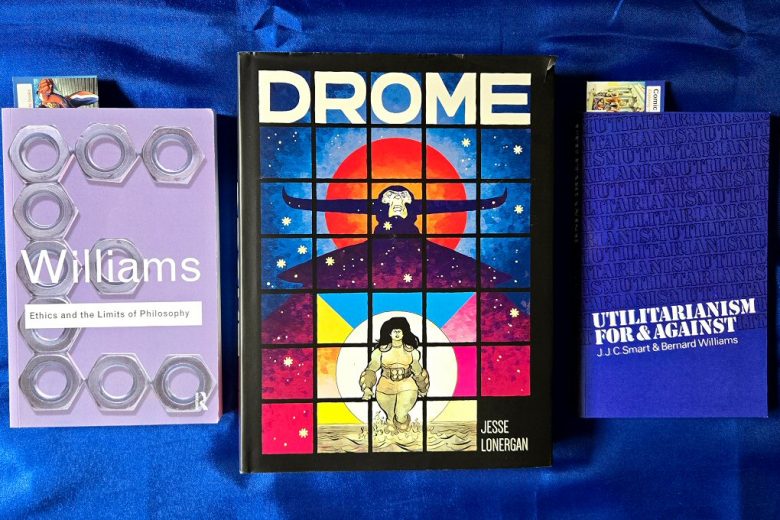
But a word of warning – to fully explore the ethics of this thoughtful graphic novel, I will need to spoil and discuss the ending here. I will warn you below before we get to that point. But if you plan to pick up Drome and don’t want the ending revealed, you will have to skip a lot of my subsequent discussion of moral luck and the writings of Bernard Williams (two of whose books are pictured with my hardcover Drome above).
As always, if you would like to know more about the terms I’m using on this site, please follow the links throughout or check out my Ethics 101 page or Glossary of Terms post.
Introduction to series’ ethics
As I explain on my Ethics 101 page, there are three branches to normative ethics, which is the field of moral philosophy that considers the question of what people should or ought to do.
Deontology is concerned with doing your duty to other people, often through the lens of rights or justice. These theories are often principle- or rule-based and focus on the moral value of the acts themselves (that is, doing the right thing). At the other extreme, consequentialism focuses not on the value of the acts but rather on their outcomes. These theories typically explore the moral burden of making good decisions (that is, doing the good thing). The third branch is virtue ethics, which shifts from the action-based theories above to the actor – being the best person you can be. These actor-centered theories typically involve the practice of virtues that align with your core values and goals (that is, being better).
Keep these three branches in mind as we go through the Drome story, as aspects of all three are presented through the various characters. But there are two key philosophers of social structures that I need to introduce before getting into the plot, as their perspectives also come up over the course of the story.
The first is one I’ve discussed on this site a few times – Thomas Hobbes, a prominent 17th century English philosopher. Hobbes was a proponent of what is known as social contract theory. Explored in his 1651 book Leviathan, Hobbes argued for an absolute ruler as the ideal governing structure for humanity. Hobbes believed that without external controls, humans would exist in a “state of nature” characterized by constant fear, violence and retribution – his famous description of human life was as “solitary, poor, nasty, brutish, and short.”
To escape this natural fate, Hobbes argued that people should voluntarily agree to surrender their individual right of self-governance to a single sovereign authority. This authority could take several forms, but Hobbes argued for a monarchy – a strong ruler with absolute power over his subjects. He was writing in the shadow of a recent English civil war, and so much of his thinking was shaped by a fear that divided or contested authority could lead to violence and societal collapse.
Significantly, Hobbes acknowledged that a monarchy wasn’t the only legitimate form of governing – he just insisted that the ultimate authority have concentrated and absolute power. Hobbes was ultimately suspicious of checks and balances or separation of powers, fearing that any divided authority could revert to the natural state of lawlessness found in nature.
Later contract theorists opposed Hobbes single-mindedness on this (like John Locke, who argued for more protections for individual rights, including the right to resist a tyrannical government). But a fundamentally different take came from the second social philosopher I want to discuss here – John Rawls, a prominent liberal American philosopher of the 20th century.
Rawls was a proponent of social justice, as articulated in his 1971 book, A Theory of Justice. Rawls took the position that justice was fundamentally about fairness, and he advocated for equal basic liberties and opportunity – and for providing the maximum benefit to the most disadvantaged members of society. He famously crafted this argument through a thought experiment known as the “original position” – asking people to consider what kind of society they would choose to create and live in if they didn’t know which social position they would be given in it.
The point of this thought experiment is that each person deliberates behind a “veil of ignorance” – each lacks knowledge of their gender, race, wealth, intelligence, education, religion, and any potential disabilities, for example, as well as what their conception of a good life even means. They only know that as a member of that society they will have the capacity to form a concept of the good, develop a sense of justice, and live by it.
Under this original position, no one would design the world of inequities we currently live in because it would be irrational to do so. In a system where one is ignorant of one’s ultimate status, the only logical and just position is to strive to improve the status of the worst off, because any one of us might find ourselves in that position.
Note that Rawls’ theory doesn’t demand strict equality – inequalities are acceptable, but only so long as they actually improve the position of the worst-off (they just can’t benefit the already well-off). Rawls was reacting against the popular utilitarian thinking of his time, which he felt could justify sacrificing individual rights or the well-being of a minority for the better social welfare of the many (sadly, something I’m seeing proposed a lot today for transgender rights). He believed justice requires respecting the “separateness” of persons — you can’t simply average away someone else’s suffering because of the benefit to others. This is a key concept in modern population debates, and one I will return to in an upcoming post.
I’ve picked these two social philosophers because they are basically at extreme ends of each other. Hobbes assumed that people needed to be controlled to avoid chaos, while Rawls assumed that people were capable of rationally designing fair institutions if they stripped away self-interest (while retaining logic). As we will see, this distinction is at the heart of world-making in this story.
Introduction to the story
The novel opens with a great graphical table of contents (in its stylistic grid format). It also gives us the names of some of the key players in this drama (helpful given the relative lack of dialogue!):

While Form and Spirit are the later chapter headings, the novel begins with Form and the creation of this world.


Here we see Form create the world and seed it with life.
We soon see its first life-form bubble up from the beneath the surface:


And the first thing this Red-Headed Man does? He takes a rock and beats to death the second arrival, the Blue-Headed Man. This underscores the initial savagery of this world (and man). I will come back to this scene later, as there is more going on here than appears.
Soon, the world is populated with a wide-range of creatures, many that look a lot like ones from our world – although it also includes some prehistoric giant-sized creatures along with modern forms, as we will come to see.


These opening pages suggest that Spirit may not approve of Form’s creation. That is soon made explicitly clear, as the unending cycle of violence continues over time:


And Spirit’s solution to the matter?


Spirit adds her own influence to Form’s world, by creating Blue.
Blue is described as a demigoddess in the publisher’s material for this book, which seem like a good description given what comes next. It starts with Blue exerting control over the creatures of this world:


The man with the eyepatch appears to be the same Red-Headed Man from the opening (hey, it’s a tough world, right?). He has apparently managed to domesticate one of those giant crabs – which he has previously been shown riding into battle.
Blue demonstrates her physical prowess by defeating and killing the crab, causing this reaction:


It seems Blue cannot be killed (or at least, not easily). Her decisive defeat of all those who oppose her convince the humans to bow down in submission to her rule. Even the Red-Headed Man kneels, although he clearly resents the situation.
Form asks Spirit the obvious question you may thinking at this point:

Over time, through Spirit’s direct influence on Blue, we see the development of technology and cooperation among the humans – and the creation of a giant castle city in the desert.

These opening scenes show how the gods (Form and Spirit) both seem to have a broadly consequentialist view – they choose to act to create what they desire. We will have many further examples as the novel unfolds. While their ultimate motives and intent are unknown, both are comfortable initiating actions in an attempt to bring about specific outcomes.
For some period of time, relative peace and prosperity seem to reign in this world. Below is a figure from later in the novel, showing the repeated cycle of day and night – with Form holding a whip to advance a cosmic bull figure (the Bringer of Night) and Spirit ridding a golden stallion (the Bringer of Light), representing the cycle of night and day.

This is the closest description I’ve ever seen in graphic literature of Thomas Hobbes’ social contract theory. This view exactly matches Hobbes – humanity is violent, competitive, and vengeful, and it requires a firm single monarch executing absolute control over the population.
And at this point in the story, it seems as if this view may be accurate – Blue (with Spirit’s influence) does have a civilizing effect on humanity. I’m reminded of the classic heroic poem Ulysses, by Alfred, Lord Tennyson:
… discerning to fulfil
This labour, by slow prudence to make mild
A rugged people, and thro’ soft degrees
Subdue them to the useful and the good.
But keep in mind that poem shows different facets of Ulysses over the course of his life, including this earlier passage:
… I mete and dole
Unequal laws unto a savage race,
That hoard, and sleep, and feed, and know not me.
Like Tennyson’s Ulysses, we soon come to see that Blue is not happy with this situation. By her very nature – which is part of the explicit system the gods created – she is alone and isolated from her people. We will come back to this point later as well, but for now I loved these scenes:

Despite how lonely Blue is, she rebuffs Red-Headed Man’s advances in the most humiliating way possible – by literally patting him on the head. This shows how the humans are little more than pets to Blue – she lacks an equal.
Blue may have meant this kindly, but you can imagine that Red-Headed Man is not going to take it well. Recall that Blue’s creation usurped Red-Headed Man’s relative power and authority – something he was likely trying to restore through an alliance with Blue. This is the first inkling of the unintended consequences of the gods’ creation and meddling in human affairs – Red-Headed Man’s growing bitterness and vengefulness.

And of course, the gods don’t stop interfering in how their creation plays out. Spirit appears to be sensitive to Blue’s longing – which, when you think about it, is a direct result of her nature as created by Spirit. And so, what does Spirit do?


Spirit creates another demigod, known as Red. Red’s nature is interesting, as revealed in his opening panels.

Red seems to have affinity for the natural world and animals – he is happiest when running with the stags above. Just as Blue was created to rule over humans, it seems like Red has some special role in the natural kingdom.
Of course, Red quickly comes into conflict with the humans, who hunt the stags for food.

Red reacts by attacking the hunter above. Significantly, he doesn’t kill him – although as does main him horribly, in defense of nature.
Red soon spots Blue taking a bath by the lake – and Blue chases after him:

Red initially recoils from her, and they fight.

But he soon succumbs to her, ahem, charms.

Interestingly, I can’t help but note this interesting subsequent scene:

While Red now fulfills Blue’s desires, it appears that the natural world is not happy to see the potential loss of their protector (as revealed through the squirrel’s “tsik-tsik”). This underscores again the potential unintended consequences of the gods’ actions.
The true genius of this novel is in these small moments that are easy to miss when looking at only the big story beats.
When Blue returns to the castle city with Red, she is surprised by the reaction of the townsfolk – who know that Red brutally beat the human hunter.


It is a brutal contest, with the human champion driving the advantage for most it. Red takes a lot of damage, but outlasts the human champion, and succeeds in defeating him.

Red refuses the crowd’s blood lust and leaves his opponent alive. This strongly suggests that Red could have a positive influence on humanity, through his example. It is also a rebuke of Hobbes’ view of nature of as “nasty” and “brutish” – Red, with his special affinity for nature, clearly shows the concept of mercy.

While Blue represents authority and control over nature’s violent impulses, Red shows a reluctance to respond with violence – and acts with great care.
Taken together, this has great promise for advancing humanity. Of course, it doesn’t last for long.


Form chooses to introduce a new variable into this seemingly stable situation. It creates Yellow, also known as the Fire Monster, or Fire Beast. Yellow wreaks havoc in the countryside, laying waste to small communities. Blue and Red set off to defeat it.
On their way, they meet an interesting figure – the original Blue-Headed Man from the beginning of this story (the one Red-Headed Man killed). It turns out he didn’t die – he was reabsorbed into the earth, and re-emerged (as recounted here):


He goes on to suffer horribly – that crocodile for example chews off his arm (which magically grows back). Over several pages, you see him suffer through a range of torments and body damage – with the affected areas growing back heavily scarred. But the cyclical illustrations also strongly suggest that he has some sort of role to play in this cosmic drama.

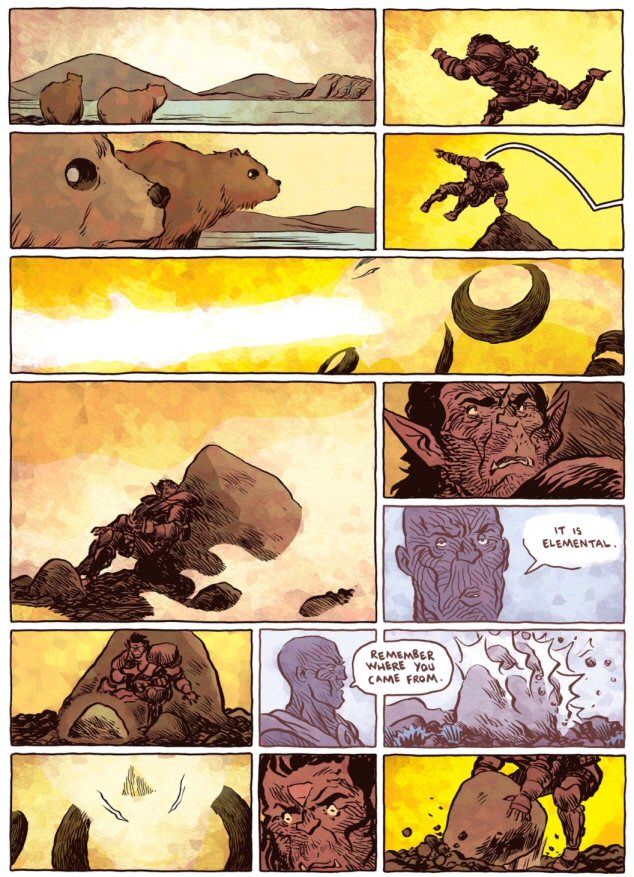
Blue and Red encounter him on their search for Yellow, the Fire Monster. They fight off a group of giant beetles attacking him, and are amazed when he doesn’t die from his wounds. He explains he should be dead a thousand times over. They ask him if he has seen the Fire Monster – and indeed he had!

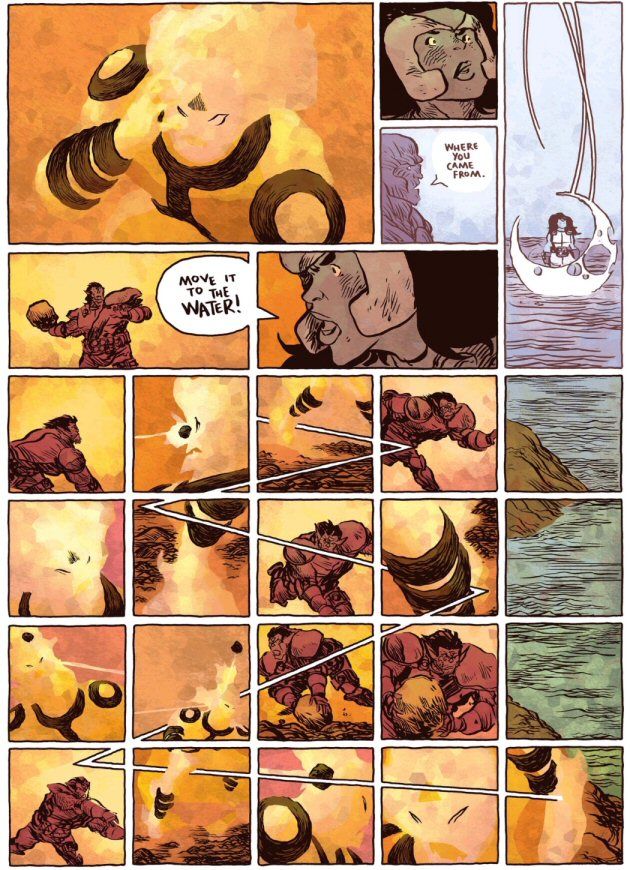
He further tells them to “remember where they came from”. I like to think of him as a Prophet of sorts – he seems to know more about the gods and their intentions than anyone else in this world.
Blue pays attention to the Prophet’s words, and they defeat Yellow
But while Blue and Red are busy fighting Yellow, Red-Headed Man has taken the time to make his own plea to the gods. Form heeds his prayers:


I’m not really sure what to call the former Red-Headed Man at this point – maybe simply the Antagonist now. Form appears to have granted him the ability to heal others – and thus, have influence over humans:


Again, you need to pay attention to the small side panels. All through this story, we have seen the Red-Headed Man accrue women as conquests – none of them last very long, though. It appears they all meet a brutal end when he tires of them.
Needless to say, Blue and Red are in for a surprise when they return:

Blue forces her way in, and confronts the Antagonist – who reveals his interest to jointly rule with her:

Blue refuses, and points out what has happened to all his previous conquests:

It seems Form has also given the Antagonist his magical whip, which he uses to control the Bringer of Night. Fighting for their lives, Blue takes the whip off the Antagonist – and strangles the bull with it.


As you might expect, Form does not take this well!

He reclaims the whip and kills Red:

Critically, Spirit intervenes and stops Form from destroying the rest of his creation:

There are several beautiful pages where Blue mourns over Red’s dead body (and Form seems to mourn the Bringer of Night). But of course, without the Bringer of Night, the sun never sets now – and the world suffers!


Blue sets off in search of the gods, carrying the dead body of Red. She quickly seeks out the Prophet:

Eventually, Blue stumbles into the realm of the gods – where she encounters Form, and the apparent spirit-forms of Red and Yellow.
Meanwhile, the Antagonist breaks free from his bonds (the humans chained him up in stocks, after his role in the bringing about the endless day). He follows the path of Blue into the desert.


Eventually, Spirit reaches out to Blue, and offers her a horrific bargain:


So, major SPOILER ALERT for what is about to happen. If you don’t want to know, please stop reading here and check out Drome for yourself.
What happens next is critical to understanding the implied ethics of this story. Returned to the world, Blue must consider her choice:

Clearly, this is a difficult decision for Blue …

She digs up the small sphere, and is presumably set to make her choice when …

… the Antagonist attacks Blue and steals the sphere.

The Antagonist seems quite pleased with his intervention. But what effect does it have on him?

Yes, it seems to turn him into a new Bringer of Night …

… who then promptly kills Blue, and takes his place as the servant of Form.
Meanwhile, back in “heaven”:

The “purest form” of Blue joins with Red and Yellow – and Spirit and Form – around a portal looking down on the world. And on that world?


The Prophet finds Blue’s body, buries it, and goes on his solitary way.
And with that, we come to the end this eventful story – but promising the ongoing saga of humanity without the demigods presence.
Ethical significance of this ending
There are many possible lenses one could use in trying to understand or explain this series – and its ending above. In terms of ethics, I need to turn now to one of my favorite writers about ethics – the 20th century English philosopher Bernard Williams. I first introduced Williams for his brutally devastating critique of the most popular form of consequentialism, utilitarianism, back in my Charles Xavier (Professor X) Redemption post. Williams was also critical of the most popular form of deontology, Kantian ethics, as illustrated through his writing on “moral luck”, which I will now address here – as they are very relevant to Drome.
As I explain on my Ethics 101 page, like many modern writers I generally treat “moral” and “ethical” as equivalent terms. The former is derived from Latin and the latter Greek, and both related to words meaning disposition or custom. As Williams himself explained in his seminal book, Ethics and the Limits of Philosophy (1985, 1993, shown above), the Latin term emphasized social obligation, while the Greek term favored individual character.
This distinction was important for Williams, as he felt that “moral philosophy” had taken on a particular and peculiar (his term) narrower meaning that distorted understanding of the broader ethical nature of life. Williams was reacting to the prevailing deontological/consequentialist duopoly of moral philosophy – which he saw as doing real damage by inappropriately narrowing ethics away from relational and character-based virtues. See my recent What Does It Mean To Be Worthy? post, and the links therein, for a greater discussion of the historical revival of virtue ethics during Williams’ time.
Moral luck occurs when someone’s moral standing depends on factors beyond their control. Williams deliberately intended this concept to be something of an oxymoron – his point was that immunity from luck had become the defining basis of moral philosophy by that point in time. As I explain in my Why Be Moral? post, for Immanuel Kant, the only thing unqualifiedly good was a good will. Kant asserted that moral worth attaches to the will – that is, to intention and to the principle behind an action (his categorical imperative), not to how things turn out. This is in part because outcomes are subject to chance, and chance is considered morally arbitrary to a Kantian.
This Kantian thinking is supposed to make morality a kind of “safe harbor”. Whatever the world does to you, your moral standing is based only on the one thing that is truly up to you – your own good will (and the actions that flow from it). It is intuitively appealing, as we would all like to believe in the general principle that moral judgments can/should only be made to the extent that factors are under someone’s control. This “control principle”, as Williams called it, is central to Kantian ethics.
Through a wide range of examples, Williams convincingly argued that this is NOT how we actually experience and apply moral judgments in real life. It turns out that a lot of our everyday thinking and practices commit us to the existence of moral luck, whether we realize it or not. In a classic series of papers (including a dialogue with American philosopher Thomas Nagel), Williams argued that luck flows all the way back to the very formation of who we are. It can be divided into three forms:
- Constitutive luck – the luck of having the actual character, temperament, and abilities that you have.
- Circumstantial luck – the luck of which situations and dilemmas you happen to find yourself in.
- Resultant luck – the luck of how things turn out once you’ve acted.
Note that resultant luck can retroactively change how we assess a choice or a person, even though the intention and deliberation were the same. Consider two drunk drivers – one who makes it home safely, and the other who kills a child along the way. Don’t we think think differently about these two, even though to a Kantian there is no difference between them? Don’t they feel differently about themselves? Shouldn’t they? Or how about two sober drivers, where one accidentally kills a child through no fault of their own. Don’t they think differently about themselves too? Shouldn’t they?
Resultant luck is a problem for utilitarianism (and other consequentialist theories), but the existence of all three forms is devastating to the control principle underlying Kantian ethics (and deontology in general). Taken to its logical extreme, Williams’ arguments suggest that it is impossible to morally assess anyone for anything if we try to rigidly adhere to the control principle. This is a devastating body blow to the rational philosophy of Kant!
As an aside, Nagel added a preceding category to the list above (“Causal luck”), which goes further back to prior causes (or “how one is determined by antecedent circumstances”, as Nagel put it). But many (me included) consider this redundant, as the first two above fully cover the ground of causal luck. By the way, some of you may have noticed that the causal nature of moral luck is essentially the classic problem of free will versus determinism, which I described in my Vision overview.
As I explained on that page, there is a way out of the classic free will/determinism problem by using compatibilism (although it is not what most may think of as freedom). The same is true for causal luck – it is possible to maintain a form of free agency by focusing on deliberation. Key here is to distinguish between the different kinds of factors over which we have no control. Simply put, if your actions are caused by factors that prevent you from exercising deliberation, then you are not responsible. However, if your actions are caused by factors that allow you to exercise deliberation, then you can still be considered responsible for your actions. Again, follow the Vision link above for a more detailed discussion.
Between the abandonment of the Kantian control principle and his critique of utilitarianism (in Utilitarianism: For and Against, written with J.J.C. Smart, also shown above), Williams came around to what is essentially a virtue ethics perspective. Like Aristotle, for him the whole question of how one should live – encompassing character, integrity, practical wisdom, emotions, and relationships – couldn’t be reduced to any single principle or rule. In his Ethics and the Limits of Philosophy (at least my 1993 second edition), his preface amusingly ends with a great quote from Albert Camus, the 20th century French philosopher and writer who developed absurdism:
“Quand on n’a pas de caractère, il faut bien se donner une méthode” (“When one has no character, one has to apply a method”)
Albert Camus, La Chute (The Fall)
How this all relates to the ending of Drome
Consider that from the beginning, Blue never had a choice in terms of her character, temperament or abilities (“constitutive luck”). She was generally successful in dealing with the situations and dilemmas that came her way as a ruler (“circumstantial luck”), but these all had unintended consequences (“resultant luck”) – like the rise of the Red-Headed Man/Antagonist opposing her. But in all that she was never truly free in the sense we humans tend to see ourselves as free (compatibilism aside). She had a predestined role to play in this drama, set in motion by the consequentialist gods, along the lines of Thomas Hobbes.
The option that Spirit gives her is thus the first time that she has been given a true choice: restore Red or restore the Bringer of Night. But this choice is a doozy – and it represents the classic normative ethics tension between the relative and the absolute, or the partial and the impartial – do what is in her own personal best interest, or the impersonal best interest of everyone else. Will she choose according to her love (virtue ethics, especially care ethics), her duty (deontology’s Kantian ethics), or the greater good of the greatest number (consequentialism’s utilitarianism)?
Recall that Blue was created by Spirit as an instrument of impartial control – imposed order over natural chaos (a la Hobbes). So this choice would have been the first time she got to exercise partiality of her own, after a whole life of enforcing impartiality on others. But the horror of this choice is immediately overshadowed by another’s actions – she is deprived of the choice by being killed just before she makes it!
In a sense, it is as if she has spent the whole story earning the capacity for true moral agency and autonomy, only to have it cruelly taken from her before she can exercise it. So the ethical crux of the ending isn’t which choice is right, or how she will make it – but rather how her earned moral agency gets cut off before it can be actualized. And as a direct consequence of hers and others’ actions to boot! That is a bleak an ending as I can recall in the comics – in this world, becoming a genuine ethical agent doesn’t protect you from being reduced back to an agent of someone else’s will. Moral luck has reared its ugly head in the extreme!
In an interesting twist, the human Antagonist becomes a powerful cosmic entity, the Bringer of Night – but inadvertently, through a selfish act of murder. He has been a consistent example of the antithesis of virtue ethics in this story – nursing his injured pride, ego and vengeance rather than showing restraint or growth (as demonstrated by Red and Blue). And of course, this is not exactly the sort of power he sought – he wanted to be an autonomous ruler over men, not a bull at the end of a master’s whip. It is hard not feel a sense of schadenfreude at the panels that show his initial glee, followed by horror, at the unintended result. Well, unintended in terms of the actions of the humans and demigods, at any rate. It is ultimately impossible to know the intentions behind the story’s two gods, Form and Spirit.
Did Spirit know that Blue’s choice was ultimately going to be meaningless? In the end, balance is restored to this world – and life goes on for the humans. But has any moral lesson been learned? I find some small hope in the closing panels with the Prophet’s burial of Blue, and his perseverance (although again, what choice does he really have in that?). But at least there is a chance now for John Rawls’ social justice to take root – assuming the gods keep their hands off human events from this point.
The book cleverly avoids taking any clear position on the question of normative ethics – or social ethics, for that matter – except to point out the potential for unintended consequences to anyone’s actions (man, god, or demigod). There is also no direct evidence in support of my hope above for social justice. The ambiguous ending could just as easily be meant to reinforce the cyclical nature of upheaval in human history – an endless cycle (or “drome”) of violence, continually displacing whoever was last in charge.
It is ultimately left to the reader to imbue what meaning they want in this ending.
The last word … for now
I feel like I have done Drome a bit of a disservice by focusing only on the major story beats above. There is so much subtlety and significance going on in the side panels and small moments. You could easily write an entire blog just about those! But the big moments correspond to the big themes in moral philosophy, which is very much my goal to explore on this site.
Moreover, I think Drome‘s ending actually makes Williams’ key point about moral luck even more forcefully than the examples he used (which were typically all about resultant luck). Drome doesn’t just show someone being judged unluckily after the fact – it shows someone’s capacity to be a moral agent being destroyed by luck moments before it could matter. So, luck doesn’t just complicate the moral assessment of your actions after the fact, it can prevent actions from happening at all. This is taking Williams’ skepticism to its logical extreme – the Kantian good will (and supposed “safe harbor”) isn’t safe from luck.
As interesting as I find this line of thinking, you might think I’ve been a bit obtuse, as there is a much more obvious way of looking at this story – through the lens of Greek mythology. After all, this is an origin story for creation – with consequentialist gods with obvious failings, creating demigods and interacting with humans. Although the cast of characters is smaller, the parallels are all there.
This story could also easily be a Greek tragedy. Often in these classic stories, the tragic hero’s downfall is not just bad luck but bound up with hamartia – a fatal flaw – typically one the hero couldn’t easily avoid given who they are. Blue’s tragic flaw isn’t really a flaw in the classical sense – she was built for impartial duty and only becomes capable of partial love near the end. The tragedy here is that achieving full moral agency happens precisely at the moment that she is struck down. But this also has precedence in Greek tragedy, where the moment a character finally sees their flaw clearly, that is when the trap closes on them.
Greek tragedy also often frames conflict between human will and moira (fate, or your portion in life). The gods don’t argue with you, they simply pre-empt you – Blue being killed at the moment of her choice fits with this way of thinking too. The choice she is offered turns out to be a red herring – moira decides it for her by removing her from the equation. Greek tragedy loves this trope – giving a character the appearance of agency, only to pull the rug out from under them (that is, their destiny was always fixed).
Finally, Greek tragedy also typically punishes hubris – overreach against the gods, or fate, or the limits imposed on mortals. The Antagonist meets just such a hubristic end – with all his desire to amass personal power, he winds up being turned into a very powerful slave instead. This is a form of moral closure, where the scales get balanced in the end (with is very common in Greek tragedies).
I think it would be overstating matters to consider this ending a form of catharsis – an emotional state of renewal or restoration. As much as the Antagonist gets what is coming to him, Blue and Red didn’t deserve their fates (although they continue in their “purest forms”, somehow). Still, a lot of Greek tragedies end with order being restored through the hero’s death, so that fits in a sense too.
Whichever lens you choose, this is a super fun story to analyze and consider. It richly deserves the kudos and awards it is amassing.
See my Glossary post for a list of the key philosophical concepts and related links on this site.
Further Reading
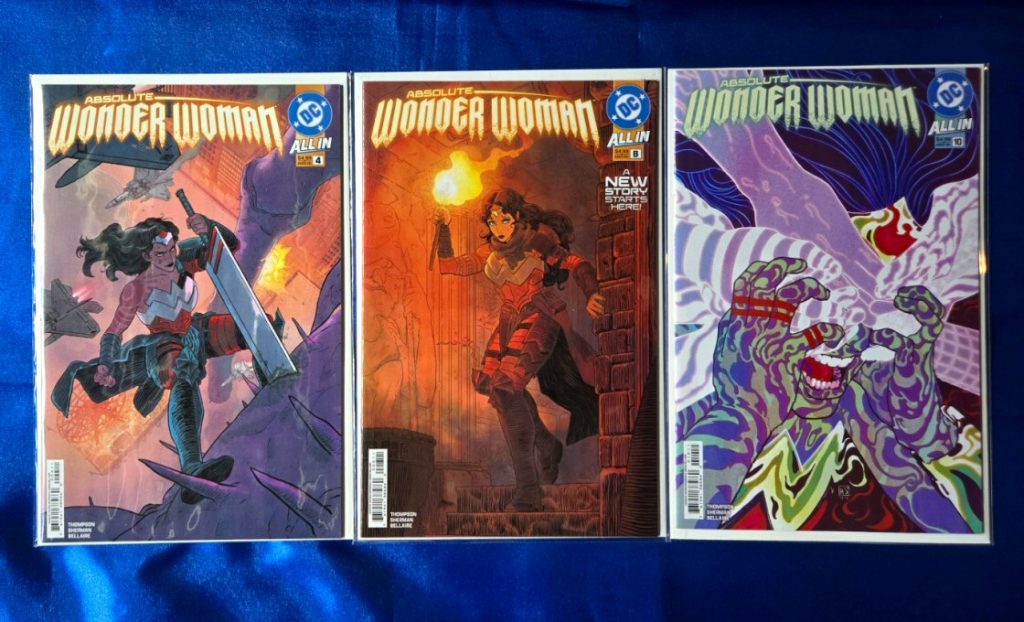
For more Greek mythology: Absolute Wonder Woman
For more history of philosophy: What Does It Mean To Be Worthy?
For more classical ethics: Jeff the Land Shark