

Despite being at the heart of ethics, the question as to why one should behave morally is a surprisingly difficult one to answer.
So difficult in fact that I have plenty of ethics texts that don’t even try to address it. Instead, they are happy to explain the types (and subtypes) of ethics in exquisite detail (see my Ethics 101 page for a short and to-the-point description – along with why I use morals and ethics interchangeably here). If you would like to know more about the terms I’m using on this site, please follow the links throughout or check out my Glossary post.
But it always struck me as odd that when we get to normative ethics (that is, the should/ought to side of ethics) they generally lack any explanation as to why you should do the very thing they purport to explain how to do. If mentioned at all, it is often only briefly in their introductions (where they also invariably praise you for your wisdom in buying their particular book on the subject).
In my experience of actually talking to people about ethics, the answers to that why question generally boil to three types of explanations. I’ve grouped and labelled these below as they seem to me:
Sociological: Humans are social animals, and without morals society wouldn’t be able to function. Being moral is required for social life.
Theological: People are worried about what will happen to them after they die. Many religions and beliefs require people to live well in this life or bear unpleasant consequences in the next. People are moral because they are afraid of the consequences if they aren’t.
Pyschological: Humans care for other people – and care what other people think about them – and so are moral because it makes people feel good about themselves. Being moral makes us happy.
While people are quick to suggest the first, they are typically a bit sheepish about the second (as in: “You know, not me, but other people worry about that”). The last is probably the least satisfying of all. Most people seem to find it hard to accept that doing something because it makes them happy is a good enough moral reason to do it (spoiler alert: it kinda is).
Don’t worry, I am going to get to the comic book relevance of all of this in a moment. But there is an underlying premise to all three of these categories that is not so obvious to see – and may be why ethicists avoid talking about it. I find people often bring this up to support the first category above (sometimes the third), but it actually applies to all three: our brains have evolved to think these ways.
Ethicists love to talk about what you should do (or more accurately, what different groups of ethicists who study different ethical theories think you should do). But at the heart of all of this is a fundamental point: we think these ways in the first place because we have brains that like to think these ways. People tend to refer to this fundamental neuroscience perspective as something that is “hardwired”. But I think a better analogy may be “firmware” – a default programming state of our brains that is further enhanced by learning (like learning about ethics – or reading comic books).
While any individual human brain is susceptible to all three categories of why answers above, some of them will resonate stronger than others depending on the lived experience of the individual.
Now, does that sound familiar? I’m hoping it sounds to you a lot like the moral intuitions we humans have, as I explained on my Ethics 101 page. I put those three common categories of why explanations in that order above because that directly corresponds to how I first listed the three branches of normative ethics on my Ethics 101 page (the how to theories ethicists have come up with):
Consequentialism: Focus on acts to do good. The most common form (utilitarianism) is about the greatest good of the greatest number. This is the basis of humanism, which encourages you to look to other people and try to maximize the good. We are social animals, after all.
Deontology: Focus on acts to do right. With its focus on universal rules of conduct, deontological perspectives are commonly found in many religions. While it is of course possible to be deontological without believing in an afterlife (e.g., Kantian ethics is rational, with the belief that we have a duty to other humans due to our natures), you can see why theological concerns fit here.
Virtue ethics: Focus on being better. In classic virtue ethics, the goal of developing virtues (and avoiding vices) is to help you reach a sense of eudaimonia – often translated as a fulfilling life, generalized well-being, or happiness. Behaving virtuously is its own reward – we feel better about ourselves.
I believe it is not an accident that the three main categories of responses to the why question line up so neatly with the three main how to theories. And this may have a lot to do with why these how to theories have become the dominant forms of normative ethics today.
Again, normative ethics theories are all fundamentally based on our moral intuitions. Of course, the detailed versions of those theories go far beyond our basic moral intuitions (there are literally many, many books written about each one). But while ethicists who spend their lives studying these will often come to prioritize one over the others, most of us – just living our lives – tend to use a mix of all three, intuitively.
And this is where neuroscience research comes in, trying to understand when (and why) we switch between these three. This is a very active area of research, and I plan to discuss recent findings further in future posts. (UPDATE: my Moral Thinking, Fast and Slow post is now up!). But the short answer for now is that it seems we tend to use the same moral intuitions in the same situations – it is really more a question of where and when the switch-over points occur from using one theory to another. Those switch-over points are what differ from person to person, based on temperament, experience and learning. See the Trolley problem on my Ethics 101 page for a good example of where people tend to switch theories.
The relevance of comic books
As I explained on my various background pages, I believe comic books are a good place to go looking for simplified morality tales. It is often inherent in the conflicts between characters, who use different normative ethics theories when dealing with the same situation. Of course, the creators rarely frame their stories so explicitly – ethics lectures are (sadly?) fairly rare in comics.
So let’s look at a series that did explicitly address ethics issues.
A.X.E.: Judgment Day
As the title suggests, this was a very ethics-heavy comic story line: the earth faces its Judgment Day. This was the major 2022 cross-over event from Marvel, affecting all of Earth’s heroes. It was created by Kieron Gillen, who wrote the main series with art by Valerio Schiti, and colors by Marte Gracia. I have created an introductory post on this event, and plan to conclude it soon, once I have finished profiling the ethics of the major heroes involved. (UPDATE: My conclusion post for this event is now available here)
The premise is that a revived god-like being, a Celestial known as the Progenitor, is deciding the fate of the world by weighing the morality of every Earth being. Although some characters’ judgments get a single panel or two in the main series, others get their own dedicated issue in their own title. As the Avengers team were an integral part of the event, I didn’t really expect a tie-in issue from the main Avengers title (which was written by Jason Aaron at the time). But they did do a tie-in issue – focused on a relatively minor character (Hawkeye, Clint Barton), written and drawn by special guest creators for the tie-in.
Here is the opening setup, from Avengers Vol 8, issue #60, 2022, written by Mark Russell, with art by Greg Land and Jay Leisten. Hawkeye’s lunch is interrupted by the Progenitor appearing as his friend and colleague, the Black Widow. As an aside, I find Russell a good choice for this issue, as his previous writing illustrates he knows a thing or two about ethics (and religion) – and can write about them in very amusing ways.
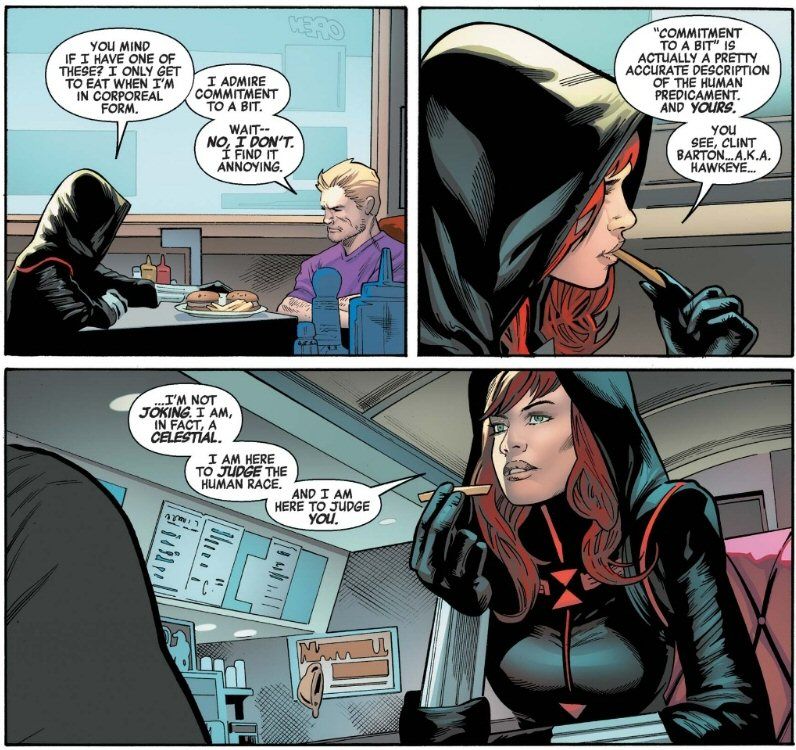
Clint finds that rather hard to believe, so the Progenitor agrees to prove to him who it really is:
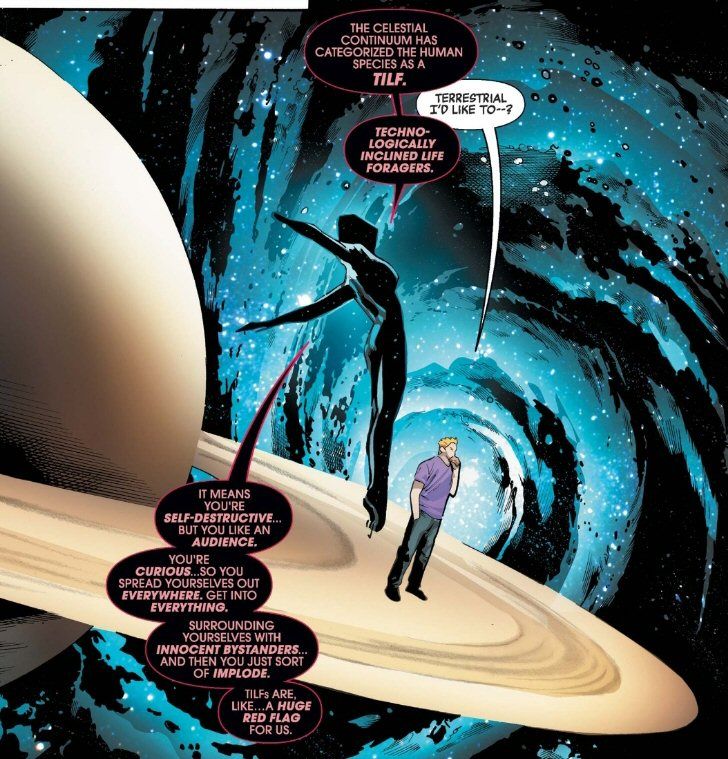
As I explain on my A.X.E.: Judgment Day introductory post, the Progenitor proceeds to judge humanity by judging every person – individually and collectively – over a 24 hour period. If more individuals pass than fail, humanity will be spared – otherwise, all will die.
Needless to say, this is a highly unethical mechanism by which to judge living beings (a point Gillen was trying to make with this series). Let’s see how Clint reacts to this news:
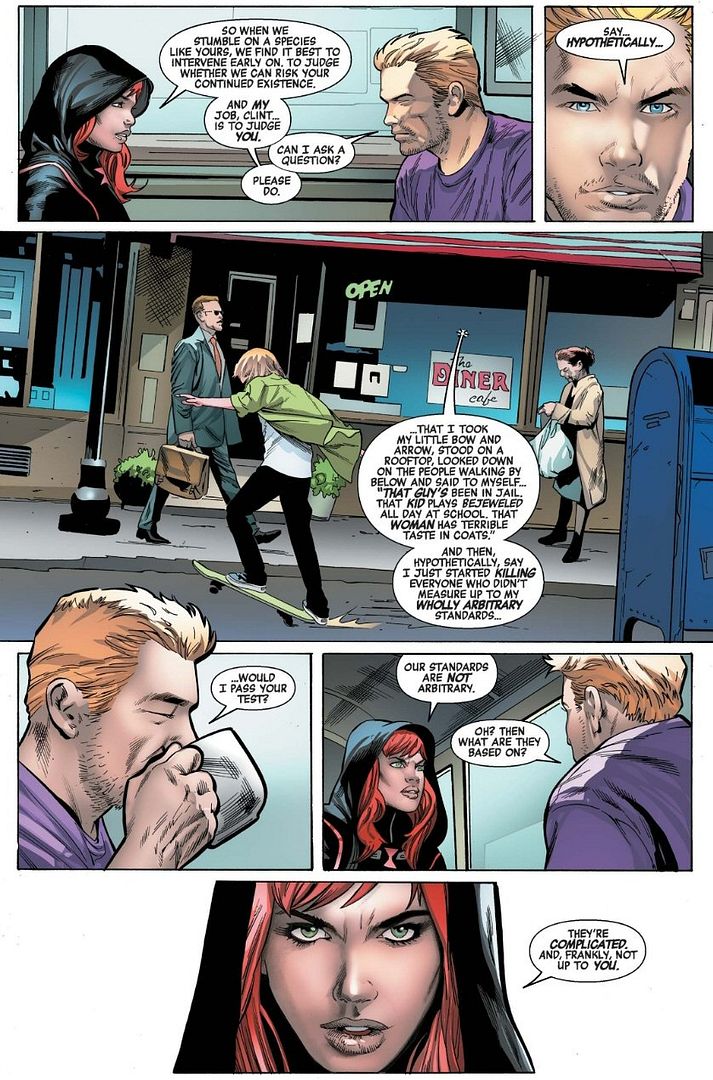
Yes, of course they are. I would say score one for Clint here. The series doesn’t intend to tell you the process the Progenitor is using to make the individual judgments (although you can be sure all the creative staff had to follow the internal guidelines laid down by Gillen). Clint isn’t done taking the Progenitor to task for its process:
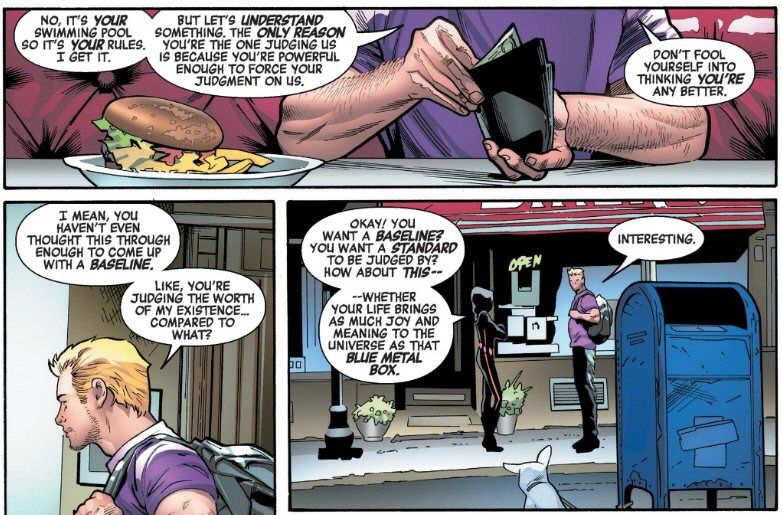
Yes, that is interesting. It sounds like the Progenitor is using a consequentialist process – somewhat akin to utilitarianism – to determine if Clint has more utility than a mailbox (to use the language of Jeremy Bentham and John Stuart Mill). Knowing what I know about the Celestials, it didn’t entirely surprise me to see the Progenitor (apparently) propose a consequentialist way to test Clint (although that isn’t exactly what they are all about, as I will explain in a bit).
At first, Clint figures that isn’t a hard hurdle to clear (despite some recent mishaps on his part). But this page dissuades him a bit:
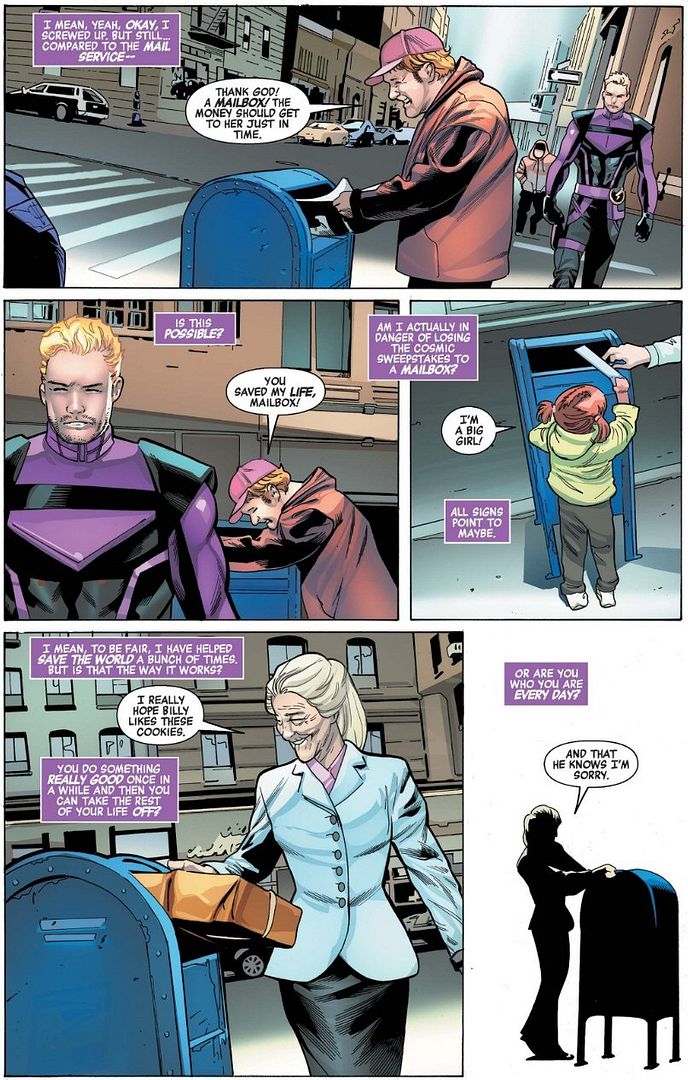
We’ll come back to Clint’s question in the end. For now, he heads off to see his old pal Luke Cage, currently the mayor of New York.
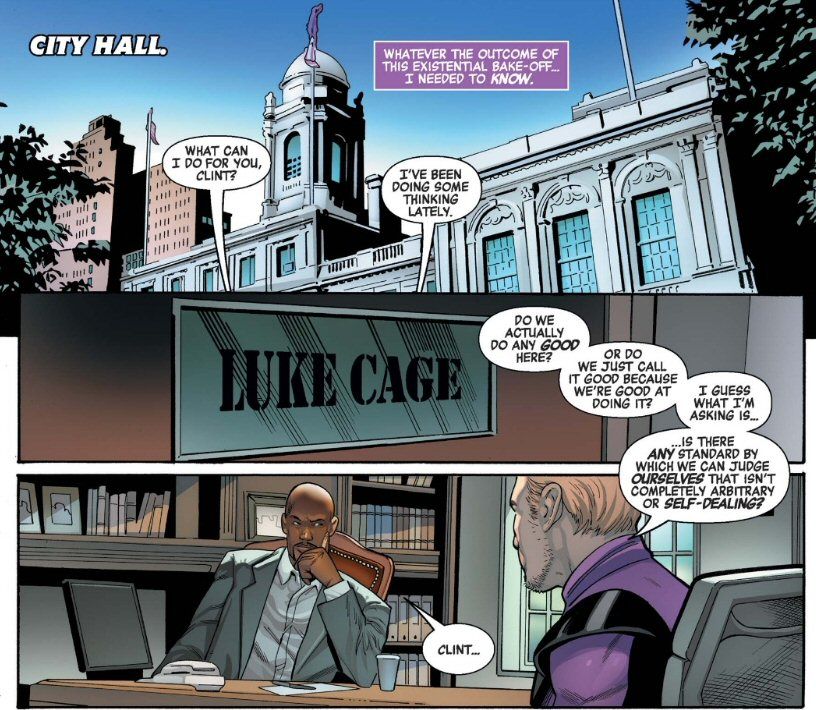
After some back-and-forth, Luke offers up this perspective:
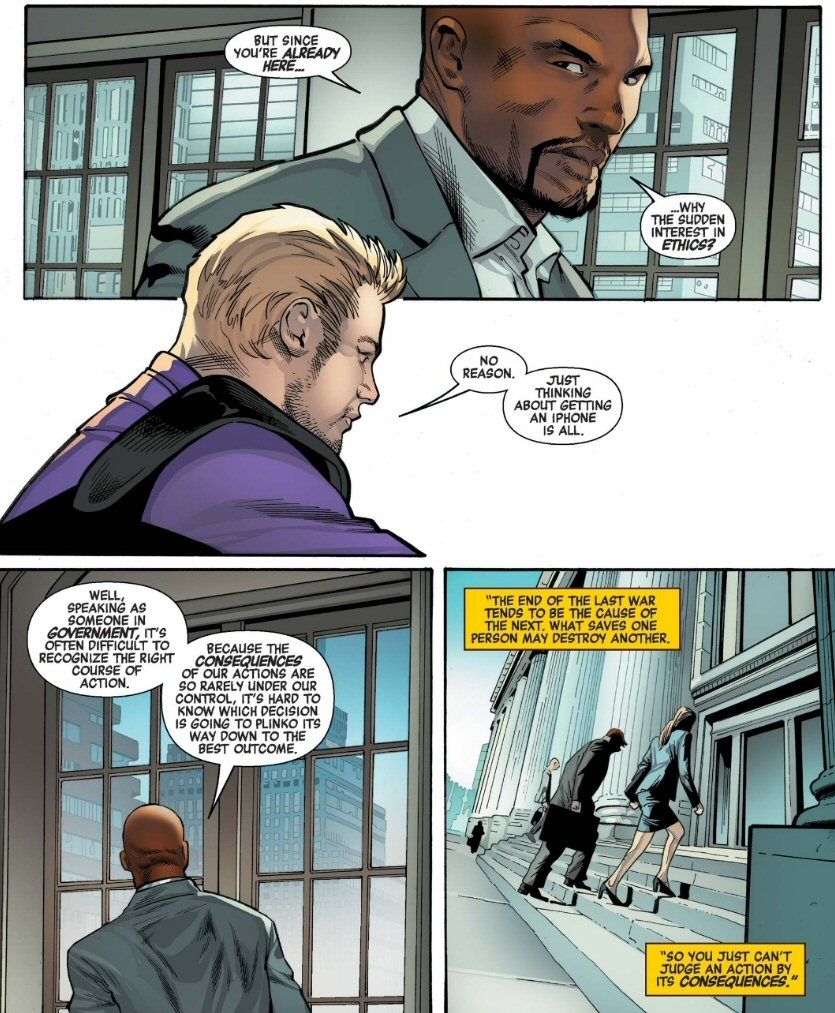
This is an interesting point about consequentialism – it works somewhat backwards in how it expects you to make decisions. It requires you to consider all the actual outcomes before deciding on the action you want to take. As pointed out above, you can’t really know all the outcomes, so it’s rather hard to judge an action by its consequences (I love the Plinko idea!). You can read more about how utilitarianism (the main form of consequentialism today) actually works on my Charles Xavier page (with a discussion of its criticisms on my Redemption of Charles Xavier page).
Ok, so much for consequentialism. Moving along to the next page …
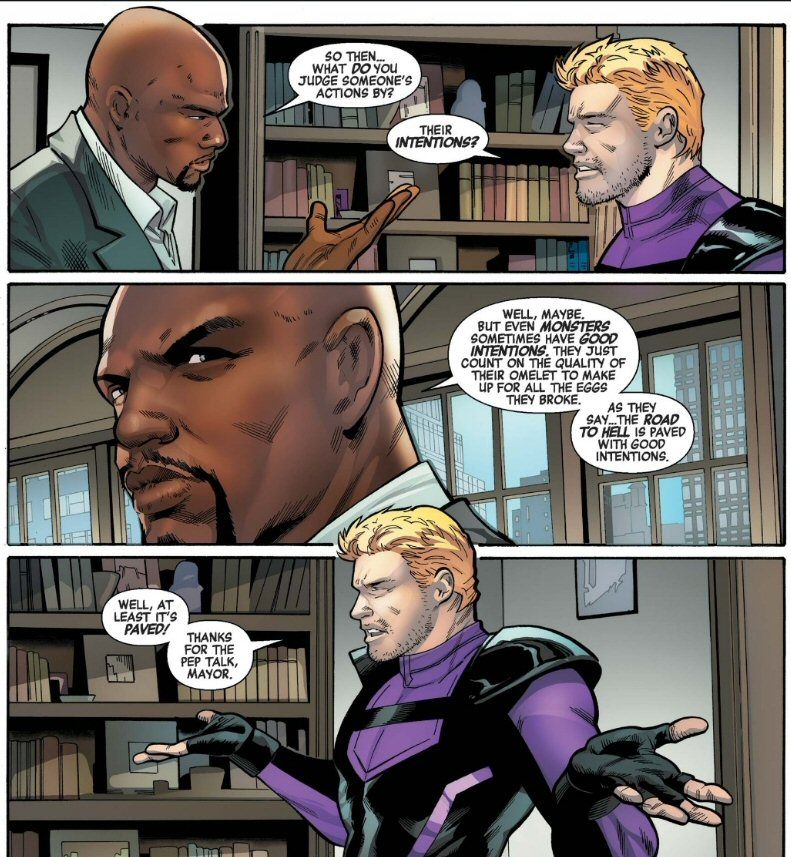
There’s a lot to unpack here. Being concerned with intentions is the basis of deontological theories like Kantian ethics – where you don’t consider the outcomes of actions, only the appropriateness of the actions themselves. For Immanuel Kant, the only thing unqualifiedly good is a good will.
I haven’t had the opportunity to explore Kantian ethics in detail yet on this site, as it is relatively uncommon in modern comic books (if you follow that Trolley problem link, you will see why a typical Kantian response would not sit well with most superheroes). But I will have an upcoming post that explores the benefits and drawbacks of Kantian thinking through the lens of a fairly unique character.
UPDATE: If you want to learn about Kantian ethics, check my overview of Superman‘s ethics. I also cover a main criticism through the discussion of “moral luck” in Jesse Lonergan’s Drome.
The framing in the above panels isn’t very detailed, but I believe it is hinting at what is sometimes considered a paradox for deontological theories – if an outcome of a deontological act was actually bad, then aren’t more bad outcomes worse than fewer? And if so, then if one wrongful act could prevent many more bad acts (by you or by others), then don’t the deontological rules prohibiting that act effectively make the world morally worse? There are ways ethicists have found out of this conundrum, but they are complicated (and not particularly satisfying). It is also whiffs of negative responsibility, which I find one of the more compelling arguments against consequentialism (follow that link for an explanation and discussion).
So with consequentialism and deontology both apparently shot down by Luke, what does he end with?
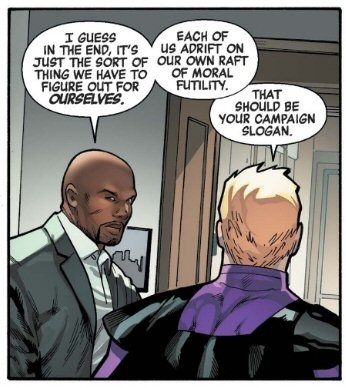
Basically, this is the entry point into virtue ethics. We each have to figure out for ourselves what is the best way to live. But it is neither as futile nor as adrift as you might think (especially with such august folks like Aristotle, Confucius, Thomas Aquinas, and many more to help you figure it out).
At the end of the comic – after Clint continues to try (and fail) to produce better outcomes, he worries he will fail the Progenitor’s mailbox comparison test. But the answer from the Progenitor comes in the form of a letter (through the mail, naturally!). As the letter’s contents are narrated, it becomes clear from the panels that the Black Widow wasn’t the only form the Progenitor took on this trip.
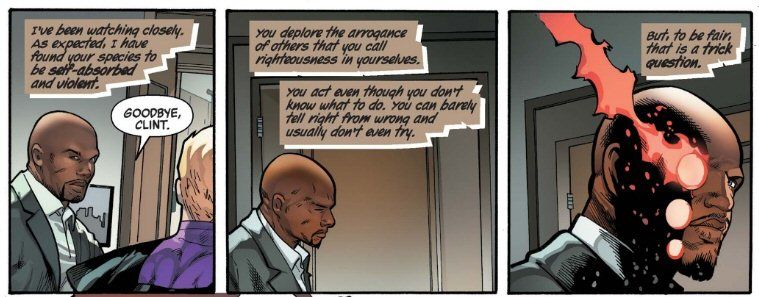
The second panel above is interesting from a deontological perspective. The first part is often a criticism I hear of people who favor deontological theories (that is, they often seem very self-righteous and condemning of others). Yet the second part of this panel is one of the common arguments given as to why you should follow a deontological theory, like the universal categorical imperative of Kantian ethics (i.e., it simplifies the question of what to do – just follow the rules for the “right” acts, and you can’t lose).
That last panel above is therefore interesting. This is most definitely NOT a “trick question” to a Kantian (or a utilitarian, for that matter). Indeed, this is exactly the question they seek to answer. So what does the Progenitor mean? The concluding panel from this comic has a lot to consider, so I will take it in pieces, one at a time:

“Because the truth is that there is no right answer.” Kant would be spinning in his grave! This is in fact exactly what a deontologist believes – there is always a right answer.
“… there are more possibilities to consider than atoms in the universe”. Take that utilitarians, with your smug supposed calculations weighing outcomes!
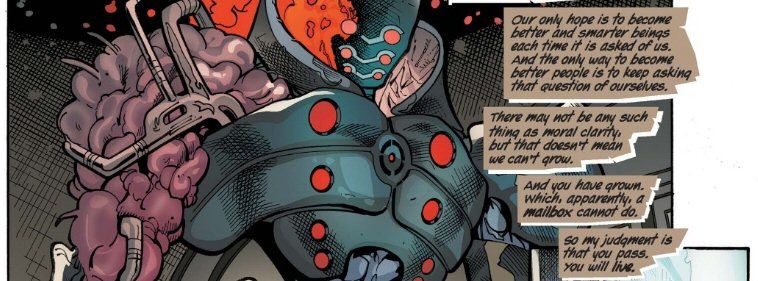
“The only hope is to become better and smarter beings each time it is asked of us. And the only way to become better people is to keep asking that question to ourselves.” (emphasis mine).
And there it is – virtue ethics. The commitment to personal growth and being better. Even if there is no such thing as “moral clarity”, the Progenitor passes Clint because he has shown that he has grown as a moral being.
This response is actually what I expected a Celestial to focus on. As I describe on my Marvel universe origins page, the Celestials were the change- and growth-focused group of early cosmic beings, in direct opposition to the more deontological-like Aspirants. But while the Celestials seek growth, they also seem to have an idea in mind of what improvement looks like (and will destroy life “experiments” they feel are not going in the right direction). So in this sense, they seem to combine consequentialist and virtue ethics theories.
It also isn’t surprising to me that the Progenitor would pass Clint specifically, as he is one of the few non-enhanced members of the Avengers (that is, Clint doesn’t have super-powers). He has a lot of skill, which he has honed through continual practice – growth, in other words. Here is a good quote that defines him, from Avenging Spider-Man Vol 1, issue #4, 2012, written by Zeb Wells:
I mean, I can’t miss … I’m on a team with super-humans. And one god, in case you’ve forgotten. Even you… well, you climb walls really well. The training is the only thing that makes me special. And if I’m not special, then none of this is worth it. I gave up a lot for this life … I wanted to play with the big boys. And if I miss, it means I’m just another dude with a bow. It means I’ve been fooling myself this whole time. And that’s why I never miss.
Sounds like a man committed to improving himself.
Note that the wrap-up in this comic doesn’t cover the full ethics of the Judgment Day event over all, where the flawed nature of the Progenitor itself needs to be considered. Simply put, this judgment makes sense in terms of Clint’s ethics specifically – but the Progenitor is more complicated than that. I’ll have more to say on that shortly, with my conclusion to the A.X.E.: Judgment Day.
But before the Progenitor leaves, it delivers a parting shot:
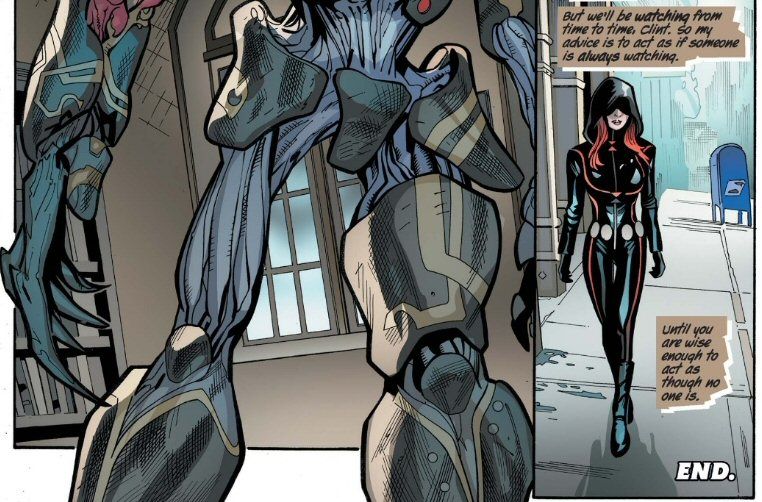
“… act as if someone is always watching.” And there is our second, theological, reason why people think you ought to be moral.
But I like the caveat: “Until you are wise enough to act as though no one is.“
This seems to imply a moral evolution – beginning with straightforward act-based considerations (consequentialism’s outcomes and deontology’s duty), but eventually moving to a being-centered one (virtue ethics’ growth and being better). And to be honest, that’s not a bad way to look at it, at least from my point of view (and that of a number of virtue ethicists). By the way, even classic virtue ethics has its critics – see my recent Absolute Wonder Woman post for some specific arguments (a few of which also apply to deontological theories).
I hope you enjoyed this little side-tour through the why and how of normative ethics, before I get back to more character overviews. It is rare to see the word “ethics” mentioned in a comic, and to see such a concise description of the three main normative theories accurately presented. This A.X.E.: Judgment Day series introduced a lot of weighty ethical subjects, and I look forward to wrapping them up soon. (UPDATE: My conclusion post for this event is now available here)
See my Glossary post for a list of the key philosophical concepts and related links on this site.
Further Reading
For more big three ethics: Powers
For more big three ethics: Superman
For more big three ethics: Jeff the Land Shark
I’ve just a passed a new milestone for this site – I have just been accused of being an AI on the basis of this post!
It’s doubly ironic to me to be suspected of being an AI due to my “constant use of em dashes”. First, I don’t actually use em dashes on this site – I use hyphens as stand-ins for en dashes exclusively. I grew up in the early computing era, and the standard QWERTY keyboard hyphen (“-“) is close enough to the en dash (“–”) in length, making it particularly easy to use without needing the ALT + 0150 keyboard shortcut.
For context, Canadian writing style sheets often use the en dash “–” over the em dash “—” (these come from an earlier era before proportional fonts, and are meant to represent “N” and “M” widths on a typewriter). As an example, the style sheet for our major national newspaper – the Globe & Mail – uses en dashes exclusively.
But the other reason it shocks me is that I have spent my whole life being criticized for my use of this stylistic writing choice. I have had a long science administration career, and was frequently criticized by superiors and later colleagues for my “flowery” writing style. When I queried what they meant by that, they always pointed to those en dashes. I guess they wanted me. To write. In short. Declarative. Sentences.
But now, AI chatbots come along mimicking this same stylistic choice – which I consider a less stuffy, more naturalistic writing style – and everyone suddenly assumes it is a “tell” for AI-generated content. Although I am a bit shocked that some people can’t seem to tell the difference between my “-” and ChatGPT’s “—”. Still, it is really hard to not appreciate the irony of going from being told I wrote with too much flourish to now being told I write like a robot! 🙂
I’m going to let you in on a little secret: I liked to read as a kid. A lot. Books, in particular. The use of en/em dashes to delineate concepts was a standard stylistic feature of the books I read. And so, it became an integral part of my writing – one that no amount of badgering or belittling over my schooling or work career could get me to stop. And I’m certainly not going to stop now simply because AI was trained on books – just like I was.
So, if you think I sound like an AI, then you may just be revealing that you haven’t read that many books.
P.S.: I have made one conscious concession for this website – dropping my standard Canadian English for American English – as that is the language of comic books. So, “Judgment Day” instead of “Judgement Day”, and dropping my “u”s in all the -“our” words, switching out my “ce”s for “se”s, etc. (or at least, as far as I able to – I’m sure a few still slip by me). Given the audience, I’m happy to try meet you where you are. But I warn you now – you will have to pry my Oxford comma out of my cold, dead, hands.
Haha, don’t ever change for us. You do you.