
“Worthy” is a five-page comics story written by Kieron Gillen with art by Declan Shalvey. This one-off appeared in this week’s issue of The Mortal Thor (issue #14, 2026, by Al Ewing and Pasqual Ferry), as part of its celebration as the 800th issue of Thor (by the old Marvel Legacy numbering system).
I have previously written a Thor ethics overview that covers the history and moral philosophy of the character. But I find this short to have something very significant to say about “worthiness” that is, well … worthy … of consideration here. Note that Gillen is very familiar with the character as he previously wrote Thor, and its companion title Journey Into Mystery, back in 2009-2012.
This short story is told from the perspective of Mjolnir, Thor’s enchanted hammer (“Whosoever holds this hammer, if they be worthy, shall possess the power of Thor”). It is basically a meditation of what makes one worthy. And Mjolnir comes to a very clear conclusion on the matter – one that is consistent with its behavior in the modern run of Thor, but never explicitly stated before now.
Thor is arguably the first (and most thoroughly explored) example of virtue ethics in Marvel comics. As I explain on my Ethics 101 page, there are three branches to normative ethics, which is the field of moral philosophy that considers the question of what people should or ought to do.
Deontology is concerned with doing your duty to other people, often through the lens of rights or justice. These theories are often principle- or rule-based and focus on the moral value of the acts themselves (that is, doing the right thing). At the other extreme, consequentialism focuses not on the value of the acts but rather on their outcomes. These theories typically explore the moral burden of making good decisions (that is, doing the good thing). The third branch is virtue ethics, which shifts from the action-based theories above to the actor – being the best person you can be. These actor-centered theories typically involve the practice of virtues that align with your core values and goals (that is, being better).
One of arguments that I made in my Thor ethics overview is that his various writers over the years have been inconsistent in how they saw or understood the role of Mjolnir in relation to Thor’s virtue ethics. Gillen knocks it right on the head with this short, setting a new standard that should hopefully last a long time. Hey, it only took 800 issues to get here, right? 😉
As always, if you would like to know more about the terms I’m using on this site, please follow the links throughout or check out my Ethics 101 page or Glossary of Terms post.
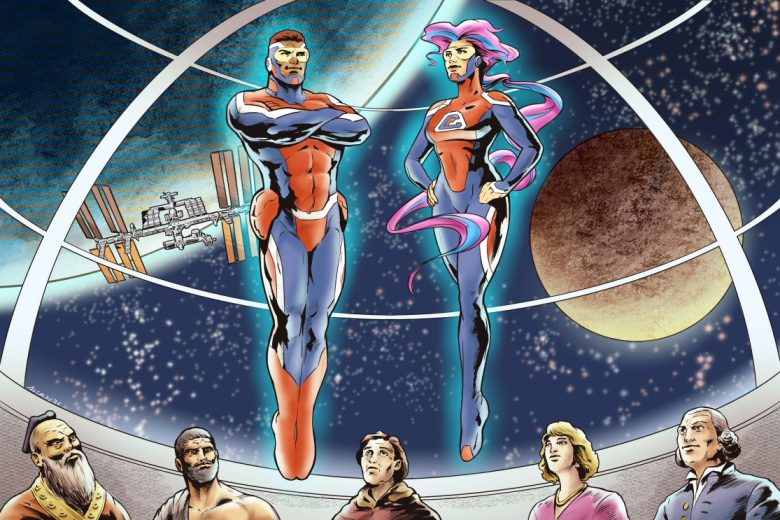
And the accompanying image at the top of this page is the latest from the extremely talented Pablo Alcalde, who provides all the custom artwork for my site.
Introduction to the story
Here is the opening page for the story, written by Gillen with all art by Shalvey (letters by VC’s Joe Sabino):
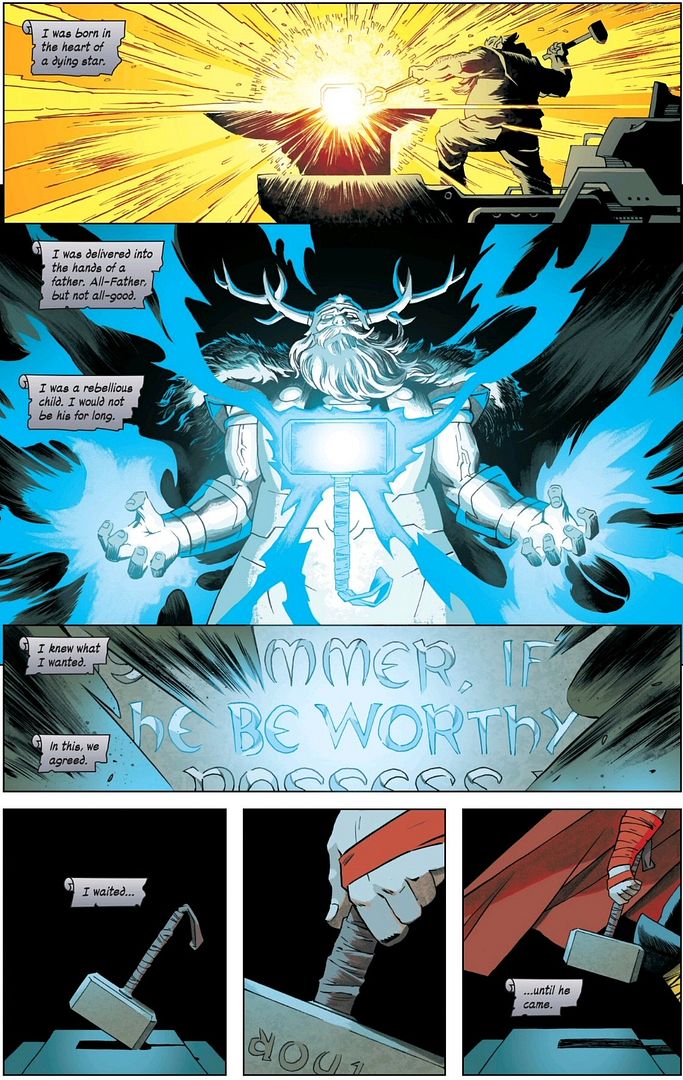
This neatly encapsulates the origin story of Mjolnir. Made for the Asgardian leader Odin, Mjolnir was forged by King Eitri of the Dwarves of Nidavellir in the heart of a dying star. It is made of the nearly indestructible metal Uru and grants the wielder the powers and abilities of Thor. But its famous enchantment allows only the worthy to wield it (something that Odin himself had found increasingly difficult to do – the “All-Father, but not all-good”).
Note that it is not just Thor Odinson who has been found worthy of wielding Mjolnir. From page 3:

This is a lovely way to show that others have wielded Mjolnir over the years – and been granted the power of Thor: Beta Ray Bill, Lady Thor (Jane Foster), Throg (Simon Walterson), and of course, our main character, Thor Odinson.
The key page of this short is the second one, where Mjolnir ponders the question of what does it mean to be worthy? But before I show it, I want to explain a historical perspective on virtue ethics – and one of the main criticisms leveled against its revival in modern times.
How do you solve a problem like worthiness?
To begin, there is fundamental struggle when trying to survey a broad field like philosophy (that is, to provide a comprehensive overview of it). There are two main approaches that philosophers have attempted – each with their own advantages and limitations.
The approach I’ve adopted on this site is predominantly a thematic one – you present philosophical concepts in the context of how they relate (or oppose) other concepts. My Ethics 101 page is an example of this – I first describe the standard modern ethics framing and then explore the normative ethics branch in more detail, showing the three main groups of theories or approaches under this branch. Across the various subsequent posts, I explore those theories in more detail, giving specific examples. This method organizes the material logically and allows you jump back and forth in your search of greater understanding (my Glossary page can be a great guide in that regard).
The other approach is to follow philosophical thinking in a historical sense over time. Any famous philosopher was likely familiar with what major philosophers before them thought (but ignorant of what would come after them, naturally!). So those famous philosophers developed their ideas in reaction to pre-existing thought. By following the threads in sequence from ancient times to today, you can learn how philosophical thinking has evolved over time.
The problem with the thematic approach is that not everything fits neatly into any one over-arching framework – things can seem misplaced or artificially shoe-horned in. It can also feel disjointed, as you try to move through distinct concepts. But it makes the most sense for a site like this, where individual comics stories or characters can evoke specific concepts or ideas – it’s helpful to be able to place those ideas (as they come up) in a framework that allows you to see how they compare to others.
The historical approach can also be fraught as it is hard to be completely fair or unbiased when it comes to choosing who to include – or how to describe their thinking. This can lead to overly broad generalizations (or dismissals) of thoughts that don’t fit the narrative the historian wants to tell. And it is easy to inadvertently cast an older philosopher’s ideas through a modern lens, given a false sense of progress. It can also read sometimes like an endless table-tennis match, as figures throughout history keep taking opposing views to those who came just before them.
That said, and in the context of this short story, there is value in looking at how historical perspectives around virtue ethics have changed over time.
All three approaches to normative ethics can be traced back to ancient times. Virtue ethics is probably the one we most closely associate with ancient eras, as it was independently developed by the ancient Chinese (e.g., Confucius), the ancient Indians (e.g., The Buddha), and the ancient Greeks (e.g., Aristotle, the Stoics, etc.). The origins of modern deontology and consequentialism can also be found in those early civilizations (a story for another time!).
But from the Enlightenment period through to the Modern era – the late 17th century through to the late 20th century – normative ethics thinking was heavily focused on developing action-based approaches (i.e., deontological and consequentialist ones). It really wasn’t until the latter part of 20th century that philosophers took up the banner of virtue ethics again in a major way, with the development of new and innovative approaches.
As you might imagine, those early days of virtue ethics’ revival were met with stiff opposition by the now entrenched deontological and consequentialist camps of normative ethics. By this point, it seemed like most moral philosophers held that the goal of normative ethics was to come up with universal rules or principles that could be applied to determining the right/good course of action in any particular case. And you didn’t even need to do any work on yourself in the process – even a non-virtuous person could simply apply the correct formula and get the right/good answer. Tada!
My sarcasm above gets at a key point – increasingly to many philosophers, it seemed degrading to the human spirit to reduce us to automatons making moral decisions by rote. Yet even those who were sympathetic to virtue ethics’ merits, and could see the problems with popular consequentialist and deontological theories, often didn’t consider themselves virtue ethicists. They either felt that had to create their own systematic, comprehensive moral theory first – or they rejected the feasibility of developing any such system to explain human moral behavior (like Bernard Williams, for example).
Eventually, the dominant deontological/consequentialist positions became increasingly untenable during the rise of applied ethics in that era, and the flourishing of relational virtue ethics that didn’t require universal or absolute rules (see my introduction to care ethics for a good example). It was increasingly appreciated that moral understanding and good judgment based on experience were important to be able to apply principles or rules correctly. That is, phronesis, or practical wisdom, was always going to be necessary – to put it in terms of ancient Greek virtue ethics thought.
Despite this, I find there is still a resurgent counter-current in philosophy that argues that virtue ethics doesn’t truly provide actionable guidance for moral behavior. Rather than being a full normative ethics competitor to deontology or consequentialism, some see it as something of an adjunct – providing only “exemplars” of how to behave – with the rules or principles coming from elsewhere. In the eyes of some philosophers, virtue ethics is not “codifiable” and therefore not suitable as a normative approach.
They are wrong however – and could learn a lot from Mjolnir, as articulated on the key second page of this story:
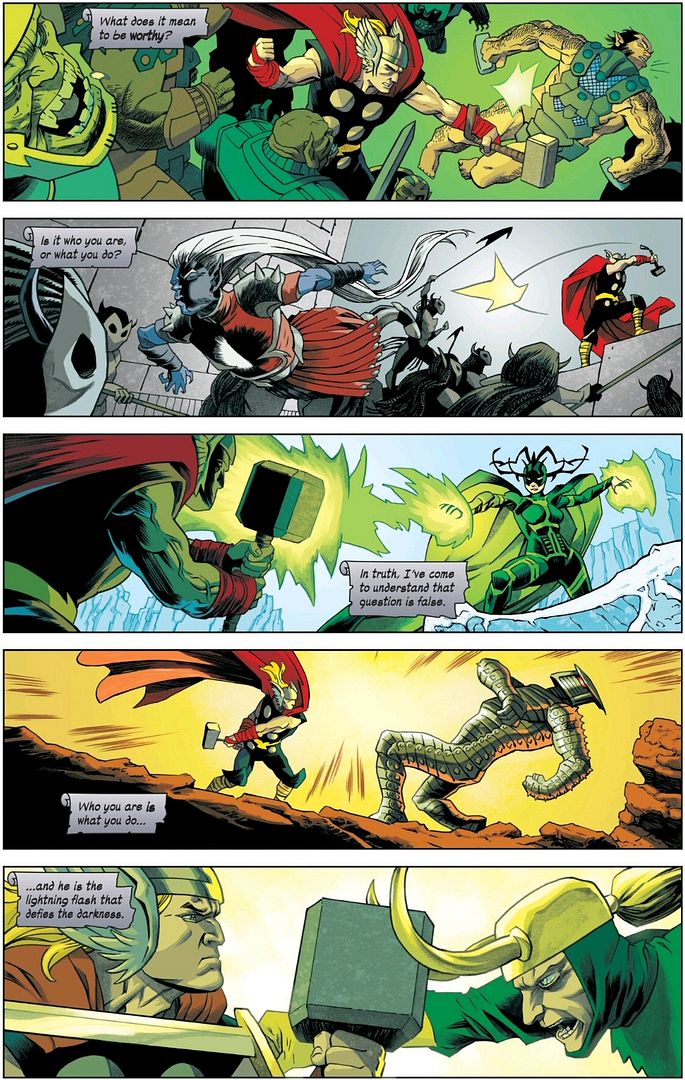
Mjolnir “comes to understand that question is false” – that is, the debate between action-centered theories (the “what you do” of deontology and consequentialism) and actor-centered theories (the “who you are” of virtue ethics). This is a false dichotomy. Instead:
Who you are is what you do …
- Mjolnir, as written by Kieron Gillen
Yes, exactly this! This wording is precise, succinct, and true: who you are is what you do – and not the other way around.
You see, there actually is a great deal of specific actionable guidance to be found in virtue ethics. Consider the original dozen or so moral virtues from Aristotle (courage, temperance, liberality, magnificence, magnanimity, ambition, good temper, friendliness, truthfulness, ready wit, justice, friendship), plus five intellectual ones (scientific knowledge, technical skill, prudence/practical wisdom, intuitive reason, and wisdom). These were boiled down to just four cardinal ones by the Stoics (prudence/practical wisdom, courage, temperance, and justice). Thomas Aquinas similarly later came up with the same cardinal list distilled from his reading of Aristotle (although directed externally to the beatification of God), plus three theological ones (faith, hope, and charity).
But while any modern list of virtues tends to be short and specific, possible lists of vices are typically remarkably long and extremely helpful in guiding specific actions (that is, what not to do). Indeed, trying to avoid any of the vices we commonly associate as the antitheses of our virtues effectively creates a much longer list of actionable rules than anything deontologists have managed to come up with! For example, there is a lot of valuable action guidance in trying to avoid being dishonest, greedy, lazy, irresponsible, ignorant, envious, prideful, inconsiderate, unsympathetic, arrogant, cold, calculating, angry, intolerant, vindictive, selfish, rude, cruel, obnoxious, vain, irresponsible, reckless, hypocritical, striving, short-sighed, ungrateful, unrealistic, incautious, fearful, self-indulgent, wasteful, presumptuous, feckless, intolerant, grudging, mean-spirited, despairing, disloyal, cynical, malicious, spiteful, etc., etc.
There are modern debates about whether virtue ethics can adequately account for action (or if it even needs to), and whether a universal application is even possible (or if it even needs to be). And of course, virtue ethics can fall prey to a number of the same criticisms as the other two forms of normative ethics – as I have detailed over the many posts on this site. But as long-term readers of the site are bound to have noticed, I have great sympathy for virtue ethics approaches in life.
As I’ve articulated before, if there was a clear “winner” in normative ethics that addressed all the concerns, we would all be following it! But the human brain doesn’t work that way, and it is important to understand where our moral intuitions and judgments ultimately come from – check out my Moral Thinking, Fast and Slow post to learn more of the modern neuroscience on that front.
The last word … for now
I marvel at the succinctness and precision of Gillen’s description of the problem of worthiness, from a virtue ethics perspective, in this story. Shalvey’s art beautifully illustrates this and is a great compliment to the narration.
I won’t spoil the final two pages, as it brings up a fairly unique perspective in terms of the relationship between Thor and Mjolnir (the core conceit of the story). I encourage you pick up the issue to read it for yourself. Ewing’s and Ferry’s ongoing Thor storyline is well worth the read all by itself, but this little short is certainly worth the price of admission.
I also marvel that it has taken 64 years – and 800 issues of the main Thor title – for someone to zero in so clearly on the core ethical question of worthiness from Mjolnir’s perspective. I hope future writers continue to work from this excellent example.
See my Glossary post for a list of the key philosophical concepts and related links on this site.
Further Reading
For more virtue ethics: Thor
For more virtue ethics: A.X.E.: Judgment Day conclusion
For more Kieron Gillen: The Power Fantasy Introduction
In the Wicked and the Divine there is an exchange that also articulates this philosophy. (Paraphrased, from memory)
Ymir says “He’s not a bad person, he just does bad things.” And Laura/Persephone thinks “I think that’s what a bad person IS. Someone who is doing bad things NOW.”
And it makes me think of the difference between a particular type of conservative though popular in the USA now – there are ‘good people’ (Christians, rich people, the president, etc) and the things they do are good, because they are good people. And they will twist themselves into knots to somehow make their actions ‘good’ no matter who it hurts (until it is them of course, leopards and faces and all that). And then there are BAD people – BIPOC, the poor, Antifa, LGBTQIA+ people … who do bad things and the things they do are by definition bad because THEY are bad.
That is the exact inverse of what is being described – and yet seemingly a lot of people – at least in the US, seem to have this twisted view of righteousness.
Thanks for the comments. Sad for such a Kieron Gillen fan to admit that I haven’t finished WicDiv yet, but I’m not surprised that this concept would come up there as well. Good writers tend to continue to develop and revise their thinking – I’m impressed at how succinct Gillen was in this 5-page short on Mjolnir.
And yes, the cognitive dissonance required for modern conservatives (especially Trump supporters) is shocking to contemplate. A lot of my comments here about virtue ethics revival in the 20th century was in preparation for another piece I was working on – just published moments ago: Drome ethics (by Jesse Lonergan). You might find that one interesting for my discussion of John Rawls and his concept of social justice. I can’t fathom how a Trump supporter thinks about the “original position”.