

Welcome to my official launch post for comicphilosophy.com!
I have been working for many months on preparing the look and feel of the site, and writing the background pages and initial character ethics posts. It has finally progressed to a stage where I’m willing to share it with the world, and have just allowed search engines to crawl and index the site.
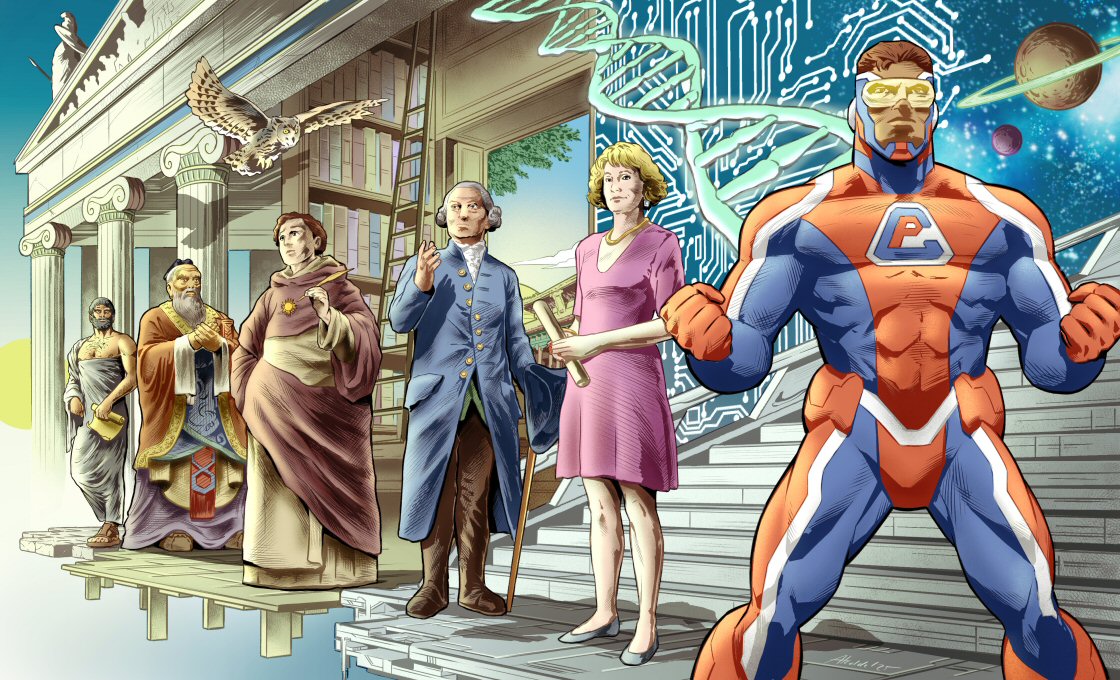
My goal remains as I described on the background pages (especially the About Site and Ethics 101 pages). Namely, exploring moral philosophy and normative ethics through superhero comic book stories, and showing how these have changed over time in parallel to societal shifts. Along the way, I hope to inject some modern fundamental neuroscience research about how we make moral decisions, showing that there is a practical evidence base to this beyond philosophical theories.
Originally, I had expected to jump right into individual story lines and authors from different eras once I finished the background pages – comparing and contrasting what they reveal about normative ethics perspectives of their time. Rather than write a whole bunch of background pages on the intricacies of different ethical theories (with their strengths, criticisms, controversies, etc.), I thought I would explore these facets in more detail slowly over time, through the individual comic stories I was profiling.
But I quickly realized that was little too scattered an approach. So I decided instead to start with historical overview posts of the ethics over time for some of the main Marvel characters. These are meant as starting points, to acquaint you with the trends for each character before I jump off into more detailed examinations of specific stories and authors (and what they reveal about the intricacies of normative ethics theories).
But along the way of writing the introductory character ethics posts, I’ve come to some additional observations about comic book stories – and comic character evolution over time – that I would like to share here.

Comic book stories and the power of Myth
I started writing background ethics posts for some of my favorite characters from when I was a kid – ones that I knew well, and I also knew had been fairly consistently described in terms of their ethics over time. Daredevil for example is one of the most consistently deontological characters, with a strong sense of Catholic guilt and sin (which is unusual in the comics). Spider-Man is a very virtuous character, but that is often hidden beneath a secondary deontological duty drive. Doctor Strange is among the most consistently utilitarian (consequentialist) of characters, but he too has an underlying duty drive.
But other characters that I started profiling have seen considerable shifts in their ethics over time. Both Clea and Captain Marvel have suffered through extensive periods of marginalization, sexism, abuse, and at times outright misogyny in the comics. Both have evolved (rapidly for the former, slowly for the later) into primarily care ethicists (virtue ethicists) with strong utilitarian drives. Care ethics was initially developed by feminist thinkers in the late 20th century, in keeping with my thesis that modern writers (and readers) reflect both their modern society and the changing philosophical/ethical norms over time.
But as I’ve been starting on my X-Men characters posts – many of whom are among the most frequently written characters in Marvel comics – I’ve noticed another pattern. Namely, there are cycles to some of the character’s motivations and ethics. This goes beyond simply repeating the same challenges or hurdles (like with Captain Marvel), but actually reverting the character to an earlier stage of their development and then retelling their progression (although, come to think of it, some of that happened to Captain Marvel too).
A good example of this is Magneto, one of the most popular antagonists in the X-Men world of mutant superheroes and villains. Magneto was humanized early on, and has had numerous redemption arcs over the decades – with subsequent writers often reverting him to an earlier state (sometimes back to an outright villain, sometimes only partially). This then proceeds with a new redemption arc (sometimes fully rehabilitating him as an outright hero, sometimes only partially). These repeating cycles largely reflected when major new writers came on board for the X-Men comics.
This repeating cyclical feature for some of the characters brings to my mind Joseph Campbell‘s writings on the nature of Myth. One of his main contentions was the “Monomyth”, the idea that there is one underlying, common narrative myth that underscores all heroic stories throughout the ages. This idea comes from his observations that there seems to be a common pattern behind the narrative elements that make up all the great historical myths, and that this pattern continues to the present time.
It seems to me that multiple generations of X-Men writers – intentionally or not – have taken this to a quite literal extreme. They have not only repeated the underlying narrative structures, but have actually re-imagined and repeated the characters’ moral evolutions over time. Moreover, this has often lead to the adoption of prevailing normative ethics theories in fashion at that particular time.
Interestingly, this is also in keeping with Campbell’s work. Despite his key insight above, Campbell did not see mythology as static and unchanging. Indeed, his various books often describe in some detail how mythologies evolved through time and across cultures. This reflected the realities in which each society operated and how it had to adjust. However, Campbell described these changes over millennia and through the different stages of human societal evolution. But like with everything today, it seems that we have shortened and reduced those shifting societal states to mere decades instead of the historical centuries or millenniums.
It’s a thoughtful idea, and one outside of the scope of what I wanted to explore here (namely, how current normative ethical theories are reflected in comic stories – and how these are informed by our moral intuitions). But it is always interesting when you take a step back and look at the broader tapestry – both for how the weaving has changed over time, and how it hasn’t.
And with that, I will now get backing to looking at some of those particularly interesting threads … welcome to the site, I hope you enjoy it!
P.S.: I updated the header image for this post, as I do plan to profile Jeff the Land Shark in an upcoming post. This all-ages Marvel character co-created by Kelly Thompson and Daniele Di Nicuolo uses some interesting normative ethics theories. Stay tuned! (UPDATE: My Jeff the Landshark post is now up)
See my Glossary post for a list of the key philosophical concepts and related links on this site.

cool site look forward to exploring. notice the superman figure here, are you planning on profiling some of the major dc comic characters too? I see its all marvel so far. thanks.
Not at the present time. I had limited funds as a kid, and focused exclusively on getting to know the Marvel universe of comics back then (was hard to keep track of things in those pre-internet days). I’ve naturally gone back to catch up the characters that I knew best.
I have picked up a few series here or there, from Image, Dynamite and DC (mainly by following writers I like). Once I’m done with the main series of Marvel characters, it’s I’ll start reviewing individual story lines from other publishers. But that won’t be for awhile yet – and I doubt that I will do full character overviews, as I don’t know enough about them to comprehensively describe the changing ethics over time. But you never know – we’ll see how this goes!