

WandaVision: You are familiar with the thought experiment the Ship of Theseus in the field of identity metaphysics?
White Vision: Naturally. The Ship of Theseus is an artifact in a museum. Over time, its planks of wood rot and are replaced with new planks. When no original plank remains, is it still the Ship of Theseus?
WandaVision: Secondly, if those removed planks are restored and reassembled, free of the rot, is that the Ship of Theseus?
White Vision: Neither is the true ship. Both are the true ship.
WandaVision: Well, then, we are agreed.
- WandaVision TV series, episode 9, The Series Finale, 2021
The Vision is a reoccurring character with the Avengers in the Marvel Universe. He is an artificial being known as a “synthezoid” in the comics (a special type of android that that has synthetic humanoid body parts). He was married to the Scarlet Witch (a very significant character), and forms an important part of her backstory. The Vision character has a long and convoluted history in the comics, with a different origin and backstory in the modern Marvel Cinematic Universe (MCU) movies and TV shows. But both bring up many of the same philosophical themes, which I am looking to explore here.
Specifically, as an artificial entity, he struggles a lot more with questions of identity and purpose than most comic characters do. As such, he is often one to insert discussions of the nature of existence, consciousness, and what it means to be human (or in a relationship with humans) into the comics stories. This makes him an excellent character to start my overview of the core philosophical underpinnings of identify and free will.
What does it mean to be an individual, and do you have the ability to choose your own actions? These philosophical concepts are critical to any discussion of normative ethics, as you cannot choose to follow any ethics theory unless you have a defined sense of self and the ability to change. If you are not free to decide on matters of ethics, what would be the point of learning about ethics (or, alas, this website)?
To illustrate the identity issues that Vision faces, I will explain the infamous Ship of Theseus thought experiment (referenced both in the comics and in the WandaVision TV show). For the free will versus determinism issue, I will explain the only theory that can reconcile the two with modern neuroscience – compatibilism. Along the way, I will also briefly introduce absurdism, as it comes up in one of the main Vision comics limited series.
As always, if you would like to know more about the terms I’m using on this site, please follow the links throughout or check out my Ethics 101 page or Glossary post.
Character introduction
The Vision first appeared in Marvel comics in 1968, in Avengers Vol 1, issue #57, created by Roy Thomas and John Buscema. His backstory is complicated though, due to a number of later retcons. To summarize it succinctly, he was created by the evil robot artificial intelligence (A.I.) Ultron, who was in turn a creation of Hank Pym of the Avengers. The Vision’s original body was a replica of the first Human Torch, an artificial human named Jim Hammond, and his mind was initially based on the thought patterns of Simon Williams (Wonder Man). The Vision ultimately overcame his Ultron-programming, and joined the Avengers as a hero.
Eventually, the Vision and Wanda Maximoff (the Scarlet Witch) fell in love and married, and had two children (through use of her magical powers – also a convoluted story with a number of retcons). At one point, the Vision was dismantled and rebuilt, but lost the emotional connection to his memories (the White Vision phase in the comics, mirrored in the TV show). In a somewhat convoluted series of subsequent stories, he eventually regained his emotional core. Still, his marriage fell apart and they lost their original children – causing the Scarlet Witch to go insane and ultimately destroy Vision (among many other things). He was eventually rebuilt by Tony Stark (Iron Man), and resumed his place in the Avengers – although he and the recovered Wanda remain “divorced” in the comics (at least so far).
In honor of the 50th anniversary of their marriage, there is a new Vision & the Scarlet Witch Vol 3 limited series launching in May, 2025. This will be written by Steve Orlando, who has been crafting all the recent Scarlet Witch stories. We’ll see what he has in mind for their relationship!

In the MCU version, Vision first appeared in the 2015 Joss Whedon film, Avengers: Age of Ultron, played by Paul Bettany. Here, the Vision’s body was a shell prepared by Ultron for his own form, which the Avengers stole and substituted Tony Stark’s A.I., J.A.R.V.I.S., along with the Infinity Mind Stone. The Vision enters into a relationship with Wanda, and is killed by Thanos in the removal of the Mind Stone during Avengers: Infinity War.
Although Wanda and the rest of the dead from the Infinity War were subsequently restored through the events of Avengers: Endgame, the Vision remained dead as his death preceded the “snap”. In her grief, Wanda recreated the Vision (and invented their two children) in a warped reality in the 2021 TV series WandaVision. Meanwhile, the paramilitary organization S.W.O.R.D. had rebuilt the dead Vision’s body into a weapon under their control, known as the White Vision – lacking the Mind Stone and the Vision’s original memories and emotions. Wanda’s recreated Vision succeeds in reactivating the White Vision’s memories, and he flees before Wanda’s artificial reality ends.
As you can see, there are a lot of parallels between the comic and film/TV versions.
Introduction to Vision’s ethics
I’m going to skip over a review of the early comics, and get right into the normative ethics of the character.
Like most humanoid robots or androids (excuse me, “synthezoids”) in the comics and science fiction, Vision’s primary normative ethics drive could best be described as utilitarian.
That sentence above may surprise you. As a machine, you might expect Vision would be primarily deontological – after all, computers are all built to follow rules, right? Except in the comics and sci-fi, that makes for a boring character. It is common to have a humanoid robot “desire to be more human”, or at least strive to be more than just its original (deontological) programming. Think Lt. Commander Data from Star Trek – The Next Generation, or R. Daneel Olivaw from Isaac Asimov’s Robot and Foundation novels.
And invariably, those robots turn to utilitarianism – as it is rooted in logic and rationality. Take Mr. Spock, or the Vulcans in general, from the original Star Trek series. Everything they do is supposedly in service of cold, rational logic – without emotion. And yet they are among the most humanistic of aliens in the Star Trek universe. Mr. Spock’s famous line – “the needs of the many outweigh the needs of the few, or the one” – could just have easily come from the lips of utilitarianism’s founders, Jeremy Bentham and John Stuart Mill.
The Vision is no different. Throughout the comics, he often speaks in a very robotic cadence, trying to maximize the most good for the greatest number – as if it were a mathematical formula. Of course, as a machine, he is inconsistently written by authors of different eras (some have him speak in more natural language, with greater moral flexibility, for example). But for the most part, he is often presented in primarily act utilitarian ways (at least in most of the ensemble Avengers stories).
Vision does display some elements of deontological ethics – in particular, a strong sense of duty and moral obligation. You see this for example in his commitment to protecting humanity and adhering to ethical principles during conflicts (e.g., he typically won’t murder anyone, even when this puts his own safety is at risk). It’s not exactly clear where these deontological ethics came from though, given that he was originally programmed by Ultron to destroy the Avengers.
Another interesting aspect to Vision’s character is that he is often presented as a gentle and thoughtful person – in both the comics and the movies/TV shows. In particular, you can see signs of classic virtues like compassion, empathy, bravery, and integrity. This is probably the most surprising for an artificial being, but I suppose the fact that he was initially based on human thought patterns could be used to justify it.
Modern comics
If you look online, you will repeatedly see the recommendation that the best Vision story to read is Vision, Vol 2, 2016, written by Tom King, with art by Gabriel Hernandez Walta, coloring by Jordie Bellaire, covers by Mike del Mundo, and lettering by Clayton Cowles. All do a superb job in this series, and I also highly recommend it.
The premise is that Vision has created his own synthezoid family – a wife Virginia and a pair of adolescents, Viv and Vin – and has moved to the suburbs. This is reminiscent of the great Star Trek TNG episode where Data makes a daughter from his own neural network (“The Offspring“) – although things go even more poorly for Vision in this series.
The mood of this series in unquestionably dark, from the opening pages of the first issue. The action begins with a welcoming visit from one of the Vision family’s new neighbors – and we know from the mysterious narrator that the neighbors will soon die as a result of the actions of the Vision family. Virginia, comments how their new neighbors “seemed kind” after the visit. Vision corrects her that the proper usage is “seemed nice”. Virginia disagrees, as she recognizes the potentially ironic nature of “nice”, and that “kind” is more positive. Vision insists that “nice” is superior, as they can’t be sure the neighbors are actually “kind”. As he continues:
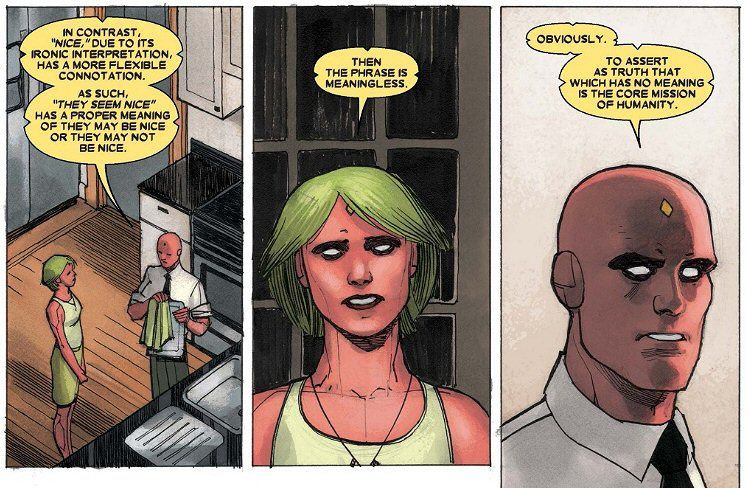
This is when I knew I was in for a good series. 🙂 Vision goes on to expound further:
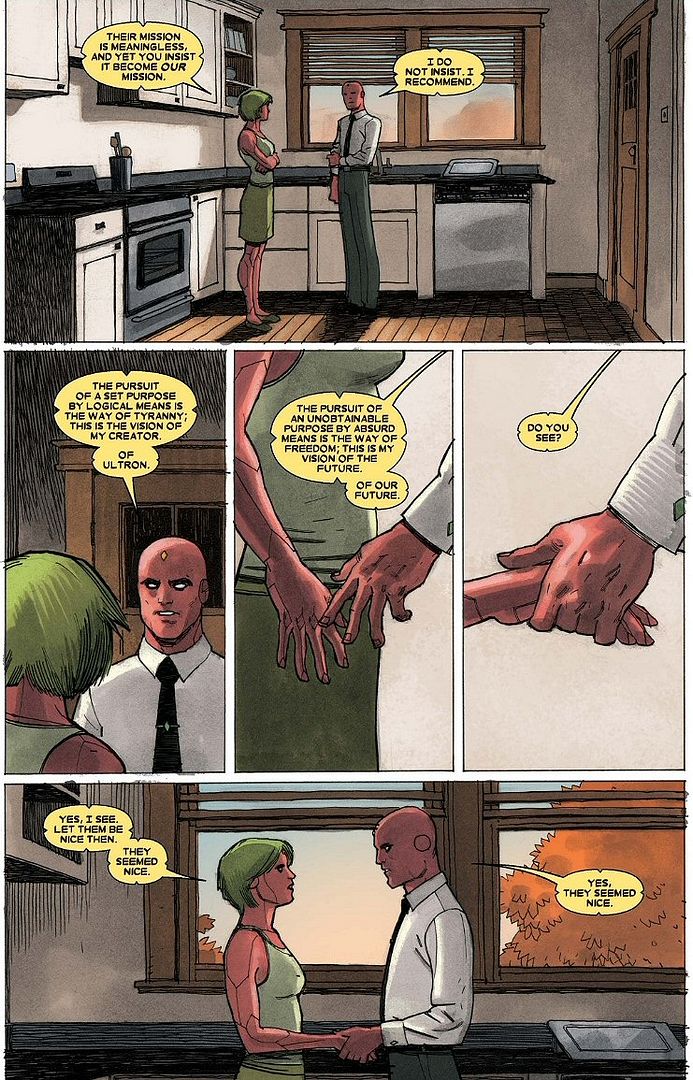
This is critical to the evolution of Vision’s normative ethics in this series – he eschews both consequentialism (utilitarianism) and deontology: “The pursuit of a set purpose by logical means is the way of tyranny“. That is a strong statement against both the logical/mathematical calculus of act utilitarianism, and the rational, universal categorical imperative of Kant (to use the most common forms of both). As discussed on my Charles Xavier’s Redemption post, this would put Vision in the good company of the philosopher Bernard Williams (and David Hume, as I will explain below). Williams pointed out that act utilitarianism robs people of their own individual moral outlook, making them slaves to a narrow and limited system of calculations – and that this in turn inevitably leads to pain, not happiness.
The ethics of Ultron by the way, is known as egoistic consequentialism. It is similar to utilitarianism, except that you value yourself (or your kind) above all others – and so, the calculus is in favor of what is best for you. It is common among super villains in the comics (Doctor Doom and Kang the Conqueror are two other good Marvel examples). It was also the way Magneto was written initially, but he eventually developed a number of virtues and a broader utilitarian focus.
So what is Vision proposing instead? As explained in the next panel: “The pursuit of an unobtainable purpose by absurd means is the way of freedom“. This is the philosophical theory known as absurdism. It is closely related to both existentialism and nihilism, but it takes them a bit further. In simple terms, what these philosophies all have in common is that they grapple with the underlying conflict between an individual’s struggle to find meaning in life, and the recognition that we live in a meaningless universe. But they differ in the conclusions they draw from this, and recommendations as to how we as sentient beings should respond.
Nihilism came first, and asserts that life is inherently meaningless and that there are no objective truths. In its existential form, existential nihilism also asserts that there are no objective values, and that morality is a human construct with no basis in reality. In this view, it is not possible to lead a meaningful life, and everything we do is ultimately pointless. Nihilism forms the core of 19th century German philosopher Friedrich Nietzsche‘s thinking, and was very popular in 19th century Russia. I’ll save my detailed discussion of nihilism for an upcoming post on a series that does explore it in some detail. (UPDATE: see my recently completed “8 Deaths of Spider-Man” series post).
For an existentialist, the fundamental meaningless of the universe could more accurately be restated that the universe doesn’t have any inherent meaning. As such, it it up to us, through free will, personal responsibility and choice, to assign our own meaning to our lives. Jean-Paul Sartre is arguably the most famous French philosopher of existentialism. (UPDATE: check out my recent entry on Simone de Beauvoir for a different take on existentialism)
Of course, this presumes that we have freedom of choice and action – something which is challenged by determinism (which I will explain below). For an existentialist, the “absurd” is what we experience the when we face the conflict between these two beliefs – that our life has meaning, and that the universe is meaningless. This uncomfortable feeling must always persist in the back of our minds, as we try to give our lives meaning.
Note that there is a lot of subtlety in the concept of the absurd, with different philosophical thinkers conceiving of it differently. I personally hue much more closely to Albert Camus‘ concept, as that is what I first read as an adolescent. Although frequently described as an existentialist, Camus rejected that label. Instead he was one of the major proponents of absurdism.
Absurdists takes this a step further and put the absurd at the forefront of our consciousness. They argue that existence as a whole is absurd – and that our attempts to assign meaning to it do not appear to be justified. Indeed, trying to assign meaning in a meaningless universe ultimately only serves to make us unhappy. In this context, freedom comes from directly confronting the absurd – as anything else is inauthentic. Exact wording is tricky here, as the translation from some writers would be “embracing” the absurd, or “rebelling/revolting” against it (in Camus’ version). The key point is that while absurdists recognize that life is absurd, they do not despair as a result (like nihilist do). Instead, they embrace the present, and seek to find joy in the struggle. This is what Camus meant by rebelling against the absurdity of existence – for only then can we be happy and truly free.
As you might tell, I’ve always been sympathetic to Camus’ framing. I’ve also long been a fan of his novel L’Étranger (The Stranger, or The Outsider, depending on your preferred translation – I prefer Outsider). But he articulated his absurdist philosophy more explicitly in Le mythe de Sisyphe (The Myth of Sisyphus). Here, Camus compares the absurdity of man’s life with the situation of Sisyphus in Greek mythology – he who was condemned to forever repeat the same meaningless task of pushing a boulder up a hill, only to see it roll down again the other side once he reaches the top. The text concludes on Camus’ key point: « La lutte elle-même vers les sommets suffit à remplir un cœur d’homme. Il faut imaginer Sisyphe heureux. » (“The struggle itself towards the heights is enough to fill a man’s heart. We must imagine Sisyphus happy.”)
This seemingly counter-intuitive idea is at the core of absurdism – freedom (and happiness) comes from recognizing the absurd and struggling against it. Ultimately, this comic series does not go on to truly espouse an absurdist view of life (although it threatens to at times). It is more a statement of how difficult it is to resolve the absurd through reason alone – which is all that the Vision family have available to them.
It is eventually revealed in this series that Virginia is responsible for a number of deaths – not necessarily intentionally, but all to protect the family. When the neighbor’s dog digs up a dead body she had buried in the back yard, Vision has to decide what to do – which will of course reveal his new-found ethics.
Along the way, we are presented with a concise description of the P versus NP problem. This is one of the major open questions in computer science and mathematics, and asks whether every problem whose solution can be computationally verified quickly (NP) can also be solved in a reasonable amount of time (P). King explains the concept very well in Issue #6, and why it is critical to the decision Vision has to make. If P = NP, then there is a rational explanation for everything (that is, an algorithm that he can apply to solve his family’s problems). But he now has to face the likelihood that P ≠ NP, namely that there are problems which he cannot practically solve (as most computer scientists believe, though it remains to be proven). This is basically a computer science version of recognizing the absurd.
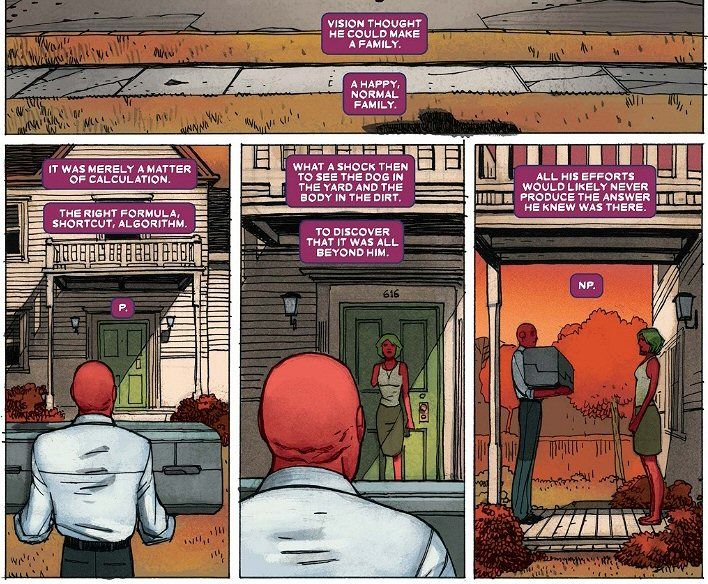
Vision then wonders if he should just revert back to the problems that he can solve (P), or to perhaps foolishly continue to try and solve the unsolvable (NP) with his family (i.e., confront the absurd). He decides he will continue forward – fix what he can with his family, hide what he can’t. And why? As our soon-to-be revealed narrator explains:
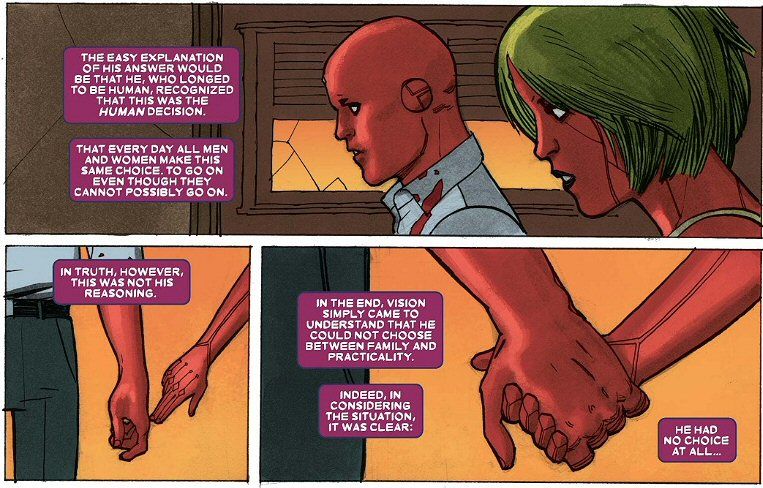
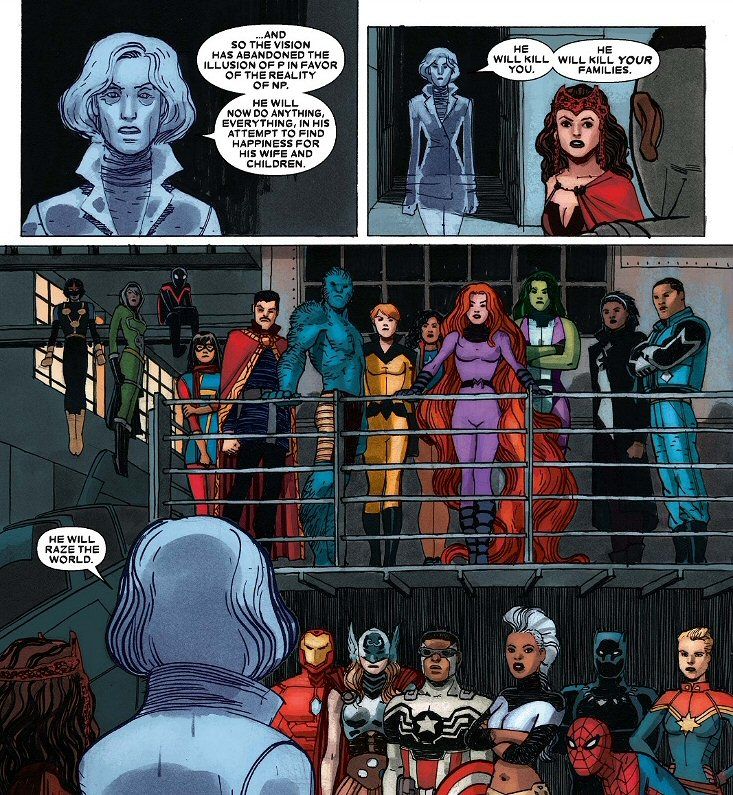
Thus speaks Agatha Harkness, a witch who has seen the future through magical means. Of course, this being the comics, her decision to reveal this to the assembled heroes is actually what puts into motion the very events that will bring about the future that is foretold.
Vision’s decision to prioritize the happiness of his family appears initially to be a very extreme form of care ethics, as I describe on my Ethics 101 page and Captain Marvel post (among others). Care ethics is a form of virtue ethics that emphasizes interpersonal relationships and the duty of care within them – by using empathy, compassion, and an awareness of the specific contexts of a situation (rather than abstract principles) when making ethical decisions.
However, the trauma for the Vision family soon gets worse – with the Avengers implicated in the death of Vision’s son, Vin, through their machinations involving Vision’s “brother”, Victor. As Vision explains to Virginia one night before bed, he has given the matter a lot of thought, specifically:
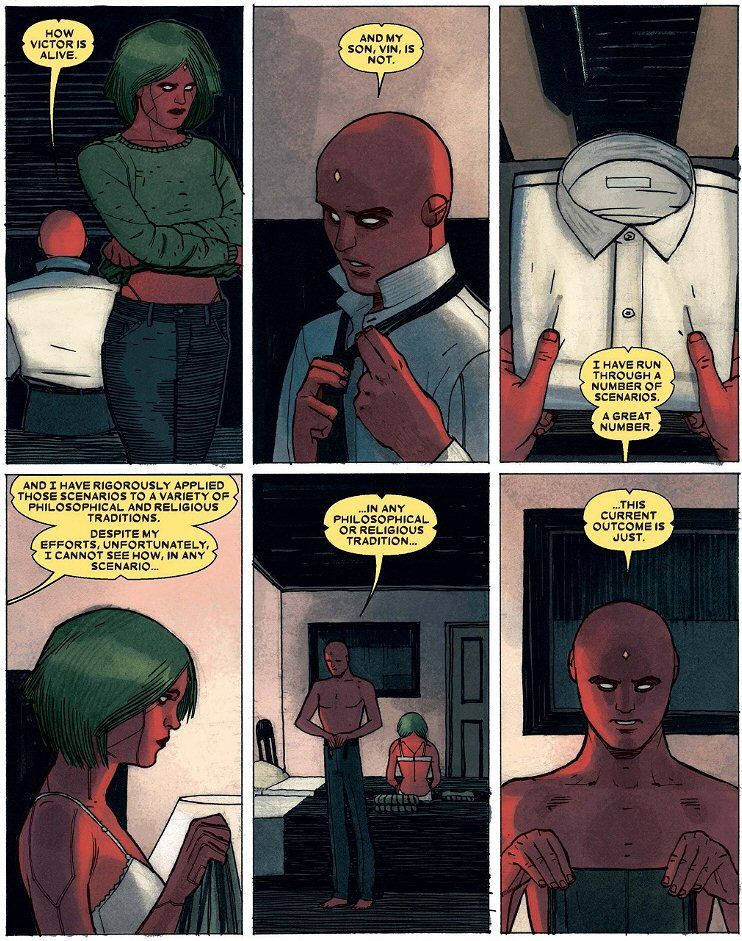
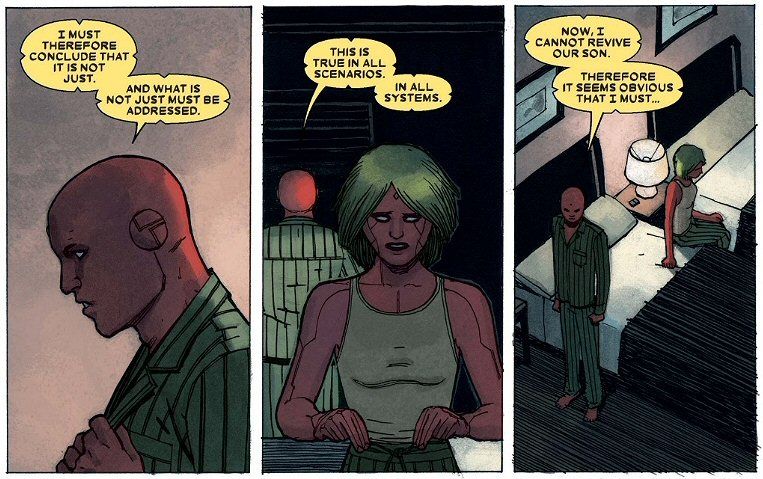
I am sure you can fill in the rest of that thought.
While this reasoning may seem sound, it is of course not true – I can think of any number of religious and philosophical traditions that would advocate (indeed, demand) acceptance over retribution. Even absurdism, with its focus on the struggle would typically advise learning to live with it (while you should certainly strive for justice, you also need to embrace/confront the absurd). Vision’s reasoning above also goes against a care ethics perspective, which shifts away from justice toward relational responsibilities (in this case, his responsibility toward Victor and his surviving family).
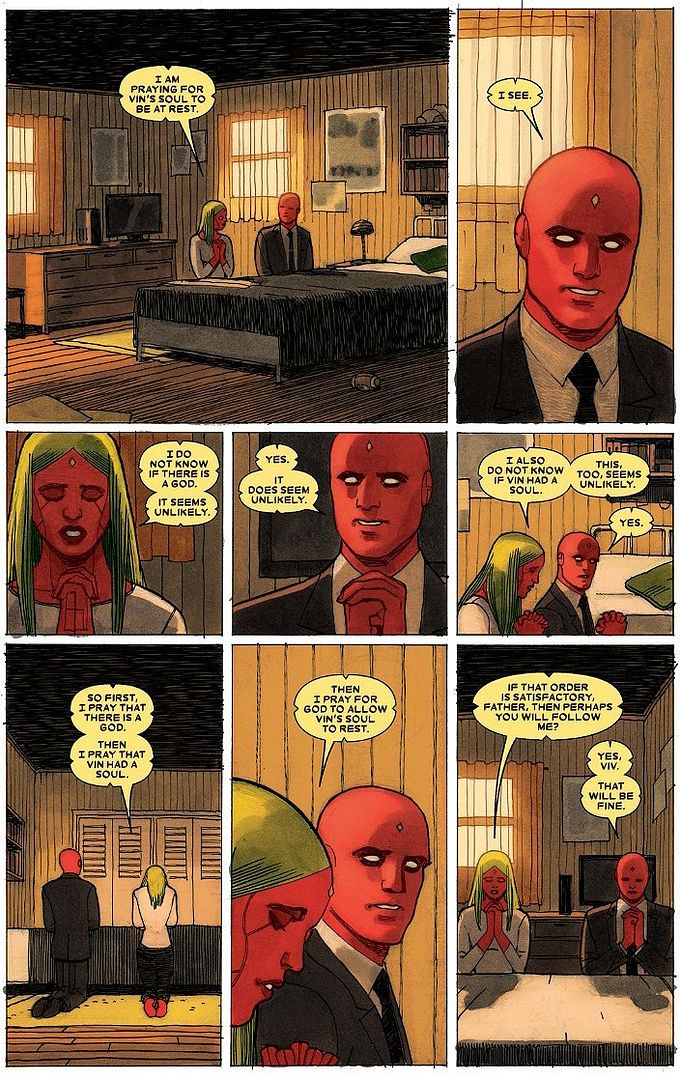
I won’t spoil the ending of this series for you – it is well worth a read to see how King extracts Vision from this mess of largely unintended outcomes. For me, the series really is about rational beings trying to move beyond abstract reason. They need to confront the absurd, but they don’t know how to. Yet the bonds of family – of care – help to sustain them. I will leave you with a great page from this same issue #6 where Vision’s daughter Viv asks him to join her in trying to pray for Vin – something that is a first for both of them (for obvious reasons, as Viv lays bare):
Identity metaethics and free will
Since normative ethics, by definition, demands that you should/ought to do something, it stands to reason that you must be able to do that thing. At a fundamental level, you need to have the freedom to choose to do that thing. If you aren’t free to choose, then what is the point of ethics?
There are two key words in that last sentence – who, exactly, are “you“, and are you truly “free” to choose?
Let’s begin with the first, identity. What does it mean to be you?
As mentioned, this is something that Vision has grappled with a lot, in both the comics and the MCU. As an artificial being who has been built, destroyed and rebuilt (the later cycle multiple times in the comics), you can see why the question of identity comes up a lot. In both the comics and the MCU they have explicitly addressed this through a famous identity thought experiment known as the Ship of Theseus problem, or Theseus’ Paradox.
In addition to the opening quote from the 2021 TV show at the top of this page, here is an earlier example from the comics when Vision meets a future version of himself. From Avengers Vol 7, issue #6, 2017, by Mark Waid and Michael Del Mundo:
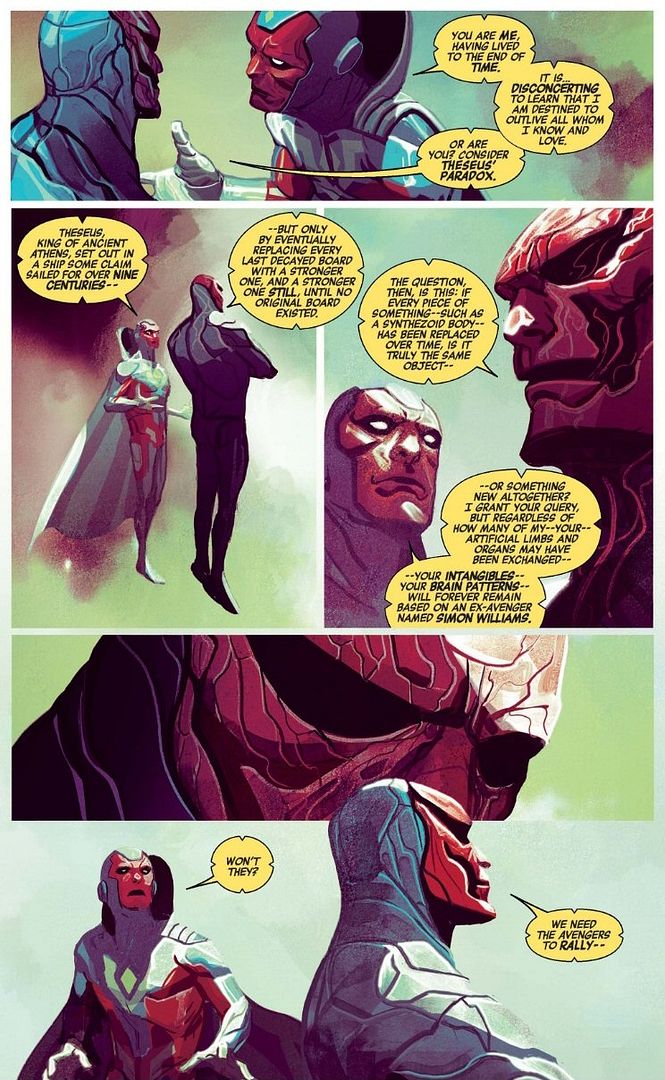
To explain the problem in a bit more detail: Theseus was the mythical founder and ruler of Athens in ancient Greece. He is said to have created a great ship that lasted for many generations of rulers after him. Mind you, ships were made entirely out of wood in those days. That would mean that all parts of it (the planks, beams, oars, etc.) would need be replaced eventually due to rot (likely many times) over the course of its many voyages. It was the Greek writer Plutarch who first posed the question nearly 2,000 years ago: can one even still call this replaced ship the Ship of Theseus any more? And if not, when exactly did it stop being the Ship of Theseus?
Plutarch wasn’t the first to pose a question like this of course – it is basically a metaphor for own lives. We know we physically change over time (and in fact, virtually all of our bodies are replaced with new cells – or at least, new atoms – over the course of a life). But his having written down this thought problem allowed later philosophers to pick it up and explore it in more detail. Probably the most significant was the 17th century English philosopher Thomas Hobbes. Hobbes is an important character in the field of ethics, as he espoused a view that is commonly known today as rational egoism, which is the belief that it is rational to act in your self-interest. This concept is closely related to the egoistic consequentialism mentioned earlier for Vision’s creator Ultron – where the right action is the one that yields the best outcomes for you.
Hobbes added a new wrinkle to the Ship of Theseus problem: what if all the discarded boards and parts were collected, and a way found to reverse the rot? Once everything had been replaced, all the original parts could then be re-assembled in a museum somewhere. Would that ship then be the Ship of Theseus? Is it any more (or less) the Ship of Theseus than the one that has been in continuous service with replaced parts? Can they both be the Ship of Theseus?
How you answer those questions reveal a lot about how you think about identity.
For example, to the collector who has painstakingly restored every piece of the original Ship of Theseus – the very planks that Theseus himself stood and sailed upon – his museum piece is unquestionably the true Ship of Theseus. In this reasoning, it is the material itself that matters. But if you are so inclined to believe that only the material parts are real, then what about the oak trees that grew to eventually produce the wood planks? Are they the Ship of Theseus too? Taken to its logical extreme, this view implies that only fundamental particles truly exist – objects made up of multiple parts are just an illusion of sorts. As an aside, this extreme philosophical view is a component of nihilism.
If you take the view that just like how our bodies can survive replacement of the individual cells and parts, then maybe the ship at sea is the real ship. This would likely be the view of the sailors onboard on the ship. Since they are the ones who replaced the planks and fixed things as they went along, there has never been a time when the ship stopped being the Ship of Theseus to them. It has been in continuous use this way for for centuries.
But maybe the problem is how we conceive of the ship in our minds. More accurately, we have a cognitive bias that what we hold true in our minds must also hold true in the real world too – this is known as externalism. This paradox could thus be said to be one of our minds, not of objective reality.
You might be wondering what I mean by that exactly – the problem/paradox seems real enough, right? But consider the ambiguous use of the word “ship” in our thinking here. One of these ships is made of the material, and the other one is the concept of a ship. Initially, these both shared the same location in space and time. But over time, they diverged – with one continuing as the concept of the “ship” at sea, and the other “ship” found itself in a museum. The problem is that our minds are not used to separating these two meanings of a ship, and thus we keep trying (inappropriately) to force them together.
Following this space-time logic, there could be many more discrete but overlapping chunks of the Ship of Theseus floating around out there. Yes, there would be the relatively small chunks of the space-time ship Theseus personally strode on, or the one with its first (or second, or third, etc.) plank replaced. But there would also be the much larger chunk which is the entire concept of the Ship of Theseus, from the trees who grew its wood to it current status as a philosophical thought experiment described on a comic book blog! I’m personally fond of this later view myself. 🙂
In the case of the two competing Visions of the MCU WandaVision TV show that opened this page, they both agree in the end that neither of them is the “real” Vision. But before the recreated WandaVision disappears from existence, he helps the original-parts White Vision access his blocked memories. So at the end of the day, the one remaining Vision is closer to being the continuation of who he originally was (at least mentally).
In the comics, the rebuilt White Vision slowly recovers his human thought patterns – and so is able to reintegrate his emotions and memories to become the true continuation of the original Vision (at least, until he is disassembled and rebuilt again!). I suspect we will see something similar for the MCU Vision, should the character return.
Free will versus determinism
This is an age-old problem in philosophy – is free will even possible given the sorts of creatures we are? Outside of existentialism and related philosophies, most philosophers would argue that we are not truly free (in the way most people understand the term). Still, there are some ways out of the inescapable and intractable problem known as determinism.
A word of warning here – I’m venturing into some murky territory in philosophy, where many have trouble separating evidence from belief. You will find many philosophy texts with hierarchical flow-charts showing little boxes separated by arrows with terms in them like determinism, libertarianism, and compatibilism, qualified like so many kinds of ripened cheese: hard, soft, and semi. As if simply naming things and putting them in the “right” order somehow explains things (see my criticism of ontological metaethics on the opening of my Ethics 101 page).
There are many ways that our destinies could be pre-determined. Some leading examples of determinism:
- Biological determinism, where core aspects of our physical bodies (e.g., our genetics, epigenetics, structure of our brains, etc.) control our behavior.
- Psychological determinism, where the core elements of the human psyche control how we think and perceive things.
- Theological determinism, since if God knows all, then she also knows everything you are going to do before you do it – and may in fact have determined it.
- Causal determinism, where the laws of science and physics determine the way everything is ordered in the universe, and the ways those things can interact with each other.
The first and last ones are key for any discussion of free will. And those are in the realms of neuroscience and physics respectively, not philosophy.
Let me start with the core one – physics shows us that causal determinism is a big problem for free will, since it is quite absolute and binding for any physical entity that exists in this universe. As every event follows from that which has just preceded it, there is an uninterrupted chain of causality stretching back to the beginning of time. And it follows that it will continue into the distant future as well. Since everything that happens is based on what has just happened, how can we escape direct causality? Rewind time and let it play forward again – doesn’t it have to come out exactly the same? How can any choice be said to be free in that context?
There are certainly things that appear to be probabilistic in quantum physics – such as quantum superposition, which I obliquely referenced on my Ethics 101 page. At least, they seem non-deterministic, according to the standard Copenhagen interpretation of quantum physics. But the potential randomness of quantum causation is of no help here: being free is NOT the ability to act randomly/probabilisticly, with no control about what happens after. And note my use of the qualifying words like “appear”, “seem”, and “potential” above – if you subscribe to the increasing popular many-world interpretation of quantum physics then everything remains deterministic, even at the quantum level.
Many philosophers are also quite unaware of fundamental neuroscience, which has provided some quite clear lessons on how our brains works – or more to the point, how they do NOT work. So biological determinism is even more relevant to this discussion than most realize. Just as I mentioned the illusion of self on my Ethics 101 page, we also have a sense of agency – the subjective awareness of initiating, carrying out, and controlling our own voluntary actions. But that too is an illusion, as it turns out.
The first involves how perception actually works in the brain. The historical view of perception is that our brains process sensory information in a “outside-in” direction – sensory signals enter through peripheral organs (for example, your skin or your eyes) and then travel deeper into the brain through increasingly sophisticated processing. But that is only half the story. The 19th century German physicist and physiologist (and prominent deontologist) Hermann von Helmholtz proposed instead that the brain is actually a “prediction machine”. This has been largely confirmed in the 20th century. Basically, a lot of the signals that flow into the brain from the outside world actually convey prediction errors – the differences between what our brains expect to find, and what they actually do. It turns out that our brains are constantly updating their predictions and trying to minimize prediction errors across all levels of processing.
Along with prediction, our illusory sense of agency also comes about due to “postdiction”. This is when we retrospectively reinterpret an event based on information we receive after the event – we just think we felt or knew it before. This is not just a quirk of our awareness – there have been numerous experimental demonstrations where a stimulus presented after an event alters the perception of an earlier event. There is even some limited evidence of emotional postdiction where your emotional response can develop after you initiate an action. I know how counter-intuitive that sounds. This was one of the most fascinating areas of cognitive neuroscience research in the 1990s, and one of the impetuses for me to study neuroscience (although I ultimately when into molecular neuroscience).
These discoveries (and the innumerable studies they are based on) are why one of the historically popular ways out of determinism – libertarianism – doesn’t rescue free will after all. Libertarianism denies the universe is deterministic because of a special property of human beings – our minds. Originally, libertarians like the 17th century philosopher René Descartes (“I think therefore I am”) argued that our minds were not made of matter, and thus not bound by the physical constraints of our brains. We know better today, so modern libertarians try to argue that our brains are just too complex to understand, and that we harbor some sort of means (e.g., “consciousness”) to free us from the deterministic universe. But this is magical thinking. While there is of course much that we don’t know about how the brain works, this perspective denies what is actually known (that is, what we can measure and experimentally demonstrate).
Of course, I don’t expect comic book writers to necessarily know much about the current state of neuroscience. And libertarianism is obviously preferable from a narrative perspective. Here is a two-page spread from an Avengers story where a fundamentally libertarian explanation is given for how the Vision’s “free will” works. This is from All-New, All-Different Avengers Vol 1 (aka Avengers Vol 6), issue #13, 2016, by Mark Waid and Adam Kubert. This issue was a tie-in to the Civil War II event, where a new Inhuman (Ulysses) can supposedly predict the future:
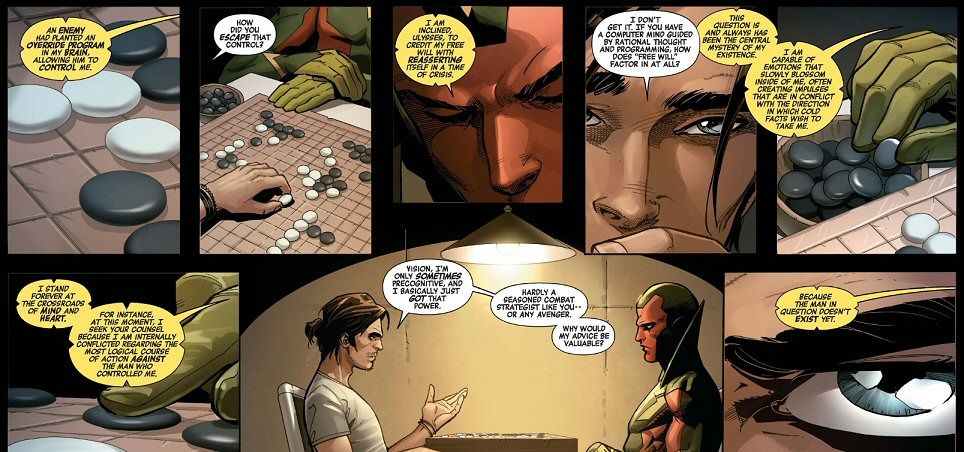
In this case, it is suggested that some sort of libertarian “emotion” arises within Vision that allows a way out of deterministic reason. This hand-waving is an understandable explanation in the context of the story, but it doesn’t work for me. It’s part of why I could not warm up to the premise of the Civil War II event.
Saving free will through compatibilism
Between causal and biological determinism, it seems hard to accept that we have free will – does this mean we must abandon ethics? No, because it turns out that it is our concept of free will itself that is off-kilter.
So what does free will actually mean? We don’t actually want or expect completely unfettered free will – that would be capricious. We want to choose things that we think we will enjoy, that fit with our preferences, our values, and our sense of identity. As it occurred to me once in a philosophy class, we are free to do anything we want – but we are not free to want anything we could do. Of course, the problem with philosophy is you eventually discover that someone else had your bright idea before you did. In my case, I believe it was the 18th century Scottish philosopher David Hume.
Hume argued that it is both inevitable and desirable that every choice we make will be the one that best matches our motivations at the time (both conscious and unconscious). We would have no moral character if we didn’t feel that there were things that we should do, and other things that we shouldn’t do. Like many scientists, I’ve always shared Hume’s broadly empiricist views (although Hume took them to an extreme degree). When it comes to ethics, I like his thinking that it should be based on what feels right in the situation, rather than on some abstract moral or logical principle. (UPDATE: and of course, Simone de Beauvoir also talked about these issues at great length in her second book on existentialism, The Ethics of Ambiguity, as I recently discussed here).
Getting back to the matter at hand – free will is not an illusion. It is just our simplistic notion of free will that is untenable. You have to move away from the incorrect belief that there is this unfettered free will which doesn’t have causes. That is as ridiculous as saying our beliefs, preferences or brain activity don’t have causes. Everything is caused by something that came before it. Instead, what we need is a new concept of free will that is compatible with modern neuroscience and the causality of the physical world.
The way out of this problem is actually another very old philosophical concept known as compatibilism. Compatibilism doesn’t deny the deterministic nature of the universe. Instead, it makes the distinction between our immediate brain reactions to external events and ones that involve deliberation.

Consider the difference between a response to a startling event (that is, the fight-flight-or-freeze reaction) and long-term plotting to attack someone you didn’t like. Both of these are deterministic, in the sense that every step of causality is maintained for both. But doesn’t our moral intuition tell us that there is a difference between planning to hit someone and just reacting when startled? Isn’t there a moral responsibility in the first case that isn’t there in the second?
Here is a compatibilist thought experiment I came across in a philosophy text once. Imagine that a friend of yours really hates your mother for some reason. He secretly plots to kill her, and goes out and buys a gun – intending to shoot her the next time he sees her. Unbeknownst to you and your friend, an evil scientist also hates your mother (I wonder what she has been up to!). The scientist secretly implants electrodes in your friend’s brain while he is sleeping. At the press of a button, the scientist can now cause your friend to go into a murderous rage and kill the first person he sees. The scientist plans to hide in wait for the first time your friend and your mother are together, and then force your friend to kill your mother. Imagine his surprise when your friend pulls out his gun and shoots your mother before the scientist can press the button!
Now, is your friend responsible for having murdered your mother in this scenario? Consider that your friend never really had a choice – even if he hadn’t pulled out that gun himself, the evil scientist would have pressed that button and forced him to do it. So does that somehow make your friend innocent of the crime, given that it was always pre-determined? If you feel that your friend is guilty – because of his deliberation – then you are applying a compatibilist perspective.
Consider the alternate ending – what if your friend thought better of it, and changed his mind and didn’t draw his gun when he saw your mother. But then he killed your mother anyway after the scientist pressed the button. Is he guilty now? If you feel that he is not responsible in this scenario – because he deliberately didn’t want to do it, even though it was still pre-determined – then you are again applying a compatibilist perspective.
Either way, you are saying that ethics doesn’t require freedom from determinism. Instead, you are saying that ethics simply requires deliberation. This is actually a reversal of the second form of determinism I mentioned earlier – our psychological nature as humans allows us a certain form of freedom (and the moral responsibility that goes with it) that animals don’t have. By virtue of our ability to deliberate on our actions, we are free.
This is sometimes referred to as the difference between first-order and second-order desires (the latter being desires about our desires). We can’t necessarily do much about our first-order instinctual desires (e.g., to eat, to have sex, to scratch an itch). But we can over-rule them through deliberation due to other considerations that matter more to us in the moment (e.g., trying to maintain a healthy weight, remaining faithful in a monogamous relationship, not making more skin damage). Note that these second-order desires again do not escape causality. But we recognize them as different from first-order ones due to deliberation. We aren’t free to choose our first-order desires, but in the ways that matters, we are free to choose our second-order ones.
If the above is all a little esoteric for you, then you might want to fall back to a simpler solution to the problem from applied ethics. When deciding whether an action affecting a person is ethically appropriate or not, we don’t get into metaphysical discussions of causality. Instead, we quite reasonably ask whether the person consented and whether that choice was coerced or not. We don’t need or expect complete unfettered freedom in a choice for it to be considered ethical. In practical terms, it is enough to be considered free so long as it was of a person’s own volition and not coerced by others.
UPDATE: If the above has whet your appetite for neuroscience, and you are wondering how moral intuitions actually come about in our brains, please check out my Moral Thinking, Fast and Slow post.
Current ethical framework: C/v


It’s basically impossible to assign a consistent normative ethics for the Vision character in the comics, given the widely divergent ways different writers have written him across eras (and his various reconstructions). Historically, the comic character has generally had a very strong utilitarian (consequentialist) streak, seeking the greatest good of the greatest number. But he has generally been somewhat virtuous as well, often showing compassion, empathy, bravery, and integrity (classic virtues). As such, a C/v on my superhero description system is probably the best fit overall. But individual writers can diverge from this significantly (e.g., see the King Vision Vol 2 series).
In the MCU, you could make a case for the original Vision as more of a V/c overall – it depends a bit on how you see Joss Whedon’s 2015 Avengers: Ultron movie. There is a great scene where all the Avengers take turns trying to pick up Thor’s enchanted hammer, Mjonir. Mjonir’ enchanted inscription currently reads “Whosoever holds this hammer, if they be worthy, shall possess the power of Thor”. As I will explain on an upcoming post, Thor is an example of virtue ethics – and his worthiness to wield Mjonir comes from his belief in himself and his character virtues (UPDATE: see my Thor post). None of the other consequentialist/deontological heroes can lift Mjonir – although it seems to wobble for Captain America (consistent with my thesis that he is a secondary virtue ethicist). But Vision is able to pick it up with ease and hand it to Thor. This leads some to conclude that Vision is also primarily a virtue ethicist (like Thor). However, others see it as “not counting” as Vision is a construct and not a person (and so the enchantment doesn’t apply to him – but that reasoning is inconsistent with Beta Ray Bill’s stint as Thor in the comics). Personally, I’m comfortable placing the MCU Vision as a V/c … but given his death and “resurrection” as the White Vision, I think a reversion to the comic norm of C/v makes sense.
Again, the purpose of this site is not to provide a definitive normative ethics framework for each character – that is impossible, given all the creative hands each character has passed through. My goal on these background pages is to provide a sufficient overview of the main ethical drives for a given character, to help you make sense of the individual stories.
The last word
The Vision Vol 2 series by Tom King really is a great read. There is one issue (Issue #7) which is mainly a series of flashbacks to earlier points in Vision’s life – especially in regards to his relationship with Wanda, the Scarlet Witch. Note that I don’t believe any of the vignettes were actually captured in the earlier comics (and so, in that sense, you could consider these mild retcons). But I would consider them more as fleshing out his character here a bit further in terms of motivation, in keeping with those earlier events.
Given the very robotic delivery King’s Vision has, it is hard to know what his character is feeling in this series. This is where the framing and shading by the art team of Hernandez Walta and Bellaire is so great – it conveys a lot of emotion. There was an interesting two-page spread in Issue #7 from his time as the White Vision in the comics (1989-1993). In this scene, he has lost his emotional connection to his memories, and Wanda makes him explain this to their two (magical) boys – who still see him as their father:
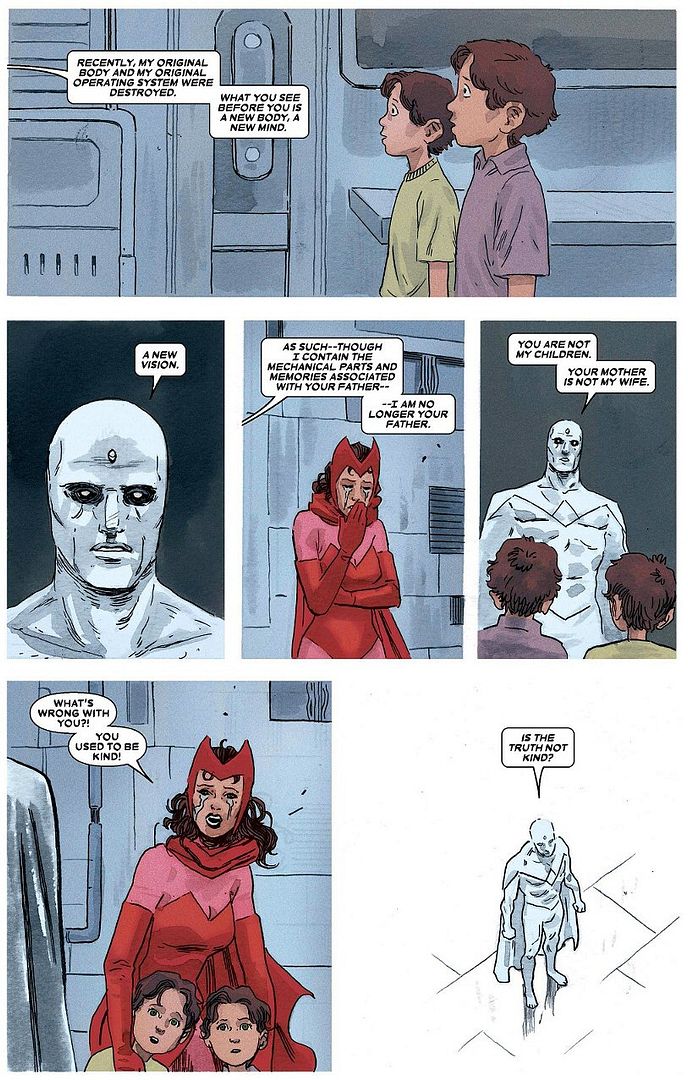
Indeed. Although this series hasn’t led to a persistent change in Vision’s characterization in subsequent stories, I’m happy to report that his synthezoid daughter Viv has had a number of interesting adventures in the Champions series of young heroes (2016-2020).
There is a new Vision & the Scarlet Witch limited series launching in May, by Steve Orlando with art by Lorenzo Tammetta. Given how Orlando has refocused Wanda around her interpersonal relationships in his two most recent Scarlet Witch limited series, I expect we will see some progression of Vision and Wanda’s relationship. In recent years, they are often written as simply team mates in the ensemble Avengers stories. I think it’s past time to have a series focus on their current (and potentially future) relationship status.
See my Glossary post for a list of the key philosophical concepts and related links on this site.
Further Reading
For more neuroscience: Moral Thinking, Fast and Slow
For more existential ethics: The 8 Deaths of Spider-Man Ethics
For more ethics: The Power Fantasy Introduction
Yo, what do you think about the ethics of a robot deciding whether or not to kill someone? Like, if virginia was programmed to protect people but had to make that choice to end a life, why didn’t she break down earlier, if she understood how messed up that was?
In terms of first death (the Grim Reaper), yeah, that is something I didn’t quite get in this series. It seems odd to me that Virginia (who it is revealed later is based on the Scarlet Witch’s thought patterns, not Vision’s) would default so quickly to hiding the death (and so incompetently too). Her fear makes sense, of course, but the response doesn’t really track for me.
To be fair, the writing does show some breakdown in her performance as a result (i.e., the stuttering). Of course, why no one else recognizes that sign sooner is also hard to understand. But her sacrifice at the end to save the Vision does “redeem” her somewhat.
In any case, this is not *really* a story about the ethics of robots – they are very human in many of their responses. I always liked the way Asimov presented it in his robot stories – if a robot were forced into a situation where it had no choice but to kill one to save many, it would be irrevocably destroyed as a result. He had a defined set of nested laws (look up the Asimov’s 3 laws of robotics), but it was discussed and explained in the stories that no robot could survive a human’s death at its hands. In the comics, the robots always seem to be a lot more human – and we seem to be able to rationalize and justify a lot!