

Cap: There are others out there a lot more powerful than I am … why not go the the X-Men? Why not Thor or Captain Marvel or somebody else who can bring more firepower to the job of protecting them?
Lyra: Because for those others, their cause can be an empire, a throne, a war. You have only one cause. Your cause is life. It is preserving innocent life, and innocence of life, from those with power, and those with powers, who would destroy that life. You have always, and you will always, put the lives of other first. Even before your own.
- J. Michael Straczynski, Captain America Vol 11, issue #8 (2024)
Welcome to my introduction to the ethics of Captain America – one of the longest-standing Marvel superheroes, and one commonly looked to as among its most moral. But what is that morality exactly?
To start us off, I picked that recent quote from the most recent run of Captain America for a couple of reasons. The first is that I was a really big fan of J.M.S.’ Babylon 5 TV show in the 1990s, and am happy to showcase his stint on Captain America (which has sadly just come to an end). But in terms of Cap’s character, it nicely brings up two key points; he is among the least physically powerful of Marvel superheroes, and among the most consistent in his fundamental drive. These are two key insights that I will return to repeatedly here as we consider his normative ethics framework.
If you would like to know more about the terms I’m using on this site, please follow the links throughout or check out my Ethics 101 page or Glossary post.
Character introduction
Captain America (Steve Rogers) was a “super-soldier” created by the U.S. Military to fight in World War II. With an indestructible shield (later confirmed to be made of Vibranium) and clad in U.S. colors and imagery, Captain America directly fought in the war along side his compatriots. In the closing days of the war, he was presumed dead in an airplane explosion and lost at sea. Instead, the Arctic ice kept him preserved, and he was thawed out and restored decades later. Captain America would go on to become one of the most important members of the Avengers, as well as a moral leader of American superheroes more generally.
Despite the iconic imagery he wears, a significant feature of his moral character is that he is loyal only to his own ideals and principles – and bears no specific loyalty to any political view or government. Indeed, he is often looked to by other superheroes (and the general Earth-616 population) as a general source of leadership and inspiration. I have found that Captain America is typically pretty consistent and steadfast in his views, despite all the creative hands he has passed through.
It is true that he does sometimes struggle with making decisions in more complex or morally-ambiguous situations (a fact that seems to confuse some writers about his ethics). But I will argue here that this is not because he is weighing options or seeking to change but rather because he is unsure about how to apply his principles in a given situation. In the end, Cap always does what he considers to be the right thing – and that right thing hasn’t changed that much over a very lengthy run in the comics.
This makes him among the most deontological of all the characters in the Marvel Universe in my view. But he also often shows a commitment to personal virtue, and tries to be a good person – not just someone who take good actions. He is someone the other characters count on as sort of a fixed weather vane – always pointing in the right direction, no matter how the wind blows.
Given his additional role as an American national icon (despite his personal reservations), a number of other individuals have taken over the “mantle” of Captain America over the years, during Rogers’ various absences, in both the comics and movies/TV series. To make it particularly interesting, there are two active Captain Americas in the Marvel comics right now – the original Steve Rogers, and Sam Wilson (formerly the Falcon). This entry is about the Steve Rogers version of the character specifically.
Early comics
Captain America was created by legendary comic creators Jack Kirby and Joe Simon, in Timely Comics (which later became part of Marvel) in 1940 – making him effectively the oldest Marvel superhero. Although the character – with his pronounced anti-Nazi sentiments and actual war exploits – were popular during the Second World War, his popularity rapidly declined in the post-war period, and the title was cancelled in 1950.
Despite some attempts at revival, the character didn’t get firmly re-established until 1964 (with the backstory above to explain his absence). It would be fair to say that political messaging has always played a major role in Captain America stories, with writers regularly using him to comment on the state of American society and government (especially true in the 1970s and 1980s, and again in this millennium). One particularly notable development during the Steve Englehart and Sal Buscema era (1972-1975), inspired by the real-life Watergate scandal, saw Captain America being framed by a corrupt U.S. President for murder. For a brief time, he came “Nomad”, the man without a country (Captain America Vol 1, issue #176, 1974), before eventually reclaiming his identity and ideals.
When I was collecting comics in the early 1980s, the main Captain America title had just come off a period of being a revolving door of major Marvel talent from month to month (circa 1975-1981). J.M. DeMatteis and Mark Zeck eventually had a consistent run from 1981-1984. I only read this title sporadically as a kid (despite hugely enjoying DeMatteis’ other work on the Defenders and Ghost Rider) – mainly because I didn’t find the U.S. politics story lines to be of compelling interest to me growing up in Canada. And I’ve never enjoyed the reuse of Nazi tropes (e.g., the Red Skull arch villain), which is a regular feature of Captain America stories.
I do recall however the big lead up to a confrontation with the Red Skull in issue #300 in 1984 – which I bought and found to be odd dud of an ending to DeMatteis’ term. It turns out that he had originally planned to end this run with Captain America renouncing violence and becoming a pacifist (I would have loved to have seen that story!). But notorious Marvel editor-in-chief Jim Shooter rejected that ending, and forced DeMatteis to change it. He resigned the title immediately after in protest (and was soon followed out the door after Shooter’s Secret Wars II cross-over debacle – which I will discuss in a separate upcoming post).
As an aside, I did enjoy Peter Gillis‘ take on the character, especially his well-known alternate Earth What If? Vol 1, issue#44 (1984), and some of his earlier issues in the late 1970s (a point I’ll come back to in a moment).
A more modern take
A significant cross-over event where Captain American played a major role was the Civil War event of 2006-2007, created by Mark Millar and Steve McNiven. Captain America became the leader of the resistance opposed to the Superhuman Registration Act. He forms a group of “Secret Avengers” to fight back against Iron Man and the other supporters of registration. The war ends when Captain America agrees to surrender, in exchange for amnesty for his followers (although he himself is jailed). There are some considerable differences to the MCU version of Civil War story line, which I will refer to below (I find the MCU version highlights the deontological-utilitarian normative ethical conflict in much starker terms).
Captain America was killed in a 2007 story line (Captain America Vol 5, issues #25-30) by Ed Brubaker and Steve Epting (don’t worry, he was eventually brought back). Brubaker’s run on Captain America continued across various titles until 2012, and was well received, helping revive interest in the character. Unfortunately, some of that was lost with the controversial 2016 story line by Nick Spencer, featuring an evil-version of Captain America that had been secretly loyal to Hydra all along. I see this story line as part of a long-standing allegorical commentary on U.S. social and political issues – in this case, concern with the rising support of fascism in the U.S.
Although this story line was resolved in the 2017 Secret Empire cross-over event, effects lingered for a while. For example, I found it over-shadowed a lot of the subsequent Captain America series by Ta-Nehisi Coates and Leinil Francis Yu (Vol 9, 2018-2021). Coates run was also affected by some controversy when he had the Red Skull accurately quote Donald Trump and Jordan Peterson.
The last Captain America title (Vol 11, 2023-2025), has just wrapped up, and was written by legendary sci-fi writer J. Michael Straczynski. It similarly began with a story line (issues #1-5, 2023-2024, with art by Jesús Saíz and Lan Medina) directly comparing what Captain America is going through today with what he experienced as a youth pushing back against the rise of Nazism in America in the late 1930s. The constant back-and-forth (the series seemed to spend roughly equal amounts of time in each period) make it clear that this was an even more overt social commentary on the dangers of rising fascist ideology in the U.S. today.
He does get to make this kick-ass point about standing up for what you believe in (issue #3):
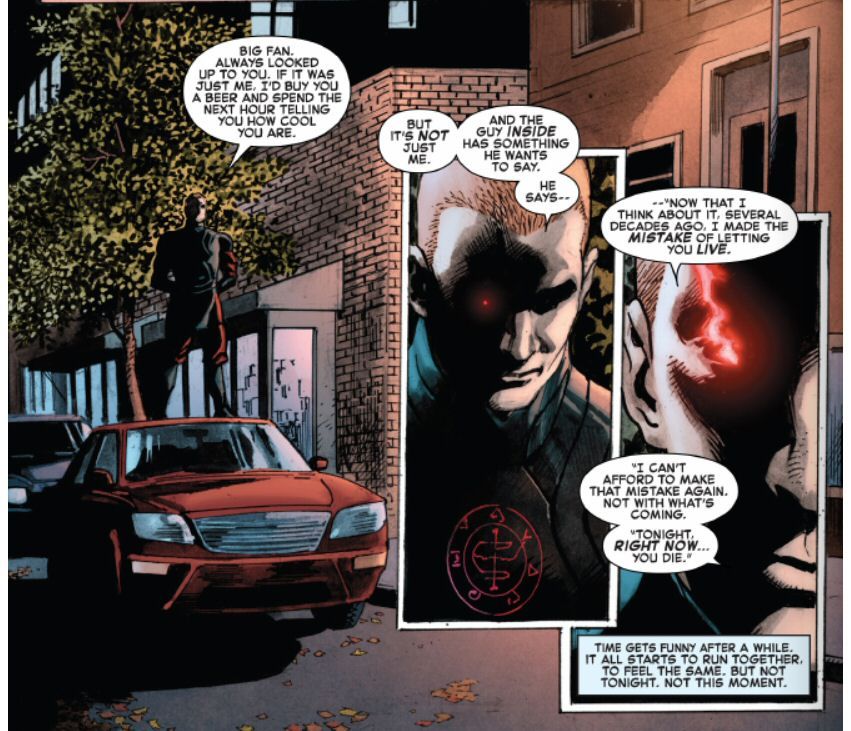
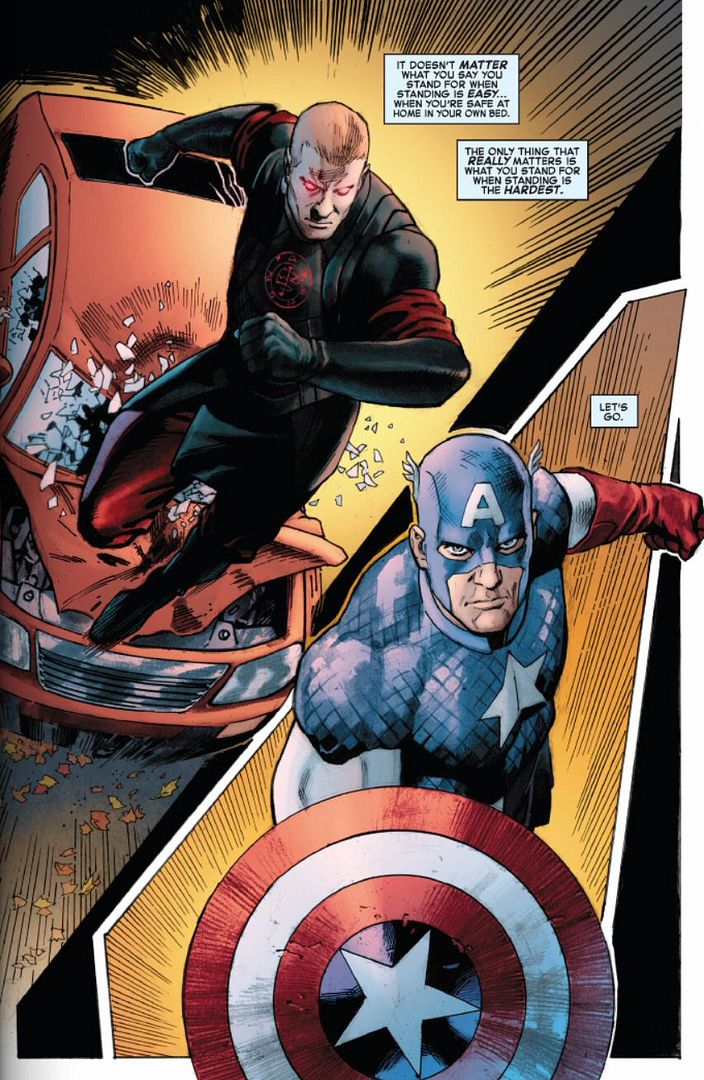
Although I appreciate the attempts to keep Captain America topical to U.S. social and political events, these story lines help to (inadvertently) reinforce my main thesis – that Captain America doesn’t really change, and always applies the same intrinsic set of moral rules to every situation (his own personal categorical imperative, if you will). This is the essence of deontology. While its certainly true that Cap also expresses personal virtues, a core element of a virtue ethics philosophy is personal growth – which is not always clear for this character.
I recognize that my views of Cap may have been influenced by the late great Peter Gillis, who was one of my favorite Doctor Strange writers in the 1980s. In a commentary on the 2007 “death” of Captain America story line, he observed the following (from the Internet Archive’s cache of his old blog):
Captain America was never one of my favorite characters as a fan. You’d have to get past Thor and Dr. Strange and the Sub-Mariner … but he quickly became one of my favorite characters to write, and I found that puzzling.
Marvel had two spiritual characters: Dr. Strange and Captain America. Stephen Strange was Imagination, and Steve Rogers was Belief. The others were just heroic people … all the challenges to Dr. Strange were challenges to the Imagination, while all of Cap’s challenges were challenges to Belief.
Captain America embodies something: not America, or national pride, but something deeper: thanks to inspired folks like Stan Lee, and perceptive folks like Steve Englehart and Marc deMatteis, he embodies something even deeper than Justice: the belief that it is possible to live rightly in the world. (emphasis mine)
As I describe on my Doctor Strange Ethics background page, I find Strange to be one of the most utilitarian of Marvel’s heroes (although with a deontological streak). And like Gillis, I find Captain America at the other extreme end – as among the most deontological of heroes (although with a virtue ethics streak).
That said, there is an entire book dedicated to discussing Captain America as a virtue ethicist – The Virtues of Captain America: Modern-Day Lessons on Character from a World War II Superhero, by American philosophy professor Mark D. White (who has written a number of good books on the ethics of modern superheroes). This interpretation has been questioned by some though – see this book review in New Republic by John Gray (although he is mainly arguing that Aristotle’s concepts of virtue are incompatible with the modern liberal world). While I agree that Cap has a strong sense of personal character, I would argue that Cap’s unchanging nature, and relative lack of self-doubt, argues against a primary virtue ethics interpretation in either the classic and modern sense.
A.X.E.: Judgment Day
Which brings us to the AXE Judgment Day event, the major 2022 Marvel cross-over event created by Kieron Gillen, Valerio Schiti, and Marte Gracia. I have created an introductory post on this event, and plan to conclude it once I have finished profiling the ethics of the major heroes involved.
The premise is that a revived god-like being, a Celestial known as the Progenitor, is deciding the fate of the world by weighing the morality of every individual human being. From issue #3 of the main event, page 1:
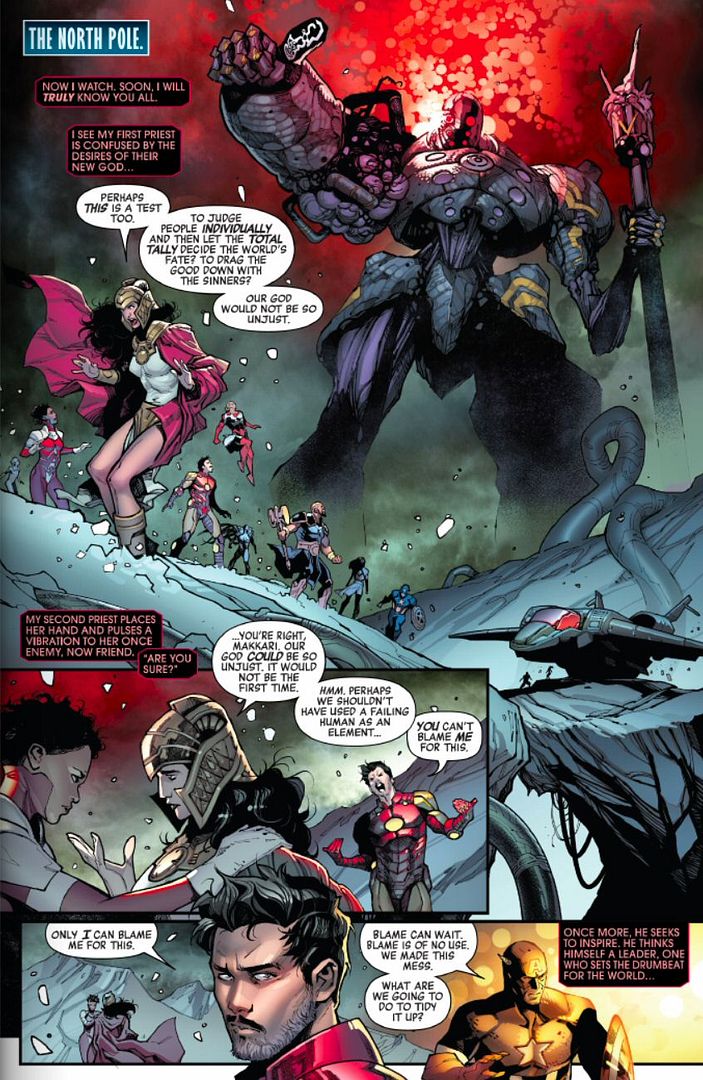
Cap is an interesting one to start with, given how he is widely perceived (and perceives himself?) as a having an incredibly strong moral compass. What does the Progenitor think of him?
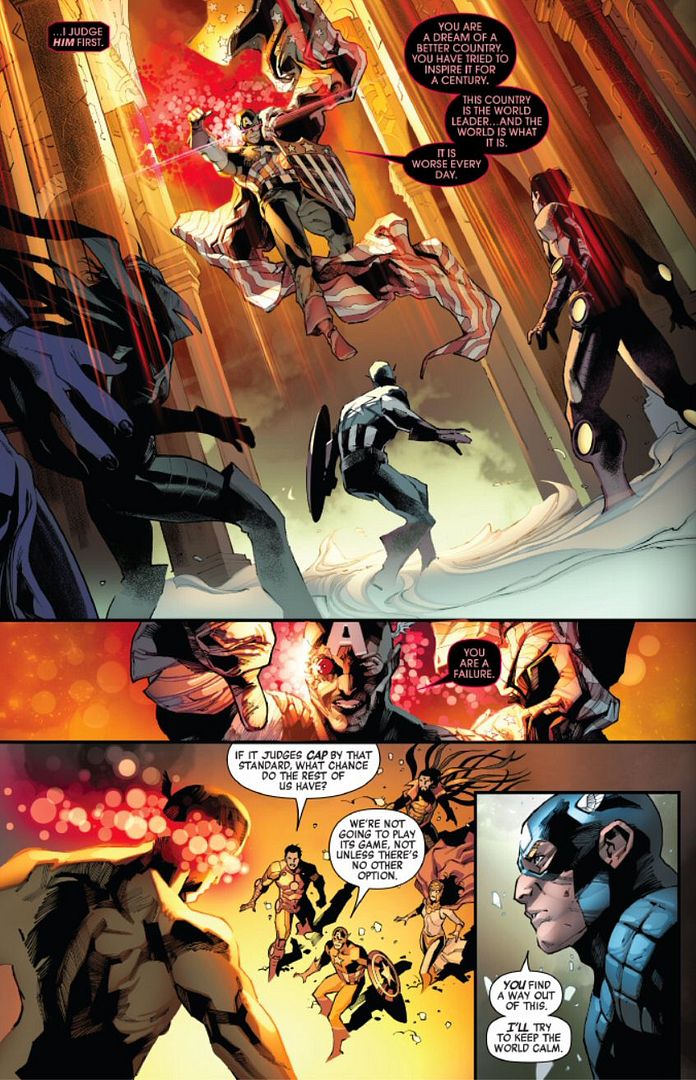
That’s a pretty harsh judgment for Cap. He has tried his whole life to the do the right thing – yet the Progenitor judges him a failure.
This gets to the crux of the ethics of this cross-over event – the answer very much depends on which normative ethics theory you favor. It seems to me that the Progenitor’s reasoning above makes it very clear which normative ethics theory it is using – a point that I will come back to later in my AXE event conclusion post. UPDATE: my A.X.E.: Judgment Day Conclusion is now up.
One of the (many) clever aspects of this event is that it is not only the superheroes who get judged – the lives of a handful of “normal” people never seen before are also followed by the Progenitor over the main series. One of these (“Jada”) gets a chance to meet with Cap during a particular low point:
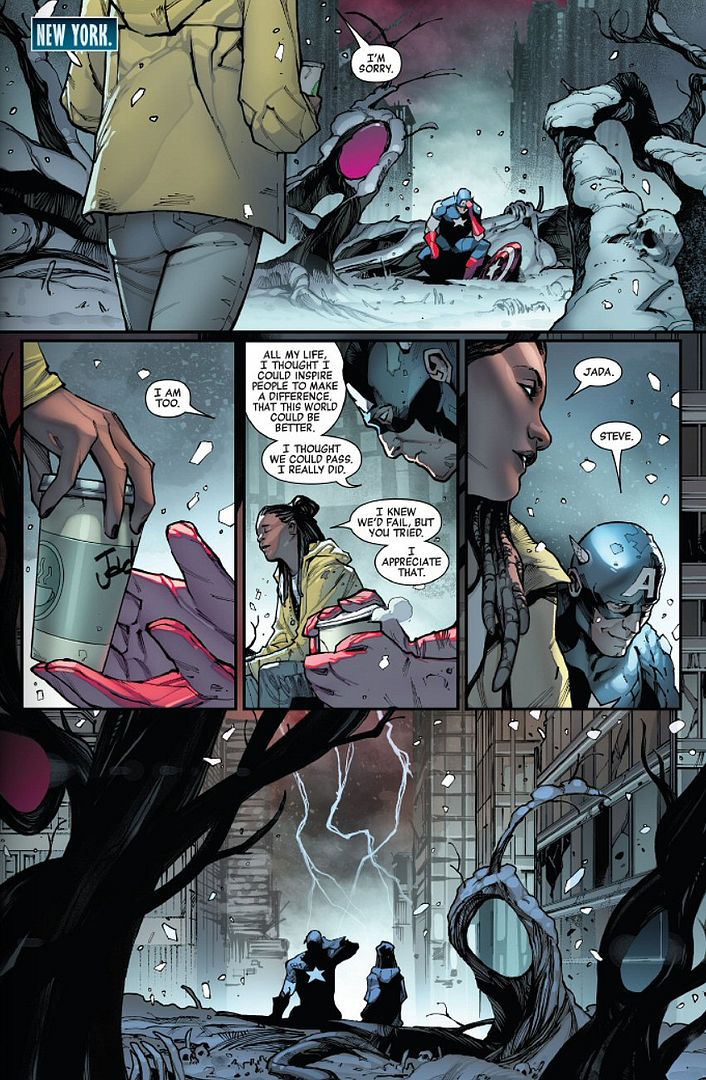
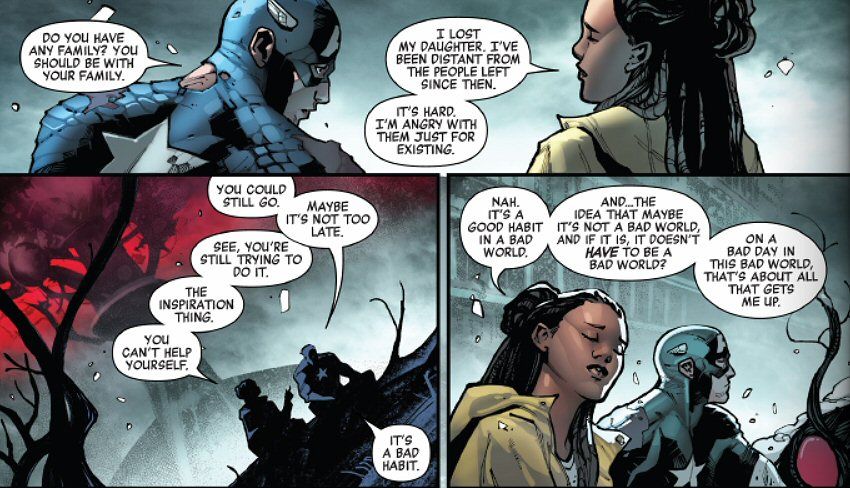
One of the many things I like about this scene is it shows that even in the darkest moments, Cap can’t help himself – he is always trying to inspire others. That is his role, and his strength.
Marvel Cinematic (MCU)
Across all the MCU Avengers and Captain America movies, I find Cap’s character (played by Chris Evans) to be particularly deontological – especially in opposition to Robert Downey Jr.’s very utilitarian Iron Man.
Through these films – especially the 2016 Civil War movie – you have a great opportunity to explore the deontological-utilitarian divide. But don’t just take my word on his – this time, philosophy professor Mark D. White’s review of the MCU Civil War film exactly matches my interpretation. He adds the extra insight that Peter Parker’s Spider-Man is the “avatar of virtue ethics” for this story – stuck in the middle, looking up to his two fighting mentors, while trying to be the best hero he can be. I highly recommend this film. Like the inaugural Doctor Strange outing, 2016 was a very good year for heavily philosophical MCU films.
The comparison to Spider-Man above is one I find interesting, as I’ve always considered him something of the flip-side of Cap – primarily driven by a virtue ethics drive, but with a strong deontological streak. As I explore further on my Spider-Man Ethics page, his defining moral trauma forms the core tenet of his personal philosophy. But to me, the oft-quoted Spidey catch-phrase – the seemingly deontological “with great power comes great responsibility” – actually misses the point to what really drives him. Namely, he is always striving to be a better person. This is different from Cap, who – as my opening quote states – always has, and always will, do the right thing as he sees it. The commitment to personal growth is part of why I see Spidey as primarily a virtue ethicist, compared to the more duty-driven deontological Captain America.
Current ethical framework: D/v


I personally find Captain America quite consistently demonstrates a primarily deontological ethical framework across his very long run in the comics and films. Captain America strongly believes in always doing the right thing, regardless of the consequences. He is constantly upholding his moral principles, even when faced with difficult choices or morally ambiguous situations. His personal moral code is based on principles like truth, duty, justice, and protecting the innocent.
However, some believe him to be more of a virtue ethicist, which I can appreciate. Cap certainly embodies classic virtues, like courage, selflessness, honesty, and compassion. He has an internal moral compass that other characters look to for guidance. Probably the most compelling argument in favor of a virtue ethics perspective is that (in least some of the stories) he strives to be a good person and not just do good things. But the unchanging nature of his morality is more indicative of deontology than virtue ethics, so I’m comfortable with ascribing a secondary virtue ethics framework for the character.
And so, a surprisingly consistent D/v on my superhero description system over time.
Again, the purpose of this site is not to provide a definitive normative ethics framework for each character – that is impossible, given all the creative hands each character has passed through. My goal on these background pages is to provide a sufficient overview of the main ethical drives for the character over time. This is to help prepare for upcoming posts where I will examine specific comic stories in more detail, to show how they illustrate key normative ethics theories.
The last word
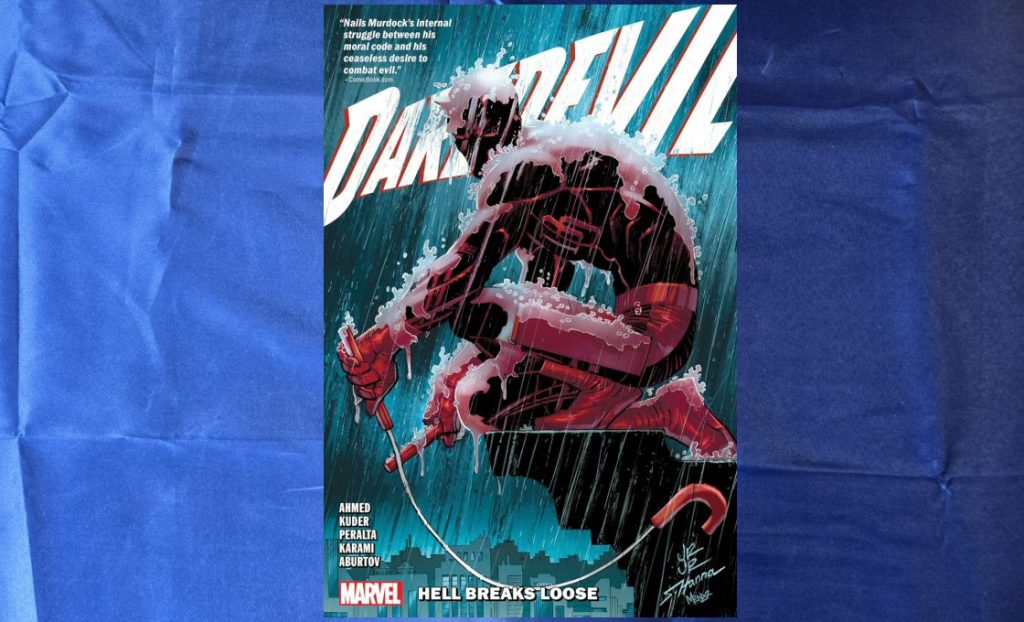
Unlike Daredevil, another very deontological character, Captain America doesn’t seem to be plagued by persistent doubts or fears. He stands as a very confident and steadfast character, always acting out of an innate sense of right. And those around him respond positively to that, looking to him for leadership and guidance.
But that sounds like it could be very lonely. Everyone being convinced of your rightness or goodness may bring about a lot of respect, but it doesn’t necessarily engender close personal connections. This is not something I’ve sent touched on much in Captain America, so I was glad to see J.M.S. raise it in the recent title (from issue #14, 2024):
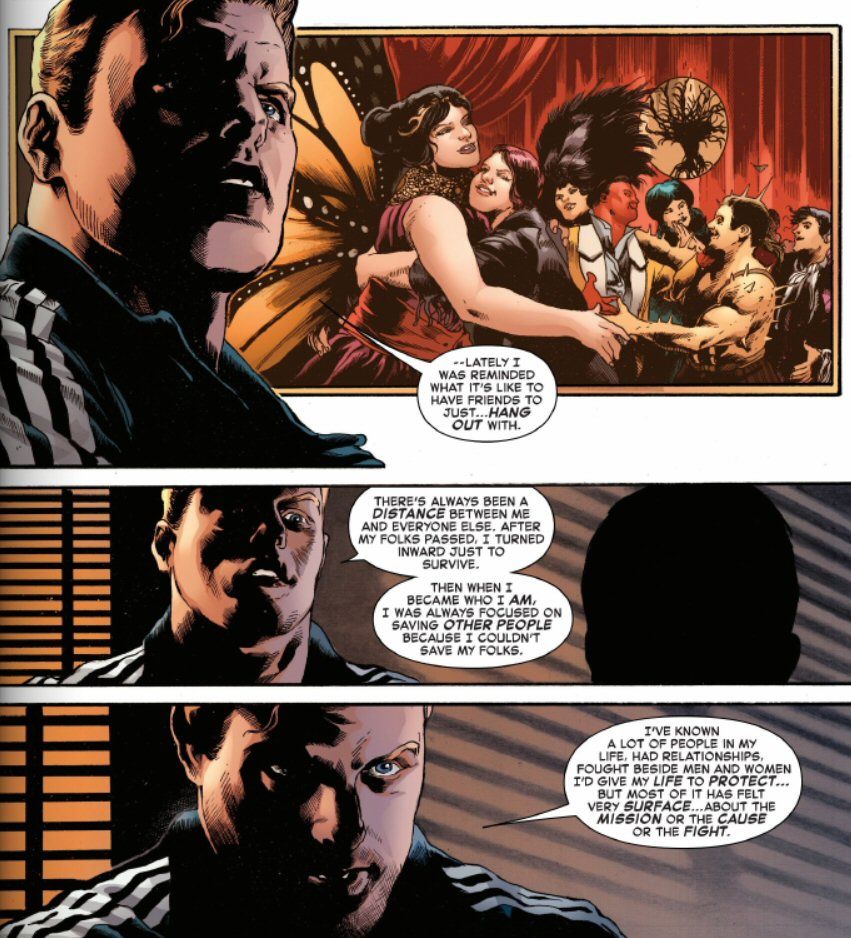
I love the awkward phone calls that follow between Cap and Peter Parker’s Spider-Man in this issue, as both struggle to find a way to connect (Cap being one of the few heroes who knows Peter’s true identity at this point in time). Despite their similar-yet-inverted virtue ethics/deontological natures (in my view), they have had relatively few sustained interactions in the comics (perhaps it’s a Queens vs Brooklyn thing!). So I was happy to see J.M.S. bring him in on his final Captain America comic’s story line.
But of course, most people look to Cap for leadership. So I would like to end this post with the very popular speech that Peter GIllis’ 1984 What If? Captain America gives to a contemporary crowd in a world that hadn’t known him. Since 2016, this speech has frequently resurfaced as an Internet meme (for somewhat obvious political reasons). How very prescient!
Listen to me – all of you out there! You were told by this man – your hero – that America is the greatest country in the world! He told you that Americans were the greatest people … He went on about how precious America was – how you needed to make sure it remained great! And he told you anything was justified to preserve that great treasure, that pearl of great price that is America! Well, I say America is nothing! Without its ideals – its commitment to the freedom of all men, America is a piece of trash! A nation is nothing! A flag is a piece of cloth! I fought Adolf Hitler not because America was great, but because it was fragile! I knew that liberty could as easily be snuffed out here as in Nazi Germany! As a people, we were no different from them! When I returned, I saw that you nearly did turn America into nothing! And the only reason you’re not less than nothing – is that it’s still possible for you to bring freedom back to America!
We can hope …
See my Glossary post for a list of the key philosophical concepts and related links on this site.
Further Reading
For more virtue ethics: Spider-Man
For more deontological ethics: Daredevil
For more superpowers ethics: Powers
This one was interesting too. Do y’all think it was actually ethical for Captain America to ditch the serkovia (sp?) accords and go rogue, or was he just being selfish and lowkey putting people in danger?
It I understand your meaning, no, I don’t think Cap was being selfish. You could make an argument that not signing the Sokovia Accords might put people at risk, but Steve (Cap) genuinely didn’t see it that way.
It’s been awhile since I’ve seen the movie, but the scene where Tony (Iron Man) is trying to get Steve to sign the accords is key. Tony’s ultimate argument is that it will get the government off their backs, and provide cover for future missions. He first tries to make some claims that it is is about accountability/legitimacy, but that’s pretty rich coming from him – that seems quite transparently to be an attempt to manipulate Steve. Tony is taking an extremely utilitarian tack here, looking for the best outcome for all (in his view).
Steve is clearly arguing from a place of principle. He doesn’t trust government oversight, and is worried about how it will take away their freedom to operate. His argument is the classic “slippery slope” one, where he worries this will lead to authoritarianism and their losing their right to choose what to do. He seems quite earnest in his view – he’s doesn’t want anyone getting hurt, but the principle is more important here (and so, a classic deontological argument).
I’ve helped mediate a lot of utilitarian/deontological conflicts in my work life over the years, and I must say that Steve is making the better argument here. It seems much more likely that government oversight could slide into direct control than Tony’s suggestion that government will lighten up on them once they sign and give them more freedom. Plus Tony is clearly being disingenuous (if not outright dishonest) in his accountability argument – he clearly doesn’t believe or care about that, he just wants to convince Steve to sign (knowing Steve cares about that). Being dishonest in an argument of this sort is the worse thing you can do – you lose the trust of the other side. I’m sure someone could make a decent accountability argument (as I definitely see its merits) – but that is not Tony.