
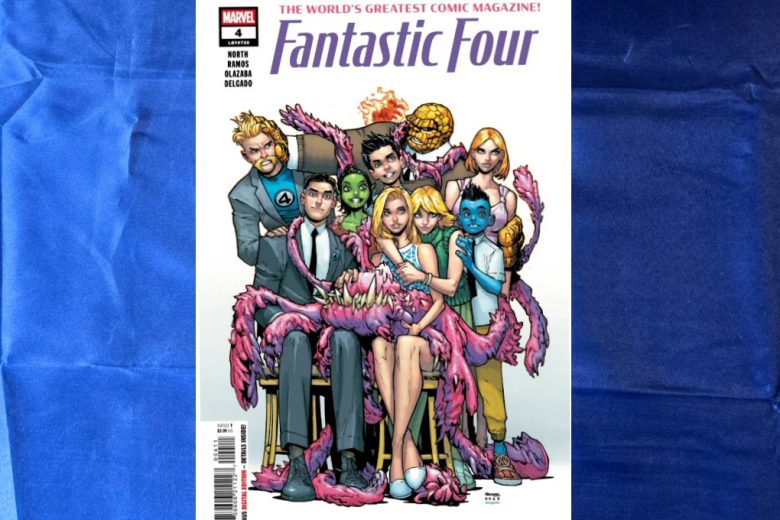
I don’t normally review single issues, but I couldn’t resist the opportunity presented by Ryan North and Humberto Ramos in their latest issue of Fantastic Four (Vol 8, issue #4, 2025, “Basic Obedience“).
This is a stand-alone, single-issue story premised on a real neuropsychological condition – pareidolia. And it just so happened to come out the day after I posted a detailed overview of the current state of research on moral decision making in the brain (“Moral Thinking, Fast and Slow“). In addition to being a great neuroscience-based premise, it’s an exciting adventure story drawn with the most insanely outstanding artwork.
I will introduce the story below and then provide some additional background on pareidolia. By the way, if you are wondering how to pronounce this Greek word in English, I first learned it as “par-uh-DOH-lee-uh” (which I realize now is a more British pronunciation). Americans typically pronounce it with different vowel sounds: “pair-ee-DOH-lyuh” (or “pair-uh-DOH-lyuh”). Either way, the emphasis is on the “DOH”.
If you would like to learn more about the Fantastic Four and its members, please check out my Fantastic Four Ethics overview. And as always, if you would like to know more about the terms I’m using on this site, please follow the links throughout or check out my Ethics 101 page or Glossary post.
Introduction to the story
The opening sentence from the pre-release summary tells you a lot of what you need to know, when paired with Ramos’ “family portrait” cover illustration shown above (with outstanding colors here and throughout by Edgar Delgado):
Alicia has returned from a sculpture convention to discover the Fantastic Four have a new pet — an adorable new dog that everyone tells her she’ll love.
That is clearly no dog … and yet they all seem to be happily blind to that fact.
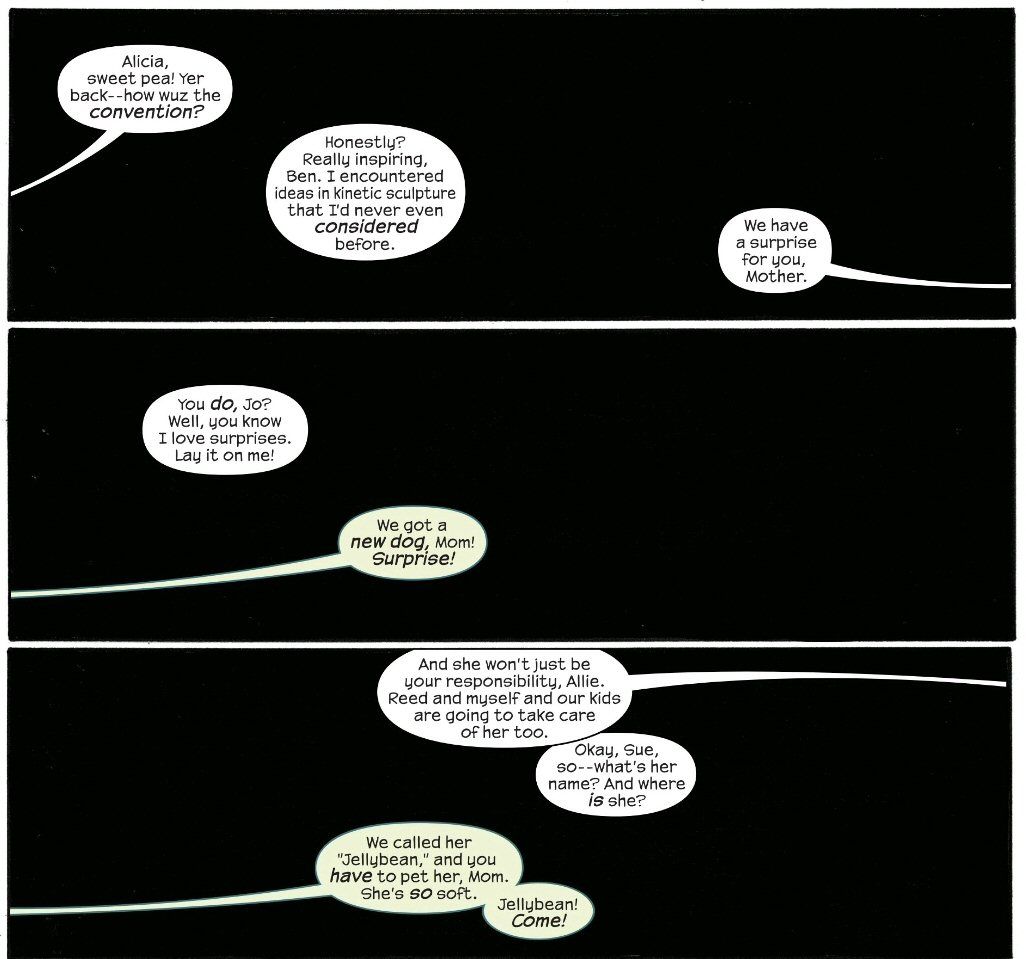
The creators emphasize Alicia’s actual blindness on the opening page, through a series of talk balloons in the dark. A few examples:
Ramos and team really sell the colorful splash page that follows:
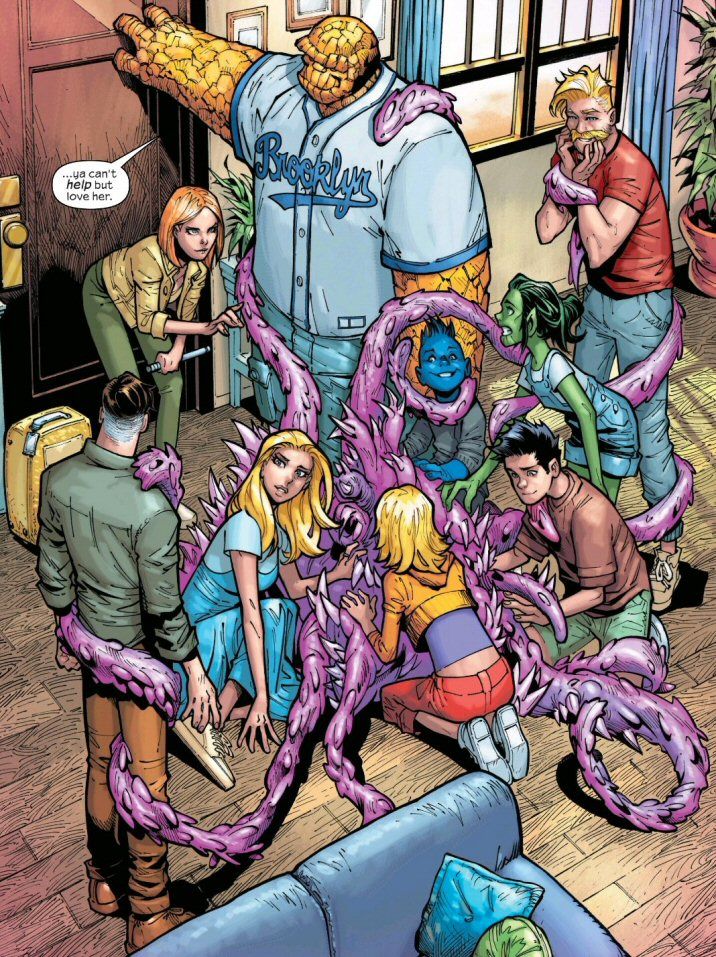
I love how enmeshed the creature is with all of them, strongly implying it is exerting control over every member of the family. But I also love how the creature’s form is disguised in these panels – we don’t get a clear view of the full creature (or its center mass).
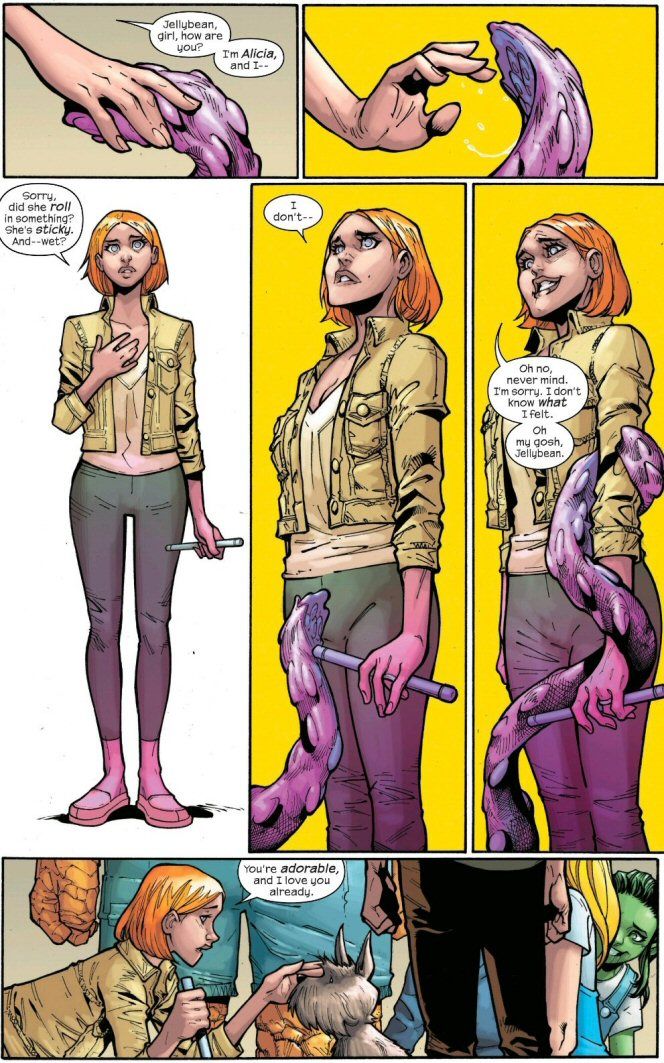
This sets the stage for the story – apparently, the more physical contact the creature has with a person, the more it can exert control over their perception.
But Alicia’s blindness – and her natural reliance on her other senses – seems to give her greater immunity to the creature’s influence. Her doubts resurface when she isn’t in direct contact.
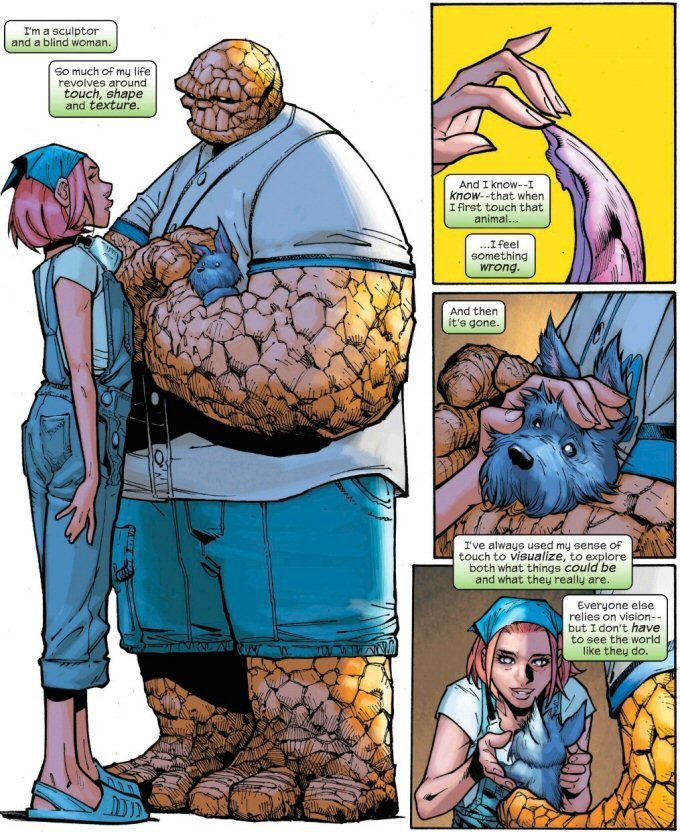
The next few panels show Alicia trying to snuggle closer to “Jellybeam”, to get a better read on it. Then the page turns, and we get to see what that is really going on with another splash page:
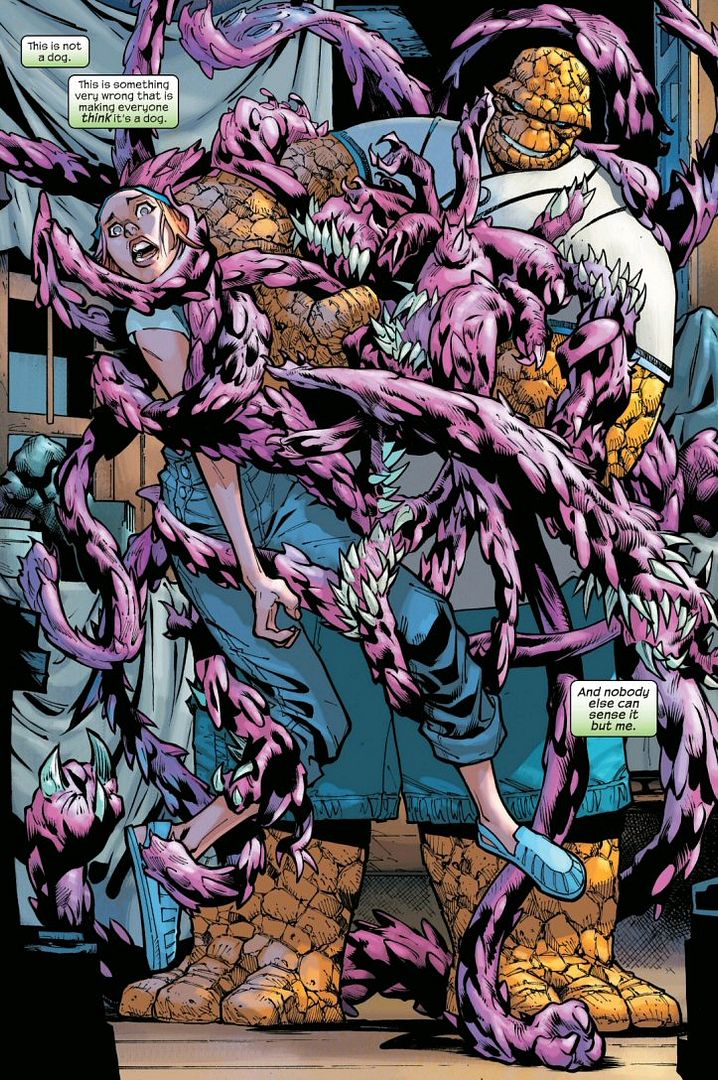
Notice how much scarier it looks now that Alicia is questioning her perceptions? The soft lines are replaced with harsh shadows, with sharp teeth/claws, not to mention the strangling posture – lifting Alicia off the ground. This is a great way to get across the presumed malign influence of this entity.
Later that day Alicia comes up with a clever way to get Reed thinking about the problem, without overtly coming out and describing her experience (since he still under its control). She asks him to hypothetically consider how a scary creature could make everyone think it looked friendly – mentally, without physical or other illusions.

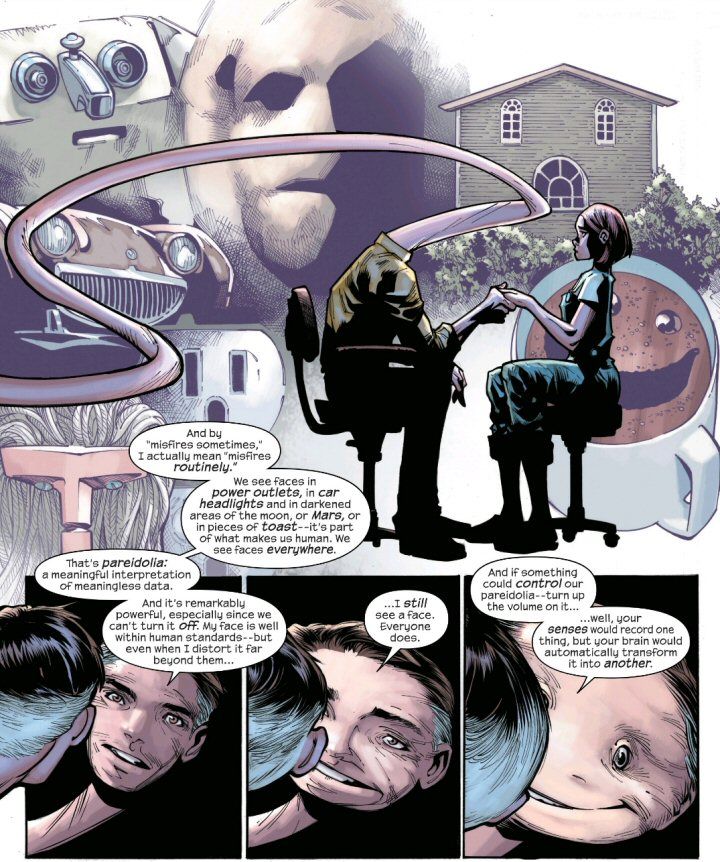
Pareidolia is when previously unseen and unrelated objects are interpreted as familiar due to previous experience and learning. Ramos’ art covers some of the famous examples of pareidolia in everyday life at the top of this last page – and you’ll note how visual they are, and how they relate to faces in particular.
North is bang on with his neuroanatomical description above – as well as how this is fundamentally a feature of our brains, not a bug. The area he mentions – the fusiform gyrus – in a region in the temporal lobe of the brain that responds to faces (specifically known as the fusiform face area, or FFA). This is ground zero for the effect of pareidolia. The FFA’s location is critical, with its close proximity to the primary visual cortex of the occipital lobe (indeed, the FFA is generally considered to be part of the visual system).
Visual recognition begins in the visual cortex (at the back of the brain), and information about potential faces is quickly sent to the FFA for dedicated processing. Likely because of how important face recognition is for social interactions, our brains evolved a region to specifically search for and identify faces preferentially. Hence the “misfires routinely” comment by Reed in the panels above – we can’t help but see faces everywhere.
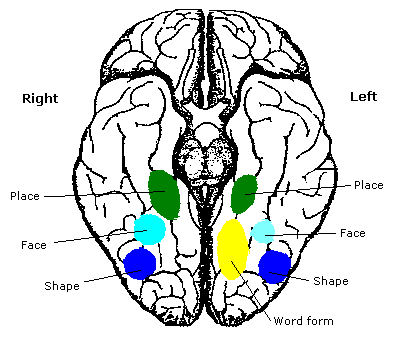
Note that recognition doesn’t end there however – information from the FFA is then sent to the prefrontal cortex (PFC) (that I described for moral decision making). Recall that the PFC is responsible for “executive functions” like decision making, paying attention, and responding to social cues. The PFC does higher-level processing of these potential faces, and integrates information from other brain regions – like the posterior superior temporal sulcus (STS), which recognizes facial expressions and combines this information with voice and auditory processes.
The PFC thus plays a key role in apophenia more generally – which is our tendency to see connections between things that aren’t there. Pareidolia is great example of a specific form of apophenia based on dedicated neural information processing, but apophenia is a common, fundamental aspect of how our brains work in general. While the ability to make connections between disparate sources of information is one of our greatest strengths, it also makes us prone to a number of fallacies and delusions (like conspiracy theories, distorted probabilities in gambling, etc.). See my earlier explanation of cognitive biases, and the Moral Thinking, Fast and Slow post to see how even our slow, deliberate “system 2” processes can make consistent errors.
Given how visually focused we are, you can see why Alicia’s blindness may be a greater challenge for the creature in terms of pareidolia. North explains this well:
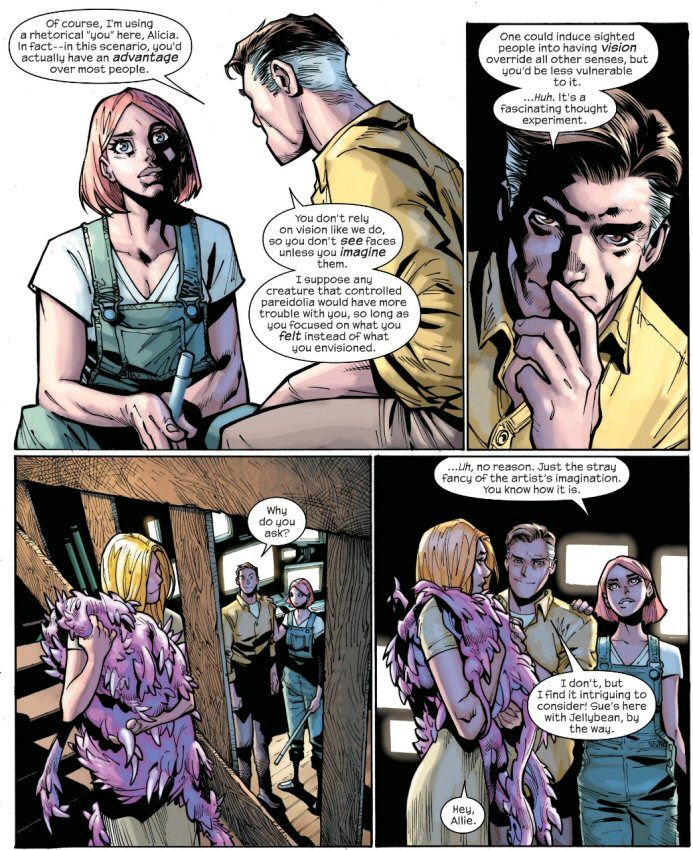
If there were any doubt as to the creature’s sinister intentions, that evening dispels them. While in bed with Ben, the creature explicitly speaks to Alicia in her mind and tells her that it knows what she is up to and that it won’t work – it is making sure everyone feels normal about this situation.
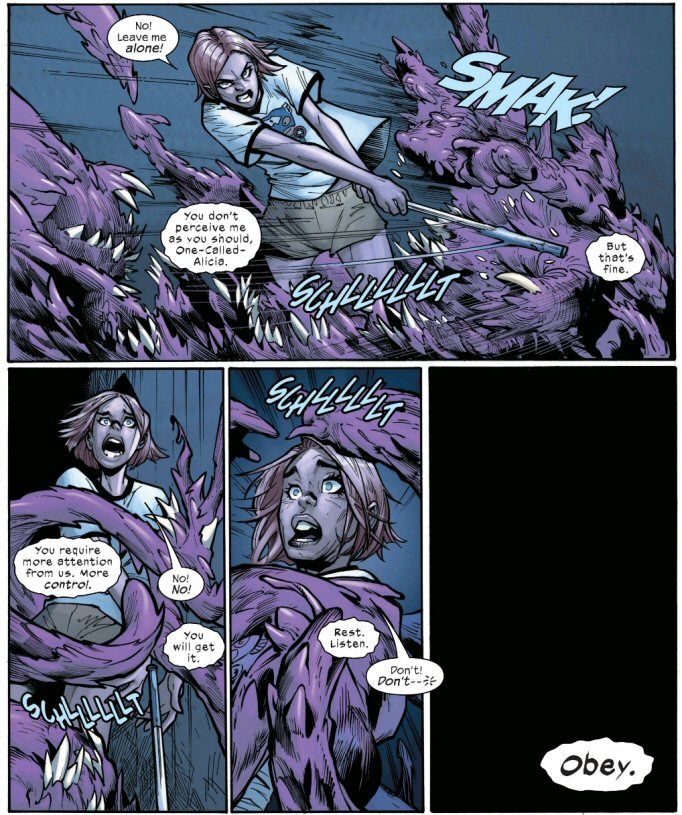
Its “more attention” during the night seems to do the trick – the next morning, Alicia is sitting well-controlled at the breakfast table with “Jellybeam” on her lap. But before morning comes, Reed has decided to stay up late in his basement lab (while the creature is off, focused on bringing Alicia to heel). Pondering the reason for Alicia’s “hypothetical” question:
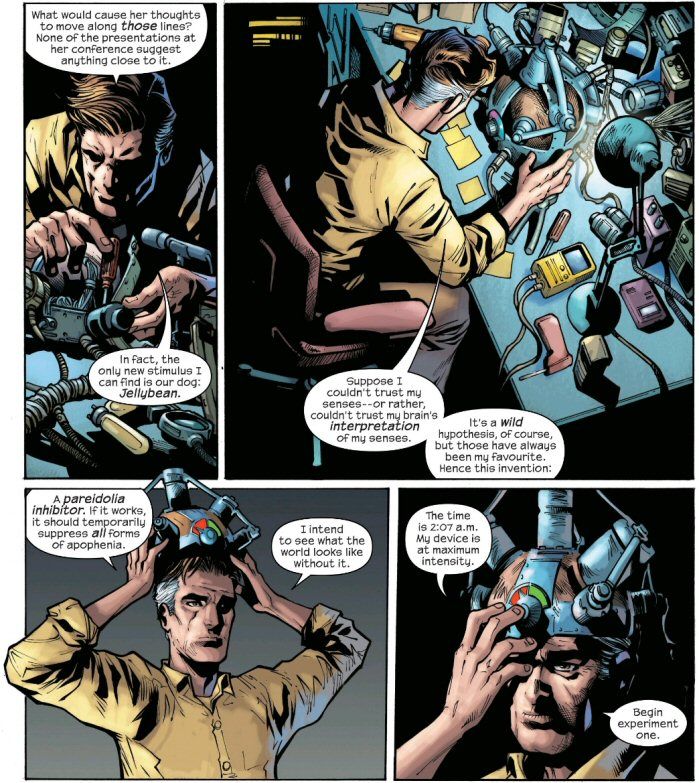
Maybe it’s just me, but I’d probably start my first brain experiment (on myself, alone) at the lowest intensity. 😉
Seriously, the design of his inhibitor actually reminds me of the early magnetoencephalography (MEG) devices. MEG is used to measure electrical activity in the brain using magnetometers arranged around the skull (you can see a more modern one here). Although MEG is an imaging device, it is often combined with the reverse process for therapeutic intervention: repetitive transcranial magnetic stimulation (rTMS). rTMS uses a fluctuating magnetic field to induce an electric current in a targeted brain area (to activate or inhibit it). I’m presuming Reed is aiming for the FFA for pareidolia specifically (as shutting down his PFC would have unpleasant side effects!).
Or maybe Ramos and North just recently re-watched the original Back to the Future movie for this design. 🙂
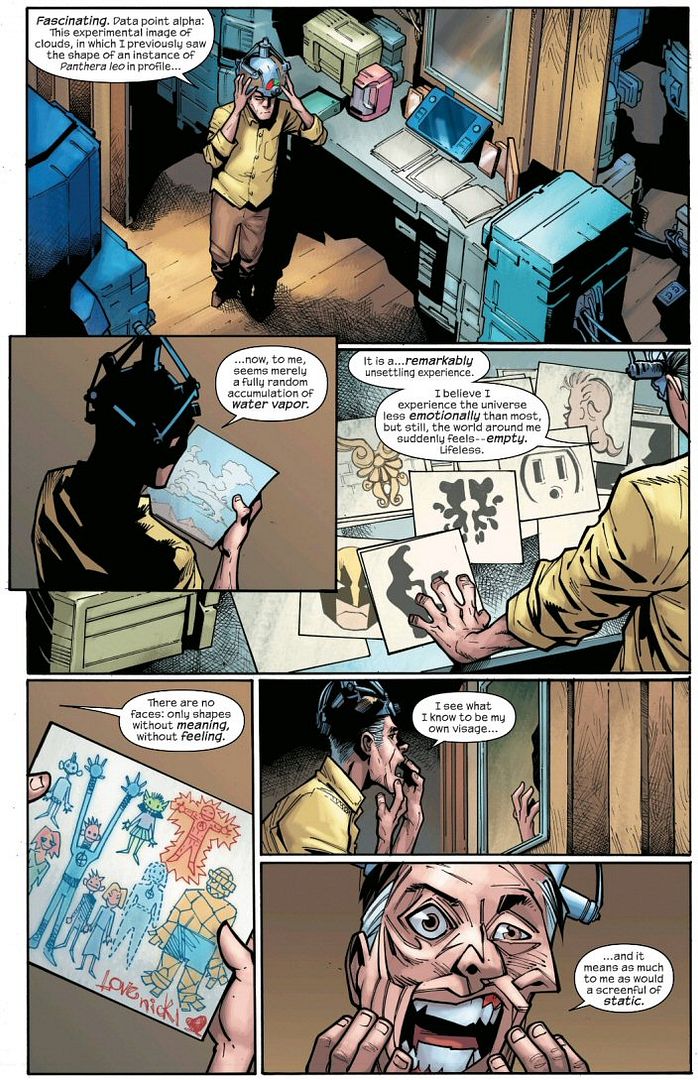
That’s a very good description and visual depiction of how people with damage to the FFA experience the world. Note that they can still see everything, but they can’t recognize people by their faces (and so, rely on other visual and auditory cues to identify individuals).
Reed decides to build a portable device that will somehow (magically!) reduce pareidolia in nearby people while still allowing them to recognize themselves. I love how Ramos has amusingly drawn this fictitious device to look like a toaster.
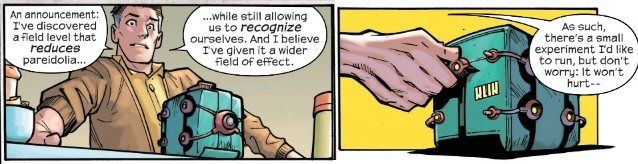
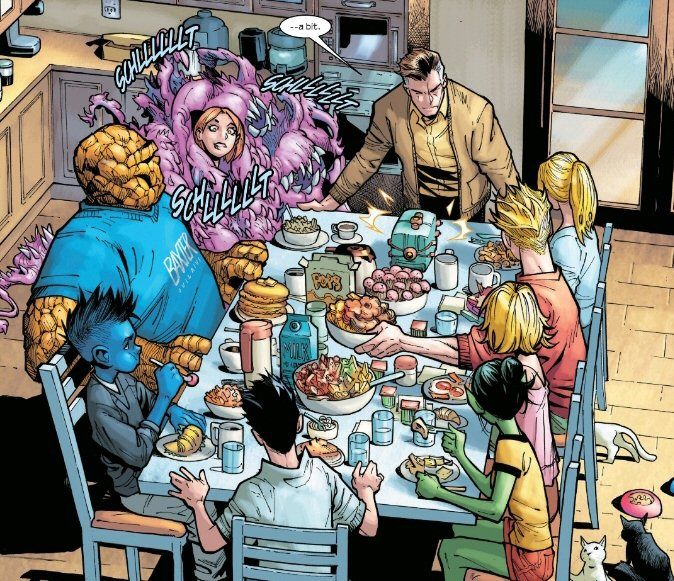
You can probably guess what happens next.
It turns out this is a much more significant story than the one-off nature of the issue suggests – it is actually a global alien invasion that would have resulted in the death of humanity had it not been for Alicia’s warning. I love the frenetic nature of what comes next – and the hilarious moments as people around the world “wake up” to what is going on. Humor is so appreciated in these side stories (especially after the – literally – doom and gloom of the preceding One World Under Doom story line). I strong encourage you the pick up this issue and see for yourself.
Again, Ramos’ art (along with Victor Olazaba‘s inking, Delgado’s coloring, and Joe Caramagna‘s lettering and speech bubble design) really sells the hidden horror nature of this story. I’ve been a fan of Ramos’ work for years – Strange Academy was a highlight, with plenty of spooky things – but this is one of the best monsters I’ve seen on the comic page. It’s amorphous and undefined nature really helps sell this story, along with its creepy-as-all-get-out way of thought-speaking.
It’s also great to have another Reed and Alicia team-up story again. I highlighted their Blood Hunt adventure together at the end of my Reed ethics overview, and mentioned how valuable I thought that pairing was in helping Reed see things he would normally miss. This adventure also ends on a nice note, with the recognition from Reed of what Alicia brings to the family/team (not to mention being responsible for literally saving humanity!).
The last word … for now
This issue was such a fun one for me as pareidolia is one of the phenomena that first got me interested in studying the brain.
Growing up, a popular past-time as a young kid was staring at clouds with my friends and coming up with imaginative ideas of what they looked like (it was the 1970s, there wasn’t much else to do!). One day, a funny thought occurred to me – how come we can’t help but see things in clouds? Even when not playing the game, shapes and faces always came unbidden. I asked this question to those around me, including adults, and was met with a lot of blank stares and shrugs. But I was left fascinated by the involuntary nature of this effect, as well other perceptual illusions that we seem to be prone to. And yes, I certainly identified with Reed in the comics as I got older!
It’s rare to see neuroscience integrated so successfully (and accurately) in a comic book adventure story. This is an issue I look forward to sharing with my granddaughter when she is a bit older (she’s not a fan of scary things – yet). Kudos to North and the art team for such a well-crafted, thoughtful, and entertaining ride!
See my Glossary post for a list of the key philosophical concepts and related links on this site.
Further Reading
More Fantastic Four: Fantastic Four
More neuroscience: Moral Thinking, Fast and Slow
More about site: Comic Philosophy 1 Year Anniversary
I am a big fan of North, love to see all the science stuff he throws in. And I liked your review of this issue, with all the neuroscience explanations. Do you have other posts like this one? I could search for “brain” I suppose, just wondering if there are specific stories you have profiled. Thanks!
In terms of neuroscience, there is of course my Moral Thinking, Fast and Slow. But if you are looking for comic stories that include how the brain works, then the next closest fit is probably my Vision overview (especially the Tom King series). I discuss identity and free will/determinism, including the only interpretation that fits with modern neuroscience (compatibilism). Which reminds me, I should go and put the “brain” category flag on that post (I only created the category recently). It will make neuroscience posts easier to find.
In terms of Ryan North, there are of course several links to his work in my Fantastic Four overview, but I don’t think I’ve mentioned him elsewhere. I’ve enjoyed his Star Trek Warp Your Own Way graphic novel (that he won a Hugo for). I do plan to review Doom one of these days (and so his One World Under Doom will be prominent). Given his science background and the integration into his writing, I’m sure he will be coming up again here eventually!
P.S.: Cool user name, BTW – assuming that isn’t your real name, of course. 🙂 Haven’t had a chance to discuss contract theory that much yet, but it will probably come up eventually.