
It’s a technique I learned in my training years. So yes, I roll what I want to roll. But it’s not cheating … it’s called being BATMAN.
- DC K.O. issue #4, 2025, by Scott Snyder and Joshua Williamson
Batman is a core character from DC comics that I have long been looking forward to profiling on this site. And dreading too, if I’m honest.
Don’t get me wrong – Batman is a great character, and obviously very popular. Along with Superman and Wonder Woman they form the so-called Trinity – the foundational superheroes of DC comics.
So what’s the problem? Well, the character has been around for 87 years, with some extremely diverse interpretations over that time – in both the comics and other media like films, TV, animated series, and games. It is no simple matter to concisely summary the ethics of a character that has been in so much flux.
Batman is also distinct from many other long-running heroes like Superman (who has been around for a few years longer) in that Batman has always exhibited multiple – and conflicting – ethics. As I explain on my Superman ethics overview, the ethics of that character has evolved and changed with time but typically remained fairly consistent over long stretches. Batman’s ethics can literally vary from one writer to the next in any given era.
As such, I’m not going to take an exhaustive historical review here but rather focus on key periods of relative stability and creators whose work either influenced others or illustrated some novel ethics. I will highlight two historic creators who I find largely dominated the field for decades, at least in terms of a key element of the character’s ethics (spoiler alert: they may not be who you think they are). I will then end with a handful of modern writers who I find are focusing on a key ethical trait that differs from earlier writers.
In roughly chronological sequence, I will be examining some of the Batman stories by:
- Historic writers
- 1. Dennis O’Neil
- 2. Frank Miller
- 3. Allan Moore
- 4. Darwin Cooke
- 5. Jeph Loeb
- 6. Judd Winick
- 7. Grant Morrison
- Modern writers
- 8. Scott Snyder
- 9. Joshua Williamson
- 10. Matt Fraction
- 11. Tom Taylor
- 12. Mark Russell
- 13. Jadzia Axelrod
This list is hardly comprehensive though – I’m leaving out many outstanding writers, including many whose Batman works I have thoroughly enjoyed. But I have a specific normative ethics focus here, and I find the ones above say something interesting in that regard. Please forgive me if I have neglected a writer of significance to you!
As always, if you would like to know more about the terms I’m using on this site, please follow the links throughout or check out my Ethics 101 page or Glossary of Terms post.
Introduction to the character
As alluded to above, Batman is one of the oldest characters in the history of American superhero comics. He was created in 1939 by comics artist Bob Kane and written by Bill Finger, first appearing in Detective Comics Vol 1, issue #27.
As I describe on my understanding DC Comics page, the DC comics universe underwent continuity-ending hard reboots in 1956, 1985, and 2011. 1985’s Crisis on Infinite Earths began the modern age of DC comics, creating “Earth-0” or “New Earth”, with redefined characters. Things soon got messy however, with numerous retcons and additional “crises” over the years. Eventually, 2011’s Flashpoint ended New Earth and started Prime Earth (also unhelpfully called Earth-0), through The New 52 event. There have been numerous soft “rebirths” since then, but the New 52 onward is typically the best place to start describing modern characters’ background and abilities.
Batman was born Bruce Wayne in Gotham City, to wealthy parents – physician and philanthropist Dr. Thomas Wayne and socialite Martha Kane. The defining trauma of young Bruce’s life was seeing his parents gunned down in front of him when walking home from a movie theater opening. Bruce was effectively raised by the Wayne family butler, Alfred Pennyworth.
When the wealthy Bruce reached young adulthood, he embarked on a global journey to find himself. He encountered Ra’s al Ghul, the mysterious leader of an ancient group known as the League of Assassins – highly-trained warriors that Ra’s uses to destabilize governments to remake the world in his image. Ra’s training prepared Bruce both physically and mentally for the challenges of being Batman, but Bruce rejected Ra’s worldview – and has staunchly opposed him ever since.
Returning to Gotham, and with the help of his loyal friend Alfred, Bruce takes up the secret identity of Batman – the dark and brooding vigilante protector of Gotham, who dresses as a bat to strike fear into the hearts of criminals. By day, Bruce plays the role of a billionaire industrialist and notorious playboy as cover for his secret identity.
Bruce has no superhuman powers, but he is in peak physical condition and is extensively trained in many forms of combat. He displays rigorous mental self-discipline and has a virtually unlimited budget to develop tactical equipment and gear. He is brilliant and a master strategist, proactively developing long-term plans to anticipate and defeat his opponents. And, if needs be, his friends – he is known to have devised countermeasures for all the major heroes in the Justice League, including those far more powerful than him. He is also an expert tactician, rapidly adapting his actions as the situation demands.
Although Batman has a reputation of being a loner (especially in the early comics), he has increasing surrounded himself with allies. Informally known as the “Batman Family” (or Bat-Family), this extended family of crime fighters includes the various Robins, Batgirls, and Batwomen over the years, along with many others like Nightwing, the Oracle, and sometimes even Catwoman. Police Commissioner Jim Gordon and Alfred have also long played supporting roles to Batman and the larger group.
Introduction to the ethics of Batman
As I explain on my Ethics 101 page, there are three branches to normative ethics, which is the field of moral philosophy that considers the question of what people should or ought to do.
Deontology is concerned with doing your duty to other people, often through the lens of rights or justice. These theories are often principle- or rule-based and focus on the moral value of the acts themselves (that is, doing the right thing).
Consequentialism is seen as the opposite, focusing not on the acts but rather on their outcomes. These theories typically explore the moral burden of making good decisions (that is, doing the good thing).
The third branch is virtue ethics, which shifts the focus from the act to the actor – being the best person you can be, typically by practicing virtues that align with your values and goals (that is, being better).
Given his long history, it probably won’t surprise you that Batman has displayed aspects of all three branches. But Batman is distinctive as he often shows all three of them at the same time, in the hands of individual writers.
Batman’s no-kill policy
To really understand the ethics of Batman (and how they have changed over time) there is one critical question to address: Why does he not kill?
I realize that may sound surprising if you know Batman mainly from the films or other media. But in the comics, it was established by 1940 that he doesn’t use guns and steadfastly refuses to take a life.
As I alluded to in my recent Supergirl ethics overview, big-screen blockbuster movies tend to be heavy on spectacle and somewhat shallow and flattened ethically compared to their source material. And the conventions of cinema are different – how satisfying would the ending of Die Hard have been if John McClane had simply arrested Hans Gruber? To put it simply, movie audiences expect resolution, comics readers expect continuity.
The initial reason given by writer Bill Finger for the no-kill rule was because of the effect on Bruce of having seen his parents killed in front of him. To prevent that kind of tragedy again, Bruce resolved never to take a life. For a great historical overview of Batman’s no-kill vow, check out Alex Jaffe‘s article on the subject over at DC.com.
As we will see, later writers came up with some increasingly creative rationales for this rule – especially as it stands in the face of the character’s other ethics frameworks. I find that it is this tension around the no-kill rule that drives a lot of the ethical diversity of the character in the comics and will underpin my analysis below.
Defining historic eras of Batman’s ethics
1. Dennis O’Neil (1970s)
The best place to look for the start of consistent ethics in Batman is Dennis O’Neil‘s iconic run writing the character in the early 1970s, with legendary Batman artist Neal Adams. Note that O’Neil wrote the character sporadically in this era (his main run was 1971-75), left for Marvel in 1980, and eventually returned to DC predominantly as an editor in 1986 – where he oversaw all Batman titles until his death in 2000.
O’Neil and Adams were responsible for crafting the dark, brooding “Dark Knight” version for the character, with a grittier and more Gothic tone for Gotham. O’Neil pulled Batman back from the campy 1960s TV era toward a more classically heroic character, although in a pulpy way with darker overtones. While O’Neil described this as returning to the character’s roots, readers and scholars eventually saw this as a redefined Batman that all later versions would build on. This is why so many point to this period as the best place to start a Batman comics journey.
From O’Neil’s first issue as writer – Batman Vol 1, issue #232 (1971), with art by Adams – where he introduces Ra’s al Ghul:

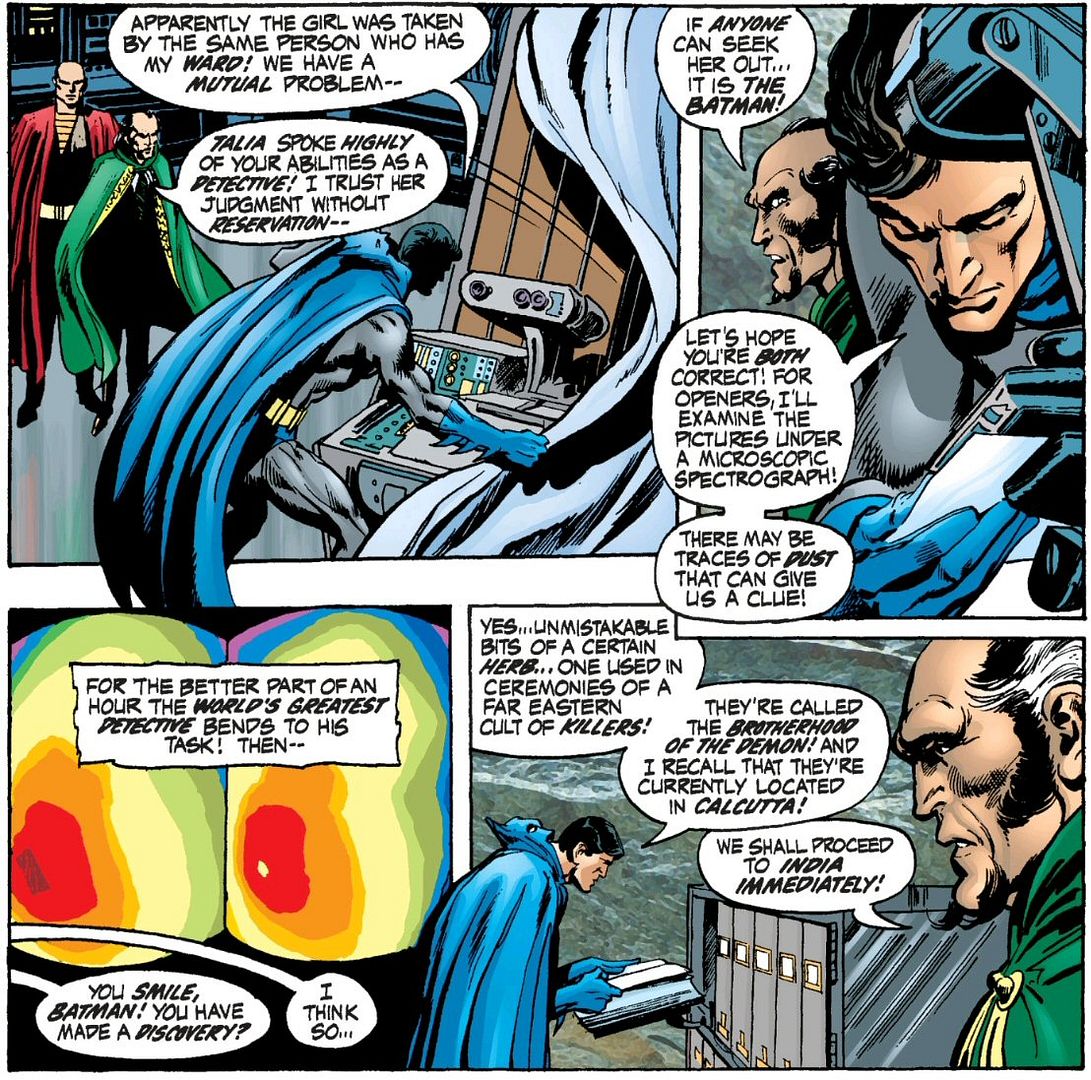
I like the return to the “World’s Greatest Detective” title, which we see in action as Bruce uses deductive reasoning repeatedly in this issue – including to identify al Ghul as Robin’s ultimate abductor:
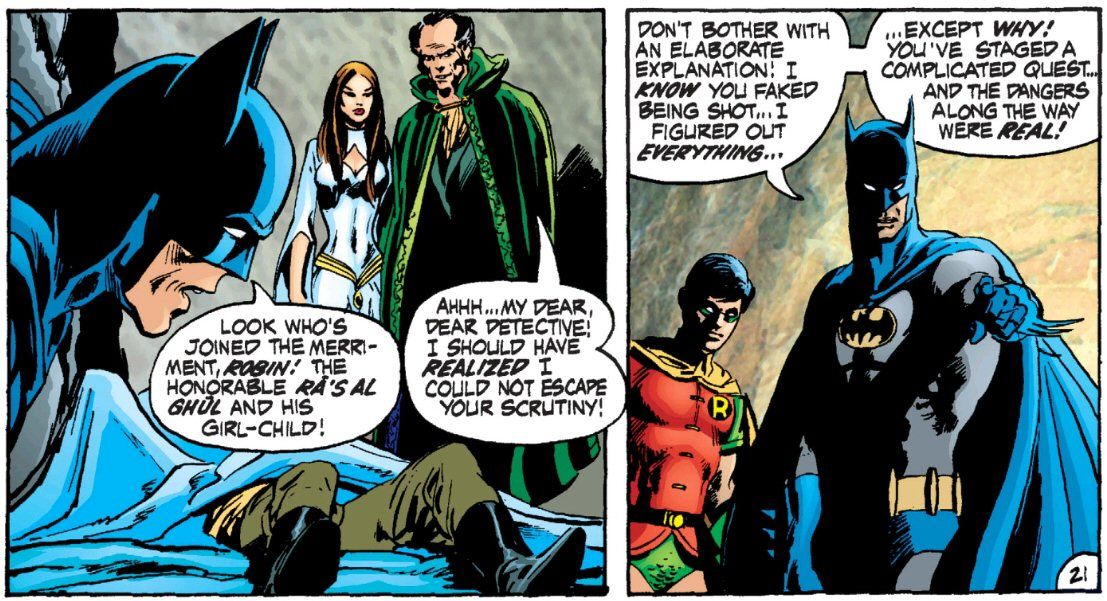
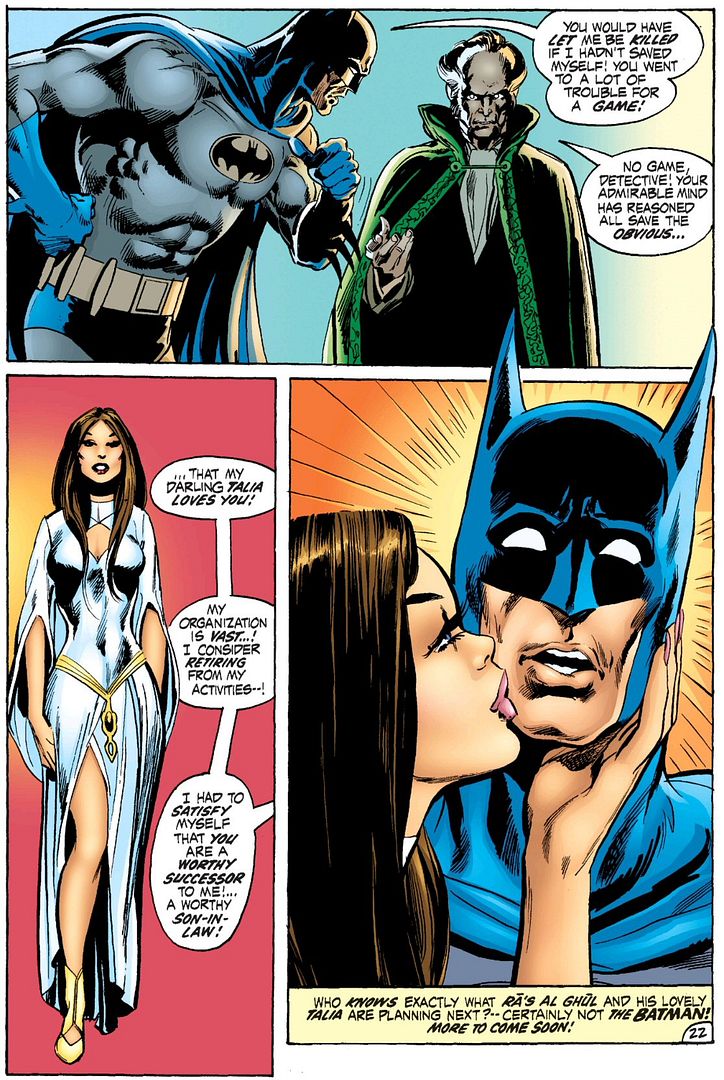
Of course, this origin for Ra’s al Ghul (and Talia) is revised later in the comics. But his creation as a key antagonist (and eventually, as a formative part of Bruce’s development) was used to accentuate Batman’s status as an expert tactician and master planner in this era.
In terms of ethics, this era is one of the clearest examples of deontology in the comics. As a detective, Batman is dedicated to justice, including respect for due process (even though he operates outside of the law). O’Neil also firmly established the no-kill rule as a non-negotiable foundational element for the character. His Batman treats killing as categorically wrong, even when it would seemingly produce better outcomes. His Batman also shows a strong sense of duty, especially when it comes to protecting the people of Gotham and those closest to him.
While this is probably the closest Batman ever gets to being somewhat Kantian in his ethics, he certainly never reaches the level of his contemporary Superman in this time period (see my Superman ethics for an explanation of this deontological ethics theory). Interestingly, Batman can also be a pretty ruthless consequentialist – he plans extensively for contingencies, frequently manipulates people and situations, and considers intimidation and violence toward criminals as a justified means to protect the innocent. His heavy use of strategy and tactics to achieve his ends is also very consequentialist.
Ultimately, this era firmly established the conflicting deontological and consequentialist drives as the core ethics for the character.
2. Frank Miller (1986-87)
With Denny O’Neil’s return to DC, he brought with him Frank Miller to write a pair of iconic Batman stories – Batman: The Dark Knight Returns (1986) with art by Miller and Klaus Janson and Batman: Year One (1987) with art by David Mazzucchelli.
Although taking place in an alternate universe (Earth-31), Miller’s Dark Knight Returns paints Batman as more a consequentialist vigilante than a principled deontological hero. His Batman is older, angrier, more willing to use force, and operates fully outside of state institutions. From the first issue, by Miller and Janson (note that the individual issues each had specific titles, but the collected series goes by the Dark Knight Returns, which is the title of the first issue):
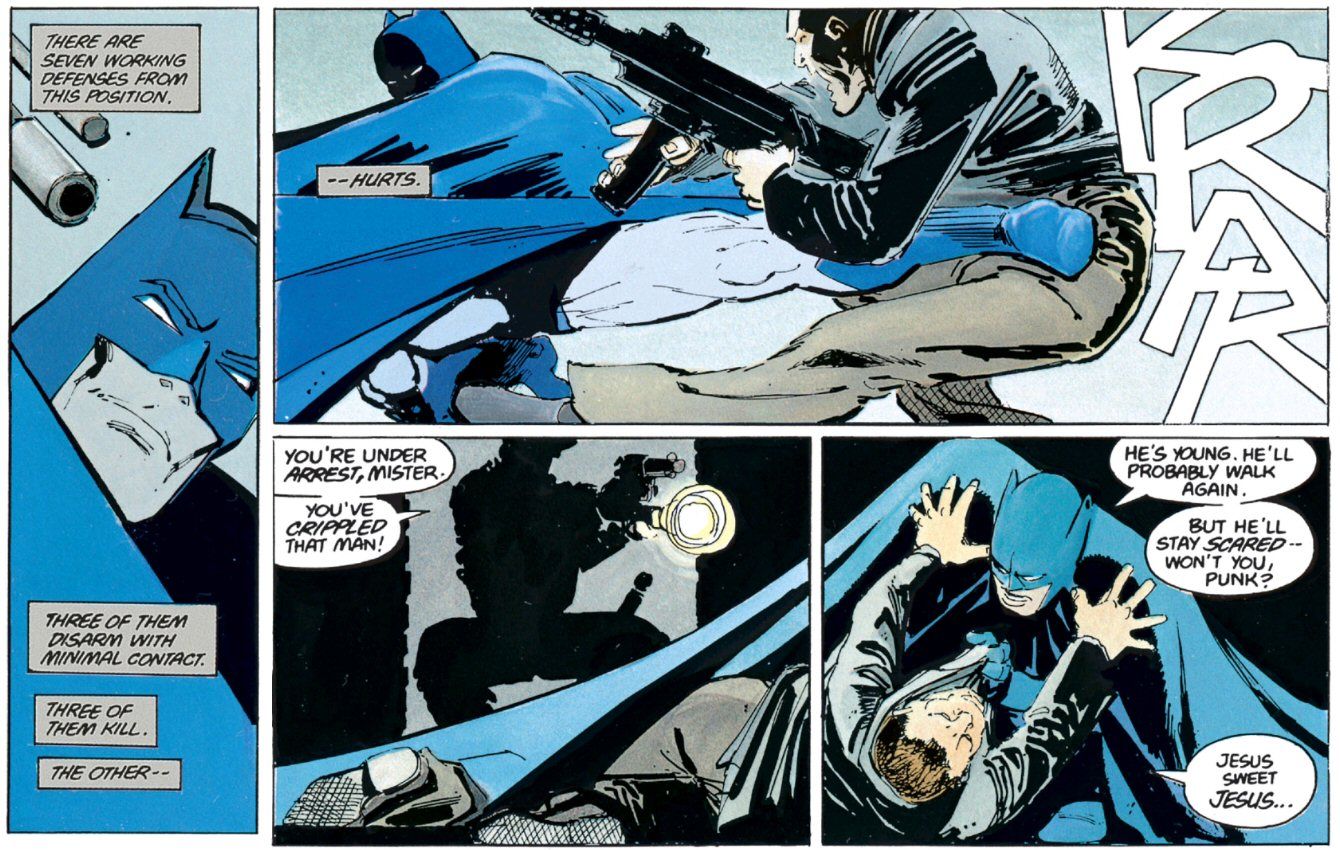
Yes, that’s an interesting middle-road option this Batman is taking! It gets worse, as he forces criminals to talk:
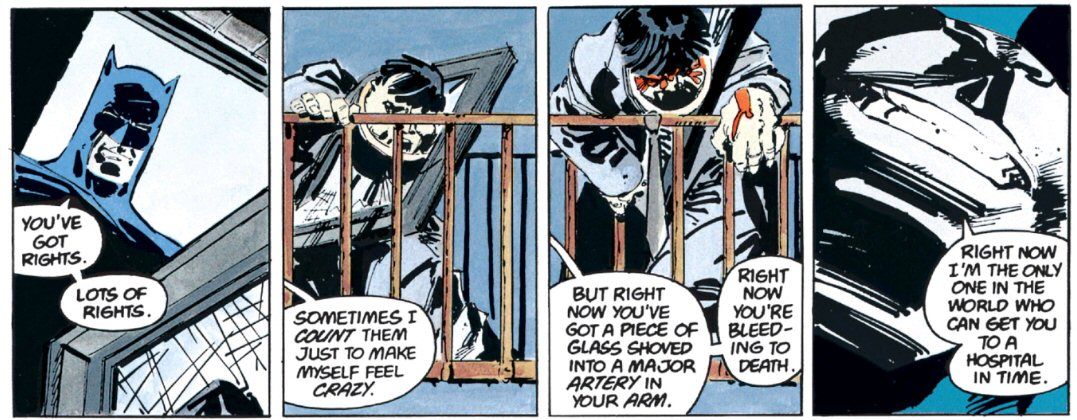
And in a real break with tradition:
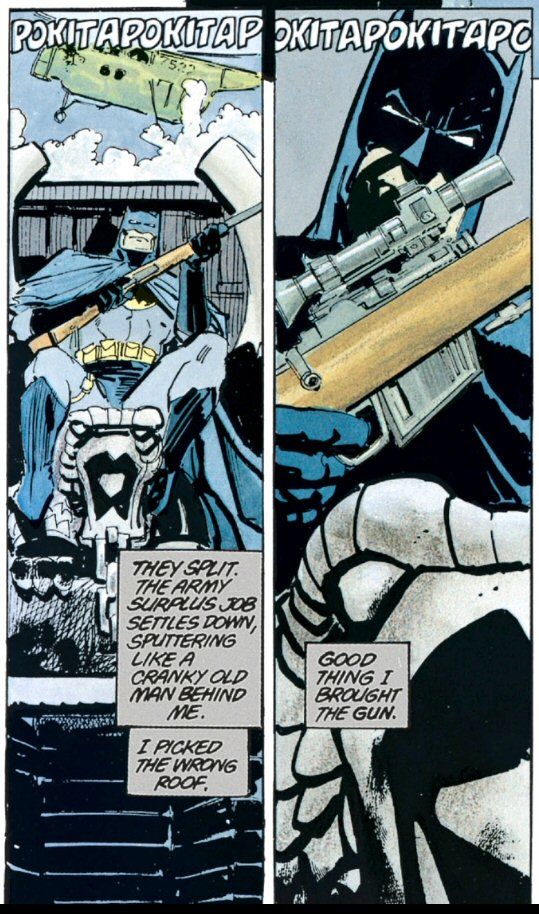
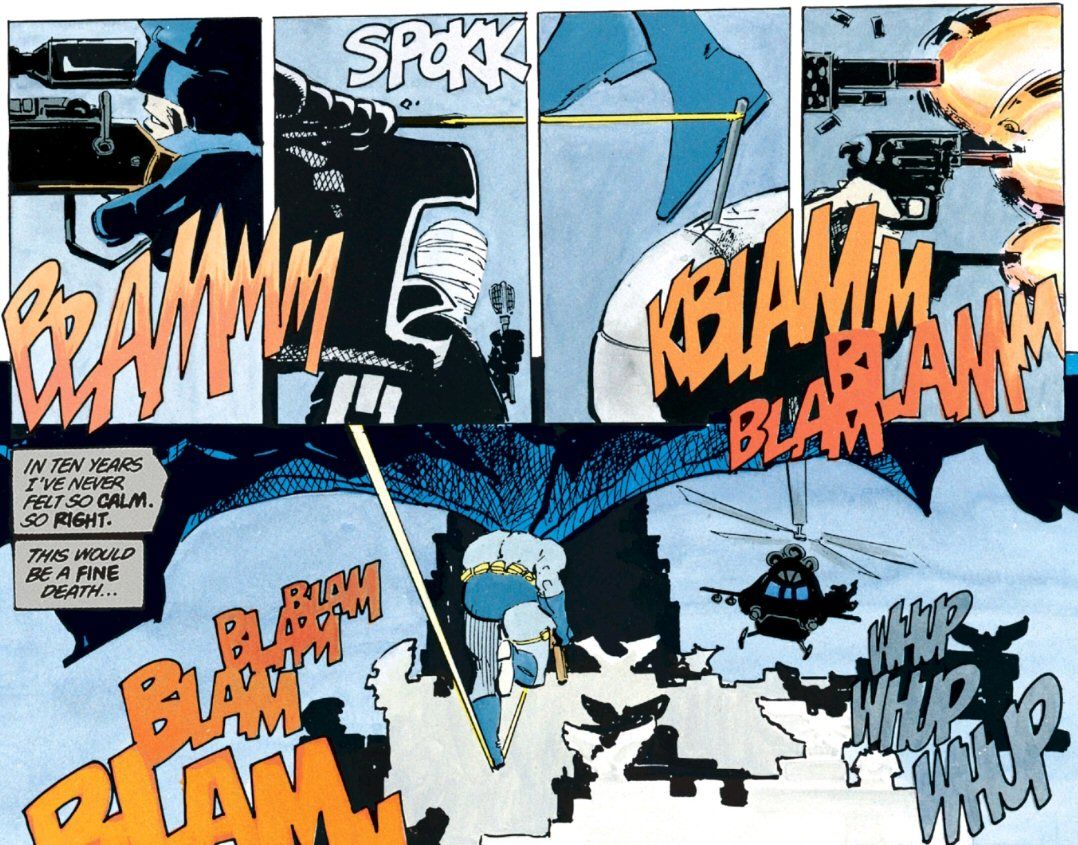
And this is just the opening issue – it goes considerably downhill from here!
While Miller’s darker take above wasn’t a literal part of continuity for the character, it became a major figurative part for how other creators saw him in this era. As we move into the late 1980s and 1990s, we typically find a much more ends-justify-the-means sort of character, with the no-kill rule under greater stress. Reading it again, Miller’s alternate take strikes me as almost Nietzschean in its tone, with his Batman as a sort of Ubermensch – the ideal of a strong man imposing order through the force of his will, skeptical of the role of the state.
As an aside, Miller’s later writing went down something of authoritarian rabbit hole for Batman (and some other characters) and doesn’t get as much interest as this earlier era. Unquestionably though, the darker tone of the early Miller Batman stories set the stage for much of what was to come in New Earth continuity.
3. Alan Moore (1988)
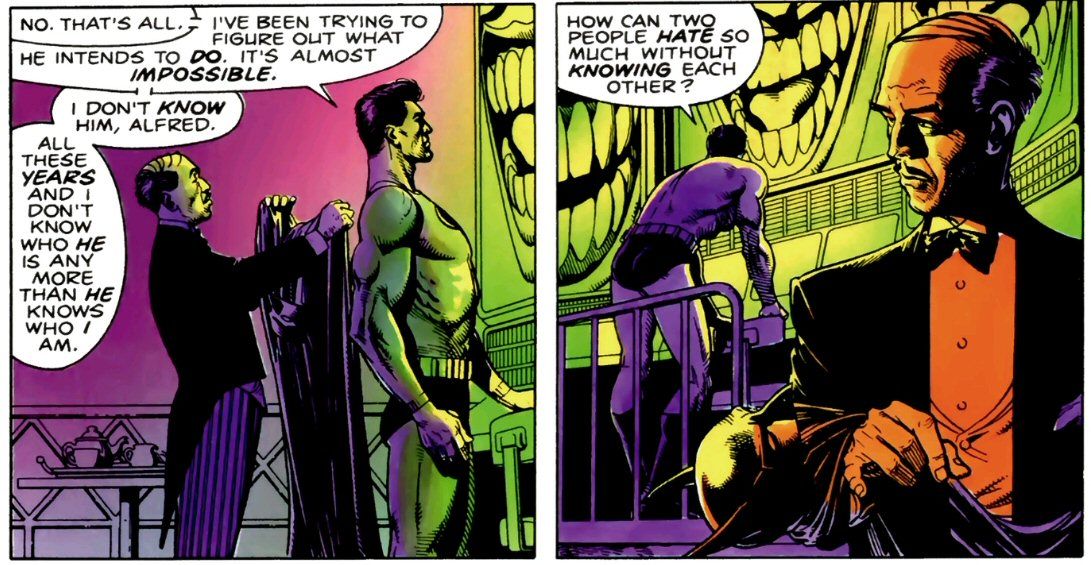
While Miller gets a lot of credit for revitalizing Batman, I find the most influential writer for this period – certainly in terms of Batman’s psychological stability and ethics – was Alan Moore. Moore’s Batman: The Killing Joke graphic novel (1988), with art by Brian Bolland, directly influenced how writers would see the character for at least the next several decades. As a result, I will go through this story in some detail.
In this early scene, Batman seemingly visits the Joker in Arkham Asylum, to see if they can overcome their differences and avoid the dark path they are on:

But the Joker had escaped the asylum, and Bruce vows to bring him in. One of the key assertions of this series is that Batman and the Joker are effectively mirror images of each other – two sides of the same coin.
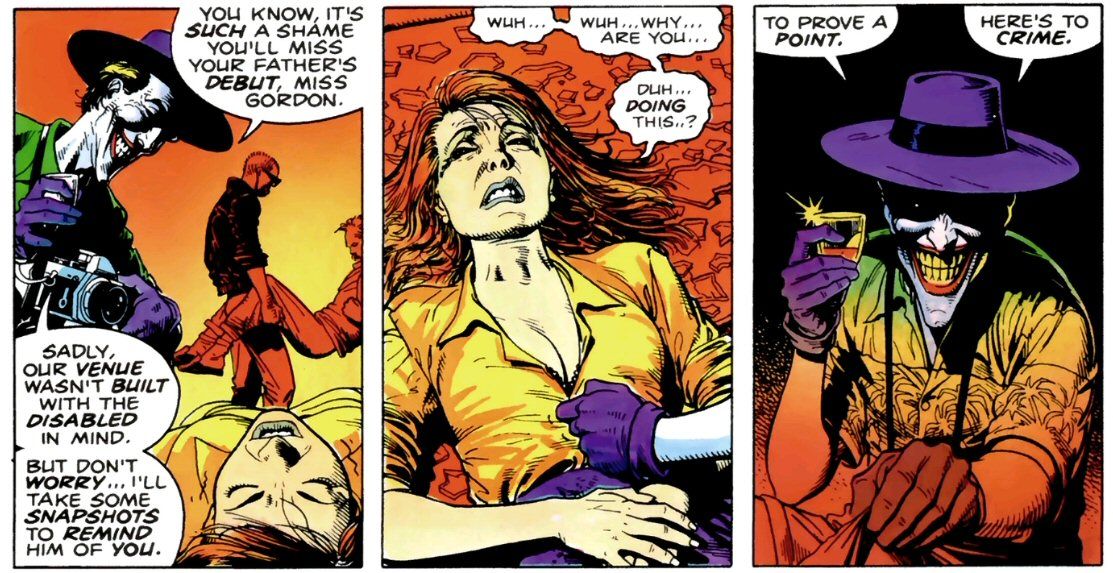
The Joker takes his depravity to a new level in this series, when he visits Commissioner Gordon’s home and shoots his daughter Barbara, paralyzing her. He then strips her naked and photographs her:
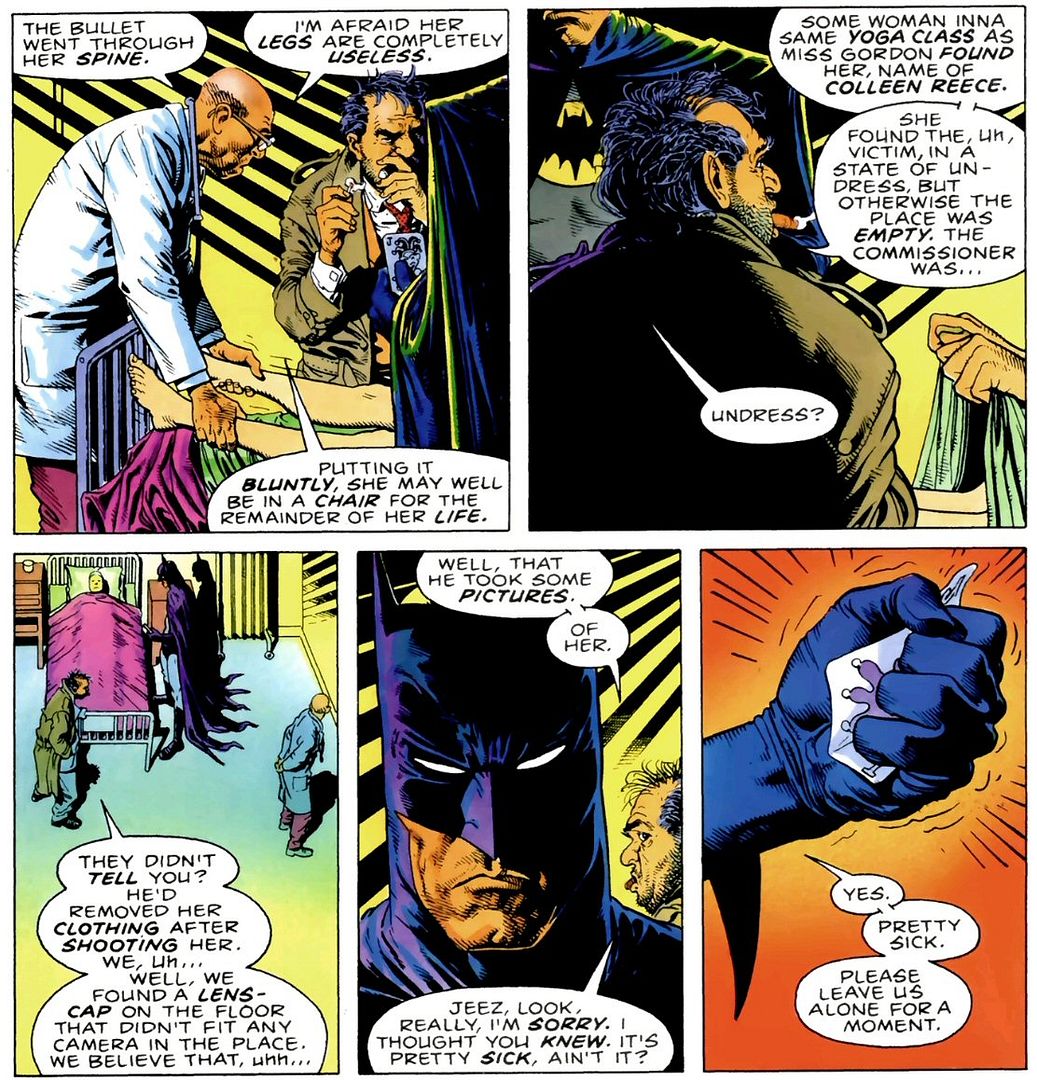
The Joker then tortures Gordon with the photographs of his daughter – and further ridicules him for his sense of morality.
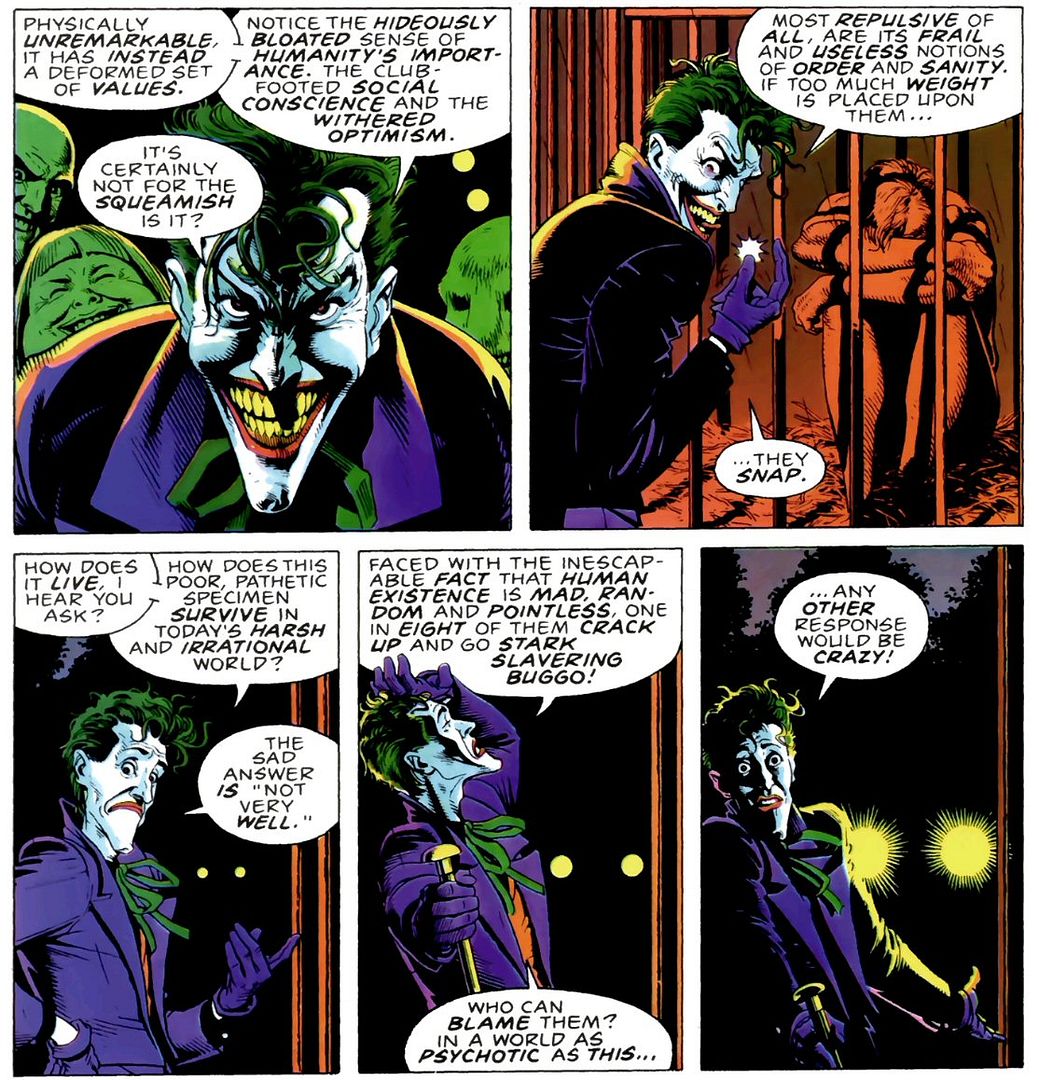
This is as a clear a depiction of nihilism as I can recall seeing for the Joker – something later writers will pick up on and expand (jump down to my Scott Snyder overview for some related philosophical concepts and links).
Despite this abuse, Gordon remains resolute in his convictions when Batman comes to rescue him:
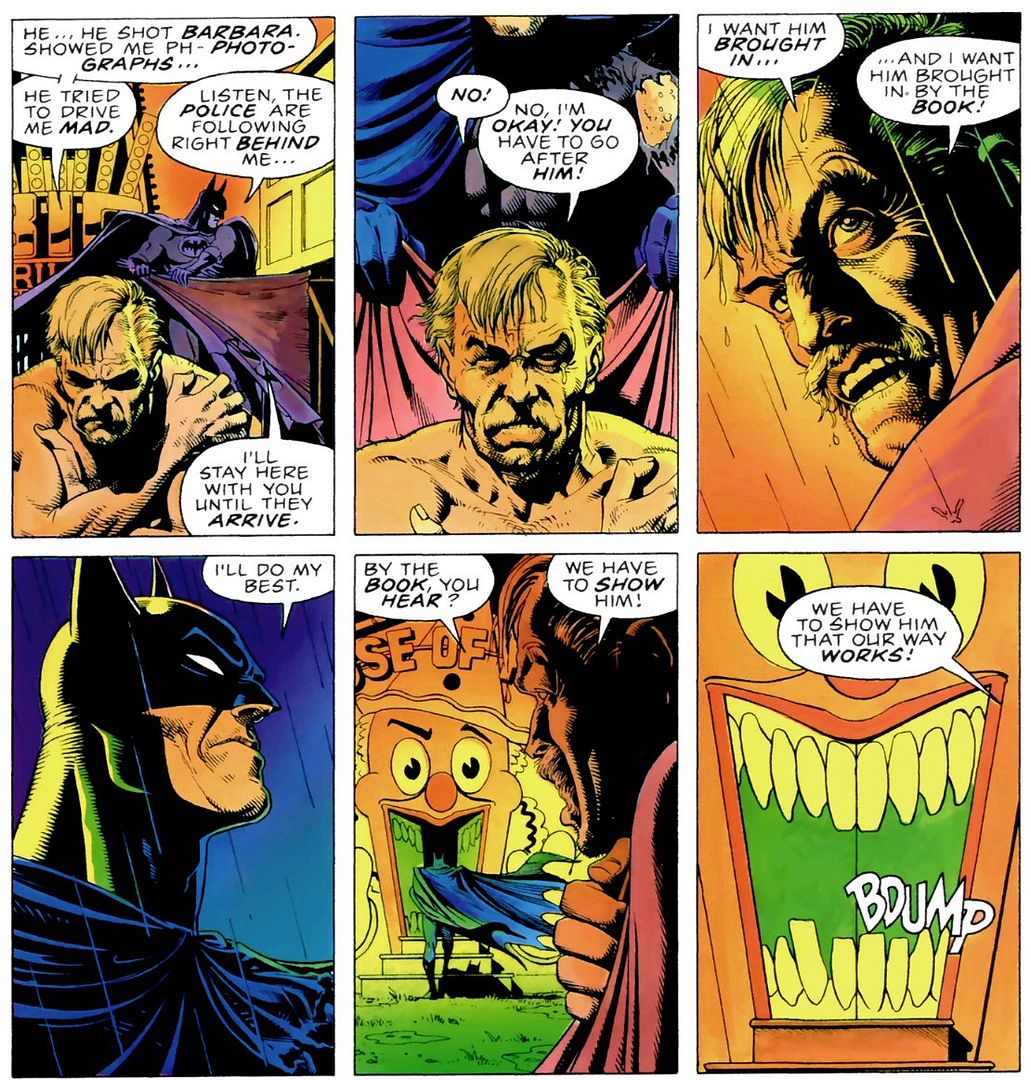
The story then moves to its climax, where the Joker explains his key point – all that separates others from him is “one bad day”. Moreover, he astutely observes that Batman himself has experienced such a bad day:
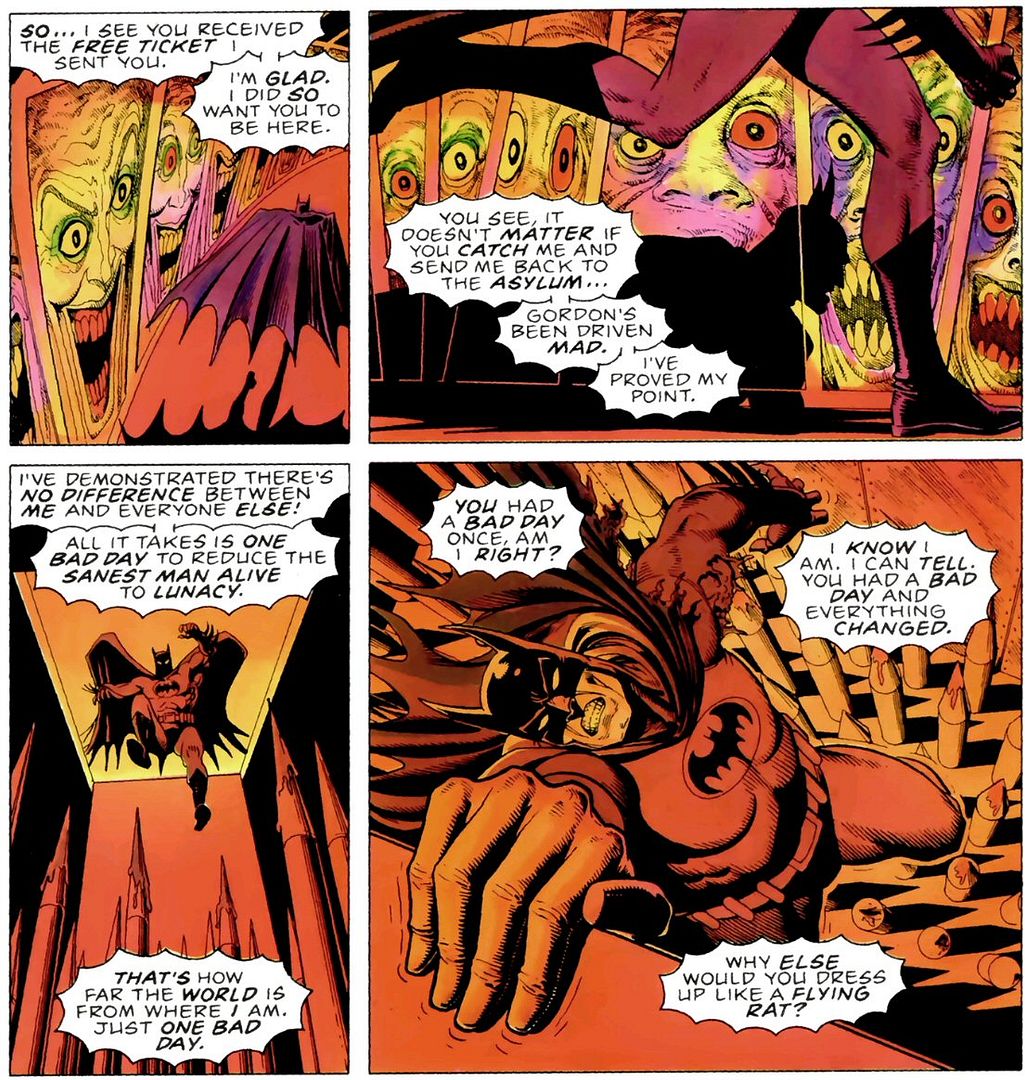
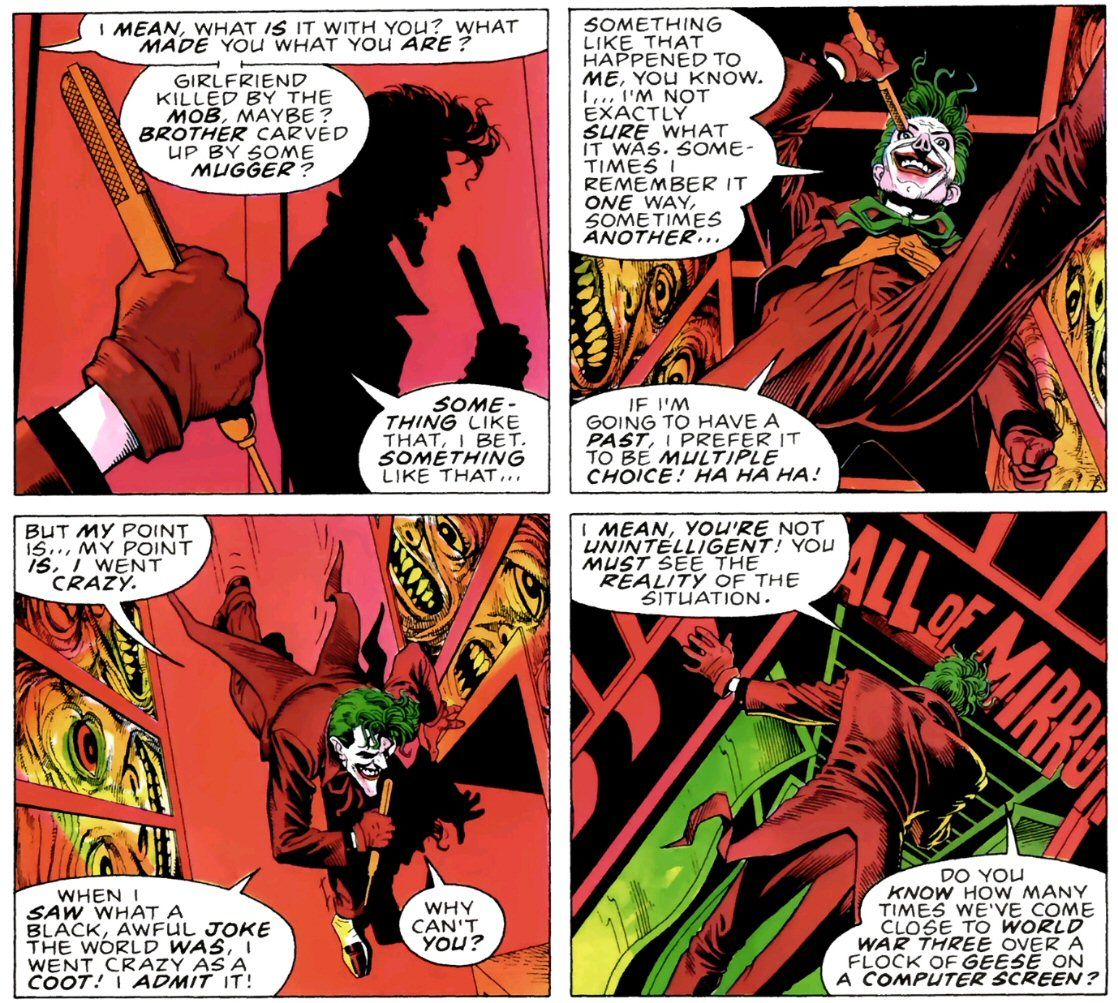
Interestingly, the Joker is an unreliable narrator of his own story, as he recounts different possible origin stories for himself. See my Supergirl ethics overview for some thoughts on the unreliable narrative motif in literature.
In the end, Batman returns to his point from the beginning:
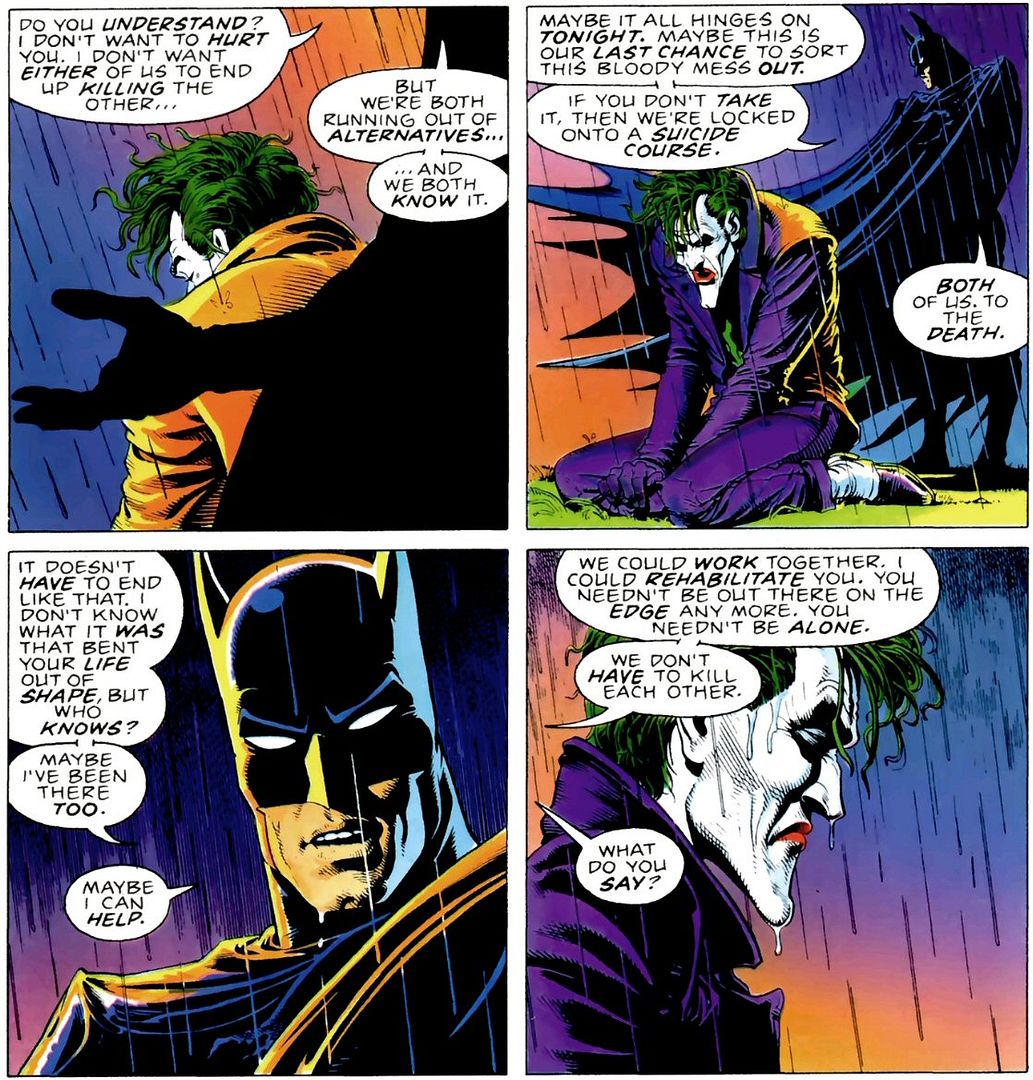
But the Joker politely declines, and offers to explain why through a joke that symbolizes their relationship from his perspective (as a pair of insane men):
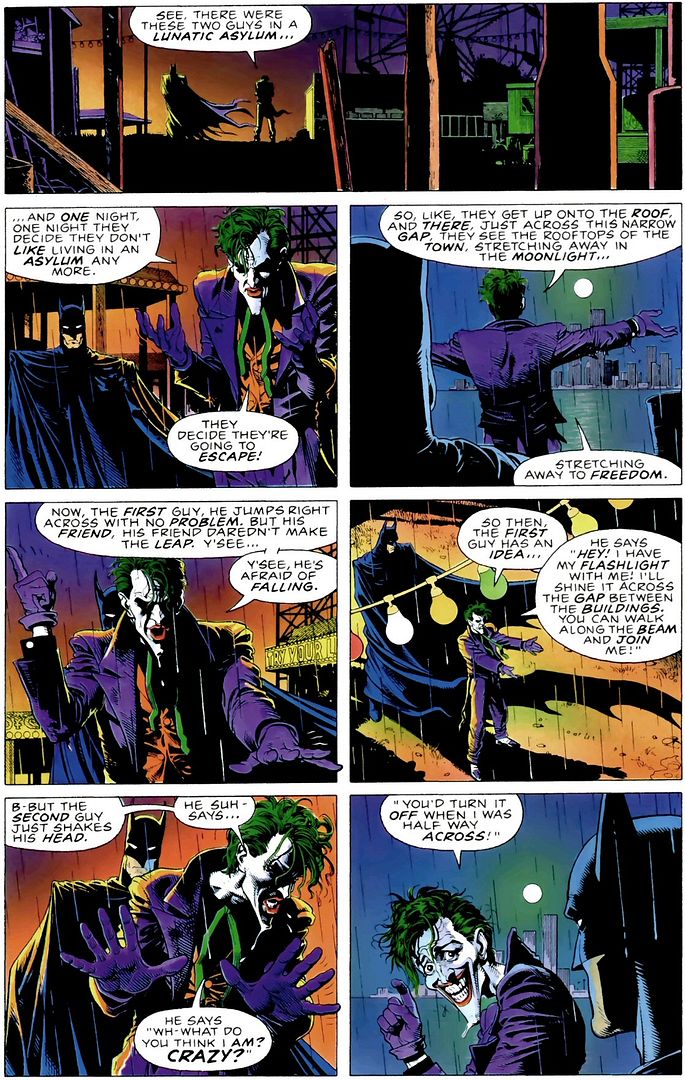
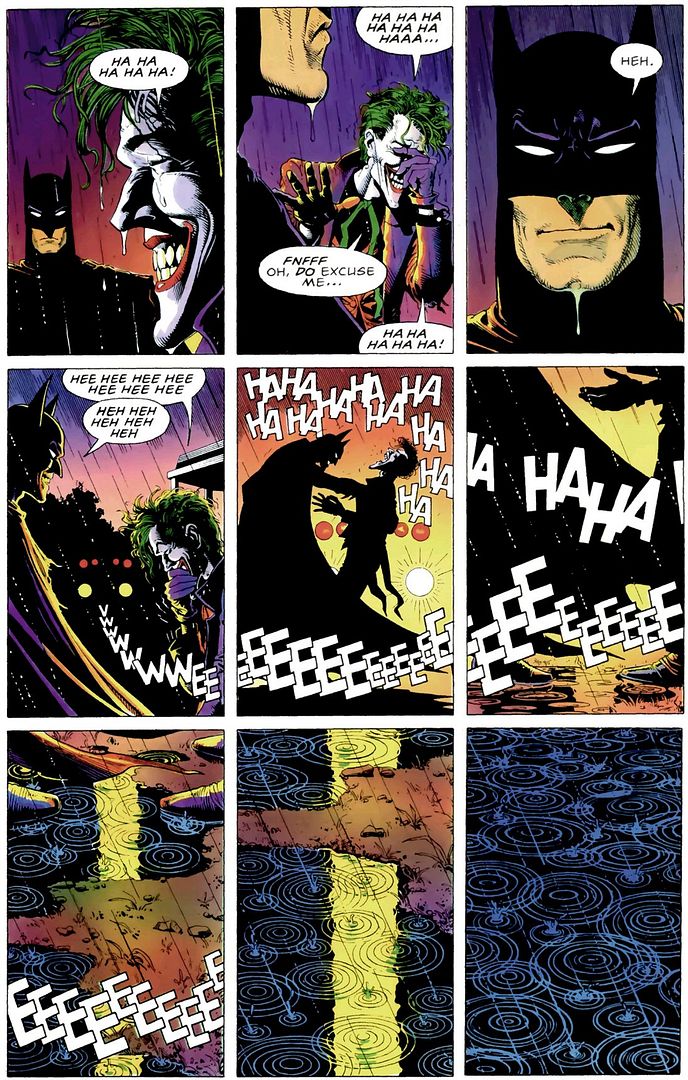
Taken at face value, this ending could just represent Batman and the Joker having a lighthearted moment at the end of a grim story – before their usual cycle repeats.
But the brutality of the Joker in this series, and his explicit goal of turning others into a version of himself, have led many to take this ending more ambiguously. Does Batman attempt to kill the Joker in the middle panel above (or succeed, in keeping with the series title)? At a minimum, this series shows them locked in an escalating cycle of violence, with the clear implication (as repeatedly stated by Batman) that it can only result in one or both of their deaths.
I find there is a pronounced shift in Batman stories after Moore’s The Killing Joke, with darker psychological undertones rising to the surface. The idea that Batman (or anyone, really) is “one bad day” away from becoming the Joker starts to become a staple of Batman storytelling from this point on.
4. Darwyn Cooke (2000)
A good example of the persistent effect of Moore is the Batman: Ego graphic novel (2000), written and drawn by Darwyn Cooke. Here, a physically and mentally drained Batman tries (and fails) to save the life of an accomplice of the Joker who has betrayed him. The accomplice has already killed his own family, to spare them the Joker’s wrath, before killing himself – all because he lacks faith in Batman or the police to stop the Joker.
In his grief, Batman’s psyche breaks down and his ego dissolves, leaving us with only the other two main elements of psychodynamic theory – the impulsive and vengeful id (represented by Batman) and the rational and moralistic superego (represented by Bruce). See my Daredevil ethics overview for an explanation of this Freudian theory.
The Badman-id wants to be free to do what it takes to stop villains – including killing the Joker. The Batman-id eventually proposes they voluntarily split themselves into two halves, like Harvey Dent:
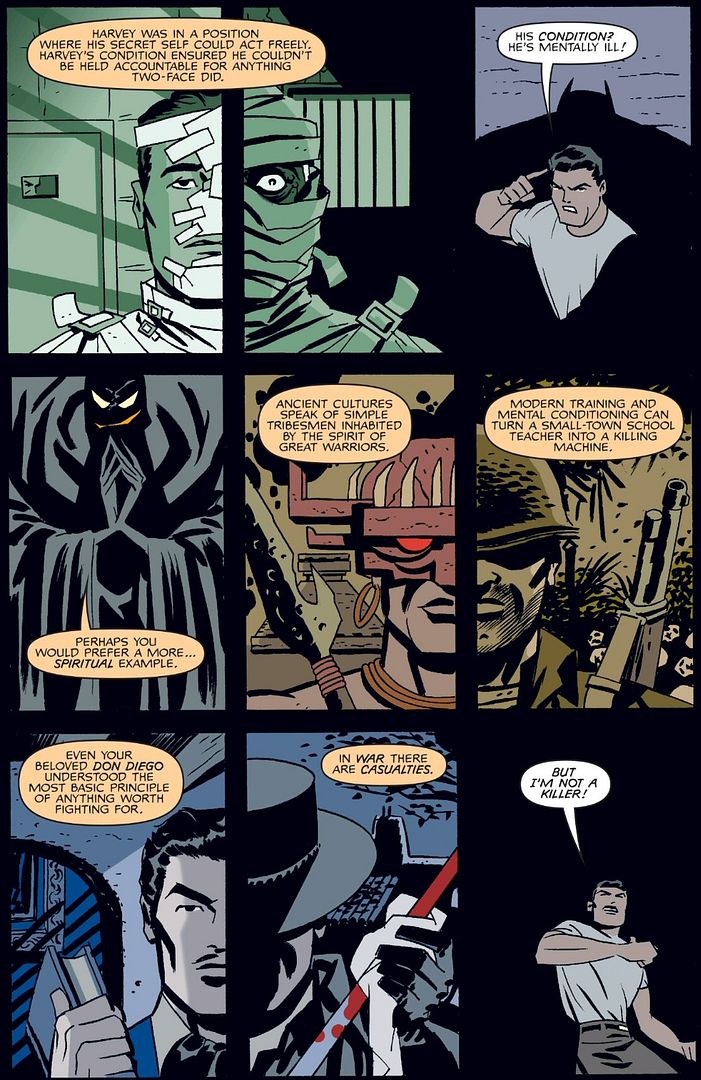

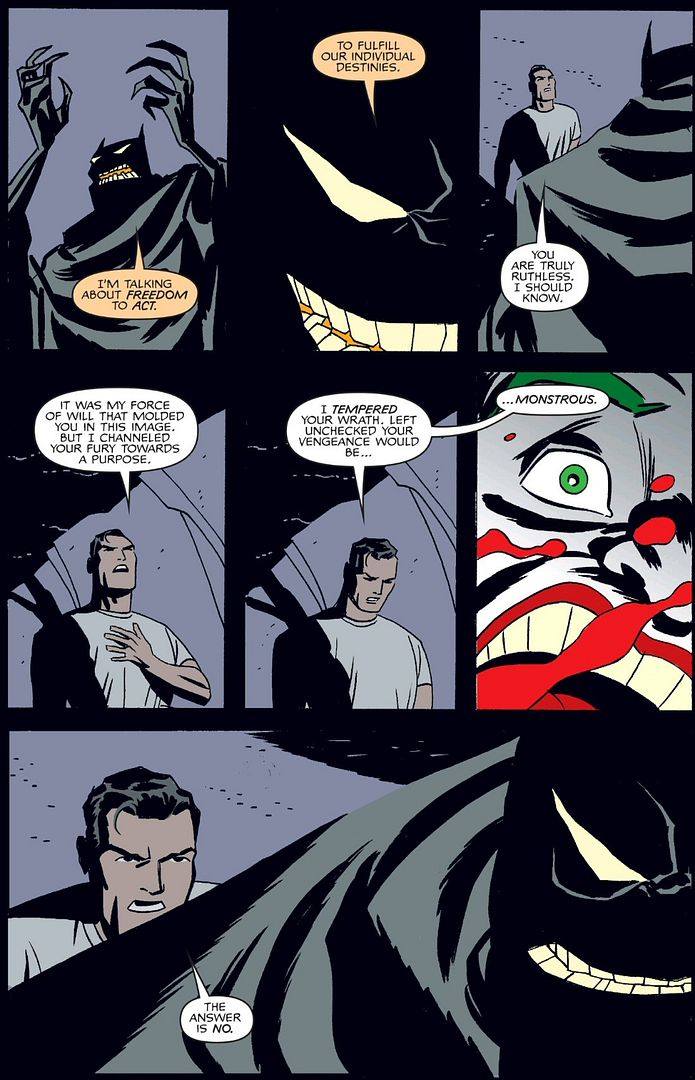
Despite the unwavering refusal, Bruce-superego continues to rail on about how tormented and guilt-ridden he is. And Batman-id pushes him further by reminding him of his vow to never let what happened to him as a child ever happen again.
Locked in this unresolvable conflict, Batman-id mentally conjures up the gun that killed their parents, and challenges Bruce-superego to shoot him to “free” themselves once and for all (in other words, both die). After some temptation, Bruce-superego rejects that option as well, and wonders if this is the torment he will need to live with for the rest of his life:
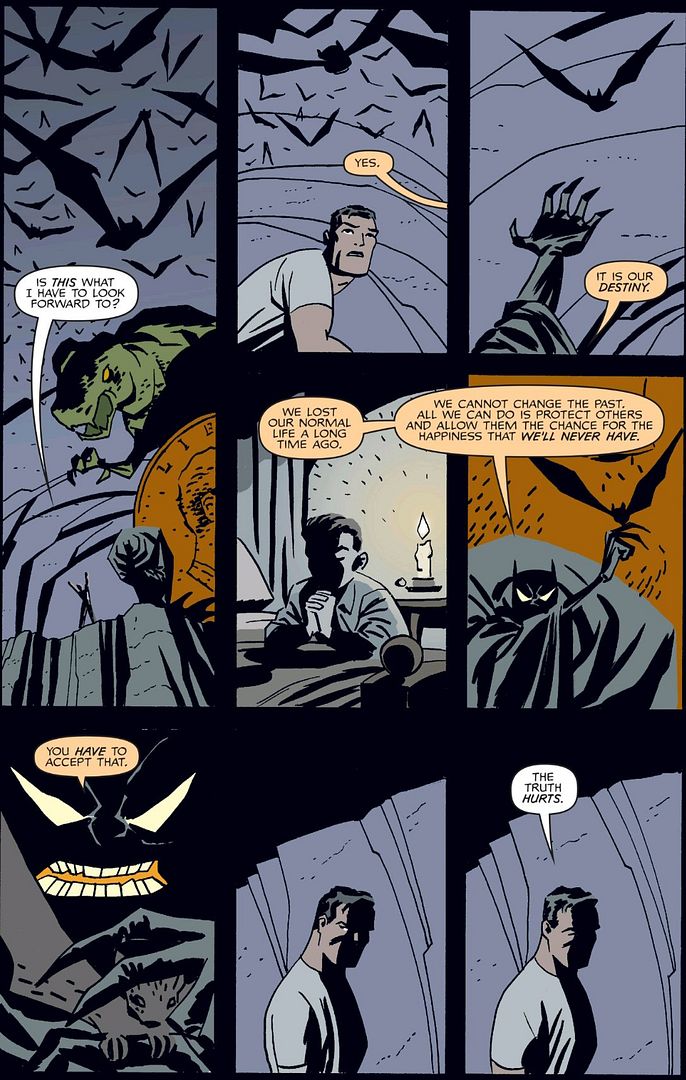
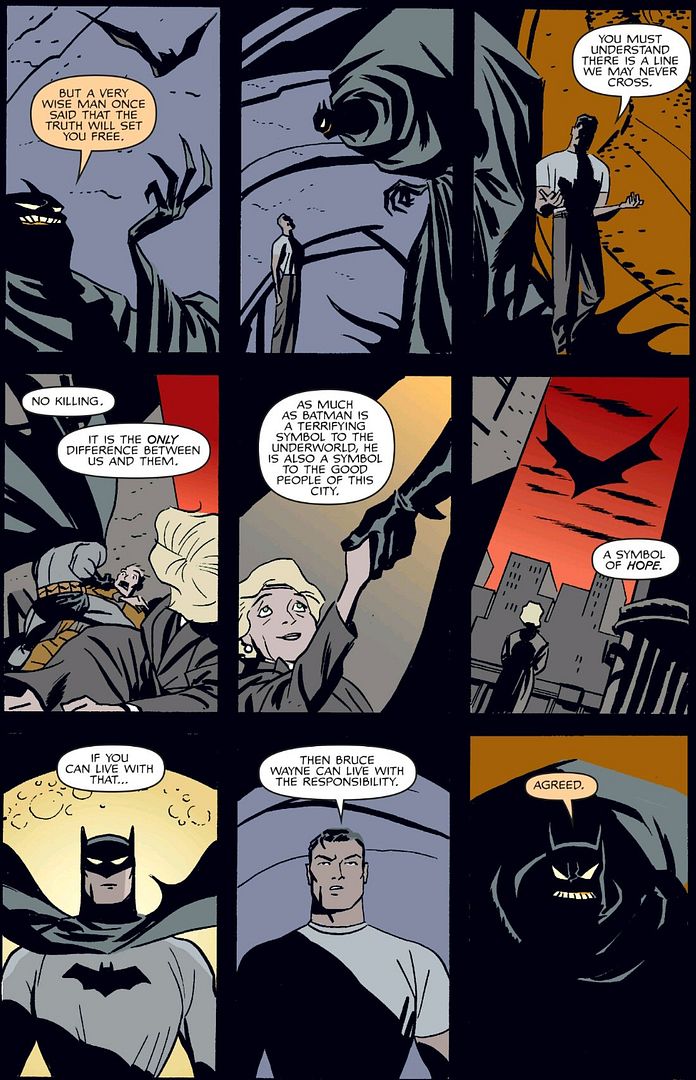
Rather than being deontological, the no-kill prohibition now stems from a new “truth” – the recognition of how close Bruce/Batman is to the edge (as Moore’s Joker pointed out). This demonstrates how later writers were prepared to consider Batman’s core drive in much starker psychological terms – and much darker ones.
5. Jeph Loeb (1996-2003)
With classic runs like The Long Halloween (1996-97) and Dark Victory (1999-2000), Jeph Loeb reframed Batman’s ethics through the dual lenses of duty and guilt (in traditional noir fashion), along with a shift to personal investment in relationships rather than abstract principles. The character is more emotionally driven in this era, with obligations to specific people taking precedence over adherence to a universal code.
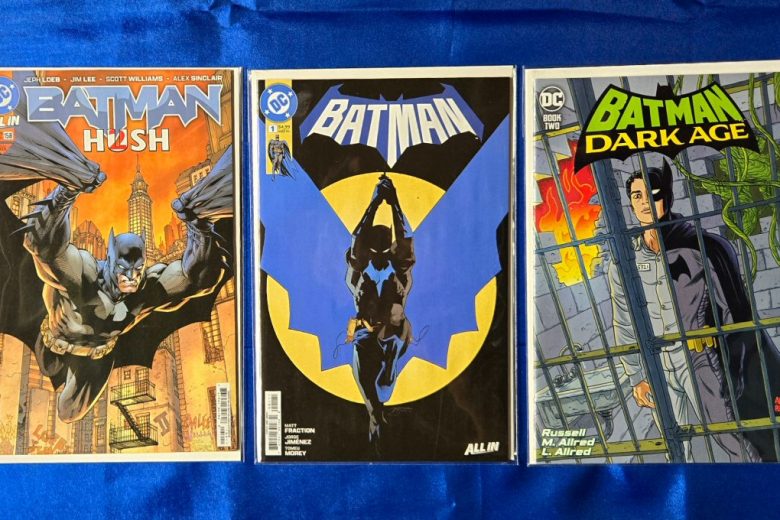
A good example is the original Hush storyline in Batman Vol 1, issues #608-619 (2002-03), drawn by Jim Lee. In this series, Bruce reveals his secret identity to Catwoman (Selina Kyle) and enters into a romantic relationship with her. Reminding himself of what the Joker has done to those closest to him (like the murdering of Jason Todd and Jim Gordon’s wife, and the paralyzing of Barbara), Bruce can’t stand the thought of Selina ending up as the Joker’s next victim.
Batman begins wailing on the Joker, with the stated intention of killing him (in a scene set in the rain, reminiscent of Moore’s earlier series). But Gordon shows up just in time, from issue #614 – with great artwork by Lee, as always:
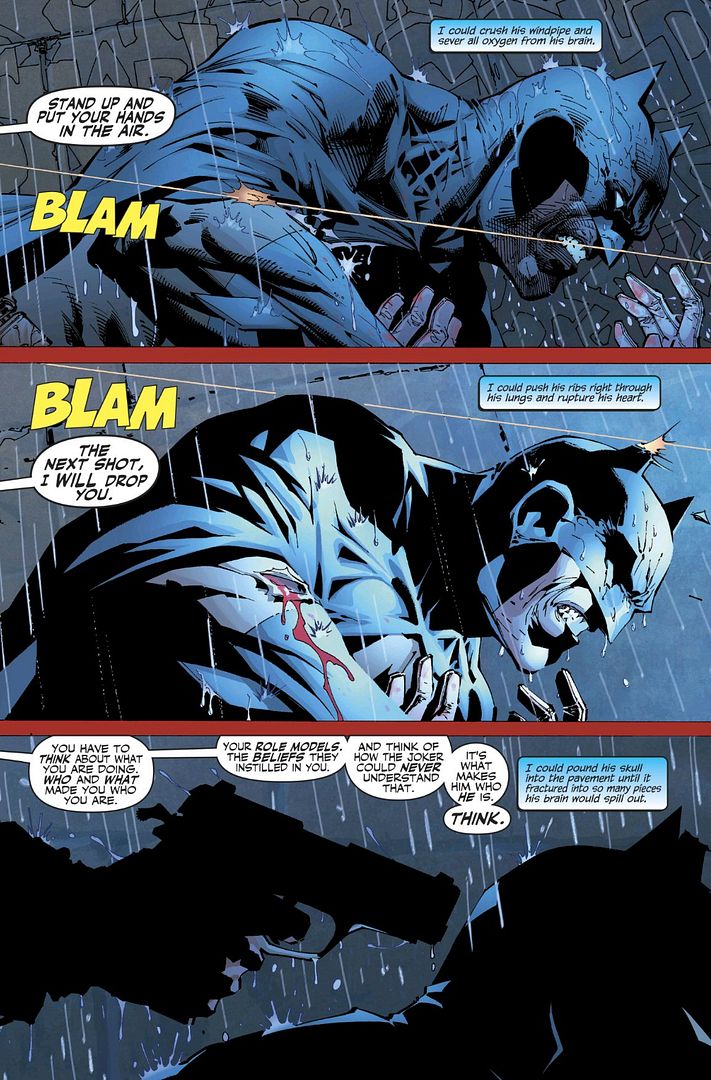
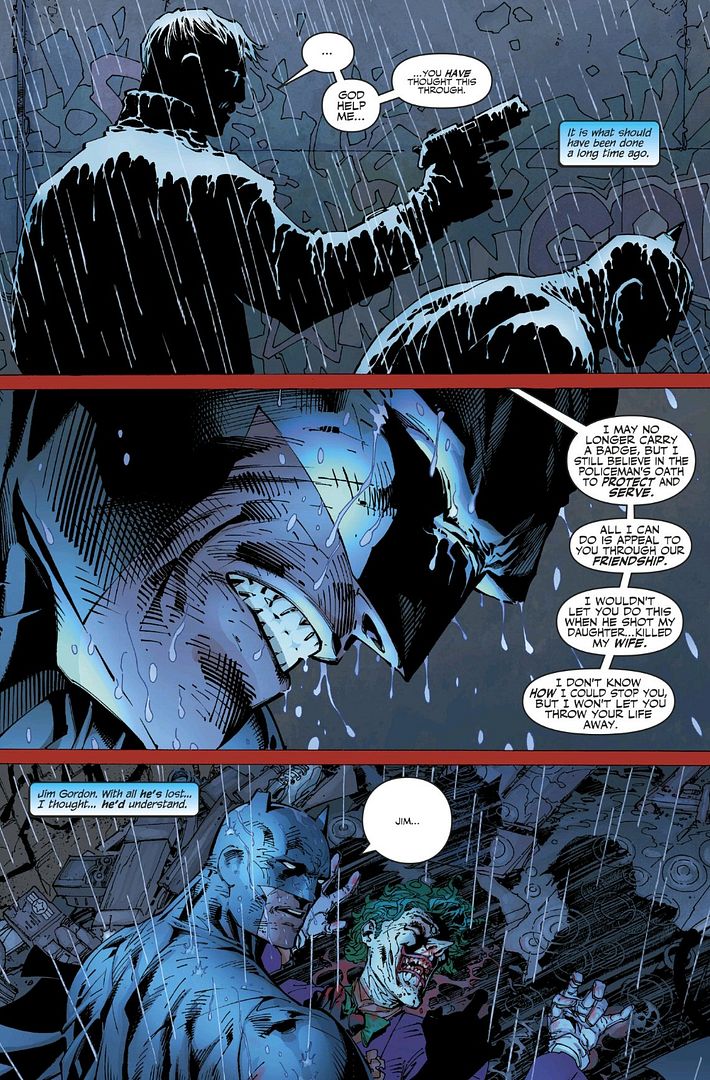
Ultimately, it is just the relationship to Gordon that stops Bruce, not any moral sense:

This is an increasingly dark era for Batman – venturing far from the earlier deontological ethics take.
6. Judd Winick (2004-2006)
I would have thought it couldn’t get much darker, but Judd Winick managed that during his run of Batman, with storylines like Under the Red Hood (2005-06). Consider its conclusion, in Batman Vol 1, issue #650 (2006), drawn by Eric Battle. The vigilante Red Hood turns out to be a reincarnated Jason Todd (Batman’s second Robin), who challenges Batman for how he let the Joker live after Todd’s murder.

Interestingly, the exchange doesn’t stop there – Todd asks the key question:
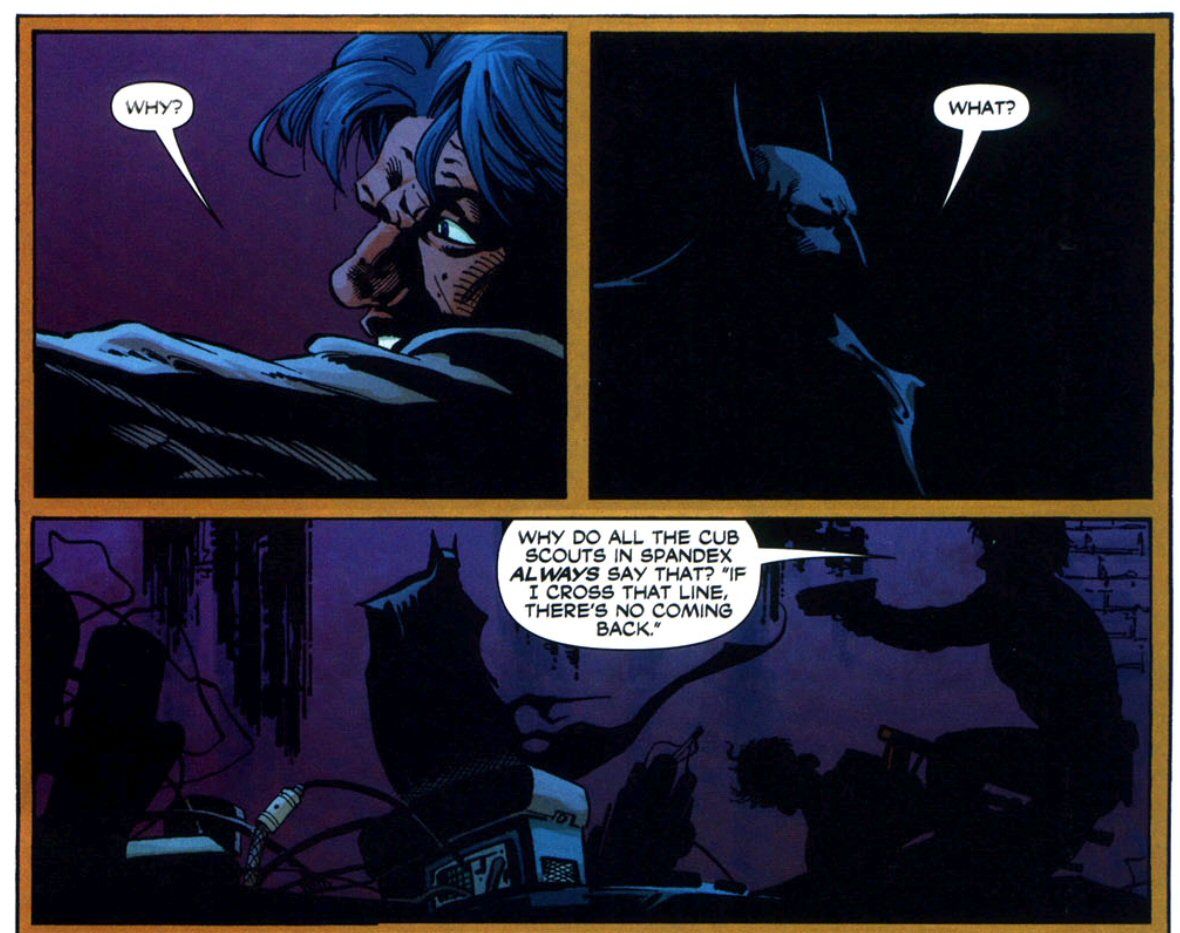
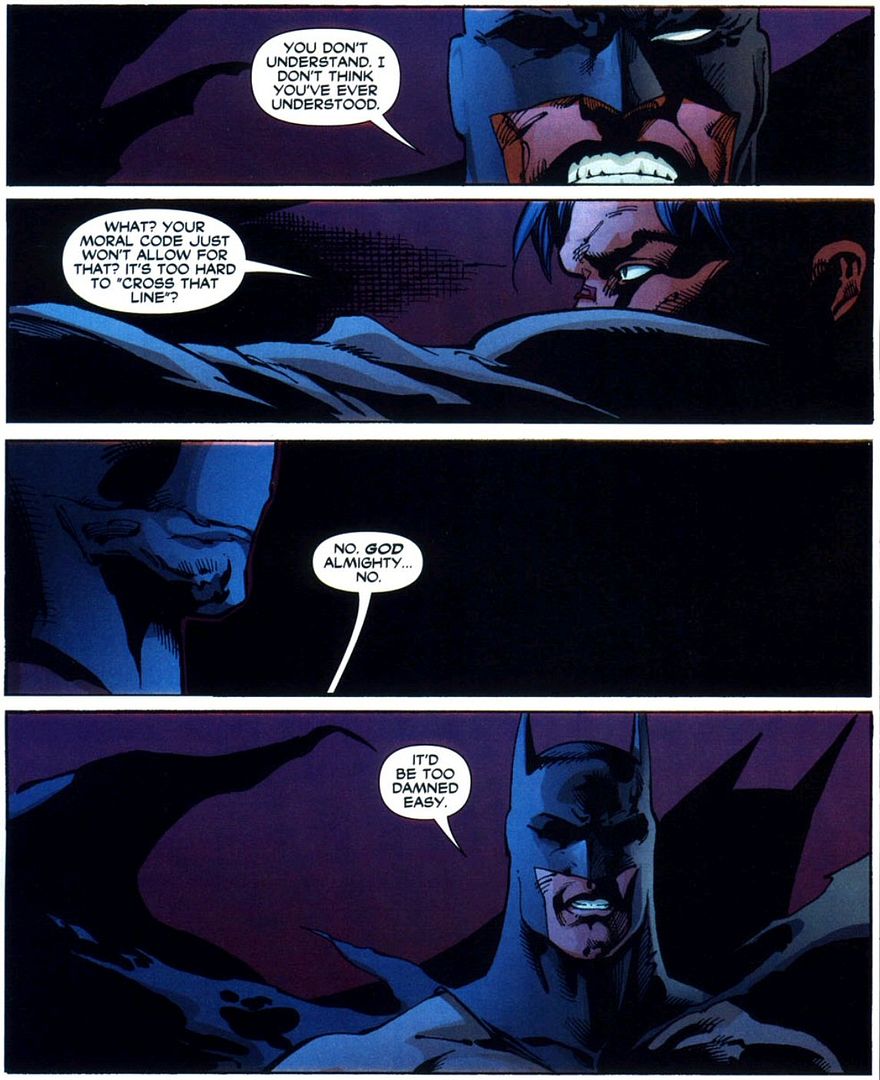
This reiterates the current direction of Batman – he remains “one bad day” away from loosing himself.
Todd takes the Joker captive, and holding a gun to his head, tells Batman that he has no choice but to either kill the Joker or kill him – as otherwise he will kill the Joker. As Todd is about to shoot, Batman acts by ricocheting a batarang off a pipe behind him:
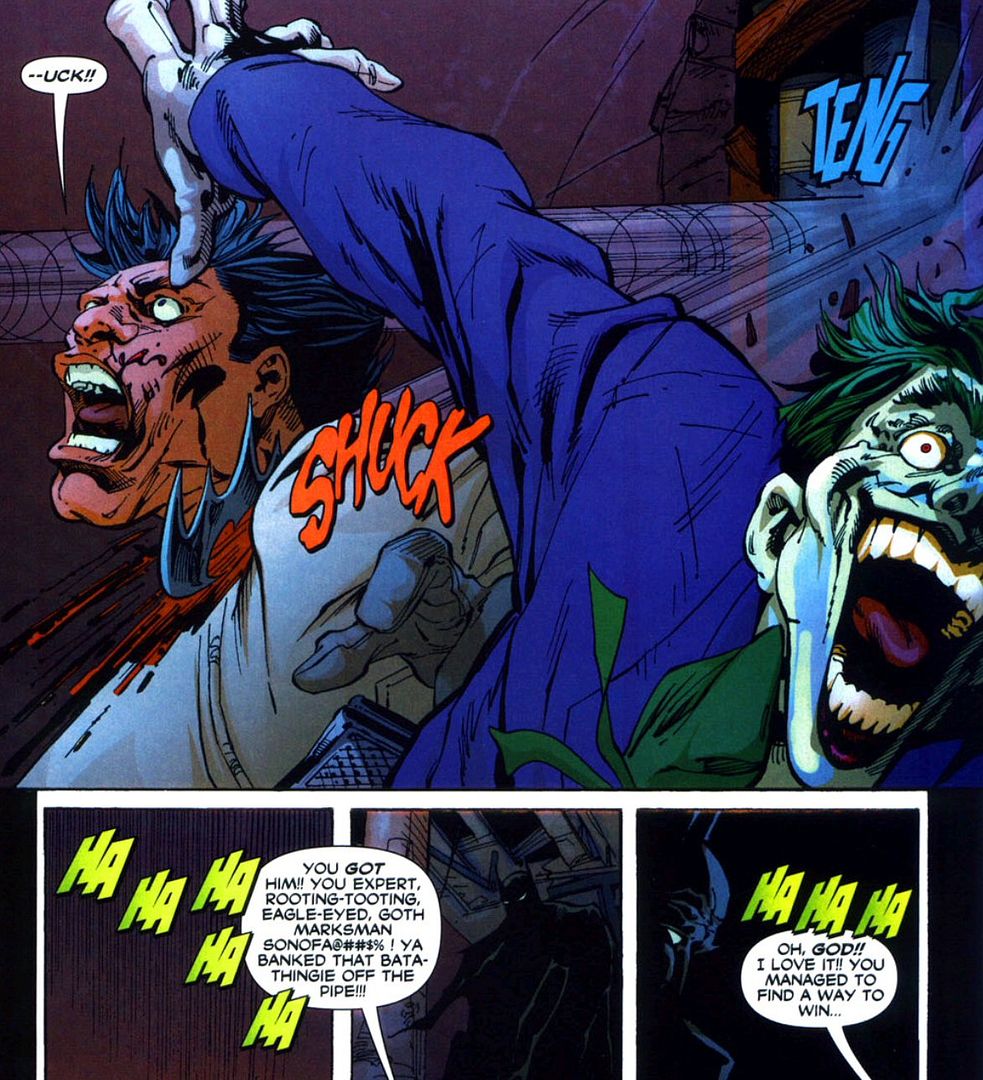
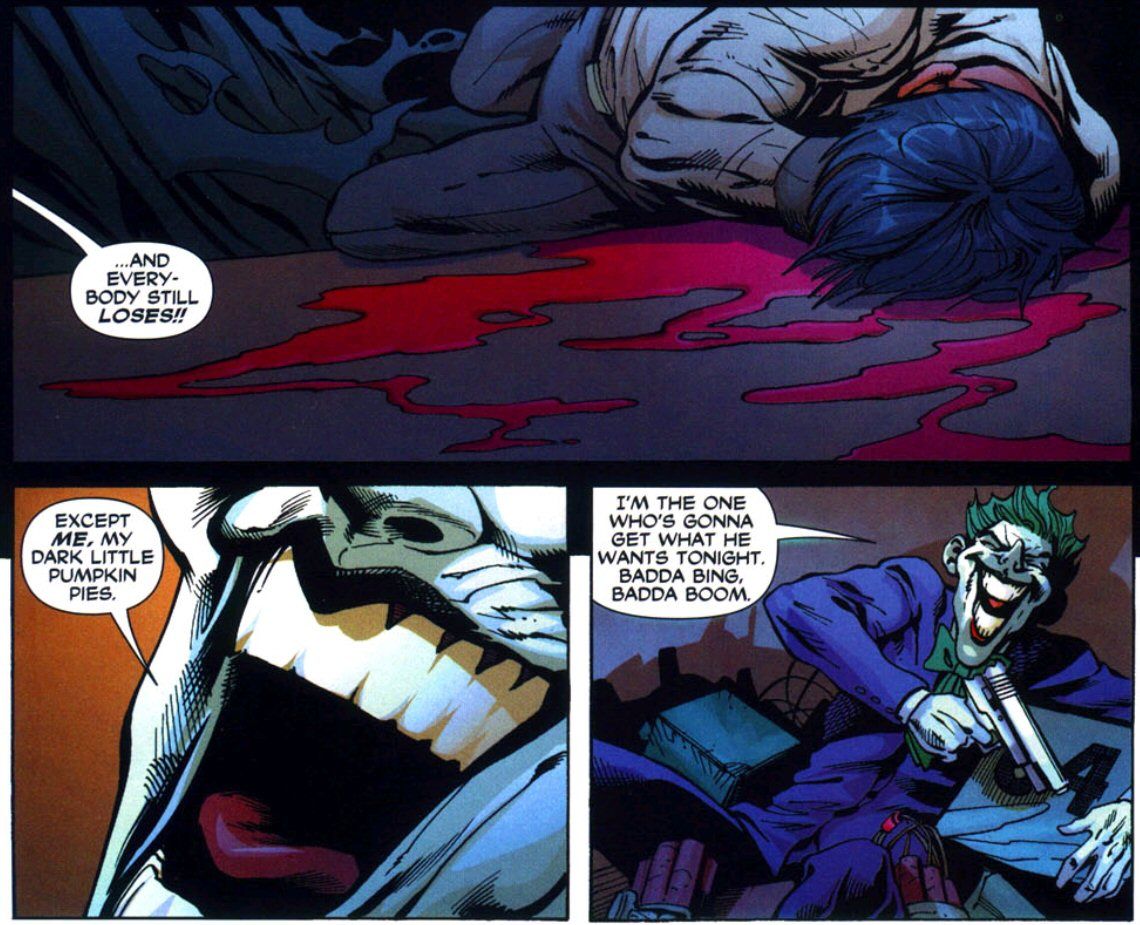
Despite Batman’s attempt to incapacitate Todd, he apparently kills him instead! A delighted Joker manages to get away, and one can only assume that this horrific outcome would be enough to finally break Batman. Except a few moments later the whole universe begins changing – and the Infinite Crisis event (2006) takes place, rebooting the universe. Whew!
7. Grant Morrison (2006-11)
After the preceding decades of increasingly dark storylines, the tide shifts hugely during Grant Morrison‘s era. With iconic storylines like Batman R.I.P. (Batman Vol 1 #676–681, 2008) and Batman Incorporated Vol 1 (2010-11), Morrison completely shifts Batman to an Aristotelian virtue ethics perspective – he is good now because of sustained character practice and preparation, not because he’s following deontological rules or calculating outcomes. See my A.X.E.: Judgment Day conclusion for an explanation of Aristotelian virtue ethics.
Consistent with this shift, Morrison’s Batman is a much more optimistic one – his morality is presented in heroic terms, as a triumph of will and identity against adversity rather than simply managing past trauma. You get the sense that Bruce actually likes being Batman, with the Batman identity aligned with Bruce’s core values (as opposed to being at odds with them).
But he can still be put through the wringer by his adversaries – with very dramatic storylines. Consider the “Black Glove” story arc from Batman Vol 1, issue #676-681, (2008) drawn by Tony S. Daniel. In a prelude to the event, Batman visits the Joker in Arkham Asylum – in a scene that I can only assume is purposefully similar Alan Moore’s The Killing Joke opening:
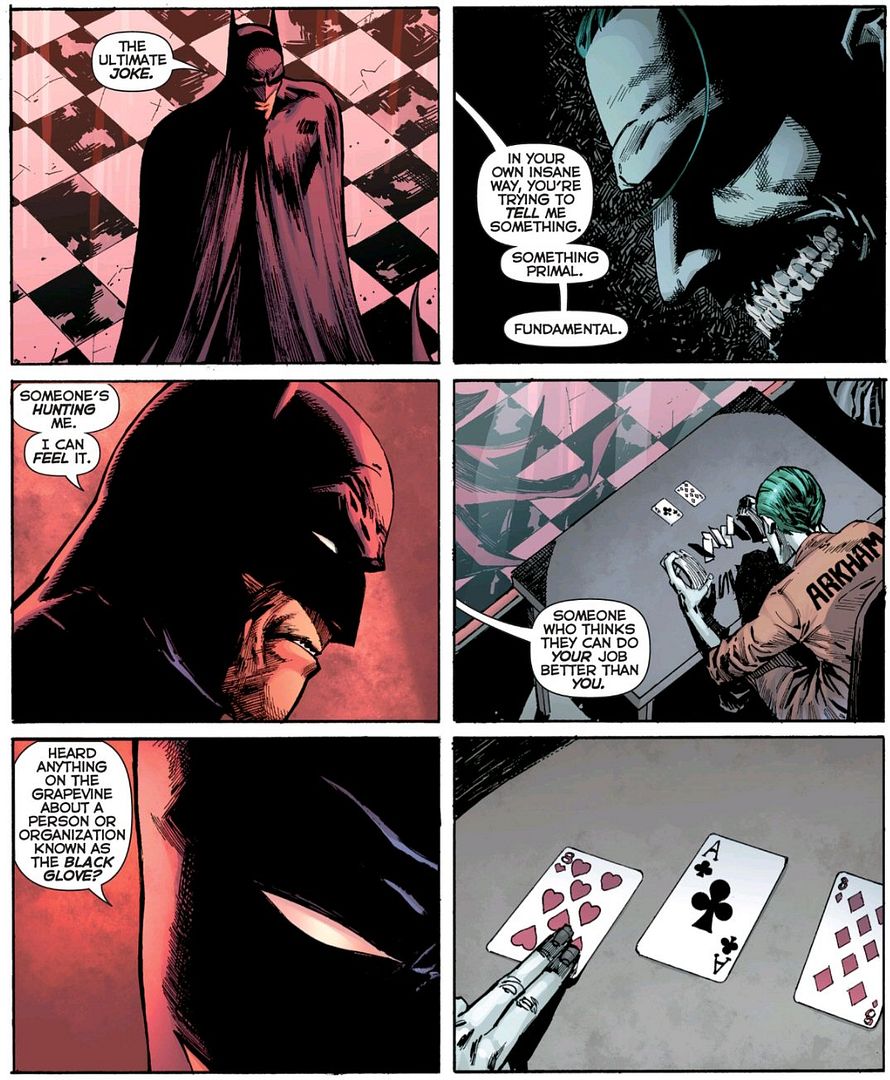
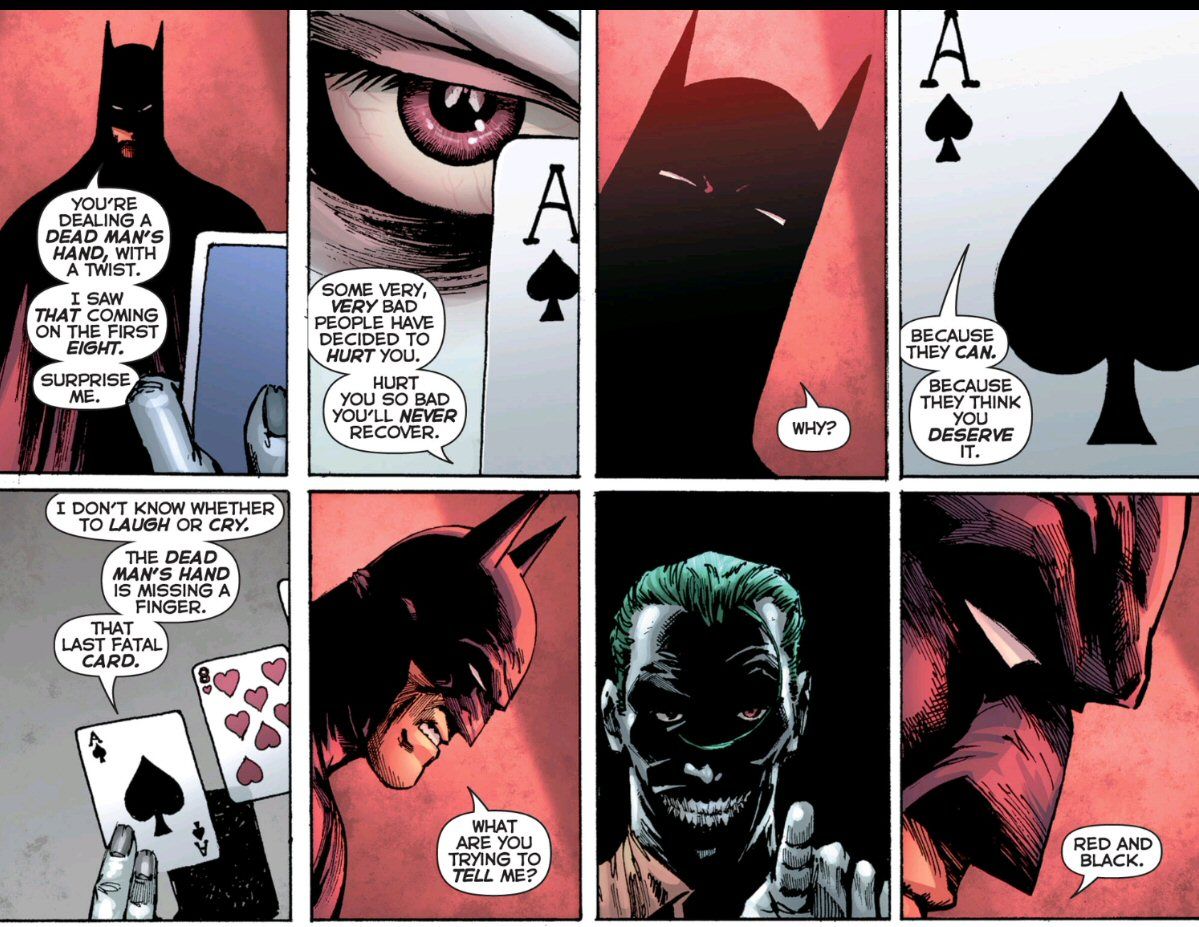
The Black Glove attack Batman and succeed in breaking his mind through psychological torture. But it turns out that Bruce had created a back-up personality in his subconscious – the “Batman of Zur-En-Arrh”. In this identity, Bruce was able to confront both the Black Glove and the Joker. Batman gets buried alive on the Asylum grounds, which gives you this lovely scene as he breaks out, from issue #681:
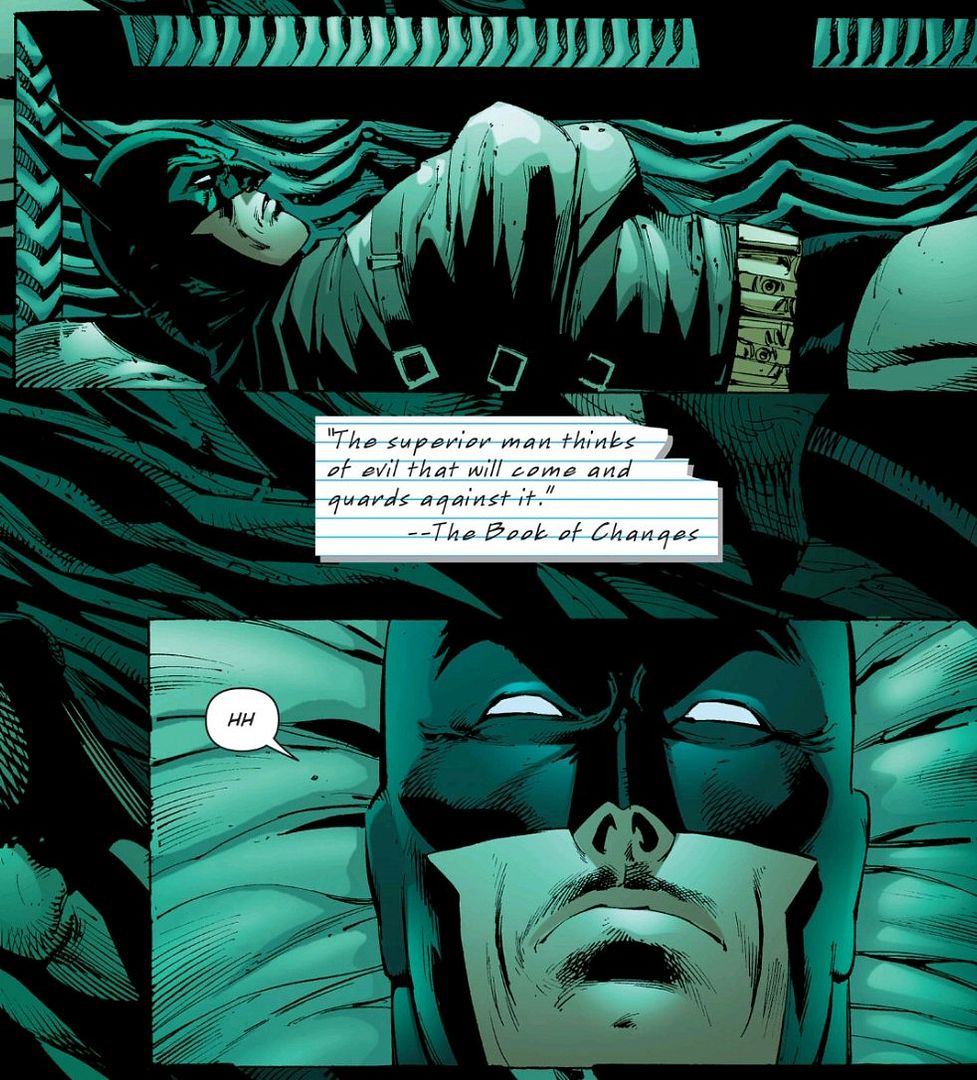
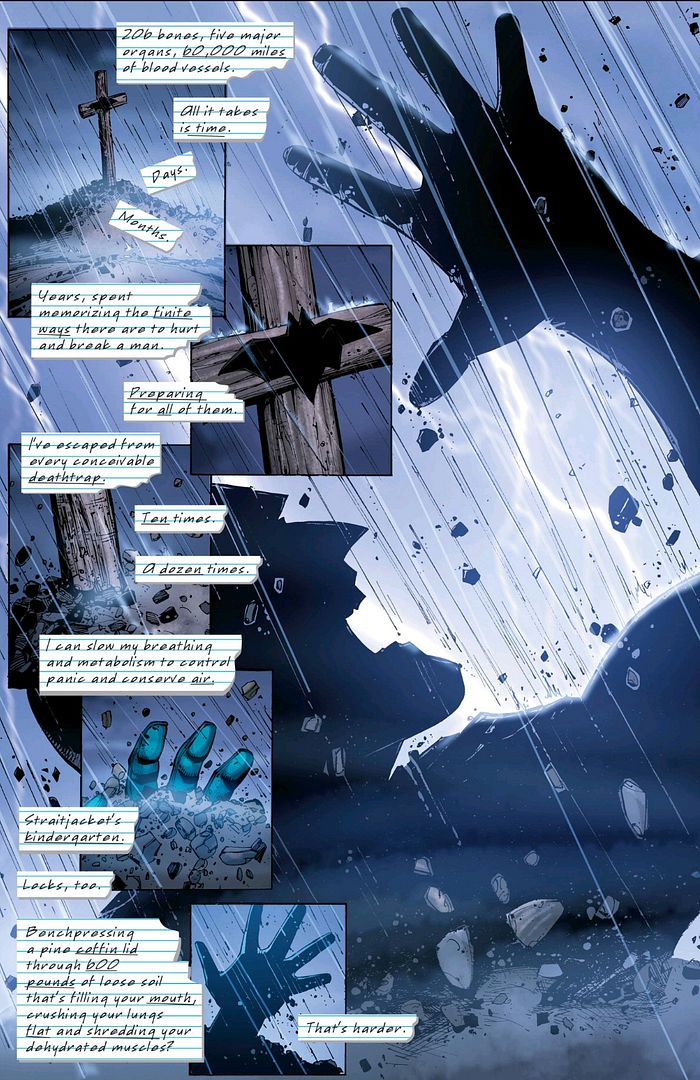
Hard but not impossible! Eventually, Bruce’s mind recovers and sheds the Batman of Zur-En-Arrh identity from his subconscious. But I love this extended scene during his recovery, before facing the story arc’s big final climax:
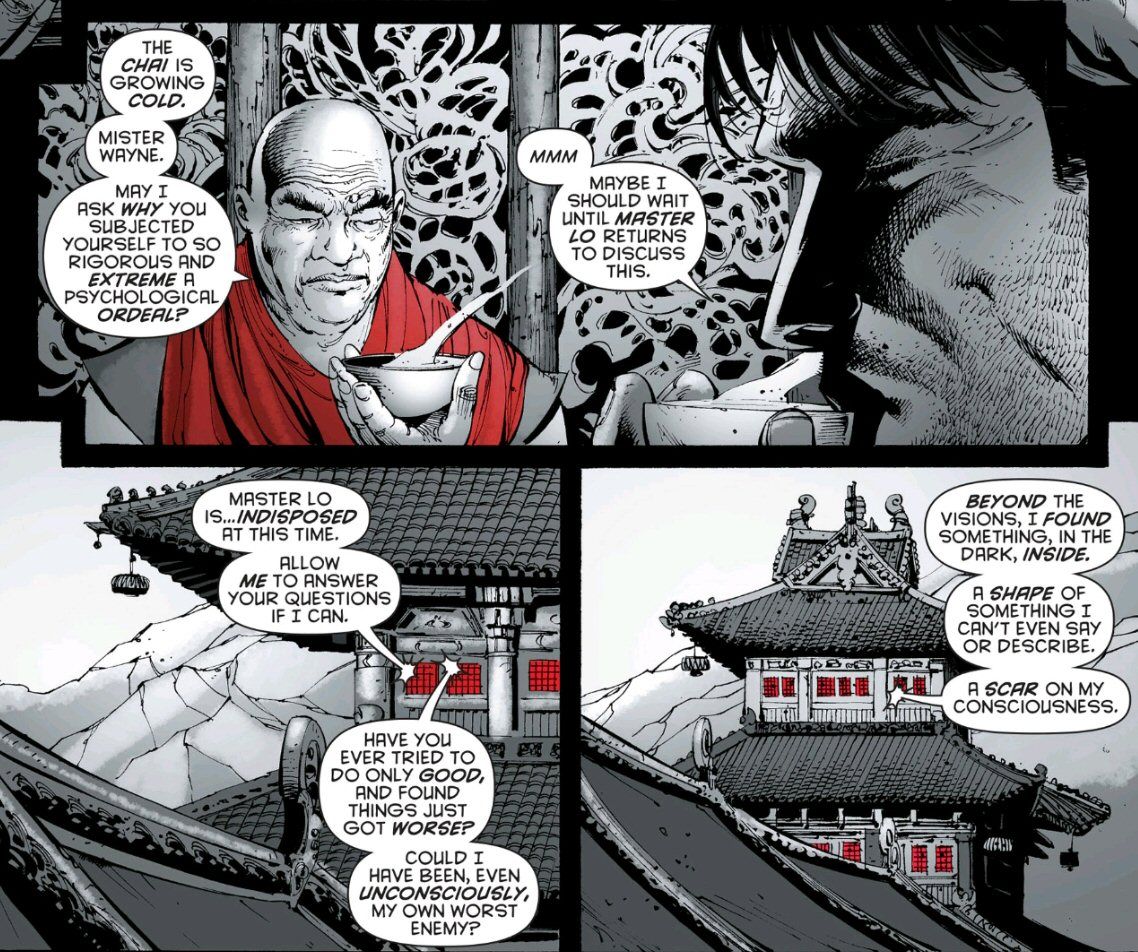
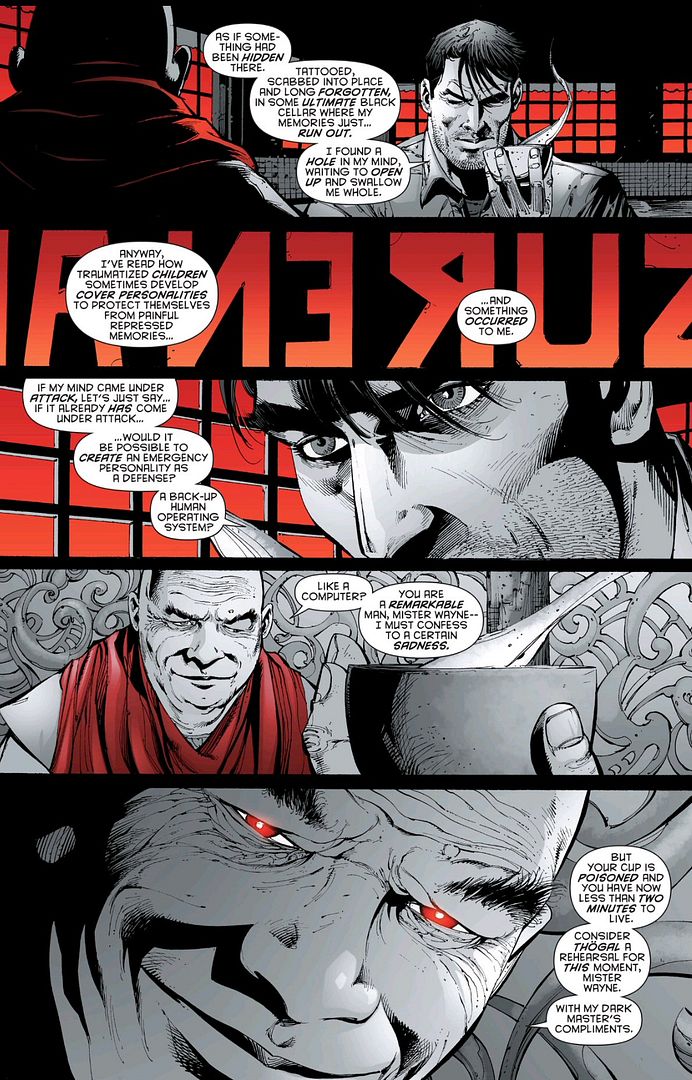
Ha! Bruce can never catch a break, right? Maybe …
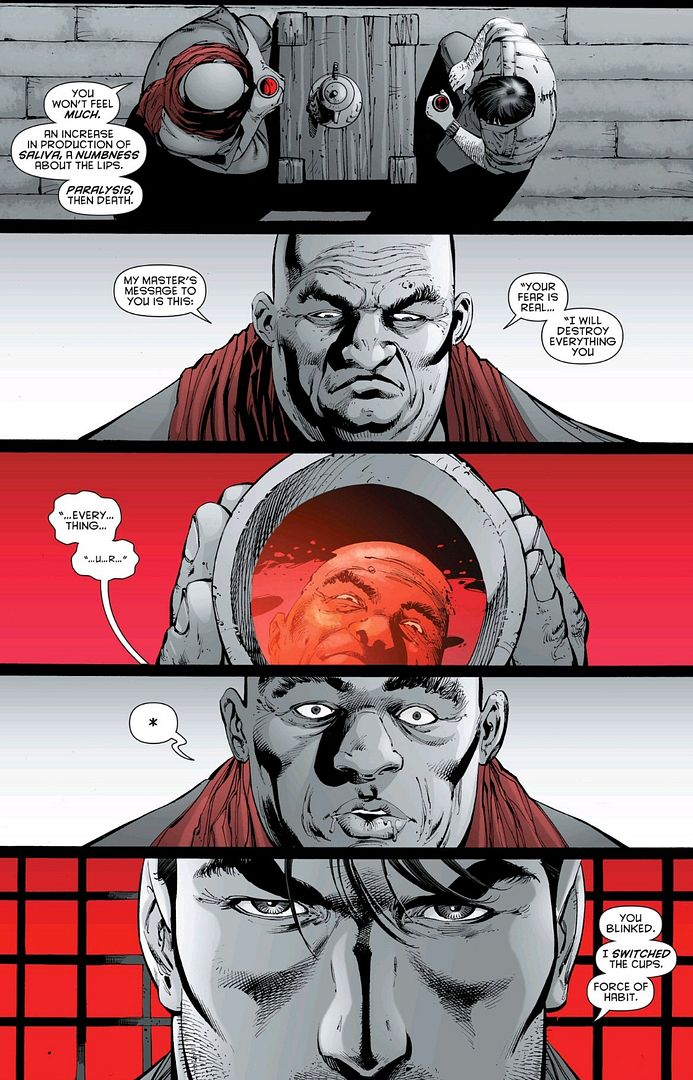
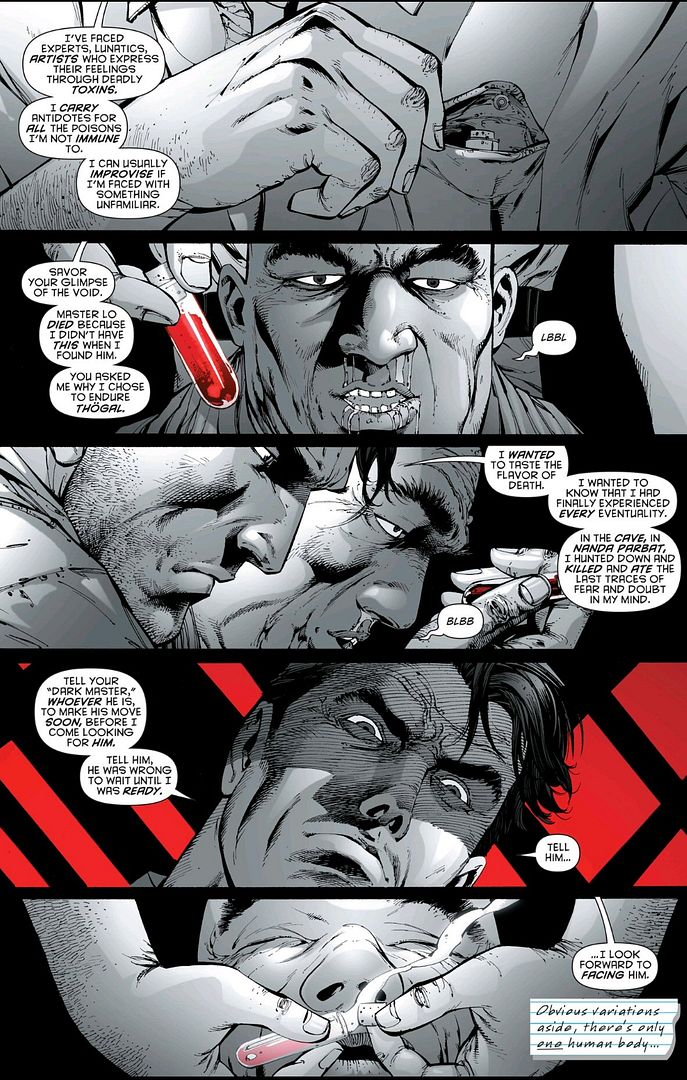
I like how this broader arc shows Bruce’s advance planning and strategic thinking (many stand-alone stories narrowly focus only on tactical decisions). This storyline illustrates Morrison’s core argument that Batman’s ethical stability isn’t accidental or naive – it is engineered, the product of his own relentless drive and foresight (“You blinked. I switched the cups. Force of habit”). And notice his no-kill rule is firmly in place above – only this time as a repudiation of everything his enemies stand for.
This virtue ethics reading of the character also has with strong suggestions of Stoicism – his preparation is a moral achievement because it means no external force can corrupt who he is. Separating what is within your control from what isn’t is a core feature of both Stoicism and Buddhism – check out my FML overview for a comparison of these two other classic forms of virtue ethics.
Interestingly, this story arc ends with Batman’s apparent death and disappearance – but he was in fact captured by members of the Evil Factory and subjected to further psychological torture! Never catching a breath, Morrison leaps into an even more interesting psychological examination of what makes Batman who he is.
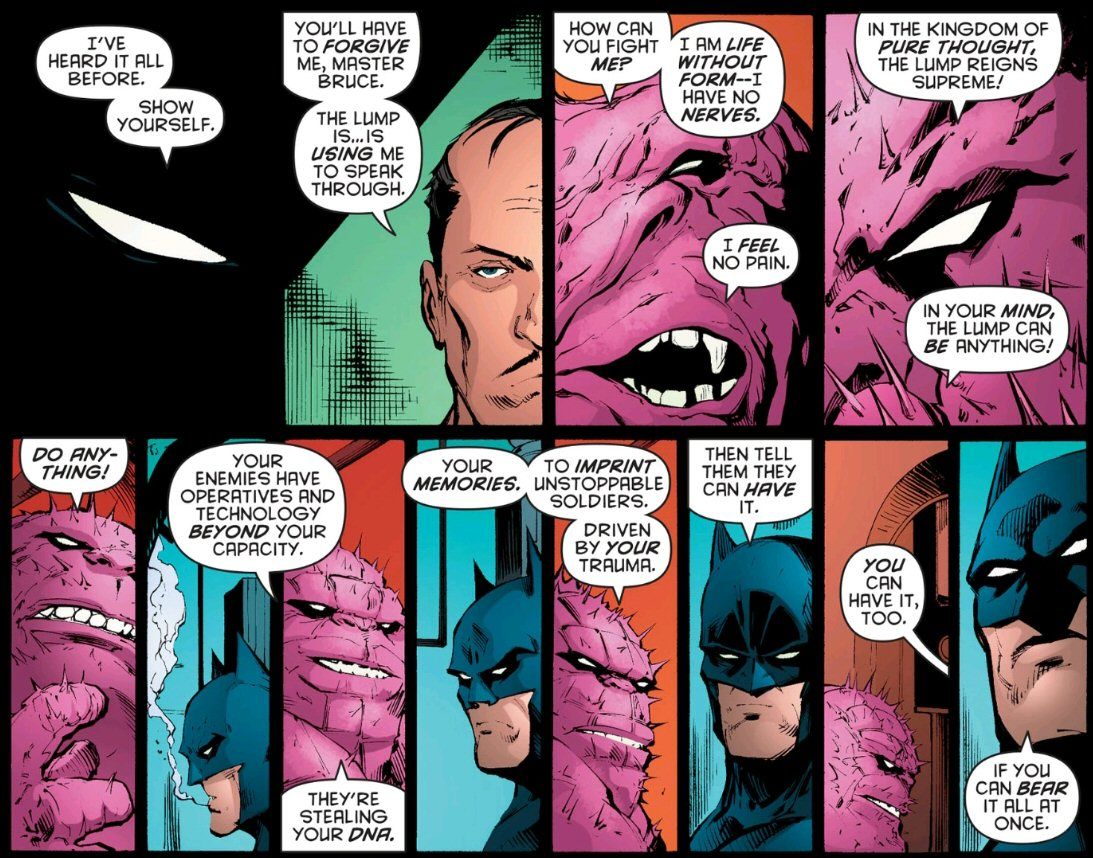
In this relatively compressed two-part story, in Batman Vol 1, issues #682-683 (2009), Morrison and artist Lee Garbett show a Batman lost in his memories, jumping from one time to another – all with his trusted advisor Alfred at his side. But Alfred’s behavior doesn’t match what Bruce expects, and it soon becomes clear to the reader that “Alfred” is being impersonated by a psychic parasite who is processing all of Batman’s memories:
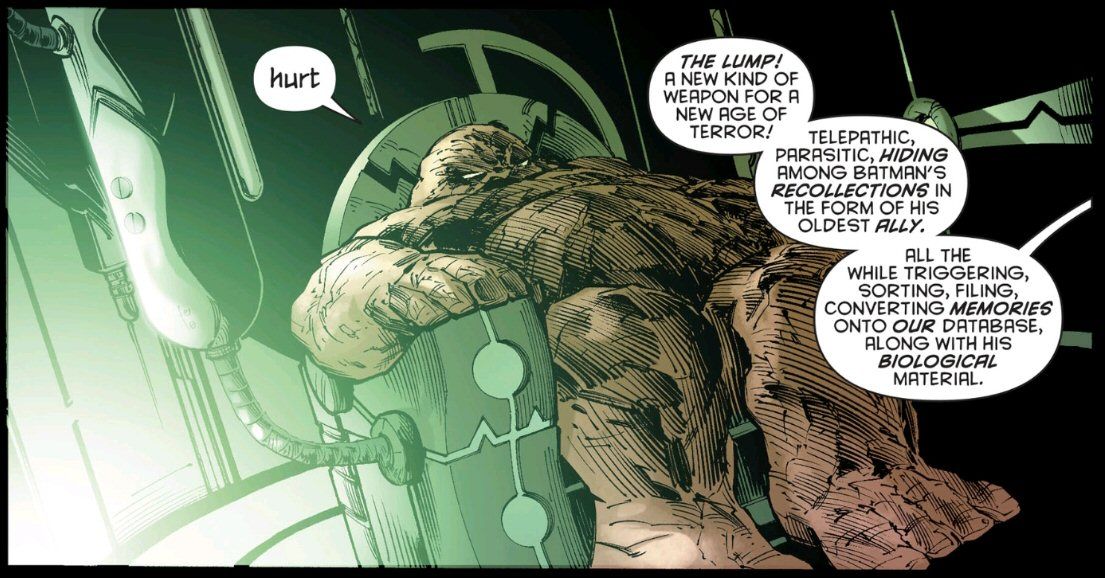
But Bruce is naturally suspicious, even of his own mind …
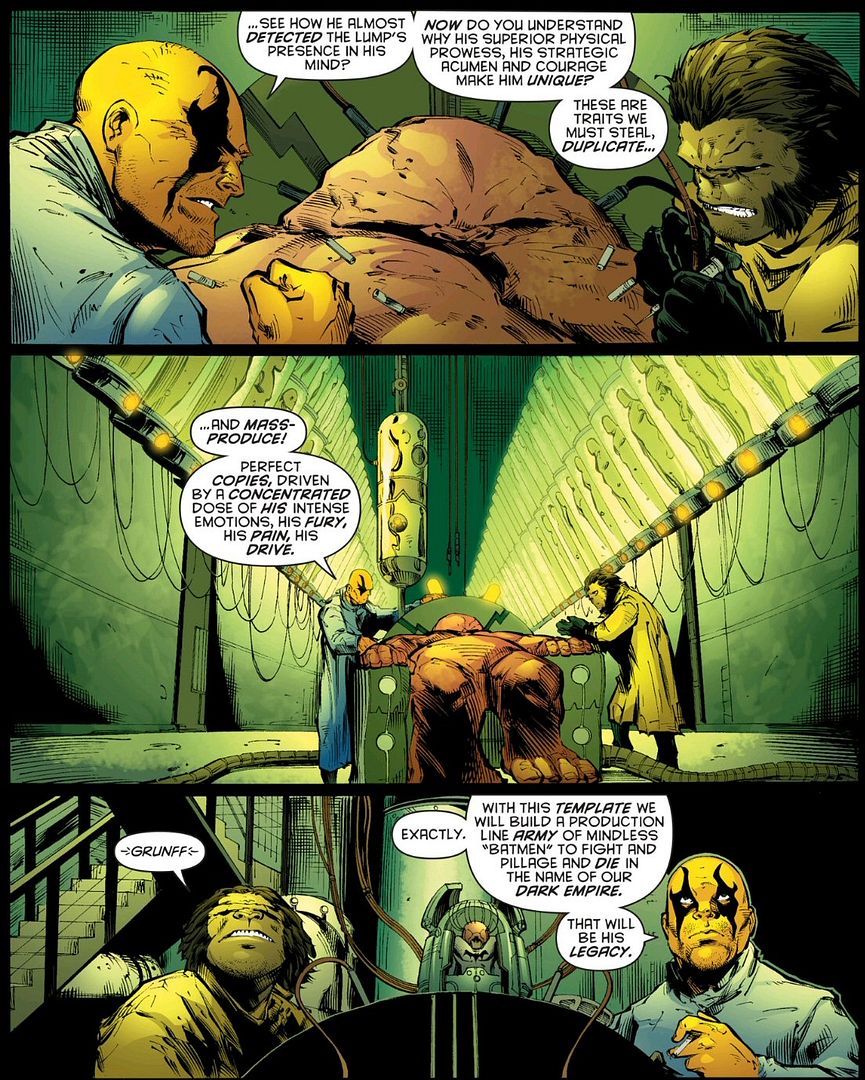
Once they create this army of foot-soldiers in his image to serve Darkseid, they plan to kill Batman. But it turns out that there is more to our Batman …
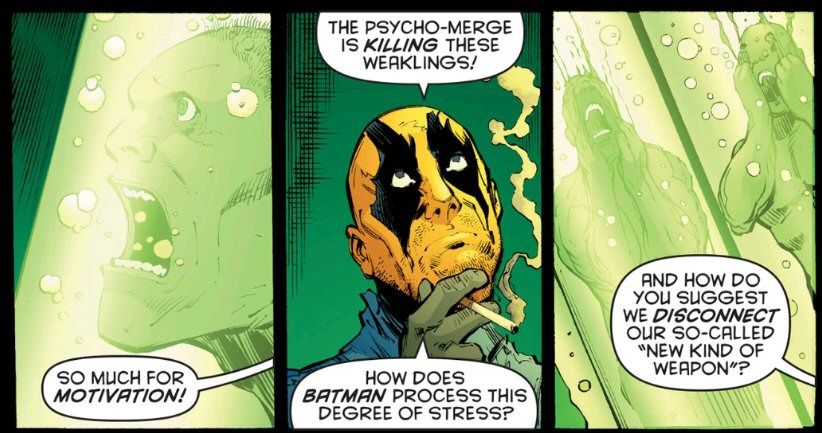
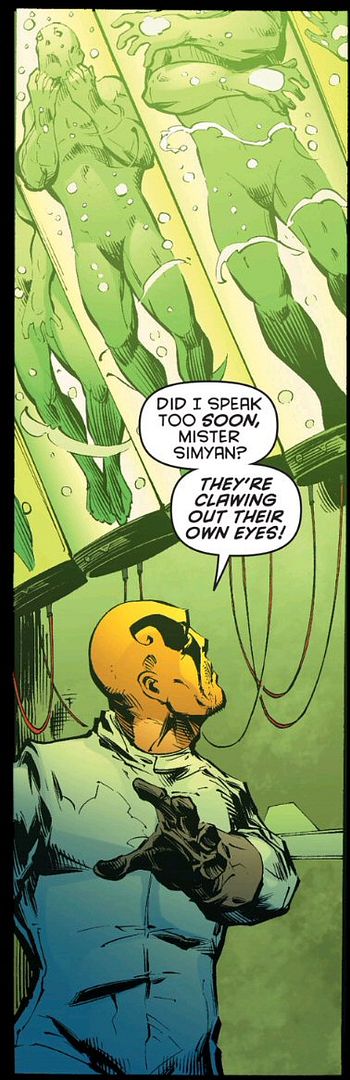
The cloned army of Batmen are unable process Bruce’s level of suffering and survive. Meanwhile, I love the scenes where Bruce talks directly to the Lump, as “Alfred”:
With their plan backfiring spectacularly, the Evil Factory decides to cut their losses, including the loose end of the Lump:
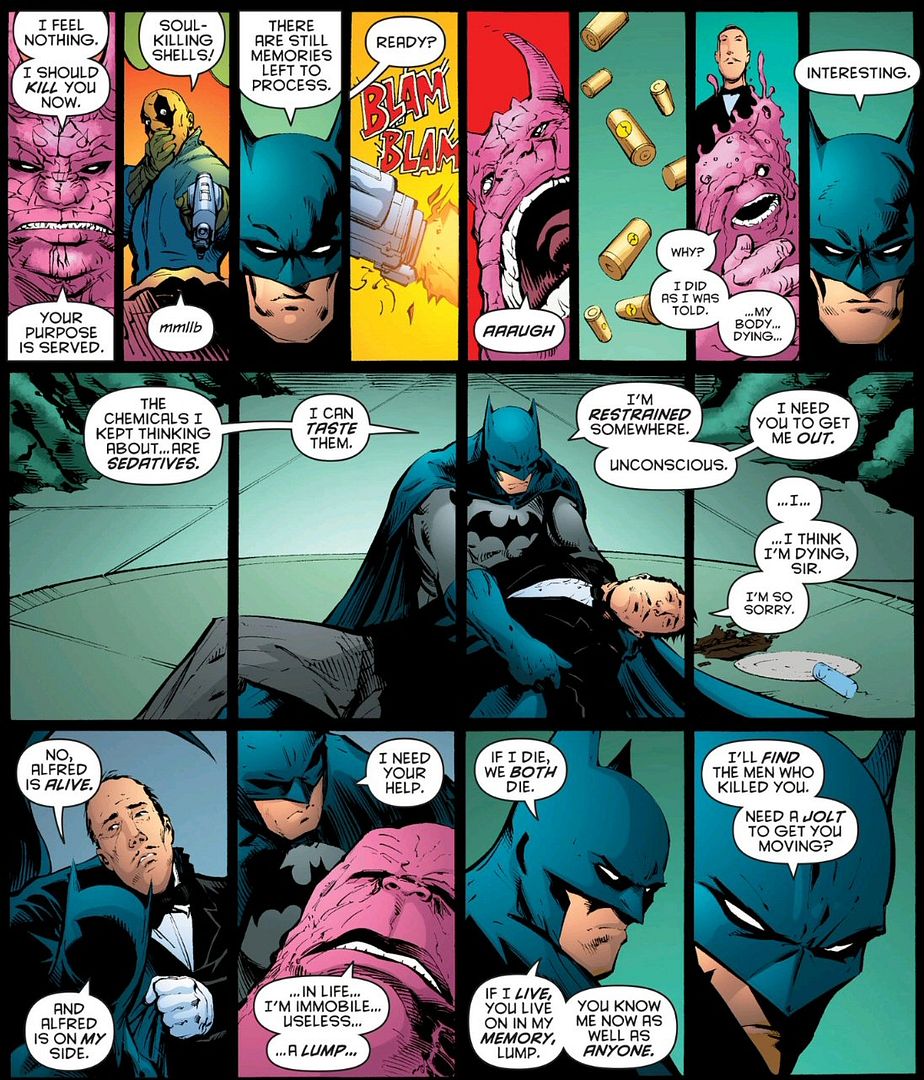
Now that’s an interesting offer …
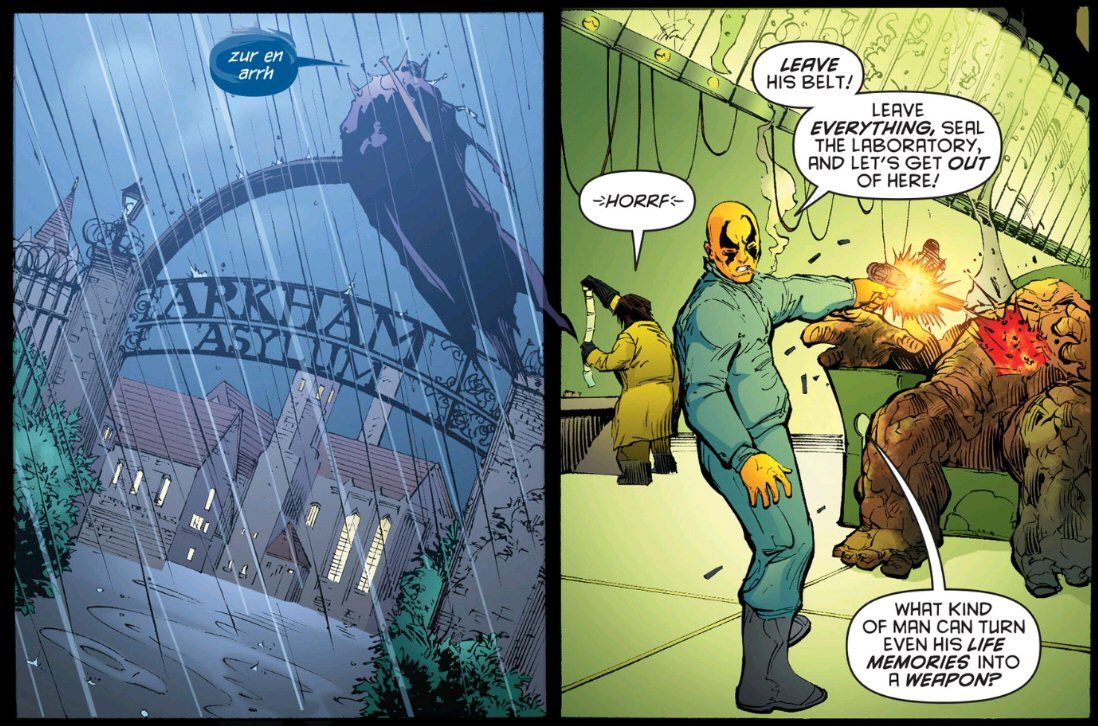
What kind of man indeed! The final scenes are narrated by the real Alfred, as the Lump’s knowingly futile attempt to break free buys Bruce the time to extricate himself:
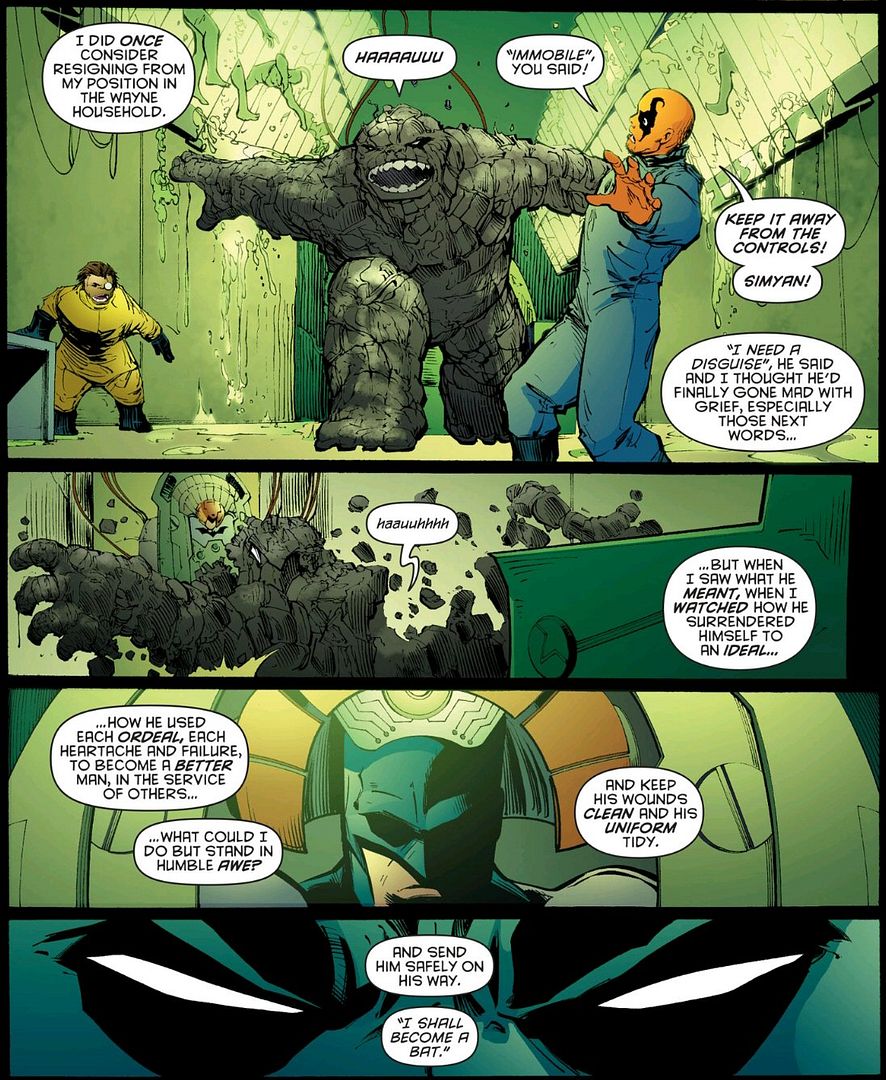
Yes, continually using his ordeals “to become a better man, in the service of others” – the very definition of virtue ethics!
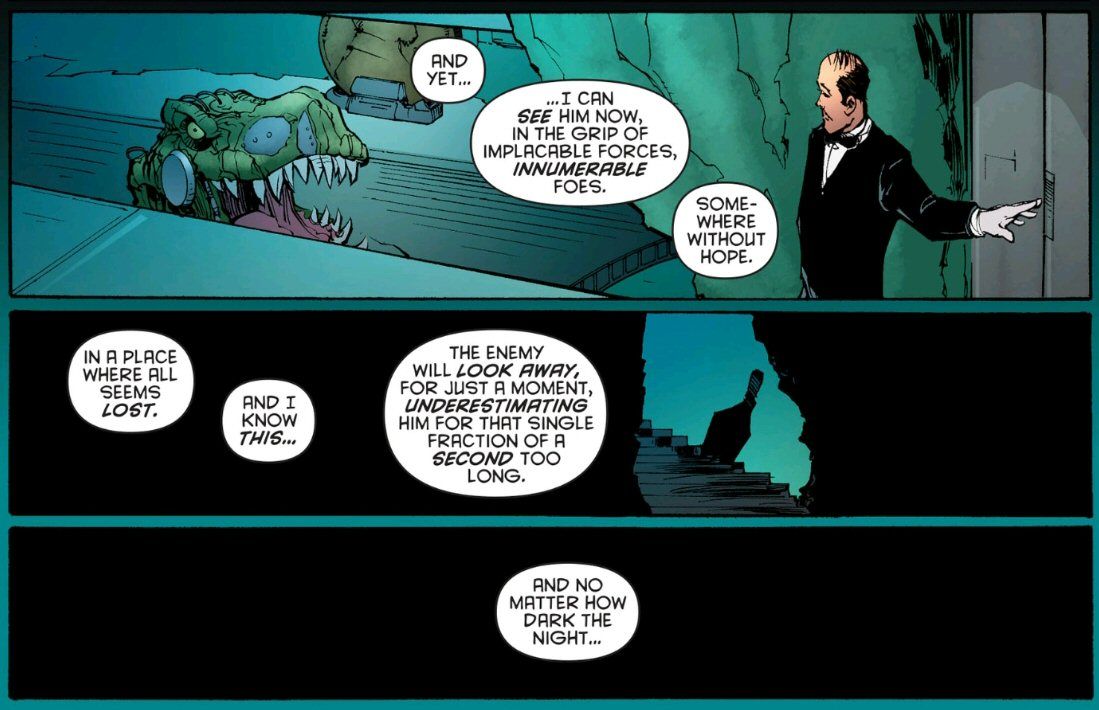
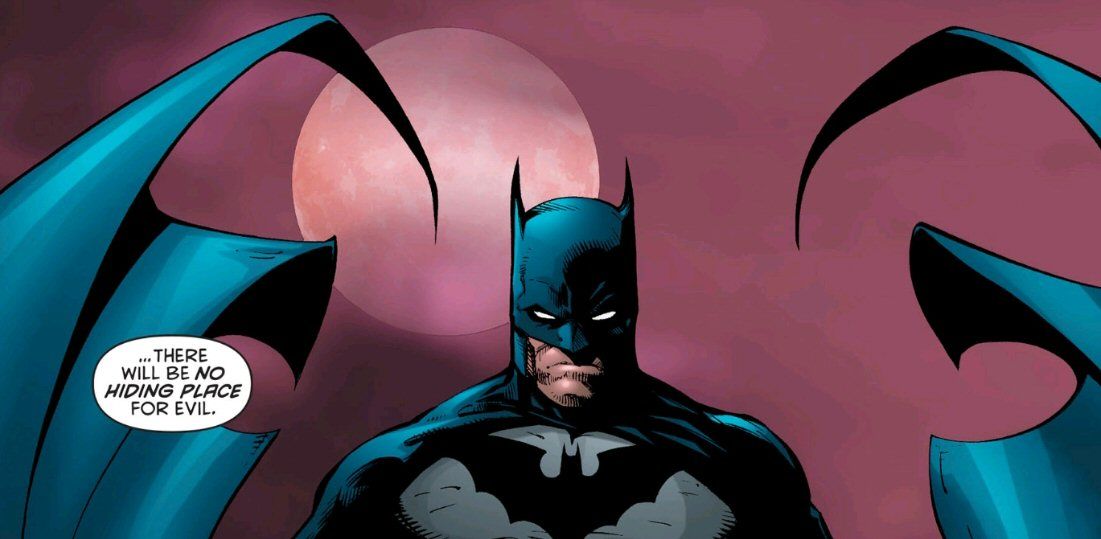
As you can probably tell, I love Morrison’s run. After several decades of a nearly-broken, almost antihero Batman – someone who is barely holding himself together a lot of the time – we are now treated to a Batman at the height of his powers. He is a true superhero in a virtue ethics sense – someone who uses his trauma to make himself better. And as you can see above, you can still tell dramatic stories from this vantage point.
In a number of interviews they gave around the end of their tenure (including this exit interview in 2012 published on DC.com), Morrison made it clear that they view every version of Batman up to that time – the almost psychedelic 1950s sci-fi Batman, the 1960s goofy TV Batman, the 1970s Gothic detective, the 1980s brutal Dark Knight, the nearly broken Batman of the early 21st century – as actually happening to the same man. Rather than continuity errors to retcon away, Morrison’s novel interpretation is to read them all as proof of a mind so disciplined it can compartmentalize wildly different personas across eras and still hold together cohesively!
This is itself a virtue ethics perspective – in Morrison’s view, moral good isn’t about consistency of behavior, or any single act or rule, it’s about the will that organizes those behaviors into an integrated character over the course of a life. Morrison’s Batman literally contains multitudes!
Just like Alan Moore before him, Morrison’s legacy continues to dominate depictions of Batman to the present day. For example, another aspect that Morrison explored was Batman’s relationship to his extended Bat-Family, turning them into a wider network of allies and comrades – indeed, making them a true family. This presages the modern turn to care ethics in the comics, which I’ve discussed extensively on this site (follow my Glossary page for some relevant examples).
Morrison particularly developed the relationship between Bruce and Damian Wayne – the son of Bruce and Talia al Ghul (Ra’s daughter). In the current telling, Talia conceived a child from their earlier time together (unbeknownst to Bruce), who was brought up in The League of Assassins. Young Damian now lives with Bruce, and, in true virtue ethics style, is being mentored and retrained as a hero (and the current Robin).
Some recent modern interpretations
Since Morrison’s iconic stint with the caped crusader, I find a similar pattern plays out with modern writers: Batman may start off arguing deontological or consequentialist positions, but he inevitably comes around to a place of virtue ethics by the end. Some representative examples:
8. Scott Snyder (2010-2020)
Scott Snyder‘s run of the character includes such gems as The Batman Who Laughs and Court of Owls, created with artist Greg Capullo. Snyder likes to work on a broad canvas, and he fundamentally queries whether Batman’s mission is even realistic – can one man even make a difference, or is the system so stacked against him to corrupt any attempt? Snyder leans into existentialism – but even in the face of overwhelming doubt, Batman continues to do what he thinks is right and good (or express his virtue, you might say).
Consider The Batman Who Laughs Vol 2 (2019), written by Snyder with art by Jock. Here, we see our Batman explain to Jim Gordon who the two multiversal variants of him running around are – The Batman Who Laughs from Earth-22 of the Dark Multiverse, and The Grim Knight from a world where young Bruce chose to pick up the gun when his parents were murdered:
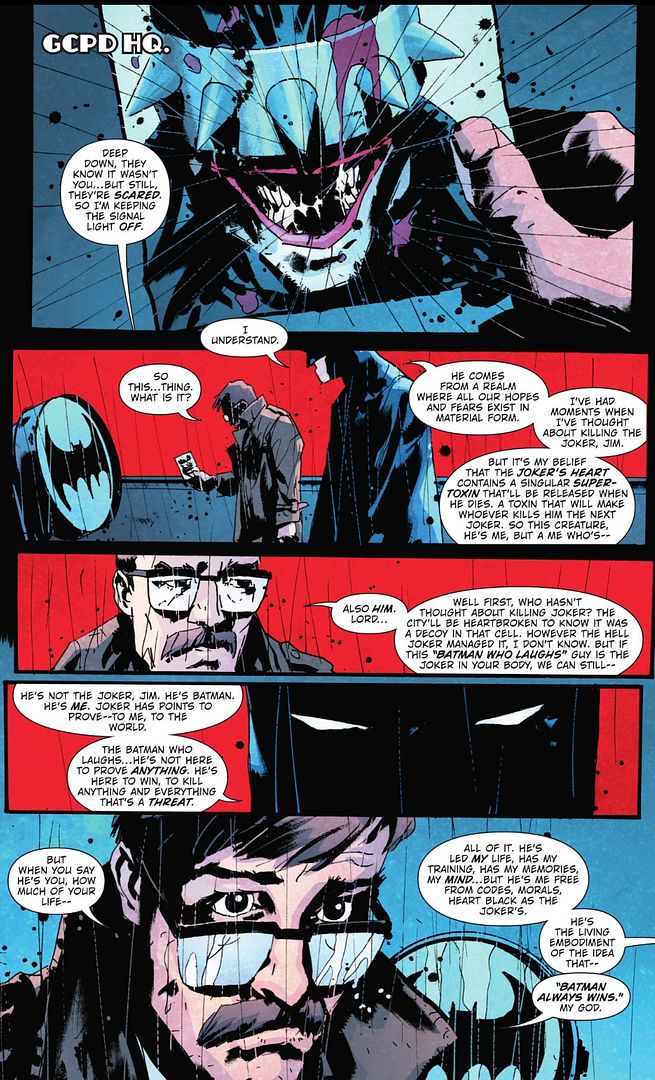
Man, it sure seems to rain a lot in Gotham, eh? 😉
Anyway, this concern soon comes to pass in the Prime Earth universe – the Joker releases the toxin in his heart to our Batman. The slow conversion of our Batman into the Joker is the dramatic stakes of this series, as our Batman succeeds in capturing (not killing) both The Batman Who Laughs and the Grim Knight.
With Alfred’s help, our Batman finds a cure to the Joker’s toxin. This provides time at the end for a meditation on the differing responses to the lack of meaning in the universe – as exemplified by the Joker, our Batman, and the Batman Who Laughs:
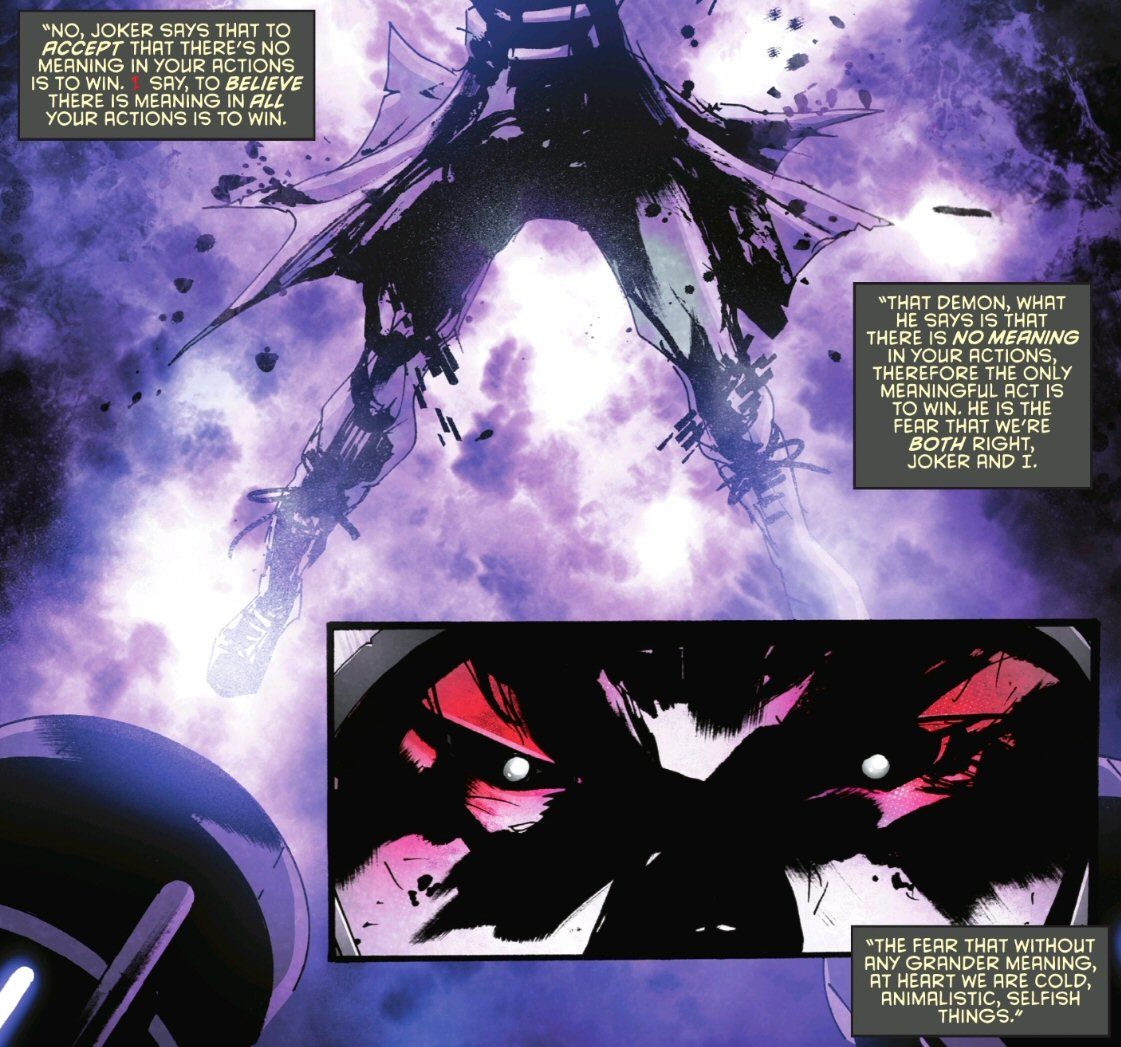
There is a lot to unpack there – to learn more about the main philosophical responses to the lack of meaning in the universe, check out my 8 Deaths of Spider-Man post for more about Friedrich Nietzsche‘s nihilism and Jean-Paul Sartre‘s existentialism, my Vision overview for Albert Camus‘ absurdism, and my Dream Girls overview for Simone de Beauvoir‘s existentialist take.
Our Batman’s virtue ethics become even clearer, as he considers the symbolism of his chosen bat:
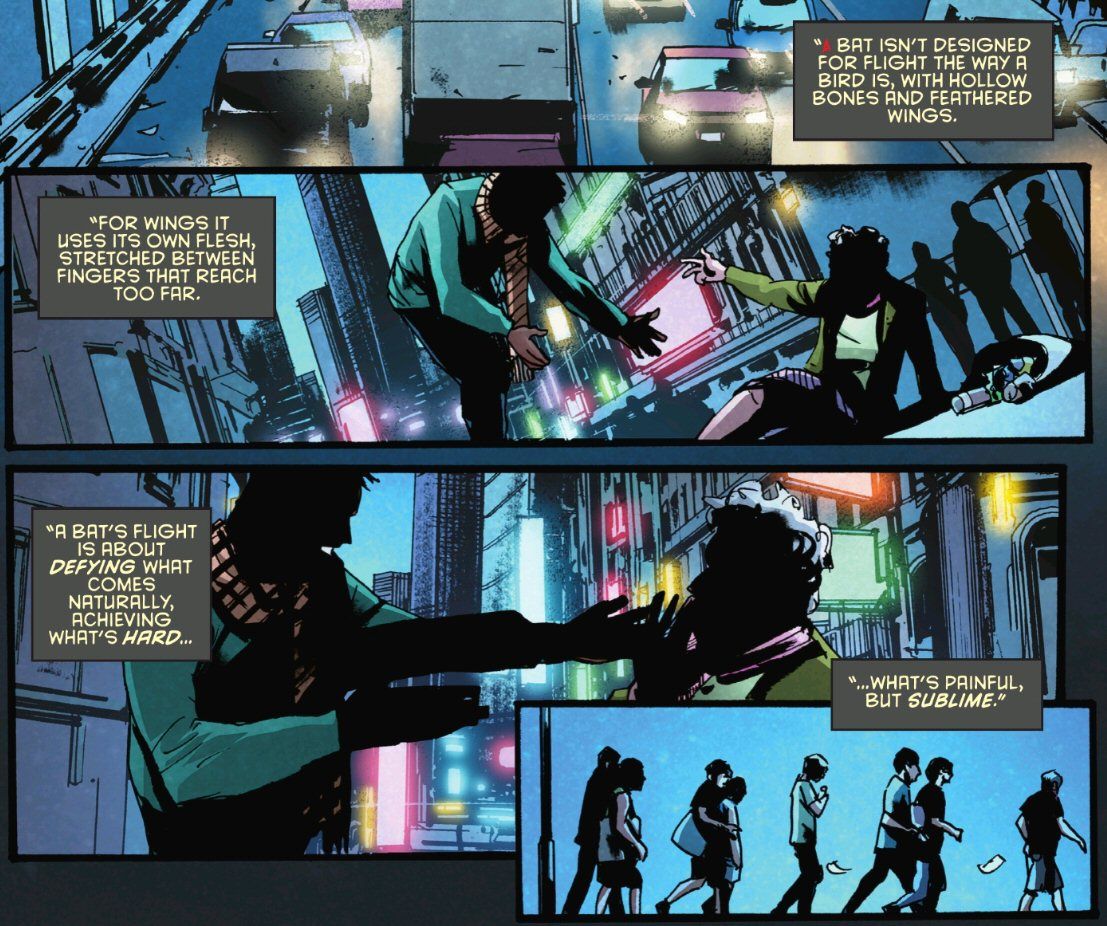
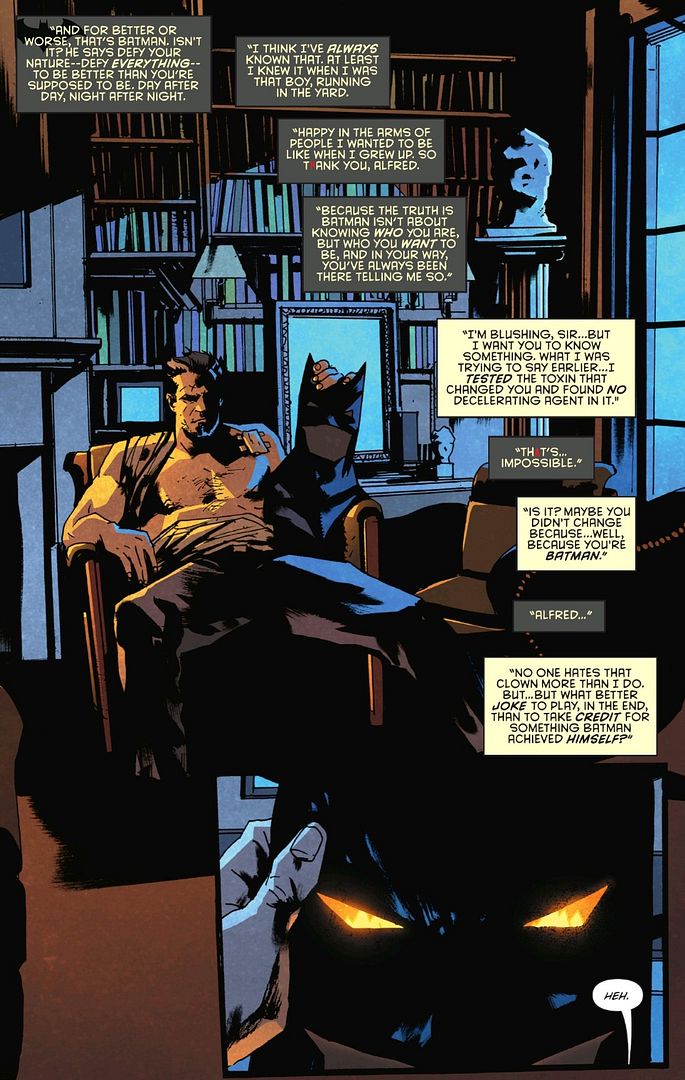
Snyder’s Batman ultimately comes to realize a virtue ethics perspective on life: it is not about being perfect – it is about continually striving to be better. And like Morrison before him, this Batman eventually also realizes that he has always been stronger than he knew.
Of course, it’s hard to bring up Snyder and not talk about his Absolute Batman – and the creation of the entire Absolute universe, which has been an incredible breakaway success for DC comics. But that version of Bruce is considerably different from Prime Earth’s and really needs to be considered in its own post (which I hope to get to soon!). But in general terms, I would say the genius of Absolute Batman is doing away with Bruce’s privileged background and mirroring his struggles to those of the working class more generally. In the Absolute universe, the overwhelmingly negative influence of Darkseid is reflected in society – villainy becomes structural rather than individual, with a system horribly stacked against the lower classes. It even corrupts Bruce’s relationships with family and allies, which can be used to hurt him even more. More to come on this front!
9. Joshua Williamson (2025-26)
Another interesting modern perspective for Bruce comes from the recent DC K.O. event (2025-2026), created by Scott Snyder and Joshua Williamson. The premise for this event is that the Prime Earth’s superheroes and super-villains are pitted against one another in a contest to be crowned “King Omega” by the heart of Apokolips, in place of Darkseid (I describe this event in my Superman ethics overview).
I find the “game night” sequences interwoven throughout the main event series are a great introduction to the ethics of the Trinity characters. These “interludes” were typically written by Williamson and drawn by Xermanico. From the first issue, DC K.O. Vol 1, issue #1 (2025):

Bruce has a clear consequentialist steak here, focused as he is on winning. But he has a broader point that he is trying to make to Clark (Superman), as he articulates in issue #2:
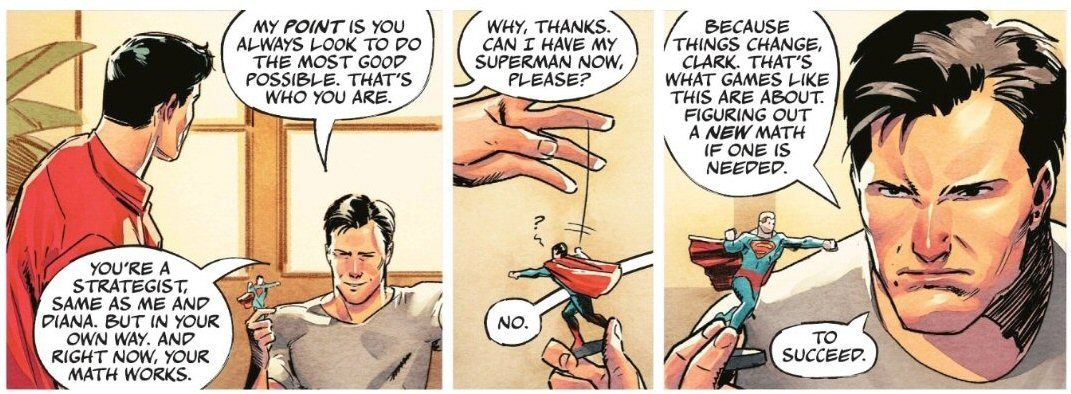
Eventually, the Bruce explains how his abilities aren’t really cheating. From issue #4:
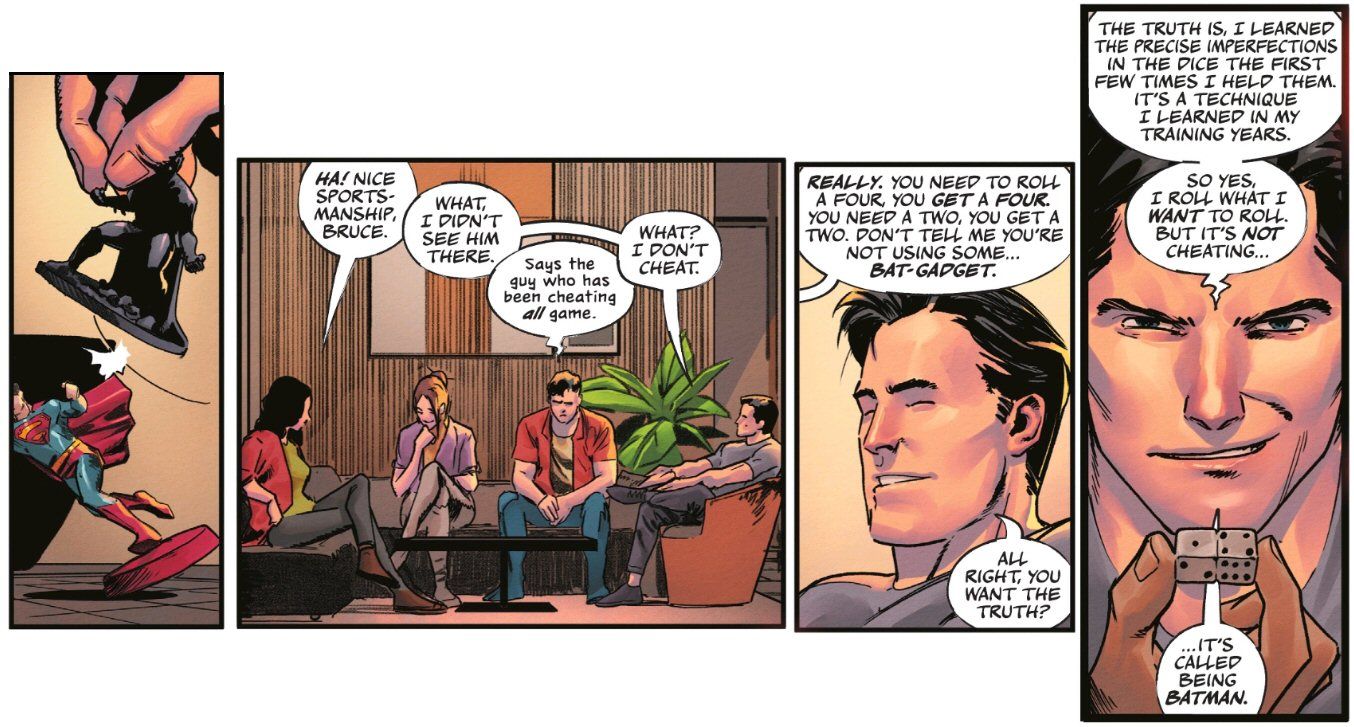
Surprisingly, Bruce “dies” early in this event, in issue #1. But his consequentialist push (shown in the flashbacks) provides the necessary impetus to drive Clark to win the tournament.
Despite the consequentialist bent for Bruce in those interludes, Williamson’s dedicated Batman series is far more virtue ethics nuanced. Not surprisingly, it turns out Bruce isn’t really dead – he cheated (of course!), as we learn in DC K.O.: Knightfight Vol 1 (2026), by Williamson and Dan Mora. As a punishment for his actions, the Heart makes him repeatedly question his sanity and fight his various Robins in alternate universes where things turned out quite differently. From issue #2:

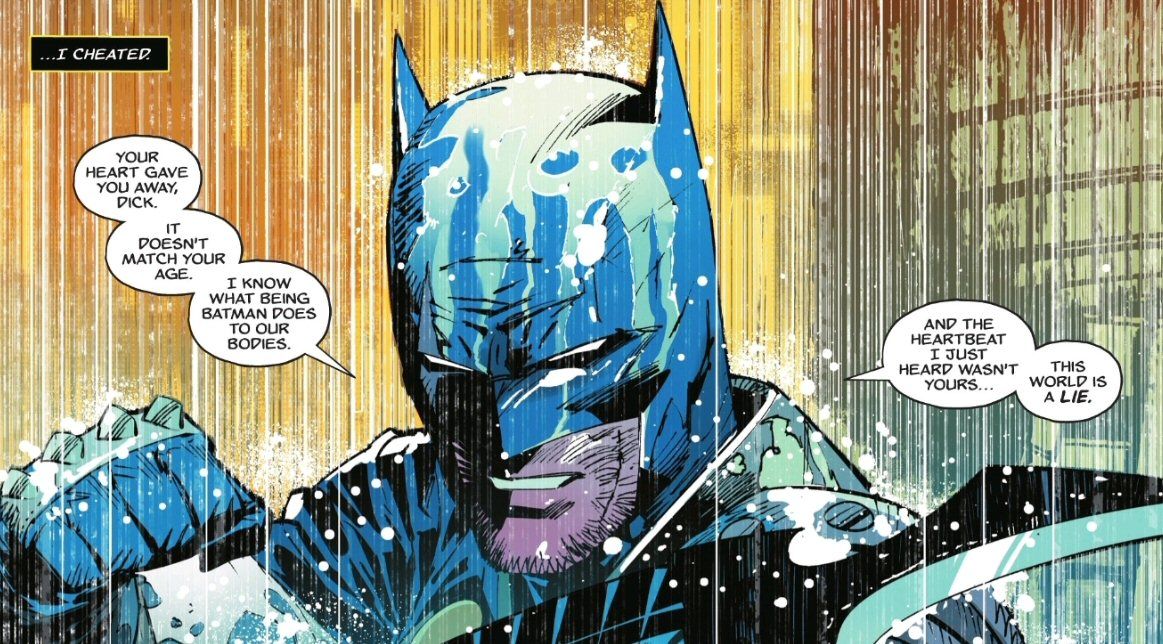
Bruce keeps finding ways to frustrate the Heart’s intentions, by reaching the recalcitrant Robins. Eventually, the Heart shows him a utopian world where everything turns out swimmingly – but where he must kill all the Robins for it to survive. From issue #4:

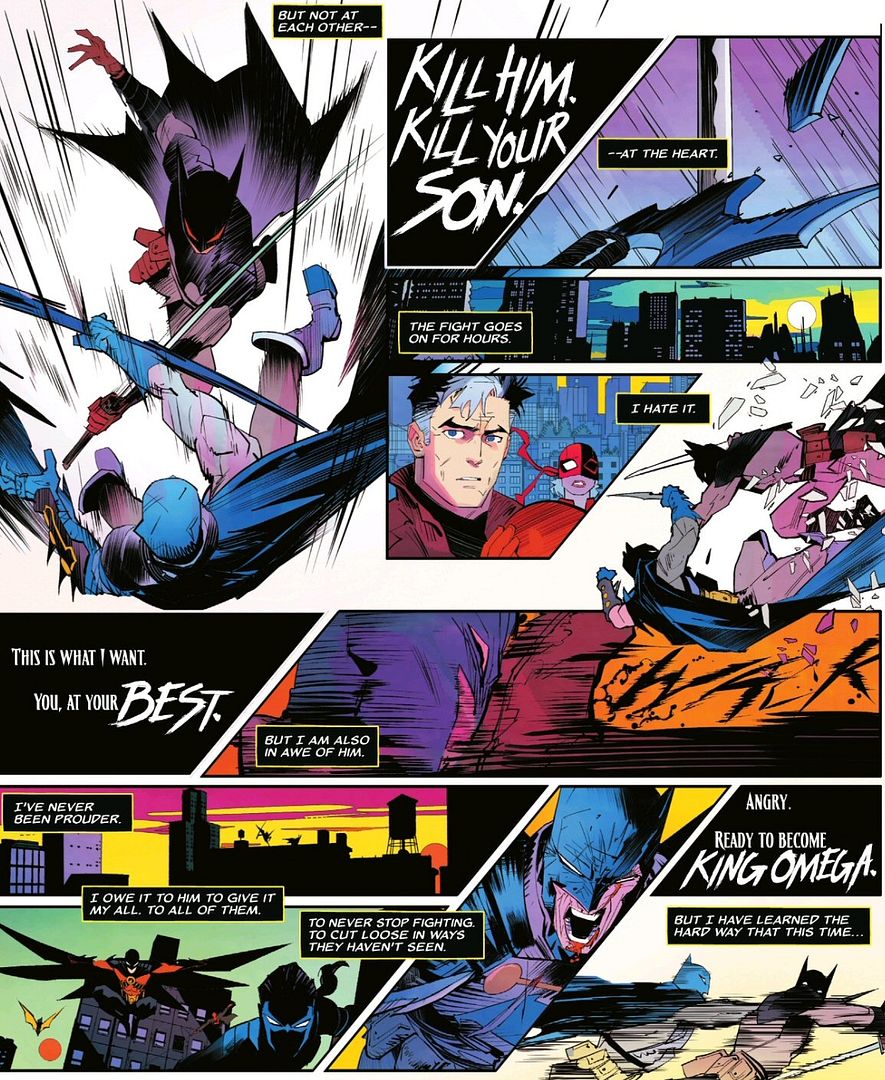
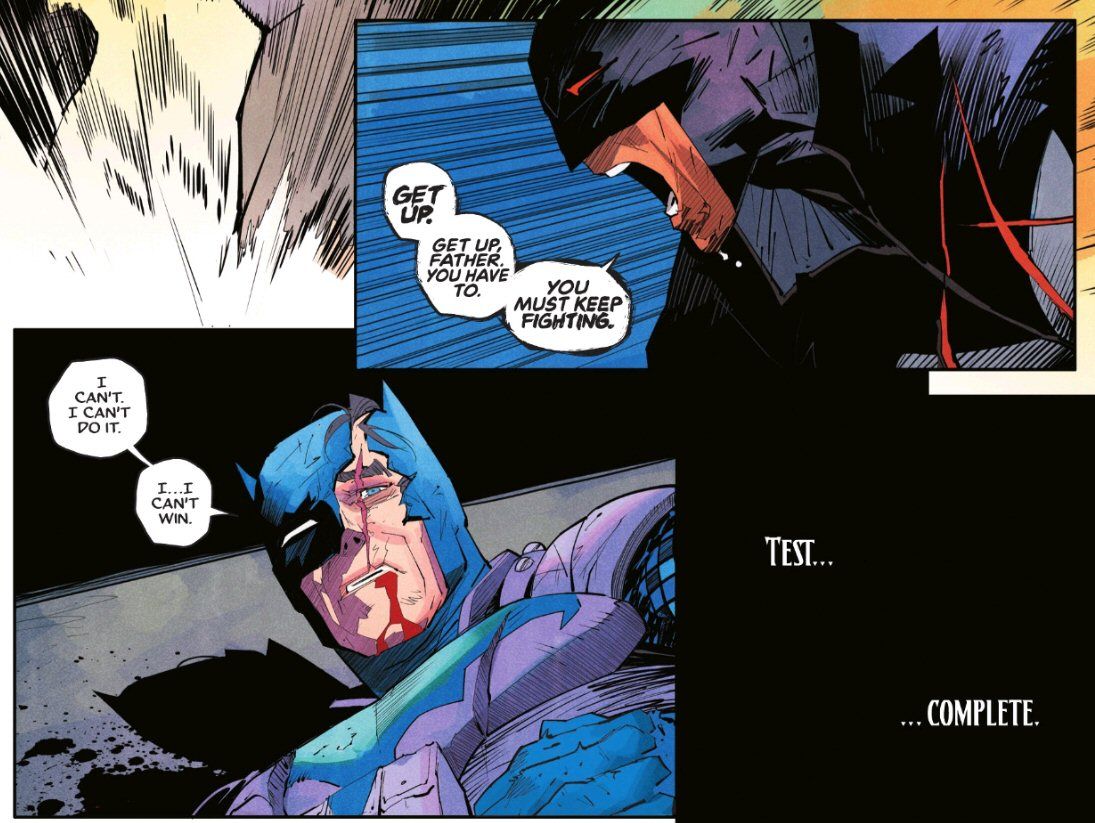
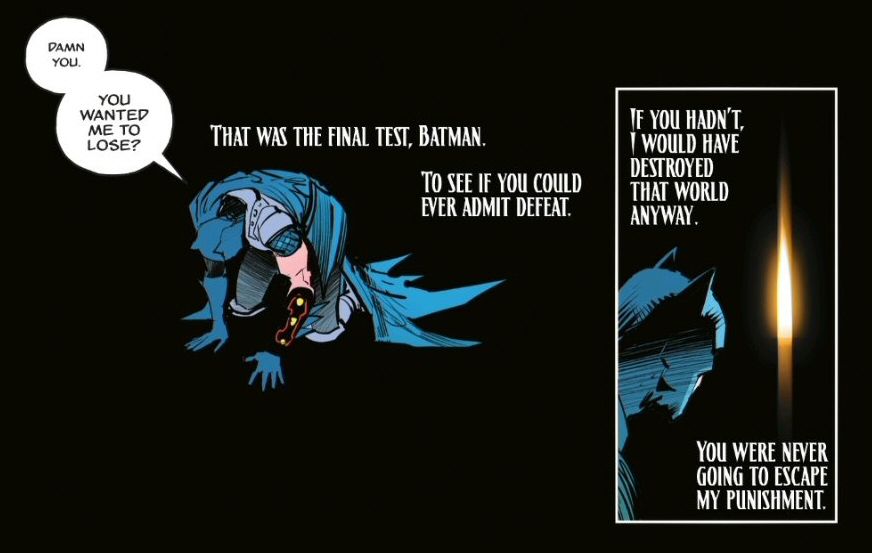
Yes, Bruce is put through the ringer here – but it is unlike the consequentialist Bruce to ever admit defeat.
The ultimate ethics message seems to be captured from the early opening pages of issue #1 of this series, where Bruce is recalling a mundane evening from before the tournament began. He was called to a scene only to discover his current Robins had it well in hand:
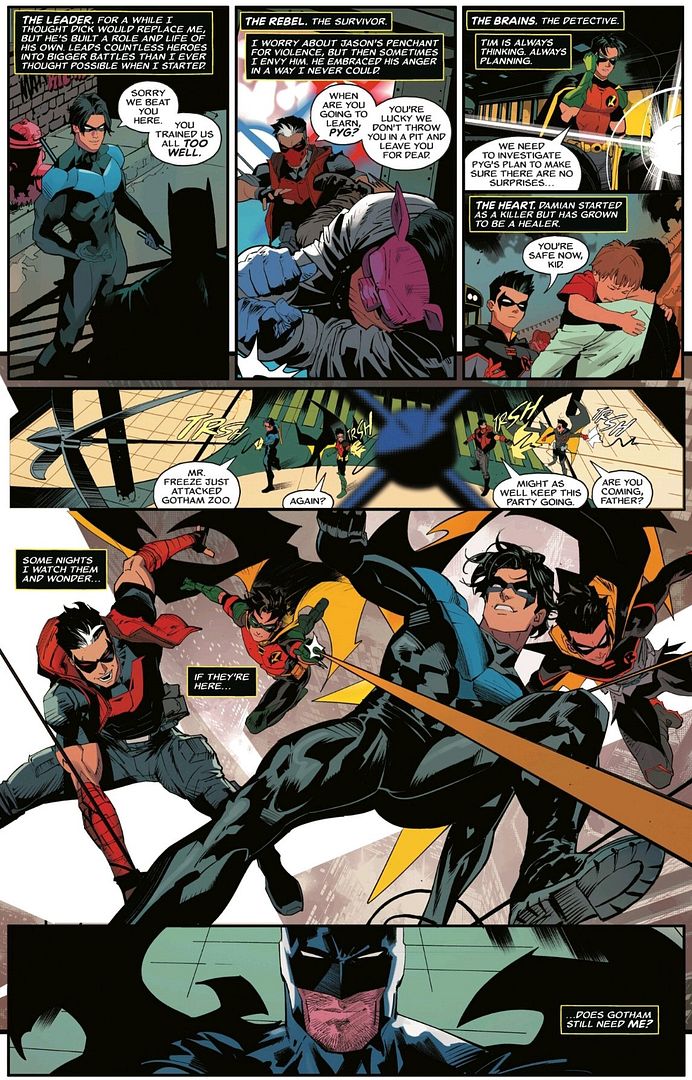
Williamson’s Batman is one who comes to realize the value of family – and the value his virtue ethics example has brought to the world, through his family. Note the familiar pattern of articulating a consequentialist view, but ultimately realizing a virtue ethics one?
10. Matt Fraction (2025-Present)
The same is true for the main Batman series, Batman Vol 4 (2025), written by Matt Fraction with art by Jorge Jiménez. The first issue opens with a somewhat cynical Bruce being called to the escape of Killer Croc (aka Waylon Jones) from Arkham Towers:
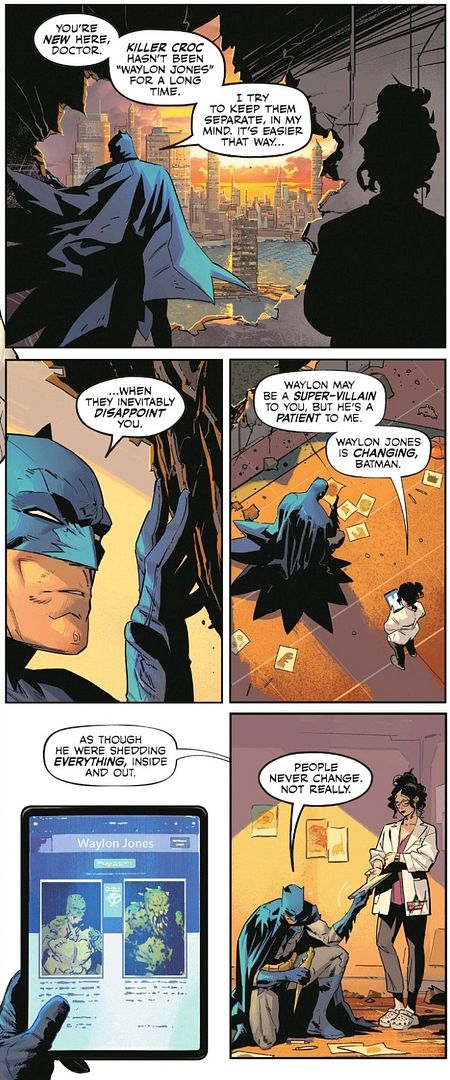

But I love these subsequent panels, which show Batman’s concern for others (Jiménez nails it with the art):
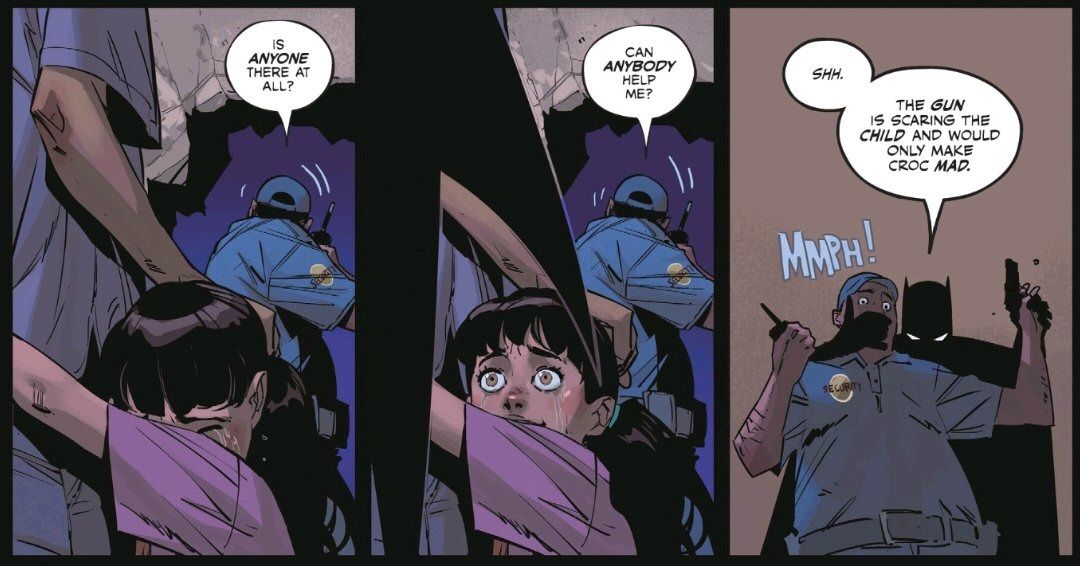
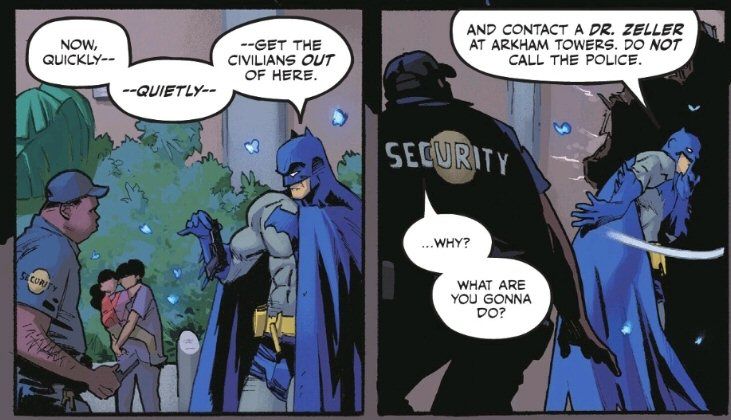
Batman is initially prepared to go in blazing on Waylon, but then his conscience – in the form of a hallucination of Alfred – stops him. FYI, Alfred was killed in the comics back in 2019 and remains dead at the present time. Fraction has confirmed that this is not an AI or hologram of Alfred (as speculated in early reviews) but a manifestation of Bruce’s own mind, providing the kind of feedback and advice Alfred used to provide:
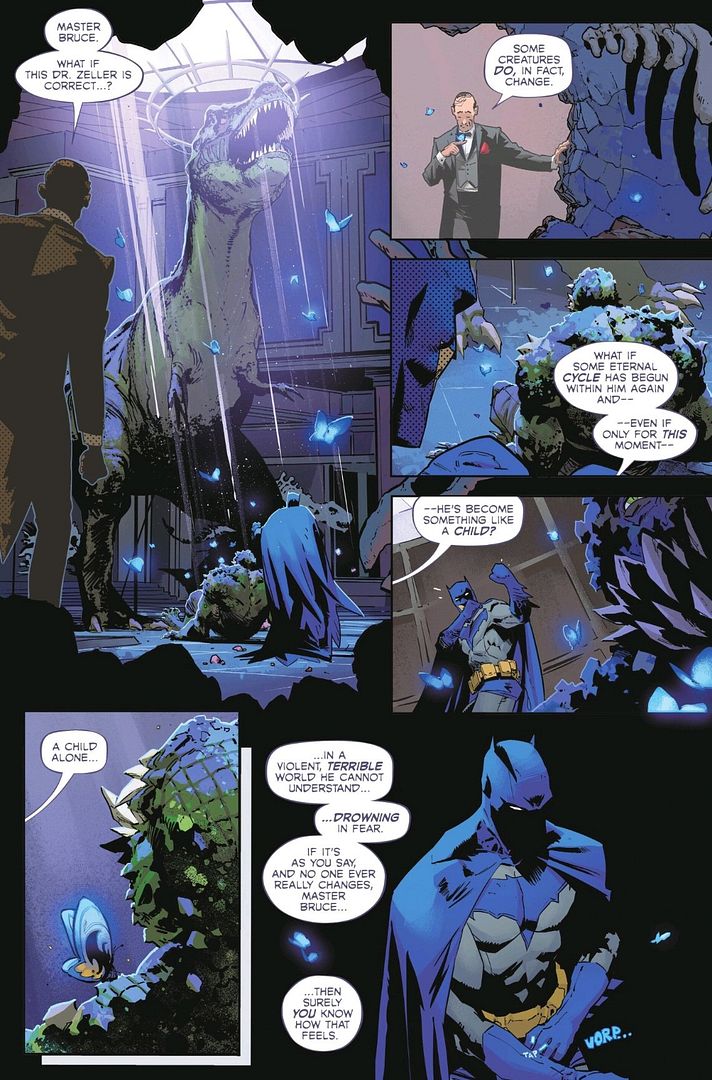
Bruce chooses to de-escalate the situation, removing his mask and talking to Waylon instead:
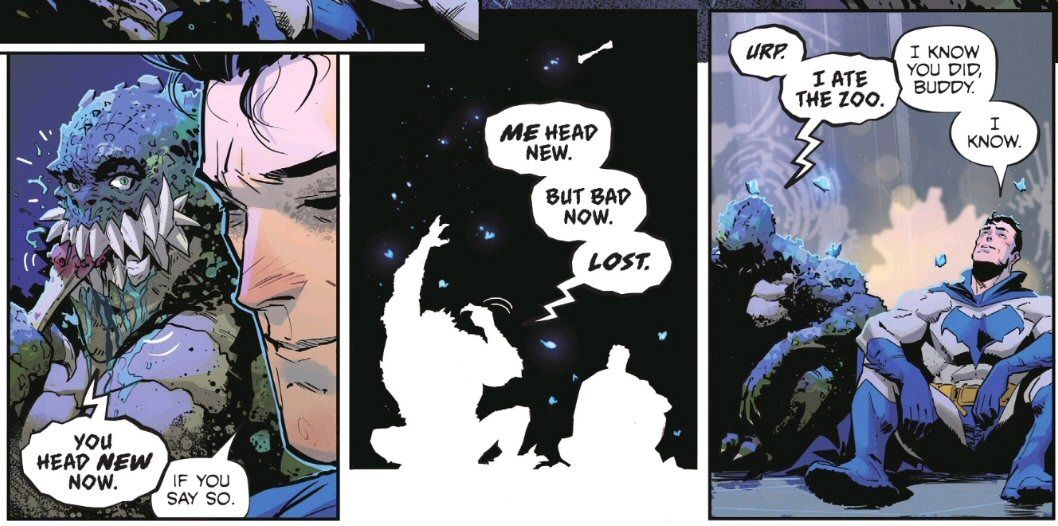
As instructed, the psychiatric help arrives instead of the police:
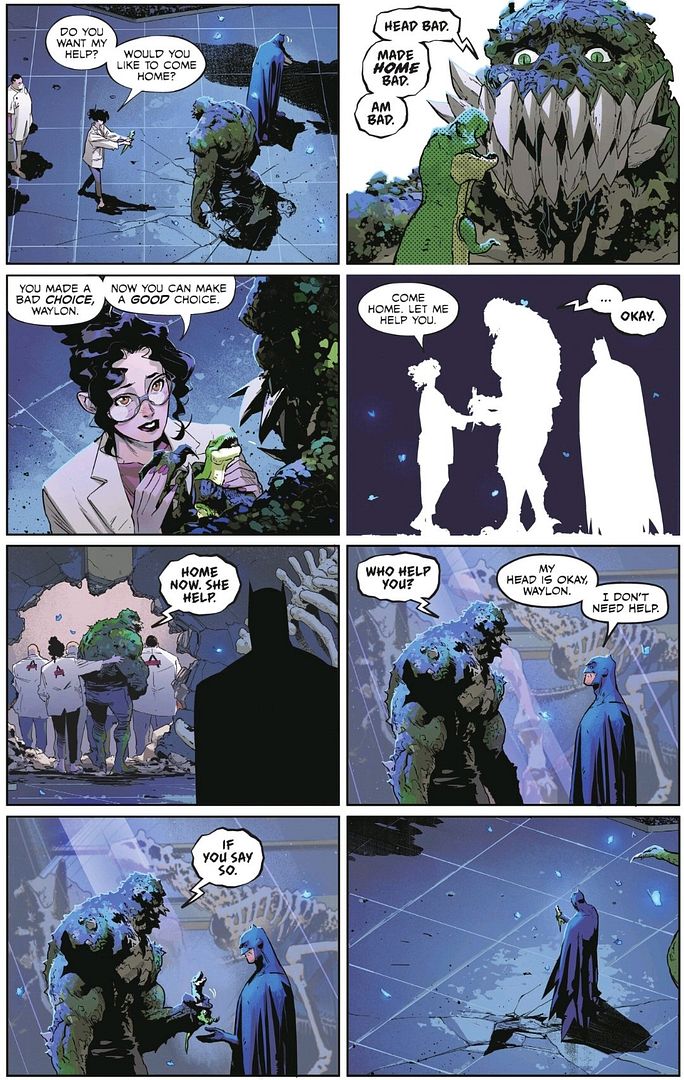
Clearly this version of Batman is both better (“You head new now”) yet still needing help (“if you say so”, as Waylon throws back at him). I remember a review when this series launched that described this Batman’s superpower as empathy – which sounds about right, and in keeping with virtue ethics. At a minimum, empathy would be an epistemic virtue, as it allows insight into other people’s thinking – thus helping you to find truth and gain knowledge (good traits in a detective!). Or in Waylon’s terms, it helps your head be good. 🙂
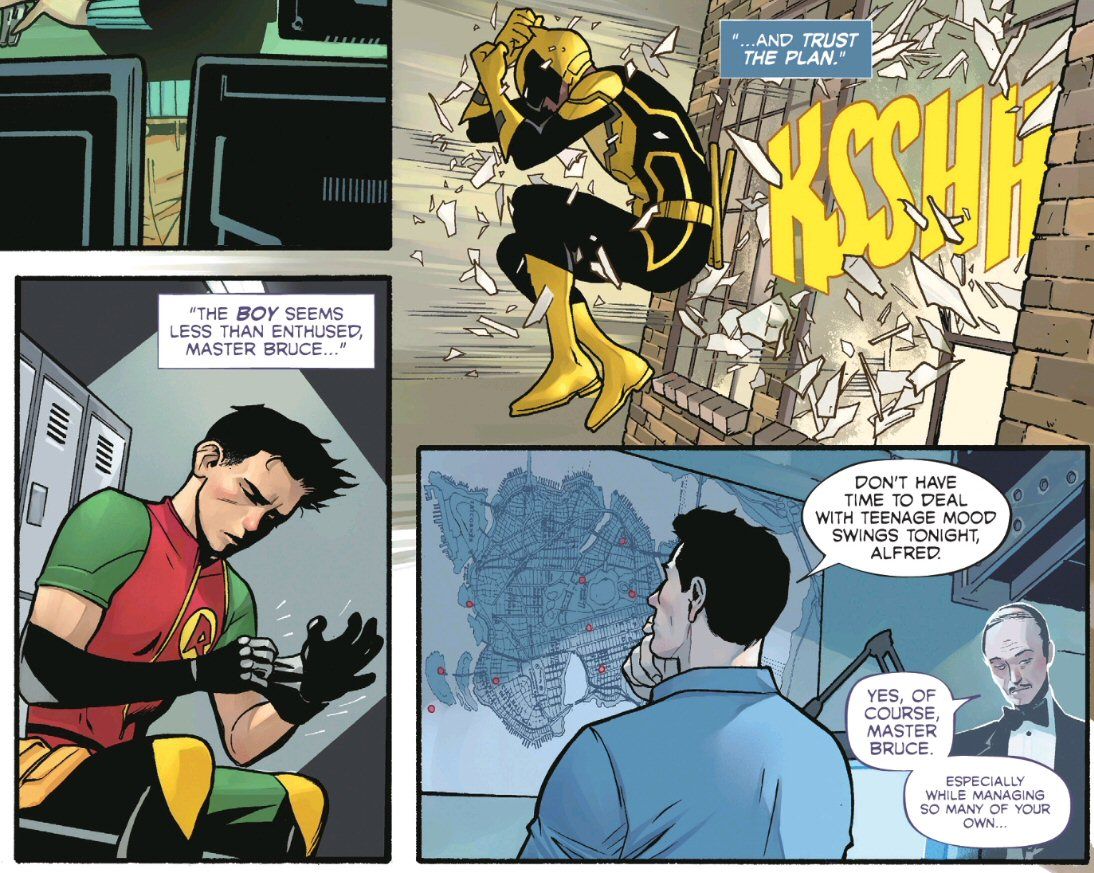
Bruce does get the help he needs in terms of the current extended members of the Bat-Family. From issue #9 (2026):
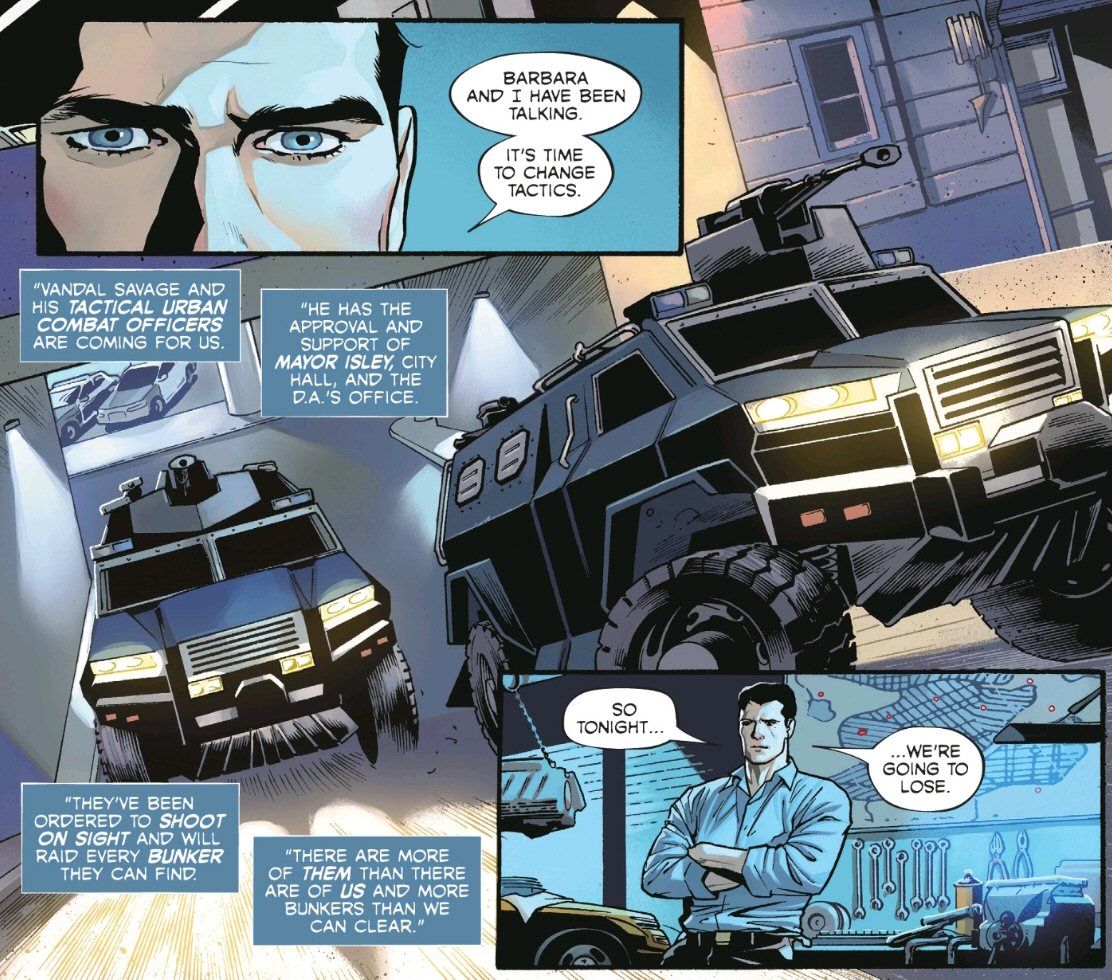
The plan Bruce and Barbara come up with is … unusual. But it does afford this nice moment in regards to Damian – again, with Bruce’s conscience (manifesting as Alfred) intervening:
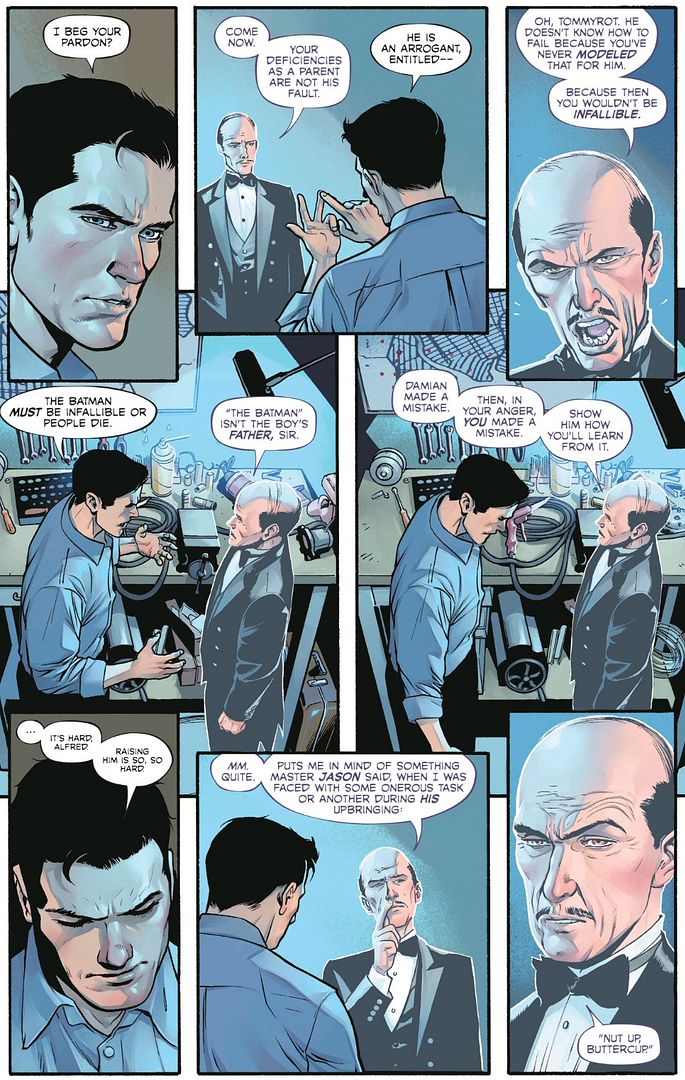
To Damian’s delight, Bruce swaps missions with him. They re-meet at the end of the issue:
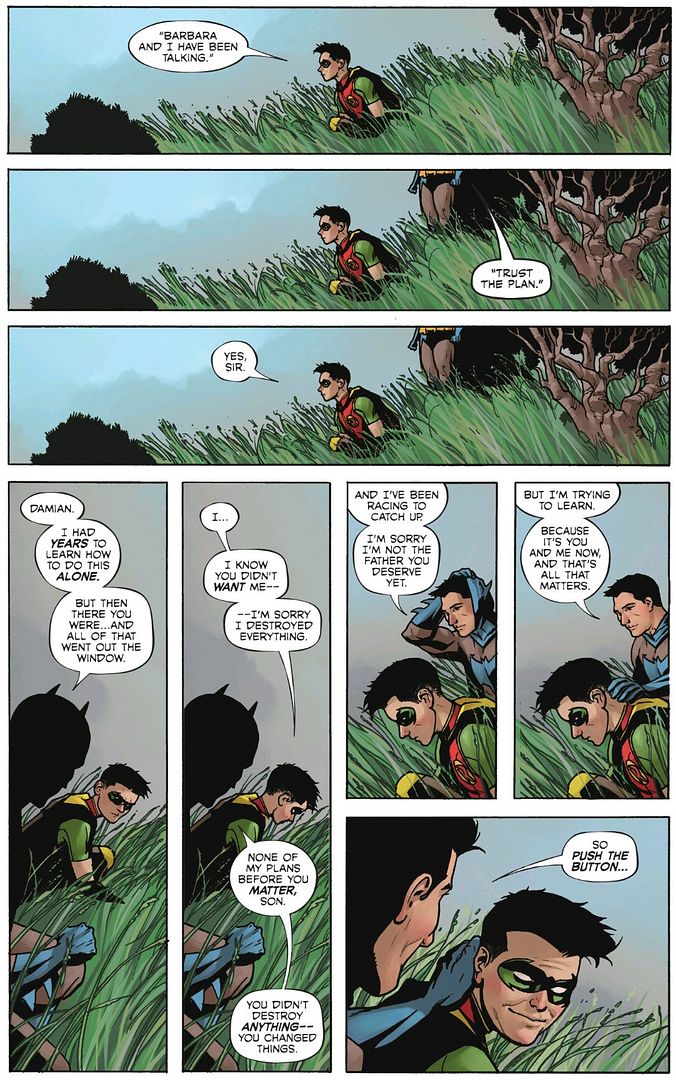
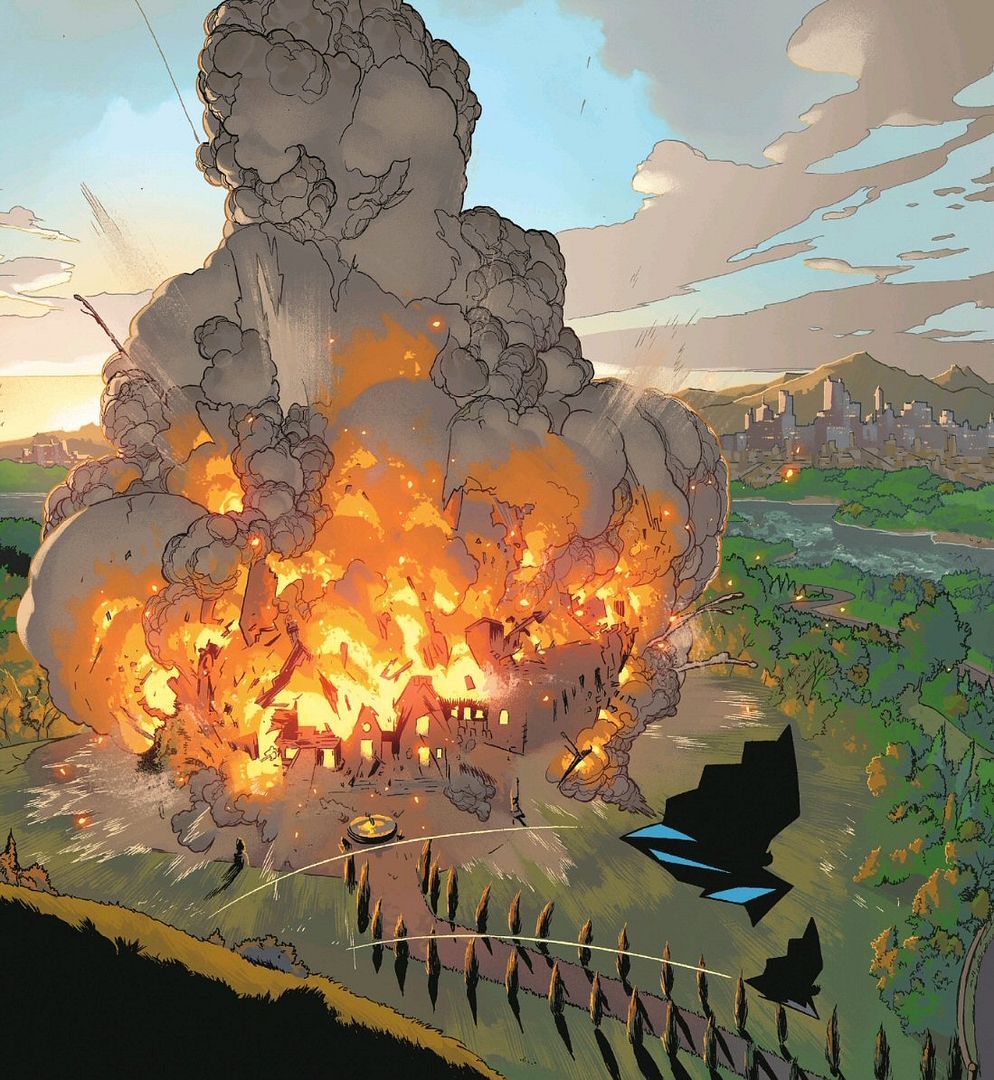
Batman and family are on the run from this point, after destroying all their own bases – including the manor.
This series strikes me as another example of Bruce learning a virtue ethics lesson again – it is the people in your life that matter, and you need to care for one another. This is the most care ethics version of the character I can recall seeing, which is another form of virtue ethics. You can read more about the care ethics in my Can Caring Be Wrong? post.
11. Tom Taylor (2021, 2024-Present)
Tom Taylor has been writing Batman since the end of 2024, in the other main Batman series, Detective Comics Vol 2, starting in issue #1090 with art by Mikel Janín. His run is heavily philosophical from the opening pages. The first arc, “Mercy of the Father”, does something relatively rare for a comic book – it shows the applied ethics of Thomas Wayne as a physician (through flashbacks). These are used to impress upon us the very deontological ethics of his Batman – they were learned from Bruce’s father (applied ethics being heavily deontological at their core). Check out my The Power Fantasy introduction for a discussion of the origins of modern applied ethics.
This is probably the most Kantian I’ve seen Bruce since the O’Neil era, at least initially. But there are also clear elements of virtue ethics in his strong rehabilitative stance against the consequentialist and retributivist villain of the first arc. The virtue ethics angle expands over the next several story arcs, as you see Bruce struggle with consequentialism. But this overview post has already gotten very long – so like Synder’s Absolute Batman, I will save a detailed review of Taylor’s run for a separate post in the future. Stay tuned!
But I can’t resist one example – I thoroughly enjoyed last week’s Detective Comics 2026 Annual (Vol 1, issue #1), written by Taylor with art by Nicola Scott.
**** SPOILER ALERT ****
Skip ahead to my Mark Russell section if you don’t want this issue spoiled for you.
This story takes place before Batman Vol 4, issue #1 (2025), and begins with Batman having a cup of tea at Alfred’s grave. Lobo soon shows up to kill him, as Batman has been framed for an intergalactic murder (with all of humanity now in peril).
Instead, Batman convinces Lobo to help him prove his innocence through a very consequentialist ruse. It’s an amusing gag that I don’t want to ruin here, but it presupposes that Batman has no deontological core (something that the consequentialist Lobo is likely to accept). In the end, they team up to investigate the death of the murdered alien King (I must say I never had a Batman/Lobo team up on my ethics bingo card, but Taylor does it well!).
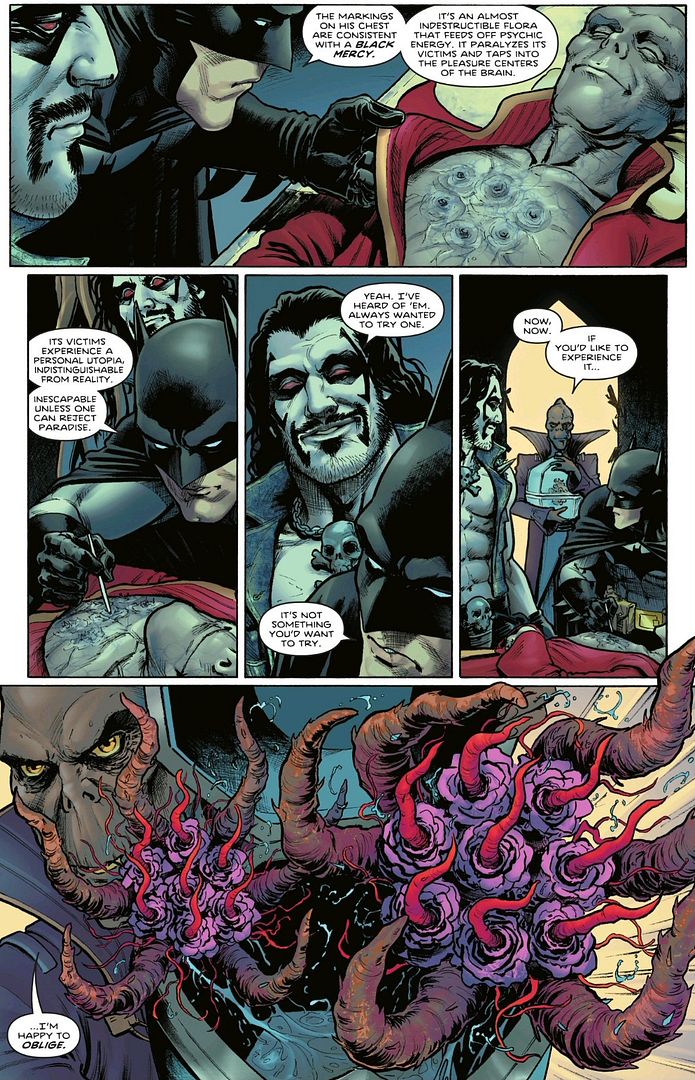
Bruce’s utopian experience shows him everything he always wanted – a happy marriage to Selina Kyle, a daughter of their own, and Alfred and his parents, Thomas and Martha, alive and well. But of course, Bruce is able to resist his personal paradise:

It’s a lovely sequence, tying in nicely to Fraction and Jiménez current run with the hallucinated Alfred. And this story underscores again how modern writers often see Batman in similar terms to Morrison – a man of incredible force of will, developed through exhaustive training, able to resist any attempt at corruption. The ultimate virtue ethics superhero.
Although this covers the modern era up to and including the two concurrent main runs of Batman, there are a couple of other writers I would like end with. They are outside of the main Batman titles – but they have also incorporated this virtue ethics shift into their recent stories.
12. Mark Russell (2024-25)
Although Mark Russell has written Batman in a number of series, I’m going to focus here on his Batman: Dark Age Vol 1 (2024), with art by Michael Allred. As I’ve previously observed, Russell is very knowledgeable about ethics and he provides a very thoughtful examination of the character’s moral growth here.
This series takes place in an alternate Dark Age Universe, set in the original comics multiverse that was destroyed during the first Crisis event in 1985. This universe is similar (but distinct) from one featured in Russell and Allred’s Superman: Space Age series that I discuss on my Superman ethics overview. But like in that story, part of this universe survives and gets transferred to Earth-832654-Z – which is one of the few Earths to survive the Crisis event.
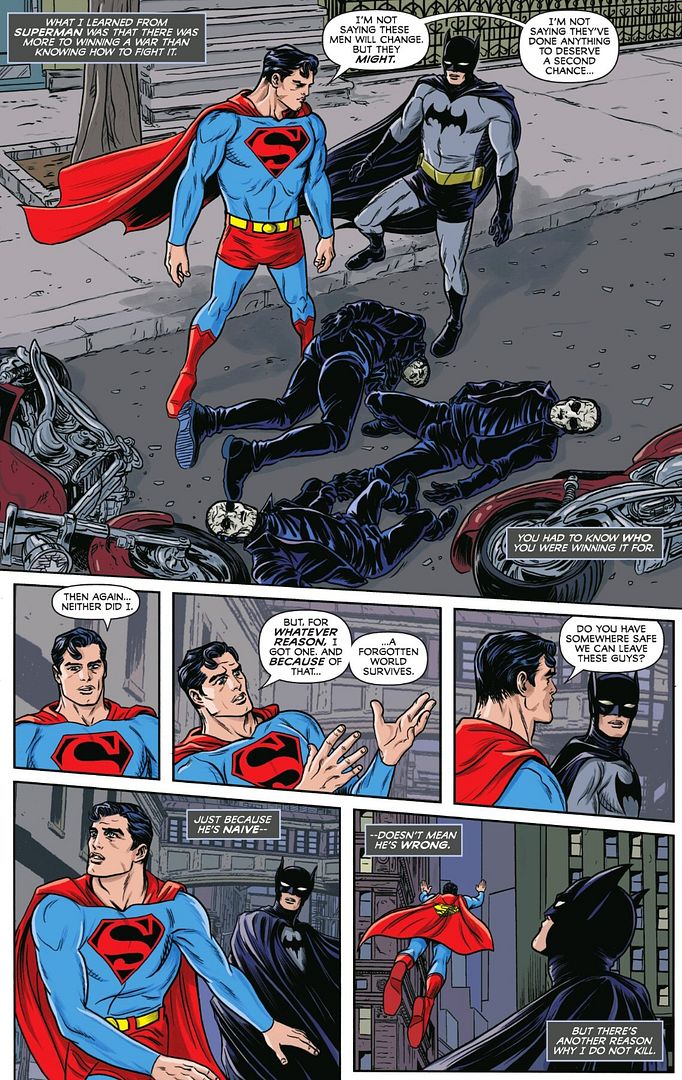
Russell makes some good points about Bruce’s character as we go along, clearly articulating a virtue ethics core for his Batman – including his no-kill rule. Russell provides three reasons for it:
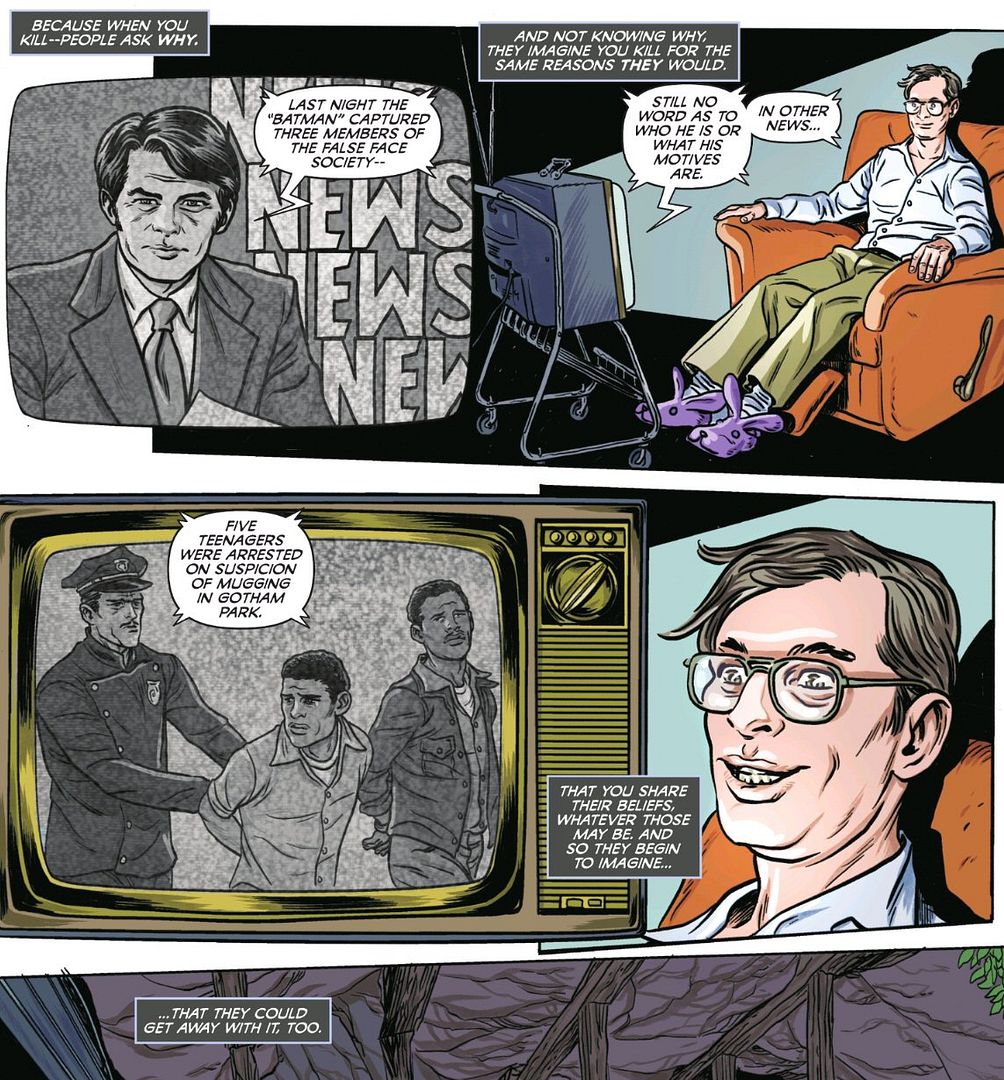
Yes, fuzzy bunny-slippers guy above is truly frightening (a real Jeffrey Dahmer vibe there!).
But there is another perspective that Russell offers, when this universe’s Ra’s al Ghul commits suicide rather than be captured:
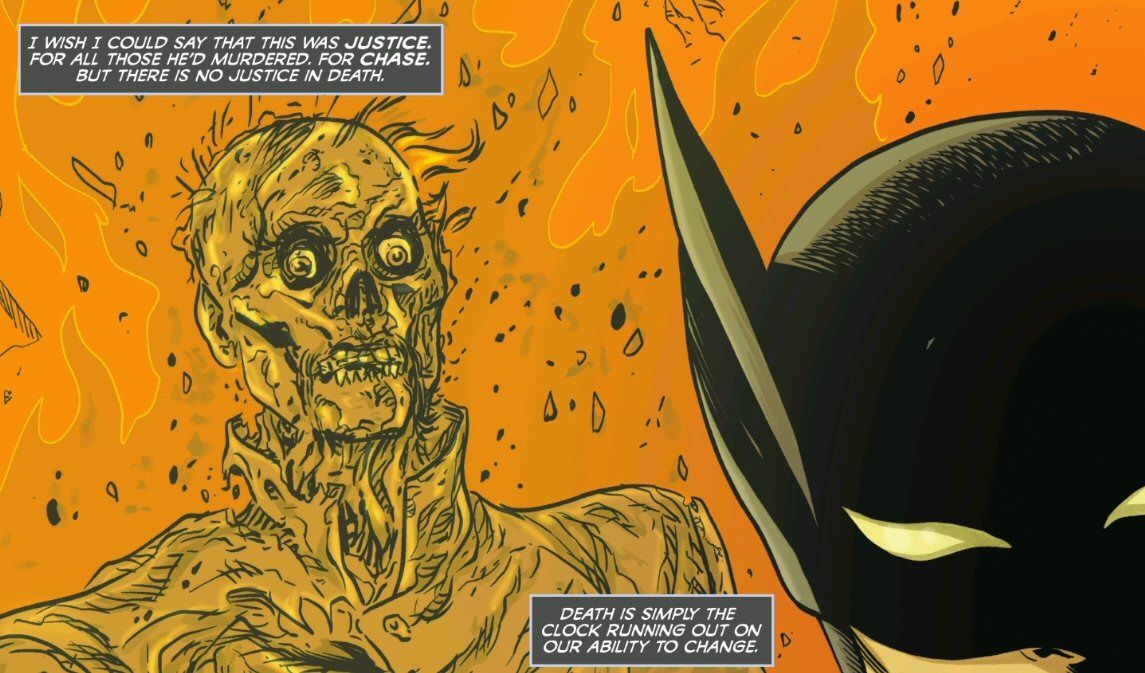
This is the first time I’ve seen this perspective offered for Batman – but it is very consistent with virtue ethics rather than deontology. After all, you have no opportunity to learn, grow and be better if you are dead!
I won’t give away the ending of this series – it has a lot more to say about Batman and his relationship to the Joker in particular. Thoughtfully done, highly entertaining – and highly recommended for any fans of Batman and ethics!
13. Jadzia Axelrod (2023, 2026)
A relatively new superheroine in main DC comics continuity is Galaxy (Taylor Barzelay), created by Jadzia Axelrod and Jess Taylor. Taylor is a princess of the planet Cyandii, who has been a refugee on Earth since her early childhood. Her powers continue to develop, but she already has extensive abilities to sense and control all forms of energy. You can read her full history and background on my DC Dream Girls ethics overview.
There is a cute exchange between a (very nervous) Taylor meeting Batman early in her career, having just saved his life. From the excellent Hawkgirl Vol 2, issue #3 (2023), written by Axelrod with art by Amancay Nahuelpan:

Taylor featured prominently in this summer’s DC Pride event, Justice League: Dream Girls Vol 1 (2026) written by Jadzia Axelrod and Nicole Maines, with art by various artists. Taylor’s current status as a member of the League was on trial due to the lanterns concerns about how easily Taylor was able to incapacitate a host of corrupted Lanterns in the preceding Justice League Intergalactic Special one-off. From issue #4, with art by Ted Brandt and Ro Stein:
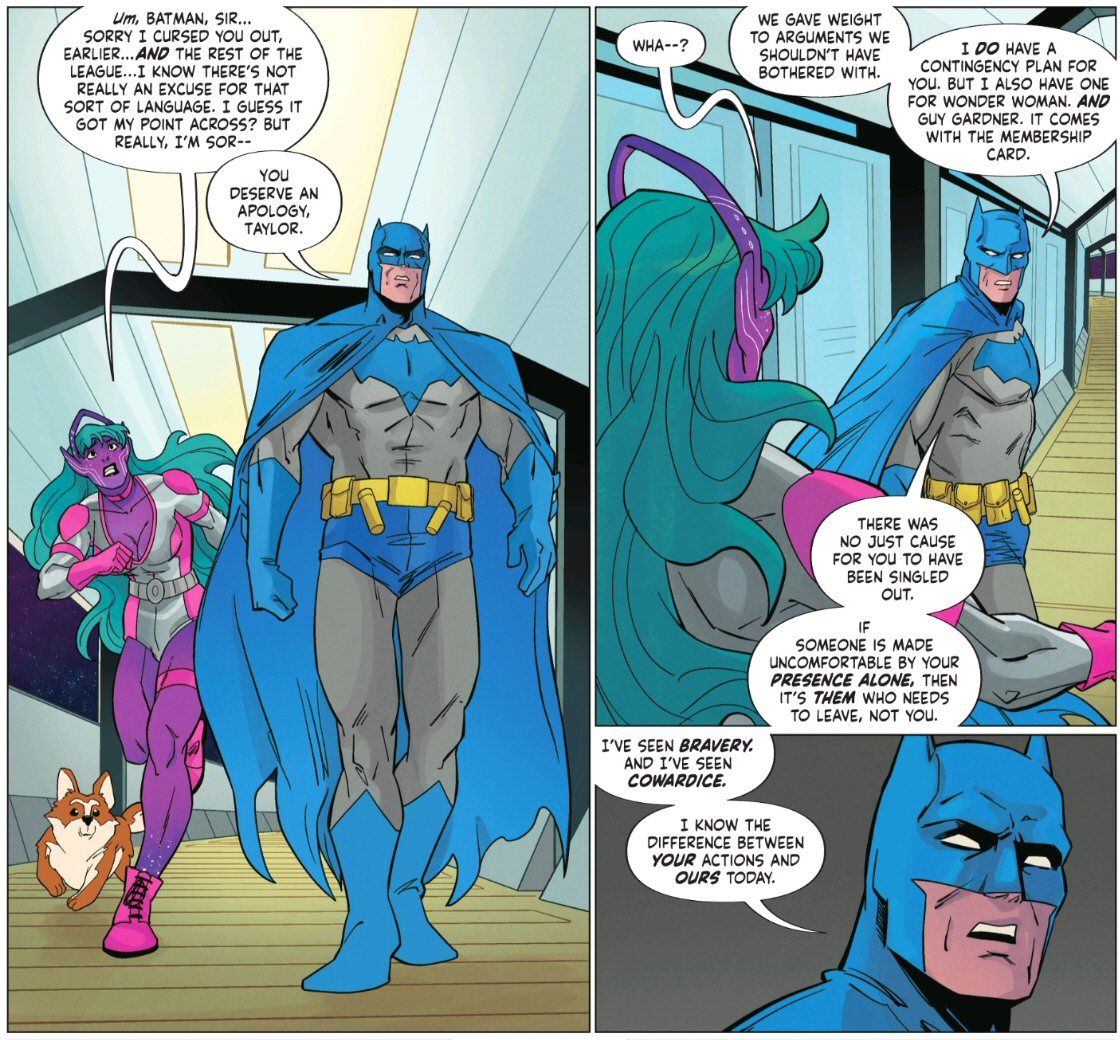
This is very much a character assessment of Galaxy (indeed, Batman goes on to recommend her for a leadership position). Again, although this takes place outside of the core Batman comics, it helps to further reiterate my main point about the current view of Batman – while he still maintains strong consequentialist tendencies, he is fundamentally about virtue today.
Movie representation: The Dark Knight (2008), by Christopher Nolan
As I mentioned previously, movies (and other media) tend to differ significantly from their comics source material in terms of ethics (especially when it comes to voluntary killing). While it’s beyond my scope here to review all the other diverse versions of Batman, I do want to highlight one thoughtful example – The Dark Knight (2008). This film was directed by Christopher Nolan, from a screenplay co-written with his brother Jonathan. The second in a trilogy of very popular films, The Dark Knight is a particularly philosophical outing, pitting several ethics frameworks against each other.
The clearest ethical divide in this film is like the historical one from the early O’Neil comics (where the title comes from) – deontology, in the form of a nearly-Kantian Batman, versus consequentialism, in the form of the Joker. But this Joker draws a lot more from Moore’s concept in The Killing Joke – a nihilist and unreliable narrator of his past. He wants to prove that morality itself is a fiction (“civilization’s parlor trick”), and his schemes are designed show how under enough pressure even supposedly good people will ultimately abandon their principles (“one bad day”, in the language of the Moore comics series).
The film even has a variant of the famous Trolley problem (crossed with another famous zero-sum game, the Prisoner’s dilemma) in its depiction of the ferry dilemma set up by the Joker. The Joker seems to be channeling a form of Thomas Hobbes‘ rational egoism here (see my Vision overview for an introduction to Hobbes) in his assumption that the ferry-goers will choose to act based on their narrow self-interest. The Joker espouses a particularly bleak and negative view of humanity – and so it is re-affirming when the regular people on the ferry refuse to act.
But the Joker is more successful in corrupting the seemingly noble district attorney, Harvey Dent. Dent starts out seemingly both virtuous and deontological in his idealism and commitment to justice and the rule of law. His descent into Two-Face is framed around a realization of the nature of moral luck, using the coin-flip as a rejection of both deontology and consequentialism. It turns out his apparent virtues weren’t based on good character after all – a very Aristotelian point about how virtue requires stable character and continual practice.
The ending of the film is a good example of what is known in philosophical terms as the noble lie – Batman takes the blame for Dent’s string of murders, reasoning that Gotham needs a symbol of martyred hope more than it needs the truth. A consequentialist choice taken by the otherwise deontological hero. Gordon’s famous closing narration (“He’s the hero Gotham deserves, but not the one it needs right now”) suggests a hybrid moral approach for Batman – consequentialist at the level of Gotham, but deontological at the individual level.
But of course, that doesn’t work – and so, it is hard not to see this ending as a repudiation of Batman’s stated deontological moral code (in a sense, the Joker can claim a victory here). There is a glimmer of hope that this could be the start of a virtue ethics turn for the character, but there is not much direct evidence for that in the film itself. To paraphrase the ending of the excellent 2019 HBO mini-series Chernobyl – a lie is a debt owed to the truth, and sooner or later that debt must be paid. This is all fodder for the final film, which is set up as a necessary redemption arc for the character.
So, there are no clear moral winners in this film, but an entertaining run through a variety of philosophical concepts. Note there is long-standing fan theory that posits the Joker is really the hero of The Dark Knight (see Film Theory’s YouTube channel for a breakdown as to why). But this analysis is based entirely on a consequentialist perspective – while the Joker is ruthless, maniacal, and happy to torture and kill innocent people, he ultimately delivers the “good outcome” that the heroes are all ostensibly trying (and failing) to achieve through their ethical frameworks. A chilling reminder of the limits of consequentialism!
Current overall ethics framework: V/c


I recognize this assessment could come as a surprise to long-time Batman readers. I would place the 1970s to mid-1980s Batman as primarily a deontological hero with secondary consequentialism (so, a D/c on my scale), with the late-1980s through to the early 2000s as the reverse (so, a C/d). But I find his virtue ethics comes through most obviously in modern stories, beginning with Grant Morrison’s run in 2006-2011. And so, I think it’s most appropriate to consider him a V/c now on my superhero description system.
Philosopher Mark D. White has written an entire book on “Batman and Ethics” (2019) – but it focuses exclusively on Batman in the comics between the early 1970s and 2011. To quote from his book’s summary blurb:
Batman’s moral behavior shows a deeply conflicted hero, one who tries to save lives and serve justice in several different ways but has trouble finding an acceptable balance between them—or even within any one goal. Instead, his actions and words reflect a mix of utilitarianism and deontology (with just a touch of virtue ethics) that reveals the value of each while demonstrating how difficult it is to pursue them at the same time.
- Mark D. White, Batman and Ethics (2019)
I fully agree with his assessment for that time period – the conflict between the character’s deontology and consequentialism is most prominent (with utilitarianism being the main form of consequentialism today) . But I find many of the modern stories since 2011 more interesting – and diverging from the classic deontology/consequentialism divide that White so accurately describes.
Again, the purpose of this site is not to provide a definitive normative ethics framework for any character. Rather, I’m seeking to show how superhero comics stories reflect the changing views of ethics in society and culture over time.
If you wanted to sum up Batman’s normative ethics across his full run in the comics, I suppose you could say he is deontological in his constraints, consequentialist in his goals, and virtue ethics in his emphasis on personal discipline, preparation, courage, and family. Which aspects gets emphasize depends on the era and the writer.
The last word … for now
This has been a fun romp through the annals of Batman comics literature – although admittedly, looking at only a narrow ethics slice of it. I hope you have enjoyed reading it as much as I did putting it together (although I know my wife is looking forward to my finally not bringing up Batman’s ethics daily – soon!).
But as a closing thought, I’ve often wondered if the propensity of many creators to take Batman right to the edge of antihero territory might not also stem from a common perception of his personality.
What I’m referring to is a popular (but problematic) personality assessment known as the Myers–Briggs Type Indicator (MBTI). This simple self-reported questionnaire has long claimed to be able to separate people into 16 distinct “personality types”. It is not considered psychologically valid today, as the personality traits it attempts to separate aren’t independent – in technical terms, it suffers from poor validity, poor reliability, and poor predictive power (as usual, follow the link above for a good summary on Wikipedia). You are best sticking with the empirically-derived Big Five personality trait model, also known as the Five-Factor model (FFM), which is well validated.
But it is hard to overstate the (unwarranted) influence the MTBI has had over the years – with many attempts to apply it to both real people and fictional characters. Batman, over his long run in the comics, is widely believed to best fit the INTJ personality profile (also known as the “Mastermind”). As I will explain below, I think this may have something to do with some of the darker takes.
I first came across the MTBI as a neuroscience graduate student in the early-to-mid 1990s, back when the internet (as we now know it) was created. I was an early user of the very first web browser (Mosaic 1.0, which eventually became Netscape, then Firefox – which I still use today). But there wasn’t much to browse outside of academia initially – it was mainly library resources and research departments on the early web. As copyright wasn’t much of a concern to academics, many psych departments put their research on MTBI online (until the commercial copyright holders eventually shut them down).
Taking the online questionnaire, my initial personality assessment was … INTJ. 🙂 This is one of the rarest MTBI personality types, ostensibly making up about 1-2% of the population. But those same psych departments tracked the results of the early web browser surveys – and were surprised to see that over 30% of respondents matched to INTJ. It goes to show you who early internet users were in the mid-1990s – a lot of science and engineering students (careers which remain top recommendations for INTJs).
I recall one site’s description of fictional INTJ characters being almost all villains. Especially the mastermind arch-villains, like Professor Moriarty (from the Sir Arthur Conan Doyle Sherlock Holmes stories) and Hannibal Lecter from the Thomas Harris‘ books and movies (like The Silence of the Lambs). But as that site pointed out, Clarice Starling from The Silence of the Lambs was also an INTJ. I thought that was a clever insight into why the two characters seemed to get along, they were fundamentally the same personality type (this also shows you the limitation of the MTBI as a comprehensive measure of personality!).
You may be amused to learn that the MTBI was the basis for two of the early online dating sites – Match.com and eHarmony. Match sought to match people with the same or similar MTBI category (“Hello Clariiiice”), while eHarmony purported to match people to “complementary” MTBI categories based on historical marriage data (note it says nothing about how happy those marriages were!). Given Bruce’s long-standing interest in Selina Kyle, I suspect he would have been a Match.com user.
Despite the limitations of the MTBI, its wide use has meant wide awareness – including what I’ve always thought was the bad rap of associating INTJs with master villains. Of course, you might think I would say that given my assignment! But as an example of the MTBI’s many limitations, people rarely remain stably assigned – on repeated testing, I more often came up as the INTP or “Architect” personality.
Here is a modern list of fictional INTJs (and you’ll note there is a lot of overlap with the fictional INTP list as well). I find the comics characters interesting – Batman and Marvel’s Doctor Strange and Magneto. This common characterization makes some sense, at least in terms of the early comics as all three characters have skirted with antihero status at times (with Magneto being initially a villain). Ironically though, I can’t help but note that all three comics characters have moved to a greater virtue ethics framing in the comics in recent years.
The tendency in modern comics to shift to a primarily virtue ethics focus (especially care ethics) is one I’ve often commented on here. But it is especially noticeable for consequentialist characters who were at risk of tipping over into antihero/villain status. This makes some intuitive sense to me, from both a personality and ethics lens. The personality perspective is simply offered here as a possible consideration – if you are open to it. 😉
See my Glossary post for a list of the key philosophical concepts and related links on this site.
Further Reading
For more DC comics: Superman
For more DC comics: Dream Girls – Dreamer and Galaxy
For more DC comics: Absolute Wonder Woman
Thanks for another thorough overview. You covered a lot of ground and good writers. But any reason you didn’t include Tom King’s run?
Thanks for that. As I mentioned in the intro, I had to leave a lot of good writers out (as this was a lengthy one as it was!).
To explain a bit more of my process for these, I went about three decades not actively following comics (outside of the occasional few from a couple of favorite writers/characters). When I got back into comics regularly (around 2020), I eventually read the full back catalogue for some of my favorite characters/writers. But for characters with extensive histories, like Superman and Batman, I had to rely on a more strategic approach – I scoured review and fan sites for favorite runs in those intervening years, especially writers who seemed to have a strong philosophical take. I also read the full synopsis for the characters’ histories on the Fandom wiki sites – which often flag specific story arcs that sound interesting (which I then follow-up by reading a few issues). In the end, I come up with the key series and story arcs I want to profile.
So I am familiar with broad outlines of King’s Batman run (2016-2019), as part of the DC Rebirth initiative. As I’m sure you know, this run was somewhat divisive among fans (and not very highly ranked by critical review sites). From what I saw, it seemed to have focused on the psychological trauma of the character (as King often does). There’s also of course of the issue of the extreme focus on the Selina relationship (and exclusion of other Bat-family characters), and the killing of Alfred. I scanned a few issues, but it looked to me like more of a narrative framing around the challenges of being Batman, and not a particular focused ethics take. Since I had already covered those character threads in the Cooke/Loeb/Winick runs, I moved along the Snyder run.
The King run is also a bit daunting at 85 issues with less delineation than typical (i.e., I read he wanted to do a 100-issue single story, which inevitably got rushed in the end). I had also just reviewed his excellent Supergirl story, and previously reviewed his excellent Vision story, and so thought it was worthwhile focusing on more recent writers that haven’t received as much attention from me.
All that said, I’m always happy to revisit earlier runs if there is something particularly noteworthy about the ethics they describe.
Roger that. I can see it is a lot to go through. I agree the King run didn’t get a lot of respect. But I thought it was underrated. The Batcat story (and called off wedding) worked for considering whether or not Bruce could be happy and be Batman. It’s worth a read.