

To start off my series of background character ethics posts, I thought I would begin with Daredevil – in part because he is one of the longest running characters, yet (paradoxically) also one of the most consistent in terms of his morality (normative ethics).
As I explain on my various background pages, it is common for the core normative ethics of the various comic characters to evolve over time, in the hands of newer writers (and changing cultural norms). But Daredevil is unusual for a number of reasons – in addition to his consistency, he is also one of the most morally conflicted heroes in the Marvel Universe, and one of the most religious.
Daredevil was created by Stan Lee and Bill Everett in 1964. I read him during the Frank Miller and Klaus Janson era of the early 1980s. I have picked him up and followed him through some of the modern times as well. I’ve also watched the first two seasons of the Netflix TV series, which I think captures some aspects well (but also deviates from the historic comics, as I will explain below).
I have always considered Daredevil to be among the most deontological of superheroes. His morality is complex however, informed by both his Catholic religious upbringing and his strong sense of guilt, as well as the greater-than-typical moral dichotomy between his superhero and “real-life” alter egos.
It is particularly uncommon to see characters with strong religious views in the comic Uuniverse (likely because the publishers would prefer to avoid controversy – I will be describing one such example in an upcoming Doctor Strange post). Like the science fiction writer and scientist Arthur C. Clarke, I also believe that “morality has been hijacked by religion” – and that in fact, morality can (and should) be considered on its own merits without requiring religious beliefs. But morality and religion have been close neighbors for a long time, so it is a potentially valuable lens through which to explore morality in the context of this particular character.
If you would like to know more about the terms I’m using on this site, please follow the links throughout or check out my Ethics 101 page or Glossary post.
Character introduction
The conflicting superhero/”real-life” alter egos are a good launching pad to jump into this character. By day, Matt Murdock is a blind lawyer, defending the wrongly accused and working within the system to improve life in his corner of the world (the Hell’s Kitchen area of New York City). By night, he is an avenging angel (devil?) known as Daredevil – the Man Without Fear – who uses his extra-sensory perception and martial arts training to strike fear into the hearts of criminals. And (quite literally) strike them until they are rendered unconscious. In a lot of ways, he is sort of Marvel’s equivalent of DC comics’ Batman (though with the extra Catholic drive).
Although Daredevil does have some unique extra-sensory abilities (obtained through the same childhood accident that blinded him), he is not really superhuman. He is more an example of someone who through training and force of will has taken on an iconic hero’s role. For a brief synopsis, check out the main Daredevil page on Fandom – and follow the link there for Earth-616’s Daredevil for an extensive comic biography.
Morally, Daredevil is one of the most righteous of superheroes in the Marvel universe, with a very strong sense of law and justice (as evidenced by his lawyer alter ego) and the morality of sin and repentance (through his Catholic faith). Unlike some other heroes who venture into anti-hero territory (e.g., the Punisher), Daredevil rejects murder and always leaves his enemies alive (though often hurting badly). The violent punishments he inflicts on criminals comes at a high moral cost to him – he feels perennially unworthy, not living up to his moral ideals (that Catholic guilt). But he also has a darker side, seemingly enjoying the beatings he delivers on occasion.
Interesting, Daredevil seems to feel the beatings he delivers are enough the exact justice. Unlike Spider-Man for example, he doesn’t feel the need to leave his victims tied up for the police. The beatings seem to serve as effective penance for the criminal’s misdeeds. This calls to my mind the redemptive suffering you will find in Catholicism, where inflicting pain on sinners can be a way “forcing” (enforcing?) forgiveness on them. In this context, their sins are “forgiven” through pain and suffering, cleansing their souls without the need for bringing in the human criminal justice system. Daredevil is thus performing a necessary evil, but perhaps at the cost of his own soul.
Early comics
The alter ego reference above also ties into what I think is one of the key ways of understanding the character during his earlier comic years. Although I no longer have my old Daredevil comics, I recall an exchange in one of the Miller-era stories with his arch-nemesis, the Kingpin. The Kingpin was the mob boss of New York, with plans for higher office (and power). Interestingly, the Kingpin never considered himself a villain. Like a number villains in the Marvel universe (e.g., Doctor Doom), the Kingpin was extremely consequentialist is his ethics word view (in this case, utilitarian). His motivation (in his own mind) was for the greater good – something that could only come about if he was personally in charge of everything. He didn’t take particular pleasure in hurting people, it was all a means to a (better) end for him. This made him a perfect foil for the very moralistic Daredevil, with his strongly deontological and Catholic world views.
Daredevil and the Kingpin would often have verbal (and sometimes physical) sparring matches in the comics of my youth. Although I don’t remember the exact issue (if any reader knows it, please drop me a comment below and I will pick up a back issue to scan for this page), but I recall one argument where – in some exasperation – the Kingpin tells the overly-moralistic Daredevil exactly what his problem is: he has an over-developed superego.
Although I didn’t know exactly what that meant at the time, the context was clear from their discussion. This term comes from psychodynamic theory, which was initially developed by Sigmund Freud and refined by his followers in the dawn of the modern age of psychology. Freud developed the idea of the psyche, and divided it into three parts: the id (our instinctual needs and desires), the superego (which contains the internalized rules and morals we learn as children), and the ego (the rational or logical mediator between our id and ego, integrating the demands of the outside world). In this framework, a relative imbalance between these components leads to a lot of the psychological distress we humans tend to suffer.
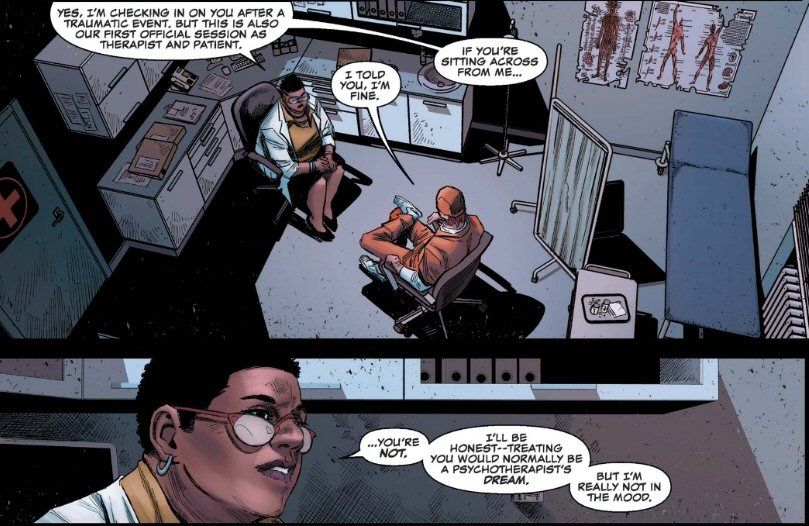
(Above image is from Daredevil Vol 6, issue #28, 2021, by Chip Zdarksy and Marco Checchetto)
An over-developed superego would occur when a person’s ideal self is so unrealistic that it constantly punishes the ego and makes them feel like a failure in everything they do. It would also unfairly try to guilt the id into acting morally rather than according to its needs. Basically, the internalized moral rules learnt as a child are so strict and literal that they are unattainable in the real world, causing great pain and suffering to the individual.
While I am not personally swayed by Freud’s psychoanalytic approach to therapy (there are other forms of psychotherapy that have much better evidence bases), I do find this early conceptual framework thought provoking from a moral behavior point of view. I would say the Kingpin (through writer Frank Miller) had Daredevil’s number on this one – it is a pretty accurate diagnosis of Daredevil’s core internal moral conflict.
A more modern take
Although I find a lot of inconsistent story lines in the intervening years (a few even crossing a line into anti-hero territory in my view), I have enjoyed a number of the modern versions. The Daredevil Vol 6, issues #1-36 (2019-2022) series written by Chip Zdarsky with various artists are particularly interesting, from a normative ethics perspective.
In the panels below from the final issue of this series (issue #36, 2022, by Zdarsky and Manuel Garcia), there is a good exchange demonstrating just how deontological Daredevil’s morality is compared to the very utilitarian and brilliant Mister Fantastic (at least in modern times, I found him less utilitarian in my early comic collecting days).
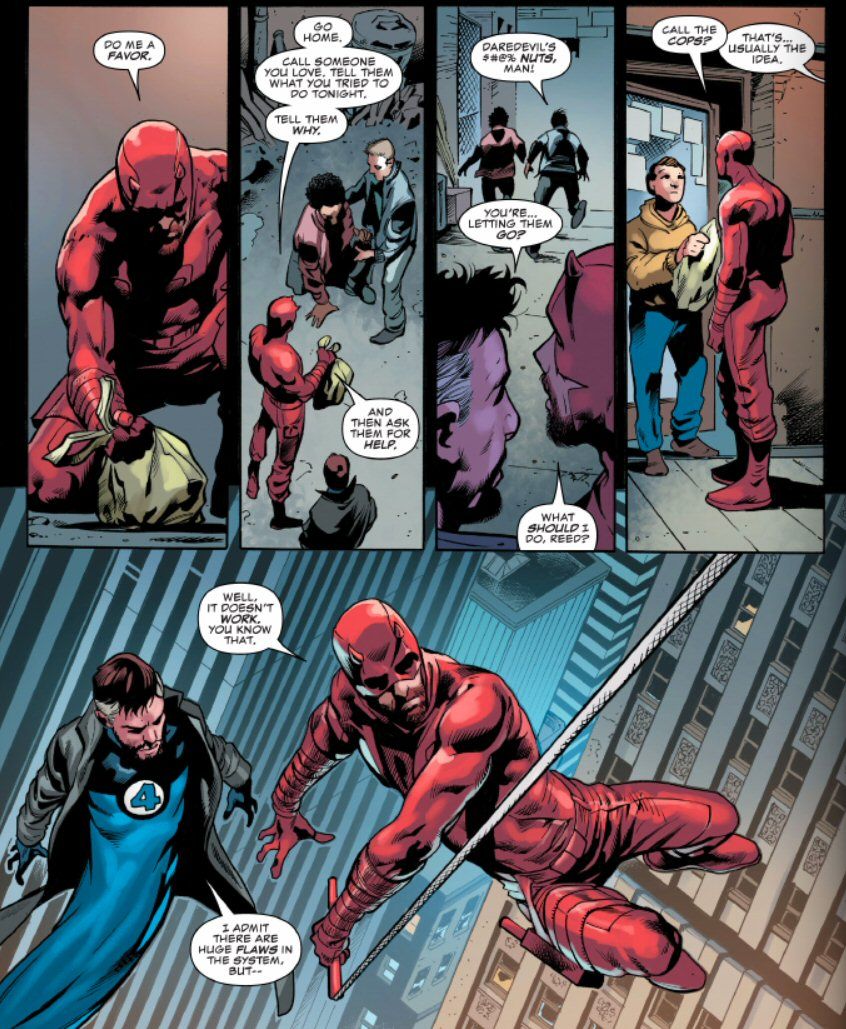
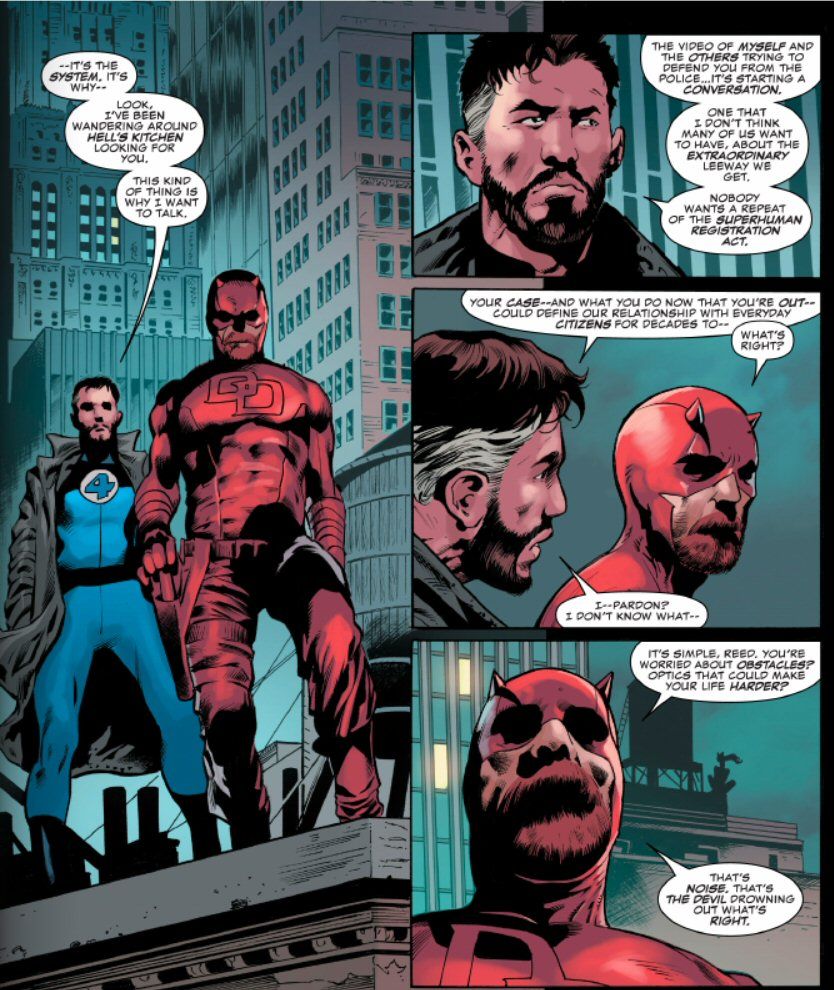
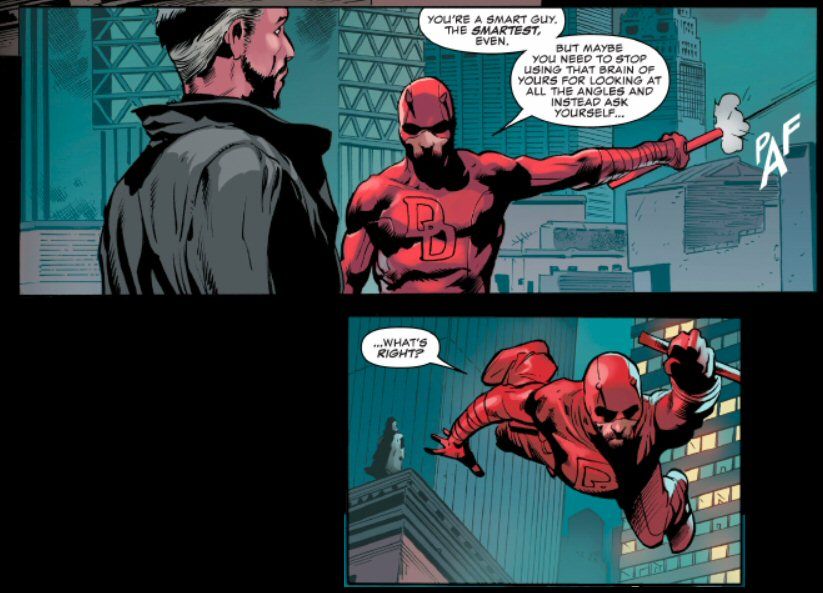
It’s rare to see such explicit moral language in a comic. Here we have an exchange between a deontological character wanting to focus on what is right (according to principles) opposing a utilitarian seeking what is good, or the best outcome in a given situation (using reason).
Of course, in practice, determining what is right is not necessarily easier than determining what is good – both require considering and weighing competing and conflicting factors (in one case rules the other outcomes). But this exchange does put into stark relief how these two main normative ethics are often at direct odds with each other – both in the comics and in the real world. And, not coincidentally, why those who are convinced they know what is right are often seen as rigid or overly moralistic by those who are weighing things differently for what they perceive to be a greater good.
The specific problem they are discussing above relates to Daredevil’s recent history of willingly accepting legal punishment for his actions, to show superhero accountability. Despite that, Zdarsky’s run in this Daredevil Vol 6 series shows a man becoming increasingly embittered and skeptical of the justice system that his alter ego is a part of.
Pardon my going out of strict temporal sequence, but there is an earlier story line that I think helps address the secondary normative ethics framework Daredevil uses. One of my favorite modern depictions of Daredevil comes from 2019, through the War of the Realms cross-over event, created by Jason Aaron.
Daredevil’s role in this event comes as a result of being asked by Heimdall to replace him as the Guardian of the Bifrost (the rainbow bridge that Asgardians use to travel through the realms). Heimdall is an Asgardian like Thor – a race of powerful beings in another realm, based on Norse mythology, who consider themselves gods (although perhaps “godlings” would be more accurate, given the more localized effects of most of their powers). Heimdall has superior extrasensory perceptions and abilities, commonly known as the “all-sight” and the “all-speak” – he can see and hear everything throughout creation, and can willingly focus his senses on whoever he wants to communicate with (and in their own language). But Heimdall’s abilities were greatly impaired as a result of recently having had his eyes gauged out (the irony in thus turning to another blind man with ESP). Taking his magical sword Hofund, Daredevil temporarily fulfills this role – and also helps both Thor and Loki succeed in their quests.
The panels below come from the opening pages of the epilogue of the event, the one-off War of the Realms Omega, Vol 1, issue #1, 2019, by Aaron and Ron Garney. Here Heimdall seeks out Daredevil to let him know how things have turned out for everyone, now that the war is over. The opening two pages:
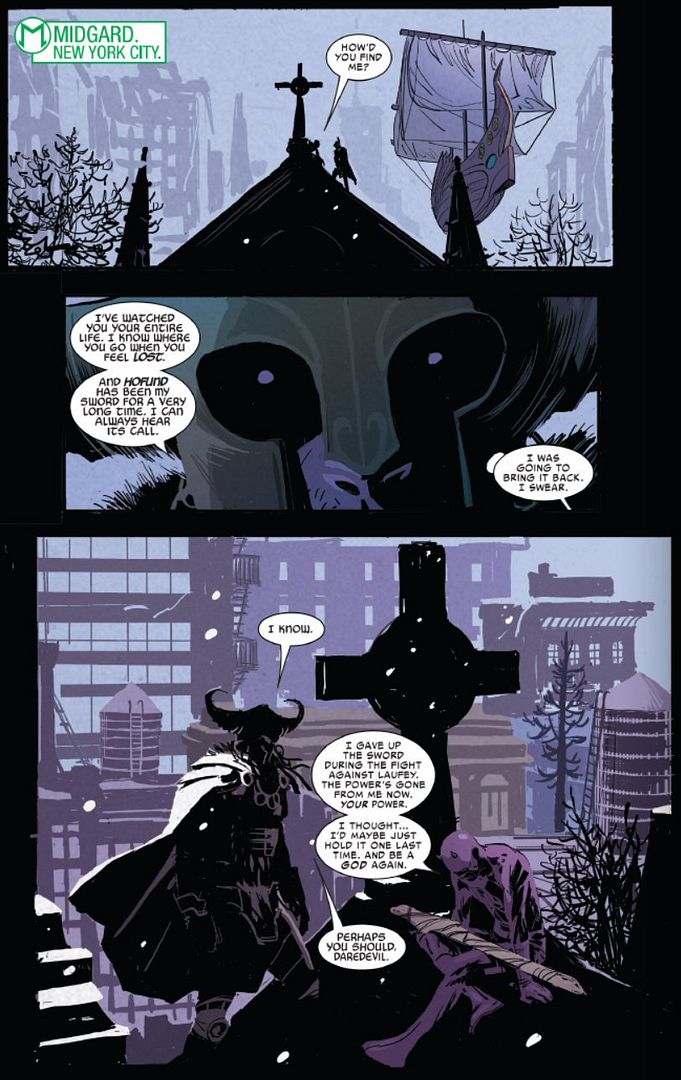
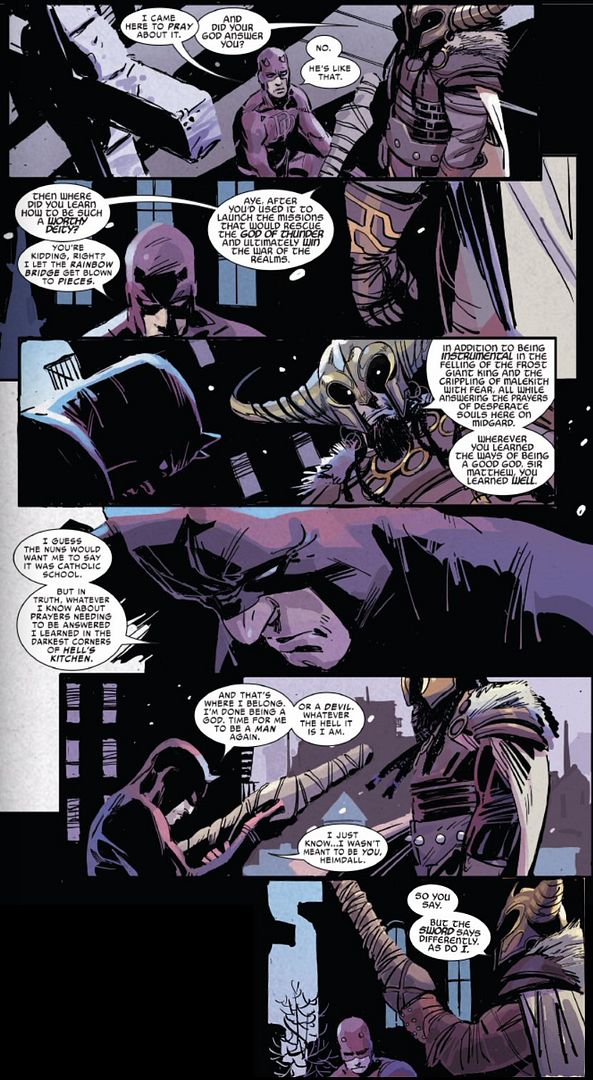
The observations that Heimdall makes are spot on in my view/ But it’s not surprising that Daredevil is unable to accept them given his high level of guilt – and rejection of utilitarian ways of thinking about outcomes. I’ll have more say about the Asgardians in my upcoming overview on Thor, but as a general rule they have a much higher sense of duty than most humans (and are thus all somewhat deontological). I would argue that Heimdall has a somewhat similar primary core deontological normative ethics, but with a secondary utilitarian perspective (that puts him at odds with Daredevil here).
Heimdall uses his sword Hofund to show Daredevil the results of his heroic actions (the main point of this Omega comic – how very consequentialist of the writers!). Of course, showing all the positive outcomes might satisfy a utilitarian – but Heimdall should know that doesn’t buy much purchase with a more narrowly deontological character like Daredevil. I will come back to this event at the end of this post.
I am also enjoying the current run of Daredevil Vol 8 (2023-present), by Saladin Ahmed and Aaron Kuder, but it is quite different. After dying at the end of Zdarksy’s second run (Daredevil Vol 7, 2022-2023), Matt somehow (remains to be revealed at the time of this writing) comes back to life as a Catholic priest in Vol 8. He slowly rediscovers his memories and abilities – as his past sins literally come to haunt those he loves. I’m not sure how this will play out exactly, but it’s nice to see a break from the lawyer alter ego (who increasingly became less relevant in the modern comics), and pay more attention to the role Catholicism and the concept of sin plays in his ethical makeup.
A.X.E.: Judgment Day
I have previously introduced the AXE Judgment Day cross-over event of 2022, created by Kieron Gillen and Valerio Schiti. This was a unique event in the Marvel universe where every person on Earth-616 is judged by the standards of a revived Celestial, to determine the fate of the Earth. See my background page on origins of the Marvel universe to learn more about Celestial history.
Daredevil is featured in issue #4 in a single panel only (but it’s a doozy), as the revived Progenitor determines his fate:
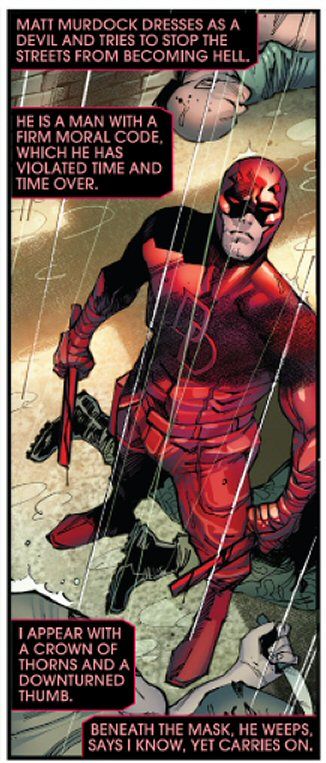
So it’s thumbs-down (i.e., a fail) for Daredevil, consistent with a number of deontological heroes (and Daredevil’s own assessment). Insult to injury to appear to him as a crucified Jesus Christ (it’s implied by the shadow of the cross on the ground and his chest as he looks up, in addition to the crown of thorns reference)! The artwork in this series is outstanding – and I love the last line, so in keeping with Daredevil’s ethos.
TV series
I’ve also enjoyed the stand-alone Netflix TV series, created by Drew Goddard and featuring a number of writers (and staring Charlie Cox and Vincent D’Onofrio as Daredevil and the Kingpin, respectively). I’m glad to see it is being picked up (with the original cast) for official integration into the MCU.
I find a lot of historical background (baggage?) of the character has been jettisoned, and they have taken their time letting his crime-fighting persona evolve. I also think it was a good idea to focus so much of the early series on the Kingpin (to see how Daredevil’s deontological moral framework develops in opposition), and then the Punisher in season 2 (to see how Daredevil’s ethical core differs).
Tonally, the main shift I’ve noticed in the TV series is away from Daredevil being the “Man Without Fear” (inspiring fear in those he fights), to Daredevil being the man who can take (and give) a beating. There is a very good discussion of the TV series’ characterization, and the moral value of pain, by Richard Rosembaum on Overthininkingit.com. I think he makes a lot of good arguments in support of this version of Daredevil being a “moral sadist” (although I think he is equally a “moral masochist”, given how much pain he seems to enjoy inflicting on himself). I personally prefer the guilt-tortured soul from the comics.
Current ethical framework: D/v


Across a long history, I find Daredevil to consistently demonstrate a primarily deontological ethics (with strong Christian elements). This would not be a controversial position to take, regardless of how specific details vary from writer to writer – his strong sense of duty, his prohibition against killing, his desire for justice, and his strict personal moral code and set of rules for himself all speak to a deontological drive. Daredevil is overwhelmingly concerned with the rightness of his actions.
But I also see some elements classic Aristotelian virtue ethics in the character – or perhaps more accurately, the updated Catholic Thomas Aquinas set of virtues which incorporate some consideration of circumstances. Specifically, Daredevil consistently demonstrates courage, justice, discipline and self-control, but also compassion and consideration for minimizing harms (both immediate and long-term). This is nowhere near enough to consider him a consequentialist by any means, but I think a secondary classic virtue ethics framework depiction is appropriate.
And so, that is a consistent D/v on my superhero description system.
Again, the purpose of this site is not to provide a definitive normative ethics framework for each character – that is impossible, given all the creative hands each character has passed through. My goal here is to provide sufficient background on the main ethical drives of the character over time, to help prepare for upcoming posts where I will examine specific comic stories to show how they illustrate key normative ethics theories.
The last word
In the closing pages of the War of the Realms Omega, Vol 1, issue #1, 2019, by Aaron and Garney, we return to a discussion between Heimdall and Daredevil. After describing all the outcomes for the other characters – and his predictions for their futures – Heimdall has this prediction for Daredevil’s future:
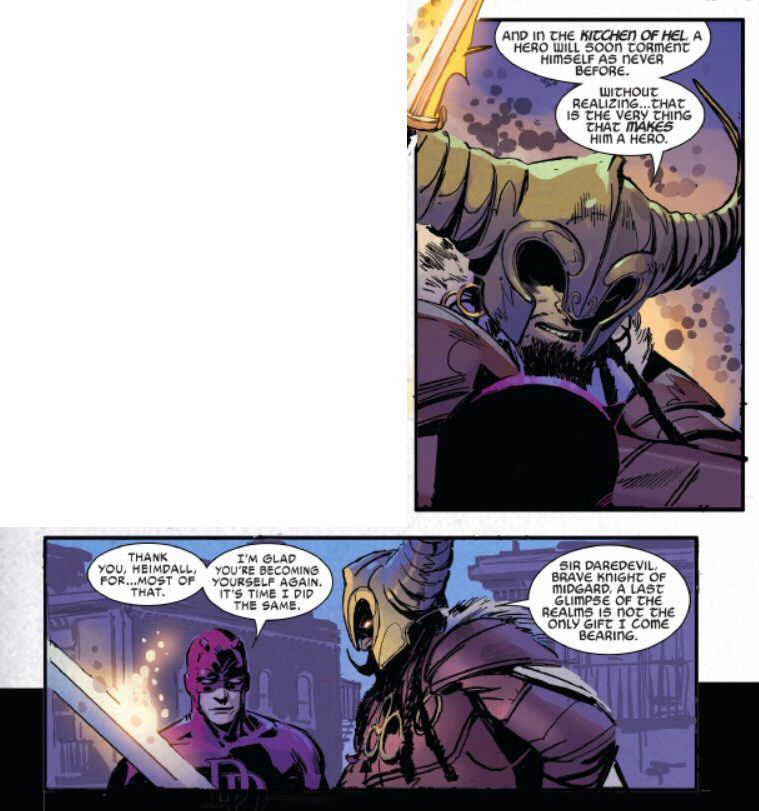
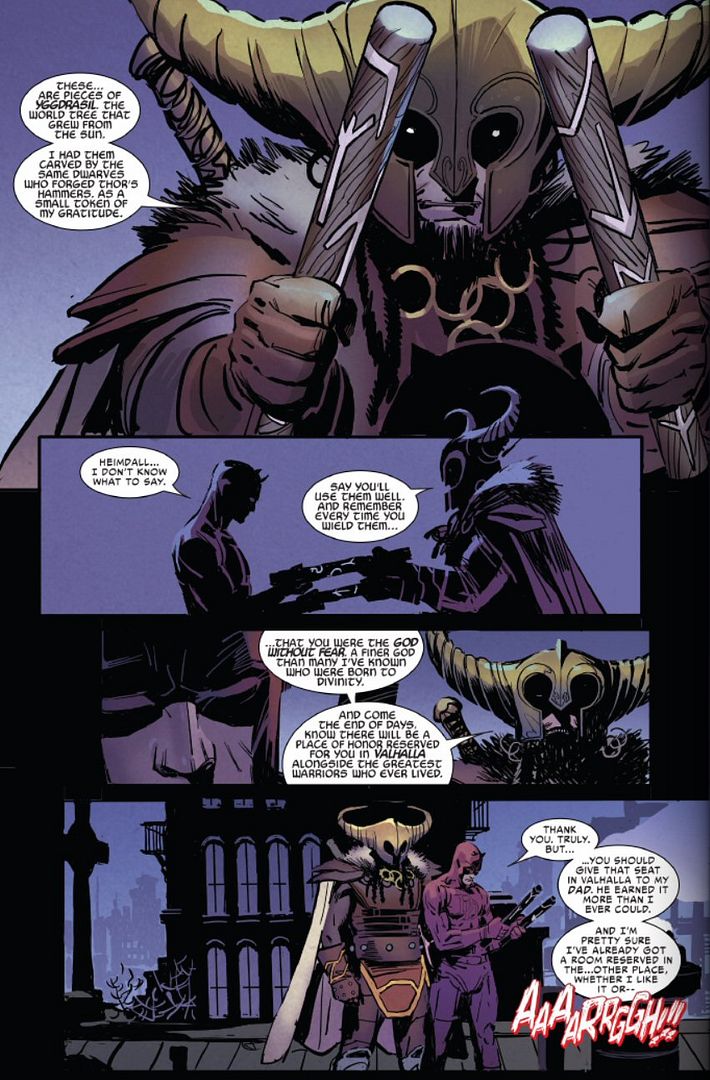
The recognition that Daredevil is a tortured soul – and the acknowledgement that he has secured his place in Valhalla (heaven for the honored dead of Asgard) – is met with what you would expect from Daredevil. No matter how much good Daredevil has done, no matter how much reassurance he is given – and from one whose ethics are largely similar and who has seen so much more – Daredevil can never accept that he is a hero worthy of eternal reward.
How very Daredevil-like, to the end.
See my Glossary post for a list of the key philosophical concepts and related links on this site.
Further Reading
For more deontological ethics: Captain America
For more virtue ethics: Spider-Man
For more mental health: Moon Knight
Again, if anyone remembers the specific issue with the ‘over-developed superego’ reference, please drop me a comment here – thanks!
I was away for a while, just back now and catching up on my reading on this site. This is another really fascinating deep dive into what makes Matt Murdock tick. As someone who grew up reading comics in the 80s, I’ve always been drawn to Daredevil precisely because of that moral complexity you highlight. The guy’s basically carrying around a theological crisis 24/7, and it makes for compelling storytelling.
Your point about the “over-developed superego” really hit home for me. I remember that Miller era too, and even as a kid I could sense there was something different about DD compared to other heroes. Spider-Man cracked jokes, the X-Men fought for acceptance, but Daredevil was out there basically flagellating himself every night. I’ve always felt the Catholic guilt angle explains so much – this isn’t just a hero with a code, it’s a man who genuinely believes his soul is at stake with every punch he throws.
What struck me most in your analysis is how you frame his relationship with punishment and redemption. The idea that he sees his beatings as exacting justice rather than just stopping crime. That’s dark stuff. I’m curious about something though – you mention he’s consistently deontological across different writers, but don’t you think there’s something almost consequentialist about his approach to vigilantism itself? I mean, he’s manipulating the law as a lawyer to achieve what he sees as true justice. Doesn’t that suggest he’s willing to bend his principles when the system fails?
Also, that AXE Judgment Day panel you included is brutal. Having the Celestial appear as Christ and still give him a thumbs down? That’s either brilliant commentary on the impossibility of Christian perfection or just plain cruel to the character!
Thanks again.
Thanks again for the supportive comments. Glad you are enjoying the rest of the site.
That’s an interesting question about Daredevil’s potential consequentialist leanings in regards to vigilantism. While I do persist in believing that he has been primarily written as deontological, I will admit that he often seems to wrestle with consequentialist “temptations” (to stick with the theological framing). He often finds himself in situations where breaking his moral code might help save more lives or prevent greater suffering, and he sometimes gives in to those temptations. And so his professed deontological code (like in the Chip Zdarksy panels, where he argues with a consequentalist Reed Richards) may be him over-compensating due to his own internal conflicts. So I think that’s a fair of expanding on his internally conflicted moral nature – thanks for pointing it out.
I don’t really see it for his legal alter-ego though. The comics don’t usually spend a lot of time on the legal side of things, and I don’t recall him ever really “manipulating” anything. Legal ethics are fairly unique – they are also deontological in their basis (like most applied ethics), but are explicitly weighed in favour of the defendant. This is because of the huge power imbalance between the state (who fund and ultimately control the courts, the prosecuting attorneys, the police, the forensics, and the prisons), and the individual being accused. Hence the presumption of innocence, the mandatory reading of rights, trial by jury of peers, supplying of a defence attorney at no cost to the defendant, mandatory revealing of all state evidence – including any exculpatory evidence that would harm prosecution’s case – burden of proof beyond a reasonable doubt, etc. Defence attorneys are required to do everything in their power to poke holes in the prosecution’s case, regardless of what they think of their clients. This is as deontological as it gets, within an applied ethics framework.
Besides, the comics have an easy out – Matt’s senses give him a supposed built-in lie detector, so he knows his clients are all innocent. So doing everything in his power to get them off is not only defensible from his applied legal ethics, but from a virtue ethics perspective as well. I don’t really see this as consequentialist (at least in the comics). In real life, I can see how this would create conflict with legal ethics for a defence attorney. Beyond the issue of selective honesty to help your case, wanting the greater good for their client by taking a plea deal rather than risk losing at trial, or seeking treatment/rehab rather than punishment, could be an example of lawyers “manipulating” (for a greater good). But the comics don’t really get into that in my reading – unless, are you thinking about a specific story line?
Maybe “manipulating” was too strong a word. I was thinking of selectively revealing or concealing information based on the desired outcome he wanted – because he knew his client was innocent. So, more selective/strategic reasoning for a desired outcome (consequentialist), rather than absolute honesty principles (as deontology would require).
I can’t think of specific comics, but I seem to remember some stories where his legal tactics got him censured.
Ah, makes sense. Sure, I can see that. I can’t think of any stories off-hand, but I can see that happening.