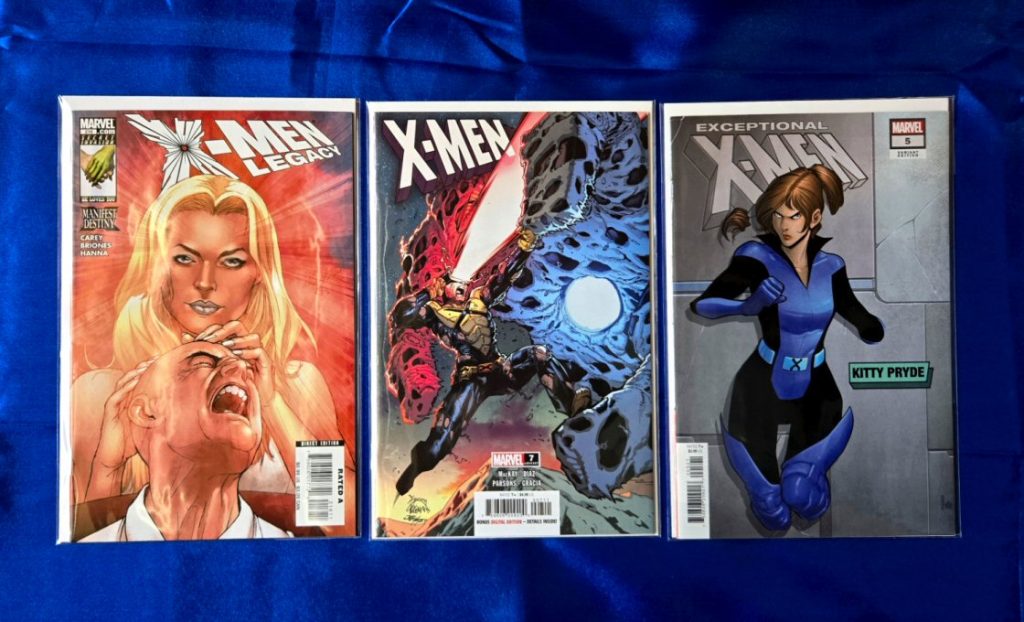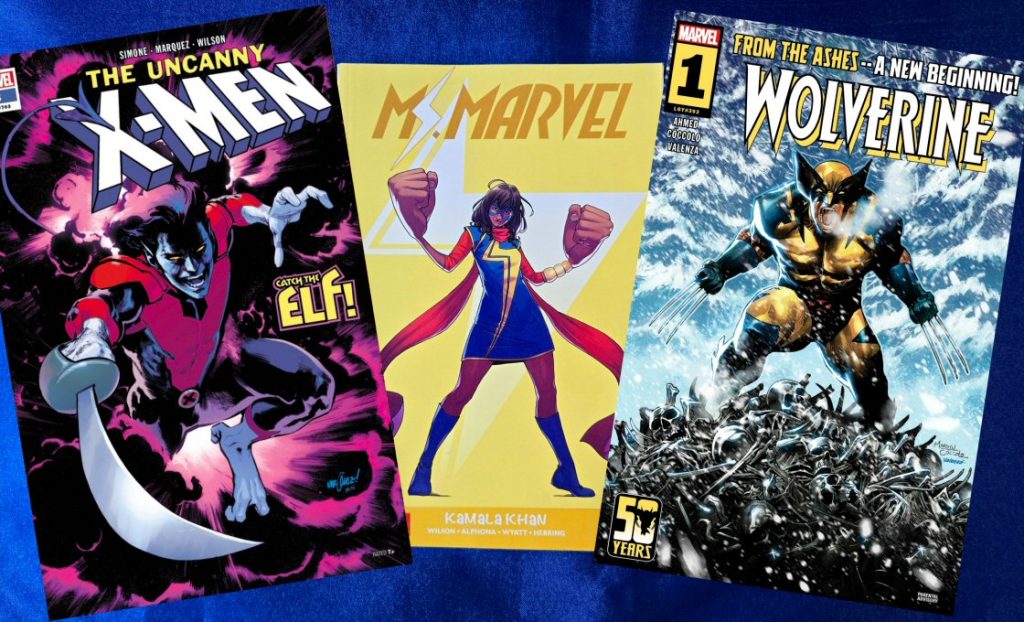

One of my goals with this site is to show how comic book stories have always illustrated normative ethics principles. But another goal is to show how some normative ethics theories and perspectives have changed over the decades, and how that is reflected in current writers taking a different view than previous ones. This often shows up as an evolution in a given character’s ethical core over time. But sometimes, it can also be a wholesale re-examination of the meaning of earlier stories, and their relevance for a whole groups of characters.
The X-Men are a good example of this. As such, I thought it would be better to provide an ethics overview of the whole group (and the changes over time), before delving into the individual characters. The popularity of the X-Men in the Marvel comics universe is undeniable. At the present time (February 2025), roughly half of the ongoing Marvel series (16/35) are based on characters from the X-Men world of mutant superheroes.
If you would like to know more about the terms I’m using on this site, please follow the links throughout or check out my Ethics 101 page or Glossary post.
UPDATE: Please also see my recent detailed overview posts on the ethics of Magneto and Professor X (as well as a follow up post about the potential redemption of the Professor X character). Further X-Men profiles are available here.
Human rights and ethics
The X-Men also raise a good opportunity to discuss the overlap between normative ethics and human rights (including civil rights). Foundational to modern discussions about ethics is the belief (and commitment) to human rights – a basic set of entitlements that all humans are said to possess. This is a relatively modern concept however, as specific protections for humans (typically from the state!) didn’t really arise as a significant part of political discourse until the late 17th and 18th centuries (with the introduction of Bills of Rights in England and the U.S., for example).
As an aside, this is part of the reason that I don’t get too into the weeds here about what exactly Aristotle or Confucius (or any other ancient philosopher) said about virtue ethics (e.g., their specific list of virtues). Modern discussions of virtue ethics sometimes get derailed by a declaration like “that isn’t what Aristotle meant by virtue”, or “he didn’t believe in rights like that”, etc. But just because a lot of modern concepts were unknown to the ancients doesn’t meant we can’t continue to use their virtue ethics framing today. People can still aspire to the general principles of Aristotelian virtue ethics without having to adhere to all of his outdated ideas as well. Or put another way, virtue ethics haven’t come to an end because we now grant people a minimal set of rights!
A good early example of rights was the U.S. Declaration of Independence (1776), which clearly articulated what those rights were, and where they came from:
We hold these truths to be self-evident, that all men are created equal, that they are endowed by their Creator with certain unalienable Rights, that among these are Life, Liberty and the pursuit of Happiness.
- Thomas Jefferson, U.S. Declaration of Independence, 1776
Of course, the definition of “men” didn’t include women and black men/slaves at that time (that didn’t come until much later). But along with the U.S. Constitution (1789) and the U.S. Bill of Rights (1789), these documents went further to expound that the legitimacy of the state should be judged in part by how well they protect those rights. The next sentences from the U.S. Declaration of Independence (1776):
That to secure these rights, Governments are instituted among Men, deriving their just powers from the consent of the governed. That whenever any Form of Government becomes destructive of these ends, it is the Right of the People to alter or to abolish it, and to institute new Government …
Although this framing is accepted as common place now, it was quite novel (and literally revolutionary!) for the time to say that the state was responsive to its citizens’ rights.
However, it’s important to note that thinking about human rights didn’t end there either (despite what some “originalist” U.S. Supreme Court justices may believe). In fact, there was a considerable advancement in 1948 with the United Nation’s Universal Declaration of Human Rights (UDHR). Directly emerging from the atrocities the Nazis committed against Jews and other disadvantaged groups in the Second World War, the UDHR sought international consensus about the minimum standards for decent treatment of humans.
The 30 articles of the UDHR can be broadly divided into two groups: civil rights (such as free speech, or a fair trial) and societal and economic rights (like basic healthcare, a healthy environment, and favorable conditions for work). The former are sometimes described as first generation or negative rights (as they are freedom from something), and the later as second generation or positive rights (as a need for something, from the state or others). Significantly, the United States to this day still doesn’t recognize this later category as actual human rights, but merely “aspirations” that they not bound by. Regardless, many other countries have drawn from the UDHR for their constitutions or statements of rights.
Believe it or not, the points above are relevant to a discussion of the X-Men – both in terms of how ethical arguments are framed in the comics, but also how events in the X-Men stories mirror real-life ones for rights-seekers.
X-Men origins
Originally created by Stan Lee and Jack Kirby in 1963, the X-Men were a team of teenage mutant superheroes – super-powered beings whose powers come from spontaneous genetic mutations. These differed from other superheroes, whose powers were usually obtained by exposure to environmental effects (like radiation, chemical exposure, etc.), or through technology. As an aside, part of this was simple expediency – spontaneous mutations meant not having to come up with detailed origin stories for each character!
The rise in popularity of these mutant superheroes can be attributed mainly to a few key Marvel creators in the 1970s and 80s – John Byrne, Dave Cockrum, and Chris Claremont. Claremont in particular had a record long run writing X-Men (1975 to 1991), introducing more complex (and darker) themes into the stories – and revising and expanding back stories. He is known for developing much more powerful women characters, such as Jean Grey/Phoenix, and Carol Danvers as Ms. Marvel/Binary (see my Captain Marvel background post for a discussion of the later). But those characters also seemed to suffer a disproportionate amount, and there are other women characters (like Clea from his concurrent run on Doctor Strange) who did not fare well.
As an aside, one of my favorite Claremont stories was a stand-alone X-Men Annual (issue #4, 1980, with art by John Romita Jr.), featuring a guest appearance by Doctor Strange. In attempt to save Nightcrawler, his fellow X-Men join Strange on a bizarre visit to Hell, which just happened to look like Dante’s Inferno:
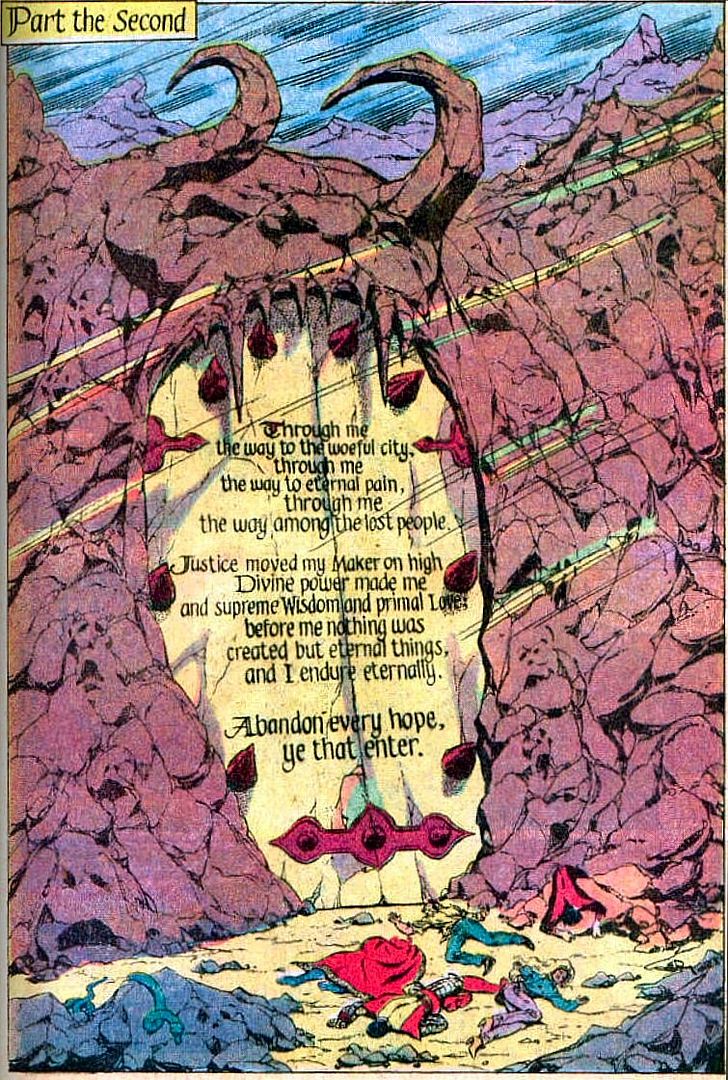
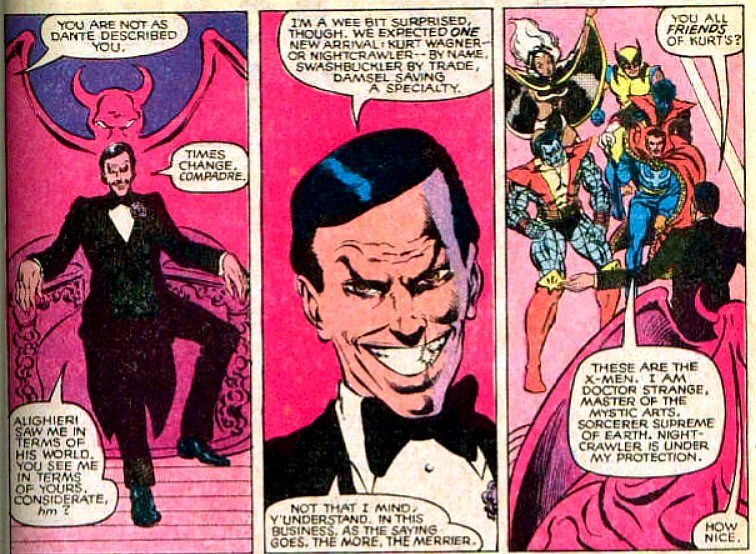
As a kid, this was a cool way to get introduced to classic literature and poetry – in a way that felt very authentic to the comic characters (spoiler alert – they weren’t really in Hell).
Claremont expanded on the inherent “otherness” of mutants that makes them the subjects of discrimination and abuse by “normal humans”. These themes of alienation – and the subsequent striving for acceptance and self-determination – would ultimately turn a single, small underperforming comic into an empire that now accounts for almost half of the modern Marvel comic titles.
Claremont also innovated the comic format by creating longer and more complex “events” for his X-Men characters. During the time when I was actively collecting comics in the early 1980s, he created two of his most famous ones – the Dark Phoenix Saga and Days of Future Past. Both were significant stories for the time, and had major impacts on the characters (and the readers).
He also significantly expanded Magneto’s character during this time – giving him a new back history as a (presumed) Jewish survivor of the camps at Auschwitz as a child. This becomes critical to humanizing the character, by understanding his motivation to “never again” allow his mutantkind to suffer a similar fate at the hands of normal humans. From Uncanny X-Men Vol 1, issue #150, 1981, by Claremont and Cockrum, where Magneto (incorrectly) believes he has killed Katherine (Kitty) Pryde:
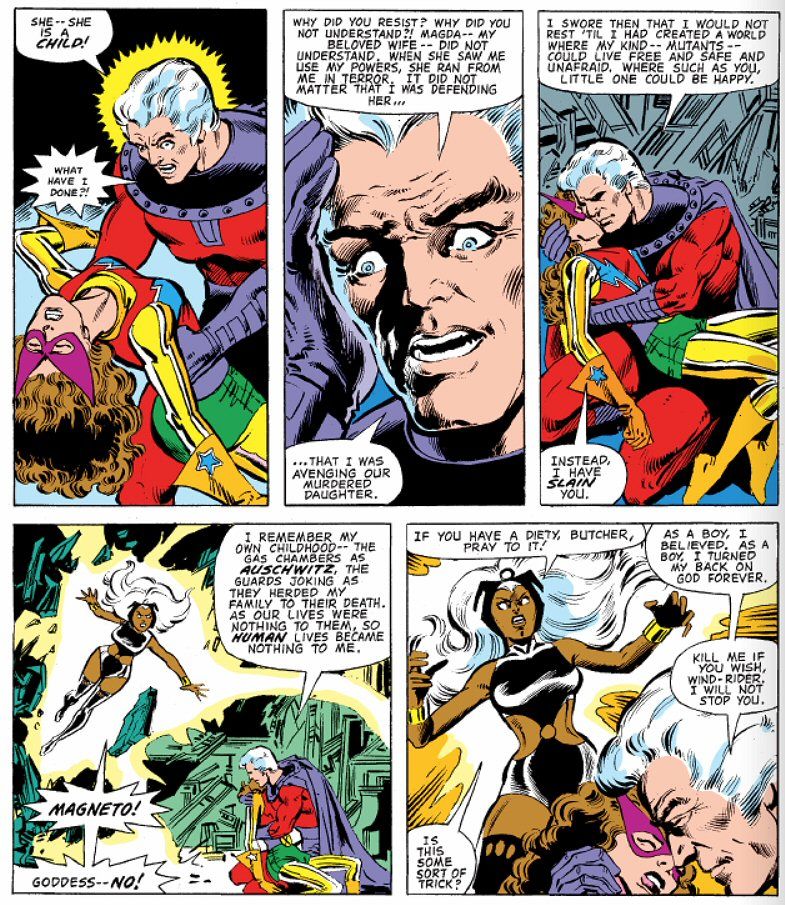
You can see how this is setting up to rehabilitate Magneto’s character, which I discuss further in my dedicated Magneto ethics post. It is also setting the stage for the consideration of human rights as well as ethics in the X-Men comics.
But I am getting a bit ahead of myself, so let’s go back to the original normative ethics foundation of the X-Men comics.
Original X-Men normative ethics
The underlying normative ethics premise for the early X-Men stories was a (seemingly) straightforward deontological-consequentialist conflict.
On the one hand, you had Professor X (Charles Xavier) and his superhero X-Men team, working to achieve his “dream” of protecting mutants and promoting peaceful coexistence with humans. On the other, you had Magneto and his Brotherhood of Evil Mutants, seeking to ensure mutant supremacy and the subjugation of humans.
Charles and his forces were seen in almost exclusively deontological terms in the early stories. Charles and Cyclops (the X-Men team leader) were both focused on duty, taking the “dream” as their own universal moral imperative. They both demonstrated this in their personal actions and their teachings, articulating the need to follow strict ethical rules and principles. As you might imagine, always prioritizing the right action without concern for outcomes didn’t typically endear Cyclops to his teammates.
In contrast, Magneto had extremely consequentialist morals initially, prioritizing the greater good for mutants no matter the consequences to humans. This is an example of egoistic consequentialism, also known as ethical egoism, which is a normative ethics theory that holds that you should act in a way that promotes your own interests above other values.
It was common in comic books of this era to focus on these two normative ethics theories as they were seen in direct opposition to each other. And the early comics were pretty heavy-handed about it, with an overly-simplistic “deontology=good” and “consequentialism=bad” dualism. But it was never that simple for the X-Men, as each camp had characteristics of the other from the beginning.
For example, Charles’ dream of peaceful coexistence and mutual understanding between mutants and humans is fundamentally utilitarian, as it promotes the greatest good for the greatest number. Both his and Cyclops approaches to dealing with Magneto by necessity incorporated utilitarian principles in their tactics (an issue I will come back to in a moment).
Magneto was also somewhat deontological, with strong beliefs about the inherent value of mutants and their rights. He literally saw mutants as a superior form of human (he called them “Homo Superior” in those early comics), and believed they deserve to be treated with respect above regular humans. He saw persecution of mutants as inherently wrong, and the protection of mutants as unquestionably good, regardless of the consequences for non-mutants. Indeed, in the early stories he also saw non-mutants as bearing only jealousy and ill-will towards their mutant superiors (further justifying his harsh approaches).
Allegorical nature of the Professor X/Magneto conflict
Claremont has said that the inspiration for his revised characterization of Professor X and Magneto were the former Israeli Prime Ministers David Ben-Gurion and Menachem Begin, respectively. That parallel makes particular sense for Magneto – he starts out as the founder of a militant (some would say terrorist) organization, and then gradually transitions into a statesman. I would say Magneto’s character rehabilitation clearly began under Claremont’s watch.
But another X-Men allegorical parallel that is widely made online is to Dr. Martin Luther King Jr. and Malcolm X, and to the U.S. civil rights movement of the 1960s. The symbolism between King’s famous “I Have a Dream” speech and “Xavier’s Dream” doesn’t seem like a coincidence. Similarly, Magneto’s willingness to push back on oppressors with force hearkens to Malcolm X’s philosophy. I find this framing tends to be the dominant allegorical lens through which people look at the late 20th century X-Men stories today.
As time went by (for reasons that I will explain below), the certainty of the two mutant extremes began to change. One example that I would like to highlight here is the first appearance of what eventually became an iconic phrase in the X-Men comics. In New X-Men Vol 1, issue #135 (2003) by Grant Morrison and Frank Quitely, Xavier is trying to shut down student dissent at his X-Men school. Note the new pupil Kid Omega’s (Quentin Quire) response and fashion choice:
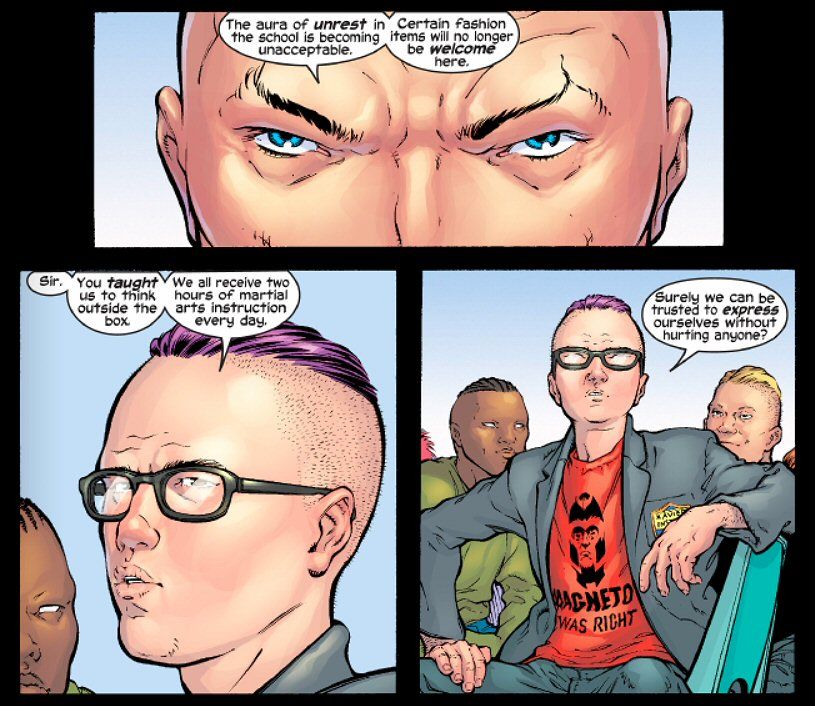
Quentin’s t-shirt reads: “Magneto was right” (presumably in his earlier militant views). The phrase quickly became popular as a symbol of the philosophical divide between the two camps – but it also shows they have become more nuanced, with increasing numbers of “heroes” agreeing with at least some aspects of Magneto’s belief that mutants should actively rebel against human tyranny. Naturally, matching fan-made t-shirts quickly caught on in the real world as well. Overall, Morrison’s run in the New X-Men seemed to explicitly explore parallels between the mutants’ struggles with persecution and oppression and those of other groups in the modern world, like Black and LGBTQ+ people, as well as Chinese minority populations.
If you search for t-shirts with that phrase today, you will find plenty of examples with the imagery shown in alternating bands of light blue, light pink and white. Those are the colors of the transgender Pride flag. The symbolism here suggests that some in the LGBTQ+ community – specifically, in the transgender and queer communities – are advocating to actively change the status quo, compared to other communities that may be looking more to integrate (i.e., follow Professor X’s “dream”).
The normative ethics problem at the core of the X-Men
Despite the above, I would argue that the original deontological-consequentialist divide has pretty much completely fallen away in the modern 21st century X-Men stories.
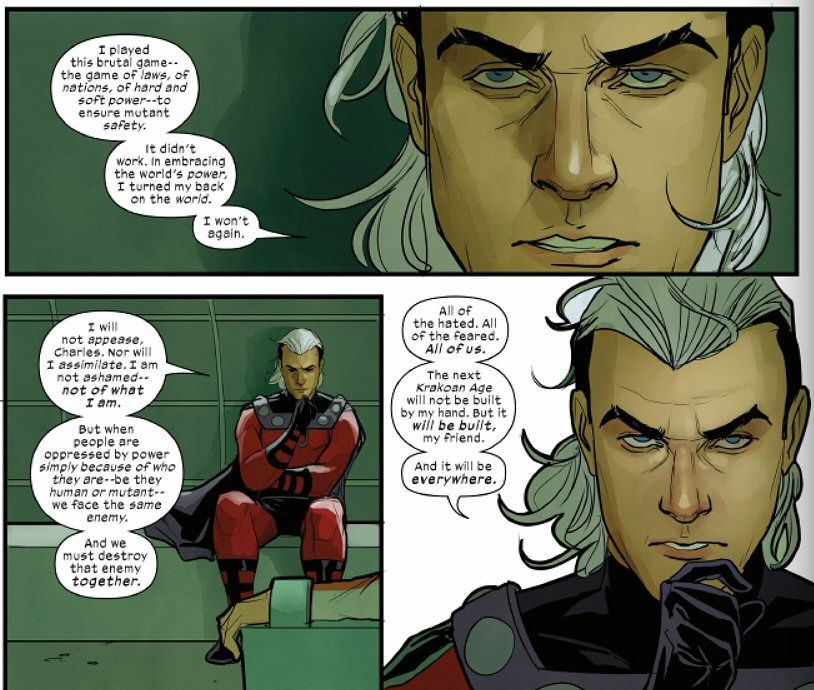
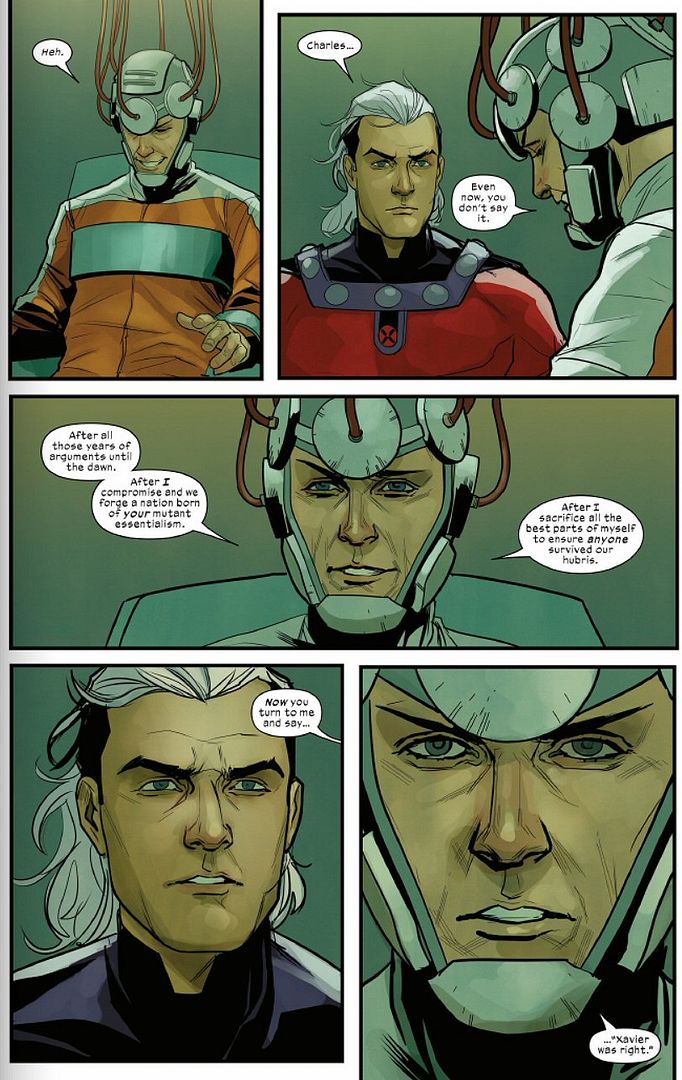
It might surprise you to learn that in 2024, Magneto now espoused the view that those in power who oppress anyone – be they human or mutant – are the true enemy that must be fought, and Charles Xavier is in prison for the (apparent) crime of human murder in defence of mutants. From the end of the Krakoan Age event (X-Men Vol 6, issue #35, 2024, by lead writers Gerry Duggan, Al Ewing, and Kieron Gillen):
See my upcoming individual X-Men Ethics pages on Magneto and Charles Xavier to learn more about how their respective characters have evolved over time to end up here.
But to broadly explain here why the normative ethics frame has shifted over the last couple of decades, it is important to consider the biggest ethical issue involved with the creation of the X-Men in the first place. In order to achieve his “dream”, Charles thought it is a good idea to identify potentially powerful mutant adolescents, take them away from their families, make himself their father figure, and train them to fight against threats to humans (thus demonstrating to humans the value of “good” mutants). At the time, no one seemed to have an issue with this line of thinking.
But let me re-frame that for you in the way that so many have in this millennium, using a modern ethics perspective: does it sound like an ethically good idea to raise a children’s army to fight humanity’s enemies, at great personal cost to the children themselves, without considering their agency or personal autonomy? Most today would consider this a violation of children’s rights (and lives!) by making them child soldiers. Some will argue that this was to prepare them to defend themselves (but that’s a stretch from the source material).
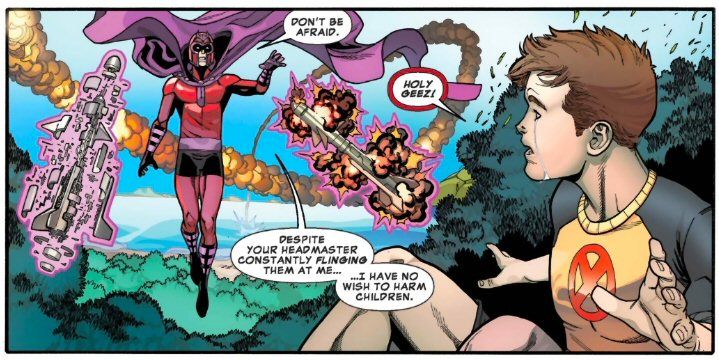
This modern ethics reframing is part of what I believe has upended the historical perceptions of the two mutant sides and their leaders. But there is a lot more to it, so I recommend you check out my upcoming Charles Xavier ethics post for more info. And here is a recent example to leave you with, articulated in a flashback sequence with Magneto in regards to the X-Men headmaster Charles, from Marvel’s Voices: Pride Vol 1, 2021, by Anthony Oliveira and Javier Garrón:
A brief history of the modern X-Men
Since the end of Claremont’s run, virtually all the major talent at Marvel has had a chance to work on X-Men stories – often taking them in directions that were very different from previous story lines. Not that this is necessarily a problem, as there are a lot of issues with how some of those earlier stories were framed. One of the main complaints with comic books (along with other serialized fiction) is that the characters often remain very static (i.e., lots of bad things happen to them over and over again, with no real change or growth). The massive popularity of the X-Men comics – and the far greater number of stories and titles over time – has certainly led to a lot of change.
From a rights perspective, an interesting event was the creation of the island of subjugated mutants known as Genosha by Claremont in 1988. Claremont has stated that this was an allegory for apartheid-era South Africa. As Genosha descended into civil war, with increasingly violent conflict between mutants and humans, it also became an allegory for the ethnic conflicts in Bosnia in the early 1990s. Eventually, at the turn of the millennium it became an allegory for the creation of Israel (when Magneto takes over the island, making it a mutant safe-haven). It was soon destroyed however, and the stories moved on with other writers to other major events like Scott Lodbell‘s Age of Apocalypse, Grant Morrison‘s Planet X and Brian Michael Bendis‘ House of M.
But probably the most significant and impactful X-Men event of all time was the one that recently ended that I alluded to above – the Krakoan Age (2019-2024). This consisted of over 500 comic books across multiple series with a great many writers and artists. It was organized into discrete narrative phases (House of X, Powers of X, Dawn of X, Reign of X, Destiny of X, and Fall of X). There was a lot of big-name creative talent behind this event, such as Jonathan Hickman for the first half (who, as I have previously observed, is not shy about trying to change established characters), followed by Kieron Gillen, Gerry Duggan and Al Ewing spearheading many of the key series of the later phases.
The main elements of the Krakoan Age were the creation of an independent mutant nation on the living island of Krakoa, a permanent Arraki and mutant colony on Mars (Arrako), and the effective immortality of mutantdom through a newly established process. Across the phases, mutants faced opposition from the growing anti-mutant organization Orchis (with several classic X-Men antagonists banding together). Orchis would ultimately lead to the downfall of Krakoa. Mutant existence was also threatened during this time by the Dominion – god-like A.I. entities who exist outside of normal space and time.
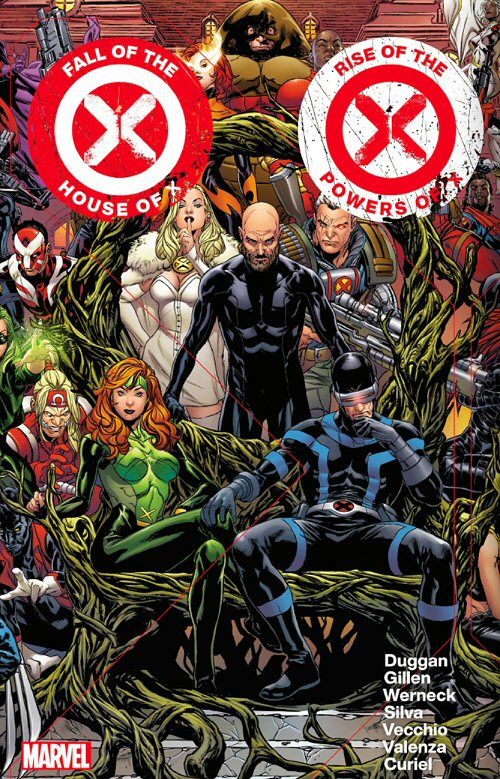
Like many, I give this event credit for departing from the usual status quo of so many comic stories. It demonstrated an unusually strong commitment to expansive world-building (and world-destroying), along with innovative story formats and the profiling of many lesser-known characters. It was also closely integrated with the 2022 A.X.E.: Judgement Day cross-over event (also written by Gillen, who was doing triple-duty with the Eternals as well at that time). I found the Krakoan Age ended with a very dramatic bang last year, with major implications for the characters for years to come.
In terms of an allegory, it is pretty much inescapable to compare the Krakoan Age to the creation of Israel and current Middle East conflict. That is beyond the scope of this blog, but for a thoughtful article discussing this connection, check out Mahmoud Salem’s The Israel of Marvel’s X-Men.
X-Men: From the Ashes Age
One of the challenges coming out of the Krakoan Age is that it has left some of the characters sporting seemingly different normative ethics than they had previously showed. But it seems to me that there is also a concerted effort among many of the writers of the current X-Men: From the Ashes Age to address (and/or correct) these changes. Many of these I agree with – but not all, as I will explain on my subsequent X-Men character ethics pages.
The three main X-Men titles shown at the top of this page – X-Men Vol 7, Uncanny X-Men Vol 6, and Exceptional X-Men Vol 1 – are written by Jed MacKay, Gail Simone, and Eve Ewing, respectively. Rather than focus on the end of the Krakoan Age (although there is some of that), I find these stories are really about establishing a new baseline for the characters – re-integrating a lot of their earlier characteristics (and ethics), but also introducing a common care ethics perspective. The same is true for some of the stand-alone character series – like Alyssa Wong in Psylocke, Erica Schultz in Laura Kinney: Wolverine and Ashley Allen in Magik. Overall, I am really enjoying the explicit ethics focus in these new stories.
A good example is last month’s issue of the new Exceptional X-Men (2024 to present, written by Sociology professor Eve Ewing, with art by Carmen Carnero). Ewing reverts Kate Pryde back to something closer to her original deontological/virtue ethics character, as co-leader of a team of young mutants. But in order to do that, Ewing has to account for Kate’s previous 180-degree character shift during the Krakoan Age stories.
During most of the Krakoan Age event, Kate had a prominent position as the heroic Red Queen and Captain of the Mauraders. But during the Fall of X phase, she turned into the assassin known as Shadowkat (which itself was a nod to the first dark persona for Kate from the Claremont era, Shadowcat).
Here is the opening page of issue #5 (2025), picking up after the inadvertent revelation to the young students of Kate’s previous murderous shift of personality:
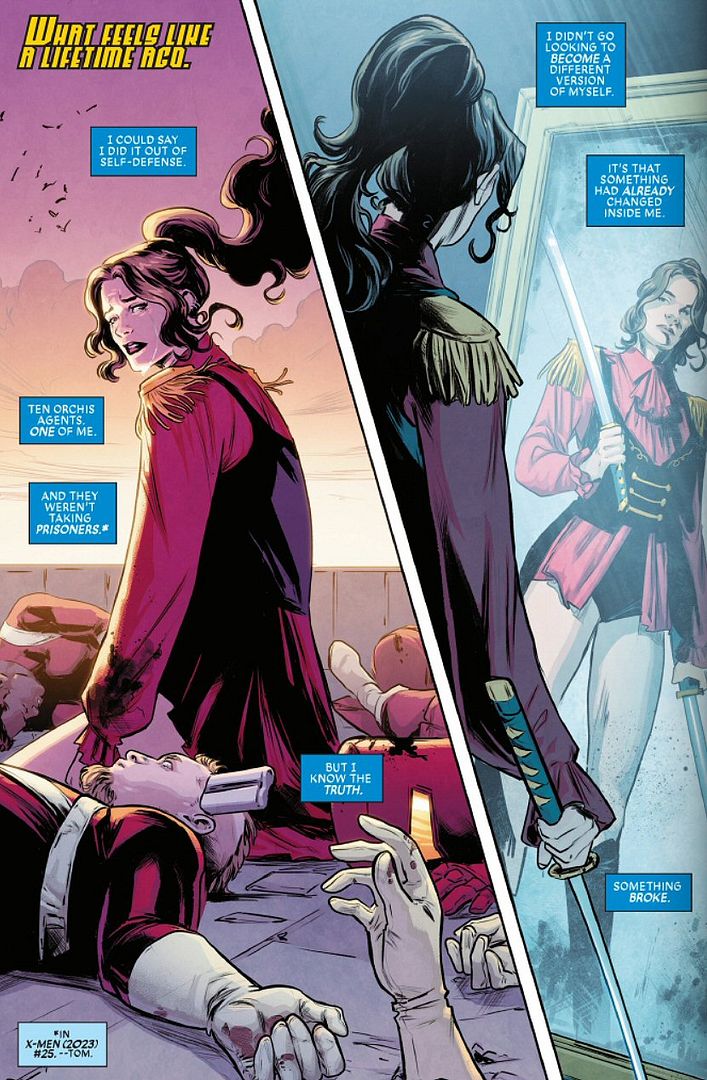
This is the beginning of the justification for the previous stark change in Kate. It eventually continues:
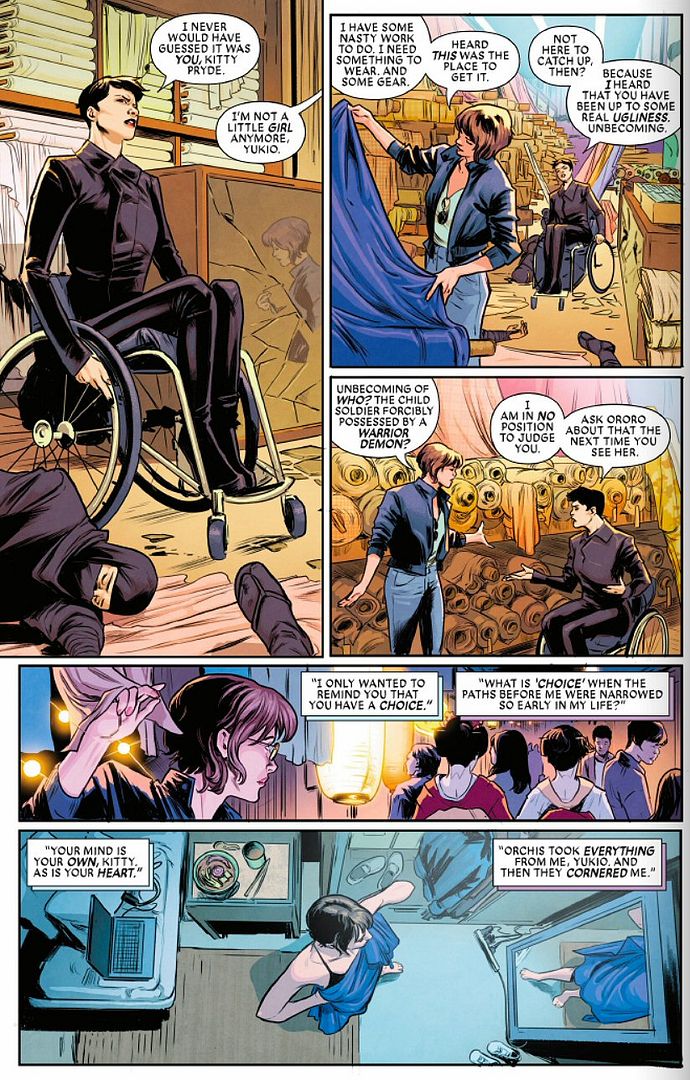
The justifications espoused by Kate within the story directly speak to what I would describe as the perceived change in normative ethics in the real world over the long run of the X-Men (i.e., being a child soldier, and having her path constrained at a young age by others). But note the end of the exchange above, where Yukio suggests that Kate has a choice. Excerpts from the next two pages:
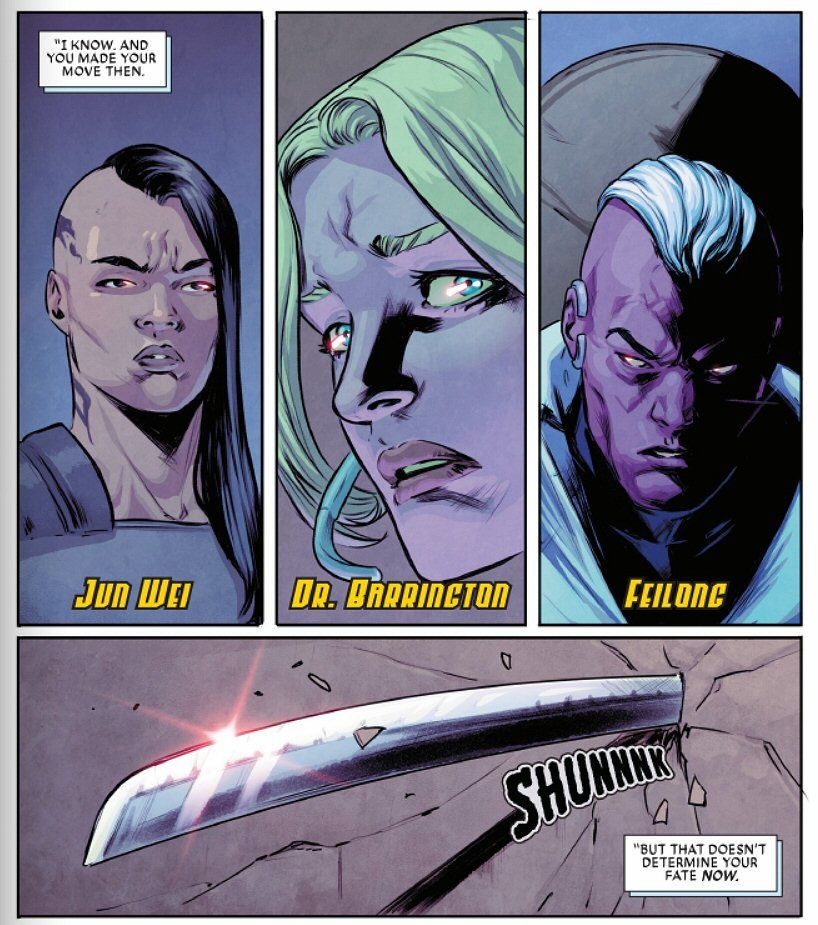
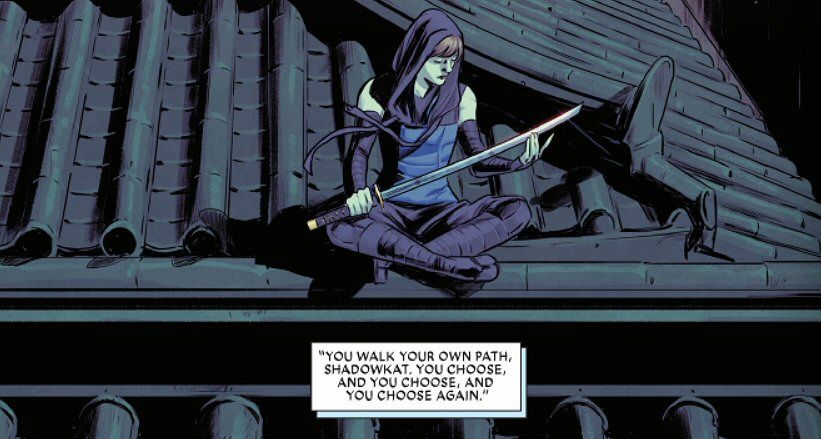
This is an interesting way out of the problem of the rapid character shifts for Kate. Ewing has reframed it as something involuntary initially – “something broke” (with the previous writers ;). And now Ewing is explaining her normative virtue ethics return by the concept of choice: “You choose, and you choose, and you choose again.” It’s a neat closing of the circle.
But Ewing isn’t done making this explicit. One of Kate’s students, Thao, abandons the team when she discovers Kate’s dark history. And in the most deontological terms possible: “But there’s right, and there’s wrong. The line is clear. And I’m not crossing it”. Once Thao learns some hard lessons in the issue about the consequences of trying to hold that deontological line, she returns to Kate for further training. This is about as concise a description of Kate’s new found care ethics as I could imagine, in relation to Thao’s deontological “moral compass”:
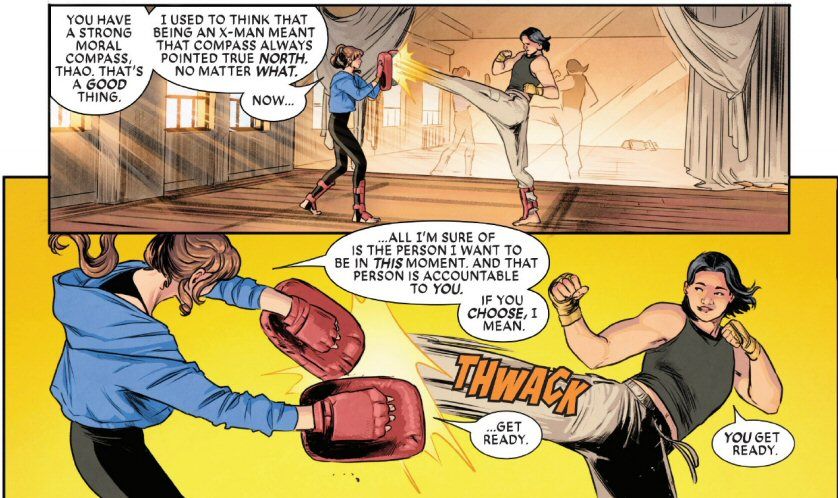
This is the essence of care ethics and virtue ethics – focusing on the person not the action, with commitment to personal growth, living in the moment, and choosing to be accountable to those you are in a relationship with. It is a welcome return from the incongruous lone-wolf assassin phase of Fall of X.
Interestingly, Jed MacKay did something similar to rehabilitate Scott Summers’ Cyclops in his X-Men Vol 7 title. And like Ewing, he also waited a while to provide the flashback – here from issue #7, with art by Netho Diaz and Sean Parsons:
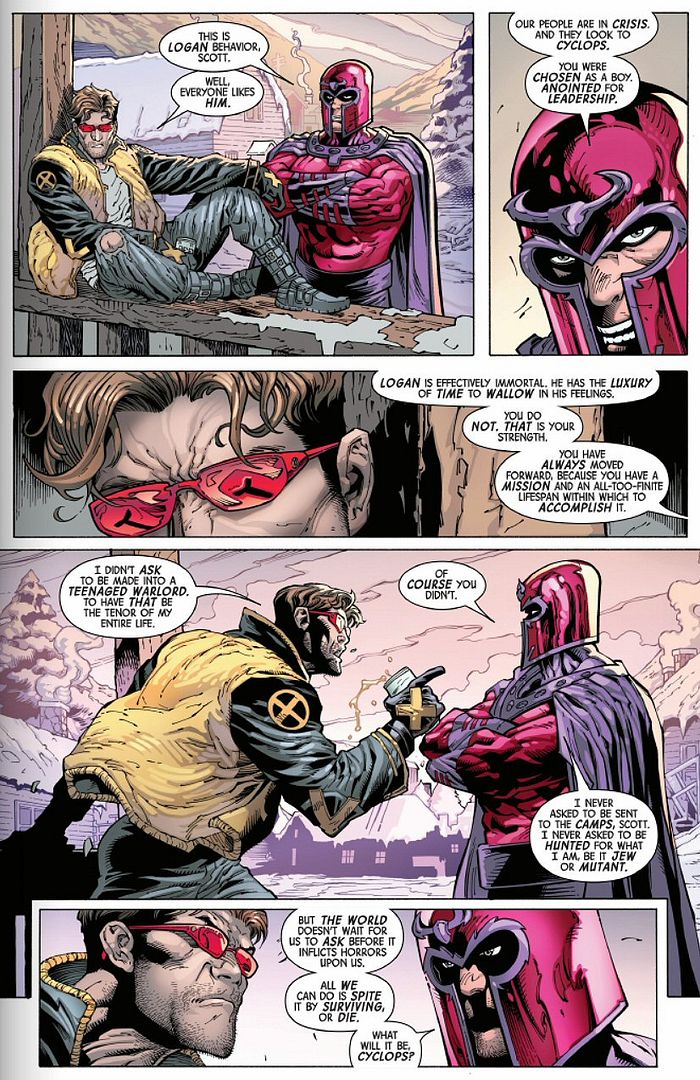
Scott wasn’t just a leader of the X-Men – he too was manipulated from adolescence to be who he became.
In this modern reframing, the whole creation of the X-Men is an example of extremely utilitarian decision-making that was very unethical. And so, the original consequentialist-deontological divide was never going to hold – the characterization of both sides was going to have to change over time in the comics.
As an aside, I’m enjoying these vignettes among the X-Men characters in this From the Ashes Age. It is an interesting modern take that the unethical experiences these heroes endured as adolescents – when they couldn’t exercise fully-informed consent – would have ramifications in their current adult lives. When you think about it, that is very in keeping with the modern psychological zeitgeist as well.
I note that a new story line is about to launch in the X-Men comics – “X-Manhunt”, featuring the escape of Charles Xavier from prison. I know everyone loves a redemption arc – which, incidentally, is very much a part of care ethics. But I have some concerns here, given the inherent contradictions within that character’s ethics (which I will explain in my upcoming Charles Xavier ethics post). Let’s just say it is going to be a challenging rehabilitation exercise given Charles’ behavior over many years in the comics! (UPDATE: My review of X-Manhunt has now been published)
That’s it for now as an introduction. For more information on the normative ethics of the major X-Men characters over the years, please check out my upcoming individual X-Men character ethics background pages. (UPDATE: available here, X-Men Characters A-Ma, Mi-Z)
See my Glossary post for a list of the key philosophical concepts and related links on this site.