

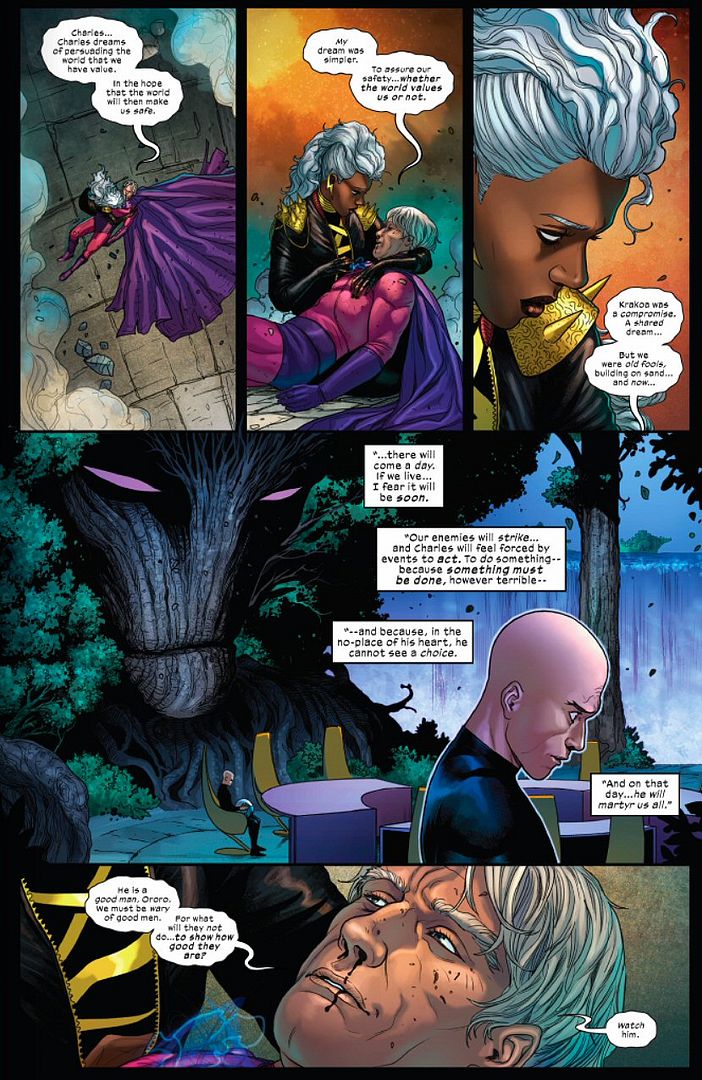
He is a good man, Ororo. We must be wary of good men. For what will they not do … to show how good they are? Watch him.
- Magneto’s dying words, in X-Men: Red Vol 2, issue #11, 2022, by Al Ewing
Thus speaks Charles Xavier’s oldest friend, Magneto, on his death bed. Like in my recent overview of Magneto’s ethics, I think Al Ewing‘s take on these two well-established characters is among the most thoughtful and well informed (from an ethics perspective) in the comics today.
There is probably no character in the Marvel Universe who has more frequently been called a “good man” than Charles Xavier – generally right before he does something that not many today would consider ethically good, right, or virtuous. How did this dichotomy come to exist – and be perpetuated – up to the present day? And how can it be best resolved?
One of the frequent discussions you will see online is questioning if – or when – this character “broke bad” (to use Vince Gilligan‘s famous phrase). But this actually misses the point – regardless of the intent of the various creators, the character was always an inherent contradiction in terms of his ethics. And the evolution of ethical thinking over the last 60+ years has inevitably caused people to reconsider some of the character’s actions – all the way back to his creation.
This character – and the challenges writers have had in fairly depicting his inherent ethical contradictions – makes for a very interesting examination of the challenges associated with the form of consequentialism known as utilitarianism. In this post, I will give an overview of the character, and delve into his normative ethics in some detail, before giving examples of his problematic behavior up to and including the conclusion of the Krakoan Age in 2024. I will then discuss in a subsequent post the attempt to rehabilitate his character in the current From the Ashes age – and explain why I think Marvel creators will need to adjust his normative ethics to do so effectively (due to a fatal incompatibility of his current ethics makeup, and a further incompatibility with his mutant power).
If you would like to know more about the terms I’m using on this site, please follow the links throughout or check out my Ethics 101 page or Glossary post.
Character introduction
The character of Professor X (Charles Xavier) was created by Stan Lee and Jack Kirby as the founder and head of the X-Men in X-Men Vol 1, issue #1, 1963. His main mutant power is telepathy – he can read and alter minds, and project his thoughts over vast distances, among other effects. He is considered an “Omega” level mutant (given the virtually unlimited range of his abilities), and is generally considered the world’s greatest telepath. In addition to founding the X-Men, he is best known for his dedication to fulfilling his “dream” of mutant and human peaceful coexistence.
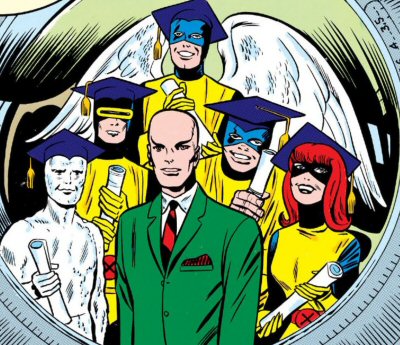
See the detailed character history on the Marvel Fandom site for more info on his abilities and background.
As originally written, Charles was unquestionably the hero of the stories. As the founder of the X-Men, he oversaw all aspects of their identification, training and deployment – all in service of his “dream” of convincing normal humans of the value of mutants, to ensure their acceptance and integration into society. In this he was opposed initially by Magneto and his Brotherhood of Evil Mutants – who sought the elevation of mutants above humans (“Homo superior” as Magneto saw mutantkind). Magneto was originally written as a fairly straightforward villain looking to subjugate humans.
As I explained on my X-Men Ethics – Introduction post, the original normative ethics premise for the early X-Men stories was a (seemingly) straightforward deontological-consequentialist conflict. On the one hand, you had the primarily deontological duty-driven Charles and his superhero X-Men team, and on the other the egoistic consequentialist Magneto and his selfish Evil Brotherhood.
But the mutant divide was never that simple, as each camp had characteristics of the other from the beginning. Charles’ dream of peaceful coexistence and mutual understanding between mutants and humans is fundamentally utilitarian, as it promotes the greatest good for the greatest number. Magneto was also somewhat deontological, with strong beliefs about the inherent value of mutants and their rights.
With the background above, you can probably understand why it didn’t take long before the ethics of both Magneto and Charles to began to change. Magneto was subsequently humanized by later writers, beginning with Chris Claremont, and eventually turned largely into a hero (with cycles of redemption and reversion over the years). To simplify his ethics, Magneto eventually moved from being an egoistic consequentualist to a utilitarian consequentualist, with growing virtue characteristics.
Charles, on the other hand, hasn’t fared as well.
One point to get out of the way up front: as I explain in my X-Men Ethics – Introduction post, changing ethical norms over time have increasingly led modern readers and writers to take the position that it was always morally wrong for Charles to have created the X-Men the way he did. Specifically, he identified potentially powerful mutants as adolescents, took them away from their families, made himself their father figure, and then trained them to selflessly fight for other people. This was apparently to fulfill his dream of mutant-human peaceful coexistence, by having the mutant teenagers risk – and potentially sacrifice – themselves for humans (thus demonstrating the value of “good” mutants). In essence, he exerted his control and influence over them to raise a children’s army to fight others’ battles, at great personal cost to the children themselves, without considering their agency or personal autonomy. That is generally seen as morally wrong today.
There are defenders of Charles (in the comics and among readers) who argue that he wasn’t forcing them to fight, but rather training them to give them the means to defend themselves, to grow through teamwork, to learn responsibility, and to ultimately guide them to making “good” moral decisions (such as risking themselves for others if they choose). This camp sees the (increasingly) negative story lines around Charles as unfair. But this framing is not honest in my view – the various X-Men teams (and New Mutants) were definitely create to fight battles at Charles’ direction. Perhaps not surprisingly, this camp has become the minority position – and declining further as time goes on. This reflects the evolution of ethical thinking both among the creators and the readers of X-Men comics.
But this reconsideration of the character’s initial actions is not what I want to focus on in this post. Instead, I want to show how his character was always problematic, due to an inherent incompatibility of the main forms of ethics he has adopted (that is to say, what he has been written with). In a subsequent post on his potential rehabilitation, I will explain why his primary ethics drive is also incompatible with his mutant power of telepathy.
His moral character arc over the years has increasingly been toward full-blown ultilitarianism, unrestrained from any deontological duty, applied ethics, or virtue characteristics. I believe this progression has further led to the current negative perception among comic fans and creators. I will provide plenty of examples below from the comic stories of this “unrestrained utilitarianism”, as I like to call it.
But why should this be a problem? Isn’t utilitarianism one of the most popular normative ethics theories today? With its focus on the greatest good for the greatest number, isn’t it the basis for Humanist philosophies? Isn’t it rational and logical to pursue the greatest good? Heck, even Mr. Spock from Star Trek is a utilitarian (recall: “The needs of the many outweigh the needs of the few, or the one.”).
To understand the issue here, we need to consider the two main ways you can be a utilitarian – and the unique challenges they pose – along with the other key ethical aspects of Charles’ makeup. In my follow-up post, I am also going to argue why Charles’ (fictional) abilities as a telepath make it impossible for him to behave ethically as the type of utilitarian he has been written as.
What makes a utilitarian?
Utilitarianism was developed by the English philosophers Jeremy Bentham and John Stuart Mill. By definition, all utilitarians are looking to maximize “utility”, which can be simply defined as a form of moral good. Since every human action could bring about more good (or bad) in the world, utilitarianism demands that people focus their attention on producing the most good they possibly can. But how – exactly – do you go about weighing potential consequences to determine what produces the most good (and for whom)? It turns out there are two basic strategies that have utilitarian philosophers have come up with.
The simplest and most common – and the one that X-Men writers have had Charles use throughout the comics, whether they realize it or not – is known as act utilitarianism. Here you choose the alternative that leads to the best overall consequences for all the people affected by a given situation. But you have to be rigorous in how you weigh these, using a three-step method to make your decision:
- Determine what all your options actually are. Be honest here – don’t ignore any.
- Make what are known as direct calculations about how much good is associated with each option for each person or group affected. Note that you can consider yourself here, but you have to value yourself the same as everyone else. And yes, you need to be explicit in how you count up the good and bad points for everyone affected (i.e., come to an actual numerical score that is fair).
- Choose the best option. Note there may only be bad options (e.g., every option has a negative score), but then your task is to select the least bad option.
A key thing to note here is that you are supposed to be only considering the direct consequences of your actions. It’s not appropriate to go too far into the weeds of long-distance, theoretical butterfly effects. Since it is practically impossible to provide an exact calculus for every eventuality, you just need to provide honest approximations to help you think things through fairly and consistently.
As an aside, this is part of why I feel Al Ewing writes Charles so well. In his X-Men: Red Vol 2, issue #11, 2022, with art by Stefano Caselli and Jacopo Camagni, Charles summons Storm because he wants to know what Magneto’s last words were (the opening quote at the top of this page). Storm challenges him for how he coerced her to join his X-Men in the first place. Note Charles’ reasoning below, and Storm’s retort:
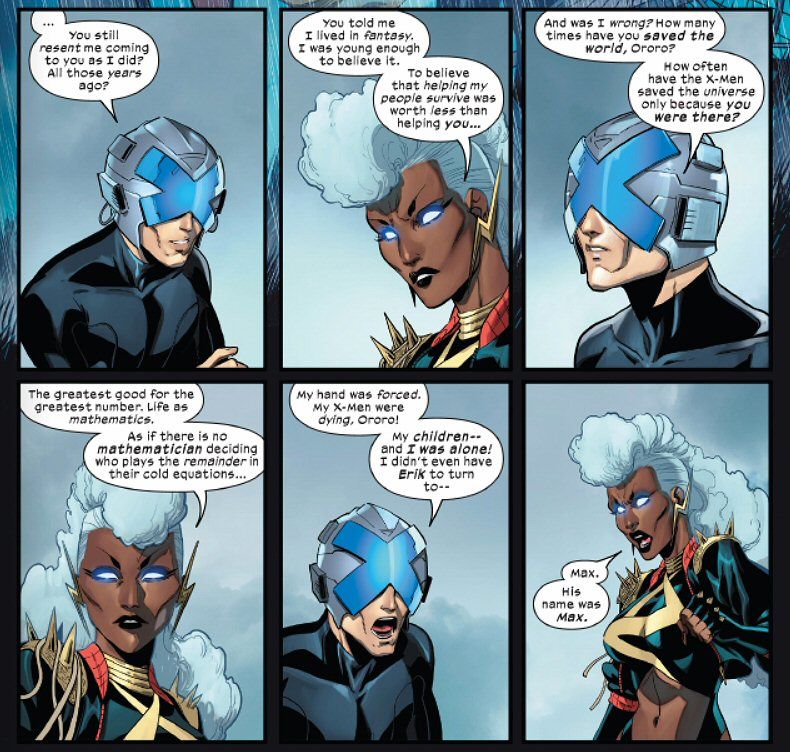
This is exactly what Charles does – he very conveniently plays the act utilitarian “mathematician” deciding how to weigh each outcome – and where those “remainders” should go. The implication (which I fully agree with) is that Charles is always holding a big fat thumb on those scales.
The problem with that thumb – that is, how Charles’s actually weighs things – is that his “dream” is fundamentally an example of what is known ethically as longtermism. Longtermism demands that you consider the long-term outcomes of your decisions. That sounds like a good idea, right? Except in this case it means that Charles is weighing the consequences of his actions not just among all the people affected today – but all the mutants (and humans) who will ever be born!
Think about what that does to the balance of your scales. What happens if you weigh the theoretical good of untold future generations against the actual harms to a handful of people today? You can see how easy it is to justify any type of horrible abuse to those who will suffer it acutely today, if it means that many, many more will potentially benefit from it in the future.
This is a very old problem in the world of ethics, and it explains why act utilitarianism requires you to consider only the direct consequences of your actions (i.e., it is incompatible with longtermism). Otherwise, unless you are restrained by some other normative ethics theory (like the alternative form of utilitarianism I will describe below, or deontological duty, or virtues, or applied ethics), you can literally justify ANY action today for the long-term good!
This is the core problem at the heart of the Charles Xavier character in the comics – he is an unrestrained utilitarian inappropriately using an act utilitarian strategy to achieve a longtermist “dream”. This is how he justified creating a children’s army (in the original 1960s version of the character), and how he continues to justify any decision he makes today – it is all for the future “greater good” of mutants and humans, by definition.
As an aside, this shows you a way out for the character (and for the Marvel writers ;). Either he has to drop longtermism (not likely, since his “dream” is core to his being), or he has to stop being an unrestrained utilitarian using act utilitarianism.
So, what is the alternative? Personally, I would advise the writers to either have Charles embrace his professional applied ethics as a psychologist (always ignored in the comics!), cultivate a set of personal virtues (as his old friend Magneto has), become a deontologist, or potentially adopt the rule utilitarianism strategy instead.
Rule utilitarianism was developed by ethicists who were trying to incorporate some of the strengths of deontology into consequentialism. It was given its name by the American philosopher Richard Brandt, although many of the core ideas can be traced back to Bentham and Mill (and others). As you can imagine, given the general opposition of consequentialist and deontological theories, this was an extremely difficult needle to thread! While there are some today who continue recommend it as a good hybrid approach, there are other ethicists who feel it compromises the actual strengths of each theory.
Rule utilitarianism is an indirect approach that moves away from the idea that you have to choose the option that directly maximizes the most good in a specific situation. Instead, it refocuses your thinking on the results that are likely to come about in general when certain rules are (or are not) considered. That is where the deontology comes in.
A good way to demonstrate this principle is to ask when is it appropriate to lie to someone. Let’s say that you are an act utilitarian and you are weighing a difficult decision. One of your X-Men comes to you and asks you what you plan to do. Since your decision involves sacrificing their personal good for some longer term benefit, you know that telling them the truth will cause them considerable pain (and may result in you getting an eye blast to the face, or an adamantium claw in your gut). But if you lie to them about your decision (or erase their memory of it afterwards, etc.), then they will be spared unnecessary pain. By this reasoning, the “good” thing to do is to lie to them (or mind-wipe them). Doesn’t this act utilitarianism sound an awful lot like what Charles does across all the stories, since the very beginning of the X-Men?
The indirect approach of rule utilitarianism considers that while lying might be “good” in this situation, it isn’t an approach that typically leads to good outcomes in general. With respect to maximizing the greatest good for the greatest number, telling the truth is overall a better policy than lying (as deontologists would agree). As a result, using rule utilitarianism, you would tell the X-Man the truth (and maybe duck!), given the rule that says telling the truth should maximize good more often than not. By applying the rule in this case, you are helping to strengthen and reinforce a way of bringing about the greater good, and setting an example for everyone else to do so too. This is the novel integration of deontology into consequentialism.
Of course, maybe you think lying is a good general rule to use to bring about the greater good. We can test that, by following the series of steps you need to ask yourself when following rule utilitarianism:
- Figure out which rule you want to apply (e.g., lying is good, or lying is bad)
- Ask yourself what would happen if everyone else followed this rule.
- Ask what would happen if you applied the opposite rule – both for yourself, and if everyone else followed this opposite rule
- Choose the rule that generally leads to the best outcome for the greatest number.
You can see how rule utilitarianism brings in this key aspect of deontology, with its consideration of universally applicable laws. But applied ethics and virtue ethics also look to apply rules or codes of behavior to help guide our actions as well. For this reason, I like to think of rule utilitarianism as a type of restrained utilitarianism, versus the unrestrained utilitarianism that Charles exemplifies in the comics.
As I explained in the neuroscience section of my Ethics 101 page, our brains have evolved a varying set of “moral intuitions” that we use, depending on the circumstances, when thinking about or dealing with moral problems. These are, by definition, restrained by the innate biases we possess. Unless you are suffering from very specific types of neurodevelopment deficits, acquired brain damage, or psychopathic personality disorders, you are not going to consistently function like the unrestrained utilitarian Charles Xavier is in the comics. As such, I find it hard to accept him as a “hero” in his current state. (UPDATE: to learn more about how our brains handle differing moral intuitions, see my Moral Thinking, Fast and Slow post).
Note that as with all normative ethics theories, there are some specific challenges with utilitarianism. I will outline these briefly here before I get back to the actual X-Men comic examples. But there is one unique problem with utilitarianism that I think makes it impossible for it to be used ethically in the case of telepaths (remember, these normative ethics were all developed for us poor normal humans ;). It’s been a lot of philosophizing here, so I’ll come back to this in a follow-up post on the potential rehabilitation of his character (UPDATE: now available here).
Concerns or issues to keep in mind with utilitarianism:
- Rights (and justice) are very much of secondary importance here (i.e., in a desire the maximize the good of the many, you easily can trample on the rights of the few).
- If you are going to apply it fairly, it’s a lot more work than it seems to try and calculate the good for every outcome for everybody – including yourself – without bias.
- If you want to apply it rigorously, you may need to do things that violate your moral integrity (e.g., kill one person to save a group?). Check out my discussion of the Trolley Problem thought experiment, and my recent Charles Xavier redemption post for a greater discussion of this.
So, how has Charles Xavier been presented in the actual comic books over the years?
Early comics
If you read the very early comics by Stan Lee and others, Charles comes off as quite the authoritarian – often demanding the unquestioning loyalty and obedience of his pupils. This was not uncommon for authority figures of the time period, however. By Claremont’s period writing the comics (1975-1991), the authoritarian aspects were dialed down somewhat – but he was still very controlling and demanding.
During my time collecting X-Men comics as an adolescent in the early 1980s, I was struck by how often this supposedly “good man” would engage in seemingly shady behavior – by what I now recognize as duty, rights, or virtue-based standards, at any rate. For all his vaunted concern for humans and mutants in the abstract, I found him frequently disrespectful of the privacy, rights or personal autonomy of the individual in the moment. Increasingly, he seemed to adopt an ends-justify-the-means mentality, prioritizing himself and his dream – often with self-motivated reasoning that was hard to square with his supposed hero status.
Interestingly, Claremont himself seemed to have a more favorable view of Charles than I did during his era. As he discussed in a Reddit AMA thread from five years ago:
The challenge with Xavier is functionally he’s perfect. He’s a noble, committed, wonderful human being. All we can do in the book is diminish him, reveal he’s flawed or not as wonderful as we thought. And that doesn’t seem fair to me. So I always kept trying to figure out, either I send him off with Lilandra and he has a happy ending and we never see him again, or we run him over with a backhoe.
- Chris Claremont, Reddit AMA, 2020
Claremont goes on to explain that Magneto was a far more interesting character to write, as he was a flawed and fallen character who was trying to do better, while also struggling with the guilt of his past actions. On the Magneto front, I fully agree with Claremont, as discussed on my Magneto ethics post.
But I find Claremont’s hagiographic view of Charles at odds with my recollection of his actual comic stories.
One story line I remember from his era was the “flashback” issue where we learn how Charles first met Magneto in Israel shortly after the Second World War – 20 years prior to the current time in the comics. In X-Men Vol 1, issue #161, 1982, by Claremont and Dave Cockrum, we were also introduced to Gabrielle Haller – a persistently catatonic patient at a psychiatric hospital that Charles had been specifically called in as a psychologist to treat. Over the course of her therapy with Charles, she displays (not surprisingly) psychological transference, as shown in these panels:
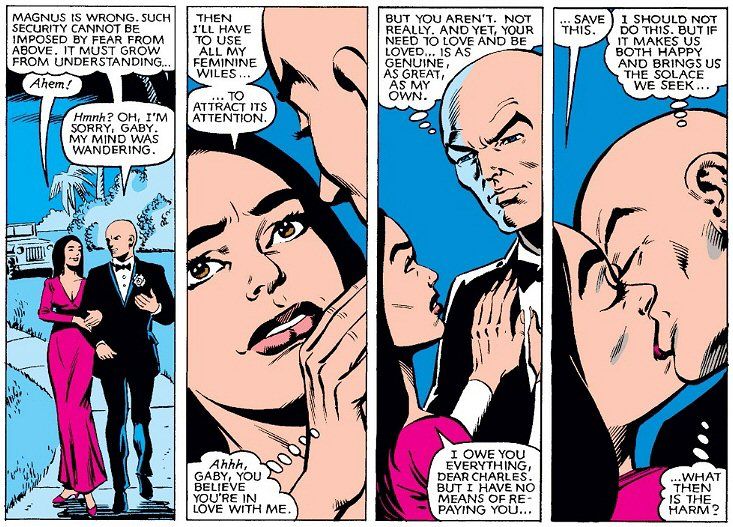
I remembered this scene, as it clearly showed Charles knew his behavior was wrong but he did it anyway for his own selfish reasons. Of course, it is also a clear violation of professional ethics to take advantage of a vulnerable woman who you are actively treating for psychological issues! And it is made worse by his telepathic awareness of her transference. Note there is no mistaking the relationship – it was quickly established by Claremont five months later that Charles and Gabrielle’s sexual relationship at this time had produced a child, the powerful and unstable mutant David Haller, known as Legion (first introduced in New Mutants Vol 1, issue #1, 1982, again by Claremont).
But looking this comic up again now, I’ve discovered it was far worse than I remembered. It was established a few pages earlier that Gabrielle – though physiologically a young woman at that point in time – had been in a catatonic state since her childhood experiences in the concentration camps. This is confirmed when Charles probes her psyche and breaks through her mental defenses. I will skip the disturbing imagery of Nazi monsters, and just give you the key talk balloons:
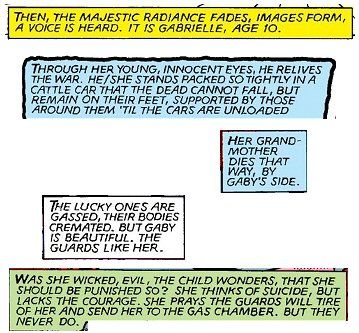
So, mentally, Gabrielle is still “age 10” inside her mind. After watching her whole family be murdered in the camps, the guards spared her because of her beauty – their attention making her wish for death. This makes it pretty clear that she was being molested, and is still a mental child. Note her reaction when she awakens in the next panel:
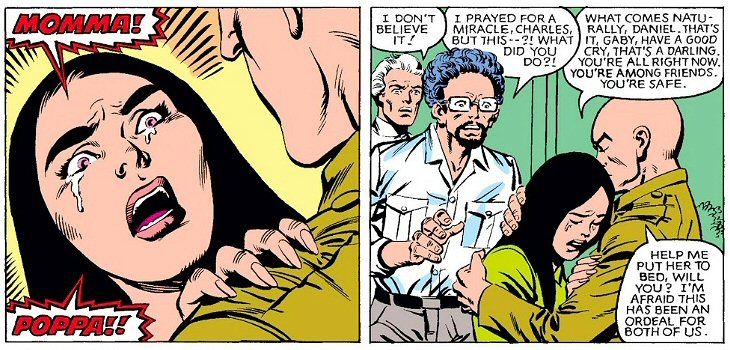
She immediately calls out for her “Momma” and “Poppa”, again implying she is still mentally a child – which makes sense, if she has been catatonic ever since the camps. But turn the page to see this narration:

So, with Charles’ help “over the weeks that follow”, “Gaby bridges the gulf between child- and adult-hood” (!).
Let me see if I got that straight – not only did Charles take advantage of a young woman who was in his therapeutic care, whose feelings for him he knew weren’t real – but she had also been molested as a child and had retained the mind of a tortured 10 year old until a few “weeks” earlier? It is shocking to me to read this full sequence now.
I suspect Claremont must have taken some criticism for this sequence – given that he decided to retcon it some 23 years later. Unfortunately, he made it even worse from my perspective.
By the early years of this millennium, it seems most X-Men writers had pretty much soured on the Professor. It was common for them to cast Charles’ character as increasingly flawed, and sometimes even dangerous. Some representative story lines include:
- his attempted infanticide of his twin sister Cassandra Nova in the Grant Morrison era (2002)
- his intentional enslavement of a sentient intelligence for his danger room in the Joss Whedon era (2005)
- his participation on the Illuminati in the Brian Michael Bendis Avengers stories (2006)
- the Deadly Genesis event in Ed Brubaker‘s era (2006), where Charles mind-wiped any knowledge of an earlier group of poorly-trained young mutants who he had sent into battle to save his X-Men – and were all killed. This included another brother of Cyclops – whose memories he subsequently erased.
Around this same time, Claremont had returned to Marvel, where he continued his own set of X-Men stories in his Excalibur Vol 3 series, outside of the main X-Men titles (at the time run by Whedon and others). In issue #14, 2005, with art by Aaron Lopresti, Charles is mentally inside his own “bug room”, where he confronts his “greatest shame” by facing a mental projection of Gabrielle from that time period:
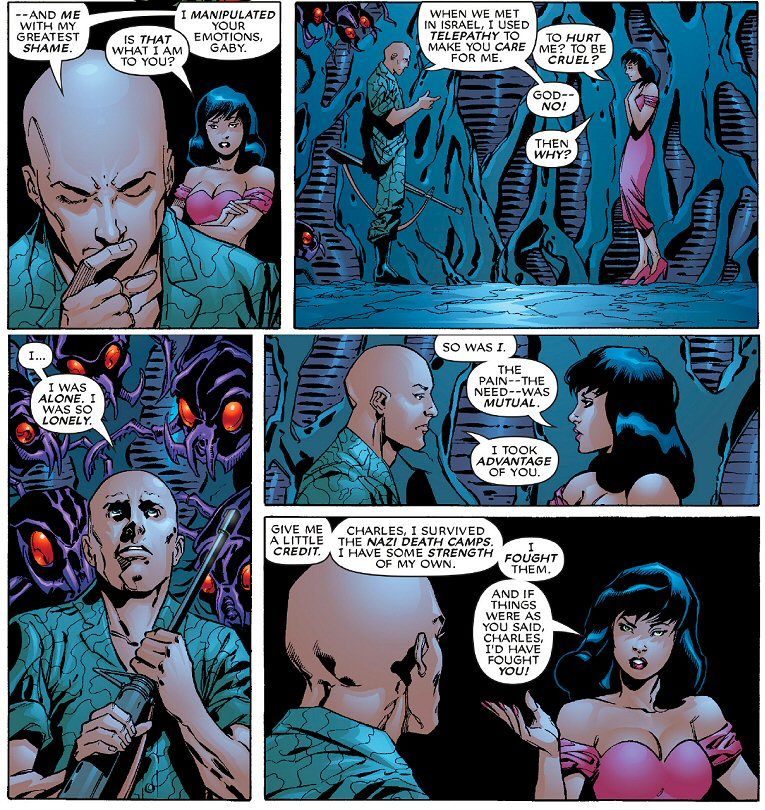
So, this makes it even worse! Now, Charles admits to deliberately manipulating a young patient with the mind of tortured child to have sex with him. But even more disturbingly, Claremont’s projection of Gabrielle seems to be arguing that since she didn’t fight him, she must have wanted it too (what does that sound like a defense of?).
Worse, she goes on after the turn of the page to explain that after their affair ended, she subsequently fell in love with and married her primary psychiatrist, Daniel Shomron (the same one that brought Charles in to consult in the first place). And she credits Charles for that:
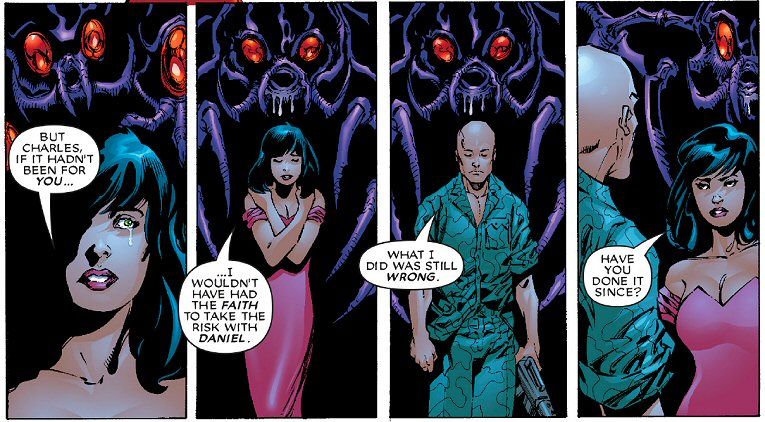
This seems to be doubling down on how it is ok for psychiatrists and psychologists to enter into sexual relationships with their vulnerable mental health patients!
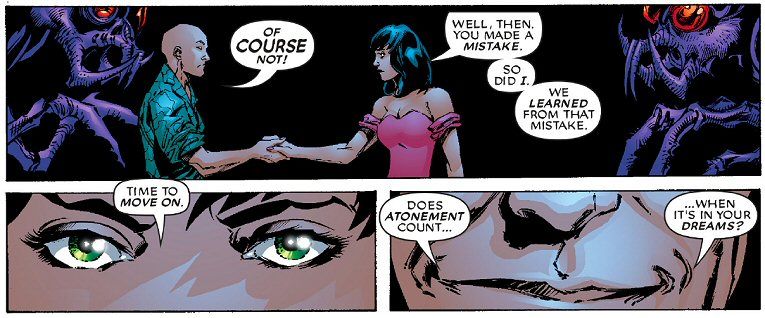
It sounds like Claremont is trying to convince others (or himself?) that is is “time to move on” and be “atoned” for this. In case he hasn’t been clear enough, Claremont drives it home a page or so later, with the final panel of this extended sequence:
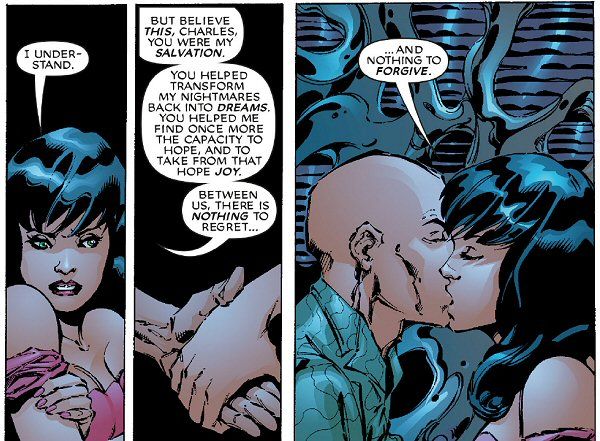
I don’t want to pile-on here, but those are Claremont’s own words above.
I do want to credit Claremont for his early 1980s condemnation of the horribly mysognistic story line in the Avengers where Carol Danvers’ Ms. Marvel was effectively raped by an adversary and discarded by her teammates. As discussed on my Captain Marvel post, Claremont did a great job tearing down his compatriots who were responsible for that horrific story.
Yet I can’t help but see the parallel here and Claremont’s time writing Doctor Strange (1979-1981). As I explained on my Clea ethics page, Claremont not only continued the decade-long unhealthy sexual relationship between the young disciple Clea and her mentor and “master” Doctor Strange – but he explicitly addressed it by having a doubting Clea opt to stay as her own supposed choice (much like the reasoning above for Gabrielle). The repeated suggestion that a young woman in a subordinate, vulnerable and insecure position can exercise free choice in participating in a sexual relationship with a much more powerful older man, who is in a position of direct authority over her, is profoundly disturbing. Again, there is much to credit Claremont for his writing of strong and powerful women in the comics – and even the first lesbian relationship between Mystique and Destiny (subtly hidden because of the Comics Code Authority). But this specific story line for Charles and Gabrielle – updated in 2005 – is difficult to accept morally.
Putting the sexual exploitation theme aside for a moment, the story line above also underscores a key contention that gets to the heart of Charles’ problematic moral character as written. Namely, he seems to think it is acceptable to violate the rights (and will) of an individual if it means some “greater good” is achieved – although he will feel bad about doing it. The implication is that we are then supposed to feel bad for Charles, because he is (somewhat) tortured by his own repeated decisions to sacrifice other peoples’ needs and rights. I find I can’t muster much sympathy here.
This is the conflicted core of the character that all X-Men writers have had to face. Many of them have tried to pull off the trick of making us feel bad for Charles, while continuing to have him do indefensible things to others.
Modern comics
There is another interesting example of Charles’s perspective in the Matthew Rosenberg era (2018-19). Consider this page from Astonishing X-Men Annual Vol 2, issue #1, 2018, by Rosenberg and Travel Foreman. At this point in time, Charles had returned from the dead in a younger body (hence the hair below) but was keeping his presence a secret from the X-Men. In this issue, he has interrupted a “pity party” (his words) that his original X-Men were having (well, the current survivors at any rate). They were bemoaning how their lives had turned out – largely as a result of Charles’ actions, not their own. And so, he puts them yet again into a situation where they have to risk themselves to save the world.
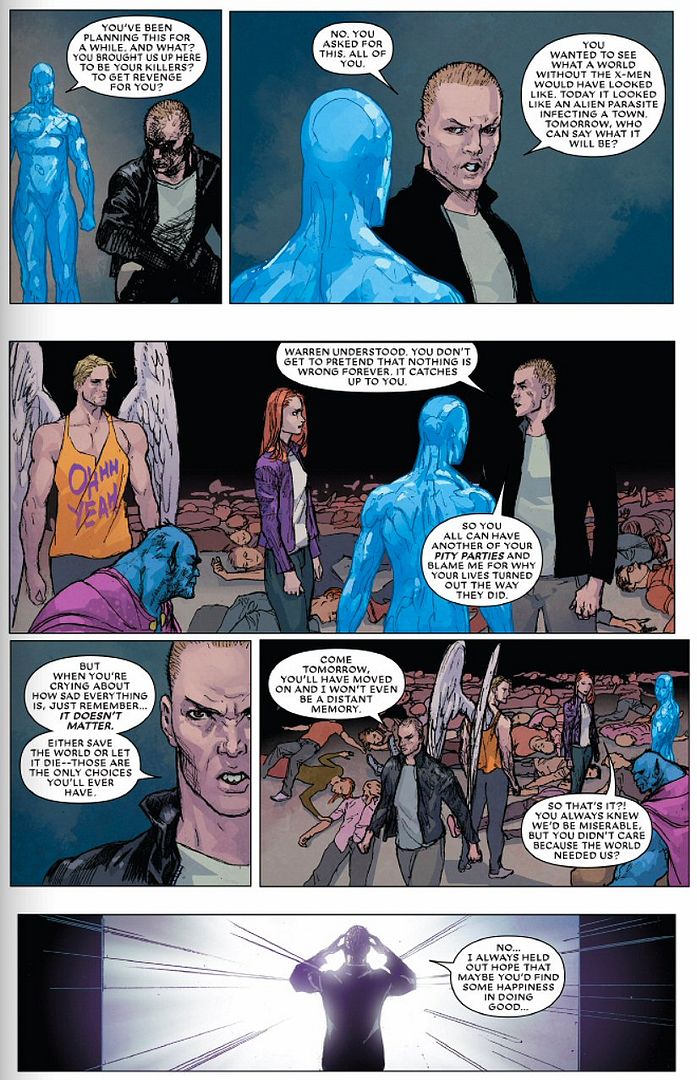
For me, I read this as Charles is again manipulating his former pupils, getting them to do what he thinks is right (for the “greater good”), all while violating their rights and agency. And then erasing their memories of his intervention – but not before lecturing them about how disappointed he is in them for not being happy about it (!). It’s not often you see such a stunning example of moral failure coupled with such moral high-handedness in a character. But other fans seem to agree with the character’s stated reasoning above – what he has been doing is educating his pupils on proper moral behavior, and he is disappointed they have not voluntarily come to embrace it themselves. So some persist in seeing him as a “good man”, even with stories like the above.
Coming to a head in the Krakoan Age
I find the closest thing to a (temporary) resolution of the dichotomy in Charles’ moral character came about in the recent Krakoan Age. This was the most massive and complex X-Men event in history – spanning 5 years (2019-2024) and over 500 comics. The premise, as initiated by Jonathan Hickman in 2019, was that along with Moira MacTaggert and Magneto, Charles set about creating a new mutant paradise on the alive and self-aware island of Krakoa. It ends with Charles being incarcerated for crimes against humans.
Hickman had come up with a novel explanation/defense of Charles’ moral failings (and self-righteousness) – he had been corrupted by Moira since the day they first met, at least from his perspective.
That qualification requires a bit of an explanation. With her introduction in the comics in 1975, Moira was presented as a brilliant geneticist who shared Charles’ dream, and was his original love interest (indeed, it is after Moira leaves him that the lonely Charles seduces Gabrielle Heller in the original stories). But Hickman retconned that origin by turning Moira into a mutant – with the novel mutant ability of reincarnation. When she dies, Moira returns fully sentient to a time just before her birth – keeping all her memories of her past lives.
This means that upon her death, the entire Earth-616 Universe essentially “resets” itself to just before her birth (with no one else being aware of the reset). But she isn’t immortal – if she dies before the age of 13 in any given life (which is when her mutant power first activates), she is gone forever and the Earth-616 Universe continues on its merry way from that point. It was prophesied by the pre-cognitive future-seer Destiny that Moira would only live 10 or 11 lives, depending on her choices in that 10th life.
Over her successive reincarnations, she kept trying to come up with a way to ensure the long-term survival of mutantkind. But she kept failing, seeing the “dream” die each time. At the time of the current Earth-616 timeline (which Hickman was writing), Moira was in her 10th life, and had seen that everything she had tried so far was ineffective – the mutant race always gets wiped out. So she decides to try something radical – she reaches out to Charles and Magneto early on and corrupts them to suit her needs.
From the Powers of X Vol 1, issue #6, 2019, by Hickman with art by R.B. Silva and Pepe Larraz:.
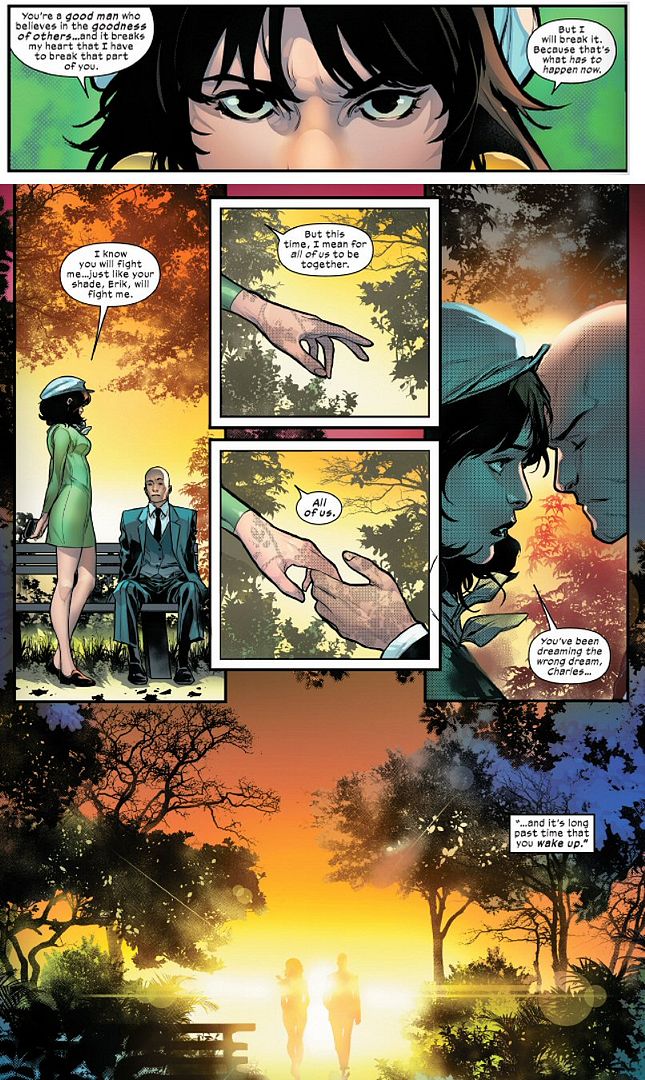
Moria schemes and manipulates both Charles and Magneto – specifically “breaking” Charles enough to have him engage in unethical behavior in pursuit of their shared “dream”. In essence, Hickman is proposing that Charles was always a good man – but in the current iteration of Earth-616 that we all know (going back to the creation of the X-Men in the 1960s), his increasingly inconsistent moral character arc is actually the direct result of Moira’s corrosive influence.
Interestingly, in this new retconning, both Magneto and Charles are aware that she has manipulated them – by her showing them how all their previous selves failed. It is even implied in Moira’s journals in the issue above that Charles’ relationship with Gabrielle was intentional on their part, under the desire to specifically produce a powerful mutant like Legion (i.e., Moira identified Gabrielle as a good genetic match for Charles). This retcon makes Charles’ seeming contradictions over the years quite intentional – and thus much worse.
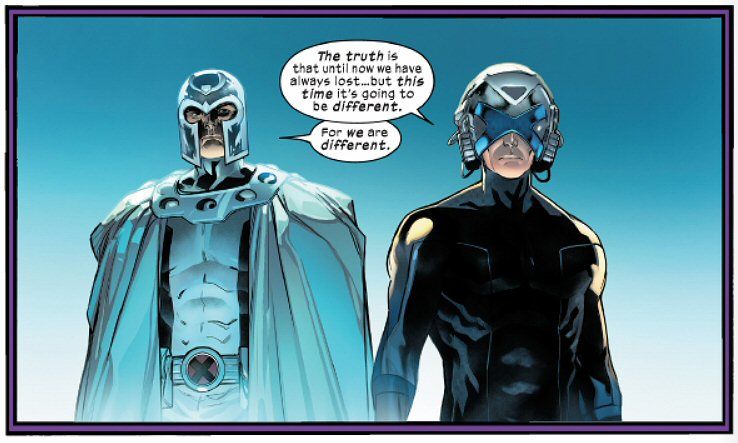
And they both happily thank Moira for making them different. How far are they prepared to go?
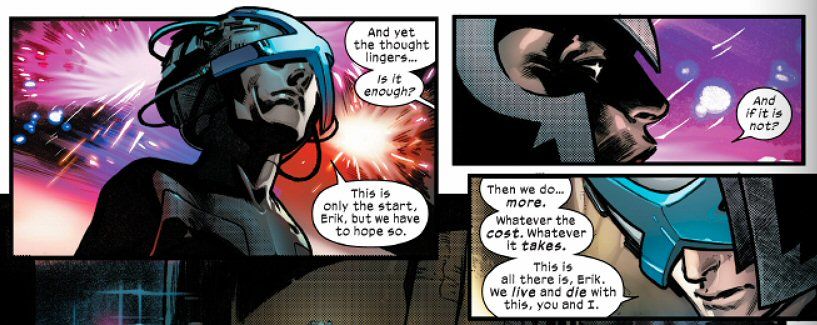
Of course, things quickly go badly for our trio – Moira soon abandons the course they are on, followed by Magneto. This leaves Charles alone to do whatever it takes to achieve the “dream”.
A.X.E.: Judgment Day
By the middle of the Krakoan Age, things took a turn for the worse due to the events described in my A.X.E.: Judgment Day Introduction – the major 2022 Marvel cross-over event created by Kieron Gillen (who was now also one of the lead writers for the X-Men). In an attempt to ward off a genocidal attack by the Eternals against all mutants, a god-like Celestial known as the Progenitor is revived. Unfortunately, it takes it upon itself to decide the fate of the whole world by weighing the morality of every human being.
By this point in time, Magneto had “retired” to Arrako (Mars) – where he successfully held his ground against the Eternal warlord Uranos, but at the cost of his own life. Magneto uses his dying words to impress upon Storm how Charles Xavier is not to be trusted. From X-Men: Red Vol 2, issue #7, 2022, by Al Ewing and Stefano Caselli:
What does the Progenitor think of all of this? While Magneto passes with a thumbs up, here is the single panel for Charles in A.X.E.: Judgement Day issue #4 (by Gillen, Valerio Schiti, and Marte Gracia):
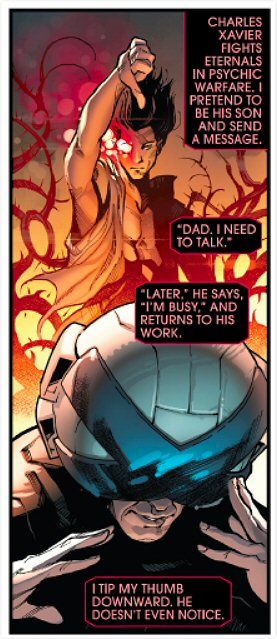
Charles was always a terrible father in the comics – and with the the Powers of X retconning, he is now something worse (i.e., manipulating Legion’s creation as simply a tool in his grand plans). So it is rather on the nose for the Progenitor to fail him in the guise of his son, without his father even noticing. It’s a nice touch to illustrate how – in this modern telling – Charles is wilfully blind to all the wrong he has done.
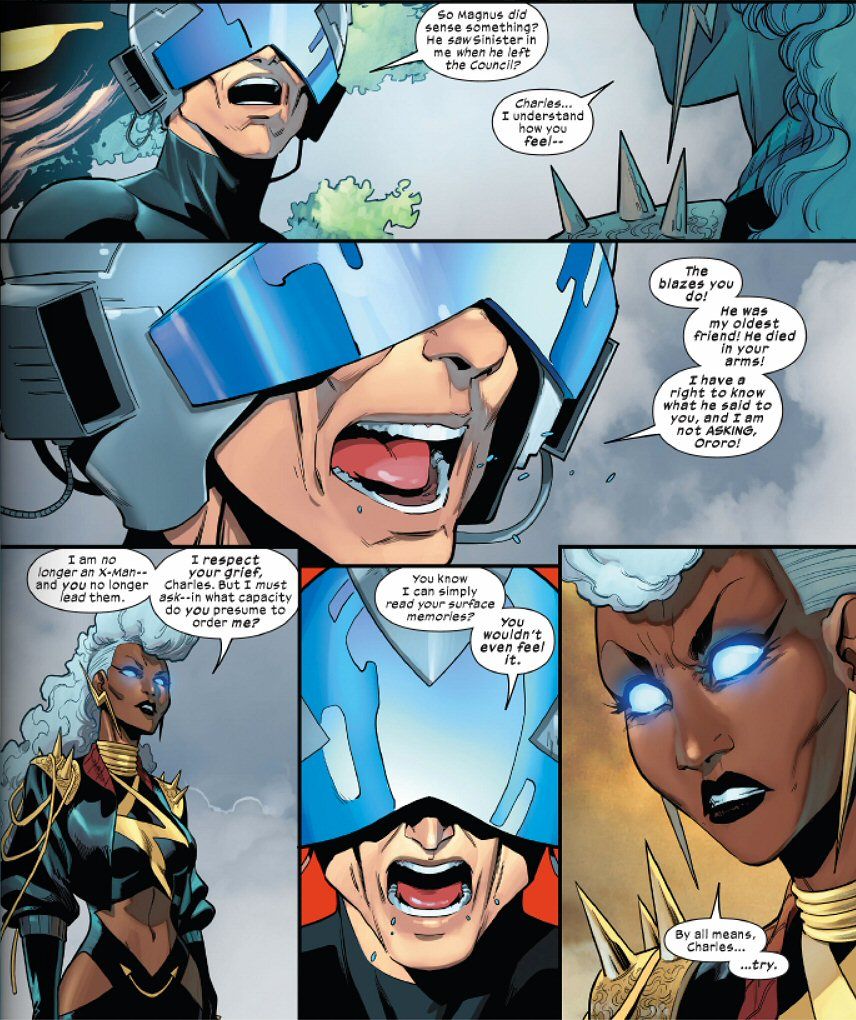
Another good example of this is the issue previously mentioned where Charles demands Storm tell him Magneto’s last words. From X-Men: Red Vol 2, issue #11, written by Ewing with art by Stefano Caselli and Jacopo Camagni:
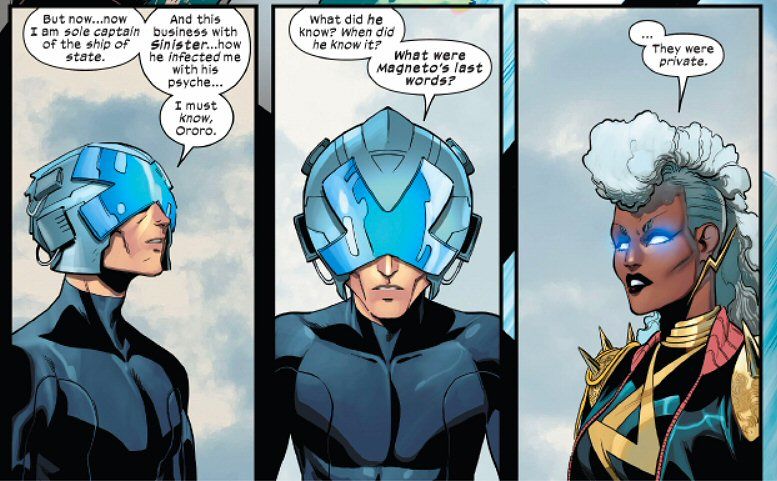
Charles doesn’t take well to being rebuffed (I particularly like the spittle flying below):
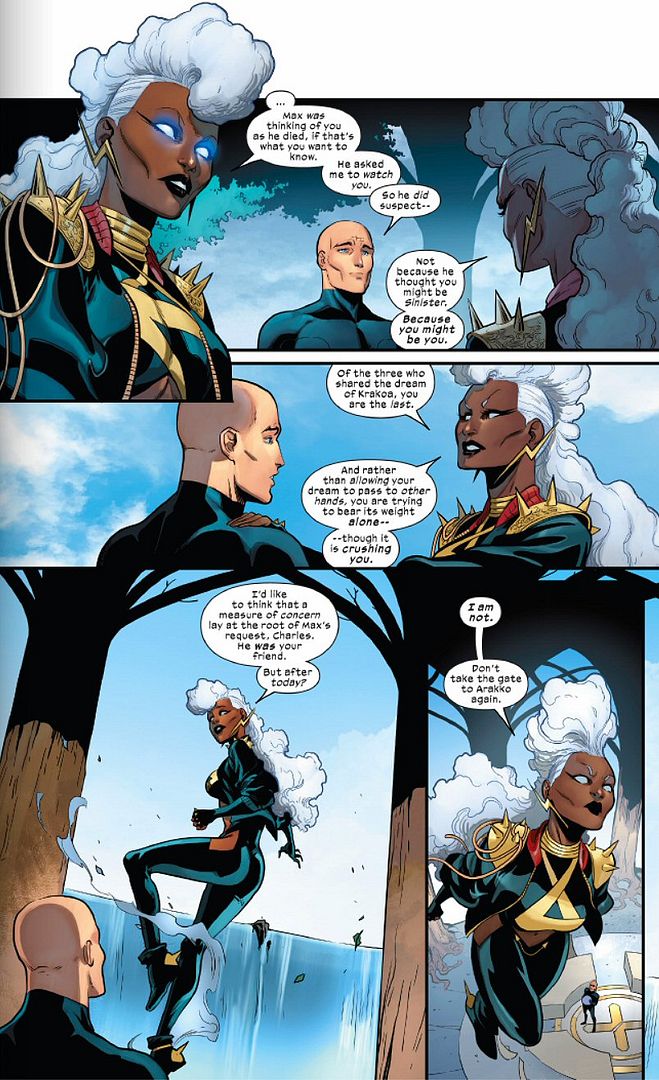
After Storm repels his psychic attack (using the method he himself taught the X-Men – for use against a “telepath with evil intentions” or “one who has lost control”), Charles eventually admits his motivation for forcing the issue: he’s afraid. Storm takes some measure of pity on him and explains:
The end of the Krakoan Age sees Magneto’s prophecy come true, as Charles (seemingly) aligns with their enemies and sacrifices human lives in order to save mutants. Here is the opening narration from the final issue of the Krakoan Age, in X-Men Vol 6, issue #35 (which just happens to be issue #700 in Marvel’s Legacy numbering system).
Once upon a time, there was a mutant telepath named Charles Xavier. He started a school for gifted youngsters and dreamed of peace. His students became a team. His team became super heroes. His super heroes changed this world … and the next. The mutant nation of Krakoa was born. And when the war came, Charles Xavier finally broke … and like all broken men at war: He did bad things. And now Charles Xavier must pay for those bad things.
- Gerry Duggan, Al Ewing, and Kieron Gillen, 2024
The opening pages show a captured Charles in transit to his permanent incarceration. The recently resurrected Magneto pays him a visit:
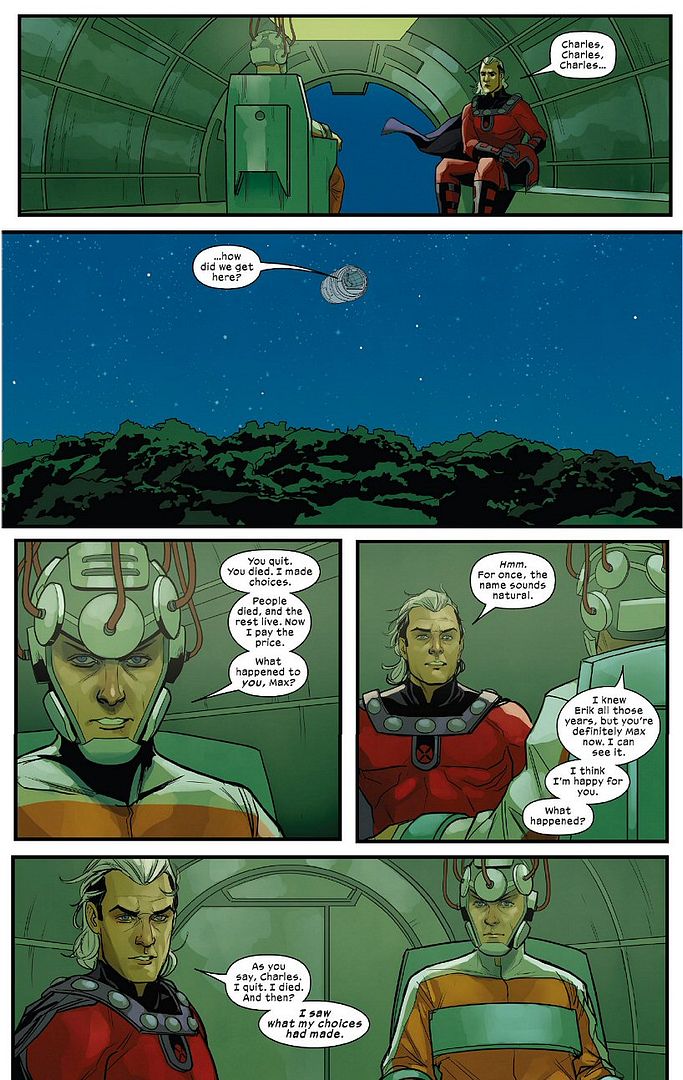
Charles gives a pretty succinct summary of events – “You quit. You died. I made choices. People died, and the rest live. Now I pay the price.” In his very utilitarian way, he is implying (as Magneto predicted) that circumstances forced him to make the choices he did to save as many as possible – the classic ends-justify-the-means defense. I’ll skip ahead a few panels:
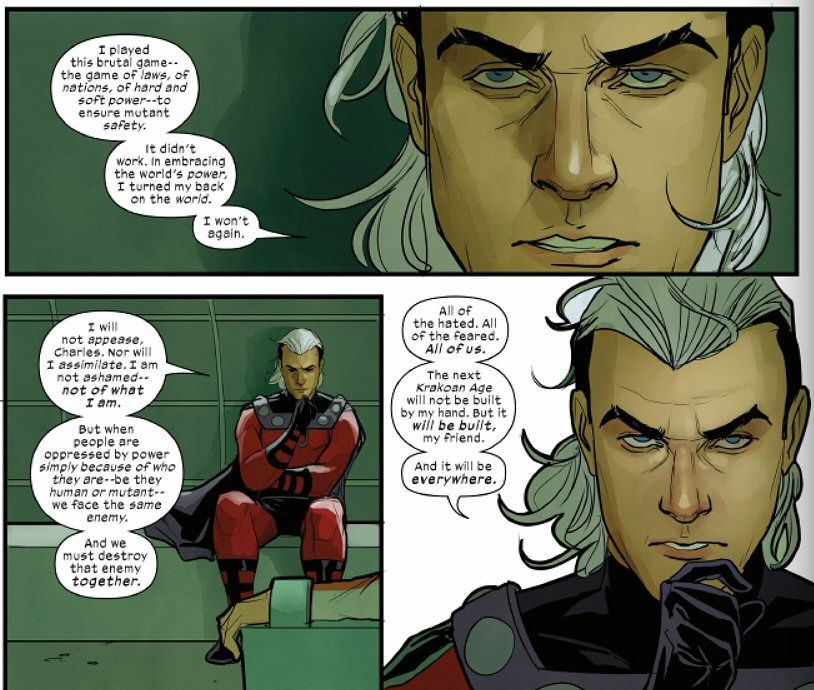
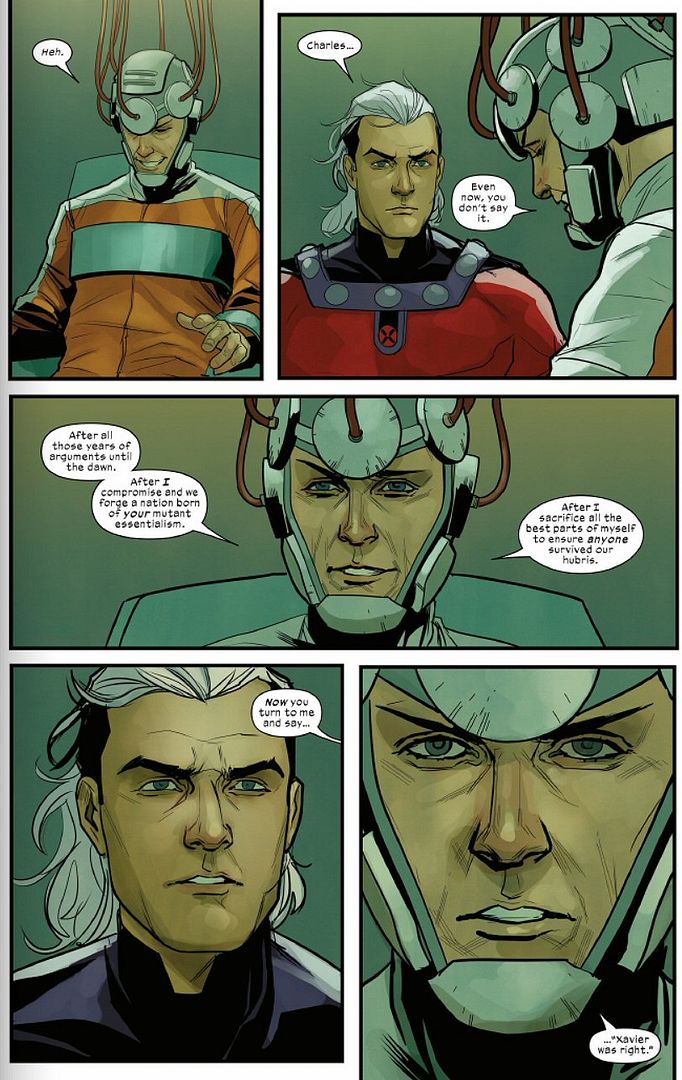
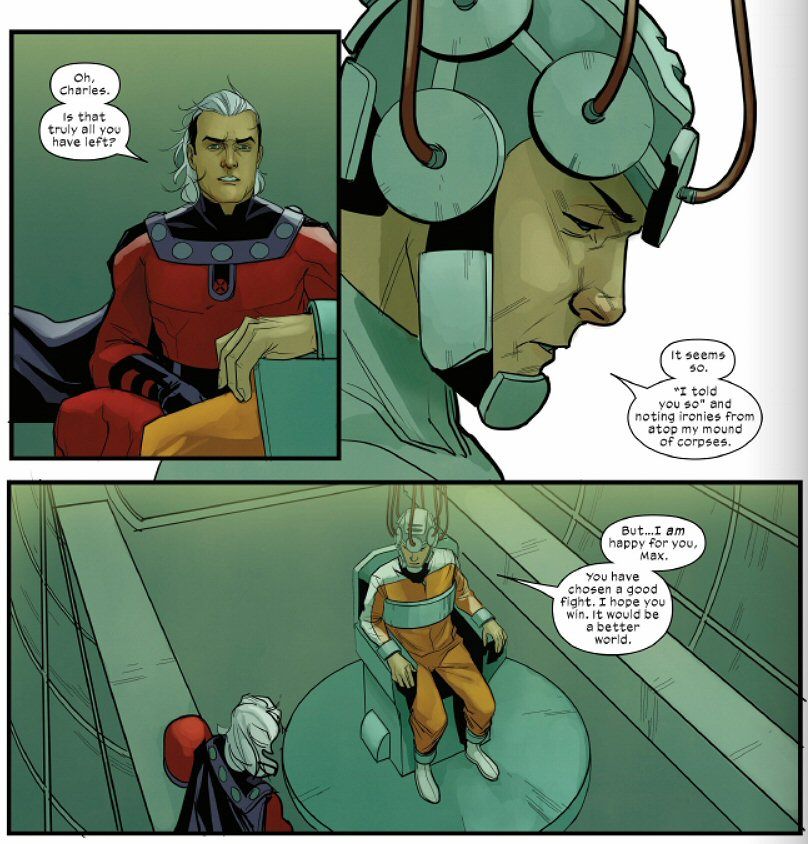
So, as of mid-2024, we have come full circle – Magneto now fully embraces Charles’ original dream of protecting the rights of all, and Charles has (apparently) destroyed himself by his unrestrained utilitarian pursuit of the best for mutants.
But Marvel couldn’t leave it there. Intrepid readers might have noticed a lot of “seemingly” and “apparently” qualifiers above. For some reason, Marvel refused to commit to this ending and immediately retconned it a month later, at the very start of the X-Men From the Ashes Age. But that is a whole story in and of itself, which I will cover in an upcoming post. (UPDATE: now available here)
Marvel Cinematic Universe (MCU)
Charles Xavier was very well portrayed in the X-Men movies by both Patrick Stewart (in the first decade of this millennium) and James McAvoy (in the second decade) for the rebooted origin stories. But since both sets of movies only portray the Professor from the earlier comic book story lines of the late 20th century, I don’t feel they are too relevant to a discussion of his current normative ethics in modern times.
Current ethical framework: C (originally, D/c)

Charles is currently an act utilitarian through-and-through. There really is no sign that he has any kind of rule, code, or applied ethics restraining feature. As explained earlier, he also seems to be an ethical longterminist, focused exclusively on the long-term “greater good” of mutants over any consideration of their needs (or rights) today. He is extremely manipulative in the stories, especially the last few years (although some of that is attributed to the malign influence of Moira MacTaggert).
As an aside, there are only two other characters I can think of in the Marvel Universe that share Charles’ unrestrained act utilitarianism and longtermism: Doctor Doom and Kang the Conqueror. Of course, they also exhibit a lot of negative personality traits that Charles doesn’t have (hence why they are villains and he is generally considered not to be). Still, it’s an interesting observation.
The last word … for now
Although Charles’ murder of human beings was soon retconned, the final pages of the last story of the Krakoan Age (X-Men Vol 6, issue #35, 2024) is interesting. Here, you get to see Charles settling into his new prison cell. He comments about how Reed Richards (Mr. Fantastic) and Tony Stark (Iron Man) had seemed as they were caging him in. Quote Charles in the narration:
No hard feelings. We’re all adults here. Everyone doing the reasonable thing. None of us being so crass to state the subtext … they had planned how to cage me if they had to. That they were right to do so makes the pill no less bitter.
This certainly seems to be an acknowledgement of how he deserves to be there. Ah, but Charles is not done digging a hole for himself. He then goes on narrating, overlayed over a real-time evolving scene of a mutant hate crime in progress, as a pro-human extremist chases a mutant with a knife:
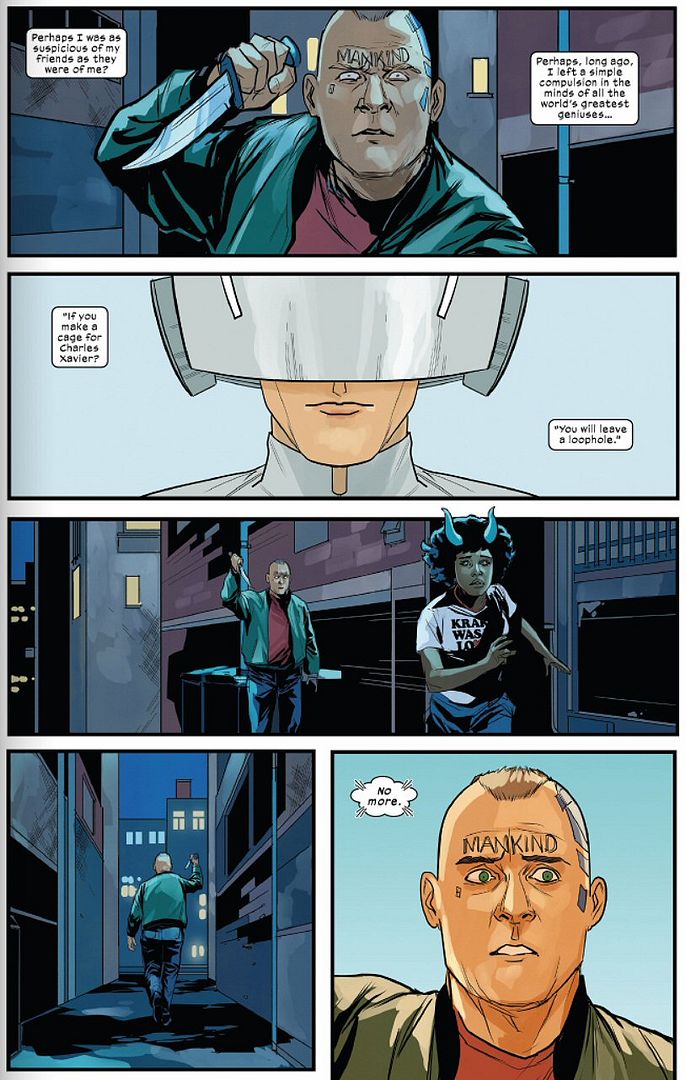
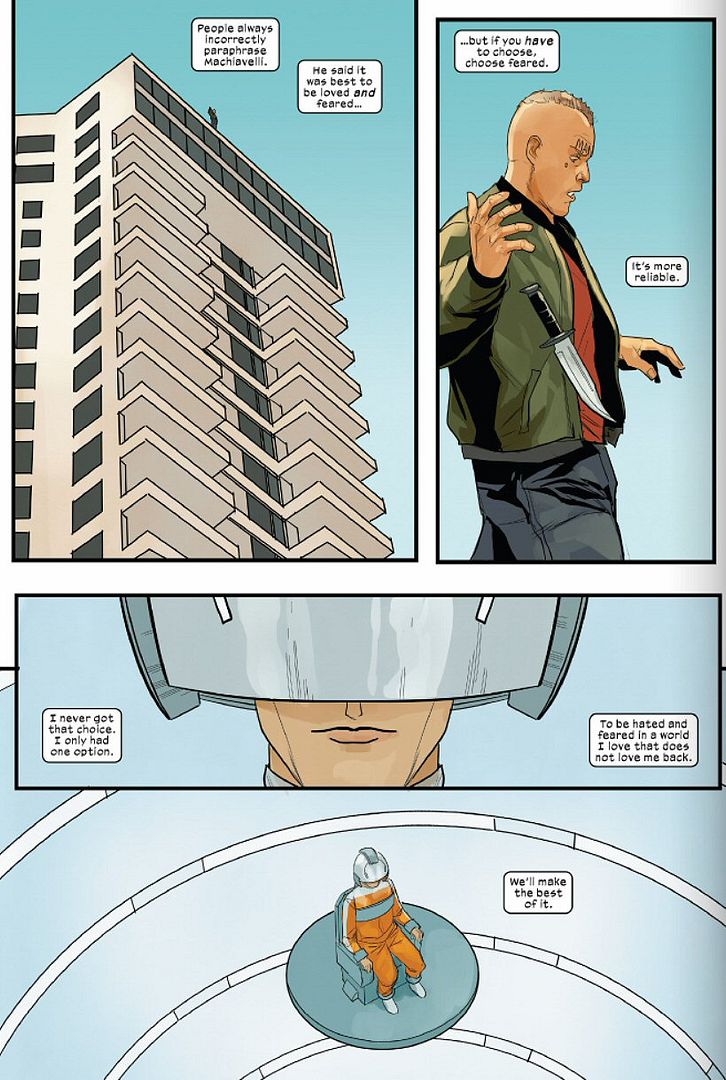
You got to love a comic that accurately summarizes Machiavelli’s writings!
The reference above refers to machiavellianism in the political sense. And to be fair, it’s unclear whether Niccolo Machievelli was proposing an actual political theory, defending a popular approach, or was simply being cynical and engaging in political satire through his writings (I like to hope it was the latter). But Charles’ speech above does capture the fundamental principle espoused in Machievelli’s writings – namely, that the accumulation of political power and control outweighs any ethical considerations, and that the ends always justify the means. That does indeed sound a lot like Charles across the Krakoan Age.
To be fair, machievellianism in the behavioral psychology sense is far less applicable to Charles’ character. In the field of personality psychology, machiavellianism is part of the so-called “dark triad” along with narcissism and psychopathy. Machiavellianism is characterized by manipulativeness, ethical indifference, lack of empathy, and a calculated focus on self-interest. While Charles is very manipulative, the rest of those characteristics really only apply to him in very limited ways.
In fact, this is where I see hope for the character. The way back from his current predicament is to lean in on the ethical side, having him develop and espouse a revised normative ethics framework. I have some suggestions in that regard – which I will save for my next post on the potential rehabilitation of Charles Xavier.
See my Glossary post for a list of the key philosophical concepts and related links on this site.
Further Reading
For more Xavier: The Redemption of Charles Xavier
For more X-Men: X-Men A-Ma
For more X-Men: X-Men Mi-Z
Thanks for this one as well. Kinda the mirror image of Magneto, one has fallen while the other rose, lol.
I never heard of that excalibur series, doesn’t look too good for Claremont. I started reading comics around the time he finished up on X-Men, so I haven’t followed him too closely. Always heard he promoted women in the comics, so that stuff was a bit of surprise. Still miss the Hickman-Gillen era, some good stuff in there.
And thanks for the ethics. A bit over my head, but interesting!