

Captain Marvel: I’ve made enough mistakes to fill a book … several books. Okay, fine, a whole shelf. But there’s this thing about making mistakes … you learn a lot from them. So I figure I’m some kind of genius at this point given the “whole shelf of mistakes” thing. And you know the most important thing I’ve learned? Always get up.
- Kelly Thompson, Captain Marvel Vol 10, issue #1 (2019)
“Captain Marvel” is an alias that has been used by a number of different Marvel comics characters over the years. When I was first collecting comics in the early 1980s, it was used by Monica Rambeau (currently known as the superhero Photon, since 1996). Before that, it was Mar-Vell of the Kree Empire (a character created in 1967, currently deceased). Presently, it is used by the human/Kree hybrid Carol Danvers. Carol was initially known as Ms. Marvel (created in 1976) and later known as Binary (during my time collecting in the 1980s) and then Warbird before returning to Ms. Marvel and then finally adopting the Captain Marvel title in 2012. The alias Ms. Marvel was subsequently adopted by the young Inhuman/mutant hybrid Kamala Khan in 2014, as a tribute to her hero, Carol.
As you might expect with an opening paragraph like that, the history of this character is long and complex – and far less consistent than many Marvel superheroes. I will summarize the early character below, but for the normative ethics I will focus just on the modern Captain Marvel version of the Danvers character. I plan to focus on the Kamala Khan Ms. Marvel in a future post (UPDATE: see my X-Men Characters entry for the current Ms. Marvel).
If you would like to know more about the terms I’m using on this site, please follow the links throughout or check out my Ethics 101 page or Glossary post.
Character introduction
In his 1977 book, The Superhero Women, Stan Lee had this to say about Carol Danvers (at the time, only recently turned into the superhero Ms. Marvel):
You see, we wanted Ms. Marvel to be treated like any other dramatic do-gooder in our merry Marvel ménage; and we also wanted a sense of relevancy — a sense of a woman’s thoughts, emotions, and reactions while facing the same problems and threats as any male adventurer.
This sounded like a good idea for the time, given how women characters had typically been portrayed in the comics – and popular culture more generally – up to that point. But it didn’t turn out that way, and it is worth discussing why.
The first appearance for Carol Danvers was as a romantic interest for Captain Marvel in Marvel’s Super-Heroes Vol 1, issue #13, 1968, by Roy Thomas and Gene Colan – right before the launch of the first Captain Marvel title (Captain Marvel Vol 1, also by Thomas and Colan). Consistent with American comic culture at the time, Carol’s character was basically just eye-candy for Captain Marvel, and appeared in increasingly diminished ways over the initial Captain Marvel run (e.g., started out as a senior security officer at NASA Cape Canaveral, but eventually gets busted down to a lowly guard).
In the first issue of her own title (Ms. Marvel Vol 1, Issue #1, 1976), by Gerry Conway and John Buscema, her backstory was updated to having left NASA and eventually finding her way to being the editor of a women’s magazine – at the same newspaper where Spider-Man’s Peter Parker is employed. They mildly retconned an earlier event in the Captain Marvel title to explain the origin of her powers – Carol had a delayed reaction to her exposure to an exploding Kree device (the “Psyche-Magnitron”), a machine that can grant superhuman powers (Captain Marvel Vol 1, issue #19, 1969).
Although some aspects of this new backstory were an improvement, overall it made things unnecessarily convoluted (and still somewhat demeaning). Putting her firmly in the Spider-Man realm of weaker, lower-power heroes and villains also didn’t help. The Ms. Marvel title was soon taken over by famed X-Men writer Chris Claremont (in issue #3), who started providing more progressive underpinnings to the Danvers character, and gradually expanding her powers and scope.
Eventually, thanks to Kelly Sue DeConnick‘s historic run (2012-2015), a much more fleshed-out backstory was developed where Carol grew up largely overlooked and dismissed by her US Navy father, who favored her brother despite Carol’s superior intellect and interest in a military career. She left home to join the Air Force to become a pilot, and earned a college degree through the military. Eventually, rising from an ace pilot to Air Force Intelligence, Carol resigns as a Major and joins NASA as the head of security at Cape Canaveral. She is multi-lingual and an expert in armed and unarmed combat.
Even this improved background was subjected to more expansive retconning in the 2018-2019 series The Life of Captain Marvel Vol 2, by Margaret Stohl. Now, it turns out that her mother had actually been a highly-trained Kree operative on the run, making Carol a half-human, half-Kree hybrid. The early Psyche-Magnitron plot was then reduced to just being the catalyst that triggered the expression of her latent true powers – which are far more substantial than the earlier Ms. Marvel telling. Now, her powers were not an accident or a gift.
As I alluded to above, the full Carol Danvers history is long and convoluted – check out the Marvel Fandom site if you want a full retelling with in-story chronological continuity. But I also recommend Alex Abad-Santos eye-opening 2014 article in Vox (“The insane, sexist history and feminist triumphs of Captain Marvel“). In particular, the appalling depiction of the character’s rape in the Avengers comics, as first called out by Carol Strickland.
The Ms. Marvel title was abruptly cancelled in 1979, presumably due to low sales. As a result, she mainly showed up in other heroes’ stories, like the Avengers for awhile. But in Avengers Vol 1, issue #200, 1980 (plotted by Jim Shooter, George Pérez, Bob Layton, and David Michelinie, and written by Michelinie) she was written out of the Avengers in the most horrific way possible. Carol is revealed to have been kidnapped, mind-controlled, raped, impregnated, memory-erased, and then happily heads off at the end of the issue to live in another dimension with her rapist (whom she gives birth to, and who rapidly develops into the actual adult man who abused her). And all this with the full support of her Avengers colleagues, who wish her well (!).
This story line seems to have been built on some plans that Claremont originally had before Ms. Marvel was cancelled (namely, that Ms. Marvel would become a single mother, and that the Supreme Intelligence wanted to use her to procreate a new race). It seems Michelinie (who was writing the Avengers at the time) got that latter plot started in Avengers issues #197-198. But when another creative team published a one-off with the same plot, Marvel’s Editor-in-Chief (Shooter) apparently forced a re-write for Avengers #200. The outcome was clearly horrific.
UPDATE 08/13/2026: In Jim Shooter’s old 2011 blog, he re-read this issue and stated that he didn’t recall contributing anything to the story and didn’t know why he had a co-plotter credit. He remarked: “I agree with the consensus, it’s heinous”. While not recalling the details, he apologized in his capacity as Editor-in-Chief at the time: “I screwed up. My judgment failed, or maybe I wasn’t paying enough attention. Sorry. Avengers #200 is a travesty”. A detailed account of this issue is also available at the ComicDeepDive blog.
Claremont was reportedly aghast at this character development, and had an appropriate bit of revenge in Avengers Annual #10, 1981 (appropriately entitled “By Friends — Betrayed!”). Here, Carol confronts her former friends and colleagues about their shocking mistreatment of her (with art by Michael Golden):
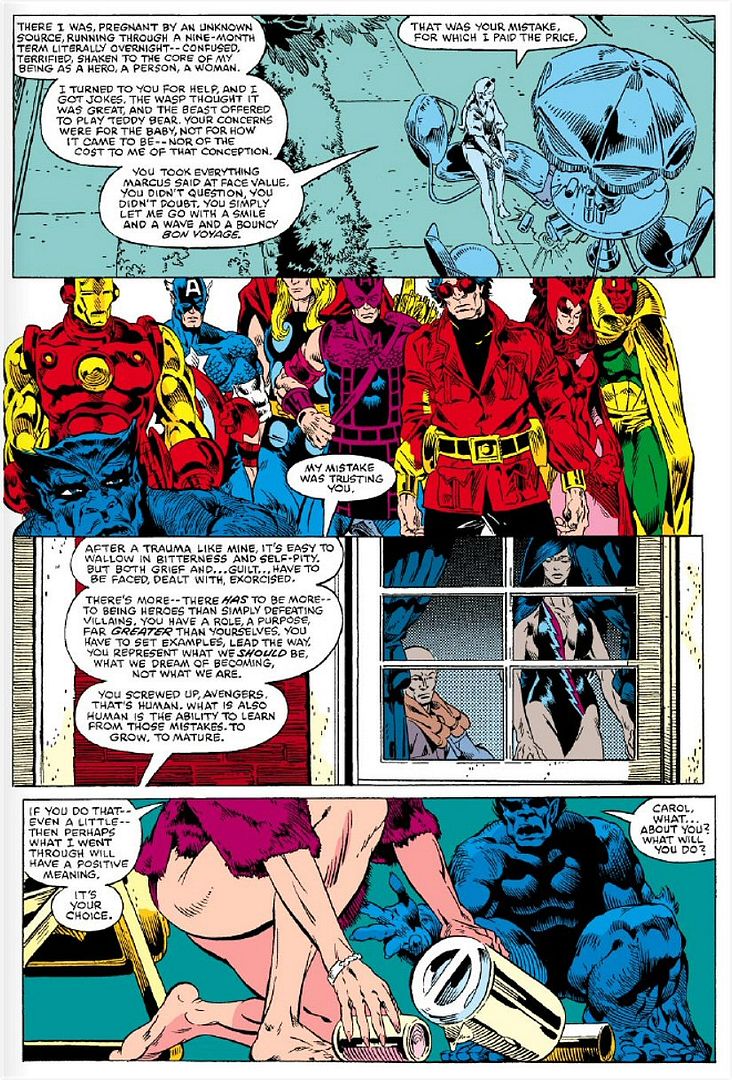
While appropriately shaming the Avengers, one imagines Claremont is really writing more for his Marvel colleagues here (Michelinie in particular – and kudos to Shooter for allowing it to be published). Consider how this could be read as excoriating his colleagues to do better:
There’s more — there HAS to be more — to being heroes than simply defeating villains. You have a role, a purpose, far GREATER than yourselves. You have to set examples, lead the way. You represent what we SHOULD be, what we dream of becoming, not what we are.
Although Claremont seems to be coming to bat for the character here, he also put her through a lot of trauma as well. In fact, the core of this Annual story is apparently one he wanted to write before Ms. Marvel was cancelled – Carol’s personality and powers get forcibly “erased” by an encounter with Rogue. With the help of Professor X, Carol eventually recovers most of her memories – but not her “feelings” or powers. In this version, Carol decides to stay with the X-Men as she tries to recover – appearing as a reoccurring character in Claremont’s extended run of Uncanny X-Men Vol 1. Eventually, Carol develops vast cosmic powers as Binary – but only after being horribly tortured and abused by the Brood. So it’s a problematic return (and by the way, why exactly does she need be lounging around in a skimpy bathing suit in this issue?). Like Claremont’s Jean Grey (who joined with the Phoenix Force for cosmic powers), both characters get to experience becoming among the most powerful beings in the Universe. But both characters also suffer horribly, and both experience losing that power as well.
Sadly, I found these early misadventures wound up setting a blueprint for how other writers would treat Carol’s character in the future. Over the subsequent years, there are far too many repeated story lines of her being depowered, tortured, and having her memories wiped, stolen, or lost. While a lot of comics characters bear considerable suffering over their long runs, this feels particularly demeaning and repetitive for a strong woman character.
Captain Marvel’s abilities (post-2012)
Carol Danvers’ Captain Marvel is considered to be one of the most powerful characters in the Marvel Universe at present. Her main power is the ability to absorb, process, manipulate and redistribute all forms of energy at will. Although not as powerful as she once was, she can still store and emit energy up to the level of an exploding nuclear bomb, or potentially even a star.
By grace of her hybrid physiology, she has superhuman strength, speed, durability, stamina, agility and reflexes, along with enhanced healing abilities. These can all be further augmented or enhanced by her energy absorbing powers. One of the main manifestations of her powers is through concussive “photon blasts” that she emits out of her fists, or other parts of her body on occasion. She can fly, including through interstellar space without the need for protective equipment (and doesn’t need air, water or food for extended periods, as she can replicate these through energy manipulation).
Carol’s connection and relationship with the Kree can be complex (and frequently updated or retconned). Carol has been a frequent member of the Avengers (and currently serves as their leader, in Avengers Vol 9, 2023-Present). Carol has a best friend on Earth – Jessica Drew, aka Spider-Woman – going back to her Ms. Marvel days. Their relationship comes up frequently in many of the modern stories. Carol’s pet cat, Chewbacca Sassy Danvers (or “Chewie“), was eventually revealed to be a Flerken – a powerful alien species with the ability to teleport, open dimensional portals and store pocket Universes inside their tentacled mouths (but who just happen to look like Earth cats otherwise). Whoever came up with this gag seems to know cats well! Carol serves as mentor and inspiration to a number of individuals, including her neighbor’s daughter Kit (“Lieutenant Trouble” as Carol calls her) and the current Ms. Marvel, Kamala Khan.
A modern take
In the stories, Carol took on the Captain Marvel title as homage to the sacrifice of her once mentor Mar-Vell, the original Captain Marvel (now deceased), in the relaunched Captain Marvel Vol 7, 2012-2013, by writer Kelly Sue DeConnick (followed by DeConnick’s Captain Marvel Vol 8, 2014-2015).
The early stories (by necessity) focused a lot on cleaning up and expanding on Carol’s initial origin story. Eventually, Carol leaves the Earth to venture into the stars, including an extended stint with the Guardians of the Galaxy. The key point to these stories is that Carol finally gets to choose what she wants to do with her life. And she pursues that agency toward the dream articulated from the early stories – to go into space and be an explorer (something denied to her previous selves).

DeConnick has been rightly credited with reinvigorating the Danvers character as a strong Captain Marvel, putting her on good footing for the next decade. But the normative ethics of the character is still in flux in these early stories. And that appears to be intentional, as Captain Marvel really is a rebirth for the Danvers character, who has to slowly find her own way – now that her own agency has been restored. The key point is that despite whatever has laid her low in her life, Danver’s Captain Marvel always gets back up!
It is only once Carol returns to Earth toward the end of that run in 2015 (and interactions with other major Marvel superheroes pick up) that Carol’s normative ethics become clearer. Carol gets embroiled with various Avengers story lines, leading up to the 2015 Secret Wars major cross-over event. Carol eventually gets involved with the Alpha Flight Space Program, serving as a front-line defense of Earth from intergalactic threats (Captain Marvel Vol 9, 2016-2017, written by Michele Fazekas and Tara Butters). That series came to an end with the Civil War II major cross-over event, where Carol had a major role as the leader of one of the two superhero fractions, facing off against Iron Man.
Civil War II (2016-2017) was created by Brian Michael Bendis and David Marquez. I have a lot respect for Bendis’ early work on the Ultimates universe, and his major cross-over events like the 2008 Secret Invasion and 2009 Dark Reign events, both of which were quite sophisticated (and the later quite prescient). Unfortunately, I found the 2016-2017 Civil War II event to be a bit of a retread of previous ground that didn’t add much new. Civil War II recasts Carol’s Captain Marvel as an extreme utilitarian (some have even described her as bordering on fascist in this event), with Iron Man serving as the voice of reason and restraint.
While Carol’s Captain Marvel character always had utilitarian leanings, this event presents Carol’s concern for the safety of the planet in such extreme terms that she is willing to exceed Iron Man’s earlier violations of other’s rights (from Mark Millar‘s first 2006-2007 Civil War event). I frankly find the precognitive nature of this event unbelievable (even by comic book standards). Carol taking things too far temporarily costs her the support of some of her allies, including her protégé, Ms. Marvel (Kamala Khan), which was thoughtfully handled. While I disagree with the extremes of the ethics framing for Carol’s Captain Marvel in this series, it did at least establish her as a strong leader in the Marvel Universe.
This series was followed by Mighty Captain Marvel Vol 1 and the Legacy Marvel numbering (2017-2018), both written by Margaret Stohl. These adventures continued Carol’s turn into the unapologetically utilitarian protector of the Earth. Carol clearly prioritized saving the greatest number of people and preventing the greatest amount of harm in these stories (although was not always successful, as you might expect).
But the most significant development for the character was Stohl’s subsequent series, the Life of Captain Marvel Vol 2, 2018-2019, as previously mentioned. Here, Stohl massively retconned her origin story – revealing that Carol’s powers were always hers (and not a gift, nor an accident), increasing her agency. It also provides an extensive consideration and re-evaluation of her personal family dynamics growing up (which is rare to see in comic books). In particular, the unprocessed trauma from Carol’s childhood and how that has led to all sorts of problems for her (like an earlier alcoholism story line). This series is an excellent starting point for those looking to dive in to the modern Captain Marvel character, I highly recommend it.
It also sets the stage for a significant shift in her normative ethics.
Next was the extensive 50-issue run of Captain Marvel Vol 9 (2019-2023), by Kelly Thompson and a variety of artists. This is an excellent extended series, and includes many sequential story lines (beginning with the opening quote at the top of this page). Thompson‘s Captain Marvel is quite definitive for me, as she articulates and demonstrates an updated moral core for Carol – one that I would describe as care ethics.
A great example of care ethics
As I explained on my Ethics 101 page, care ethics was first developed in the 1980s by feminist thinkers in response to a persistent male bias in normative ethics. Note that care ethics is not reserved for women – it is simply that women’s typical lived experience informed the development of this modern form of virtue ethics.
All previous normative ethics theories prized impartiality and universal application. They also tended to focus on very individual and abstracted ways of thinking and decision making (which Carol’s utilitarian Captain Marvel had exhibited up until now). In care ethics, the self is seen as relational and not autonomous. Independence is downplayed, and human connection and interdependence is emphasized. Using a care ethics framework means you are responsive to ways of bringing people closer to you (and not further away, as abstraction and generalization requires).
A good example of this is in the initial “Re-Entry” story line (issues #1-5) of this Thompson series, with art by Carmen Carnero. Carol is transported into a dystopian pocket world of New York, along with some of her women friends and superhero comrades (who have all been depowered). The women have been separated from the men, and there is a misogynous villain who wants to subdue Carol and make her his “bride” (sounding familiar?). From some of the early panels, after her arrival:
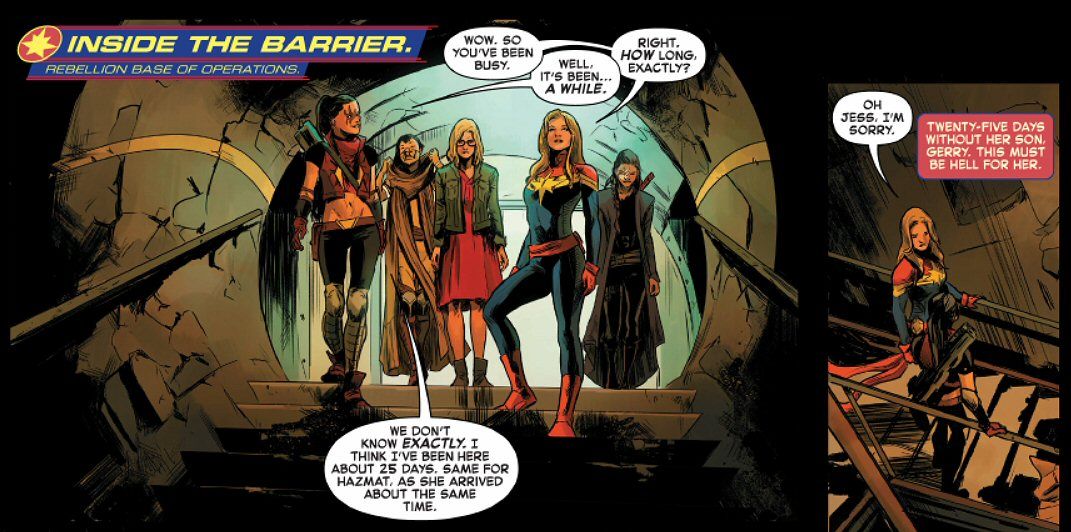
You’ll note that her first concern is how this must be affecting her best friend, who is a mother to an infant child at this point in time.
Carol and her extremely competent colleagues – despite lacking powers – organize the other women into an effective resistance to save the men. Carol must deal with a mind-controlled Rogue (now a hero, but similarly being abused) who is being forced to drain Carol’s powers. Cue creative solutions and teamwork – and an explicit reframing and rehabilitation of Rogue and Carol’s relationship. This story line is an excellent example of how people can come together, against seemingly insurmountable obstacles, to jointly triumph. A great example of positive care ethics in action.
There is a parallel to family dynamics here, where protecting and strengthening interpersonal bonds and connections is the goal (so long as you are being treated in an equally respectful and caring way). Family plays an important role in this extended series, especially in the “Accused” story line (issues #18-21) and the “Last of the Marvels” (issues #32-36) – both of which introduce distinct new “sister” characters for Carol. They are both good story arcs, demonstrating how the family you make can matter as much (or more) than the family you come from.
There’s also a nice one-off issue (#30) with a side story by Jamie McKelvie and Clayton Cowles, where a down-trodden Carol goes to her protégé, Ms. Marvel, looking for validation as to why she is an inspiration. Kamala explains that it is the ripple effect of how Carol’s actions lead others to not only have better outcomes, but want to be better than they were.
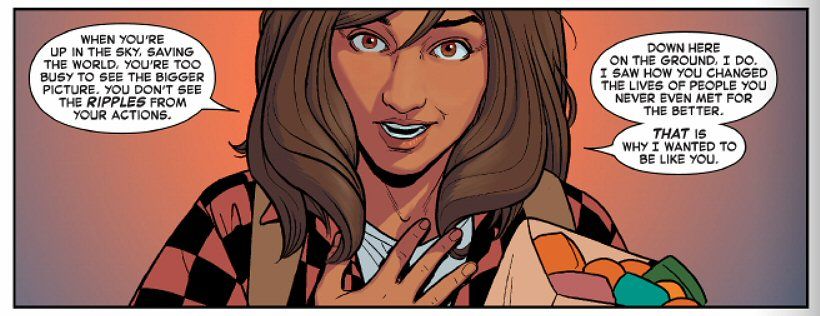
This is also a key aspect of care ethics – and virtue ethics more generally – where it is not just about your effects on others, but how that encourages them to also want to be better or more caring. This growth is a core feature of virtue ethics.
Indeed, Carol’s personal growth is also noted by others in this extended series by Thompson. An inter-linked series of stories that I found very interesting from an ethics perspective were the “The New World”, “Strange Magic” and “Trials” story lines (issues #22-30, 38-41). Carol gets transported into a dystopian future ruled brutally by the love-child of Namor the Sub-Mariner and Amora the Enchantress, named Ove. Both Carol and Ove make it back to our present, and Carol resolves to stop that future from occurring. With help from Doctor Strange, Carol is successful. But in the process commits a “sin” against the magical community (who definitely have a deontological streak, with their focus on the rules of magic).
Carol is subsequently put on “trial” by a magical tribunal for her crime. Interestingly, this trial is to determine if she is “worthy” of being allowed to live, and not just “guilty” (and sadly, involves temporarily erasing her memories and subjecting her to traumatic events, sigh). While a bit over the top, this trial story line is a good philosophical example of an extremely utilitarian way of thinking (which is also common to characters with magical powers). Basically, magic heroes tend to be primarily utilitarian in their ethics (e.g., quite willing to sacrifice some for the greater good of the many), while at the same time upholding a deontological set of rules about magic itself.
This isn’t the first time in the Marvel Universe that a utilitarian “star chamber” has decided to take it upon themselves to determine the fate of others (e.g., the Illuminati, which I will discuss in an upcoming post). The rationale is much the same here – Carol is becoming too powerful, and so a group of self-appointed judges take it upon themselves to determine if her continued survival is for the “greater good” or not. Interestingly, at a minimum they hope that they can “educate” Carol about the risks to the path she is on. And so, a “good outcome” either way in their view – if she is not worthy, they kill her and potentially save the universe, and if she is worthy, they torment her repeatedly to teach her a lesson and potentially save the Universe (!).
Of course, the ethics of this is horrible, and I have a hard time taking it too seriously as a plot point (i.e., it diminishes my view of the magical characters who participate). But it does illustrate the perils of taking utilitarian thinking too far. And I see it as a way of helping to confirm the transition of the Carol Danvers’ Captain Marvel character away from strictly utilitarian thinking to primarily care ethics.
Ultimately, Carol survives and wins the trial by demonstrating that she can change (even with her memories temporarily erased). Whatever the risks with letting her live, her potential for growth – for change – is what defines her character now. And that is very in keeping with a virtue ethics perspective. Like Carol’s advocate in that series, Wanda Maximoff the Scarlet Witch, I rest my … case.
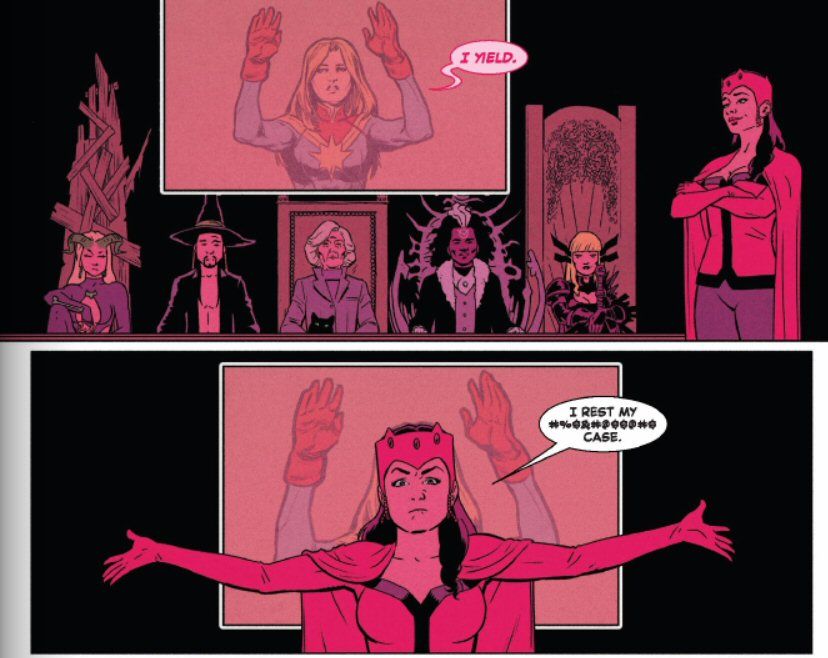
Thompson’s run ends with a soul-searching Carol exploring who and what she has become now. This is summarized for her quite clearly by a projection of Carol’s own subconscious (in the form of her friend and champion, Wanda), in issue #50, 2023, by Thompson, Javier Pina and David López:
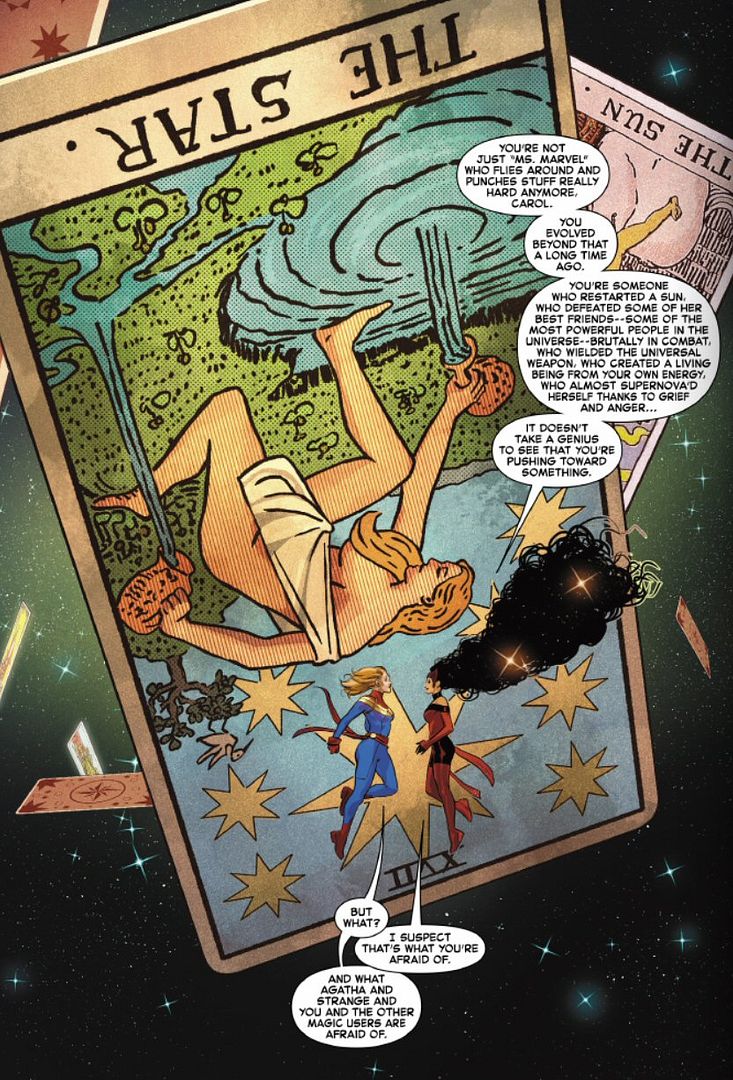
“Wanda” explains that she is not afraid, because she knows Carol’s heart. She knows that Carol with fight for everyone, even when all hope is lost – and that she will die fighting for others.
I will give Thompson the last word here, quoting from what Carol says in the closing panels of that story:
Carol: Avenger. Boss of Space. Higher, further, faster. All that stuff sounds cool, but it’s all just window dressing on what I’m supposed to do … what I’m supposed to BE. So let’s get started.
- Kelly Thompson, Captain Marvel Vol 10, issue #50, 2023
And I can’t think of a clearer statement that Carol has evolved from acting like a utilitarian to primarily being a virtue ethicist.
With those big ethical shoes to fill, Captain Marvel was re-launched with Alyssa Wong as writer (Captain Marvel Vol 11, issues #1-10, 2023-2024). This is another great series, that further expands on the emerging care ethics of Carol (including a new family that basically adopts her).
It doesn’t completely discount her utilitarian tendencies though, as made clear from the opening couple of pages of issue #1, with great art by Jan Bazaldua:
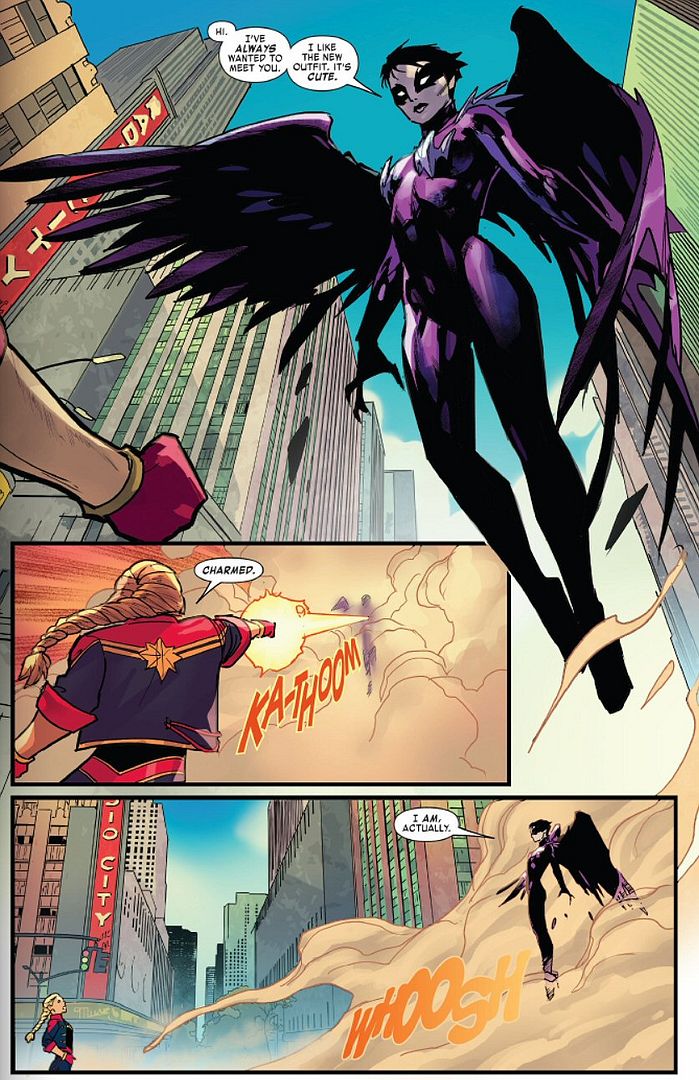
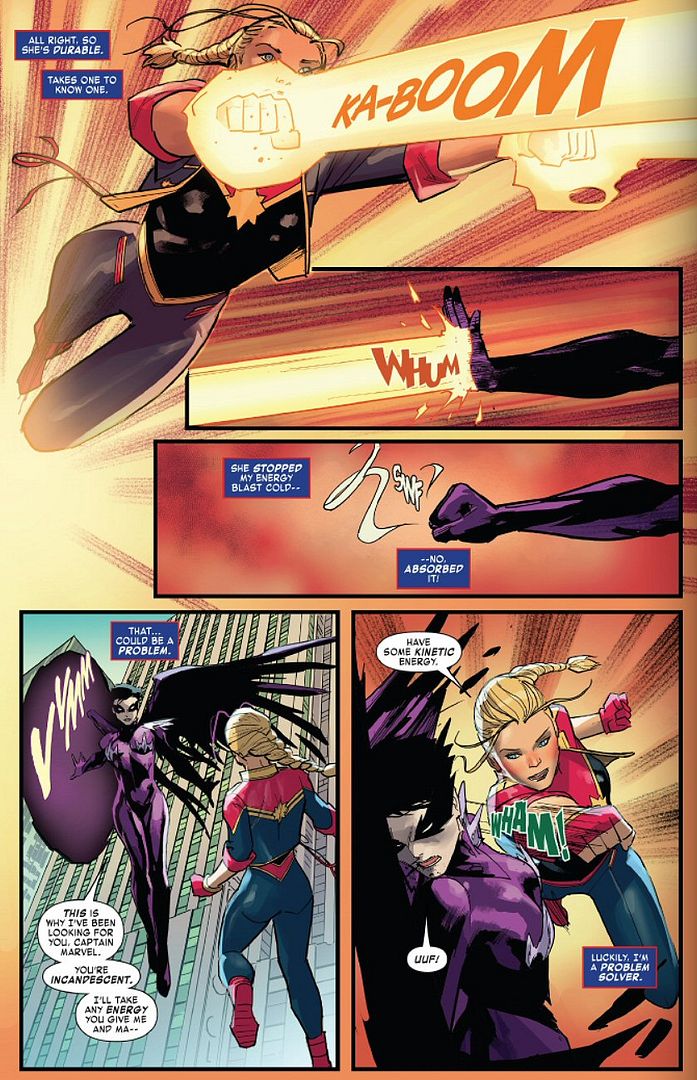
Indeed, Carol’s “problem solver” – aka, utilitarian – tendencies are still on display in the opening of this series. But what you see over the course of the 10 issues is a large commitment to care ethics, including how new people can be brought closer to become part of your “family”.
This series also sees the introduction of a new villain, the Undone, and a great new hero, Yuna Yang (who is quite literally linked to Carol throughout the series). There is some excellent overlap with Jed MacKay‘s current characters on this series (with Black Cat, Doctor Strange and Clea all making appearances), just as Yuna made a guest appearance in MacKay’s Avengers Vol 9 run. Interestingly, I find MacKay espouses a strong care ethics perspective in a lot his writing too, so the connections here make sense. And many of the Kree characters also make an appearance as well, solidifying the extended family theme.
It is also a very action-packed story line, with some interesting elements of body horror in terms of what Carol and colleagues have to face (especially poor Genis-Vell). Distinctive, edgy, and a great addition to the Captain Marvel legacy by Wong. I will definitely be following their work closely from now on.
A.X.E.: Judgment Day
So, how does Carol fare in the A.X.E.: Judgment Day event, the major 2022 Marvel cross-over event created by Kieron Gillen, Valerio Schiti, and Marte Gracia? I have created an introductory post on this event, and plan to conclude it once I have finished profiling the ethics of the major heroes involved.
The premise is that a revived god-like being, a Celestial known as the Progenitor, is deciding the fate of the world by weighing the morality of every Earth being. Although some characters get a single panel or two in the main series, others get their own dedicated issue in their own title – as is the case for Carol in Captain Marvel Vol 10, issue #42, by Kelly Thompson and Andrea Di Vito. And special bonus, Carol’s sister Lauri-Ell and pet cat Chewie get judged as well.
In this issue, the Progenitor is observing them all (appearing as their mother Mari-Ell to Lauri-Ell, as Mar-Vell to Carol, and as Carol’s Captain Marvel to Chewie). While Carol and Mari-Ell try to contain some sort of outbreak among the humans, unknown to them Chewie winds up saving the day using her Flerken teleportation and pocket Universe-swallowing abilities to capture the source of the upheaval.
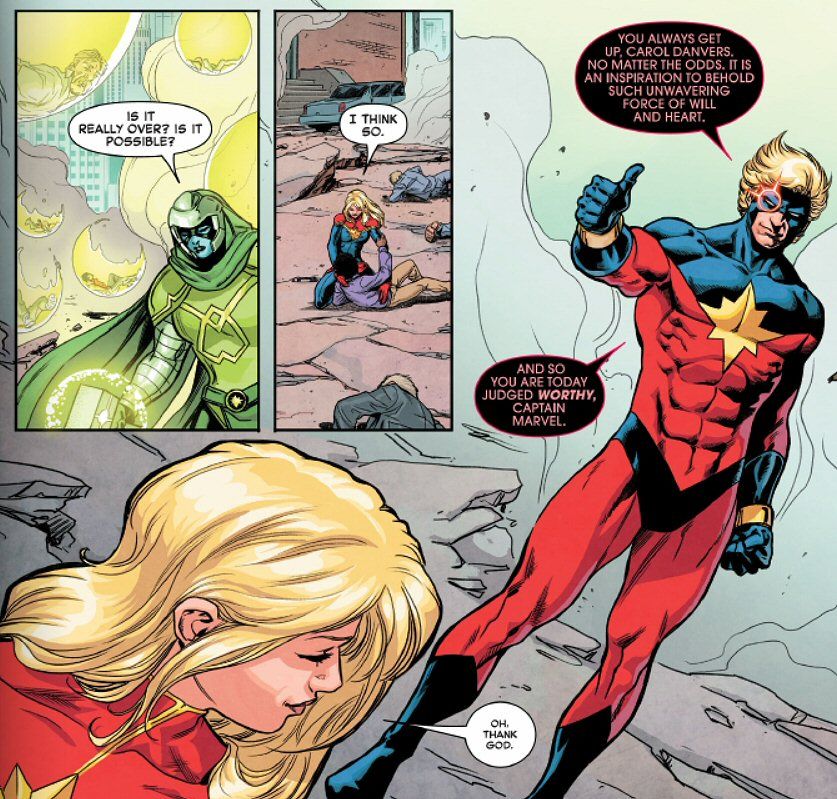
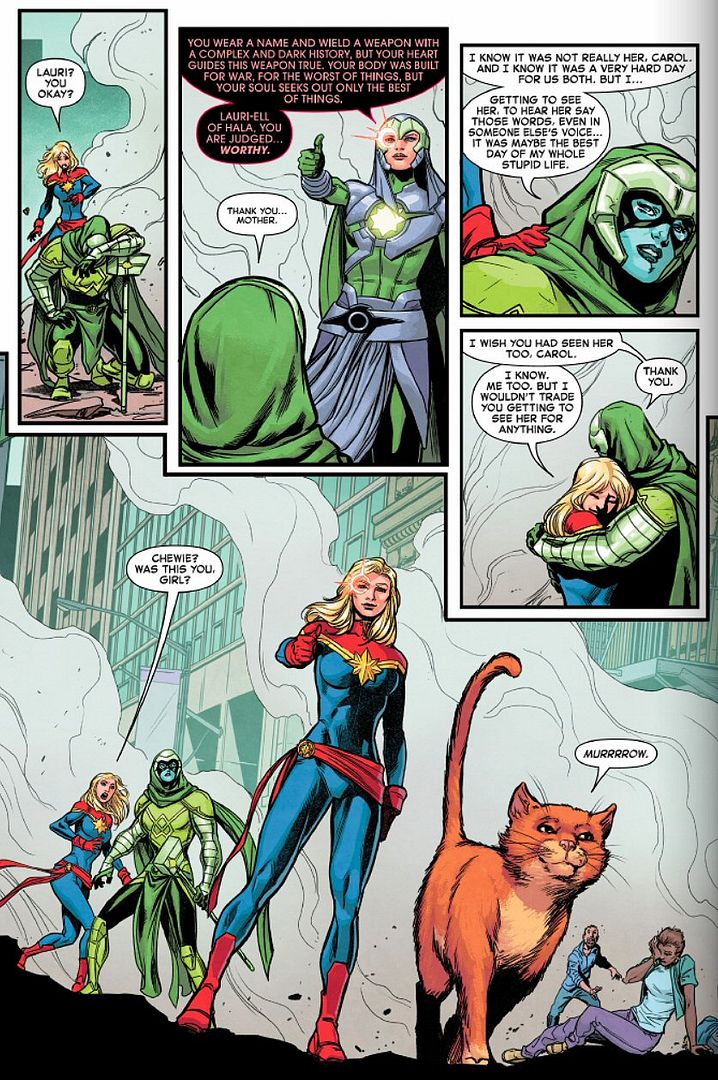
Like with Peter Parker’s Spider-Man, it’s thumbs-up for Carol and Lauri-Ell mainly because of their “heart”, and how they continually seek to overcome their personal histories to seek out the “best” of things. It’s a thumbs-up for Chewie, as well, for reasons unspoken. But I can’t help but note that Chewie has spent the day attending to those in her building in need of aid or comfort (whether she likes them or not). If that isn’t care ethics in action, I don’t know what is!
Not that Chewie seems to care about the Progenitor’s judgement of course … like every cat, Chewie has already judged herself worthy.
Marvel Cinematic (MCU)
The first MCU appearance of Carol Danvers came in the 2019 Captain Marvel movie, staring Brie Larson and based on a screenplay by Anna Boden, Ryan Fleck and Geneva Robertson-Dworet. The film provided a novel origin story for Carol, repurposing many of the original characters, races and motifs from the comics – but fully modernized for the big screen. Carol is suffering from amnesia for much of the film (sadly also a reoccurring motif for the character!), making it hard to discern a consistent ethical framework. But this MCU Captain Marvel, which was in development for quite a few years, seems more consistent with the moral character of Carol from the time before the 2018 origin retcon in the comics (i.e., primarily utilitarian, with secondary classic virtues).
In 2023, Brie Larson’s Captain Marvel returned to the MCU in The Marvels, opposite Monica Rambeau and the current Ms. Marvel Kamala Khan. Screenplay by Nia DaCosta, Megan McDonnell and Elissa Karasik. Here, you see the first indications of Carol developing a care ethics framework, as the reclusive Carol begins to make and seek connection with her fellow heroes. The poor box office performance of this film will likely limit future productions, but I would consider this a positive new direction for the MCU Captain Marvel character, quite consistent with the progression of the character in the comics.
Current ethical framework: V/c (historically, C/v)


Historically, both the comic and MCU Carol Danvers’ Captain Marvel character had a very strong utilitarian (consequentialist) streak, seeking the greatest good of the greatest number. Carol has also expressed certain classic virtues (like courage, justice, compassion, and selflessness), but these were secondary to her main goal of pursuing the best outcomes.
That began to change during the modern era – and certainly over the last 5 years or so in the comics, where Carol now primarily demonstrates a care ethics perspective. Carol prioritizes the quality of relationships – and the responsibilities that come with them – throughout these recent stories. She seems acutely aware of the inter-connectness and interdependence of people, and undertakes her actions with empathy and compassion for those who are suffering – including, most significantly, those who have wronged her. Carol’s commitment to change and personal growth, and the recognition that she is becoming something more – being more – is integral to why I see her as increasingly demonstrating a primarily care ethics (virtue ethics) core.
And so, a V/c currently on my superhero description system (historically, the reverse C/v would have been true).
Again, the purpose of this site is not to provide a definitive normative ethics framework for each character – that is impossible, given all the creative hands each character has passed through. My goal on these background pages is to provide a sufficient overview of the main ethical drives for the character over time. This is to help prepare for upcoming posts where I will examine specific comic stories in more detail, to show how they illustrate key normative ethics theories.
The last word
Wong’s recent Captain Marvel Vol 11 series ended on an interesting note. Carol and Yuna managed to jointly save the day – and rescue or restore everyone affected by the Undone. But one of Carol’s close comrades (Genis-Vell) is unable to accept the cost of what has been done to him. Despite the best of intentions – and the desire to bring those close to you even closer – not everyone in a relationship with you will agree with your actions. And so, it is not a uniformly happy ending. But it is important to celebrate the wins you have, as is demonstrated in many of the final panels from issue #10, 2024, by Wong, Ruairí Coleman and Roberto Poggi:
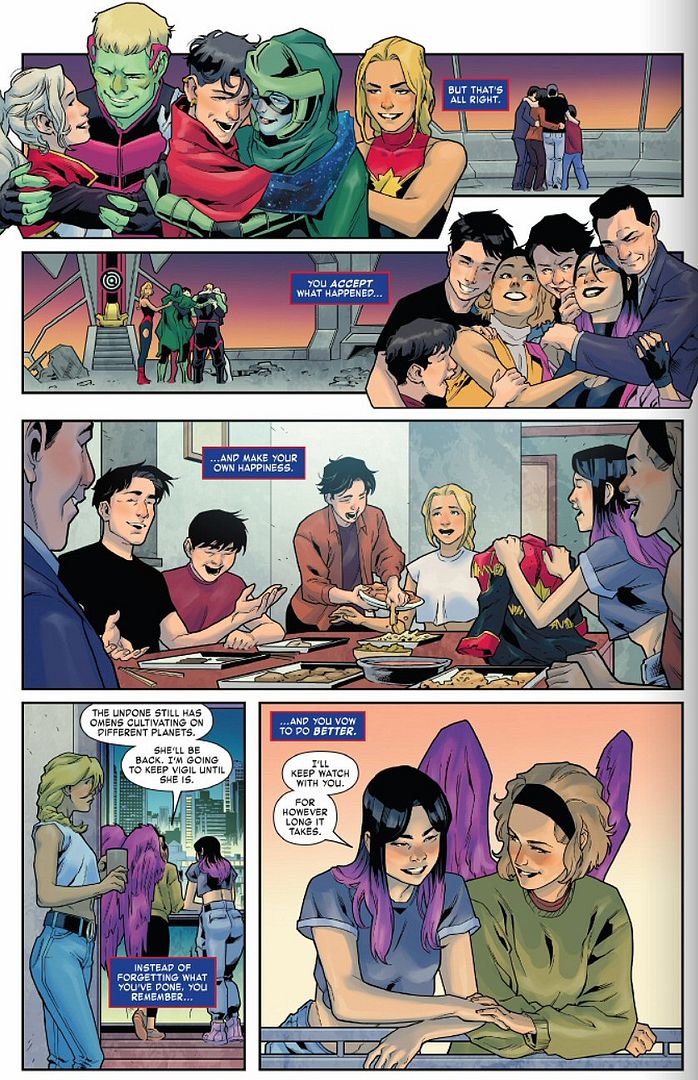
I find this nicely book-ends the opening 2019 quote from Thompson’s Vol 10 at the start of this page.
I really like the way these Thompson and Wong comics show a positive progression of a utilitarian hero into a modern care ethicist – kudos to all the creative teams involved.
See my Glossary post for a list of the key philosophical concepts and related links on this site.
Further Reading
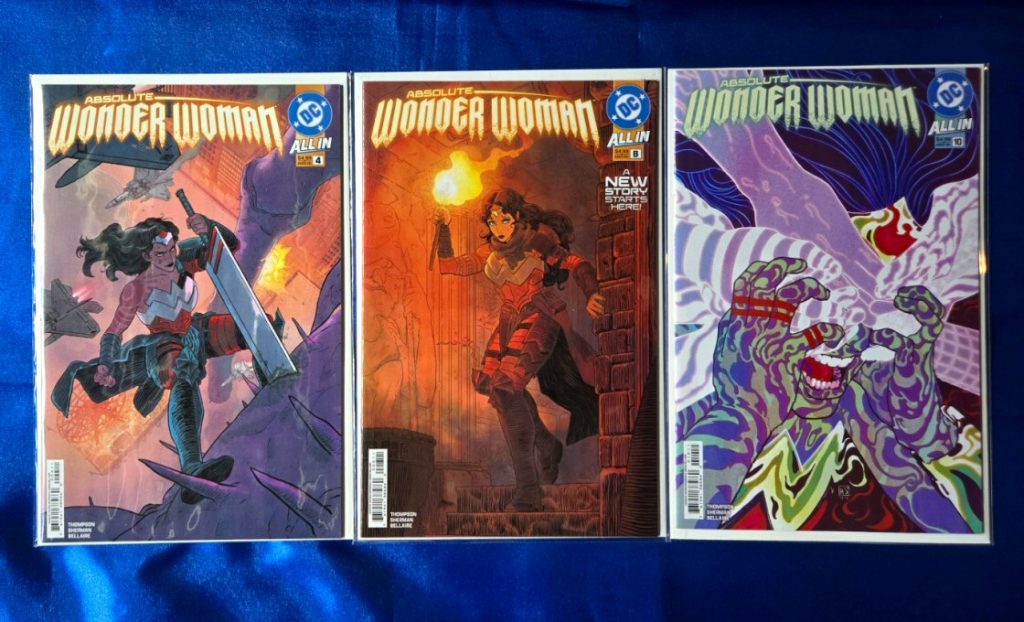
For more Kelly Thompson: Absolute Wonder Woman

For more Kelly Sue DeConnick: FML comix
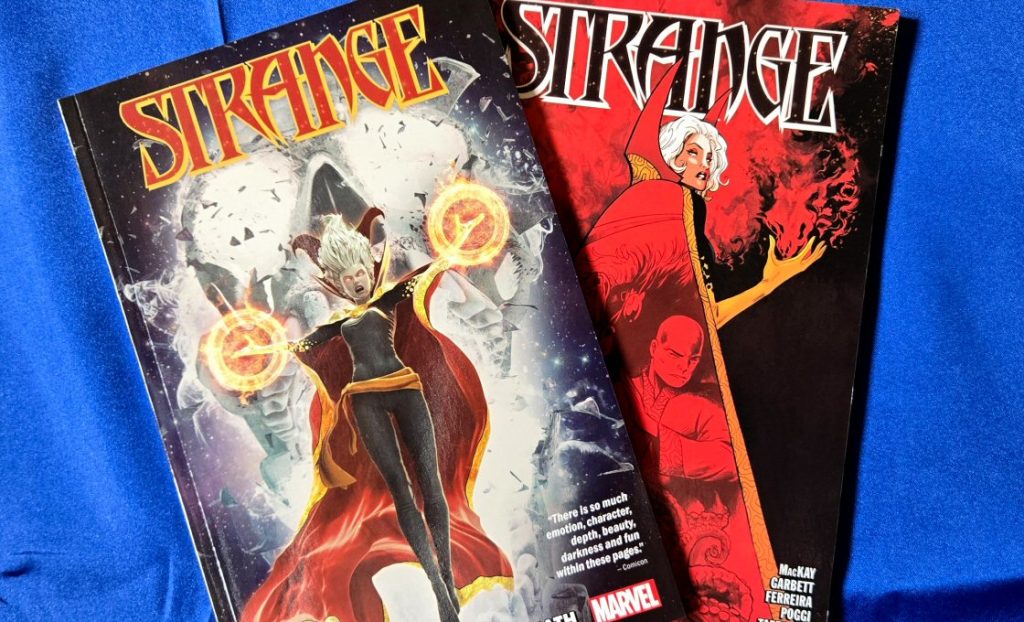
For more care ethics: Clea
Wow, what a great overview of Carol’s moral character. I was looking online for some background material on Captain Marvel, and was finding commentaries that she isn’t even a hero. And than I came here and found everything i could want, and more! What an incredible resource, very helpful (and well organized!).