

I thought I would provide here a quick “snapshot” overview of the ethics of many of the key mutant characters in the X-Men stories. I have already expanded some of these into stand-alone posts – and may do more in the future – but this should serve as helpful background for some of my upcoming commentaries (especially the conclusion to the A.X.E.: Judgment Day event). I’ve split these mini-overviews across two posts for space (A-Ma here, Mi-Z posted here), by either superhero name or by first name, following the current Marvel Unlimited nomenclature for which name is commonly used to identify the character. These profiles reflect the apparent character ethics as of 2025 – I will mark any updates as they come.
As always, please see my Ethics 101 page for a description of my Superhero normative ethics rating scales, and an explanation of normative ethics terms. And see my Glossary post for a list of the key philosophical concepts and related links on this site.
X-Men/Mutants – A through Ma
I have previously provided an Introductory overview of the ethics of the X-Men (and mutants more generally) in the Marvel Universe. There, I tried to show not only how character’s normative ethics can change with time, but how modern writers can take a wholesale different view of ethics than earlier ones. This is in keeping with the evolution of ethics thinking over time (including in terms of human rights, for example), and the changing Zeitgeist of people living through different time periods (with the advent of modern care ethics as an example).
I have also explored in detail two long-running X-Men characters, Professor X (Charles Xavier) and Magneto (known as Magnus, Erik, or Max depending on the time periods) in stand-alone posts. Both have seen considerable ethics changes over time, but often with cycles of redemption and reversion. In the case of Charles Xavier, the complexity and contradiction of his ethical drives resulted in a second post, where I discussed his potential redemption (and the unique challenges faced by utilitarians).
I’m also looking forward to wrapping up my discussion of Kieron Gillen‘s ethics-heavy (and excellent) 2022 cross-over event, A.X.E.: Judgment Day (introduced here).
Brief Background
Originally created by Stan Lee and Jack Kirby in 1963, the X-Men were a team of “mutant” superheroes (i.e., super-powered beings whose powers come from spontaneous genetic mutations). These differed from the other superheroes of the time, whose powers were usually obtained by exposure to environment effects (often radiation), or through technology.
The inital rise in popularity of these mutant superheroes can be attributed mainly to two key Marvel creators from the 1970s and 80s – John Byrne and Chris Claremont. Claremont in particular had a record long run writing X-Men (1975 to 1991), and introduced a lot of more complex themes into the stories. Subsequently, pretty much all the major talent at Marvel has had a chance to pen X-Men stories. At the present time (summer 2025), roughly half the ongoing Marvel comic titles feature X-Men/mutant characters.
Beast (Hank McCoy) Ethics: C/d
A frequent member of the X-Men, Beast is a scientist with a genius-level IQ, endowed with superhuman strength, agility, and dexterity along with enhanced regenerative and sensory abilities. See detailed character history here.
A.X.E. event Progenitor judgment: Unknown.

In writing these summaries, I am often balancing the historical weight of the character against modern story lines (which can sometimes take the character in a different ethical direction). Hank McCoy’s Beast is a unique case: the character I knew from the early 1980s – a highly intelligent and thoughtful soul – eventually turned into a mad villain in the modern comics, dying in 2024. But he was replaced by a clone with memories that were last “backed up” in the mid-80s. So, effectively, Beast has been “restored” to the character I knew from my adolescent comic collecting.
Like many highly-intelligent characters in the comics (and in fiction more generally), Hank’s primary ethical drive seems very utilitarian – focusing on the greatest good for the greatest number. As a classic X-Man, he frequently prioritized protecting both mutant and human lives. As a scientist, he actively sought solutions that benefited society in general (such as developing cures for both human and mutant illnesses). In my earlier time reading X-Men comics, he seemed to believe deeply in the inherent value of all life, and the importance of treating others with respect. This focus on the rights of others – and his own duty – suggests a strong secondary deontological ethical drive.
Where the original Hank seems to have gone off the rails was in pursuit of his scientific goals – increasingly denying the rights of others in medical experiments in pursuit of the “greater good”. In this sense, he mirrors the earlier abuses of utilitarian medical research that led to the rise of applied bioethics in the 1960s and 1970s.The “rebooted” cloned Hank is very concerned about what happened to his original self, suggesting he (hopefully) won’t be following down the path that led his original self astray. So I think the original consequentialist/deontology (C/d) ethical rating should persist.
Check out Alex Paknadel‘s excellent X-Men From the Ashes Infinity comic from earlier this year, specifically issues #15-18, which focused on Hank’s current struggles. Here some panels from the end of issue #18, with art by Phillip Sevy:
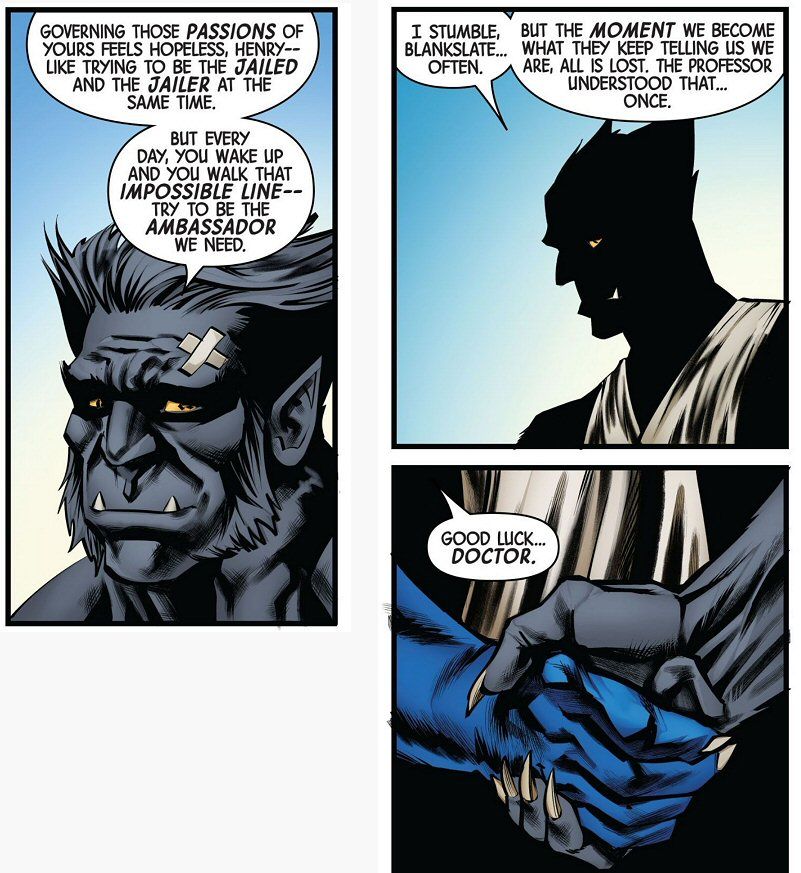
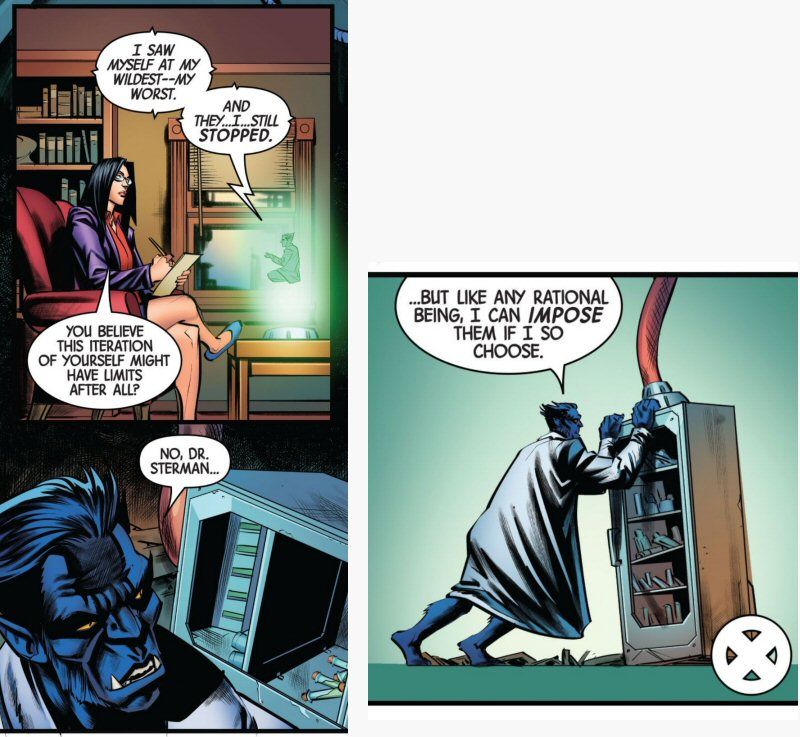
Jed MacKay‘s ongoing X-Men Vol 7 series is another one to watch for the evolution of Hank’s character.
Charles Xavier (aka Professor X) Ethics: C (historically C/d)
Founder of the X-Men, considered to be a genius and the greatest telepath on Earth, with extensive psionic powers. See detailed character history here.
A.X.E. event Progenitor judgment: Failed.

I’ve provided two detailed posts on Charles Xavier – an introductory post looking at his ethical makeup in detail, and a follow-up post exploring the unique challenges with his ethics and a possible path to redemption.
To summarize briefly, he was originally conceived to be predominantly a deontological character (in the 1960s stories). Charles’ moral philosophy initially focused on duty, working to protect mutants and promote peaceful coexistence with humans – his “dream” (and moral imperative). In both his own behavior and in his training of mutant students, he demonstrated the need to follow strict ethical rules and principles, always prioritizing the right action. In those early stories he was seen as the polar opposite of Magneto – who was initially written as a villain with extremely consequentialist morals, prioritizing the greater good for mutants no matter the consequences to humans.
However, it was never that simple. Fundamentally, Charles’ dream of peaceful coexistence and mutual understanding between mutants and humans is also utilitarian, as it promotes the greatest good for the greatest number. His constant efforts to thwart Magneto’s more militant approaches also aligns with utilitarian principles (e.g., creating what were effectively children’s armies – the X-Men, the New Mutants – to fight against threats to his dream). By my time reading comics in the early 1980s, I increasingly found that Charles would engage in unethical behavior – by rule-and duty-based deontological standards – in order to achieve what he saw as the best outcome (although he would feel guilty about it afterwards). Indeed, as time went on, I found his moral compass to be increasingly suspect, as his utilitarian tendencies didn’t seem to actually lead to better outcomes most of the time.
Upon my return to comic books in the modern era, I was surprised to see the scale and level of his betrayal of his core principles. Reading back over 20 years, I found his constant scheming and manipulating of others – often on a grand scale – revealed he was now exclusively utilitarian in his decision making, and completely removed from any restraining rules or respect of other’s rights. In the last few years of the comics, there are increasing numbers of his own comrades who see him as a fallen character (or at a minimum, someone who has to be restrained/stopped). This is in contrast to Magneto, who has grown more heroic as Charles has grown more unpredictable.
Kieron Gillen wrote him very well, as shown by some key observations (from Charles’ perspective, narrating below), in Immortal X-Men Vol 1, issue #10, with art by Lucas Werneck. In the first set of panels below, Charles illustrates what would have happened if Magneto had had his telepathic gifts instead of him:
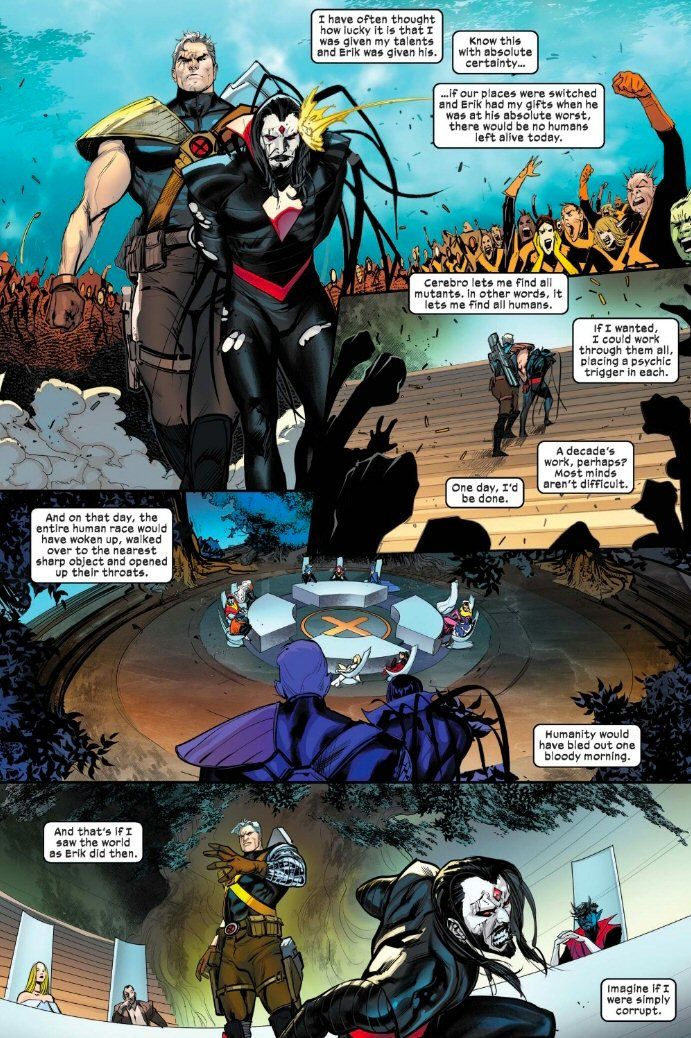
Gillen’s Charles is not trying to reassure the reader – he wants you to be worried. And if you don’t find the above distressing enough, consider this:
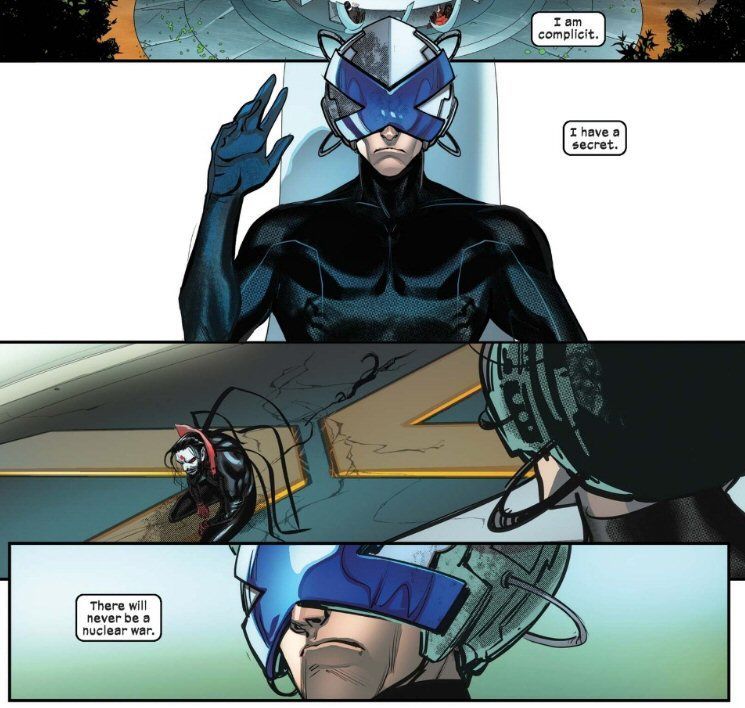
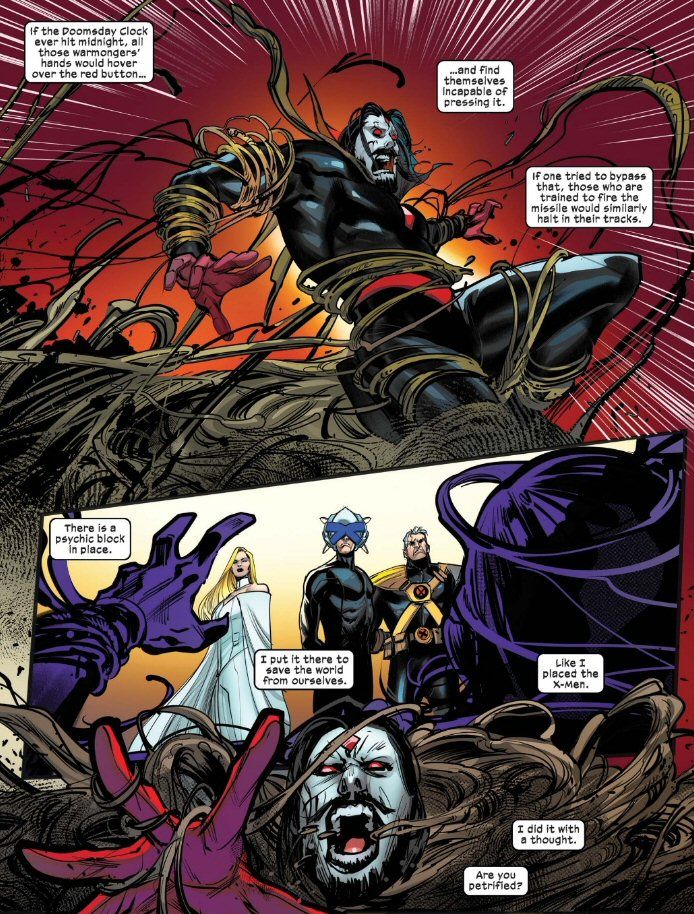
I’m surprised no one ever worked this out before. Given Charles’ conversion to extreme utilitarianism in the modern comics, this conclusion seems only logical. And utilitarianism is nothing if not logical. Charles is not going to stand by and let the entire world (including himself and his beloved mutants) be destroyed when he could easily stop it, right? So what if it means removing other people’s agency and autonomy – and hiding that fact from them and others – if it brings about the greatest good? As an aside, Charles is revealed to be under Sinister’s influence at this point in time, but that doesn’t distract from the truth of what he is revealing here – and this is why I argue that a telepath should never be a utilitarian.
This insight by Gillen is the starting point for his current The Power Fantasy comic series, at Image Comics. Although ongoing, I plan to review that series soon, as it has a lot of interesting ethical reasoning to chew over. (UPDATE: My Introduction to the TPF is now up)
As for Charles, I feel it is necessary to classify him now as exclusively a consequentialist (utilitarian). Indeed, he has become quite admittedly Machiavellian by the end of the Fall of X/Rise of the Powers of X in 2024. The attempt to redeem him in the current From the Ashes Age doesn’t work from my perspective (follow that link for a discussion). But of course, this being the comics, he may find his way back to his earlier principles. Still, for the time being, I think the C designation fits best.
Cyclops (Scott Summers) Ethics: C/d
An original member and frequent leader of the X-Men, Cyclops has the ability to fire powerful optic beams from his eyes. See detailed character history here.
A.X.E. event Progenitor judgment: Passed.

As the first member (and subsequent leader) of the X-Men, Scott Summers’ ethical framework was very much in line with Professor X (Charles Xavier) – at least initially. In the early stories, Scott was very deontological – he operated within a strict set of universal moral rules and principles. Scott enforced the Professor’s code of conduct on his teammates, upholding all their principles even when it was difficult or unpopular (which it frequently was!). He felt a strong sense of duty to protect his teammates and had a strict prohibition against killing, willing to risk his own life to save others. And he demonstrated a lot self-discipline and took responsibility for himself and the team.
But as a tactician, Scott also demonstrated utilitarian aspects – especially in outcomes that might deviate from a strict deontological application of rules. He often sought to minimize adverse events from his or the team’s actions, showing strong consequentialist leanings early on. As time went on, Scott became increasingly utilitarian, sometimes finding himself more aligned with Magneto than Charles (by the end of the 20th century in the comics). He has had a rough few decades in the comics, often being laid low – but always bouncing back. Scott has frequently led the X-Men over the many years, and is currently leading one of the three main X-Men titles (Jed MacKay‘s X-Men Vol 7, 2024 to present). MacKay has done a good job restoring the key strengths of the character. I would peg him as a C/d, given his strong primary consequentialist focus, but with an underlying deontological duty streak.
As an example, I particularly like the “pep talk” Magneto gives him in a flashback scene of issue #7 – getting him to snap out of his funk, and return to being the Cyclops they need (with art by Netho Diaz and Sean Parsons). This clearly shows that MacKay sees Scott as having a “mission” – which could be used in a deontological sense, but from the context of the discussion is clearly meant in a consequentialist one. In other words, there is an outcome Scott is trying to achieve.
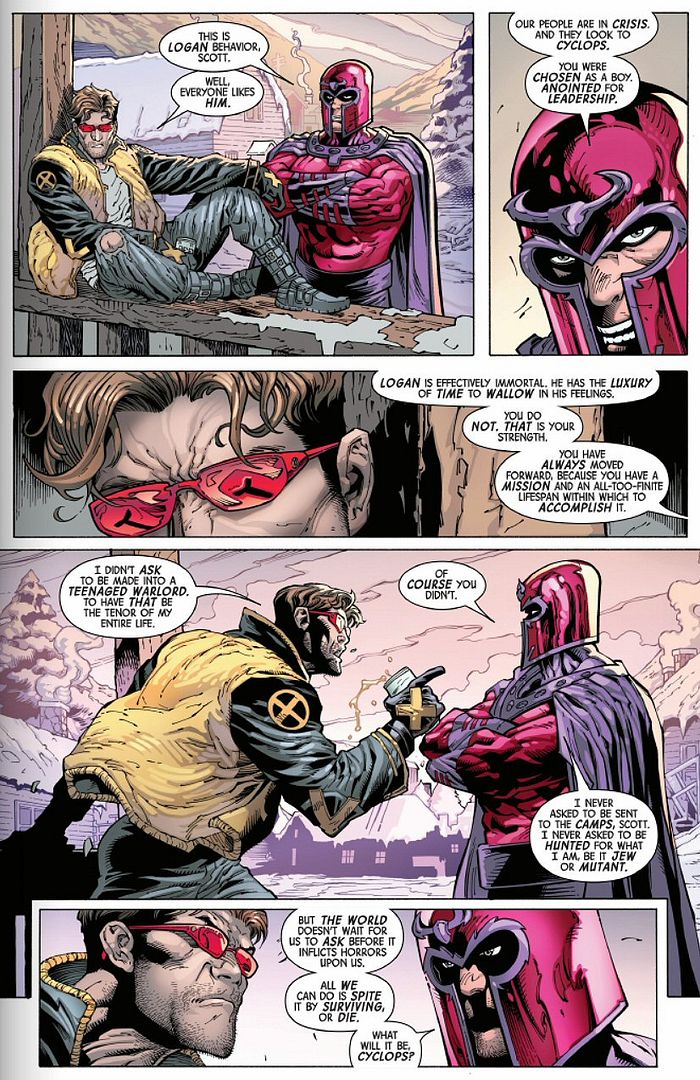
Well said!
Destiny (Irene Adler) Ethics: C
Desinty’s mutant power is precognition – described in the comics as the ability to see all possible futures in a probabilistic way. She is also legally blind, but her ability to accurately predict the immediate near future allows her to move through the world well. See detailed character history here.
A.X.E. event Progenitor judgment: Failed.

As a neuroscientist (and compatibilist), I find it hard to take Irene’s mutant power of precognition seriously (see my discussion in the Vision about free will and determinism). I appreciate the modern attempt to make her abilities seem more scientific by making them explicitly probabilistic (and based on chaos theory). But critically, those are both still deterministic (just not predictably so in advance), as is the apparent Universe we live in. But let’s take it at face value for the sake of the comic stories (which tend to take a libertarian view for narrative reasons).
Like her lover Mystique, Irene is quite long lived – her origins date back to the mid 19th century. Fans of the Sherlock Holmes stories by Sir Arthur Conan Doyle are bound to recognize her name – Irene Adler was the closest Sherlock ever came to a love interest. It was eventually established in the Marvel Universe that Mystique assumed the identity of Sherlock Holmes (with Irene serving as a Dr Watson of sorts), and that she and Irene befriended Conan Doyle and served as the inspiration for his stories.
The normative ethics of a true precog would seem to be irrelevant, as everything would appear to be predetermined. And knowing the future in this way would likely bring about a sense of extreme nihilism. But that is not how it works for Irene – she sees overlapping potential futures, of various degrees of probability. Her actions can apparently influence these outcomes, by tipping the balances (“There is no destiny”, as Irene frequently likes to say). But it is not easy, and Irene is typically very frustrated in the stories by her repeated failures. Talk about a burden – to know the future isn’t set in stone, but to rarely succeed in having an impact (and then, only at great personal cost).
This effectively turns Irene into a frustrated utilitarian and longtermist, a lot like Charles Xavier. And also like Charles, her consequentialist actions to change the future degrades her personal virtue. This robs her of her own personal moral outlook, making her a slave to her own machinations to help achieve the “best” outcomes. Effectively, this is why the Progenitor failed her, in Immortal X-Men Vol 1, issue #6, by Kieron Gillen and Lucas Werneck:
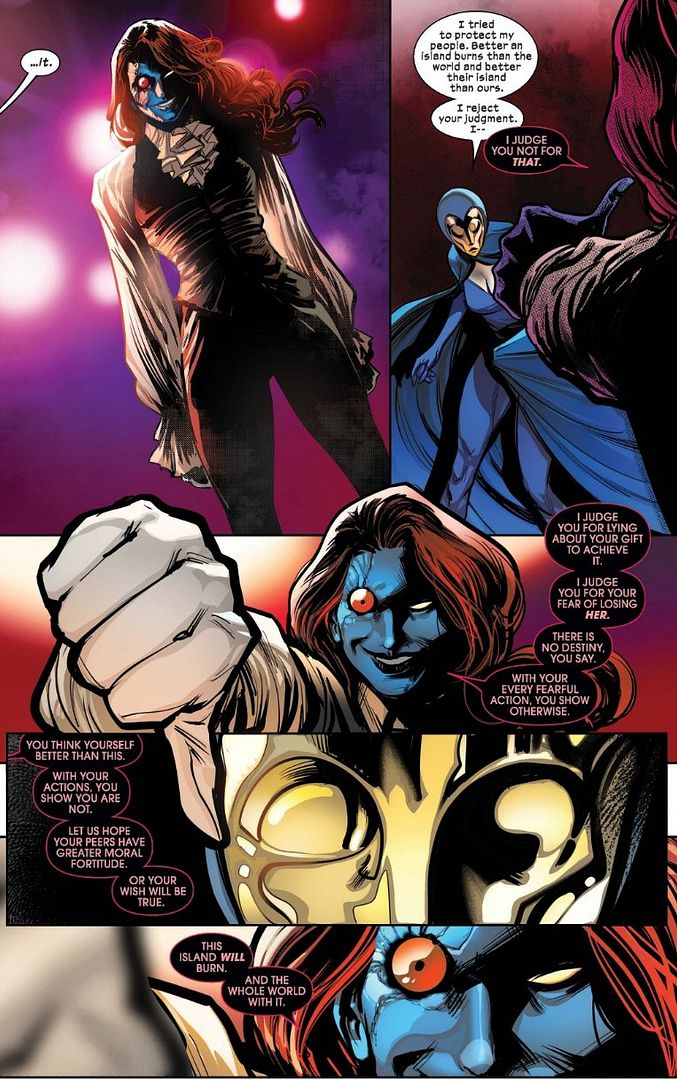
As an aside, Destiny and Mystique were the first same-sex couple created in the Marvel Universe (by Chris Claremont, in 1980). But their relationship had to be obscured with code phrasing for many years, until the Comics Code Authority (with its archaic ban on homosexuality) was eventually abandoned.
Emma Frost Ethics: C
Emma is an Omega-level telepath, on par with Charles Xavier. She is particularly adapt at providing protective psychic shields, and in projecting illusions. She has acquired a secondary mutation allowing her to turn into a nearly impervious flexible diamond form. See detailed character history here.
A.X.E. event Progenitor judgment: Failed.

Emma is one of the most “morally flexible” of all the X-Men/mutant superheroes. Indeed, she started out as a villain, became more of an anti-hero, and is now fairly consistently considered a hero – although with some sharp edges. She is a quintessentially pragmatic character, doing whatever it takes to achieve her goals – which are primarily protective and defensive of mutantkind. But she has often adapted her morality and tactics based on the circumstances (and her shifting alliances).
I would describe her primary ethics as consequentialist (utilitarian) – but for mutants preferentially. While not openly hostile to humans, she is often driven by fear or concern of what humans will do to mutants. She sometimes makes decisions that could be harmful to a few humans if it benefits mutantdom as a whole (although she always stops short of seriously harming anyone). She doesn’t consistently do this though – at times, in the hands of some creators, she has shown a preference for maintaining the delicate balance between humans and mutants. As such, there are times when she makes decisions that seem more fully utilitarian, benefiting both the human and mutant populations.
This morally ambiguity can make her an inconsistent character. But in the right hands, this can actually make her quite a compelling character. Consistent with her ethics, she is quite clever and sophisticated in her reasoning and actions – including being manipulative. But she does this with a lot of humor, including self-deprecating humor, suggesting a high degree of self-awareness. She also has a definitely vampy attitude, consistent with her risque wardrobe choices (I once heard her described as exhibiting sex positivity before that was even a thing). Unfortunately, she often doesn’t get the respect her abilities and drive deserve, with many Marvel characters over the years making disparaging remarks at her expense.
One of the defining aspects of her personality is her desire to educate and empower the next generation of young mutants. She has frequently taken on a headmistress role, and her catchphrase could easily be “consider the children”. Again, she is often mocked for this as well by some of the other characters, but it is her most noble characteristic – it shows a sense of hope for the future. Kieron Gillen wrote her well in my view, from his Immortal X-Men Vol 1, issue #4, 2022, with art by Michele Bandini:
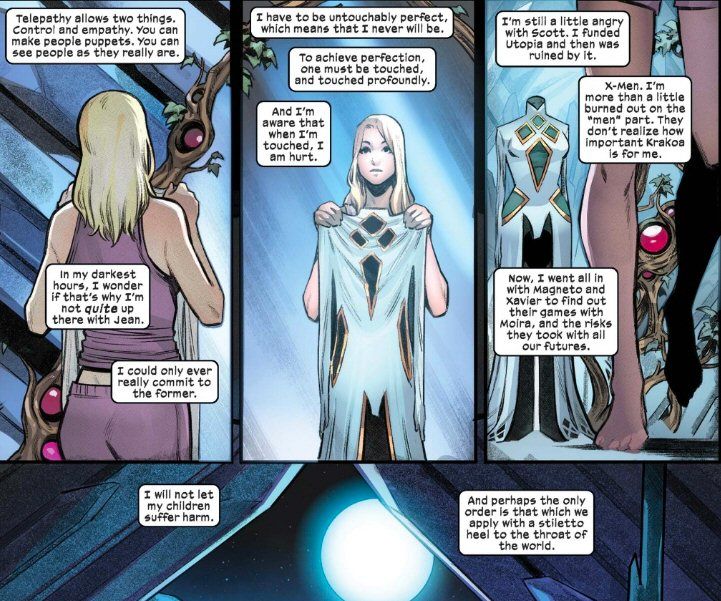
This passage shows how Emma is very hard on herself. It also explores a key point about telepathy – it could be used as a way to increase empathy for others. The fact that it rarely is in the comics is not Emma’s fault, but she is one of the few to admit to it.
In this regard, the Progenitor’s failing judgment of Emma in Gillen’s A.X.E.: Judgment Day event is interesting (as is how the Progenitor appeared to her specifically). From Immortal X-Men Vol 1, issue #6, 2022, by Kieron Gillen and Lucas Werneck:
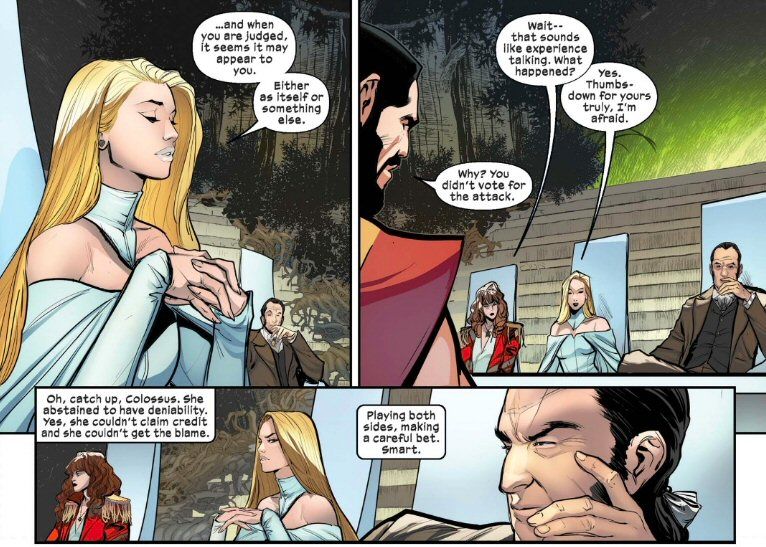
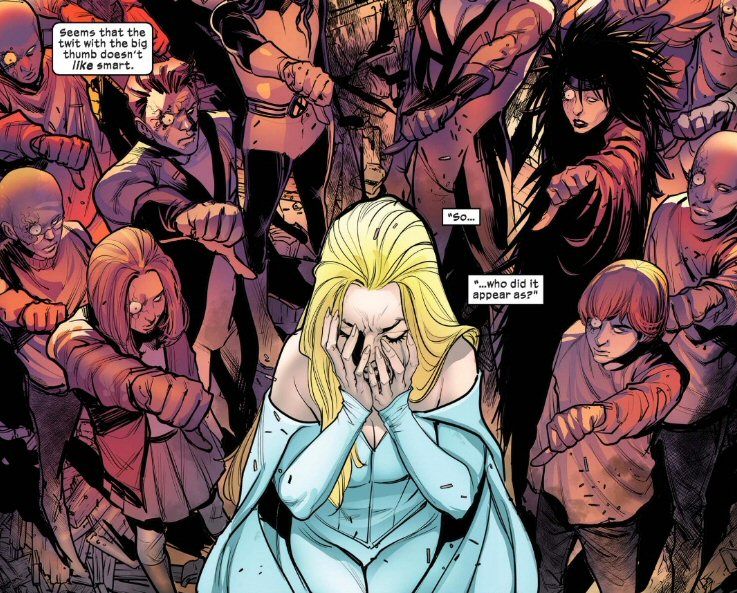
That seems a little harsh, as Emma has genuinely striven to do right by the mutant children – for their own sake, not hers. But her self-doubt – and repeated failures in this regard – appear to be enough to give her the thumb’s down. As an aside, it is interesting that Sebastian Shaw is the one to narrate this sequence, given his own judgment later in this issue. I will be exploring this further in upcoming A.X.E.: Judgment Day summaries.
Personally, I was glad to see Emma have a leadership role with Kitty (Kate) Pryde in the Exceptional X-Men series, written by Professor Eve L. Ewing. The care ethics perspective Ewing brings to a lot of her characters could fit well with Emma, I’m curious to see how it develops.
Exodus (Bennet du Paris) Ethics: D/v
Bennett is an Omega-level mutant with a wide range of psionic powers, including telepathy, telekinesis, and teleportation. He is also able to transfer psionic energy to and from others, and has a unique faith empowerment ability (he grows strong when others believe in him). See detailed character history here.
A.X.E. event Progenitor judgment: Passed.

Bennet was a 12th century French nobleman turned Crusader. Specifically, he was one of the Knights Templar, a religious and military order who safeguarded pilgrims to the Holy Land. On one of his journeys, his mutant powers manifested, and were enhanced by Apocalypse. Named Exodus, Bennet soon betrayed his mutant master and was put into a coma and entombed for centuries. He was eventually awoken by Magneto, and served as Magneto’s right hand for a period of time. He eventually broke with Magneto and went his own way.
Bennet is a challenging character to profile from a normative ethics perspective, as he exhibits aspects of all three ethics theories to varying degrees, depending on the writer. I first saw him as very deontological, transferring his adherence to Christian religious rules and duties to a new “holy mission” to protect and promote mutantkind. His ability to psychically draw on others faith in him – or transfer his powers to them – fits with his prioritizing the collective over individual interests. But the source of his mutant-based duty is unclear, despite his continued use of religious symbolism and thinking in justifying his actions (i.e., is he acting on the word of God, or his own judgment now?).
Over time, Bennet seemed to become more consequentialist in his thinking, especially when adopting Magneto’s mutant exceptionalism. Again, he certainly prioritizes the group over any individual – although it is unclear if he is actually using consequentialist principles. Note that there are modern consequentialist theories derived from Christian teachings, but I don’t ever see Bennet espouse any of these (it would be interesting if he did, but that’s a topic for another post).
Bennet could also be read as someone striving towards specific virtues he feels are important for the survival of mutants. He follows a warrior’s path, which is often associated with either a deontological or a virtue ethics perspective. He is certainly loyal, faithful, determined, and unwavering in his commitment to the mutant cause. But it is unclear what virtue ethics framework he is using, and his personal values rarely find a match with the other mutants he is working with or protecting.
One thing is is clear – in keeping with his origins, he sees himself as a holy warrior, on a holy mission to save his “mutant church”. Kieron Gillen captured this well, explaining how he sees every battle; from Immortal X-Men Vol 1, issue #5, 2022, by Gillen and Michele Bandini (I love how the classic Templar uniform has a X instead of a cross):
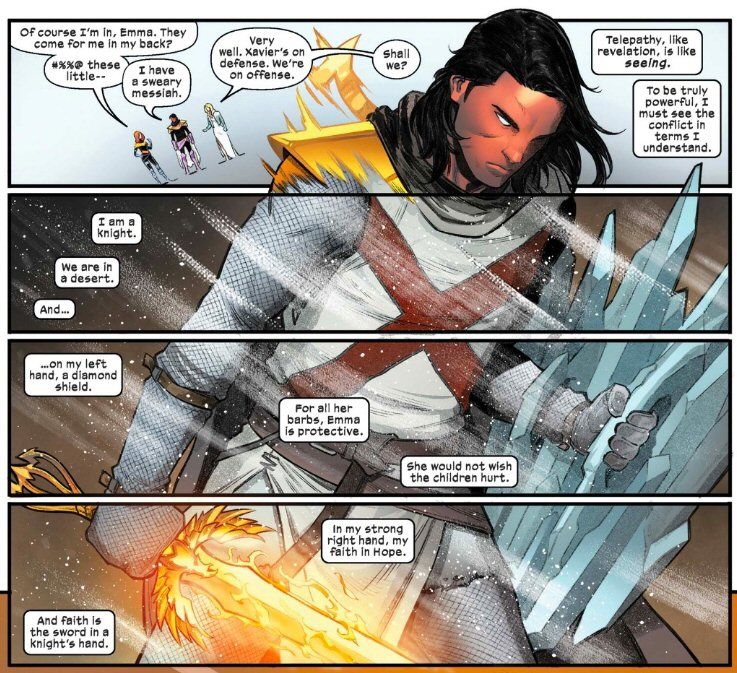
Bennet sees everything in terms of his faith and his mission – subtlety is not in his playbook. Note that he sees Hope Summers as the Messiah to his mutant faith, and so prioritizes her over everything else. From later that same issue, when the Eternals unleash there most massive elements against Krakoa:
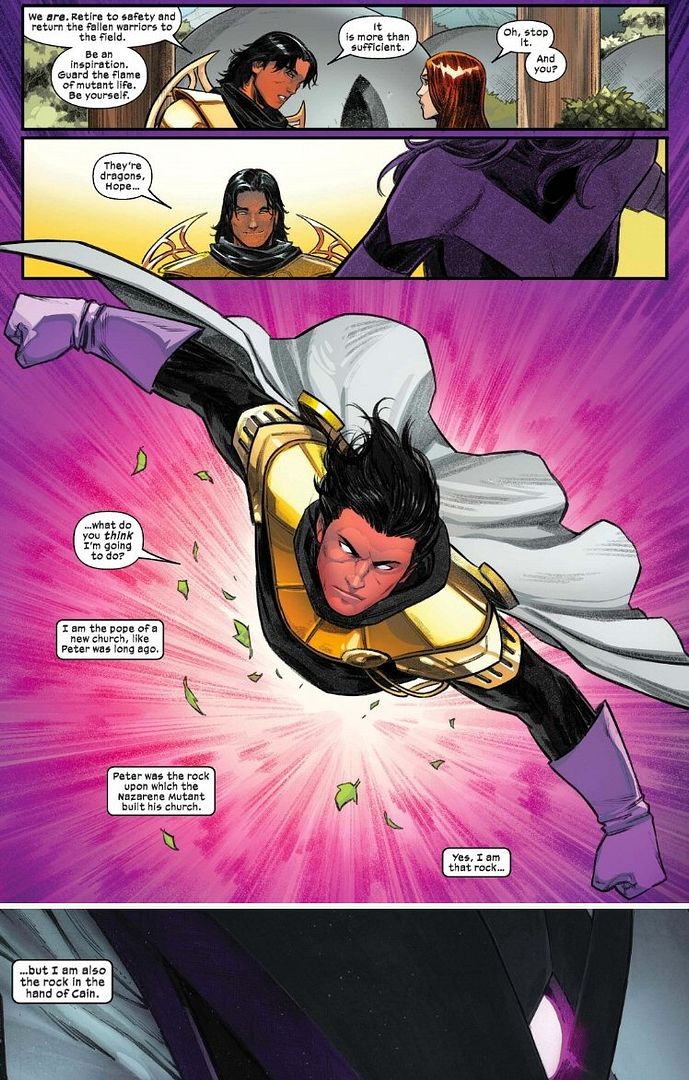
Yes, he very much sees himself as a rock in both senses – an unwavering beacon of mutant integrity, and a weapon to keep them safe at any cost. His relative lack of self-reflection (and self-doubt) argues against a primary virtue ethics framing in my view. He is hyper-intense and doggedly unrelenting, which is better in keeping with a deontological primary ethics core. I would tentatively assign him a D rating, recognizing it very much changes in the hands of different writers.
His judgment at the hands of the Progenitor fits this complicated set of ethics. I love the narration by the extremely cynical Sebastian Shaw in Immortal X-Men Vol 1, issue #6, 2022, by Gillen and Lucas Werneck. Here we see the challenge the Progenitor sets for Bennet, by condemning his former best friend Garrington to Hell – but Bennet struggles to find a solution that saves everyone:
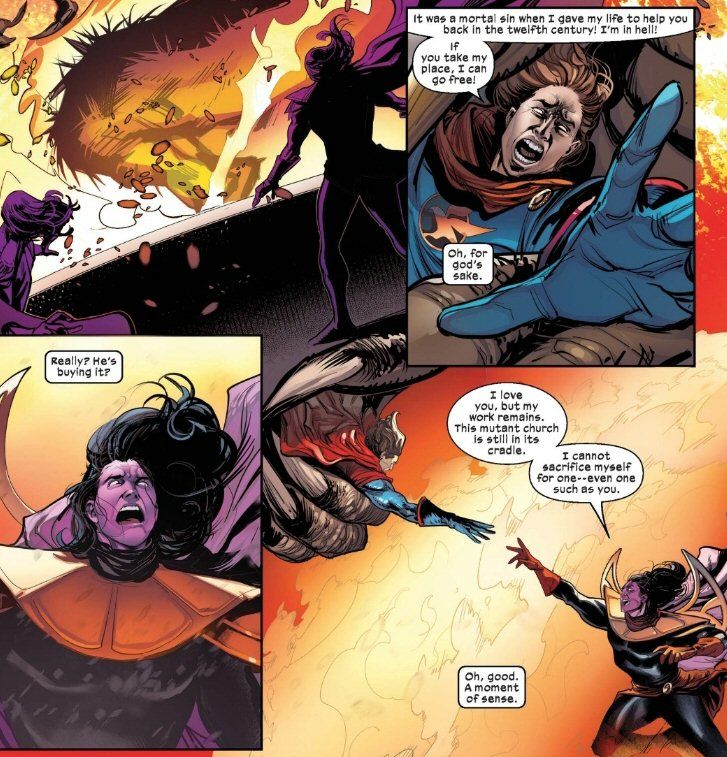
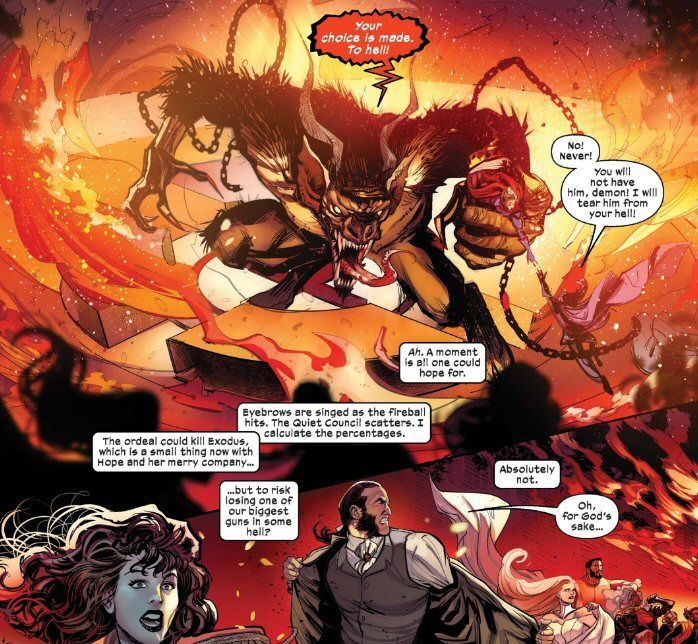
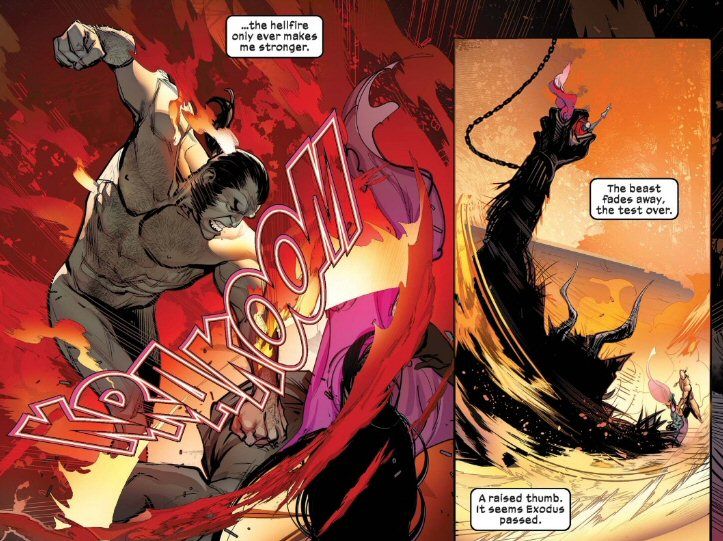
I must say, I’m not entirely sure of what to make of the Progenitor’s (or Bennet’s)mreasoning here. Bennet’s refusal to shirk from his duty is admirable, but the Progenitor typically doesn’t reward those who try but aren’t successful in their goals (for example, see its failing of the similarly deontological Captain America). But I suppose the point here is that Bennet won’t give up on his mutant church, yet still tries to grow and be more than he was (i.e., he won’t let Garrington go this time). Because of this exchange, I’m willing to extend a minor virtue ethics element to Bennett, beyond his primary deontological perspective.
You don’t see much of Bennet outside of times of major wars or upheavals, as his power set and personality make him more of a blunt instrument. He doesn’t have a lot of patience for the mundane matters of everyday life.
Isca the Unbeaten Ethics: C
Isca is a an Omega-level mutant. Her power is the ability to always win, no matter what. This means she automatically skews contests of chance to her favor, and develops whatever powers and abilities needed to defeat an opponent. See detailed character history here.
A.X.E. event Progenitor judgment: Passed.

Isca is a relatively new mutant character, created by Jonathan Hickman for the Arrako story line of his broader Krakoan Age of X-Men in 2020. I have absolutely no clue how her power is practically supposed to work, as it involves everything from unconsciously manipulating chance events to purposefully betraying her comrades by switching sides in the middle of a conflict to ensure she is on the winning side. Obviously, Isca is not going to make or keep a lot of friends with this “power” – but she also doesn’t go away, as she is always on the winning team!
As you might expect, Isca is extremely arrogant (consistent for someone who can’t lose!), and her long life (supposedly over 10,000 years old) has made her quite jaded and cynical. No one trusts her, and she tends to align with some pretty unsavory characters. However, her power can be used against her, by challenging her to something she doesn’t actually want. For example, Sunspot tricked her into inadvertently supporting the death of her lover, the Omega-level sadist Tarn the Uncaring, at the hands of Magneto in Al Ewing‘s X-Men: Red Vol 2, issue #3, 2022.
Being unable to lose, you can see how Isca would be an extreme example of an egoistic consequentialist (and so, a C rating). I include her here mainly because her character is revealing from the perspective of the A.X.E.: Judgment Day event. When the Eternals attack all mutants – including on Mars, by releasing Uranos – Isca immediately betrays her side by murdering her colleague Idyll on the Great Ring ruling council of Arakko. But Nightcrawler teleports her away from the battle, and her compatriots were eventually able to defeat Uranos.
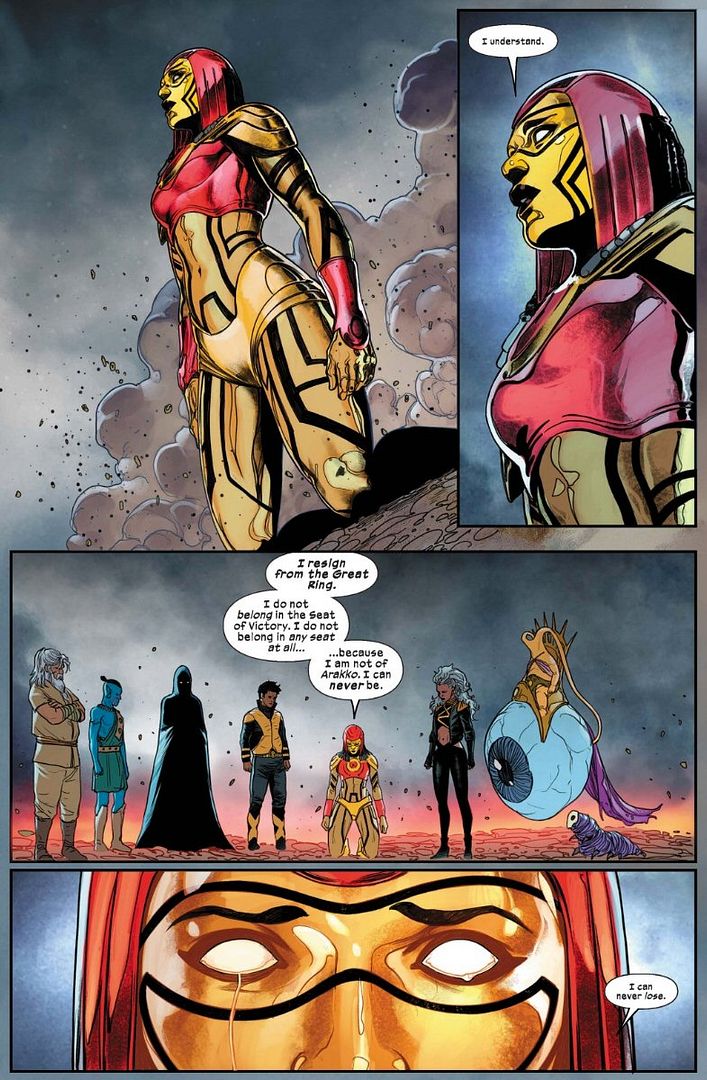
As you might expect, a tense stand-off occurred when the surviving Great Ring members confronted an unrepentant Isca. This was cleverly resolved in X-Men: Red Vol 2, issue #7, 2022, by Al Ewing and Stefano Caselli. Here, the Fisher King – a character who had lost everything in life (including his own name, identity, and past) challenges Isca to “a contest of understanding”, with the winner “the one who most truly understands the meaning of loss”.
It seems an impossible one for Isca to win, given their relative situations. There is a full page of narration that follows, where Isca reflects on her long life. And it all boils down to the fact that Isca has never had a choice – her powers required her to always win. Being forced to confront this for the first time, Isca truly understands the loss that all of this “winning” has bought her. And so, dropping to her knees, she relents in all her pursuits (and thus “wins” this contest!):
And to add insult to injury? The Progenitor chooses this moment to judge her, in the form of her fallen lover (whom she was tricked into helping kill):
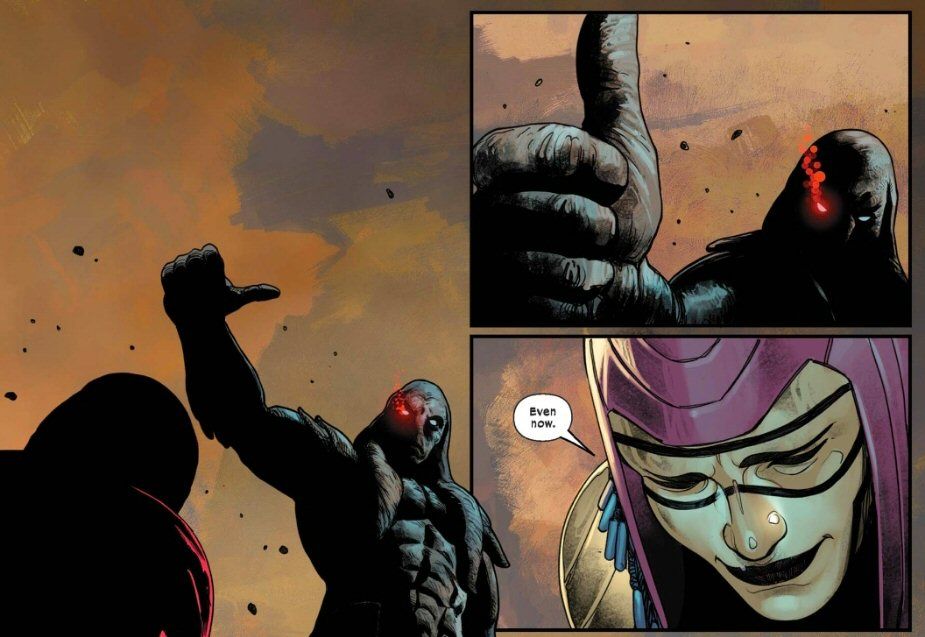
Yes, the irony of ironies – she passes (and wins) yet again.
Jean Grey (aka Phoenix) Ethics: C/v
A powerful telepath and empath, with telekinetic abilities. When linked to the Phoenix Force, an ancient cosmic entity, Jean is one of the most powerful beings in the Universe with almost unlimited god-like powers. See detailed character history here.
A.X.E. event Progenitor judgment: Failed.

Jean Grey is a mutant telepath/empath whose abilities first manifested due to a traumatic event in adolescence. She found herself under the tutelage of Charles Xavier (Professor X) – who initially put controls on her telepathic powers – and she became one of the original X-Men. She fell in love with Cyclops (Scott Summers), and the two remain romantically linked (currently married). She subsequently became one of the most powerful beings in the Universe, when the cosmic Phoenix Force bonded to her.
Like a number of very powerful beings (e.g., Captain Marvel), Jean’s origin story – or rather, how she is linked to the cosmic Phoenix Force – has been retconned extensively within the Marvel Universe. So much so that she needs her own expanded history page on the Marvel Fandom site.
Originally, she was simply the latest host that the Phoenix bonded to. She subsequently turned into the destructive Dark Phoenix because of her fears (later retconned as through manipulation), and was then killed. However, she was eventually brought back – which was retconned as she hadn’t died but had been kept in stasis for years – and the previous stories had all been the Phoenix Force impersonating her. This accepted story line is problematic, as her ongoing core trauma to this day is the destruction of an innocent populated world during her stint as the Dark Phoenix – but which, apparently, she hadn’t personally done due to the retconning. The way around this is to accept (with some cognitive dissonance) that Jean and the Phoenix are in fact one – even when they are apart. And so, Jean remains responsible for the Phoenix’s actions even when she wasn’t there. To me, this persistent guilt doesn’t seem fair, given the imbalance in relative autonomy when linked. But within the Marvel Universe, Jean continues to feel (and is treated as) responsible even when the Phoenix Force leaves her for other hosts (it always seems to come back before too long, as Jean seems to be its preferred host). At the conclusion of the Krakoan Age, Jean plays a pivotal role in the rebirth of the Phoenix Force.
As one of the first (and most powerful) cosmic entities, the Phoenix Force doesn’t have consistent normative ethics in the traditional sense. Its actions and motivations are meant to be inscrutable (and unknowable) by us mere mortals. It is believed to be driven more by instinct and cosmic power than rational thought (or ethics!). I suppose it does have some consequentialist tendencies, but it’s impossible to know what it considers to be the “greater good” – its desire to cause destruction in the name of renewal certainly appears to conflict with human utilitarian principles. And of course, the ethics of a cosmic entity bonding with a human host is also quite complex and unresolvable (e.g., against their will? is consent even possible given the power imbalance? does the host still have agency? etc.).
Taken on her own, Jean (when not directly bonded to the Phoenix Force) often demonstrates a consequentialist (utilitarian) bent in the stories. She often makes decisions that prioritize the well-being of humanity and mutantdom, even if it means personal sacrifice on her part. For example, after the truth is revealed, she proposes opening up the mutant regeneration protocols to (some) humans in order to keep the peace with humanity. She was also willing to die to help save mutants in the Fall of the House of X story line.
Significantly, although Jean is currently channeling the Phoenix Force again, she was not at the time of 2022 A.X.E.: Judgment Day event (as she presumably would have been able to easily stop the Progenitor!). Even the Progenitor admits her history and abilities make her challenging to judge (“You are difficult.”), and calls several “character witnesses” before making its decision. From A.X.E.: X-Men Vol 1, issue #1, 2022, by Kieron Gillen and Francesco Mobili:
Progenitor: I think you are like me. For all the love you share and provoke, THAT is the part I cannot get past. Yes, I am destroying a world — but you destroyed one for no reason at all.
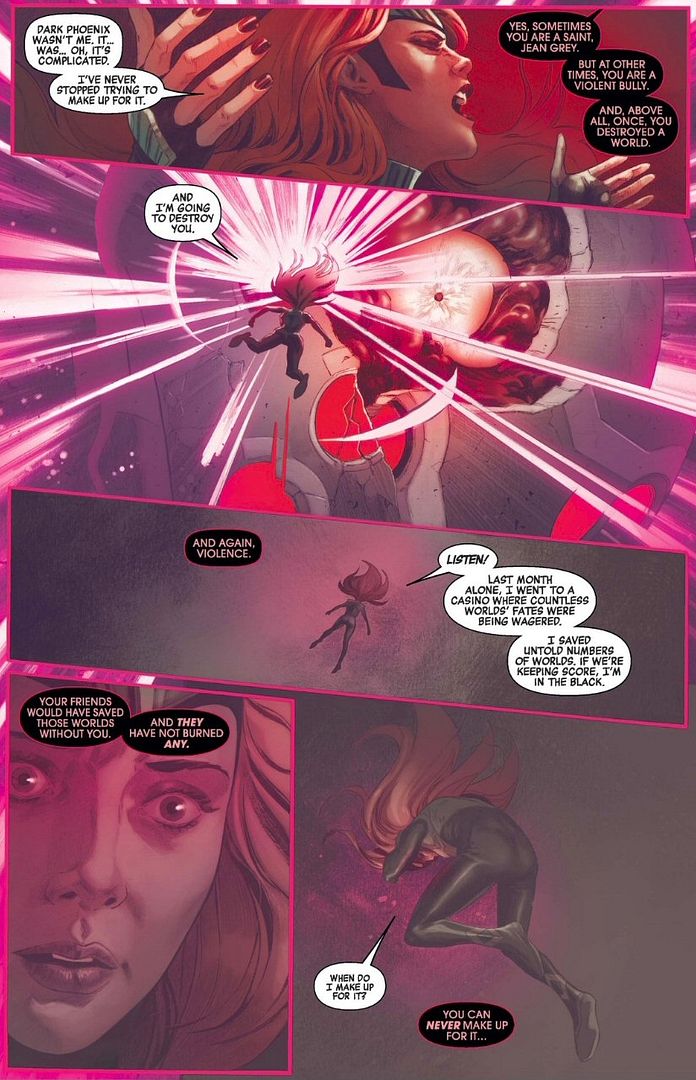
Progenitor: You are the Phoenix, now and forever.
Jean’s defense to the Progenitor is very utilitarian in its framing, showing how she more than “made up” for all the previous deaths she caused. In the end, it seems that this attempt to justify and defend herself – in very utilitarian terms, despite having earlier failed by those terms – contributes to why the Progenitor ultimately fails her.
Note that Jean also exhibits a number of classic virtues, such as compassion, courage, wisdom, and justice. However, I don’t see these as primary for her character. For example, she only proposed extending the resurrection protocols to humans after the truth came out. Moreover, these virtues seem to be in conflict with the Phoenix Force when they are linked. That said, I have found that a number of recent Jean/Phoenix stories by Stephanie Phillips (Phoenix Vol 1, 2024-present, with Alessandro Miracolo, and a guest spot in Spider-Gwen: The Ghost-Spider Vol 1, 2025, issue #13 with Paolo Villanelli) are showing a much more empathetic and caring character. So it remains to be seen how this will evolve.
So, pulling that all together, I would give Jean a C/v rating based largely on all the events up to and including the Krakoan Age. But with enough time and the newer stories/writers, it’s possible that could change eventually.
Kitty (Katherine/Kate) Pryde Ethics: V/d (historically D/v)
A frequent member (and occasional leader) of the X-Men, Kate is a mutant with the ability to phase through solid objects. See detailed character history here.
A.X.E. event Progenitor judgment: Passed.

I remember when Katherine “Kitty” Pryde joined the X-Men in 1980, as its youngest member. She has had various superhero names and titles over the years (e.g., Sprite, Ariel, Shadowcat, Excalibur team member, Captain of Marauders, Red Queen of the Hellfire Trading co., Shadowkat). In the beginning she played a somewhat naive and enthusiastic young character – eventually enduring considerable suffering, turning into a darker character at times. Over the years, she has had a lot of interactions with the X-Men (coming and going from the team) and mutant society in general, along with periods of “retirement”. Check out the Fandom link above for a full history.
The early Kitty Pryde stories were fairly consistent in their presentation of her character, which I would describe as very deontological, in keeping with her recruitment by Professor X. Young Kitty had a strong sense of duty and adherence to the rules, with a particular commitment to the X-Men’s guiding principle of safeguarding mutants and humans alike. She saw actions as being inherently right or wrong in those days, regardless of their consequences (e.g., very opposed to killing, even in self-defence).
Interestingly, Kitty showed aspects of care ethics early on, especially in how she showed empathy in relationships and prioritized the well-being of her teammates, friends, and family (and the vulnerable, in general). She demonstrated a strong sense of compassion, including for her enemies. These “carer” actions were part of what I liked about her character during my early days collecting comics – they were far less common in comic stories back then. Kitty also showed several key classic virtues like honesty, selflessness, and perseverance – as well as personal courage, integrity, responsibility, and compassion.
But then began the first dark turn of her character into Shadowcat in 1984 by Chris Claremont, and the introduction of new utilitarian aspects. Her normative ethics bounced around a lot in the intervening decades, and I found the character became quite inconsistent. For example, Kate sided with the very utilitarian Captain Marvel in the second Civil War 2016 cross-over event (which I was not a fan of, for either of their characters).
During the Krakoan age, Kate returned to something closer to her original personality when she became the Captain of the Marauders and the Red Queen of the Quiet Council. This may explain why she passed the Progenitor’s judgement in the 2022 A.X.E.: Judgment Day event. But with the Fall of the House of X, she started running black-op assassinations as a new Shadowkat. Kate’s latest attempted retirement – and reluctant return to a leadership role for a bunch of new young mutants – is very much in keeping with a modern care ethics perspective.
Indeed, issue #5 of this new title, Exceptional X-Men, Vol 1 (2024-present, by Eve L. Ewing and Carmen Carnero) explicitly addresses this point – and the inconsistencies with the character previously. The issue begins with a flashback about how Kate changed from the Red Queen into the assassin Shadowkat during the Orchis crisis.
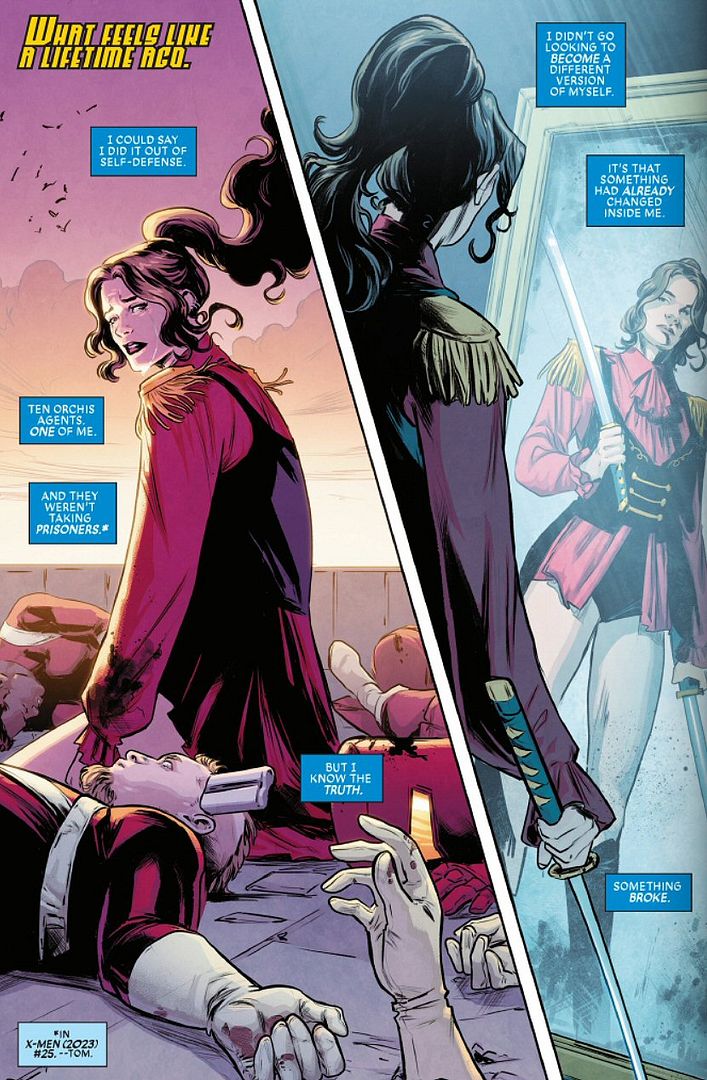
This is the beginning of the justification for the previous stark change in Kate. It eventually continues:
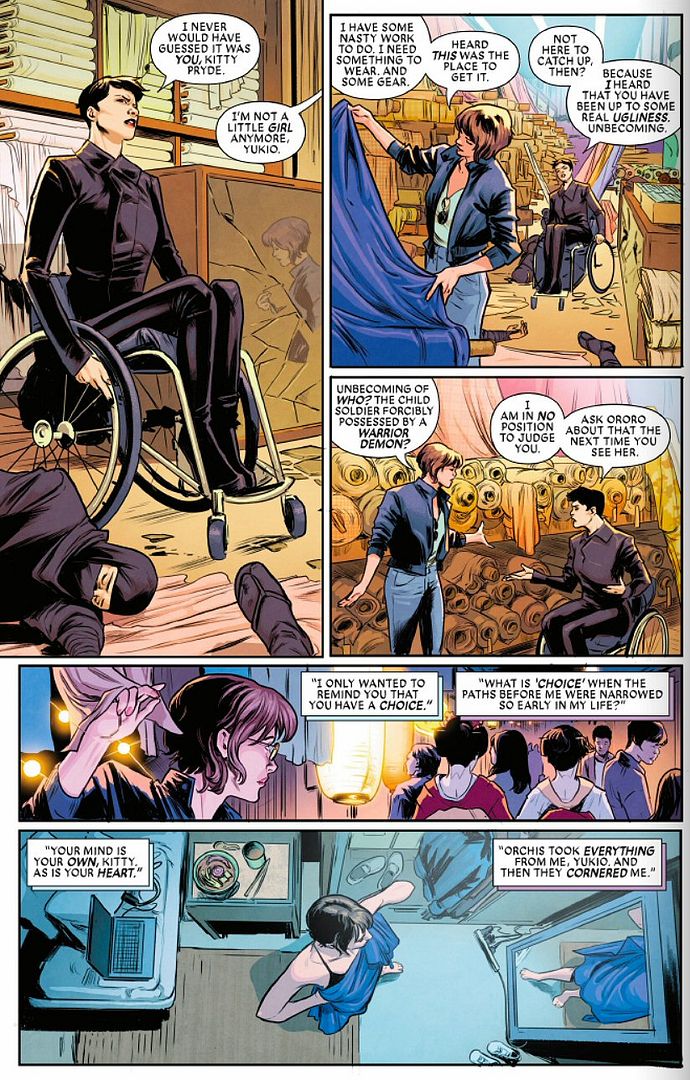
The justifications espoused by Kate within the story directly speak to what I have described as the change in normative ethics in the real world over the long run of the X-Men (i.e., being a child soldier, and having her path constrained at a young age by others). But note the end of the exchange above, where Yukio suggests that Kate has a choice. Excerpts from the next two pages:
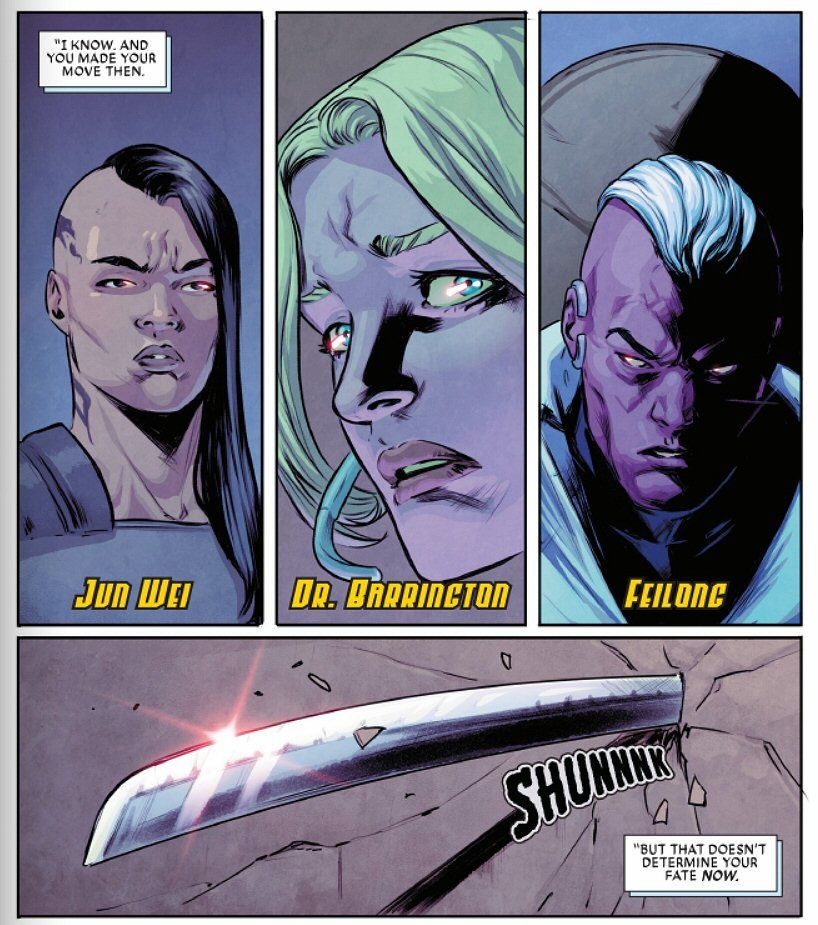
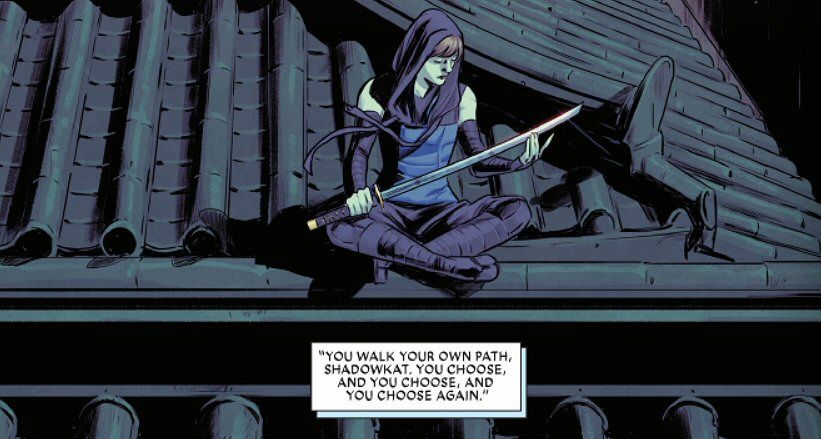
This is an interesting way out of the problem of the rapid character shifts for Kate. Ewing has reframed it as something involuntary initially – “something broke”. And now Ewing is explaining her normative virtue ethics return by the concept of choice: “You choose, and you choose, and you choose again.” It’s a neat closing of the circle.
But Ewing isn’t done making this explicit. One of Kate’s new students, Thao, abandons the team when she discovers Kate’s dark history. And in the most deontological terms possible: “But there’s right, and there’s wrong. The line is clear. And I’m not crossing it”. Once Thao learns some hard lessons in the issue about the consequences of trying to hold that deontological line, she returns to Kate for further training. This is about as concise a description of Kate’s new found care ethics as I could imagine, in relation to Thao’s deontological “moral compass”:
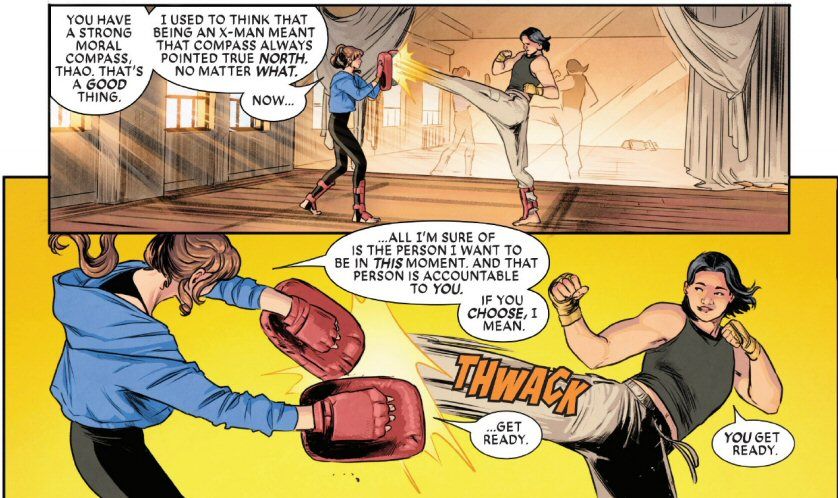
This is the essence of care ethics – focusing on the person not the action, with commitment to personal growth, living in the moment, and choosing to be accountable to those you are in a relationship with. It is a welcome return from the incongruous lone-wolf assassin phase of Fall of X.
In this moment, it is clear that Eve Ewing’s Kate has adopted primarily a care ethics (virtue ethics) drive. So I’m comfortable providing a V/d rating for now (with an original D/v, along with periods of heavy consequentialist ethics in-between).
Legion (David Haller) Ethics: V
An Omega-level mutant with the ability to create mutations with a nearly infinite array of abilities. These come with a new persona (or alter), although since his rebirth David is able to access these abilities while remaining in control. He can also bend time to his will. See detailed character history here.
A.X.E. event Progenitor judgment: Passed.

David Haller is an (at times) unstable mutant with nearly god-like powers. He is the son of Charles Xavier, and was given the name Legion to reflect the vast number of separate personas (or alters) contained within his mind. He is considered to have Dissociative Identity Disorder (DID), which is what “Multiple Personality Disorder” was eventually renamed as in the early 1990s. In the original stories, these alters reflect the distinct powers he possesses (which are virtually limitless in number and scope). Eventually, he was given a device to allow him to access each of this distinct powers without being overwhelmed by the alter personality. Since his rebirth in the Krakoan Age, he appears to be more stable and has access to all his powers – as well as the ability to create new ones.
As a character, Legion has always been problematic – there is literally nothing he cannot do, but he has rarely been stable (until modern times). The fragmented nature of his personality means that there has been little opportunity to develop a consistent or coherent ethical framework.
The DID diagnosis has never really worked for me either. Although most people wouldn’t realize this, DID is a controversial diagnosis in the mental health community. “Multiple Personality Disorder” captured the public’s imagination due to a pair of well known older movies. It was eventually entered into the Diagnostic and Statistical Manual of Mental Disorders (DSM), produced by the American Psychiatric Association, as DID – a form of severe dissociative identity disorder (reflecting a fragmentation or splintering of identity, not a growth or proliferation of distinct identities). But it is still debatable if it exists at all, or is just an artifact of therapeutic intervention or of extremely severe dissociative states being interpreted as separate identities. I will discuss this further in my upcoming overview of Moon Knight, as he is also considered to have DID. (UPDATE: Moon Knight post is now up)
One version of this character that I did enjoy was the limited TV series created by Noah Hawley and starring Dan Stevens. Although the history and origin of the character’s powers differ, it is still within the frame of the comic stories (with an old enemy of Charles Xavier as the source of trouble initially). But it evolves into a thoughtful examination of how power corrupts.
In the comics, my favorite version of Legion is the one since his resurrection in the Krakoan Age, as depicted in Legion of X Vol 1, by Si Spurrier and Jan Bazaldua. His role in the A.X.E.: Judgment Day event created by Kieron Gillen is thoughtfully done. From From Legion of X Vol 1, issue #6, 2022, by Spurrier and Rafael Pimentel:
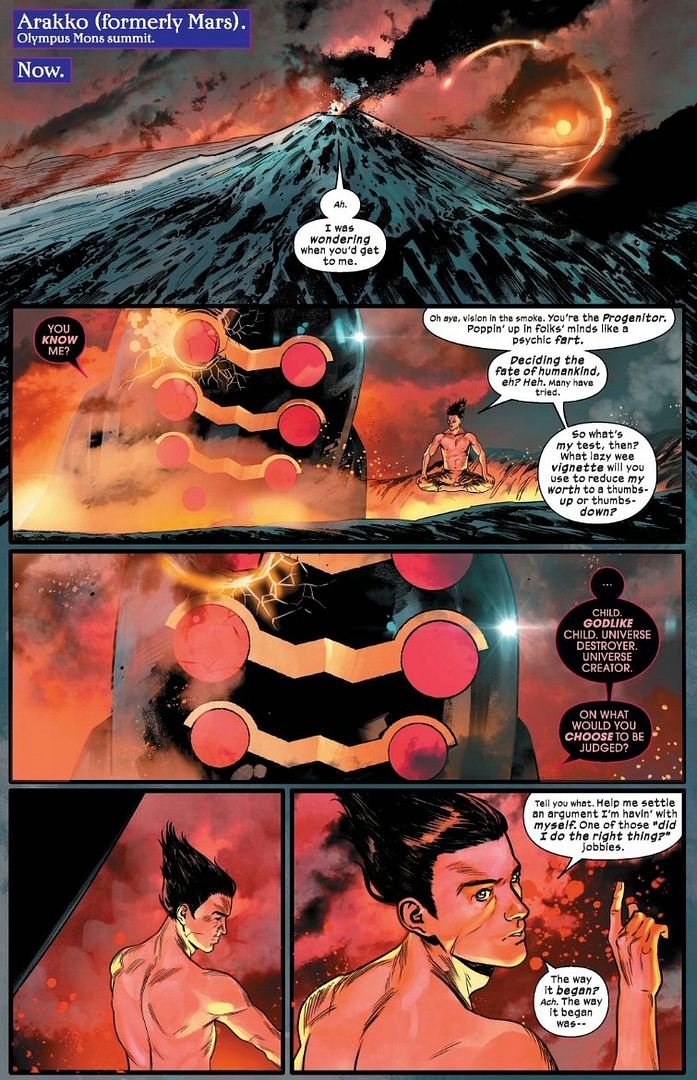
That is certainly a different tack to take with the Progenitor. David goes on to explain why and how he initially failed against Uranos, and how he wanted to try again. But Magneto stopped him, as he had more important work to do, while Magneto personally dealt with the threat. As I’ve explained below for Magneto, this gave him a noble hero’s death.
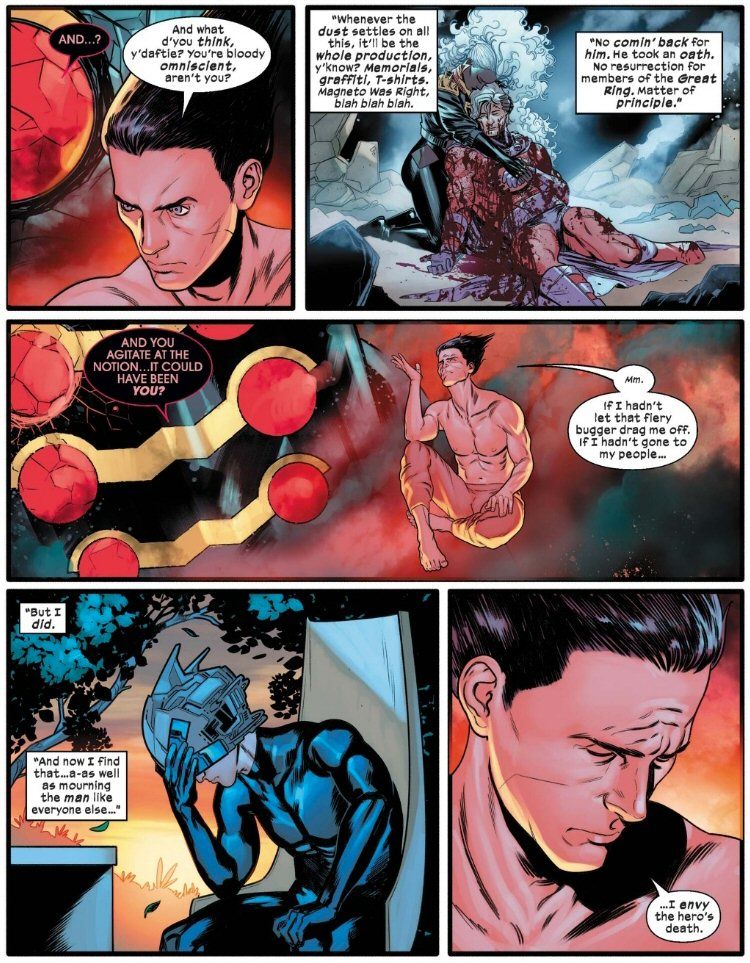
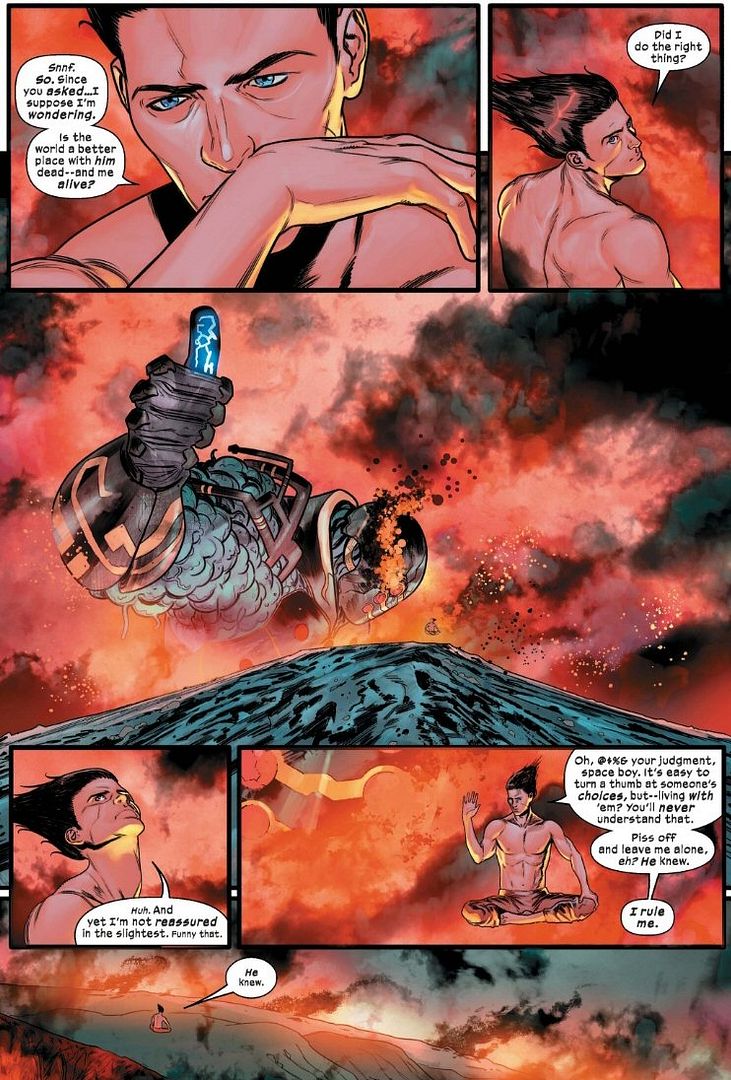
It’s a thoughtful examination of David’s desire to seek redemption for his past. We’ll see where it goes in the stories, and if his character integration lasts. But for the time being, I’m tentatively giving David a V (virtue ethics) rating, as he seems intent on developing virtuous characteristics within his consolidated self.
Magik (Illyana Rasputina) Ethics: V/c
A mutant sorcerer linked to the demonic realm of Limbo, with teleportation, stepping discs, her soulsword, and sorcery as her main powers. See detailed character history here.
A.X.E. event Progenitor judgment: Unknown.

Magik is hard character to profile, given all of her traumatic back history elements. I recall her creation during my time reading comics in the 1980s (and her early friendship with Kitty Pryde), but she too has gone through a lot more since then. Although very powerful and dedicated to both her mutant and magical colleagues, she is something of a cypher – with her humorous attitude masking a traumatized and fundamentally distant person. Although she plays a significant role in many story lines, it feels like we never really get to know her.
Torunn Grønbekk took Magik in a more humanized direction in Realm of X (2023, with art by Diógenes Neves), where she was temporarily depowered and forced to deal with things on her own – eventually reclaiming her powers, and giving away more than she received. There’s an excellent stand-alone Magik series that has been ongoing since early 2025, by Ashley Allen and Germán Peralta. This series has given us a chance hear Magik’s internal monologue (and internal conflict with her Darkchild persona).
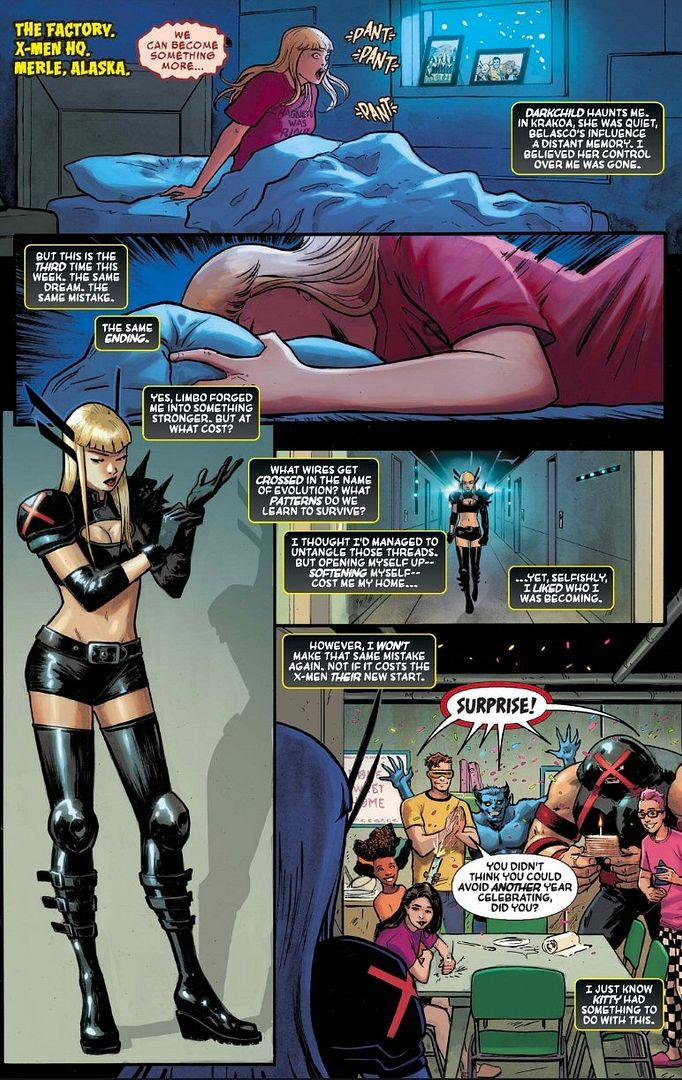
This series will hopefully continue to provide greater insight into the character as it goes along. It already has a lot of nice touches (e.g., her sleeping in a t-shirt that reads “Magneto was right”, teleportation to a Tokyo Cat Cafe for a scene of extended dialogue, etc.). But more significantly, it deals with the reintegration of her Darkchild persona – which may finally allow for a more consistent and substantive ethics framework.
Based on relatively limited information, it seems to me like Magik is starting to primarily display a virtue ethics perspective – both in the classic Aristotelian sense and the modern care ethics sense. Magik often demonstrates courage, resilience, discipline, and the responsibility that comes with use of both her mutant and magical powers. She strives to overcome her inner demon (literally!) and use her abilities to help others. Her commitment to personal growth, cultivating virtues and using them to protect others, best fits a primary virtue ethics framework at the current time.
She also has a lot of utilitarian aspects, especially in how she conducts herself in battle (i.e., she does what it takes to win – but considers the consequences of her actions). This involves making difficult or morally questionable choices along the way. But these are typically in service to her primary care ethics drive of protecting those she cares about, so I would say that makes her very much a secondary consequentialist. And so, a V/c on my rating system.
Magneto (Max Eisenhardt) Ethics: V/c
One of the most powerful mutants, Magneto has comprehensive control over all forms of magnetism, with potentially limitless range. See detailed character history here.
A.X.E. event Progenitor judgment: Passed.

Magneto is a very difficult character to profile quickly, given his complex morality, extensive backstory (with innumerable retcons) and evolving role in the comics – with many cycles of redemption and reversion. And so, I recommend you check out the dedicated Magneto post I created.
To summarize it simply, Magneto originally served as the very consequentialist villain to Professor X’s somewhat deontological hero. But just as Charles Xavier’s Professor X became increasingly utilitarian in his behavior and goals, I would argue Magneto’s moral core shifted to a different form of consequentialism (i.e., away from egoistic consequentialism and more toward utilitarianism himself). He has also become increasingly virtuous – especially in recent years. So much so that I would now consider him to be a V/c on my superhero normative ethics scale.
To show how far he has come, I particularly liked the Progenitor’s assessment of Magneto, from A.X.E.: Judgement Day Vol 1, issue #4, 2022, by Kieron Gillen, Valerio Schiti, and Marte Gracia, where Magneto sacrifices himself for the sake of mutantdom:
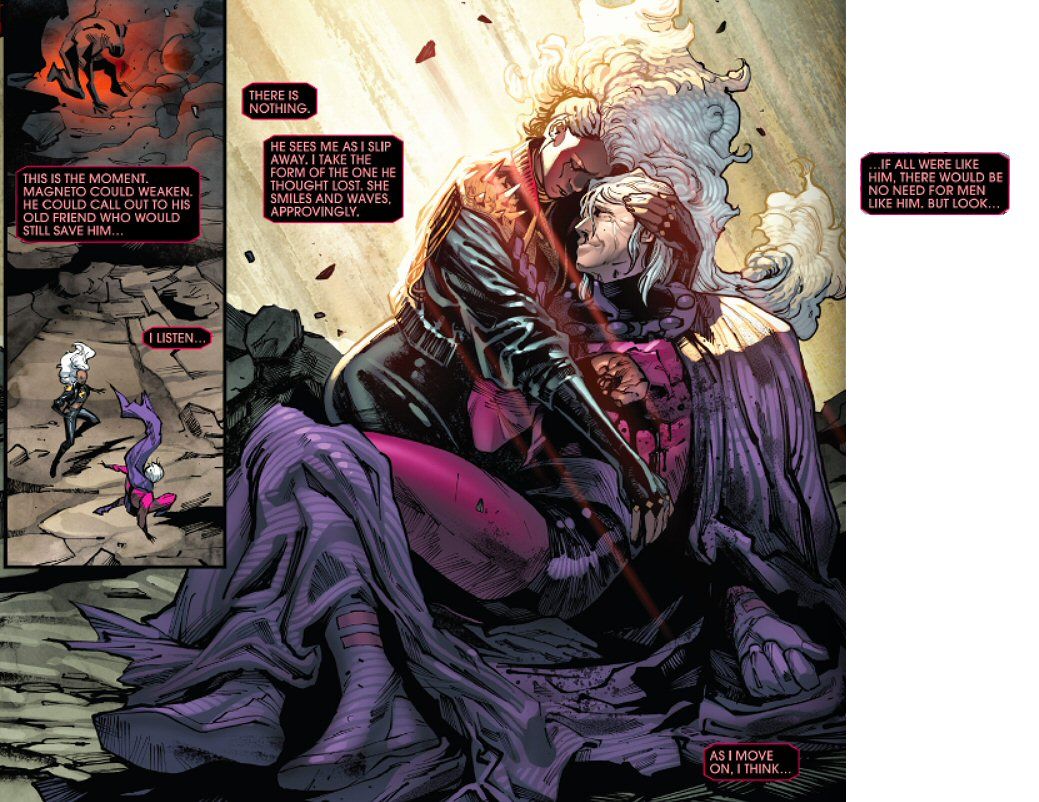
High praise indeed! This scene above – and some of the preceding story lines that led to it – show how the overall arc of Magneto is bending to increased virtuosity.
Oh, and don’t let death scene worry you – Magneto was resurrected a year and half later, in Al Ewing‘s excellent Resurrection of Magneto, Vol 1, 2024, with Luciano Vecchio. To show you how far he has come, here are a few panels from the final issue of the Krakoan Age, X-Men Vol 6, issue #35, by Gerry Duggan, Al Ewing, and Kieron Gillen along with a host of artists:
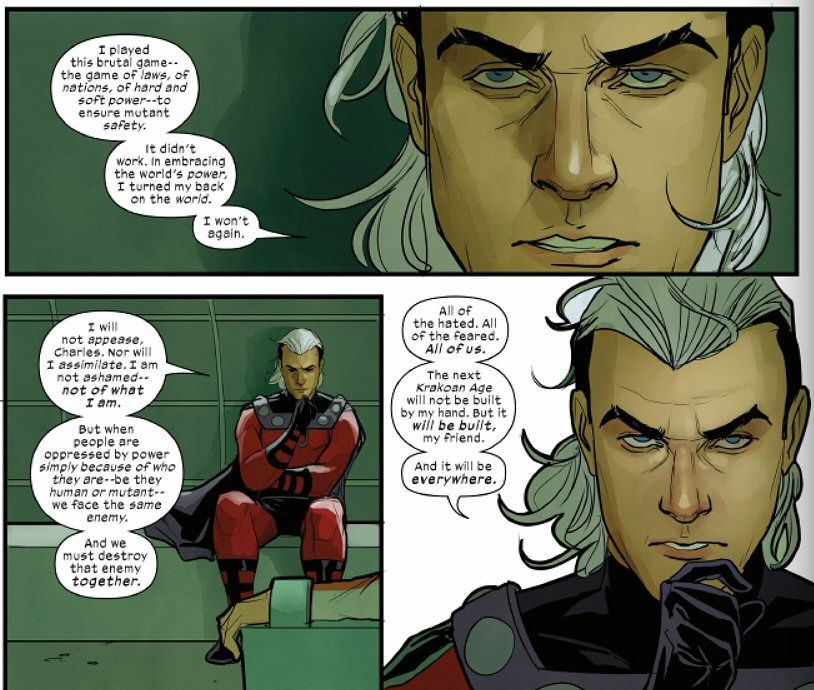
Let’s hope his virtuous nature continues to develop. Check out my Magneto ethics page to learn more, including some recent developments in the From the Ashes Age.
See my Glossary post for a list of the key philosophical concepts and related links on this site.
Further Reading
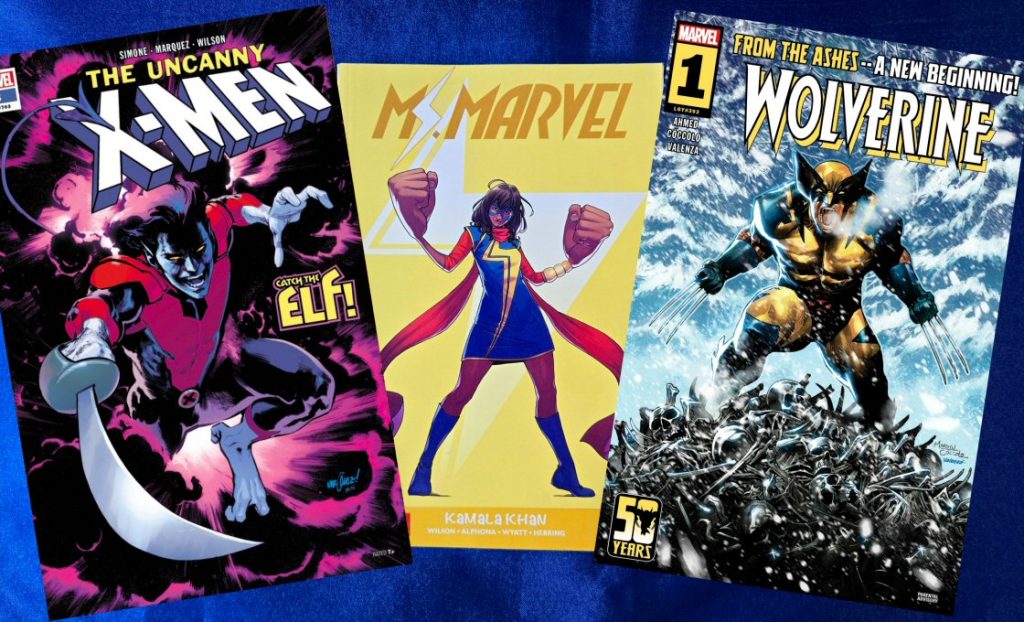
For more X-Men: X-Men Mi-Z
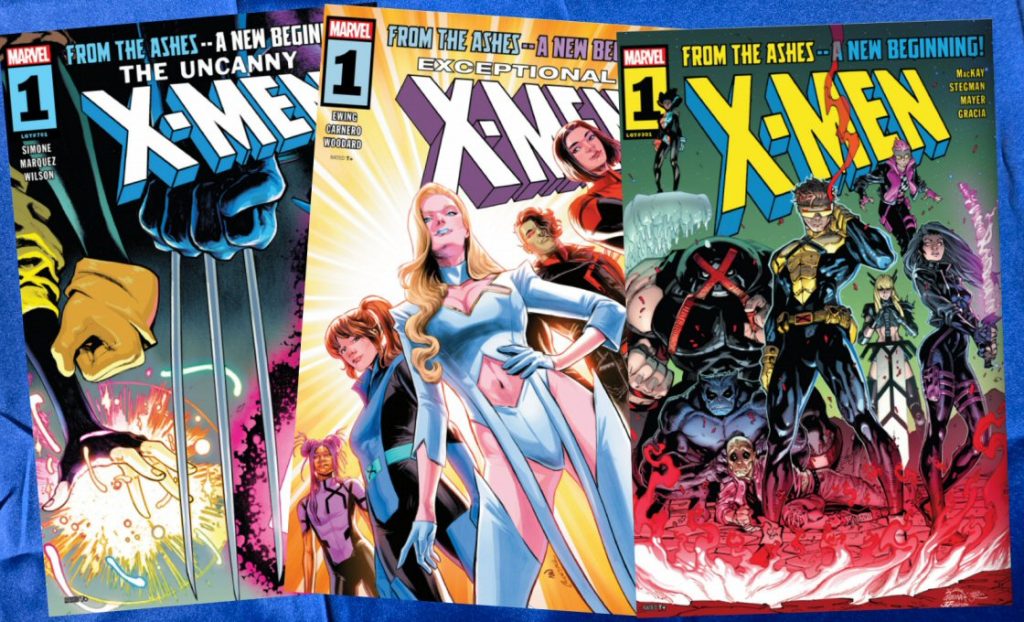
For more X-Men: X-Men Introduction

For more X-Men: Charles Xavier Introduction
Wow, that’s a lot of profiles. I was wondering why you hadn’t posted in a while, lol! Is there a reason why you bunched them liked this, instead of separate posts? Just curious, as there is a lot to read through here.
I like the focus on the Hickman-Gillen era. I haven’t really gotten into the new stories as much. Those Krakoan age comics really were a golden age for X-Men. Thanks!
On your first question, yes, it has to do with the nature of the Word Press theme I’m using. I find it’s hard to find things if there are too many small posts. My individual comic story line posts tend to run at 10-20 mins read time, and my full character overviews at 20-30+ mins. These shorter profiles are ~5 mins each, so I thought it made sense to consolidate (with anchor links, so I can always link to just the specific character). I was planning to cover all significant mutants in one post, but it got so long I thought it was better to split in two. My site uses lazy loading so images don’t preload until you view them, but I am still mindful of keeping the site responsive.
To your second point, yes, Kieron Gillen is obviously very familiar with normative ethics. His characters are always very internally-consistent, for the dominant ethics they display. Often he drops clever turns-of-phrase or references that signal his deep understanding. I find his Immortal X-Men run a great place to hunt for quotes, especially given how he often had different characters narrate each issue.
Hi there!
I’m totally new to comic books and looking to dive into X-Men, but I’m feeling kinda overwhelmed by how much there is 😅
I appreciate your short overviews here. I’ve always loved stuff with cool characters and powers – I play Pokemon, Magic and Yu-Gi-Oh!, and I’ve spent tons of time in games like World of Warcraft and Guild Wars. So the idea of a whole new world with different mutants, powers, teams, and villains sounds really awesome!
But I don’t really know where to start… there’s just so much! Are there certain X-Men characters or story arcs that are great for someone like me, who loves strategy, fantasy and building teams with unique abilities? I don’t mind older stories if they’re good, and I also like cool art if that helps pick where to begin.
Thanks a ton for any tips — I’m really excited to start exploring!
Given your background and interests, there is no better place to jump in than the whole Krakoan Age story arc (2019-2024).
Just to warn you though, it is ~500 comics if you try to read everything. Do you have a Marvel Unlimited account?
There is a great reading guide to all the individual issues, in the best order, on Reddit here: https://www.reddit.com/r/xmen/comments/1d8sg25/the_complete_singleissue_reading_order_for_the/
Marvel has released various “chronology editions” for the different phases, which I found helpful to fill in some of my gaps (I haven’t read everything, but did read most of the main titles). But those aren’t intended as a reading order, they just help to keep track of everything with in-story chronology (i.e., it reveals later plot points sooner than you should know, but is helpful to make sense afterwards). The later chronology with the Moira engine is super helpful (you’ll understand what I mean when you get there). I think you are best sticking with reading order above, if you can.
Enjoy!
Great, thanks. But while I’m super interested in the big X-Men team stories, I’d also love to check out some character-focused stories too. Are there any solo series or story arcs that are especially good for individual X-Men, beyond the examples here? Like, stuff that really dives into a specific character’s background, powers, or personality?
I don’t have any trouble finding comics online, though really old stuff (like pre-80s maybe?) can be a little harder for me to track down or get into, especially if it hasn’t aged well 😅. So anything more modern or easier to follow would be awesome.
Thanks again — you rock!
As mentioned previously, the Kieron Gillen Immortal X-Men run (2022) is a great place for individual character stories – but you will get to those eventually in you Fall of X/Rise of Powers of X story arcs. And that run will keep you busy for awhile!
There are some great stand-alone newer series which you will want to check out, but only after you’ve read the main Krakoan stories. For example, Al Ewing’s Resurrection of Magneto (2023-2024), and the recent From the Ashes series (especially Jed Mackay and Eve Ewing main series, but also Alyssa Wong’s Psylocke and Ashley Allen’s Magik).
If you are looking for older stories, I suggest you check out the background character pages at Marvel Fandom (https://marvel.fandom.com/wiki/Marvel_Database), and then follow any story lines that sound of interest to you.