
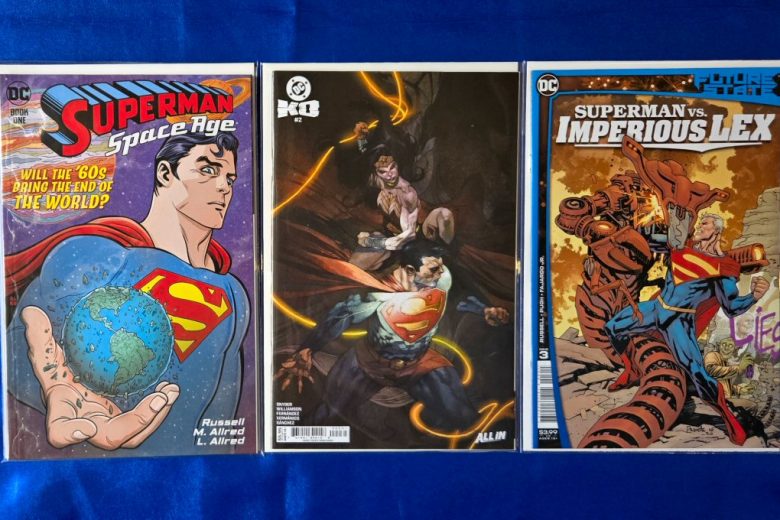
My name is Clark Kent. I am not a King Omega. Because we don’t need one. No one hand should hold that much power … because when only one person wins, none of us do. What we need is not one hand to save us … but many. Every hand. Their hands. And yours too.
- Superman, DC K.O. issue #5, 2026, written by Scott Snyder
Superman’s ethics are a particular challenge to describe succinctly – which is why I haven’t attempted it until now on the site! And it is not because the character’s ethics are unusually complex, or involve relatively niche areas of normative ethics (aka, moral philosophy). In fact, the evolution of Superman’s ethical core is fairly straightforward, and has been relatively stable throughout the modern era.
So what’s the issue? The first is the same problem that I described in my introduction to Spider-Man – as one of the most popular superheroes of all time, Superman has similarly been written into more comics stories than anyone could read in a lifetime. Even worse, Superman first appeared several decades before Spider-Man, back in 1938 (created by writer Jerry Siegel and artist Joe Shuster in Action Comics #1). As a result, you could plausibly make a case for just about any form of normative ethics you can think of – somebody somewhere has probably written him that way.
Similarly, if you were to ask any of the current Large Language Models (LLMs) chatbots (please don’t, for the sake of the planet, or the truth) you would get the classic Dickensian it-was-the-best-of-times-it-was-the-worse-of-times response that I’ve described previously. In other words, it will tell you that Superman exhibits all three branches of normative ethics – and likely multiple forms of each – with a slight emphasis on one branch or another depending on which sources the LLM plagiarized was trained on. But because it doesn’t actually understand those sources, it will be hit-or-miss as to what it says. Aren’t you glad you came here instead? 😉
The other issue in providing a comprehensive overview of Superman’s ethics is the nature of the frequent revisions and reboots of the character’s history (and ethics) in the comics. Spider-Man’s history has been relatively stable compared to some problematic Marvel characters who have experienced significant origin revisions or retcons over the years (e.g., see my Moon Knight ethics overview). But DC has taken this further with numerous whole universe reboots (both hard reboots that re-wrote continuity, and soft reboots that altered aspects of it). Please see my concise summary of the various “Crisis events” in DC comics for more info.
As such, my initial plan for DC comics characters was to focus on a specific run or story line that captured some of the character’s most significant or interesting ethics (e.g., my Absolute Wonder Woman post). But that seems a bit too limiting for Superman, given the over-arching significance he has for superhero ethics – he is something of a moral anchor that many comics creators either try to emulate or oppose in their stories.
So, with due humility and dread, I’m going to do my best to give a high-level historical overview here, and then focus on time periods that are particularly impactful for understanding the character’s changing ethics. Along the way, I am going to profile stories from two of the most recent writers of Superman – Scott Snyder and Joshua Williamson in the recent DC K.O. event, and Williamson’s ongoing main Superman series – as I feel they capture a key aspect of the modern ethics of the character well. I’m also going to highlight Mark Russell‘s Superman series from 2022-23 (Superman: Space Age). Although it takes place in a parallel universe, it neatly encapsulates the changing ethics of the character from the Silver Age through to the pre-Modern Age.
As a moral philosophy primer, my Ethics 101 page briefly presents the three branches of normative ethics that will be discussed here. Deontology is concerned with doing your duty to other people, often through the lens of rights or justice. These theories are often principle- or rule-based, and focus on the moral value of the acts themselves (that is, doing the right thing). Consequentialism is seen as the opposite, focusing not on the acts but rather on their outcomes. These theories typically explore the moral burden of making good decisions (that is, doing the good thing). The third branch is virtue ethics, which shifts the focus from the act to the actor – being the best person you can be, typically by practicing virtues that align with your values and goals (that is, being better). I tend to use ethics and moral interchangeably, as I explain on that page.
As always, if you would like to know more about the terms I’m using on this site, please follow the links throughout or check out my Ethics 101 page or Glossary of Terms post. And full disclosure – I am not as familiar with long run of DC series as I am with Marvel, so I will be relying more on expert- and fan-curated resources for parts of this overview (such as the DC Fandom Wiki).
Historical introduction to Superman
There are certain well-defined periods of American superhero comics. Although exact age ranges vary, comics historians broadly defined them as Golden Age (1938 to 1955), Silver Age (1956 to 1971), Bronze Age (1972 to 1984), Copper Age (1985 to 1991), Chrome Age (1992 to 1999), and Modern Age (2000 to present). See my Comics overview page for more info.
As I describe on my DC Comics page, the DC comics universe underwent a continuity-ending hard reboot in 1956 (marking the start of the Silver age) and again in 1985 (marking the start of the Copper age). Note that with the 1985 Crisis on Infinite Earths reboot the earlier periods were given defined universes within DC comics storytelling. So, the distinct Golden Age characters were considered as existing on “Earth-2”, the Silver/Bronze Age characters on “Earth-1”, and Copper through Early-Modern Age characters on “Earth-0” or “New Earth”. Modern storytellers have always had the ability to include those earlier Earth-2/1 versions of the characters in their ongoing stories – although they usually presented them using a modern lens.
Superman’s personal history has been rewritten and rebooted many times over the years (probably more than most, which affects which stories may currently be considered as in-continuity). The most significant of these were in the Copper-early-Modern Age of New Earth stories. John Byrne did a major revision in his 1986 The Man of Steel series, which significantly affected the character’s ethics (as I’ll explain below). This was later updated and expanded by Mark Waid in his 2003 Superman: Birthright (which restored some earlier plot points). Geoff Johns revised it further in his 2006 soft reboot Infinite Crisis, and most especially his 2009 mini-series Superman: Secret Origin. Grant Morrison also revised him further in his 2011 Action Comics stories.
In 2011, Geoff Johns‘ led the DC Flashpoint reboot that marked a hard demarcation from the Copper-early-Modern Age stories – with the main DC universe now known “Prime Earth” or (somewhat unhelpfully) still “Earth-0”. But this was subsequently softened for many of the major characters in Johns’ 2017 DC Rebirth soft reboot, which tried to integrate a lot of the Post-Crisis/Pre-Flashpoint stories into the current Prime Earth era. For Superman, many of the origin story revisions from the Copper-early-Modern Age described above are still relevant today, as his New Earth and Prime Earth versions were effectively merged in 2017. And his backstory was further updated in Johns’ 2019 Doomsday Clock series, as part of the Rebirth era.
So, here is the currently accepted origin and history we are working from right now in the main DC universe for Superman: Superman is one of the most powerful beings on Earth. He is an alien refugee named Kal-El from the planet Krypton who was sent to Earth by his parents Jor-El and Lara Lor-Van before its destruction and their deaths (and before he was even born). He was raised by Jonathan and Martha Kent in Smallville, Kansas, who adopted him and named him Clark Kent. Both of his Earth parents are currently still alive. He is married to Lois Lane, and they have a late adolescent biological son Jonathan “Jon” Kent (also called Superman) and a foster son Christopher “Chris” Kent (aka Lor-Zod, the biological son of General Zod, and current Nightwing). In his Clark Kent civilian identity, he works as a mild-mannered reporter for the Daily Planet in Metropolis.
Now that I have all that out of the way (whew!), it makes sense to consider Superman’s ethics in the context of three well-defined eras – Golden Age, Silver-Bronze Age, Copper-Modern Age. And it may surprise you to learn that Superman was originally written very differently then he is often presented today.
A quick introduction to Superman’s modern ethics
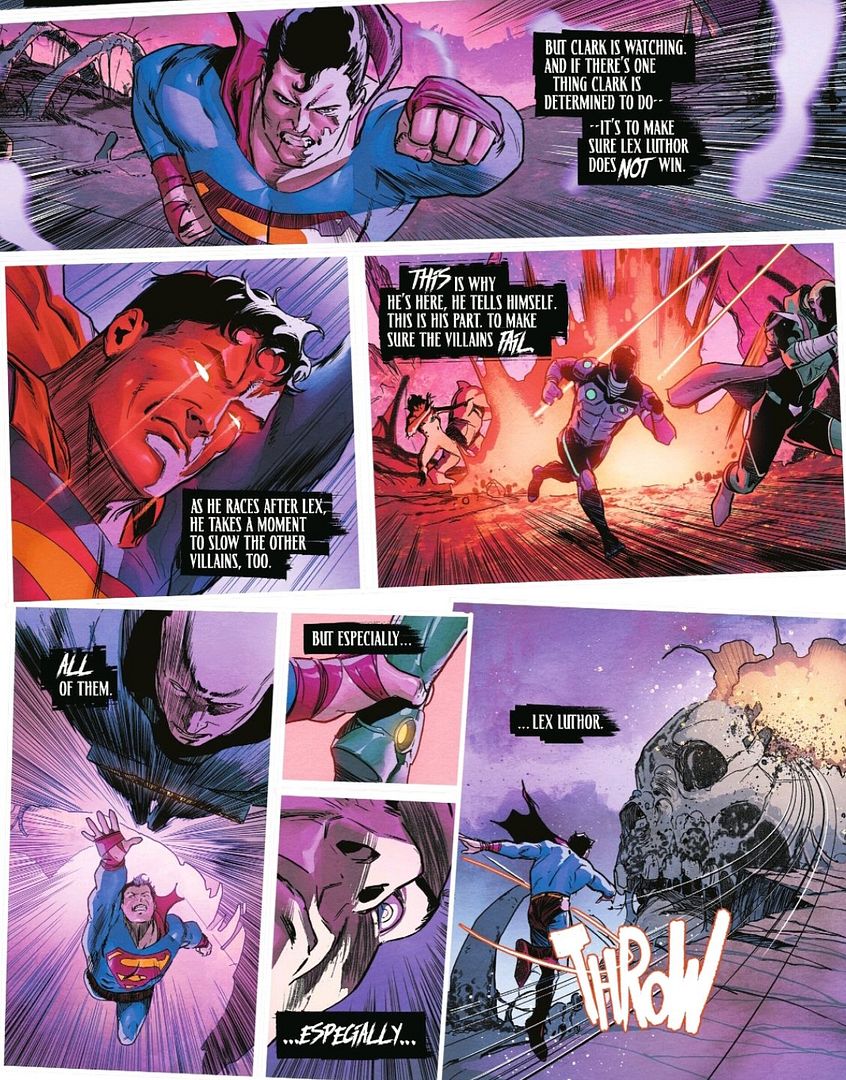
Before I get into all that, I would like to start with a few pages from the second issue of the 2025-2026 DC K.O. event, written by Scott Snyder with support from Joshua Williamson. I’ll discuss this universe-ending event in more detail down below, but the premise for these pages is that DC superheroes and super-villains are pitted against one another in a contest to acquire the favor of the heart of Apokolips. And it’s a great introduction to Superman’s modern ethics.
As context for this event, the primal energies of all DC reality are known as Alpha and Omega – with Alpha the energy of creation and life, and Omega the energy of conquest and destruction. Omega exists in the heart of Apokolips – a sentient entity that previously chose Darkseid as its bearer. In a contest to convince the heart to crown one of them instead, each has been given a vision of what they could achieve if granted King Omega status. In one of the early rounds of the K.O. event, Superman (Clark) is resolved to stop his arch-nemesis Lex Luthor from winning.
From issue #2 by Snyder, with art by the always excellent Javi Fernandez:
As an aside, I love Fernadez’ art (supplemented by Xermanico in this series), and the vibrant colors by Alejandro Sánchez and lettering by Hassan Otsmane-Elhaou.
As I will explain below, Superman (at least from the Silver Age onward) is commonly depicted in either deontological or virtue ethics terms (or some combination thereof). Above we see an example of his deontological side, doing the right thing and following his duty. While racing to stop Lex, he “takes a moment” to slow the other villains down too. “This is why he’s here, he tells himself. This is his part. To make sure the villains fail.”
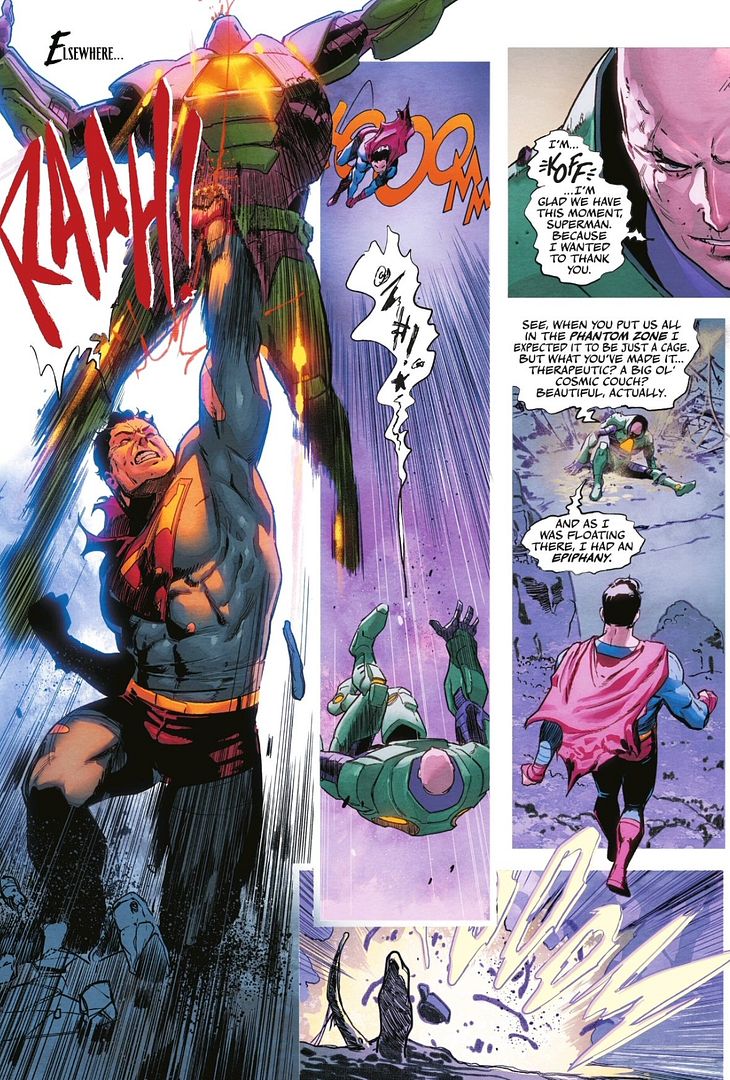
Note that prior to this event, Lex had been imprisoned in a reconfigured Phantom Zone – which as Lex himself admits was redesigned by Superman to be far more therapeutic than punitive. Although you might argue that is a sense of restorative justice in Superman, I think it hews more closely to Superman’s innate sense of virtue ethics – trying to the help the villains be better.
Interestingly, Lex claims that this opportunity provided him an epiphany on Superman’s moral character. Superman is not interested to hear to it, but Lex soon gets his attention with a hefty dose of different forms of Kryptonite (Superman’s main weakness):
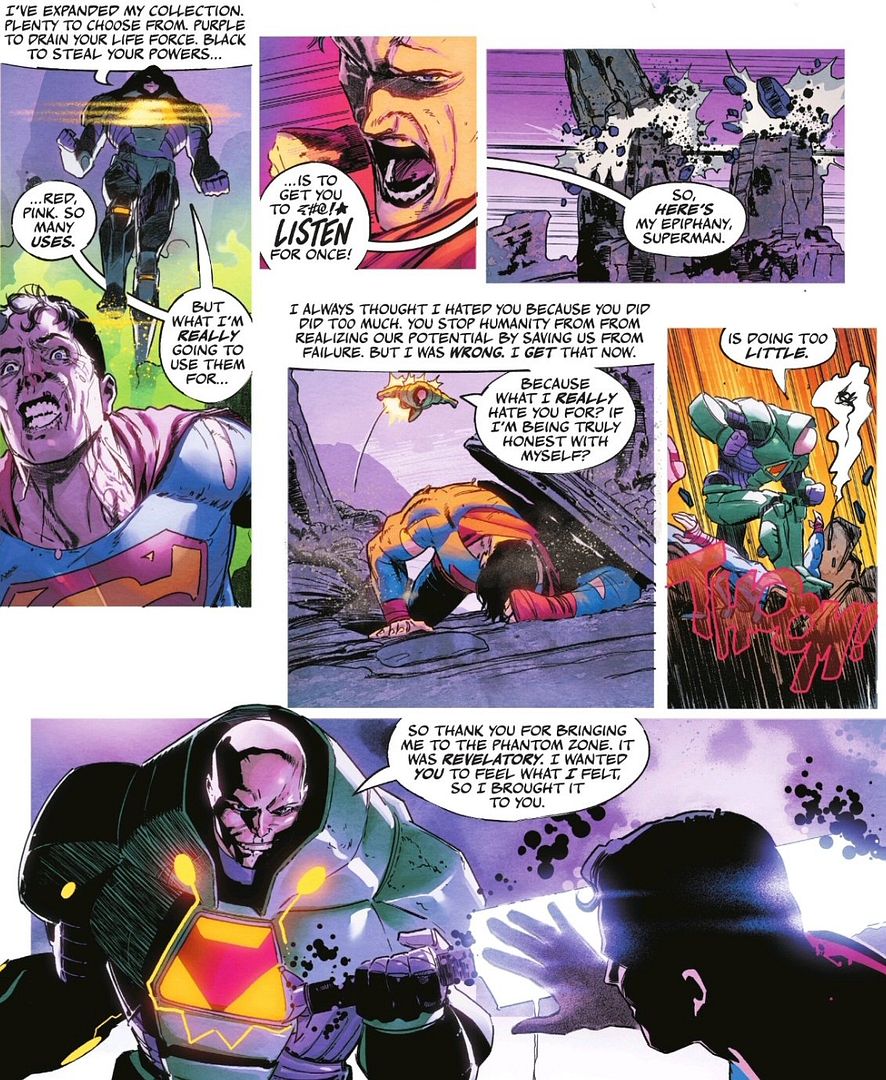
The stated reasons above for Lex’s enmity to Superman is accurate – in the early stories, he often claimed that Superman was bad for humanity because he could make people dependent on him, stunt human progress, and ultimately threaten our self‑reliance. In this earlier framing, Lex saw himself in hard humanist terms, which is closely associated with the main form of consequentialism today, utilitarianism (see my Professor X post for a discussion of its main types). But I would argue that the early Lex’s reasoning had a much stronger whiff of Ayn Rand‘s “objectivism” (see my Doctor Strange post for why that supposed philosophical system is in quote marks), or even Friedrich Nietzsche‘s concept of the ironically-named “Übermensch” (as explained in my Secret Wars post).
In fact, modern Lex is a narcissist with an inflated ego and sense of self. He sees himself as a member of very small class of historically “great” individuals. As for other people (if he sees them at all), it is simply as existing to serve or glorify him. His supposed humanism is thus really a would-be tyrant’s smokescreen. In this sense, he is a good comic stand-in for the current “tech bro” billionaires who fancy themselves effective altruists (but are in fact neither, as I explain in my Can Caring be Wrong? post).
In the end, Lex is one DC’s best examples of an ethical egoist (also known as an egoistic consequentialist), much like Marvel’s Doctor Doom, Kang the Conqueror, or early Magneto.
Now, back to that epiphany:
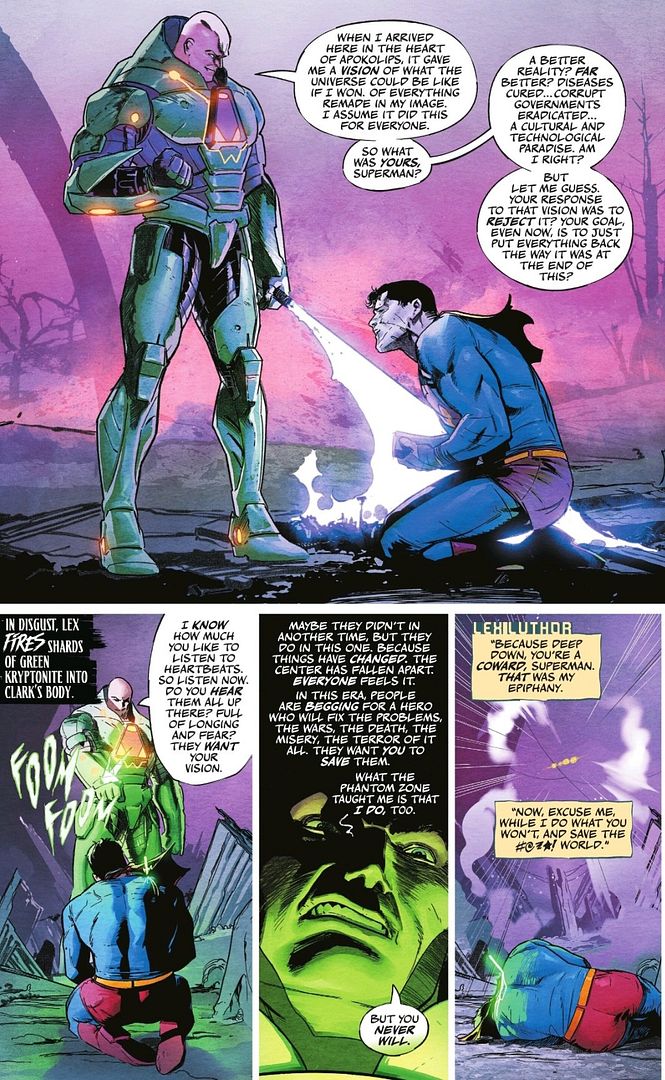
This is a key insight into both Lex’s and Superman’s moral views.
Lex is right in the first part of his assessment – Superman doesn’t actually want to make a new utopian world (even if it does appeal to him greatly). Instead, in his virtue ethics way, he wants to preserve and protect the world that exists for everyone to define for themselves how to be – and how to be better. But Lex believes that he knows better than everyone else, and is quite willing to sacrifice everything to create a world that suits him best – and he expects everyone (well, the survivors at any rate) to thank him for it. See the related concept of rational egoism in Lex’s psychological makeup.
And this is why Superman is a hero and Lex a villain. Superman’s limited experience as a consequentialist (as I will explain below) has convinced him that what Lex is proposing always ends badly. Deontology and virtue ethics – both captured in this small snippet – remain core to who Superman is, as I hope I will convince you of. When I get to my examination of Superman’s modern ethics below, I will return to this DC K.O. event.
Now, let’s see how Superman wound up there over the course of his long history.
The evolution of Superman’s ethics
Golden Age (1938-1955) – aka Earth-2
The early Superman was a lot less powerful than the later one that you are probably familiar with. He was initially characterized by the phrase “faster than a speeding bullet, more powerful than a locomotive, able to leap tall buildings in a single bound”. So, the flying, x-ray/heat vision, planet-moving strength, and virtual indestructibility all came later (although the “Man of Steel” reference did appear early in the run). See the DC Fandom wiki for more info on how his powers evolved.
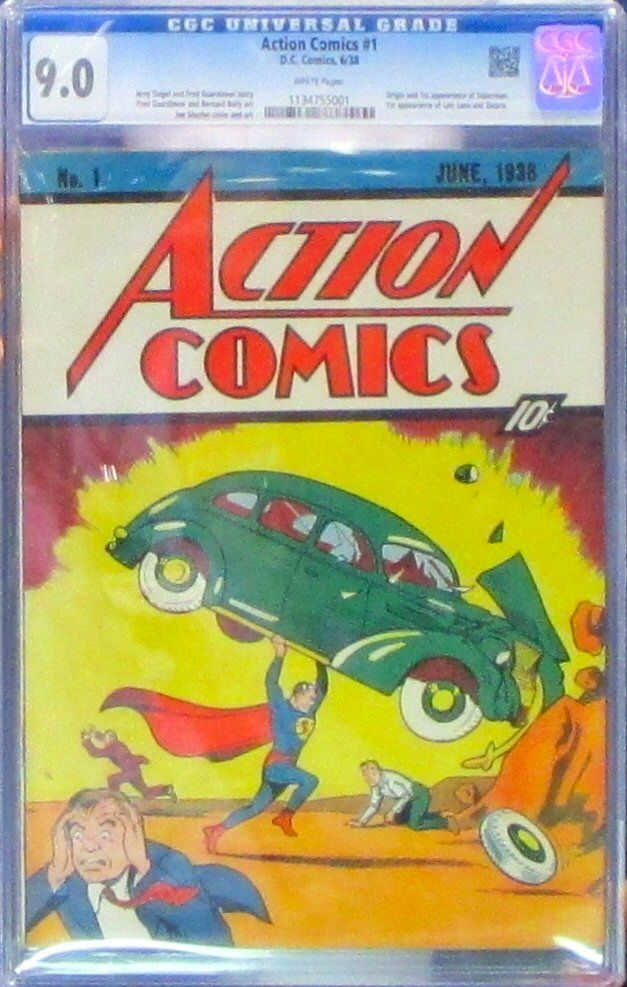
Consistent with these lesser powers, Superman’s primary adversaries were similarly a lot less impressive – he mainly went after wife-beaters and corrupt landlords and politicians. Especially in the early stories, he was something of a vigilante hero who acted outside of the law. While this is a far cry from what his ethics (or powers) would soon become, I’ve seen it argued that this reflected the progressive social justice values of the New Deal time period they were written in. Basically, economic exploitation and corruption were the focus for the character, rather than abstract moral principles.
If you wanted to ascribe an ethics theory to his character, the best fit would be consequentialism. In particular, he showed a strong utilitarian streak of seeking the greatest good for the greatest number (again, see my Professor X post for a detailed discussion of utilitarianism). But as we will see, consequentialism was eventually viewed far less favorably as the character’s morality evolved.
Silver/Bronze Age (1956-1984) – aka Earth-1
Although it is important to remember that correlation does not imply causation, there are two interesting parallel shifts in Superman during this period – he became a lot more powerful, and he became far more deontological as well.
His powers probably peaked around the early 1970s, when he became virtually all-powerful and indestructible (again, see the DC Fandom wiki for a discussion). And by this point, he was acting with a very strict and rigid moral code – very much bound by principles, and following society-conforming norms when carrying out his duty. Consider his frequently cited motto of “truth, justice, and the American way” in this era – which sounds very much like a set of duties that must be followed without fail. It’s beyond the scope of this article (and my expertise), but I have also seen commentaries that this may have reflected rising Cold War anxieties in this time period.
By the time I was reading comics as a kid (late 1970s and early 1980s), I found Superman to be very focused on always doing the right thing, including upholding the law. I now recognize this period as a classic example of the most common form of deontology, Kantian ethics (I discuss another example of Kantian ethics in the Powers comic series).
Developed by Immanuel Kant, Kantian ethics is a rational framework for moral duty that is principles-based. And not just any principles – Kant strove to identify the best ones through reason. And the main universal one he developed – which he referred to as the categorical imperative – is that you should only act on a principle that everyone else could act on too. Or in Kant’s more formulaic terms: “act only according to that maxim whereby you can at the same time will that it should become a universal law”.
I like to think of the categorical imperative as an improved version of the so-called Golden Rule – you should treat people (including yourself!) only as you would like them to treat others (and not how you want to be treated). The point is that everyone has intrinsic worth (even super-villains) who must all be treated as ends onto themselves and never as a means to an end. Indeed, that is the popular phrasing of the second formulaic form: “always treat humanity in yourself or another as an end in itself and never merely as a means”.
A key point here is that the categorical imperative is all about using your reason to decide moral action, and not relying on natural inclination or intuition. There can also be no consideration of the consequences of your actions – only your moral duty in carrying out the categorical imperative. So while Superman would of course still protect the innocent, this more Kantian version now prioritized saving anyone in danger – regardless of who they were or what they have done.
Similarly, Superman was now committed to never killing anyone, and not lying to others either (both “perfect duties” in Kantian ethics). Of course, maintaining Superman’s “secret identity” as Clark Kent doesn’t exactly fit with that latter prohibition. Even though you could reasonably argue he isn’t hurting anyone with that lie – and is in fact protecting the vulnerable and at-risk (his friends and loved ones) – it still isn’t permissible under Kantian ethics. And this is a big part of why so many find it hard to fully commit themselves to Kantian ethics – its inflexibility means even Superman can’t adhere to all of its requirements!
In any case, I would argue that the tension between Superman’s rising power and his moral choices became the central drama for the character in this time period, with a pronounced shift to deontology (particularly Kantian ethics) as a result.
You could make an argument for the emergence of virtue ethics by the end of this time period, especially in stories that focused more on his character traits (like compassion, humility, and self-restraint). This shows how deontology and virtue ethics can often overlap – you can choose to follow your duty according to your principles, or you can choose to limit yourself as part of a growing sense of virtue awareness. But I didn’t see a lot of moral growth overall in that era (honestly, I found him to be a bit too much of a rule-following Boy Scout). So I would argue that Superman was still predominantly deontological throughout this period.
Copper-Modern-Age (1985-Present) – aka New Earth, Prime Earth
A virtue ethics rebirth
Following the hard reboot of 1985’s Crisis on Infinite Earths, John Byrne took the character firmly down the virtue ethics path. Interestingly, this also corresponded with drastically reducing his powers. This is the era that introduced the idea that our yellow sun’s energy was ultimately the source of his powers (turning him into a battery, in essence). He was quickly weakened if deprived of sunlight for any length of time. Again, see the DC Fandom wiki for the evolution of his powers.
Critically – from an ethics perspective – this era also placed far more emphasis on his upbringing by the Kents. Effectively, this made Clark the true character, and Superman simply the costumed identity. This distinction is critical to understanding the shift to Aristotelian virtue ethics during this period. Please see my A.X.E.: Judgment Day Conclusion post for an explanation of Aristotelian virtue ethics, and how it compares to other forms of virtue ethics. Superman (or rather, Clark) is a good man because of how he was raised and who he chooses to be.
Indeed, I think this was the most insightful and significant ethical shift that Byrne made, by having the Kents alive and present throughout Clark’s life (including into adulthood). In Aristotelian virtue ethics, character is formed through the practice of virtues, until they become habitual. The Kents’ continued presence in Clark’s life now served as moral guide and model of human values.
This framing continues to the present day (and so, I will refer to him mainly as Clark below, and only specifically cite Superman when it is a direct action in costume). As an aside, I can’t help but notice how this pattern has also been replicated in the films – the early Superman films I saw as a kid emphasized Superman’s alien nature (with recorded instructions from Jor-El), while more recent ones show instead the moral influence of the Kents.
In essence, his humanity became his moral core from this point on, grounded in the primary Clark Kent identity. It is his relationships and every day choices that show his personal values (like honesty, personal integrity, faithfulness, care for others, etc.). Superman’s heroism becomes simply the extension of Clark’s character under exceptional circumstances – not a separate ethical identity.
The virtue ethics shift in this time period meant that Clark could now grow as a person – he could make mistakes, he could change his mind, and more significantly, he could now experience and display self-doubt. In modern times, I find Clark’s self-doubt to be one of his most defining (and human) characteristics.
In the post-Byrne years, Clark’s powers started to increase again – although they never reached the peak of the pre-Crisis era. But his emotional connection to the Kents (and humanity) remained a cornerstone of his ethics, even if his connection to Krypton was expanded by subsequent writers of this time period, like Mark Waid. Waid clearly saw him as an optimistic figure, and thoughtfully placed that optimism firmly in his virtue ethics make-up. Setting the model for future stories, Superman’s optimism is still framed as a moral stance today – a core virtue to practice and exemplify (as I will describe below).
And of course, any history of Superman has to account for the infamous 1992–1993 Death of Superman story arc (which can be credited to a series of writers: Dan Jurgens, Roger Stern, Jerry Ordway, Louise Simonson, and Karl Kesel, overseen by editor Mike Carlin). This event centered around the violent contest between Clark and his newly created anti-Kryptonian nemesis, Doomsday. While it was hard at the time not to see this cynically as being driven by a strong (ahem) commercial incentive, it did effectively explore the themes of heroism and sacrifice, and the essential goodness of humanity.
This event further reiterated that Clark’s strength was not in his Kryptonian Superman abilities, but in his personal human virtues (and moral core). Of course, Clark is eventually revived – but in the interim, the arc cleverly examined the impact of a life spent in service to others, and the void created when it’s been snuffed out. Ultimately, this arc reinforced the core optimism theme that Clark exemplifies – he has become a key force for good in the DC universe.
Before I get into some of the consequentialist takes we see with later writers, I would like to explore Mark Russell‘s excellent 2022-23 Superman: Space Age series with art by Michael Allred. As I’ve previously observed, Russell is very knowledgeable about ethics and provides a very thoughtful examination of the character’s moral growth in this series.
This series takes place in the Silver/Bronze Age between 1963 and 1985 on an alternate Earth (“Earth-203495-B”) that appears to be virtually identical to the main DC universe. The key difference is that this version of Superman gets multi-decade advanced warning of the 1985 Crisis on Infinite Earths event. From issue #1 (2022):
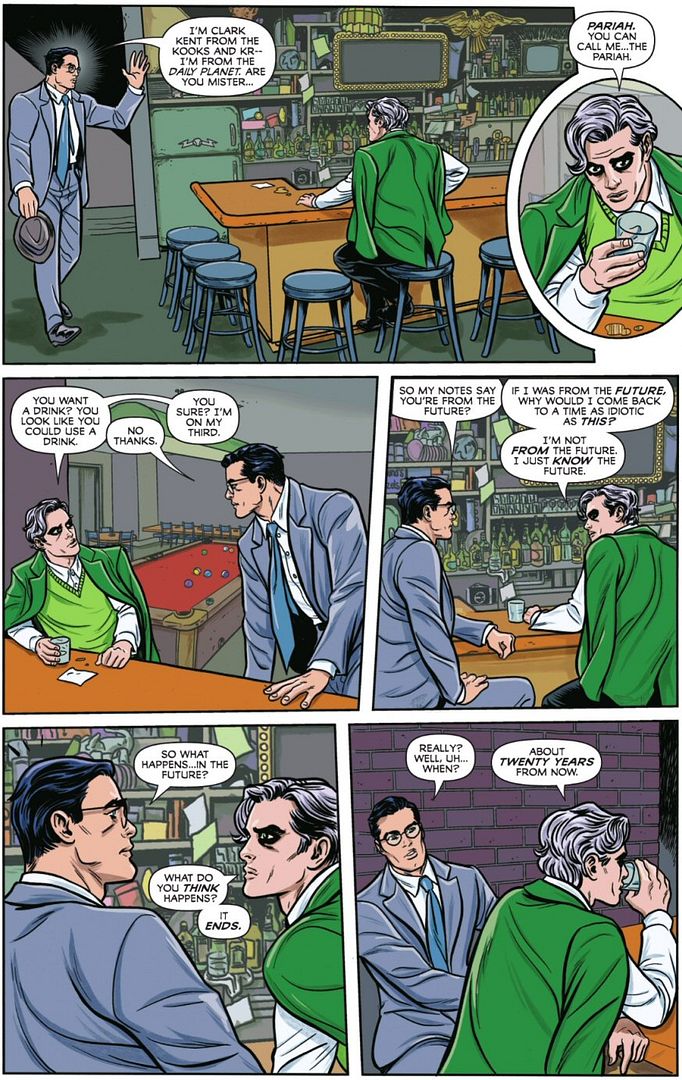
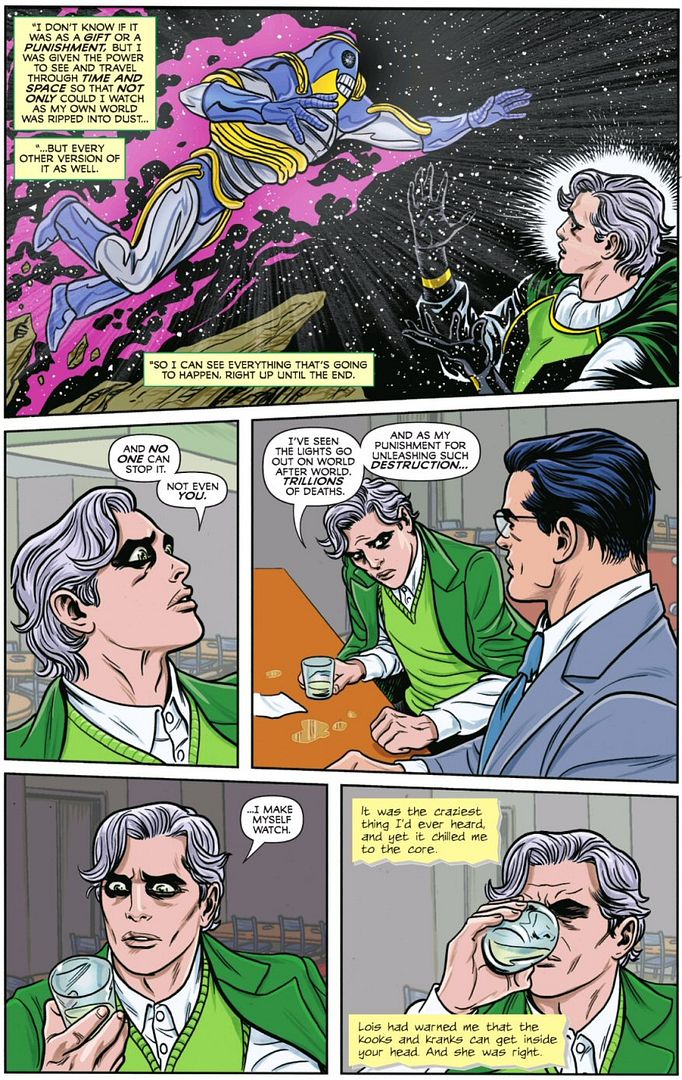
As an aside, I love how this series is cleverly drawn in the style of comics from that era (with kudos to Laura Allred for colors and Dave Sharpe for letters in a retro style).
With the Pariah’s warning, this series thoughtfully examines how knowledge of the future subtly alters the evolution of Clark’s normative ethics. The series actually opens by showing the destruction of his Earth in 1985 – indicating this Clark won’t prevent it – before flashing back and reliving the two decades previous. These opening pages also clearly show that this version of Clark turned toward virtue ethics far earlier than the main universe character. In addition to the narration, note the replication of the later Modern Age marriage to Lois and their child Jon, named after the grandfather (whom he clearly got to know on this Earth, from the framed photos):
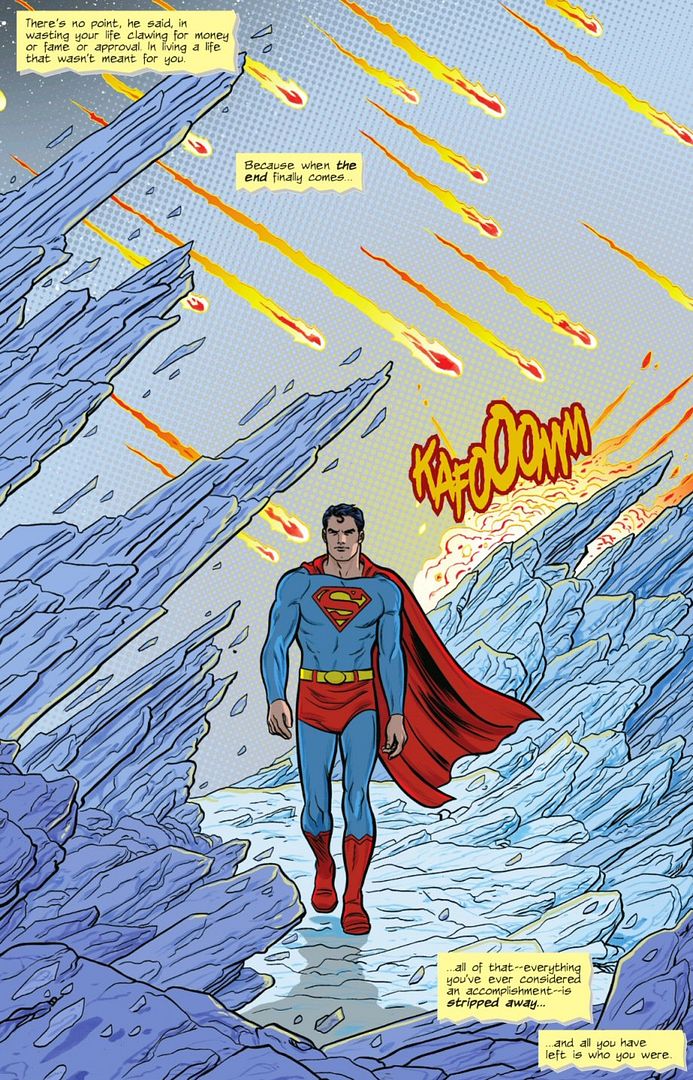
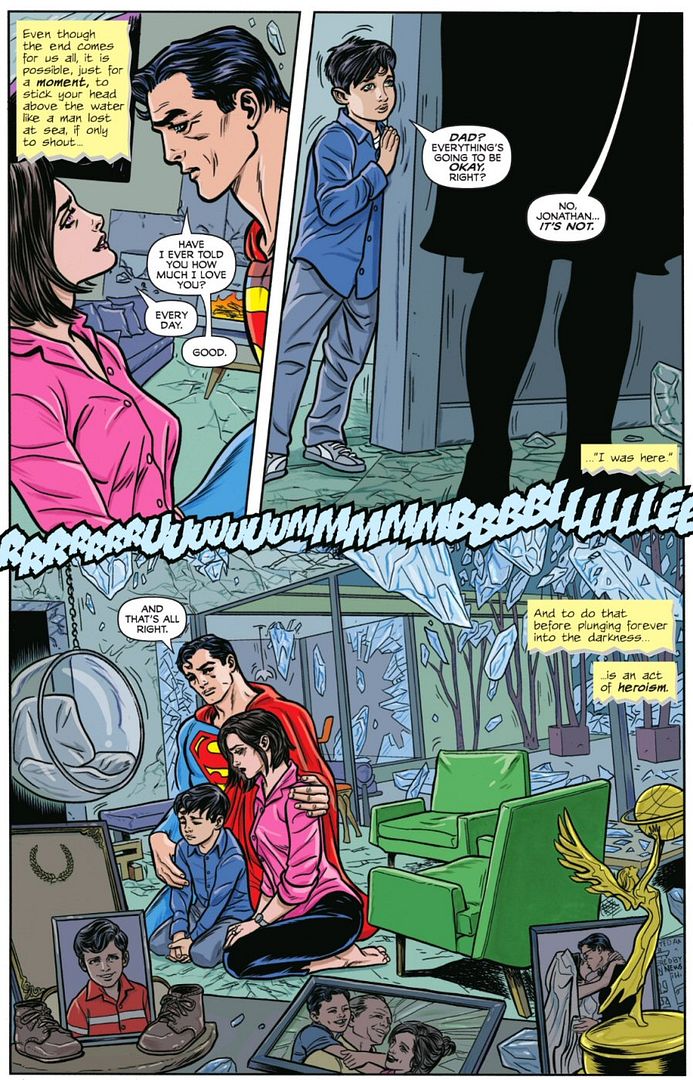
There is a lot of ethics to explore in how he got to that point above. Consider this early scene from issue #2 (2022), where Superman plans to ask Lois out on a date (right after fending off an Earth-shattering asteroid):
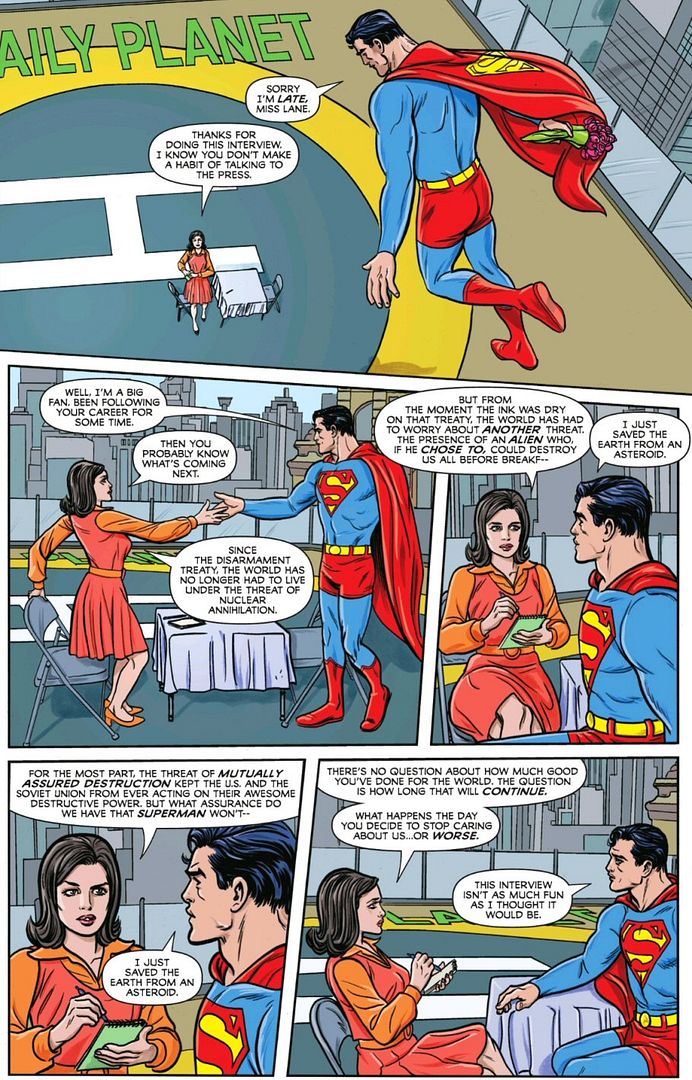
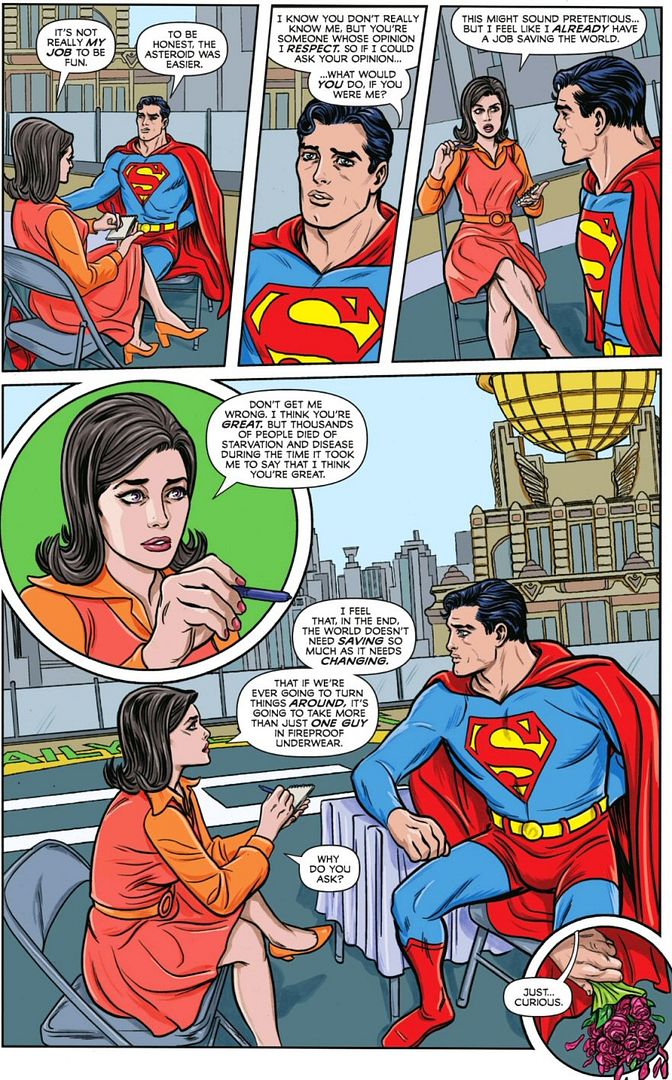
Interestingly, Lois is making the point here (much like Lex Luthor did in the recent DC K.O. event introduced above) that Superman is a risk to the world, and that the world needs changing not just saving. But unlike Lex, Lois is taking a modern perspective that acknowledges that changing the world takes concerted coordinated effort, not just one guy in a costume.
In this series, Clark has both of his fathers to rely on for moral advice – his Earth father, Jonathan Kent (there are numerous scenes of them together) as well as his biological father, Jor-El (through an AI representation):
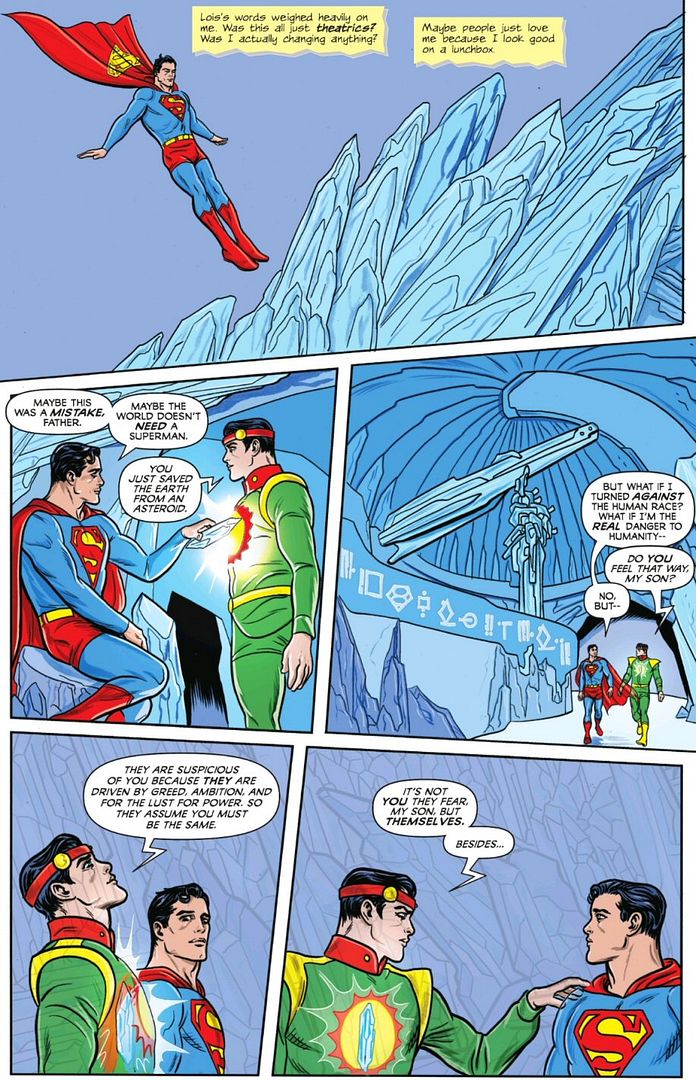
Yes, that assessment of humanity sums up Lex Luthor in a nutshell, doesn’t it?
This issue has a great depiction of the famous Trolley Problem thought experiment in normative ethics (as I explain on my Ethics 101 page). Note how the evolving ethics of this Clark have moved beyond the traditional deontological response to the problem:
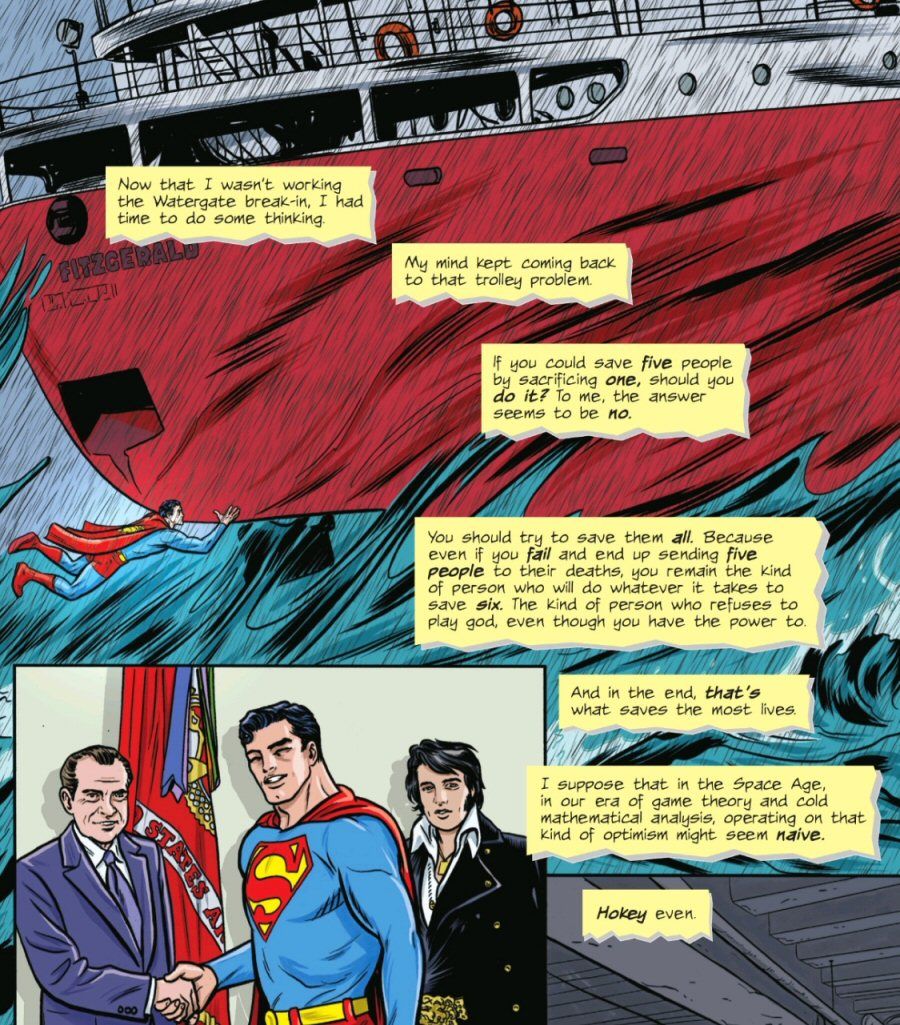
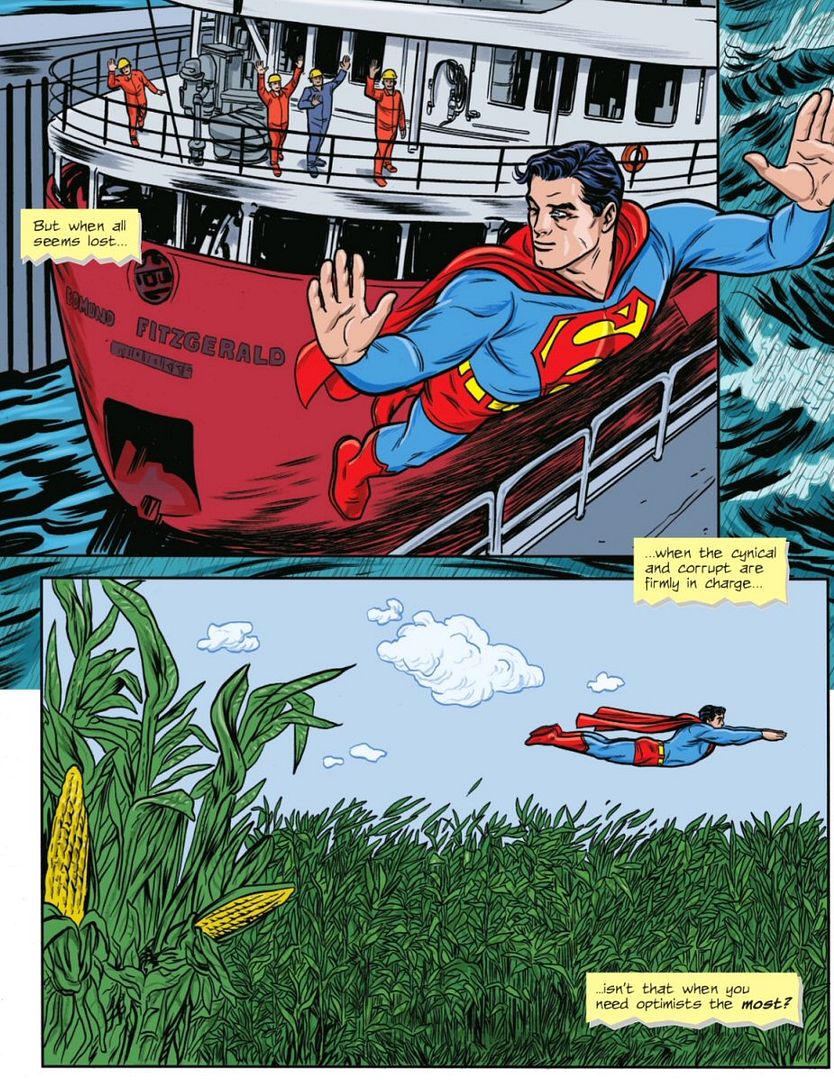
Russell is presaging both the turn to virtue ethics in the post-Crisis Clark (being “the kind of person” who does what it takes), and the eventual incorporation of optimism as a core virtue.
But I can’t help but notice the other part of Clark’s statement (“And in the end, that’s what saves the most lives”). That sounds very consequentialist to me. As I’ll explain below, most writers who explore consequentialism in Clark (typically safely in alternate universes!) find that it turns him into a dictator and a tyrant. But Russell seems to be channeling a very specific form of consequentialism that integrates some of the best aspects of deontology: rule utilitarianism. See my Professor X post for an explanation of this hybrid approach, and how it compares to the more common act utilitarianism.
You can see the evolution of Superman’s virtue ethics thinking in this series through his subsequent get-togethers with Lois:
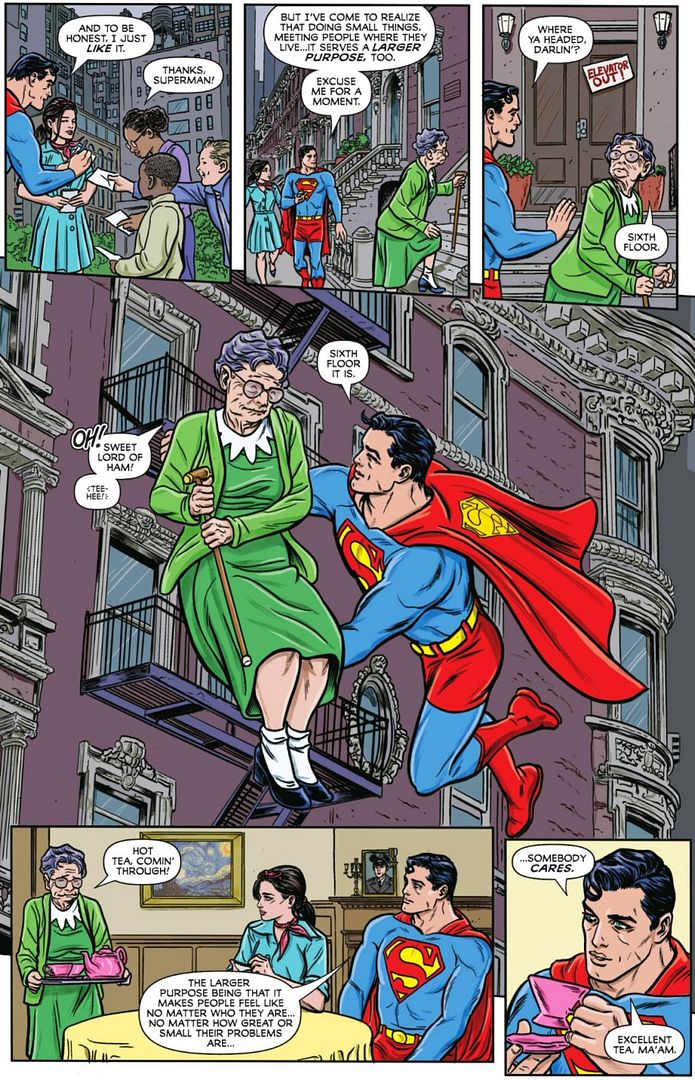
This reminds me of the relationship between suffering and personal growth in virtue ethics – which I described in my Battleworld post.
You also get this very interesting exchange on his vulnerabilities:
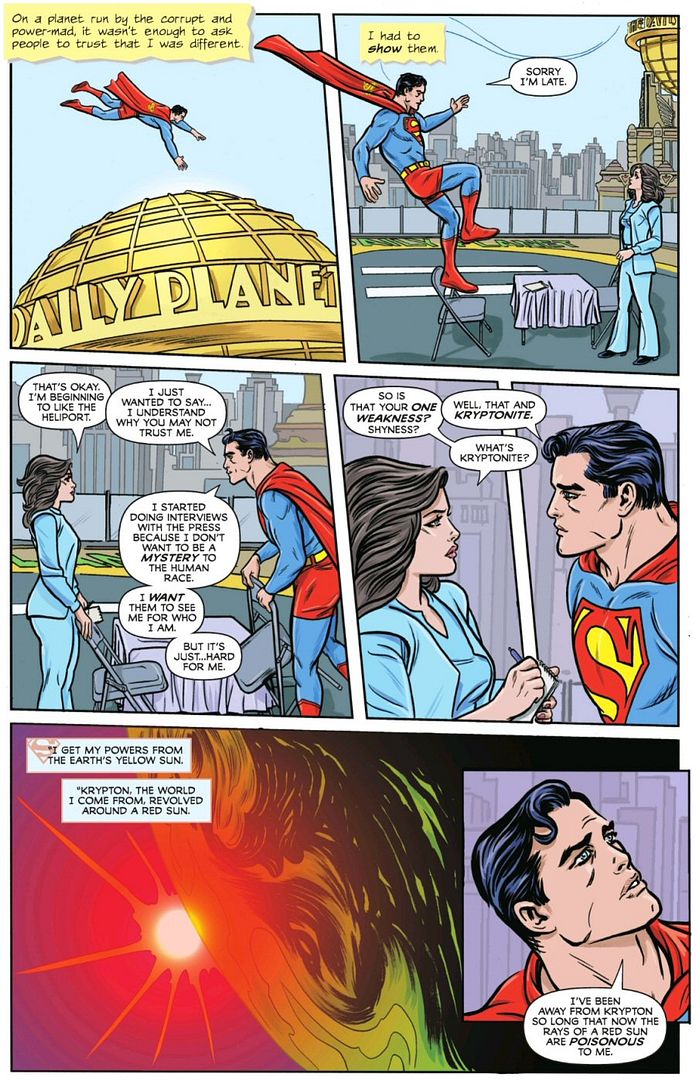
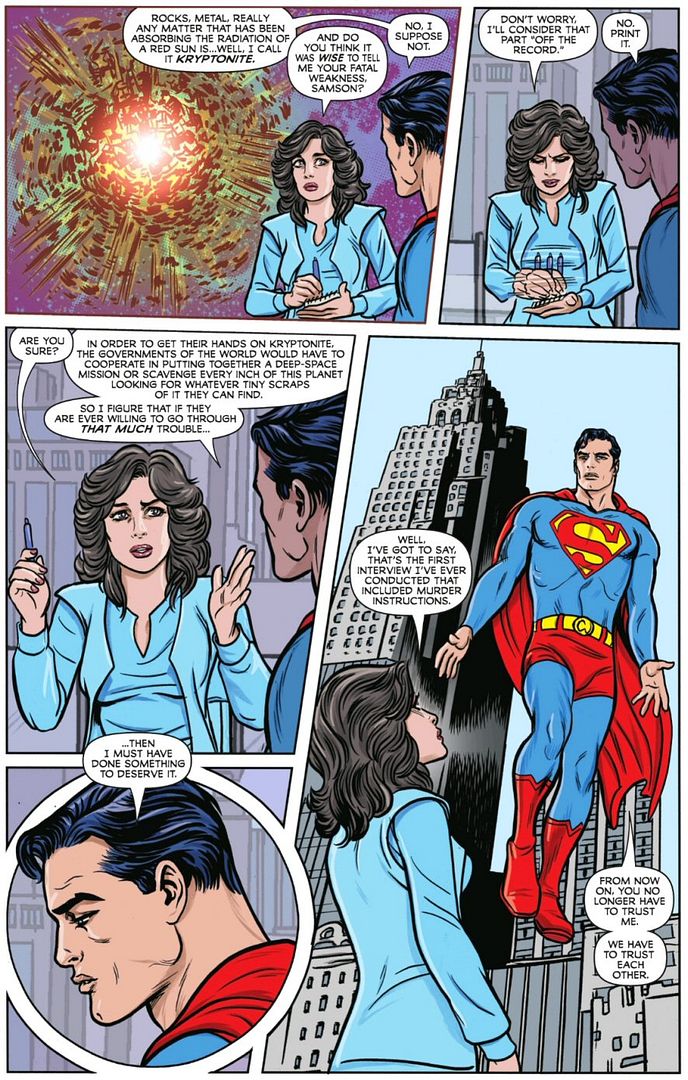
The concept of self-limitation is one I introduced in my Powers ethics overview, and explored further in my Secret Wars discussion. Basically, this can be a sign of deontological ethics, but I think his choice to publicly announce his vulnerabilities fits much better with Clark’s evolving virtue ethics in this series (and the comics, generally).
Of course, despite all his good works – and his commitment to Aristotelian virtue ethics’ eudaimonia in this series – his world is still coming to an end. From the final issue #3:
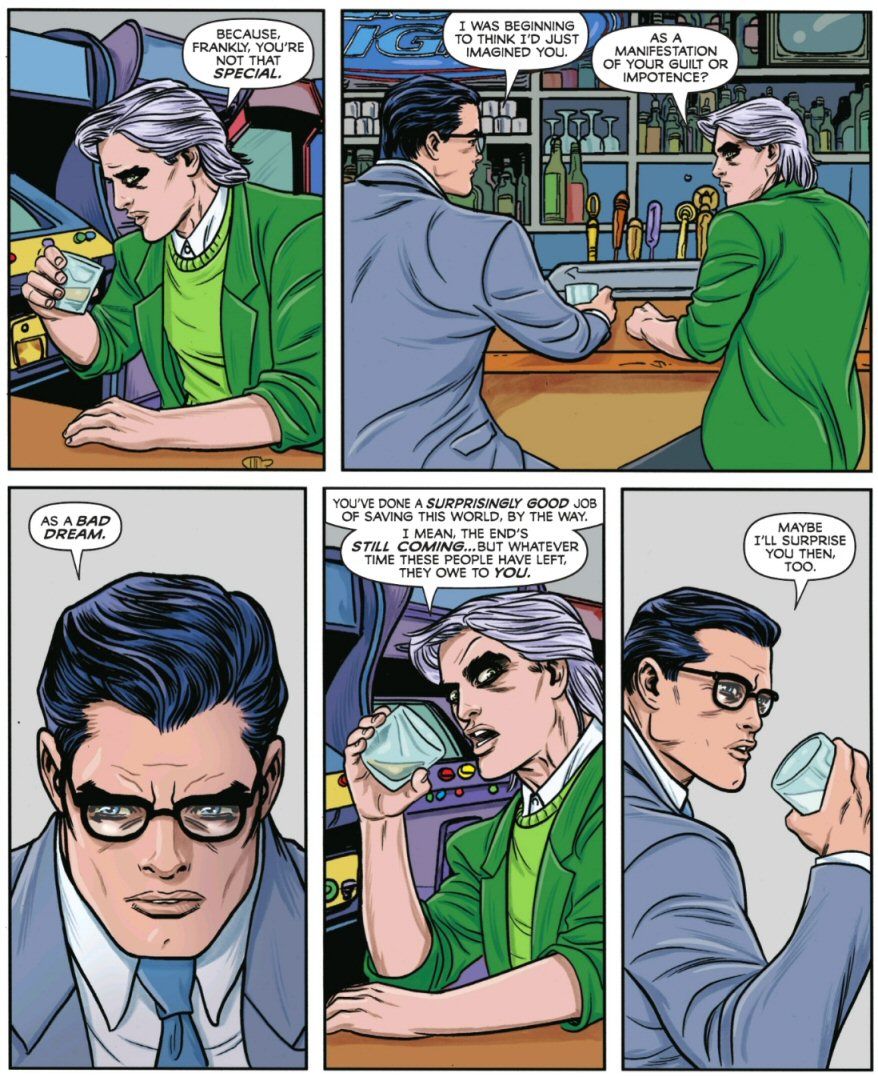
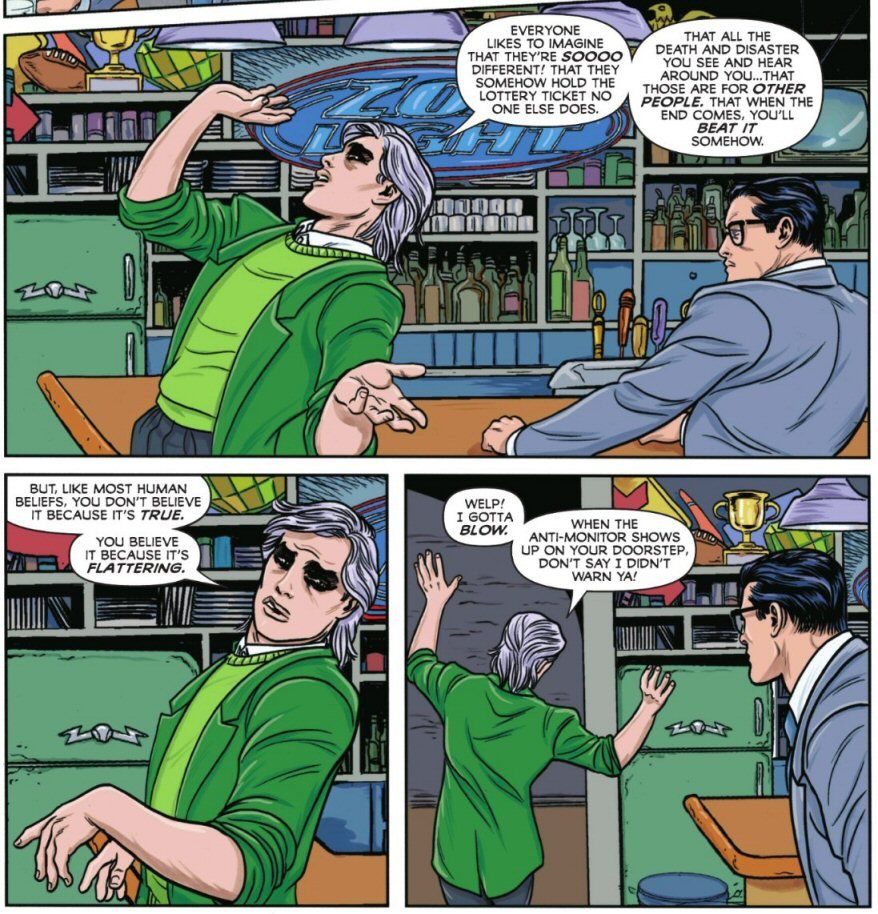
Again, Clark’s father is alive through most of this series (as with many later origin reboots), and there are several scenes where he imparts his virtue ethics perspective:
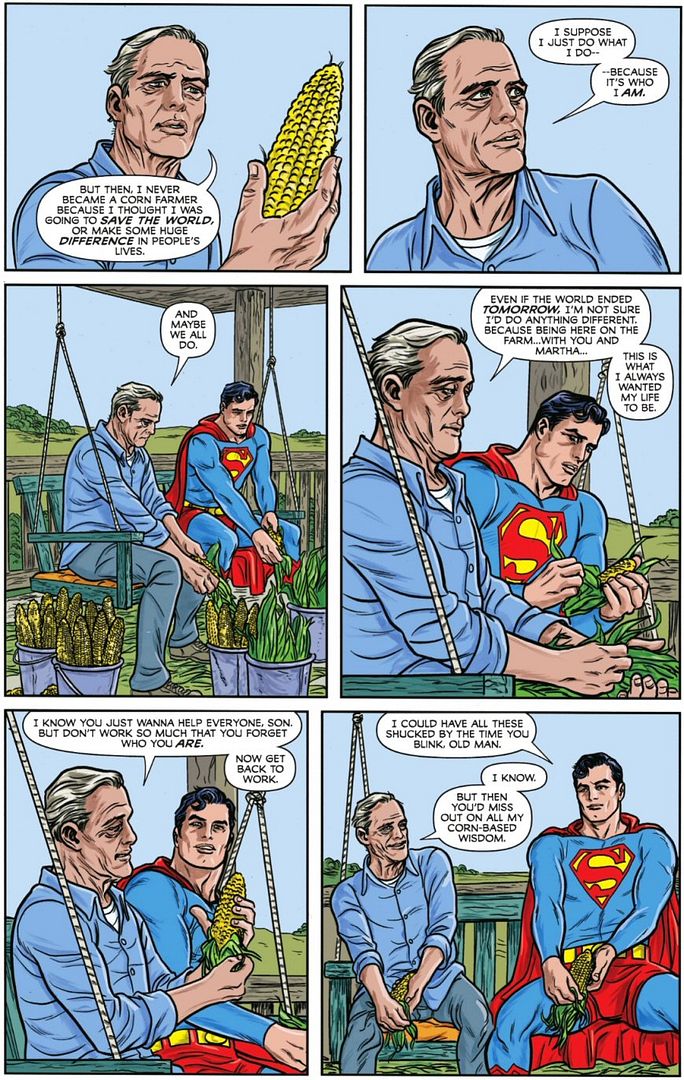
In the end, Clark comes up with an interesting solution for humanity:
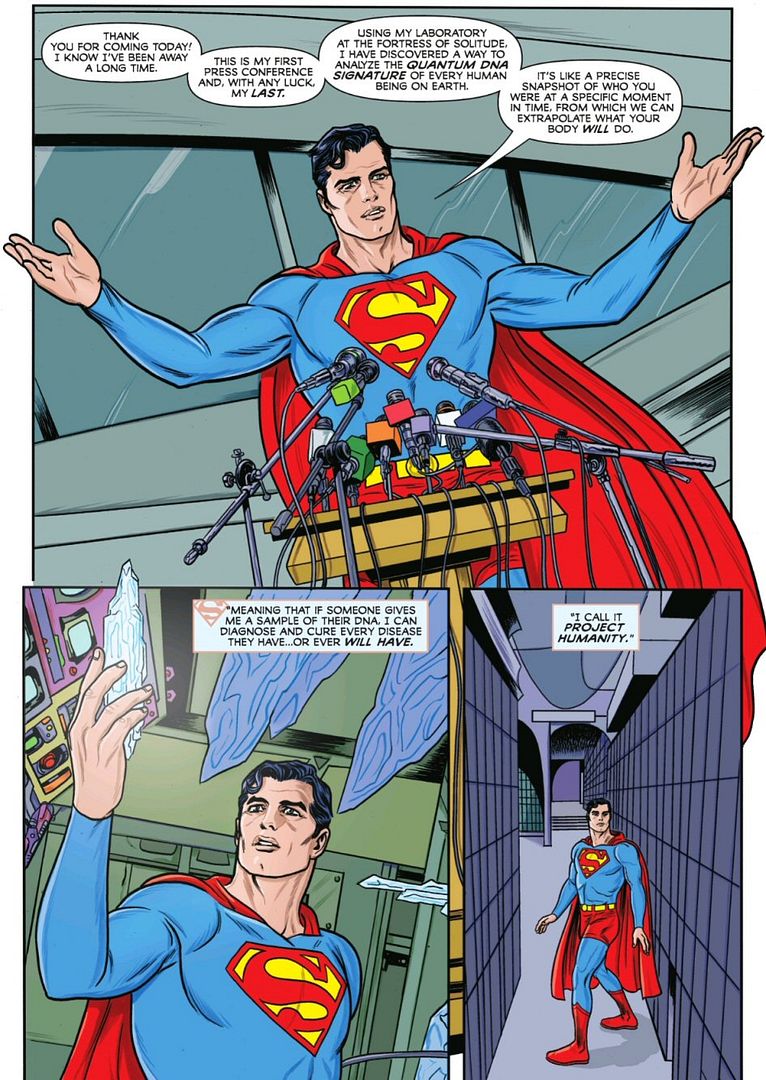
Clark has been given an opportunity by Braniac to survive the coming apocalypse of his world. But he has also learned that there is an Earth that will survive the coming Crisis – Earth-832654-Z – an Earth where humanity has killed itself off, but where a lone Superman still survives. And so, his creative virtue solution is interesting:
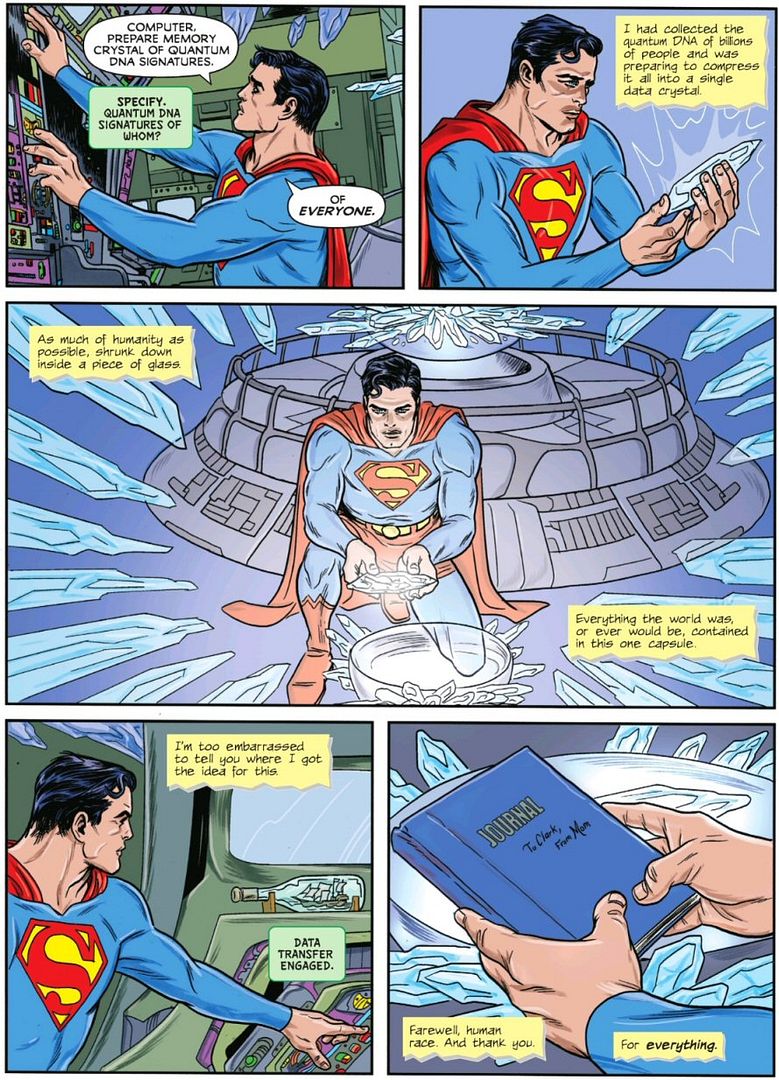
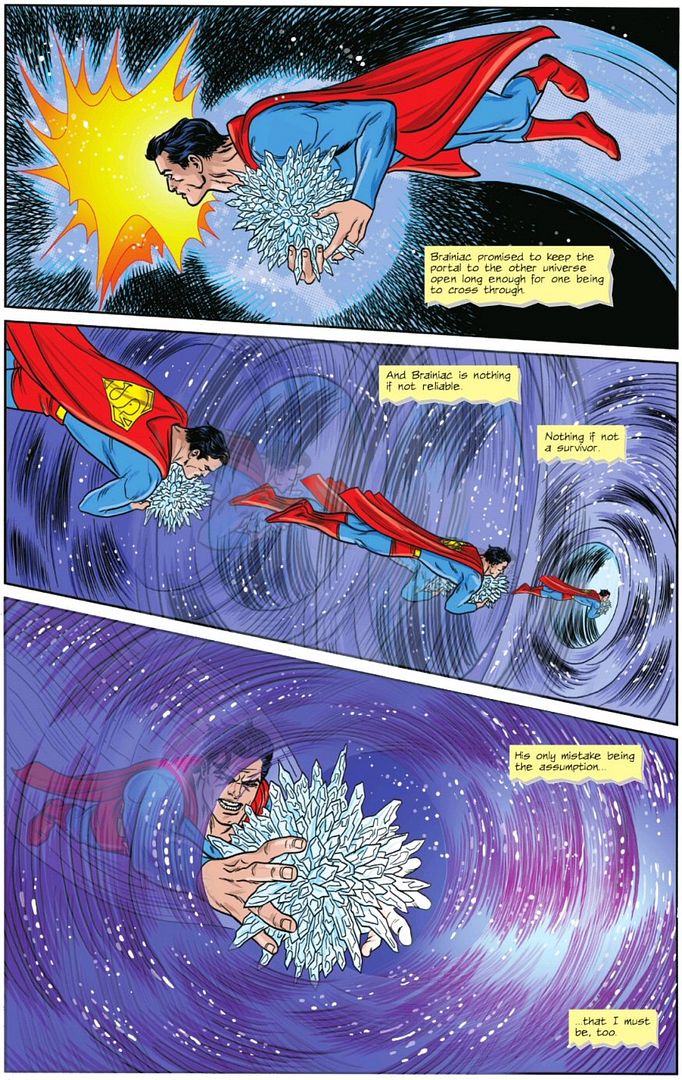
Clark chooses to return home and die with his world – having done his best to ensure the people of his world could be reborn on another, under another Superman’s care:
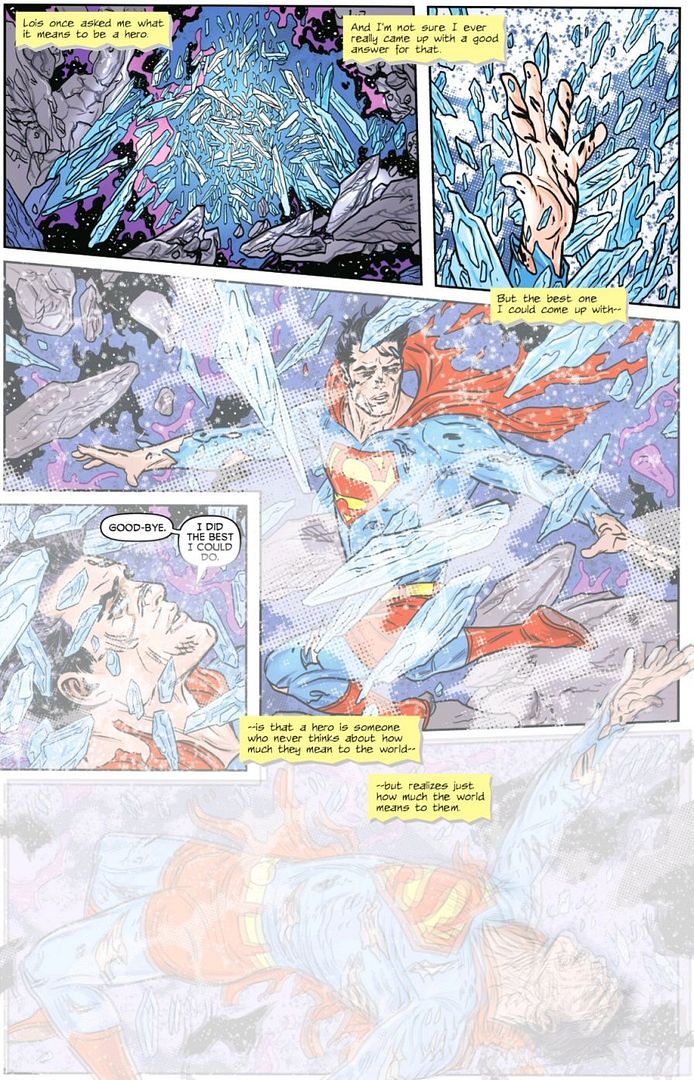
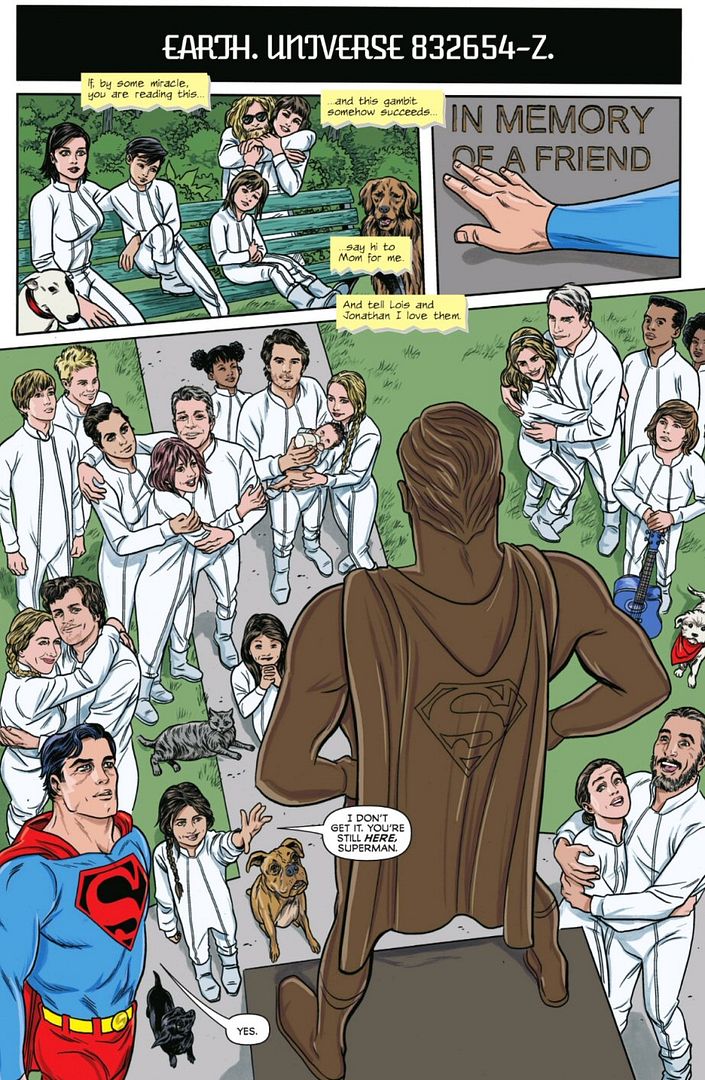
I’m impressed with how well Russell has encapsulated the larger multi-decade moral arc of Clark in such a compressed timeframe. A highly recommended series!
Consequentialism rears its head
Of course, it wasn’t all sunshine and roses for Clark in the post-Crisis era. Various writers began to explore consequentialism with the character – typically with disastrous results.
A good early example is the John Byrne Pocket Universe Zod story (Superman Vol 2, issues #21-22, 1988). Forcing Clark into a no-win scenario, he chooses to over-ride his no-kill rule and execute Zod and his associates to save the Earth. Clark is so traumatized by his actions that he exiles himself for a period, and then struggles with guilt longer-term. Eventually this leads to him enforcing an even stronger no-kill rule. But it’s important to understand that his renewed prohibition against killing is not because of a duty or a categorical imperative. Instead, he is now deeply uncomfortable with his own power, and the implications of it. He is aware of how easily his strength could turn into oppression and control. This is closer to the classic virtue of temperance (or potentially self-mastery) seen in Aristotelian virtue ethics.
Another example in more Modern times is Grant Morrison‘s run in Action Comics (2011-2012), as part of DC’s New 52. This run saw Clark return to his Golden Age roots, with its heavy consequentialist and social justice themes (note however that Morrison also wrote Clark in both Aristotelian and mythological terms in other series). A more stark example is the Injustice series begun by Tom Taylor in 2013 (and continued by Brian Buccellato until 2016). This series (taking place in an alternate universe) sees Clark take a dark totalitarian turn, highlighting key themes around how power corrupts.
Indeed, there many examples of creators riffing off Superman when exploring the abuse that power (especially absolute power) can bring. DC’s The Authority, created by Warren Ellis in 1999 and continued by many other famous writers up to 2021 (including notably Mark Millar, Taylor and Morrison), Brian Michael Bendis‘ Powers (2000-present), Robert Kirkman‘s Invincible (2003-2018), Garth Ennis‘ The Boys (2006-2012), and Mark Waid‘s Irredeemable (2009-2012) and Absolute Power (2024) series, for example.
Through stand-ins or alternate universes, many writers could thus treat him as a moral philosophy experiment. Taken together, a consolidated view seems to be that when a being of Superman’s power fully embraces consequentialism, he eventually turns into a fascist dictator (although a number of the above examples step back before falling into that abyss). Generally, it seems like most were arguing that deontological or virtue-based constraints were the correct choice in preventing a consequentialist catastrophe. However I would add that this generally requires virtue ethics’ constant vigilance and active practice (i.e., it is not some passive innate goodness). For those looking to pursue this idea further, a thoughtful examination of the attempts to “deconstruct” Superman’s moral character was published by Comic Club Live last fall (coinciding with the latest Superman film). It’s worth a read.
I’m not aware of anyone going down the rule utilitarian path with Clark – that should avoid the worse of the authoritarian impulses modern writers seem to ascribe to consequentialism (if anyone knows of such a series, please drop me a comment below!).
In any case, I would argue that Clark holding himself back – and the personal toll that takes on him – is now the revised central drama of the Modern Age character. It represents a genuine exercise of virtue against natural inclination – which is very Aristotelian.
Modern Superman stories
As mentioned in my introduction, I think Joshua Williamson (current writer of the main Superman series) and Scott Snyder (lead on recent DC K.O. event) get the character’s modern ethics well – and are helping to expand it.
Getting back to the DC K.O event (and those pages from issue #2 introduced above), Clark was initially reticent to agree to the heroes’ plan to attempt to restart the heart of Apokolips and have it crown a new King Omega from among them. From issue #1, by Snyder and Fernandez:
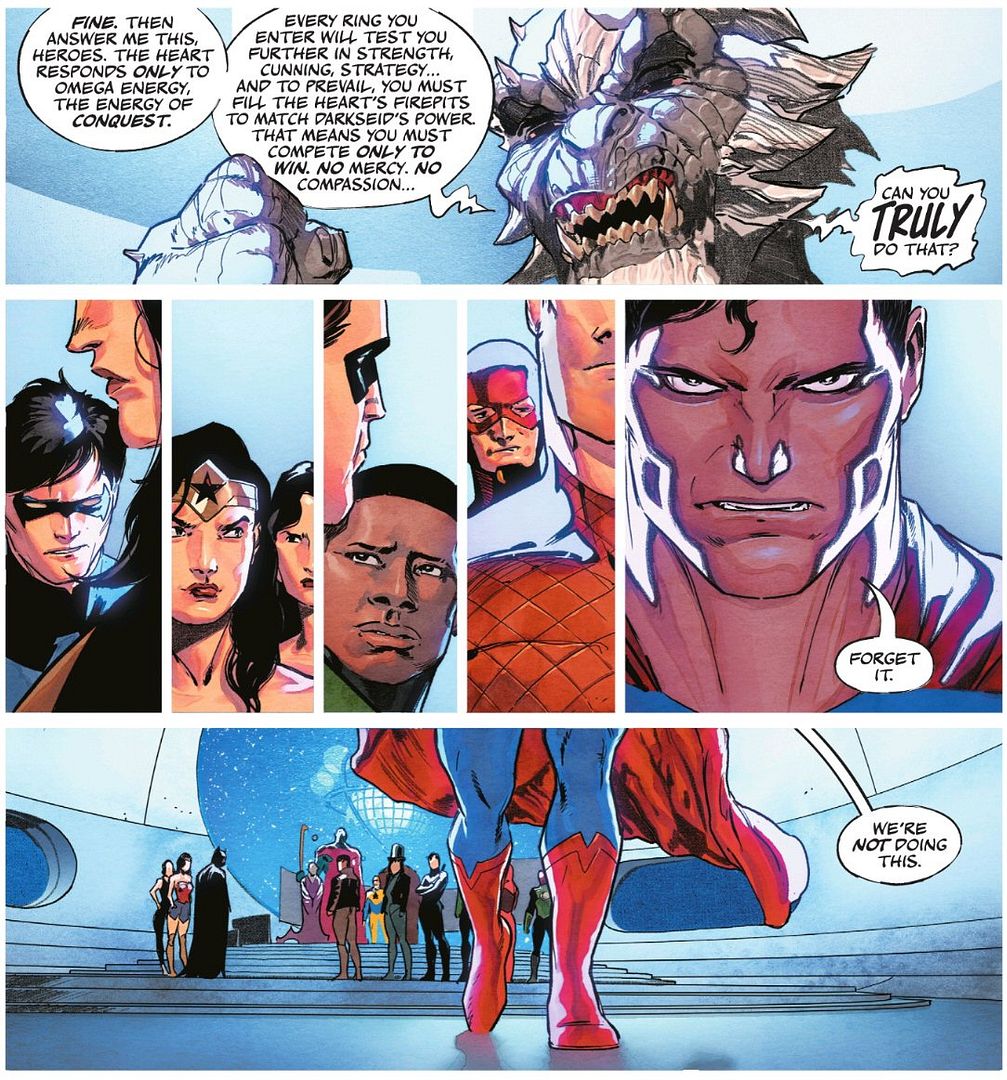
His friends help convince him:
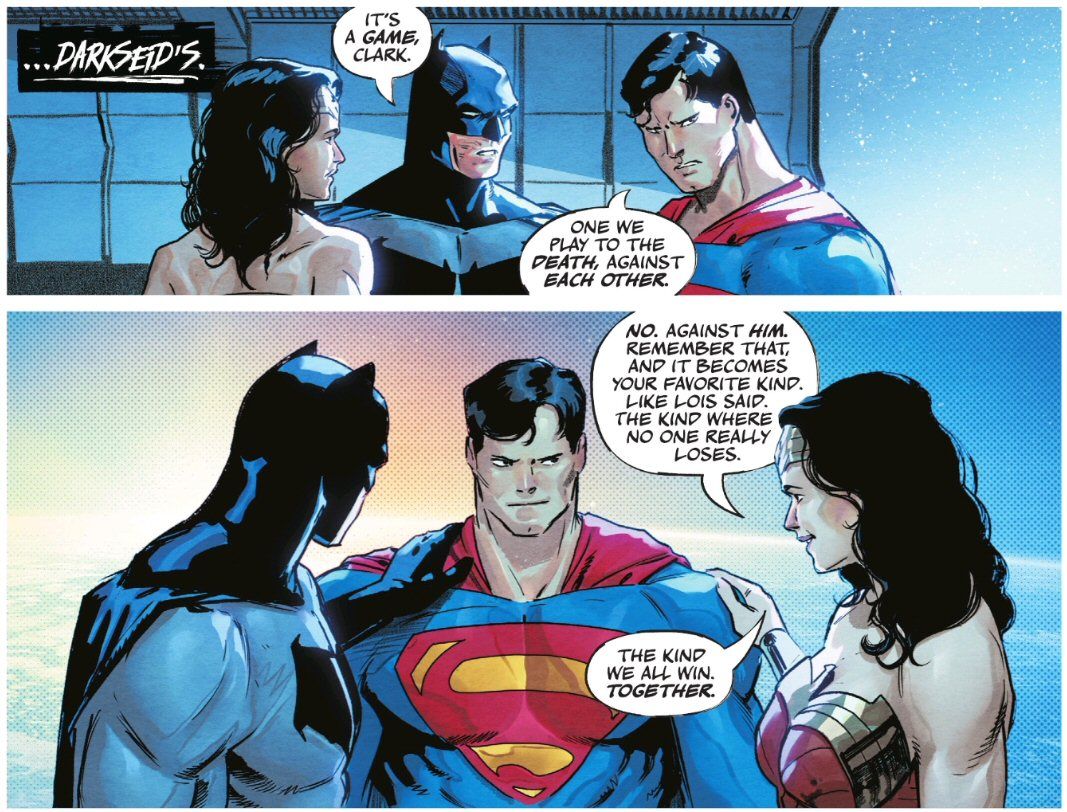
The game they are referring to is a superhero board game that Clark, Bruce (Batman), Diana (Wonder Woman) and Lois Lane were playing when the series first kicked off.
This “game night” party at Lois and Clark’s place is pivotal to understanding the ethics of the characters in the current time period – and these game night flashbacks are cleverly interwoven throughout the five-issue run of the DC K.O. event. These “interludes” were typically written by Williamson and drawn by Xermanico. Also from the first issue:
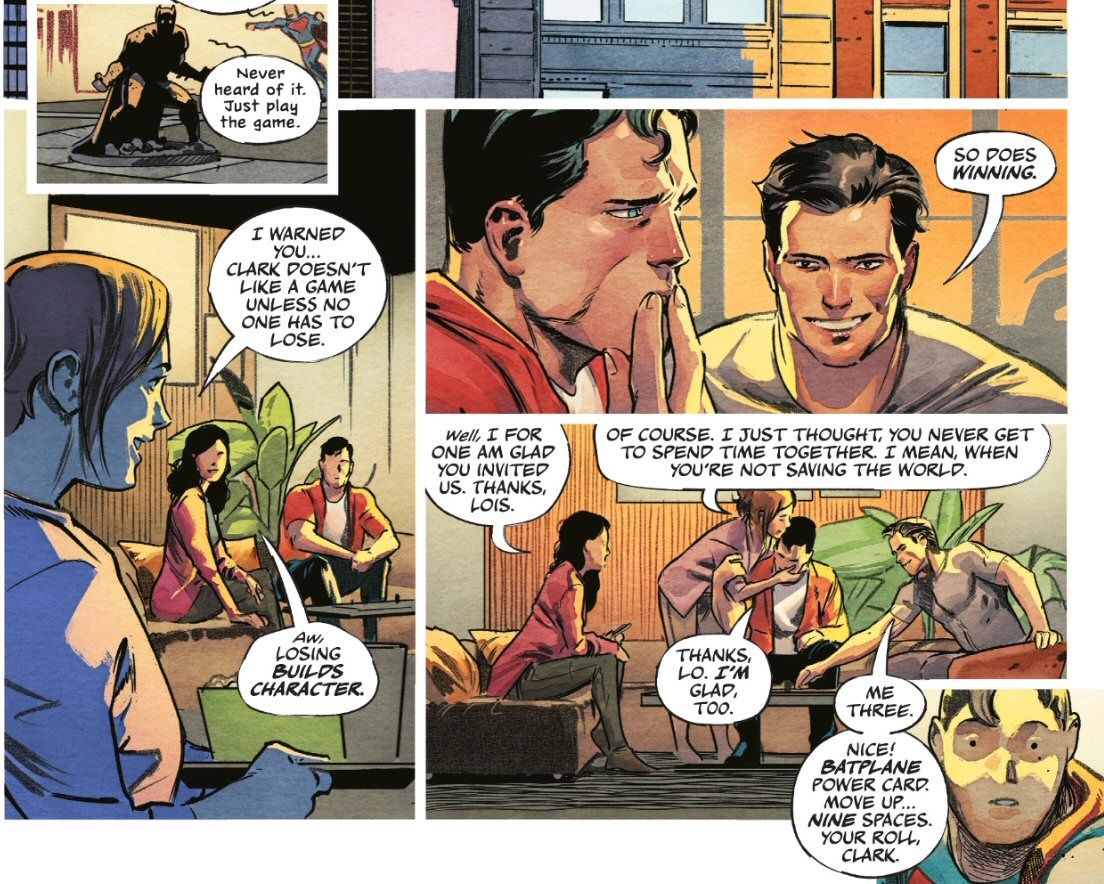
From issue #2:
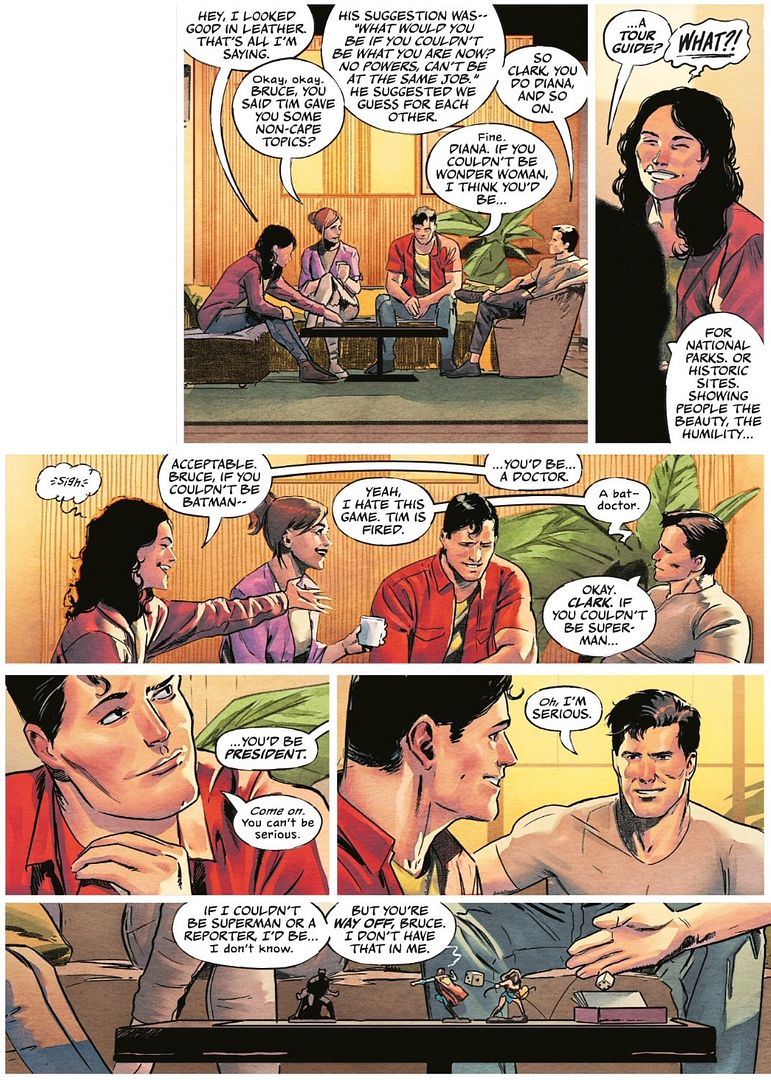
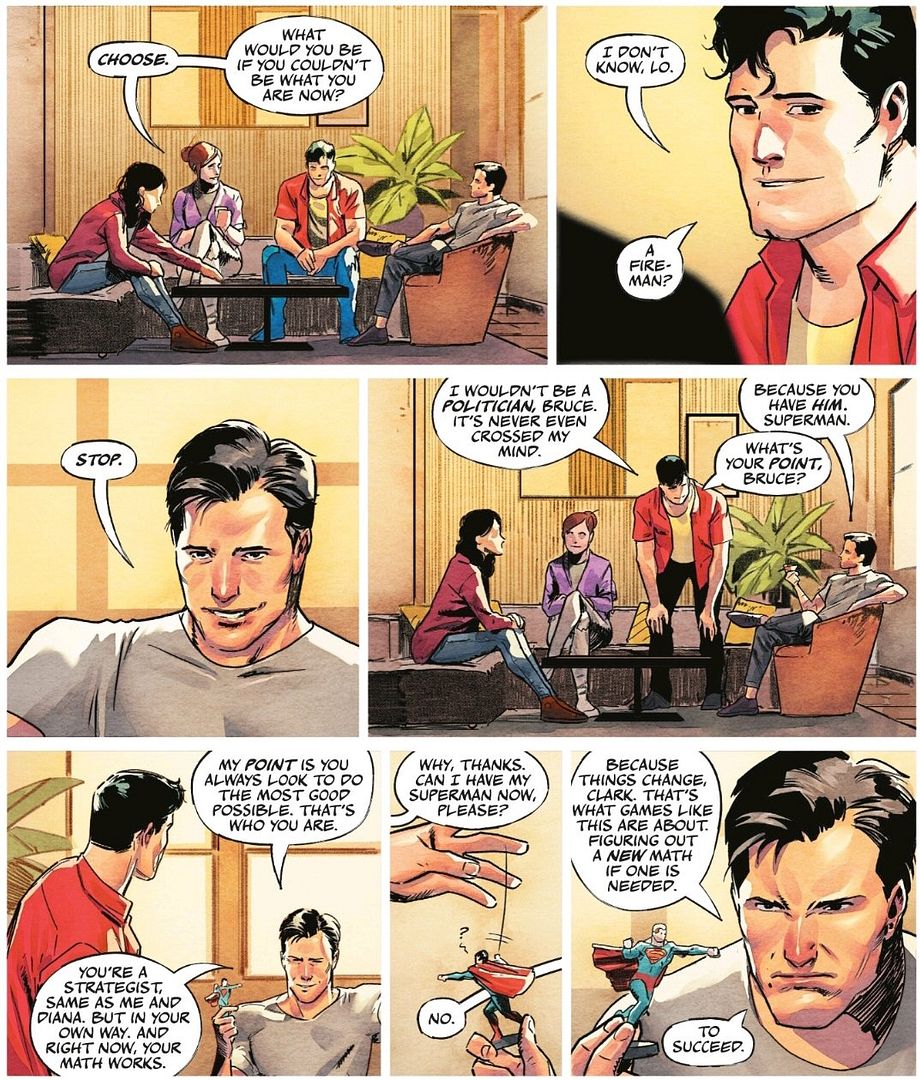
What I like about these sequences is how they show Clark thinks of himself differently from how the others think of him. In particular, he still seems to see himself in somewhat deontological terms, despite being firmly in the virtue ethics camp (for many decades in the comics). And not just in the classic Aristotelian form, but in a modern variant as well, as I will explain below.
A good example of what I am referring to is how hard Clark finds it to think of this tournament as just a “game”. Take these pages from one of the early event side issue battles, DC K.O.: Superman vs. Captain Atom #1 (2025), by Williamson with art by Sean Izaakse:
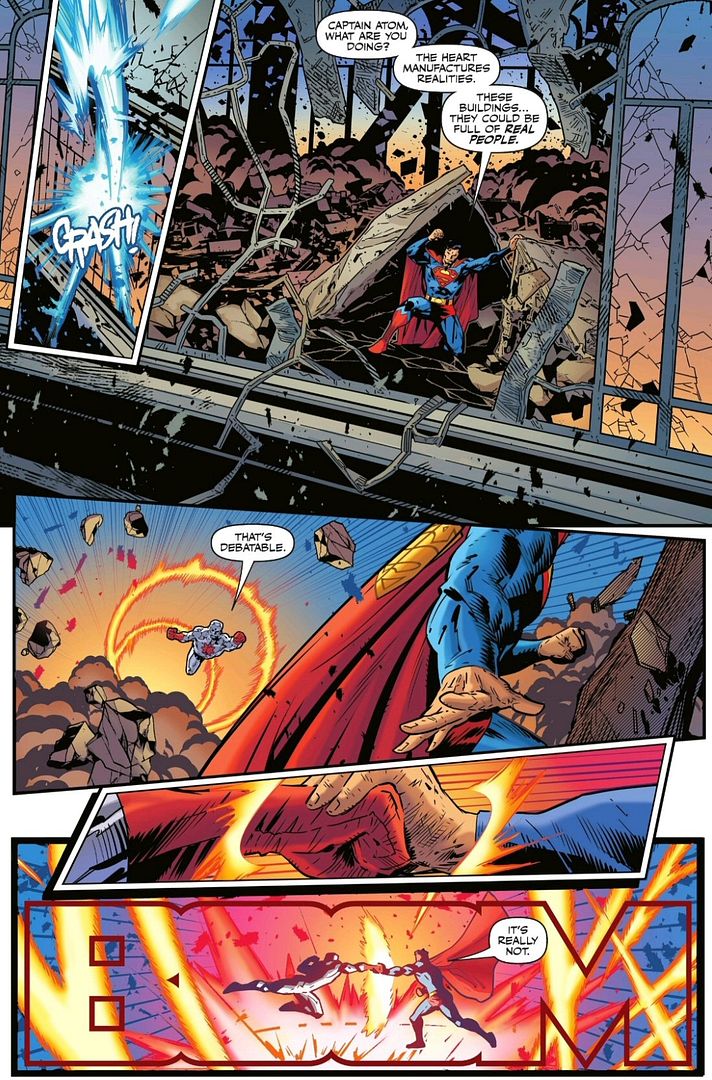
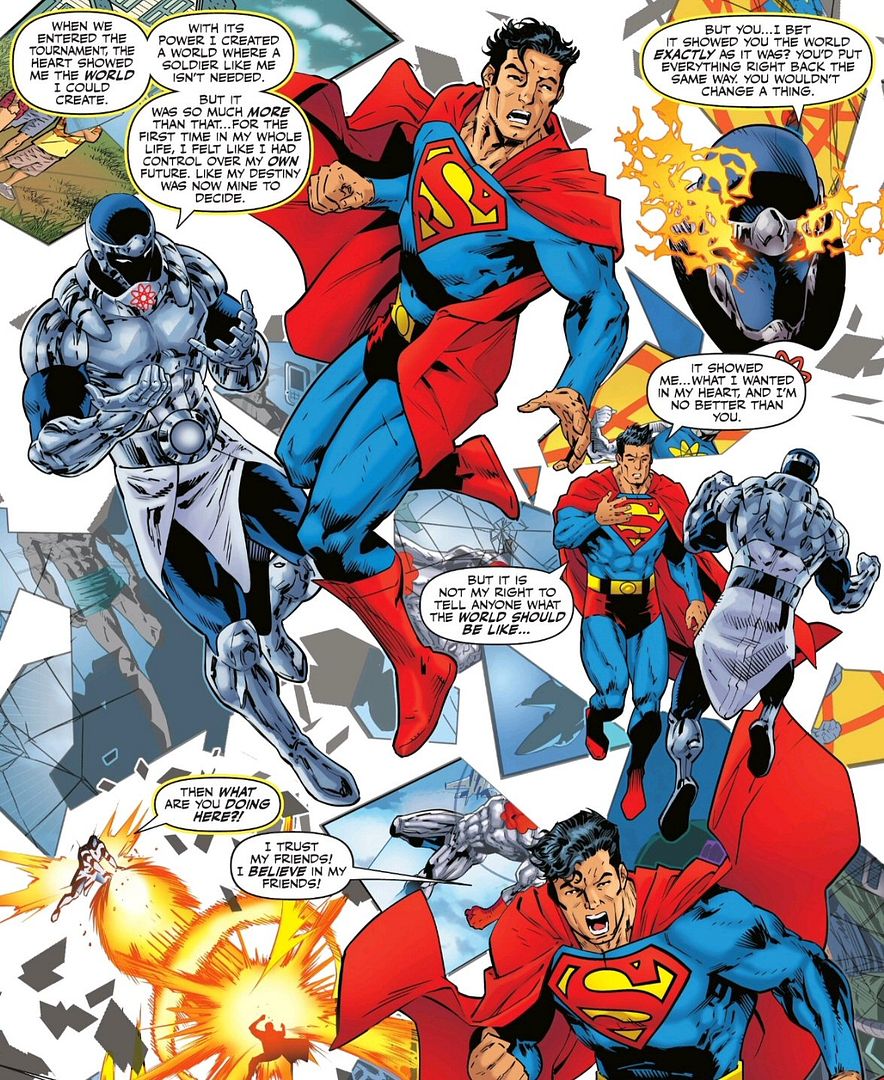
But it is not my right to tell anyone what the world should be like … I trust my friends! I believe in my friends!
This gets back to Lex’ criticism of Clark refusing to impart his vision on the world – which is at the heart of Clark’s character. But this exchange explicitly shows how the modern Clark (in Williamson’s and Snyder’s telling) shows strong signs of care ethics in his moral thinking.
Care ethics is a modern form of virtue ethics that holds that moral action should be based on interpersonal relationships and the duty of care we have to one another. It was originally developed by feminist thinkers in the 1980s, as a direct response to the heavily abstracted and universal ethics theories typically favored by men. While earlier ethics theories tended to emphasize generalizable standards and impartiality (inflexible Kantian ethics is a good example), care ethics emphasizes the importance of responding to the particulars of a situation and the needs of the individual. In essence, one has a duty of care to those you are in a relationship with, proportional to their vulnerability. See my detailed history and explanation of care ethics in my Can Caring be Wrong? post.
I find care ethics is increasingly common in modern comic books (check out my Glossary page for many examples). Note this philosophical view is something that Clark shares with Lois, as shown both in Williamson’s Superman Vol 6 run and in the DC K.O. game night sequences. For example, consider this scene following Bruce’s rather adamant consequentialist posture above (from issue #3, by Williamson and Xermanico):
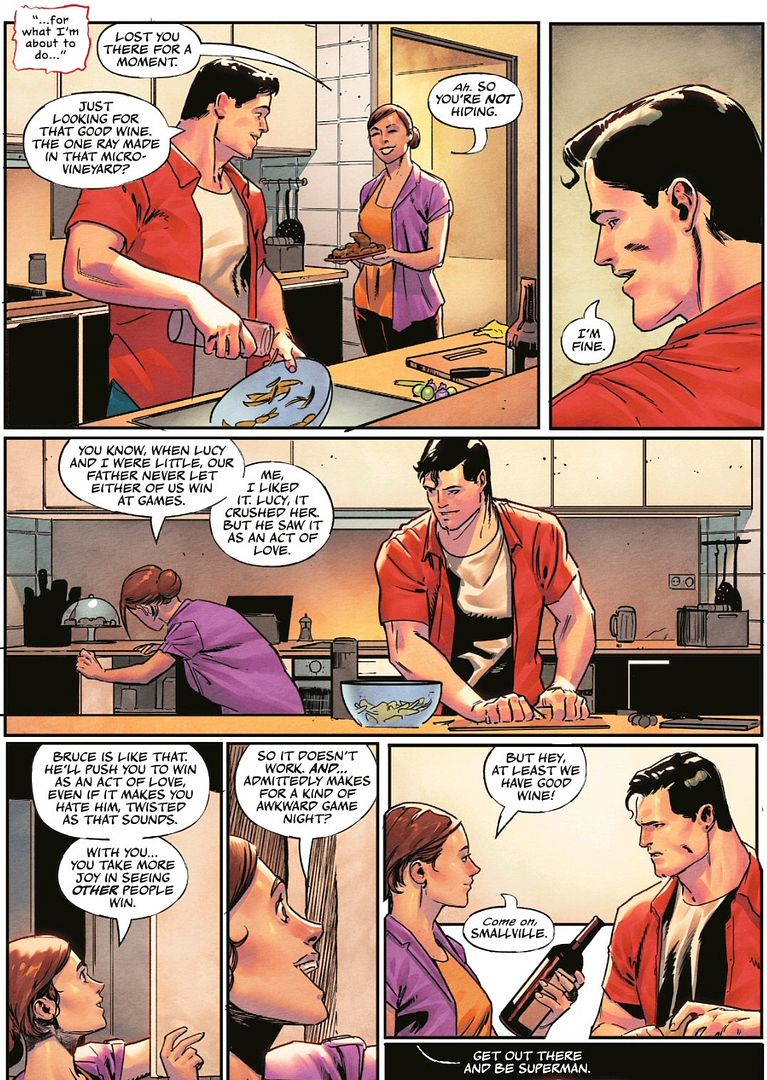
Like Lois, I would argue that care ethics is a big part of what currently makes “Superman” a hero in the comics.
As an aside, these interludes also capture the other characters well – such as this scene with the very consequentialist Bruce explaining how his abilities aren’t really cheating. From issue #4:
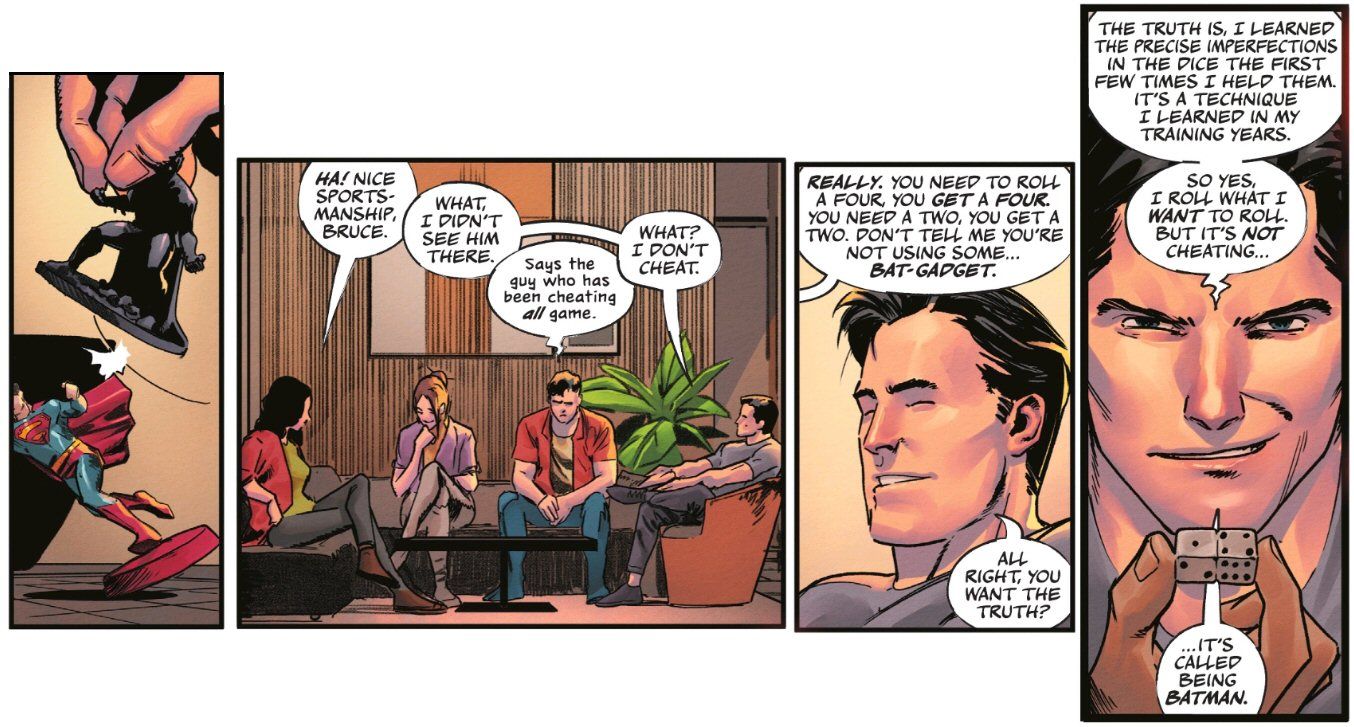
But probably the surest proof of the modern care ethics framing for Clark is his fateful decision in the final battle with Darkseid. From issue #5, by Snyder and Fernandez (with the heart narrating):
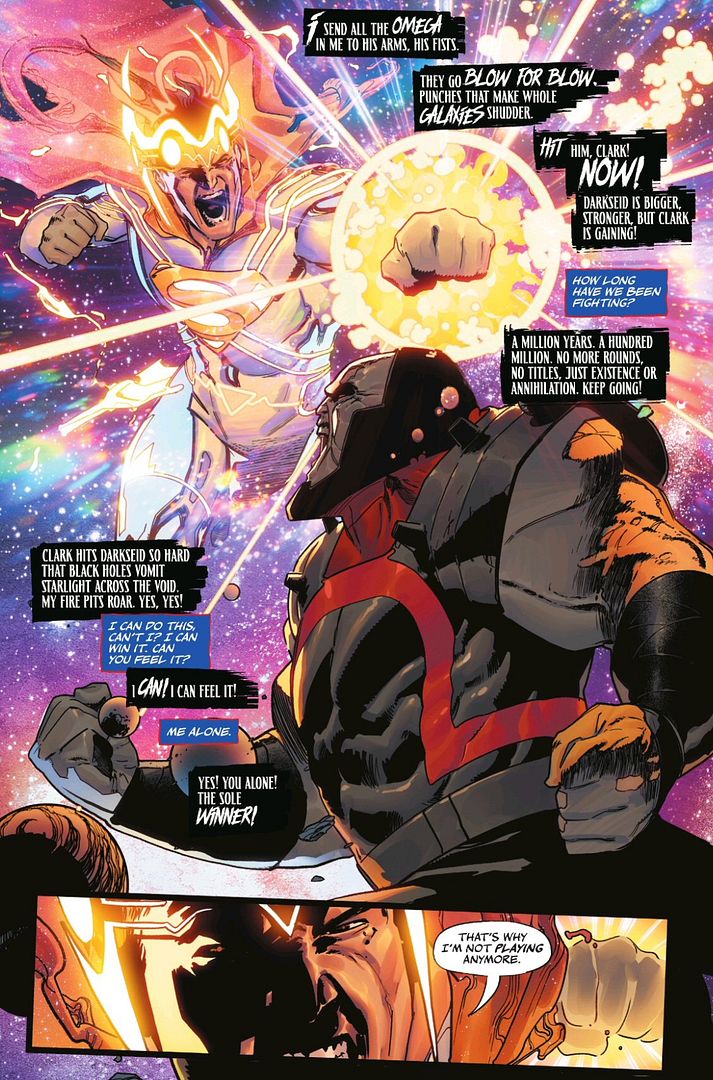
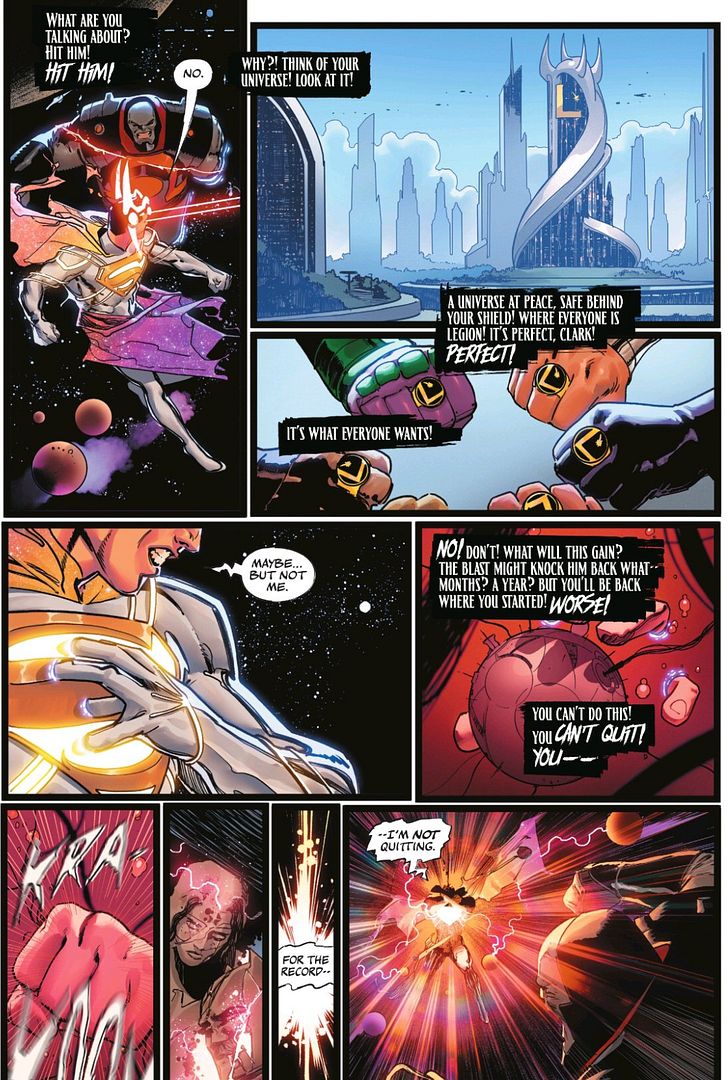
“I’m just tagging them in” – Clark frees all the other players from the tournament (who come to his aid), as he unwinds his “perfect” universe:
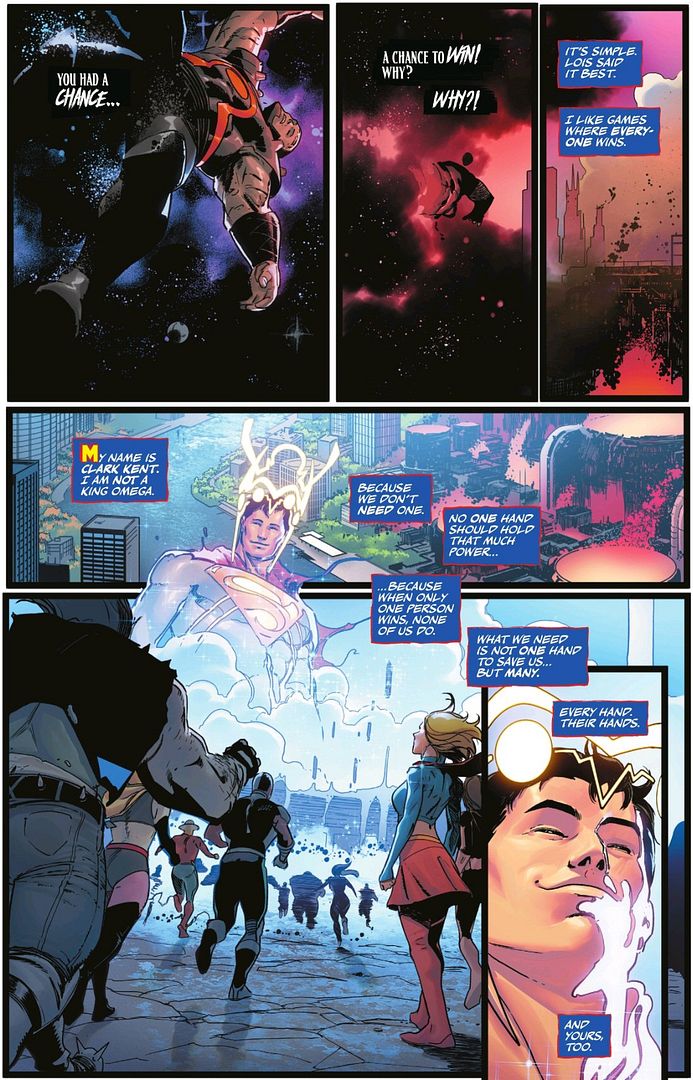
This hearkens back nicely to what Lois said to Clark in that Superman: Space Age series by Mark Russell that I presented earlier – it takes a village to change the world. And so for Clark, he chooses to restore the original universe, not his utopian version:
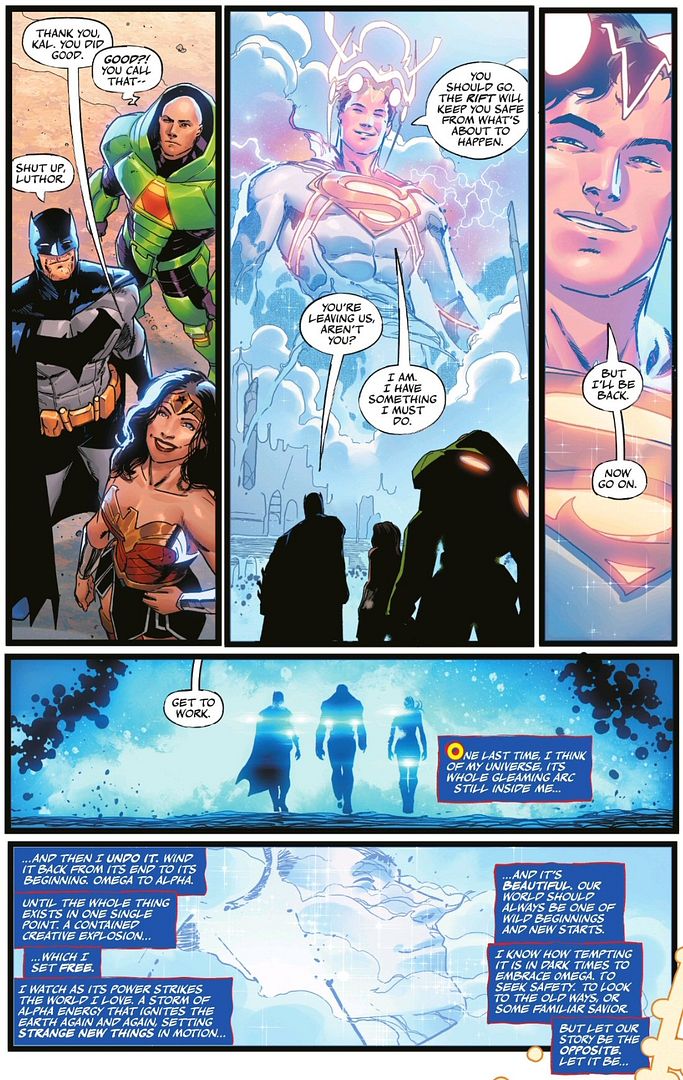
The DC K.O. event was a best-selling series, although I have seen a lot of consternation online around this ending. It seemingly restores the status quo, but leaves Darkseid in a very powerful position – and with a mysteriously disappeared Clark to boot (so, more questions than answers, and an obvious setup for the next event).
But for me, I think an under-appreciated aspect is how powerfully it shows that care ethics has been fully integrated into Clark’s moral character. It has made everyone – including Clark himself – aware of it. Again, consider how deontological Clark saw himself in both the early fight sequences and game night discussions.
Where we go from here is uncertain, but I like the direction Williamson’s Superman Vol 6 title has taken. With Clark away at the tournament, the concurrent stories in the main series largely focused on Lois (who had regained her own superpowers, it’s a long story) and an unusual choice for a Superman stand-in: Superboy-Prime.
Superboy-Prime was initially created by Elliot Maggin in 1985 for the Crisis event. “Prime”, as he is often simply known, hails from an alternate Earth that is just like our own real Earth – one where superheroes are only characters appearing in comic books (at least until his own Kryptonian powers emerged, shortly before Crisis). Prime is one of the few survivors of the Crisis event, although his reality didn’t make it (it has since been recreated, sort-of). This reality is known as Earth-Prime – not to be confused with the current main DC reality known as Prime Earth (consistent nomenclature is not one of DC’s strong suits!).
Prime functions a bit like Gwendolyn Poole in the Marvel universe, but with one key difference: Gwen is a humorous stand-in from our world, whose main abilities are flaunting her knowledge of the heroes’ secrets and wryly observing familiar comics tropes. Prime, in contrast, is an extremely powerful character (think peak Superman from the 1970s), and one that was eventually written to represent toxic fandom – angry that this new world’s heroes don’t live up to his idealized standards (at least in his modern return since Geoff Johns‘ Infinite Crisis in 2005). Prime’s character arc is one of a superhero-turned-supervillain, who has been finding his way back to being a superhero again through a redemption arc in recent years.
From Superman Vol 6, issue #34 (2026), where Prime is talking with a Superman robot copy that he revived to help him battle Darkseid’s forces (by Williamson with art by Eddy Barrows and Eber Ferreira):
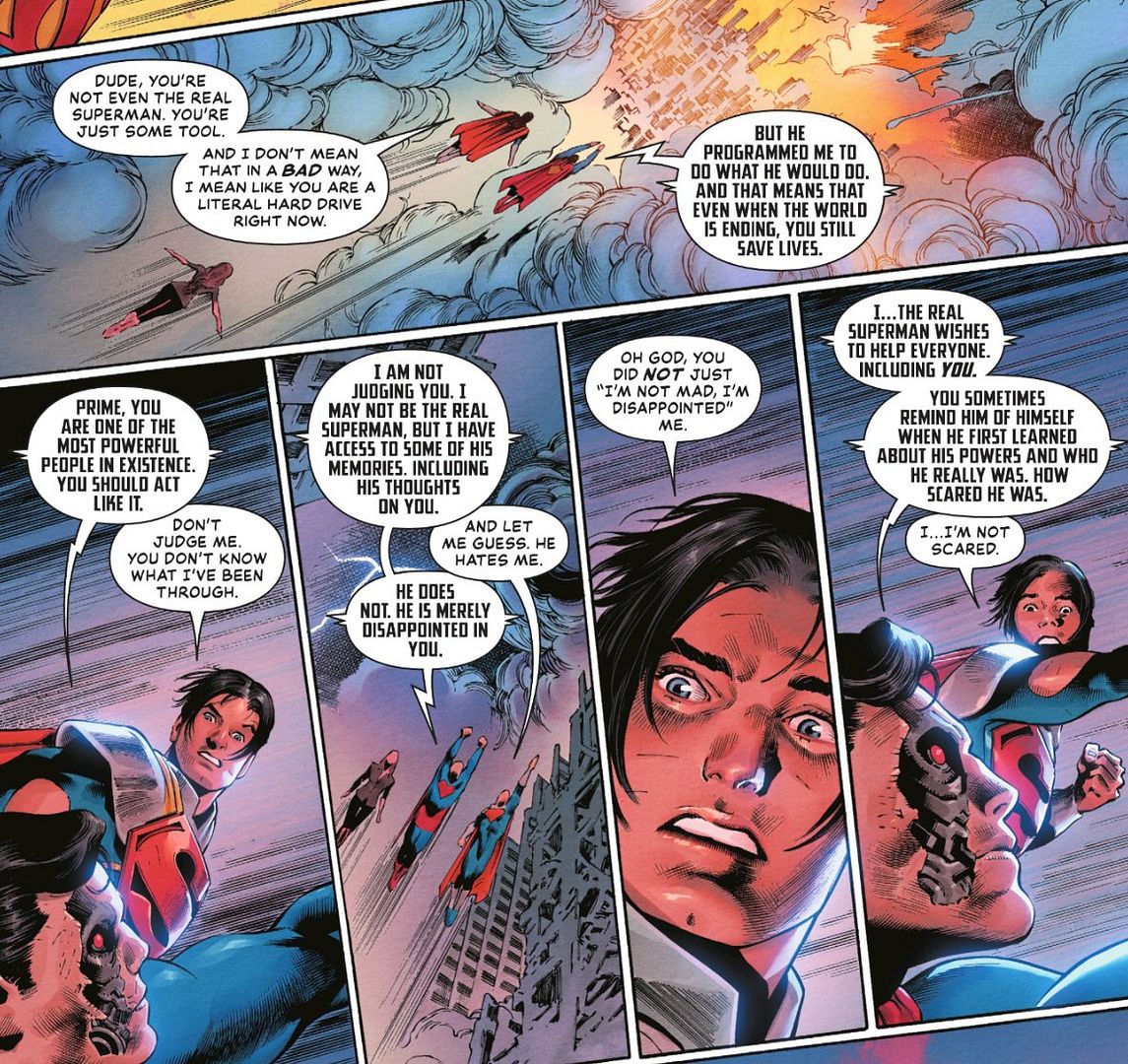
The next issue ended on an interesting perspective, as Lois reunited with the Kents. From Superman Vol 6, issue #35 (2026), by Williamson with art by Barrows, Eber Ferreira, and Julio Ferreira:
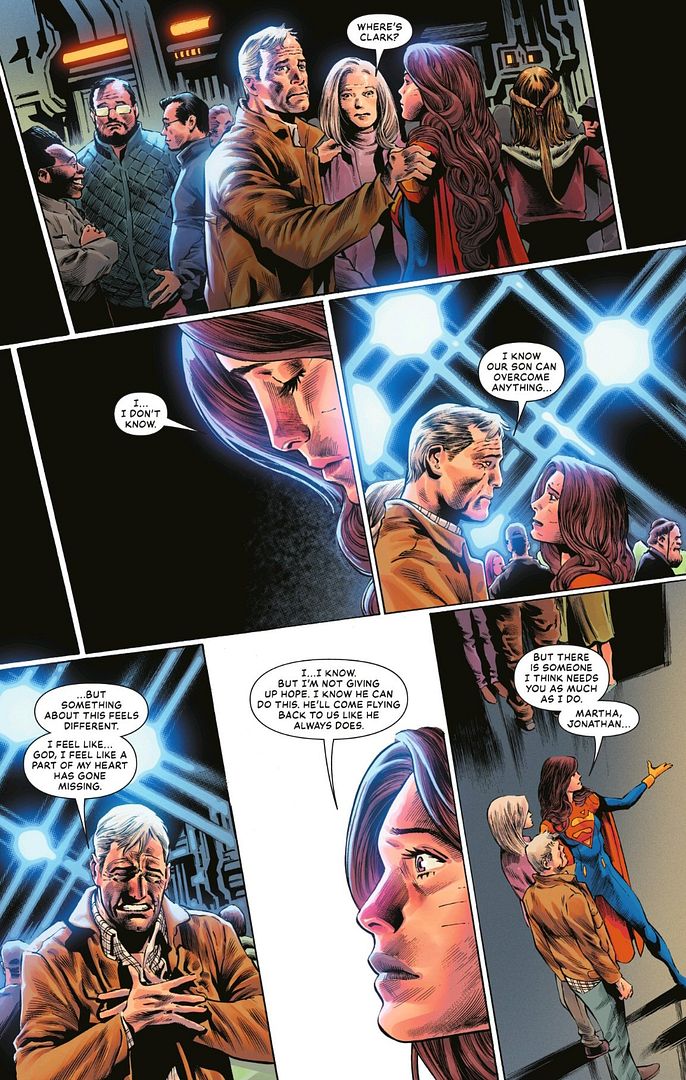
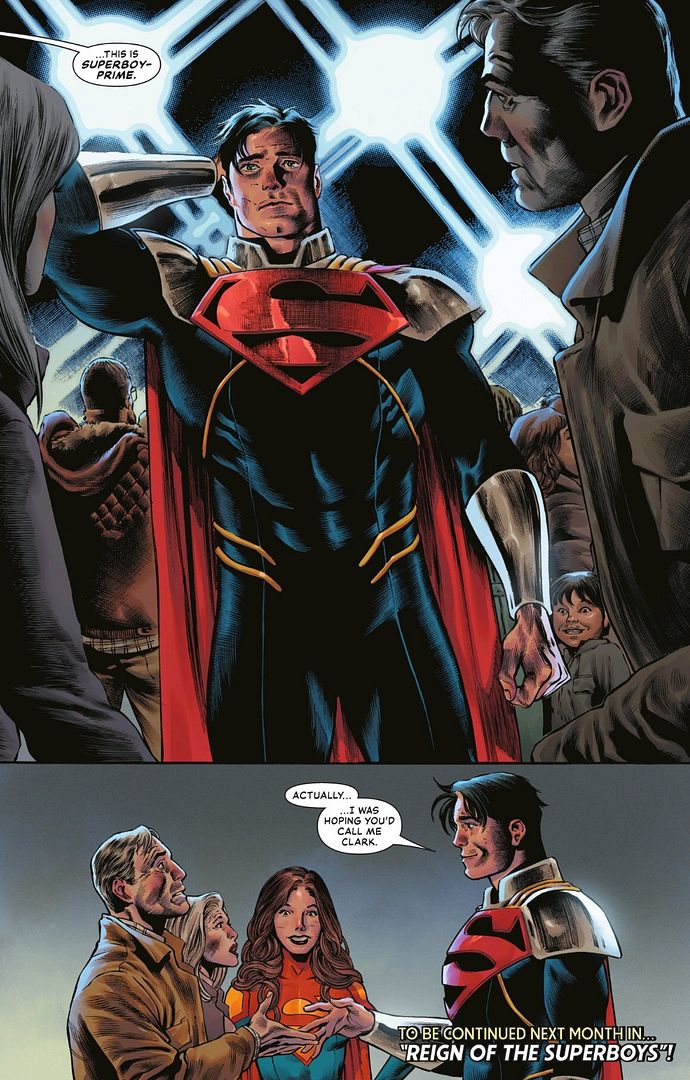
And thus the wheel comes full circle! Just like how the continued existence of the Kents originally marked the shift of Clark from deontological ethics to Aristotelian virtue ethics, Prime will now have the same opportunity that Clark did. And with “his new BFF” Lois – with her characteristic modern care ethics perspective – at his side.
To my mind, this is a great legacy to the DC K.O. event, and I look forward to the future adventures of Prime and Lois in the main title, whilst we all await Clark’s return (from where ever he has gone).
Current overall ethical framework: V/d


As explained above, Clark has gone through several major ethics changes over the years – from consequentialist in the Golden Age, deontological in the Silver/Bronze Age, and virtue ethics in the Copper through Modern Age. Although originally very classically Aristotelian in the Copper-early-Modern Age stories, I have found the recent stories show a lot more care ethics. Various modern (mis)adventures with consequentialism generally occurred safely hived-off in alternate realities (or independent series with Superman-like characters).
Although it’s been 40 years of primarily virtue ethics framing for the character, his deontological traits still come through frequently in the modern stories. And so, I think it’s most appropriate to consider him a V/d for now on my superhero description system.
Again, the purpose of this site is not to provide a definitive normative ethics framework for any character. Rather, I’m seeking to show how superhero comics stories reflect the changing views of ethics in society and culture over time.
The last word … for now
As I mentioned in my introduction, Clark’s ethics are a real challenge to capture concisely given all the creative hands he has passed through in nearly 80-year history. I can’t comprehensively cover all the major story lines (and there are bound to be disagreements on what those even are). Instead, I’ve focused on certain key time periods above to show the major shifts in ethics for the character, and highlighted just a few of the creators behind those shifts. Please don’t take my lack of inclusion of any favored creator as evidence of exclusion – it more likely reflects my limited awareness of their work. I apologize for any significant omissions!
I would like to end with a few scenes from Mark Russell’s other Superman series – this time as part of the 2021 Future State event (looking at a possible future world). In Future State: Superman vs. Imperious Lex, we have a good comparison of Clark and Lex’s word views later in their lives.
Consider this early scene where Clark is recounting a battle with some resource-extracting robotic marauders designed by Lex. From issue #1, by Russell with art by Steve Pugh:
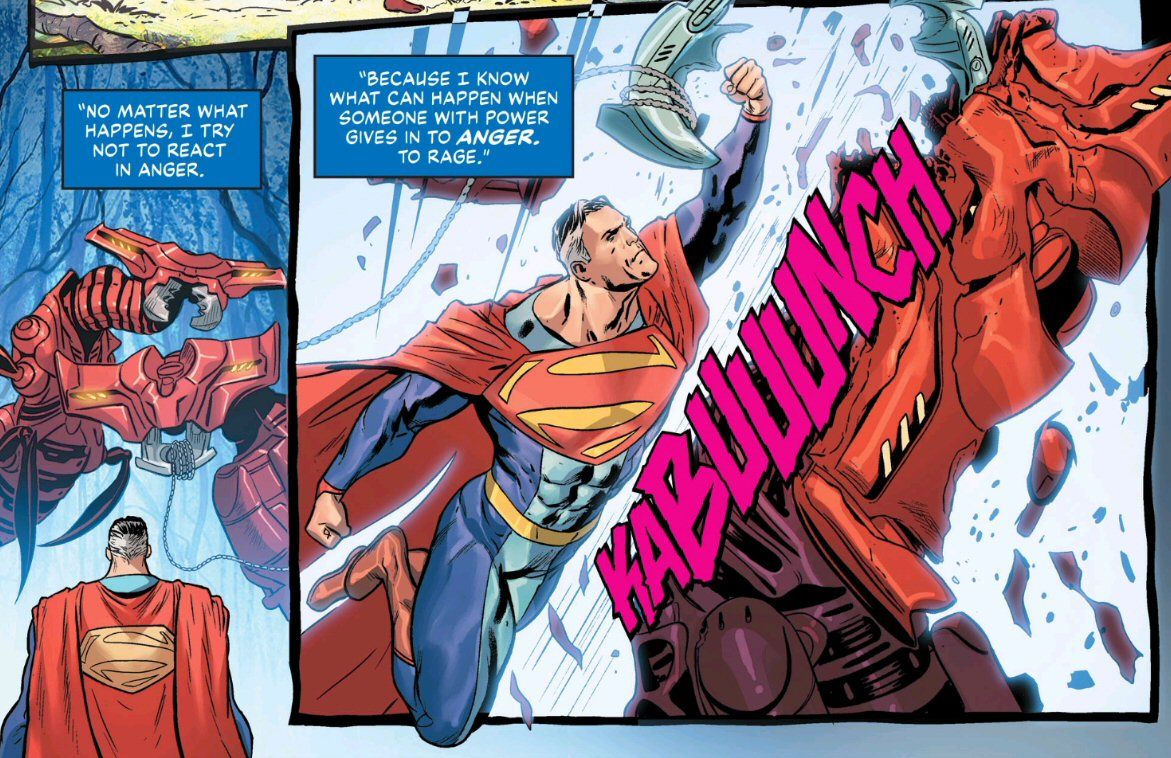
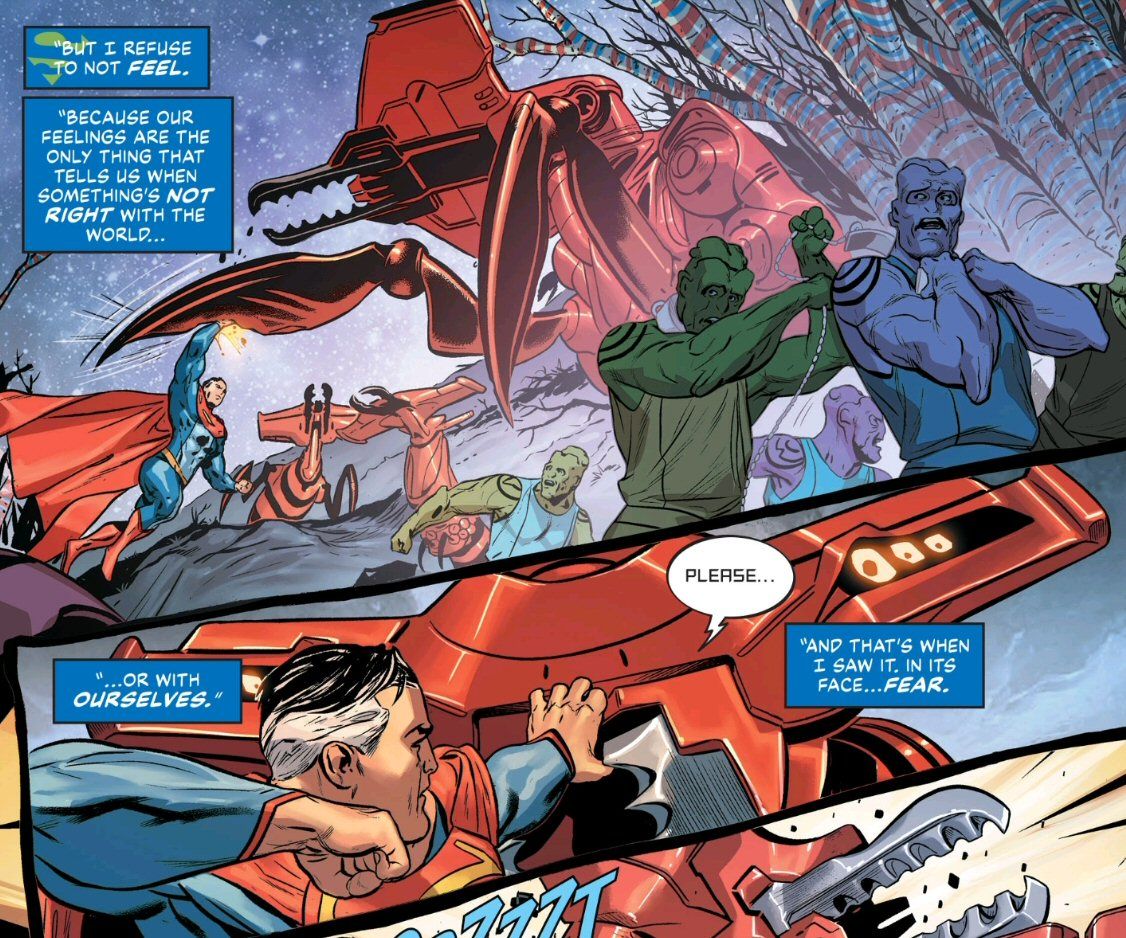
Russell neatly captures something that is core to human deontological thinking above. As I explain in my Moral Thinking, Fast and Slow post, modern brain imaging studies show that deontological moral reasoning can occur very quickly in the brain, through intuitive “system 1” processes without conscious awareness. These are intimately linked to emotional processing, especially feelings of empathy for others, or our own guilt and remorse. Both of these findings were an unpleasant surprise to deontologists – especially Kantians – who see their philosophy as the triumph of deliberate reason over “natural inclination” (in other words, feelings).
But Russell is quite accurate above when his Clark says our feelings are what tell us whether something is right – with the world, and with ourselves. This is an insightful (dare I say intuitive?) understanding of deontological moral reasoning that you don’t typically see in the comics – it is almost invariably presented as a reasoned argument.
This series also gives one of the funniest depictions of an ancient Greek philosopher – Plato – that I think I’ve ever read (most academic philosophy writing tends to be a little stuffy!). From issue #3, by Russell and Pough:
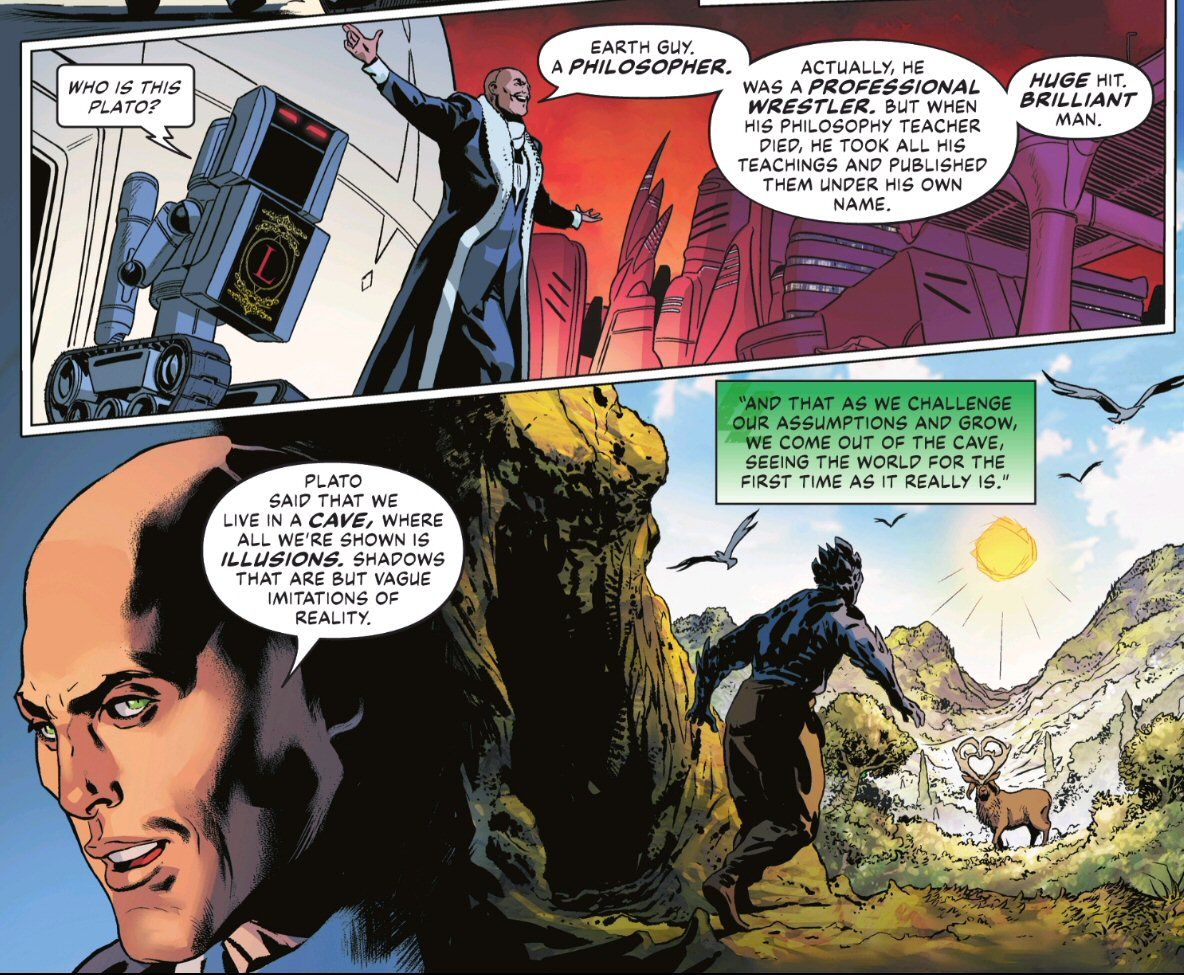
I literally burst out laughing when I read those opening panels – very much on point to Lex’s distorted world view, but not altogether inaccurate. Plato was indeed Socrates‘ most successful student. He was previously more interested in gymnastics and poetry, but Socrates got him onto the path of studying philosophy. He eventually succeeded Socrates as the leader of his school, which Plato then focused on his three principal interests: philosophy, mathematics, and gymnastics. 🙂
Socrates never wrote anything down – and it was indeed Plato who wrote most of the famous surviving dialogues that bear Socrates name (with Plato as the acknowledged author, but explicitly quoting his master). Plato expanded greatly on Socrates’ philosophical views in his own subsequent published works. It’s fair to say that Socrates was the first true Western moral philosopher, but Plato largely founded the traditions of Western philosophy that we inherited from the ancient Greeks. Indeed, if it wasn’t for Plato’s subsequent popularity, most of what we know about Socrates would have been lost to time (like with many other ancient Greek philosophers).
Plato’s famous allegory of the cave argues for how a philosopher is like a prisoner freed from a cave where he has only seen shadows on the wall his whole life, and not the direct source of those images. Through reason and study, the philosopher comes to understand and perceive the higher levels of reality. However, when trying to share that knowledge with the other inmates still trapped in the cave, they often react badly to the philosopher, having no desire to leave their prison. It is widely believed that Plato was referring to Socrates own experience, having being sentenced to death for widely sharing his enlightened views.
Of course, Lex has somewhat missed that specific nuance – but he does get the ultimate point:
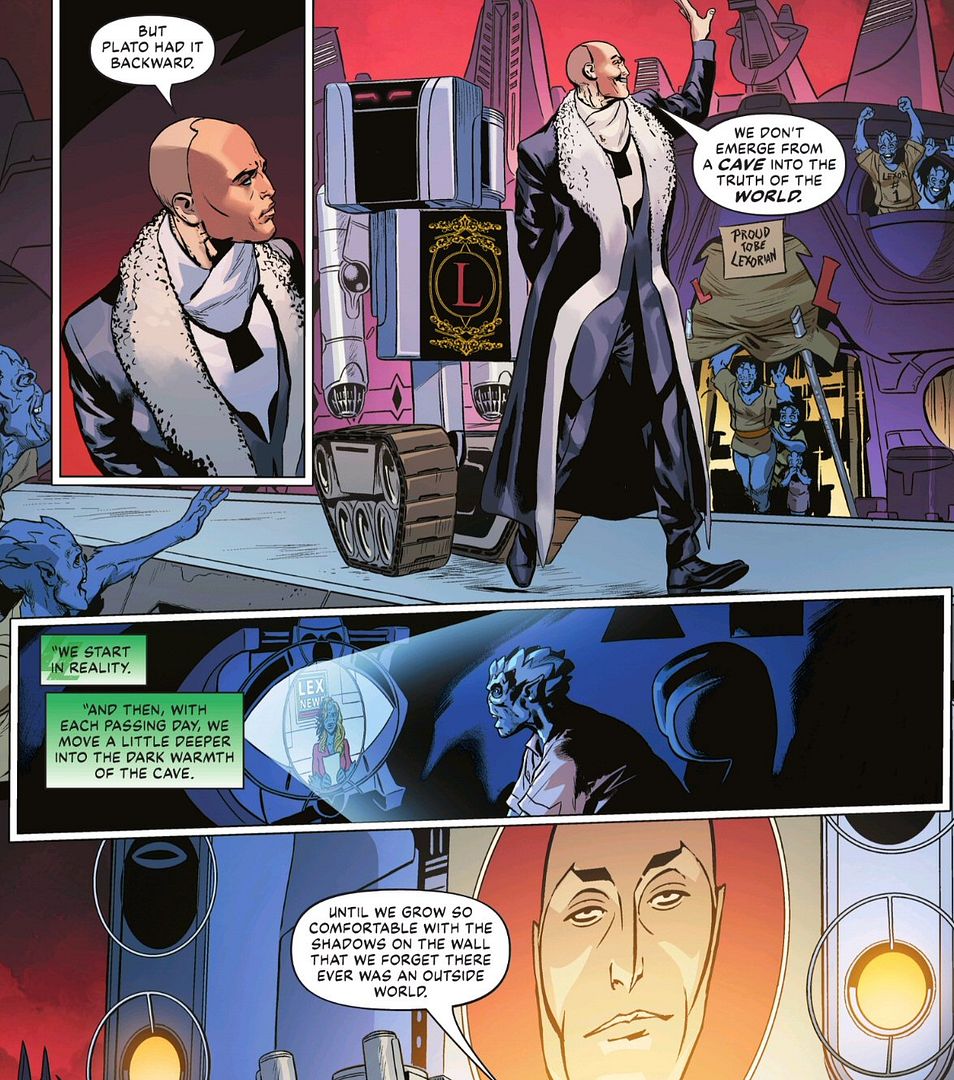
I always love seeing a little explicit philosophy smuggled into a comic book 😉
I also enjoyed the implied vanity of Lex in this series. Although Clark and Lois have both clearly aged, Lex is wearing a permanently youthful face mask. It’s a nice artistic touch!
And so, how better to wrap up this lengthy overview than in the flip-side to my opening panels for the DC K.O. event, and let Clark have his own say on Lex’s morals. From issue #3:
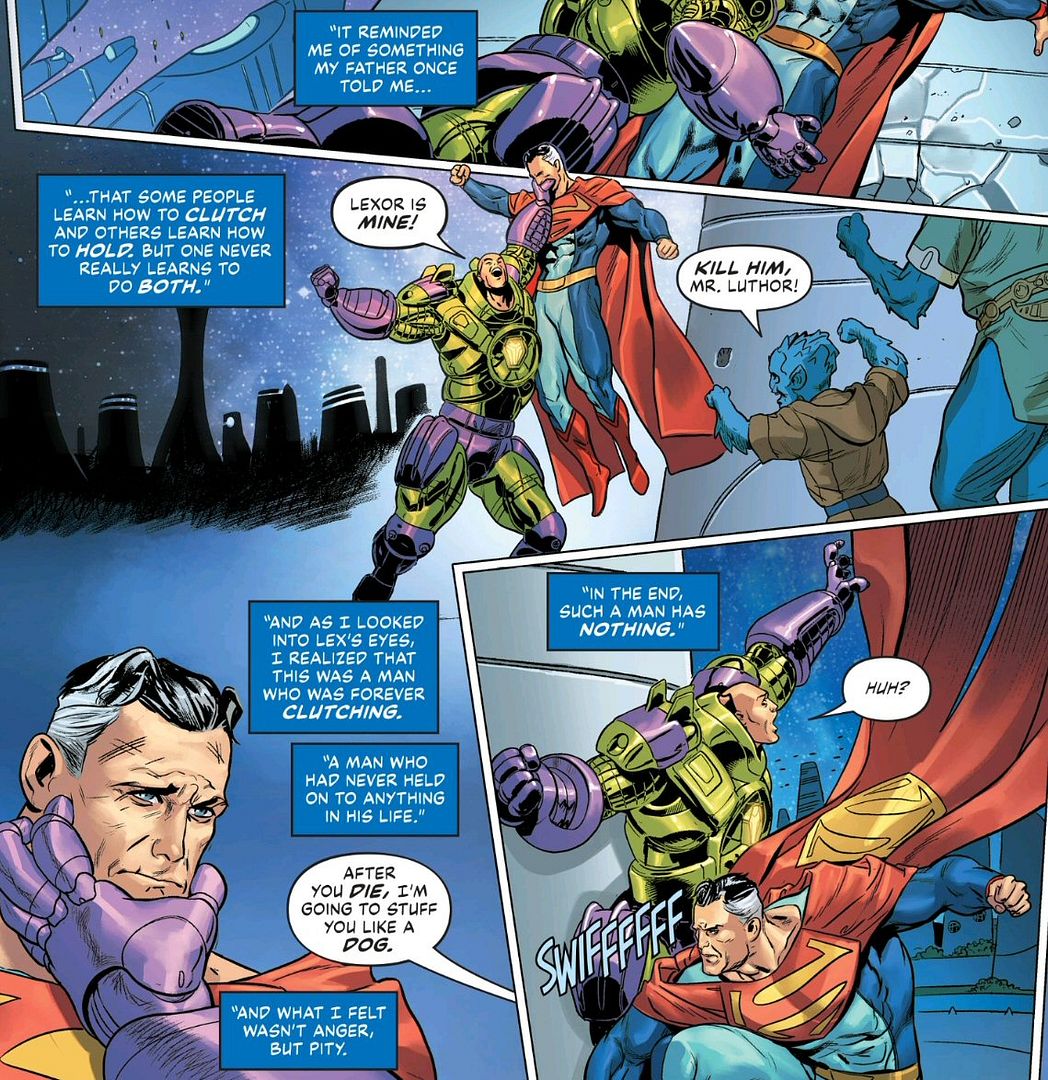
I hope you enjoyed this tour through Superman’s ethics. If you feel I’ve misrepresented anything in DC’s complex history, please drop a comment below.
See my Glossary post for a list of the key philosophical concepts and related links on this site.