

I’ve previously introduced care ethics, and described how it came about from a feminist critique of a persistent masculine gender bias in traditional ethics. As is probably obvious in my writings here, I’m a fan of the care ethics perspective in general, and how it has been successfully applied in modern comics.
I want to explain this normative ethics theory is more detail here and then explore the relative strengths and weaknesses of a care ethics approach. For this, I’m also going to return to the conclusion of a comic series that I was previously critical of (this summer’s X-Manhunt event) – but show how it actually demonstrates a lot of the positive aspects of care ethics (along with its key risks).
As always, if you would like to know more about the terms I’m using in these posts, please follow the links throughout or check out my Ethics 101 page or Glossary post (located on the header and sidebar respectively, if you on a non-mobile screen).
History of care ethics
Until the 20th century, virtually all ethics theories (of the last 2,500 years or so) were developed and refined by men – and many of them were single, and a lot were without children at that. I’ve found little historical criticism of this situation (there were some commentaries from women philosophers in the 1950s, but these seemed to be largely ignored or dismissed by the establishment at the time). It wasn’t until the 1970s that the tide began to turn, and the 1980s before this persistent bias was explicitly addressed with the development of a new virtue ethics theory, care ethics.
The individual most directly responsible for care ethics (or ethics of care as she termed it) is American psychologist and ethicist Carol Gilligan. Gilligan was responding to a dominant theory of ethical development first created in the 1960s and refined through to the 1980s by American psychologist Lawrence Kohlberg. Known as the Six stages of moral development, this was a hierarchical arrangement that purported to show how people develop from lesser to more sophisticated moral reasoning during development (though, critically, with not everyone reaching the higher stages). This built on the earlier work of developmental cognitive stages in children by the famous Swiss psychologist Jean Piaget.
Consistent with this origin, Kohlberg’s moral development hierarchy moves from a high degree of concern with one’s own personal needs and wants (pre-conventional level, stages 1-2), through general concerns for others using established social, cultural, and relationship norms (conventional level, stages 3-4), and finally to a higher level of principled ethical thinking that is supposedly culture-free and focused on justice, seeing ethical duties in terms of universal, abstract, and impartial rules (post-conventional level, stages 5-6). The Wikipedia entry for the theory describes it well.
That last bit of the post-conventional level may strike you as very deontological – and it is, especially in its focus on duties and what is “right” in a universal sense (similar to Immanuel Kant and his categorical imperative). But Kohlberg’s theory was actually a justice-centered theory, where justice was the source of the highest form of moral reasoning. Justice is of course dependent on principles, and so both deontology and Aristotelian virtue ethics could fit within this framework (Kohlberg himself apparently considered his theory compatible with both). And to be fair, pretty much all normative ethics theories up to this point emphasized some combination of universality, abstraction, and impartiality (particularly deontology, virtue ethics, and consequentialism’s utilitarianism – in roughly that corresponding order of relative emphasis).
There are several problems here. The main one is illustrated by the fact that Kohlberg’s theory does a particular disservice to women and girls, whom he saw as often getting “stuck” at stages 3-4 (conventional level). Again, Kohlberg saw these as strict developmental stages that everyone must pass through (no skipping levels!), and girls were commonly failing to progress to true higher ethical thinking.
Gilligan had worked as a research assistant for Kolhberg and so was very well acquainted with his theory and methods. In her highly influential book, In a Different Voice (1982), she called out this theory for not only prizing the kind of thinking that is commonly associated with men (universality, abstraction and impartiality) but treating the kinds of ways that women often approach ethical thinking as immature. Presenting it as a fixed linear hierarchy essentially marginalized women’s ways of thinking. Moreover, it seemed to imply that a woman can only be a fully realized person (since person-hood of course includes an ethical sense) if they choose to adopt a way of thinking commonly associated with men. She correctly called that oppressive.
As a scientist (and a man) I too find this offensive – when your theory tells you that half of humanity fails to develop fully as ethical human beings, it is far more likely there is something wrong with your theory than with half of humanity! To many, this was the crack that finally burst open the dam of unrelenting masculine bias in normative ethics.
But as I explain on my Ethics 101 entry on care ethics, you have be very careful when making generalized statements about how men and women typically think. I find people are often too quick to draw major significance from what are often relatively minor statistical differences at a population level (see my link above for more of a discussion). Plus, you cannot assume the reason for any observed difference – it could be either innate or sociocultural (i.e., nature or nurture), or some combination thereof.
And note that I don’t mean to suggest here that there are only two genders, or that they are fixed – but due to historical biases and limited sample sizes, most of the psychological research on differences between genders has focused on straight cis-men and cis-women. As a sample size example – back when I was in grad school in the 1990s, I volunteered for a brain imaging study because they were having a hard time finding left-handed heterosexual men (that’s my brain scan on the right).
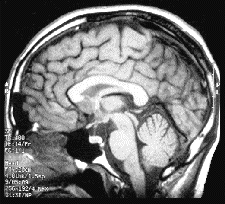
Even if you accept there are differences – on average – between how men and women commonly think about ethics, and that these diverge during development (for whatever reason), the obvious mistake was to assume this was a linear progression for just one group. More properly, this may be a point of divergence between the genders – and it would thus be important to examine the trajectory of both groups. At best, any difference between girls and boys is simply descriptive – that doesn’t justify making prescriptive judgments about it (i.e., better and worse). To me, this is a fatal flaw in Kohlberg’s theory – and yet, despite this, I find his paradigm is still cited (authoritatively) in the moral philosophy literature to this day.
Opening yourself up to the possibility that both gender groups can have valid ethical perspectives – and that one is not inherently superior to the other – is an opportunity to explore novel theories that may complement the traditional ones, and add to the richness of human ethical knowledge and experience. This is a theme I will come back to at the end, discussing a possible way forward for how we think about normative ethics (moral philosophy).
Care ethics strengths

Despite the history above, care ethics is not in any way restricted to women – it is simply a common way of looking at ethics that has been traditionally ignored due to a bias toward universal and abstract theories. In contrast to those traditional theories – many of which can put justice, rights, and impartiality at the center of moral decision making – care ethics instead shifts the focus to the protection of personal relationships. It does have a strong sense of duty – but again, in a concrete sense of a duty to those we care about, not an abstract sense to those we don’t know. With its emphasis on responding to the relative needs of those you are in a relationship with, care ethics holds that moral action should be based on bringing others closer to you and taking on their well-being as a personal burden (which is a form of duty of care). Empathy, compassion, and consideration of others is thus core to care ethics.
Care ethics is considered a form of virtue ethics because it focuses on the development of good character traits and behaviors (virtues) rather than following rules or seeking a good outcome. Unlike classical virtue ethics, care ethics is typically not interested in universal application or impartiality – and it is also correspondingly less focused on the issue of what is right (deontology) or good (consequentialism) in an abstract sense. Care ethics demonstrates a heightened awareness of the specifics for a particular moral situation – and encourages you to think of the self as relational, not independent or separate.
Note that this later point is not entirely unique to care ethics – there is a much older form of virtue ethics that shares some elements of this view: Confucianism. Confucian virtue ethics is an exception among traditional ethics, with its primary focus on family as the core ethical unit, and on the bonds between family members. It similarly shares a sense of the “relational self” with care ethics that is absent from most other traditional virtue ethics. However, as initially conceived, Confucianism was also closely associated with patriarchy, and the flow of family down male lines. Modern forms of Confucianism – as I presented in my Marvel Fantastic Four ethics overview – have more in keeping with care ethics, as the current interpretation of “social harmony” involves supporting and nurturing complementary family relationships, and the needs of family members.
But this does go to show that relational thinking in ethics is quite an old concept – and one developed by men, at that! It is also intuitive if you think about the model of growing up in a supportive family. I suspect it was the separation of rationalism in ancient Greek thought that led to the dominant “separate self” model in Western philosophy (which I describe briefly here, in terms of Buddhism and Stoicism). I’ll come back to this point in more detail in an upcoming post.
The core message of leading with empathy and sympathy in relationships is a powerful one, which is why I am so pleased to see care ethics increasingly coming up in modern comic book stories. See for example Kelly Sue DeConnick‘s excellent FML comix, or Kelly Thompson‘s and Alyssa Wong‘s respective runs in Captain Marvel, G. Willow Wilson‘s Ms. Marvel (Kamala Khan), and Jed MacKay‘s Moon Knight and Clea revivals.
Criticisms of care ethics
Consider this hypothetical example. Your nephew has a long history of poor behavior, lacking motivation, and a general disdain for other people. But he is your sister’s only child, and she would like to get him out of her basement – so she asks you to do something to help the family out. There is an opening for a highly-sought-after summer intern position in your company, and as the manager responsible for the division, you can parachute your nephew into the job without holding a competition (or overriding the results of one). This way, you figure your nephew will have a chance to learn some responsibility and make something better of himself. A win for everyone involved, yes?
No. First off, you can’t make someone else change – they have to want to for themselves, or it won’t work. But even if your nephew had expressed a desire to change, you have just installed him in a role by passing over many other better-qualified candidates who deserved it and could have really benefited from it. This is known as nepotism. You know, it’s like when your son’s father-in-law becomes President of the United States, issues you a pardon for your 18 felony convictions, and then later appoints you as the U.S. Ambassador to France (even though you don’t speak French). Sometimes caring goes too far.
Getting back to the original nephew example, it can be hard to see but you are not doing him – or yourself – any favors here. It is more likely that the nephew will learn that he can screw up as much as wants, and family will always bail him out (since that is what you and your sister have actually modeled and taught him here). And beyond the harm done to the qualified candidates (who will never get hired), everyone in your company will be aware of your nepotism and likely be very unhappy about it (as it assaults their sense of fairness, or because they will have to work with the dweeb!). Indeed, in many cases, this would be sufficient grounds to get you fired.
Some care ethicists would argue that these points are exactly why you should not hire your incompetent nephew – and that, in fact, it is a caring kindness to refuse to do so. So, this is not actually a problem after all, in their view. And yet, that solution seems to conflict with the stated desire to bring those close to you even closer (and it is certainly likely to lead to some conflict at the next Thanksgiving dinner with your sister!).
Other care ethicists see another way out – they limit care ethics to only applying in personal and private situations, not public ones. That would mean that care ethics is not a comprehensive or complete ethical theory on its own and can only be applied in specific situations (and it can be a bit hard to know when it should take priority over other theories, in that case). As I will argue below for another reason, I think this is the best way to go.
A second common criticism of care ethics relates to what happens when other people are not treating you in a reciprocally caring way – up to and including the much more serious and charged situation of abuse.
In milder cases (say, a misbehaving child), you could adopt the “tough love” approach that is similar to the first response to the criticism above. It would be harmful to both you and the child in the long-term to acquiesce to their acutely disruptive behavior, so it is actually caring to enforce boundaries that ultimately promote mutual respect. Indeed, this is not a new issue unique to care ethics – Confucianism has had to grapple with this for a long time (hence its focus on “social harmony” of respectful relationships).
But what happens when your enforcement of healthy boundaries leads to an escalation in the controlling behavior of someone you are in a relationship with – to the point of mentally, emotionally, or physically abusing you? Does care ethics require you to suffer indefinitely? No. A possible care ethics response is that you must protect your own integrity (or those of your loved ones) by literally removing yourself from the harmful relationship that is beyond repair. This of course is an extreme option, and one that needs to be carefully considered. But the point here is that you must care for yourself too – for your own sake, and for the fact that you will not be able to effectively care for others if you are directly suffering abuse (the old “put on your own oxygen mask first, before helping other passengers” message).
But that latter perspective concerns me. And to illustrate why, I first need to explain a third criticism of care ethics, and one it shares with consequentialism: what to do when care conflicts with the rights of others? Like with consequentialism, concerns over rights or justice (the domain of deontology) can get short shrift when you are focusing on what you believe is in yours or someone else’s best interest. What about their autonomy, personal integrity, and agency? Is it ok to consider these but then deny or disregard them because you are following what you believe to be a higher goal of bringing people closer together? It is a slippery slope, obviously. But it also brings with it some risks for the carer.
Considering the related case with altruism
There is a reason why utilitarianism remains the most dominant form of consequentialism: it mandates that you do not consider the good of yourself any higher (or lower) than the good of everyone else. This lack of personal preference is a core strength of utilitarianism. Consider the other two ends of the consequentialist spectrum: you consider the good of others before yourself (altruistic consequentialism, aka altruism), or the good of yourself above others (egoistic consequentialism, aka ethical egoism). The latter makes you a villain in the comics (e.g., Marvel’s Doctor Doom, Kang the Conqueror, the early Magneto, etc.). But it is worth taking a moment to consider the problem with altruism, as it also relates to care ethics.
Imagine a situation where you are a carer who tends toward altruism – that is, you put the needs of others above your own. Now imagine you are paired with a partner who tends toward egoism – that is, they also put their own needs before yours or others. This might seem like a match made in heaven for the egoist – but what are the consequences to the altruist? It seems to me this pairing of personalities is extremely common in the world, to the benefit of one group and the detriment of the other. Just listen or watch almost any episode of a true crime podcast or TV show about spousal murders: the egoistic spouse did it! This is why I’m concerned that the proposed care ethics redress of abuse – breaking contact to set yourself up to care for others again – may be premature in cases where the carer is too caring of others who don’t reciprocate.
Altruism has recently come back into fashion under a rebranding exercise as effective altruism. This has real philosophical underpinnings to it, originally in terms of behaviors that benefit global health, animal welfare, and the environment, while avoiding inefficient or ineffective top-down bureaucratic aid mechanisms. But its use in modern parlance is driven mainly by the billionaire tech bro crowd, and could more accurately be called a social movement. However, even a quick glance at the behavior of these individuals reveals that their approach is neither “effective” nor “altruistic” in terms of the stated goal of benefiting other people (or species) over themselves (they are billionaires, after all). But I suppose it does wonders for their own egos and sense of self-aggrandizement – a feature known as psychological egoism, which can lead to ethical egoism. This is ironically one of the main counter-productive risks of trying to use altruistic thinking – it can lead you down egoistic paths (“Aren’t I wonderful for being so altruistic?”).
But the other problem with altruism is that it favors in-group consideration – just like care ethics can. This is another common, innate human cognitive bias that we all have. The preference for like can in turn foster or reinforce exclusionary practices – selectively benefiting your own in-group, segregating from others, and ultimately increasing inequality in society. When considered along with the relative lack of justice and personal rights considerations in both consequentialism and care ethics, this brings clear risks to the exclusive application of these theories. Again, I will come back to this predicament at the end of this post.
Care ethics and comic books
As much as I enjoy seeing care ethics infuse modern comic books, I have also seen some of the concerns above show up. I can think of three recent comic series (by three different writers, all of whom I have a lot of respect for) where a character was struggling with the same care ethics decision. In all three cases, the character was mistreated, neglected, or abused as a child by someone who owed them a duty of care and didn’t provide it. And yet, all three heroes later felt a drive to risk their own well-being for the sake of the one who let them down.

This could be the start of a positive reconciliation between the characters (and likely will be in the comics). But in none of these stories was there any evidence of remorse or a desire to make things right on the part of the person who previously shirked their duty of care. Indeed, in two of the cases, they had continued to actively maintain their spite for the hero and continued to treat them poorly. And in two of these stories there was also another character counseling the hero that they would regret it if they didn’t unilaterally sacrifice and forgive/help their abuser, based on their familial relationship. Forgiveness is a very powerful and positive emotion, and one that can bring a lot of comfort to both sides in a disagreement. But in terms of an ongoing relationship, I don’t think the forced or unilateral application of it with no evidence of behavioral change on the abuser’s side is a good idea.
To address this with a specific example, I would like to return to a series that I have previously described as problematic – the X-Manhunt event, where mutant fractions fight to free/stop Professor X (Charles Xavier) in his escape from Earth. See the first link above for a detailed discussion of this event. I was critical of this event at the time, because of the very long history of (in my view) abusive behavior by Xavier in the comics – or at a minimum, his persistent disrespect of others’ autonomy, rights, and agency for his sense of the greater good. But the conclusion to this event does have a lot to commend it as well, which I would now like to explore from a care ethics lens.
Effectively, the design of this X-Manhunt event was set up as one massive care ethics challenge: Xavier was choosing to risk the lives and well-being of those he had mentored over his life, for the sake of helping his off-world biological daughter (whom he barely knew). And his former students in the stories split along two distinct lines – those trying to stop him from escaping, and those trying to help him – with individuals in the two camps seemingly willing to risk potential lethal force against their friends and comrades.
However, Xavier’s culpability was attenuated in the event proper: it was revealed that a brain tumor was distorting his personality and abilities. Mind you, it is unclear how long this newly introduced (and very convenient) tumor has been plaguing him. It doesn’t seem likely that it can retroactively justify his behavior across the preceding five-year run of the Krakoan Age where he was resurrected at least twice that I recall, and carefully purged of Sinister’s influence. And of course, it doesn’t excuse the unethical behaviors he has exhibited across the previous twenty years in the comics – but it does seem to mitigate the direct effects of his behavior in this series.
Consider this early scene from the conclusion of this event, X-Manhunt Omega Vol 1, issue #1, 2025, by Gail Simone and Murewa Ayodele, with art by Gleb Melnikov, Federica Mancin, and Enid Balam. To set the scene, Xavier’s ship is trying to escape, all while his partner Lilandra is working to remove his tumor (it remains to be fully excised). He mentally visits Cyclops (Scott Summers) – the leader of the resistance opposing his departure:

Even with the retconned story of the Agnew in place, the professor is clearly behaving like, well, a dick.
And the resistance by Scott and his allies – which was unwavering across this event – had repercussions in terms of their relationships with those on the other side. Consider these two scenes from this first part of the story:



But there is a very meaningful turn of events after Xavier manages to successfully escape the Earth.
Lilandra has succeeded in removing Xavier’s tumor on their escape vessel. Once he regains consciousness, we have this very interesting scene:

This marks a critical turn in the comic, and one that reveals the underlying care ethics proposition of this story: he doesn’t need to return (he is free and clear), but he wants to in order to re-establish a caring relationship with his former X-Men (“I can’t let it end this way”).
Interestingly, this part of the comic also tries to undo the conflict between the opposing sides. On Xavier’s return to Earth, he has called together key representatives of both sides. Consider this scene:

I know there was a switch of artists (and presumably writers) at this point in the story, but this seems like an odd panel for what is only supposed to be 10 hours later in the story time. However, it is trying to establish that there are no hard feelings between Scott and Wolverine. Personally, I don’t think I would be quite as forgiving as Scott here – but he has been showing an increasing care ethics perspective during Jed MacKay‘s run with the character.
Xavier then gives this impassioned speech to all the assembled X-Men, from both sides:
I never wanted to be a general, Scott. All I wanted to be, all I ever wanted to be, was a professor. I haven’t been myself for a long time. I am sorry. It has cost me. And it has cost everyone I care about. Including all of you. I tried to heal the world. I failed. I believe you, all of you here, are the best chance to dream a new dream. A better one. Perhaps you will succeed where I could not. We are all of us the sum of our greatest triumphs and our deepest failures. As well as the long ghost walk in between. The others will look to you. All of you. For guidance, for protection, for comfort. They do not ask for perfection. They only ask that you be there when they need you. To the rest of you around the world. No more fighting each other. Fight for freedom. Fight for justice. Do not fight your brother. Look upon your sister with patience. Help others. And ask for help when it is needed. And for pity’s sake, please build another school.
- Professor X (Charles Xavier), X-Manhunt Omega Vol 1, issue #1, by Gail Simone and Murewa Ayodele
I really love this speech as a description of care ethics. I don’t know between Simone and Ayodele who wrote it, but they really seem to get what care ethics is about. On the surface, Xavier appears to be genuinely seeking forgiveness and redemption for his past actions from his former pupils and colleagues. It is hard to read that passage and not feel moved with sympathy and concern for the character, and to want to support his desire for reconciliation.
But … I can’t help but notice that this apparent care ethics conversion of Xavier seems remarkably abrupt. It starts dishonestly by denying explicit choices that he made (e.g., being “a general”). Further, the lack of specificity for what he is apologizing for – and the fact that he is yet to demonstrate any actual change in his long-standing behavior – raises the concerns I noted above for providing forgiveness too quickly in care ethics.
But the other point to this second part to the story is how it tries to show that care ethics can bring everyone together. Consider the apparent responses from all the assembled mutants:


As I described briefly previously, I find this shared caring response of all of the characters very hard to accept given the consistently opposing behavior up to this point (particularly Emma, Scott and Magik). BTW, for an understanding of the previously established primary normative ethics of all the other characters, please see my X-Men Ethics – Characters A to Ma, and Mi to Z posts.
But this ending demonstrates the goal care ethics is trying to bring about – ultimately bringing people closer together. So, from this perspective, this conclusion is very consistent. And in trying to show how empathy, care and consideration of others brings people closer together, it also shows how you can bring about the greater good too.
Whether you find this a believable outcome for this event is another matter. Can modeling a care ethics position lead other people to abandon their long-held opposing normative ethics views and adopt a care ethics position along with you? Maybe, but that strikes me as unlikely in general (and especially so in this specific case).
The history of moral philosophy has many clever philosophers, ethicists, and religious leaders all trying to develop a single overarching theory that (they believe) can uniquely provide a comprehensive guide to how everyone should live an ethical life. Yet for all the strengths of any given theory, there are always criticisms of it (lobbied by the very clever proponents of the other competing theories!). Professional philosophers and ethicists often seem to be in a perpetual tug-of-war with each other – with endless skirmishes, and no definite victory by any side. In over 2,500 years, it seems no one has yet to create an unassailable, comprehensive theory of normative ethics. And it is certainly not for want of trying!
Which brings me back around to my final point – what other alternative is there? I want to propose one but first need to consider one final opposing camp.
Alternative to traditional normative ethics theories
Again, all normative ethics theories have their strengths and weaknesses, and it is important to consider the criticisms and potential limitations of each one. In addition to care ethics here, I have done this previously for consequentialism, where I described the most popular form today (act utilitarianism) and a modified form that sought to bring in some of the better elements (but also the limitations) of deontology (rule utilitarianism). More significantly, I also discussed the main criticisms of utilitarianism, some of which can be quite significant. I have briefly introduced some specific concerns with deontology, and more general ones for both deontology and virtue ethics. Finally, I’ve recently detailed some specific criticisms of Aristotelian eudaimonic virtue ethics.
As a result of this persistent problem, a number of philosophers and ethicists reject normative approaches altogether. Note that it is called “normative” because it seeks to establish norms (standards and rules) for evaluating human moral actions and determining what is right and wrong (or, good and bad). Instead, there are philosophers and ethicists who try to rely on meta-ethical arguments, like relativism (denying absolute objectivity and asserting an everything-is-relative perspective) or subjectivism (putting primacy on subjective mental experience). These theories come in an incredibly diverse array of forms – I covered some key examples in my profile of Mystique (moral relativism, subjectivism, and cultural relativism) and Wolverine (moral particularism).
I have some sympathy for these approaches, and appreciate their attempts to keep an open mind toward others’ experiences (a key benefit). But I have yet to find any of them compelling or convincing. They typically all fall into circular reasoning or other logical traps when you try push them into practical examples. Of course, like everyone I have my own biases – but I try to keep an open mind, and I ultimately always come back to normative ethics as the most powerful tool in trying to explain human moral behavior (and more relevant for comic books too).
A personal perspective
Over my professional career, I had a lot of first-hand experience of observing and managing conflicts between well-intentioned people making different moral decisions. I found two ways to deal with these, and one of them is very relevant here.
I held senior positions in health research funding and worked with many dedicated individuals around the world who were trying to affect positive change in human health. Pretty much everyone who works for a health research agency has that goal – they could put their skills to use anywhere in government or academia in their respective countries. But they all chose to do the difficult work of helping ensure that the very limited funds available are put to the best use possible and have the highest chance of ultimately helping people. As background, there are always a lot more good research proposals that should be funded than there are public/private funds available (if all those supposedly altruistic billionaires are short of ideas to help humanity, I could help hook them up with a few agencies!).
I spent many years developing successful, innovative health research programs both nationally and internationally. In addition to a leadership role in my own national brain and mental health research funding agency, I spent a decade as the chief executive of an international research coordination activity in the genomics space. By working collaboratively across countries, we could efficiently leverage regional expertise, funds, and resources to accomplish greater outcomes than could be done independently.
In those experiences, I couldn’t help noticing how people typically self-selected roles and positions in their own agencies that best aligned with their preferred ways of moral thinking. Those on the strategic side are looking to create new and innovative initiatives to address unmet health needs – this branch is invariably staffed with those who favor utilitarian thinking. Those on the delivery side are looking to ensure fair processes are used to adjudicate competing proposals according to impartial excellence, given the limited funds available – this branch is heavily staffed with those who favor deontological thinking. And those on the project management side are looking to maintain relationships with the funded projects, to ensure the outcomes and progress are fed back into the system for impact and continual improvement – this branch contains many who prefer a care ethics way of thinking. Note that these roles are typically segregated and managed separately in almost all national-level funders (at a minimum, delivery is separated from strategy/management) to prevent conflicts of interest or biases from influencing funding decisions.
But you can probably guess what happens as a result. Those in the utilitarian strategy group often believe their role is the most critical, and they need to be involved throughout the whole process to ensure good outcomes (and so, they can come to resent the involvement of the other two independent groups). The deontological folks in the delivery group can become suspicious of the motives of those in the other two groups and try to limit their access or awareness of the delivery activities under their direct control (to ensure fairness and lack of influence/bias). And the care ethics-minded people in the management group keep trying to bring those in the other two groups closer to them, to ensure that they can effectively transition everything through all the necessary stages (their attempts to establish closer personal relationships is typically better received by the utilitarians than the deontologists!).
My experience has taught me that it is important to foster a culture of appreciation of the different forms of moral thinking in these situations, rather than trying to get the individuals to all adopt the same form of thinking. The goal here is not to convince others that they are wrong (or worse, to accuse them of being unethical!). Rather, it is to work toward a negotiated compromise that everyone can live with – and one that is founded on personal integrity and respect of the alternative ethical viewpoints. It is only by understanding that other people’s moral reasoning differs from ours – but is still valid – do we have any hope of successfully working together for the benefit of all.
To get back to that first criticism of care ethics – I agree those who argue that the application of care ethics is appropriate (and desirable) in the personal space, but not always in the public one. That doesn’t make care ethics wrong, or lesser than deontology for example – it just makes it differently adapted and offering different value. And in my experience, you are not going to convince someone who believes in abstract concepts of universal justice or fairness to abandon those views by demonstrating caring toward them. It is ok to use different normative ethics in different circumstances – in fact, it is often called for in real life.
Dialogical vs dialectical approaches
To put this in terms of ancient Greek thought (and you just know I was going to sooner or later!) the approach that I took in these situations was often more dialogical than dialectical. Dialogical processes involve the open exchange of views, with mutual understanding of perspectives, without requiring coming together to a common consensus. Dialectical practices proactively use disagreements to overcome conflict to reach a new, better way of doing things that everyone can agree on.
Dialogical is what I came to aim for within my own agency’s operations. But for the larger multinational initiatives, the direct clash of opposing ideas – managed through the application dialectical processes – could sometimes bring about the synthesis of a new, higher-level concept or approach that everyone could get behind. That was certainly very rewarding when it worked – but it is relatively rare in my experience. Both approaches are valuable, and both have their place depending on context.
When it comes to normative ethics, dialogical is the way to go in my opinion – given the multi-millennial failure of philosophy to resolve moral differences dialectically. I am a bit puzzled as to why this seems to be so hard for many to accept. But that may be because I am a professional neuroscientist by training, not a philosopher. 🙂 A lot of what we now know about the brain supports the idea that we struggle internally to choose between differing moral intuitions, and have natural preferences (or biases, if you prefer) in how we deliberate on those decisions.
As I explained on my Ethics 101 page, we are prone to a large number of biases in our thinking – along with a set of moral intuitions. I see these as the wellspring from which all normative ethics theories have been developed. Put another way – philosophers have come up with the normative ethics theories they have precisely because they reflect some aspect of the way we tend to think. Of course, they are only starting points – our normative ethics theories are incredibly detailed and thoughtful, and require careful consideration to deliberately choose from. And not like there aren’t blinders here – as this post has illustrated, a very common way of thinking (that may be more prized by women, on average) was largely ignored by ethicists in the West until the late 20th century.
Note that I am not trying to throw shade on philosophers (or comic creators!) for not understanding how the brain works – most were indeed reacting to prevailing views of their time periods. And it is only in this century that imaging technologies have advanced sufficiently (and consistently across studies) to allow for more sophisticated interrogation of how our brains make decisions. Paired with the development of more complex and subtle experimental study designs, it is really only in the last decade or so that we have gained real insight into how we make moral decisions.
Since I have finally broken the seal on my neuroscience background, so to speak, I will describe this research in my next post, as sort of a part two to this overview (UPDATE: please see my Moral Thinking, Fast and Slow post). In the meantime, please know that there is a lot of similarity in moral decision making between people across cultures – just with different ways of interpreting those decisions, and with natural variability as to when our personal intuitions switch from one form to another. You can check out my example of a popular normative ethics thought experiment – the Trolley problem – for some background on this point. Despite the differences in when we shift forms of ethical thinking, we aren’t as different from one another as many may believe – but we can often come to quite different conclusions in the same situation.
And that will be the topic of my next post: Moral Thinking, Fast and Slow.
See my Glossary post for a list of the key philosophical concepts and related links on this site.
Further Reading

For more about X-Manhunt: The Redemption of Charles Xavier

For more morality: Why be moral?

For more care ethics: Captain Marvel
Glad to see this write-up, big fan of care ethics! You are getting heavily philosophical on us lately, lol. I think it’s great.
Also glad that this redeemed (?) Gail Simone’s story for you (I’m a big fan of hers too, like Kelly Sue DeC). I can see why you didn’t think this conclusion worked for the other characters, but I love her focus on relationships in her writing. She seems really committed to the X-Men!