

I think you’re good. You’re moral. He’s ethical. That doesn’t mean you’re on the same side.
- Jack Magus, The Power Fantasy issue #2 (written by Kieron Gillen)
As I explained on my About Me post, I saw the superhero comics of my youth as explicit moral philosophy primers. Much of the conflict, to my eyes, was between the various heroes, or internal to a given hero – as they debated the “right” or “best” course of action. Of course, not all writers approached it that way – many were simple adventure stories, with a lot fighting and explosions. But the stories and characters that I gravitated to were the ones where differing perspectives on how one should/ought to act (to use the language of modern normative ethics) framed the core conflicts. With a few fights and explosions thrown in, of course.
So imagine how thrilled I was when The Power Fantasy by Kieron Gillen and Caspar Wijngaard (Image Comics) launched in 2024 – a story that is almost exclusively focused on the ethical disagreements of a small number of superpowered beings who have the ability to single-handedly destroy the world. In one sense, this beautifully reverses the classic fighting superhero comic trope – the heroes can’t fight, or the world ends. Yet at the same time, it remains particularly true to a core underlying feature of the medium: exploring the nature of differing moral intuitions between people, and how to resolve moral dilemmas. It also explores the limitations of classic moral philosophies when applied to modern superhero comics – where the power levels are now so inhumanly high (unlike the comics of my youth).
In my view, Gillen is not only one of most ethically aware and informed comics writers today, he can expertly craft tension and narrative out of ethical concepts and disagreements. His Marvel comics’ A.X.E.: Judgment Day cross-over event from 2022 (whose ethics I introduced, discussed further, and then concluded here) was an outstanding example of exploring this within the confines of the Marvel Universe. And I mean confines not just within the sense of the established continuity of Marvel’s Earth-616 characters – the guiding precept of the Marvel Universe is the “world-outside-your-window” (that is, the comic world has to look and function exactly the same as the world we know).
How realistic is that when you now have numerous superpowered beings who could take over the world – or even more simply, alter how it functions? This is what Alan Moore explored to great effect in Watchmen. Gillen was clearly starting to think through the consequences of that much power during his time writing the complex conclusion of the Krakoan Age of the X-Men. Once free to launch his own creator-owned series, he came up with this alternate Universe where the arrival of super-powered beings altered the trajectory of the world in the same ways that the development of nuclear weapon states did in ours.
As this is an ongoing series (issue #13 just out, with a minimum run of 16 planned), I am going to focus in this Introduction on just the first 8 issues. I am also going to try very hard not to spoil anything beyond the first story arc (issues #1-5, which also make up the first trade paperback). But as I want to fully introduce the six main characters and their ethical conflicts, I do need to include material up to issue #8 below. I will then briefly consider the broader implications (and limitations) of the ethics presented in this series so far, as a jumping off point into where I think this series might be going.
This will be a long one, but I recommend you read through in sequence. If you want to skip ahead, you can jump to my ethics intro for the series, the individual character ethics overviews, or the discussion of the missing ethics and where this could go.
As always, if you would like to know more about the terms I’m using on this site, please follow the links throughout or check out my Ethics 101 page or Glossary post.
Introduction to the story
Gillen is the master of pithy quotes, and he put it well when he described the series as: “Watchmen if there were six Doctor Manhattans” and “imagine if you and your five messy mates had to stay civil or the world ends”.
The context for this story begins with the creation and testing of the first nuclear bomb – the Trinity test on July 16, 1945, at Los Alamos, New Mexico. With that explosion, a new age of “Atomics” (also called the “Nuclear Family” in the series) came into being – individuals with “extranormal” powers mysteriously began to appear. Think of them as analogous to the mutants in Marvel’s Earth-616 Universe. And like that Universe, most of these “Atomics” have fairly minor gifts – but several have “omega-level” mutant abilities (to again use the Marvel X-Men language) that could individually destroy the world. The arrival of these Atomics, and other extradimensional entities, altered the balance of power between the nuclear superpower nations – and among the current six superpowered individuals.
Thoughtfully, the creators (Gillen and Wijngaard, plus Clayton Cowles letterer, Rian Hughes designer) have developed a more extensive primer on bindings.app to fully introduce you to the story and the six main characters, with links to help you follow along further. You can read the first ten pages of the comic there, with a link to read the entire first issue online for free (courtesy of Image Comics). Which I strongly urge you to do – please follow those links before progressing further here, as I won’t duplicate their excellent background. I will instead jump right into the ethical conflicts between the characters, and some of the major events of the first arc. You’ve been warned!
Gillen tells the story in a non-linear fashion, jumping from time-period to time-period between 1945 and 1999 (which is “present day” in the stories). Again, this world evolved very differently from the one we know – while some crises mirror or deviate from true events (e.g. the Cuban missile crisis in 1962, the Second Summer of Love in 1989), others are made up for this story (e.g., The Signal in 1978).
Although I’m going to profile the ethical frameworks of each of the six main superpowers individually in this Introduction, it is really only through their interactions that we get to know them – and understand the moral dilemmas that underlie their fateful decisions. It is important to note that none of them are explicit villains in this series – just flawed people trying to do the right thing, but with more power than they should have. And very much like the flawed but powerful Progenitor in Gillen’s A.X.E.: Judgment Day event, we’ll see how the differing human normative ethics each applies proves insufficient to dealing with the implications of their powers and the weight of their decisions.
A quick word about the art – I love how Wijngaard so beautifully captures the distinctiveness of these characters through subtle stylistic choices (e.g., the clothes they wear, how they style their hair, the mannerisms they adopt – and how the other characters respond to those). I can’t think of another series where we see multiple characters pore over their wardrobes while engaging in detailed telepathic debates (well, maybe Emma Frost of the X-Men).
Ethics introduction
There is no better place to start a review of the ethics of this series than the opening ten pages of issue #1, which is set on a street corner in New York city in 1966. Here, we are treated to a heavy philosophical conversation between two of our main protagonists: Etienne Lux and Santa Valentina:
The opening splash page:
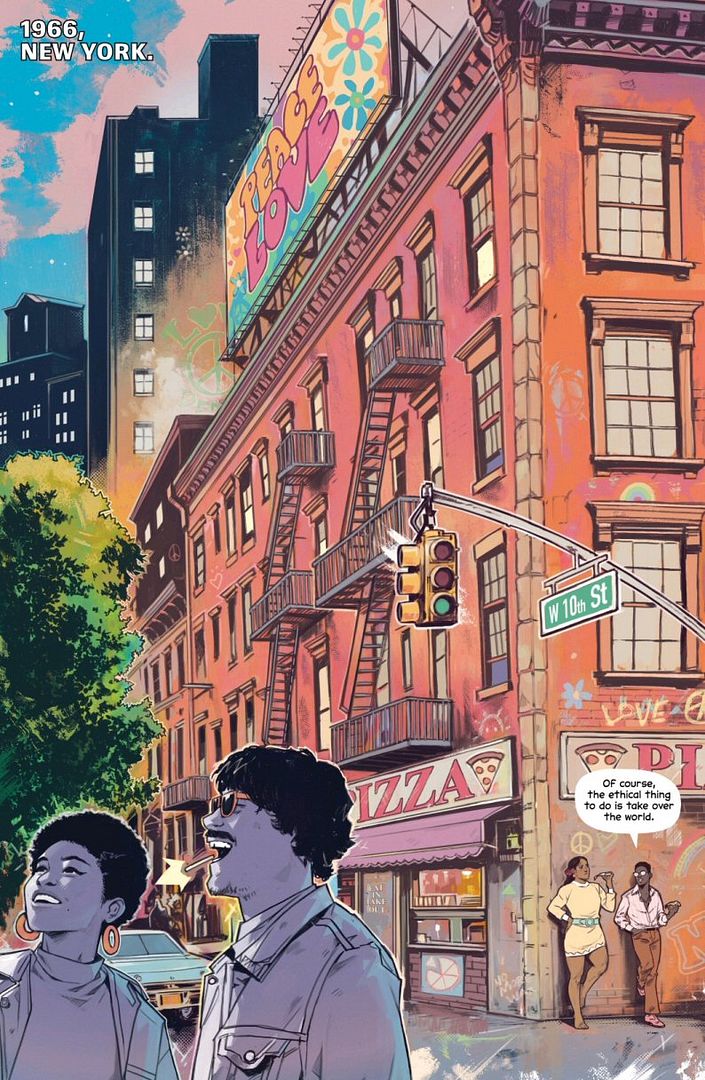
What a great opening!
As I explain in my Ethics 101 introductory primer, I use the words “moral” and “ethical” interchangeably throughout this site – like most modern commentators do. The discipline previously known “moral philosophy” is called “normative ethics” today (normative referring to setting standards or norms for how we should/ought to behave). The ethics framing is seen as preferable, as it is more structured and brings in other forms of non-normative ethical thinking as well (I also use “ethics” and “ethical” interchangeably).
There are three branches of normative ethics theories. Deontology is concerned with doing your duty to other people, often through the lens of rights or justice. These theories are often rule-based and focus on the moral value of the acts themselves (that is, doing the right thing). Consequentialism is often seen as the opposite, focusing not on the acts themselves but rather on their outcomes. These theories typically focus on the moral burden of making good decisions (that is, doing the good thing). Finally, virtue ethics shifts the focus from the act to the actor – being the best person you can be, typically by practicing virtues that align with your values and goals (that is, being better). Although philosophers often seem to want you pick just one theory and use it exclusively, that is not how our brains work (as I have recently explored in my Moral Thinking, Fast and Slow post).
Gillen adopts a simplified description in this comic, with “ethical” referring to consequentialism’s focus on the greater good, and “moral” referring to deontology’s focus on duty and what is right. We get a chance to see these opposing views square off against each other in the words of one of the most consequentialist characters (the “ethical” Etienne) and one of the most deontogical ones (the “moral” Valentina). What follows over the next ten pages is so good it could be taught in an introductory University philosophy course!
Etienne explains his opening reasoning through an analogy to the influential early 20th century philosopher Bertrand Russell:
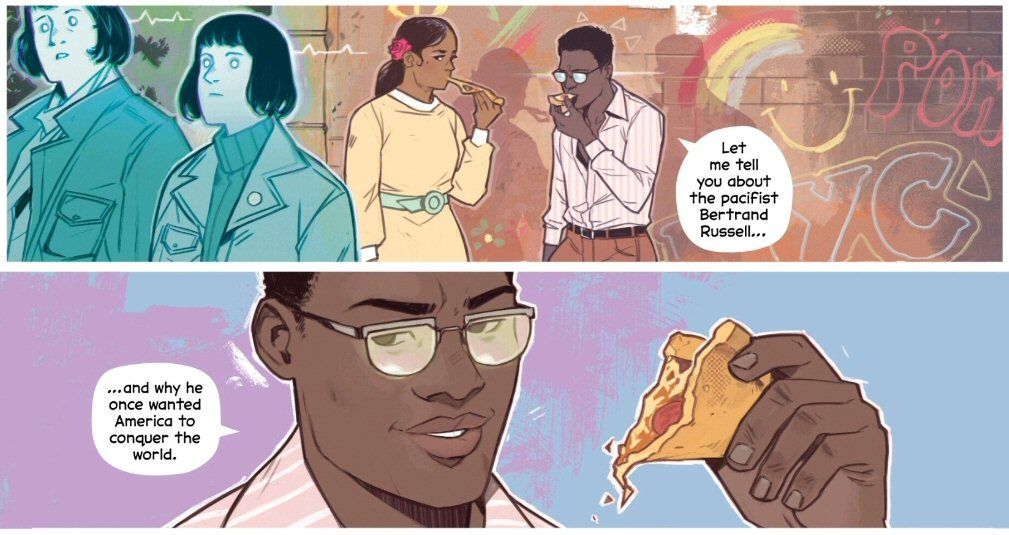
I will come back to Russell in my overview of Eliza and my ethics wrap-up at the end, but what Etienne says about him is absolutely correct in this context.
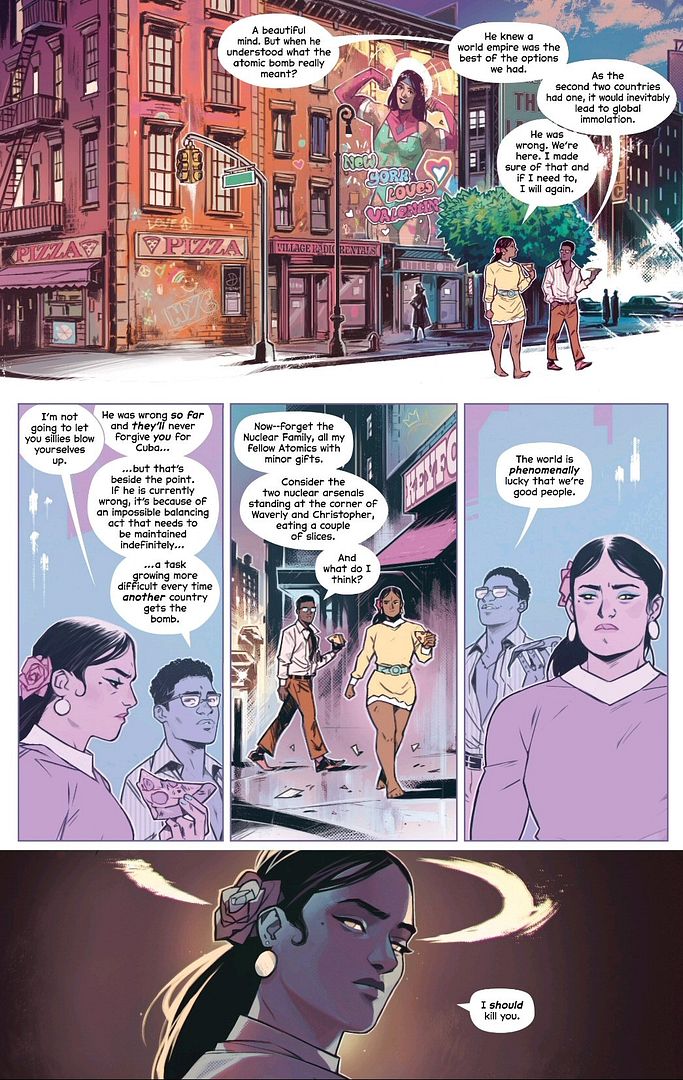
Recall that normative ethics is all about should/ought to statements. Etienne laying out his “ethical” consequentialist thinking here triggers a “moral” deontological response from Valentina: “I should kill you”. Note also that her moral high-handeness comes through very clearly here as well – she knows what is right and will (and apparently has) imposed it on us “sillies” before.
How Etienne responds to her intent to kill him is a real tour-de-force:
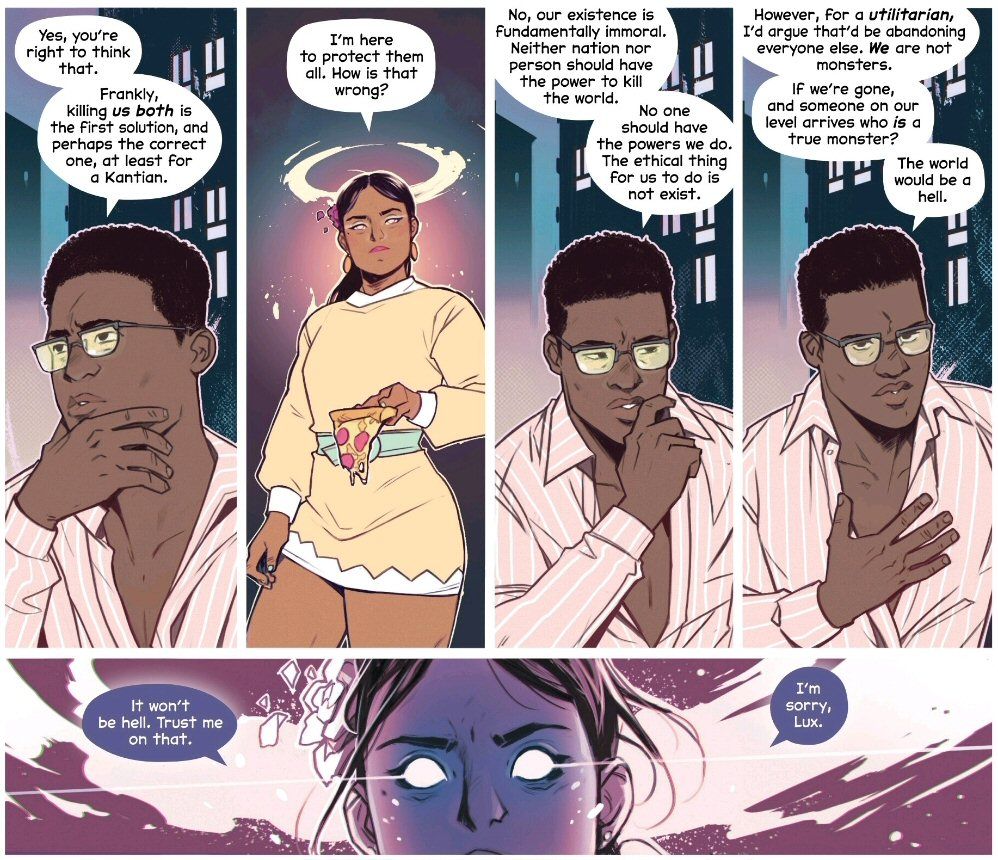
Ok, that is a lot to deconstruct!
Kantian ethics is the main form of deontology today – and Gillen is (creatively) letting us know that it is NOT the form that Valentina is using. Kantian ethics is named after Immanuel Kant, and is all about creating a rational framework for moral duty that treats people as ends onto themselves, and never as a means to an end (indeed, that is the second common phrasing of its categorical imperative). It is not justified to murder another person, even to prevent that person from committing mass murder. Indeed, it is even not allowed to lie to a murderer to prevent murder, as lying is similarly morally wrong.
So what does Etienne mean here? That first panel stopped me in my tracks (I literally put the comic down for a minute while I considered that panel). This led me to an initial conclusion: both Etienne and Valentina have killed people by this 1966 time period.
Kant himself noted an exception to the otherwise absolute prohibition on murder: the state is not only allowed but has an obligation to put to death those who commit murder. This might sound contradictory (indeed, a lot of modern Kantians don’t necessarily agree with Kant on this point!). His rationale was entirely focused on retribution, not deterrence: the criminal deserves the punishment that they would will for themselves under universal moral law. And not punishing a murderer with death would be a failure (on the state’s part) to respect moral law and the rational agency of both the victim and the murderer. Very neat reasoning, wouldn’t you say?
But the rest of those panels bring in another rationale for killing them both – and one that is even more of a slippery slope for Kantians. Etienne’s comment: “No, our existence is fundamentally immoral … no one should have the powers we do. The ethical thing for us to do is not exist.”
The word choice is specific here – Etienne is first arguing that it is “morally” (that is, deontologically) wrong for them to exist. Why? Because their existence denies other people the right to preserve their own rational agency (to put it in Kantian terms). You can see this subtly in the art – everywhere they go, Etienne is mind-controlling those around them to not notice their conversation. This would be grist for an entire philosophy class discussion on Kantian ethics: you could argue that it would be permissible to kill Etienne and Valentina on self-defense grounds – as those two can easily violate others’ ability to act according to moral law (and apparently already have). This is a potential loop-hole for murder, for some Kantians.
But that third panel ends with Etienne observing that it is also the “ethical” (that is, consequentialist) decision for them not to exist – as they individually and collectively can destroy the world (thus removing any good outcome from humanity). It’s relatively rare when you can get agreement on something from both deontological and consequentialist arguments: well done Etienne!
Etienne seems to be willing here to fairly entertain his own death (in contrast to Valentina). But the last panel explains his reasoning in support of their continued survival, in explicitly utilitarian terms (the main form of consequentialism today): they would be condemning the world to suffer horribly if others came along with their same superpowers but lacking their ethical perspectives. And of course, their very existence demonstrates that it is possible for others like them to come along.
While these panels establish Etienne’s bona fides as a truly versatile ethical thinker, Valentina clearly see morality much more simply – and continues to prepare to kill him as a result:
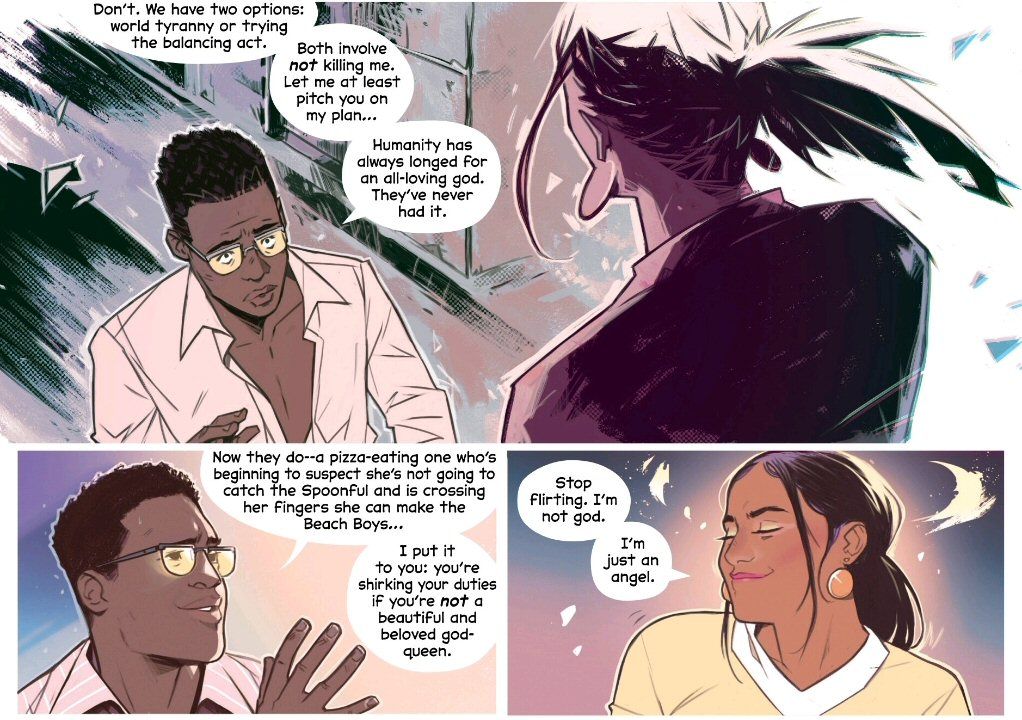
It seems like Etienne is proposing a form of divine command theory, with Valentina as the omnibenevolent god-head. Divine command theory is very old and comes in a normative deontological form (which Kantian ethics sought to replace in modern times). Etienne is explicitly appealing to Valentina’s innate sense of duty here – but she again turns him down:
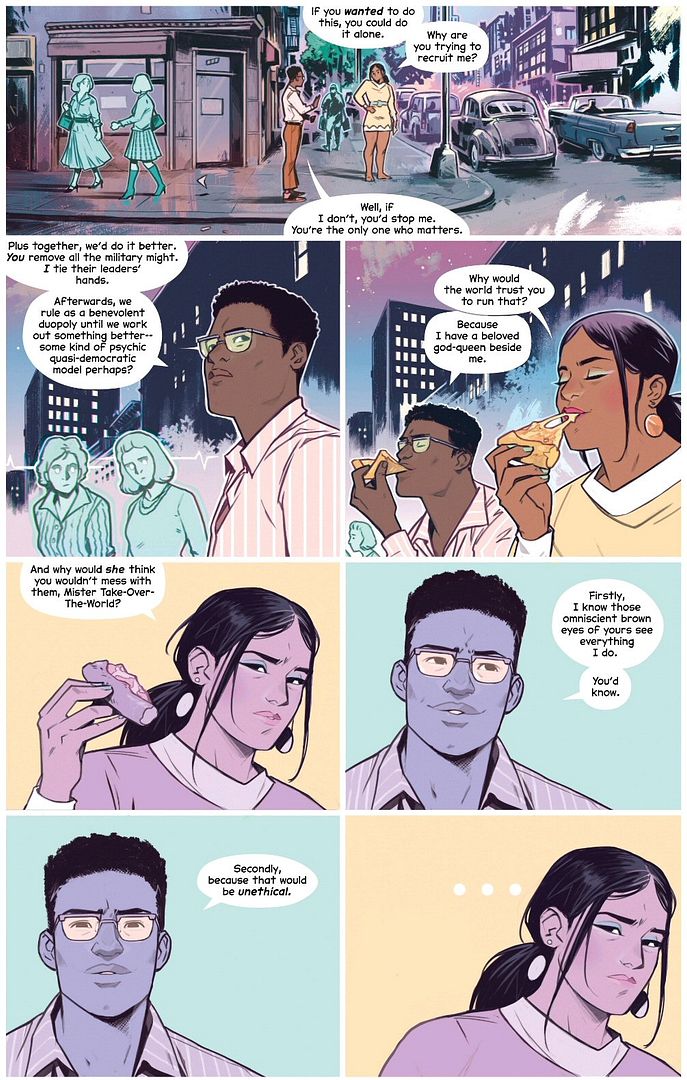
Interestingly, Etienne seems to be arguing that he is willing to let himself be bound by her normative ethics standards – if he can get her support for his plan (taking over the world together). This demonstrates his extreme ethical flexibility – he is not only willing to consider different theories, he is willing to limit himself to one. But that doesn’t sit well with our “angel”, whose deontological core is apparently neither Kantian nor divine command – and is not big on Etienne’s obvious ethical flexibility (most deontologists aren’t, in my experience):

It looks like our moral deontologist has decided to end Etienne’s life (though with appreciation to him for concealing this from others, so as not to distress passers-by with his own murder!).
But it turns out Etienne has two more aces up his ethical sleeve – the truth, and a threat:
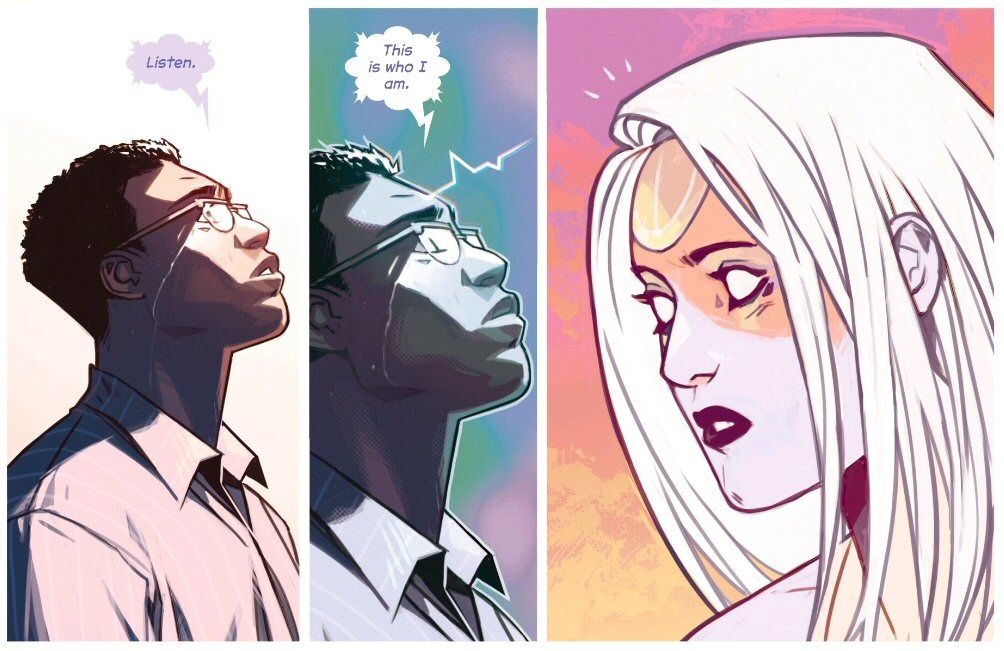
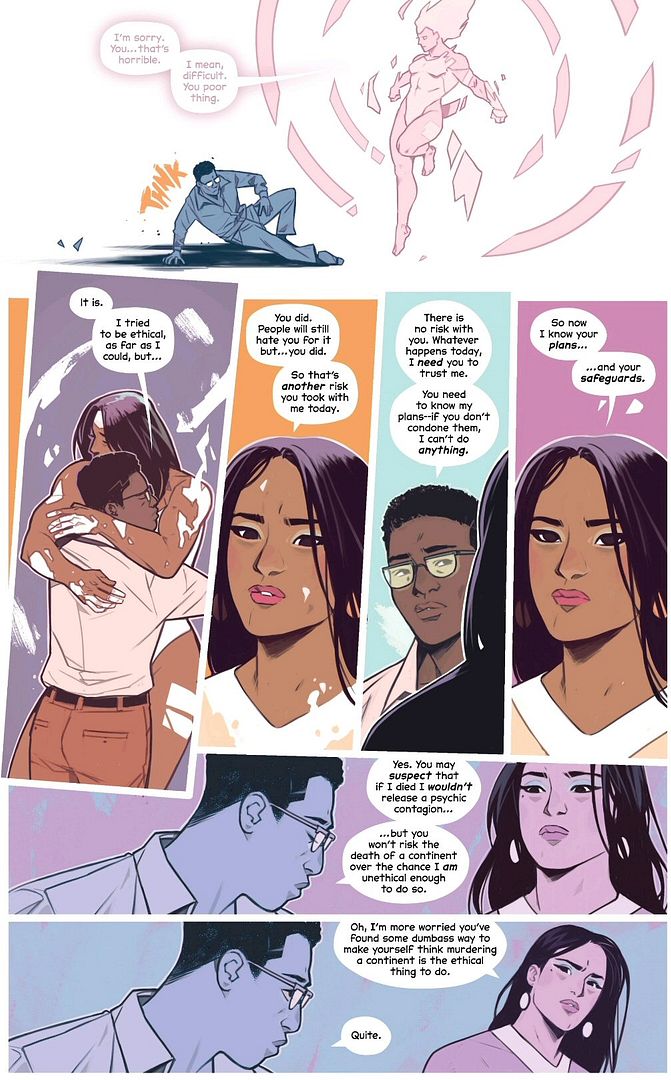
As you might guess, the mystery of Etienne’s true self is will not be revealed to us for a while. But Valentina feels considerable sympathy for him now – and decides to let him live. Regardless of the truth of Etienne’s nature, this shows that Valentina’s moral sense includes great compassion.
But Etienne also reveals (to her and the reader) that he has “safeguards” in place to stop anyone from killing him: a “psychic contagion” that would destroy a continent if he dies! Of course, truly enacting that would be “unethical” (as Etienne points out) – but Valentina is (rightly) concerned that he has found some dumbass line of reasoning to justify it ethically. Quite.
In any case, on to his plan B – the balancing act – then:
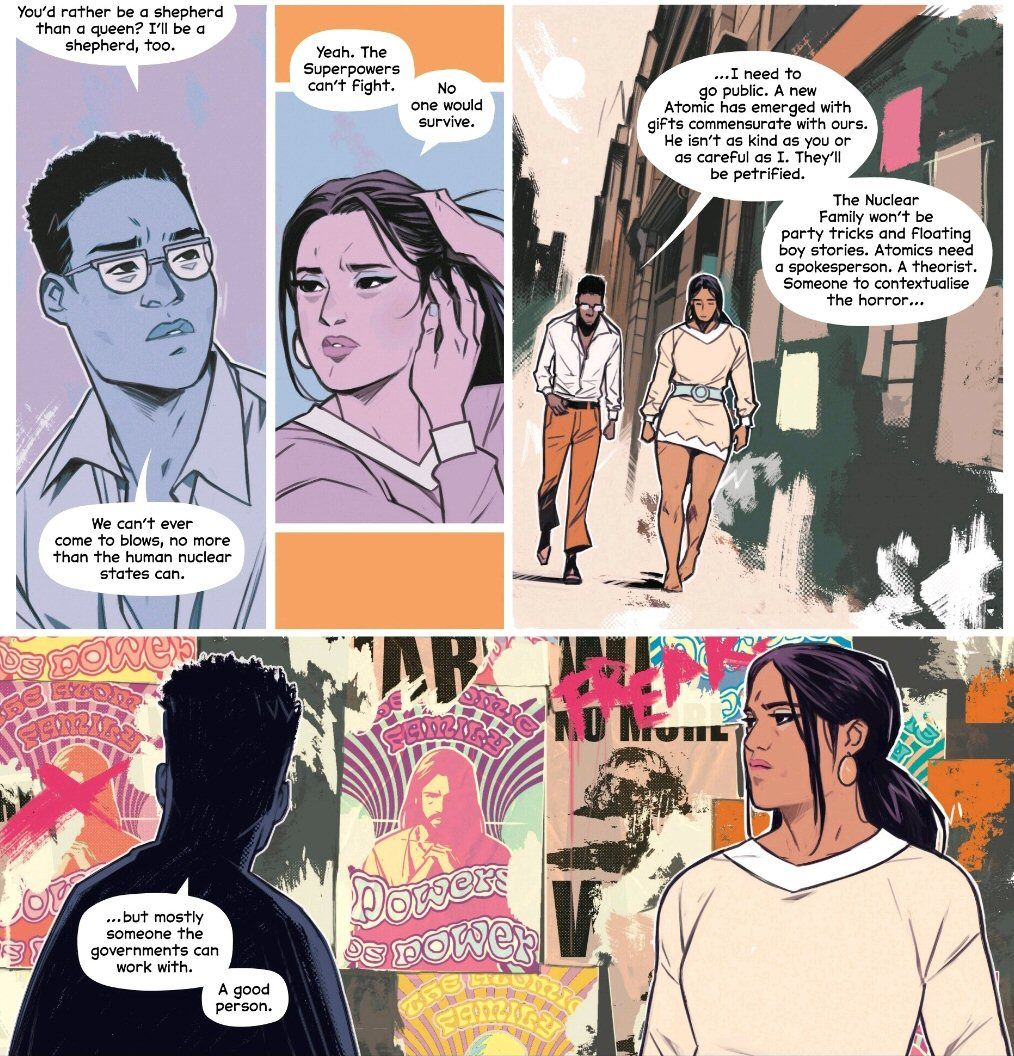
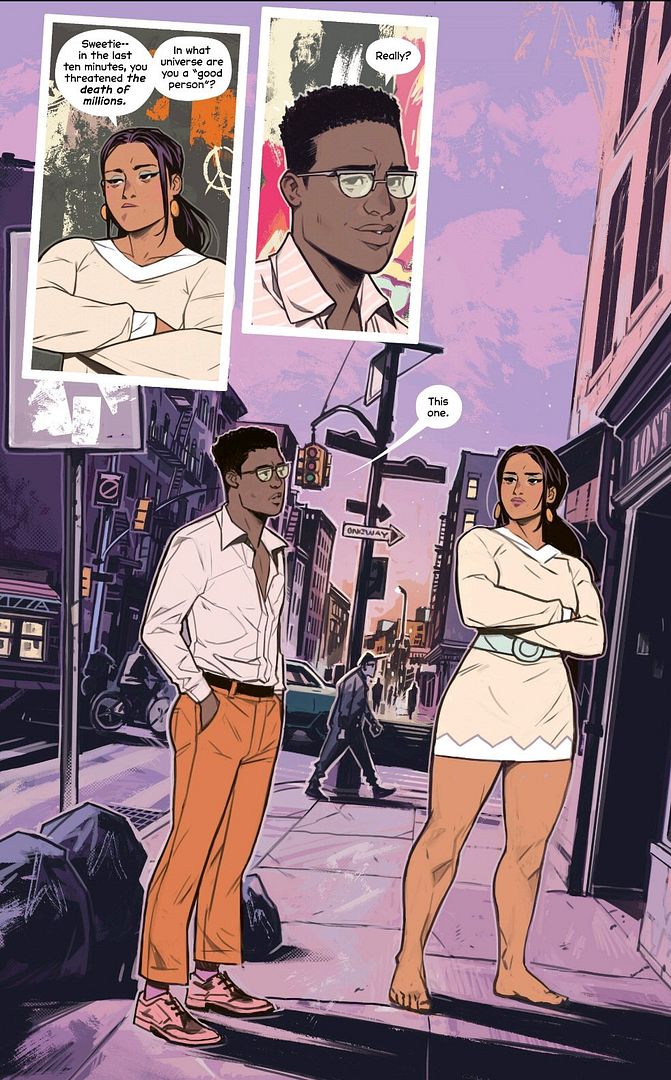
And we are off to the races!
That might seem like a lot of exposition for a comic, but I believe it was critical to set the stage for the nature of the ethical conflicts to come. The conclusions that Etienne draws above are very logical – and are the natural conclusions you would expect for an apex-level telepath with a utilitarian ethical world view. Gillen previously introduced this well in his Immortal X-Men series for Charles Xavier (Professor X), as I summarized on my brief overview of that character. Follow that link for panels by Gillen showing Charles’ similar reasoning around others having his gift, and the threat of nuclear war. This is what I was referring to earlier when I said that this series flows naturally from Gillen’s previous work on the X-Men.
Of course, Gillen couldn’t alter the continuity of the Marvel Universe by having Xavier come out and tell everyone what he had done. But Etienne is free to do so here. After all, it is the ethical thing to do. 🙂 At least by Etienne’s ethical standards (which are a bit different from Xavier’s, as I’ll explain below).
Individual superpowers ethics
Again, this series is really all about the interactions of the characters – so I will be revealing aspects about all of them as I go through the individual overviews. I therefore recommend you read them in the sequence I’ve presented them – but here are some links if you want to jump around: Etienne, Valentina, Magus, Heavy, Masumi, and Eliza.
One thing I can help but observe with these characters’ interactions: Gillen’s previous experience as a game critic (and designer) shines through. The arrival of the nuclear superpower states in our world gave rise to political game theory – mathematical theories of strategic interactions and resulting equilibria – as exemplified by John von Neumann. Similarly, modern gaming requires detailed consideration of interactions and metastable states. Simply put, if you don’t have opposing forces well-balanced to start with, the game will end too soon. Each of his characters have advantages – and disadvantages – in their interactions with the others (he eventually made this explicit in graphical form in issue #11).
Etienne Lux – Apex Telepath (Omnipath)
Described as the “ethical one”, Etienne has the ability to simultaneously interact with every single individual on Earth (“Omnipath”). He is able to control as well as read minds, although his ability to control or read deeper thoughts is limited or non-existent with most of the other superpowers (for various reasons). Unlike most of the other superpowers, Etienne is apparently limited to standard human physiology. As such, he is among the most physically vulnerable.
Killen has described him in short as: “Chidi from the Good Place meets Charles Xavier. And petrifying.” The Xavier reference is obvious – but I would clarify that he is like Chidi in that he is always explaining ethics to the others, discussing various famous philosophers and their theories. Unlike Chidi though, Etienne seems to find it remarkably easy to make ethical decisions – for reasons I will explore below.
In terms of his ethics, he has clearly adopted a utilitarian perspective. By definition, utilitarians are looking to maximize “utility”, which can be simply defined as moral good (specifically, the greatest good of the greatest number). But there are two main forms of utilitarianism, as I describe in detail on my Charles Xavier page: act utilitarianism and rule utilitarianism.
Act utilitarianism is when you weigh all your direct options and then choose the one that leads to the best overall consequences for all the people affected. It is thus very calculating by its very nature, and not limited by any moral rules (I argued in that earlier post that Charles has become increasingly act utilitarian in the modern Marvel comics).
In contrast, rule utilitarianism is an indirect approach that instead focuses on the results that are likely to come about in general when certain rules are considered. Basically, it tries to bring in that key aspect of deontology, applying it here in terms of the rules that could bring about the greatest good.
From the subsequent events of the first issue (and beyond), it seems to me that Etienne strives to be a rule utilitarian – but has remarkably little difficulty in switching to act utilitarianism when the need arises. Consider this scene from the first issue where Etienne is being interviewed by Tonya, while a crisis erupts due to the action of another character (Ray “Heavy” Harris). Etienne explains that Heavy is a showman who likes to play to a crowd:
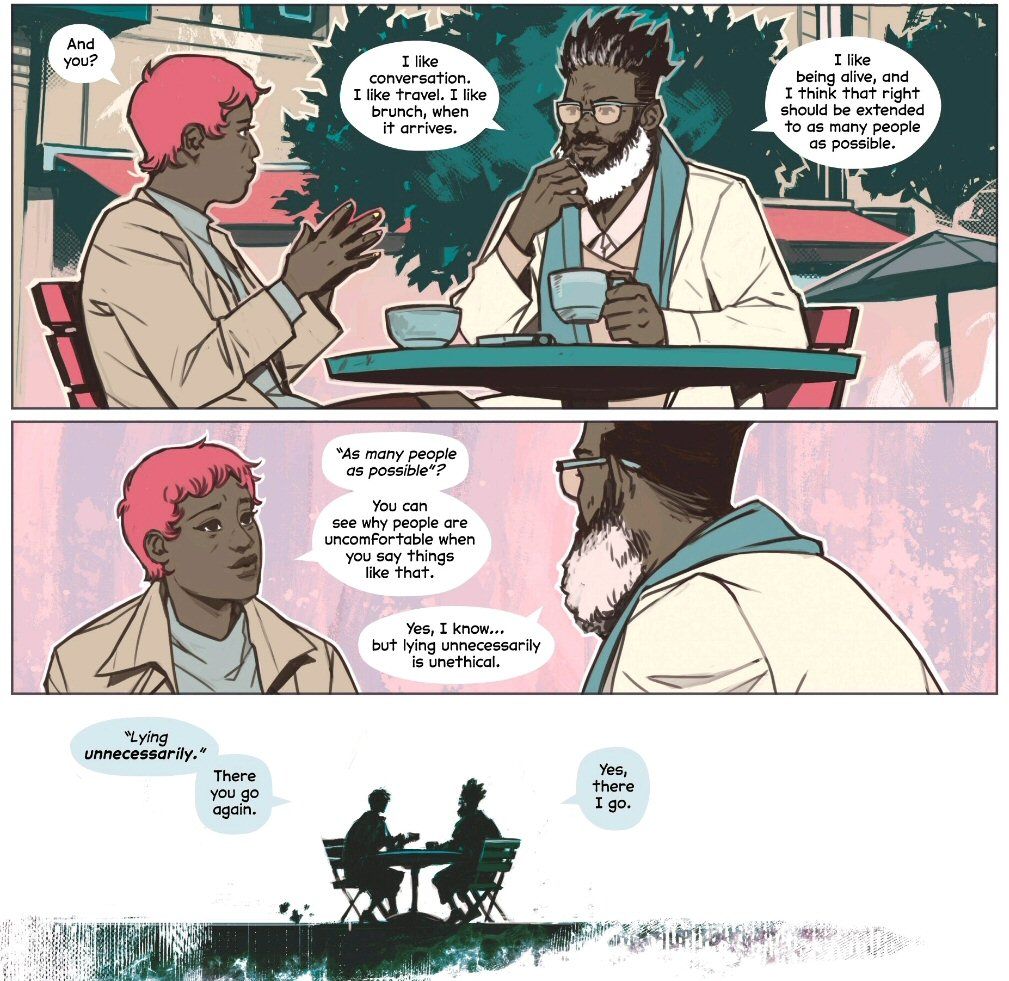
“As many people as possible” shows that Etienne is a utilitarian – and thinking that “lying unnecessarily is unethical” shows he is using rule utilitarianism as his primary approach (again, see that Charles Xavier link for a explicit comparison of lying in the two forms of utilitarianism). Ironically, although Tonya is disturbed by this, I actually find Etienne’s default rule utilitarianism rather reassuring!
Unfortunately, Heavy’s provocative actions result in the U.S. Government attempting to murder him – and failing. With only seconds to act, Etienne reaches out to the other four superpowers and get their permission to let him handle the matter his way. Etienne asks Heavy what it will take to prevent Heavy from destroying a good portion of the United States in retaliation. First off, Heavy asks Etienne to kill the President, who ordered the strike:
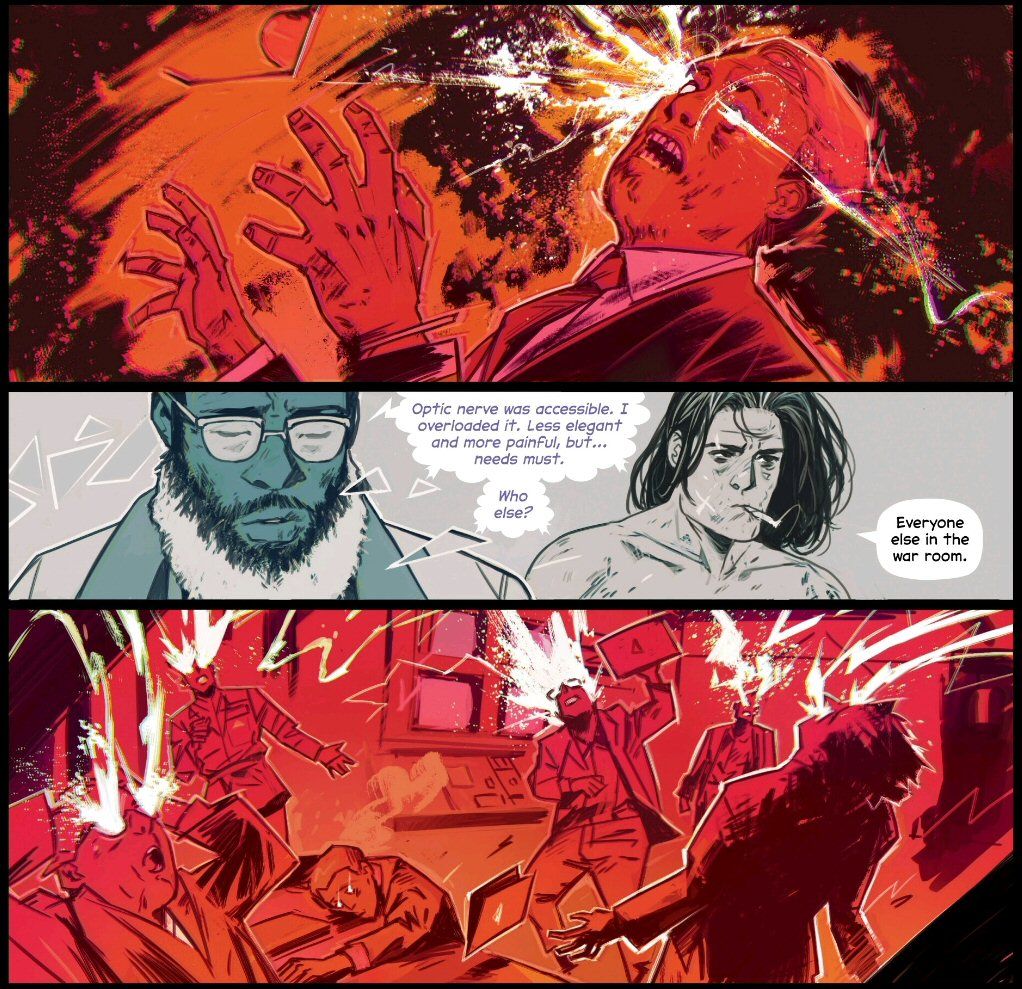

Etienne seems to be in full act utilitarian mode here. He follows through on Heavy’s request to kill all who knew about the device – including that last request above to kill all who were involved in supporting the technology. Etienne fully complies, until Heavy asks him to kill the innocent families of all of the above. Etienne makes a fateful rule utilitarian decision here:
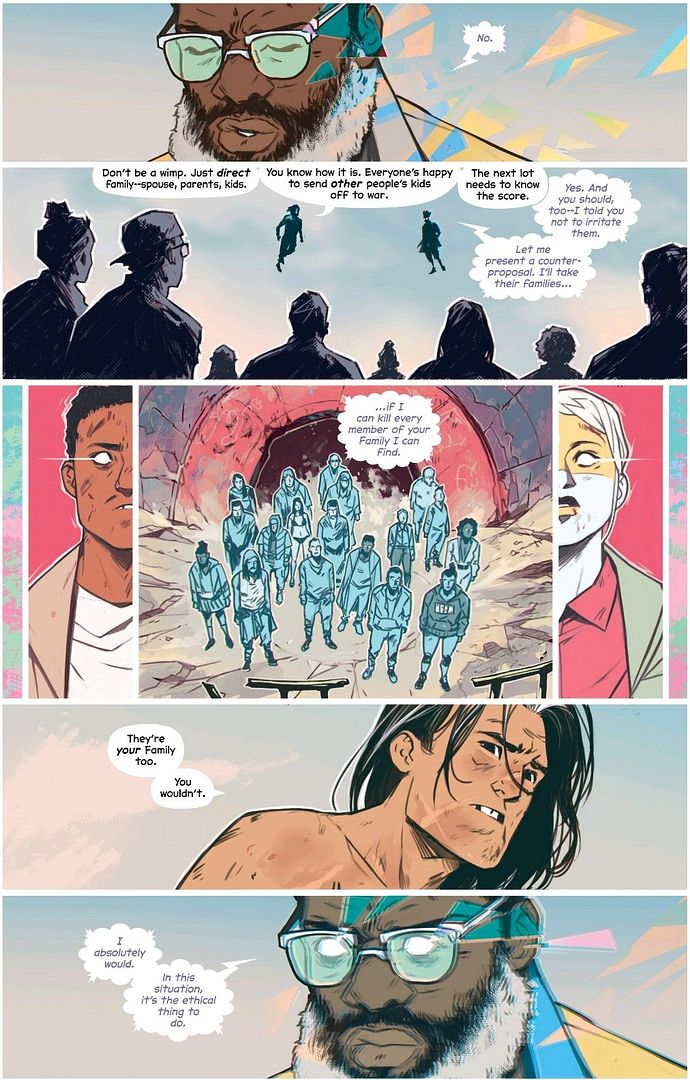
Heavy agrees and backs off, but not before telling Etienne that he will not forget the threat to his own family.
Etienne calls the interview to an end, as he expects his decision to kill the President “will be unpopular” (!). But true to his word (and ethical beliefs), Etienne goes public by co-opting a news broadcast and describing his actions – and their ramifications (I love Wijngaard’s chain-smoking family in the first panel):
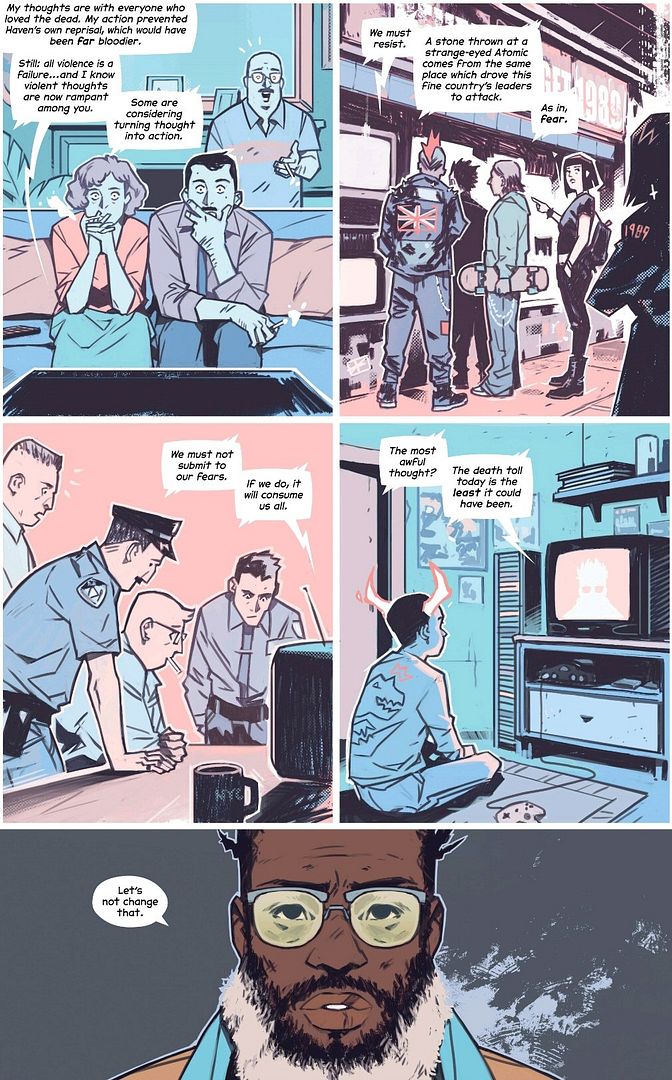
Etienne is not naive however, and realizes that the U.S. government (well, what is left of it) will come after him – and risk innocent lives to kill him. He flees the country (with Valentina‘s explicit protection while in transit). But I loved this scene at his arrival airport, where an elite commando in a telepathically-sealed suit comes for him, in issue #2:
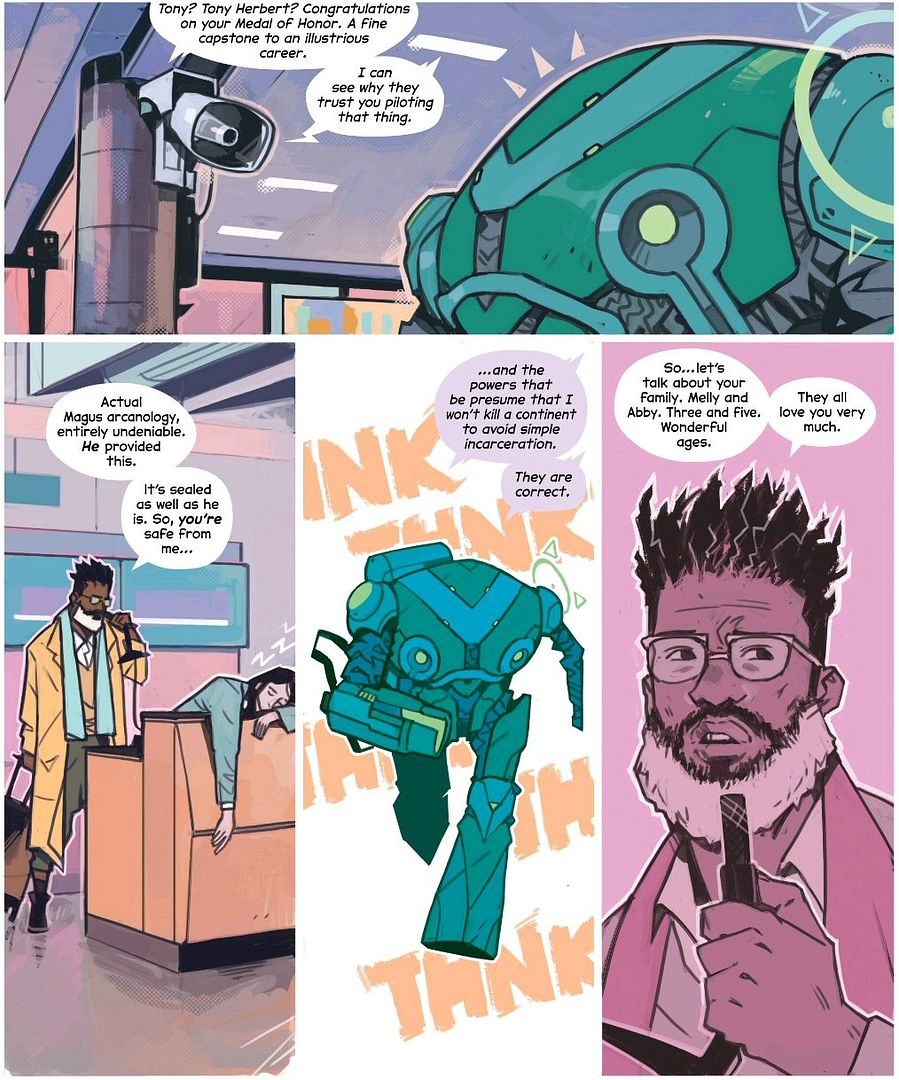
Uh oh …
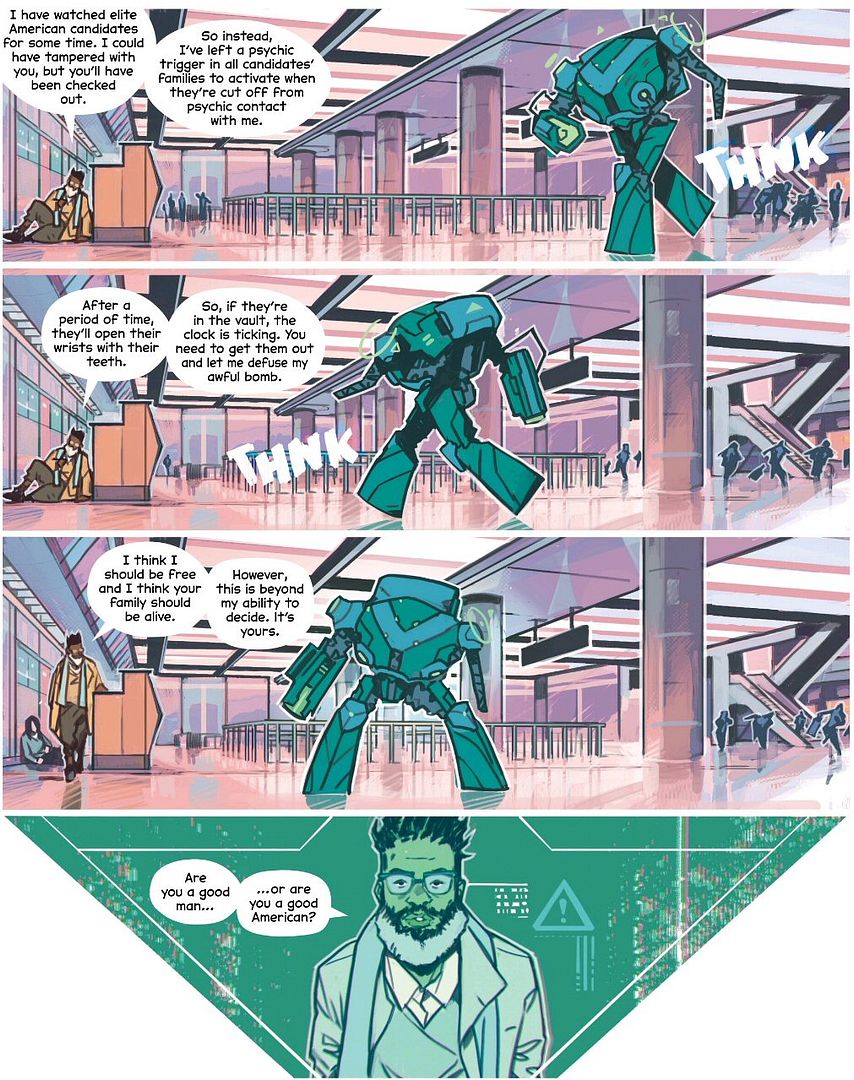
Note how Etienne gives Tony the option to decide whether to be a “good man” or not …
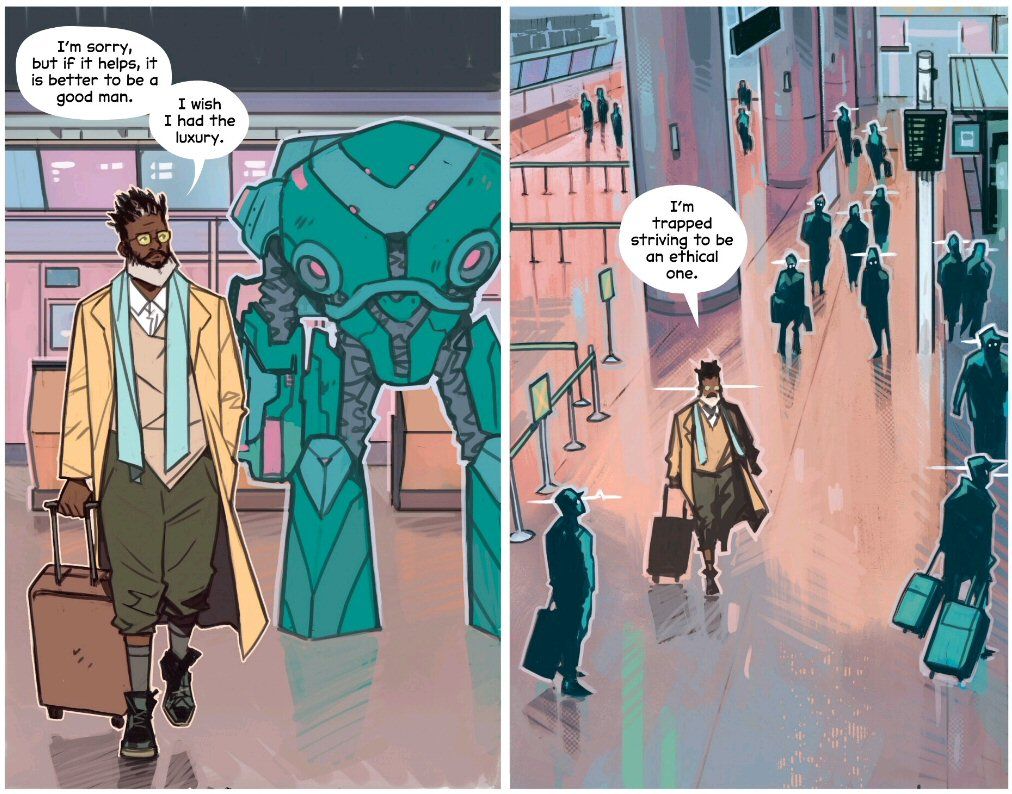
… an option that he doesn’t feel he has himself.
As this indicates, Etienne is troubled by the decisions he has to keep making. He would like to abide by rule utilitarianism but keeps finding it necessary to apply act utilitarianism to maintain the balancing act between the superpowers – with as little loss of life as possible.
Back during that interview, Tonya asked him what he wanted the world to know about him:
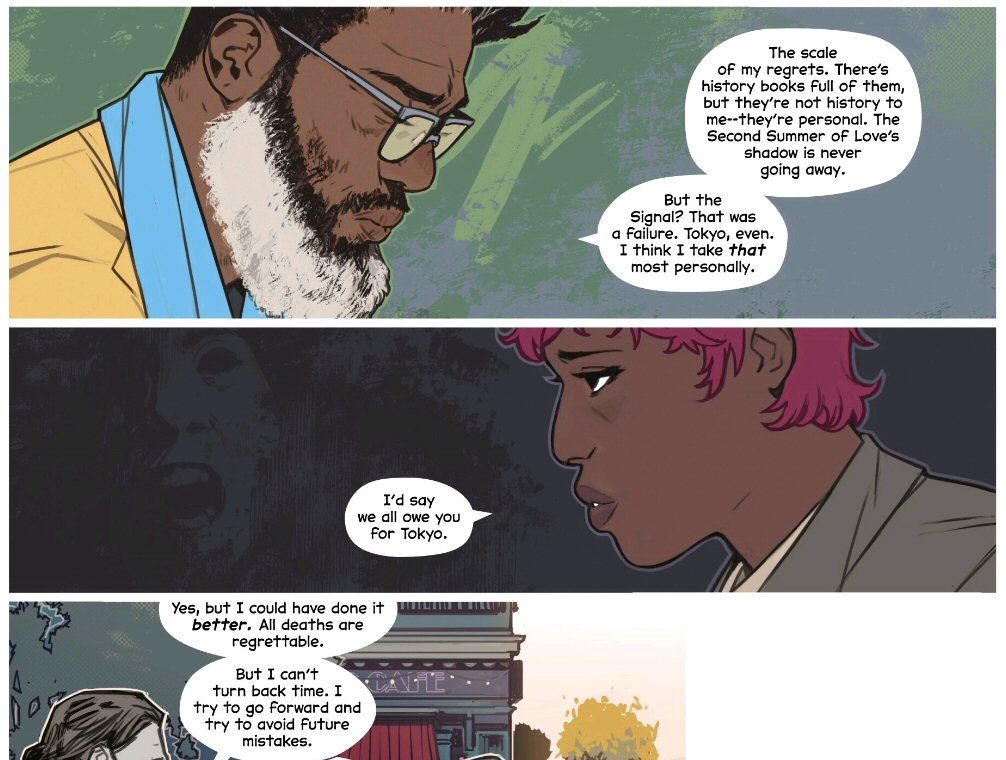
And thus his need to balance out direct actions in the specific circumstances he finds himself. In a way, he has trapped himself into having to follow act utilitarianism – to “try and avoid future mistakes”.
But you would have to be a very unemotional person to do that consistently (and not be crippled with guilt as a result). How does Etienne manage that? Gillen starts to explain in this scene with Masumi from issue #2
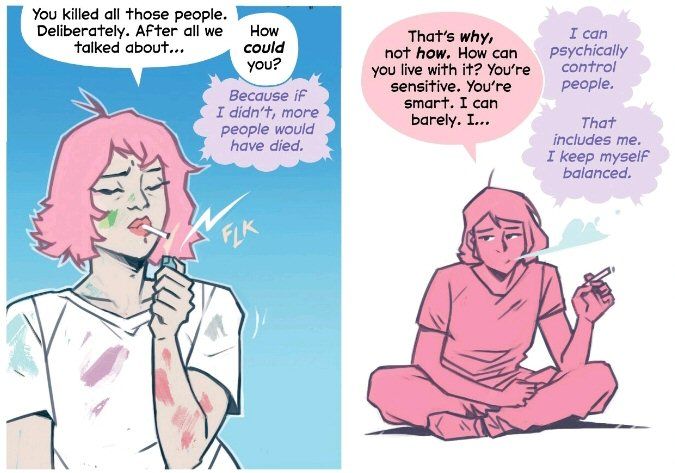
Etienne’s relative lack of emotion is discussed further in a number of subsequent issues. I particularly like this later issue where he explains why he has to do this to himself – in keeping with his physical limitations:
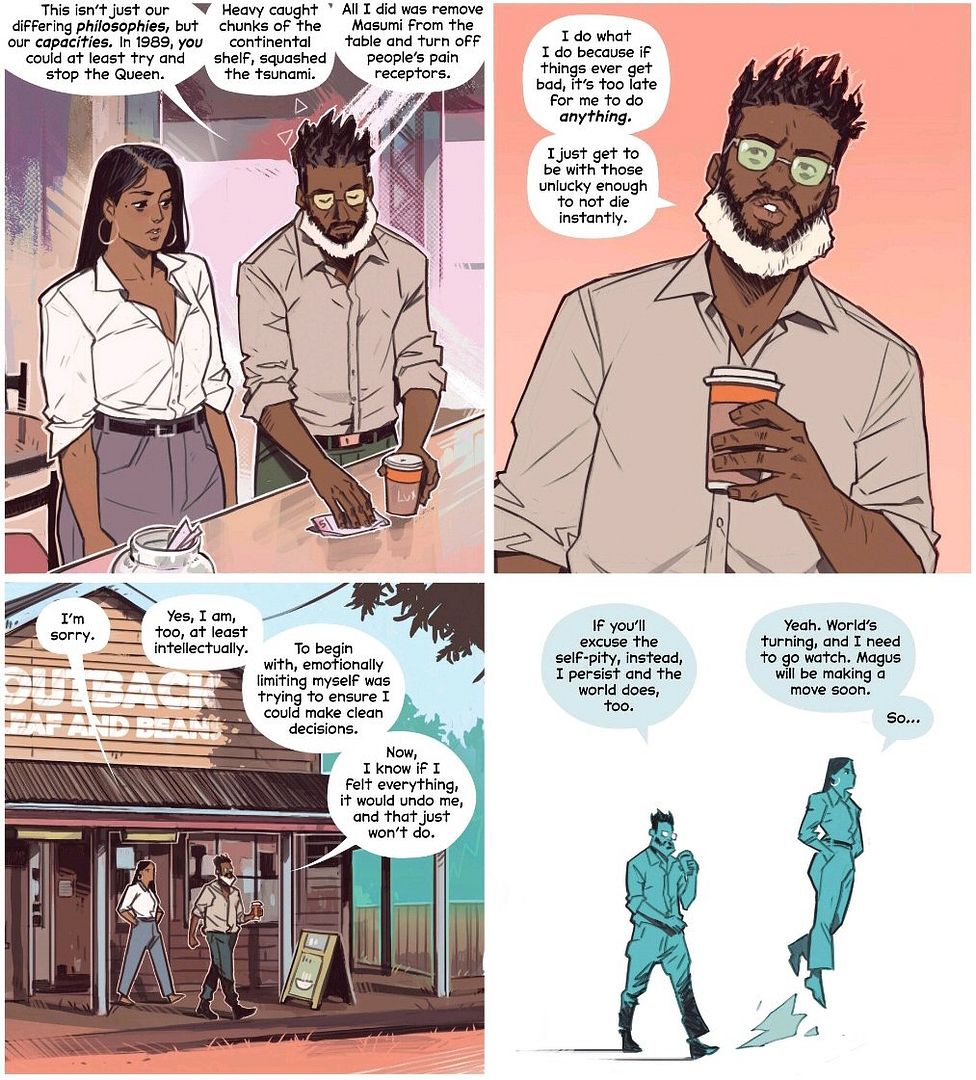
Etienne’s abilities and actions come with a heavy personal cost – the need to constantly suppress his own emotions. And to continue to do so for ever. Even if he were to change course at some point, he cannot let himself feel the full emotional weight of his past decisions. Despite this, he is willing to go on paying that cost indefinitely, for the greater good (“if you’ll excuse the self-pity, instead, I persist and the world does, too”).
As Gillen himself has noted in interviews, there are several online fan group polls that score the six superpowers for how much like “heroes” or “villains” they seem (here is an example of one). Etienne is typically the most variable, ranging across the full scale, although most seem to see him more on the heroic side. I can certainly see why he is “petrifying” (to use Gillen’s phrase). But I can’t help but note how he is willing to sacrifice his own well-being for the greater good. While other characters can also display a sacrificial quality, Etienne’s seems far more pronounced (and permanent) than most. It is an interesting observation on the nature (and perhaps limits) of sacrifice and heroism.
In a way, Etienne actually reminds me a bit of Spider-Man here – think of his infamous catchphrase, “with greater power comes great responsibility”. Etienne feels the overwhelming burden that his great power demands – he feels responsible for the world. In fact, this gets into one of the main problems with utilitarianism: negative responsibility. This is where you not only feel responsible for your own actions, but also for everyone else’s. Follow that link for a summary of the utilitarian critic and philosopher Bernard Williams, from my redemption of Charles Xavier post.
That is an impossible burden that Etienne has taken on himself. And the only way to manage it is for him to excise his own humanity – by removing the human emotions (like guilt, fear, empathy and compassion) that keep our moral reasoning in check (see my Moral Thinking, Fast and Slow post for a discussion of how we use emotions in moral decision making). Without those, Etienne is capable of almost anything in the name of the greater good – a truly petrifying thought.
And as we know from the opening issues, his power is growing. So the others are right to fear him.
Santa Valentina – Extradimensional Entity (Angelic)
Described as “the moral one”, Valentina entered into existence (aka the “single timeline”) concurrent with the Los Alamos nuclear detonation in 1945 (from issue #3):
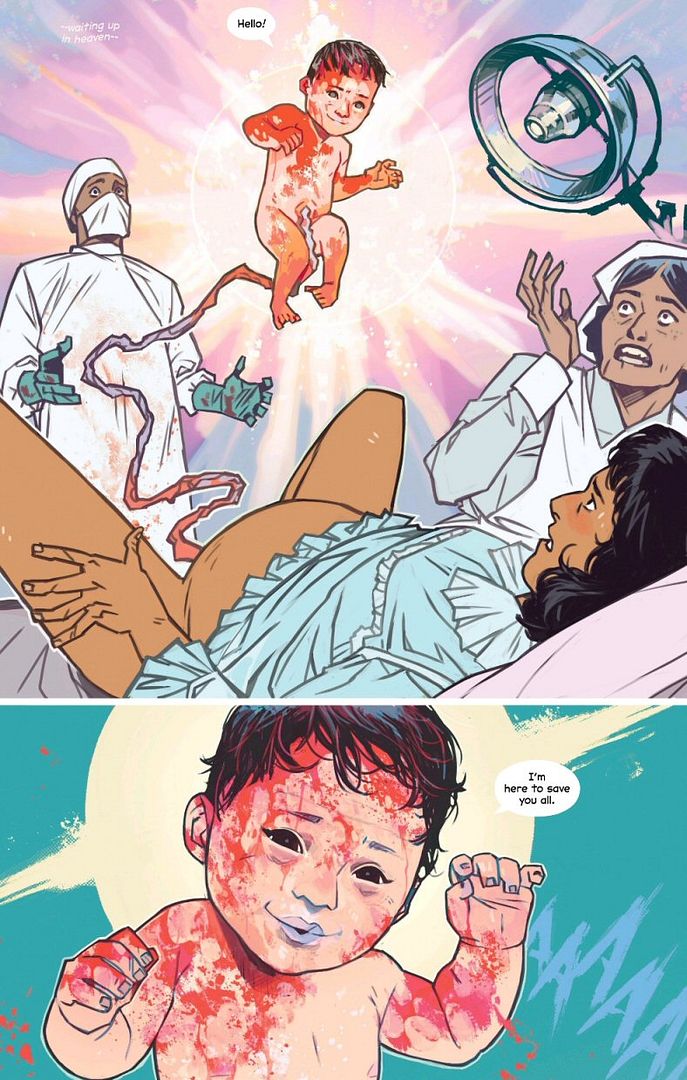
Gillen has described her in short as: “An angel who fell to Earth to save us all and listen to pop music”. Although she has a fairly unique normative ethics core (as I will describe below), the closest comic book parallel is DC comics’ Superman. Not only is she often drawn is a similar way (floating down from above, hands on hips or arms crossed), she seems to have a somewhat similar power set (with near invulnerability). While both characters are primarily deontological in their moral perspectives, Superman is far more Kantian – and far more willing to limit himself in service of his moral principles – than Valentina is (as we will see below).
As shown in the panel above, Valentina arrived as a fully self-aware entity in a human body. Although her body continues to age, her abilities are unchanging: she remains one of the most powerful beings in existence. She doesn’t seem to remember anything from before her time before Earth, but has a very clear sense of her “mission” or duty: she is here to save us from destroying the single timeline.
Honestly, it took me a bit of time to figure out what exact deontological form her morality takes. As explained earlier, the opening issue makes it clear she is neither Kantian nor divine command driven. She seems to be very compassionate – but also seems willing to kill. Consider her reaction when Etienne reached out to her in issue #1 asking her not to intervene while he tried to negotiate with Heavy:
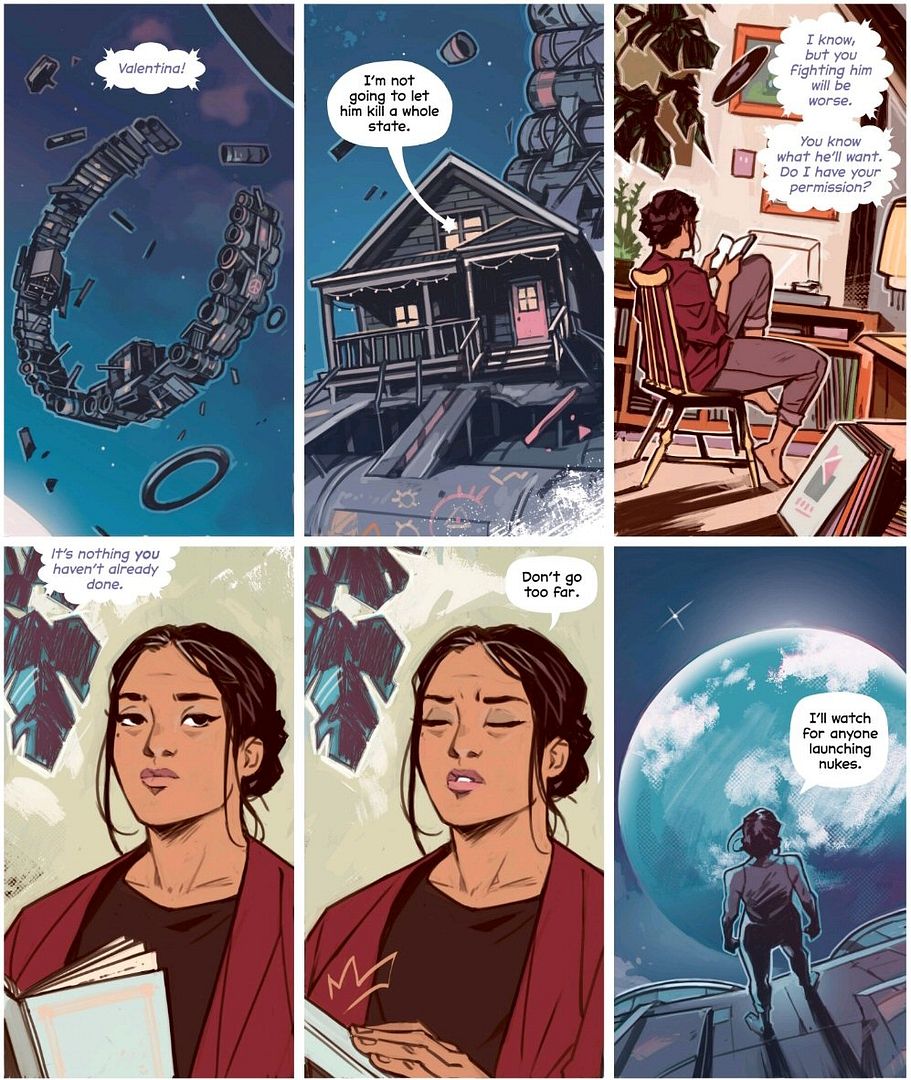
“It’s nothing you haven’t done” and “don’t go to far” are very revealing comments.
Valentina clearly weighs decisions (as we saw in the opening, when she repeatedly thought about killing Etienne, but demurred). Consider this sequence, right after she has personally intervened to end the Cuban missile crisis in 1962 by destroying all the short-range missiles on both sides (from issue #3):
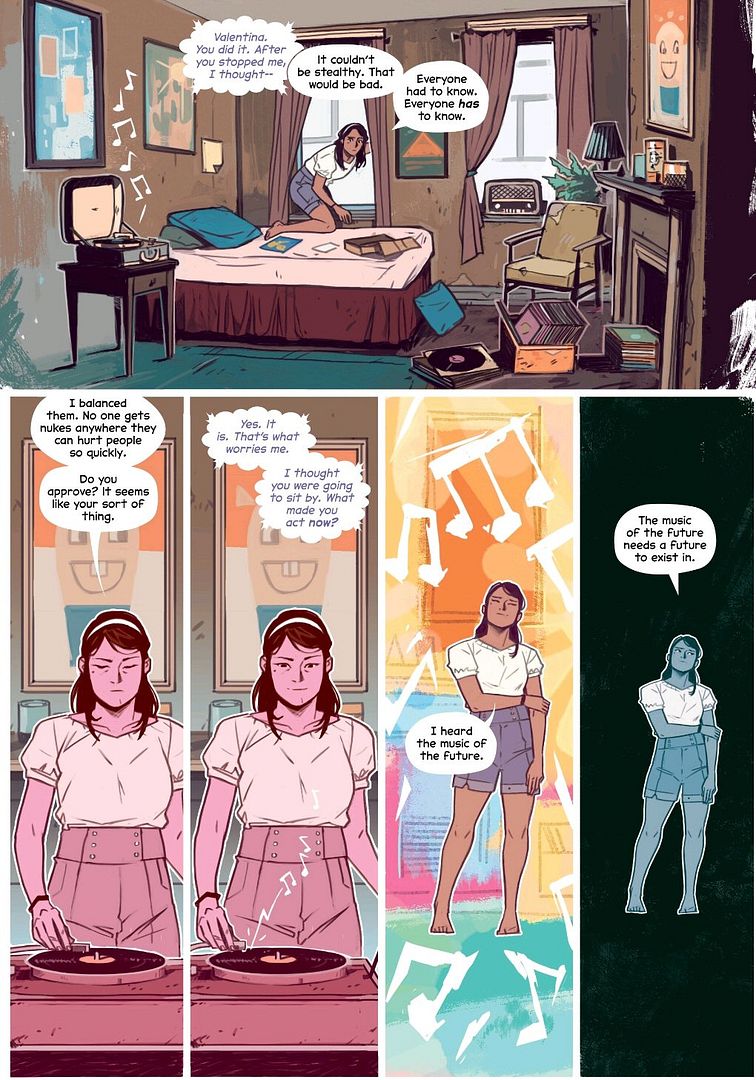
So, it seems like she can reason like Etienne on occasion – or, at a minimum, she finds him a useful resource to consider in making her own judgments. And she has an over-riding moral imperative to make sure the world doesn’t destroy itself.
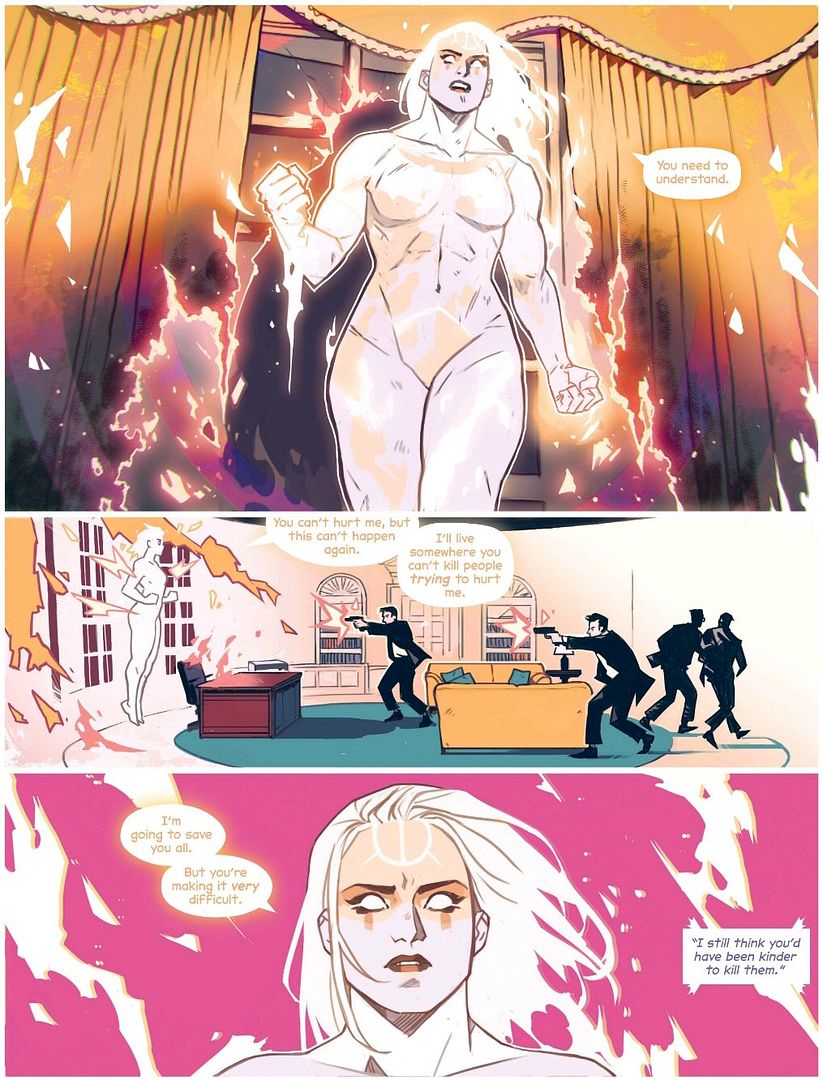
What is also distinctive about Valentia is that she is supremely confident in her moral decision making. And the other characters see her that way too – she is consistently described by all the characters as the most “idealistic”, “moral” or “good” among them. And she is never vengeful. Consider this sequence after the U.S. President attempted to murder her by detonating a nuclear bomb at a music festival on U.S. soil:
Still, her deontological core was all a bit opaque to me until the 1957 flashback sequence in this same issue, where she first introduces herself to Etienne:
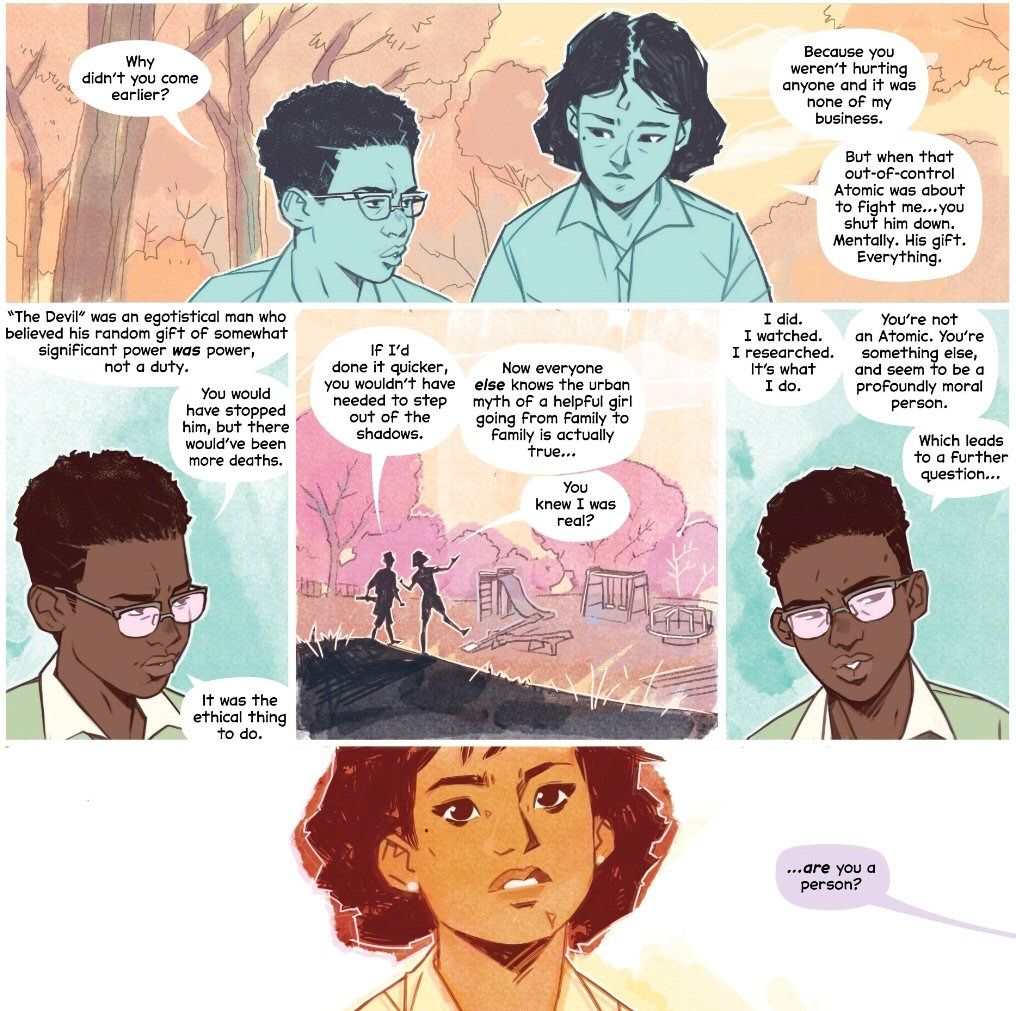
As an aside, you can see that Etienne has always been consistent, even as a child – he strives to prevent as many deaths as possible. As for Valentina, she hadn’t intervened with Etienne before he acted to help her directly, because he “wasn’t hurting anyone and it was none of my business”. But what is she, exactly?
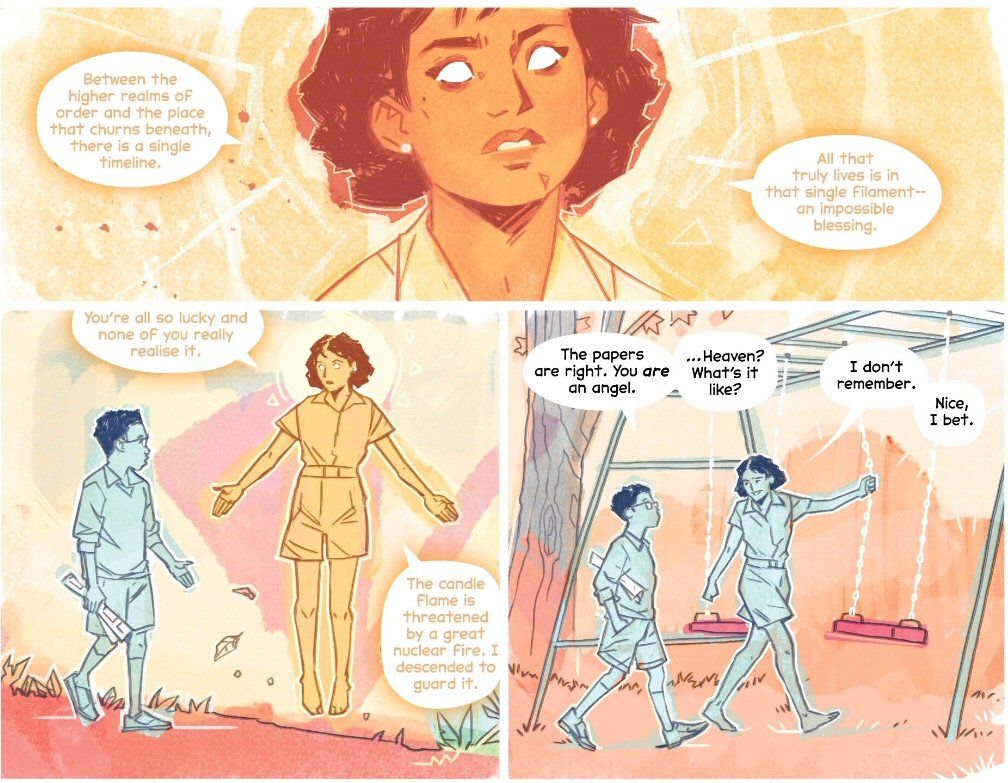
And here is the point of clarity for me:
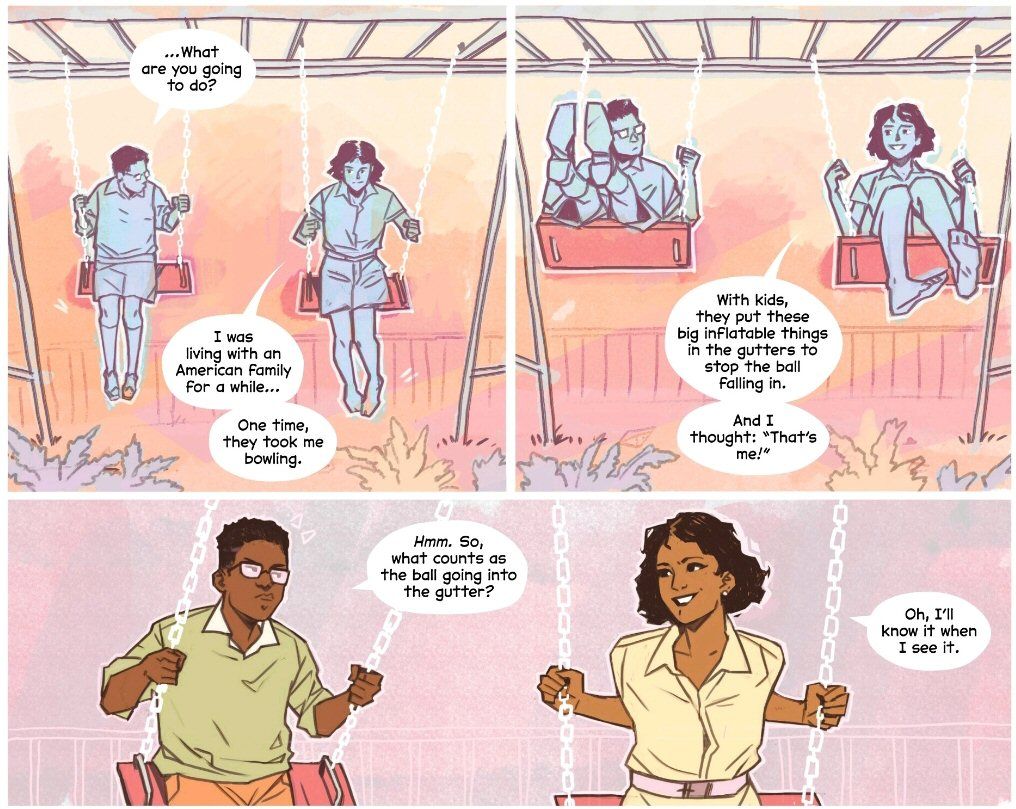
Ah … “Oh, I’ll know it when I see it”.
Valentina is mainly using what used to be known as moral intuitionism (now called ethical intuitionism, consistent with the modern ethics framing). While this is normally considered a meta-ethical position, it does come in normative forms as well. I recently described a very popular form of deontological moral intuitionism (as it was known at the time) developed by the Scottish philosopher W.D. Ross in the early 20th century.
Ross argued that intuition self-evidently shows four kinds of things that are intrinsically good: virtue, knowledge, justice, and pleasure (in that relative order). We feel these to be good, and therefore don’t need further deliberation or logical inference to convince ourselves. Valentina does seem to be led by these concepts – including pleasure (e.g., her love of pop music, the appeal of the Queen and the Second Summer of Love, etc.).
According to Ross, these good things lead to obvious obligations for us, which he referred to as “prima facie duties”: fidelity (a duty to keep our promises), reparation (a duty to correct previous wrongs we have done), gratitude (a duty to return favors from those we have received them from), beneficence (a duty to maximize the general good), and non-maleficence (a duty not to harm or injure others).
This theory was “pluralistic” in that these are distinct relative duties that we feel, with none of them being absolute or automatically over-ruling the others (as Kantian and pretty much all other deontological ethics theories require). In any given situation, we need to consult our own perceptions to recognize which duty(ies) best apply – with one ultimately rising to the top, deciding the proper course of action for us.
The point here is that some deliberation is involved in weighing the most relevant duty. And note that one of those duties (beneficence) is very compatible with utilitarianism. So this is why Valentina can be aligned with Etienne on occasion, despite using a deontological form of ethics. But fundamentally, she is driven by concern and compassion for humans (non-maleficence).
This normative ethics theory is not a perfect fit for Valentia though – Valentina is not human, and she does have an over-riding prime directive: preserving the single timeline. This comes out well in her discussion with Eliza Hellbound in issue #8, when Valentia considers her failure to stop the Queen in the Second Summer of Love:
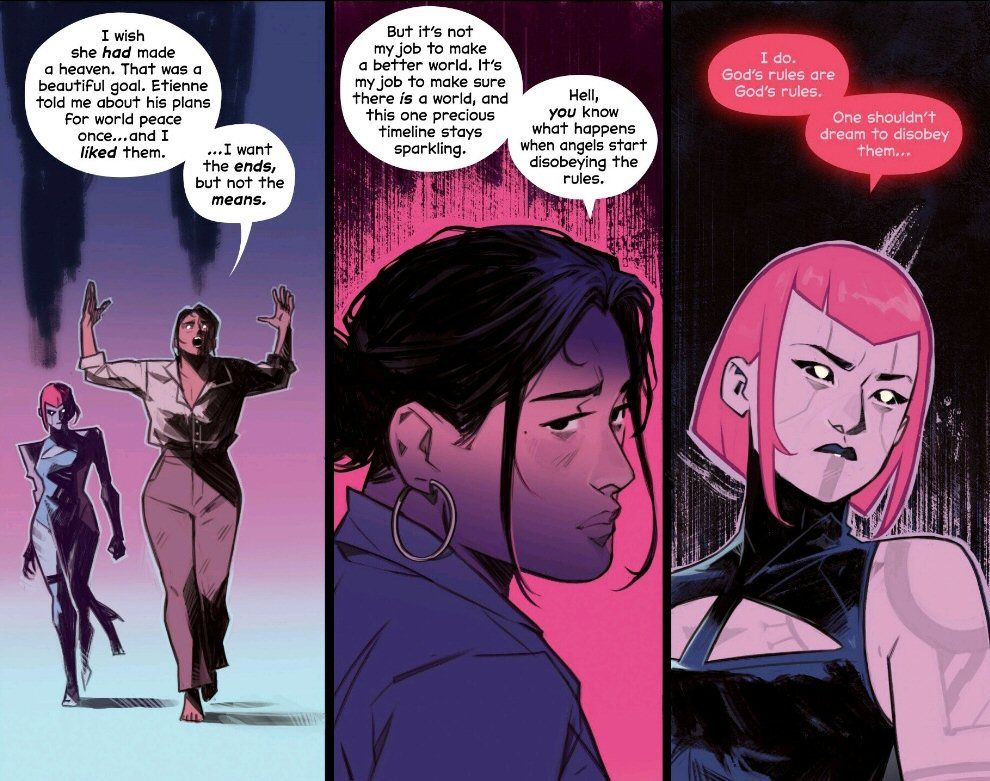
This reiterates her deontological world view – the means matter.
Online polls show that Valentia is the one who is most consistently considered “heroic” by fans (with the lowest amount of variation). The Superman comparison seems apt for most readers.
And yet … she is willing to kill individual humans in service of her mission to humanity. And her moral intuitionism is ultimately something of a “black box” – we don’t know how she will reason in different situations. Consider how Etienne and Heavy both chastise her for siding with Magus in the airport attack on Etienne – despite having offered him safe passage:
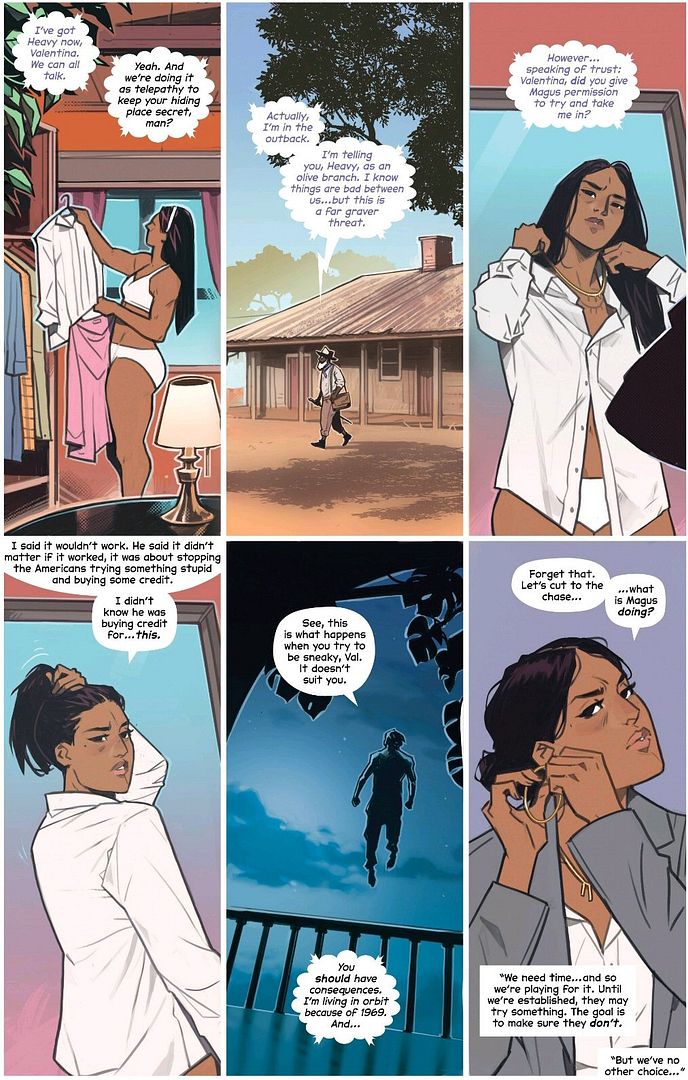
I love Wijngaard’s artwork here, as it captures Valentia’s character so well (she seems very human for an “angel” – and just like Etienne is a real clothes horse).
But consider her use of language throughout the series: she is not going to let us “sillies” blow ourselves up. Even among her close friends and peers, the other superpowers, she constantly refers to them as “honey”, “hun”, “sweetie”,”sweetum”, etc. While this could be seen as endearing, it also comes across as condescending and paternalistic.
Valentina has demonstrated through her actions, repeatedly, that she believes she knows better than anyone else what the right thing to do is. While she is willing to try and get the others onboard with her plans, she will also assert her will over others. She thus seems quite comfortable in denying everyone else their own moral agency. And we don’t know how she will “intuitively” reason in any given situation – for that matter, even she admits she doesn’t know what she will do until she does it! All while not even remembering what “heaven” is like (and we are repeatedly told in this series that heaven and hell are not what we think they are).
For these reasons – and against popular opinion – I personally find Valentina to be one of the most disconcerting and unpredictable superpowers. What won’t she do to preserve humanity – and will the humans have any say in it?
Jacky Magus – Technomage and Peak of the Pyramid
Described as the “asshole one”, Gillen pithy sums him up as: “John Constantine meets Doctor Doom … and sold out, hard.” This is a good description, although I’d throw punk anarchist into the mix as well.
Magus’ character and his Pyramid of followers makes me think of an old philosophical joke: The problem with an anarchic collective is that no one will follow the rules. 🙂 I can’t remember who said it (maybe Thomas Hobbes? If anyone knows it, please drop me a comment!). Fundamentally, Magus is very suspicious of anyone with power (including himself!). He is extremely critical of authority, and very much an anarchist (at least to start).
Although the motivations (and ethics) are very different, the comparison to Marvel’s Doctor Doom is apt in two senses: Doom is both a master of technology and magic, and Magus similarly blends and combines the two. Magus’ superpower is basically knowledge – he knows things, intuitively – while Doom is always in pursuit of knowledge. And Magus can put that knowledge to practical use.
From the flashback sequences in issue #5:
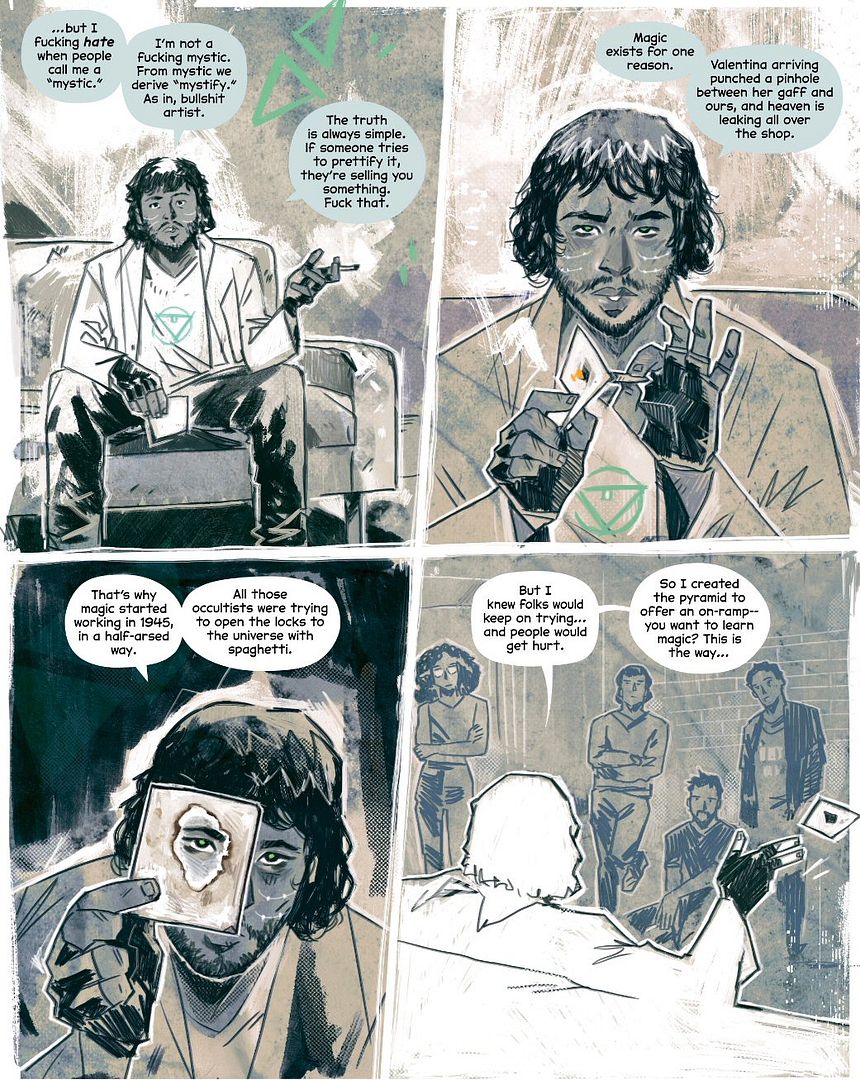
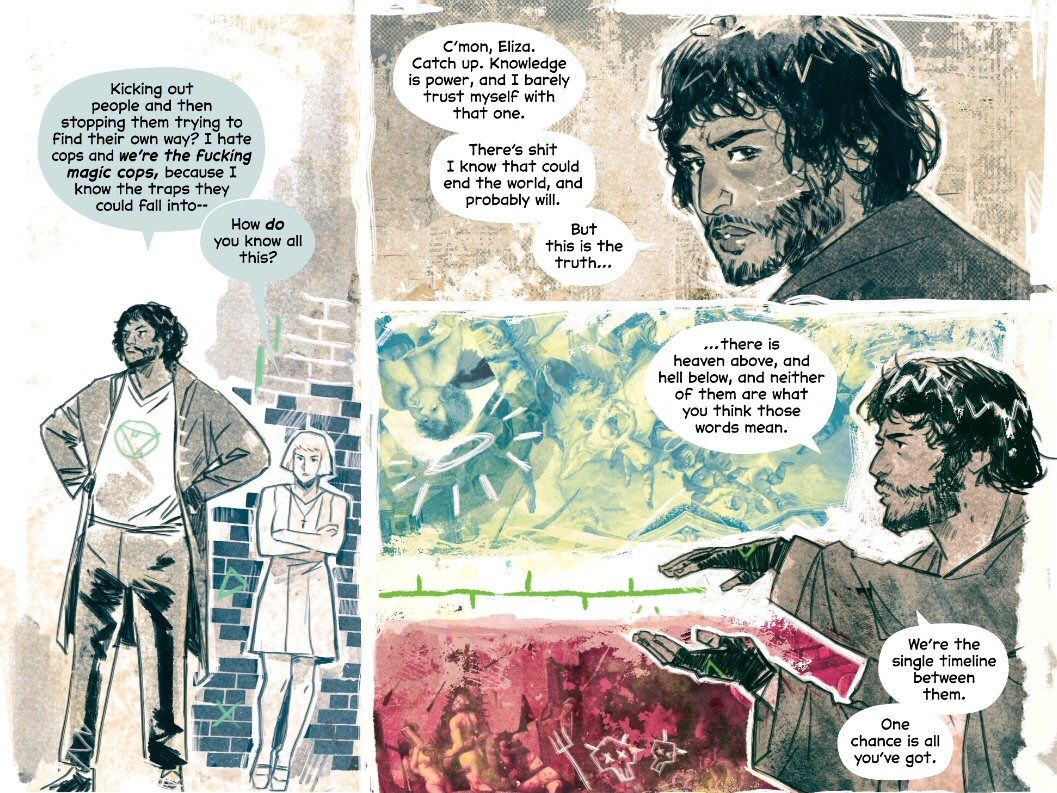
And so, Magus created the technomagic Pyramid as a way to protect the single timeline from the other superpowers as well as the dabblers in the occult (none of whom he trusts). And what is his problem with people with power, exactly?
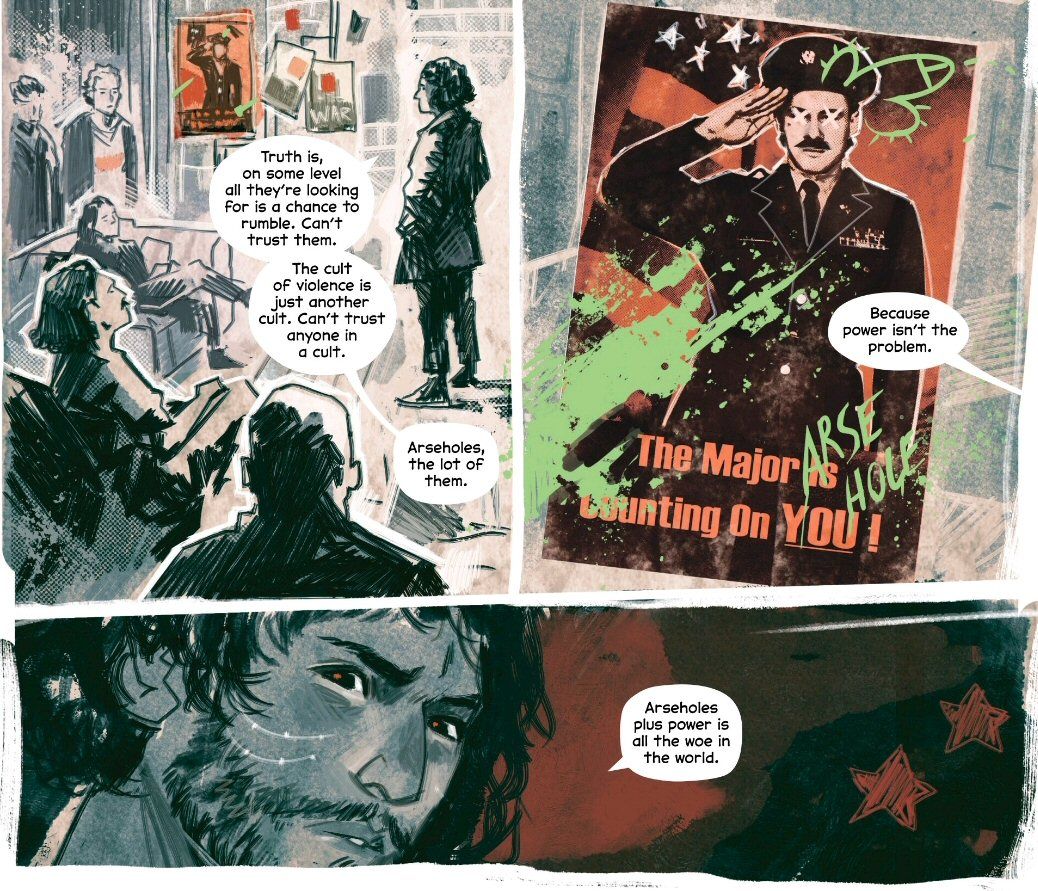
Yes, that’s a good way to sum up the problem of the world.
This is also why Magus developed the technology to shield him and his followers from Etienne‘s mind-reading and mind-control: the face mask he is always wearing from this point on is an example. The physical Pyramid he has created is also shielded against Etienne.
Interestingly, Magus is quite honest when Eliza calls him out on the inconsistency of his position:
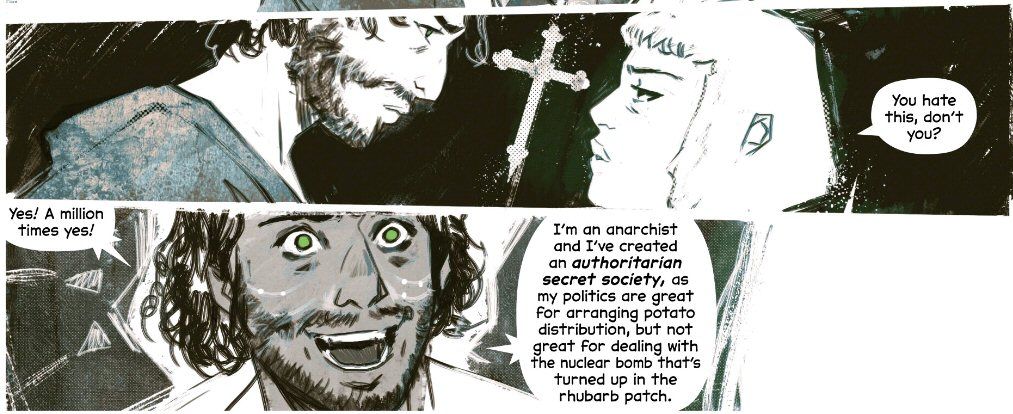
Despite Eliza’s criticism, this sequence actually makes me feel better about Magus! He is honest and genuinely regrets the decisions he feels he needs to make.
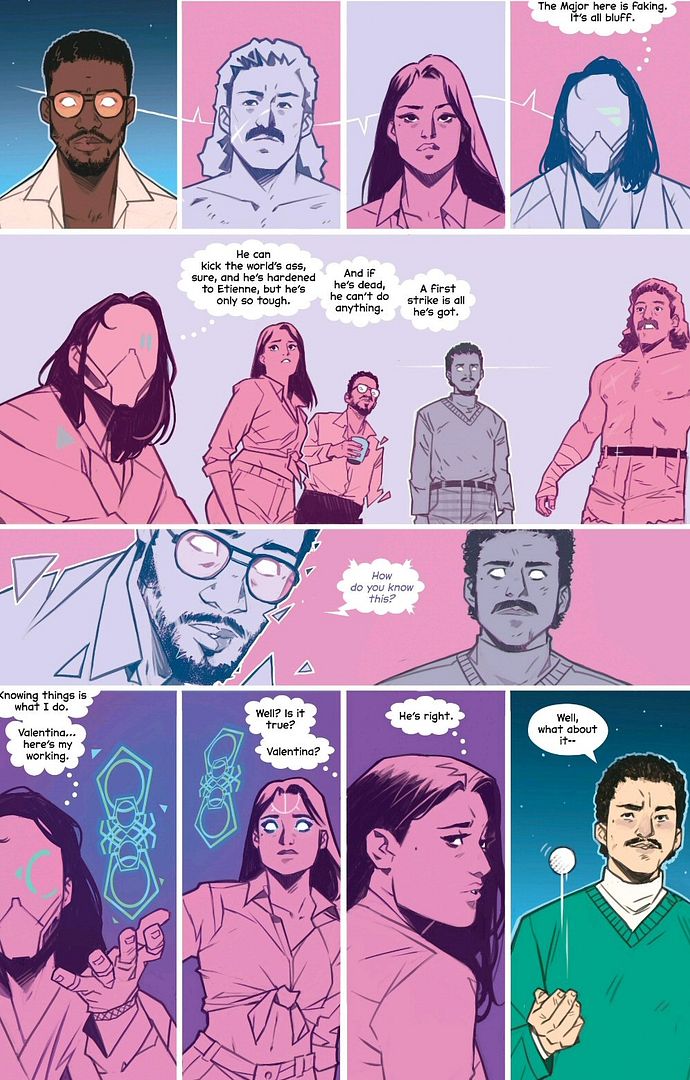
Magus is very challenging of the the other superpowers, most notably Etienne (and Valentina and Heavy to a lesser extent). He frequently questions their moral frameworks and delights in exposing any potential hypocrisy he spots. He plays this provocative role most heavily in the early years, constantly testing the group. Consider the sequence when he decides to reveal (apparently for the first time) the limited power of the Major (a U.S. Government Atomic representative) in 1982:
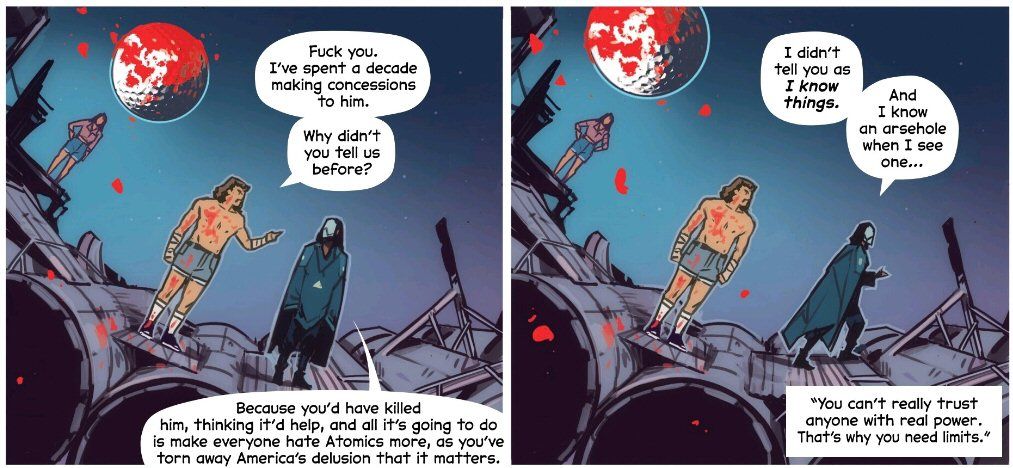
When Heavy then proceeds to immediately kill the Major, Magus is critical of his cowboy theatrics:
There were long-term consequences to this decision, especially in terms of Magus’ character:
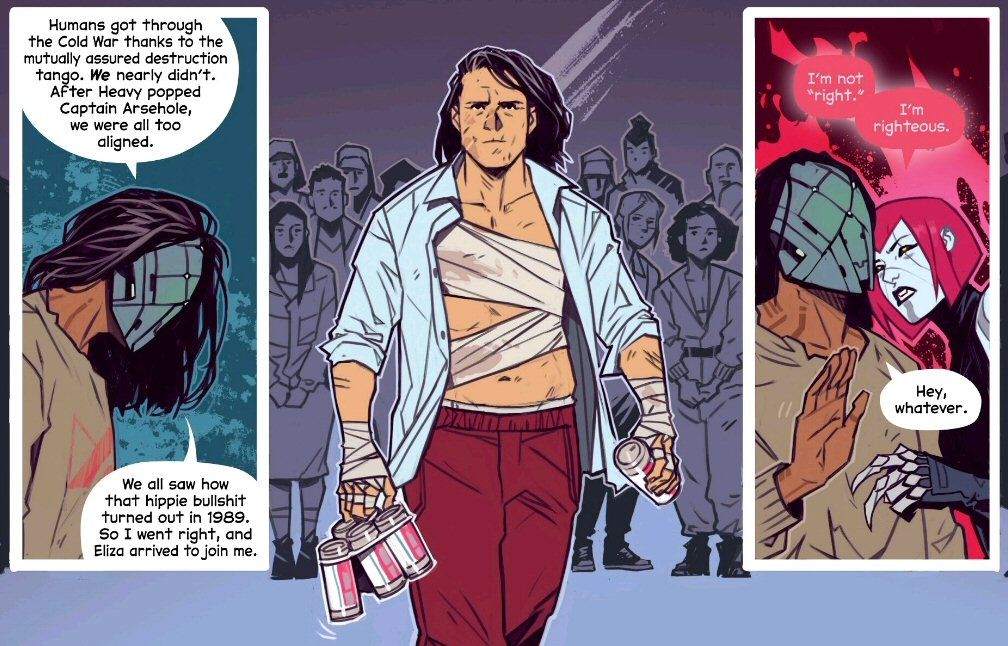
As indicated above, it’s important to note that the catastrophic Second Summer of Love event in 1989 marked a significant change in Magus. Let’s start with the immediate aftermath (note that this is the event that turned Eliza into a superpower, by selling her soul to hell):
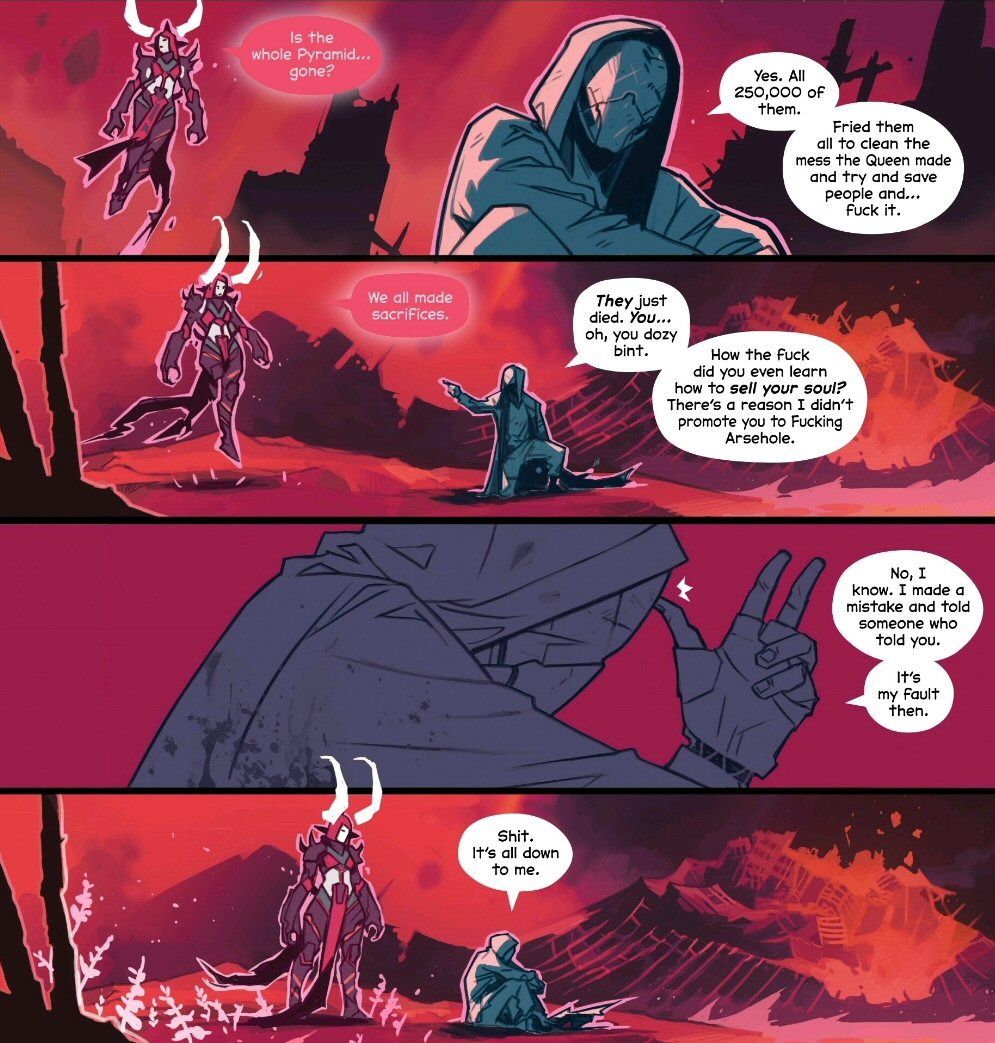
It turns out the Pyramid played another specific purpose – it amplified Magus’ power immensely (as the head of the Pyramid). Indeed, we eventually find out he is not actually a superpower without a well-staffed Pyramid. And not unexpectedly, he has had difficulty rebuilding that power. From issue #2, in 1999:
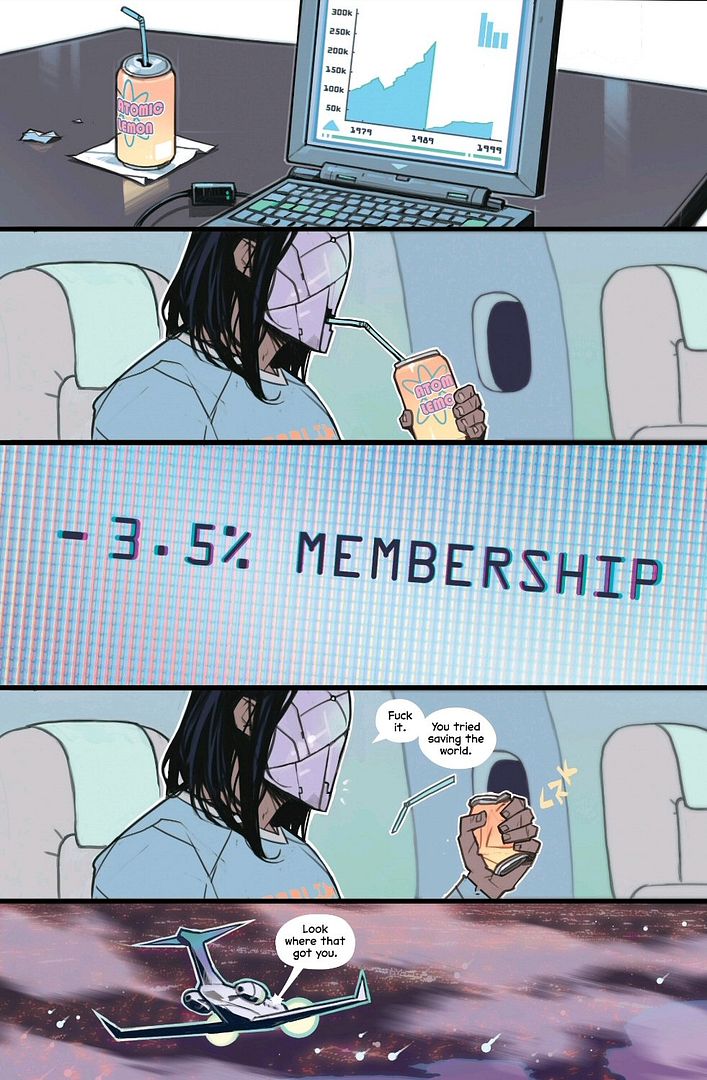
Even before his rightward political shift, Magus remains the polar opposite of the radical leftist Heavy. You don’t see a lot of scenes of them together, due to their shared animosity to each other. But there are several amusing scenes when each learns what the other has been up to.
Magus’ very real disdain for Etienne has also been growing significantly during this last decade. From issue #2 again, in 1999:
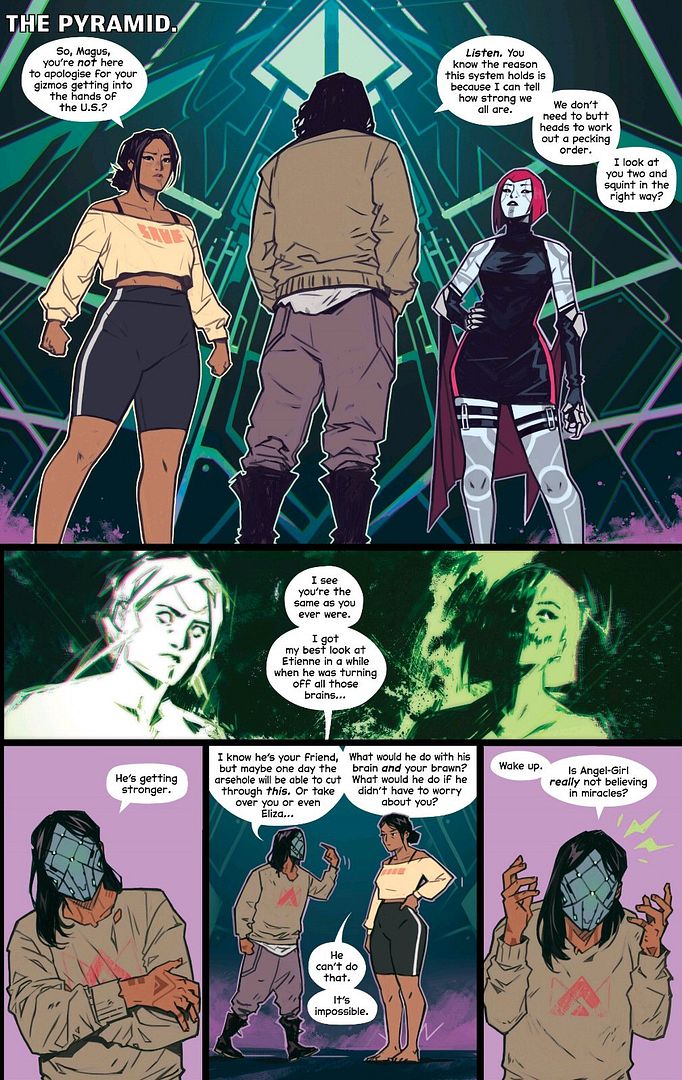
His reasoning in regard to Valentina is interesting – as well as his own change:
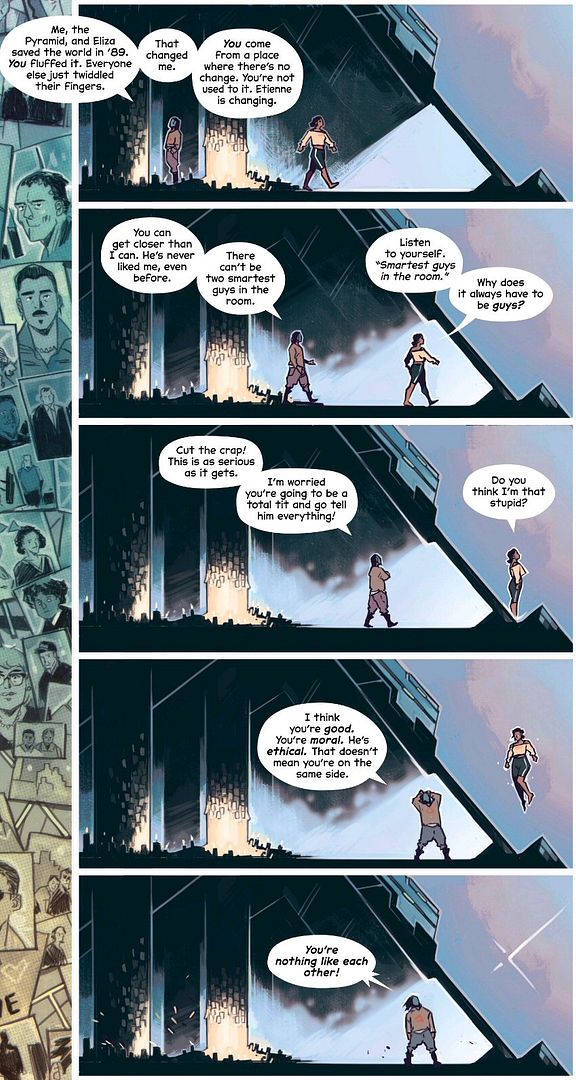
Magus is correct in terms of the distinction between deontology and consequentialism. But he inadvertently reveals that he is actually a lot like Etienne, and not just for the reason he states (“the two smartest guys in the room”). In general, I would consider Magus to be an ethical pragmatist and increasingly a utilitarian. Pragmatism doesn’t hold any moral criteria as beyond the potential for revision. In a normative sense, ethical pragmatism has a broader focus on society rather than just individuals. This fits with both his anarchic roots and his technological approach to problem solving.
In terms of his increasing utilitarianism, he tries to solve problems with efficiency (like Etienne), but with a minimum of moral philosophizing (unlike Etienne). He is even less bound by deontological rules than Etienne and is willing to take greater risks along the way. Like Etienne, he strongly feels the responsibility to bring about that greater good (there is that negative responsibility again) and is similarly quite comfortable at manipulating (and even killing) people to achieve it. The difference seems to be that Magus more fully feels the weight of his decisions (and so, has become increasingly bitter about the outcomes).
Magus is the one most consistently ranked at the “villain” end of the scale in online polls. In at least one of these, a correlation analysis indicated that he is strongly negatively correlated with Etienne (that is, those who see Etienne as a hero also see Magus as a villain, and vice-versa). Which is an interesting result given the similarities in their in ethical perspectives.
There is another way in which Magus is potentially similar to Etienne in a heroic sense: he too is willing to make personal sacrifices for the greater good. You can see this in how he had to reluctantly abandon his principles to build the Pyramid in the first place. But there is more to 1989 Second Summer of Love event, which explores his willingness to personally sacrifice even further. But I can’t get into that without revealing major second-arc spoilers. Suffice it to say for now, there is a dichotomy at the moral heart of the Magus character: he demonstrated self-sacrifice prior to 1989 but no longer shows that trait, in my view.
For this reason, he has increasingly become a dangerous and unpredictable character.
Ray “Heavy” Harris – The Walking Singularity, and Head of the Nuclear Family
Described as the “radical one”, Gillen sums him up as: “As if the Dude from the Big Lebowski was also Magneto.”
This is a great descriptor, as his power set and world view both remind me of Marvel’s Magneto: Heavy is fundamentally a radical who wants to protect and promote his own people (“Atomics” instead of “mutants”), and he has “omega-level” powers over gravity (as opposed to magnetism). As an aside, this is a great concept – gravity manipulation is relatively rare in superhero comics, but it makes Heavy extremely powerful here.
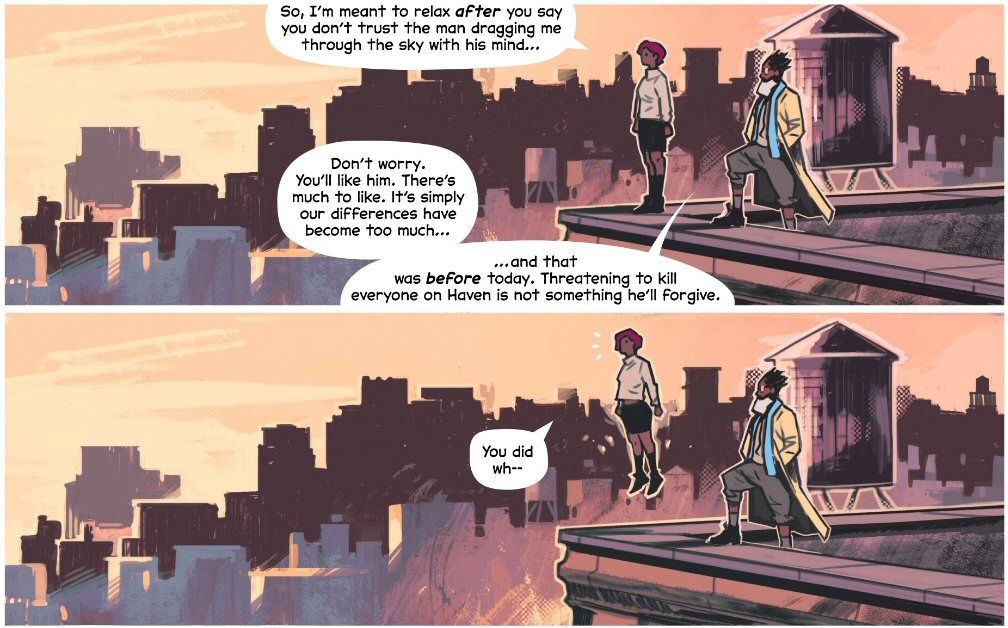
The Dude reference is also on point – he is nearly constantly stoned, and almost always has a lit joint floating near his lips. Unlike Magneto’s militant support for his oppressed people (think Malcolm X and the Civil Rights movement), Heavy is a hippy leader, forming his own radical left commune and cult of personality. And like Magneto’s Asteroid M, Heavy has created his own floating continent for his “Nuclear Family”, known as Haven (powered by a small singularity that – conveniently – interferes with Etienne’s ability to read and control onboard minds).
Heavy is also something of a loose canon, and precipitates the crisis detailed in the comics’ present time (1999), by needlessly challenging the Americans. See my Etienne overview for more details on that event, and Etienne’s subsequent actions to diffuse the threat. Also from issue #1:
The introduction of Tonya to Haven helps us in understanding Heavy better, as he opens up to her. Including in acknowledging his mistakes:
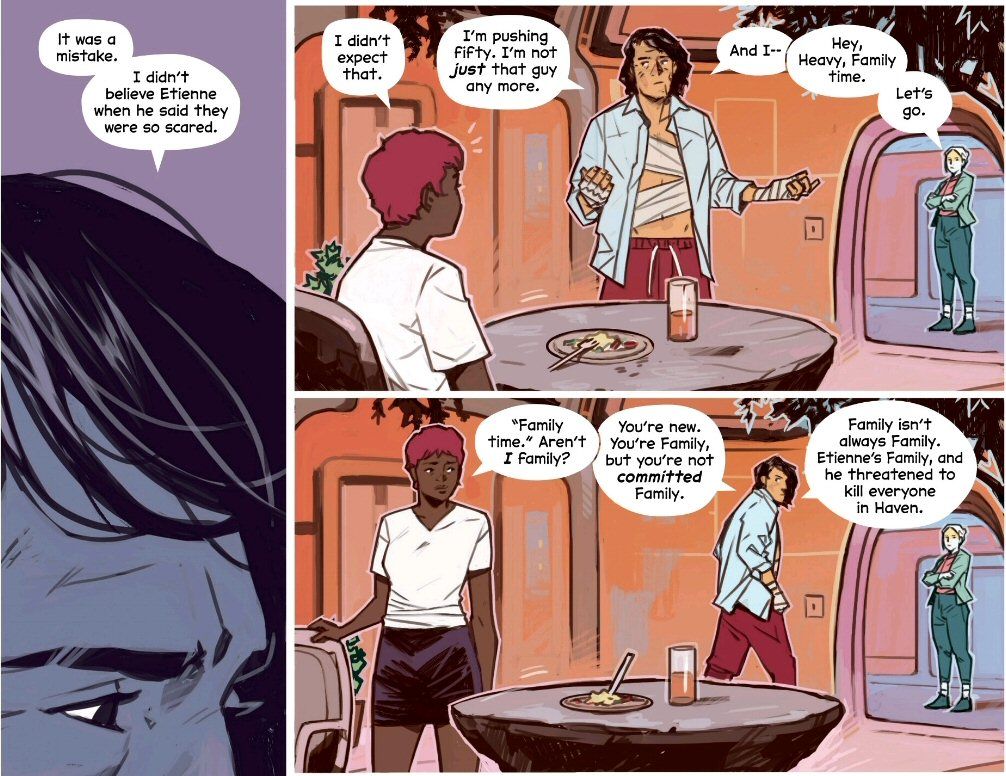
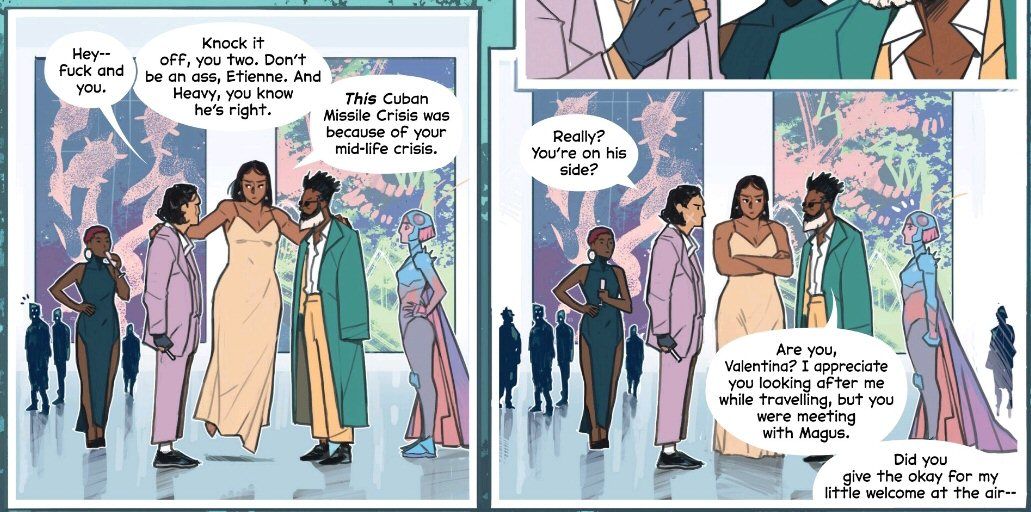
Note that “I’m not just that guy any more” is not the same as saying he is not “that guy” – but he does see himself as more. Of course, he still gets into it with Etienne when the latter criticizes him for starting the latest crisis, when they meet for Masumi‘s art unveiling in issue #4:
After the party, Heavy further explains his disdain for Etienne, from issue #5:
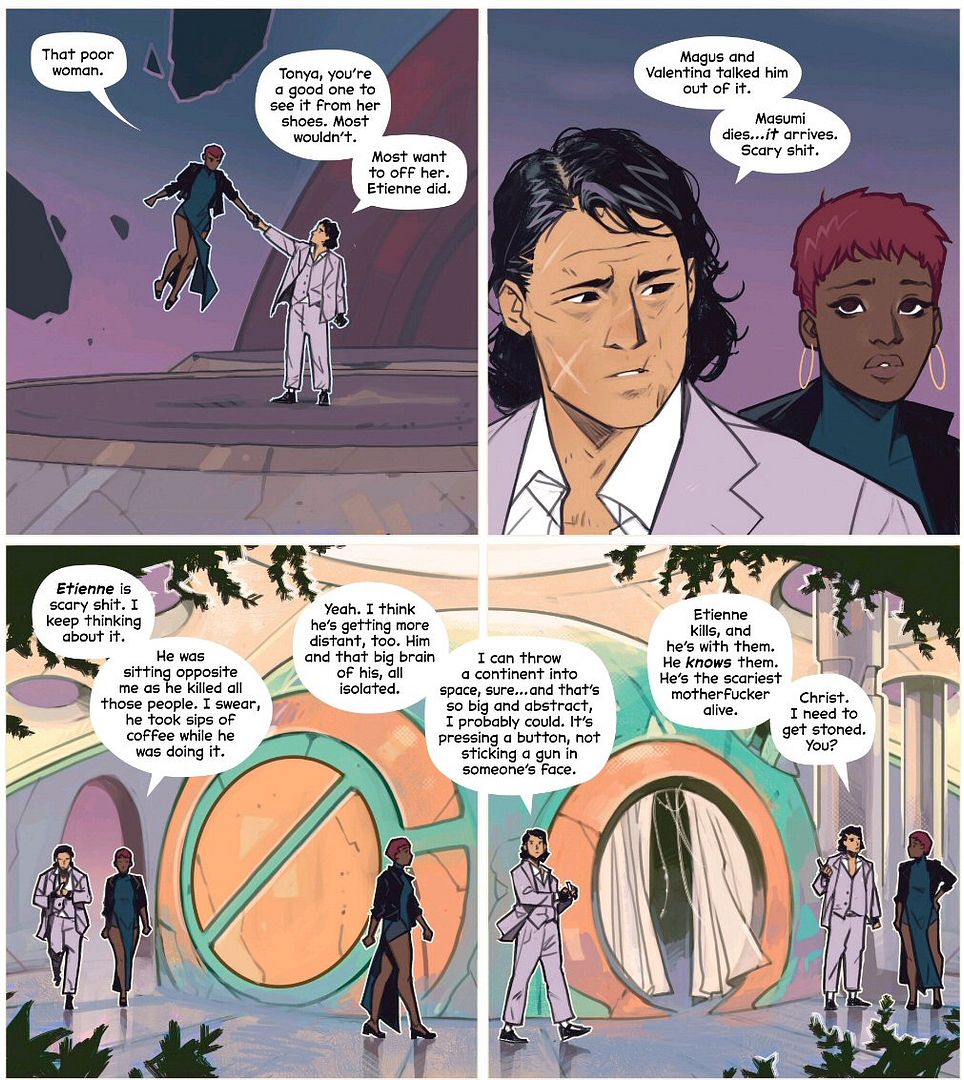
It turns out the “Nuclear Family” doesn’t just need Heavy – he needs them just as much. Also from issue #5:
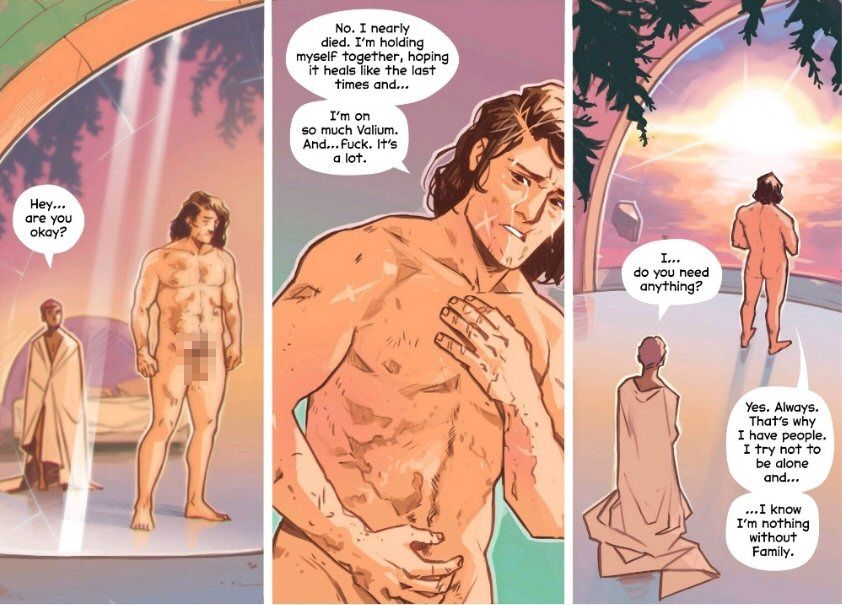
Heavy reminds me here of the narrator of the Philip Larkin poem, Aubade – always needing people (or cannabis) to distract him from death.
Heavy chooses to reveal to Tanya something the readers have known since the end of issue #2: Heavy has child, who is also a superpower (but has been hidden from the world up until now). From issue #6:
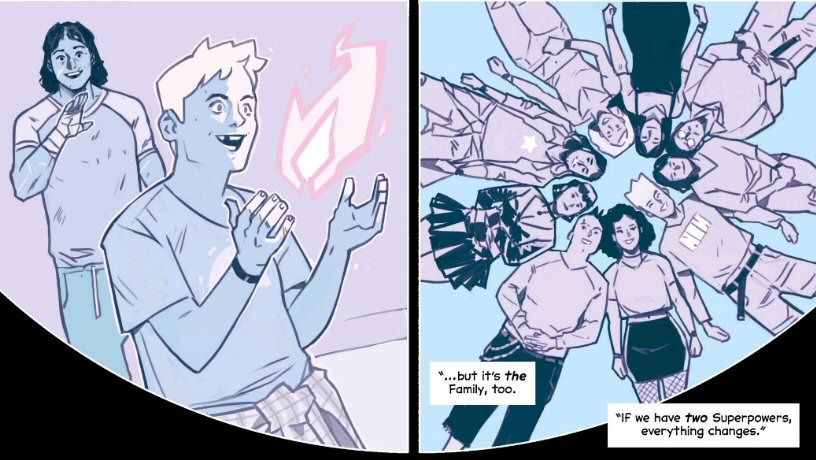
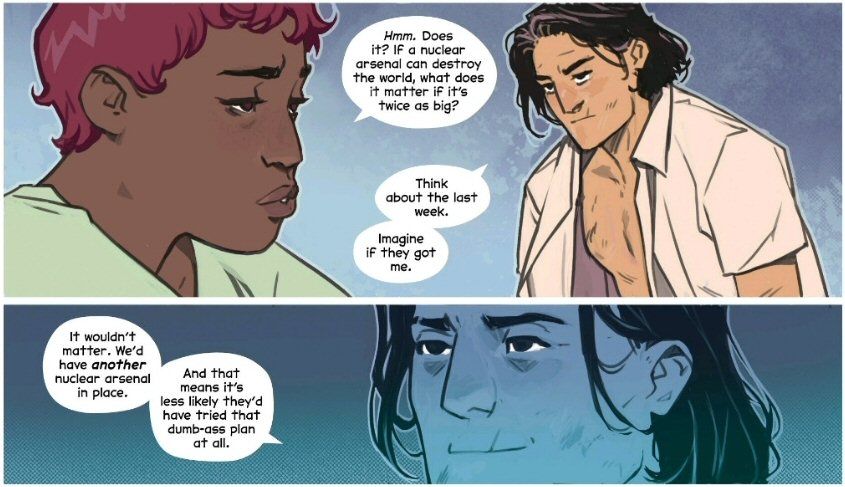
While this could be seen as irresponsible, in other ways this shows evidence of pragmatism in Heavy, just like in Magus. Heavy is similarly aware of the power structures of the world – and wants to bend them to the advantage of his group (just like Magus does). They both have strong collectivist tendencies. As much as left and right may see themselves as opposite ends of a scale, there are ways in which they come together to form a circle – especially in the call to violence and extremism at the far ends.
I suppose you could say that Heavy speaks to revolutionary or liberation philosophy, but I can’t think of a specific normative ethics theory to fit him. He certainly doesn’t match Magneto, who I described in my detailed ethics post as initially an egoistic consequentialist who moved firmly toward virtue ethics over time. I don’t see a lot virtue in Heavy – he seems to be avoidant, and self-medicating for a lot of anxiety and fear of the future.
Heavy tends to get a fairly wide range of views in online polls of hero/villain characteristics – although with few votes for the extremes. I think his protective nature helps him here – he feels it is his responsibility to protect the Nuclear Family of Atomics from all threats (including the other superpowers). Unfortunately, he is also very impetuous – and could easily light the spark that blows up the world.
Morishita Masumi / Deconstructa – Subconscious Kaiju
Masumi is a modern artist who is somehow subconsciously linked to a destructive Kaiju (a Japanese media genre of giant monsters – like Godzilla). Gillen has referred to her as “the depressed one”, and “a modern artist for whom getting a bad review really is the end of the world”.
Masumi was 15 years old in 1982 when her subconsciously linked Kaiju (“Deconstructa”) went on a rampage in Tokyo (presumably as Masumi sank into deep depression). Masumi is drawn as literally fading away when the Kaiju starts to rise. Etienne was able to talk her back out in 1982 but is otherwise unable to directly control Masumi. As an aside, this character and story line reminds me a bit of the excellent 2016 sci-fi black comedy film Colossal, by Nacho Vigalondo.
It is clear both Masumi and Etienne wish he could directly manage her emotional states (from issue #2, right after he explains how he keeps himself balanced):
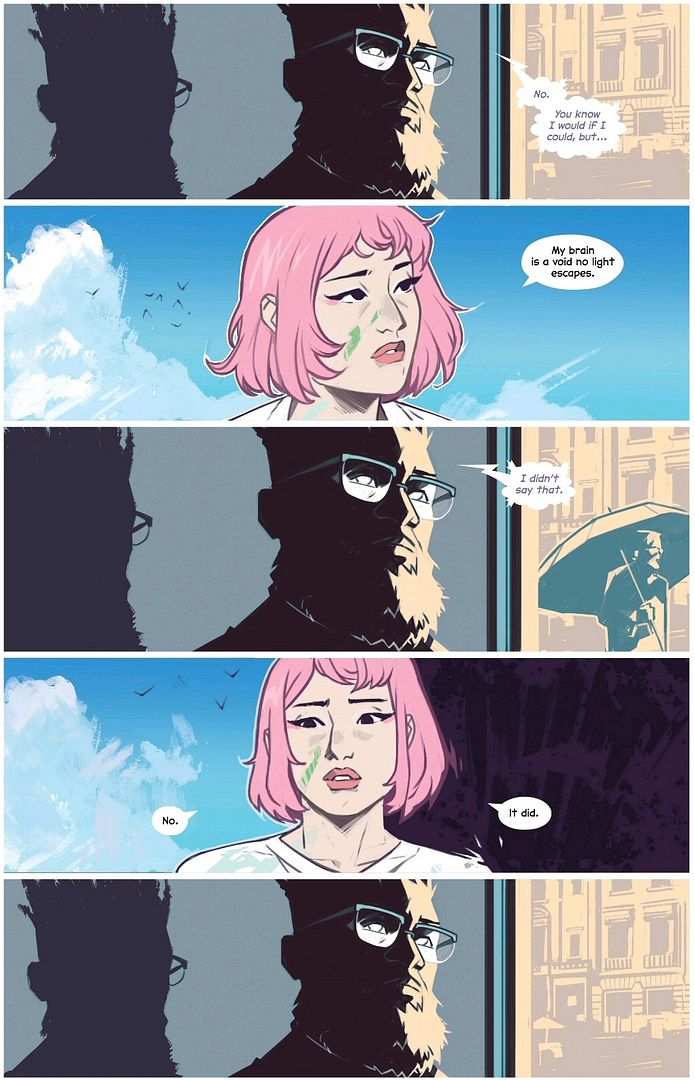
Instead, Etienne resorts to indirect means to keep her pacified – like through her girlfriend, Isabella (from issue #4):

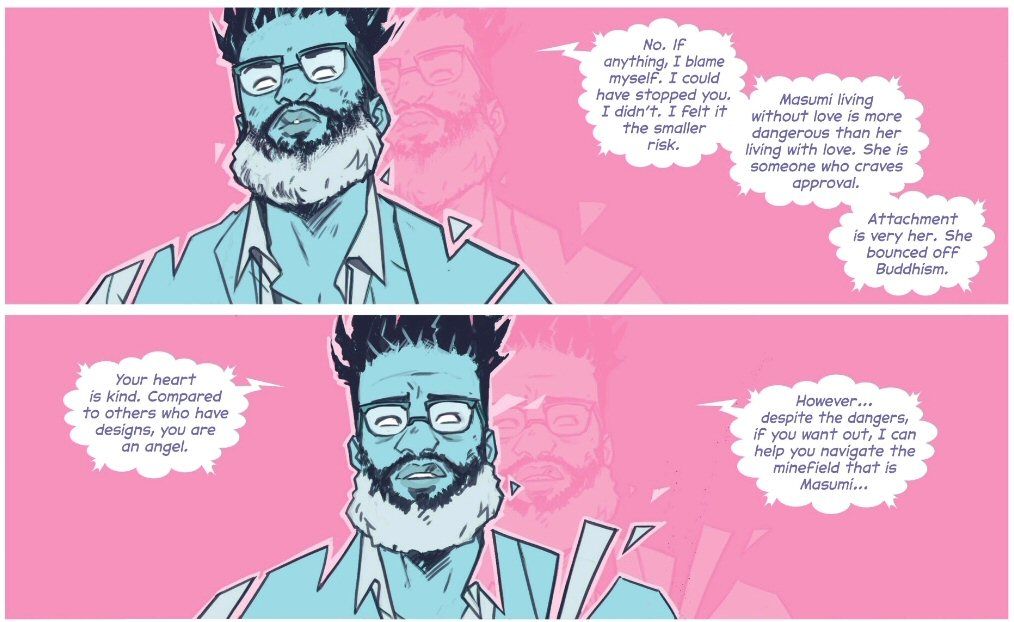
I love the comment that Masumi “bounced” off Buddhism, due to her need for approval and attachment. If you are interested, I have described Buddhism in terms of its virtue ethics elements and history in my FML comix post.
Despite offering a way out, Isabella asks him instead to help her cope better with the situation – which he agrees to, both because it is easier to do, and because it is more ethical! He also points out how he had to interfere with the art critic at the gallery show, to ensure Masumi didn’t melt down:
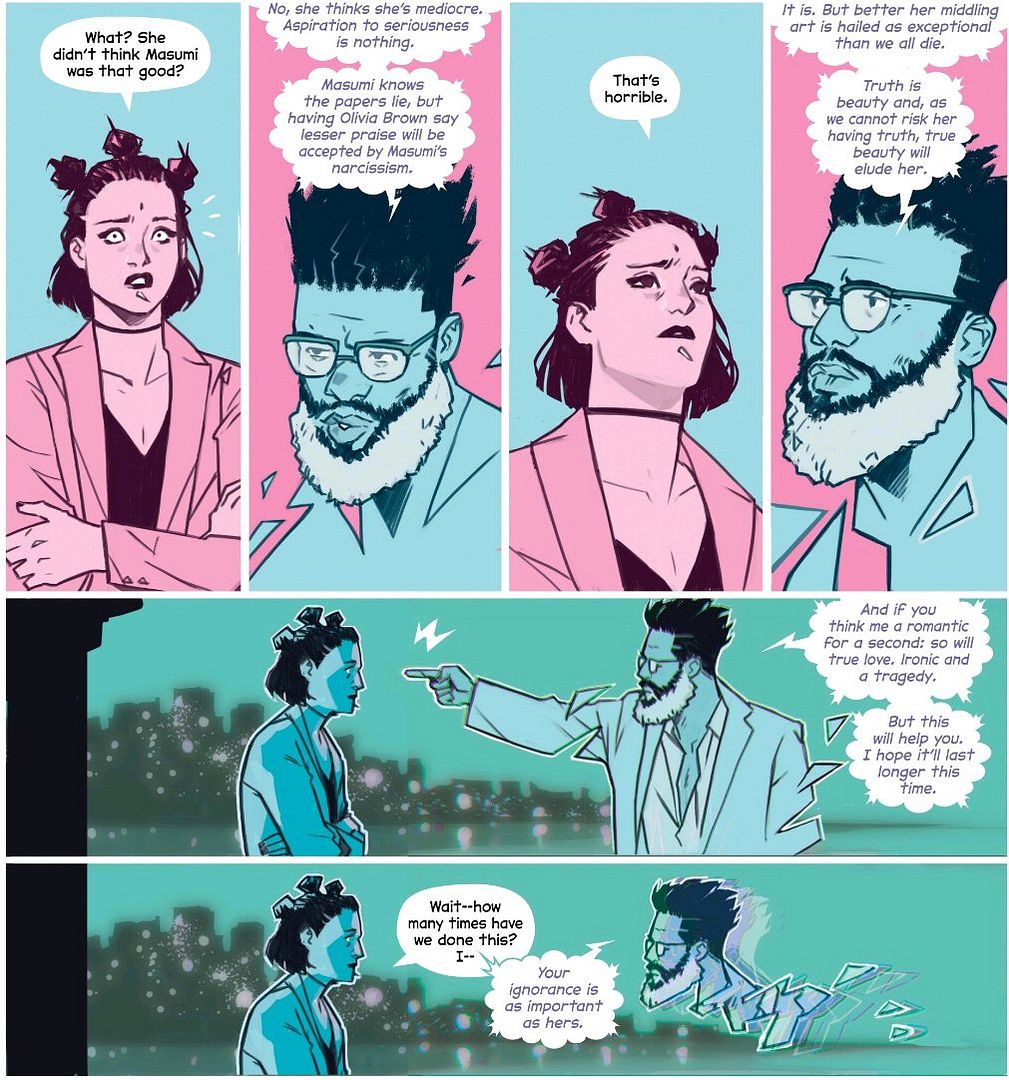
This is a great scene, on many levels. Gillen’s previous background as a culture critic shines through, and the confirmation of an artist’s narcissism seems apt. But it is the fact that Etienne has been doing this repeatedly (at Isabella’s request) that is truly horrifying. Masumi may wish Etienne could mollify her own emotions, but manipulating Isabella in this way (even with her consent) denies them both the experience of true love. A romantic indeed!
It is implied in this series that when Masumi dies, the Kaiju will be released in an uncontrollable state. The specifics of the 1982 Tokyo event are left somewhat vague so far. So I don’t understand why Heavy couldn’t just fling the Kaiju into outer space, or why Valentina can’t stop it. But taking the story on its face value, it could justify Masumi’s rather glum outlook.
You could reasonably describe Masumi’s approach as somewhat nihilistic (a philosophical perspective which I describe here). She also seeks isolation – outside of Isabella, who she has an extreme attachment to. Her personal sense of self is thus rooted in guilt, avoidance and self-preservation (in her Masumi form). Her seeking understanding and absolution through art – and her overwhelming and unavoidable fear of her Kaiju’s destructive potential – means her primary moral motivation is really to minimize harm and save the world by limiting herself. I find that interesting, as she is really the only one of the superpowers looking to do that – the rest all seem to be intent on asserting themselves (and their world view) to the greatest degree their powers will support, in order to save the world.
It is also interesting to see the opposite reaction in Isabella, who seems driven by her emotions, and does seem to genuinely care for Masumi – but clearly fears her as well. Her moral compass is personal and relational, in a potentially care ethics way. There is a later issue that focuses a bit more on Isabella, but I will save that for my conclusion to this series.
Given Masumi’s fears and guilt, you think she would do everything in her power to self-regulate her emotional states (an aspiring artist driven by ego and dependent on praise sounds like a poor career choice). For the sake of her mental health – and mental stability – it would have been nice if she had given Buddhism more of a try!
Eliza Hellbound – Devout Catholic and Extradimensional Entity (Demonic)
Eliza started out as a member of Jacky Magus‘ Pyramid, rising to the second-highest rank of “Arsehole”. But during the 1989 Second Summer of Love Event, Eliza sold her soul to hell for the power to stop the Queen, who was destroying the world. As a result, she has been referred to by Gillen as “the doomed one” and an example of how “the road to hell is paved with good intentions”.
You can see part of the explanation for that in my Magus overview above, but these panels from issue #8 explain the situation very clearly and starkly:
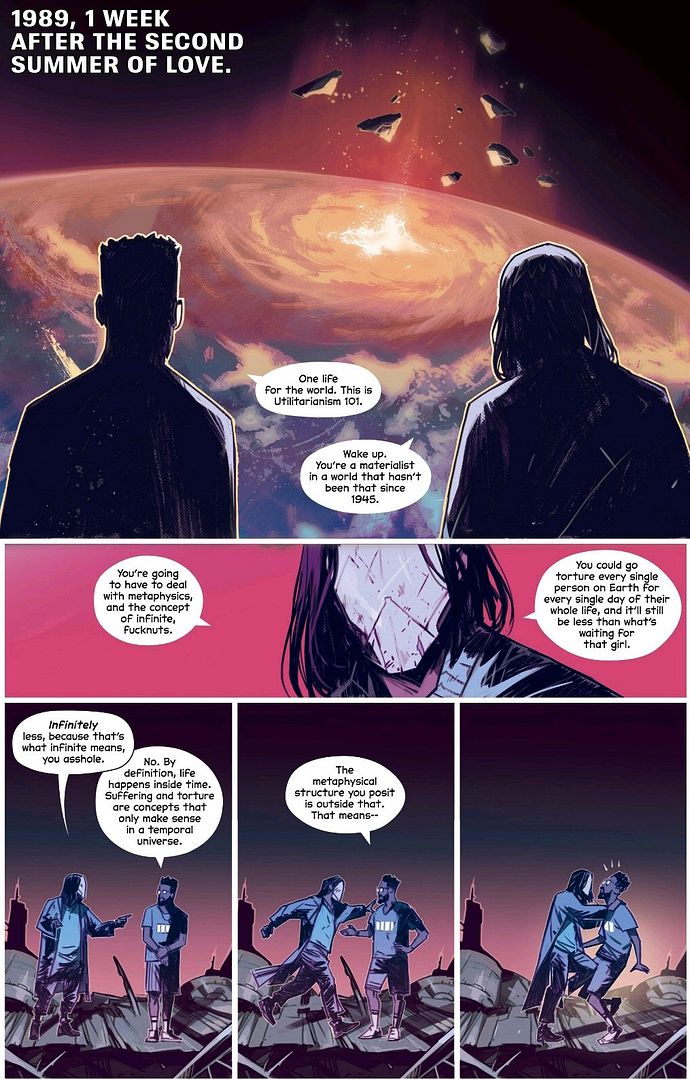
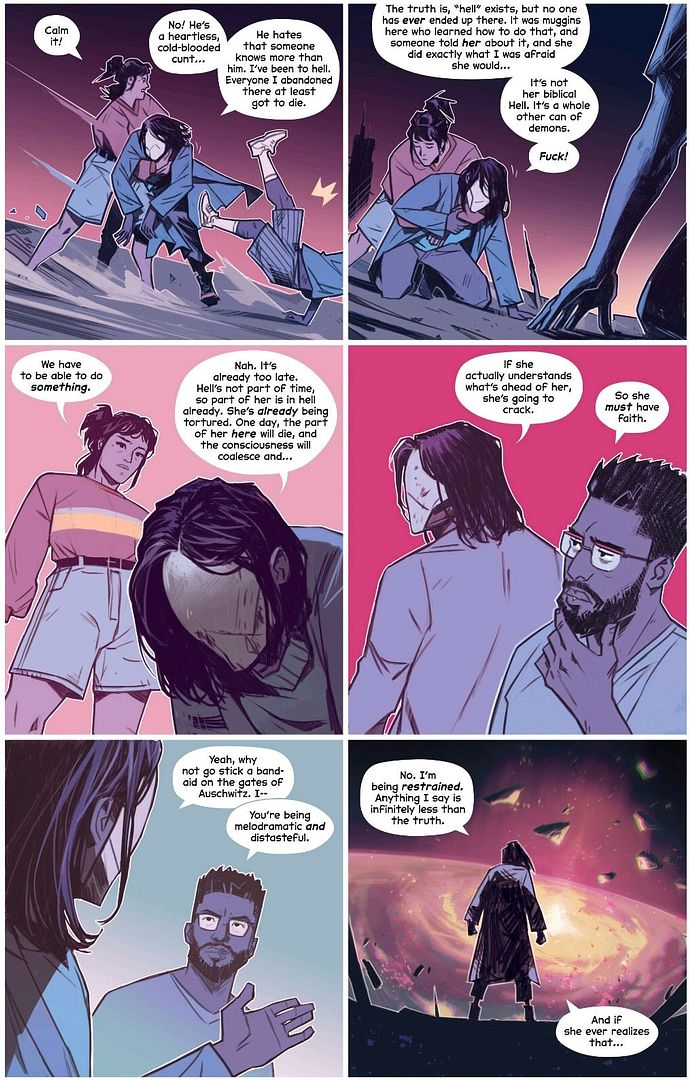
This exchange underscores another one of the major issues with act utilitarianism that I haven’t addressed yet – how do you weigh the relative suffering of people? Is a little bit of suffering for a lot of people better or worse than a lot of suffering for a small number? Or is a little bit suffering for a long time better or worse than a lot of suffering for a short time? There is no easy mathematical answer to those questions – and the math certainly fails when you consider the infinite. This is why Etienne rejects the infinite – he seems to have worked out his own calculus for balancing relative levels of suffering in this life. But if Magus is correct, then what awaits Eliza is horrific beyond imagining.
But let’s begin with Eliza’s world-view before she joined the Pyramid, with this flashback from issue #8:
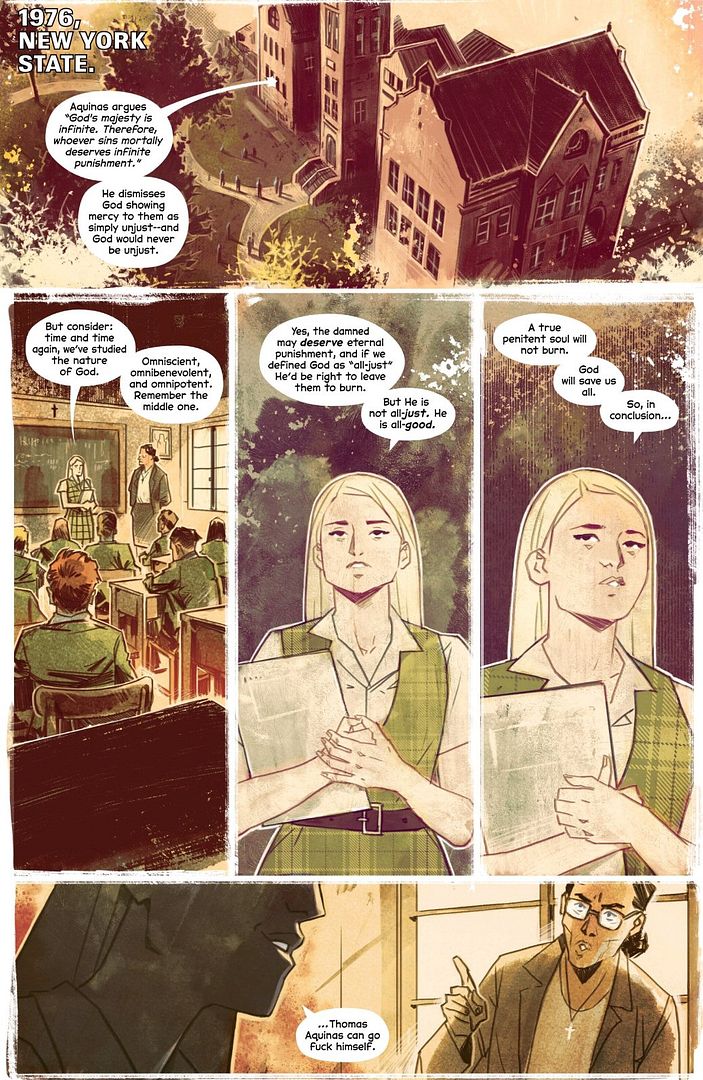
I burst out laughing at this page – its composition suggests multiple ideas that Gillen is trying to get across. Gillen has described himself as having been raised Roman Catholic, and I can’t help but wonder if this page isn’t a bit autobiographical given all his deep thinking on the subject!
I have referred to Thomas Aquinas on a few of my overviews of religious comic characters (like Daredevil), as Aquinas’ version of Aristotle‘s virtue ethics often better fits Christian characters than the classical version. But the Aquinas quote above (which is from his main theological work, Summa Theologiae) deals with one of his lesser known arguments for why those who commit mortal sins (that is to say, sins over the course of a finite life) deserve infinite unending punishment.
Aquinas’ justification for this position lies on some interesting, motivated reasoning. First, he argued that punishment should be meted out according to the dignity of the person sinned against, and since God’s “majesty” is infinite, then so should the punishment be. Moreover, since punishment cannot be infinite in intensity (apparently due to the types of creatures we are), it must be infinite in at least duration. Note that Aquinas saw a way out of this – you just need to repent and will to do good while you are alive. But once you are dead, you no longer have the ability to change: according to Catholic doctrine (Catechism), the soul can no longer repent after death. Since you therefore remain guilty forever, it would be “unjust” if your punishment was not similarly infinite.
This problem came up a lot in Aquinas’ theological writings – he had some clever reasoning at times to justify elements of the Catholic faith, but whenever he encountered a problem, he simply hand-waved it away by saying it was beyond human reasoning or that we needed to accept the “revealed” word of God (as described in Catechism). And you know who was a particular critic of Aquinas for this backward reasoning (that is, assuming the thing you are trying to prove)? That “beautiful mind” from the opening pages of this comic series, the British philosopher Bertrand Russell. Eliza seems to be channeling Russell here. Her problem, ultimately, is with Catholic doctrine itself, but she is taking out her frustration on the dishonest reasoning Aquinas used in justifying it. I can see why Gillen … excuse me, Etienne and Eliza … seem to like Russell so much. 😉
But I believe there is more going on here with this page, given the way Eliza first frames her response – which reminds me of a famous disproof of God’s existence (or more accurately, the problem of evil in the world if God exists).
Eliza explains that that God is supposedly omniscient (all-knowing), omnibenevolent (all-loving), and omnipotent (all-powerful). There is a very old philosophical argument that demonstrates that all three of those things are not possible in a God – due to the persistence of evil in the world. Basically, you can only have two of the three – otherwise, evil wouldn’t exist. This argument has been attributed to several individuals over the years, and is commonly known as Epicurus’ Trilemma or the Epicurean Paradox (although it likely predates Epicurus, and the modern framing of it actually comes from the Scottish philosopher David Hume). Follow the paradox link above for the full reasoning. And if you want to know more about Epicurus, I discuss his normative ethics here.
But Eliza maintains her Catholic faith throughout this series – and despite having sold her soul to hell, she still believes she can be redeemed by repenting. From issue #8:
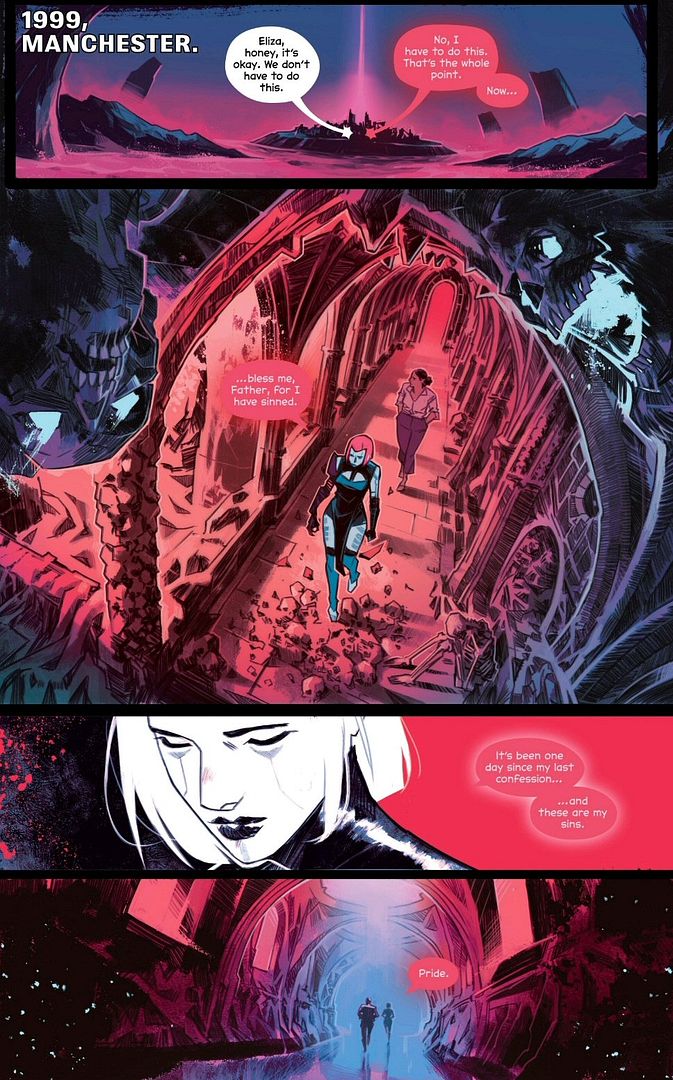
Eliza goes on to articulate the many ways she was prideful.
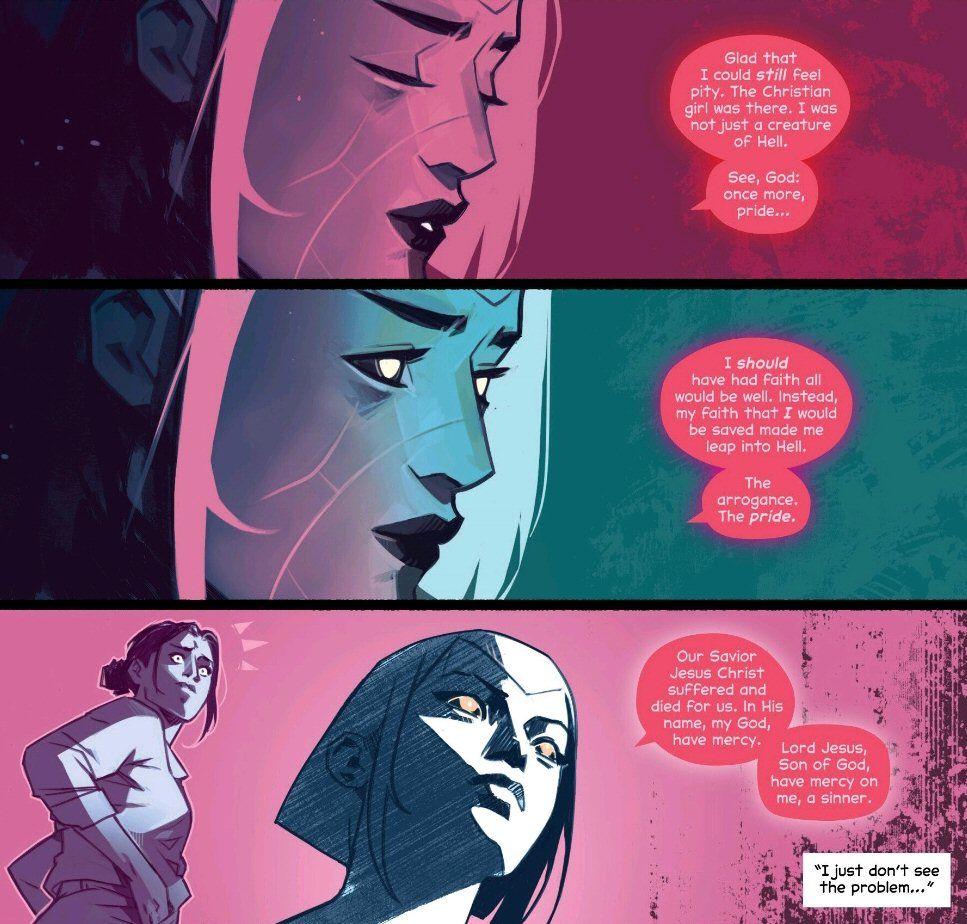
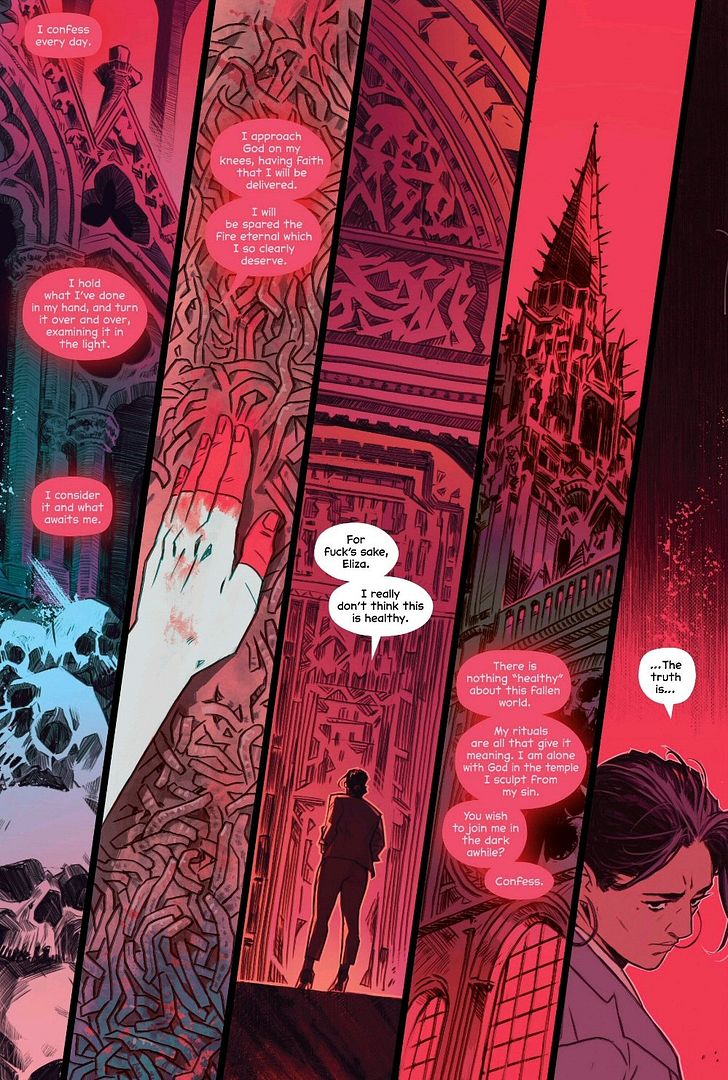
Eliza is stuck in a catch-22 – her Catholic faith (and belief in an omnibenevolent God) means she has to believe that there is still hope for her to saved. But Magus and the others all believe it is too late as it has already happened – she is already in hell; she just doesn’t know it yet. And if she ever realizes it, it will break her.
And what was Etienne’s solution to the risk Eliza posed if she ever realized the truth? This scene from shortly after Valentina leaves is revealing:
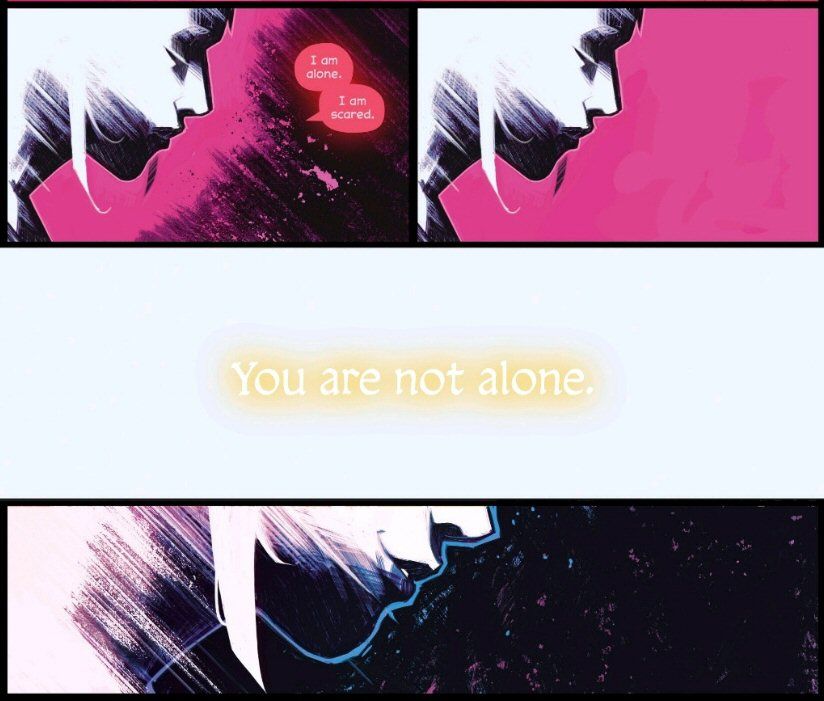
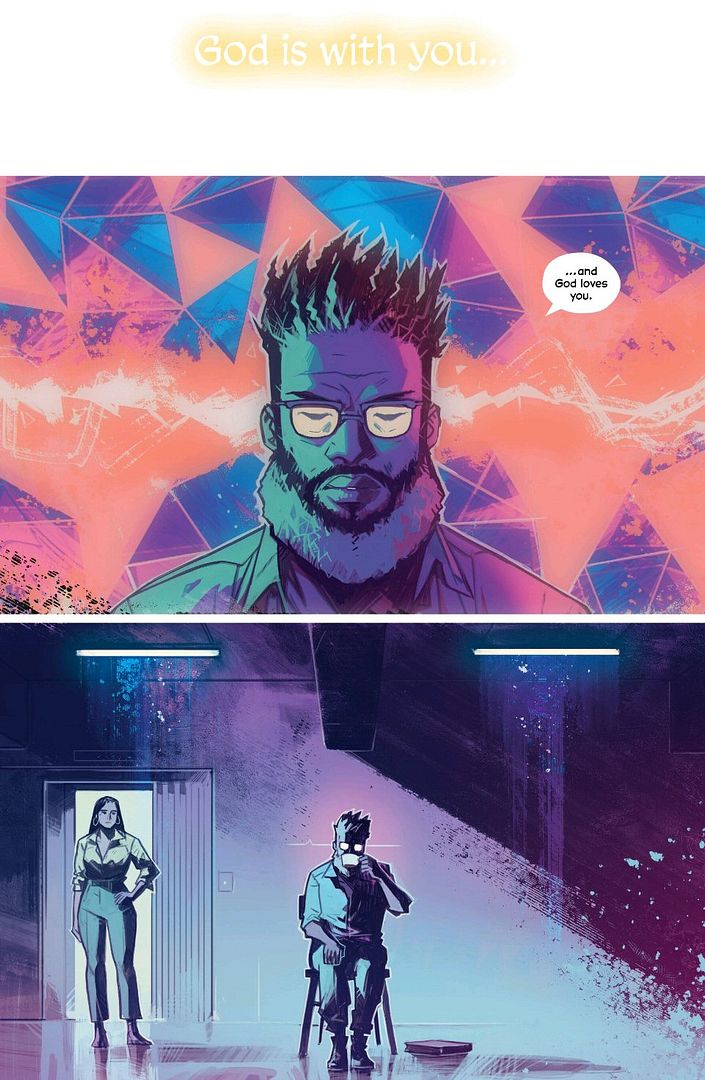
Oh Etienne …
Eliza is a truly tragic figure – she is a hero and savior of humanity through her own sacrifice. Yet humanity’s only hope for continued survival is for her to remain deluded about the true nature of that sacrifice until her natural death. Not exactly a solid game plan.
The missing ethics in this series, and where it is going
If you have read through all the character overviews, I think you will agree that we were NOT in a stable state at the start of this series. As events unfolded, it became clear that even the slightest perturbation could be enough to spin events wildly out of control, leading to the destruction of everything. Over the course of the second arc, this ramps up further, as characters conspire to purposefully alter the status quo. And the currently ongoing third arc is dropping (figurative) bombs every issue, as we get closer to the greater denouement in issue #16. It is a wild ride!
A common commentary I’ve seen online is that this series reveals the limitations of human normative ethics when applied to beings with the world-altering power these superpowers have. And that is a reasonable supposition, given the specific normative ethics we’ve seen at play for these characters, as described above.
But do you notice that a branch of normative ethics is missing? Virtue ethics – in any of its myriad forms (e.g., Aristotelian, Stoic, Confucian, Buddhist, or even the modern care ethics) is suspiciously absent from our main cast of characters. And it is not like Gillen is not intimately familiar with virtue ethics (and its core conceit of striving to be better). Consider the Progenitor from his 2022 A.X.E.: Judgment Day cross-over event: a superpowered entity with the ability to single-handily destroy the world turns to virtue ethics to judge all the world’s inhabitants. So why its absence here?
Interestingly, it seems some of the characters are aware of their lack of growth – consider this exchange between Valentina and Eliza in issue #8:
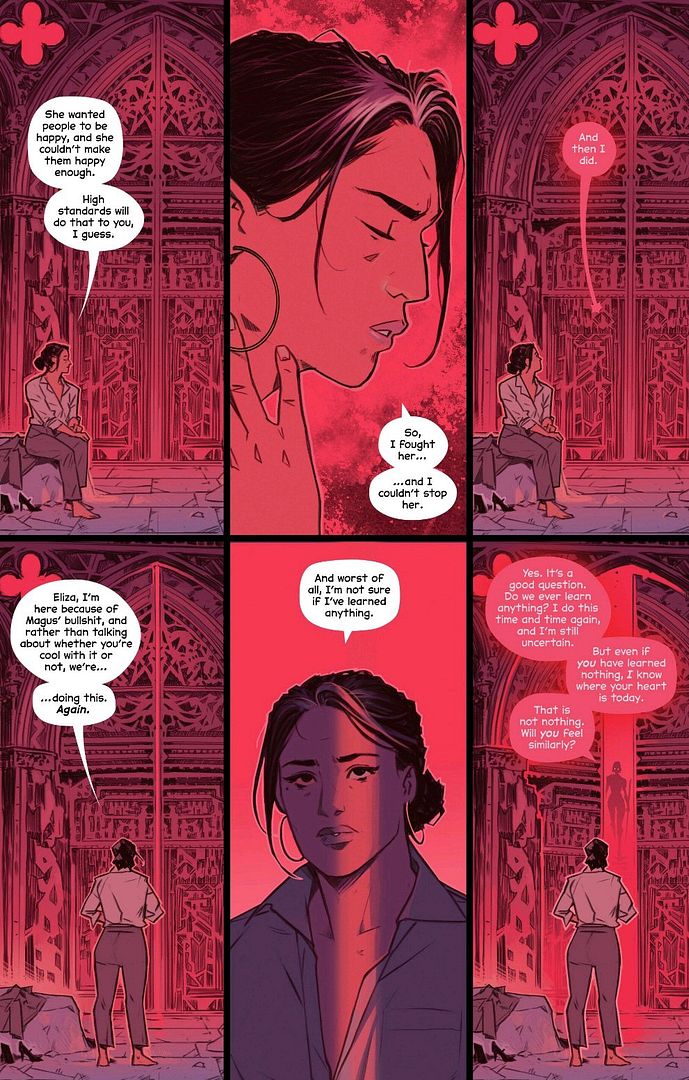
It’s true that knowing where your “heart is” is not nothing. But is it enough? I would argue no – for any of us really, and especially so when it comes to beings of this power.
It is not hard to see that if any of the superpowers in this series had adopted a primarily virtue ethics perspective, they would not currently pose as great a risk to humanity as they do. I alluded to this for Masumi above – a commitment to Buddhism (and away from egoism) would go a long way to helping keep the Destructa Kaiju at bay. The same is true for the others. As such, it seems to me that virtue ethics may have something to do with how The Power Fantasy world will get out of the pickle it is in (assuming it does, of course, or any of our main characters do!).
But even if virtue ethics makes things better, what if none of the current normative ethics theories are ultimately sufficient when individuals get as much power as the superpowers in this series? This does seem to be a key theme of this series – and it is a fair question. So, what is the alternative? Ironically, I think there was a tip-of-the-hat to the answer in that opening reference to Bertrand Russell.
We don’t need to imagine a world with these superpowers to recognize the limitations of normative ethics – we just need to look to our own history! Consider the traumatic events of first six decades of the 20th century. A world war that saw the death of a quarter of all young men in Europe, will little effect on national boundaries. The rise of fascism and a second world war that saw the genocide of the Jewish population of Europe, among other horrors. The development and use of atomic bombs on civilian populations to end that war in Asia. The development of a cold war, and the threat of global extinction through a nuclear arms race. The mass oppression of people based on their gender, or the color of their skin – giving rise to a civil rights movement in the US. And what were moral philosophers doing through all of this? Coming up with revised abstract theories and scoring debating points in thought experiments. WTF?
It wasn’t until the 1960s and 70s that applied ethics (also called practical ethics) emerged, to address (among other things) the failure of normative ethics to provide guidance and protect the vulnerable. Shockingly, considering what they were living through, moral philosophers of the first six decades almost universally eschewed any discussion of applied ethics – with the notable exception of Bertrand Russell. However, he seemed to keep his thoughts on world politics and ethics separate from his actual philosophical work, and didn’t try to develop his ethical views into any sort of rigorous system (alas!). But you could argue he was the one who paved the way for the applied ethicists who came after him.
The entire branch of applied ethics is largely missing from comic books (especially superhero comics), aside from the occasional reference to a specific form of professional applied ethics (and even then, it is not usually treated with any rigor). That Wikipedia link above for applied ethics is not a great description of the field though, so I’m planning a more detailed post soon that explores the world of applied ethics with potential relevance to comics.
Why do I think applied ethics will be relevant to the ending of The Power Fantasy? Well, as I will explain in that upcoming post, applied ethics comes in a lot of different forms. But at their core, they typically deal with the issue of power – specifically, how those without it can be protected from those who have it, and how to safeguard the most vulnerable from risks to their autonomy. Seems like something that would be relevant here, no? Mind you, I have no idea if Gillen plans to go in that direction if there is an extended run of The Power Fantasy (or how he will implement it if he does). But it has given me some ideas for a subsequent post, so stay tuned if you are interested!
At a minimum, I’m confident we will see some more commentary about the missing virtue ethics before this series ends. In the closing words of Gillen’s Progenitor: be better!
The last word … for now
This has been a fun series to introduce. There is always so much ethical substance to Gillen’s writing – and probably nowhere more so than this series. I encourage you to pick it up in single issues, trade paperbacks, or digitally (or as I have done, in all three!).
Please check back in a few months, after issue #16 completes the third arc, and I write up a concluding piece. Happy reading until then!
SPOILER ALERT: I’m going to discuss something that may spoil the thrust of the second story arc for you, so don’t read further unless you want to know.
I love Gillen’s use of language – it is always so precise, and it is a great way to distinguish characters. So I was particularly struck by this scene from issue #8 when I first read it:
I was a bit surprised to see Magus lose his cool like that – but was even more surprised by what he said to Etienne.
My first thought was: “Wow, that was a surprising mistake for Gillen to make.”
Second thought: “I wonder why his editor didn’t catch it?”
Third though: “Ohhhhhh ….”
And so of course, I went back and re-read the Magus backstory issue (#5) – and was immediately struck by a revealing piece of introductory dialogue. And then by a revealing piece of artwork. 🙂 Which all fit with why he lost his cool above. And so, I wasn’t surprised by the big cliff-hanger reveal at the end of issue #9. The explanation for why it occurred the way it did (shown in issue #10) was interesting, and greatly increased my opinion of Jacky Magus. A great bit of sleight-of-hand on Gillen’s part.
It is small things like that that I really enjoy in Gillen’s writing and Wijngaard’s art – they play fair with the audience and drop a trail of breadcrumbs if you are willing hunt around for them. I can’t wait to see what rabbits they have left to pull out of their hats!
UPDATE: A few have asked me to explain what exactly I am referring to above in terms of the language and art. In the scene shown above, immediately after the Second Summer of Love, “Magus” called Etienne an “asshole” – and not an “arsehole” (Magus had used that Briticism exclusively up until then). When I went back and re-read issue #5, the first scene with the American Dev shows him imitating Magus’ accent and way of speaking (with Magus confirming he was pretty good). I noticed their general similarity in terms of skin and hair – and then in a later issue there is a flashback panel showing them facing each other, and being exactly the same height. If it was now Dev impersonating Magus under that mask, it would make sense why he lost his cool and kneed Etienne – and momentary slipped up on his accent – given they were discussing the woman he loved.
See my Glossary post for a list of the key philosophical concepts and related links on this site.
This is one of my favorite comics series of all times. And this is the most in-depth examination I’ve read of it, very well done! You write at the intersection of several of my interests, I look forward to exploring the rest of your site.
Glad you enjoyed it – and welcome to the site! 🙂
I came here from Gillen’s newsletter to read this and it was a wonderful use of my time. Thanks so much for writing this all up!
That is very kind of you – and I appreciate Gillen’s lovely note in his newsletter today as well. I hope you enjoy the rest of the site!
P.S.: Gillen also seemed to enjoy my A.X.E.: Judgment Day conclusion as well.
That was an impressive analysis! I haven’t heard of this series, but will look it up now (that free first issue was great). Thanks for another great overview.
Another philosophy-heavy post, I love it! Look forward to digging into this series.